Trump Admits: ‘We Took The Freedom Of Speech Away’ – Above the Law

In
what
may
be
the
most
accidentally
honest
moment
of
his
presidency,
Donald
Trump
just
admitted
what
we’ve
been
documenting
for
months:
“We
took
the
freedom
of
speech
away.”

Yes,
that’s
literally
what
he
said:

For
those
who’ve
been
following
Trump’s
systematic
assault
on
the
First
Amendment—which
we’ve
covered extensively at Techdirt—this
admission
is
remarkable
not
for
its
content,
but
for
its
candor.
Here’s
a
president
whose
supporters
claimed
he
would
“bring
free
speech
back”
explicitly
acknowledging
that
his
administration
has
done
the
opposite.

He
said
this
at
the
White
House’s
bizarre
roundtable
on
antifa,
which
involved
a
bunch
of
serial
fabulists
and
conspiracy
theorists
feeding
the
President’s
delusional
need
to
justify
using
the
military
on
American
citizens
who
live
in
states
that
didn’t
vote
enough
for
him.

If
you
can’t
see
the
video,
the
transcript
is
pretty
straightforward:


We
made
it
one
year
penalty
for
inciting
riots.
 We
took
the
freedom
of
speech
away
 because
that’s
been
through
the
courts
and
the
courts
said
you
have
freedom
of
speech,
but
what
has
happened
is
when
they
burn
a
flag
it
agitates
and
irritates
crowds.


I’ve
never
seen
anything
like
it
on
both
sides.
And
you
end
up
with
riots
so
we’re
going
on
that
basis.


We’re
looking
at
it
from
not
from
the
freedom
of
speech,
which
I
always
felt
strongly
about,
but
never
passed
the
courts.
This
is
what
they
do,
is
they
incite…
when
you
burn
an
American
flag,
you
incite
tremendous
violence.
We
have
many
examples
of
it.
Many,
many
examples
of
it.
And
it’s
actually
down
on
tape
and
you
see
things
happen
that
just
don’t
happen
unless
it’s
the
flag
that’s
burning.

Well,
thank
you
for
admitting
what
we
all
know
is
true.

Now,
of
course,
this
is
a
bit
of
typical
Trumpian
word
salad,
but
we
can
parse
what
he’s
trying
to
say
in
a
manner
that
likely
reveals
what
the
circle
of
suck-ups
around
him
have
been
telling
him
in
order
to
justify
their
deeply
censorial,
deeply
authoritarian
desires.

Back
in
August
he
signed
an
executive
order,
which
has
no
legal
basis
for
anything,
claiming
that
federal
prosecutors
should try to
figure
out
a
way
to
prosecute
people
for
burning
the
flag
by
arguing
that
it’s
incitement
to
imminent
violence.
This
is
because
there
is
a
widely
recognized
exception
to
the
First
Amendment
which
is
“incitement
to
imminent
lawless
action.”

The
theory,
such
as
it
is,
goes
like
this:
while
flag
burning
is
normally
protected
speech,
Trump’s
handlers
think
they
can
circumvent
that
protection
by
arguing
that
flag
burning
constitutes
incitement
to
imminent
lawless
action.

Normally
“incitement”
is
very,
very
limited
to
situations
where
someone
points
at
someone
else
and
tells
people
“go
kill
that
person”
or
something
of
that
nature.
It
has
to
be
clear,
directed,
and
involving
“imminent
lawless
action”
meaning
right
after
the
words
are
said.

Flag
burning
is
not
that.
And,
for
all
his
talk
about
“never
passed
the
courts,”
this
has
been
tested
in
the
courts
and
the
courts
have
been
pretty
clear:
burning
a
flag
is
almost
always
First
Amendment
protected
expression.
The
key
case
here
is Texas
v.
Johnson
:


We
are
tempted
to
say,
in
fact,
that
the
flag’s
deservedly
cherished
place
in
our
community
will
be
strengthened,
not
weakened,
by
our
holding
today.
Our
decision
is
a
reaffirmation
of
the
principles
of
freedom
and
inclusiveness
that
the
flag
best
reflects,
and
of
the
conviction
that
our
toleration
of
criticism
such
as
Johnson’s
is
a
sign
and
source
of
our
strength.
Indeed,
one
of
the
proudest
images
of
our
flag,
the
one
immortalized
in
our
own
national
anthem,
is
of
the
bombardment
it
survived
at
Fort
McHenry.
It
is
the
Nation’s
resilience,
not
its
rigidity,
that
Texas
sees
reflected
in
the
flag

and
it
is
that
resilience
that
we
reassert
today.


The
way
to
preserve
the
flag’s
special
role
is
not
to
punish
those
who
feel
differently
about
these
matters.
It
is
to
persuade
them
that
they
are
wrong.

When
Trump
says
this
“never
passed
the
courts,”
he’s
not
just
wrong—he’s
demonstrating
a
fundamental
misunderstanding
of
how
Supreme
Court
precedent
works.
Texas
v.
Johnson
didn’t
fail
to
“pass”
the
courts;
it
established
that
flag
burning
is
constitutionally
protected
speech.

As
for
the
“one
year
penalty”
that
is
not
in
the
executive
order,
nor
is
it
something
a
President
could
determine
by
Executive
Order.
But
no
one
dares
tell
the
mad
king
he’s
got
no
idea
what
he’s
talking
about.

More
telling
than
Trump’s
legal
confusion
is
his
claim
to
possess
extensive
evidence
that
doesn’t
exist.
He
insists
they
have
“many,
many
examples”
of
flag
burning
inciting
violence
that
they
have
“down
on
tape.”
This
should
be
easy
to
verify—if
such
tape
existed.

If
journalists
cared
about
getting
this
right,
they
could
ask
him
any
number
of
questions,
starting
with
why
he’s
ignoring
Texas
v.
Johnson.
Or,
maybe,
since
he
claimed
they
have
“many,
many
examples”
of
flag
burning
inciting
violence,
that
they
have
“down
on
tape,”
someone
should
ask
him
to
provide
the
tapes.
Where
is
the
evidence
of
this?
He
says
they
have
so
much
of
it,
so
surely
they
can
show
it?

The
Brandenburg
standard
for
incitement
requires
speech
that
is
“directed
to
inciting
or
producing
imminent
lawless
action
and
is
likely
to
incite
or
produce
such
action.”
Flag
burning,
as
symbolic
political
speech,
simply
doesn’t
meet
this
test.
Not
even
close.
There
would
need
to
be
specific,
directed
calls
to
violence,
not
mere
symbolic
expression
that
some
find
offensive.

But
we
all
know
it’s
the
usual
nonsensical
ramblings
of
an
old
man
who
has
no
idea
what’s
actually
going
on,
and
who
is easily
fooled
by
fake
things
 they
put
on
Fox
News.

The
only
honest
and
accurate
thing
he
said
in
the
whole
thing
was
the
line
that
every
Democrat
should
use
in
their
political
ads:

“We
took
the
freedom
of
speech
away.”

Yes,
Donald,
you
sure
did.
And
you
continue
to
do
so.
Bring
this
up
every
day.
Make
the
quote
famous.
Make
sure
everyone
knows
what
Donald
Trump
is
admitting.

This
admission
fits
perfectly
into
Trump’s
broader
pattern
of
attacking
the
First
Amendment.
From threatening
to
sue
publishers
 to promising
to
imprison
protestors
,
this
administration
has
consistently
treated
free
speech
as
an
obstacle
to
be
overcome
rather
than
a
principle
to
be
protected.

And
everyone
who
supported
him
on
the
false
belief
that
he
would
“bring
free
speech
back”
might
want
to
do
some
soul
searching
to
understand
why
you
bought
an
obvious
lie
from
an
obvious
fabulist.


Trump
Admits:
“We
Took
The
Freedom
Of
Speech
Away”


More
Law-Related
Stories
From
Techdirt:


America
Is
Now
The
World’s
Sundown
Town


Hey,
San
Francisco,
There
Should
Be
Consequences
When
Police
Spy
Illegally


Appeals
Court
Subtly
Lets
The
Trump
Administration
Know
It’s
Just
Being
Racist
By
Demanding
An
End
To
Birthright
Citizenship

Morning Docket: 10.10.25 – Above the Law

*
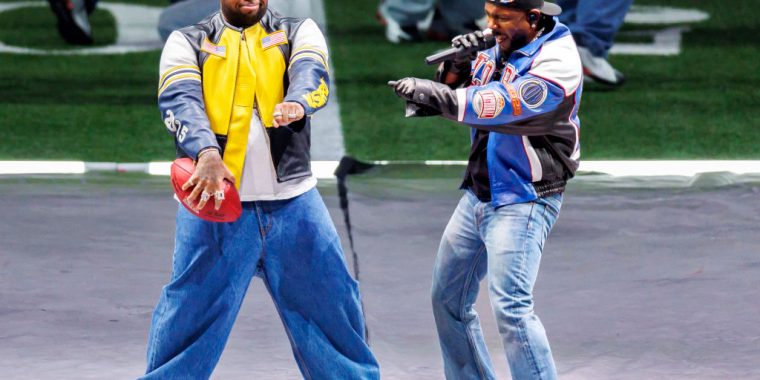
Drake
loses
suit
over
Kendrick
diss.
[Law360]

*
Capitulating
firms
dodge
NY
ethics
complaint.
[Bloomberg
Law
News
]

*
Illinois
troop
deployment
temporarily
blocked.
[Reuters]

*
Erwin
Chemerinsky
discusses
how
this
Supreme
Court
will
redefine
the
presidency.
[Law.com]

*
Lawyer
learns
the
importance
of
making
sure
the
hearing
is
over
first.
[ABA
Journal
]

*
A
conversation
following
Spellbook’s
new
funding
round.
[Artificial
Lawyer
]

Mpilo Hospital faces legal storm over babies swapped 18 years ago


BULAWAYO

The
shocking
discovery
that
two
babies
were
switched
at
birth
at
Mpilo
Central
Hospital
in
Bulawayo
18
years
ago
has
opened
the
door
to
potentially
landmark
legal
battles,
with
top
lawyer
Advocate
Thabani
Mpofu
saying
the
families
and
children
involved
could
pursue
multiple
claims
against
the
hospital.

As
revealed
by
ZimLive
this
week,
two
families

one
from
Bulawayo
and
another
from
Shurugwi

recently
learned
through
DNA
tests
that
their
daughters,
born
on
May
13,
2007,
were
mistakenly
exchanged
at
birth.

The
truth
emerged
after
a
Bulawayo
man,
suspicious
that
his
youngest
daughter
did
not
resemble
her
siblings,
secretly
commissioned
a
DNA
test
that
revealed
she
was
not
his
biological
child.

His
wife,
adamant
she
had
never
been
unfaithful,
launched
her
own
investigation.
Only
two
girls
had
been
born
at
Mpilo
on
the
day
she
gave
birth,
and
her
dogged
enquiries
helped
her
eventually
trace
the
other
mother
through
social
media.

Further
DNA
tests
confirmed
the
unthinkable:
their
daughters
had
been
swapped
at
Mpilo
Hospital,
which
later
admitted
negligence,
citing
staff
shortages
and
system
failures
during
the
2007
economic
crisis.The
mix-up
has
devastated
both
families,
who
are
now
grappling
with
deep
emotional
turmoil,
cultural
differences
and
questions
of
identity.

The
“father”
of
the
child
raised
in
Shurugwi
died
without
knowing
the
truth.
The
second
family
lives
in
Bulawayo.

Lawyers
have
since
been
engaged
to
explore
possible
lawsuits
against
the
hospital,
the
biggest
referral
health
centre
in
south-western
Zimbabwe.

“Never
before
have
a
single
set
of
facts
opened
up
so
many
viable
causes
of
action,”
Advocate
Thabani
Mpofu
told
ZimLive
in
an
exclusive
interview.

According
to
him,
both
sets
of
parents
can
sue
Mpilo
Hospital
for
negligence
that
deprived
them
of
“the
comfort
and
integrity
of
family
life.”

“The
children
themselves
can
bring
claims
for
the
loss
of
familial
security,
for
psychological
injury
and
for
the
profound
disruption
to
their
personal
development,”
he
said.

“If
one
of
the
children
was
raised
in
harmful
or
unsuitable
conditions
they
can
also
claim
damages
for
the
injury
caused
by
that
exposure.
Equally,
there
are
likely
claims
flowing
from
being
compelled
to
live
under
false
identities
and
to
adopt
imposed
cultural
and
linguistic
practices.
These
claims
touch
on
dignity,
identity
and
constitutional
rights.”

Mpofu
said
such
suits
would
be
groundbreaking,
noting
that
while
precedent
is
limited,
Zimbabwean
courts
could
adapt
general
delictual
principles
to
accommodate
new
forms
of
harm.

“General
delictual
principles
[misdeed
or
offense]
can
be
adapted
to
support
novel
causes
of
action,
and
constitutional
remedies
may
supplement
common-law
claims.
The
law,
after
all,
is
a
living
instrument
and
must
evolve
to
meet
ever-changing
social
needs.”

The
main
challenge,
Mpofu
cautioned,
would
be
proving
and
quantifying
damages.

“Roman-Dutch
jurisprudence
has
traditionally
been
conservative
when
awarding
non-pecuniary
damages,
and
quantification
in
these
circumstances
will
be
difficult,”
he
opined.

“That
said,
the
law
does
not
consign
injured
parties
to
mere
conjecture.
Courts
have
discretion
to
make
principled,
impression-based
awards
where
necessary
to
vindicate
rights
and
compensate
real
harm.”

He
said
remedies
could
extend
beyond
compensation
to
include
measures
that
vindicate
dignity
and
deter
institutional
negligence.

“I
cannot
overstate
the
havoc
such
negligence
wreaks
on
young
lives
and
on
the
family
unit,”
he
added.
“A
measured
but
forceful
judicial
response,
one
that
recognises
the
scale
of
the
wrong
and
sets
a
clear
precedent,
is
essential.”

The
baby-swap
revelation
comes
as
Mpilo
Central
Hospital
battles
to
repair
its
image
following
a
string
of
scandals

including
the
admission
of
nursing
students
with
fake
O’
Level
certificates
and
the
exposure
of
a
bogus
doctor
who
treated
patients
and
stole
from
them.

Mpilo
Hospital
chief
medical
officer
Dr
Narcisius
Dzvanga
has
repeatedly
dodged
our
questions.
One
of
the
questions
was
whether
the
hospital
had
changed
processes
on
the
handling
of
newborn
babies,
and
if
he
can
guarantee
families
that
children
born
at
Mpilo
are
truly
theirs.

On
Wednesday,
Dr
Dvanga
said
he
would
respond
“during
working
hours
any
day
midweek.”
The
enquiry
had
been
sent
during
working
hours,
and
in
midweek.

On
Thursday,
Dr
Dzvanga

appointed
to
the
job
in
December
2022
after
a
stint
at
the
United
Bulawayo
Hospitals

said
he
had
“no
idea
on
the
timeline,”
adding:
“We
have
to
retrieve
the
records
first.”

Post
published
in:

Featured

New Merger Alert! – See Also – Above the Law

Welcome
To
The
Fold,
FBT
Gibbons!:
They
are
set
to
go
live
on
January
1st,
2026.
Crime
May
Actually
Pay:
Sullivan
&
Cromwell
got
scammed
for
half
a
million
dollars.
Here
Is
The
Letitia
James
Indictment:
Who
needs
evidence,
really?
Can
You
Argue
A
Murder
Charge
In
11
Hours
Flat?:
Oregon
wants
that
to
be
the
new
standard.
Future
Lawyers
Won’t
Need
A
Backbone
Or
A
Heart
Beat:
How
will
the
practice
adopt
to
AI
attorneys?

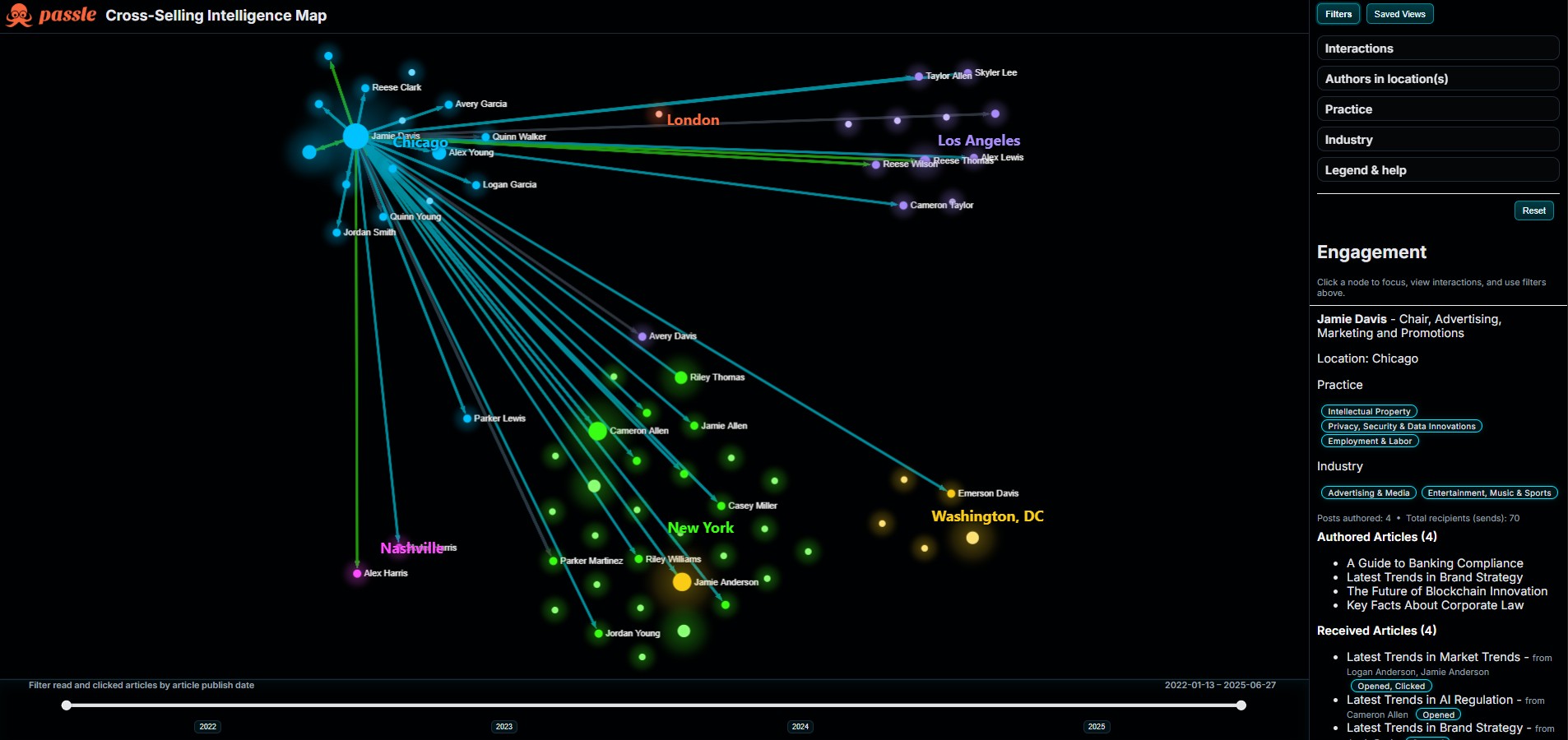
Exclusive: Passle Launches Intelligence Map to Visualize Cross-Selling Activity within A Law Firm


Passle
,
a
technology
company
that
develops
thought
leadership
and
cross-selling
tools
for
law
firms,
has
unveiled
a
new
visualization
tool
for
its
CrossPitch
AI
platform
that
promises
to
make
cross-selling
activity
in
law
firms
visible,
actionable
and
measurable
for
the
first
time.

The
Cross-Selling
Intelligence
Map,
released
today,
creates
a
network
diagram
showing
how
thought
leadership
content
flows
among
a
firm’s
attorneys
across
different
offices
and
practice
areas.

The
Intelligence
Map
aims
to
address
what
Passle
characterizes
as
a
major
revenue
leak:
84%
of
law
firm
business
development
and
marketing
professionals
believe
their
firms
are
missing
cross-selling
opportunities,
with
99%
estimating
this
costs
them
at
least
10%
of
annual
revenue,
according
to
a
Passle-commissioned
study.


AI
to
Drive
Cross-Selling

The
map
is
an
expansion
of
the
company’s
CrossPitch
AI,
which
it
launched
in
June
and
which
uses
artificial
intelligence
to
analyze
attorney-authored
thought
leadership
content,
such
as
blog
posts,
articles
and
client
alerts.
Using
attorneys’
public-facing
biographical
information,
the
system
automatically
identifies
which
colleagues
might
have
clients
interested
in
that
content
and
sends
them
personalized
email
notifications
with
AI-generated
summaries.

“The
AI
reads
the
thought
leadership
that’s
been
created
in
the
firm
and
it
reads
the
bio
pages,
profile
pages
of
all
the
attorneys
at
the
firm
and
it
matches
the
two
together,”
James
Barclay,
Passle’s
CEO,
explained
in
an
interview
with
LawSites
last
week.

The
notifications
include
an
80-100
word
summary
so
attorneys
can
quickly
understand
the
content’s
relevance
without
reading
the
full
article.

To
supplement
what
the
AI
gleans
from
their
public
bios,
attorneys
can
add
an
“enhanced
profile”
within
Passle
where
they
specify
topics
of
interest
in
natural
language

such
as
“anything
about
the
pharmaceutical
industry”
or
“artificial
intelligence.”

A
firm’s
business
development
teams
can
set
a
relevancy
threshold
(typically
70-75%,
according
to
Barclay)
to
control
how
many
notifications
attorneys
receive,
balancing
comprehensiveness
against
information
overload.

The
platform
also
generates
pre-written
“I
saw
this
and
thought
of
you”
emails
that
attorneys
can
send
to
clients
with
a
single
click,
requiring
only
that
they
add
a
personal
greeting.


Visualizing
the
Invisible

Building
on
this
Crosspitch
AI
platform,
the
new
Intelligence
Map
launched
today
transforms
this
notification
data
into
an
interactive
network
visualization.


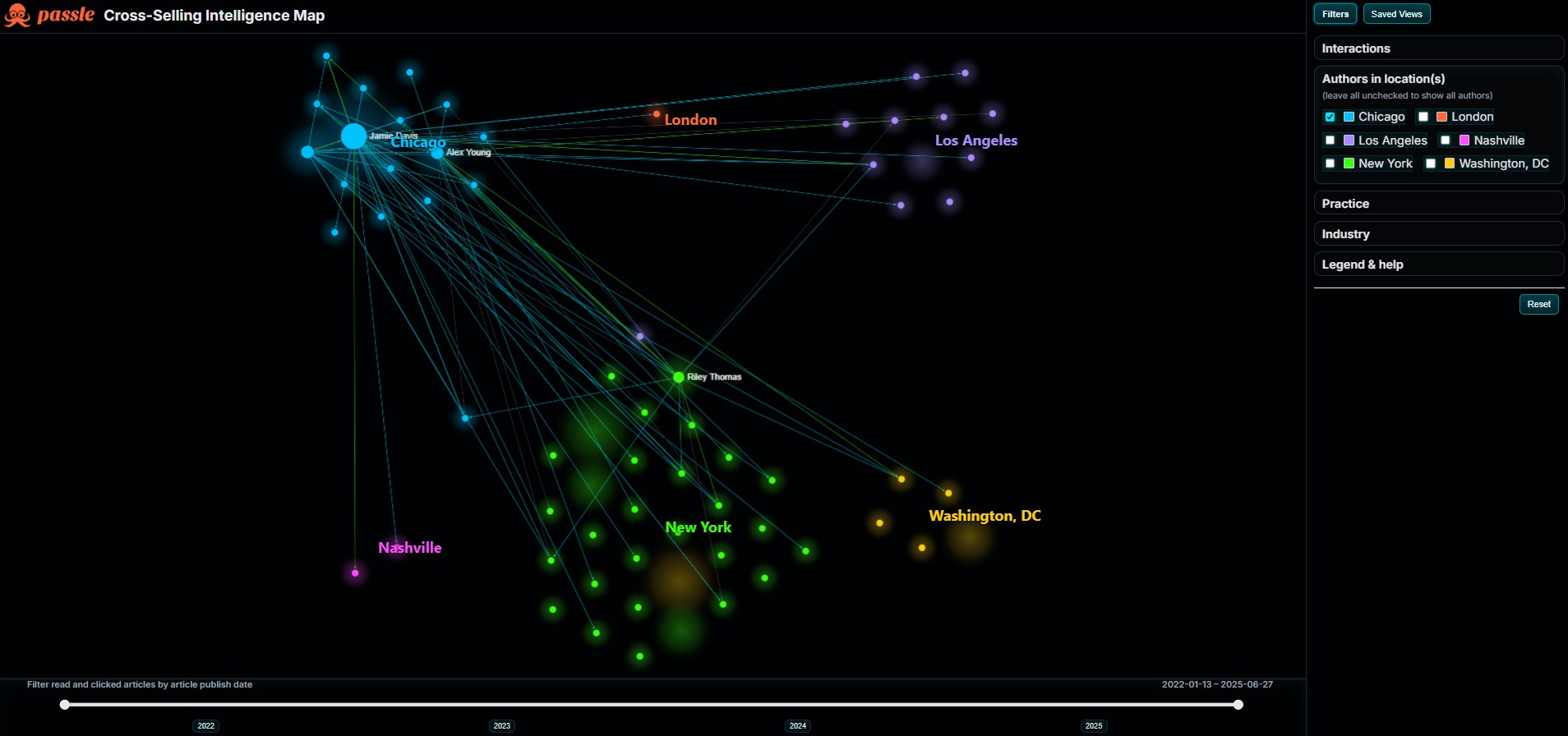
The
map
can
be
filtered
to
show
activity
for
a
specific
office.

Larger
dots
represent
more
active
attorneys
who
create
and
share
more
content.
Connections
between
dots
show
where
thought
leadership
is
being
shared
across
the
firm.
Light
and
dark
patches
reveal
areas
of
high
and
low
activity.

Users
can
filter
the
map
by
location,
practice
area
or
industry,
and
use
a
timeline
slider
to
track
changes
over
time.
This
allows
leadership
to
see
insights
such
as
whether
a
newly
acquired
lateral
hire
or
practice
group
is
integrating
into
the
firm’s
knowledge-sharing
ecosystem
or
remaining
isolated.

In
his
conversations
with
large
law
firms,
Barclay
said,
they
always
want
to
know
how
they
can
show
collaboration
among
attorneys
and
practice
groups,
particularly
in
the
wake
of
a
merger
or
acquisition.

This
map,
he
said,
lets
them
do
exactly
that,
in
a
visual
manner.


The
Cross-Selling
Challenge

The
map
addresses
two
fundamental
barriers
to
cross-selling
that
Barclay
sees
time
and
again
in
firms:
awareness
and
trust.

“We
don’t
know
what
our
colleagues
know,
and
we
need
to
know
that,”
Barclay
said.
As
one
managing
partner
told
him:
“I
kind
of
knew
what
the
people
on
my
floor
knew.
I
didn’t
really
know
what
the
people
upstairs
or
downstairs
knew.
And
I
certainly
didn’t
know
what
L.A.
or
London
was
talking
about.”


The
map
can
show
activity
and
engagement
for
a
specific
lawyer.

The
trust
barrier
is
equally
significant.
“I’ve
just
spent
15
years
building
a
book
of
business
and
I
don’t
know
if
I
want
to
introduce
Jenny,
who
I
haven’t
heard
of,
to
my
client,”
Barclay
said,
describing
how
that
trust
issue
might
inhibit
attorneys
from
cross
selling.

By
repeatedly
exposing
attorneys
to
colleagues’
expertise
through
relevant
content
summaries,
the
platform
aims
to
build
both
familiarity
and
confidence.

He
described
an
attorney,
Alice,
receiving
alerts
about
her
partner
Oscar’s
articles
on
autonomous
vehicles.
The
first
time
she
receives
it,
she
might
barely
notice
it.
The
second
time,
she
might
think
“Oh,
that’s
interesting,
Oscar’s
still
writing
about
autonomous
vehicles.
That’s
kind
of
cool.”
By
the
third
time,
she
might
realize
she
wants
to
get
in
touch
with
Oscar.


Eliminating
Guesswork

Since
launching
in
June,
CrossPitch
AI
has
been
adopted
by
29
law
firms,
including
Barnes
&
Thornburg,
Loeb
&
Loeb,
Manatt,
and
firms
from
both
the
Am
Law
200
and
UK
Top
50.
Passle
reports
that
open
rates
for
CrossPitch
notifications
average
42%,
more
than
double
the
18%
industry
average
for
legal
marketing
emails.

“With
CrossPitch
AI,
we’ve
eliminated
guesswork
and
replaced
it
with
a
data-driven
roadmap
showing
where
our
insights
will
have
their
greatest
impact,”
Trish
Lilley,
chief
marketing
and
business
development
officer
at
Barnes
&
Thornburg,
said
in
a
statement
provided
by
Passle.
“This
fact-fueled
approach
allows
us
to
deliver
optimal
value
to
our
clients
by
bringing
the
right
people
together
faster.”


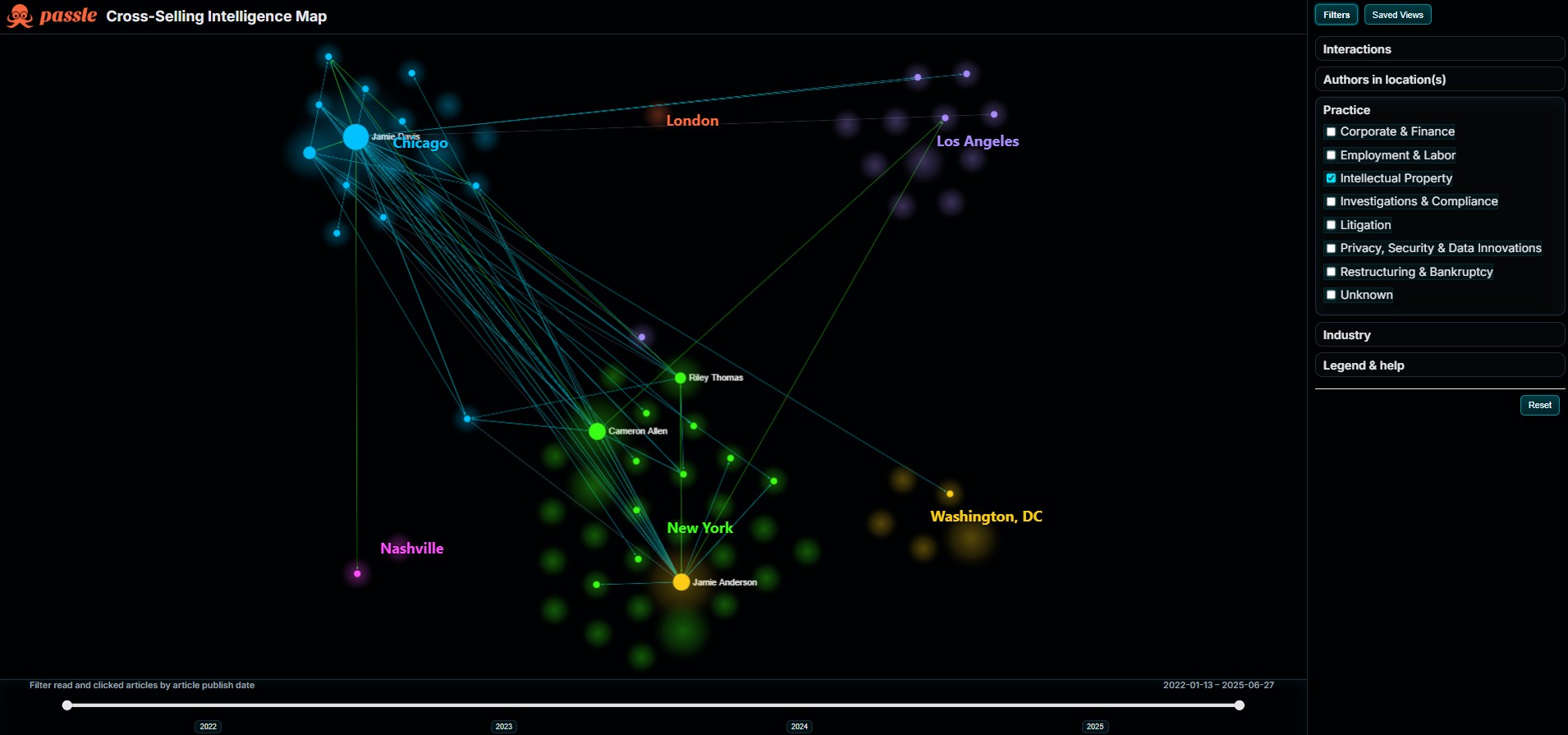
Activity
can
be
filtered
by
practice
areas.

Notably,
CrossPitch
AI
only
analyzes
publicly
available
information,
such
as
published
thought
leadership
and
public-facing
attorney
bios,
to
avoid
any
concerns
law
firms
might
have
about
providing
an
AI
tool
with
access
to
confidential
client
data
or
internal
firm
documents.

“Vendors
like
us
come
along
and
say,
hey,
we’ve
got
an
absolute
silver
bullet

and
all
we
need
to
do
is
go
into
all
your
most
secret
stuff
and
learn
it
and
read
it
and
don’t
worry,
it’ll
be
fine,”
Barclay
said.

Passle
has
deliberately
taken
a
different
approach,
using
only
public-facing
sources
of
content.

Not
only
does
that
assuage
firms’
fears
of
exposing
their
data,
but
it
also
enables
them
to
implement
the
product
much
more
quickly

within
just
a
week,
Barclay
said.

The
AI
platform
can
work
alongside
any
content
source
and
does
not
require
firms
to
use
Passle’s
separate
thought
leadership
platform.


Integrating
Lateral
Hires

Beyond
general
cross-selling,
the
Intelligence
Map
specifically
targets
lateral
hire
integration

a
persistent
challenge
given
that
approximately
50%
of
lateral
hires
leave
within
five
years,
by
some
industry
estimates.

For
a
lateral
who
cost
$750,000
to
several
million
dollars
to
recruit,
the
map
can
show
managing
partners
and
business
development
teams
whether
that
attorney
is
becoming
known
throughout
the
firm
by
creating
and
sharing
expertise

or
remaining
disconnected
from
potential
cross-selling
relationships.

“The
reason
you’re
here,”
Barclay
said
of
lateral
hires,
“is
essentially
to
cross
sell.
You
build
your
book,
you
bring
your
book
and
you
make
sure
that
other
people
know
that
you’re
there
and
that
we
can
sell
off
the
back
of
you
and
your
knowledge
and
what
you
do.”


What
the
Map
Cannot
Show

The
Intelligence
Map
tracks
three
types
of
activity:
creating
thought
leadership,
receiving
notifications
about
colleagues’
content,
and
taking
action
on
those
notifications
(clicking
through
to
articles
or
sharing
them).
Business
development
teams
can
drill
down
to
see
why
specific
attorneys
were
matched
with
specific
content,
based
on
what
the
AI
extracted
from
their
bios.

However,
the
map
does
not
capture
follow
up

whether
recipients
of
a
notification
actually
contacted
the
content
authors,
introduced
them
to
clients,
or
generated
any
cross-selling
revenue.
It
visualizes
key
indicators
of
cross-selling
behavior
rather
than
outcomes.

“It’s
not
necessarily
[that]
we’re
going
to
be
able
to
say,
okay,
there
was
a
$3
million
deal
done
because
a
notification
was
sent,”
Barclay
acknowledged.
“But
we
know
that
those
notifications
will
definitely
help.”

The
tool
represents
a
bet
that
making
previously
invisible
knowledge-sharing
activity
visible
will
drive
behavior
change,
even
without
directly
measuring
revenue
impact.
Whether
that
visibility
alone
can
overcome
the
structural
and
cultural
barriers
that
have
made
cross-selling
a
perennial
challenge
in
law
firms
remains
to
be
seen.

Letitia James Becomes Second Trump Political Enemy To Be Indicted – Above the Law

New
York
Attorney
General
Letitia
James
(Photo
by
Michael
M.
Santiago/Getty
Images)

Two
separate
career
prosecutors
did
not
believe
there
was
enough
evidence
to

support
mortgage
fraud
charges

against
New
York
Attorney
General
Letitia
James.
But
James
was
the
driving
force
behind
the
civil
fraud
case
against
the
Trump
organization,
and
a
major
thorn
in
Donald
Trump’s
side.
So...
here
we
are.

Today,
James
became
the
second
Trump
political
enemy

to
be
indicted.
Yes,
U.S.
Attorney
for
the
Eastern
District
of
Virginia
Erik
Siebert was
forced
out
of
a
job
 for
refusing
to
bring
these
very
charges
against
James.
And
Elizabeth
Yusi,
head
of
major
criminal
prosecutions
in
the
Norfolk
office,

prepared
for
the
same
fate

for
refusing
to
bring
the
charges.
But
Trump
has

installed
his
former
personal
attorney
Lindsey
Halligan

(with
zero
prosecutorial
experience)
into
Siebert’s
former
role,
and
well,
she
does
not
have
the
same
qualms.

The
charges
against
James
have
not
been
made
public,
but
multiple
sources
are

reporting

at
least
one
fraud
charge
has
been
returned
by
a
grand
jury.
James
has
been
under
investigation
for
mortgage
fraud
since
2023
for
a
loan
she
took
out
to
help
her
niece
obtain
a
home.
One
document
in
the
loan
application
allegedly
reported
that
the
home
in
question
was
going
to
be
James’s
primary
residence,
something
her
team
claims
was
an
error.
Other
loan
documents
state
the
property
was
not
going
to
be
James’s
primary
residence
and,
in
an email
to
her
loan
originator,
James
wrote
“this
property
WILL
NOT
be
my
primary
residence.”


Kathryn
Rubino
is
a
Senior
Editor
at
Above
the
Law,
host
of

The
Jabot
podcast
,
and
co-host
of

Thinking
Like
A
Lawyer
.
AtL
tipsters
are
the
best,
so
please
connect
with
her.
Feel
free
to
email

her

with
any
tips,
questions,
or
comments
and
follow
her
on
Twitter

@Kathryn1
 or
Mastodon

@[email protected].

From Biglaw To In-House At The House Of Mouse – Above the Law

(Photo
by
Olga
Thompson/Walt
Disney
World
Resort
via
Getty
Images)


Ed.
note
:
Welcome
to
our
daily
feature,

Quote
of
the
Day
.


Rose
has
been
a
trusted
adviser
and
a
driving
force
in
some
of
our
most
important
matters.
Her
judgment,
dedication,
and
strategic
insight
have
left
a
lasting
mark
on
the
firm
and
on
our
clients.
We
are
proud
of
all
she
has
accomplished
here
and
excited
to
see
the
impact
she
will
make
in
this
new
leadership
role.


Barbara
Becker
,
Gibson
Dunn’s
chair
and
managing
partner,
in

comments
given

concerning
partner

Rosemarie
Ring’s

decision
to
join
The
Walt
Disney
Co.
as
a
deputy
general
counsel
for
litigation
and
patents.
Per

Bloomberg
Law
,
Ring
will
report
to
Disney
Corporate
Legal
General
Counsel
David
Howard


Staci Zaretsky


Staci
Zaretsky
 is
the
managing
editor
of
Above
the
Law,
where
she’s
worked
since
2011.
She’d
love
to
hear
from
you,
so
please
feel
free
to

email

her
with
any
tips,
questions,
comments,
or
critiques.
You
can
follow
her
on BlueskyX/Twitter,
and Threads, or
connect
with
her
on LinkedIn.

Chiwenga decries corruption in mining sector as he opens Mine Entra

BULAWAYO-
Vice
President
Constantino
Chiwenga
on
Thursday
vowed
that
the
government
will
introduce
stringent
regulations
and
oversight
mechanisms
to
root
out
corruption,
illicit
trading
and
leakages
in
Zimbabwe’s
mining
sector

warning
that
such
vices
are
“cancers
that
erode
public
trust”
and
deprive
citizens
of
national
wealth.

Speaking
at
the
official
opening
of
the
28th
Edition
of
the
Mining,
Engineering
and
Transport
(Mine
Entra)
Expo
in
Bulawayo,
Chiwenga
said
the
government
would
tighten
compliance
systems
to
ensure
transparency
across
the
mining
value
chain.

“Corruption,
illicit
trading
and
leakages
are
cancers
that
erode
public
trust,
distort
markets
and
deprive
citizens
of
their
rightful
benefits,”
Chiwenga
said.
“We
are
challenging
all
responsible
authorities
and
agencies
to
put
in
place
mechanisms
that
enhance
transparency
in
licensing,
monitoring
and
enforcement.”

He
said
regular
audits,
whistleblower
protection,
and
community
engagement
would
be
central
to
a
new
governance
framework
aimed
at
cleaning
up
the
sector.

He
also
commended
recent
investments,
including
the
commissioning
of
the
Palm
River
Energy
Metallurgical
Plant
and
Zimplats’
Smelter
Expansion
and
Abatement
Project,
describing
them
as
“milestones
that
anchor
beneficiation
and
energy
self-sufficiency.”

However,
Chiwenga
stressed
that
Zimbabwe’s
ambitions
went
beyond
such
projects,
calling
for
a
“fully-integrated
mining
value
chain”
that
supports
manufacturing,
energy
production
and
exports.

He
also
urged
greater
collaboration
between
mining
houses
and
research
institutions
to
adopt
geospatial
mapping,
artificial
intelligence
and
automation
for
improved
efficiency
and
traceability.

Under
the
National
Development
Strategy
1
(NDS1),
mining
is
identified
as
a
key
pillar
of
economic
transformation.
Chiwenga
said
Zimbabwe
was
aligning
its
operations
with
the
Africa
Mining
Vision
and
the
SADC
Protocol
on
Mining
by
integrating
climate
resilience,
renewable
energy
use
and
ecosystem
restoration
into
its
framework.

“The
expansion
of
our
mining
industry
must
not
come
at
the
expense
of
our
environment
and
communities,”
he
added.

Chiwenga
said
the
government’s
re-engagement
policy
remained
open
to
“investors
from
all
corners
of
the
world
who
share
our
values
of
responsibility,
transparency
and
shared
prosperity.”

Declaring
the
expo
officially
open,
Chiwenga
called
on
all
miners,
investors
and
stakeholders
to
“go
beyond
extraction”
and
turn
Zimbabwe’s
mineral
wealth
into
“sustainable
prosperity.”

Scammers Walked Away With Nearly A Half Million Of Sullivan & Cromwell’s Dollars – Above the Law

New
York
Attorney
General
Letitia
James
is
cracking
down
on
a
series
of
fraudulent
entities
trying
to
impersonate
one
of
the
most
well-known
Biglaw
firms
in
New
York:
Sullivan
&
Cromwell
LLP.

This
week,
James

filed
a
lawsuit

against
a
series
of
familiar,
but
not
quite
right,
corporate
entities:
Sullivan
&
Cromwell
LLC,
Sullivan
&
Cromwel
LLC,
Sullivan
&
Kromwell
LLC,
Sullivan
&
Kromwel
LLC,
Sullivan
&
Cromwelll
LLC,
Sullivann
&
Cromwell
LLC,
and
Sulivan
&
Cromwel
LLC,
under
a
state
law
that
allows
the
AG
to
sue
entities
that
“engage
in
repeated
fraudulent
or
illegal
acts
or
otherwise
demonstrate
persistent
fraud
or
illegality
in
the
carrying
on,
conducting
or
transaction
of
business.”

According
to
the
complaint,
the
scammers
behind
these
suspiciously
named
companies
cashed
almost
$500,000
in
checks
intended
for
the
Biglaw
firm.
The
checks,
issued
by
firm
clients,
were
stolen
and
altered
ever-so
slightly
to
the
fraudulent
company’s
name.
Two
altered
checks
were
cleared
by
JP
MorganChase,
but
a
third, made
payable
to
“Sullivan
&
Kromwell” didn’t
pass
the
sniff
test.

“These
entities’
names
closely
resemble
that
of
the
Complainant
without
its
permission,
and
use
the
Complainant’s
address
as
their
registered
addresses
without
its
permission,”
as
detailed
in
the
filing.

James
is
asking
for
the
dissolution
of
the
entities
and
to
block
them
from
further
allegedly
fraudulent
conduct.

Looks
like
even
Donald
Trump’s

personal
attorneys

(S&C
LLP)
sometimes
need
the
assistance
of

noted
Trump
enemy,
Tish
James.


Kathryn
Rubino
is
a
Senior
Editor
at
Above
the
Law,
host
of

The
Jabot
podcast
,
and
co-host
of

Thinking
Like
A
Lawyer
.
AtL
tipsters
are
the
best,
so
please
connect
with
her.
Feel
free
to
email

her

with
any
tips,
questions,
or
comments
and
follow
her
on
Twitter

@Kathryn1
 or
Mastodon

@[email protected].

Oregon Public Defense Commission Thinks You Can Argue A Murder Case In The Time It Takes To Watch The First Season Of ‘Game Of Thrones’ – Above the Law

(Photo
via
New
Jersey
Criminal
Law
Resource)

The
state
of
public
defense
has
been
dire
in
Oregon.
Overworked
and
understaffed
public
defenders
aren’t
able
to
meet
the
constitutionally
required
minimum
standards
for
fair
trials,
to
the
point
that
last
year,
the
state
started
to
let
defendants
walk,
purely
because
no
one
was
able
to
represent
them
after
a
week.
Without
effective
counsel
and
access
to
it,
it
is
very
easy
for
the
state
to
steamroll
the
accused
toward

gambling
on
a
known
plea
deal

or
dealing
with
the
uncertainty
of
trial

making
our
justice
system
have
less
to
do
with
due
process
than
with
applied
game
theory.
Oregon
has
a
proposed
solution
to
the
public
defender
crisis,
more
overworking,
and
public
defenders
are
suing
to
fight
the
recent
changes.

Salem
Reporter

has
coverage:

The
executive
director
of
Marion
County’s
public
defense
law
firm
filed
a
lawsuit
Tuesday,
Sept.
30,
in
Marion
County
Circuit
Court
against
the
Oregon
Public
Defense
Commission
after
it
recently
added
minimum
caseload
requirements
to
the
firm’s
contract
with
the
state.

The
new
contracts,
which
took
effect
Oct.
1,
expect
Marion
County
public
defenders
to
handle
the
equivalent
of
300
misdemeanor
cases
or
138
serious
felonies,
like
kidnapping
or
first-degree
assault,
per
year,
according
to
the
complaint
filed
by
Shannon
Wilson,
executive
director
of
the
Public
Defender
of
Marion
County.

The
contract
would
require
attorneys
handling
the
highest
level
felonies
to
reach
a
resolution
in
11
hours.
Those
would
include
people
accused
of
first-degree
manslaughter,
rape
or
arson.

For
context,
a

National
Public
Defense
Workload
Study

found
that
high-severity
felony
cases
require
an
average
of
286
hours
to
meet

constitutionally
required

minimum
standards
of
adequate
representation.
What
the
hell
are
public
defenders
supposed
to
do
with
11
hours?
That’s
barely
enough
time
to
argue
against
the
planted
finger
prints
and
the
de-watermarked
Sora
2
video
of
the
defendant
stabbing
the
victim
before
they
faced
the
camera
and
recited
their
Social
Security
number!
And
if
the
cap
on
hours
wasn’t
enough,
the
contract
also
came
with
a
pay
cut
for
five
people.
Unless
the
goal
is
to
get
more
bodies
in
prison
beds,
whatever
trade-offs
the
Oregon
Public
Defense
Commission
thinks
are
worth
pushing
public
defenders
to
churn
through
their
clients
instead
of
devoting
the
time
needed
to
zealously
defend
them
was
poorly
calculated.


Oregon
Wants
To
Impose
Quotas
On
Public
Defenders.
Marion
County
Lawyers
Are
Pushing
Back

[Salem
Reporter]


Earlier
:

Oregon’s
Overworked
Public
Defense
System
Means
Defendants
Walk
Free


Chris
Williams
became
a
social
media
manager
and
assistant
editor
for
Above
the
Law
in
June
2021.
Prior
to
joining
the
staff,
he
moonlighted
as
a
minor
Memelord™
in
the
Facebook
group Law
School
Memes
for
Edgy
T14s
.
 He
endured
Missouri
long
enough
to
graduate
from
Washington
University
in
St.
Louis
School
of
Law.
He
is
a
former
boatbuilder
who
is
learning
to
swim, is
interested
in
critical
race
theory,
philosophy,
and
humor,
and
has
a
love
for
cycling
that
occasionally
annoys
his
peers.
You
can
reach
him
by
email
at [email protected]
and
by
tweet
at @WritesForRent.