There
have
been
a
few
examples
of
Biglaw
firms
that
capitulated
to
Trump
stepping
up
to
provide
the
kinds
of
legal
representation
the
nation
is
particularly
desperate
for
in
2025,
but
it’s
far
from
enough
to
cover
the
need
that
exists.
It’s
clear
that
Biglaw isn’t
going
to
be our
savior,
and
small
and
boutique
law
firms
have
helped
fill
in
the
gap.
But
the
legal
landscape
keeps
on
getting
worse,
and
it’s
really
an
all-hands-on-deck
moment.
Good
thing
there’s
Democracy
Forward,
a
501(c)(3)
legal
organization
that
has
more
than
100
actions
against
the
Trump
administration
in
2025.
As Skye
Perryman,
CEO
and
president,
told
Law.com,
“The
demand
for
our
work
has
grown
much
greater.
There
are
a
number
of
law
firms
that
are
not
taking
on
the
level
of
pro
bono
work,
the
level
of
pro
democracy
work
that
they
did
in
the
first
Trump
administration,
or
that
they
have
historically,
as
a
result
of
the
president’s
strategy
to
try
to
intimidate
institutions.”
And
Democracy
Forward
is
filling
in
the
void
created
by
Biglaw’s
withdrawal,
Perryman
continued,
“We
have
a
number
of
clients
and
people
and
communities,
diverse
groups,
coming
to
us
needing
that
representation
that
they
would
have
otherwise
got
from
the
private
sector.”
Democracy
Forward,
which
was
created
in
the
wake
of
the
first
Trump
administration,
is
staffed
by
many
former
Biglaw
and
government
attorneys.
And
they’ve
expanded
to
150
staff
members,
putting
them
in
an
excellent
position
to
continue
the
legal
fight
against
Trump.
“We
have
always
prioritized
having
full-time
legal
staff
so
that
we
could
be
able
to
take
on
matters
ourselves
when,
for
instance,
larger
institutions
like
some
of
the
elite
law
firms
that
are
not
taking
on
pro
bono
matters,
pull
back,”
said
Perryman.
“That’s
why
the
demand
for
our
work
has
exponentially
grown.”
And
it
only
looks
like
Democracy
Forward
will
get
busier.
Kathryn
Rubino
is
a
Senior
Editor
at
Above
the
Law,
host
of
The
Jabot
podcast,
and
co-host
of
Thinking
Like
A
Lawyer.
AtL
tipsters
are
the
best,
so
please
connect
with
her.
Feel
free
to
email
her
with
any
tips,
questions,
or
comments
and
follow
her
on
Twitter
@Kathryn1 or
Mastodon
@[email protected].
Biglaw
firms
want
their
attorneys
to
have
more
of
a
physical
presence
in
the
office,
and
attendance
mandates
continue
to
be
rolled
out
—
not
just
in
the
United
States,
but
abroad
as
well.
Now,
one
of
the
world’s
top
firms
is
upping
its
facetime
requirements,
but
the
policy
isn’t
as
harsh
as
it
could
be…
not
yet,
at
least.
Starting
in
November,
DLA
Piper
—
a
firm
that
brought
in
$4,239,832,000
gross
revenue
in
2024,
putting
it
at
No.
3
on
the
Global
200
—
will
increase
its
in-person
attendance
policy
to
three
days
for
all
personnel
in
its
offices
outside
of
America.
The
firm
is
one
of
the
last
of
the
global
elites
to
resist
a
four-day
work
week
for
non-U.S.
attorneys
and
staff.
This
news
comes
hot
on
the
heels
of
the
firm’s
decision
to
require
that
its
U.S.
corporate
attorneys
work
from
the
office
four
days
each
week.
Per
Law.com
International,
a
DLA
Piper
spokesperson
offered
the
following
comment
on
the
firm’s
move:
“We
are
updating
our
international
approach
to
hybrid
working
as
of
November
2025
to
ask
our
people
to
attend
the
office
at
least
three
days
a
week,
moving
from
our
previous
requirement
of
at
least
50%.
“This
update
reflects
the
value
we
see
in
face-to-face
collaboration
and
the
benefits
of
an
engaged
office
culture,
while
still
maintaining
flexibility
for
our
people.
We
remain
committed
to
supporting
our
people
with
the
tools
and
working
arrangements
they
need
to
balance
productivity
and
wellbeing.”
At
least
six
U.S.-based
firms
have
already
transitioned
employees
to
a
four-day
office
presence
in
London
(Covington;
Kirkland;
Ropes
&
Gray;
Skadden;
Vinson
&
Elkins;
and
Weil
Gotshal).
It
is
unknown
at
this
time
whether
additional
firms
plan
to
go
this
route.
As
soon
as
you
find
out
about
office
attendance
plans
at
your
firm,
please email
us (subject
line:
“[Firm
Name]
Office
Reopening”)
or
text
us
at (646)
820-8477.
We
always
keep
our
sources
on
stories
anonymous.
There’s
no
need
to
send
a
memo
(if
one
exists)
using
your
firm
email
account;
your
personal
email
account
is
fine.
If
a
memo
has
been
circulated,
please
be
sure
to
include
it
as
proof;
we
like
to
post
complete
memos
as
a
service
to
our
readers.
You
can
take
a
photo
of
the
memo
and
attach
as
a
picture
if
you
are
worried
about
metadata
in
a
PDF
or
Word
file.
Thanks.
Staci
Zaretsky is
the
managing
editor
of
Above
the
Law,
where
she’s
worked
since
2011.
She’d
love
to
hear
from
you,
so
please
feel
free
to
email
her
with
any
tips,
questions,
comments,
or
critiques.
You
can
follow
her
on Bluesky, X/Twitter,
and Threads, or
connect
with
her
on LinkedIn.
Known
firebrand
leftist
Ronald
Reagan
stacked
the
courts
with
woke
activist
judges
who
keep
blocking
Donald
Trump’s
glorious
agenda!
First,
Judge
John
Coughenour
blocks
the
executive
order
erasing
the
Fourteenth
Amendment’s
citizenship
guarantee
as
if
some
“Constitution”
constrains
presidential
action.
Now,
Judge
William
Young
of
the
District
of
Massachusetts
unleashes
a
massive
excoriation
of
the
Trump
administration’s
effort
to
use
immigration
law
to
attack
campus
free
speech.
Meanwhile,
somewhere
out
there,
the
Democratic
Party’s
elected
leaders
considered
sending
Trump
a
polite
letter
of
concern.
Judge
Young’s
161-page
decision
ripped
the
administration
for
flexing
immigration
laws
to
abduct
and
threaten
to
deport
individuals
legally
within
the
United
States
based
on
pro-Palestinian
statements.
The
sweeping
opinion
comes
after
a
bench
trial
conducted
to
determine
if
the
administration
acted
to
unconstitutionally
chill
the
free
speech
rights
of
non-citizen
members
of
plaintiff
educational
associations.
Judge
Young
doesn’t
waste
much
time
getting
to
the
crux
of
it:
This
case
-–
perhaps
the
most
important
ever
to
fall
within
the
jurisdiction
of
this
district
court
–-
squarely
presents
the
issue
whether
non-citizens
lawfully
present
here
in
United
States
actually
have
the
same
free
speech
rights
as
the
rest
of
us.
The
Court
answers
this
Constitutional
question
unequivocally
“yes,
they
do.”
“No
law”
means
“no
law.”
The
First
Amendment
does
not
draw
President
Trump’s
invidious
distinction
and
it
is
not
to
be
found
in
our
history
or
jurisprudence.
See
Section
III.A
infra.
No
one’s
freedom
of
speech
is
unlimited,
of
course,
but
these
limits
are
the
same
for
both
citizens
and
non-citizens
alike.
Armed
with
this
established
principle
of
law,
Judge
Young
determined
that
officials
up
and
down
the
administration
acted
“deliberately
and
with
purposeful
aforethought”
to
chill
First
Amendment
rights.
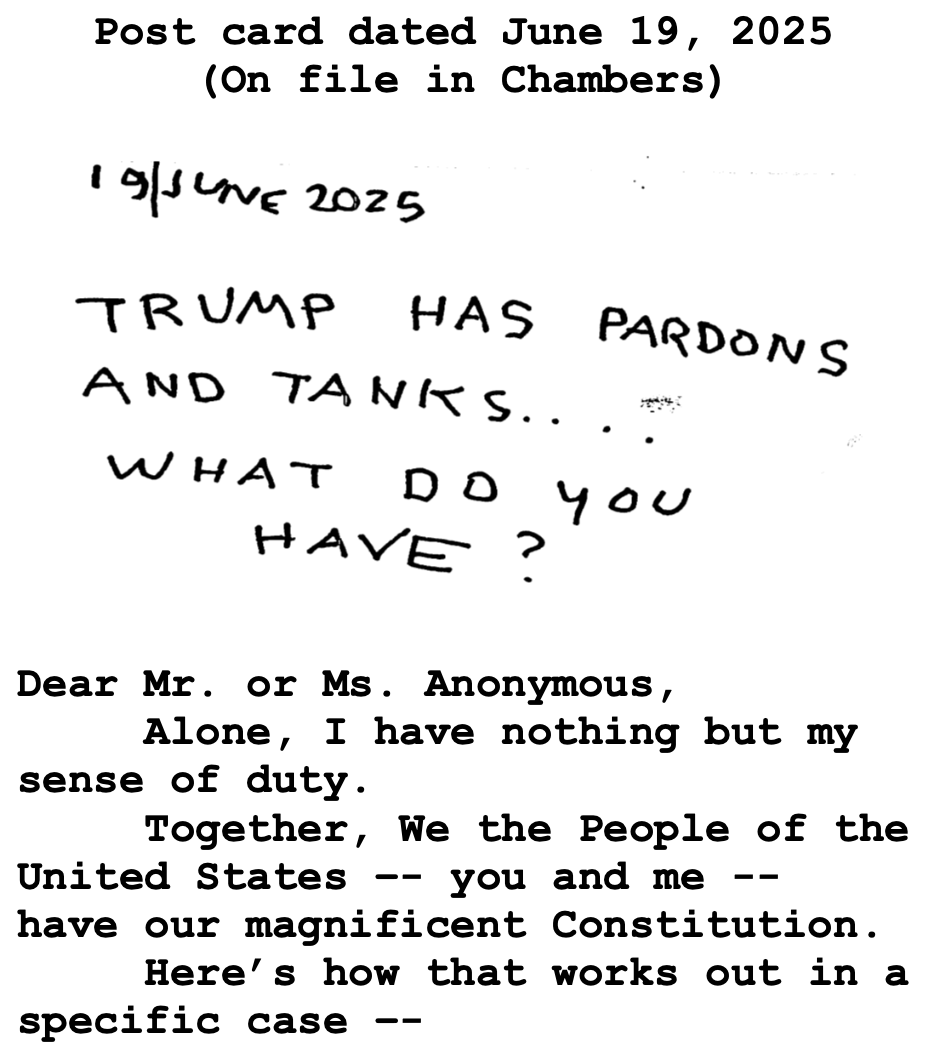
Judge
Young
received
some
flak
online
for
his
decision
to
open
the
opinion
with
an
anonymous
postcard
he
received:
We
finally
have
a
rhetorical
successor
to
“John
Marshall
has
made
his
decision;
now
let
him
enforce
it!”
and,
appropriate
to
the
2025
America
milieu,
it’s
an
anonymous
postcard
in
all
caps,
haphazardly
hand-scrawled
by
a
lunatic.
Critics
chided
the
judge
for
using
this
as
a
framing
device.
We’re
the
first
to
criticize
judges
for
getting
cute
when
holding
someone’s
life
or
livelihood
in
the
balance.
When
a
judge
decides
to
go
off
with
a
bunch
of
puns
while
denying
a
stay
of
execution,
that’s
wildly
inappropriate.
That’s
not
really
the
case
here.
If
anything,
Judge
Young
is
doing
his
part
to
bring
more
attention
to
the
elevated
threat
level
faced
by
federal
judges
face
in
light
of
the
feckless
Supreme
Court.
The
White
House
has
used
the
Supreme
Court’s
unwillingness
to
explain
its
rubberstamping
of
the
administration
as
a
jumping
off
point
to
whip
Trump’s
followers
into
threatening
any
court
that
might
invoke
existing
precedent
to
place
brakes
on
executive
action.
America
has
always
had
cranks,
but
the
volume
of
cranks
preemptively
mouthing
off
to
judges
in
cases
that
don’t
even
involve
them
is
a
new
phenomenon.
Judges
don’t
have
a
lot
of
opportunities
to
share
what’s
going
on
behind
the
scenes
on
a
stage
as
impactful
as
a
written
opinion.
It
is,
paradoxically,
why
the
conservatives
on
the
Supreme
Court
are
so
adamant
about
not
writing
them.
A
footnote
in
the
opinion
directly
addresses
the
impact
the
shadow
docket’s
“governance
via
Post-It
note”
approach
has
in
emboldening
the
administration’s
lawlessness:
The
flurry
of
activity
on
the
Supreme
Court’s
emergency
docket
is
itself
a
tacit
admission
that,
when
dealing
with
an
administration
that
is
admittedly
seeking
to
“flood
the
zone,”
it
needs
to
intervene
to
correct
rulings
that,
if
not
immediately
remedied,
will
remain
in
effect
far
too
long.
He
leaves
open
to
the
reader
to
work
out
how
the
shadow
docket
is
being
used
instead
to
guarantee
incorrect
ruling
remain
in
effect
far
too
long.
Judge
Young
does
not
take
lightly
the
privilege
he
enjoys
to
enter
his
opinions
into
the
unbroken
line
of
American
jurisprudence.
To
that
end,
he
goes
beyond
the
mere
abuse
of
the
Immigration
and
Nationality
Act
—
which
he
notes
is
unprecedented
in
its
unconstitutional
gall
—
to
call
out
the
tactics
that
the
administration
adopts
to
add
to
the
sense
of
terror
they
can
impose
in
the
name
of
squelching
speech:
And
there’s
the
issue
of
masks.
This
Court
has
listened
carefully
to
the
reasons
given
by
Öztürk’s
captors
for
masking-up
and
has
heard
the
same
reasons
advanced
by
the
defendant
Todd
Lyons,
Acting
Director
of
ICE.
It
rejects
this
testimony
as
disingenuous,
squalid
and
dishonorable.
ICE
goes
masked
for
a
single
reason
—
to
terrorize
Americans
into
quiescence.
Small
wonder
ICE
often
seems
to
need
our
respected
military
to
guard
them
as
they
go
about
implementing
our
immigration
laws.
It
should
be
noted
that
our
troops
do
not
ordinarily
wear
masks.
Can
you
imagine
a
masked
marine?
It
is
a
matter
of
honor
—
and
honor
still
matters.
To
us,
masks
are
associated
with
cowardly
desperados
and
the
despised
Ku
Klux
Klan.
In
all
our
history
we
have
never
tolerated
an
armed
masked
secret
police.
Carrying
on
in
this
fashion,
ICE
brings
indelible
obloquy
to
this
administration
and
everyone
who
works
in
it.
“We
can
not
escape
history,”
Lincoln
righty
said.
“[It]
will
light
us
down
in
honor
or
dishonor,
to
the
latest
generation.”
Abraham
Lincoln,
Second
Annual
Message
to
Congress
(Dec.
1,
1862).
For
those
keeping
score,
this
is
a
Republican-appointed
judge
comparing
the
Republican
administration
to
the
Ku
Klux
Klan.
Remember
this
when
the
White
House
inevitably
blasts
this
as
a
partisan
opinion.
Speaking
of
partisanship,
aside
from
Judge
Young
being,
in
fact,
a
Republican,
some
critics
did
scold
the
judge
for
not
appearing
appropriately
neutral.
This
is
gaslighting.
Judges
shouldn’t
exhibit
bias
—
something
the
Supreme
Court’s
current
majority
consistently
refuses
to
consider
—
but
that’s
not
the
same
thing
as
betraying
a
point
of
view.
An
opinion
about
politicians
making
a
political
decision
to
abuse
their
role
of
public
servants
to
squelch
political
speech
will
always
sound
in
politics.
Without
condemning
the
actions
of
these
politicians,
the
extent
of
the
viewpoint
discrimination
on
display
takes
on
a
“view
from
nowhere”
quality.
It
becomes
the
sort
of
sterile
artifact
casually
tossed
in
the
dustbin
of
history
rather
than
standing
as
an
ongoing
touchstone
in
constitutional
jurisprudence.
To
borrow
from
another
old
Republican
who
would
be
loudly
protesting
this
administration,
“extremism
in
calling
out
constitutional
violations
is
no
vice.”
Vague
demands
of
“neutrality”
are
an
act
of
sentiment
policing
pitched
over
Chick-fil-A
in
the
Federalist
Society
writers’
room
to
help
mute
the
severity
of
constitutional
violations.
It’s
cheap,
bothsiderism
rhetoric
designed
to
normalize
authoritarian
creep
by
scolding
everyone
who
dares
describe
it
as
anything
but
politics
as
usual.
It’s
a
strategy
that’s
enjoyed
undue
success:
Behold
President
Trump’s
successes
in
limiting
free
speech
-–
law
firms
cower,53
institutional
leaders
in
higher
education
meekly
appease
the
President,54
media
outlets
from
huge
conglomerates
to
small
niche
magazines
mind
the
bottom
line
rather
than
the
ethics
of
journalism.55
53
But
not
all
of
them.
See
infra. 54
But
not
all
of
them.
See
infra. 55
But
not
all
of
them.
See
infra.
Unfortunately,
the
judge
seems
to
feel
a
little
less
than
enthusiastic
about
the
rule
of
law
right
now.
In
the
golden
age
of
our
democracy,
this
opinion
might
end
here.
After
all,
the
facts
prove
that
the
President
himself
approves
truly
scandalous
and
unconstitutional
suppression
of
free
speech
on
the
part
of
two
of
his
senior
cabinet
secretaries.
One
would
imagine
that
the
corrective
would
follow
as
a
matter
of
course
from
the
appropriate
authorities.
Yet
nothing
will
happen.
The
Department
of
Justice
represents
[]
the
President,
and
Congress
is
occupied
with
other
weighty
matters.
By
“other
weighty
matters,”
he
means
“covering
up
the
Epstein
files.”
The
161-page
missive
ends
on
an
ominous
note:
Freedom
is
a
fragile
thing
and
it’s
never
more
than
one
generation
away
from
extinction.
It
is
not
ours
by
way
of
inheritance;
it
must
be
fought
for
and
defended
constantly
by
each
generation,
for
it
comes
only
once
to
a
people.
President
Ronald
Reagan,
Inaugural
Address
as
Governor
of
the
State
of
California
(January
5,
1967).
I
first
heard
these
words
of
President
Reagan’s
back
in
2007
when
my
son
quoted
them
in
the
Law
Day
celebration
speech
at
the
Norfolk
Superior
Court.
I
was
deeply
moved
and
hold
these
words
before
me
as
a
I
discharge
judicial
duties.
As
I’ve
read
and
re-read
the
record
in
this
case,
listened
widely,
and
reflected
extensively,
I’ve
come
to
believe
that
President
Trump
truly
understands
and
appreciates
the
full
import
of
President
Reagan’s
inspiring
message
–-
yet
I
fear
he
has
drawn
from
it
a
darker,
more
cynical
message.
I
fear
President
Trump
believes
the
American
people
are
so
divided
that
today
they
will
not
stand
up,
fight
for,
and
defend
our
most
precious
constitutional
values
so
long
as
they
are
lulled
into
thinking
their
own
personal
interests
are
not
affected.
The
battle
between
Harvard
and
the
Trump
administration
may
soon
be
coming
to
an
end.
Our
great
leader
recently
announced
that
negotiations
are
very
close
to
being
finished:
you
know
things
are
serious
because
he
delivered
the
news
in
person
instead
of
via
a
Truth
Social
post.
New
York
Times
has
coverage:
President
Trump
said
Tuesday
that
his
administration
was
close
to
reaching
a
multimillion-dollar
agreement
with
Harvard
University,
which
would
end
a
monthslong
standoff
that
had
come
to
symbolize
the
resistance
to
the
White
House’s
efforts
to
reshape
higher
education. … “We
are
in
the
process
of
getting
very
close,”
President
Trump
said
in
an
appearance
from
the
Oval
Office.
He
added
that
the
details
were
being
finalized
and
said,
“They
would
be
paying
about
$500
million.”
Big
if
here
—
he
said
negotiations
with
Harvard
should
be
done
in
a
week
or
so
back
on
June
20th
—
but
if
the
school
goes
through
with
paying
out
$500M
to
the
Trump
administration,
they
should
expect
a
lot
of
push
back
from
all
of
the
donors
that
dug
deep
and
donated
to
try
and
make
up
for
the
government
playing
hardball
with
their
grants.
And
sure,
the
million
or
so
they
got
in
April
is
a
far
cry
from
the
billions
that
the
government
put
on
hold,
but
the
summary
judgment
ruling
that
the
government’s
funding
freeze
was
unlawful
gave
some
hope
that
the
law
was
on
their
side.
Protracted
fights
suck,
but
this
hardly
seems
like
the
time
to
throw
in
the
towel.
Even
the
prospect
of
surrender
alone
will
have
reputational
consequences:
If
there
is
any
saving
grace
it
would
be
that
the
$500M
is
earmarked
for
trade
schools.
Let’s
see
how
long
it
takes
for
someone
to
discover
whatever
payola
scheme
they’d
have
to
do
to
keep
Trump
happy
was
illegal
the
whole
time.
Chris
Williams
became
a
social
media
manager
and
assistant
editor
for
Above
the
Law
in
June
2021.
Prior
to
joining
the
staff,
he
moonlighted
as
a
minor
Memelord™
in
the
Facebook
group Law
School
Memes
for
Edgy
T14s
.
He
endured
Missouri
long
enough
to
graduate
from
Washington
University
in
St.
Louis
School
of
Law.
He
is
a
former
boatbuilder
who
is
learning
to
swim, is
interested
in
critical
race
theory,
philosophy,
and
humor,
and
has
a
love
for
cycling
that
occasionally
annoys
his
peers.
You
can
reach
him
by
email
at [email protected]
and
by
tweet
at @WritesForRent.
Perennially
embattled
Cooley
Law
School
once
again
called
out
by
the
ABA
over
sagging
bar
passage
rates.
The
school
has
been
out
of
compliance
with
ABA
standards
since
2020,
and
now
finds
itself
on
probation
with
its
accreditor.
And
that
matters
because
law
schools
that
take
student
money
and
then
don’t
set
them
up
for
a
career
are
failing
those
students.
The
last
time
something
like
this
happened,
Cooley
sued
the
ABA
into
relenting.
History
is
a
flat
circle.
After
learning
that
Paul
Weiss
and
Kirkland
were
providing
free
legal
services
to
the
Commerce
Department,
presumably
in
an
effort
to
satisfy
their
pro
bono
payola
obligations,
we
wondered
how
this
could
possibly
be
legal
in
light
of
31
U.S.C.
1342.
Apparently,
lawmakers
wondered
the
same
thing.
And
James
Comey
finds
himself
indicted
after
a
whirlwind
that
involved
removing
the
existing
top
federal
prosecutor
for
refusing
to
file
a
sham
case
and
replacing
him
with
an
in-over-her-head
Florida
insurance
lawyer.
The
exodus
of
Biglaw
heavyweights
into
the
boutique
arena
rolls
on,
with
Brown
Rudnick’s
top
litigators
leading
the
charge
this
time.
Michael
Bowe
and
Lauren
Tabaksblat,
formerly
co-chairs
of
the
Am
Law
200
firm’s
litigation
practice,
announced
earlier
this
week
the
opening
of
Brithem
LLP,
a
New
York-based
firm
devoted
exclusively
to
high-stakes
courtroom
advocacy.
At
launch,
Brithem
has
13
professionals
—
including
nine
lawyers,
two
investigators,
and
two
paraprofessionals
—
and
expects
to
reach
at
least
20
attorneys
by
the
first
quarter
of
2026.
Early
hires
include
a
former
Supreme
Court
clerk
joining
as
of
counsel
and
two
Quinn
Emanuel
alumni
stepping
in
as
partners.
Bowe
and
Tabaksblat
hope
to
make
a
big
impact
with
their
new
impact
litigation
firm,
and
Bowe
has
been
quite
direct
about
what
differentiates
Brithem
from
the
firm
he
and
Tabaksblat
left
behind.
“[Biglaw]
is
drunk
on
leverage
and
billables
that
deliver
little
bang
for
the
buck,”
he
said.
“Smart
consumers
of
legal
services
know
better,
want
an
alternative,
and
love
supporting
a
firm
that
is
also
heavily
committed
to
combating
child
abuse,
human
trafficking,
discrimination,
and
other
injustices.”
Perhaps
one
of
the
most
striking
details
of
the
new
boutique
is
its
compensation
model.
The
firm
will
pay
above
the
Cravath
scale,
and
in
a
sharp
departure
from
Biglaw
lockstep,
associates
will
not
be
slotted
strictly
by
class
year.
Bowe
explains
what
that
means:
“We
are
paying
above
the
Cravath
scale
and
are
not
ranking
by
class
year.
If
you
are
performing
above
your
class
level
that
is
where
you
get
paid.
Below
you
get
paid
there.
You
can
go
up
after
down
if
you
get
there.
And
it
is
based
on
performance
and
skill
value
not
billables.
We
want
a
system
that
rewards
associates
who
demonstrate
the
desire
to
become
autonomous
first-chair
lawyers.
We
are
convinced
this
will
result
in
a
product
clients
will
flock
to.”
That
merit-based
approach
is
designed
to
accelerate
the
development
of
young
trial
lawyers
—
a
message
reinforced
by
Tabaksblat,
whom
Chambers
sources
have
said
“commands
the
courtroom.”
She
noted
that
Brithem’s
structure
“offers
a
fast
track”
to
becoming
a
competent
trial
lawyer
and
has
already
attracted
significant
interest
from
ambitious
associates.
Tabaksblat
went
on
to
share
what
litigators
will
really
love
about
the
firm:
“Brithem
is
devoted
to
the
art
of
trial
lawyering
and
using
that
art
to
make
a
difference.
Our
name
is
not
on
the
door
because
the
firm
is
about
our
clients,
not
us.
Our
first
love
is
being
courtroom
advocates
who
deliver
results
for
clients
and
make
a
difference.”
By
pairing
premium
associate
pay
with
a
fast
track
to
the
courtroom,
Brithem
is
positioning
itself
as
both
a
client-focused
alternative
and
proving
ground
for
the
next
generation
of
trial
lawyers.
Staci
Zaretsky is
the
managing
editor
of
Above
the
Law,
where
she’s
worked
since
2011.
She’d
love
to
hear
from
you,
so
please
feel
free
to
email
her
with
any
tips,
questions,
comments,
or
critiques.
You
can
follow
her
on Bluesky, X/Twitter,
and Threads, or
connect
with
her
on LinkedIn.
Although
the
deals
market
has
shown
a
modest
rebound
in
early
2025,
a
recent
report
by
Deloitte
notes
that
today’s
dealmakers
must
“navigate
perpetual
uncertainty.”
This
uncertainty
is
driven
by
numerous
factors:
economic
changes,
evolving
risk
management,
and
emerging
technologies,
for
example.
As
a
result,
Deloitte
says,
“pivoting
has
emerged
as
a
core
competency”
for
dealmakers.
The
same
goes
for
law
departments
involved
with
a
corporate
transaction
—
or
even
the
possibility
of
a
future
transaction.
“‘Logistics’
is
an
important
word
here,
because
the
whole
M&A
process
is
also
a
process
of
logistics,”
says
Kariem
Abdellatif,
the
head
of
Mercator
by
Citco
(Mercator),
a
specialist
entity
management
provider
that
helps
organizations
manage
their
global
entity
portfolios,
including
during
complex
M&A
transactions.
Having
the
right
partner
in
place
to
oversee
a
transaction’s
numerous
and
intricate
details
will
allow
the
lawyers
to
focus
on
high-level
work
like
pricing
and
negotiation,
he
notes.
This,
in
turn,
enables
the
flexibility
that
today’s
dealmakers
must
cultivate.
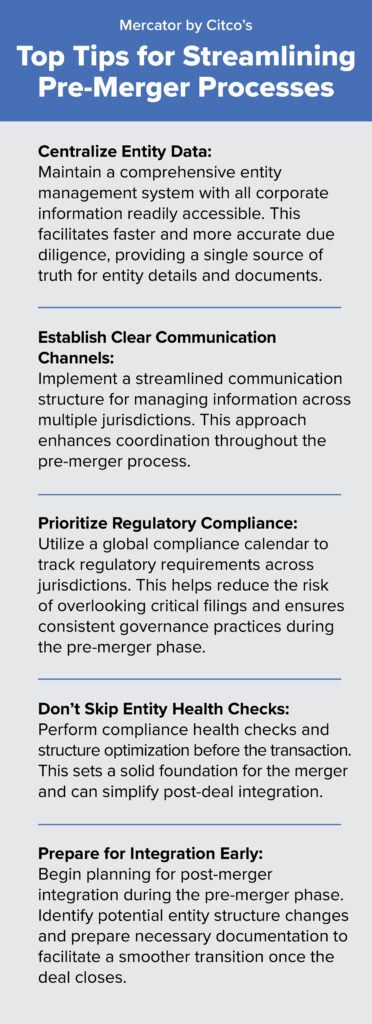
In
this
series
presented
by
our
friends
at
Mercator,
we’ll
be
providing
a
step-by-step
guide
for
general
counsel
navigating
a
merger
or
other
corporate
transaction.
To
start,
we’re
exploring
best
practices
for
corporate
law
departments
in
the
pre-merger
phase.
Stay
tuned
for
our
upcoming
articles
detailing
how
GCs
can
help
negotiate
and
close
a
deal,
as
well
as
how
the
law
department
can
help
integrate
organizations
post-merger.
A
first
step
for
any
legal
department
involved
in
a
corporate
transaction
is
to
understand
the
portfolio
of
companies
involved.
The
only
way
to
do
this
is
by
gathering
trustworthy
data.
“When
it
comes
to
data,
there
are
several
critical
questions
that
need
answering,”
Abdellatif
says.
“What
information
do
we
need?
Where
is
it
stored?
Who
maintains
it?
How
can
we
verify
its
accuracy?
Is
it
up
to
date?
Getting
clear
answers
to
these
questions
early
on
is
essential
for
making
informed
decisions
and
planning
effective
integration.”
A
platform
like
Mercator’s
Entica
can
take
this
a
step
further
by
applying
that
data
to
create
detailed
and
interactive
corporate
org
charts.
The
platform
can
also
generate
hypothetical
charts
to
model
potential
acquisitions.
These
charts
map
out
the
“family
tree”
of
an
organization
—
showing
which
entity
sits
on
top,
what
happens
if
entities’
locations
are
moved,
what
it
would
mean
if
an
entity
were
liquidated.
“Our
technology
enables
legal
teams
to
visualize
the
entire
org
chart,”
Abdellatif
says.
“From
there
they
can
toy
around
with
it
to
see
how
changes
might
affect
the
overall
corporate
structure.
This
is
particularly
valuable
during
M&A
discussions,
where
understanding
complex
entity
relationship
is
key.”
Determine
Your
Lane
While
gathering
corporate
data
is
critical,
knowledge
of
a
potential
deal
must
typically
be
kept
confidential
outside
of
a
few
key
stakeholders.
When
the
GC
is
brought
under
the
umbrella,
their
first
step
is
to
determine
their
role.
Will
the
GC
be
engaging
outside
counsel?
Will
they
be
managing
these
lawyers?
Will
the
GC
be
the
primary
point
of
contact
for
the
transaction?
The
scope
of
these
potential
roles
varies
widely,
notes
Josh
Hollingsworth,
an
M&A
partner
with
Barnes
&
Thornburg
LLP.
The
GC
of
a
company
being
acquired,
for
example,
might
be
limited
to
assisting
the
buyer
in
conducting
due
diligence.
In
other
circumstances,
the
GC
might
be
expected
to
lead
the
entire
deal.
“Navigating
where
they
fit
in
and
asking
affirmative
questions
so
that
there
aren’t
any
assumptions
—
it’s
important
for
a
GC
to
just
figure
out
what
their
role
is
in
some
cases,”
Hollingsworth
says.
Master
Organizational
Psychology
When
a
GC
is
involved
in
advancing
a
transaction,
they
must
draw
on
their
soft
skills
as
much
as
their
legal
training
in
the
pre-merger
phase.
Thinking
strategically
about
the
organization
and
the
stakeholders
involved
is
a
key
to
success.
“I
don’t
think
there’s
a
specific
playbook
for
each
circumstance,”
Hollingsworth
says.
“I
think
it’s
just
a
matter
of
being
aware
of
everyone
who’s
involved
and
making
sure
that
you
understand
the
universe
of
how
this
transaction’s
going
to
affect
everybody.”
An
initial
step
is
to
determine
who
will
be
brought
into
the
deal,
and
who
will
not
be
informed.
This
requires
thinking
through
who
in
the
organization
will
be
important
—
the
IT,
HR,
and
risk
management
teams,
for
example.
“If
nobody
in
HR
knows,
it’s
going
to
be
hard
to
get
through
employee
and
benefits
diligence,”
Hollingsworth
says.
“If
nobody
in
IT
knows
about
a
transaction,
and
an
IT
issue
comes
up,
similarly,
that
will
be
challenging.”
Abdellatif
notes
that
technology
like
Mercator’s
Entica
system
can
play
a
role
in
ensuring
the
knowledge
of
the
deal
sits
only
with
the
stakeholders
who
are
looped
in.
“What
we
want
to
make
certain
is
that
data
access
is
available
to
those
who
need
it,
but
not
beyond
that,”
Abdellatif
says.
“That
data
is
only
accessible
to
those
who
actually
require
it,
and
you
don’t
have
people
rummaging
through
information
they
shouldn’t.”
Understand
Your
Team
It’s
also
important
to
gauge
the
likely
motivations
of
each
stakeholder
with
a
role
in
the
transaction.
Hollingsworth
notes
that
anyone
informed
of
a
potential
deal
will
first
ask
themself
a
simple
question.
“Literally,
‘What
does
this
mean
for
me?’
is
going
to
be
the
first
question
that
everybody
who’s
brought
under
the
tent
is
going
to
think
about,
and
that’s
just
human
nature,”
Hollingsworth
says.
“So
just
being
prepared
to
work
through
those
dynamics
is
important
for
a
GC.”
If
a
company
is
being
acquired,
for
example,
that
could
be
seen
as
a
threat
to
many
stakeholders,
who
may
work
to
undermine
the
deal.
It’s
true
of
acquiror
companies
as
well,
Hollingsworth
notes.
Some
may
see
someone
in
the
acquired
organization
as
a
threat
to
their
position.
Some
may
simply
think
it’s
too
much
work
to
go
through
with
the
deal.
Will
a
stakeholder
be
gaining
or
losing
in
job
title
and
status?
Are
there
financial
incentives,
like
parachute
payments
to
a
departing
CEO,
involved?
“I
think
a
lot
of
people
take
it
for
granted
that
if
the
CEO
or
the
board
says,
‘We’re
gonna
do
something,’
that
we’re
gonna
do
it,”
Hollingsworth
says.
“What
ends
up
happening
in
any
group
dynamic
is
there
are
various
levels
of
resistance.”
For
a
company
potentially
being
acquired,
maintaining
impeccable
data
and
compliance
can
help
thwart
resistance
to
a
deal.
These
practices
can
even
provide
bargaining
leverage,
according
to
Abdellatif.
“Having
this
level
of
organization
builds
confidence
with
potential
acquirers
and
can
positively
influence
their
approach
to
the
transaction”
he
says.
If
a
company
doesn’t
seem
to
have
well-maintained
regulatory
compliance,
by
contrast,
an
acquiring
company
will
likely
become
more
critical.
Technology
can
also
help.
Mercator’s
Entica,
for
example,
features
a
corporate
compliance
calendar
that
tracks
all
requirements
a
year
in
advance
and
ensures
a
company
maintains
proper
structures
around
compliance.
Abdellatif
has
seen
acquired
companies
impressing
acquirors
with
the
thoroughness
of
their
regulatory
compliance,
and
the
acquiring
companies
in
turn
seeking
to
adopt
their
systems.
This
thoroughness
can
also
help
stave
off
any
internal
resistance
to
a
deal.
“The
best
defense
is
making
sure
that
you
have
your
ducks
in
a
row,
that
your
information
and
data
is
properly
set
up,
and
that
you
can
demonstrate
just
how
effectively
you
run
your
department,”
he
says.
Don’t
Forget
About
Your
JD
In
addition
to
organizational
management,
of
course,
a
GC
must
also
consider
legal
risks
at
this
stage.
One
top
risk
in
a
pre-merger
environment
is
confidentiality.
For
publicly
traded
companies,
insider
trading
laws
will
kick
in,
and
for
nonpublicly
traded
companies,
there
can
be
issues
with
employees
or
vendors
knowing
of
the
deal
at
the
early
stages.
A
GC
must
ensure
there
are
robust
nondisclosure
agreements
—
and
serious
consideration
around
which
internal
and
external
stakeholders
are
informed
to
begin
with.
“Confidentiality
will
be
at
the
very
top
of
your
legal
risk
in
the
pre-transaction
phase,”
Hollingsworth
says.
“Similarly,
antitrust
considerations
go
hand-in-hand.”
Corporate
transactions
will
often
take
place
between
competing
companies,
which
must
make
a
pre-merger
filing
with
the
Federal
Trade
Commission
under
the
Hart-Scott-Rodino
Act.
If
there
are
foreign
operations,
a
variety
of
other
regulations
apply
as
well.
Competing
companies
that
are
exploring
a
merger
must
also
be
careful
about
the
level
of
cooperation
during
this
stage
because
of
antitrust
concerns
known
as
“gun-jumping.”
“The
expectation
is
that
you’re
going
to
operate
the
business
independently
all
the
way
up
through
closing,”
Hollingsworth
says.
Leverage
Your
Tech
As
with
all
things
in
the
corporate
world,
AI-enabled
technology
is
playing
an
increasing
role
in
mergers
and
acquisitions.
In
the
pre-merger
phase,
generative
AI
will
come
into
play
for
in-house
lawyers
—
particularly
when
drafting
pre-merger
documents
like
nondisclosure
agreements.
New
technology
can
also
immediately
inform
counsel
of
“what’s
market,”
giving
negotiators
detailed
knowledge
of
precedent
regarding
every
aspect
of
a
transaction.
The
Entica
platform
combines
workflows
with
data
management,
ensuring
actions
as
varied
as
filing
financial
statements,
appointing
directors
and
auditors,
and
executing
documents
are
all
tracked
and
accounted
for.
It
allows
quick
access
to
this
data
throughout
a
company’s
full
portfolio,
and
segments
it
to
ensure
it’s
only
accessible
to
stakeholders
who
require
it.
“When
you
come
back
to
logistics,
it
really
serves
as
the
backbone
in
many
ways,”
Abdellatif
says.
Seasoned
practitioners
like
Hollingsworth
remember
the
due
diligence
process
of
decades
ago,
where
there
was
a
physical
data
room
that
contained
banker
boxes
full
of
documents
related
to
the
transaction.
These,
of
course,
have
been
replaced
by
online
data
rooms
that
can
be
accessed
24/7.
Similarly
to
due
diligence,
closings
and
negotiations
have
moved
from
in-person
to
virtual.
For
negotiators,
though,
this
convenience
may
create
a
new
pitfall
to
avoid.
If
you’ve
flown
across
the
country
for
an
in-person
meeting,
the
expectation
is
that
items
will
be
resolved
in
that
meeting,
Hollingsworth
notes.
“Allowing
virtual
negotiations
leads
to
more
iterations
of
the
document,”
he
says,
“and
it
may
actually
lead
to
the
negotiations
taking
longer.”
Last
night
at
12:01
a.m.,
the
federal
government
shut
down
due
to
a
partisan
impasse.
This
means
that
thousands
of
government
employees
will
be
furloughed
and
many
government
services
will
be
unavailable
until
a
funding
bill
is
passed.
If
that
wasn’t
bad
enough,
a
few
days
earlier,
up
to
150,000
federal
employees
submitted
their
resignations
as
part
of
a
large-scale
reduction
in
force
program.
What
will
this
mean
for
the
federal
government?
The
federal
government
shut
down
last
night
because
it
failed
to
pass
an
appropriation
bill
that
would
fund
the
government.
While
the
Senate
is
controlled
by
the
Republicans,
the
bill
requires
60
votes,
which
means
seven
Democratic
senators
must
vote
along
with
the
Republicans.
Only
three
Democratic
senators
support
the
Republican
bill.
Democrats
are
demanding
an
enhancement
and
extension
of
health
care
subsidies
under
the
Affordable
Care
Act.
Otherwise,
Americans
receiving
subsidies
could
see
their
health
insurance
premiums
rise
substantially.
How
long
the
shutdown
will
last
is
uncertain.
Shutdowns
have
been
threatened
but
most
were
resolved
at
the
last
minute.
Since
1976,
the
government
has
shut
down
20
times.
Most
of
the
time,
it
only
lasted
a
few
days.
The
last
government
shutdown
happened
in
2018-2019
and
lasted
a
record
35
days.
Also,
around
this
time,
between
100,000
to
150,000
federal
employees
have
resigned
under
the
Deferred
Resignation
Program.
Soon
after
the
results
of
the
2024
election,
President
Trump
teamed
up
with
Elon
Musk
to
establish
the
Department
of
Government
Efficiency
(DOGE).
Musk’s
goal
with
DOGE
was
to
identify
and
cut
unnecessary
government
staff,
similar
to
how
he
cut
the
number
of
Twitter’s
staff
soon
after
he
acquired
that
company.
Federal
employees
who
signed
on
to
the
Deferred
Resignation
Program
would
continue
to
receive
pay
and
benefits
until
the
end
of
September.
Otherwise,
they
could
be
subject
to
layoffs
in
the
future.
People
with
jobs
that
are
considered
essential
will
continue
to
work,
although
in
some
cases
will
not
be
paid
until
a
spending
bill
is
passed,
at
which
point
back
pay
will
be
disbursed.
Essential
positions
generally
involve
the
military,
aviation,
and
courts,
to
name
a
few.
This
means
that
ICE
agents
will
still
be
around
to
conduct
immigration
raids
and
antagonize
protestors
even
though
they
will
not
be
paid
during
the
shutdown.
Hopefully
they
got
their
$50,000
sign-up
bonuses
up
front.
One
interesting
note
is
that
the
Office
of
Personnel
Management
has
clarified
that
agencies
can
let
employees
working
on
“reduction-in-force”
(RIF)
activities
continue
doing
their
jobs,
with
no
lapses,
throughout
a
government
shutdown.
RIF
activities
are
basically
plans
for
large-scale
layoffs
—
something
that
was
planned
when
DOGE
was
initially
set
up.
Courts
have
invalidated
some
of
the
mass
terminations.
Also,
Musk
and
Trump
apparently
had
a
falling
out
which
led
to
Musk
leaving
DOGE
and
later
disparaging
Trump
on
Twitter/X,
including
an
accusation
that
he
is
in
the
Epstein
files.
Some
agencies
may
have
contingency
plans
in
case
of
a
shutdown.
For
example,
at
the
IRS,
funding
has
been
reserved
to
pay
for
an
additional
five
business
days.
What
happens
after
is
uncertain.
But
in
2023
when
a
government
shutdown
was
likely,
the
IRS
plan
was
to
furlough
two-thirds
of
its
staff.
The
short
term
effects
of
the
shutdown
and
resignations
are
likely
to
be
profound.
A
shutdown
can
mean
temporarily
stopping
unnecessary
government
services.
According
to
Rep.
Ami
Bera,
during
the
2018-2019
partial
shutdown,
the
Food
and
Drug
Administration
suspended
routine
inspections,
increasing
public
health
risks.
The
National
Park
Service
stopped
trash
collection
and
road
repairs,
creating
unsanitary
conditions
and
unsafe
roads,
while
some
national
parks
and
museums
closed
entirely.
Resignations
could
increase
the
unemployment
rate.
It
could
also
result
in
a
brain
drain
as
some
of
them
could
get
a
job
in
the
private
sector.
Unfortunately,
some
may
turn
to
working
for
rogue
countries.
Sadly,
in
the
future,
shutdowns
may
be
more
frequent
due
to
stubborn
politicians,
and
escalation
in
rhetoric.
Perhaps
a
bipartisan
task
force
should
be
established
to
discuss
procedures
that
would
encourage
negotiations
and
penalize
shutdowns.
This
can
include
withholding
pay
for
legislators
with
no
reimbursement,
eliminating
fringe
benefits,
stiff
campaign
finance
limitations,
or
possibly
even
denial
of
security
personnel.
Chances
are
the
shutdown
will
not
last
long
based
on
history.
But
the
resignations
will
stick
unless
a
court
invalidates
the
Deferred
Resignation
Program
or
the
president
rescinds
it.
But
the
large
drop
in
federal
employees
from
various
sectors
will
have
a
negative
effect
on
the
federal
government’s
operations
in
the
short
term.
Whether
the
government
will
act
more
efficiently
in
the
long
run
is
anyone’s
guess.
Steven
Chung
is
a
tax
attorney
in
Los
Angeles,
California.
He
helps
people
with
basic
tax
planning
and
resolve
tax
disputes.
He
is
also
sympathetic
to
people
with
large
student
loans.
He
can
be
reached
via
email
at
[email protected].
Or
you
can
connect
with
him
on
Twitter
(@stevenchung)
and
connect
with
him
on LinkedIn.
Pfizer
is
the
first
big
pharmaceutical
company
to
reach
an
agreement
with
the
Trump
administration
over
most-favored
nation
drug
pricing,
a
deal
that
lowers
U.S.
prices
of
certain
medications
and
makes
them
available
directly
to
patients
through
new
online
channels.
The
agreement
announced
Tuesday
also
gives
Pfizer
a
grace
period
before
facing
potential
tariffs
on
its
drugs.
With
most-favored
nation
pricing,
the
prices
of
a
drug
in
the
U.S.
will
be
matched
to
the
lowest
price
of
the
same
drug
in
a
comparable
developed
nation.
President
Trump
revived
the
policy
in
a
May
executive
order.
In
July,
he
sent
letters
to
CEOs
of
17
big
pharma
companies
outlining
ways
he
wanted
them
to
comply
with
the
order.
That
letter
gave
companies
until
Sept.
29
to
respond.
In
a
Tuesday
news
conference
with
the
Trump
administration,
Pfizer
executives
said
the
company
will
participate
in
TrumpRx.gov,
a
new
purchasing
platform
that
will
allow
Americans
to
purchase
most
primary
care
treatments
and
certain
specialty
drugs
from
Pfizer
“at
a
significant
discount.”
A
White
House
fact
sheet
listed
some
examples
of
existing
Pfizer
products:
an
80%
discount
for
atopic
dermatitis
drug
Eucrisa;
a
40%
discount
for
immunology
drug
Xeljanz;
and
a
50%
discount
for
migraine
drug
Zavpret.
Specific
terms
of
the
agreement
remain
confidential.
But
the
White
House
said
the
agreement
means
every
state
Medicaid
program
in
the
country
will
have
access
to
most-favored
nation
drug
prices
on
Pfizer
products.
Furthermore,
the
agreement
secures
most-favored
nation
pricing
on
all
new
drugs
Pfizer
brings
to
the
market.
As
the
deadline
for
a
response
to
Trump’s
most-favored
nation
proposal
approached,
pharma
companies
rolled
out
initiatives
that
could
help
them
meet
the
goals
outlined
in
the
executive
order.
That
order
specified
that
selling
directly
to
patients
would
be
one
way
to
comply,
as
long
as
the
prices
offered
through
these
channels
was
no
higher
than
the
best
prices
in
other
developed
nations.
Last
week,
Bristol
Myers
Squibb
announced
a
new
direct-to-patient
website
will
launch
in
January
with
the
plaque
psoriasis
drug
Sotyktu
as
the
first
product
offered
at
a
steep
discount.
AstraZeneca,
Novartis,
and
Boehringer
Ingelheim
have
since
unveiled
their
own
direct-to-consumer
online
plans.
Industry
trade
group
PhRMA
also
announced
a
new
website
that
will
connect
U.S.
consumers
with
the
direct-purchase
programs
of
drug
manufacturers.
Another
move
taken
by
some
companies
is
raising
prices
on
drugs
sold
overseas.
Earlier
this
month,
BMS
said
schizophrenia
drug
Cobenfy
will
launch
in
the
United
Kingdom
at
a
price
equal
to
the
drug’s
U.S.
list
price.
That
followed
Eli
Lilly’s
August
announcement
it
had
reached
an
agreement
with
the
U.K.
to
raise
the
price
of
type
2
diabetes
drug
Mounjaro.
Lee
Brown,
global
sector
lead,
health
care,
at
consultancy
Third
Bridge,
said
this
strategy
addresses
a
Trump
argument
that
other
nations
are
“freeloading
on
American
pharmaceutical
innovation,”
as
stated
on
White
House
fact
sheets.
This
strategy
also
gives
pharma
companies
a
way
to
protect
their
revenue
in
the
U.S.,
their
biggest
market.
“I
think
[pharma
companies]
raise
some
prices
to
offset
some
price
reductions
in
the
U.S..,
and
they
do
that
for
a
selected
number
of
drugs,
and
they
deliver
those
as
wins
to
the
Trump
administration,”
Brown
said
in
an
interview.
“Trump
will
take
that
as
a
win.
That’s
the
way
he
works.
He’s
not
really
looking
for
everything.
He’s
looking
for
some
things
that
he
wouldn’t
have
gotten.”
In
a
note
sent
to
investors,
Leerink
Partners
analyst
David
Risinger
said
there
is
now
a
framework
for
other
countries
to
absorb
higher
prices
than
they
have
in
the
past
for
new
drugs.
He
added
that
Pfizer
anticipates
this
opens
up
a
way
of
introducing
new
drugs
at
list
prices
overseas
consistent
with
U.S.
list
prices.
But
Leerink
does
not
expect
the
prices
of
existing
drugs
to
be
raised
outside
of
the
U.S.
because
of
the
economic
challenges
of
doing
so.
Trump
has
also
threatened
to
impose
tariffs
on
pharmaceuticals.
Section
232
of
the
Trade
Expansion
Act
permits
tariffs
if
a
U.S.
Department
of
Commerce
investigation
finds
they
are
necessary
for
national
security.
That
rationale
has
already
been
used
to
justify
tariffs
on
aluminum
and
steel
imports.
The
investigation
on
pharmaceuticals
is
ongoing.
But
Pfizer
said
its
products
under
a
Section
232
inquiry
won’t
face
tariffs
for
three
years
as
long
as
the
company
invests
in
its
U.S.
manufacturing.
In
the
past
year,
big
pharma
companies
have
unveiled
multi-billion-dollar
capital
investment
plans
for
the
U.S.,
the
most
recent
one
GSK’s
plan
to
spend
$30
billion
on
U.S.
manufacturing
and
R&D
sites
over
the
next
five
years.
That
announcement
was
made
while
Trump
was
in
the
U.K.
on
a
state
visit.
William
Blair
analyst
Matt
Phipps
said
in
a
research
note
that
it
remains
to
be
seen
whether
companies
will
need
to
provide
drugs
directly
to
patients
via
TrumpRx.gov
or
through
their
own
programs.
It’s
also
unclear
how
these
new
options
will
affect
prices
of
drugs
for
the
Department
of
Veterans
Affairs
or
Medicaid.
“The
majority
of
large
biopharma
companies
have
already
announced
large
commitments
to
invest
in
manufacturing
and
R&D
facilities
in
the
United
States,”
Phipps
said.
“Following
today’s
announcement,
we
expect
more
companies
will
announce
direct-to-consumer
channels
to
further
appease
the
Trump
administration
and
largely
remove
threats
of
100%
tariffs
and
1,000%
price
reductions.”
*
Another
Trump
acting
U.S.
Attorney
determined
to
be
squatting
in
the
job
illegally.
This
time
in
Nevada.
[NY
Times]
*
SEC
opens
the
door
to
more
crypto
because
if
there’s
one
thing
this
administration
is
committed
to,
it’s
fake
money
that
can
only
be
used
for
online
heroin
sales
as
long
as
the
president
gets
a
cut.
[Bloomberg
Law
News]
*
Apple
and
OpenAI
move
to
toss
Elon’s
sour
grapes
competition
suit.
[Reuters]
*
FTC
says
Zillow
and
Redfin
collaborating
to
eliminate
genuine
competition.
[CNN]
*
Diddy
lost
his
effort
to
get
out
of
his
conviction.
[Law360]


 Kathryn