Supreme Court’s Shadow Docket Scam Collides With Reality – Above the Law

The
shadow
docket
used
to
be
the
sleepy
part
of
the
Court’s
work.
The
ramifications
for
the
individual
litigants
were
still
tremendous,
of
course,
but
the
Court’s
unexplained
rulings
on
half-argued
cases
remained
confined
to
the
caption
itself.
These
days,
it’s
the
Supreme
Court’s
main
stage,
an
opportunity
to
rewrite
long-standing
precedent
through
a
process
barely
a
notch
removed
from
advisory
opinions.

While
once
limited
to
glorified
preliminary
injunctions,
the
Supreme
Court’s
conservative
majority
has
recast
the
shadow
docket
as
an
avenue
to
upset
the
status
quo
and
award
the
administration
victories
that
plaintiffs
have
no
hope
of
seeing
repaired.
Unlike
keeping
some
middle
manager
sidelined,
the
result
of
shadow
docket
decisions
over
independent
agency
leadership,
the
Court’s
order
renders
the
legal
landscape
impossible
to
later
untangle.

And,
on
top
of
this,
the
Court
began
demanding
that
lower
courts
take
the
“vibe
precedent”
of
its
shadow
docket
opinions
as
superseding
existing
precedent.
Justice
Gorsuch
went
so
far
as
to
claim
that
lower
courts
“defy”
the
Supreme
Court
when
they
don’t
apply
the
hinted
at
justifications
in
these
unexplained
emergency
orders
as
controlling
over
existing
caselaw.
Justice
Jackson
referred
to
this
as

Calvinball
jurisprudence
with
a
twist
.
More
recently
Justice
Kagan
explained
that
“our
emergency
docket
should
never
be
used,
as
it
has
been
this
year,
to
permit
what
our
own
precedent
bars.”

Professor
Steve
Vladeck

captured
this
bizarro
new
order
perfectly
:

“In
a
nutshell,
the
trilogy
appears
to
stand
for
the
(new)
proposition
that
courts
not
only
may,
but
must,
consider
the
possibility
that
a
party
is
likely
to
prevail
even
if
the
governing
precedent
is
squarely
to
the
contrary—if
it’s
a
case
in
which
the
Supreme
Court
is
likely
to
overrule
that
precedent.
In
other
words,
courts
are
now
under
an
obligation
to
issue
equitable
relief
even
in
contexts
in
which
they’re
not
allowed
to
rule
for
the
party
on
the
merits—where,
at
the
Supreme
Court’s
own
insistence,
they’re
unquestionably
bound
to
follow
the
relevant
precedent
until
it
is
overruled.”

But
why
are
the
Republican
justices
so
gassed
up
about
using
the
shadow
docket
to
backdoor
overrule
long-standing
precedent?
They
have
the
votes
to
do
it
“the
right
way,”
of
course.
Why
undermine
the
Court’s
long-term
legitimacy?

Speedrunning
is
definitely
a
factor.
By
issuing
emergency
orders,
the
Court
can
jump
the
line
and
give
the
administration
the
result
it
wants
without
having
to
wait
for
the
slow
wheels
of
the
judiciary
to
run
their
course.
And
a
lack
of
integrity
plays
into
it
as
well,
as
the
GOP
justices
have
expressed
their
understanding
that
precedent
and
the
usual
trappings
of
the
rule
of
law
are

subservient
to
their
new
superlegislature
status
.

But
the
news
that
the
Supreme
Court
is
fast-tracking
an
opportunity
to
formally
overrule

Humphrey’s
Executor
,
the
near
century
old
precedent
governing
agency
independence
that
the
Court
has
undermined
over
and
over
this
year
without
expressly
addressing,
suggests
an
even
more
cynical
reason
for
its
embrace
of
the
shadow
docket.

They
never
really

wanted

to
overrule
the
case.

This
may
sound
ridiculous
considering
the
open
hostility
the
Court
has
shown
that
precedent,
but
the
evidence
is
there.
Earlier
this
year,
while
authorizing
the
administration
to
keep
NLRB
members
off
the
job
after
Trump
illegally
fired
them
(at
least
according
to
existing
caselaw),
the
Court
went
out
of
its
way
to
invent
a
new
standard
suggesting
that
the
executive
can
fire
independent
agency
leaders…

except
for
the
Federal
Reserve
.
With
this
gratuitous
caveat,
the
Court
hoped
to
have
it
both
ways,
allowing
the
administration
to
fire
the
leaders
of
agencies
that
protect
consumers
or
labor
while
keeping
guardrails
up
around
the
agency
that
prevents
the
justices’
own
stock
portfolios
from
suffering.

It’s
a
carveout
that,
as
Justice
Kagan
noted
at
the
time,
wouldn’t
stand
up
to
scrutiny.
But,
coupled
with
their
newfound
stance
that
lower
courts
had
to
apply
their
best
guess
at
the
justifications
of
shadow
docket
rulings,
the
majority
seems
to
have
hoped
that
this
would
force


lower
courts

to
rubberstamp
Trump’s
firings

save
any
Federal
Reserve
dismissals

and
keep
the
Supreme
Court
out
of
it.

This
strategy
crashed
into
reality
when
the
Trump
administration
went
ahead
with
the
first
baby
steps
in
his
Federal
Reserve
purge.
Now
that
it’s
clear
that
the
administration
isn’t
going
to
leave
the
Fed
out
of
it,
it’s
forced
the
Supreme
Court’s
hand
on
all
of
these
firings,
and
the
justices
had
to
grant
certiorari
to
resolve
the
continuing
validity
of

Humphrey’s
Executor
.

They
hoped
to
temporarily

underrule

the
case.
Strong
arm
lower
courts
into
agreeing
that
the
Trump
administration
could
fire
the
Democrats
off
bipartisan
independent
agencies
based
on
the
Court’s
facially
temporary
orders,
while
preserving

Humphrey’s
Executor

so
they
could
block
a
future
Democratic
president
from
removing
Trump’s
cronies
from
these
agencies
in
a
few
years.

Allow
“likely
to
succeed
on
the
merits”
to
guide
lower
courts
for
now,
while
allowing
a
future
conservative
majority
to
respond
“well,
we
never

technically

overruled
that
precedent!”
down
the
road.

And,
to
borrow
from
Scooby-Doo,
they
would’ve
gotten
away
with
it
if
it
weren’t
for
those
pesky,
incompetent
administration
officials.
Rather
than
leave
well
enough
alone
and
let
the
Fed
continue
to
buttress
the
economy
against
the
1970s-style
stagflation
brought
on
by
Trump’s
economic
policy,
they
had
to
force
the
Supreme
Court’s
hand.
That
half-assed
Fed
carveout
didn’t
deter
the
administration
and
now
they’ll
have
to
address
the
case
head
on.

Whatever
they
decide,
they’re
going
to
put
it
on
the
books
and
be
forced
to
deal
with
it
when
Democrats
take
advantage
of
the
new
precedent.

Make
no
mistake,
this
majority
is
more
than
comfortable
with
naked
hypocrisy,
but
they
resent
having
to
make
it
so
obvious.


HeadshotJoe
Patrice
 is
a
senior
editor
at
Above
the
Law
and
co-host
of

Thinking
Like
A
Lawyer
.
Feel
free
to email
any
tips,
questions,
or
comments.
Follow
him
on Twitter or

Bluesky

if
you’re
interested
in
law,
politics,
and
a
healthy
dose
of
college
sports
news.
Joe
also
serves
as
a

Managing
Director
at
RPN
Executive
Search
.

How Innovative Legal Teams Are Turning AI From Promise To Practice – Above the Law

Image
courtesy
of
Opus
2.

In
recent
years,
AI
has
moved
beyond
speculation
in
the
legal
industry.
What
used
to
be
hypothetical
is
now
very
real.
Litigation
and
other
legal
teams
at
forward-thinking
law
firms
are
adopting

AI-enhanced
tools
for
case
strategy,
preparation,
and
management

and
seeing
measurable
benefits.
This
article
explores

what’s
working
now
—how
firms
are
gaining
buy-in,
improving
client
relations,
and
using
technology
to
win
business.


Gaining
Adoption:
From
Small
Wins
to
Broad
Trust

One
of
the
first
hurdles
for
many
law
firms
is
simply
getting
people
to
trust
and
use
AI
tools.
The
approach
that’s
proving
effective
is
starting
small.

Targeted
workflows:
Rather
than
full-scale
tech
overhauls,
many
firms
begin
by
applying
AI
to
specific,
well-defined
tasks
like
summarizing
documents,
extracting
entities
(names,
dates),
analyzing
transcripts
or
depositions.
These
smaller
wins
help
build
confidence.

Fit-for-purpose
solutions:
General-purpose
AI
tools
tend
to
fall
short
when
it
comes
to
the
detailed
demands
of
litigation.
Features
tailored
for
litigation,
such
as
issue
tracking,
chronologies,
and
witness
profiling,
are
much
more
readily
adopted.
When
users
can
test
tools
that
align
closely
with
their
workflow,
enthusiasm
increases.

User-driven
evangelism:
When
users
(lawyers,
case
teams)
participate
in
selecting,
testing,
or
improving
tools,
they
become
champions.
Having
people
on
the
ground
who
believe
in
the
value,
and
who
help
train
others,
makes
adoption
smoother.

Training
that
respects
time
and
attention:
Long
sessions
disrupt
busy
legal
schedules,
so
the
most
effective
training
tends
to
be
lightweight—short
demos,
focused
modules,
just
enough
to
get
people
comfortable.
These
leaner
approaches
build
confidence
without
becoming
burdensome.


Enhancing
Client
Service
Through
Transparency
and
AI
Workflows

As
AI
and
innovative
technology
applications
get
integrated
into
legal
workflows,
firms
are
doing
more
than
saving
time.
They’re
changing
how
firms
relate
to
clients.

Collaboration
portals:
Firms
are
using
client-facing
dashboards/portals
that
pull
together
case
documents,
summaries
of
expert-witness
or
deposition
content,
and
more.
When
clients
can
see
progress,
key
summaries,
and
core
data
in
one
place,
it
builds
trust
and
clarity.

Customizable
deliverables:
Some
tools
start
off
solving
a
specific
urgent
need,
but
evolve
into
platforms
that
support
recurring
compliance,
training,
and
reporting
obligations.
That
means
firms
are
better
able
to
deliver
bespoke
solutions,
rather
than
one-off
fixes.

Digital
“situation
rooms:”
Litigation
can
involve
huge
volumes
of
documents,
evidentiary
materials,
transcripts,
and
so
on.
Creating
a
focused,
organized
virtual
workspace
where
all
the
hot
and
relevant
evidence
exists,
which
is
separate
from
a
massive
eDiscovery
“file
room,”
helps
everyone
on
a
legal
team
manage
complexity,
collaborate
more
effectively,
and
stay
strategic
rather
than
reactive.


Using
AI
as
a
Competitive
Differentiator
 

Beyond
operational
efficiencies
and
client
satisfaction,
AI
is
now
also
a
way
to
win
new
business
and
generate
revenue.

Showcase
tech
in
proposals:
Some
law
firms
are
incorporating
AI
features
demonstrably
when
pitching
to
clients,
for
example,
live
demos
of
AI-enabled
data
rooms,
or
showing
how
a
portal
will
deliver
transparency,
turnaround
speed,
and
better
organization.
These
go
beyond
static
promises
and
seeing
it
in
action
can
tip
a
prospective
client’s
decision.

Solving
client
problems
pre-emptively:
AI
tools
aren’t
just
for
reacting
to
litigation,
they’re
being
used
to
build
solutions
that
anticipate
client
needs,
such
as
reporting,
monitoring,
compliance,
and
more.
When
firms
can
share
how
technology
will
help
manage
risk
or
keep
things
orderly,
clients
often
see
more
value.

Long-term
value
and
trust:
When
AI
isn’t
treated
as
a
“nice
to
have,”
but
as
part
of
a
core
service
offering
(case
preparation,
communication,
collaboration),
it
strengthens
the
relationship
with
clients
over
time.
Firms
that
deliver
reliably
through
these
platforms
tend
to
build
deeper
loyalty.


Key
Takeaways
and
Advice

Based
on
what’s
working
in
the
field,
here
are
some
distilled
lessons
for
firms
considering
or
currently
adopting
AI
in
litigation:

Start
small
but
with
intention:
Pick
one
or
two
high-impact
workflows
to
test
AI.
Let
early
wins
drive
broader
buy-in.

Choose
tools
built
for
purpose:
Each
practice
area
has
its
own
structure,
demands,
and
risk.
Tools
that
understand
those
nuances
and
can
enhance
existing
workflows
tend
to
be
more
useful
than
general
tools
that
try
to
cover
everything.

Get
input
early:
Include
case
teams,
paralegals,
lawyers,
and
support
professionals
in
tool
selection
and
testing.
They’ll
help
identify
useful
features,
realistic
pain
points,
and
become
internal
champions.

Train
smartly:
Go
for
short,
focused
segments
rather
than
long
seminars.
Use
real-world
examples
during
training
to
show
how
the
tool
helps
with
specific
tasks.

Build
client-centric
transparency:
Use
custom
portals,
dashboards,
or
summary
reports
to
keep
clients
informed.
The
clarity
and
access
can
differentiate
a
firm.

Use
tech
as
part
of
the
value
proposition:
Don’t
treat
AI
as
just
a
backend
improvement.
Make
it
visible
in
pitches,
proposals,
and
client
interactions
to
show
how
your
firm
can
bring
intelligence,
insights,
clarity,
and
efficiency.


Next
Steps

As
litigation
and
other
legal
workflows
become
more
complex,
there’s
increasing
pressure
on
law
firms
to
find
better
ways
to
stay
organized,
aligned,
and
efficient.
AI-enhanced
case
strategy,
preparation,
and
management
tools
are
proving
to
be
more
than
software
categories—they’re
practical
levers
for
improving
processes,
strengthening
client
trust,
and
winning
business.

If
your
firm
is
exploring
AI-enabled
technology,
you’ll
want
to

read
this
article

that
provides
deeper
examples,
concrete
use
cases,
and
keen
insights
from
leading
practitioners
who
are
doing
this
right
now.

Finders, Minders, And Grinders: Why Every Lawyer Needs To Be A Finder – Above the Law

One
of
my
favorite
movies
of
all
time
is

The
Rainmaker
,
starring
Matt
Damon
and
Jon
Voight.
Most
people
don’t
realize
it
was
written
and
directed
by
Francis
Ford
Coppola.
The
film
has
everything:
David
versus
Goliath,
love,
suspense,
courtroom
drama,
the
total
package.
And
of
course,
it
comes
from
a
John
Grisham
novel,
which
makes
it
even
better.

Recently,
I
caught
the
new
streaming
version
of

The
Rainmaker
.
Not
as
good,
but
still
a
decent
watch.
The
standout
villain
is
Leo
Drummond,
who
explains
to
a
new
hire
the
three
types
of
lawyers:
finders,
minders,
and
grinders.
It
is
a
classic
breakdown
you
may
have
heard
before.


  • Finders

    are
    the
    rainmakers,
    the
    ones
    who
    bring
    in
    business.

  • Minders

    are
    the
    managers,
    overseeing
    relationships
    and
    teams.

  • Grinders

    are
    the
    workhorses,
    billing
    the
    hours
    and
    producing
    the
    legal
    work.

That
framework
is
useful,
but
my
take
is
different.


Why
You
Can’t
Just
Grind

Every
lawyer
should
start
as
a
grinder.
You
learn
the
craft,
hone
your
skills,
and
stack
wins.
Those
wins
build
your
reputation,
both
inside
your
firm
and
in
the
industry.
Being
excellent
at
the
work
is
table
stakes.
It
is
how
you
establish
credibility
and
show
that
you
belong.

But
staying
in
grinder
mode
forever
is
a
career
trap.
You
can
be
the
hardest
worker
in
the
room
and
still
have
no
control
over
your
future
if
you
cannot
generate
business.


Minders
Keep
Things
Moving

To
grow,
you
also
need
to
develop
the
minder
skill
set.
Managing
a
team,
handling
client
relationships,
and
knowing
when
to
delegate
are
all
essential.
If
you
cannot
push
work
down
to
others,
you
will
never
free
yourself
to
step
into
the
role
of
finder.


Finders
Rule
the
Game

This
is
where
the
magic
happens.
Finders
bring
in
the
clients,
create
opportunities,
and
ultimately
build
independence.
Business
development
is
not
an
innate
gift.
It
is
a
learned
skill.
With
the
right
systems,
processes,
and
language,
you
can
become
a
rainmaker.
That
means
learning
how
to
build
relationships,
create
thought
leadership,
and
use
marketing
channels
to
make
yourself
known
and
respected
in
your
space.

The
best
way
to
accomplish
the
“finder”
piece
of
this
puzzle
is
to
start
today.
Not
tomorrow
or
next
week.
Start
reading
more
about
business
development,
listen
to
podcasts
or
watch
some
videos.
The
content
is
out
there,
not
just
mine,
but
from
hundreds
of
experts
who
can
show
you
the
way.
Speak
with
a
rainmaker
you
know
for
advice.
Whether
you’re
looking
to
bring
in
your
first
client
or
get
to
your
first
million,
there’s
always
more
to
learn.

Here
is
the
truth:
if
your
firm
gets
acquired,
if
your
boss
is
difficult,
or
if
you
are
buried
under
layers
of
managers
who
treat
you
like
a
billing
machine,
the
only
real
insurance
policy
is
your
ability
to
bring
in
business.
Being
a
finder
is
how
you
protect
your
career
and
your
freedom.


The
Real
Formula

You
need
all
three
roles.
Grinders
build
the
foundation.
Minders
make
the
machine
run.
But
finders
create
sustainability.
The
earlier
you
start
working
on
these
skills,
ideally
by
your
third
or
fourth
year,
the
stronger
your
career
will
be.

If
you
are
tired
of
being
just
the
grinder
in
your
firm
and
want
to
start
building
the
finder
skill
set,
that
is
where
I
come
in.
Business
development
coaching
is
about
turning
capable
lawyers
into
rainmakers.

Reach
me
at

[email protected]

or
send
me
a
DM
on
LinkedIn.
Every
lawyer
has
the
opportunity
to
build
the
law
practice
of
their
dreams,
not
just
survive
with
the
one
they
have
now.


Steve
Fretzin
is
a
bestselling
author,
host
of
the
“Be
That
Lawyer”
podcast,
and
business
development
coach
exclusively
for
attorneys.
Steve
has
committed
his
career
to
helping
lawyers
learn
key
growth
skills
not
currently
taught
in
law
school.
His
clients
soon
become
top
rainmakers
and
credit
Steve’s
program
and
coaching
for
their
success.
He
can
be
reached
directly
by
email
at 
[email protected].
Or
you
can
easily
find
him
on
his
website
at 
www.fretzin.com or
LinkedIn
at 
https://www.linkedin.com/in/stevefretzin.

The Best Biglaw Firms, Ranked By Summer Associates (2025) – Above the Law

‘We
love
our
firms!’

The
summer
of
2025
was
pretty
exciting
for
summer
associates

after
all,
summer
programs
are
now
back
to
the
days
of
yore,
sparing
no
expense
to
impress
would-be
associates
with
fun
times
and
fun
work,
too.
From
luxurious
boat
trips
to
Beyonce
box
seats,
this
year’s
summer
associate
experience
did
not
disappoint.
Unlike
the
days
of
yore,
however,
summer
associates
are
now
worried
about
the
rise
of
artificial
intelligence
and
Donald
Trump’s
affect
on
the
legal
profession
and
the
practice
of
law.

Given
that
backdrop,
what
mattered
most
to
summer
associates,
and
which
firms
did
they
like
best?

With
firm
reputation
at
top
of
mind,
this
year’s
crop
of
summers
had
more
to
think
about
than
extravagant
outings,
like
their
firms’
AI
adoption
and
integration
(or
lack
thereof)
and
how
their
firms
handled
(or
mishandled)
the
Trump
administration’s
assault
on
Biglaw.
Here
are
some
of
the
details
from
the American
Lawyer
:

Firms’
varied
progress
on
adopting
and
integrating
AI
into
their
workflows
directly
impacted
summer
associates’
experiences:
Some
firms
encouraged
frequent
AI
use
while
others
appeared
to
shun
it
altogether.
Summer
associates
were
also
split
on
how
they
viewed
AI,
with
a
majority
feeling
equal
parts
hopeful
about
the
technology’s
potential
to
make
lawyers
more
efficient
and
concerned
about
it
eliminating
entry-level
roles.

And
in
the
background,
law
firms’
handling
of
scrutiny
from
the
Trump
administration
earlier
this
year
remains
imprinted
in
the
minds
of
summer
associates.
Asked
to
what
extent
a
firm’s
response
to
political
and
social
pressures
influenced
a
summer’s
ultimate
employment
decision,
31%
of
summers
said
it
would
“moderately”
impact
their
decision,
21%
said
they’d
weigh
firms’
actions
“significantly,”
and
13%
said
it
would
factor
in
“extensively.”
By
comparison,
35%
of
associates
rated
firms’
actions
as
not
influential
or
slightly
influential
in
their
employment
decision.

Regardless
of
how
they
felt
about
their
firms’
actions
concerning
Trump,
the
vast
majority
(92%)
had
no
plans
to
interview
with
other
firms,
and
91%
had
already
received
an
offer
of
full-time
employment
or
planned
to
receive
one
in
the
future.
With
an
average
weekly
pay
of
$4,350,
money
sure
does
talk
to
summer
associates.

That
having
been
said,
without
further
ado,
here
are
the
Top
10
firms:

  1. Choate
    Hall
    &
    Stewart
  2. Proskauer
    Rose
  3. Arnold
    &
    Porter
    Kaye
    Scholer
  4. HSF
    Kramer
  5. Kilpatrick
    Townsend
    &
    Stockton
  6. Blank
    Romse
  7. Sheppard
    Mullin
  8. Fried
    Frank
  9. Morgan
    Lewis

Click here to
see
the
full
list.

Congratulations
to
all
of
the
firms
that
earned
the
respect
and
appreciation
of
their
summer
associates.


The
Summer
Associates
Survey:
Sentiments
Sail
Or
Sink
Based
on
Approach
to
2025’s
Biggest
Challenges

[American
Lawyer]


Staci Zaretsky


Staci
Zaretsky
 is
the
managing
editor
of
Above
the
Law,
where
she’s
worked
since
2011.
She’d
love
to
hear
from
you,
so
please
feel
free
to

email

her
with
any
tips,
questions,
comments,
or
critiques.
You
can
follow
her
on BlueskyX/Twitter,
and Threads, or
connect
with
her
on LinkedIn.

Legal Aid Organizations Embrace AI at Twice the Rate of Other Lawyers, New Study Reveals

A
study
examining
artificial
intelligence
adoption
in
legal
aid
organizations
has
revealed
that
these
resource-constrained
nonprofits
are
embracing
AI
technology
at
nearly
double
the
rate
of
the
broader
legal
profession,
driven
by
the
urgent
need
to
serve
millions
of
underserved
Americans.

The
survey,

The
AI
Advantage:
How
Technology
Can
Help
Bridge
the
Justice
Gap
,
was conducted
by
Everlaw
in
partnership
with
the

National
Legal
Aid
&
Defender
Association

(NLADA),

Paladin
,
and
LawSites.

It
found
that
74%
of
legal
aid
organizations
are
already
using
AI
in
their
work

significantly
higher
than
the
37%
adoption
rate
recently
reported
across
the
wider
legal
profession
for
generative
AI
tools.

AI
As
Justice
Gap
Solution


The
study’s
most
striking
finding
centers
on
legal
aid
professionals’
optimism
about
AI’s
potential
impact:
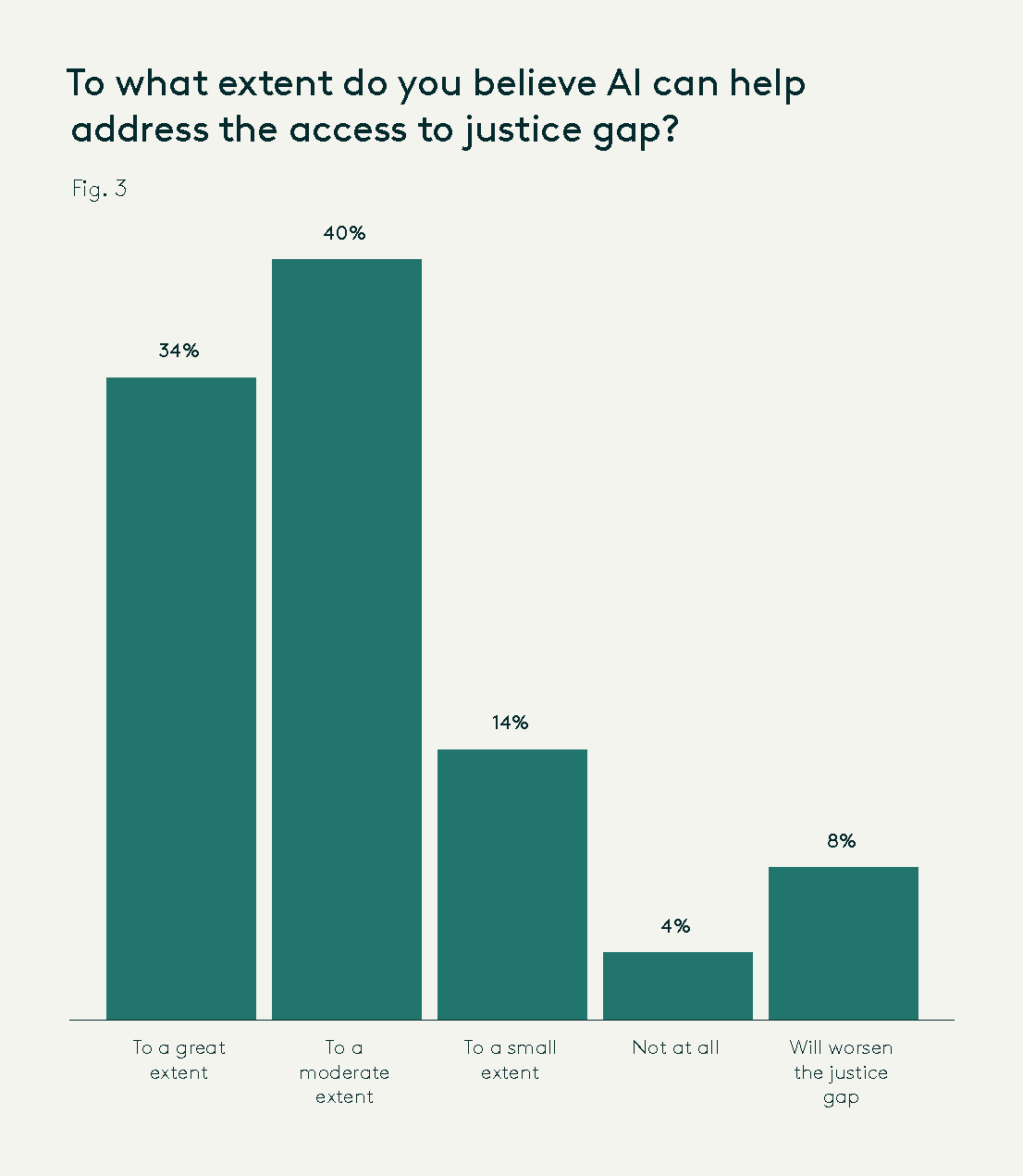
88%
of
respondents
believe
AI
can
help
address
the
access
to
justice
gap
to
some
extent,
with
34%
saying
it
can
help
“to
a
great
extent.”

This
widespread
belief
in
AI’s
transformative
potential
comes
against
the
backdrop
of
a
stark
justice
crisis
in
America.
According
to
the
study,
92%
of
civil
legal
problems
encountered
by
low-income
Americans
receive
no
or
inadequate
legal
help,
and
the
United
States
ranks
just
107th
out
of
142
countries
in
affordability
and
accessibility
of
civil
justice.

As
I
am
quoted
in
the
study
as
saying:


“This
survey
reveals
that
AI
adoption
is
not
just
happening
in
well-funded
BigLaw
firms

it
is
being
driven
by
organizations
serving
our
most
vulnerable
populations
When
88%
of
legal
aid
professionals
see
AI
as
a
tool
to
address
the
justice
gap,
that
underscores
its
potential
to
fundamentally
democratize
access
to
legal
services.”

Regular
Use
of
AI

The
survey
revealed
significant
integration
of
AI
into
the
daily
operations
of
legal
aid
organizations.
Among
the
112
legal
aid
professionals
surveyed
in
May
2025:

  • 40%
    reported
    using
    AI
    at
    least
    weekly.
  • 26%
    use
    it
    daily.
  • 12%
    use
    it
    multiple
    times
    per
    day.

Common
applications
include
document
summarization,
legal
research,
analysis,
translations,
and
development
work

showing
AI’s
versatility
across
different
aspects
of
legal
aid
practice.

Increasing
Client
Capacity


The
Legal
Services
Corporation
estimates
that
nearly
one
of
every
two
people
who
qualify
for
legal
aid
are
turned
away
due
to
lack
of
resources.

For
these
legal
aid
organizations
struggling
with
overwhelming
caseloads,
perhaps
one
of
the
survey’s
most
compelling
findings
is
that
90%
of
respondents
said
using
AI
to
its
full
potential
would
enable
them
to
serve
more
clients.

When
asked
to
quantify
potential
impact,
respondents
provided
specific
projections:

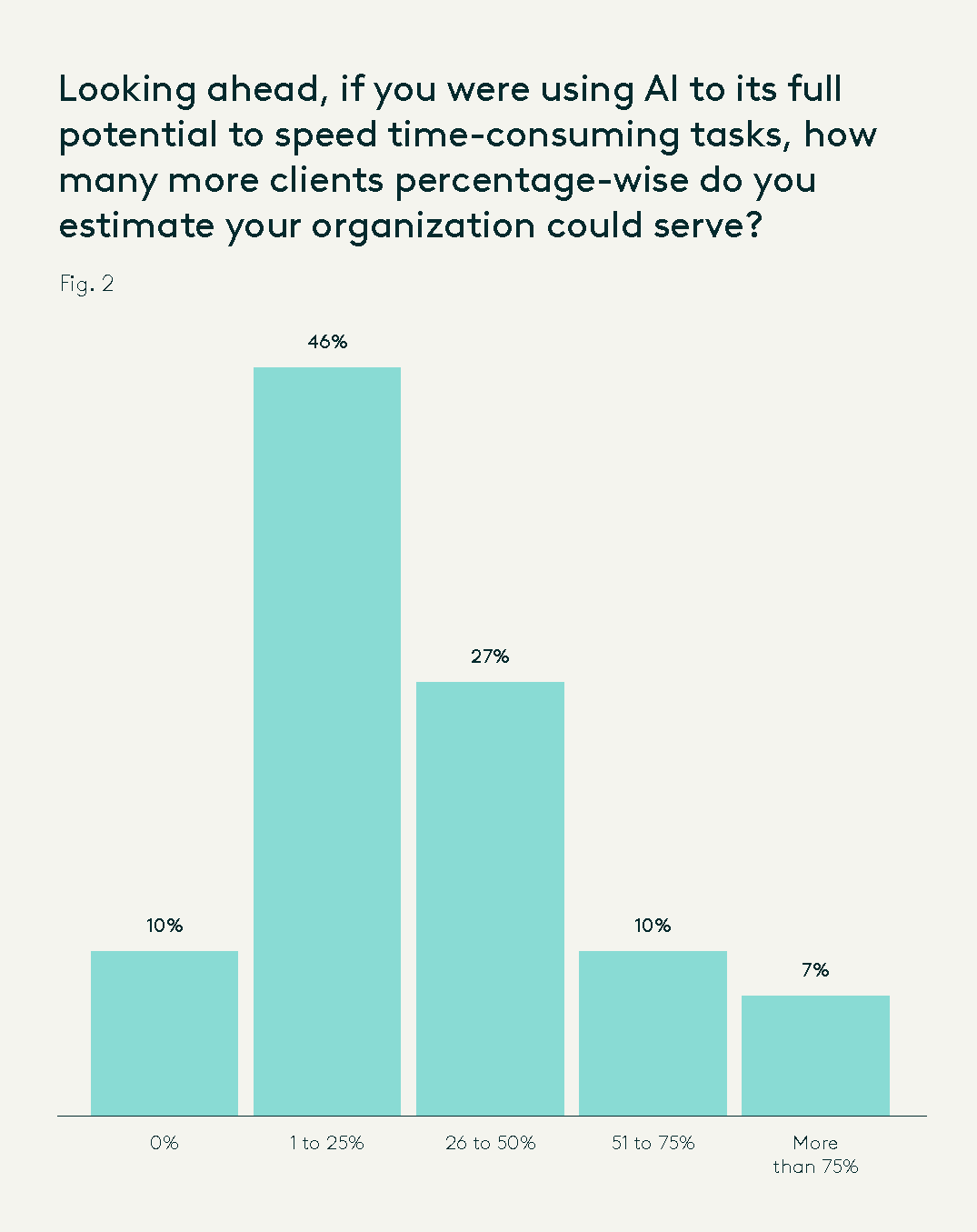
  • 46%
    estimated
    they
    could
    serve
    1-25%
    more
    clients.
  • 27%
    believed
    they
    could
    serve
    26-50%
    more
    clients.
  • 17%
    projected
    capacity
    increases
    of
    over
    50%.

“AI
presents
a
generational
opportunity
to
fundamentally
expand
who
has
access
to
justice,
but
it’s
not
a
foregone
conclusion,”
said
Joanne
Sprague,
head
of
Everlaw
for
Good.
“By
empowering
these
critical
legal
organizations
with
AI
tools,
we
can
make
a
real
difference
in
the
lives
of
millions.”

Implementation
Challenges
Remain

Despite
widespread
optimism,
the
survey
identified
significant
obstacles
to
full
AI
implementation.
The
top
areas
of
concern,
ranked
by
severity,
include:

  1. Data
    privacy
    and
    confidentiality
    (5.8
    out
    of
    10
    on
    concern
    scale).
  2. Hallucinations
    and
    AI
    quality
    (5.6
    out
    of
    10).
  3. Ethical
    and
    professional
    responsibility
    (5.0
    out
    of
    10).
  4. Prohibitive
    cost
    (3.6
    out
    of
    10).
  5. Lack
    of
    technical
    resources
    (3.2
    out
    of
    10).

These
challenges
highlight
the
complex
considerations
legal
aid
organizations
face
when
implementing
AI,
particularly
given
their
ethical
obligations
to
vulnerable
client
populations
and
limited
financial
resources.

Spotlight
on
North
Carolina

The
report
spotlights
Legal
Aid
of
North
Carolina
(LANC)
as
an
example
of
innovative
AI
implementation.
The
state’s
largest
nonprofit
law
firm
serves
300,000
people
annually
seeking
help
with
issues
such
as
domestic
violence
and
unlawful
eviction.

LANC
is
testing
an
AI-powered
voice
agent
for
initial
intake
that
operates
24/7
in
multiple
languages,
addressing
accessibility
challenges
for
clients
in
rural
areas
or
those
with
transportation
issues.

By
automating
this
foundational
step,
LANC’s
200
statewide
attorneys
can
focus
on
high-value
work
such
as
court
appearances
and
client
advocacy,
the
survey
notes.

“We
will
never
be
able
to
‘lawyer
ourselves’
out
of
this
access-to-justice
crisis,”
said
LANC’s
Chief
Innovation
Officer
Scheree
Gilchrist
in
the
survey
report.
“AI
is
a
force
multiplier
to
scale
our
services.”

A
Powerful
Tool
for
Legal
Aid

According
to
experts
cited
in
the
report,
the
study’s
findings
align
with
broader
observations
about
AI’s
democratizing
potential
in
legal
services.

“Generative
AI
offers
a
rare
chance
to
address
this
crisis,”
said
Kristen
Sonday,
cofounder
and
CEO
of
Paladin.
“It
can
democratize
legal
information,
simplify
processes,
and
offer
meaningful
legal
tools
at
scale.”

The
survey
results
suggest
that
legal
aid
organizations
view
AI
not
as
a
threat
to
legal
employment,
but
as
a
crucial
tool
for
expanding
access
to
justice.
The
technology
appears
to
be
enabling
these
organizations
to
stretch
limited
resources
further
while
maintaining
quality
representation
for
vulnerable
populations.

“Professionals
across
the
access
to
justice
community
are
embracing
this
technology
as
a
crucial
ally
in
the
long-term
fight
to
close
the
persistent
justice
gap,”
the
report
concludes.

“This
isn’t
about
automating
jobs
or
taking
work
away
from
lawyers;
it’s
about
equipping
advocates
with
a
powerful
new
instrument
to
manage
complex
caseloads,
streamline
tasks,
and
supercharge
their
capacity
to
serve
more
clients
more
effectively.”

Methodology
and
Participants

The
survey
was
conducted
in
May
2025
by
Everlaw
in
partnership
with
NLADA,
Paladin
and
LawSites.

It
surveyed
112
legal
aid
society
professionals,
examining
their
AI
usage
patterns,
perceptions
of
AI’s
potential
to
support
access
to
justice,
and
views
on
how
AI
might
help
their
organizations
better
serve
people
facing
housing,
family,
employment,
and
other
critical
legal
issues.

Morning Docket: 09.30.25 – Above the Law

*
DLA
Piper
must
face
pregnancy
bias
case.
[Reuters]

*
Google
will
give
Trump
$24.5
million
for
having
kicked
him
off
YouTube
after
January
6.
[Bloomberg
Law
News
]

*
Government
lawyers
who
raised
concerns
over
the
Trump
administration
breaching
the
Fair
Housing
Act
were
fired.
[New
York
Times
]

*
A
billion
dollar
valuation
for
another
AI-to-lawyers
startup.
[Bloomberg]

*
California
enacts
law
requiring
more
AI
safety
and
transparency.
[Law360]

*
A
deep
dive
into
allegations
that
the
Trump
administration
used
diplomatic
efforts
to
protect
El
Salvador’s
president
from
law
enforcement.
[ProPublica]

Travelers Stranded as TACV, Air Zimbabwe, and South African Airlink Abort 11 Flights Across Cape Verde, Botswana, South Africa and More at Airports like Praia, OR Tambo, Harare International and Maun


Travelers
stranded
 across Cape
Verde
Botswana,
and South
Africa
 are
facing
significant
disruption
as TACVAir
Zimbabwe
,
and South
African
Airlink
 abort
11
flights
.
These
cancellations
have
severely
affected
key airports including PraiaOR
Tambo
Harare
International
,
and Maun.
Passengers
scheduled
to
travel
from Praia
International
 (Cape
Verde)
to OR
Tambo
International
 (South
Africa)
and
from Harare
International
 (Zimbabwe)
to Maun (Botswana)
are
among
the
worst
hit.

The
disruption,
caused
by
unforeseen
operational
issues,
has
left
many
travelers
uncertain
about
their
next
steps.
As TACVAir
Zimbabwe
,
and South
African
Airlink
 deal
with
these
cancellations,
affected
passengers
are
being
advised
to
reach
out
to
their
respective
airlines
for rebooking and compensation options.
The
airlines
are
working
to
accommodate
the
passengers
on
the
next
available
flights.
However,
the delays continue
to
cause
widespread
inconvenience
across
these
major
travel
hubs.

Affected
Airlines


TACV
,
the
national
carrier
of
Cape
Verde,
has
been
the
most
affected,
with 8
cancellations
 (24%)
and 2
delays
 (6%)
in
its
flights.
This
has
resulted
in
a
number
of disruptions between
Cape
Verde
and
South
Africa,
causing
frustration
for
travelers
expecting
smooth
connections.

Meanwhile, Air
Zimbabwe
 has
faced 2
cancellations
 (20%)
but
no
delays.
While
the
number
of
cancellations
is
comparatively
lower,
this
still
represents
a
significant
disruption
for
passengers
traveling
between
Zimbabwe
and
South
Africa.

On
the
other
hand, South
African
Airlink
 has
faced
one cancellation,
but
the
airline
has
been
notably
impacted
by 83
delays
 (28%).
This
indicates
a
large
number
of
passengers
who
were
forced
to
wait
longer
than
expected,
often
disrupting
their
travel
schedules.

Airports,
Cities,
and
Countries
Affected

The
disruptions
have
affected
key
airports
across
Southern
Africa
and
beyond.
Flights
operated
by
TACV,
Air
Zimbabwe,
and
South
African
Airlink
have
been
disrupted
at
various
major
airports.

Advertisement

For TACV,
passengers
flying
from
Praia
International
Airport
(RAI
/
GVNP)
in
Cape
Verde
to OR
Tambo
International
Airport
 (JNB
/
FAOR)
in
Johannesburg,
South
Africa,
faced
significant
delays
and
cancellations.
Similarly,
flights
from
Rabil
(BVC
/
GVBA)
to
Amilcar
Cabral
International
Airport
(SID
/
GVAC)
were
also
affected,
with
multiple
cancellations
and
delays.


Air
Zimbabwe
 passengers
traveling
from Harare
International
Airport
 (HRE
/
FVRG)
to
Johannesburg
were
also
impacted
by
the
cancellations,
which
left
many
passengers
stranded
or
seeking
alternative
arrangements.


South
African
Airlink
 flights
from
Maun
(MUB
/
FBMN)
in
Botswana
to
Johannesburg
(JNB
/
FAOR)
experienced
widespread
delays.
This
left
passengers
waiting
for
extended
periods,
causing
significant
disruptions
to
their
travel
plans.

Total
Delays
and
Cancellations

Across
the
three
airlines,
a
significant
number
of
flights
have
been
disrupted.
TACV
saw 8
cancellations
 and 2
delays
,
while
Air
Zimbabwe
faced 2
cancellations
 with
no
delays.
South
African
Airlink,
however,
experienced 1
cancellation
 and
a
staggering 83
delays
,
reflecting
the
scale
of
disruption
and
the
impact
on
a
large
number
of
travelers.

This
large
proportion
of
delays
with
South
African
Airlink
indicates
that
many
passengers
were
not
only
affected
by
cancellations
but
also
had
to
contend
with
long
waiting
times
at
airports.
With
28%
of
their
flights
delayed,
passengers
could
face
considerable
inconvenience.

What
Affected
Passengers
Can
Do
Now

For
those
affected
by
the
cancellations
and
delays,
it’s
important
to
stay
informed
and
take
appropriate
steps
to
minimize
the
disruption.
First
and
foremost,
passengers
should
reach
out
to
their
airlines
directly
to
inquire
about
their
specific
flight’s
status.
Many
airlines,
including
TACV,
Air
Zimbabwe,
and
South
African
Airlink,
offer
rebooking
services,
and
they
may
be
able
to
accommodate
passengers
on
the
next
available
flight.

Additionally,
staying
updated
on
flight
statuses
is
crucial,
as
delays
and
cancellations
can
often
change
rapidly.
Passengers
should
monitor
airport
information
screens
and
check
with
the
airline
via
their
website
or
customer
service
numbers.

Passengers
who
experience
delays
or
cancellations
may
also
be
entitled
to
compensation,
depending
on
the
airline’s
policy
and
the
nature
of
the
disruption.
Compensation
may
include
meal
vouchers,
hotel
accommodations,
or
even
a
full
refund
in
some
cases.
For
longer
delays,
passengers
are
encouraged
to
ask
about
alternative
routes
or
connecting
flights,
especially
if
their
initial
departure
time
has
been
significantly
altered.

If
passengers
have
travel
insurance,
it’s
advisable
to
check
the
policy
for
any
coverage
related
to
flight
disruptions.
Many
travel
insurance
policies
offer
compensation
for
delays,
cancellations,
and
other
related
inconveniences.

Conclusion

These
travel
disruptions
have
impacted
many
passengers,
particularly
those
traveling
on
international
routes
between
Southern
Africa
and
Cape
Verde.
While
some
airlines
have
been
hit
harder
than
others,
the
disruptions
serve
as
a
reminder
of
the
challenges
travelers
may
face
due
to
unforeseen
circumstances.
Passengers
are
urged
to
stay
updated
on
their
flight
status
and
communicate
with
their
airline
to
explore
rebooking
options
or
compensation
opportunities.

Source:
FlightAware

Post
published
in:

Featured

Mauritius Leads, Zimbabwe Trails in Africa’s 2025 Economic Freedom Ranking

Mauritius
remains
Africa’s
most
“economically
free”
country,
according
to
the
“Economic
Freedom
of
the
World
2025”
report
released
on
September
25,
2025,
by
the
Fraser
Institute,
a
Canadian
think
tank.
The
report
assesses
the
state
of
economic
liberty
across
165
countries
and
territories
based
on
45
distinct
indices
grouped
into
five
broad
categories.

The
categories
measured
are:
Size
of
Government
(including
tax
rates,
public
ownership,
and
government
investment);
Legal
System
and
Property
Rights
(judicial
independence,
military
interference,
and
police
effectiveness);
Sound
Money
(money
supply
growth,
inflation,
and
foreign
currency
accounts);
Freedom
to
Trade
Internationally
(average
tariff
rates,
capital
controls,
and
trade
barriers);
and
Regulation
(bank
ownership,
interest
rate
controls,
and
labor
market
rules).

Each
index
is
scored
from
0
(least
free)
to
10
points
(most
free).
These
scores
are
then
equally
weighted
and
aggregated
to
create
a
value
for
each
of
the
five
major
categories.
A
country’s
overall
score,
which
also
ranges
from
0
to
10,
is
the
average
of
the
five
category
scores.
Mauritius
ranked
21st
globally
with
an
overall
score
of
7.76
points.
The
Indian
Ocean
island
nation
achieved
its
best
performance
in
Freedom
to
Trade
Internationally
(8.76
points)
and
Sound
Money
(8.61
points).

With
a
score
of
7.58
points,
the
Seychelles
ranked
second
in
Africa
and
31st
globally.
They
were
followed
by
Cape
Verde
(44th),
Gambia
(68th),
Botswana
(69th),
Uganda
(72nd),
Kenya
(81st),
and
South
Africa
(83rd).
Morocco
and
Namibia
tied
for
94th
place
in
the
global
ranking,
completing
the
African
Top
10.
The
continent’s
least
economically
free
countries
were
Chad
(156th
globally),
Libya
(157th),
Algeria
(162nd),
Sudan
(163rd),
and
Zimbabwe
(164th).

Globally,
Hong
Kong
maintained
its
position
as
the
freest
economy
with
a
score
of
8.85
points,
ahead
of
Singapore,
New
Zealand,
Switzerland,
and
the
United
States.

The
ranking
also
highlighted
a
strong
statistical
correlation
between
a
nation’s
level
of
economic
freedom
and
both
its
GDP
growth
rate
and
average
income
level.
This
correlation
is
attributed
to
the
fact
that
economic
agents
operate
more
efficiently
when
they
have
the
right
to
initiative
and
are
motivated
to
innovate,
work,
and
save.


Walid
Kéfi


African
Countries
Ranked
by
Economic
Freedom,
2025


 Rank
in
Africa

Country

Global
Ranking
1 Mauritius 21
2 Seychelles 31
3 Cape
Verde
44
4 Gambia 68
5 Botswana 69
6 Uganda 72
7 Kenya 81
8 South
Africa
83
9 Morocco 94
10 Namibia 94
11 Rwanda 97
12 Benin 98
13 Somalia 101
14 Burkina
Faso
102
15 Tanzania 102
16 Zambia 104
17 Mozambique 105
18 Senegal 107
19 Liberia 109
20 Djibouti 110
21 Mauritania 111
22 Ivory
Coast
113
23 Togo 115
24 Madagascar 117
25 Lesotho 121
26 Nigeria 123
27 Tunisia 124
28 Guinea 125
29 Niger 125
30 Ghana 128
31 Mali 130
32 Cameroon 133
33 Sierra
Leone
135
34 Comoros 136
35 Eswatini 140
36 Guinea-Bissau 142
37 Gabon 143
38 Angola 146
39 Malawi 147
40 Egypt 149
41 Democratic
Republic
of
the
Congo
151
42 Burundi 152
43 Ethiopia 152
44 Central
African
Republic
154
45 Republic
of
the
Congo
155
46 Chad 156
47 Libya 157
48 Algeria 162
49 Sudan 163
50 Zimbabwe 164

Darkness descends — Eskom confirms blackout in Zambia and Zimbabwe after ‘incident’


Darkness
descends

Eskom
confirms
blackout
in
Zambia
and
Zimbabwe
after
‘incident’
© Copyright
(c)
Daily
Maverick
,
All
Rights
Reserved

At
around
12.55
on
Tuesday
afternoon,
the
lights
flickered
and
then
failed
across
Zimbabwe
and
Zambia.
This
synchronised
blackout,
the second in
recent
weeks,
was
triggered
by
cascading
failures
in
the
Southern
African
Power
Pool
(SAPP)

a
cooperative
framework
meant
to
bolster
regional
energy
resilience.

Towards
the
end
of
November,
another
such
blackout
occurred
which
was attributed to
“an
unexpected
development
on
the
Zambia-Zimbabwe interconnector”.

The
National
Transmission
Company
of
South
Africa
(NTCSA)

a
wholly
owned
subsidiary
of
Eskom

told
Daily
Maverick
that
Tuesday’s
incident
was
not
a
“power
surge”,
but
rather
an
“incident,
event
or
fault”.

“The
tripping
of
lines
occurs
automatically
to
protect
the
power
system
and
power
equipment,
and
it
is
misleading
to
suggest
that
Eskom
took
a
decision
to
disconnect
the
SAPP
region.”


SAPP
SADC
grid
map.
 (Source: SAPP)

The
Zimbabwe
Electricity
Transmission
and
Distribution
Company
(ZETDC)
said
an
“imbalance
in
power
on
the
international
connections”
caused
the
blackout.

In
statement,
the
ZETDC
said,
“[Zimbabwe
Electricity
Supply]
Holdings
would
like
to
advise
its
valued
customers
that
the
national
grid
experienced
a
system
disturbance
which
resulted
in
a
national
blackout
on
Tuesday,
December
17,
2024,
at
1255
hours.
This
incident
was
caused
by
an
imbalance
in
power
on
the
international
connections
which
affected
the
national
grid
of
Zimbabwe
and
some
parts
of
the
region.

“Restoration
to
most
parts
of
the
country
has
been
completed,
except
for
areas
under
load
shedding.”

The
incident
is
being
investigated
by
the
SAPP
Coordination
Centre
based
in
Harare.

The Lusaka
Times
reported
 that
on
Monday,
a
day
before
the
blackout,
Zimbabwe’s
power
generation
plummeted
to
its
lowest
level
in
more
than
12
months,
with
daily
electricity
production
hitting
736MW.
For
context,
just
one
of
Koeberg
Nuclear
Power
Station’s
two
units
can
produce
970MW.

Eskom
is
Africa’s
largest
electricity
producer,
supplying
nearly
30%
of
the
continent’s
power.
Accordingly,
it
plays
a
critical
role
in
the
SAPP.

Complementing
this
is
the
NTCSA,
which
operates
under
a
National
Energy
Regulator
of
South
Africa-issued
licence
which
allows
the
NTCSA
to
manage
imports,
exports
and
the
trade
of
electricity
within
the
SAPP,
ensuring
the
interconnected
grid
functions
smoothly
and
efficiently. DM

Post
published
in:

Featured

Byo urgently needs new provincial and district hospitals to decongest central hospitals

Dr
Siamuchembu
stresses
that
expanding
healthcare
infrastructure
is
essential
to
achieving
universal
access
to
health
in
Bulawayo.

In
an
interview
with
CITE,
the
PMD
said
the
current
system
forces
central
hospitals
to
operate
like
large
district
hospitals,
limiting
their
capacity
to
handle
complex
medical
cases.

“Basically,
the
central
hospitals
are
working
like
big
district
hospitals.
At
night,
everybody
flocks
to
Mpilo
and
UBH
because
all
the
clinics
are
closed,”
he
said.

The
solution,
according
to Dr
Siamuchembu lies
in
establishing
more
district-level
and
provincial
health
facilities.

“We
think
that
our
central
hospitals

Mpilo,
UBH
and
Ingutsheni
are
swamped
by
sicknesses
and
illnesses
that
should
be
managed
at
lower
level
health
facilities,”
he
said.

“So
to
decongest
the
central
hospitals,
I
would
like
to
have
three
district
level
hospitals
and
one
provincial
level
hospital.
Yes,
one
provincial
hospital,
three
district
hospitals.”

Dr
Siamuchembu
explained
that
Bulawayo
Metropolitan
Province
has
three
administrative
districts
under
the
Ministry
of
Health
and
Child
Care,
which
are
Emakhandeni,
Nkulumane
and
the
Northern
Suburbs,
with
each
of
those
needing
a
district
hospital.

“Then
I
think
we
need
a
provincial
hospital,
where
the
district
hospitals
can
be
referring
to,
before
patients
are
referred
to
the
Apex
hospitals,
which
are
the
central
hospitals,”
said
the
PMD.

He
also
stressed
having
additional
hospitals
would
allow
Mpilo,
UBH,
and
Ingutsheni
to
focus
on
specialised
care
and
complex
cases.

“That
would
leave
the
central
hospitals
to
provide
just
the
specialised
care
or
cater
for
complex
management
of
conditions,”
he
said.

Dr
Siamuchembu
said
he
has
engaged
the
Ministry
of
Health
and
Child
Care,
which
is
still
assessing
the
proposal
and
trying
to
secure
funding,
adding
that
as
a
medical
professional
he
hopes
the
plan
comes
to
fruition
and
welcomes
support
from
well-wishers.

“Yes
I
have
engaged
with
our
parent
ministry
and
they
are
looking
at
it.
They
are
still
trying
to
find
money
for
that.
Yes,
it’s
something
that
they’re
still
assessing.
This
is
something
that
I
hope
comes
true.
So
if
we
can
push
well
wishers,
good,”
he
said.

Although
funding
remains
a
challenge,
the PMD
hoped
the
Ministry
of
Finance
will
allocate
necessary
resources
for
the
province
to
achieve
universal
health
access
by
2030.

Dr
Siamuchembu
also
said
that
his
role
as
PMD
involves
assessing
the
healthcare
needs
of
Bulawayo
residents
and
communicating
them
to
the
government.

“I
am
a
provincial
medical
director
and
my
job
is
to
assess
the
needs
of
the
citizens
or
the
residents
of
my
province
and
tell
government
that
for
us
to
achieve
universal
access
to
health
by
2030,
this
is
what
we
need
in
Bulawayo
Metropolitan
Province.”

As
for
the
location
for
the
new
facilities,
the
PMD
said
these
were
still
under
consideration.

“We
will
have
to
assess
and
decide
which,
what
location
is
best.
One
of
our
dreams
is
to
integrate
mental
health
services
with
other
clinical
services
at
Ingutsheni.
So
Ingutsheni
is
a
possible
location
for
the
provincial
hospital.
Yeah.
But
we’ll
have
to
consult
with
all
the
stakeholders
and
agree
what
the
best
location
is.”

Dr
Siamuchembu
said
he
has
also
engaged
private
partners
on
this
initiative.

“Yes,
there
is
a
trust
or
an
organisation
that
came
to
my
office.
They
said
they
wanted
to
build
a
hospital
in
Nketa
in
memory
of
someone
important
to
them.
They
wanted
my
advice
and
I
told
them,
what
would
work
is
if
they
looked
at
the
provincial
desires
and
build
the
hospital
in
line
with
these
desires,”
he
said.

“So
they
said
they
were
going
to
look
at
it
and
come
back
to
me.
I’m
still
waiting
for
them
to
come
back.
It’s
been
maybe
two
months
ago.“

The
PMD
clarified
that
while
central
hospitals
are
not
overwhelmed,
minor
ailments
dominate
patient
visits.

“I
don’t
have
the
statistics
off
my
head
as
to
how
many
patients
pass
through
the
central
hospitals
but
understand
that
I
did
not
say
Mpilo
or
UBH
overwhelmed.
I
said
they
are
swamped
by
minor
ailments,”
he
said.