You
can’t
overstate
the
importance
of
the
indictment
of
former
FBI
Director
James
Comey.
Despite
the
weak
protests
of
the
Vice
President,
the
move
smacks
of
bald
faced
political
retribution
on
evidence
so
flimsy
Erik
Siebert,
the
career
prosecutor
—
appointed
by
Donald
Trump,
no
less
—
at
the
Eastern
District
of
Virginia
was
forced
out
of
his
job
for
refusing
to
bring
these
personally
motivated
charges
(and
ones
against
another
Trump
enemy,
New
York
Attorney
General
Letitia
James).
Siebert
was
replaced
by
Trump
flunkie
Lindsey
Halligan,
who
I’d
refer
to
as
deeply
unserious
if
she
didn’t
wield
so
much
undeserved
power.
And,
she’s
already
objectively
embarrassing
at
her
job.
Former
White
House
attorney
and
current
thorn
in
Donald
Trump’s
side
Ty
Cobb
told
MSNBC’s
Alex
Witt
“we
should
be
scared
to
death”
over
the
indictment
and
the
obvious
threat
it
poses
to
democracy.
There’s
“justifiable
paranoia”
that
others
who
have
crossed
the
president
will
also
be
churned
through
the
criminal
justice
system
as
the
president
keeps
pushing
these
vendettas.
Given
the
sky
high
stakes
of
the
case,
many
are
wondering
who
is
handling
Comey’s
criminal
case?
Repping
Comey
is
Michigan
solo
practitioner
Patrick
Fitzgerald.
Fitzgerald
is
a
retired
Skadden
partner
who
previously
represented
Comey
after
he
was
fired
by
Trump
as
FBI
Director.
He
has
a
long
personal
history
with
Comey
and
the
two
met
when
they
were
with
the
U.S.
Attorney’s
office
in
Manhattan.
That’s
right,
unlike
Halligan,
the
defense
team
actually
has
prosecutorial
experience!
In
fact,
Fitzgerald
led
a
number
of
high
profile
prosecutions
including
those
against
former
Illinois
governors
George
Ryan
and
Rod
Blagojevich, 1993
World
Trade
Center
bombing
mastermind
Sheikh
Omar
Abdel
Rahman,
and
Dick
Cheney’s
Chief
of
Staff
Scooter
Libby.
Comey
also
has
local
counsel
in
Jessica
Carmichael,
one
of
the
founders
of
Virginia-based
Carmichael
Ellis
&
Brock
with
previous
experience
in
the
Federal
Public
Defender’s
Office.
Comey
has
expressed
confidence
in
the
legal
system
posting
on
Instagram
that
he’s
“not
afraid,
and
I
hope
you’re
not
either.”
Though
he
noted,
“My
heart
is
broken
for
the
Department
of
Justice,
but
I
have
great
confidence
in
the
federal
judicial
system,
and
I’m
innocent.
So
let’s
have
a
trial
and
keep
the
faith.”
Kathryn
Rubino
is
a
Senior
Editor
at
Above
the
Law,
host
of
The
Jabot
podcast,
and
co-host
of
Thinking
Like
A
Lawyer.
AtL
tipsters
are
the
best,
so
please
connect
with
her.
Feel
free
to
email
her
with
any
tips,
questions,
or
comments
and
follow
her
on
Twitter
@Kathryn1 or
Mastodon
@[email protected].
These
are
not
ordinary
times.
The
indictment
of
former
FBI
Director
James
Comey
is
the
latest—and
most
troubling—action
by
a
Justice
Department
increasingly
wielded
as
the
personal
instrument
of
the
President
of
the
United
States.
The
circumstances
surrounding
this
indictment
reflect
a
profound
betrayal
of
the
American
principle
of
prosecutorial
independence
and
discretion.
As
President
Trump
himself
warned:
“There’ll
be
others.” These
words
underscore
the
peril
of
this
moment.
We
are
at
a
turning
point
in
our
history.
—
An
excerpt
from
a
statement
issued
by
the
New
York
City
Bar
Association,
which
discusses
all
of
the
ways
that
President
Donald
Trump’s
“[weaponization
of
the]
Justice
Department
is
antithetical
to
democracy.”
The
New
York
City
Bar
Association
goes
on
to
“reaffirm[]
its
unwavering
commitment
to
prosecutorial
independence,
the
impartial
administration
of
justice,
and
the
preservation
of
constitutional
norms.
Consistent
with
its
mission
and
long
history,
the
City
Bar
speaks
out:
the
justice
system
must
never
be
used
as
a
weapon
of
politics.
Speaking
out
now
is
not
optional.
It
is
our
collective
duty.”
Click
here
to
read
the
full
statement.
Staci
Zaretsky is
the
managing
editor
of
Above
the
Law,
where
she’s
worked
since
2011.
She’d
love
to
hear
from
you,
so
please
feel
free
to
email
her
with
any
tips,
questions,
comments,
or
critiques.
You
can
follow
her
on Bluesky, X/Twitter,
and Threads, or
connect
with
her
on LinkedIn.
Adelson
then
launched
a
Hail
Mary
effort
to
get
a
new
trial,
citing
juror
media
use.
The
judge
has
now
rejected
that
bid:
Juror
No.
7
had
posted
on
TikTok
during
the
trial
that
she
had
been
selected
as
a
juror,
Adelson’s
lawyers said
in
a
new
trial
motion.
But
Everett
said
the
juror
did
not
reveal
the
parties
in
the
case,
the
attorneys,
the
alleged
crimes,
whether
it
was
criminal
or
civil,
or
even
the
location
of
the
trial.
As
a
result,
she
did
not
communicate
“about
this
case”
as
banned
by
jury
instructions,
he
concluded.
The
text
displayed
over
juror
No.
7’s
video
had
said,
“When
I
told
God
I
needed
a
break,
and
he
makes
it
so
I
am
selected
to
serve
on
a
jury
for
a
two
week
trial…
won’t
he
do
it,”
and
included
a
happy
face.
A
caption
read,
“No
work,
no
kids
(for
most
of
the
day)
yk
what…
heaven
yeah.”
Sing
it,
sister.
While
perhaps
betraying
a
lack
of
appreciation
for
the
gravity
of
the
civic
duty
at
hand
to
describe
it
as
a
state-sponsored
vacation,
there’s
nothing
explicitly
wrong
with
indicating
that
you’re
on
jury
duty.
The
more
nuanced
argument
contends
that
this
description
provided
enough
for
someone
to
work
out
what
trial
the
juror
would
hear,
but
that
proved
a
stretch
without
any
other
information.
Adelson
also
complained
of
the
juror
talking
about
the
experience
after
the
trial
—
which
is
actually
fine
—
and
another
juror
who
told
a
podcast
after
the
fact
that
he’d
paid
attention
to
the
defendant’s
reaction
to
testimony
even
though
he’d
said
he
hadn’t
done
that
in
other
comments.
The
judge
brushed
away
that
concern
too,
explaining
that
there’s
nothing
wrong
with
observing
the
defendant.
With
Adelson
not
getting
a
new
trial,
the
case
will
move
forward
to
sentencing.
The
legal
industry,
known
for
its
reliance
on
precedent
and
time-tested
review,
is
undergoing
a
shift
in
philosophy
driven
not
by
changing
laws,
but
by
evolving,
transformative
technologies.
Advanced
artificial
intelligence
(AI)
is
not
just
automating
repetitive
tasks;
it
is
redefining
how
legal
professionals
access
and
leverage
critical
information
in
real
time.
From
streamlining
workflows
to
unlocking
courtroom
insights,
AI
is
enabling
attorneys,
court
reporters,
and
legal
technologists
to
operate
with
unprecedented
efficiency
and
intelligence.
From
Manual
Tasks
to
Strategic
Execution
Historically,
much
of
a
lawyer’s
attention
was
consumed
by
time-intensive
manual
work,
such
as
reviewing
and
summarizing
testimony,
cross-referencing
against
other
discovery
materials,
conducting
legal
research,
and
identifying
key
insights.
AI
adoption
empowers
modern
lawyers
to
streamline
these
tasks,
surface
relevant
information
more
quickly,
and
make
sharper,
data-driven
decisions
in
real-time.
Today’s
AI-driven
systems
and
platforms
can
automatically
transcribe
legal
proceedings,
identify
key
themes
and
insights,
and
generate
accurate
summaries,
enabling
legal
teams
to
devote
more
time
to
higher-value
activities,
such
as
developing
case
strategy
and
preparing
for
trial.
What
sets
today’s
AI
solutions
apart
from
early
automation
tools
(and
AI
models
from
a
few
years
ago)
is
their
ability
to
interpret
context,
tone,
and
legal
relevance.
Using
natural
language
processing,
voice
recognition,
and
large
language
models,
modern
AI
can
understand
complex
legal
language
and
help
legal
professionals
capture,
comprehend,
and
apply
actionable
insights,
marking
a
significant
shift
from
process
support
to
true
strategic
enablement.
Enhanced
Deposition
Coverage
Through
AI-Powered
Court
Reporting
Nowhere
is
this
transformation
more
apparent
than
in
the
evolving
world
of
court
reporting.
Court
reporting
professionals
must
provide
accurate,
reliable
records
of
legal
proceedings;
the
pressure
to
deliver
quickly
and
efficiently
has
never
been
greater.
New
AI
tools
and
platforms
are
arming
professionals
with
scalable,
cloud-based
solutions
that
improve
the
speed
and
quality
of
their
work.
Court
reporters
can
generate
real-time
transcripts
with
speaker
IDs
that
enhance
accuracy,
support
faster
turnaround
times,
and
create
a
searchable
record
of
events.
With
secure
login
access,
other
members
of
the
case
team
can
also
access
the
same
information
remotely,
reducing
bottlenecks
and
enhancing
collaboration.
Turning
Transcripts
into
Intelligence
with
Gen
AI
AI’s
role
goes
beyond
converting
speech
to
text.
By
leveraging
accurately
generated
transcripts
with
speaker
IDs,
generative
AI
provides
immediate
insights
that
would
previously
have
required
extensive
manual
review,
thereby
creating
a
strategic
edge.
Tools
powered
by
large
language
models
can
generate
executive
summaries
of
depositions
and
other
proceedings,
flag
inconsistencies
within
the
testimony
or
against
other
materials,
and
draft
follow-up
questions
for
cross-examinations.
Legal
professionals
can
also
interact
with
these
tools
conversationally,
asking,
for
instance,
“Did
the
witness
contradict
himself?”
or
“Are
there
any
gaps
in
the
timeline
described
by
the
witness?”
Seamless
Integration
into
Legal
Workflows
One
of
the
biggest
strengths
of
today’s
AI
tools
is
their
ability
to
plug
right
into
the
platforms
that
legal
teams
already
rely
on.
From
litigation
and
eDiscovery
software
to
law
firm
case
management
systems,
these
AI-driven
solutions
are
designed
to
integrate
seamlessly
within
existing
workflows,
resulting
in
faster
adoption,
reduced
training
requirements,
and
a
more
immediate
impact.
Beyond
Human
Limits
Lawyers
using
AI
tools
can
make
more
informed
and
more
timely
decisions.
They
can
spot
patterns
that
might
be
invisible
to
the
human
eye,
surface
anomalies
across
documents,
and
identify
high-risk
issues
earlier
in
the
litigation
process.
By
combining
human
judgment
with
machine-driven
intelligence,
legal
teams
of
all
sizes
can
act
with
greater
confidence
and
agility.
Security,
Privacy,
and
Trust
Data
security,
privacy,
and
trust
remain
primary
concerns
as
AI
becomes
increasingly
embedded
in
legal
workflows,
given
the
sensitive
and
personal
nature
of
the
client
information
at
stake.
Leading
legal
AI
providers
incorporate
best
practices,
including
end-to-end
encryption
in
transit
and
at
rest,
secure
cloud
storage,
and
strict
access
controls,
to
ensure
that
confidential
data
is
protected
at
every
stage
of
the
legal
process
and
that
solutions
meet
the
stringent
compliance
and
security
standards
of
the
legal
sector.
Most
also
will
combine
enterprise-grade
security
with
domain-specific
AI
training
to
ensure
that
legal
terminology,
courtroom
protocol,
and
jurisdictional
nuances
are
handled
with
precision.
The
Future
of
Legal
Work
The
legal
industry
is
entering
a
new
era,
one
in
which
AI
is
redefining
workflows.
By
enabling
legal
professionals
to
capture
more
accurate
information
in
real-time,
extract
insights
from
transcripts,
and
seamlessly
integrate
data
into
case
strategies,
AI
has
become
a
crucial
tool
for
litigation
success.
As
court
reporters,
legal
technologists,
and
lawyers
continue
to
adopt
these
innovations,
the
result
will
be
a
more
efficient,
equitable,
and
impactful
legal
system.
AI
goes
beyond
changing
how
legal
work
is
done.
It
is
transforming
what
is
possible.
Matan
Barak
is
the
Head
of
Legal
Products
at
Verbit,
with
over
a
decade
of
experience
leading
AI-driven
solutions
to
market.
He
played
a
key
role
in
developing
and
launching
Verbit
Legal
Visor,
a
real-time
intelligence
platform
for
litigators
that
enhances
legal
professionals’
efficiency
with
AI-powered
insights,
including
inconsistency
detection,
intelligent
search,
and
summaries
to
help
secure
better
case
outcomes.
When
I
first
heard
Tyler
Quillin,
principal
corporate
counsel
at
Microsoft,
say
that
he
asks
engineers
to
“explain
it
to
me
like
I’m
an
eighth
grader,”
I
had
to
laugh.
Not
because
it
was
funny,
although
the
image
of
an
Xbox
hardware
engineer
breaking
down
technical
specs
like
a
middle
school
science
project
is
objectively
charming,
but
because
I’ve
been
there.
Tyler
supports
Xbox
hardware
devices
and
accessories,
meaning
his
daily
work
involves
translating
between
engineers,
executives,
and,
increasingly,
regulators.
It
is
a
role
where
technical
complexity
is
the
default.
Instead
of
nodding
along
to
words
he
doesn’t
fully
understand,
Tyler
has
learned
to
slow
the
conversation
down
deliberately.
“Sometimes
I’ll
ask
them
to
say
it
again,
slower,
or
explain
it
like
I’m
10,”
he
told
me.
“Then
I’ll
work
my
way
back
until
I
can
really
grok
it.”
I
have
used
a
similar
trick
for
years,
but
my
go-to
is
eighth
grade.
The
reason
is
simple.
U.S.
consumer
protection
rules
often
recommend
that
critical
disclosures
be
written
at
about
an
eighth-grade
reading
level.
When
I
tell
engineers
this,
they
stop
seeing
my
request
as
a
confession
of
ignorance
and
start
seeing
it
as
a
shared
goal:
making
our
language
work
for
the
people
who
will
actually
use
the
product.
Why
This
Matters
In
Contracting
If
you
have
ever
read
your
own
company’s
end-user
license
agreement
and
felt
your
eyes
glaze
over,
you
already
know
the
problem.
Contracts
are
too
often
written
at
a
level
that
requires
a
law
degree
and
a
strong
pot
of
coffee
to
understand.
That
is
not
just
a
usability
issue.
It
is
a
compliance
risk.
When
customers,
partners,
or
even
internal
stakeholders
cannot
grasp
the
meaning
of
their
contractual
obligations,
the
chance
of
misunderstanding,
delay,
or
outright
breach
skyrockets.
Tyler
put
it
plainly
when
we
discussed
regulatory
interactions.
“The
disconnect
often
comes
when
regulators
don’t
entirely
understand
how
the
industry
or
product
functions.
So
it’s
critical
to
open
up
those
conversations,
educate
them
on
what
the
product
does
and
doesn’t
do,
and
find
a
path
to
meet
their
goals.”
That
is
equally
true
for
contracts.
If
the
words
do
not
clearly
convey
the
deal,
you
are
asking
for
trouble.
The
In-House
Counsel
As
Translator
The
job
of
in-house
counsel
is
not
only
to
get
the
deal
done
or
make
the
language
airtight.
It
is
to
make
the
deal
and
its
terms
understandable
to
everyone
who
has
to
operate
under
it.
That
means
using
plain
language
where
possible,
avoiding
internal
jargon
that
only
makes
sense
inside
your
department,
and
anticipating
where
a
regulator,
counterparty,
or
internal
team
might
misunderstand
a
term
so
you
can
clarify
before
it
becomes
an
issue.
Your
audience
might
not
be
one
group.
You
are
often
speaking
to
multiple
stakeholders
at
once:
engineers
building
the
product,
regulators
shaping
its
market,
customers
buying
it,
and
executives
approving
the
deal.
Each
has
a
different
starting
point
of
understanding,
but
they
all
have
to
walk
away
clear
on
what
the
words
mean.
Making
Simplicity
A
Strategic
Advantage
Clarity
is
not
just
a
kindness.
It
is
a
competitive
advantage.
If
your
contracts
are
easier
to
understand
than
your
competitor’s,
you
will
close
faster,
reduce
post-signature
disputes,
and
build
trust
with
both
counterparties
and
internal
teams.
And
if
you
ever
need
a
real-world
example
of
how
simplifying
the
message
opens
doors,
just
remember
Tyler’s
eighth
grader.
“It
is
not
about
being
the
dumbest
person
in
the
room,”
he
said.
“It
is
about
making
sure
we
can
all
speak
the
same
language
because
that
is
how
you
actually
get
things
done.”
The
next
time
you
are
drafting
or
negotiating,
ask
yourself
if
an
eighth
grader
could
explain
this
back
to
you.
If
not,
your
work
is
not
finished
yet.
Olga V.
Mack is
the
CEO
of TermScout,
an
AI-powered
contract
certification
platform
that
accelerates
revenue
and
eliminates
friction
by
certifying
contracts
as
fair,
balanced,
and
market-ready.
A
serial
CEO
and
legal
tech
executive,
she
previously
led
a
company
through
a
successful
acquisition
by
LexisNexis. Olga is
also
a Fellow
at
CodeX,
The
Stanford
Center
for
Legal
Informatics,
and
the
Generative
AI
Editor
at
law.MIT.
She
is
a
visionary
executive
reshaping
how
we
law—how
legal
systems
are
built,
experienced,
and
trusted. Olga teaches
at
Berkeley
Law,
lectures
widely,
and
advises
companies
of
all
sizes,
as
well
as
boards
and
institutions.
An
award-winning
general
counsel
turned
builder,
she
also
leads
early-stage
ventures
including Virtual
Gabby
(Better
Parenting
Plan), Product
Law
Hub, ESI
Flow,
and Notes
to
My
(Legal)
Self,
each
rethinking
the
practice
and
business
of
law
through
technology,
data,
and
human-centered
design.
She
has
authored The
Rise
of
Product
Lawyers, Legal
Operations
in
the
Age
of
AI
and
Data, Blockchain
Value,
and Get
on
Board,
with Visual
IQ
for
Lawyers (ABA)
forthcoming. Olga is
a
6x
TEDx
speaker
and
has
been
recognized
as
a
Silicon
Valley
Woman
of
Influence
and
an
ABA
Woman
in
Legal
Tech.
Her
work
reimagines
people’s
relationship
with
law—making
it
more
accessible,
inclusive,
data-driven,
and
aligned
with
how
the
world
actually
works.
She
is
also
the
host
of
the
Notes
to
My
(Legal)
Self
podcast
(streaming
on Spotify, Apple
Podcasts,
and YouTube),
and
her
insights
regularly
appear
in
Forbes,
Bloomberg
Law,
Newsweek,
VentureBeat,
ACC
Docket,
and
Above
the
Law.
She
earned
her
B.A.
and
J.D.
from
UC
Berkeley.
Follow
her
on LinkedIn and
X
@olgavmack.
The
Lone
Star
State
is
tired
of
the
ABA
dunking
on
their
low
bar
passage
rates
and
wants
their
Supreme
Court
to
be
the
final
arbiter
of
who
gets
to
be
a
lawyer.
Kind
of
the
thing
you’d
expect
from
a
state
with
a
history
of
independence
and
secession
efforts.
Reuters
has
coverage:
The
Supreme
Court
of
Texas
said
in
an
order
on
Friday
that
it
“is
of
the
tentative
opinion
that
the
ABA
should
no
longer
have
the
final
say”
on
whether
a
law
school’s
alumni
can
sit
for
the
Texas
Bar
or
be
licensed.
The
court
itself
would
determine
which
law
schools
are
“approved”
under
the
state’s
lawyer
admissions
rules,
according
to
the
preliminary
order. … The
Texas
Supreme
Court
did
not
provide
details
on
how
any
new
law
school
approval
system
would
function
but
asked
the
public
to
submit
comments
on
the
proposal
by
December
1,
with
anticipated
changes
taking
effect
January
1.
Can
knowing
how
to
work
a
smoker
be
part
of
the
approval
system?
Lawyers
are
getting
a
bad
rap
right
now,
but
this
could
be
the
change
we
need.
If
being
served
notice
with
a
side
of
brisket
with
a
mean
smoke
ring
doesn’t
make
our
adversarial
system
a
little
kinder,
nothing
will.
At
the
very
least,
I’d
prefer
a
slab
to
a
mariachi
band.
On
a
more
serious
note:
things
might
not
change
much
at
the
“take
the
bar,
get
a
passing
grade
and
go
practice
level,”
but
should
courts
really
be
in
the
business
of
evaluating
law
school
efficacy?
It
is
fashionable
for
Trump-heavy
states
to
give
the
finger
to
the
ABA
right
now
—
lingering
attention
to
DEI
efforts
and
the
Association’s
outspoken
interest
in
the
rule
of
law
are
enough
for
people
to
complain
about
the
group’s
“political
engagement”
—
but
is
the
answer
really
to
have
Chief
Justice
Jimmy
Blacklock
be
the
one
to
determine
if
Texas
Southern
University
Thurgood
Marshall
School
of
Law
is
up
to
par?
Seems
like
a
lot
of
effort
just
for
the
sake
of
owning
the
libs.
In
the
meantime,
the
public
is
invited
to
submit
comments
on
the
proposed
changes
up
to
December
1st.
Best
of
luck
to
whatever
direction
Texas
ultimately
goes
with.
Chris
Williams
became
a
social
media
manager
and
assistant
editor
for
Above
the
Law
in
June
2021.
Prior
to
joining
the
staff,
he
moonlighted
as
a
minor
Memelord™
in
the
Facebook
group Law
School
Memes
for
Edgy
T14s
.
He
endured
Missouri
long
enough
to
graduate
from
Washington
University
in
St.
Louis
School
of
Law.
He
is
a
former
boatbuilder
who
is
learning
to
swim, is
interested
in
critical
race
theory,
philosophy,
and
humor,
and
has
a
love
for
cycling
that
occasionally
annoys
his
peers.
You
can
reach
him
by
email
at [email protected]
and
by
tweet
at @WritesForRent.
The
things
that
you
do
professionally
can
create
a
bias: I
did
not
like
the
plaintiffs’
bar. I
never
defended
a
lawsuit
brought
on
behalf
of
a
single
individual,
so
I
saw
little
of
the
good
that
plaintiffs’
lawyers
do. But
I
saw
many
class
actions
and
mass
torts
that
seemed
designed
only
to
transfer
money
from
pharmaceutical
and
medical
device
companies
to
plaintiffs’
lawyers. Whether
a
drug
or
device
actually
harmed
anyone
was
beside
the
point;
anyone
who
was
actually
hurt
could
file
their
own
individual
lawsuit.
The
class
actions
and
mass
torts
picked
up
the
stragglers,
whose
situations
didn’t
merit
filing
a
case
—
people
who
overpaid
for
an
allegedly
dangerous
drug
(but
hadn’t
suffered
physical
injury)
and
wanted
to
recover
the
purchase
price;
people
who
hadn’t
been
hurt
yet
but
might
be
hurt
in
the
future;
people
who
didn’t
even
know
they
had
a
claim,
but
the
lawyer’s
advertisement
said
they
might
be
entitled
to
free
money.
Do
you
see
why
you
might
develop
a
distaste
for
these
shenanigans?
Many
of
my
fellow
mass
tort
defense
lawyers
were
hardcore
Republicans. Although
generalities
can
be
misleading,
there
was
a
widespread
perception
in
the
defense
bar
that
Democrats
appointed
pro-regulatory
folks
to
the
FDA. Democratic
regulatory
appointees
were
extraordinarily
tough
on
drug
companies. Democrats
also
appointed
many
judges
who
didn’t
like
to
grant
summary
judgment
in
cases
in
which
thousands
of
people
sued
the
manufacturer
of
some
drug
or
device: “The
evidence
might
be
pretty
thin,
but
thousands
of
people
are
claiming
that
the
bubble
gum
causes
brain
cancer! Who
am
I
to
throw
out
those
lawsuits?”
Mass
tort
defense
lawyers
just
had
to
vote
Republican.
That
was
the
only
chance
they
had
to
win
their
cases!
Where
do
mass
tort
defense
lawyers
stand
now?
Mass
tort
defense
lawyers,
as
a
group,
are
pretty
well
off
financially: They’re
partners
at
prestigious
defense
firms. These
folks
aren’t
really
motivated
by
the
culture
wars. Indeed,
as
I
heard
many
years
ago
(long
before
Trump):
“Mark,
you
should
vote
Republican. The
Republicans
just
say
that
crap
about
guns
and
abortion
to
placate
the
lunatics. What
really
matters
are
the
money
issues
—
taxes
and
spending
—
and
Republicans
are
much
better
than
Democrats
on
those.”
Mass
tort
defense
lawyers
generally
believed
in
free
trade;
these
folks
had
gone
to
college
when
the
benefits
of
free
trade
were
the
conventional
wisdom. Trump
has
disappointed
the
free
traders.
Mass
tort
defense
lawyers
believed
in
keeping
the
federal
deficit
under
control. Trump
has
let
them
down.
Mass
tort
defense
lawyers
tend
to
be
“law
and
order”
types. They
weren’t
happy
on
January
6,
2021,
when
Trump
unleashed
his
supporters
on
Congress,
and
they
weren’t
happy
on
January
20,
2025,
when
Trump
granted
a
wholesale
pardon
to
the
rioters.
These
lawyers
don’t
believe
in
a
weaponized
Department
of
Justice. They
were
outraged
when
federal
and
state
Democratic
administrations
indicted
Trump: “This
happens
only
in
Third
World
countries!”
Those
34
felony
convictions
posed
a
little
more
trouble
for
my
brethren
—
the
indictments
were
phony,
but
how
do
you
explain
convictions?
—
but
they
nonetheless
made
excuses: “The
trial
was
in
New
York
City. I
usually
believe
in
the
jury
system,
but
this
never
should
have
happened.”
Now
that
Trump’s
encouraging
his
Department
of
Justice
to
pursue
Letitia
James,
John
Bolton,
Jim
Comey,
and
others,
all
that’s
left
is
cognitive
dissonance. Maybe: “The
Democrats
did
it. Trump’s
mad. Fair
is
fair.”
But
Tylenol,
guys,
Tylenol!
Well-established
science
suggests
that
Tylenol
does
not
cause
autism
or
ADHD. In
the
mass
tort
litigation
involving
Tylenol,
the trial
court
threw
out the
plaintiffs’
claims,
saying
that
the
plaintiffs’
experts
used
unreliable
methodologies
and
failed
to
prove
a
credible
link
between
the
use
of
Tylenol
during
pregnancy
and
the
alleged
harms.
Junk
science,
guys,
junk
science!
We’ve
been
beating
that
drum
for
decades,
and
now
you
have
a
judge
who’s
on
your
side!
The appellate
argument on
the
trial
court’s
decision
is
scheduled
for
October
6.
And
now,
just
weeks
before
oral
argument,
Trump
and
RFK
Jr.
choose
to
announce
that,
on
the
basis
of
the
same
old
tired
evidence,
the
FDA
believes
that
taking
Tylenol
during
pregnancy
is
dangerous.
Might
now
be
the
time
to
break
your
inherited
allegiance
to
the
Republican
Party
and
move
on
to
sanity?
Doesn’t
Tylenol,
at
long
last,
give
you
a
headache?
In
this
episode,
I
chat
with
Marc
Brown,
a
dynamic
attorney
and
Big
Dave’s
Cheesesteaks
franchise
owner.
Marc
opens
up
about
his
non-linear
career
path
from
Biglaw
to
founding
his
own
successful
firm,
sharing
insights
on
the
fulfilling
shift
to
plaintiff’s
work
and
the
challenges
of
running
a
business.
Aspiring
lawyers
and
entrepreneurs
alike
will
find
inspiration
in
Marc’s
journey
of
pursuing
passion
over
convention
and
learning
to
balance
career
and
life.
Tune
in
for
a
mix
of
legal
wisdom
and
the
secret
to
a
perfect
cheesesteak!
Episode
Highlights
Childhood
dream
of
becoming
a
lawyer
Reality
vs.
TV
portrayal
of
law
work
Unplanned
career
path:
Starting
a
law
firm
Shift
from
Biglaw
to
plaintiff’s
work
Dealing
with
emotionally
challenging
cases
Transition
to
owning
a
law
firm
Lessons
from
running
a
personal
injury
firm
Challenges
of
starting
a
new
practice
Importance
of
experience
before
starting
a
firm
Franchise
opportunity
with
Big
Dave’s
Balancing
multiple
business
ventures
Career
highlight:
Marc
Brown
Legal
Minute
Learning
from
career
lows
and
losses
The
Jabot
podcast
is
an
offshoot
of
the
Above
the
Law
brand
focused
on
the
challenges
women,
people
of
color,
LGBTQIA,
and
other
diverse
populations
face
in
the
legal
industry.
Our
name
comes
from
none
other
than
the
Notorious
Ruth
Bader
Ginsburg
and
the
jabot
(decorative
collar)
she
wore
when
delivering
dissents
from
the
bench.
It’s
a
reminder
that
even
when
we
aren’t
winning,
we’re
still
a
powerful
force
to
be
reckoned
with.
Happy
listening!
Kathryn
Rubino
is
a
Senior
Editor
at
Above
the
Law,
host
of
The
Jabot
podcast,
and
co-host
of
Thinking
Like
A
Lawyer.
AtL
tipsters
are
the
best,
so
please
connect
with
her.
Feel
free
to
email
her
with
any
tips,
questions,
or
comments
and
follow
her
on
Twitter
@Kathryn1 or
Mastodon
@[email protected].
Cadwalader
Wickersham
&
Taft,
long
viewed
as
a
stalwart
of
Wall
Street
law
firms,
now
seems
to
be
scrambling
to
steady
its
ship.
Already
battling
turbulence,
the
firm
just
shook
the
table
again
—
this
time,
by
naming
a
new
co-managing
partner
in
the
midst
of
mass
partner
exits
and
swirling
merger
chatter.
The
timing,
and
optics,
are
hard
to
ignore.
As
noted
by
the
American
Lawyer,
the
firm
recently
announced
the
appointment
of
Wesley
Mission,
the
firm’s
finance
group
chair,
to
assist
Patrick
Quinn,
the
firm’s
longtime
managing
partner.
The
firm
hasn’t
had
a
co-managing
partner
in
a
decade.
In
a
memo
to
partners,
Quinn
said
that
Mission
“has
been
serving
alongside
me
effectively
as
co-managing
partner,
and
I’m
thrilled
that
he
has
agreed
formally
[to]
take
on
the
role.”
So
what,
exactly,
is
Mission’s
mission
at
CWT?
The
addition
of
a
co-managing
partner
may
suggest
the
firm
is
hedging
its
bets
in
an
attempt
to
stop
the
bleeding.
Over
the
past
several
months,
Cadwalader
has
lost
more
than
40
partners
to
competitor
firms,
with
high-profile
defections
hitting
core
practices.
Many
of
these
moves
are
reportedly
tied
to
internal
dissatisfaction
over
the
firm’s
controversial
agreement
with
the
Trump
administration,
in
which
CWT
pledged
$100
million
in
pro
bono
payola
to
help
avoid
punitive
executive
orders.
Some
partners
viewed
the
deal
as
a
capitulation,
prompting
their
resignations
in
protest.
This
talent
drain
caused
merger
rumors
to
swirl,
and
perhaps
the
firm
hopes
that
Mission’s
appointment
will
stem
further
partner
loss,
reestablish
confidence
in
Cadwalader’s
platform,
and
manage
—
or
at
least
resist
—
further
merger
overtures.
Earlier
this
month,
the
firm
offered
Am
Law
the
following
comment
on
its
speculated
merger
plans:
According
to
a
firm
leader,
“Cadwalader
has
received
inbound
interest
from
multiple
firms
over
the
years,
but
is
not
currently
engaged
in
merger
discussions.”
The
leader
added
that
the
firm
considers
all
strategic
opportunities
that
are
best
for
it
and
its
clients.
In
short,
Cadwalader’s
announcement
of
a
co-managing
partner
is
as
much
a
firefight
as
it
is
a
renewal.
The
firm
is
attempting
to
reassert
control
amid
spiraling
exits
and
uncertainty.
What
will
matter
most
here,
however,
is
whether
Mission
and
leadership
can
engineer
a
coherent
recovery
—
or
whether
Cadwalader
will
be
forced
into
a
merger
by
necessity,
not
choice.
Staci
Zaretsky is
the
managing
editor
of
Above
the
Law,
where
she’s
worked
since
2011.
She’d
love
to
hear
from
you,
so
please
feel
free
to
email
her
with
any
tips,
questions,
comments,
or
critiques.
You
can
follow
her
on Bluesky, X/Twitter,
and Threads, or
connect
with
her
on LinkedIn.
Draftable’s
simple
design
and
reliable
performance
takes
the
stress
out
of
redlining
and
summarising
changes.
It’s
closing
in
on
midnight,
and
instead
of
watching
that
movie
you
planned,
you’re
toggling
between
three
windows
on
your
laptop.
Jittery
after
your
third
cup
of
coffee,
you’re
trying
to
reconcile
the
“final-final-v7-clean.docx”
version
of
a
1,000-page
contract
a
partner
sent
before
dinner.
The
deadline
to
file
is
tomorrow.
The
redlines
are
chaotic,
the
PDF
formatting
is
jumping
all
over
the
place,
and
the
software
keeps
crashing.
Hanging
over
it
all
is
the
dread
that
a
single
missed
change
will
blow
the
deal.
That’s
exactly
the
situation
the
fastest-growing
document
comparison
tool
Draftable
was
built
to
resolve.
“Every
lawyer
has
lived
that
pain,”
said
Caspar
Roxburgh,
product
lead
at
Draftable.
“Our
goal
was
to
make
sure
they
never
have
to
again.”
Unlike
other
legal
tech
that
tries
to
do
everything,
Draftable
focuses
on
one
thing:
making
document
comparison
seamless.
The
software
doesn’t
need
hours
of
training,
and
it
doesn’t
overwhelm
you
with
features
you
don’t
need.
And
with
its
newest
upgrade,
redlining
directly
in
email,
it
has
become
even
more
useful.
“We’ve
been
demoing
this
new
feature
at
conferences
and
firms
are
saying,
‘I
want
everyone
in
my
firm
to
have
this.
This
is
something
I
need,’”
Roxburgh
said.
He
noted
these
features
also
come
at
a
more
affordable
price
than
any
competing
software.
More
than
900
law
firms
globally
have
already
switched
to
Draftable,
including
leading
firms
like
Allens,
Brodies
and
Mills
&
Reeve.
So
read
ahead
for
a
quick
primer.
Getting
Started
The
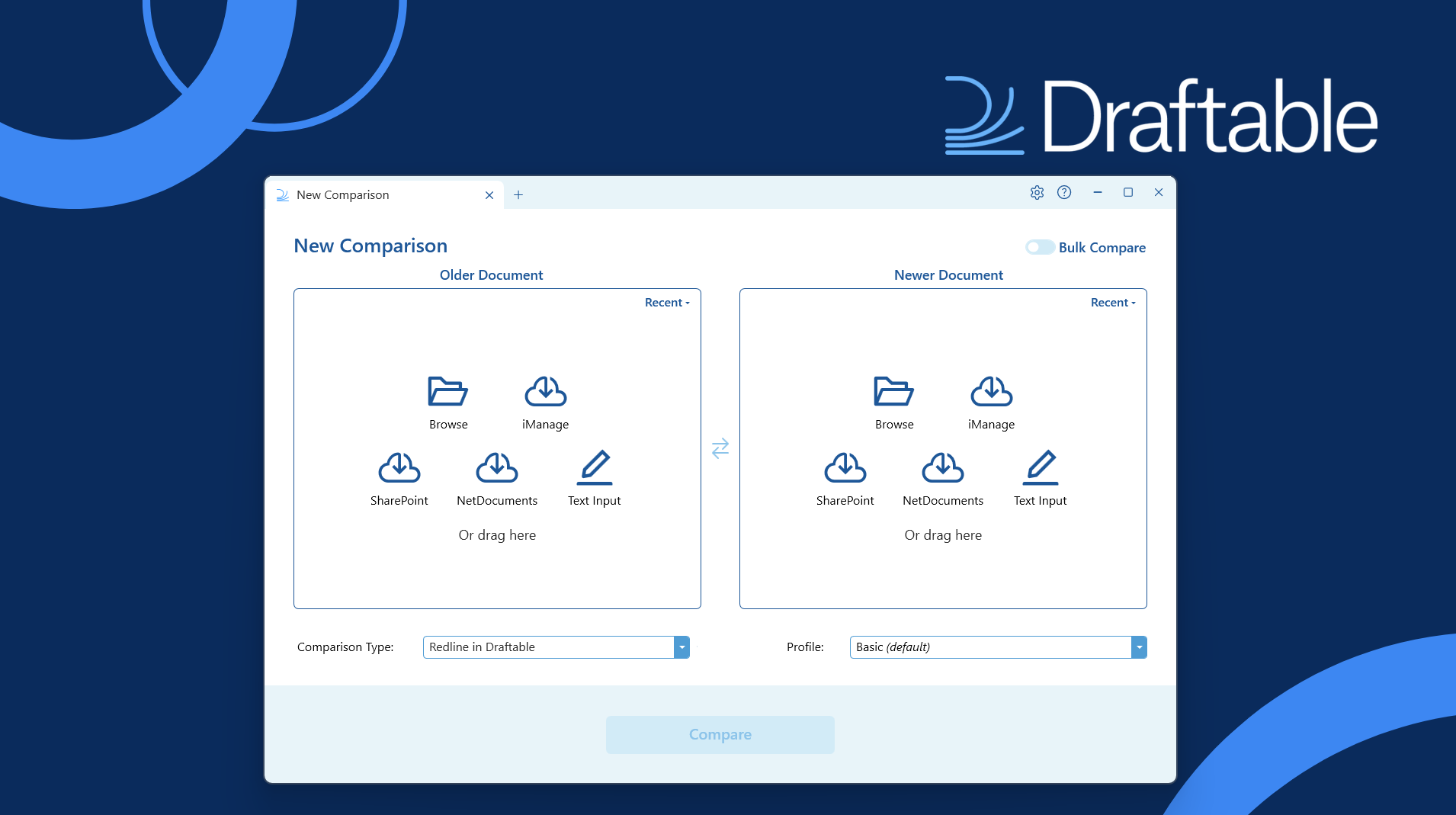
simple
interface
of
Draftable
is
designed
to
mimic
familiar
software
to
clearly
show
lawyers
what
changed
between
two
documents.
Users
upload
two
versions
of
a
file
and,
with
a
single
click,
the
software
highlights
the
differences.
Photo:
Courtesy
of
Draftable.
Draftable
offers
more
than
25
ways
to
upload
documents,
letting
lawyers
work
exactly
how
they
like.
You
can
drag
and
drop
files,
browse
from
your
desktop,
right-click
or
pull
them
straight
from
iManage,
NetDocuments,
SharePoint
or
other
web-based
software.
There’s
also
quick
access
to
recently
compared
files
and
even
the
option
to
paste
text.
The
software
integrates
with
Word,
Excel,
Outlook
and
other
everyday
tools,
“almost
pedantic”
in
the
number
of
paths
it
offers,
Roxburgh
said.
But
that’s
the
point.
“It’s
part
and
parcel
of
trying
to
build
something
that
time-poor
lawyers
need
to
just
work,
and
everyone’s
got
their
own
way
of
doing
things,”
he
said.
No
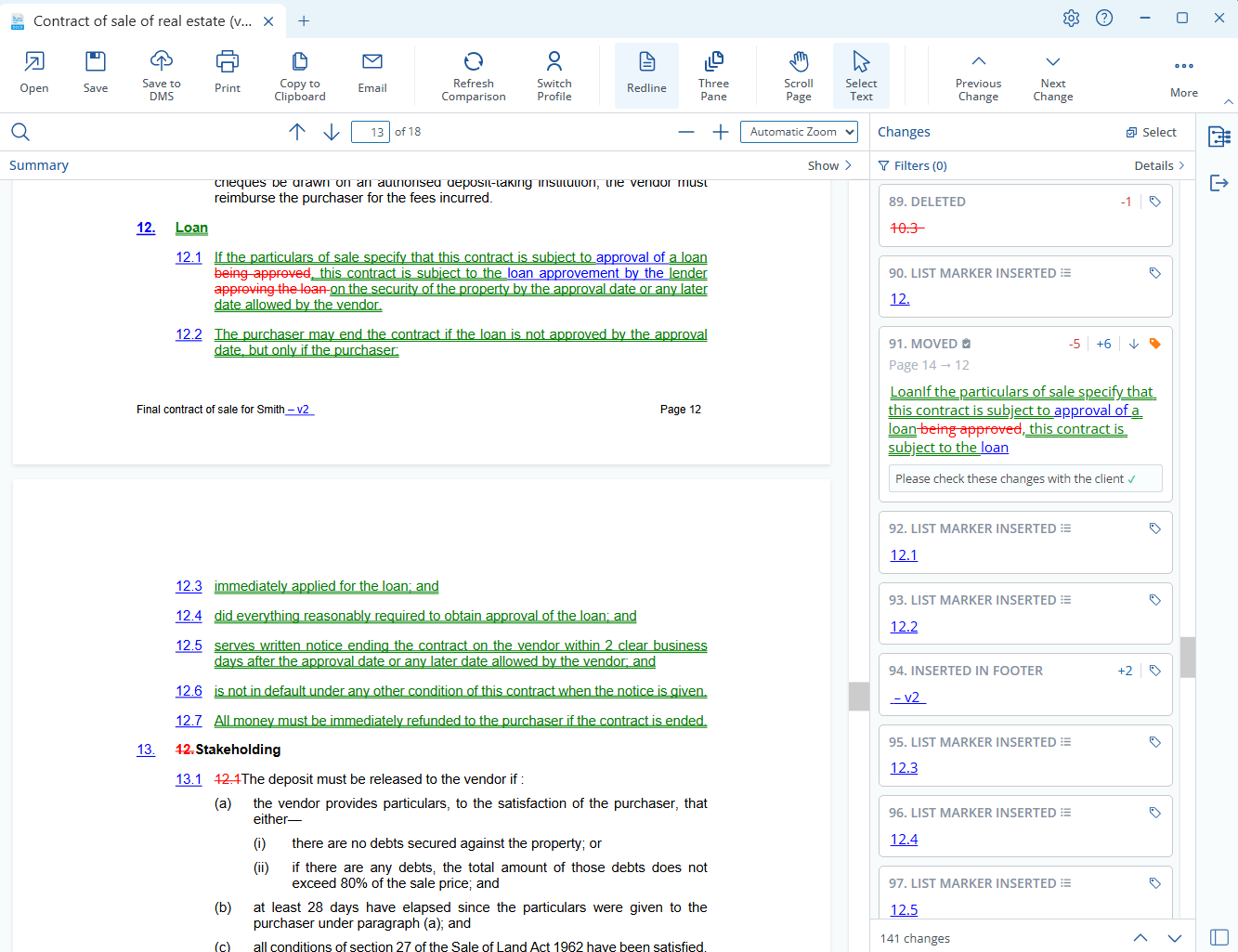
Regrets
Design
Once
the
software
runs
the
comparison,
lawyers
can
review
the
changes
in
several
ways,
depending
on
their
preference.
A
drop
down
menu
offers
the
choice
to
redline
in
Draftable
directly,
using
track
changes
in
Word,
as
a
side
by
side
comparison
and
in
a
departures
table.
In
the
side
by-side
comparison,
for
instance,
the
original
appears
on
the
left,
the
modified
on
the
right,
and
changes
are
highlighted
in
a
customizable,
color-coded
display.
A
sidebar
on
the
right
highlights
each
change,
with
the
ability
to
tag
or
make
a
note.
Photo:
Courtesy
of
Draftable.
Lawyers
can
scroll
through
a
long
agreement
or
jump
directly
to
specific
sections
where
edits
appear.
The
report
can
be
saved
as
a
PDF
for
sharing,
or
exported
into
Word
for
further
markup.
Once
documents
are
uploaded,
the
software
creates
several
comparison
types
simultaneously,
so
users
can
select
their
preferred
view.
The
interface
is
deliberately
simple,
which
is
part
of
the
design
philosophy.
Roxburgh
said
users
should
never
have
regrets
about
having
made
the
wrong
decision
in
their
workflow.
“Products
should
be
designed
in
a
way
where
you
don’t
have
to
go
backwards,”
he
said.
“You
maintain
the
flexibility
to
allow
people
to
flow
through
the
product
to
get
the
outcome
they
want.”
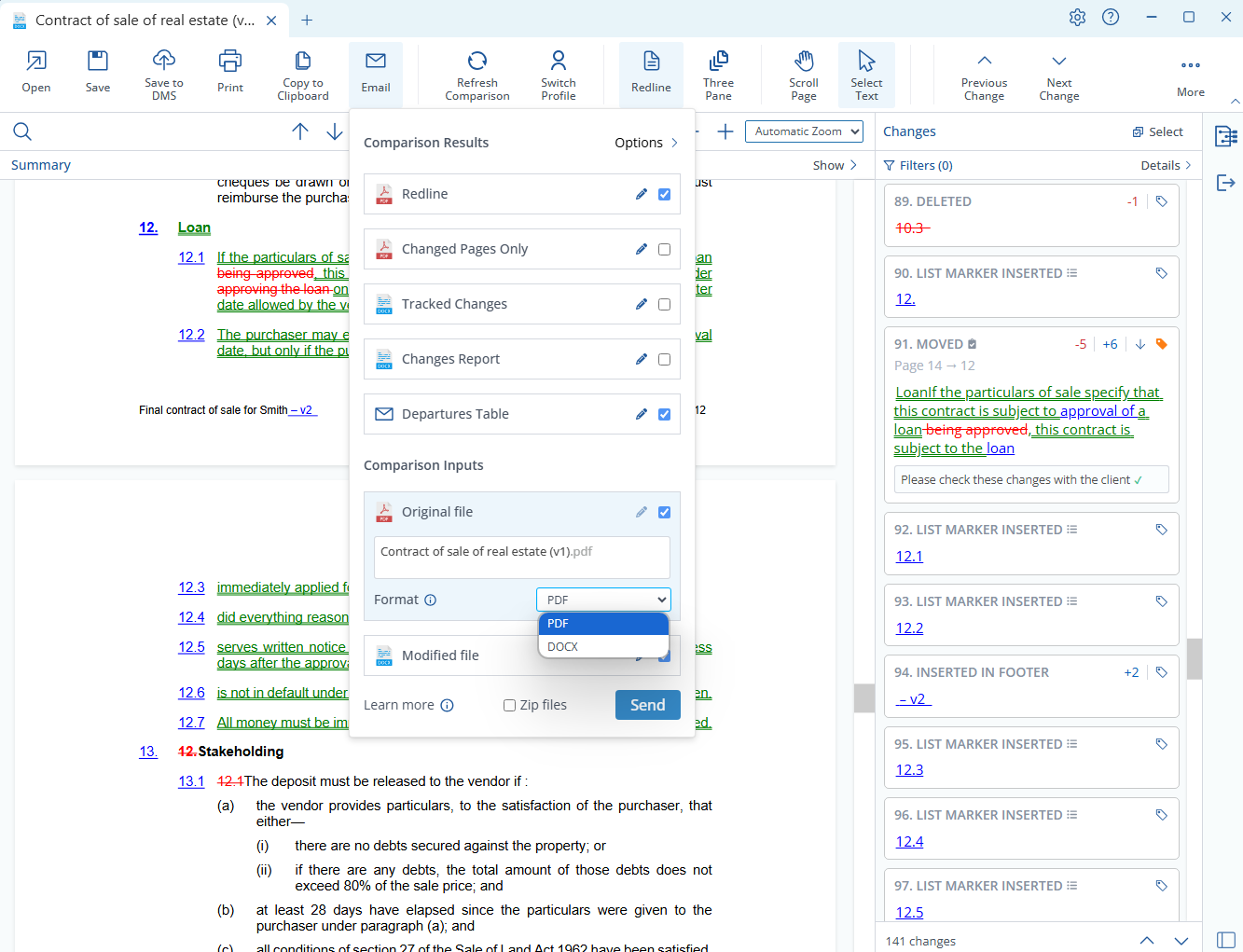
Once
the
changes
are
reviewed,
it
provides
the
option
to
save
or
send
only
what
you
need
to
your
colleagues.
For
instance,
users
could
select
to
export
only
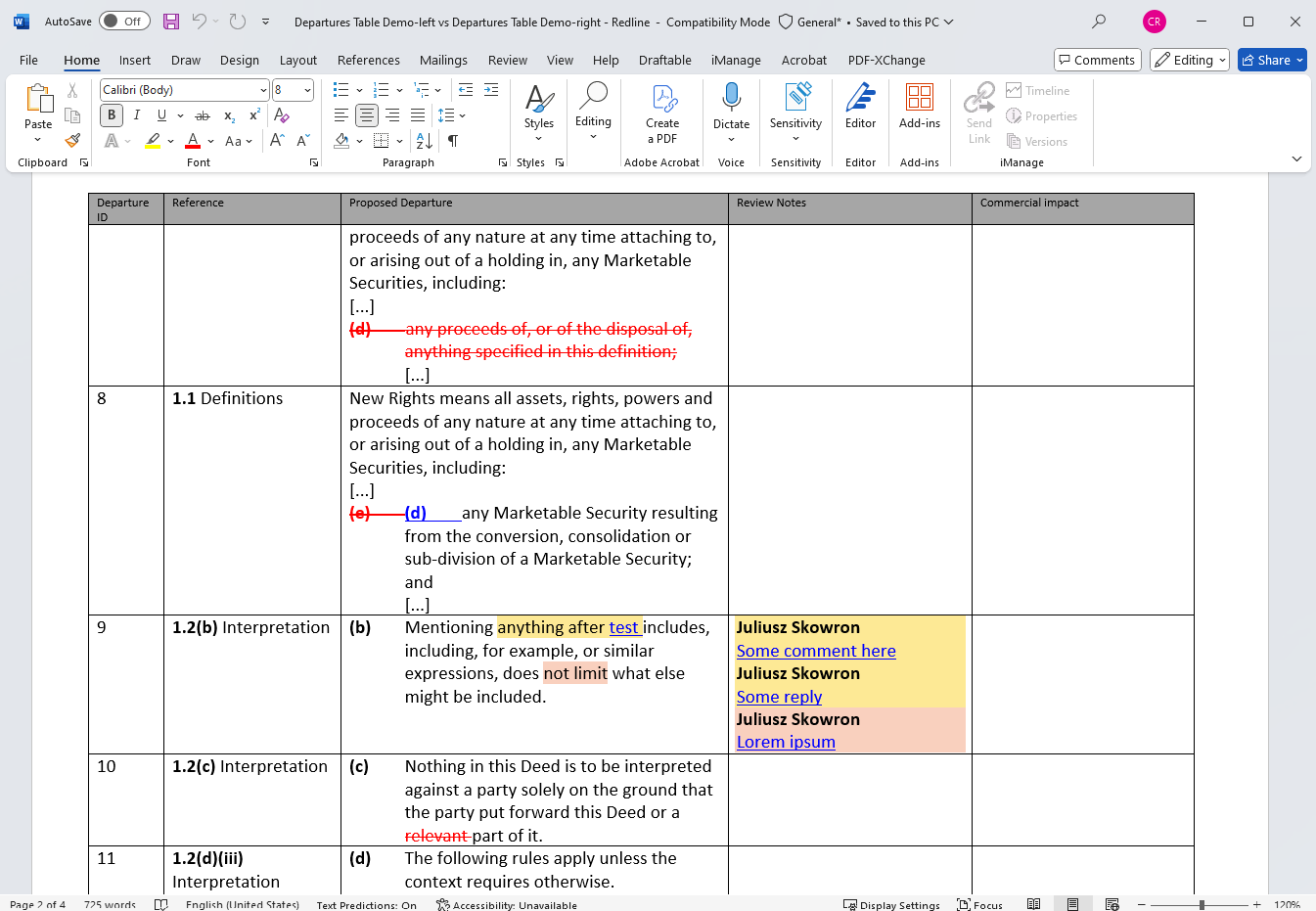
the
redline
and
departures
table
of
the
modified
file
as
an
email.
The
goal
is
to
give
lawyers
immediate
confidence
in
what
has
changed,
without
the
distraction
of
irrelevant
noise.
Photo:
Courtesy
of
Draftable.
Redline
in
Email
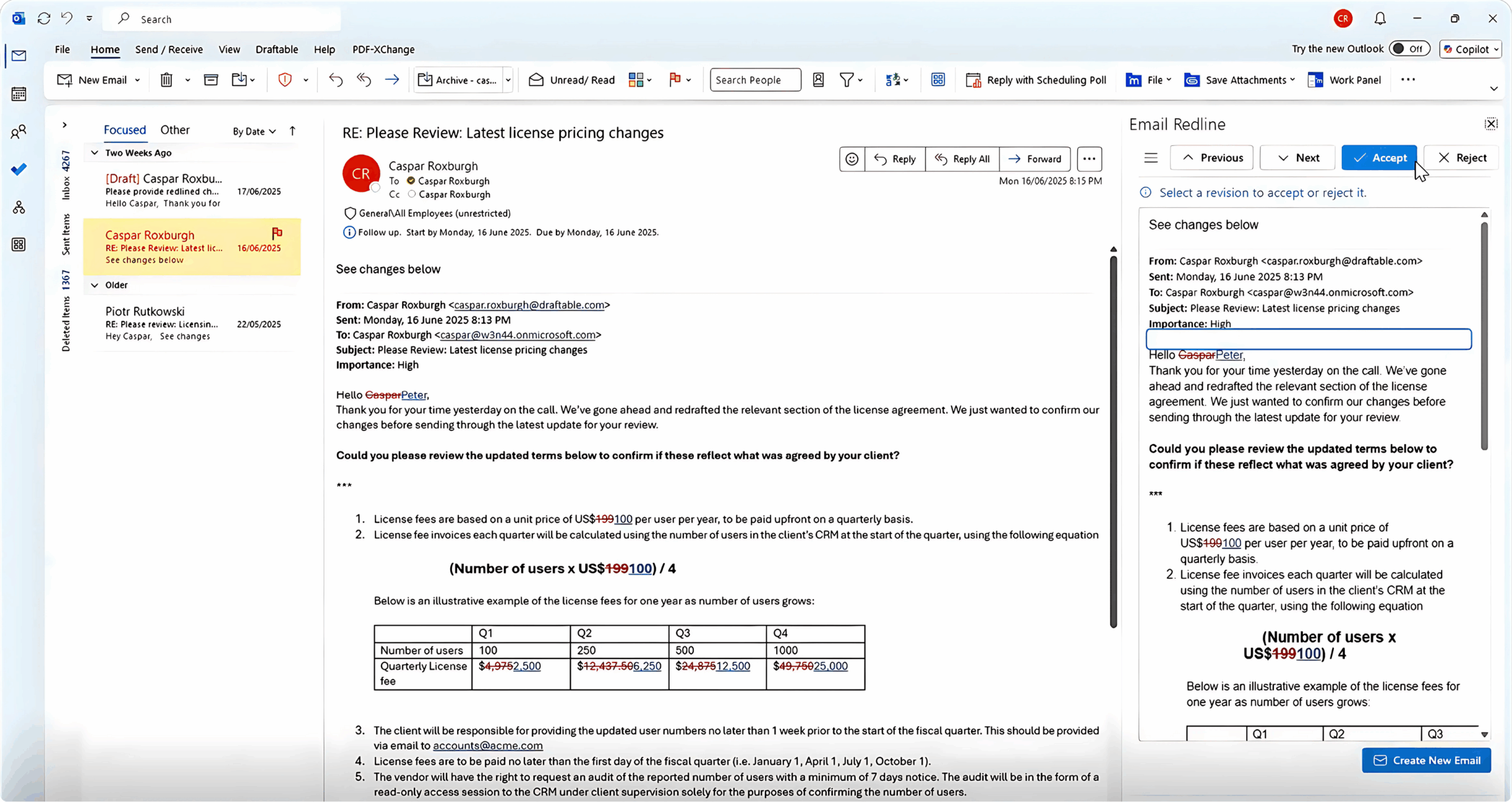
The
newest
feature
most
firms
are
buzzing
about—only
released
in
May
2025—is
Draftable’s
ability
to
handle
redlines
directly
in
email.
Imagine
a
long
email
negotiation
among
a
few
lawyers.
Someone
says,
“Yep,
see
my
changes
below.”
But
they
haven’t
visually
indicated
the
changes.
Instead
of
having
to
compare
each
email
in
a
thread
of
dozens,
Draftable’s
integration
with
Outlook
compares
emails
in
the
thread
to
highlight
the
differences.
Clicking
the
menu
that
says
“Compare
against
an
earlier
email”
automatically
tries
to
select
the
right
one.
Or
users
can
select
a
specific
email
or
compare
it
against
the
first
email
they
sent.
Photo:
Courtesy
of
Draftable.
“This
is
hugely
valuable
because
Outlook
can’t
do
this
on
its
own,”
Roxburgh
said.
“We’re
using
Draftable’s
algorithm
with
all
that
ability
to
detect
moves
and
granularity.”
Then
users
can
accept
or
reject
changes
directly
in
the
email.
A
Faster
Departures
Table
Another
of
Draftable’s
standout
features
is
how
it
handles
departures
tables.
Instead
of
asking
lawyers
to
comb
through
a
full
redline,
the
software
pulls
out
the
relevant
changes
and
lays
them
out
in
a
structured
table
format.
“Realistically,
most
people
looking
at
what’s
changed
in
an
agreement
aren’t
reading
the
full
agreement,”
he
said.
“They’re
reading
a
summary
someone
else
has
created.”
Traditionally,
that
summary
takes
hours.
An
associate
has
to
review
the
redline,
copy
the
relevant
text
into
Word,
paste
it
into
a
table,
and
add
notes
on
what
the
change
means
and
whether
it
goes
back
to
the
client.
Draftable
automates
the
entire
process
with
a
single
command.
Photo:
Courtesy
of
Draftable.
Lawyers
can
choose
how
much
detail
to
include—every
change,
or
just
those
marked
as
important—and
the
table
can
be
shared
as
a
Word
or
Excel
document
or
dropped
straight
into
the
body
of
an
email.
That
means
a
senior
partner
doesn’t
have
to
wait
for
a
manual
summary
before
weighing
in.
They
can
see
the
substance
of
the
edits
instantly.
More
to
come
in
2025—for
half
the
money
Roxburgh
said
Draftable
isn’t
stopping
there.
In
the
next
several
months
they
plan
performance
upgrades
that
will
speed
comparisons
and
improve
their
already
stellar
PDF
comparison
tool.
A
modernized
user
experience
will
include
improved
settings,
new
add-ins
for
Microsoft
Office
and
capability
in
German
and
French.
And
perhaps
most
significantly
for
Mac
users,
Draftable
is
working
on
a
web
application
that
can
be
used
on
any
operating
system
and
browser.
That’s
besides
providing
empathetic
customer
support
with
real
humans
at
a
transparent,
fair
price.
“We’re
less
than
half
the
cost
of
our
competitor
and
we
actually
offer
more
functionality,
but
it’s
a
deliberate
choice,”
Roxburgh
said.
“We’re
doing
something
really
boring—building
good
products,
supporting
it
well
and
charging
a
fair
price
for
it.
It’s
not
rocket
science,
but
lawyers
love
it.”


 Kathryn