Ed.
Note:
A
weekly
roundup
of
just
a
few
items
from
Howard
Bashman’s
How
Appealing
blog,
the
Web’s
first
blog
devoted
to
appellate
litigation.
Check
out
these
stories
and
more
at
How
Appealing.
“Trump’s
grip
on
the
Supreme
Court
seems
to
be
slipping;
The
administration’s
early
winning
streak
at
the
high
court
may
be
fizzling”: Josh
Gerstein
of
Politico
has this
report.
“‘I
Think
It’s
Time’:
The
Inside
Story
of
Pam
Bondi’s
Ouster;
The
attorney
general
was
always
on
the
ropes
but
thought
she
was
finally
on
safer
footing;
She
wasn’t.” Josh
Dawsey,
Alex
Leary,
C.
Ryan
Barber,
and
Sadie
Gurman
of
The
Wall
Street
Journal
have this
report.
“Justice
Dept.
says
the
Presidential
Records
Act
is
unconstitutional;
The
DOJ’s
Office
of
Legal
Counsel
said
the
law
exceeds
Congress’s
powers
and
impedes
on
the
autonomy
of
the
executive
branch”: Maegan
Vazquez
and
Jeremy
Roebuck
of
The
Washington
Post
have this
report.
“A
President,
the
Supreme
Court
and
a
Landmark
Citizenship
Order
Collide;
The
justices
seems
poised
to
rule
against
the
president’s
birthright
citizenship
plan;
He
is
already
furious
over
their
decision
rejecting
his
tariffs
program”: Adam
Liptak
has this
new
installment of
his
“The
Docket”
newsletter
online
today
at
The
New
York
Times.
“What
Is
Trump’s
‘Election
Integrity’
Order
Even
Trying
to
Achieve?
It
isn’t
easy
for
the
executive
to
impose
election
requirements,
because
the
Constitution
makes
it
impossible.
But
that
hasn’t
stopped
the
president
from
trying.” Molly
Roberts
and
Loren
Voss
have this
post at
the
“Lawfare”
blog.
“Trump
Will
Lose
the
Birthright
Citizenship
Case.
But
in
a
Way,
He’s
Already
Won.” Law
professor Stephen
I.
Vladeck has this
guest
essay online
at
The
New
York
Times.
The
Trump
Administration’s
case
is
like
a
failed
cold
call.
We
all
sat
back
and
felt
schadenfreude
second-hand
embarrassment
when
Solicitor
General
Sauer
didn’t
have
the
foresight
to
tee
up
a
reply
to
the
biggest
advocate
for
Native
sovereignty
in
the
history
of
Supreme
Court
Justices
asking
about
how
the
administrations
domicile
requirement
would
impact
Native
American
citizenship.
But
like
a
cold
call
gone
bad,
sometimes
an
instructor’s
brilliance
seeps
through
and
condenses
high
theory
into
an
approachable,
easily
consumable
thing.
Like
batteries
and
lasagna!
If
you
were
to
asked
to
explain
a
battery,
you’d
probably
provide
an
example:
one
AAA
Energizer
battery
suffices.
But
we
all
know
that
despite
how
useful
examples
can
be,
they
aren’t
in
themselves
explanations.
Not
to
mention
that
without
a
clear
understanding
of
the
concepts
you
may
give
faulty
examples:
you
could
define
a
battery
as
a
thing
that
stores
energy,
but
that
would
include
odd
things
you’d
want
to
exclude
like
fat
reserves
and
uranium.
What
a
battery
is
is
simple:
a
thing
that
changes
chemical
reactions
into
electrical
energy
using
an
anode,
cathode
and
an
electrolyte.
Or,
to
bring
the
theory
back
down
to
earth,
think
about
a
tray
of
lasagna!
You
ever
prepare
a
tray
of
lasagna,
cover
it
with
aluminum
foil,
throw
it
in
the
oven
to
find
out
that
the
aluminum
foil
is
sticking
to
the
damn
cheese?
That’s
because
you
made
a
battery!
It’s
a
simple,
concrete
example
that
drives
home
the
essential
parts
of
a
battery
and
how
easy
they
can
be
to
make,
but
if
someone
mishandles
your
explanation
and
takes
it
to
mean
that
you
should
try
to
power
a
Tesla
with
comfort
food,
you
should
take
that
as
a
sign
that
they’re
stupid
and
move
on.
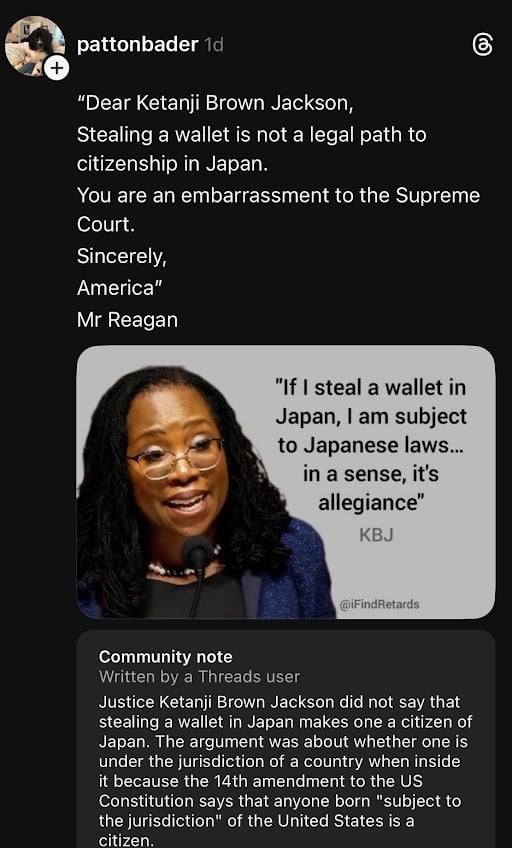
Justice
Jackson
used
a
hypothetical
about
an
American
stealing
in
Japan
to
shed
some
light
on
the
legal
concept
of
“allegiance”
and
dumb
dumbs
who
didn’t
understand
the
purpose
of
the
example
are
trying
to
spin
it
as
some
big
DEI
gotcha
moment.
You
can
hear
her
below:
DEI
hire
Ketanji
Brown
Jackson’s
“logic”:
Stealing
a
wallet
in
Japan
=
owing
“allegiance”
to
Japan.
This
clown-level
reasoning
on
birthright
citizenship
proves
she’s
unqualified.
In
a
case
about
the
“subject
to
the
jurisdiction
thereof”
chunk
of
the
birthright
clause,
the
stealing
in
Japan
example
shows,
in
a
very
common
sense
way,
how
even
a
non-citizen
would
be
subject
to
Japan’s
laws
penalizing
theft
if
they
stole
something
while
they
were
visiting
the
country.
Further,
non-citizens
would
still
be
able
to
(at
least
in
theory)
employ
legal
avenues
to
get
their
property
back
via
the
Japanese
government
because
of
the
same
local
allegiance,
which
clarifies
how
the
“subject
to
the
jurisdiction
thereof”
bit
of
the
clause
would
engage
with
foreign
nationals
acting
within
the
parameters
of
the
US.
Still,
people
somehow
found
a
way
to
misunderstand
her
entirely:
Sometimes
the
children
left
behind
are
grown
ass
adults.
The
funniest
thing
about
this
is
that
the
most
vocal
critics
have
all
the
qualifications
of
being
some
dude
in
a
car.
Skip
to
about
1:24
for
a
big
dose
of
weaponized
ignorance:
SCOTUS
WORD
SALAD
ALERT:
Justice
Ketanji
Brown
Jackson
just
embarrassed
herself
defending
BIRTHRIGHT
CITIZENSHIP
for
illegal
invaders’
kids! She
rambled
on
like
a
malfunctioning
robot,
comparing
it
to
“stealing
a
wallet
in
Japan”
—
as
if
that
somehow
justifies
turning
America…
pic.twitter.com/E2Si7koxG5
Just
because
it
didn’t
make
sense
to
you
doesn’t
mean
it
didn’t
make
sense.
There
are
some
ideas
people
aren’t
ready
for;
I
for
one
am
still
trying
to
wrap
my
head
around
how
gut
microbiomes
can
effect
mood
and
happiness,
but
I
also
know
better
than
to
bash
scientists
who
specialize
in
this
because
I
don’t
understand
the
mechanics
of
a
regular
diet
of
grilled
cheese
sandwiches
making
the
dark
thoughts
come
at
3
AM.
I
give
unto
Caesar
what
is
his
and
go
about
my
lunch.
Scientists
enjoy
a
(dwindling)
expertise
deference
that
judges
don’t
get
the
benefit
of.
It
is
understandable
for
lay
people
to
make
the
mistake
of
thinking
law
is
an
easily
accessible
discipline
because
it
really
just
boils
down
to
words
on
a
page
and
they
can
read.
But
there
is
a
problem
with
that
approach.
They
probably
don’t
actually
read
that
well
—
most
Americans
read
on
a
7th-8th
grade
reading
level
which
makes
interpreting
the
Constitution
a
hard
chestnut
to
crack
when
the
Hemingway
App
(admittedly
not
the
end
all
be
all
of
evaluating
reading
level)
clocks
the
Constitution
and
the
first
14
amendments
at
being
post-graduate
level.
Reading
well
also
goes
further
than
being
able
to
just
identify
words:
it
also
factors
in
being
able
to
read
author
intent,
comparative
analysis
and
all
sorts
of
other
things
you
miss
when
your
first
response
to
hearing
Ketanji
is
to
start
bashing
former
President
Biden.
It
is
almost
like
thinking
like
a
lawyer
takes
more
work
than
listening
to
a
sound
clip
and
sounding
off
as
you
drive
to
do
your
errands.
Tough
crowd,
Justice
Jackson.
Dumb
too,
but
that’s
not
polite
to
say.
Chris
Williams
became
a
social
media
manager
and
assistant
editor
for
Above
the
Law
in
June
2021.
Prior
to
joining
the
staff,
he
moonlighted
as
a
minor
Memelord™
in
the
Facebook
group Law
School
Memes
for
Edgy
T14s
.
He
endured
Missouri
long
enough
to
graduate
from
Washington
University
in
St.
Louis
School
of
Law.
He
is
a
former
boat
builder
who
is
learning
to
swim
and
is
interested
in
rhetoric,
Spinozists
and
humor.
Getting
back
in
to
cycling
wouldn’t
hurt
either.
You
can
reach
him
by
email
at
[email protected]
and
by
Tweet/Bluesky
at @WritesForRent.
As
we
bring
our
series,
“The
Encore:
Turning
CLE
Success
into
Long-Term
Growth,”
to
a
close,
it’s
time
to
focus
on
the
final,
but
perhaps
most
critical,
step
in
the
CLE
process:
staying
connected.
Over
the
course
of
this
series,
we’ve
walked
through
crafting
compelling
content,
delivering
your
CLE
with
impact,
and
leveraging
your
content
to
extend
its
reach.
Now,
the
spotlight
turns
to
maintaining
the
relationships
you’ve
built
through
your
CLE,
ensuring
that
the
connections
you’ve
made
continue
to
grow
and
bear
fruit
long
after
the
final
slide
has
been
shown.
Tying
it
All
Together:
The
Value
of
Continuous
Connection
From
the
moment
you
select
a
topic
for
your
CLE
to
the
final
thank-you
note
you
send
to
attendees,
the
CLE
process
is
about
more
than
just
sharing
knowledge
—
it’s
about
building
and
nurturing
relationships.
Staying
connected
is
the
key
to
transforming
a
one-time
presentation
into
ongoing
professional
growth.
CLEs
are
not
just
about
adding
a
line
item
to
your
resume;
they
are
strategic
tools
for
getting
in
front
of
a
captive
audience
as
a
trusted
advisor,
which
leads
to
new
relationships
and
opportunities.
The
Power
of
Personalized
Follow-Up:
Keep
the
Conversation
Going
One
of
the
most
effective
ways
to
stay
connected
is
through
personalized
follow-up.
This
isn’t
just
about
sending
a
generic
thank-you
email;
it’s
about
making
each
attendee
feel
valued
and
remembered.
•
Custom
Follow-Up
Messages:
Reference
specific
points
from
your
conversation
with
attendees
during
or
after
the
CLE.
Whether
it’s
something
they
found
particularly
insightful
or
a
personal
detail
they
shared,
acknowledging
this
in
your
follow-up
reinforces
your
connection
and
shows
that
you
were
truly
engaged.
•
Timely
Responses:
Don’t
let
too
much
time
pass
before
reaching
out.
A
prompt
follow-up
keeps
the
momentum
going
and
ensures
that
the
interaction
is
fresh
in
the
attendee’s
mind.
•
Clear
Call
to
Action:
Every
follow-up
message
should
include
a
clear
call
to
action
that
goes
beyond
just
professional
meetings.
Whether
it’s
inviting
the
attendee
to
grab
lunch,
coffee,
or
a
drink,
or
asking
them
to
connect
on
LinkedIn,
make
sure
they
know
what
the
next
step
is.
These
more
personal
interactions
help
to
build
trust
and
deepen
the
relationship,
turning
a
professional
connection
into
a
lasting
partnership.
Ongoing
Engagement:
Beyond
the
Initial
Follow-Up
Staying
connected
requires
more
than
just
a
single
touchpoint.
Ongoing
engagement
through
various
channels
ensures
that
your
relationship
with
attendees
continues
to
grow.
•
Social
Media
Interaction:
Continue
to
engage
with
your
attendees
on
platforms
like
LinkedIn.
Comment
on
their
posts,
share
relevant
articles,
and
participate
in
discussions
they’re
involved
in.
This
keeps
the
relationship
active
and
demonstrates
your
continued
interest
in
their
professional
journey.
Tag
your
photos
with
people
you
met
and
shared
experiences
during
the
presentation.
Creating
a
Community:
Turning
Attendees
into
Advocates
Your
CLE
attendees
can
become
some
of
your
greatest
advocates
if
you
nurture
those
relationships
effectively.
Building
a
sense
of
community
among
your
attendees
not
only
strengthens
individual
connections
but
also
enhances
your
professional
network.
•
Exclusive
Groups:
Consider
creating
an
exclusive
LinkedIn
group
or
online
community
where
your
CLE
attendees
can
continue
the
conversation,
share
insights,
and
network
with
each
other.
This
fosters
a
sense
of
belonging
and
keeps
you
at
the
center
of
their
professional
development.
•
Invite
to
Future
Events:
Keep
your
attendees
in
the
loop
about
future
CLEs,
webinars,
or
industry
events
you’re
involved
in.
Inviting
them
to
participate
again
strengthens
the
relationship
and
increases
the
likelihood
of
them
becoming
repeat
attendees.
Everyone
loves
to
be
invited,
even
if
they
can’t
attend.
Long-Term
Strategic
Growth:
The
Impact
of
Staying
Connected
Staying
connected
isn’t
just
about
being
remembered
—
it’s
about
being
relied
upon.
By
maintaining
and
nurturing
the
relationships
you’ve
built
through
your
CLE,
you
position
yourself
as
a
go-to
resource,
a
trusted
advisor,
and
a
leader
in
your
field.
This
not
only
opens
doors
to
future
opportunities
but
also
creates
a
network
of
advocates
who
can
help
amplify
your
influence
and
reach.
Long-Term
Strategic
Growth:
The
Impact
of
Staying
Connected
Throughout
this
series,
we’ve
explored
every
facet
of
the
CLE
process,
from
initial
concept
to
sustained
connection.
By
mastering
each
step
—
from
crafting
compelling
content
to
delivering
a
dynamic
presentation,
leveraging
that
content
for
broader
impact,
and
staying
connected
with
your
audience
—
you’ve
equipped
yourself
with
the
tools
needed
to
transform
your
CLEs
into
powerful
drivers
of
long-term
professional
growth.
As
you
move
forward,
remember
that
each
CLE
is
more
than
just
a
presentation;
it’s
a
platform
for
building
relationships,
sharing
knowledge,
and
creating
lasting
impact.
The
true
success
of
a
CLE
isn’t
measured
by
the
applause
at
the
end
but
by
the
connections
you
nurture
and
the
growth
you
achieve
long
after
the
session
concludes.
Checklist
for
Part
4,
Article
4:
Personalized
Follow-Up:
✔️ Send
custom
follow-up
messages
referencing
specific
conversations
or
insights
shared
during
the
CLE.
✔️ Ensure
timely
follow-up
to
maintain
momentum
and
engagement.
Ongoing
Engagement:
✔️ Interact
on
LinkedIn
to
maintain
an
active
and
visible
presence.
✔️ Engage
with
attendees
on
social
media,
tagging
them
in
posts
related
to
the
CLE
and
shared
experiences.
Creating
a
Community:
✔️ Consider
forming
an
exclusive
group
for
continued
discussion
and
networking.
✔️ Invite
attendees
to
future
events
to
strengthen
the
relationship.
By
implementing
these
strategies,
you’ll
ensure
that
your
CLE
serves
as
a
foundation
for
sustained
success,
turning
one-time
attendees
into
long-term
connections
that
continue
to
benefit
your
practice
for
years
to
come.
Sejal
Bhasker
Patel is
a
Rainmaking
Consultant
and
Author
of Rainmaker:
Unleashed
—
a
sharp,
strategic
playbook
for
attorneys
who
don’t
fit
the
traditional
mold.
She’s
the
founder
of
Sage
Ivy,
a
consulting
firm
that
works
directly
with
law
firms
and
attorneys
to
turn
relationships
into
revenue
—
without
selling
their
soul.
Her
work
is
blunt,
tailored,
and
built
on
one
core
belief:
Authenticity
isn’t
a
liability
—
it’s
your
strongest
competitive
edge. www.sageivyconsulting.com
On
a
recent
episode
of
The
Late
Show
with
Stephen
Colbert,
the
host
turned
his
attention
to
the
firing
of
Pam
Bondi,
a
departure
that,
if
reports
are
to
be
believed,
has
a
whole
lot
to
do
with
her
handling
of
the
Epstein
files.
You
know,
the
ones
that
have
been
released
in
a
fashion
best
described
as
“Mad
Libs,
but
make
it
national
scandal.”
Colbert
opened
with
what
might
be
the
most
efficient
takedown
of
the
situation
yet.
“In
tribute
to
Pam
Bondi,
I
offer
this
heartfelt
farewell,”
he
said,
holding
up
a
document
redacted
except
for
the
following:
“Dear
Pam,”
and
“Sincerely,
Stephen
Colbert.”
via
CBS
It’s
a
joke
works
because
it’s
barely
an
exaggeration.
And
he
didn’t
stop
there,
“Saying
that
the
villain
of
the
Epstein
files
is
Pam
Bondi
is
like
saying
the
lead
in
‘Die
Hard’
is
the
dad
from
‘Family
Matters.’”
Which
brings
us
to
the
official
line
from
Donald
Trump,
who
announced
Bondi
would
be
“transitioning
to
a
much
needed
and
important
new
job
in
the
private
sector.”
Sure…
but
it
did
let
Colbert
bust
out
his
Trump
impersonation.
“It’s
a
much-needed
job
at
a
very
important
farm
upstate.
There’ll
be
lots
of
room
for
her
to
run
around.
Unfortunately,
we
can’t
go
visit
her,”
he
said.
“Now
let’s
go
to
the
strip
mall
and
get
you
a
new
attorney
general,
buddy.”
When
big
money
is
on
the
line
you
want
to
get
any
chance
of
a
suit
dismissed
as
early
as
possible.
DLA
Piper
tried
to
get
a
summary
judgement
against
Anisha
Mehta’s
claims
that
they
fired
her
over
taking
maternity
leave,
arguing
instead
that
it
was
because
she
regularly
handed
in
sloppy
work
product.
Big
if
true
—
the
sloppy
work
and
“catastrophic
blunders”
the
firm
could
muster
amounted
to
a
couple
of
typos
in
her
work
that
clients
didn’t
even
ultimately
see.
If
summary
judgement
isn’t
in
your
favor
and
the
facts
don’t
seem
to
be
either,
a
jury
trial
with
an
empathetic
plaintiff
is
one
of
the
last
things
you
want
to
deal
with.
DLA
Piper
is
set
to
get
to
dealing
pretty
soon.
Reuters
has
coverage:
DLA
Piper
is
poised
to
go
to
trial
in
federal
court
in
Manhattan
on
Monday
over
claims
that
it
fired
an
associate
for
seeking
maternity
leave,
marking
a
rare
chance
for
a
jury
to
hear
an
employment
discrimination
case
against
a
major
law
firm.
This
could
very
easily
get
spun
as
“Multi-billion
dollar
law
discriminates
against
hard
working
mother
and
only
you,
the
jury,
are
the
ones
that
can
make
things
right”
at
closing
arguments.
It
doesn’t
help
that
DLA
as
a
firm
seems
to
be
less
accommodating
to
parents
and
parents
to
be
than
most;
they
made
a
firm
wide
6
week
cut
to
parental
leave
not
very
long
after
they
cut
Mehta
after
all.
Depending
on
the
strength
of
her
case
and
the
sensibilities
of
the
jury,
the
money
DLA
Piper
might
have
to
pay
out
could
cover
a
lot
of
cribs.
Chris
Williams
became
a
social
media
manager
and
assistant
editor
for
Above
the
Law
in
June
2021.
Prior
to
joining
the
staff,
he
moonlighted
as
a
minor
Memelord™
in
the
Facebook
group Law
School
Memes
for
Edgy
T14s
.
He
endured
Missouri
long
enough
to
graduate
from
Washington
University
in
St.
Louis
School
of
Law.
He
is
a
former
boat
builder
who
is
learning
to
swim
and
is
interested
in
rhetoric,
Spinozists
and
humor.
Getting
back
in
to
cycling
wouldn’t
hurt
either.
You
can
reach
him
by
email
at
[email protected]
and
by
Tweet/Bluesky
at @WritesForRent.
There
is
usually
a
fair
amount
of
politics
around
who
gets
which
office
at
a
law
firm. Sometimes,
a
dispute
arises
as
to
prime
locations
within
an
office,
and
other
times,
attorneys
may
fight
over
the
size
of
individual
offices. One
of
the
most
interesting
situations
occurs
when
a
retiring
partner
needs
to
give
up
a
prized
office
so
that
an
up-and-coming
lawyer
can
relish
the
trappings
of
success
at
a
firm. With
few
exceptions,
it
makes
sense
that
retiring
partners
would
give
up
their
offices
to
make
room
for
younger
lawyers
on
the
rise.
I
used
to
work
for
a
partner
that
had
an
amazing
office. The
office
was
probably
the
second-largest
space
at
that
firm.
Only
the
office
of
the
managing
partner
was
larger. You
could
tell
that
this
partner
had
occupied
this
particular
office
for
many
years. The
walls
were
adorned
with
old
pictures
and
mementos
of
the
lawyer
and
some
of
the
cases
he
had
worked
on
throughout
the
decades.
However,
this
particular
partner
got
to
a
point
where
he
would
only
work
at
the
office
a
day
or
two
a
week,
and
he
spent
his
other
time
on
different
pursuits. Indeed,
it
was
extremely
common
to
walk
by
the
office
without
the
lights
on,
which
was
some
kind
of
reminder
that
this
partner
did
not
show
up
that
often. As
a
result,
a
prime
office
(that
the
firm
was
presumably
paying
a
hefty
amount
of
money
for)
was
going
unused
most
of
the
week.
I
was
only
an
associate
at
this
shop,
so
I
was
not
privy
to
discussions
among
the
partners
about
who
should
occupy
which
individual
office. However,
one
day,
I
came
to
work,
and
I
noticed
that
the
majority
of
this
partner’s
stuff
had
been
moved
into
a
smaller
office
only
a
little
bigger
than
the
one
I
occupied
at
the
firm. The
possessions
barely
fit
the
smaller
space,
and
it
was
almost
comedic
to
look
at
the
cluttered
walls
and
desk
of
this
partner,
since
he
had
not
yet
decided
which
items
would
be
a
permanent
fixture
of
his
new
space.
I
could
tell
that
this
partner
was
bitter
about
his
new
situation. His
new
space
was
not
nearly
as
grand
as
his
old
office,
and
he
probably
thought
it
was
an
insult
to
be
office
demoted
in
this
way. Indeed,
this
partner
worked
less
and
less
at
the
office
until
he
eventually
left
the
firm
altogether.
However,
I
think
it
is
important
that
senior
lawyers
relinquish
their
offices
in
a
number
of
circumstance. If
a
partner
is
no
longer
arriving
at
an
office
as
much
as
in
the
past,
either
due
to
their
age
or
changing
interests,
they
should
be
open
to
relinquishing
their
offices. Seeing
a
dark
office
lay
unoccupied
can
impact
morale
at
a
law
firm,
and
a
partner
who
does
not
even
come
to
the
office
often
should
not
miss
their
coveted
office
too
much.
Moreover,
as
partners
move
out
of
roles
since
they
will
be
retiring
soon,
they
should
also
be
open
to
giving
up
their
prized
offices. Moving
to
a
more
modest
space
can
mentally
prepare
someone
to
leave
a
law
firm,
and
this
can
serve
as
a
vote
of
confidence
in
the
next
generation
of
law
firm
leaders. In
addition,
occupying
less
space
could
be
a
good
cost-saving
measure
that
can
benefit
the
bottom
lines
of
many
law
firms.
All
told,
it
can
be
awkward
and
indeed
painful
for
some
senior
lawyer
to
give
up
their
offices. However,
this
is
an
important
process,
and
law
firms
should
have
set
policies
about
this
issue
so
lawyers
are
not
surprised
when
it
comes
time
to
downsize
their
spaces.
Jordan
Rothman
is
a
partner
of The
Rothman
Law
Firm,
a
full-service
New
York
and
New
Jersey
law
firm.
He
is
also
the
founder
of Student
Debt
Diaries,
a
website
discussing
how
he
paid
off
his
student
loans.
You
can
reach
Jordan
through
email
at jordan@rothman.law.
But
we
have
some
good
news
for
the
departing
Attorney
General!
She’s
still
on
track
for
a
potential
victory
in
our
bracket
challenge.
Which
is
important
news
as
she
moves
on
to
the
“much
needed
and
important
new
job
in
the
private
sector”
that
she
absolutely
does
not
have.
And
she
absolutely
crushed
Alina
Habba
in
our
Final
Four
matchup:
Bondi
issued
a
statement
attempting
to
slather
lipstick
on
her
shitcanning,
she
touted
the
fact
that
murders
in
this
country
are
at
an
historic
low.
This
is
true,
but
has
also
been
true
of
pretty
much
every
year
since
the
90s.
She
did
not,
for
example,
mention
that
she’s
diverted
the
Department
of
Justice’s
efforts
from
prosecuting
23,000
drug,
terrorism,
and
other
crimes
to
chase
down
roofers
who
messed
up
their
immigration
paperwork
20
years
earlier.
On
the
other
side
of
the
bracket
is
the
last
standing
of
Trump’s
Killer
Bs.
Bondi,
Blanche,
and
Bove
rolled
into
the
Justice
Department
and
destroyed
a
couple
centuries
worth
of
credibility.
Blanche
will
take
over
for
Bondi
in
the
short-term,
but
even
his
personal
efforts
to
run
interference
for
Jeffrey
Epstein
and
publicly
attack
the
rule
of
law
did
not
prove
sufficient
to
give
him
the
inside
track
to
the
top
job.
Blanche
recently
confessed
that
senior
Trump
administration
officials
expect
to
be
indicted
after
the
next
election.
Most
people
would
take
that
fear
and,
you
know,
stop
committing
acts
that
would
get
them
indicted.
Blanche,
however,
is
willing
to
put
his
foot
on
the
gas.
Which
is
a
commitment
since
this
administration
is
driving
oil
to
$200
a
barrel!
So
the
final
matchup
is
Bondi
v.
Blanche.
VOTE
HERE.
Trump’s
do
everything
all
at
once
approach
to
immigration
enforcement
is starting
to
go
off
the
rails.
Trump’s plainly
stated
hatred of
“shithole
countries”
and
their
inhabitants
manifested
in
early
wins
for
his
bigoted
“remove
the
brown
people”
programs.
Then
Stephen
Miller
(the
man
who
answers
the
“what
if
a
lightbulb
had
eyebrows
and
was
also
a
white
nationalist”
question
no
one
asked)
showed
up
and
amped
things
up. 3,000
arrests
per
day! he
screamed
into
the
void.
(The
void
did
not
respond
to
our
request
for
comment
before
press
time.)
A
lot
of
wrenches
approached
the
anti-migrant
works
and
immediately
threw
themselves
into
it.
First,
ICE
didn’t
have
enough
officers
to
staff
a
surge.
No
problem,
said
the
administration.
Here’s
$50,000
and
almost
no
training
to
get
you
started!
Here’s several
(more!)
billion
dollars to
keep
it
going!
Here’s
everyone
we
actually
can’t
spare
from
multiple
federal
agencies!
Bang!
Into
the
blue
cities
they
went, kidnapping
and
murdering their
way
towards
Miller’s
arrest
quota.
All
well
and
good
but
at
the
end
of
the
day,
you’ve
still
got
to
have
some
lawyers
left
to
fight
the
lawsuits
these
surges
generated,
as
well
as
to
handle
challenges
against
detentions,
removals,
and
direct
flights
to foreign
torture
prisons.
Well,
the
Trump
administration
no
longer has
enough
lawyers left
to
do
its
dirty
work.
Whoever hasn’t
been
purged for
not
being
loyal
enough
or
exited
ahead
of
the
purges
has
been
asked
to
clean
up
a
mess
with
extremely
limited
amounts
of
resources
and
manpower.
To
make
things
worse,
Trump’s
handpicked
prosecutors
keep
being kicked
out
of
court because
Trump
bypassed
the
appointment
process
essential
to
them
remaining
employed.
Then
there’s
the self-inflicted
reputational
damage Trump’s
DOJ
has
done.
The
government,
for
the
most
part,
is
no
longer
granted
the
presumption
of
good
faith.
Courts
across
the
land
are
not
only
aware
this
government
isn’t
acting
in
good
faith,
but
they’re
refusing to pretend it
is,
no
matter
how
much
copy-pasted
boilerplate
appears
in
DOJ
filings.
Hundreds
of
adverse
rulings
have
already
been
handed
down.
Hundreds
more
are
on
the
horizon,
especially
now
that
the
DOJ
has
admitted
pretty
much
every
arrest
that
took
place
in
an
immigration
court
was
illegal.
It
all
adds
up
to
the
long
tail
of
“flooding
the
zone.”
If
you
can’t
bail
water
fast
enough,
you’re
going
to
drown.
Here’s
how
this
is
working
out
for
the
DOJ
now, as
reported
by
Kyle
Cheney
for
Politico:
In
dozens
of
cases
over
the
past
several
weeks,
Justice
Department
lawyers
have
declined
to
push
back
on
detainees’
claims
that
they’re
owed
a
chance
to
make
a
case
for
their
release.
In
those
cases,
the
administration
has
simply
agreed
to
provide
a
bond
hearing,
or
even
outright
release,
telling
judges
that
officials
“do
not
have
an
opposition
argument
to
present”
or
saying
they
couldn’t
cobble
together
enough
information
to
mount
a
defense.
[…]
The
new
phenomenon
is
the
latest
manifestation
of
the
extraordinary
strain
that
the
administration’s
mass
deportation
effort
—
compounded
by
the mass
detention of
people
who
have
lived
for
years
without
incident
in
the
U.S.
interior
—
has
exacted
on
the
justice
system.
While
ICE
bathes
in
newly
awarded
billions,
the
problems
its
efforts
have
created
are
being
attended
to
by
a
skeleton
crew
that
can’t
keep
up
with
Trump’s
rights-violating
fire
hose.
That’s
created
some
pretty
gaudy
numbers,
which
certainly
isn’t
a
compliment.
Federal
judges
have
ruled
more
than
7,000
times
in
recent
months
that
ICE
has
illegally
locked
people
up
without
—
at
the
very
least
—
a
chance
to
prove
they
can
live
safely
in
the
community.
That’s
a
lot.
This
administration
is
setting
judicial
records
that
hopefully
will
never
be
broken.
It’s
not
just
the
government
losing
cases
on
the
merits.
Many
of
these
losses
are
the
result
of
the
DOJ
simply
being
unable
to
respond at
all to
legal
challenges
by
people
ICE
has
arrested,
detained,
or
deported.
If
there’s
a
silver
lining
in
this
bigoted
war
on
non-white
people,
it’s
everything
listed
above.
Trump’s
administration
may
be
evil
and
stupid
in
equal
measures,
but
those
aspects
are
being
held
in
check
by
its
inability
or
unwillingness
to
anticipate
the
natural
side
effects
of
sending
wave
after
wave
of
masked
goons
into
cities
to
kidnap
anyone
who
looks
a
little
bit
foreign.
The
administration
is
a
defective
centrifuge
that
edges
closer
to
disintegration
with
every
rotation.
What
remains
to
be
seen
is
who’s
going
to
get
hit
with
the
majority
of
the
shrapnel
when
it
finally
falls
apart.
We
can
only
hope
it’s
the
people
that
started
it
spinning
in
the
first
place.
WASHINGTON
—
US
commercial
space
firms
are
by
and
large
welcoming
a
Commerce
Department
proposal
for
a
one-stop
licensing
shop
for
currently
unregulated
operations,
including
a
number
of
new
missions
—
such
as
on-orbit
refueling,
satellite
repair
and
close-up
inspections
—
that
the
Space
Force
hopes
to
be
able
to
at
least
partially
outsource
to
commercial
firms
in
the
future.
“For
years,
the
space
industry
has
discussed
the
uncertainty
facing
companies
seeking
government
approval
of
new
activities
in
space
—
a
loophole
that
left
no
federal
agency
with
clear
authority
to
authorize
commercial
space
operations
like
in-space
manufacturing
or
space-based
power
generation,”
president
of
the
Commercial
Space
Foundation
Dave
Cavossa
told
Breaking
Defense.
The
Department
of
Commerce
proposal
closes
the
loophole
by
setting
up
a
voluntary
framework
bound
by
deadlines
for
the
government
to
approve
or
deny
an
activity.
“By
providing
a
predictable
and
repeatable
pathway
to
launch,
this
proposal
will
help
the
administration
meet
and
exceed
their
goal
to
attract
at
least
$50
billion
of
new
investment
in
American
space
markets,”
he
added.
“[At]
first
look,
companies
are
happy
about
it,”
another
industry
representative
said.
Eric
Fanning,
president
and
CEO
of
the
Aerospace
Industries
Association,
told
Breaking
Defense
that
“this
is
the
right
moment”
for
moving
out
on
mission
authorization,
and
praised
Commerce
putting
a
focus
on
“safety
and
responsible
operations”
to
support
space
sustainability
over
time.
“As
implementation
moves
forward,
it’s
important
to
have
clear
accountability
across
agencies,
guardrails
against
regulatory
creep,
and
the
predictability
companies
need
to
invest
for
the
long
term.
We
look
forward
to
continuing
to
work
with
the
government
as
the
details
take
shape,”
he
said.
The
draft
Commerce
Department
proposal,
issued
March
24,
was
mandated
by
President
Donald
Trump’s
August
2025
executive
order
on
enhancing
the
competitiveness
of
the
US
commercial
space
sector
on
the
global
market.
It
would
upend
a
proposal
for
a
new
regulatory
regime
for
what
is
known
as
“mission
authorization”
of
novel
space
activities
made
by
the
Biden
administration,
instead
creating
a
voluntary
certification
process,
with
a
presumption
of
approval,
spearheaded
by
its
Office
of
Space
Commerce
for
industry
planning
currently
unregulated
missions.
“Our
proposal
expedites
and
streamlines
today’s
laborious
and
sometimes
duplicative
system
for
regulating
the
commercial
space
industry
with
a
consolidated
space
commerce
certification
process,”
the
Commerce
Department
draft
proposal
states.
Our
new
‘Space
Commerce
Certification’
can
get
companies
to
‘yes’
with
predictability
and
speed,
allowing
them
to
swiftly
explore
new
technologies
and
missions
to
bring
benefits
to
the
American
economy.”
Companies
would
still
require
licenses
from
other
regulatory
bodies
—
the
Federal
Communications
Commission
that
regulates
use
of
spectrum,
the
Federal
Aviation
Administration
responsible
for
ensuring
spaceflight
safety,
and
Commerce’s
National
Oceanic
and
Atmospheric
Administration
that
licenses
remote
sensing
operations
—
and
those
bodies
would
still
be
able
to
weigh
in
within
30
days
with
any
objections.
However,
the
Office
of
Space
Commerce
would
be
in
charge
of
coordinating
the
process
and
working
out
any
kinks
with
other
agencies,
with
an
eye
to
issuing
a
certification
within
120
days.
Further,
because
the
plan
is
voluntary,
the
Office
of
Space
Commerce
also
could
“waive
certain
regulatory
requirements
imposed
through
current
regulatory
or
licensing
frameworks.”
That
said,
Clayton
Swope,
deputy
director
of
the
Aerospace
Security
Project
at
the
Center
for
Strategic
and
International
Studies,
said
there
is
a
likelihood
that
some
companies
won’t
see
any
value
to
going
through
the
process.
“It
adds
a
new
layer
of
red
tape
on
top
of
existing
paperwork.
It
would
give
the
interagency
essentially
a
blank
check
to
express
concerns
with
what
innovative
U.S.
companies
are
doing
in
space.
What
happens
if
an
agency
expresses
concerns?
Are
companies
required
to
address
the
concerns?
What
happens
when
[the
Office
of
Space
Commerce]
withholds
a
certification
based
on
interagency
concerns?
Presumably,
the
mission
could
not
go
forward.
What
is
the
benefit
to
a
company
to
volunteer
for
a
process
that
could
kill
its
business
plan?”
he
said.
Further,
he
noted,
although
Commerce
can
grant
such
voluntary
certifications,
it
cannot
actually
impose
any
regulations
without
congressional
authorization
—
and
the
issue
has
long
been
a
bone
of
contention
on
Capitol
Hill.
“Under
this
plan,
the
process
will
have
no
teeth,”
Swope
said.
A
decision
to
take
the
Commerce
proposed
scheme
to
Congress
for
codification
would
need
to
be
made
by
the
White
House.
And
at
the
moment,
the
industry
representative
said,
the
“White
House
wants
to
hear
industry
feedback
before
they
fully
endorse
the
certification
process.”