Last
week
there
was
a
hearing
in
the
case
brought
by
the
National
Trust
for
Historic
Preservation
over
the
Trump
administration’s
unilateral
demolition
of
the
East
Wing
of
the
White
House.
Remember,
Donald
Trump
intends
to
build
a
$400
million
White
House
ballroom
(funded
privately,
more
on
that
later)
on
top
of
the
torn
down
East
Wing
site,
with
exactly
zero
Congressional
approval
or
oversight.
But,
well,
the
presiding
judge,
Richard
Leon,
has
some
questions
about
it
all.
Attorney
Anne
P.
Mitchell
calls
out
some
of
the
more
interesting
exchanges
at
the
hearing
on
her
Substack.
And
it’s
pretty
clear
Judge
Leon
has
run
out
of
patience.
From
the
get-go,
Judge
Leon
was
unimpressed
with
the
government’s
(lack
of)
argument.
Emphasis
absolutely
added,
“First,
the
president’s
constitutional
authority
to
construct
the
ballroom.
I
appreciate
that
the
Government
chose
not
to
focus
on
this
issue
in
their
brief.
That’s
your
choice.
But
if
you’re
not
arguing
the
president
is
acting
pursuant
to
his
constitutional
authority,
I
want
you
to
state
clearly
—
emphasis
on
the
word
“clearly”
—
where
the
president
gets
the
authority
to
demolish
the
East
Wing
and
construct
the
ballroom.”
And
that
funding
I
lampshaded
earlier?
Judge
Leon
derogatorily
referred
to
the
financing
as
a
“Rube
Goldberg
contraption”
multiple
times
during
the
hearing.
Which…
considering
the
donations
are
collected
by
a
nonprofit
organization,
turned
over
to
the
National
Park
Service,
and
then
handed
over
to the
Executive
Residence
at
the
White
House,
which
is
overseen
by
Trump,
feels
just
about
right.
But,
for
my
money,
the
interactions
between
Judge
Leon
and
the
administration’s
attorney
Jacob
Roth
are
iconic.
THE
COURT:
And
your
best
effort
to
demonstrate
to
this
Court
that
the
Congress
intended
this
to
be
used
for
a
purpose
of
this
size
and
proportion
on
an
icon
that’s
a
national
institution
is
what?
Is
what?
MR.
ROTH:
Well,
Your
Honor,
I
think
that
I
would
point
to
the
OLC
opinion.
Obviously,
a
pool
is
different.
THE
COURT:
The
’77
—
MR.
ROTH:
Yeah.
THE
COURT:
The
Gerald
Ford
swimming
pool?
You
compare
that
to
ripping
down
the
East
Wing
and
building
a
new
East
Wing?
Come
on.
MR.
ROTH:
I’m
not
comparing
—
THE
COURT:
Be
serious.
Be
serious?!?!
::Chef’s
kiss::
For
real,
if
a
federal
judge
snapped
at
my
arguments
like
that
I’d
curl
up
and
die
on
the
spot.
But
if
you
had
that
much
shame,
you
probably
aren’t
working
for
this
administration.
So
Roth
has
an
upward
hill
to
climb
to
get
Judge
Leon
on
board
with
the
unique
argument
the
government
is
making.
Something
the
judge
acknowledged
at
the
end
of
Roth’s
comments.
MR.
ROTH:
Your
Honor,
did
I
address
all
the
questions
that
Your
Honor
had
at
the
outset?
THE
COURT:
You
did
the
best
you
could.
That’s
yet
another
devastating
line
from
Judge
Leon.
Leon’s
ruling
is
expecting
next
month,
but
I’m
pretty
sure
we’ve
already
gotten
a
preview.
Kathryn
Rubino
is
a
Senior
Editor
at
Above
the
Law,
host
of
The
Jabot
podcast,
and
co-host
of
Thinking
Like
A
Lawyer.
AtL
tipsters
are
the
best,
so
please
connect
with
her.
Feel
free
to
email
her
with
any
tips,
questions,
or
comments
and
follow
her
on
Twitter
@Kathryn1 or
Mastodon
@[email protected].
Ed.
note:
This
article
is
part
of
Parental
Leave
&
The
Legal
Profession,
a
special
series
for
Above
the
Law
that
explores
the
realities
of
parental
leave
and
return-to-work
in
law
firms.
From
planning
leave
to
reintegration,
from
the
role
of
managers
to
the
mental
load
of
Biglaw
parents,
these
articles
bring
research,
clinical
insight,
and
practical
strategies
to
help
lawyers
and
the
firms
that
employ
them
navigate
one
of
the
most
critical
transitions
of
their
careers.
Firms
often
treat
parental
leave
and
related
benefits
as
individual
accommodations
rather
than
systemic
leadership
and
talent
tools
with
measurable
consequences
for
retention,
equity,
and
firm
performance.
In
this
article,
we
discuss
the
cultural
context
of
parental
leave
in
the
legal
profession
and
then
explore
the
macro
effects
of
how
parental
leave
is
handled,
on
both
firms
and
the
profession
more
broadly.
We
conclude
with
top
tips
for
firms
that
want
to
establish
or
strengthen
a
supported
leave
process.
The
Cultural
Context
On
average,
firms
provide
terrific
parental
leave
policies
for
lawyers
in
terms
of
time
and
pay
relative
to
U.S.
standards.
But
in
our
work
as
coaches
and
consultants,
we
find
that
cultural
obstacles
and
inflexibility
undermine
support
for
working
parents
who
utilize
those
benefits,
with
women
navigating
the
landscape
distinctly
from
men.
We
hear
consistent
stories,
such
as:
Jan,
now
a
partner
at
a
medium-sized
firm,
says
no
one
acknowledged
the
transitions
she
went
through
during
two
periods
of
parental
leave
at
a
previous,
large
firm.
“There
was
minimal
discussion
of
my
role
on
cases
leading
to
leave
and
coming
back
after
leave.
I
was
isolated.
As
a
result
I
decided
I
wouldn’t
stay
at
that
firm
more
than
a
few
years.”
Margaret
remembers
the
piles
of
files
on
her
desk
upon
her
return
from
a
short
period
of
leave,
with
her
managing
partner
leaving
the
office
early
to
get
to
his
son’s
baseball
games.
“I
had
to
prove
my
commitment;
he
didn’t.”
Sal,
a
young
partner,
had
to
gear
up
to
battle
for
a
leave
period
after
adopting
a
newborn.
“I
was
the
first
person
to
use
leave
in
this
way.”
Our
clients
also
tell
stories
about
the
stigma
and
assumptions
made
about
their
caregiving
responsibilities
and
capacity
for
or
engagement
in
work
(“the
caregiver
bias”)
and
about
pay
and
opportunities
decreasing
after
they
become
parents
(“the
motherhood
penalty”).
Policies
at
law
firms
–
more
so
than
in
peer
professions
–
commonly
ignore
nontraditional
gender
roles,
negatively
impacting
women
who
are
breadwinners
and
men
who
want
equal
leave
periods.
When
men
don’t
take
leave,
or
are
only
granted
minimal
days
or
weeks
off,
widespread
workplace
equality
is
difficult
to
achieve.
Firm
Impact:
Retention,
Recruitment,
and
Finances
While
individual
leave
and
parenting
experiences
are
often
seen
as
isolated
hurdles
with
impact
on
the
employee
alone,
they
have
repercussions
across
firms.
After
negative
experiences,
high
performers
leave
firms
shortly
after
leave
or
earlier
than
they
would
have
otherwise.
Indeed,
poor
morale,
unfair
compensation,
and
being
passed
over
for
promotion
are
top
reasons
that
women
change
firms
and
positions
within
the
law.
For
firms,
that
results
in
the
high
costs
of
turnover
and
loss
of
top
talent.
Just
think
about
the
amounts
spent
on
recruiting
and
training
new
lawyers
and
lateral
hires
at
your
firm.
Analysts
generally
consider
that
replacement
of
highly
educated
workers
costs
1.5
to
4
times
their
salary.
While
leave
and
other
benefits
require
funding,
in
a
recent
study
Vivvi
and
the
Fifth
Trimester
estimated
an
$18
benefit
for
every
$1
spent
on
support
for
employees
with
children.
In
addition,
there
are
negative
effects
on
morale
and
firm-wide
retention,
with
others
who
anticipate
future
parenting
or
caring
responsibilities
more
likely
to
look
elsewhere
for
a
long-term
professional
home.
And
increasingly,
we
find
that
prospective
employees
review
leave
policies
before
joining
firms,
with
benefits
a
key
factor
in
their
decision-making,
making
recruitment
more
challenging.
The
Profession:
Gender
Disparities
and
the
Leadership
Pipeline
Research
conducted
by
the
ABA
and
other
organizations
identify
profession-wide
consequences
of
the
negative
stories,
replicated
over
time
and
surprisingly
consistent
at
firms
of
all
sizes.
Many
studies
connect
the
dots
to
gender
inequality
in
the
legal
profession
generally,
with
treatment
of
parental
leave
and
early
parenthood
providing
a
partial
explanation
for
disparities
between
men
and
women
in
representation,
compensation,
and
promotion.
Indeed,
parental
leave
experiences
directly
intersect
with
leadership
development:
In
a
2021
study,
for
example,
35
percent
of
participants
reported
their
advancement
to
partnership
was
affected
by
taking
leave.
As
a
consequence
of
these
and
other
findings
that
lawyers
experience
negative
consequences
for
utilizing
parental
leave,
firm
managers
should
address
the
policy
and
practice
of
parental
leave
and
related
benefits
in
their
leadership
pipeline
plans.
Additional
topline
findings
from
studies
of
the
legal
profession
include:
Targeted
research
conducted
by
the
ABA
into
the
legal
careers
of
parents
and
caregivers
found
that
parenthood
has
a
negative
impact
on
careers
of
both
women
and
men,
with
severe
consequences
for
women.
In
surveys
and
focus
groups,
women
reported
that
taking
leave
was
held
against
them,
they
were
perceived
as
being
less
committed
to
careers,
and
they
received
fewer
business
development
opportunities
after
becoming
parents.
Sixty-one
percent
of
women
received
demeaning
comments
about
being
a
working
parent.
The
report
found
that
negative
experiences
affected
pay,
promotion,
retention,
and
the
types
of
jobs
that
women
choose
within
the
profession.
As
mentioned
above,
incorporate
the
practice
of
leave
and
related
parenting
benefits
into
leadership
development
plans.
Leave
is
an
accepted
part
of
a
long-term
professional
career
and
presents
professional
development
opportunities
for
the
employee
and
team
members.
Top
leadership
will
benefit
from
understanding
the
value
of
working
parents
within
the
firm
and
should
reflect
those
insights
in
decisionmaking
related
to
parental
leave
policies.
Manager
approach
matters,
creating
a
ripple
effect
across
the
firm.
Ensure
managers
are
informed,
supportive,
and
intentional,
focused
on
the
long
game.
Along
with
the
employees,
they
should
develop
strategic
plans
for
offboarding
and
–
crucially
–
re-onboarding
on
projects
and
cases
so
that
the
employee
does
not
lose
ground
in
their
career
before
and
after
leave.
Managers
may
need
guidance
on
communicating
directly
about
sometimes
difficult
topic
areas.
Empower
parents
to
be
engaged,
communicative,
and
proactive
in
managing
the
process
surrounding
leave.
Create
a
shared
language
and
defined
process
across
the
organization
while
allowing
for
flexibility
to
adapt
to
individual
circumstances.
For
details
on
these
elements
and
more,
check
out
the
other
articles
in
this
ATL
series,
providing
in-depth
guidance
for
lawyers
and
managing
partners
on
navigating
parental
leave
in
the
legal
profession.
And
look
out
for
February’s
edition
covering
the
mental
load
of
working
parenthood
in
Biglaw.
Marny
Requa,
JD is
an
academic,
coach,
and
consultant
with
global
experience
and
gender
equity
expertise. Dr.
Anne
Welsh is
a
clinical
psychologist,
executive
coach,
and
consultant
with
a
specialization
in
supporting
working
parents
in
law.
Both
are
certified
RETAIN
Parental
Leave
Coaches,
engaging
a
research-backed
methodology
to
support
and
retain
employees
as
they
grow
their
families.
Legal
teams
aren’t
asking
if
AI
belongs
in
legal
work.
They’re
deciding
how
and
where
it
should
be
operationalized.
In
previous
years,
the
conversation
centered
on
whether
AI
could
be
trusted
for
legal
work.
In
2026,
that
question
has
largely
been
answered.
To
understand
the
true
scope
of
legal
AI
adoption,
LegalOn
Technologies
partnered
with
in-house
counsel
to
survey
452
in-house
legal
professionals.
The
data
shows
a
clear
shift
from
curiosity
to
reality.
Download
this
report
for
the
findings
from
the
study,
including:
Legal
Department
Adoption
of
AI
for
Contract
Review
A
number
of
leaders
from
the
legal
technology
community
are
joining
other
legal
professionals
in
an
open
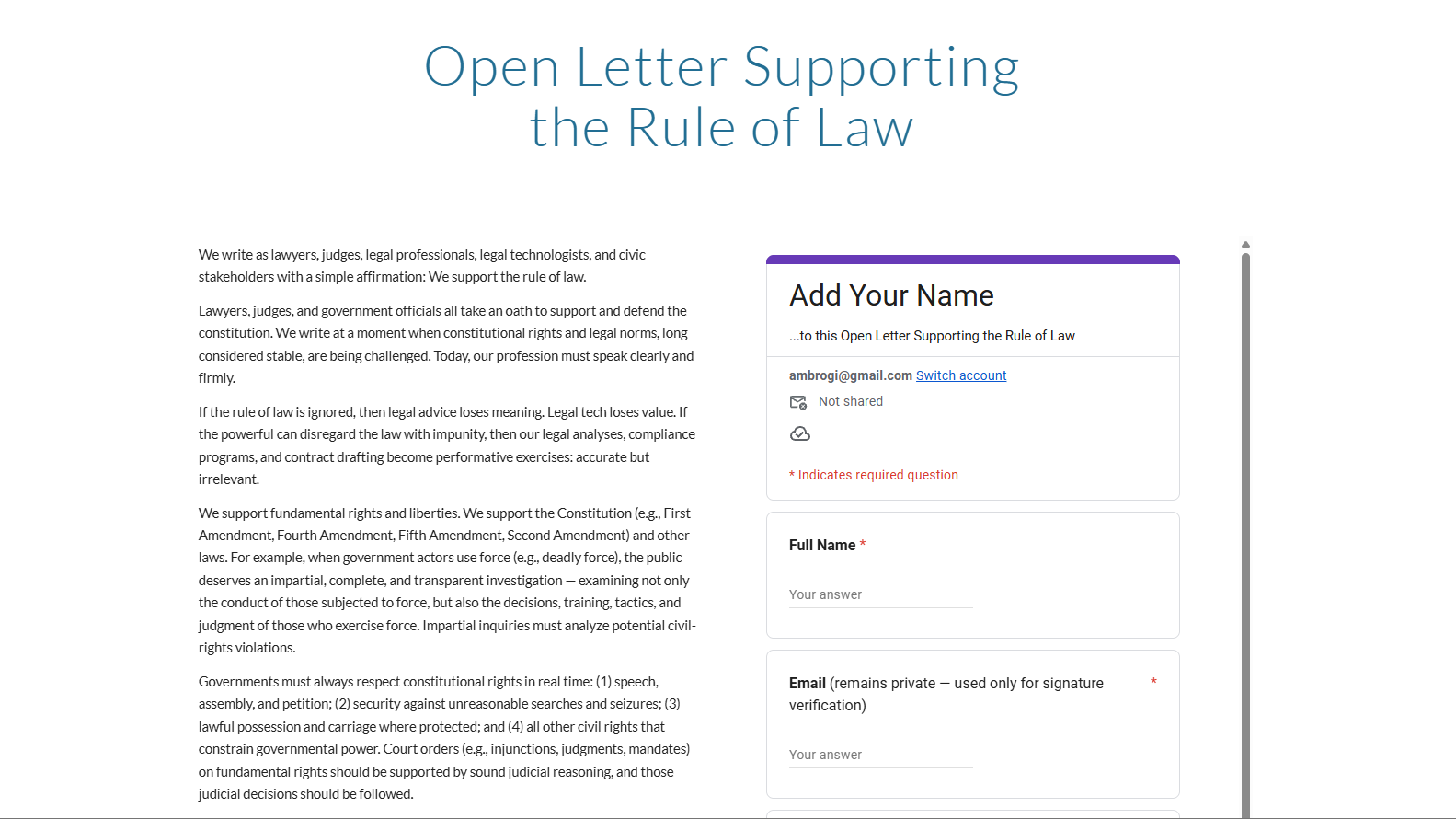
letter
supporting
the
rule
of
law.
“Lawyers,
judges,
and
government
officials
all
take
an
oath
to
support
and
defend
the
constitution,”
the
letter
says.
“We
write
at
a
moment
when
constitutional
rights
and
legal
norms,
long
considered
stable,
are
being
challenged.
Today,
our
profession
must
speak
clearly
and
firmly.”
One
of
the
organizers
of
the
letter
is
Damien
Riehl,
solutions
champion
at
Clio,
who
lives
in
the
Twin
Cities
where
federal
agents
shot
and
killed
Minneapolis
resident
Alex
Pretti
on
Saturday.
“History
will
judge
us,”
Riehl
said
in
an
email.
“Who
is
standing
up
for
justice?
Who
is
remaining
silent?”
Lawyers,
Riehl
said,
have
an
obligation
to
uphold
the
rule
of
law
and
to
use
their
voices
to
advance
justice.
“That
has
always
been
true,”
he
said.
“And
it’s
never
been
truer
than
right
now.
If
we
don’t
stand
up
and
be
counted,
as
supporting
the
rule
of
law,
who
will?”
This
moment
even
has
implications
for
legal
tech,
he
said.
“If
the
rule
of
law
is
ignored,
what
happens
to
legal
tech?
What
good
is
a
tool
that
tells
you
the
law,
that
isn’t
followed?
…
Even
if
you’re
not
moved
by
our
professional
and
moral
obligations,
please
be
moved
by
your
pocketbook.”
Another
who
helped
organize
the
sign-on
campaign
is
Kara
Peterson,
cofounder
and
CEO
of
Descrybe.ai.
In
an
email,
she
said
that
the
rule
of
law
is
foundation
to
the
work
of
legal
tech
innovators.
“When
you
spend
time
in
legal
tech,
you
quickly
realize
that
our
work
depends
on
something
deeper
than
innovation:
legitimacy,”
she
said.
“We
can
build
smarter
search,
better
analytics,
and
more
accessible
tools,
but
none
of
it
matters
if
rules
don’t
constrain
power
and
rights
can
be
overridden
without
consequence.
…
“This
letter
is
us
saying:
we
support
the
rule
of
law.
We
support
judicial
independence
and
accountability.
And
we
believe
those
principles
are
not
partisan.
They
are
foundational.
If
we
don’t
stand
up
for
the
conditions
that
make
law
meaningful,
we
shouldn’t
be
surprised
when
the
work
we
do
becomes
meaningless
too.”
The
letter
says
it
best:
“We,
the
undersigned,
support
and
defend
the
rule
of
law.
We
support
impartial
investigations
wherever
governmental
actions
raise
credible
legal
and
constitutional
questions.
And
we
insist
on
accountability
and
judicial
independence
as
a
business
value
and
a
societal
imperative.
We
cross
geographic
and
political
lines,
supporting
our
common
ideals.
Because
without
the
rule
of
law,
our
lives
—
our
work,
our
institutions,
and
our
society
—
all
lose
value.”
I
have
added
my
name.
I
hope
many
others
do
as
well.
Roughly
31,000
Kaiser
Permanente
nurses
and
other
healthcare
professionals
are
planning
to
launch
an
open-ended
strike
starting
on
Monday.
Their
main
grievances
are
chronic
understaffing,
rising
workloads
and
concerns
that
Kaiser’s
wage
and
contract
proposals
fail
to
address
cost-of-living
pressures.
The
workers
going
on
strike
are
represented
mainly
by
the
United
Nurses
Associations
of
California/Union
of
Health
Care
Professionals
(UNAC/UHCP).
Their
strike
will
affect
20
hospitals
and
200
clinics
across
California
and
Hawaii.
Kaiser
said
it
plans
for
its
facilities
to
stay
open
but
is
warning
of
disruptions,
rescheduled
appointments
and
possible
pharmacy
closures.
This
week,
the
health
system
released
a
statement
saying
national
labor
negotiations
have
stalled
despite
what
it
called
significant
progress
and
a
“historic”
wage
proposal,
blaming
unions
for
bad-faith
tactics
and
disruptions
to
the
bargaining
process.
Kaiser
stated
that
shifting
unresolved
issues
to
local
negotiations
is
the
most
practical
way
to
reach
agreements
on
pay
and
benefits.
The
unions
frame
the
strike
as
a
patient
safety
and
workforce
retention
crisis,
not
just
a
pay
fight.
They
argue
that
low
staffing
levels
and
mounting
administrative
pressures
are
already
delaying
care
—
forcing
clinicians
to
cut
back
services
and,
in
some
cases,
leave
the
organization
altogether.
One
union
member
—
Cameron
Cook,
a
nurse
anesthetist
at
Kaiser’s
hospital
in
Redwood
City,
California
—
noted
that
Kaiser
has
not
negotiated
in
good
faith
and
has
tried
to
portray
union
workers
as
greedy
while
avoiding
serious
bargaining.
He
said
clinicians
are
not
seeking
major
financial
gains
but
are
fighting
to
preserve
existing
benefits
and
protections
that
Kaiser
is
now
trying
to
roll
back,
despite
claims
of
generous
wage
increases.
“While
Kaiser
does
push
this
idea
that
they’re
offering
a
very
generous
wage
increase,
they’re
hiding
the
fact
that
they’re
actually
trying
to
cut
a
lot
of
our
benefits
and
retirement
and
healthcare,
as
well
as
our
ability
to
control
our
own
scheduling,”
Cook
declared.
He
also
pointed
out
that
the
dispute
is
a
patient
care
issue
and
highlighted
how
staffing
shortages
lead
to
delayed
appointments,
canceled
surgeries
and
poor
communication.
He
has
witnessed
these
problems
as
both
as
a
provider
and
as
a
patient
family
member.
“I
have
a
child
who
has
a
permanent
disability,
so
we
are
constantly
going
to
Kaiser.
I
see
what
the
patients
face
on
that
end,
in
terms
of
delayed
or
canceled
appointments,
and
the
inability
to
get
a
response
or
talk
to
a
human.
She
recently
had
a
major
surgery,
and
we
were
never
able
to
get
in
for
her
three-month
follow
up.
We
eventually
just
had
to
stop
trying
because
no
one
would
get
back
to
us,”
Cook
stated.
Ultimately,
he
thinks
workers
still
believe
in
Kaiser’s
mission
but
worry
the
organization
is
drifting
toward
corporate
priorities
at
the
expense
of
patients
and
frontline
staff.
He
warned
that
if
Kaiser
continues
down
its
current
path,
the
gap
between
its
stated
values
and
day-to-day
realities
for
patients
and
clinicians
will
only
widen.
“We
do
like
Kaiser.
We
believe
in
Kaiser.
I
think
in
terms
of
healthcare
in
the
U.S.,
Kaiser’s
model
is
to
be
admired
—
but
we
are
starting
to
see
corporate
interests
creep
in,
and
frankly,
they’re
losing
their
way.
We
want
to
see
Kaiser
invest
in
patient
care
and
the
providers
who
provide
that
care,”
Cook
remarked.
This
type
of
labor
dispute
is
nothing
new
for
Kaiser.
This
same
group
of
31,000
workers
went
on
strike
as
recently
as
October,
when
they
walked
out
for
five
days
over
concerns
related
to
staffing,
wages
and
patient
care.
*
Remember
when
Foley
&
Lardner
fired
a
new
associate
after
she
expressed
support
for
the
citizens
of
Gaza?
After
winning
a
preliminary
battle
over
certain
claims,
the
firm
will
have
to
go
to
court.
[Reuters]
*
This
will
totally
shock
you,
but
big
banks
may
still
be
loaded
with
misogyny.
[Law360]
*
Former
Biglaw
partner
returns
to
the
U.S.
from
Asia
transformed
as
a
poet.
Isn’t
that
the
Colonel
Kurtz
story
arc?
[Law.com
International]
*
Media
begins
to
worry
about
law
students
when
AI
fully
arrives.
Maybe
ask
more
questions
about
how
AI
is
supposed
to
fully
arrive
when
the
biggest
AI
company
is
teetering
on
collapse?
[NY
Times]
*
The
Atlantic
invites
torture
enthusiast
John
Yoo
to
write
an
article
explaining
why
we
shouldn’t
have
international
law.
[The
Atlantic]
Trump’s
Lawyers
Should
Be
Disbarred:
Time
for
accountability.
Mike
Johnson
Wants
To
Impeach
Judges:
Not
the
best
time
to
signal
that
sort
of
thing.
So
Much
For
Perp
Walking
Don
Lemon:
Gotta
try
harder
than
that
when
the
law
and
facts
aren’t
on
your
side.
About
George
Washington
And
Georgetown
Rejecting
ICE:
No
such
luck
this
time.
Interested
In
Entertainment
Law?:
These
law
schools
should
be
on
your
list!
According
to
data
pulled
from
Lobbying
Disclosure
Act
(LDA)
filings,
which
Am
Law
200
Biglaw
firm
took
in
the
most
lobbying
money
in
2025?
Hint:
The
law
firm’s
record
$73.8
million
in
total
LDA
revenue
is
impressive,
but
falls
behind
the
LDA
revenue
($88.3
million)
of
Ballard
Partners,
a
lobbying-only
firm.
Ed.
note:
This
article
first
appeared
in
an
ILTA
publication.
Artificial
intelligence
is
more
than
the
latest
new
tool
to
land
on
lawyers’
desks.
This
time
feels
different
from
earlier
waves
of
technology.
Just
as
the
internet
started
as
a
novelty
and
became essential infrastructure,
AI
is
now
leading
us
to
another
platform
shift.
It
is
not
a
discrete
product,
but
a
new
layer
that
shapes
how nearly
every legal
task
is,
or
can be, performed.
As
someone
who
teaches
and serves as
a
member
of
the
Vanderbilt
Artificial
Intelligence
Law
Lab
(VAILL),
I
have
the
privilege
of
helping
prepare
the
next
generation
for
our
profession.
VAILL
has
become
both
a
model
and
a
hub
for
what
AI
education
can
look
like
in
law
schools.
Our
work
encompasses
more
than
just
training
students
to
navigate
specific
platforms.
We
equip
them
with
AI literacy,
blending-tool awareness,
general capabilities,
critical
thinking,
ethical
grounding,
and
adaptability.
These
are
the
skills
that
future
lawyers
and
legal
leaders
need
to
thrive
in
legal
environments
undergoing
unprecedented
layers
of
rapid
change.
Vanderbilt’s
Approach
and
the
Role
of
VAILL
Vanderbilt
Law
School
embraced
this
shift
through
a
bold
commitment
to
create
VAILL
and
prioritize
a
human-centered
approach
to
exploring
how
AI
intersects
with
law
and
legal
education.
Through
VAILL
and
our
broader
curriculum,
we
create
and
launch
courses
that
directly
address
students’
needs
in
AI
education.
Our
approach
includes
introducing
them
to
the
types
of
tools
they
are
most
likely
to encounter in
practice,
exploring
how
generative
AI
is impacting and
reshaping
workflows,
and
empowering
them
to
engage
with
AI
as
informed
professionals
who
can
confidently
interact
with
it.
For
example,
one
course
enables
students
to
act
as
decision-makers
by
evaluating
tools,
developing
implementation
strategies,
and
addressing
practical
challenges
related
to
data
security
and
firm
policies.
More
importantly,
our
courses
help
students
understand
the
risks
and
benefits
and
how
these
tools
will
complement
their
future
practice
more
broadly.
If
law
schools
neglect
AI
education
now,
they
do
their
students
a
disservice.
The
myth
of
the
“digital
native”
can
lull
us
into assuming
that younger
generations
intuitively
understand
technology. In
reality,
I regularly
see
students
who
can
navigate
TikTok
with
ease
but
struggle
to
understand
why
an
AI
tool
might
hallucinate
legal
citations
or fail
to grasp
the
ethical
implications
of
feeding
client
data
into
ChatGPT.
Law
students
are
learning
AI
at
the
same
pace
as
everyone
else.
Waiting
until
they
arrive
at
a
firm
to figure
it out
may
be
too
late.
There
is
positive
momentum
as
law
schools
rise
to
the
occasion,
with
an
increase
in
AI-related
courses
each
year.
Defining
AI
Literacy
When
I
teach
my
students
about
AI
literacy,
I
emphasize
that
it
extends
beyond
knowing
which
buttons
to
click
on
the
latest
drafting
assistant
or
research
bot.
True
literacy
encompasses
understanding
the
foundational
concepts
behind
the
technology,
the
ability
to
evaluate
outputs,
the
ability
to
adapt
to
evolving
tools,
and
awareness
of
the
ethical
and
professional
duties
that
accompany
its
use.
Our
students
will
go
on
to
work
in
various
settings,
but
we
want
them
to
have
a
clear
picture
of
the
role
technology
will
play
wherever
they
land.
What I’ve learned
is
that
AI
literacy
is
about
understanding
a
tool’s
place
in
workflows, anticipating risks,
and
imagining
new
possibilities.
Once
we
know
what
is
possible,
strategic
thinking
becomes
more
accessible.
Our
students
are
poised
to
spot
the
“possible”
and
serve
as
voices
of
innovation.
Embracing Students’ Uncertainty Boosts
Engagement
When
students
talk
about
using
AI,
their
reactions
often
mirror
those
of
the
profession:
a
mix
of
skepticism,
anxiety,
and
curiosity.
Some
are
understandably
concerned.
After
all, they’re investing
three
years
and
substantial
tuition
in
legal
education,
only
to
read
headlines
predicting
that
AI
will
automate
their job
away.
We
are
happy
to
help
temper
those
fears.
But
what
strikes
me
most
is
that
those
skeptical
students
are
also
the
ones
who
voluntarily
enroll
in
our
courses
and
engage
deeply.
Our
goal
is
not
to
produce
AI
advocates,
but
rather
to
cultivate
future
lawyers
who
can
think
critically
about
when
and
how
to
deploy
these
tools
effectively.
Students
want
to
understand
what
lies
ahead
rather
than
fear
it.
Education
becomes the antidote
to
uncertainty.
We
also
hear
regularly
from
students
returning
from
summer
jobs
that
AI
is
present
at
their
firms,
but
often
without
clear
policies,
structured
training,
or
consistent
implementation.
That
lack
of
guidance
can
leave
young
lawyers
unsure
of
how
to
contribute
or
engage
responsibly.
By
equipping
them
with
frameworks
for
evaluating
tools
and
understanding
ethical
obligations,
we
prepare
them
not
just
to
use
AI
but
to
lead
conversations
about
its
role
in
practice.
Law
Students
as
Future
Leaders
That
leadership
will
hopefully emerge sooner
than
we
might
expect.
Our
students
are
being
exposed
to
AI
literacy
in
ways
that
graduates
just
a
few
years
ago
never
were.
This
positions
them
to
step
into
meaningful
roles
in
firm
innovation
and
governance
much
earlier
in
their
careers.
I
do
not
subscribe
to
the
belief
that
AI
will
reduce
the
need
for
new
associates.
Who
will
become
senior
associates
and
partners
if
we
cut
off
the
pipeline?
Instead,
I
view
AI
as
an
opportunity
to reframe what
early
practice
looks
like.
Rather
than
spending
their
first
years
bogged
down
in
repetitive
but
necessary
tasks,
associates
will
be
able
to
focus
earlier
on
rewarding
intellectual
work.
In
some
ways,
this
may
help
students
become
better
lawyers
more
quickly.
This
shift
could
accelerate
their
growth
by
channeling
their
energy
toward
the
uniquely
human
aspects
of
practice,
such
as
strategic
thinking,
creative
problem-solving,
and
nuanced
client
advice.
They
will
still
learn
the
fundamentals,
but
without
being
defined
by
rote
work
that
technology
can
now
handle.
That
is
a
profound
shift
in
how
lawyers
receive
on-the-job
training.
I
hope
that
partners
understand
and
adapt
to
this
change,
engaging
new
associates
in ways different
from
the
past.
We
have
long operated under
the
principle
of
“doing
more
with
less,”
but
AI
flips
that
script
for
new
associates,
enabling
them
to
learn
more
substantive
skills
with
less
time
spent
on
repetitive
tasks.
Looking
five
to
ten
years
ahead,
I
envision
law
schools
empowering
students
to
innovate
in
ways
that
were
previously
impossible.
For
the
first
time,
non-technical
students
can
imagine,
design,
and
even
create
tools
that
serve
their
practice
or
their
clients. I
am
already
seeing
students
prototype
simple
legal
workflows
using
no-code
platforms
or
design
AI-assisted
client
intake
processes. AI
is
lowering
the
barriers
to
innovation
in
law,
and
that
should
excite
us
all.
A
Shared
Mission
If
I
could
leave
readers
with
one
message,
it
would
be
this:
preparing
the
next
generation
of
AI-literate
lawyers
is
not
a
solo
mission.
Law
schools
around
the
country
are
doing
their
part,
but
the
journey
requires
collaboration
with
firms,
technologists,
and
professional
organizations
to
fully
realize
its
potential.
Our
goal
is
not
to
graduate
students
who
know
how
to
use
one
tool,
but
rather
to
produce
professionals
who
can
lead
in
a
world
where
technology
will
constantly
change
and
prove
essential
for
competent
representation.
Firms
should
continually
educate
their
employees
through
clear
policies,
practical
training,
and
an
environment
that
fosters
openness
to
exploration
and
experimentation.
At
VAILL,
we
are
committed
to
equipping
students
not
just
to
survive
in
an
AI-enabled
profession,
but
to
shape
it.
And
for
those
already
in
practice,
the
lesson
is
clear:
be
open
to
learning
from
the
newest
members
of
your teams.
Their
AI
literacy
will
help
your
firm
navigate
the
changes
ahead.
T.
Kyle
Turner
is
the Assistant
Director
of Emerging
Technology
and
Digital
Initiatives
at
Vanderbilt
Law
School,
where
he
is
a
member
of
the
Vanderbilt
Artificial
Intelligence
Law
Lab
(VAILL).
His
work
focuses
on
legal
technology,
AI
literacy,
and
preparing
students
and
practitioners
to
engage
with
AI ethically and effectively.
President
Donald
J.
Trump
begins
the
public
portions
of
his
Cabinet
meetings
by
going
around
the
table
having
all
of
the
Cabinet
members
praise
Trump
to
the
heavens.
How
embarrassing.
Embarrassing
for
Trump,
who
is
so
insecure
that
he
insists
that
others
publicly
praise
him. But
also
embarrassing
for
the
members
of
the
Cabinet,
who
have
chosen
to
publicly
debase
themselves
for
the
chance
to
hold
power
(and,
for
those
named
Vance
and
Rubio,
the
possibility
of
holding
yet
more
power
in
the
future).
I’ve
attended
an
awful
lot
of
meetings
with
powerful
people
in
my
life
—
CEOs,
managing
partners,
and
the
like. Not
one
has
insisted
on
starting
with
praise
of
the
boss
before
moving
on
to
the
rest
of
the
agenda. In
fact,
if
you’d
tried
to
start
a
presentation
by
flattering
the
boss,
most
bosses
would
have
shut
you
up. Those
who
didn’t
shut
you
up
would
have
simply
fired
you.
That
doesn’t
mean
folks
don’t
suck
up
to
the
boss. Of
course
they
do. Folks
flatter
the
boss
in
private. They
laugh
at
his
or
her
jokes. They
stay
at
the
company
holiday
party
until
five
minutes
after
the
boss
leaves. But
no
boss
insists
on
reverential
praise
in
public.
Except
Trump.
What
a
sad,
pathetic
little
man.
Foreign
leaders
have
learned
this
lesson. Praise
Trump
publicly,
and
perhaps
he’ll
treat
you
better. Heads
of
state
across
Europe
now
play
this
disgraceful,
but
effective
game.
Maria
Corina
Machado,
the
Venezuelan
opposition
leader
who
won
the
Nobel
Peace
Prize,
recently
gave
her
prize
to
Trump. She
accompanied
that
gift,
naturally,
with
flattery. If
you’d
like
Trump’s
help
to
install
you
as
the
leader
of
Venezuela,
flatter
the
man.
A
person
with
a
shred
of
dignity
would
have
refused
to
accept
Machado’s
prize.
Not
our
guy.
I
checked
the
comments
on Breitbart to
see
what
the
Trump morons loyalists
were
saying
about
Machado’s
presentation. The
loyalists
figure
Machado
was
sincere: “She
said
great
things
about
Trump. It
was
touching. He
must
be
a
great
man,
and
she
sees
it.”
Did
those
commenters
miss
the
way
Cabinet
meetings
start? What’s
your
explanation
for
that?
Just
coincidence?
Trump
is
not
great. He’s
a
sad,
pathetic
little
man.
John
McCain
was
captured
in
Vietnam
and
then
declined
an
early
release
from
prison
because
he
feared
the
North
Vietnamese
would
use
his
release
to
score
public
relations
points. Private
Bone
Spurs
didn’t
like
McCain.
Bone
Spurs
said
he
likes
the
guys
who
don’t
get
captured.
Like
himself,
maybe. Avoid
the
draft;
avoid
the
risk
of
capture.
Trump
knows
what
a
real
hero
is,
and
he
knows
that
he
doesn’t
look
like
one. That’s
what
really
bothers
Trump
about
McCain.
Guys
who
died
on
the
beaches
of
Normandy
were
“suckers
and
losers.”
Right. I
can
see
Trump
going
over
the
side
of
a
Higgins
boat
on
June
6,
1944,
into
freezing
water,
in
the
face
of
enemy
fire,
at
Normandy
Beach.
Wait
—
my
aching
bone
spurs!
Only
once
in
history
—
in
the
aftermath
of
9/11
—
has
any
member
of
NATO
invoked
Article
5,
which
says
that
an
attack
on
one
NATO
member
will
be
deemed
an
attack
on
all.
Our
NATO
allies
heeded
the
United
States’
call
to
duty. Those
allies
paid
a
price
for
their
loyalty.
Of
the
roughly
3,500
service
members
from
NATO
countries
who
were
killed
in
Afghanistan,
about
1,000
were
from
countries
other
than
the
United
States.
But
last
week
Trump
said
of
those
1,000
dead
that
the
U.S.
never
“needed
them.” According
to
Trump,
“they’ll
say
they
sent
some
troops
to
Afghanistan
or
this
or
that.
And
they
did.
They
stayed
a
little
back,
little
off
the
front
lines.”
Tell
that
to
the
grieving
sons
and
daughters,
you sad,
pathetic
little
man.
On
the
night
before
D-Day,
General
Dwight
D.
Eisenhower
wrote
a letter in
the
event
that
the
Normandy
invasion
failed. He
praised
the
troops
and
took
all
the
blame
for
the
failure.
When
President
Donald
Trump
was
asked
if
he
took
responsibility
for
the
problems
with
COVID
testing,
he
heroically responded,
“No.
I
don’t
take
responsibility
at
all.”
Of
course
not.
You
sad,
pathetic
little
man.
What
president
—
indeed,
what
person
—
would
give
visitors
free
admission
to
national
parks
on
their
birthday,
post
insulting
plaques
about
former
presidents
on
the
walls
of
the
White
House,
or
put
their
name
before
that
of
the
assassinated
John
F.
Kennedy
on
the
facade
of
the
Kennedy
Center?
Yes,
yes: The
answers
to
those,
and
all
the
other,
questions
are
the
same:


 Kathryn