The law firm of choice for internationally focused companies

+263 242 744 677

admin@tsazim.com

4 Gunhill Avenue,

Harare, Zimbabwe

Category: News Feeds

Category Added in a WPeMatico Campaign

Govt admits lack of border technology to detect rare earth mineral exports

The admission came during a parliamentary question-and-answer session, where legislators pressed the Mines and Mining Development Minister, Polite Kambamura, on measures to prevent rare earth minerals from being exported secretly alongside other minerals such as lithium.

Legislator Clemence Chiduwa highlighted the global scramble for rare earth elements, which are essential for high-tech industries, artificial intelligence, and robotics.

“If we have lithium as the principal mineral, rare earths could be hidden within those consignments,” Chiduwa warned. “What policies does the government have to prevent this?”

Minister Kambamura said the government has introduced interim measures to tighten oversight of mineral exports, including banning the export of raw minerals and lithium concentrates. He added that authorities are now calling on mining companies to voluntarily declare the composition of their deposits and export consignments.

“We are developing a critical mineral policy that will guide how these minerals are extracted, beneficiated, and marketed,” Kambamura said. “The measures already in place aim to ensure the country does not lose out amid the global scramble for rare earths.”

However, when pressed on the government’s ability to detect undeclared minerals at borders, Kambamura admitted that scanning technology has not yet been deployed.

“Currently, we rely on our laboratories, which are being upgraded to analyse export consignments before they reach the borders. Scanners will be deployed at border posts in the near future,” he said.

Kambamura also announced plans to establish internationally recognised laboratories in major cities and along key transport routes to prevent smuggling.

Lawmakers questioned the consistency of government policy, particularly regarding lithium exports. Legislator Corban Madzivanyika noted that a 2023 statutory instrument allowed lithium exports until 2027. “Does the suspension of lithium exports not amount to policy inconsistency?” he asked.

The minister responded that the government reserves the right to intervene if investors breach existing regulations, emphasising the need to balance investor rights with national interests.

Questions were also raised about the availability of data on rare earth mineral deposits. Legislator Edwin Mushoriwa warned that reliance on incomplete information could result in losses. Kambamura confirmed that the government still largely depends on historical geological data but said a geophysical aeromagnetic survey is planned to accurately map and quantify the country’s rare earth resources.

“This survey will allow us to conduct proper research and identify precisely where our rare earths are and their quantities,” he said.

Council cracks down on illegal dumping

In a recent enforcement operation in Pumula North, five households were fined $1035 for dumping litter in unauthorised areas, Senior Parks Warden Mthabisi Moyo said.

He urged residents to report instances of illegal dumping to council authorities.

“As soon as you see your neighbour dumping, contact the council. They will issue a ticket, and failure to pay within seven days will see the amount added to your utility bills,” Moyo said.

The council has also expressed concern over churches conducting open-air services without permits, warning that fines of $71 will be imposed for non-compliance. Moyo admitted that current bylaws are insufficient to fully curb the practice.

“Our bylaw is not as strong as we would like. We issue tickets, they pay, and then they return to worship in the same place,” he said.

Residents have additionally raised concerns over the disposal of special waste items, including TVs, fridges, and chambers, noting that the council does not collect them. Moyo advised residents to contact their local councilor for assistance or transport such items to Ngozi Mine.

The council is appealing to the public to assist in enforcing local laws. Moyo called on communities to empower neighbourhoods to report illegal dumping and other unlawful activities.

“Let us not attend these churches so that they relocate. We are not saying people should not worship, but open-air services and unauthorised structures are not permitted,” he said.

He added: “We encourage residents to work with the council to maintain a clean and safe environment.”

Bona Chikore appointed EmpowerBank deputy board chair

<br /> Bona<br /> Chikore<br /> appointed<br /> EmpowerBank<br /> deputy<br /> board<br /> chair


6.3.2026


18:39

Mrs
Bona
Chikore,
daughter
of
the
late
former
President
Robert
Mugabe,
has
been
appointed
deputy
chairperson
of
the
newly
constituted
EmpowerBank
board.


This
follows
the
appointment
of
a
seven-member
board
by
Minister
of
Youth
Empowerment,
Development
and
Vocational
Training,
Tino
Machakaire.

Post
published
in:

Business


Manage
consent

Lawyers in dirty fight over money


Lawyers
involved
in
Matabeleland
pressure
group
Ibhetshu
LikaZulu
and
one
of
its
leaders
Mbuso
Fuzwayo’s
Constitutional
Court
bid
to
block
President
Emmerson
Mnangagwa’s
term
extension
are
at
each
other’s
throats
over
legal
fees
involving
US$450
000,
well-informed
legal
sources
say.
The
highly-placed
sources
say
Nqobani
Sithole
of
Sithole
Law
Chambers
and
Method
Ndlovu
of
Apex
Legal
Group
of
Advocates’
fight
intensified
after
the
latter
hastily
withdrew
his
legal
services
yesterday,
citing
a
breakdown
in
trust,
reputational
risk
and
lack
of
payment.

Sithole
was
the
instructing
lawyer
and
Ndlovu
the
advocate
in
the
case.
The
bill
for
the
whole
project
was
US$450
000
which
Ibhetshu
and
Fuzwayo
settled.
The
money
was
initially
supposed
to
be
equally
divided
among
three
senior
lawyers,
including
Sithole
as
the
instructing
lawyer,
Ndlovu
as
the
advocate
and
another
advocate
from
the
Advocates’
Chambers
in
Harare
who
later
withdrew.
A
top
legal
source
told
The
NewsHawks:
“When
the
case
started
Sithole,
as
instructing
lawyer,
looked
for
an
advocate
and
initially
choose
a
Harare
lawyer
from
Advocates’
Chambers.

It’s
not
necessary
to
drag
his
name
into
this
since
he
withdrew.
However,
their
negotiations
broke
down
as
the
advocate’s
fees
were
astronomically
high.
He
wanted
US$450
000.
Yet
US$450
000
was
the
whole
budget.
So
Sithole
then
approached
Ndlovu
with
a
US$150
00
offer.
But
when
the
money
was
out
and
ready
for
collection,
Ndlovu
took
US$225
000;
US$75
000
more.
Sithole
took
the
balance
since
the
preferred
advocate
had
withdrawn.
Now
the
problem
is
Ndlovu
wants
more
money,
claiming
US$450
000,
the
whole
budget.
This
is
the
source
of
the
current
fight,
the
other
issues
arise
from
this.
Trust
broke
down
because
of
money,
including
the
recently
leaked
audio
concerning
(former
minister)
Jonathan
Moyo.

The
reputational
risk
Ndlovu
is
taking
about
regards
his
view
that
he
took
a
case
which
he
knew
would
perhaps
damage
his
reputation,
but
was
willing
to
brave
it
at
the
right
price.
Resultantly,
Ndlovu
got
US$225
000,
but
wants
more.
This
has
fuelled
the
already
simmering
tensions
and
explosive
legal
wrangle.”
The
dispute
between
Sithole
and
Ndlovu
may
open
a
Pandora’s
Box
of
legal
and
political
issues
with
far-reaching
implications
for
Zimbabwe.
The
legal
battle
between
the
two
is
deeply
intertwined
with
the
debate
on
the
controversial
constitutional
amendments
that
extend
Mnangagwa’s
term
and
change
the
political,
electoral
and
governance
systems.

Sithole
is
said
to
be
protesting
against
Ndlovu’s
letter
after
he
withdrew
throwing
tantrums.
Sources
say
Sithole
thinks
the
letter
was
written
to
pre-empt
his
move
to
terminate
Ndlovu’s
services
after
a
confidential
conversation
between
them
yesterday.
The
sources
say
the
two
had
agreed
on
a
process,
which
would
have
entailed
Sithole
officially
writing
to
Ndlovu
this
morning,
then
waiting
for
his
reply
before
a
professional
and
mutually
agreed
disengagement.

Instead,
Ndlovu
pre-empted
the
process
to
extricate
himself
by
writing
the
letter
and
leaking
it
to
the
media
before
it
was
received
and
acknowledged
by
Sithole,
the
sources
say.
Sithole
took
exception
to
that
and
contents
of
the
letter,
particularly
Ndlovu’s
claim
that
he
has
not
been
paid.
The
ensuing
fierce
battle
between
Sithole
and
Ndlovu
also
entangles
another
lawyer,
Zibusiso
Ncube,
who
played
a
critical
liaison
role,
including
fielding
a
phone
call
to
Moyo,
which
was
later
leaked
to
the
media.
The
sources
said
all
hell
broke
loose
after
Sithole
moved
to
remove
Ndlovu
from
the
case
following
the
recent
controversy
over
Moyo’s
audio.

Ndlovu
says
in
his
letter
Moyo
is
the
“principal
architect
of
the
litigation”.
Sources
say
Moyo
disputes
this
and
has
taken
issue
with
Sithole
and
Ndlovu,
and
may
make
a
public
denunciation
of
the
two.
Moyo
has
already
denounced
Ncube
and
Ndlovu
over
the
leaked
audio,
which
has
given
the
case
a
new
political
dimension.

Post
published
in:

Featured

Zimbabwe taking steps to clear $23bn debt, president says

File
photo:
Reuters/Philimon
Bulawayo


  • The
    country
    has
    enlisted
    the
    services
    of
    the
    AfDB
    and
    former
    Mozambican
    President
    Joaquim
    Chissano
    to
    help
    negotiate
    with
    creditors.

The
authorities
recognise
that
credibility
and
predictability
are
essential
ingredients
to
restoring
investor
confidence
and
securing
new
lines
of
credit,
Mnangagwa
told
heads
of
diplomatic
missions
and
international
organisations
in
the
capital,
Harare,
on
Thursday.

“My
government’s
ongoing
engagement
with
international
financial
institutions,
under
the
Arrears
Clearance
and
Debt
Resolution
Process,
is
progressing
well,”
Mnangagwa
said.
“We
are
taking
concrete
steps
towards
fulfilling
our
financial
obligations,”
he
said,
without
providing
details.

Zimbabwe
last
month
secured
a
staff-monitored
program
from
the
International
Monetary
Fund,
a
key
step
toward
resolving
about
$23
billion
of
debt
that
has
shut
it
out
of
international
capital
markets
for
almost
three
decades.

The
southern
African
nation
has
been
locked
out
of
international
capital
markets
since
1999,
after
defaulting
on
debt
owed
to
lenders
including
the
World
Bank,
the
Paris
Club
and
the
African
Development
Bank.

The
country
has
enlisted
the
services
of
the
AfDB
and
former
Mozambican
President
Joaquim
Chissano
to
help
negotiate
with
creditors.

How Appealing Weekly Roundup – Above the Law


Ed.
Note
:

A
weekly
roundup
of
just
a
few
items
from
Howard
Bashman’s

How
Appealing
blog
,
the
Web’s
first
blog
devoted
to
appellate
litigation.
Check
out
these
stories
and
more
at
How
Appealing.


“States
Sue
to
Stop
Trump
From
Reviving
Steep
Tariffs;
The
lawsuit
filed
by
two
dozen
attorneys
general
seeks
to
invalidate
the
president’s
new,
10
percent
global
tax
on
imports”:
 Tony
Romm
of
The
New
York
Times
has this
report
.


“Supreme
Court
Continues
to
Shoot
Self
In
Foot
In
Second
Amendment
Cases;
The Bruen decision
is
somehow
getting
even
more
embarrassing
with
time”:
 Madiba
K.
Dennie
has this
essay
 online
at
Balls
and
Strikes.


“Why
Trump
First
Ended
the
Law
Firm
Suits,
Then
Didn’t;
We
can’t
know
for
sure,
but
he
ended
in
a
worse
place
than
before”:
 Bob
Bauer
has this
post
 at
the
“Executive
Functions”
Substack
site.


“This
OLC
Opinion
Is
‘Bullshit’;
When
lawyers
are
motivated
to
‘get
to
yes,’
their
work
is
prone
to
bullshit
(in
the
technical
sense);
And
this
OLC
opinion
is
full
of
it”:
 Dan
Maurer
has this
post
 at
the
“Lawfare”
blog.


“The
End
of
Limits
on
a
President’s
Wars;
Past
conflicts
eroded
Congress’s
ability
to
decide
when
to
go
to
war;
Donald
Trump’s
attack
on
Iran
destroyed
it”:
 Ruth
Marcus
has this
essay
 online
at
The
New
Yorker.


“He
Didn’t
Kill
Anyone.
Alabama
Is
About
to
Execute
Him
Anyway.”
 Elizabeth
Vartkessian
has this
guest
essay
 online
at
The
New
York
Times.

Analysis of the Constitution Amendment Bill : Part 2


In
the
first
part
of
our
analysis
of
the
Constitution
of
Zimbabwe
Amendment
(No
3)
Bill [link] we
looked
at
the
amendments
the
Bill
proposes
to
make
to
the
way
in
which
the
President
is
elected,
the
extension
of
the
presidential
term
and
the
life
of
Parliament,
and
the
appointment
of
Senators.  In
this,
the
second
part,
we
shall
examine
the
remaining
provisions
of
the
Bill.

Elections

The
Bill
proposes
to
strip
the
ZEC
of
some
of
its
functions
namely: registering
voters,
maintaining
voters
rolls
and
delimiting
electoral
boundaries.

Voter
registration
and
maintenance
of
voters
rolls


Clause
2
 of
the
Bill
will
confer
on
the
Registrar-General
the
functions
of
registering
voters
and
compiling
and
maintaining
voters
rolls.


Comments
:  This
makes
some
administrative
sense.  The
Registrar-General
keeps
registers
of
births
and
deaths,
and
is
in
a
better
position
than
ZEC
to
register
citizens
as
voters.
On
the
other
hand,
voters
rolls
were
not
properly
maintained
between
1980
and
2013,
when
the
Registrar-General
was
responsible
for
them,
and
there
is
a
fear
that
they
will
not
be
maintained
any
better
now.  The
Registrar-General
is
a
civil
servant
and
subject
to
political
control
and
manipulation
by
the
President
through
his
Ministers,
while
ZEC
is
at
least
notionally
independent.

Delimitation
of
Electoral
Boundaries

A
new
Commission

the
Zimbabwe
Electoral
Delimitation
Commission

will
be
established
to
fix
and
alter
the
boundaries
of
constituencies
and
wards
in
accordance
with
Chapter
7
of
the
Constitution
(clauses
11
to
13
of
the
Bill).  It
will
be
appointed
whenever
delimitations
have
to
be
done

which
means
every
10
years
in
terms
of
section
161
of
the
Constitution.  All
the
members
of
the
Commission
will
be
appointed
by
the
President,
the
chairperson
after
consultation
with
the
Judicial
Service
Commission.


Comments
:  How
well
the
new
commission
will
function
remains
to
be
seen,
but
it
can
hardly
make
a
worse
job
of
delimiting
electoral
boundaries
than
the
ZEC,
whose
2023
delimitation
was
full
of
inaccuracies
and
violated
the
Constitution
and
the
Electoral
Act.

It
should
be
noted
however
that
all
the
members
of
the
new
commission
will
hold
office
at
the
President’s
pleasure,
which
means
they
can
be
dismissed
and
replaced
whenever
the
President
pleases
(see
section
320(2)
of
the
Constitution).  Hence
the
commission
will
not
be
independent.  ZEC,
as
we
have
said,
is
at
least
notionally
independent.

Jurisdiction
of
the
Constitutional
Court

At
present
the
Constitutional
Court
decides
only
constitutional
matters,
i.e.
cases
involving
the
interpretation
and
enforcement
of
the
Constitution.  Its
decisions
on
those
matters
bind
all
other
courts.  Clause
14
 of
the
Bill
proposes
to
extend
the
court’s
jurisdiction
to
cover:

“any
other
matter,
if
the
Constitutional
Court
grants
leave
to
appeal,
on
the
grounds
that
the
matter
raises
an
arguable
point
of
law
of
general
public
importance
which
ought
to
be
considered
by
the
Court.”


Comment
:  This
proposal
is
badly
conceived
and
ineptly
drafted.  It
will
give
the
Court
power,
in
effect,
to
determine
its
own
jurisdiction

a
dangerous
thing
to
do,
because
judges
are
not
always
above
power-grabbing.  The
Supreme
Court
is
declared
by
section
169
of
the
Constitution
to
be
the
final
court
of
appeal
for
Zimbabwe,
but
if
the
Constitutional
Court
encroaches
on
its
jurisdiction,
the
Supreme
Court’s
status
will
be
placed
in
doubt.  Furthermore,
section
167(1)
of
the
Constitution
states
that
the
Constitutional
Court’s
decisions
in
constitutional
matters
bind
all
other
courts,
including
the
Supreme
Court.  But
what
of
the
Constitutional
Court’s
decisions
in
these
new
“other
matters”
referred
to
in
the
amendment?  Will
they
bind
other
courts?  The
amendment
does
not
say.

Appointment
of
Judges

Clause
15
of
the
Bill
will
amend
the
constitutional
requirements
for
appointing
judges
so
that
all
judges,
from
the
Chief
Justice
downwards,
will
be
appointed
by
the
President
after
consultation
with
the
Judicial
Service
Commission.  There
will
be
no
calling
on
the
public
for
nominations,
no
public
interviews
of
candidates
and
no
selection
of
candidates
by
the
Judicial
Service
Commission.  There
will
be
no
transparency
whatever
about
the
processes
by
which
the
President
selects
his
judges. 
It
will
be
difficult
to
assess
whether
those
appointed
have
the
requisite
experience
and
qualifications

and
an
inexperienced person
without
judicial
experience
could
be
appointed
as
Chief
Justice


Comment
:  The
Constitution
gives
the
superior
courts
power
to
monitor
constitutional
compliance
by
everyone,
from
the
President
down
to
the
lowest
official,
and
to
ensure
that
everyone
abides
by
the
principles
laid
down
in
the
Constitution
including
respect
for
the
law
and
fundamental
human
rights
and
freedoms.  So
important
is
the
courts’
role
that
section
164
of
the
Constitution
states:

“The
independence,
impartiality
and
effectiveness
of
the
courts
are
central
to
the
rule
of
law
and
democratic
governance
…”

If
judges
are
to
be
appointed
at
the
whim
of
the
President,
how
can
the
public
respect
their
independence,
impartiality
and
effectiveness?

Appointment
of
Prosecutor-General

Under
section
259(3)
of
the
Constitution,
the
Prosecutor-General
is
appointed
by
the
President
on
the
advice
of
the
Judicial
Service
Commission.  Clause
20
of
the
Bill
will
allow
the
President
to
appoint
the
Prosecutor-General
entirely
at
his
own
discretion,
without
seeking
anyone’s
advice.


Comment
:  Like
the
proposed
changes
to
the
appointment
of
judges,
this
is
an
undesirable
amendment.  The
Prosecutor-General
is
in
charge
of
prosecutions
on
behalf
of
the
State,
which
means
he
or
she
decides
who
should
be
prosecuted
for
crimes
and
who
should
not.  It
is
important
that
these
decisions
are
made
impartially
and
without
interference
from
the
Executive

indeed
section
260
of
the
Constitution
says
that
the
Prosecutor-General
must
be
impartial
and
not
subject
to
anyone’s
direction
or
control.  A
Prosecutor-General
appointed
at
the
sole
discretion
of
the
President
is
unlikely
to
have
the
requisite
independence
and
impartiality.

Abolition
of
Zimbabwe
Gender
Commission


Clauses
18
and
19
 of
the
Bill
will
abolish
the
Zimbabwe
Gender
Commission
and
transfer
its
functions
to
the
Zimbabwe
Human
Rights Commission.


Comment
:  The
functions
of
the
two
commissions
overlap
because
gender
rights
are
part
of
human
rights,
though
admittedly
a
very
important
part.  Hence
there
is
some
sense
in
folding
the
Gender
Commission
into
the
Human
Rights
Commission.

On
the
other
hand,
gender
rights
are
particularly
sensitive
so
a
special
commission
to
handle
them
is
justified.  There
has
been
no
suggestion
that
the
Zimbabwe
Gender
Commission
has
failed
to
carry
out
its
functions
properly,
or
that
the
Zimbabwe
Human
Rights
Commission
is
in
a
better
position
to
carry
them
out.  So
why
abolish
the
Commission? 
Women’s
forums
have
expressed
their
opposition
to
this
change. 
Gender-based
violence
is
endemic
in
Zimbabwe,
and
a
commission
that
specialises
in
gender
issues
may
be
in
a
better
position
to
deal
with
it
than
a
more
generalised
human
rights
commission.

Note,
incidentally,
that
abolition
of
the
Commission
will
mean
the
Zimbabwe
Gender
Commission
Act
of
2015
will
have
to
be
repealed
and
some
provision
made
for
the
terminal
benefits
of
its
commissioners
and
staff
and
the
continuation
of
its
functions
by
the
Human
Rights Commission.

Traditional
Leaders

According
to
section
281(2)
of
the
Constitution,
traditional
leaders
must
not
be
members
of
any
political
party
and
must
be
completely
non-partisan.  Clause
21
of
the
Bill
will
abolish
this
requirement.


Comments
:  The
Bill’s
memorandum
explains
this
amendment
by
saying
that
requiring
traditional
leaders
to
be
non-partisan
violates
their
political
rights.  It
doesn’t – any
more
than
requiring
judges
and
members
of
the
Defence
Forces
to
be
non-partisan
violates
their
rights.  Being
party-political
would
also
interfere
with
many
of
their
traditional
functions
such
as
presiding
over
their
courts
and
allocating
land, which
require
them
to
be
impartial.

Other
Amendments
to
Constitution

In
addition
to
those
we
have
outlined
above
and
in
our
earlier
bulletin,
the
Bill
will
make
several
other
amendments
to
the
Constitution:


Qualifications
of 
Attorney-General

At
present,
lawyers
are
qualified
to
be
appointed
Attorney-General
if
they
are
qualified
to
be
appointed
as
judges
of
the
High
Court.  Clause
7
of
the
Bill
will
require
them
to
have
the
qualifications
of
Supreme
Court
judges.  All
this
really
means
is
that,
to
be
qualified
for
appointment,
lawyers
will
have
to
have
been
in practice for
ten
years
rather
than
seven
years.

Role
of
Defence
Forces

Section
212
of
the
Constitution
declares
that
the
Defence
Forces
have
the
function
of
protecting
Zimbabwe
and
its
people,
and
upholding
the
Constitution.  Clause
16
of
the
Bill
 will
remove
the
separate
function
of
upholding
the
Constitution
and
instead
will
state
that
protecting
Zimbabwe
and
its
people
must
be
done
in
accordance
with
the Constitution.


Comment
:  The
amendment
does
not
significantly
alter
the
role
of
the
Defence Forces.

Abolition
of
National
Peace
and
Reconciliation
Commission

Clause
22
of
the
Bill
will
abolish
the
National
Peace
and
Reconciliation
Commission.


Comment
:  The
Commission
was
established
for
a
ten-year
period
which
ended
in
2023,
so
its
abolition
as
a
constitutional
commission
is
a
formality,
legally
at
least.
 The
National
Peace
and
Reconciliation
Commission
Act
of
2017
does
not
extend
the
Commission’
life,
which
means
that
in
law
it
ceased
to
exist
in
2023.
 In
fact
the
Commission
has
continued
to
receive
government
funding
(this
needs
to
be
accounted
for)
so
it
has
remained
notionally
in
existence,
though
unable
to
do
anything.

General
Comments

According
to
the
Bill’s
memorandum,
the
proposed
amendments
are
unobjectionable,
designed
to

“reinforce
constitutional
governance,
strengthen
democratic
structures,
clarify
institutional
mandates
and
harmonise
Zimbabwe’s
constitutional
order
with
tested
and
successful
practices
in
other
progressive
jurisdictions.”

Nothing
could
be
further
from
the
truth,
as
we
have
tried
to
demonstrate
in
this
and
the
earlier
bulletin:  the
amendments
will
weaken
constitutional
governance
by
violating
the
principle
of
separation
of
powers
and
reducing
the
judiciary
and
chief
prosecutor
to
presidential
hirelings;  and
they
will
nullify
the
institutional
mandate
of
the
Constitutional
Court
by
allowing
it
to
determine
its
own
jurisdiction.  As
for
harmonising
our
constitutional
order
with
other
progressive
jurisdictions,
the
amendments
will
bring
our
presidential
system
into
line
with
countries
such
as
the
Central
African
Republic, Gabon
and
Equatorial
Guinea,
none
of
which
can
lay
claim
to
stability
and
good
governance.

The
Bill
has
nothing
to
recommend
it.  When
it
comes
before
Parliament
it
should
be
rejected
in
its
entirety. 
Even
if
it
is
passed
by
Parliament
it
will
be
open
to
challenge
on
the
ground
that
it
violates
the
fundamental
values
of
the
Constitution.


Veritas
makes
every
effort
to
ensure
reliable
information,
but
cannot
take
legal
responsibility
for
information
supplied

Post
published
in:

Featured

Lindsey Halligan Under Investigation And The DOJ Is Big Mad About It – Above the Law

Lindsey
Halligan
(Photo
by
Al
Drago/Getty
Images)

The
Department
of
Justice

just
dropped
a
proposed
regulation

to
grant
Attorney
General
Pam
Bondi
unilateral
authority
to
block
state
bar
ethics
investigations
into
current
and
former
government
lawyers.
Bondi’s
pitch
to
become
God-Empress
of
Ethics
lacked
that
certain
“coherent
legal
argument”
energy
one
would
expect
from
proposed
rulemaking.
But,
like
a
lot
of
this
Justice
Department’s
shenanigans,
the
rule
wasn’t
really
intended
to
hold
up
under
scrutiny,
it
just
needed
to
assert
a
big,
splashy
threat
that
might
silence
anyone
who
doesn’t
want
to
have
a
protracted
fight
with
the
Department
of
Justice.
If
it
worked
for
Paul
Weiss,
it
can
definitely
work
for
some
underfunded
state
disciplinary
committee!


The
last
remaining
check
on
DOJ
misconduct
,
I’ve
argued,
is
the
fear
that
a
state
licensing
authority
will
look
at
their
ethical
violations
and
prevent
them
from
seamlessly
transitioning
back
to
private
practice.
Criminal
accountability
is
impossible
between
sovereign
immunity
and
blanket
pardons
and
the
DOJ
gutted
its
own
Office
of
Professional
Responsibility.
Contempt
powers
are
met
with
DOJ
declaring
“war”
on
judges.
Four
years
running
roughshod
over
the
rule
of
law
like
an
unchained
Professional
Responsibility
exam
hypo
followed
by
a
low-impact
gig
on
Biglaw
letterhead
makes
for
a
nice
little
career
arc.
Bar
discipline
is
the
only
monkeywrench
left
to
jam
in
the
revolving
door.

Apparently
the
DOJ
read
my
column
and
the
response
was:
“Oh
yeah?
What
if
we
just…
make
that
illegal
too?”
But
why
rush
this
undercooked
rule
proposal
out
the
door
this
week?
It
turns
out,
one
state
might
have
lit
a
fire
under
Bondi’s
ass
by
exhibiting
some
zeal
for
enforcing
the
goddamned
rules
around
here.

Lindsey
Halligan,
the
insurance
lawyer
turned
Trump
revenge
prosecutor
whose
brief,
catastrophic
tenure
as
the
not-really-interim
U.S.
Attorney
for
the
Eastern
District
of
Virginia
generated

brutal
judicial
benchslaps

and

botched
prosecutions
,
appears
to
be
facing
a
disciplinary
inquiry
in
Florida.

First
reported
by
the
New
York
Times
,
a

letter
from
the
Florida
Bar

to
the

Campaign
for
Accountability


who
raised
Halligan’s
specific
possible
ethical
breaches
with
both
Florida
and
Virginia
regulators

confirmed
an
ongoing
investigation:

Thank
you
for
your
recent
correspondence.
We
are
aware
of
these
developments
and
have
been
monitoring
them
closely.
We
already
have
an
investigation
pending.

Well,
well,
well…
if
it
isn’t
the
consequences
of
her
own
actions.

The
CfA’s
complaint

cataloged
Halligan’s
greatest
hits

as
fake
U.S.
Attorney:
making
fundamental
misstatements
of
law
to
a
grand
jury,
pursuing
criminal
cases
that
career
prosecutors
had
declined
to
bring
because
the
evidence
didn’t
support
charges,
continuing
to
identify
herself
as
U.S.
Attorney
after
courts
ruled
her
appointment
was
unconstitutional,
and
generally
treating
the
Rules
of
Professional
Conduct
like
the
warranty
card
that
came
with
your
toaster.
Florida,
for
its
part,
took
notice
and
decided
to
take
a
look
before
Halligan
scurries
back
to
practice
law
in
the
Sunshine
State.
The
investigation
is
in
its
early
stages
and
there’s
no
guarantee
the
state
will
ever
tell
her
she’s
despicable
and
say
it’s
unforgivable,
but
so
far
Florida
is
far
ahead
of
its
peers
on
this.

Virginia,
where
Halligan
committed
the
alleged
breaches,

cowered
like
a
frightened
animal

when
asked
to
look
into
misconduct
in
its
jurisdiction.
The
Virginia
State
Bar
responded
that
whether
indictments
were
obtained
through
misrepresentations
“falls
within
the
authority
of
the
court
to
determine
and
not
this
office.”
After
three
federal
judges
weighed
in,
CfA
called
Virginia’s
bluff
and
heard
crickets
in
return.

But
Florida

where
Halligan
is
actually
licensed

apparently
decided
to
do
something
novel
for
a
state
bar
in
2026:
its
job.

It’s
a
notable
turn
of
events
because
the
Florida
Bar
previously
refused
to
even
consider
ethics
complaints
against
Pam
Bondi
on
the
theory
that
it
can’t
investigate
sitting
officers
appointed
under
the
U.S.
Constitution
for…
reasons.
It
seemed
like
an
unfounded
cop
out,
but
it’s
Florida’s
story
and
they’re
sticking
to
it

and
that
means
Halligan,
having
been

drummed
out
of
her
illegally
held
position

in
January,
no
longer
enjoys
that
shield.

The
Florida
Bar’s
letter,
dated
February
4,
predates
this
week’s
performative
tantrum
from
the
DOJ.
Will
they
stand
up
to
the
threat,
or
cave
like
Virginia?


Lindsey
Halligan
Is
Under
Investigation
by
the
Florida
Bar

[NY
Times]


Earlier
:

Disbar
Them
All:
The
Only
Accountability
Left
For
Trump’s
Lawyers


Pam
Bondi
Wants
Sole
Power
To
Decide
If
DOJ
Lawyers

Including
Herself

Act
Unethically


HeadshotJoe
Patrice
 is
a
senior
editor
at
Above
the
Law
and
co-host
of

Thinking
Like
A
Lawyer
.
Feel
free
to email
any
tips,
questions,
or
comments.
Follow
him
on Twitter or

Bluesky

if
you’re
interested
in
law,
politics,
and
a
healthy
dose
of
college
sports
news.
Joe
also
serves
as
a

Managing
Director
at
RPN
Executive
Search
.

The New Way Litigators Handle Depositions Applies AI Every Step Of The Way – Above the Law

For
most
lawyers,
depositions
follow
a
script
that
has
barely
changed
in
decades.
Schedule
a
court
reporter,
show
up,
ask
questions
and
wait
for
a
transcript
that
isn’t
even
certified. 

When
someone
needs
a
summary,
you
(or
a
very
tired
associate)
spend
up
to
two
hours
creating
one
for
every
hour
of
testimony.
Multiply
that
across
20
depositions,
and
you
are
looking
at
dozens
of
hours
of
work.

Now,
Filevine
has
reimagined
depositions
to
save
countless
hours
and
thousands
of
dollars
a
year.
Their

case
management
software
had
long
been
like
a
junior
associate

who’s
never
off
the
clock,
helping
with
every
aspect
of
case
management
from
organization
to
redlining
and
billing. 

But
the
new
Filevine
Depositions
and
Depo
CoPilot
revolutionize
the
way
depositions
are
taken.
They
help
lawyers
schedule
depositions,
set
and
track
goals
during
them,
draft
summaries
and
timelines,
and
even
prep
for
trial.

“It’s
a
deposition
in
a
box,”
said
Giancarlo
Cellini,
Solutions
Engineer
at
Filevine.
“From
the
time
that
you
agree
on
a
date
and
time
of
the
deposition
to
all
the
way
past
trial,
these
deposition
tools
take
care
of
you.”

Cellini
recently
walked
us
through
the
new
tools.
Here
are
the
highlights. 


Getting
Started 

Filevine
Depositions
builds
on
the
functionality
of
the
Filevine
platform,
which
means
scheduling,
transcripts,
summaries
and
analysis
happen
in
a
space
that’s
integrated
with
where
the
rest
of
the
case
data
already
sits. 

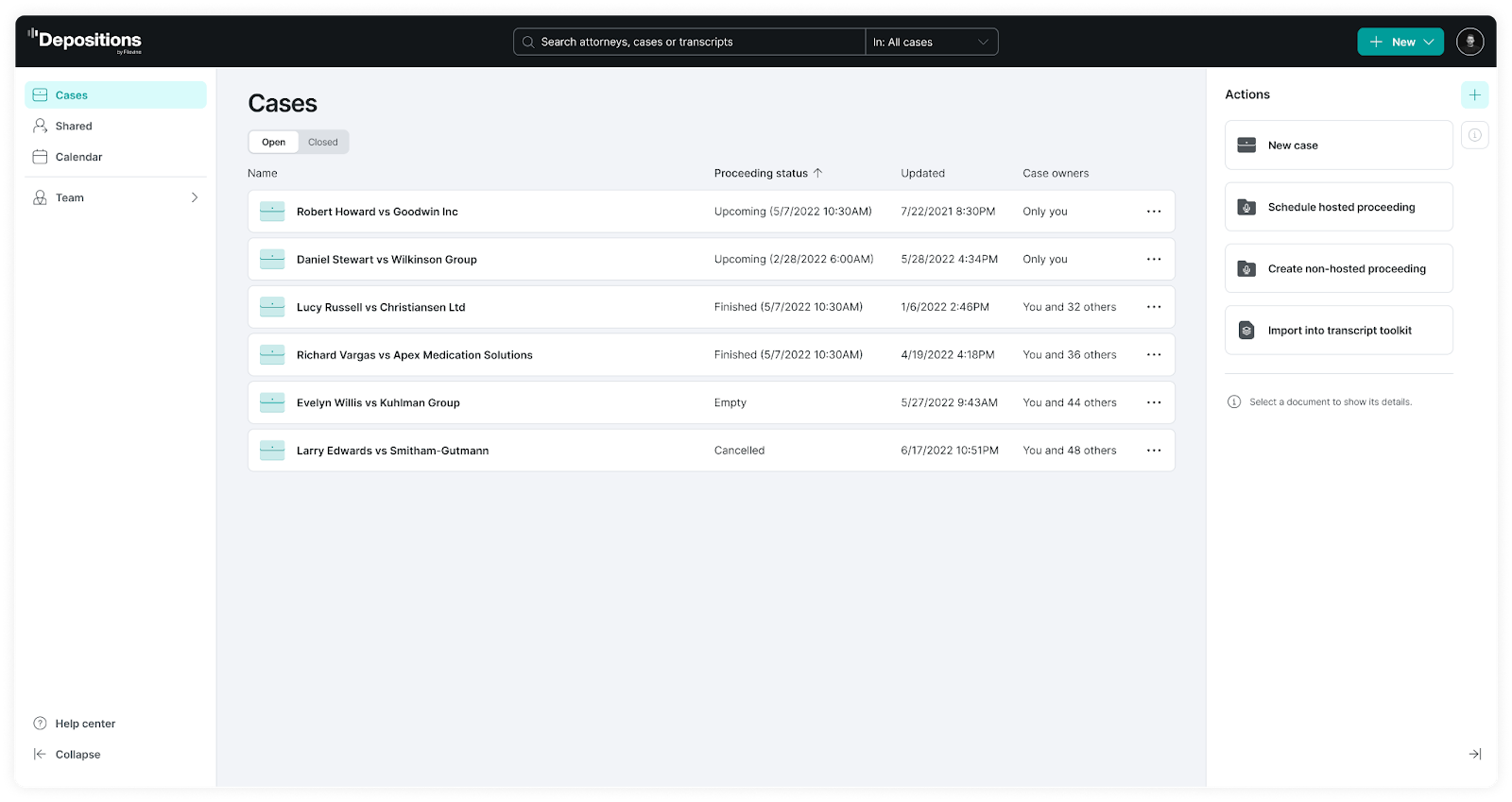
From
the
Depositions
dashboard,
users
see
all
their
cases
and
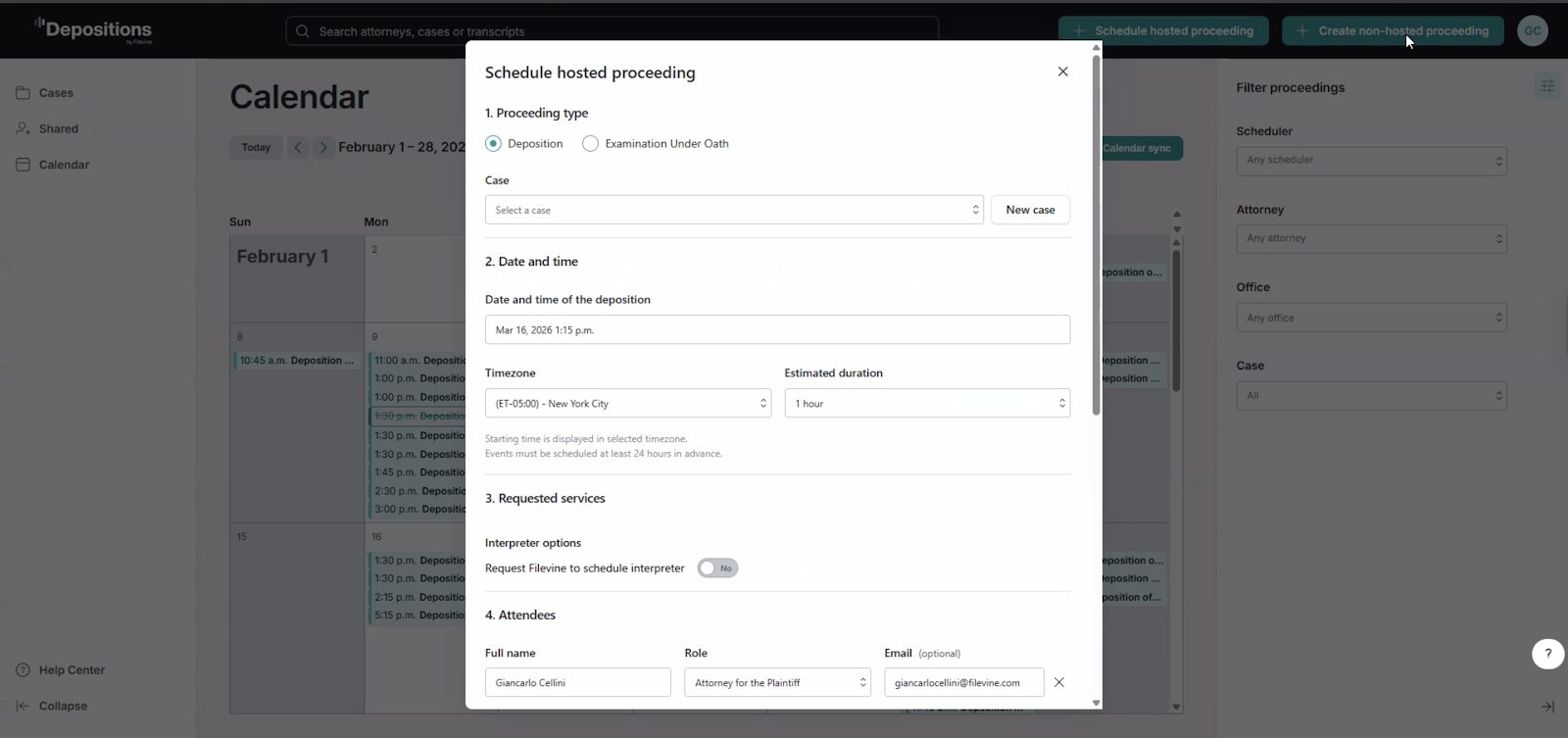
can
easily
schedule
a
proceeding
in
all
50
states
and
in
federal
jurisdictions.
In
states
that
require
a
certified
court
reporter,
Filevine
can
help
provide
one.
In
other
states,
it
schedules
a
person
to
digitally
attend. 


Users
can
toggle
between
a
case
and
calendar
view
to
see
what’s
coming
up,
and
appointments
can
be
integrated
with
lawyers’
Outlook,
iCal
or
Google
Calendar.
People
can
be
added
to
the
event
to
send
three
automatic
reminder
emails:
once
at
the
time
of
scheduling,
again
the
day
before
the
deposition,
and
a
final
email
goes
an
hour
before
the
deposition.

An
exhibits
folder
embedded
in
the
case
can
be
shared
with
the
court
reporter,
and
a
video
clips
folder
will
help
organize
the
most
relevant
portions
of
the
proceedings.


Immediate
Transcripts
for
a
Usable
Work
Product

The
real
magic
begins
when
the
deposition
starts.

Under
the
traditional
model,
lawyers
have
to
wait
for
at
least
a
rough
draft
of
the
transcript
before
serious
analysis
begins.
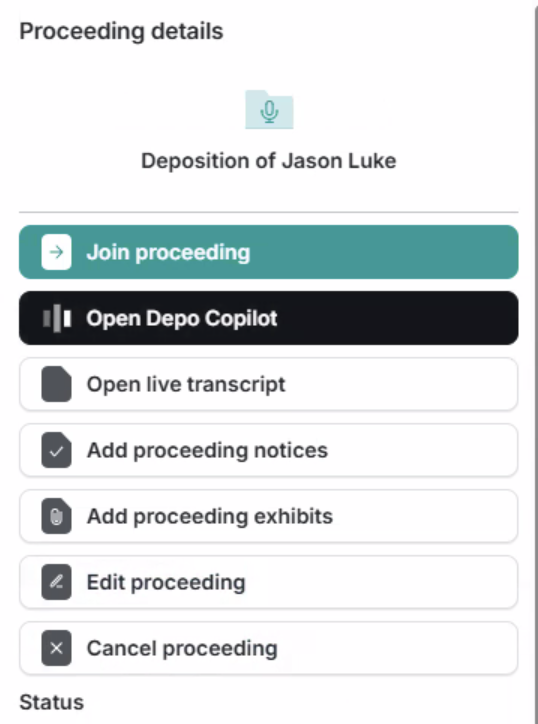
But
when
they
click
Depo
CoPilot,
the
software
follows
along
and
transcribes
the
deposition
in
real
time. 

Cellini
recommends
letting
it
run
in
the
background
so
that
when
you
take
a
break,
you
or
a
paralegal
can
check
on
the
tool. 

“Now
if
I
have
a
follow-up
question
based
on
a
specific
answer,
I
can
find
that
very
quickly
by
searching
my
real-time
transcript,”
Cellini
said.
“So
I
don’t
have
to
rely
on
my
notes
or
my
memory.”


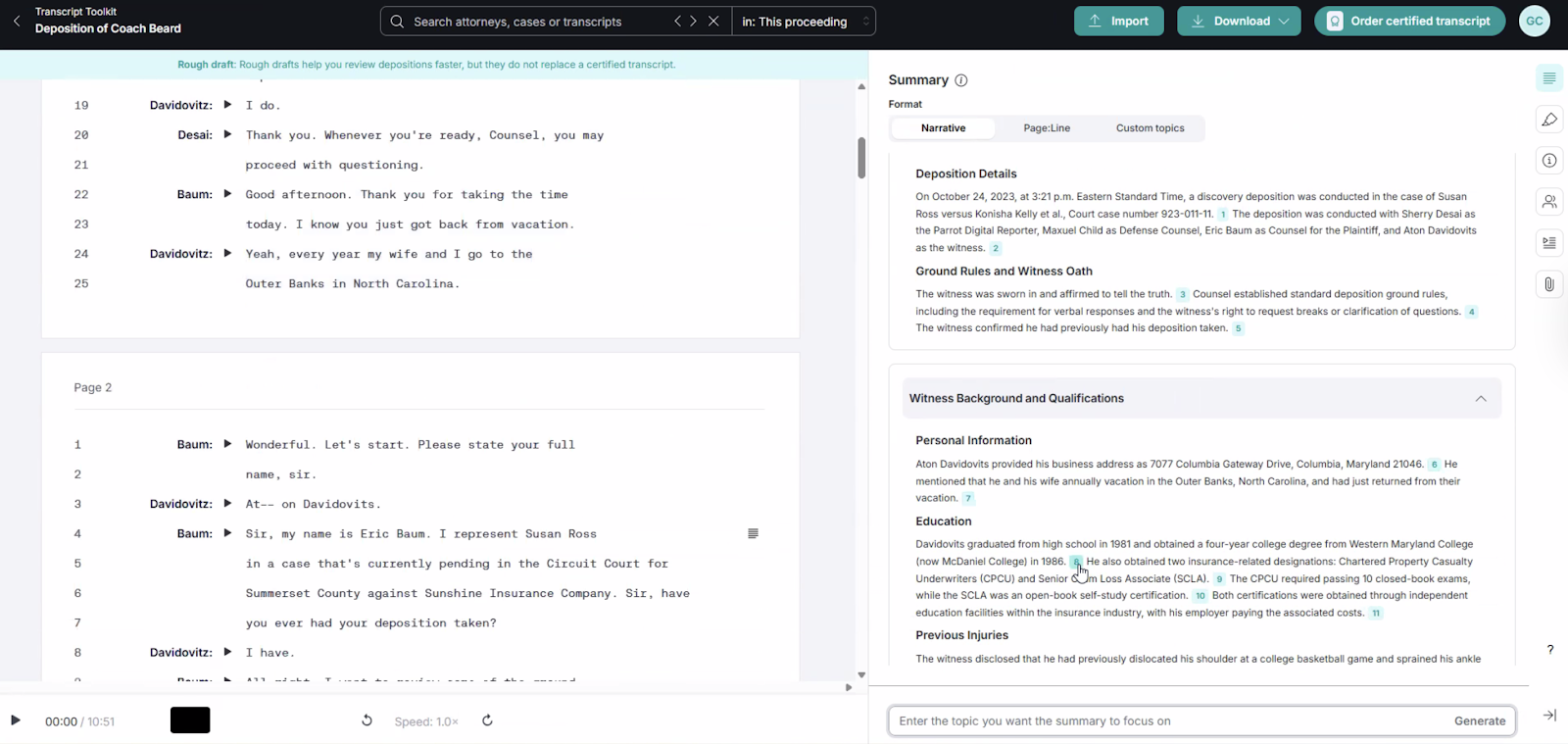
The
Long
Wait
is
Gone
for
Transcripts
and
Summaries

As
soon
as
a
deposition
concludes,
the
AI
gets
to
work.
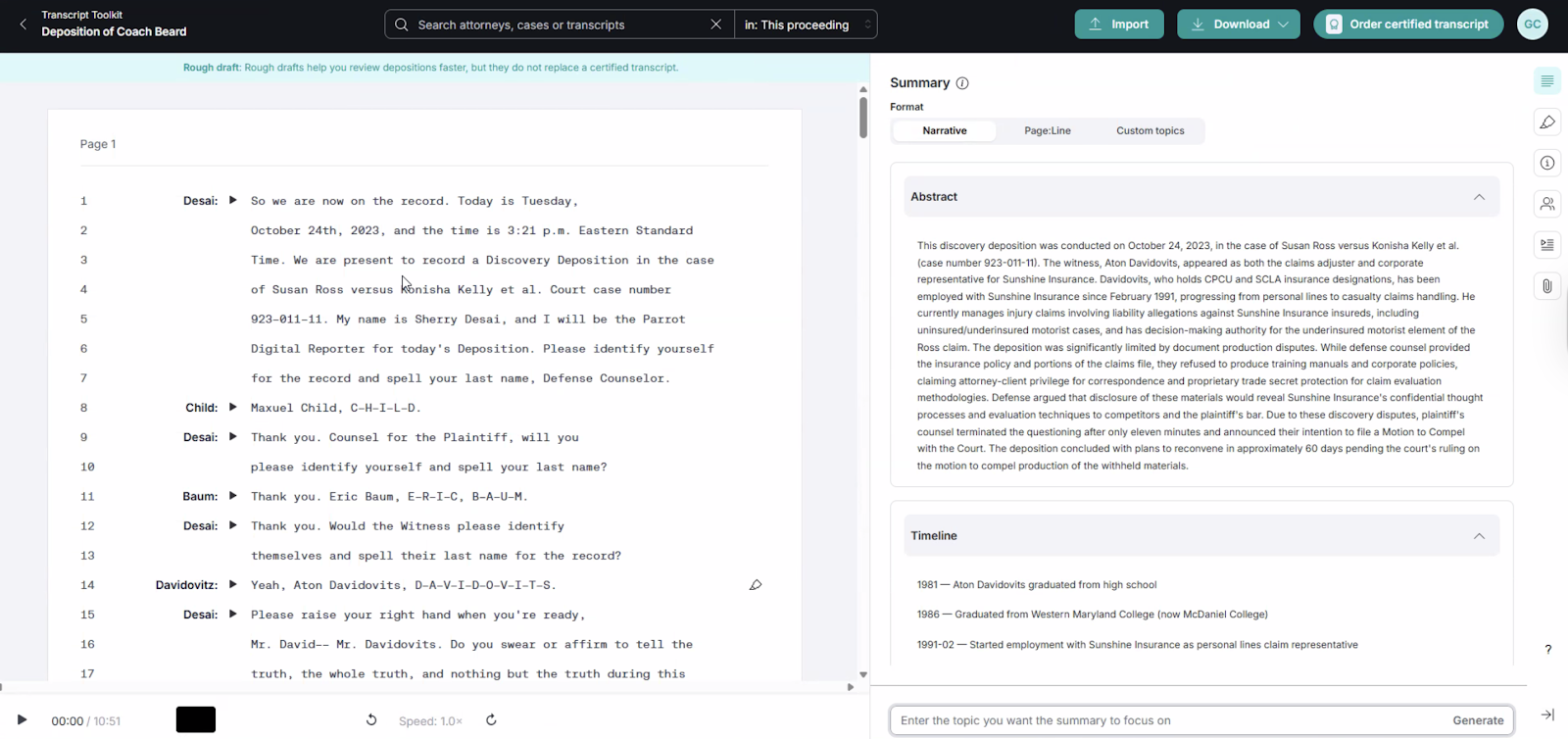
A
video-synced
rough
draft
transcript
appears
(generally)
within
one
business
day.
Included
with
the
rough
draft,
the
AI
uses
the
draft
to
generate
an
abstract,
narrative
summary
and
page-and-line
summaries.
It
organizes
the
deposition
into
custom
topics
and
syncs
the
audio
and
video
to
their
location
in
the
summaries.


The
AI
also
searches
the
transcript
for
events
and
automatically
builds
a
timeline.
If
specific
dates
or
details
are
not
provided,
the
system
does
not
guess
or
“hallucinate”
them,
Cellini
said

The
narrative
summary
is
organized
by
topics
and
subtopics,
and
every
summarized
statement
includes
a
direct
link
back
to
the
transcript,
allowing
attorneys
to
quickly
verify
the
source
material.


Set
Deposition
Goals
with
Depo
CoPilot

Before
the
deposition
begins,
lawyers
can
set
the
tool
up
like
it’s
an
extra
team
member
in
the
room

a
feature
called
“AI
Second
Chair.”
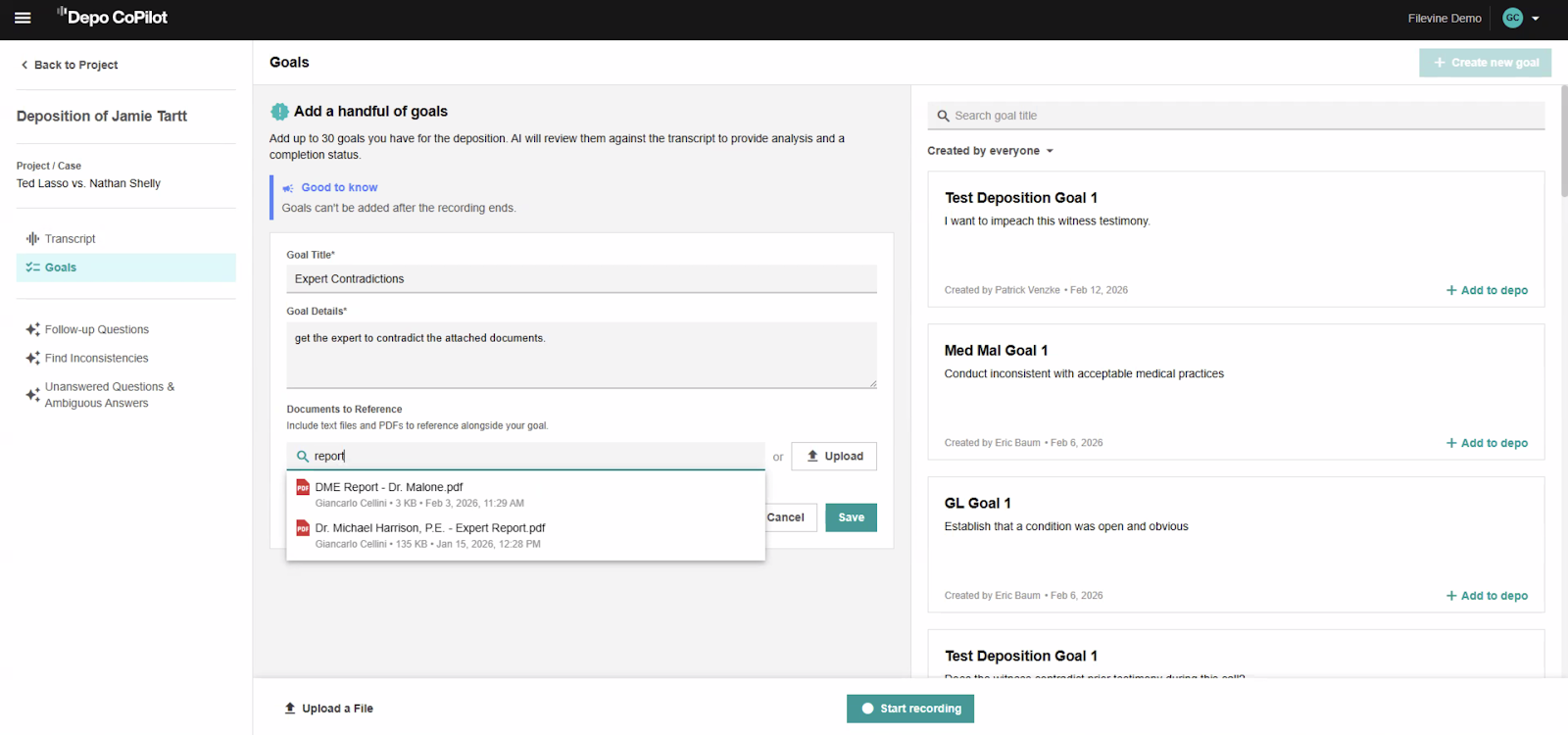
Depo
CoPilot
allows
them
to
create
goals
for
the
proceeding
and
tracks
them
in
real
time. 

“Let’s
say
I
want
to
get
this
guy
to
admit
these
exact
words,”
Cellini
said.
“It’ll
track
that
for
us.
Or
we
may
say,
get
this
expert
to
contradict
himself.” 


Lawyers
don’t
need
to
follow
along
or
be
distracted
during
the
deposition.Instead,
they
can
let
the
CoPilot
run
in
the
background
and
check
it
during
breaks.
Or
if
a
paralegal
is
in
the
room,
they
can
monitor
the
real-time
transcript
and
goals
seconds
after
the
text
appears
on
the
screen.

With
the
Insights
function
in
the
left
sidebar,
the
AI
automatically
updates
its
impression
of
the
case.
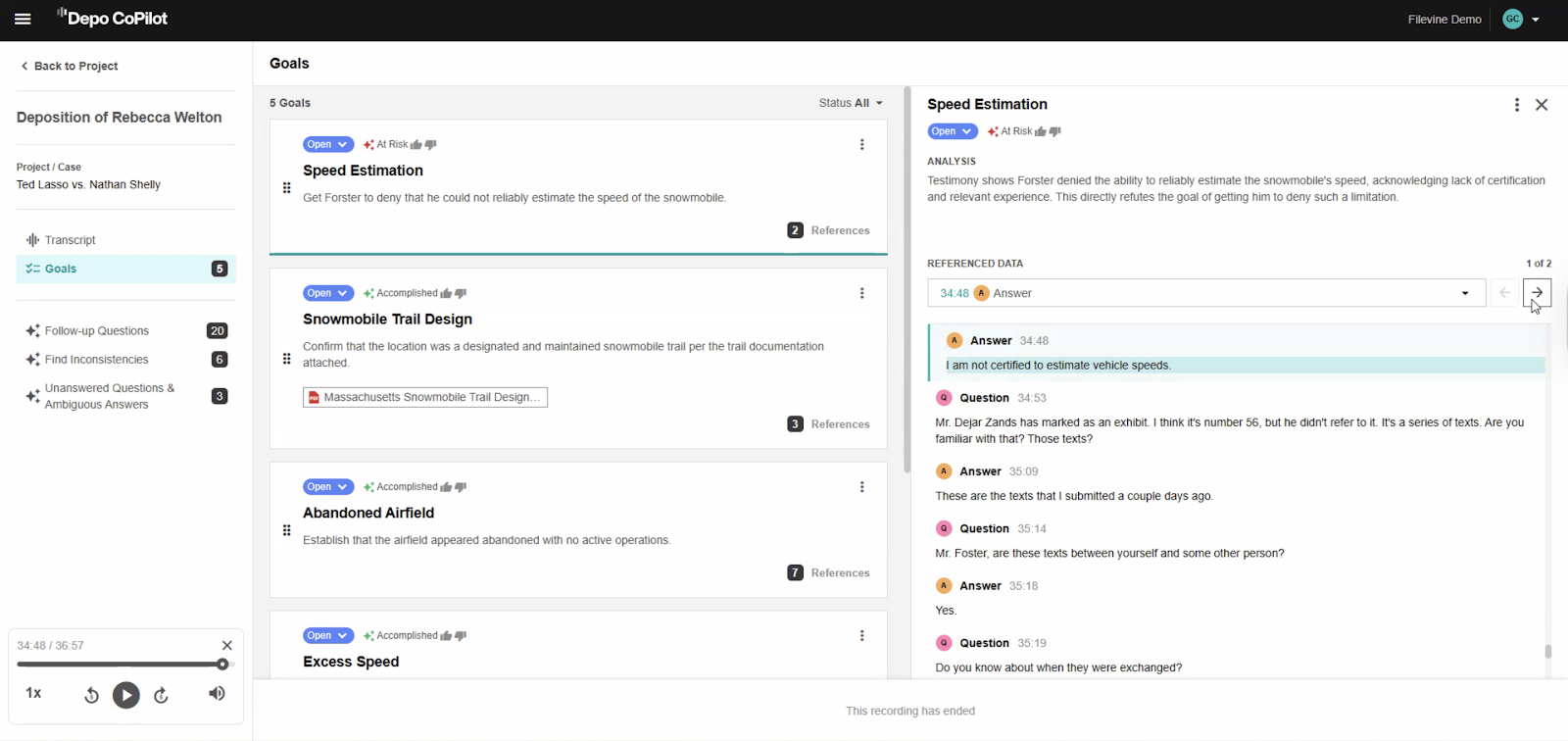
The
software
offers
follow-up
questions,
singles
out
inconsistencies
and
highlights
ambiguous
or
incomplete
answers,
offering
backup
that
is
linked
to
case
materials.

“If
our
deponent
here
says
something
that
contradicts
himself,
it’s
going
to
pick
that
up
and
give
us
our
analysis
and
reference
the
data
as
well,”
Cellini
said.


All
the
documents
in
Filevine’s
system
are
also
accessible
with
a
click,
so
it’s
like
having
the
entire
case
on
hand
all
at
once. 


Helping
with
Trial
Prep
Like
a
Paralegal

Before
trial,
lawyers
can
query
the
AI’s
large
language
model
to
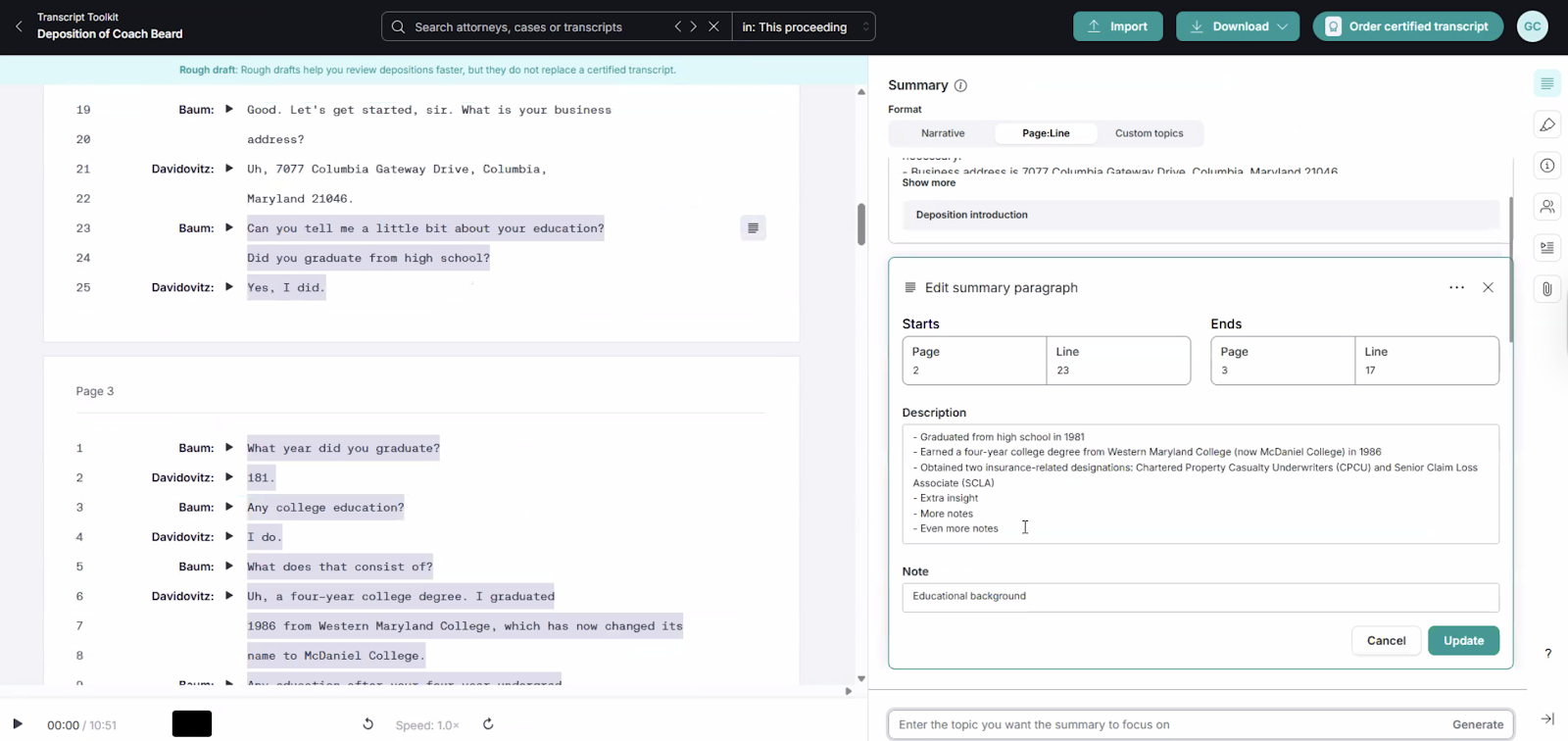
create
custom
topics.
For
example,
if
the
educational
history
of
the
deponent
is
important,
users
can
ask
the
software
to
review
the
transcript
for
relevant
information
on
that
topic.

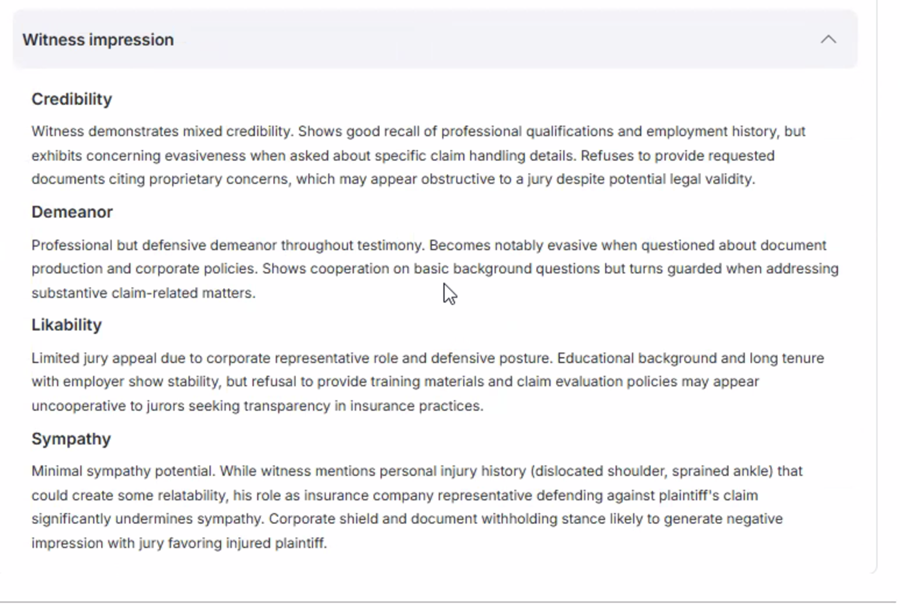
The
software
even
analyzes
witness
demeanor
and
gives
an
assessment
of
credibility,
likability
and
sympathy.
Cellini
noted
that
all
kinds
of
attorneys
from
plaintiffs’
lawyers
to
insurance
defense
counsel
have
to
write
reports
after
every
deposition
with
witness
impression,
but
this
tool
gives
an
incredibly
accurate
head
start.


“I’ve
never
heard
an
attorney
tell
me
it
wasn’t
accurate,”
he
said.

But
lawyers
don’t
have
to
rely
on
the
AI.
Because
the
system
syncs
the
audio
and
video
with
the
transcript,
users
can
look
back
at
relevant
portions
to
see
if
the
deponent
looks
flustered,
widens
their
eyes
and
looks
over
at
their
attorney,
or
conveys
other
nonverbal
cues. 

“I
don’t
get
that
from
a
text
transcript,
but
I
can
get
it
here
even
at
the
rough
draft
level,
so
I
haven’t
had
to
pay
extra
for
a
certified
transcript,”
Cellini
said. 


Saving
Money
Without
Cutting
Corners

Immediately
after
a
deposition
is
recorded,
a
human
begins
working
in
the
background
to
clean
up
that
automated
transcript. 

Unlike
traditional
court
reporting
services
that
often
require
attorneys
to
order
a
certified
transcript
just
to
receive
a
rough
copy,
Filevine
provides
the
rough
draft
automatically,
typically
within
one
business
day,
often
within
just
a
few
hours.

Since
the
vast
majority
of
cases
are
settled
before
going
to
court,
an
expensive
certified
copy
of
the
transcript
is
often
unnecessary
anyway. 

Finally,
the
cost
of
using
video
is
a
fraction
of
what
it
used
to
be.
Rather
than
pay
a
specialized
firm
to
record
and
edit
clips
that
you
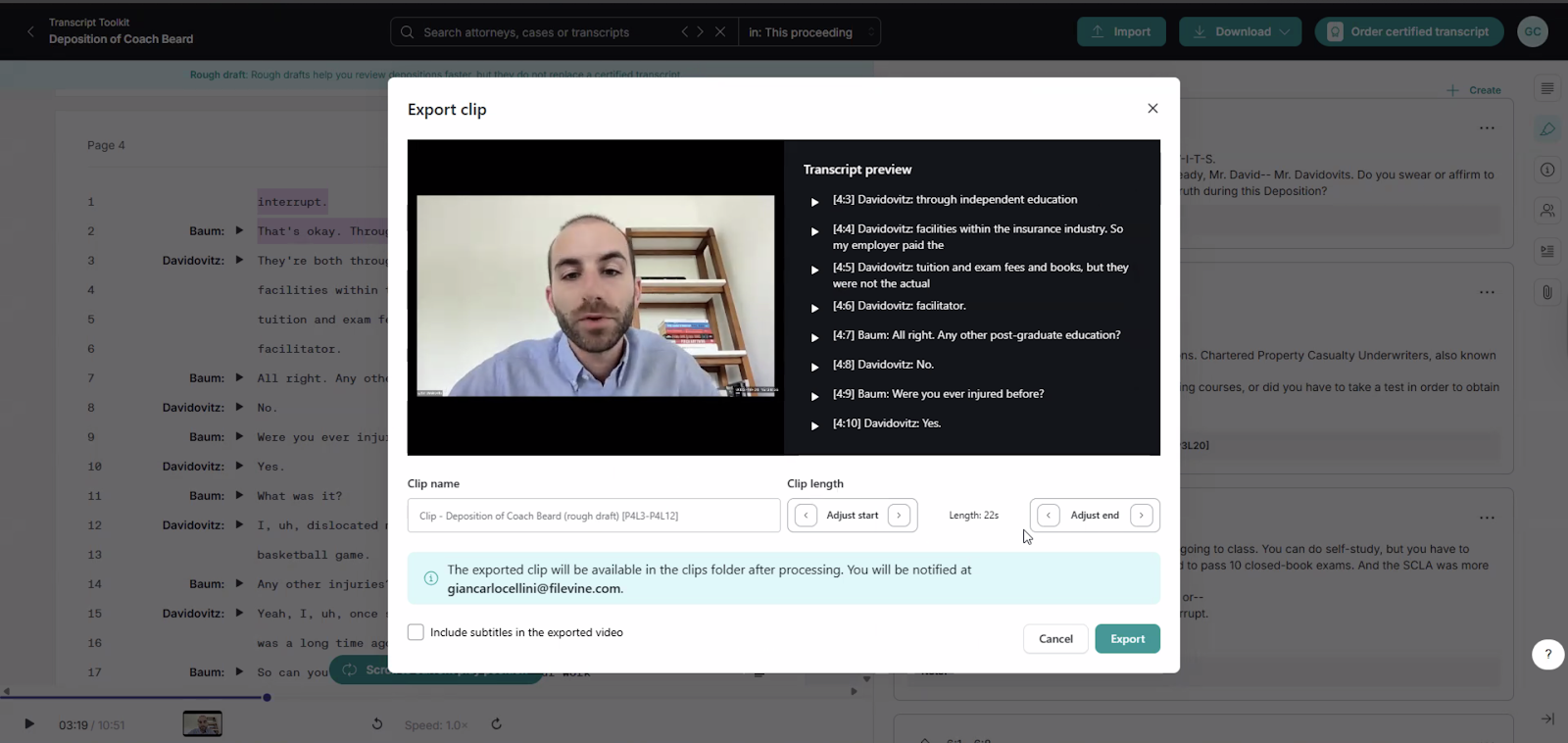
won’t
receive
until
weeks
later,
associates
can
make
clips
in
mp4
format
to
use
in
another
deposition
right
away.


“The
trend
is
going
from
using
video
clips
exclusively
for
trial
to
using
them
in
the
middle
of
a
mediation,
or
even
in
subsequent
depositions,”
Cellini
said.
“Rather
than
reading
from
a
transcript,
I
can
show
the
video
of
your
employee
and
ask,
‘But
now
you’re
saying
this.
Do
you
agree
or
disagree?”


The
Bottom
Line

The
bottom
line
is
that
no
other
company
combines
document
management,
trial
prep,
deposition
management
and
back-end
office
work
like
Filevine. 


Ready
to
see
Depositions
by
Filevine
in
action?

Schedule
your
demo
here
.