Lawyers
are
often
expected
to
spend
an
inordinate
amount
of
time
at
work
billing
hours
and
completing
other
work-related
tasks. As
a
result,
it
might
be
easier
for
lawyers
to
use
work
computers
to
complete
personal
tasks
like
paying
for
bills
and
sending
personal
emails. However,
lawyers
should
try
to
minimize
the
amount
of
personal
matters
they
handle
on
work
computers,
since
attorneys
may
reveal
personal
information
to
bosses
by
using
work
devices
and
may
be
separated
from
work
computers
on
a
moment’s
notice.
One
time,
earlier
in
my
career,
I
was
completing
a
project
that
required
me
to
go
through
files
that
were
stored
on
the
computer
of
a
coworker
who
departed
the
firm. While
completing
this
project,
I
came
across
personal
files
of
the
former
coworker. This
included
family
photos
and
other
similar
items,
which
were
pretty
innocuous.
However,
I
also
came
across
this
person’s
tax
returns,
which
included
some
very
sensitive
information. I
am
not
entirely
sure
how
this
coworker’s
tax
returns
ended
up
on
this
work
computer;
either
the
coworker
used
the
computer
to
complete
her
taxes,
or
she
downloaded
the
tax
returns
onto
the
computer
for
some
reason. Of
course,
I
quickly
exited
the
file
when
I
realized
what
I
was
seeing,
but
other
individuals
who
had
access
to
this
information
might
have
used
it
for
a
variety
of
bad
reasons.
Another
reason
why
lawyers
should
be
cautious
about
using
work
devices
for
personal
tasks
is
that
managers
might
be
able
to
access
those
work
computers
and
see
sensitive
information
stored
on
such
devices.
As
discussed
in
a
previous
article,
workplace
monitoring
is
common
at
many
law
firms. I
worked
at
firms
at
which
coworkers
reported
that
managers
were
using
tracking
software
to
track
productivity
and
how
much
time
was
spent
at
computers
completing
tasks. One
former
colleague
claimed
he
had
firsthand
knowledge
that
a
manager
was
using
a
keystroke
recorder
that
was
able
to
see
all
of
the
typing
done
on
a
computer.
If
such
workplace
monitoring
tools
are
used
at
a
given
firm,
managers
can
have
access
to
personal
information
if
lawyers
use
devices
to
complete
personal
tasks.
In
addition,
it
might
not
be
prudent
to
use
work
computers
to
send
personal
communications
since
this
might
reveal
sensitive
information
that
lawyers
may
not
want
to
share
with
managers.
Another
point
against
using
work
computers
for
personal
matters
is
that
lawyers
can
be
separated
from
work
devices
on
short
notice.
It
is
not
uncommon
for
lawyers
to
immediately
forfeit
their
work
devices
upon
being
terminated
since
managers
want
to
avoid
a
situation
in
which
a
former
employee
hurts
ongoing
projects. When
I
was
an
associate
at
a
Biglaw
shop,
I
used
my
work
computer
to
help
edit
an
academic
article
I
was
publishing. I
figured
managers
would
not
get
too
upset
if
they
found
out
I
used
a
work
device
for
this
purpose
since
this
publication
would
presumably
boost
the
profile
of
the
firm.
When
I
was
separated
from
the
firm,
I
immediately
lost
access
to
the
drafts
of
the
article
that
I
had
saved
on
the
work
computer. Fortunately,
I
knew
that
this
might
happen,
and
had
earlier
emailed
myself
copies
of
the
latest
drafts
so
they
would
not
be
lost
if
I
was
separated
from
my
employer.
However,
lawyers
with
less
foresight
could
lose
substantial
amounts
of
work
if
they
are
separated
from
a
work
device
that
includes
personal
projects.
In
any
case,
lawyers
should
act
like
everything
they
do
on
a
work
device
will
be
reviewed
by
managers,
since
there
is
a
good
chance
that
monitoring
software
is
being
used
at
any
given
firm.
Lawyers
should
also
avoid
using
work
computers
for
personal
tasks
so
they
do
not
need
to
start
from
scratch
if
they
are
ever
separated
from
a
work
device
on
short
notice.
Jordan
Rothman
is
a
partner
of The
Rothman
Law
Firm,
a
full-service
New
York
and
New
Jersey
law
firm.
He
is
also
the
founder
of Student
Debt
Diaries,
a
website
discussing
how
he
paid
off
his
student
loans.
You
can
reach
Jordan
through
email
at jordan@rothman.law.
Ed.
Note:
A
weekly
roundup
of
just
a
few
items
from
Howard
Bashman’s
How
Appealing
blog,
the
Web’s
first
blog
devoted
to
appellate
litigation.
Check
out
these
stories
and
more
at
How
Appealing.
“Alabama
Is
Asking
the
Supreme
Court
For
Some
Leeway
On
‘Cruel
and
Unusual
Punishment’;
In
2002,
the
Court
decided
that
the
Constitution
does
not
allow
executions
of
intellectually
disabled
people;
But
states
are
testing
that
holding’s
limits”: Madiba
K.
Dennie
has this
essay online
at
Balls
and
Strikes.
“South
Carolina
man
asks
Fourth
Circuit
for
new
trial
in
trans
woman’s
slaying;
Daqua
Ritter’s
case
was
the
first
time
federal
prosecutors
brought
a
hate
crime
based
on
gender
identity
to
trial”: Steve
Garrison
of
Courthouse
News
Service
has this
report.
“Halligan’s
US
attorney
nomination
appears
dead
on
arrival
in
Senate;
Both
Democratic
senators
from
Virginia
signaled
they
would
withhold
blue
slips
for
the
controversial
nominee,
who
served
as
the
acting
lead
prosecutor
in
the
Eastern
District
of
Virginia
until
she
was
disqualified
by
a
judge”: Benjamin
S.
Weiss
of
Courthouse
News
Service
has this
report.
“Remember
the
Torture
Memos?
The
Boat
Strike
Memos
May
Be
Worse.
The
Trump
administration
needs
to
release
the
legal
analysis
underpinning
its
controversial
military
campaign.” Ankush
Khardori
has this
essay online
at
Politico
Magazine.
“Laurence
Tribe’s
‘security
blanket’
for
Supreme
Court
advocacy”: Harvard
Law
School
has
posted this
video on
YouTube.
“We’re
Trying
to
Find
a
Line
the
Supreme
Court
Won’t
Cross”: Emily
Bazelon
and
David
French
have this
Conversation online
at
The
New
York
Times
Opinion.
Arresting
people
and
putting
them
under
your
custody
is
one
of
the
most
serious
ways
that
the
state
can
intervene
in
someone’s
life.
To
do
so
comes
with
some
obligations,
namely
the
conditions
of
the
custody
have
to
be
humane.
And
while
there
have
been
some
gross
examples
of
that
duty
not
being
held
(see
Alligator
Alcatraz),
the
smaller
breaks
in
responsibility
are
worth
correcting
too.
Thankfully
a
district
court
judge’s
concerns
were
in
the
right
place
once
she
realized
that
ICE
tried
to
skip
feeding
a
detainee
in
an
immigration
hearing.
Oregon
Live
has
coverage:
When
a
22-year-old
woman
in
immigration
custody
took
the
witness
stand
Monday
and
said
she
hadn’t
had
anything
to
eat
since
she
was
rousted
at
2
a.m.
for
the
drive
from
a
detention
center
in
Tacoma
to
federal
court
in
Eugene,
the
judge
immediately
halted
the
hearing.
“OK,
that’s
unacceptable,”
U.S.
District
Judge
Ann
Aiken
said
about
eight
minutes
into
the
9:30
a.m.
hearing.
Aiken
said
she
wouldn’t
continue
until
federal
officers
fed
her.
The
judge
even
offered
up
her
own
lunch
so
the
woman
wouldn’t
go
hungry.
Small
gestures
can
make
a
world
of
difference
when
it
comes
to
honoring
human
dignity
—
making
sure
someone
has
had
something
to
eat
that
day
is
one
of
them.
Chris
Williams
became
a
social
media
manager
and
assistant
editor
for
Above
the
Law
in
June
2021.
Prior
to
joining
the
staff,
he
moonlighted
as
a
minor
Memelord™
in
the
Facebook
group Law
School
Memes
for
Edgy
T14s
.
He
endured
Missouri
long
enough
to
graduate
from
Washington
University
in
St.
Louis
School
of
Law.
He
is
a
former
boatbuilder
who
is
learning
to
swim, is
interested
in
critical
race
theory,
philosophy,
and
humor,
and
has
a
love
for
cycling
that
occasionally
annoys
his
peers.
You
can
reach
him
by
email
at [email protected]
and
by
tweet
at @WritesForRent.
At
the
end
of
the
day,
everybody
just
wants
to
be
paid
what
they
consider
to
be
market.
And
at
this
point,
folding
the
special
bonuses
to
the
holiday
bonus
is
the
current
market.
People
who
don’t
get
bonuses
when
many
of
their
peers
do,
are
going
to
be
out
the
door.
—
Kate
Reder
Sheikh,
a
legal
recruiter
with
Major,
Lindsey
&
Africa,
in
comments
given
to
the
American
Lawyer,
concerning
the
“surprising
handful”
of
Am
Law
50
firms
that
reportedly
haven’t
announced
special
bonuses
with
their
year-end
bonuses,
which
has
been
“very
poorly
received”
by
associates.
Why
wouldn’t
a
firm
match
the
special
bonuses
that
are
now
regarded
as
part
of
the
market
rate?
“That’s
kind
of
a
million-dollar
question,
and
what
associates
who
are
at
these
firms
are
asking
me,”
Sheikh
said.
“‘Do
they
not
care
if
I
leave?
Do
they
not
care
if
a
lot
of
us
leave?
Is
it
actually
potentially
a
goal
to
get
some
people
out
the
door
without
doing
layoffs?’
It’s
been
a
point
of
great
curiosity.”
Staci
Zaretsky is
the
managing
editor
of
Above
the
Law,
where
she’s
worked
since
2011.
She’d
love
to
hear
from
you,
so
please
feel
free
to
email
her
with
any
tips,
questions,
comments,
or
critiques.
You
can
follow
her
on Bluesky, X/Twitter,
and Threads, or
connect
with
her
on LinkedIn.
Donald
Trump
signed
an
executive
order
yesterday
purporting
to
block
states
from
artificial
intelligence
regulation.
Can
a
president
unilaterally
invent
new
laws
and
then
assert
that
this
counts
as
occupying
the
field
to
then
preempt
state
laws?
No,
of
course
not.
But
he
issued
the
order
anyway
because
this
administration
is
itself
a
hallucination
engine
stochastically
vomiting
out
orders.
And
the
public
is
troublingly
dumb
enough
to
think
executive
orders
can
create
policy
out
of
thin
air.
Let
us
endeavor
to
redline
this
unlawful
gibberish,
since
there
does
not
appear
to
be
a
competent
attorney
within
the
White
House
orbit
capable
of
doing
so:
Section 1. Purpose.
United
States
leadership
in
Artificial
Intelligence
(AI)
will
promote
United
States
national
and
economic
security
and
dominance
across
many
domains.
This
is
marketing
fluff
that
would
make
Sam
Altman
blush,
but
let’s
give
Trump
credit
where
it’s
due:
introducing
AI
to
national
security
already
successfully
flagged
Pete
Hegseth
as
a
war
criminal
so
maybe
the
technology
does
bring
something
to
the
table.
My
Administration
has
already
done
tremendous
work
to
advance
that
objective,
including
by
updating
existing
Federal
regulatory
frameworks
to
remove
barriers
to
and
encourage
adoption
of
AI
applications
across
sectors.
These
efforts
have
already
delivered
tremendous
benefits
to
the
American
people
and
led
to
trillions
of
dollars
of
investments
across
the
country.
As
a
reminder,
the
“trillions
of
dollars
of
investments”
he’s
talking
about
are
mostly
on
paper
IOUs
passed
around
a
perfect
circle.
At
the
center
of
the
Ouroboros
of
Suck
sits
NVIDIA,
the
company
that
holds
the
entire
U.S.
economy
afloat
right
now.
The
media
covers
it
every
time
NVIDIA
throws
a
life
preserver
to
drowning
AI
companies,
but
rarely
point
out
that
the
money
is
mostly
as
hallucinatory
as
the
AI
results.
As
Ed
Zitron
summed
it
up:
OpenAI
cannot
afford
the
$300
billion,
NVIDIA
hasn’t
sent
OpenAI
a
cent
and
won’t
do
so
if
it
can’t
build
the
data
centers, which
OpenAI
most
assuredly
can’t
afford
to
do.
That
said,
if
there’s
anyone
who
understands
claiming
with
conviction
that
something
is
worth
more
than
it
actually
is
on
financial
reports
it’s
Donald
Trump.
Indeed,
Trump
has
multiple
convictions
to
that
effect.
To
win,
United
States
AI
companies
must
be
free
to
innovate
without
cumbersome
regulation.
But
excessive
State
regulation
thwarts
this
imperative.
China
is
a
totalitarian
state
and
they’ve
already
built
a
better
product
in
DeepSeek
—
as
long
as
you
don’t
ask
it
any
questions
about
Tibet
—
so
some
state
guardrails
against
Sora
generating
child
porn
aren’t
going
to
grind
AI
development
to
a
halt.
First,
State-by-State
regulation
by
definition
creates
a
patchwork
of
50
different
regulatory
regimes
that
makes
compliance
more
challenging,
particularly
for
start-ups.
Remember
when
these
guys
couldn’t
shut
up
about
states’
rights?
It’s
almost
as
though
that
was
more
about
pushing
neo-segregation
than
an
honest
commitment
to
federalism.
Weird.
Second,
State
laws
are
increasingly
responsible
for
requiring
entities
to
embed
ideological
bias
within
models.
For
example,
a
new
Colorado
law
banning
“algorithmic
discrimination”
may
even
force
AI
models
to
produce
false
results
in
order
to
avoid
a
“differential
treatment
or
impact”
on
protected
groups.
My
guy,
AI
does
not
need
any
help
producing
false
results.
In
fact,
the
Colorado
law
at
issue
is
about
preventing
false
results
given
that
algorithms
are
uniquely
prone
to
garbage
in/garbage
out
bias.
Third,
State
laws
sometimes
impermissibly
regulate
beyond
State
borders,
impinging
on
interstate
commerce.
That’s…
not
impermissible.
Congress
can
exercise
its
authority
to
regulate
interstate
commerce,
but
that
doesn’t
mean
—
absent
congressional
action
—
that
states
are
barred
from
passing
laws
that
can
have
knock
on
effects
beyond
their
borders.
“Sometimes”
is
carrying
a
lot
of
water
here
and
the
order
isn’t
making
any
effort
to
show
its
work.
My
Administration
must
act
with
the
Congress
to
ensure
that
there
is
a
minimally
burdensome
national
standard
—
not
50
discordant
State
ones.
The
“must
act
with
the
Congress”
part
is
critical.
Because,
you
know,
they
make
laws
and
executive
orders
DO
NOT
MAKE
LAWS.
This
is
Schoolhouse
Rock
shit.
That
said,
there’s
a
certain
symbolic
beauty
to
the
way
this
order
tracks
the
very
problems
with
AI
that
everyone’s
trying
to
regulate.
Christine
Lemmer-Webber
is
credited
with
calling
generative
AI
“mansplaining
as
a
service”
and
here
we
have
an
executive
order
that’s
all
confidence
and
buzzwords
while
managing
to
be
completely
wrong
about
everything.
That
framework
should
also
ensure
that
children
are
protected…
Sure.
censorship
is
prevented…
Sort
of
the
exact
opposite
of
the
last
one.
copyrights
are
respected…
Too
late.
and
communities
are
safeguarded.
What
does
that
even
mean?
Until
such
a
national
standard
exists,
however…
There’s
no
“however”
here.
Until
Congress
sees
fit
to
draft
a
law
setting
this
“national
standard,”
the
president
cannot
do
one
goddamned
thing
about
it.
it
is
imperative
that
my
Administration
takes
action
to
check
the
most
onerous
and
excessive
laws
emerging
from
the
States
that
threaten
to
stymie
innovation.
And
even
if
the
president
could
impose
a
placeholder
law
while
Congress
dithers,
it
absolutely
cannot
cancel
state
laws
in
favor
of
that
new
made-up
law.
Trump
really
should
stick
to
the
white
supremacy
because
this
is
not
how
supremacy
works
in
a
Supremacy
Clause
sense.
It
does
not
read
“this
Constitution,
the
laws
of
the
United
States,
and
whatever
the
President
is
mad
about
on
Truth
Social
shall
be
the
supreme
law
of
the
land.”
He’s
acknowledging
that
there
is
no
existing
law
of
the
United
States
and
just
inventing
one
and
claiming
preemption.
The
Tenth
Amendment
says
the
total
opposite
of
this.
Within
30
days
of
the
date
of
this
order,
the
Attorney
General
shall
establish
an
AI
Litigation
Task
Force
(Task
Force)
whose
sole
responsibility
shall
be
to
challenge
State
AI
laws
inconsistent
with
the
policy
set
forth
in
section
2
of
this
order,
including
on
grounds
that
such
laws
unconstitutionally
regulate
interstate
commerce,
are
preempted
by
existing
Federal
regulations,
or
are
otherwise
unlawful
in
the
Attorney
General’s
judgment,
including,
if
appropriate,
those
laws
identified
pursuant
to
section
4
of
this
order.
No,
the
Attorney
General
cannot
challenge
state
laws
for
being
inconsistent
with
non-existent
federal
laws.
Nor
can
the
administration
withhold
congressionally
allocated
funds
from
states
in
retaliation
over
state
AI
regulations,
which
the
order
also
purports
to
do.
Not
that
the
Supreme
Court
has
shown
anything
to
suggest
they’d
stop
him.
Train
v.
City
of
New
York?
This
Court
ignores
way
bigger
precedents
than
that
on
the
regular!
To
be
clear,
if
this
were
challenged,
the
Court
wouldn’t
rule
in
Trump’s
favor
—
because
that
might
empower
a
future
Democratic
president
—
and
would
just
fire
off
a
shadow
docket
opinion
allowing
Trump
to
do
it
indefinitely.
Nor
can
any
of
the
other
federal
flunkies
he
identifies
in
the
order
—
Commerce,
the
FTC,
or
the
Special
Advisor
for
AI
and
Crypto
and
Unicorn
Farts
—
preempt
state
laws.
The
order
gives
some
lip
service
to
a
creative
executive
agency
concocting
an
argument
for
AI
falling
under
otherwise
existing
regulations,
which
would
be
a
fair
executive
order
power,
but
there’s
not
much
of
an
argument
for
how
a
law
banning
AI
from
being
used
to
deepfake
naked
celebrities
constitutes
the
state
making
the
AI
provider
engage
in
a
deceptive
commercial
practice.
There
just
aren’t
any
existing
hooks
to
credibly
hang
this
preemption
effort.
Tech
policy
researchers
have
already
noted
the
Trump
administration
cannot
restrict
state
regulation
this
way
without
Congress
passing
a
law.
OpenAI
has
acknowledged
that
“federal
preemption
over
existing
or
prospective
state
laws
will
require
an
act
of
Congress.”
Hell,
STEVE
BANNON
says,
“”David
Sacks
having
face-planted
twice
on
jamming
AI
Amnesty
into
must-pass
legislation
now
completely
misleads
the
President
on
preemption.”
So
we’re
all
in
agreement
here
except
the
Dunning-Kruger-in-Chief
occupying
the
White
House.
When
AI
hallucinates,
it
at
least
has
the
decency
to
admit
it’s
wrong
when
called
out.
When
the
executive
branch
does
it,
apparently
we
just
call
it
policy.
Elon
Musk
is
now
calling
for
the
dissolution
of
the
European
Union
because
it
fined
him
$140
million
for
violating
a
law
he
once
said
was
“exactly
aligned”
with
his
vision
for
(what
was
then
called)
Twitter.
And
he’s
doing
it
by
lying
about
what
the
fine
is
actually
for.
The
EU
hit
X
with a
$140
million
fine last
week
for
violating
the
Digital
Services
Act
(DSA).
But
(despite
what
you
may
have
heard)
this
isn’t
some
censorship
overreach
by
Brussels
bureaucrats.
The
violations—which
have been
known
for
over
a
year—have
nothing
to
do
with
content
moderation.
Zero.
Anyone
telling
you
otherwise
is
lying.
The
fine
is
for
three
specific
transparency
failures:
misleading
users
when
Elon changed
verification from
actual
verification
to
“pay
$8
for
a
checkmark,”
maintaining
a
broken
ad
repository,
and
refusing
to
share
required
data
with
researchers.
The
European
Union
has
announced
a
fine
of
$140
million
against
Elon
Musk’s
X,
the
social
media
platform
formerly
known
as
Twitter,
for
several
failures
to
comply
with
rules
governing
large
digital
platforms.
A
European
Commission
spokesperson
said
the
fine
against
X’s
holding
company
was
due
to
theplatform’s
misleading
use
of
a
blue
check
markto
identify
verified
users,
a
poorly
functioning
advertising
repository,
and
a
failure
to
provide
effective
data
access
for
researchers.
Again,
let’s
repeat:
it
has
nothing,
whatsoever,
to
do
with
the
way
X
handles
content
moderation
or
what
speech
it
allows
on
its
platform.
As Daphne
Keller
explains:
Don’t
let
anyone
—
not
even
the
United
StatesSecretary
of
State—
tell
you
that
the
European
Commission’s€120
million
enforcementagainst
Elon
Musk’s
X
under
the
Digital
Service
Act
(DSA)
is
about
censorship
or
about
what
speech
users
can
post
on
the
platform.
That
would,
indeed,
be
interesting.
But
this
fine
is
just
the
EU
enforcing
some
normal,
boring
requirements
of
its
law.
Many
of
these
requirements
resemble
existing
US
laws
or
proposals
that
have
garnered
bipartisan
support.
There
are
three
charges
against
X,
which
all
stem
from
amulti-year
investigationthat
was
launched
in
2023.
One
is
about
verification
—
X’s
blue
checkmarks
on
user
accounts
—
and
two
are
about
transparency.
These
charges
have
nothing
to
do
with
what
content
is
on
X,
or
what
user
speech
the
platform
should
or
should
not
allow.
There
is
plenty
of
EU
political
disapproval
about
those
things,
for
sure.
But
the
EU
didn’t
choose
to
pick
a
fight
about
them.
Instead,
it
went
after
X
for
violating
much
more
basic,
straightforward
provisions
of
the
DSA.
Those
violations
were
flagrant
enough
that
it
would
be
weird
if
the
EU
hadn’t
issued
a
fine.
Both
Daphne
and
I
have
criticized
attempts
by
EU
officials
to
abuse
the
DSA
in
pursuit
of
censorship.
I directly
called
it
out when
former
EU
Commissioner
Thierry
Breton
clearly
went
way
over
the
line
last
year,
a
move
that
quickly
led
to Breton
losing
his
job.
I’ve
been
highly
critical
of
the
DSA
for
years,
so
if
this
were
actually
an
abuse
of
the
law
for
censorship,
I’d
be
first
in
line
to
call
it
out
and
side
with
Elon
(I’ve
done
it in
other
circumstances
as
well).
But
this
is not that.
This
has
nothing
to
do
with
“content
moderation”
or
“censorship”
in
any
way.
And
yet,
Elon
Musk
is
running
around
pretending
it
is
a
free
speech
issue,
and
his
once-again
friends
in
the
Trump
administration
are
bolstering
that
false
claim.
As
Daphne
pointed
out,
the
EU could investigate
certain
aspects
of
X’s
content
moderation,
and
that could lead
to
serious
questions
about
censorship
and
free
speech.
But they
have
not
done
so.
Honestly,
this
move
is
little
different
than
the
Trump
FTC
taking
action
against
a
Chinese
company
for
violating
COPPA. Which
it
has
done.
Did
we
see
Chinese
politicians
lose
their
minds
over
that?
Did
we
see
the
CEO
of
that
company,
Apitor
Technology,
call
for
dissolving
the
United
States
like
Elon
Musk
is
now
calling
for
dissolving
the
EU?
No.
No,
we
did
not.
But
because
the
Elon
Musks/JD
Vances/Marco
Rubios
of
the
world
can only
think
in
terms
of
memes
and
culture
wars,
they
know
that
if
they
just
insist
that
this
is
about
censorship,
that
the
media
will
cover
it
that
way,
and
the
ignorant
rabble
on
X
will
buy
their
version
of
the
story.
All
this
is
even
more
incredible
because
Elon
Musk
told
the
EU
that he
was
entirely
on
board
with
the
DSA while
he
was
in
the
process
of
buying
Twitter.
Yes,
the
law
he’s
now
claiming
is
censorship
tyranny
requiring
the
dissolution
of
an
entire
governmental
body
is
the
very
same
law
he
declared
was
“exactly
aligned”
with
his
vision
for
the
platform.
At
the
time, we
called
out how
the
EU
was
clearly
playing
Musk,
who
seemed
to
have
no
clue
what
he
was
actually
endorsing.
It
was
obvious
he
hadn’t
read
or
understood
the
DSA.
But
there
he
was,
recording
a
video
claiming
perfect
alignment
with
a
regulatory
framework
he’s
now
treating
as
an
existential
threat
to
free
speech.
So
it’s
pretty
rich
for
him
to
whine
about
it
now.
Of
course,
Musk
isn’t
just
misrepresenting
the
fine.
He’s
responding
with
a
series
of
escalating
tantrums
designed
to
feed
his
false
censorship
narrative.
First,
he
called
for
abolishing
the
entire
EU:
Then
came
the
petty
retaliation.
First, he
canceled
the
EU
Commission’s
X
advertising
account.
X
claimed
it
was
because
they
“exploited”
X’s
ad
platform
by
posting
a
link
that
appeared
to
be
a
video,
but
replies
to
that
tweet
suggested
many,
many
people
said
that
claimed
“exploit”
was
not
an
exploit
at
all,
but
a
tool
that
many
others
had
used.
As the
coiner of
“The
Streisand
Effect,”
I’d
just
like
to
point
out
that
this
is
not
what
the
Streisand
Effect
means
at
all.
Each
move—calling
to
dissolve
the
EU,
canceling
ads,
threatening
individuals—is
transparently
designed
to
manufacture
a
free
speech
crisis
where
none
exists.
It’s
performance
art
for
an
audience
that
won’t
bother
checking
whether
the
fine
is
actually
about
censorship
(it
isn’t).
And
he’ll
likely
keep
escalating
with
the
help
of
the
Trump
administration.
The
DSA
certainly
has
some
issues,
but
this
fine
is
not
one
of
them.
But
that
hasn’t
stopped
Elon
Musk
and
his
crew
of
political
supporters
from
pretending
that
this
is
some
huge
attack
on
American
free
speech.
It’s
not.
No
more
than
the
FTC’s
fine
against
Apitor
was
an
attack
on
China-based
speech.
But,
of
course,
most
of
the
media
will
continue
to
pretend
this
is
about
free
speech.
They
will
frame
it
that
way
and
for
years
into
the
future
we’ll
hear
false
stories—that
the
media
and
tons
of
other
people
will
simply
accept
as
true—that
the
EU
fined
X
and
Elon
$140
million
for
not
censoring
people.
This
is
the
template
now.
Violate
fairly
modest
regulations,
claim
it’s
censorship,
get
your
political
allies
to
amplify
the
lie,
use
it
to
de-legitimize
any
attempt
at
platform
accountability
for
actively
misleading
users.
It’s
not
about
free
speech.
It
never
was.
It’s
about
securing
freedom
from
accountability
while
wielding
the
power
of
both
private
platforms
and
state
resources
to
crush
anyone
who
tries
to
impose
it.
So
yeah,
anytime
you
hear
someone
claim
the
EU
fined
Musk
for
not
censoring
people,
call
it
out.
Because
the
truth
matters,
even
when
powerful
people
would
prefer
you
didn’t
notice
they’re
lying.
Donald
Trump
is
thinking
outside
the
box.
He
wasn’t
elected
because
of
his
color-inside-the-laws,
paint-by-Constitution
thinking.
MAGA
wants
results!
Or
at
least
a
big
MISSION
ACCOMPLISHED
sign,
which
is
functionally
the
same
thing
when
you
get
your
news
from
social
media.
Trump’s
current
mission
is
to
rescue
Tina
Peters,
the
former
election
clerk
for
Mesa
County,
Colorado
and
current
guest
of
the
La
Vista
Correctional
Facility
in
Pueblo.
In
2020,
Trump’s
margin
of
victory
in
Mesa
was
28
percent.
But
Peters
became
convinced
that
there
were
ghosts
in
the
Dominion
Machines
and
set
out
to
prove
it.
That
effort
included:
giving
her
voting
machine
password
to
associates
of
the
pillow
weirdo
Mike
Lindell;
stealing
a
government
ID
for
an
associate
of
Overstock
weirdo
Patrick
Byrne;
sneaking
said
associate
in
and
allowing
him
to
digitally
image
the
Dominion
machines;
passing
off
the
associate
as
a
government
employee
so
he
could
attend
a
confidential
software
update
with
Dominion
staff;
recording
a
court
hearing
on
her
iPad;
and
kicking
a
cop
in
a
bagel
shop
when
he
came
to
seize
the
device.
All
this
endeared
her
to
the
MAGA
faithful,
but
not
to
the
court.
In
August
of
2024,
she
was
convicted
on
seven
counts
and
sentenced
to
nine
years.
Colorado
Judge
Matthew
Barrett
called
her
“a
charlatan
who
used,
and
is
still
using,
your
prior
position
in
office
to
peddle
a snake
oil that’s
been
proven
to
be
junk
time
and
time
again.”
None
of
this
dimmed
her
right-wing
star,
and
springing
her
from
jail
became
a
particular
fixation
of
the
Trump
administration.
For
the
record,
Old
Lady
Peters
is
70
—
a
full
nine
years
younger
than
the
guy
who
wrote
that
post,
and
another
one
in
November
demanding
that
the
state
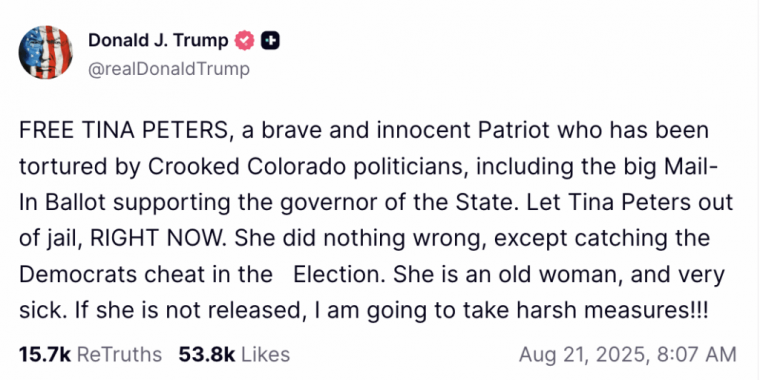
of
Colorado
“FREE
TINA
PETERS,
WHO
SITS
IN
A
COLORADO
PRISON,
DYING
&
OLD,
FOR
ATTEMPTING
TO
EXPOSE
VOTER
FRAUD
IN
THE
RIGGED
2O20
PRESIDENTIAL
ELECTION!!!”
In
March,
the
Justice
Department
docketed
a
statement
of
interest
in
her
federal
habeas
petition
and
announced
that
it
intended
to
review
Peters’s
state
prosecution for
“abuses
of
the
criminal
justice
process.”
In
November,
the
Federal
Bureau
of
Prisons
sent
a
letter
to
the
Colorado
Department
of
Corrections
demanding
that
Peters
be
transferred
to
federal
custody.
A
week
after
Governor
Jared
Polis
refused,
the
Justice
Department’s
Civil
Rights
Division
announced
an
investigation
of
the
Colorado
Department
of
Corrections
and
Colorado
Department
of
Youth
Services
“to
ensure
that
DOC
inmates
and
youths
in
the
custody
of
DYS
are
being
afforded
their
rights
under
the
U.S.
Constitution
and
federal
law.”
(By
coincidence,
that
was
the
same
week
the
administration
decided
to
stop
enforcing
the
Prison
Rape
Elimination
Act’s
requirement
to
protect
transgender
inmates
in
federal
custody.)
On
December
8,
Peters’s
habeas
petition
was
denied,
and
her
lawyer
had
to
get
creative.
Luckily
Peters’s
lawyer
is
Peter
Ticktin,
the
president’s
former
boarding
school
roommate
and
the
author
of
the
book
“What
Makes
Trump
Tick:
My
Years
with
Donald
Trump
from
New
York
Military
Academy
to
the
Present.”
Ticktin
has
also
penned
some
amazing
poetry,
featured
on
his
law
firm’s
website
legalbrains.com.
And
so
he
put
his
mind
to
it
and
came
up
with
A
PLAN.
In
a
letter
published
by
Colorado
Newsline,
he
suggested
that
the
Framers
totally
meant
for
the
president
to
be
able
to
pardon
state
crimes.
The
reason
that
many
pundits
opine
that
you
have
only
the
power
to
grant
pardons
for
federal
offenses
is
that
we
all
understand
the
“United
States”
to
be
the
federal
government
of
our
country.
We
have
one
country,
and
it
is
called
the
“United
States.”
When
we
consider
the
United
States,
it’s
personal
pronoun
is
“it”
which
exemplifies
that
it
is
one
nation.
Therefore,
we
read
“Offenses
against
the
United
States”
to
mean
offenses
against
the
federal
government.
[…]
The
question
of
whether
a
president
can
pardon
for
state
offenses
has
never
been
raised
in
any
court.
The
issue
which
needs
to
be
answered
whether
our
founders
understood
or
intended
when
they
wrote
that
the
President
had
the
Power
to
Pardon
offenses
against
the
United
States,
if
it
meant
the
states
or
only
the
federal
government.
Did
they
mean
the
one
central
authority,
or
did
they
mean
the
plural,
meaning
the
states
which
were
united?
In
that
day
and
age,
they
were
speaking
of
the
United
Countries,
and
the
President
was
given
the
right
to
pardon
all
offenses.
Moreover,
it
does
not
make
sense
that
they
intended
to
give
the
individual
states
the
power
to
circumvent
the
President’s
power
to
pardon.
The
matter
of
Tina
Peters
is
a
perfect
example
of
how
the
power
of
the
President
is
being
circumvented.
Federalism,
LOL.
But
since
Chief
Justice
John
Roberts
has
assured
the
president
that
none
may
question
him
for
his
exercise
of
the
pardon
power,
Trump
figured
what
the
hell.
Well,
you
can
type
any
shit
you
like
on
social
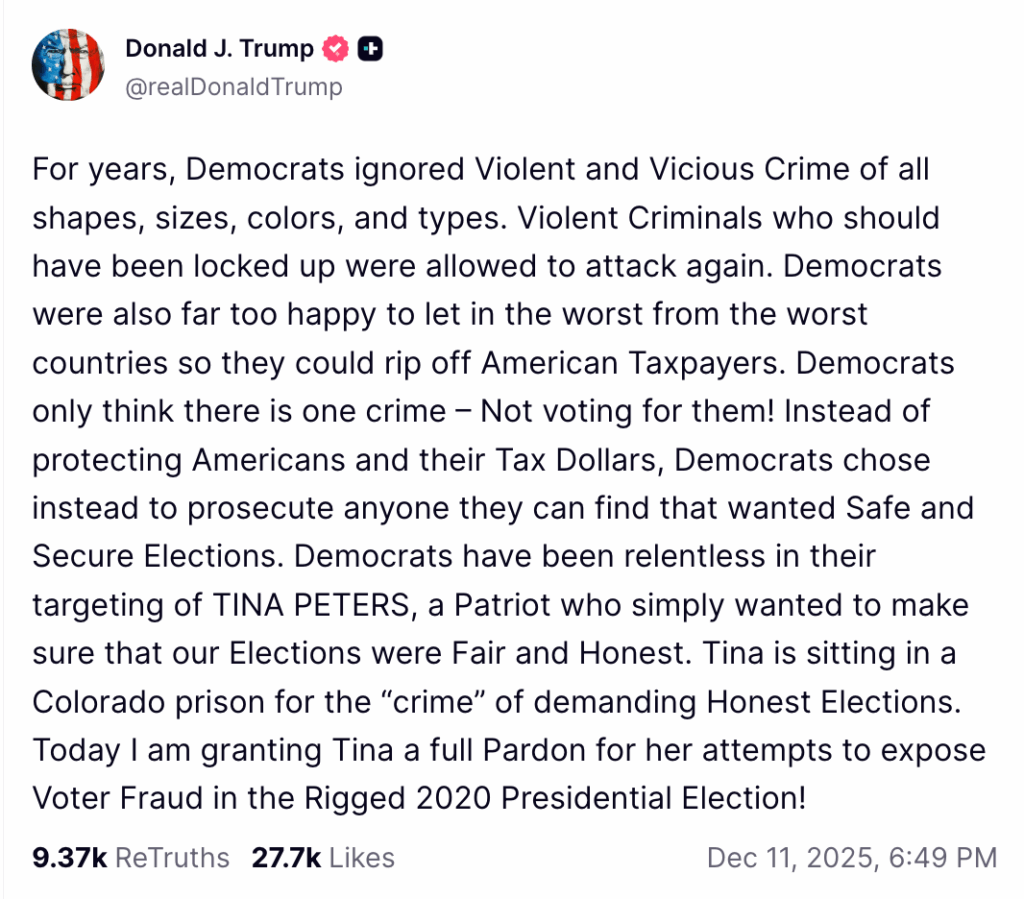
media.
As
of
this
writing,
the
Justice
Department
has
not
added
this
“pardon”
to
the
list
of
Trump’s
clemency
grants.
Nor
has
it
been
announced
by
the
White
House.
But
lawyers
in
this
administration
have
a
seemingly
bottomless
appetite
for
beclowning
themselves,
so
…
We
are
hearing
lots
about
bonuses
at
Biglaw
firms
(and
a
few
elite
boutiques)
these
days,
which
is
great
—
so
keep
those
tips
coming
in!
But
we
know
that
many
readers
work
in
small
and
midsize
firms
that
may
not
play
the
Biglaw
bonus
matching
game.
That’s
where
our
law
firm
compensation
survey
comes
in.
Every
year,
we
collect
compensation
information
from
solo
practitioners
and
small
firm
lawyers
for
our
annual
compensation
report,
and
this
year
we
also
want
to
hear
from
attorneys
at
midsize
law
firms.
If you
are
a
lawyer
at
a
firm
with
fewer
than
250
attorneys,
please click
here to
take
this
brief, completely
confidential
survey.
Feel
free
to
share
the
survey
with
colleagues
and
peers;
the
more
responses
we
receive,
the
more
comprehensive
the
information
we’ll
have
to
share.
Navigating
a
life
sciences
market
marked
by
relentless
innovation,
shifting
deal
dynamics,
and
global
competitive
pressures
requires
more
than
technical
expertise
—
it
demands
perspective,
agility,
and
a
keen
eye
on
where
growth
is
accelerating.
That’s
precisely
the
vantage
point
that
leading
partners
in
this
area
need
to
bring
to
the
table
in
their
work.
From
upticks
in
strategic
M&A
activity
to
burgeoning
drug
development
hugs
across
the
Asia-Pacific
region,
how
are
these
trends
reshaping
strategic
priorities
for
companies
and
investors?
Who
better
to
ask
than
the
leaders
of
a
prominent
global
life
sciences
practice
group?
I
recently
had
the
pleasure
of
chatting
with
Michael
Cohen
and
Adam
Schoen,
co-leaders
of
Brown
Rudnick’s
Global
Life
Sciences
Group,
to
get
their
thoughts
on
the
matter.
Their
work
spans
the
full
spectrum
of
corporate
transactions
and
sector-defining
growth
stories.
Here
is
a
(lightly
edited
and
condensed)
write-up
of
our
lively
conversation
on
their
ever-evolving
practice
area
Staci
Zaretsky
(SZ):
What
key
trends
are
you
seeing
right
now
in
life
sciences
M&A
activity?
Michael
Cohen
&
Adam
Schoen
(MC
&
AS):
We’ve
seen
a
steady
uptick
in
M&A
and
broader
corporate
development
activity
(including
licensing
and
collaboration/co-development
transactions)
in
recent
quarters
and
that
momentum
has
continued
through
the
second
half
of
2025.
Large
pharmaceutical
companies
remain
focused
on
opportunities
to
replenish
their
pipelines
as
existing
products
are
coming
off-patent
over
the
next
few
years.
While
IPO
activity
has
increased
toward
year-end,
M&A
remains
the
primary
exit
strategy
for
life
science
companies
in
late
2025.
SZ:
Which
areas
within
life
sciences
are
generating
the
most
growth
and
investment
interest?
MC
&
AS:
Investor
interest
remains
strong
in
biologics,
specifically
immunotherapies. In
2025,
we
saw
a
renewed
focus
on
antibody/drug
conjugates
and
significant
investment
in
companies
developing
multi-specific
antibody
products
(e.g.,
bi-specific
and
tri-specific
antibody
products). Key
areas
attracting
investment
include
cancer,
non-cancerous
inflammatory
disorders,
neurology,
and
GLP1/GIPR
related
indications.
SZ:
How
is
the
momentum in
the
Asia-Pacific
market
shaping
innovation
and
dealmaking
in
this
sector?
MC
&
AS:
The
Asia-Pacific
market
drove
a
substantial
share
of
transactional
activity
in
the
first
half
of
2025
and
maintained
a
robust
contributor
in
the
second
half.
The
region’s
growing
influence
will
continue
to
shape
global
life
science
dealmaking
dynamics
in
2026.
SZ:
What
are
the
main
legal
or
regulatory
challenges
you’re
navigating
in
life
sciences
transactions?
MC
&
AS:
With
the
growth
in
deals
from
the
Asia-Pacific
market,
one
of
the
primary
challenges
is
balancing
licensors’
desire
to
retain
Asia-Pacific
rights
with
licensees’
need
for
rest-of-world
rights.
This
is
especially
the
case
when
a
licensor
has
a
platform,
and
a
desire
to
undertake
multiple
transactions.
Structuring
agreements
to
align
these
interests
remains
a
critical
focus.
SZ:
What
opportunities
should
life
sciences
companies
be
prioritizing
now
to
position
themselves
for
strategic
growth
or
future exits?
MC
&
AS:
Clinical
data
remains
the
primary
catalyst
for
financing,
partnerships,
and
M&A
activity.
Our
most
successful
clients
have
oriented
around
efficient
use
of
capital
and
a
streamlined
approach
for
clinical
research
to
produce
a
data
package
that
drives
investment,
collaboration,
and
M&A. The
Asia-Pacific’s
regulatory
environment
has
also
enabled
rapid
data
generation,
offering
a
competitive
advantage.
Companies
should
prioritize
generating
high-quality
clinical
data
quickly
to
attract
attention
from
investors,
strategic
partners,
and
potential
acquirers.
On
behalf
of
everyone
here
at
Above
the
Law,
we’d
like
to
thank
Michael
Cohen
and
Adam
Schoen
of
Brown
Rudnick
for
taking
the
time
to
help
answer
some
pressing
questions
on
a
life
sciences
market
where
innovation
cycles
are
speeding
up
and
capital
is
on
the
move.
Staci
Zaretsky is
the
managing
editor
of
Above
the
Law,
where
she’s
worked
since
2011.
She’d
love
to
hear
from
you,
so
please
feel
free
to email her
with
any
tips,
questions,
comments,
or
critiques.
You
can
follow
her
on Bluesky, X/Twitter,
and Threads, or
connect
with
her
on LinkedIn.
Do
we
have
another
mega
Biglaw
firm
on
the
horizon?
According
to
reporting
from
Bloomberg
Law,
Winston
&
Strawn
and
the
UK
firm
Taylor
Wessing
are
considering
a
merger.
According
to
the
firms,
“Winston
&
Strawn
and
Taylor
Wessing
UK
confirm
that
they
are
in
discussions
regarding
a
potential
combination,
which
would
build
upon
the
complementary
strengths,
shared
ambitions,
and
combined
international
reach
of
the
two
firms
going
forward.”
Sounds
serious!
Now
onto
the
financials,
and
you’ll
get
a
sense
of
why
this
is
a
mega
merger
in
the
making.
Last
year,
Winston
took
in
$1.27
billion in
revenue,
while
Taylor
Wessing
made
€619
million
($726
million)
in
revenue,
a
new
high
for
the
firm.
Before
we
get
too
excited
about
the
potential
combination,
the
firms
are
still
in
the
playing
coy
stage,
saying,
“There
is
nothing
to
formally
announce
at
this
stage,
so
we
will
not
be
commenting
further
at
this
time.”
Still,
we
could
have
one
very
large
new
firm
in
the
new
year.
Kathryn
Rubino
is
a
Senior
Editor
at
Above
the
Law,
host
of
The
Jabot
podcast,
and
co-host
of
Thinking
Like
A
Lawyer.
AtL
tipsters
are
the
best,
so
please
connect
with
her.
Feel
free
to
email
her
with
any
tips,
questions,
or
comments
and
follow
her
on
Twitter
@Kathryn1 or
Mastodon
@[email protected].













 Kathryn