Morning Docket: 11.26.25 – Above the Law

*
Lower
court
judges
face
escalating
threats,
so
they
will
receive
NO
additional
security.
But
Congress
will
increase
Supreme
Court
security
so
they
can
safely

continue
to
put
lower
court
judges
at
risk
.
[ABA
Journal
]

*
UK
getting
rid
of
jury
trials
for
most
crimes
in
order
to
clear
backlog.
[Legal
Cheek
]

*
Lawyer
arrested
as
cruise
turns
into
fight
club.
[The
Independent
]

*
Trump
administration
threats
against
Senator
Kelly
face
“hurdles”
to
the
extent
Kelly…
committed
no
crime
when
he
accurately
described
military
law.
[Reuters]

*
Judges
refuse
opportunity
to
testify
in
kangaroo
court.
[Law360]

*
Warner
Music
settles
with
AI
music
generator
Suno.
[The
Recorder
]

*
NLJ
500
partner
appearing
on
Jeopardy!
[Law.com]

Zimbabwean company boss held in Botswana over alleged jobs scam

GABORONE,
Botswana

A
29-year-old
Zimbabwean
man
accused
of
orchestrating
an
international
job-seekers
scam
has
been
remanded
in
custody
after
appearing
before
the
Village
Magistrates’
Court
in
Gaborone,
Botswana,
on
Tuesday.

Evans
Sivechere,
a
director
of
Diamond
Migration
(Pty)
Ltd,
was
arrested
on
Sunday
at
Sir
Seretse
Khama
International
Airport
following
what
Botswana
police
described
as
“intensive
investigations.”

He
is
facing
11
counts
of
fraud.

Sivechere
and
his
company
allegedly
defrauded
11
people
of
more
than
P240,000
between
October
last
year
and
October
23
this
year.
Prosecutors
say
the
victims
were
misled
into
believing
Diamond
Migration
was
processing
overseas
job
placements
and
work
permits
on
their
behalf.


The
applicants
reportedly
submitted
all
required
documents
and
paid
various
fees,
but
later
realised
no
jobs
existed.

The
alleged
scam
involved
purported
employment
opportunities
in
Ireland,
the
Czech
Republic,
Bulgaria,
Luxembourg,
Finland,
Poland
and
Greece.

Evans
Sivechere
arrested
by
police
in
Botswana
on
allegations
of
running
a
jobs
scam

Investigators
say
more
charges
could
be
added
as
the
probe
continues.

Sivechere
is
due
back
in
court
on
December
2.

The
Botswana
Police
Service
has
urged
the
public
to
be
cautious
when
dealing
with
employment
or
recruitment
agencies
and
to
verify
their
legitimacy
before
making
any
payments.

Grade 7 school leaver blows US$1,500 and R1,500 on clothes, gaming and bar outings

BULAWAYO

A
13-year-old
Bulawayo
boy
who
had
just
finished
writing
his
Grade
7
final
exams
admitted
in
court
on
Monday
to
stealing
US$1,500
and
R1,500

savings
his
mother
had
been
putting
aside
to
buy
a
residential
stand

before
going
on
a
reckless
spending
spree
with
an
accomplice.

The
minor,
who
cannot
be
named
for
legal
reasons,
appeared
before
Magistrate
Richard
Ramaboea
at
Tredgold
Magistrates’
Courts
and
pleaded
guilty
to
theft.

The
National
Prosecuting
Authority
said
the
teenager
stole
the
money
on
September
16,
2025,
from
the
family
home
in
Mahatshula
North.

After
taking
the
cash,
he
teamed
up
with
a
friend
and
the
two
blew
the
savings
on
new
clothes,
gaming
sessions
and
drinks
at
a
local
bar
known
as
Hashtag.


The
offence
came
to
light
when
the
boy’s
mother
noticed
the
money
was
missing.
Although
police
later
recovered
the
plastic
bag
the
cash
had
been
stored
in,
no
money
was
recovered.

Magistrate
Ramaboea
remanded
the
teen
in
custody
at
Percy
Ibbotson
Juvenile
Centre.
He
is
expected
back
in
court
on
December
13
for
sentencing.

University Of Zimbabwe Appeals To Citizens To Donate Their Bodies For Medical Research

A
lack
of
donations
is
affecting
the
quality
of
training
for
future
health
professionals,
as
real
human
bodies
are
essential
for
learning
anatomy,
which
forms
the
foundation
of
all
medical
education.

Speaking
at
the
funeral
of
Rosalie
Chigariro,
the
first
black
Zimbabwean
woman
to
donate
her
body
to
science,
Mr
Kavhura,
Chief
Technician
in
the
Department
of
Anatomy,
said
the
university
still
faces
serious
shortages,
even
as
more
students
enrol
in
health-related
courses.

He
stressed
that
hands-on
experience
with
human
anatomy
is
crucial
for
training
doctors,
nurses,
and
other
medical
practitioners.
Said
Kavhura:

“Anatomy
is
the
cornerstone
of
medical
education.
Without
sufficient
specimens,
it
becomes
difficult
for
students
to
gain
the
full
appreciation
of
human
structure
and
function,
something
no
textbook
or
computer
model
can
replace.”

Kavhura
said
Chigariro’s
decision
to
donate
her
body
was
not
only
an
act
of
remarkable
selflessness
but
also
a
landmark
step
in
challenging
cultural
taboos
that
have
long
discouraged
body
donations
in
Zimbabwe.

He
added
that
while
traditions
are
important,
donating
one’s
body
to
medical
science
does
not
diminish
a
person’s
dignity.
Said Kavhura:

“It
is
an
act
of
generosity,
of
service,
and
of
faith;
faith
that
even
in
death,
one
can
still
help
others
live.”

Kavhura
urged
families
to
have
open
discussions
about
donation,
saying
awareness
and
education
are
crucial
for
changing
perceptions
and
boosting
participation.

He
added
that
Chigariro’s
example
demonstrates
that
it
is
possible
to
honour
both
cultural
values
and
scientific
principles.

Keep The Bonus News Coming! – See Also – Above the Law

The
Latest
Bonus
Matches:
Tis
the
season
to
be
thankful
at
Weil
and
Holwell
Shuster
!
Your
Time
Is
Up:
Statute
of
limitations
means
they
won’t
get
another
bite
at
Comey.
Giving
Up
Isn’t
A
Winning
Strategy:
Marc
Elias
weighs
in
on
dealing
with
Trump.
Say
A
Little
Less
To
Your
LLM:
Those
ChatGPT
chats
aren’t
as
private
as
the
average
person
thinks!
An
Icon
For
Our
Time:
Will
Miss
Piggy
be
the
new
emblem
of
resistance?

Elite Boutique Firm Serves Associates A Generous Helping Of Bonus Bucks – Above the Law

No
such
thing
as
a
free
lunch.

Thanksgiving
is
nearly
upon
us,
and
this
holiday
season,
Biglaw
associates’
bank
accounts
are
being
stuffed
like
turkeys
thanks
to
firm
after
firm
matching
the
prevailing
market
bonus
rate.

We’ve
recently
received
word
that
commercial
litigation
boutique Holwell
Shuster
&
Goldberg

has
announced
its
bonus
scale.
The
firm

founded
in
2012
by
former
Southern
District
of
New
York
Judge
Richard
Holwell,
along
with
former
White
&
Case
colleagues
Mike
Shuster,
Dan
Goldberg,
and
Dorit
Ungar
Black

is
a
destination
for
litigators
who
want
to
be
paid
well
and gain
trial
experience
early
in
their
careers
.
Of
course
the
successful
firm
is
offering
associates
a

Cravath
match
,
complete
with

Milbank’s
summer
bonuses
.
Here’s
what
that
looks
like
at
the
firm,
with
deposits
set
to
hit
bank
accounts
in
late
December:

Here’s
a
kind
note
to
associates
that
was
included
in
the
firm’s
bonus
memo:

We
are
proud
of
our
continued
commitment
to
providing
top-tier
legal
services
and
the
impressive
victories
that
we
have
earned
for
our
clients
as
a
result.
You
are
all
a
big
part
of
what
makes
the
firm’s
successes
possible
and
why
HSG
remains
a
very
special
place
to
practice
law.

Congratulations
to
everyone
at
Holwell
Shuster
&
Goldberg!

Remember
everyone,
we
depend
on
your
tips
to
stay
on
top
of
compensation
updates,
so
when
your
firm
announces
or
matches,
please
text
us
(646-820-8477)
or email
us
 (subject
line:
“[Firm
Name]
Bonus/Matches”).
Please
include
the
memo
if
available.
You
can
take
a
photo
of
the
memo
and
send
it
via
text
or
email
if
you
don’t
want
to
forward
the
original
PDF
or
Word
file.

And
if
you’d
like
to
sign
up
for
ATL’s
Bonus
Alerts
(which
is
the
alert
list
we
also
use
for
salary
announcements),
please
scroll
down
and
enter
your
email
address
in
the
box
below
this
post.
If
you
previously
signed
up
for
the
bonus
alerts,
you
don’t
need
to
do
anything.
You’ll
receive
an
email
notification
within
minutes
of
each
bonus
announcement
that
we
publish.
Thanks
for
your
help!


Staci
Zaretsky
 is
the
managing
editor
of
Above
the
Law,
where
she’s
worked
since
2011.
She’d
love
to
hear
from
you,
so
please
feel
free
to

email

her
with
any
tips,
questions,
comments,
or
critiques.
You
can
follow
her
on BlueskyX/Twitter,
and Threads, or
connect
with
her
on LinkedIn
.

Law Professor Offers Pitch Perfect Response To Trump’s Latest Insult – Above the Law

(Christopher
Willard
via
Getty
Images)

Donald
Trump
recently
pointed
at
Bloomberg
reporter
Catherine
Lucey
during
a
press
gaggle
aboard
Air
Force
One
and
snarled,
“Quiet.
Quiet,
piggy.”
The
insult
came
after
she
asked
a
follow-up
question
about
Jeffrey
Epstein’s
files,
a
chillingly
symbolic
moment,
but…
not
exactly
shocking
coming
from
a
man
who’s
repeatedly
demeaned
women
in
public.

When
Lucey
asked
why
Trump
wouldn’t
release
Epstein’s
files
if
there
was
nothing
incriminating
in
them,
he
cut
in
like
a
bratty
child
and
dropped
that
“insult.”
The
intention
was
certainly
to
demean,
and
whether
it
was
the
result
of
a
elderly
man
on
the
edge
of
dementia
forgetting
the
concept
of
decorum,
or
a
coldly
calculated
move
to
distract
from
Lucey’s
pointed
question
is
kinda
beside
the
point.
That’s
especially
true
when
you
consider
Trump’s
long
documented
history
of
gender
based
insults.
Calling
women
“piggy,”
“dog,”
“loser,”
or
worse,
especially
when
they
dare
to
ask
real
questions.

That’s
exactly
why
former
federal
prosecutor
and
current
professor
at
the
University
of
Alabama
School
of
Law,
Joyce
Vance
argued
in
her

Substack

Civil
Discourse

that
Miss
Piggy,
the
glamorous,
sassy
Muppet
diva
with
a
noteworthy
karate
chop,
deserves
a
spot
in
our
resistance
imagery.

Vance
subversively
calls
on
women
to
reclaim
Miss
Piggy
as
their
own
symbol.
Yes,
Miss
Piggy,
the
diva
piguette.
Not
because
she’s
meek
or
delicate,
but
because
she’s
exactly
the
opposite:
glamorous,
self-assured,
and
all
too
happy
to
stand
up
for
her
self
when
she’s
crossed.
Vance
writes:

Portland
has
reclaimed
the
frog
as
a
symbol
of
its
resistance
to
Trump’s
efforts
to
militarize
the
city.
Perhaps
women
should
claim
the
glamorous,
sassy
Muppet
Miss
Piggy,
a
known
diva
with
a
fierce
karate
chop,
as
their
own
symbol.
Call
a
woman
a
piggy,
and
see
how
that
goes
for
you,
Mr.
President.
Enough
demeaning
of
women.
Signing
the
Epstein
Files
bill
when
it
hits
his
desk,
which
Trump
has
promised
to
do,
won’t
be
enough.
The
files
have
to
be
released,
no
excuses.
It’s
time
to
emulate
the
great
Miss
Piggy,
who
has
never
stayed
quiet
in
the
face
of
those
who
don’t
respect
her.

If
you
raise
an
eyebrow
at
a
Muppet
as
a
feminist
figure,
well,
you
don’t
know
Miss
Piggy,
the
OG
diva.
Since
the
1970s,
she’s
been
unapologetic,
ambitious,
and
ferociously
self-confident.
In
2015,
she
even
received
a

feminist
award

from
the
Sackler
Center
for
Feminist
Art,
and
her
acceptance
speech
was
a
10/10.
Miss
Piggy

defended

her
feminism,
saying
that
a
woman
who
cares
about
her
star
billing,
appearance,
and
success

is

a
feminist.
As
The
Washington
Post

put
it,

her
“wild,
voracious
sort
of
freedom”
and
her
refusal
to
conform
is
an
“unruly,
defiantly
unrespectable
feminist
act.”

Trump’s
“quiet,
piggy”
isn’t
just
another
insult.
It’s
emblematic
of
a
larger
problem:
powerful
men
trying
to
silence
women
who
press
for
accountability.
But
Vance’s
call,
that
we
channel
Miss
Piggy
instead
of
shrinking
in
response,
flips
the
insult
on
its
head.

This
isn’t
about
politeness.
It’s
about
standing
up,
with
humor
and
strength,
to
someone
who
thinks
demeaning
a
woman
is
a
power
move.

If
Trump
thinks
calling
a
woman
“piggy”
is
clever,
let
him
meet
the
real
Miss
Piggy

and
every
woman
who
refuses
to
be
silenced.


Kathryn
Rubino
is
a
Senior
Editor
at
Above
the
Law,
host
of

The
Jabot
podcast
,
and
co-host
of

Thinking
Like
A
Lawyer
.
AtL
tipsters
are
the
best,
so
please
connect
with
her.
Feel
free
to
email

her

with
any
tips,
questions,
or
comments
and
follow
her
on
Twitter

@Kathryn1
 or
Mastodon

@[email protected].

For This, I Am Still Grateful – Above the Law

As
this
year
draws
to
a
close,
I
find
myself
reflecting
once
again,
but
this
time,
the
reflection
feels
heavier,
deeper,
and
more
urgent.
Last
year,
I
wrote
about
learning
to
pause,
to
be
present,
to
step
away
from
the
relentless
need
to
be
busy.

This
year
has
taught
me
something
equally
important:
what
we
do
matters.
Not
in
the
résumé
sense.
Not
in
the
“look
at
how
much
I
accomplished”
sense.
It
matters
because
our
actions
leave
ripples.
Our
presence
leaves
marks.
The
choices
we
make,
even
the
quiet
ones,
have
impact.

This
lesson
didn’t
come
easily.

In
January,
I
lost
a
close
friend
and
colleague.
She
was
38.
She
was
far
too
young.
She
was
far
too
good. She
was
far
too
full
of
life
and
purpose
to
be
gone
so
soon.
She
was
the
kind
of
person
who
believed
fiercely
in
relationships,
connection,
community,
and
in
supporting
the
underdog
every
chance
she
got.
She
never
hesitated
to
lift
someone
up,
to
speak
up
for
what
was
right,
or
to
give
someone
the
benefit
of
the
doubt
when
the
world
was
too
ready
to
dismiss
them.

Losing
her
made
me
ask
myself: What
am
I
doing
with
the
time
I
have?
How
am
I
showing
up
for
others?
What
impact
do
I
want
to
leave?

This
year,
I
tried
to
honor
her
by
living
the
values
she
embodied.

  • I
    mentored
    students
    who
    were
    unsure
    of
    themselves,
    but
    filled
    with
    potential.
  • I
    taught
    law
    school
    and
    poured
    into
    my
    students,
    not
    just
    doctrine,
    but
    belief
    in
    themselves,
    belief
    in
    the
    profession
    we
    are
    still
    trying
    to
    shape.
  • I
    showed
    up
    for
    people
    who
    needed
    space,
    silence,
    or
    simply
    someone
    to
    sit
    with
    them
    without
    judgment.
  • I
    leaned
    into
    the
    hard
    moments,
    doing
    what
    was
    right
    even
    when
    it
    was
    uncomfortable
    or
    inconvenient.
  • I
    challenged
    people
    (gently,
    honestly)
    to
    be
    the
    best
    version
    of
    themselves
    because
    she
    always
    challenged
    me
    to
    be
    mine.

And
what
have
I
gotten
in
return?

So
much
more
than
I
ever
expected.

I
have
learned
about
people’s
stories
and
the
struggles
they
carry
quietly.
I
have
learned
about
resilience.
I
have
learned
about
how
much
a
small
act
(a
conversation,
a
check-in,
an
opportunity)
can
mean
to
someone
who
needed
it
more
than
you
realized.

Most
of
all,
I
have
learned
how
lucky
I
am.
And
for
that,
I
continue
to
be
grateful.

Because
here
is
the
truth
I
kept
relearning
this
year: gratitude
grows
when
you
give
it
away.
 Paying
it
forward
isn’t
just
about
helping
others;
it’s
about
expanding
your
own
understanding
of
the
world.
It
deepens
your
empathy.
It
sharpens
your
perspective.
It
reminds
you,
especially
in
a
profession
that
rewards
busyness
and
ego,
that
your
real
legacy
isn’t
found
in
your
output. 

It’s
found
in
your
impact.

This
year
wasn’t
about
doing
less,
like
last
year.
It
was
about
doing more
of
what
matters
,
more
of
what
leaves
people
better
than
you
found
them,
more
of
what
reflects
who
you
want
to
be
when
no
one
is
keeping
score.

And
again,
the
legal
profession
doesn’t
always
make
that
easy.
We
are
taught
to
move
fast,
to
compartmentalize,
to
win,
to
perform,
but
slowing
down
last
year
made
space
for
other
things
this
year.
Purpose. 

Intention.
Service.
Connection.

I
am
grateful
for
the
students
who
trusted
me
enough
to
let
me
guide
them.

I
am
grateful
for
people
who
allowed
me
to
step
into
their
lives
during
difficult
seasons.

I
am
grateful
for
the
quiet
moments
that
reminded
me
of
what,
and
who,
truly
matters.

I
am
grateful
for
the
chance
to
carry
forward
the
spirit
of
someone
who
taught
me
so
much
simply
by
how
she
lived.

And
I
am
grateful
for
the
reminder
that
life
is
fragile,
fleeting,
and
far
too
short
to
waste
on
things
that
don’t
build
others
up.

We
don’t
get
to
control
how
much
time
we
have,
but
we
do
get
to
control
how
we
use
it
and
who
we
become
because
of
it. 

This
year,
I
chose
gratitude.
I
chose
presence.
I
chose
impact.
I
chose
to
pay
it
forward.

For
this,
and
for
all
the
lessons
that
came
wrapped
in
both
joy
and
grief-


I
am,
still,
deeply
grateful.


Lisa
Lang
is
an
accomplished
in-house
lawyer
and
thought
leader
dedicated
to
empowering
fellow
legal
professionals. She
offers
insights
and
resources
tailored
for
in-house
counsel
through
her
website
and
blog,
Why
This,
Not
That™
(
www.lawyerlisalang.com).
Lisa
actively
engages
with
the
legal
community
via
LinkedIn,
sharing
her
expertise
and
fostering
meaningful
connections.
You
can
reach
her
at 
[email protected],
connect
on
LinkedIn
(
https://www.linkedin.com/in/lawyerlisalang/).

Thomson Reuters Tells Appeals Court: ROSS’s Copying Was ‘Theft, Not Innovation’

In
a
redacted
brief
filed
Nov.
19
with
the
3rd
U.S.
Circuit
Court
of
Appeals,
Thomson
Reuters
urged
the
court
to
affirm
the
Delaware
district
court’s
ruling
that
ROSS
Intelligence
infringed
Westlaw’s
copyrights
by
copying
thousands
of
its
attorney-written
headnotes
to
train
an
AI-powered
legal
research
tool.

“Copying
protectable
expression
to
create
a
competing
substitute
isn’t
innovation:
it’s
theft,”
the
brief
asserts.
“This
basic
principle
is
as
true
in
the
AI
context
as
it
is
in
any
other.”

The
85-page
brief
(which
you
can
read
here
),
signed
by
Kirkland
&
Ellis
partners
Dale
Cendali,
Joshua
Simmons
and
Miranda
Means,
defends
the
copyrightability
of
Westlaw’s
headnotes,
the
editorial
summaries
written
by
its
attorney-editors,
and
portrays
them
as
a
hallmark
of
creative
legal
analysis
rather
than
mere
factual
summaries.

“For
over
a
hundred
years
and
as
recently
as
2020,”
TR’s
brief
argues,
“the
Supreme
Court
has
upheld
‘the
reporter’s
copyright
interest
in
explanatory
materials
including
headnotes.”
Citing

Callaghan
v.
Myers

(1888)
and

Georgia
v.
Public.Resource.Org

(2020),
TR
calls
headnotes
“a
paradigmatic
example
of
protectable
material,”
and
argues
that
the
Delaware
court
was
right
to
treat
2,243
of
them
as
copyrightable
works.


Related:

‘No
One
Can
Own
the
Law’:
Amici
Come
Out
In
Force
to
Support
ROSS
In
Appeal
of
Copyright
Ruling
Favoring
Thomson
Reuters
.

TR
asserts
that
its
headnotes
are
crafted
through
numerous
creative
editorial
choices

how
to
phrase
the
point
of
law,
how
many
headnotes
to
create,
which
facts
or
concepts
to
include,
which
case
passages
to
link
and
how
to
categorize
them
within
the
West
Key
Number
System.
These
choices,
TR
says,
easily
satisfy
the
minimal
creativity
required
by
Feist.

ROSS,
the
brief
says,
“may
want
to
ignore
the
Supreme
Court’s
numerous
statements
that
headnotes
are
protectable,
as
it
did
in
its
opening
brief,
but
this
Court
must
follow
binding
precedent.”

‘Knew
It
Could
Not
Legally
Access
Westlaw’

TR’s
account
portrays
ROSS
as
a
commercial
actor
that
knowingly
copied
Westlaw
to
build
a
rival
product.
After
being
denied
a
Westlaw
license,
ROSS
allegedly
hired
the
outsourcing
firm
LegalEase
Solutions
to
scrape
Westlaw
data
and
convert
headnotes
into
“question
and
answer”
pairs
for
training
its
AI
model.

According
to
exhibits
described
in
the
brief,
LegalEase
contractors
“copied
the
West
Headnotes
into
the
form
of
questions”
and
then
copied
“the
case
passages
that
West’s
attorney-editors
had
selected
to
link
to
those
headnotes.”
TR
accuses
ROSS
of
using
bots
to
“scrape
Westlaw

en
masse
,”
creating
“thousands
of
Bulk
Memos
quickly”
and
copying
“hundreds
of
thousands
of
annotated
cases.”


(Two
days
before
using
ROSS
in
2020,
TR
settled
litigation
against
LegalEase
based
on
similar
facts,
with
the
two
parties
agreeing
to
entry
of
a


consent
judgment
and
stipulated
permanent
injunction
 in
the
U.S.
District
Court
in
Minnesota.)

The
brief
asserts
that
ROSS
used
the
resulting
material
multiple
times
in
training
its
AI
system.
It
cites
testimony
that
ROSS
already
possessed
a
repository
of
case
law
but
needed
Westlaw’s
editorial
analysis
to
build
a
functional
search
tool
capable
of
mapping
natural-language
questions
to
relevant
case
passages.

ROSS’s
conduct,
TR
contends,
was
not
inadvertent:
“ROSS
knew
it
could
not
legally
access
Westlaw.
When
ROSS
directly
asked
TR
for
a
Westlaw
subscription,
TR
expressly
declined.”
Yet
after
learning
this,
the
brief
says,
ROSS
induced
first
another
company
(whose
name
is
redacted)
and
then
LegalEase
to
get
ROSS
access
anyway.

‘A
Direct
Substitute,
Not
a
Transformative
Use’


A
ROSS
ad
reproduced
in
TR’s
brief.

On
the
question
of
fair
use,
TR’s
central
argument
is
that
ROSS’s
platform
“substituted
for
and
competed
with
Westlaw
in
the
legal
research
platform
market.”

It
says
ROSS’s
marketing
materials
explicitly
positioned
its
AI
as
a
“Westlaw
replacement,”
even
using
slogans
like

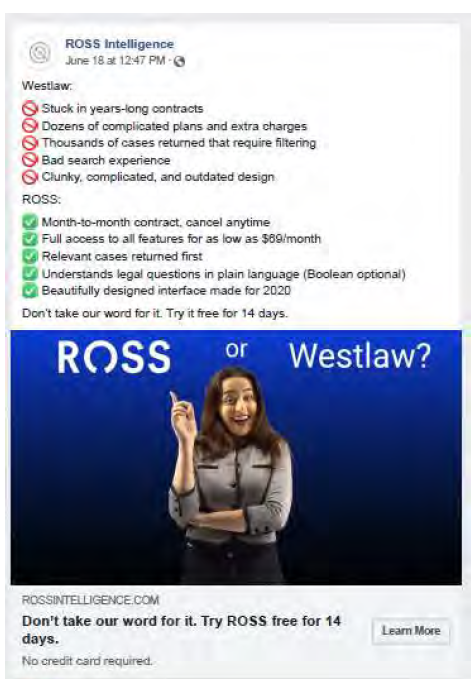
“ROSS
or
Westlaw?”

alongside
a
price
comparison
ad

a
copy
of
which
is
reproduced
in
the
brief.

Under
the
Supreme
Court’s
2023
decision

Andy
Warhol
Found.
for
the
Visual
Arts
v.
Goldsmith
,
TR
says,
ROSS’s
use
was
not
“transformative”
because
it
served
“the
same
purpose
as
the
original,”
which
was
to
“help
researchers
find
and
understand
the
law.”

It
draws
a
contrast
with
other
cases,
such
as
one
involving
Google
Books,
which
merely
indexed
books
and
drove
users
back
to
the
originals.


See
all
my
coverage
of
this
litigation
here
.

Here,
it
contends,
ROSS
“copied
the
Westlaw
content
that

already

provided
a
way
for
researchers
to
find
and
understand
law
to
develop
a

competing

way
to
find
and
understand
law.”

TR
also
accuses
ROSS
of
acting
in
bad
faith,
noting
a
similar
case
in
which
the
court
found
bad
faith
when
the
defendant
“requested
a
license,
was
refused
one,
and
then
obtained
a
copy
from
a
third
party
rather
than
paying
the
requisite
fee.”

That,
it
says,
“is
precisely
what
happened
here,
where
ROSS
was
refused
a
license
and
then
illicitly
went
through
a
third
party.”

Harm
to
Westlaw’s
Markets

Much
of
TR’s
brief
focuses
on
market
harm,
which
it
argues
is
the
most
important
of
the
fair
use
factors.
It
argues
that
ROSS’s
copying
deprived
TR
of
several
valuable
markets:

  • The
    existing
    market
    for
    Westlaw
    subscriptions.
  • The
    potential
    market
    for
    licensing
    Westlaw
    content
    as
    AI
    training
    material.
  • The
    exclusive
    ability
    to
    train
    its
    own
    AI
    using
    that
    content.

“ROSS
harmed
the
original
market
for
Westlaw
by
substituting
therefor,”
TR
argues,
and
it
“diminished
the
value
of
the
Westlaw
content
by
depriving
TR
of
its
exclusive
ability
to
train
its
own
AI
on
that
content.”

A
ruling
in
ROSS’s
favor
would
have
broad
consequences,
the
brief
argues.
“If
any
competitor
could
copy
the
Westlaw
content
to
train
their
own
legal
research
platform,
why
on
earth
would
anyone
pay
TR
for
it?”

AI
Innovation
or
‘Parasitic
Copying’?

Responding
to
arguments
from
ROSS
and
others
that
enforcing
TR’s
copyright
in
this
case
would
hinder
AI
progress,
TR
suggest
that
is
alarmist,
pointing
out
that
Westlaw
itself
has
used
artificial
intelligence
“long
before
the
founders
of
ROSS
were
in
school.”
The
company
cites
milestones
from
its
own
AI
history
dating
back
to
the
1990s,
including
its
1992
launch
of
the
“first
commercially
available
search
engine
with
probabilistic
rank
retrieval”
and
the
2018
launch
of
WestSearch
Plus,
an
AI-powered
research
feature.

“AI
development
has
moved
forward
at
a
rapid
pace
since
the
decision
below
was
entered,
and
will
surely
continue
to
do
so,”
the
brief
says.

While
there
may
be
scenarios
where
training
an
AI
algorithm
using
copyrighted
material
is
fair
use,
“this
scenario

where
the
copying
was
for
purposes
of
creating
a
commercial
substitute
for
the
original

is
not
one
of
them.”

The
brief’s
concluding
paragraph
drives
home
the
theme
that
ROSS’s
behavior
is
not
about
innovation
but
misappropriation:

“This
case
may
involve
AI,
but
it
is
far
from
novel.
ROSS
indisputably
pilfered
the
creativity
of
a
competitor
to
bring
to
market
a
substitute.
ROSS’s
copying
was
not
technological
advancement.
It
was
theft.”

Washington Post Analysis Shows We Are Talking Too Much And Getting Questionable Advice From LLMs – And It May All Be Discoverable – Above the Law

The
jury
is
still
out
on
how
much
and
how
soon
GenAI
will
impact
the
legal
profession,
as
I
pointed
out
in
a
recent
article.
But
one
thing
is
certain:
GenAI
is
affecting
what
people
are
revealing,
the
questions
they’re
asking,
and
what
advice
they’re
receiving.
The
implications
for
lawyers,
or
perhaps
more
accurately,
their
clients,
are
downright
scary.
People
are
talking
too
much
and
getting
wrong
advice
that’s
memorialized
for
future
use
and
discovery

I
had

sounded
this
alarm

before.
And
now
a
recent

Washington
Post
analysis

of
some
47,000
ChatGPT
conversations
validates
many
of
these
concerns
in
alarming
ways.


The
Post
Analysis

Here’s
what
the
Post
found:

  • While
    most
    people
    are
    using
    the
    tool
    to
    get
    specific
    information,
    more
    than
    1
    in
    10
    use
    it
    for
    more
    abstract
    discussions.
  • Most
    people
    use
    the
    tool
    not
    for
    work
    but
    for
    very
    personal
    uses.
  • Emotional
    conversations
    were
    common,
    and
    people
    are
    sharing
    personal
    information
    about
    their
    lives.
  • The
    way
    ChatGPT
    is
    designed
    encourages
    intimacy,
    and
    the
    sharing
    of
    personal
    things.
    It
    has
    been
    found
    that
    techniques
    that
    make
    the
    tool
    seem
    more
    helpful
    and
    engaging
    also
    make
    the
    tool
    more
    likely
    to
    say
    what
    the
    user
    wants
    to
    hear.
  • About
    10%
    of
    the
    chats
    analyzed
    show
    people
    talking
    about
    emotions.
    OpenAI
    estimated
    that
    about
    1
    million
    people
    show
    signs
    of
    becoming
    emotionally
    reliant
    on
    it.
  • People
    are
    sharing
    personally
    identifiable
    information,
    their
    mental
    issues,
    and
    medical
    information.
  • People
    are
    asking
    the
    chat
    to
    prepare
    letters
    and
    drafts
    of
    all
    sorts
    of
    stuff.
  • ChatGPT
    begins
    its
    responses
    with
    yes
    or
    correct
    more
    than
    10
    times
    as
    often
    as
    it
    starts
    with
    no.

And
of
course,
it
still
hallucinates.
While
the
analysis
focused
on
ChatGPT
conversations,
there
can
be
little
doubt
that
other
public
and
perhaps
closed
LLMs
are
being
used
in
many
of
the
same
ways
and
doing
the
same
things.


The
Problem

That
means
there’s
a
lot
of
scary
stuff
out
there
that
could
of
course
be
open
to
discovery
in
judicial
and
regulatory
proceedings.
Indeed,
as

previously
written
,
OpenAI’s
CEO
Sam
Altman
has
recognized
that
the
company
would
have
to
comply
with
subpoenas.
And
government
agencies
like
law
enforcement
can
seek
access
to
private
conversations
with
an
LLM
as
well.

What
the
Post
analysis
tells
me
though
is
that
people
aren’t
recognizing
this
danger.
They
seem
to
think
that
they
stuff
they
put
in
and
get
out
is
private.
Indeed,
the
Post
got
the
47,000
conversations
because
people
created
sharable
links
to
their
chats
that
were
then
preserved
in
the
Internet
Archive.
OpenAI
has
now
removed
the
option
to
have
shared
conversations
discoverable
with
a
mere
Google
search
since
people
had
accidentally
made
some
chats
public.
That’s
troubling
in
and
of
itself.

Worse,
the
answers
given
by
ChatGPT
since
they
tell
the
user
what
they
want
to
hear,
are
wrong.
One
thing
I
learned
in
my
years
practicing
law,
is
that
clients
usually
start
out
convinced
they
are
right.
(Most
never
really
change
their
minds.)
Their
mindset
when
their
lawyer
tells
them
they
are
wrong
is
that
they
would
have
received
the
answer
they
wanted
if
only
they
had
a
better
lawyer.

Now
we
have
the
problem
on
steroids.
The
client
walks
in
convinced
they
are
right
and
thinks
that
their
position
has
been
confirmed
by
ChatGPT.

Perhaps
even
worse,
people
may
be
acting
on
the
advice
they
are
getting
from
the
LLMs,
getting
themselves
in
even
more
trouble.
Clients
often
held
back
acting
on
something
because
they
knew
enough
to
know
they
should
consult
a
lawyer.
But
since
that
was
expensive,
they
just
didn’t
do
it
out
of
an
exercise
of
caution.
Now
they
have
what
they
think
is
confirmation.
A
green
light.


Here’s
Where
We
Are

Putting
these
facts

people
putting
discoverable
and
potential
damaging
stuff
in
an
LLM
thinking
it’s
private
(which
LLMs
encourage),
LLMs
telling
the
user
what
they
want
to
hear
or
making
up
answer
which
the
user
believes
and
might
even
act
upon
–together
with
some
common
situations
demonstrates
why
these
factors
should
be
concerning
to
lawyers.
 

It
doesn’t
take
much
to
foresee
a
C-suite
officer,
for
example,
using
ChatGPT
to
seek
to
solve
a
thorny
personnel
problem
by
brainstorming
with
an
LLM
and
commenting
on
the
responses
in
a
back-and-forth
manner
that
creates
a
paper
trail
for
a
future
wrongful
termination
case.

Or
a
disgruntled
spouse
venting
in
a
conversation
that
becomes
public
in
a
divorce
or
custody
decision.
Or
people
seeking
advice
on
how
to
hide
documents.
Or
how
to
avoid
discovery.
Or
taking
advice
to
avoid
paying
taxes.

Or
someone
in
a
fit
of
rage
writing
something
threatening
even
though
they
were
just
venting.
And
then
getting
charged
with
terroristic
threatening.

I
could
go
on
and
on.

And
don’t
forget,
the
tools
are
going
to
get
better.


An
Added
Issue

I
am
sure
that
the
Post
got
access
to
the
47,000
conversations
in
a
legitimate
way.
But
it
also
seemed
pretty
easy
and
carried
the
risk
that
some
of
the
participants
didn’t
realize
their
conversations
were
public.

And
that
makes
me
uneasy.
As
we
have
seen
over
and
over
in
the
digital
world,
what
many
think
is
private
somehow
became
public.
I
worry
that
many
of
the
millions
of
conversations
with
LLMs
might
end
up
being
not
private
at
all,
either
through
legitimate
or
illegitimate
ways.


What’s
a
Lawyer
to
Do

Back
in
the
early
days
of
eDiscovery,
there
was
a
push
by
many
lawyers
to
try
to
educate
their
clients
about
the
perils
of
not
being
careful
with
what
they
say
in
things
like
emails,
texts,
and
other
digital
tools.
Even
with
that,
people
still
screw
up
and
say
things
they
shouldn’t,
thinking
or
assuming
that
just
because
it’s
digital
it’s
somehow
private.
Now
we
have
a
tool
that
in
essence
eggs
you
on
to
perhaps
say
or
do
something
you
shouldn’t
and
help
you
do
it.

It’s
incumbent
on
all
of
us

lawyers,
legal
professionals,
vendors,
and
even
LLM
developers

to
do
all
we
can
to
make
ordinary
people
aware
of
the
dangers.
There
can
be
little
doubt
that
savvy
lawyers
will
use
the
proclivity
of
people
to
say
too
much
to
their
favorite
bot
to
their
advantage
in
litigation
and
discovery,
as
will
government
investigative
and
regulatory
entities.

Based
on
experience,
I
know
many
aren’t
going
to
get
the
message.
But
that
doesn’t
mean
we
shouldn’t
try.
We
need
to
lead
the
way
in
training
our
clients
about
the
risks,
not
the
other
way
around,
when
the
damage
is
already
done.
We
need
to
sound
the
alarm
in
ways
they
can
understand.

The
Post
analysis
is
a
start
toward
an
educational
process.
We
owe
it
to
our
clients
to
do
more.
And
don’t
forget
we
are
ethically
and
practically
bound
to
understand
the
risks
and
benefits
of
relevant
technology.
It’s
hard
to
run
and
hide
from
the
relevance
of
GenAI
anymore.


Stephen
Embry
is
a
lawyer,
speaker,
blogger,
and
writer.
He
publishes TechLaw
Crossroads
,
a
blog
devoted
to
the
examination
of
the
tension
between
technology,
the
law,
and
the
practice
of
law
.