Thomson Reuters Tells Appeals Court: ROSS’s Copying Was ‘Theft, Not Innovation’

In
a
redacted
brief
filed
Nov.
19
with
the
3rd
U.S.
Circuit
Court
of
Appeals,
Thomson
Reuters
urged
the
court
to
affirm
the
Delaware
district
court’s
ruling
that
ROSS
Intelligence
infringed
Westlaw’s
copyrights
by
copying
thousands
of
its
attorney-written
headnotes
to
train
an
AI-powered
legal
research
tool.

“Copying
protectable
expression
to
create
a
competing
substitute
isn’t
innovation:
it’s
theft,”
the
brief
asserts.
“This
basic
principle
is
as
true
in
the
AI
context
as
it
is
in
any
other.”

The
85-page
brief
(which
you
can
read
here
),
signed
by
Kirkland
&
Ellis
partners
Dale
Cendali,
Joshua
Simmons
and
Miranda
Means,
defends
the
copyrightability
of
Westlaw’s
headnotes,
the
editorial
summaries
written
by
its
attorney-editors,
and
portrays
them
as
a
hallmark
of
creative
legal
analysis
rather
than
mere
factual
summaries.

“For
over
a
hundred
years
and
as
recently
as
2020,”
TR’s
brief
argues,
“the
Supreme
Court
has
upheld
‘the
reporter’s
copyright
interest
in
explanatory
materials
including
headnotes.”
Citing

Callaghan
v.
Myers

(1888)
and

Georgia
v.
Public.Resource.Org

(2020),
TR
calls
headnotes
“a
paradigmatic
example
of
protectable
material,”
and
argues
that
the
Delaware
court
was
right
to
treat
2,243
of
them
as
copyrightable
works.


Related:

‘No
One
Can
Own
the
Law’:
Amici
Come
Out
In
Force
to
Support
ROSS
In
Appeal
of
Copyright
Ruling
Favoring
Thomson
Reuters
.

TR
asserts
that
its
headnotes
are
crafted
through
numerous
creative
editorial
choices

how
to
phrase
the
point
of
law,
how
many
headnotes
to
create,
which
facts
or
concepts
to
include,
which
case
passages
to
link
and
how
to
categorize
them
within
the
West
Key
Number
System.
These
choices,
TR
says,
easily
satisfy
the
minimal
creativity
required
by
Feist.

ROSS,
the
brief
says,
“may
want
to
ignore
the
Supreme
Court’s
numerous
statements
that
headnotes
are
protectable,
as
it
did
in
its
opening
brief,
but
this
Court
must
follow
binding
precedent.”

‘Knew
It
Could
Not
Legally
Access
Westlaw’

TR’s
account
portrays
ROSS
as
a
commercial
actor
that
knowingly
copied
Westlaw
to
build
a
rival
product.
After
being
denied
a
Westlaw
license,
ROSS
allegedly
hired
the
outsourcing
firm
LegalEase
Solutions
to
scrape
Westlaw
data
and
convert
headnotes
into
“question
and
answer”
pairs
for
training
its
AI
model.

According
to
exhibits
described
in
the
brief,
LegalEase
contractors
“copied
the
West
Headnotes
into
the
form
of
questions”
and
then
copied
“the
case
passages
that
West’s
attorney-editors
had
selected
to
link
to
those
headnotes.”
TR
accuses
ROSS
of
using
bots
to
“scrape
Westlaw

en
masse
,”
creating
“thousands
of
Bulk
Memos
quickly”
and
copying
“hundreds
of
thousands
of
annotated
cases.”


(Two
days
before
using
ROSS
in
2020,
TR
settled
litigation
against
LegalEase
based
on
similar
facts,
with
the
two
parties
agreeing
to
entry
of
a


consent
judgment
and
stipulated
permanent
injunction
 in
the
U.S.
District
Court
in
Minnesota.)

The
brief
asserts
that
ROSS
used
the
resulting
material
multiple
times
in
training
its
AI
system.
It
cites
testimony
that
ROSS
already
possessed
a
repository
of
case
law
but
needed
Westlaw’s
editorial
analysis
to
build
a
functional
search
tool
capable
of
mapping
natural-language
questions
to
relevant
case
passages.

ROSS’s
conduct,
TR
contends,
was
not
inadvertent:
“ROSS
knew
it
could
not
legally
access
Westlaw.
When
ROSS
directly
asked
TR
for
a
Westlaw
subscription,
TR
expressly
declined.”
Yet
after
learning
this,
the
brief
says,
ROSS
induced
first
another
company
(whose
name
is
redacted)
and
then
LegalEase
to
get
ROSS
access
anyway.

‘A
Direct
Substitute,
Not
a
Transformative
Use’


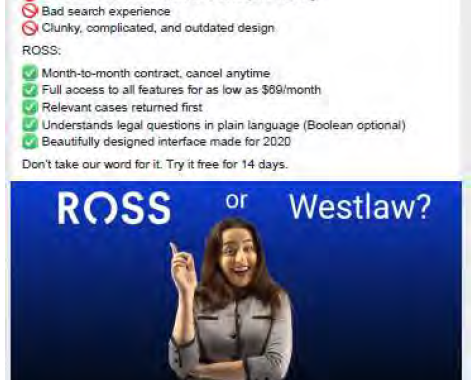
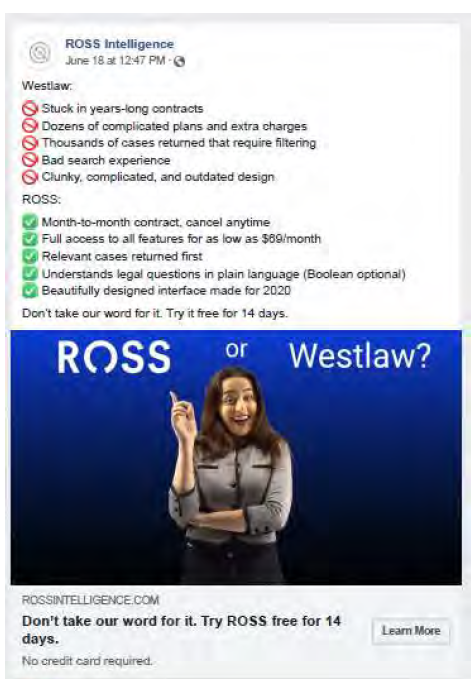
A
ROSS
ad
reproduced
in
TR’s
brief.

On
the
question
of
fair
use,
TR’s
central
argument
is
that
ROSS’s
platform
“substituted
for
and
competed
with
Westlaw
in
the
legal
research
platform
market.”

It
says
ROSS’s
marketing
materials
explicitly
positioned
its
AI
as
a
“Westlaw
replacement,”
even
using
slogans
like

“ROSS
or
Westlaw?”

alongside
a
price
comparison
ad

a
copy
of
which
is
reproduced
in
the
brief.

Under
the
Supreme
Court’s
2023
decision

Andy
Warhol
Found.
for
the
Visual
Arts
v.
Goldsmith
,
TR
says,
ROSS’s
use
was
not
“transformative”
because
it
served
“the
same
purpose
as
the
original,”
which
was
to
“help
researchers
find
and
understand
the
law.”

It
draws
a
contrast
with
other
cases,
such
as
one
involving
Google
Books,
which
merely
indexed
books
and
drove
users
back
to
the
originals.


See
all
my
coverage
of
this
litigation
here
.

Here,
it
contends,
ROSS
“copied
the
Westlaw
content
that

already

provided
a
way
for
researchers
to
find
and
understand
law
to
develop
a

competing

way
to
find
and
understand
law.”

TR
also
accuses
ROSS
of
acting
in
bad
faith,
noting
a
similar
case
in
which
the
court
found
bad
faith
when
the
defendant
“requested
a
license,
was
refused
one,
and
then
obtained
a
copy
from
a
third
party
rather
than
paying
the
requisite
fee.”

That,
it
says,
“is
precisely
what
happened
here,
where
ROSS
was
refused
a
license
and
then
illicitly
went
through
a
third
party.”

Harm
to
Westlaw’s
Markets

Much
of
TR’s
brief
focuses
on
market
harm,
which
it
argues
is
the
most
important
of
the
fair
use
factors.
It
argues
that
ROSS’s
copying
deprived
TR
of
several
valuable
markets:

  • The
    existing
    market
    for
    Westlaw
    subscriptions.
  • The
    potential
    market
    for
    licensing
    Westlaw
    content
    as
    AI
    training
    material.
  • The
    exclusive
    ability
    to
    train
    its
    own
    AI
    using
    that
    content.

“ROSS
harmed
the
original
market
for
Westlaw
by
substituting
therefor,”
TR
argues,
and
it
“diminished
the
value
of
the
Westlaw
content
by
depriving
TR
of
its
exclusive
ability
to
train
its
own
AI
on
that
content.”

A
ruling
in
ROSS’s
favor
would
have
broad
consequences,
the
brief
argues.
“If
any
competitor
could
copy
the
Westlaw
content
to
train
their
own
legal
research
platform,
why
on
earth
would
anyone
pay
TR
for
it?”

AI
Innovation
or
‘Parasitic
Copying’?

Responding
to
arguments
from
ROSS
and
others
that
enforcing
TR’s
copyright
in
this
case
would
hinder
AI
progress,
TR
suggest
that
is
alarmist,
pointing
out
that
Westlaw
itself
has
used
artificial
intelligence
“long
before
the
founders
of
ROSS
were
in
school.”
The
company
cites
milestones
from
its
own
AI
history
dating
back
to
the
1990s,
including
its
1992
launch
of
the
“first
commercially
available
search
engine
with
probabilistic
rank
retrieval”
and
the
2018
launch
of
WestSearch
Plus,
an
AI-powered
research
feature.

“AI
development
has
moved
forward
at
a
rapid
pace
since
the
decision
below
was
entered,
and
will
surely
continue
to
do
so,”
the
brief
says.

While
there
may
be
scenarios
where
training
an
AI
algorithm
using
copyrighted
material
is
fair
use,
“this
scenario

where
the
copying
was
for
purposes
of
creating
a
commercial
substitute
for
the
original

is
not
one
of
them.”

The
brief’s
concluding
paragraph
drives
home
the
theme
that
ROSS’s
behavior
is
not
about
innovation
but
misappropriation:

“This
case
may
involve
AI,
but
it
is
far
from
novel.
ROSS
indisputably
pilfered
the
creativity
of
a
competitor
to
bring
to
market
a
substitute.
ROSS’s
copying
was
not
technological
advancement.
It
was
theft.”


Washington Post Analysis Shows We Are Talking Too Much And Getting Questionable Advice From LLMs – And It May All Be Discoverable – Above the Law

The
jury
is
still
out
on
how
much
and
how
soon
GenAI
will
impact
the
legal
profession,
as
I
pointed
out
in
a
recent
article.
But
one
thing
is
certain:
GenAI
is
affecting
what
people
are
revealing,
the
questions
they’re
asking,
and
what
advice
they’re
receiving.
The
implications
for
lawyers,
or
perhaps
more
accurately,
their
clients,
are
downright
scary.
People
are
talking
too
much
and
getting
wrong
advice
that’s
memorialized
for
future
use
and
discovery

I
had

sounded
this
alarm

before.
And
now
a
recent

Washington
Post
analysis

of
some
47,000
ChatGPT
conversations
validates
many
of
these
concerns
in
alarming
ways.


The
Post
Analysis

Here’s
what
the
Post
found:

  • While
    most
    people
    are
    using
    the
    tool
    to
    get
    specific
    information,
    more
    than
    1
    in
    10
    use
    it
    for
    more
    abstract
    discussions.
  • Most
    people
    use
    the
    tool
    not
    for
    work
    but
    for
    very
    personal
    uses.
  • Emotional
    conversations
    were
    common,
    and
    people
    are
    sharing
    personal
    information
    about
    their
    lives.
  • The
    way
    ChatGPT
    is
    designed
    encourages
    intimacy,
    and
    the
    sharing
    of
    personal
    things.
    It
    has
    been
    found
    that
    techniques
    that
    make
    the
    tool
    seem
    more
    helpful
    and
    engaging
    also
    make
    the
    tool
    more
    likely
    to
    say
    what
    the
    user
    wants
    to
    hear.
  • About
    10%
    of
    the
    chats
    analyzed
    show
    people
    talking
    about
    emotions.
    OpenAI
    estimated
    that
    about
    1
    million
    people
    show
    signs
    of
    becoming
    emotionally
    reliant
    on
    it.
  • People
    are
    sharing
    personally
    identifiable
    information,
    their
    mental
    issues,
    and
    medical
    information.
  • People
    are
    asking
    the
    chat
    to
    prepare
    letters
    and
    drafts
    of
    all
    sorts
    of
    stuff.
  • ChatGPT
    begins
    its
    responses
    with
    yes
    or
    correct
    more
    than
    10
    times
    as
    often
    as
    it
    starts
    with
    no.

And
of
course,
it
still
hallucinates.
While
the
analysis
focused
on
ChatGPT
conversations,
there
can
be
little
doubt
that
other
public
and
perhaps
closed
LLMs
are
being
used
in
many
of
the
same
ways
and
doing
the
same
things.


The
Problem

That
means
there’s
a
lot
of
scary
stuff
out
there
that
could
of
course
be
open
to
discovery
in
judicial
and
regulatory
proceedings.
Indeed,
as

previously
written
,
OpenAI’s
CEO
Sam
Altman
has
recognized
that
the
company
would
have
to
comply
with
subpoenas.
And
government
agencies
like
law
enforcement
can
seek
access
to
private
conversations
with
an
LLM
as
well.

What
the
Post
analysis
tells
me
though
is
that
people
aren’t
recognizing
this
danger.
They
seem
to
think
that
they
stuff
they
put
in
and
get
out
is
private.
Indeed,
the
Post
got
the
47,000
conversations
because
people
created
sharable
links
to
their
chats
that
were
then
preserved
in
the
Internet
Archive.
OpenAI
has
now
removed
the
option
to
have
shared
conversations
discoverable
with
a
mere
Google
search
since
people
had
accidentally
made
some
chats
public.
That’s
troubling
in
and
of
itself.

Worse,
the
answers
given
by
ChatGPT
since
they
tell
the
user
what
they
want
to
hear,
are
wrong.
One
thing
I
learned
in
my
years
practicing
law,
is
that
clients
usually
start
out
convinced
they
are
right.
(Most
never
really
change
their
minds.)
Their
mindset
when
their
lawyer
tells
them
they
are
wrong
is
that
they
would
have
received
the
answer
they
wanted
if
only
they
had
a
better
lawyer.

Now
we
have
the
problem
on
steroids.
The
client
walks
in
convinced
they
are
right
and
thinks
that
their
position
has
been
confirmed
by
ChatGPT.

Perhaps
even
worse,
people
may
be
acting
on
the
advice
they
are
getting
from
the
LLMs,
getting
themselves
in
even
more
trouble.
Clients
often
held
back
acting
on
something
because
they
knew
enough
to
know
they
should
consult
a
lawyer.
But
since
that
was
expensive,
they
just
didn’t
do
it
out
of
an
exercise
of
caution.
Now
they
have
what
they
think
is
confirmation.
A
green
light.


Here’s
Where
We
Are

Putting
these
facts

people
putting
discoverable
and
potential
damaging
stuff
in
an
LLM
thinking
it’s
private
(which
LLMs
encourage),
LLMs
telling
the
user
what
they
want
to
hear
or
making
up
answer
which
the
user
believes
and
might
even
act
upon
–together
with
some
common
situations
demonstrates
why
these
factors
should
be
concerning
to
lawyers.
 

It
doesn’t
take
much
to
foresee
a
C-suite
officer,
for
example,
using
ChatGPT
to
seek
to
solve
a
thorny
personnel
problem
by
brainstorming
with
an
LLM
and
commenting
on
the
responses
in
a
back-and-forth
manner
that
creates
a
paper
trail
for
a
future
wrongful
termination
case.

Or
a
disgruntled
spouse
venting
in
a
conversation
that
becomes
public
in
a
divorce
or
custody
decision.
Or
people
seeking
advice
on
how
to
hide
documents.
Or
how
to
avoid
discovery.
Or
taking
advice
to
avoid
paying
taxes.

Or
someone
in
a
fit
of
rage
writing
something
threatening
even
though
they
were
just
venting.
And
then
getting
charged
with
terroristic
threatening.

I
could
go
on
and
on.

And
don’t
forget,
the
tools
are
going
to
get
better.


An
Added
Issue

I
am
sure
that
the
Post
got
access
to
the
47,000
conversations
in
a
legitimate
way.
But
it
also
seemed
pretty
easy
and
carried
the
risk
that
some
of
the
participants
didn’t
realize
their
conversations
were
public.

And
that
makes
me
uneasy.
As
we
have
seen
over
and
over
in
the
digital
world,
what
many
think
is
private
somehow
became
public.
I
worry
that
many
of
the
millions
of
conversations
with
LLMs
might
end
up
being
not
private
at
all,
either
through
legitimate
or
illegitimate
ways.


What’s
a
Lawyer
to
Do

Back
in
the
early
days
of
eDiscovery,
there
was
a
push
by
many
lawyers
to
try
to
educate
their
clients
about
the
perils
of
not
being
careful
with
what
they
say
in
things
like
emails,
texts,
and
other
digital
tools.
Even
with
that,
people
still
screw
up
and
say
things
they
shouldn’t,
thinking
or
assuming
that
just
because
it’s
digital
it’s
somehow
private.
Now
we
have
a
tool
that
in
essence
eggs
you
on
to
perhaps
say
or
do
something
you
shouldn’t
and
help
you
do
it.

It’s
incumbent
on
all
of
us

lawyers,
legal
professionals,
vendors,
and
even
LLM
developers

to
do
all
we
can
to
make
ordinary
people
aware
of
the
dangers.
There
can
be
little
doubt
that
savvy
lawyers
will
use
the
proclivity
of
people
to
say
too
much
to
their
favorite
bot
to
their
advantage
in
litigation
and
discovery,
as
will
government
investigative
and
regulatory
entities.

Based
on
experience,
I
know
many
aren’t
going
to
get
the
message.
But
that
doesn’t
mean
we
shouldn’t
try.
We
need
to
lead
the
way
in
training
our
clients
about
the
risks,
not
the
other
way
around,
when
the
damage
is
already
done.
We
need
to
sound
the
alarm
in
ways
they
can
understand.

The
Post
analysis
is
a
start
toward
an
educational
process.
We
owe
it
to
our
clients
to
do
more.
And
don’t
forget
we
are
ethically
and
practically
bound
to
understand
the
risks
and
benefits
of
relevant
technology.
It’s
hard
to
run
and
hide
from
the
relevance
of
GenAI
anymore.


Stephen
Embry
is
a
lawyer,
speaker,
blogger,
and
writer.
He
publishes TechLaw
Crossroads
,
a
blog
devoted
to
the
examination
of
the
tension
between
technology,
the
law,
and
the
practice
of
law
.

Marc Elias: Capitulating To Trump Isn’t Strategy — It’s Surrender – Above the Law

(Photo
by
Win
McNamee/Getty
Images)


Ed.
note
:
Welcome
to
our
daily
feature,

Quote
of
the
Day
.


The
attacks
that
Donald
Trump
has
leveled
against
me
and
others
are
related
to
his
own
pathological
need
to
attack
people
who
stand
up
to
him
and
who
fight
for
free
and
fair
elections
and
for
democracy.


I
wouldn’t
recommend
that
people
try
to
get
themselves
in
his
crosshairs,
but
I
would
certainly
say
that
anyone
who
finds
themselves
in
those
crosshairs
should
be
standing
up
and
speaking
out,
and
not
cutting
deals
or
capitulating.


Marc
Elias
,
chair
of
election
litigation
boutique
Elias
Law
Group,
in
comments
given
to
the

New
York
Law
Journal
,
concerning
attacks
made
against
him
by
Donald
Trump
for
his
work
opposing
the
administration’s
policies.
Elias
said
his
firm
has
seen
a
“massive
surge”
in
redistricting
litigation
and
voting
rights
litigation
in
general
“because
of
the
attacks
on
voting
coming
from
this
administration,
particularly
the
fact
that
the
Department
of
Justice
is
now
not
only
not
defending
voting
rights
but
is
actually
now
suing
to
try
to
make
voting
harder.”


Staci
Zaretsky
 is
the
managing
editor
of
Above
the
Law,
where
she’s
worked
since
2011.
She’d
love
to
hear
from
you,
so
please
feel
free
to

email

her
with
any
tips,
questions,
comments,
or
critiques.
You
can
follow
her
on BlueskyX/Twitter,
and Threads, or
connect
with
her
on LinkedIn.

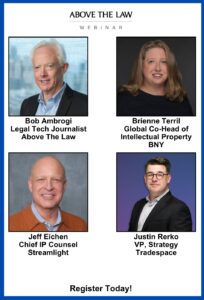
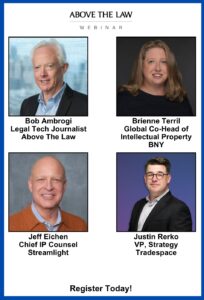
CLE Webinar – Anatomy Of A Modern IP Department: The Data Behind A Shift In Strategy – Above the Law

Something
is
changing
inside
IP
departments.
And
for
the
first
time,
we
have
the
data
to
prove
it.
Above
the
Law
and
Tradespace
partnered
on
a
first-of-its-kind
study
to
uncover
how
IP
leaders
are
redefining
the
function:
where
they’re
investing,
how
they’re
measuring
value,
and
what’s
next
for
the
modern
IP
organization.

Join
us
on December
3rd
at
1
p.m.
ET
, as
we
reveal
surprising
patterns
emerging
from
this
new
research

insights
that
challenge
long-held
assumptions
about
staffing,
technology,
and
the
business
role
of
IP. Live
attendees
can
receive
1
hour
of
CLE
credit.


You’ll
walk
away
knowing:


Why
a
growing
segment
of
organizations
are
reframing
IP
from
a
cost
center
to
a
strategic
driver

How
resource
allocation
and
staffing
ratios
are
quietly
reshaping
performance
outcomes

Where
technology
adoption
is
accelerating
fastest
(and
what’s
holding
others
back).

What
top-performing
IP
teams
are
planning
for
2026
and
beyond

Be
part
of
the
first
conversation
unpacking
these
findings

and
see
where
your
department
stands
in
this
new
era
of
IP
management.


Register
Today.

1
hour
CLE
credit
is
available.


Top 50 Biglaw Firm Rings In The Holiday By Announcing Bonuses! – Above the Law

There’s
a
lot
of
money
to
go
around
at
successful
firms
and
Weil,
Gotshal
&
Manges
is
no
exception!
According
to
the
Am
Law
100,
Weil
grossed
$2,024,581,000
last
year.
The
best
thing
to
do
with
all
that
cash
is
to
spread
it
among
the
folks
who
worked
tirelessly
to
earn
it

Weil
is
rewarding
their
associates
by
matching
the
market
bonus
and
special
bonuses!

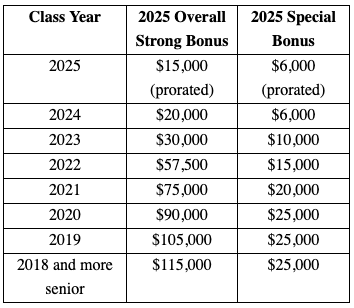
Here’s
the
scale:

Bonuses
will
be
paid
out
on
January
30th.
To
everyone
at
Weil,
enjoy
the
money!
And
if
you’re
looking
for
inspiration
on
what
to
spend
some
of
it
on,
check
out
Hollow
Knight
or
its
amazing
sequel
Hollow
Knight:
Silk
Song!
They
make
for
great
excuses
to
leave
the
table
if
your
Uncle
goes
on
a
rant
about
something
he
saw
on
Twitter.
That
said,
you
may
want
to
go
back
to
listening
to
his
tirade
once
you
meet
Zote
the
Mighty.

We
like
hearing
about
bonuses
almost
as
much
as
you
enjoy
spending
them.
As
soon
as
your
firm’s
memo
comes
out,
please email
it
to
us

(subject
line:
“[Firm
Name]
Bonus”)
or
text
us
(646-820-8477).
Please
include
the
memo
if
available.
You
can
take
a
photo
of
the
memo
and
send
it
via
text
or
email
if
you
don’t
want
to
forward
the
original
PDF
or
Word
file.

And
if
you’d
like
to
sign
up
for
ATL’s
Salary
&
Bonus
Alerts,
please
scroll
down
and
enter
your
email
address
in
the
box
below
this
post.
If
you
previously
signed
up
for
the
bonus
alerts,
you
don’t
need
to
do
anything.
You’ll
receive
an
email
notification
within
minutes
of
each
bonus
announcement
that
we
publish.


Chris
Williams
became
a
social
media
manager
and
assistant
editor
for
Above
the
Law
in
June
2021.
Prior
to
joining
the
staff,
he
moonlighted
as
a
minor
Memelord™
in
the
Facebook
group Law
School
Memes
for
Edgy
T14s
.
 He
endured
Missouri
long
enough
to
graduate
from
Washington
University
in
St.
Louis
School
of
Law.
He
is
a
former
boatbuilder
who
is
learning
to
swim, is
interested
in
critical
race
theory,
philosophy,
and
humor,
and
has
a
love
for
cycling
that
occasionally
annoys
his
peers.
You
can
reach
him
by
email
at [email protected]
and
by
tweet
at @WritesForRent.

How Bad Is It To Spit At Law Enforcement? Very Bad, It Turns Out. – Above the Law

(Image
via
Getty)

Sean
Charles
Dunn,
a
paralegal
at
the
Department
of
Justice,
got
acquitted
in
early
November
for
throwing
a
Subway
sandwich
at
a
federal
agent
during
what
he
thought
was
an
ICE
raid. 

He
was
threatened
with
a
felony
charge,
but
the
grand
jury
refused
to
indict,
so
prosecutors
pursued
his
case
as
a
misdemeanor. 
He
lost
his
job
in
the
interim
but
was
ultimately
acquitted
at
trial.
Apparently,
DC
jurors
did
not
believe
that
a
Subway
sandwich,
no
matter
how
intentionally
lobbed
at
an
agent,
constituted
assault.

Spitting,
however,
because
of
the
visceral
element
and
the
possibility
of
disease
transmission,
is
a
whole
different
animal.
Special
laws
have
been
enacted
that
penalize
spitting
as
a
felony
whether
it
reaches
the
other
person’s
skin
or
not.

I
learned
this
firsthand
when
a
close
friend
of
my
son
was
arrested
during
the
June
2025
No
Kings
rally
in
Los
Angeles.

Angus

a
24
-year-old
college
grad,
a
musician
and
set
assistant
in
L.A.,
with
no
criminal
record
and
as
far
from
an
“Antifa”
agitator
as
a
monk

went
to
the
protest
with
my
son.
It
was
festive,
full
of
marchers,
picnickers,
grandmas
and
kids,
funny
signs
and
costumes.
But
when
phalanxes
of
Los
Angeles
national
guards
in
heavy
armor
accompanied
by
other
federal
law
enforcement
and
LAPD
moved
in
to
order
the
crowd
to
disperse,
things
changed.

They
shouted
through
bullhorns
and
fired
rubbers
bullets,
some
of
which
ripped
through
protest
signs
even
though
it
was
daylight
and
the
allotted
protest
time
had
not
expired.
Some
in
the
crowd
stood
their
ground
as
law
enforcement
closed
in
with
shields,
batons,
and
other
riot
gear.

As
they
approached
Angus,
he
did
something
stupid.
He
spat
at
them

something
he’ll
regret
for
the
rest
of
his
life.
A
hunk
of
phlegm
landed
on
an
officer’s
shoe
and
face
shield.

Within
moments,
Angus
was
dog-piled
by
a
group
of
soldiers,
disappearing
beneath
the
scrum
of
heavily
armed
men.
He
didn’t
reappear
for
four
days.
He
had
been
in
federal
custody,
not
allowed
to
call
friends
or
family
who,
naturally,
were
frantic.
 He
described
this
as
the
hardest
time
of
his
ordeal,
not
knowing
what
he
was
being
charged
with
or
when
he’d
see
a
judge.

He
finally
saw
a
federal
magistrate
and
learned
that
federal
prosecutors
were
charging
him
with
felony
assault

a
crime
that
carries
the
possibility
of
eight
years.
As
U.S.
Attorney
Pam
Bondi
told
Fox
News,
“You
can
run,
but
you
can’t
hide.
We
are
coming
after
you
federally.
If
you
assault
a
police
officer,
if
you
rob
a
store,
if
you
loot,
if
you
spit
on
a
police
officer,
we
are
coming
after
you.” 

Two
days
after
being
arraigned,
prosecutors
gave
Angus
an
ultimatum:
plead
guilty
to
a
misdemeanor,
or
they’d
indict.
The
plea
bargain
compelled
Angus
to
serve
four
months
in
federal
prison.
That’s
a
lot
of
time
for
a
guy
exercising
his
First
Amendment
rights,
albeit
a
little
too
enthusiastically.

Ironically,
he
had
to
make
his
decision
around
the
time
of
July
4th,
a
day
that
celebrates
America’s
freedom
from
tyrannical
governments. 

Being
convicted
of
a
federal
crime
carries
long-term
consequences.
There
is
none
of
the
expungement
or
sealing
of
records
which
can
happen
in
state
courts.
Whatever
crime
is
pleaded
to,
the
person
carries
the
rest
of
their
lives. 

Angus
was
released
from
jail
and
mulled
over
options
with
his
attorney,
friends,
and
family.
Most
found
that
compelling
four
months
in
jail
for
spitting
during
a
protest
rally
was
outrageous. 
But
what
choice
did
he
have?
Could
he
risk
being
indicted?
 Although
a
Washington,
D.C.,
grand
jury
refused
to
indict
the
sandwich
man,
that
was
no
guarantee
they’d
do
the
same
in
L.A. 

There
was
no
doubt
that
Angus
spit,
and
federal
law
is
clear

if
done
intentionally
against
a
federal
officer,
that’s
a
crime
even
if
no
harm
ensues.

Having
a
felony
record
does
a
lot
more
damage
than
a
misdemeanor.
It
prevents
the
person
from
getting
certain
jobs,
bank
loans,
housing,
and
even
travelling
to
certain
countries.

Angus
and
his
attorney
looked
at
all
the
angles.
The
spitting
was
not
on
video.
The
officer
exaggerated
what
had
happened
and
claimed
some
landed
on
his
skin
in
spite
of
his
face
visor
and
shield.
However,
the
possibility
of
ending
up
with
a
felony
conviction
and
being
sentenced
to
more
than
four
months
was
high
a
risk
to
run.

A
lot
of
cases
turn
on
a
dime

the
political
winds
of
the
time;
the
direction
of
higher-ups
in
the
prosecution
offices;
the
political
whims
of
the
Department
of
Justice.
Ultimately,
it
comes
down
to
a
cost
benefit
analysis,
how
much
risk
a
person
is
willing
to
handle.
Maybe
the
prosecution

would
not

have
indicted.
Maybe
it
was
a
bluff.
Maybe,
even
if
they
did,
Angus
would
have
been
indicted
only
for
a
misdemeanor,
or
maybe
he
wouldn’t
have
been
found
guilty
after
trial.
But
with
the
stern
rhetoric
of
the
Justice
Department
backed
by
the
vociferousness
of
the
U.S.
president
himself,
Angus
ultimately
decided
it
was
a
risk
he
couldn’t
take.

Angus’
parents,
two
research
scientists
from
Washington
State,
got
involved.
They
called
his
 federal
public
defender
to
intercede.
She
then
spoke
to
her
supervisor,
who
then
spoke
to
the
head
of
the
prosecutor’s
office.
Character
letters
streamed
in
about
Angus’s
good
nature,
talents,
and
peacefulness.

It
helped
the
needle
budge
incrementally.
The
prosecution
still
insisted
Angus
serve
jail
time
on
a
misdemeanor
plea,
but
instead
of
four
months,
they
agreed
to
leave
it
up
to
a
judge
to
determine
what
amount
of
time
was
warranted.
But,
they
said,
it
had
to
be
at
least
two
weeks
and
could
still
be
as
much
as
four
months.

Angus
accepted
the
plea
deal.

While
this
wasn’t
a
total
victory,
it
saved
him
a
felony
conviction
and
left
the
possibility
that
his
jail
sentence
would
be
less
than
four
months.

Angus
had
to
report
to
federal
probation
during
the
pendency
of
his
case.
He
couldn’t
go
within
a
certain
distance
of
federal
buildings.
He
had
to
get
permission
to
travel
out
of
the
district.

Finally,
the
day
came
when
the
judge
pronounced
sentence.
At
least
20
well-wishers,
friends,
and
family
filled
the
courtroom.
In
the
six
months
since
the
time
of
the
crime,
the
political
climate
in
the
U.S.
had
shifted.
Trump’s
popularity
was
on
the
decline;
a
D.C.
jury
found
the
Subway
sandwich
defendant
not
guilty
of
even
a
misdemeanor.
It
appeared
reason
was
taking
hold
over
intimidation.

The
judge
commented
how
in
all
his
years
on
the
bench
he’d
never
see
the
prosecution
ask
for
jail
time
for
a
young
man
with
no
criminal
record
who
spit
during
a
protest
rally.
He
did,
however,
reiterate
that
it
was
against
the
law
and
should
not
be
done
ever
again.

Angus
thought
he
might
not
have
to
do
any
time
at
all,
but
that
was
a
misreading
of
the
plea
agreement.
No
matter
how
sympathetic
the
judge,
he
had
to
give
him
a
minimum
of
two
weeks
in
federal
prison.
And
that’s
what
Angus
got

two
weeks.

He’ll
turn
himself
in
to
start
the
sentence
in
January.
Undoubtedly,
the
conviction
will
impact
Angus’s
future.
He’ll
never
shake
himself
loose
from
it.

One
thing
is
for
certain

he’ll
never
spit
at
law
enforcement
again.
But
how
it
will
impact
his
and
his
friends’
interest
in
standing
up
for
what
they
believe
in,
taking
part
in
rallies,
and
making
their
voices
heard,
remains
to
be
seen.


Toni
Messina
has
tried
over
100
cases
and
has
been
practicing
criminal
law
and
immigration
since
1990.
You
can
follow
her
on
Twitter: 
@tonitamess.

Is The Comey Case Barred By The Statute Of Limitations? It’s Complicated! (But Also Yes.) – Above the Law

James
Comey
(Photo
by
Eric
Thayer/Getty
Images)

Yesterday,
Judge
Cameron
McGowan
Currie
tossed
the
Trump
administration’s
slapdash
effort
to
criminally
prosecute
former
FBI
Director
James
Comey,
noting
that
the
purported
U.S.
Attorney
behind
the
prosecution
had

all
the
legal
authority
of
three
raccoons
in
a
trench
coat
.
Alas,
the
role
of
“Kinda
Sorta
Interim-ish
U.S.
Attorney
for
the
Eastern
District
of
Virginia,”
is
not
so
much
“real,”
with
the
statutory
authority
provided
to
the

actual

interim
U.S.
Attorney
having
expired
months
ago.
Shuffling
lawyers
in
the
top
job,
Judge
Currie
observed,
cannot
reset
the
120-day
cap
on
staffing
a
U.S.
Attorney’s
Office
with
a
placeholder
or
the
executive
could
keep
swapping
out
cronies

ad
infinitum

to
permanently
avoid
the
constitutional
requirement
for
Senate
confirmation.

With
Halligan
proving
more
confident
than
the
law
or

her
own
competence

could
support,
Judge
Currie
found
herself
with
no
choice
but
to
ditch
both
the
case
against
Comey
and
the
equally
(pun
intended)
trumped
up
charges
against
current
NY
Attorney
General
Letitia
James.

While
the
dismissals
were
without
prejudice,
it
likely
closes
the
door
on
Comey’s
case,
since
the
whole
reason
Halligan
scrambled
to
cobble
together
an
indictment
that

the
grand
jury
never
voted
upon

was
the
ticking
clock
of
the
statute
of
limitations
that
would
turn
the
allegations
against
Comey
into
pumpkins
that
week.
And
now
that
indictment

which
was
already
doomed
because
of
the
grand
jury
screwup

is
void
from
jump
because
Halligan
lacked
any
more
authority
than
a
random
person
off
the
street,
and
the
statute
of
limitations
has
definitively
closed.

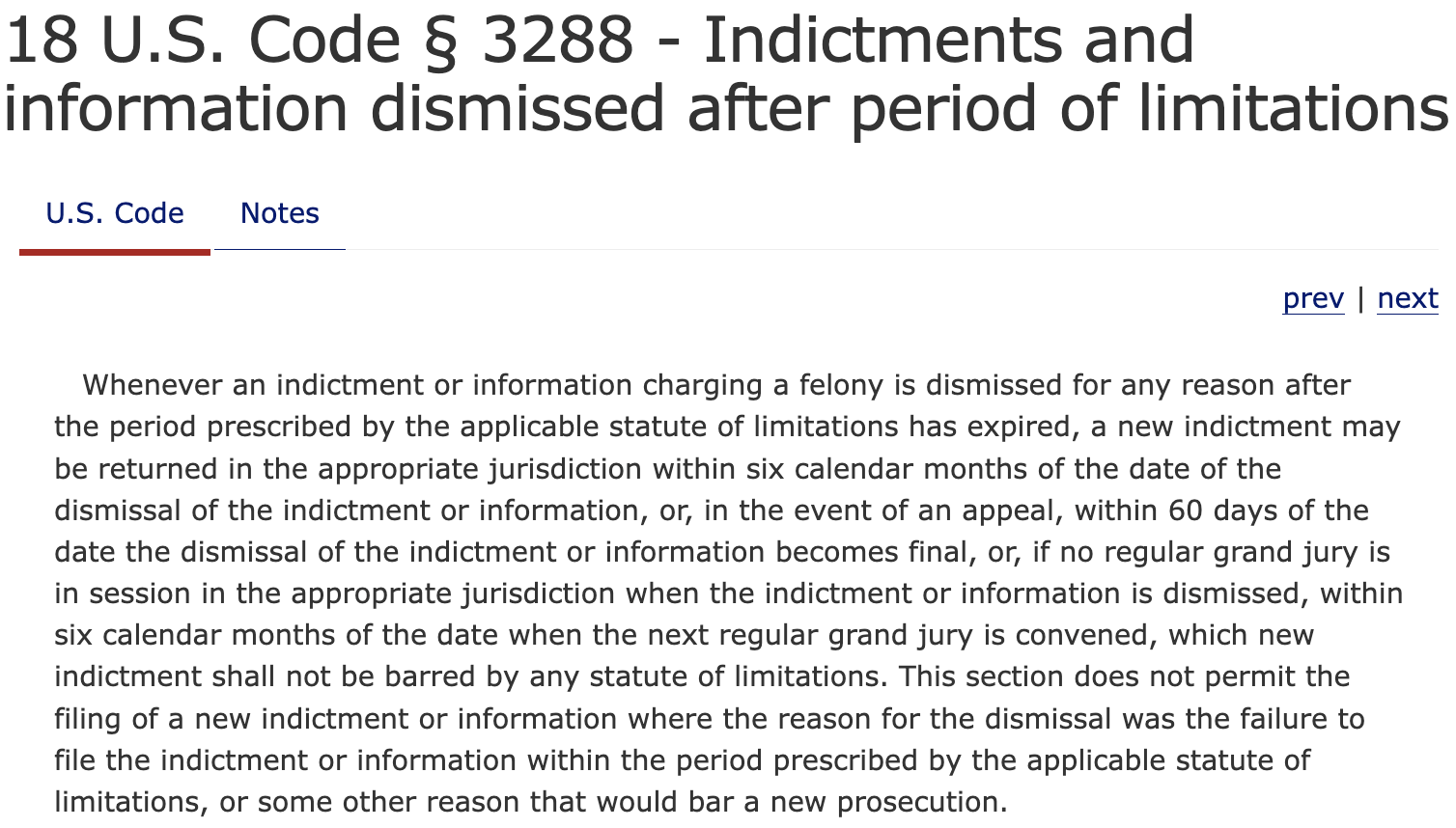
But
MAGA
social
media
still
has
hope:


There’s
a
six-month
extension!
See,
it
says
“for
any
reason”
right
there!
Now,
even
though
this
case
would’ve
been
time-barred
within
hours
of
the
flawed
indictment,
the
government
gets
another
half
a
year
to
get
its
act
together.
Assuming
they
can
convince
the
Senate
to
confirm
someone
dumb
enough
to
bring
the
case.

Except…
no.

Despite
the
hope
they’re
pouring
into
this
“for
any
reason”
language,
the
problem
facing
the
government
is
that
Judge
Currie
didn’t
“dismiss”
the
indictment
so
much
as
declare
that

there
never
was
an
indictment
in
the
first
place
.
As
she
explains
in
footnote
21,
even
though
“fake
prosecutors”
are

mercifully

not
something
the
justice
system
historically
dealt
with
very
often,
we
actually
do
have
caselaw
covering
how
to
handle
this
specific
six-month
extension
statute
in
light
of
a
void
indictment:

Generally,
“[t]he
return
of
an
indictment
tolls
the
statute
of
limitations
on
the
charges
contained
in
the
indictment.”

United
States
v.
Ojedokun
,
16
F.4th
1091,
1109
(4th
Cir.
2021).
“An

invalid

indictment,”
however,
“cannot
serve
to
block
the
door
of
limitations
as
it
swings
closed.”

United
States
v.
Crysopt
Corp.
,
781
F.
Supp.
375,
378
(D.
Md.
1991)
(emphasis
in
original);

see


also
United
States
v.
Gillespie
,
666
F.
Supp.
1137,
1141
(N.D.
Ill.
1987)
(“[A]

valid

indictment
insulates
from
statute-of-limitations
problems
any
refiling
of
the
same
charges
during
the
pendency
of
that
valid
indictment
(that
is,
the
superseding
of
a
valid
indictment).
But
if
the
earlier
indictment
is

void,

there
is
no
legitimate
peg
on
which
to
hang
such
a
judicial
limitations-tolling
result.”
(emphasis
in
original)).

Here,
the
statute
of
limitations
collapsed
before
any
government
official
with
legal
authority
even
tried
to
get
an
indictment.
The
indictment
doesn’t
even
exist.

This
is
the
reading

Comey’s
lawyers
endorse
,
and
it’s
the
only
one
that
makes
any
sense.
The
alternative
would
incentivize
the
government
to
hire
an
intern
off
Fiverr
to
turn
in
a
fake
indictment
the
day
before
the
limitations
period
runs
to
avoid
the
law.
Perhaps
fittingly,
the
alternative
reading
exhibits
the
same
core
bad
faith
as
repeatedly
stacking
“interim”
appointments
to
avoid
a
statute
capping
the
role
at
120
days.
Just
as
it
can’t
be
the
law
that
the
executive
can
forever
shuffle
lawyers
to
escape
the
Senate’s
constitutional
role,
they
can’t
constantly
file
void
documents
to
prolong
the
statute
of
limitations
just
by
slapping
the
word
“indictment”
on
them.


Earlier
:

Lindsey
Halligan
Manages
To
Lose
Two
Cases
At
Once,
Which
Is
Honestly
Impressive


HeadshotJoe
Patrice
 is
a
senior
editor
at
Above
the
Law
and
co-host
of

Thinking
Like
A
Lawyer
.
Feel
free
to email
any
tips,
questions,
or
comments.
Follow
him
on Twitter or

Bluesky

if
you’re
interested
in
law,
politics,
and
a
healthy
dose
of
college
sports
news.
Joe
also
serves
as
a

Managing
Director
at
RPN
Executive
Search
.

Lawmakers Introduce Multiple Bills Aimed at Medicare Advantage Reform – MedCity News

A
group
of
13
Democratic
House
Representatives

introduced

a
package
of
eight
bills
last
week
that
would
crack
down
on
Medicare
Advantage
and
strengthen
traditional
Medicare.

The
package
was
introduced
by
Mark
Pocan
(D-Wisconsin)
and
cosponsored
by
Andre
Carson
(D-Indiana),
Steve
Cohen
(D-Tennessee),
Rosa
DeLauro
(D-Connecticut),
Lloyd
Doggett
(D-Texas),
Pramila
Jayapal
(D-Washington),
Ro
Khanna
(D-California),
Eleanor
Holmes
Norton
(D-D.C.),
Alexandria
Ocasio-Cortez
(D-New
York),
Jan
Schakowsky
(D-Illinois),
Mark
Takano
(D-California),
Shri
Thanedar
(D-Michigan)
and
Rashida
Tlaib
(D-Michigan).

The
bills
fall
under
three
categories:

1.
Delays
and
denials
of
care

  • Denials
    Don’t
    Pay
    Act:
    Disincentivizes
    MA
    plans
    from
    delaying
    and
    denying
    care
    through
    prior
    authorization
    requirements
  • Right
    to
    Appeal
    Patient
    Insurance
    Denials
    Act:
    Helps
    patients
    receive
    needed
    care
    by
    automatically
    appealing
    denials
  • Disclose
    Your
    Denials
    Act:
    Requires
    MA
    plans
    to
    disclose
    their
    delay
    and
    denial
    rates
    when
    advertising

2.
Overcharging
taxpayers

  • Medicare
    Advantage
    Fraud
    Accountability
    Act:
    Bans
    companies
    from
    participating
    in
    MA
    if
    they’ve
    been
    convicted
    of
    defrauding
    the
    government
  • Keep
    Medicare
    Costs
    Down
    Act:
    Requires
    MA
    plans
    to
    charge
    the
    government
    per
    beneficiary
    as
    much
    as
    or
    less
    than
    traditional
    Medicare
  • Seniors’
    Choice
    and
    Clarity
    Act:
    Limits
    the
    number
    of
    plans
    that
    MA
    companies
    can
    provide
    to
    just
    three
    a
    year

3.
Strengthening
traditional
Medicare

  • Protecting
    Medicare
    Choice
    Act:
    Prevents
    Medicare
    Advantage
    from
    being
    set
    as
    the
    default
    option
    for
    seniors,
    which
    was
    proposed
    in
    Project
    2025
  • Find
    My
    Doctor
    Act:
    Requires
    CMS
    to
    create
    a
    national
    website
    that
    allows
    people
    to
    search
    for
    doctors
    by
    plan

“Only
Medicare
is
Medicare.
It
is
one
of
the
most
popular
and
important
services
our
government
provides,”
Pocan
said
in
a
statement.
“But
for
too
long,
private
healthcare
companies
taking
advantage
of
Medicare’s
brand
and
popularity
have
tricked
and
wronged
seniors.
This
package
of
commonsense,
pro-patient
reforms
will
bring
greater
accountability,
transparency,
and
affordability
to
Medicare
Advantage,
while
strengthening
traditional
Medicare
and
protecting
patient
choice.
This
package
represents
a
strong
step
forward
to
protect
seniors,
save
taxpayer
dollars,
and
restore
integrity
to
the
Medicare
program.”

The
bills
are
endorsed
by
several
organizations,
including
the
Center
for
Health
and
Democracy,
Just
Care
USA,
Labor
Campaign
for
Single
Payer,
Physicians
for
a
National
Health
Program,
Public
Citizen
and
Social
Security
Works.

According
to
JustCare,
a
crackdown
on
Medicare
Advantage
is
overdue.

“Medicare
Advantage
insurers
profit
from
withholding
medically
necessary
care,
and
can
withhold
care
with
near
impunity.
So,
people
enrolling
in
corporate
MA
plans
are
forced
to
gamble
with
their
health
and
with
their
lives.
They
can’t
avoid
the
bad
actors.
It’s
time
Congress
protected
older
Americans
and
people
with
disabilities
from
bad
actor
Medicare
Advantage
insurers,
as
Congressman
Pocan’s
MA
Bill
package
would
do,”
said
Diane
Archer,
president
and
founder
of
JustCare.


Photo:
designer491,
Getty
Images

Morning Docket: 11.25.25 – Above the Law

*
Department
of
Justice
make
another
attempt
to
unseal
Epstein
grand
jury
records,
knowing
that
the
courts
will
say
no,
allowing
the
White
House
to
pretend
they
tried
to
follow
new
law,
even
though
there’s
nothing
preventing
them
from
releasing
everything
in
their
custody.
[New
York
Law
Journal
]

*
Gordon
Rees
avoids
sanctions
for

AI
hallucinations
.
[ABA
Journal
]

*
DOJ
works
to
settle
more
antitrust
suits
brought
by
Biden
administration.
It’s
a
good
time
to
wear
a
top
hat
and
monocle!
[Law360]

*
Linklaters
builds
AI-lawyer
team
to
build
out
AI
leverage
across
departments.
[Legal
Cheek
]

*
Fired
DOJ
official
sues
after
being
fired
saying
out
loud
what
everyone
already
knew.
[Politico]

*
TSwift
fans
coming
at
Live
Nation
like
a
missile.
[Reuters]

*
Supreme
Court
battle
brewing
over

Feres

doctrine.
[National
Law
Journal
]

Milbank Finally Answers! – See Also – Above the Law

The
Answer
To
If
Milbank
Will
Top
the
Scale
Is!:
Nah.
They’re
paying
out
market
bonuses.
It
Pays
To
Work
In
Texas!:
Vinson
&
Elkins
announced
bonuses!
…And
Other
Places,
Too!:
Simpson
Thacher,
Covington
&
Burling,
and
A&O
Shearman.
The
Biggest
Loser:
Lindsey
Halligan
manages
to
lose
two
cases
at
once!
ICE
Is
Using
ChatGPT
To
Do
Their
Paperwork:
If
ethics
won’t
stop
them
from
arresting
children,
why
wouldn’t
it
stop
them
from
half-assing
their
paperwork?