Vinson & Elkins Announces Texas-Sized Bonuses For Associates – Above the Law

They
say
that
everything’s
bigger
in
Texas,
but
when
it
comes
time
for
Biglaw
bonus
season,
it’s
the
match
that
matters
most.

We’ve
recently
received
word
that
Texas-based
Vinson
&
Elkins

which
grossed
$1,049,945,000
in
2024

has
announced
its
bonus
scale,
and
of
course
it’s
a

Cravath
match
,
complete
with

Milbank’s
summer
bonuses
.
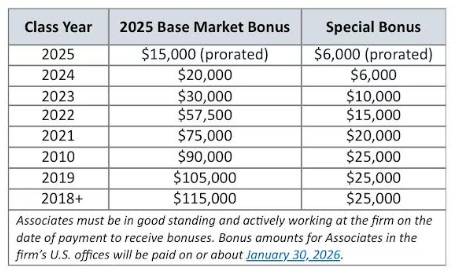
Here’s
what
that
looks
like
at
the
firm:

Congratulations
to
everyone
at
Vinson
&
Elkins!

Remember
everyone,
we
depend
on
your
tips
to
stay
on
top
of
compensation
updates,
so
when
your
firm
announces
or
matches,
please
text
us
(646-820-8477)
or email
us
 (subject
line:
“[Firm
Name]
Bonus/Matches”).
Please
include
the
memo
if
available.
You
can
take
a
photo
of
the
memo
and
send
it
via
text
or
email
if
you
don’t
want
to
forward
the
original
PDF
or
Word
file.

And
if
you’d
like
to
sign
up
for
ATL’s
Bonus
Alerts
(which
is
the
alert
list
we
also
use
for
salary
announcements),
please
scroll
down
and
enter
your
email
address
in
the
box
below
this
post.
If
you
previously
signed
up
for
the
bonus
alerts,
you
don’t
need
to
do
anything.
You’ll
receive
an
email
notification
within
minutes
of
each
bonus
announcement
that
we
publish.
Thanks
for
your
help!


Staci
Zaretsky
 is
the
managing
editor
of
Above
the
Law,
where
she’s
worked
since
2011.
She’d
love
to
hear
from
you,
so
please
feel
free
to

email

her
with
any
tips,
questions,
comments,
or
critiques.
You
can
follow
her
on BlueskyX/Twitter,
and Threads, or
connect
with
her
on LinkedIn
.

Covington Shows Up to Bonus Season — And Yes, They Brought Their Checkbook – Above the Law

Hold
on
to
your
timekeepers:
Covington
&
Burling
just
officially
joined
the
“yes,
we’ll
match
bonuses”
club.
It’s
been
under
a
week
since

Cravath
announced

their
year-end
bonus
scale
(same
one
as
last
year,
and
the
year
before
that,
and…),
and
perhaps
because
the
scale
is
so
familiar,
firms
have
been
matching
the
standard
fast
and
furiously.

On
Friday,
Covington
shared
the
good
bonus
news
with
associates,
and
yes,
they
are
also
matching
the
special
bonuses
that
Milbank
started

over
the
summer
.
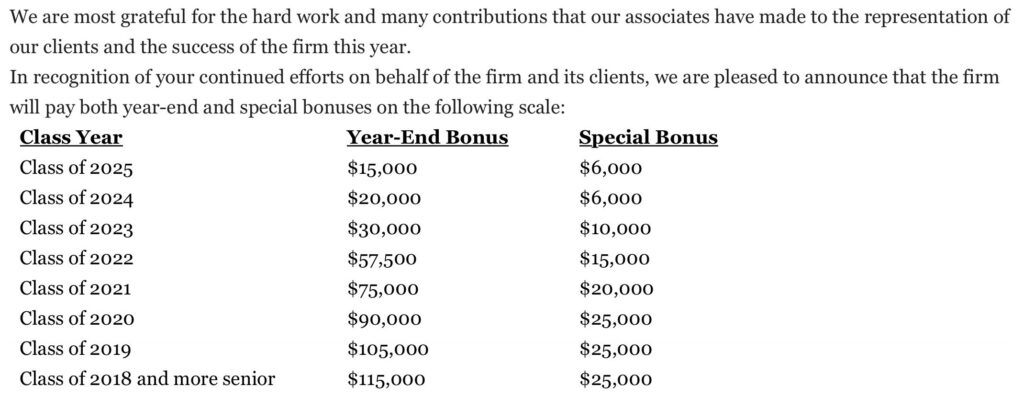
Below
is
the
full
bonus
scale
at
the
firm.

So,
is
your
firm
matching
*both*
the
year-end
and
special
bonuses?
Let
Above
the
Law
know!
We
depend
on
your
tips
to
stay
on
top
of
important
bonus
updates,
so
when
your
firm
matches
(or
if
they
fail
to
do
so),
please
text
us
(646-820-8477)
or email
us
 (subject
line:
“[Firm
Name]
Matches”).
Please
include
the
memo,
if
available.
You
can
take
a
photo
of
the
memo
and
send
it
via
text
or
email
if
you
don’t
want
to
forward
the
original
PDF
or
Word
file.

And
if
you’d
like
to
sign
up
for
ATL’s
Bonus
Alerts
(which
is
the
alert
list
we
also
use
for
salary
announcements),
please
scroll
down
and
enter
your
email
address
in
the
box
below
this
post.
If
you
previously
signed
up
for
the
bonus
alerts,
you
don’t
need
to
do
anything.
You’ll
receive
an
email
notification
within
minutes
of
each
bonus
announcement
that
we
publish.
Thanks
for
all
of
your
help!


Kathryn
Rubino
is
a
Senior
Editor
at
Above
the
Law,
host
of

The
Jabot
podcast
,
and
co-host
of

Thinking
Like
A
Lawyer
.
AtL
tipsters
are
the
best,
so
please
connect
with
her.
Feel
free
to
email

her

with
any
tips,
questions,
or
comments
and
follow
her
on
Twitter

@Kathryn1
 or
Mastodon

@[email protected].

Transatlantic Biglaw Behemoth Announces Bonuses For Associates And Counsel – Above the Law

Bonus
season
is
here,
and
slowly
but
surely,
Biglaw
firms
are
lining
up
to
announce
their
own
variants
of
the

Cravath
scale
,
complete
with

Milbank’s
summer
bonuses
.
Which
firm
is
the
latest
to
step
up
to
the
plate
to
offer
associates
six
figures
of
bonus
earnings?

That
would
be
A&O
Shearman,
the
Biglaw
behemoth
formed
from
the
union
of
Allen
&
Overy
and
Shearman
&
Sterling.
The
firm
grossed
$3.7
billion
in
2024,
putting
it
at
No.
4
on
the
Global
100,
so
of
course
it’s
matching
the
market
bonus
scale
for
associates
and
counsel
in
the
Americas.
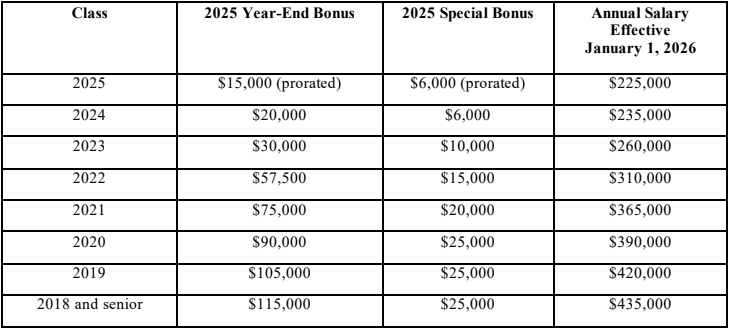
Here’s
what
the
scale
looks
like
at
the
firm:

Attorneys
at
the
firm
may
also
be
eligible
for
an
“enhanced
year-end
bonus”
if
they
“significantly
exceed”
the
firm’s
hourly
requirements.

Congratulations
to
everyone
at
A&O
Shearman!

Remember
everyone,
we
depend
on
your
tips
to
stay
on
top
of
compensation
updates,
so
when
your
firm
announces
or
matches,
please
text
us
(646-820-8477)
or email
us
 (subject
line:
“[Firm
Name]
Bonus/Matches”).
Please
include
the
memo
if
available.
You
can
take
a
photo
of
the
memo
and
send
it
via
text
or
email
if
you
don’t
want
to
forward
the
original
PDF
or
Word
file.

And
if
you’d
like
to
sign
up
for
ATL’s
Bonus
Alerts
(which
is
the
alert
list
we
also
use
for
salary
announcements),
please
scroll
down
and
enter
your
email
address
in
the
box
below
this
post.
If
you
previously
signed
up
for
the
bonus
alerts,
you
don’t
need
to
do
anything.
You’ll
receive
an
email
notification
within
minutes
of
each
bonus
announcement
that
we
publish.
Thanks
for
your
help!


Staci
Zaretsky
 is
the
managing
editor
of
Above
the
Law,
where
she’s
worked
since
2011.
She’d
love
to
hear
from
you,
so
please
feel
free
to

email

her
with
any
tips,
questions,
comments,
or
critiques.
You
can
follow
her
on BlueskyX/Twitter,
and Threads, or
connect
with
her
on LinkedIn
.

Morning Docket: 11.24.25 – Above the Law

*
Effort
to
go
after
those
who
investigated
Trump
crimes
getting
funneled
into
Aileen
Cannon’s
courtroom.
[NY
Times
]

*
Agriculture
workers
sue
administration
over
new
slashed
minimum
wage
for
migrant
workers…
because
the
administration
doesn’t
realize
cheaper
migrant
labor
lowers
all
wages.
[Courthouse
News
Service
]

*
Arguments
all
set
for
appeals
hearing
on
Trump’s
power
to
ban
a
specific
outlet
from
the
White
House
because
he
doesn’t
like
their
coverage.
[Reuters]

*
Former
Google
CEO
accused
of
sexual
assault.
[Law360]

*
Federalist
Society
undergoing
existential
crisis
as
Trump’s
explicit
demands
run
afoul
of
fig
leaf
philosophy
they’ve
spent
decades
crafting.
[NY
Times
]

*
DLA
Piper
sued
for
racial
discrimination.
[American
Lawyer
]

*
Yale
Law
Library
staff
morale
is
in
the
tank.
[Yale
Daily
News
]

Biglaw Bonus Season Arrives! – See Generally – Above the Law

Cravath
Starts
Bonus
Season,
Everyone
Begin
The
Freakout:
The
firm
kicked
off
the
year-end
festivities
and
peers
began
the
scramble
to
match.
Lindsey
Halligan
Sets
New
Low
Score:
Trump’s
most
loyal
lawyer
somehow
managed
to
botch
our
already
subterranean
expectations.
Biglaw
Firm
Celebrating
The
Holidays
With
Some
Mandatory
Togetherness:
Associates
expecting
a
bonus
announcement
found
out
they’d
be
spending
more
time
enjoying
the
privilege
of
fluorescent
lighting.
Judge
Jerry
Smith’s
Goes
Full
Wingnut
In
Texas
Redistricting
Case:
And,
to
be
clear,
the
Supreme
Court
will
find
a
way
to
sanewash
it.
Disbarment
Shoe
Drops:
Josh
Kindred’s
long-running
ethics
circus
ends
exactly
where
everyone
knew
it
would.
DoorDash
Driver
Learns
Viral
Content
Can
Be
A
Felony:
Refusing
to
put
on
pants
is
already
the
most
popular
reason
to
call
DoorDash.
Biglaw’s
Latest
Transatlantic
Marriage
Proposal:
Ashurst
and
Perkins
Coie
look
to
join
forces.

The Collateral Damage of Climate Migration

On
the
steep
slopes
of
Zimbabwe’s
lush
Eastern
Highlands,
newly
built
homes—mostly
grass-thatch,
pole,
and
mud
dwellings—scatter
the
rugged
terrain.
These
houses
were
built
by
tens
of
thousands
of
small-scale
farmers
who,
driven
by
crippling
droughts
in
Zimbabwe’s
lower
elevations,
have
migrated
to
the
Eastern
Highlands
in
search
of
fertile
soil,
fresh
water,
and
pasture
for
their
livestock.

Since
the
1960s,
the
average
temperature
in
Zimbabwe
has
risen
by
about
1
degree
Celsius
(2
degrees
Fahrenheit),
while
the
average
rainfall
has
decreased
by
about
20
percent.
Droughts
are
becoming
evermore
frequent,
too.
Crop-decimating
droughts
used
to
hit
roughly
once
per
decade;
they
now
strike once
every
three
years
.
These
droughts
ravage
the
livelihoods
of
Zimbabweans, up
to
70
percent
 of
whom
work
in
agriculture.
Yet
the
Eastern
Highlands,
which
stretches
nearly
300
kilometers
along
the
border
with
Mozambique,
still
boasts
a
glut
of
perennial
rivers,
heavy
rainfall,
dense
vegetation,
foggy
mountain
peaks,
and
a
plethora
of
species.

While
the
politics
and
policies
of
international
migration
tend
to
make
headlines,
existing
scientific
evidence
suggests
that
when
it’s
the
climate
forcing
people
to
move,
they
tend
to
stick
within
their
national
borders.
In
2018,
the World
Bank
warned
 that
without
urgent
global
and
national
climate
action,
including
cutting
greenhouse
gas
emissions,
more
than
140
million
people
in
sub-Saharan
Africa,
South
Asia,
and
Central
America
will
likely
migrate
within
their
own
countries
by
the
year
2050.

In recent
research
,
Roman
Hoffmann,
who
heads
the
migration
and
sustainable
development
research
group
at
the
International
Institute
for
Applied
Systems
Analysis
in
Austria,
used
census
records
to
show
that
drought
and
aridification
has
already
led
to
increased
internal
migration,
especially
in
particularly
dry
places—like
parts
of
Zimbabwe.

“This
area
is
our
only
hope,”
says
Lloyd
Gweshengwe,
a
farmer
who
migrated
to
the
Eastern
Highlands
a
few
years
ago
and
whose
home
now
sits
on
a
treacherous
mountainside
overlooking
a
small
river.
“It’s
still
good
for
farming.
Water
is
plenty,
and
the
soils
are
good,”
he
adds.

“This
year,
I
had
a
very
good
harvest
of
maize.
It’s
enough
to
feed
my
family
until
the
next
harvest.
I
might
even
sell
the
surplus,”
he
says.

Gweshengwe’s
story
is
one
of
many.
In
their
2022 study
of
climate
migrants
to
Zimbabwe’s
Eastern
Highlands
,
Trymore
Maganga
and
Cathy
Conrad
Suso
from
Saint
Mary’s
University
in
Halifax,
Nova
Scotia,
write
that
“most
households
in
the
small-scale
farming
regions
are
resorting
to
either
short-
or
long-term
migration
to
areas
that
offer
them
food
security.”

But
the
influx
of
climate
migrants
to
Zimbabwe’s
Eastern
Highlands
is
prompting
concern
from
the
Zimbabwean
government,
environmental
groupsand
timber
companies.
These
climate
migrants,
tarred
as
squatters
or
illegal
settlers
by
local
environmentalists,
are
clearing
large
swaths
of
forests
for
croplands.
They’re
clogging
rivers
and
wetlands
with
cut
trees,
and
transforming
once-lush
forests
into
broken
mosaics
of
maize
and
other
crops.

Source:


The
Collateral
Damage
of
Climate
Migration


bioGraphic

This Is Not The Announcement You Were Looking For – See Also – Above the Law

Biglaw
Firm
Announces
In-Person
Requirements
Instead
Of
Bonuses:
Learn
how
to
read
the
room,
Reed
Smith.
Paul,
Weiss
Rewards
Employees
With
Market
Value
Bonuses:
Gotta
reward
the
associates
that
stuck
by
them
somehow!
The
Trend
Setter
Announces
Bonuses!:
Vartabedian
Hester
&
Haynes
bonuses
are
on
the
market
scale!
Bonus
Medley!:
Skadden,
Cleary
Gottlieb,
Debevoise
&
Plimpton,
White
&
Case,
Davis
Polk,
Baker
Botts,
and
Proskauer.
DOJ
Issues
Charges
After
‘Trump
Whore’
Hoax:
There
are
better
ways
to
use
your
time
in
law
school.

All That Biglaw Bonus Money With Nowhere To Spend It – Above the Law

Associates
associate
time
of
year
with
two
things:
getting
paid
a
lot
of
money
and
finally
having
the
time
to
see
your
family.
And
for
the
associates
at
Cleary
Gottlieb,
they
won’t
have
to
worry
about
getting
their
money!
The
firm
boasted
an
impressive
$1,700,000,000
gross
revenue
in
2024
according
to
Am
Law
100
and
has
no
problem
with
sharing
the
wealth
via
bonuses
and
special
bonuses.
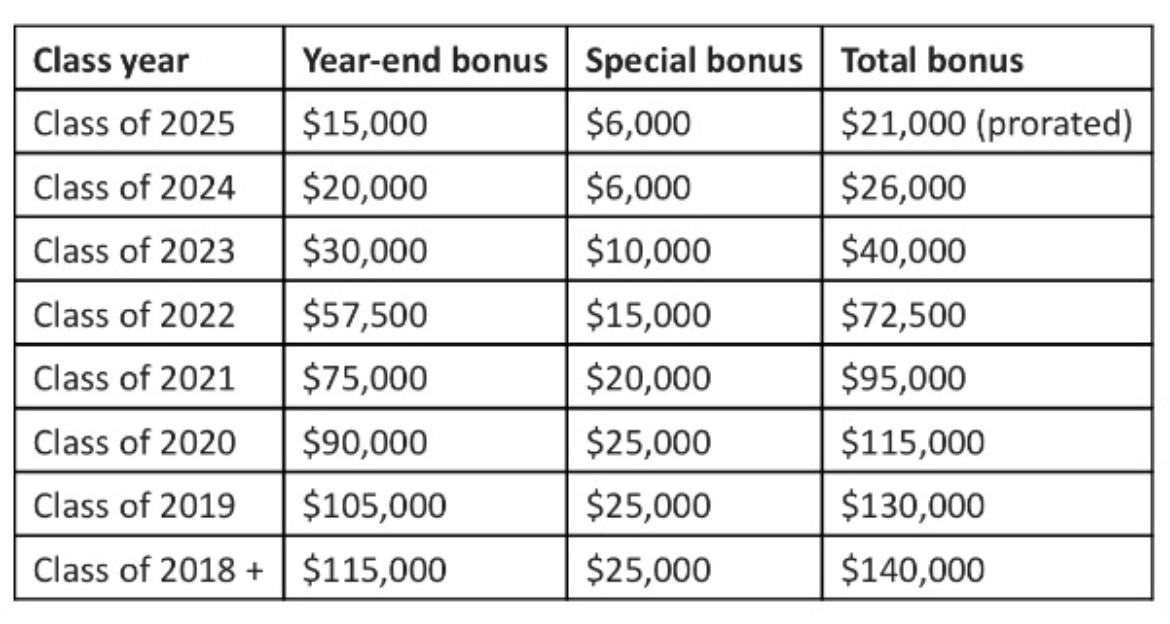
Here’s
the
scale:

Bonuses
will
be
paid
on
the
19th
of
December!
Yay
money!

Now
that
that’s
out
of
the
way,
let’s
loop
back
to
the
seeing
your
family
bit
of
the
holidays.
According
to
Above
the
Law
tipsters,
Cleary
told
associates
to
cancel
any
holiday
plans
they
had

those
hours
aren’t
going
to
bill
themselves
after
all.
The
silver
lining
behind
the
golden
handcuffs
is
that
the
firm
also
offered
to
reimburse
the
travel
costs
lost
by
the
last
minute
cancellation.
Associates
without
vacation
plans
were
invited
to
make
sure
that
they
had
a
proper
vacation
scheduled
for
2026.
Hard
way
to
find
out
that
you’ll
have
to
push
off
seeing
your
loved
ones
until
Christmas,
but
at
least
Cleary
put
in
the
effort
to
soften
the
blow.
If
the
kind
words
aren’t
enough,
at
least
you’ll
have
a
nice
set
of
$100s
to
dry
those
tears
with.

We
like
hearing
about
bonuses
almost
as
much
as
you
enjoy
spending
them.
As
soon
as
your
firm’s
memo
comes
out,
please email
it
to
us
 (subject
line:
“[Firm
Name]
Bonus”)
or
text
us
(646-820-8477).
Please
include
the
memo
if
available.
You
can
take
a
photo
of
the
memo
and
send
it
via
text
or
email
if
you
don’t
want
to
forward
the
original
PDF
or
Word
file.


Chris
Williams
became
a
social
media
manager
and
assistant
editor
for
Above
the
Law
in
June
2021.
Prior
to
joining
the
staff,
he
moonlighted
as
a
minor
Memelord™
in
the
Facebook
group Law
School
Memes
for
Edgy
T14s
.
 He
endured
Missouri
long
enough
to
graduate
from
Washington
University
in
St.
Louis
School
of
Law.
He
is
a
former
boatbuilder
who
is
learning
to
swim, is
interested
in
critical
race
theory,
philosophy,
and
humor,
and
has
a
love
for
cycling
that
occasionally
annoys
his
peers.
You
can
reach
him
by
email
at [email protected]
and
by
tweet
at @WritesForRent.

Who Will Pay If ACA Tax Credits Lapse? – MedCity News

It’s
been
a
week
since
the
nation’s
longest-ever
government
shutdown
ended,
but
millions
of
Americans
still
don’t
know
whether
they’ll
be
able
to
afford
their
healthcare
coverage
next
year.

The
shutdown
finally
ended
November
12
when
a
funding
bill
was

signed
into
law
.
Notably
absent
from
the
law
was
any
extension
of
the
enhanced

Affordable
Care
Act
(ACA)
subsidies

that

24
million

Americans
rely
on
to
keep
their
premiums
somewhat
affordable.

Enhanced
ACA
tax
credits
were
introduced
during
the
pandemic
to
expand
healthcare
affordability,
and
they
are
set
to
expire
at
the
end
of
this
year
if
Congress
doesn’t
act. 

This
year,

93%

of
ACA
marketplace
enrollees
received
the
tax
credits.
For
many,
these
expanded
subsidies
have
meant
the
difference
between
affording
routine
care
for
themselves
and
their
loved
ones
and
skipping
these
visits
entirely.

Experts
say
that
the
expiration
of
these
subsidies
wouldn’t
just
push
coverage
out
of
reach
for
millions
of
Americans

it
could
also
create
significant
challenges
for
hospitals
already
battling
financial
pressures,
as
well
as
potentially
hurt
the
economy
at
large. 

Overall,
healthcare
leaders
have
a
number
of
concerns
about
what
could
happen
if
Congress
doesn’t
renew
the
expanded
tax
credits

premiums
could
increase,
a
larger
share
of
Americans
could
become
uninsured,
hospitals
could
be
forced
into
more
bad
debt
and
uncompensated
care,
and
most
worrisome,
American
public
health
would
further
deteriorate.


Soaring
premiums
could
be
on
the
horizon

When
the
ACA
health
insurance
marketplaces
launched
in
2014,
tax
credits
went
into
effect
to
make
coverage
more
affordable
for
individuals
and
families.
These
tax
credits

which
are
based
on
ACA
shoppers’
income
and
household
size

were
later
expanded
temporarily
under
the
American
Rescue
Plan
Act
in
2021,
and
then
extended
again
through
the
Inflation
Reduction
Act
in
2022.
As
a
result,
people
received

l
arger
subsidies
and
eligibility
criteria​
was
broadened.

When
the
marketplaces
were
first
established,
the
government

provided
subsidies

to
people
earning
100-400%
of
the
federal
poverty
level,
and
individual
premium
contributions
ranged
from
2.07-9.83%
of
their
income.

The
American
Rescue
Plan
Act
and
its
extension
under
the
Inflation
Reduction
Act

boosted

these
subsidies
by
lowering
premium
contributions
to
0-8.5%
of
income
and
approved
$0
premiums
for
people
earning
100–150%
of
the
federal
poverty
level.
The
changes
introduced
during
the
pandemic
also
allowed
Americans
earning
above
400%
of
the
federal
poverty
level
to
qualify
for
subsidies
if
premiums
exceeded
8.5%
of
their
income.

These
credits
have
played
a
key
role
in
reducing
the
country’s
uninsured
rate

last
year,
the
national
uninsured
rate
reached
an
all-time
low
of

7.9%
.

The
expiration
of
enhanced
tax
credits
would
turn
a
$460/month
premium
to
a
$700/month
premium
for
a
family
of
four,
said
ACA
marketplace
enrollee
Shana
Verstegen,
during
a
media
call
hosted
by
nonprofit
advocacy
group

Keep
Americans
Covered

She
is
a
small
business
employee
at
a
gym
in
Madison,
Wisconsin,
along
with
her
husband.
They
rely
on
ACA
marketplace
coverage
for
themselves
and
their
two
children.

“Seven
hundred
dollars
per
month
in
2026
may
seem
like
a
small
number,
but
that’s
over
$2,500
a
year.
Right
now,
our
family
would
really
struggle
with
that

losing
that
tax
credit
would
create
a
real
crisis
for
us,”
Verstegen
remarked.

She
said
she
and
her
husband
have
discussed
the
possibility
of
him
leaving
the
job
he
has
loved
for
decades
to
secure
employer-based
coverage.
Not
only
is
this
a
difficult
and
emotionally
painful
decision,
it’s
also
one
that
needs
to
be
made
under
a
severe
time
crunch,
Verstegen
noted. 

Open
enrollment
for
2026
ACA
coverage
is
already
underway,
with
deadlines
approaching.
Enrollment
must
be
completed
by
mid-December
for
coverage
starting
January
1,
leaving
little
time
for
families
like
the
Verstegens
to
adjust.

She
described
this
time
as
a
“really
tough
and,
quite
frankly,
scary”
moment
for
her
family.

“This
isn’t
about
politics
and
polling,
or
winners
and
losers
in
Congress,
or
red
or
blue
or
purple
states.
It’s
about
real
families
and
real
kids

real
people
who
need
healthcare.
Marketplace
coverage
and
the
premium
tax
credits
are
essential
for
entrepreneurs
and
small
business
employees
like
myself
to
afford
healthcare,”
Verstegen
declared.


Can
hospitals
handle
another
financial
hurdle?

About
22
of
the
24
million
people
who
have
ACA
insurance
will
see
their
premiums
double
if
the
tax
credits
expire,
and
5
million
are
expected
to
lose
coverage
completely,
said
Charlene
MacDonald,
executive
vice
president
of
public
affairs
at
the

Federation
of
American
Hospitals
.

When
coverage
erodes,
hospitals’
levels
of
uncompensated
care
go
up. 

MacDonald
said
hospitals
are
bracing
for
a
significant
uptick
in
uncompensated
care

especially
in
states
that
haven’t
expanded
Medicaid
coverage,
as
private
marketplace
plans
are
an
especially
critical
source
of
coverage
in
those
areas.

“Hospitals
treat
all
patients
who
come
through
their
doors
regardless
of
their
insurance
or
their
ability
to
pay

but
those
costs
don’t
disappear.
They
shift
back
onto
hospitals,
employers
and
taxpayers,”
she
explained.

This
strain
will
affect
all
healthcare
providers,
but
rural
and
safety
net
hospitals
will
be
hurt
the
most.
These
providers
tend
to
have
lower
patient
volumes
and
a
greater
share
of
patients
on
Medicaid
and
Medicare,
both
of
which
reimburse
hospitals
at
a
lower
rates
and
often
fail
to
cover
the
full
costs
of
providing
care,
MacDonald
added.

For
many
of
these
vulnerable
hospitals,
the
loss
of
the
ACA
tax
credits
isn’t
just
another
financial
hurdle
— 
it’s
a
threat
to
service
lines
and,
in
some
cases,
their
long-term
viability,
she
stated.

“When
coverage
declines,
the
impact
shows
in
reduced
access
for
patients
and
diminished
capacity
in
the
healthcare
system.
Hospitals
facing
higher
levels
of
uncompensated
care
are
forced
to
make
difficult
choices
to
sustain
a
community’s
access
to
24/7
care,
whether
that’s
scaling
back
services
or
delaying
investments
that
improve
quality
and
access
for
patients,”
MacDonald
remarked.

She
also
noted
that
higher
rates
or
uncompensated
care
can
reduce
hospitals’
ability
to
offer
competitive
wages,
which
exacerbates
healthcare’s
workforce
crisis.


The
broader
economy
could
take
a
hit,
too

The
expiration
of
ACA
enhanced
subsidies
could
also
have
a
negative
effect
on
the
broader
economy.

Julio
Fuentes,
CEO
of
the

Florida
Hispanic
Chamber
of
Commerce
,
warned
that
the
additional
healthcare
costs
from
the
credit’s
expiration
could
force
small
business
owners
to
make
“decisions
that
really
no
one
wants
to
make”

such
as
delaying
hiring,
raising
customer
prices
and
cutting
employee
hours.

Even
though
these
small
business
owners
don’t
sponsor
their
employees’
insurance,
they
often
cannot
afford
to
absorb
sudden
spikes
in
personal
healthcare
costs
without
cutting
hours
or
staff.

“This
is
a
main
street
crisis.
It’s
certainly
not
a
Wall
Street
problem,
by
no
means.
The
first
people
who
feel
this
pain
are
the
ones
who
keep
our
communities
running

you’re
talking
about
the
landscapers
with
five
employees,
the
woman
who
runs
a
small
cleaning
business,
the
contractor
who
depends
on
a
handful
of
subcontractors,”
he
explained.

Economists

estimate

that
allowing
ACA
tax
credits
to
expire
would
lead
to
about
286,000
job
losses,
as
well
as
reduce
the
country’s
GDP
by
$34
billion.

Those
estimates
come
from

the
Commonwealth
Fund

and
the

George
Washington
University
Milken
Institute
School
of
Public
Health
.
Their
teams
first
calculated
how
much
federal
spending
on
enhanced
ACA
tax
credits
would
disappear
if
the
subsidies
expired

roughly
$26
billion
next
year
alone. 

That
reduction
in
spending
affects
not
only
households

but
also
providers
and
payers,
who
would
see
lower
revenues
as
a
result
of
fewer
people
being
able
to
afford
coverage.
About

10%
of
Americans

are
employed
in
the
healthcare
sector

so
putting
financial
pressure
on
industry
will
inevitably
lead
to
a
wave
of
job
losses,
the
researchers
explained.

The
researchers
used
an
input-output
model
to
estimate
the
broader
effects
on
the
economy

accounting
for
direct
impacts,
like
providers
losing
income
and
laying
people
off,
and
indirect
effects,
such
as
decreased
lifestyle
spending
by
families.  


Time
is
running
out

Some
lawmakers,
including
Senator
Bill
Cassidy
(R-Louisiana),
have

floated

the
idea
of
replacing
the
ACA
premium
tax
credits
with
other
mechanisms,
like
pre-funding

Health
Savings
Accounts
(HSAs)
.
They
are
curious
as
to
whether
directing
funds
straight
to
individuals
could
increase
efficiency
and
reduce
overhead.

“Is
there
anybody
who
would
not
want
to
take
a
large
portion
of
that,
which
we’re
using
to
help
Americans
purchase
healthcare,
and
give
it
directly
to
the
individual,
so
that
100%
of
its
used
to
purchase
healthcare,
as
opposed
to,
as
opposed
to
giving
that
money
to
the
insurance
company,
of
which
20%
goes
for
profit
and
overhead?”
Cassidy,
who
is
chair
of
the
Senate
Committee
on
Health,
Education,
Labor
and
Pensions,
as
during
a
Monday
hearing.

This
approach
would
be
impractical,
according
to
Lauren
Aronson,
executive
director
of
Keep
Americans
Covered. 

She
pointed
out
that
this
could
cost
the
federal
government
more
than
simply
extending
the
tax
credits,
and
there
isn’t
enough
time
to
implement
a
whole
new
system.

“If
you
were
to
theoretically
pre-fund
an
HSA
that
would
very
likely
cost
more
federal
dollars
than
the
cost
of
extending
the
tax
credits
themselves.
You’d
have
to
pre-fund
between
$1,500
and
$6,000
per
year.
Then
thinking
about
it
operationally,
plans
would
have
to
then
refile
rates
and
put
new
high
deductible
health
plan
offerings
into
the
market
for
2026

there’s
no
time
to
do
that
between
now
and
January
1,”
Aronson
explained.

She
said
that
the
ACA’s
current
design

applying
credits
directly
to
monthly
premiums

is
essential
for
keeping
coverage
affordable
in
real
time
for
middle-class
families.

Senators
from
both
parties
are
forming
working
groups
to
address
the
issue,
but
there
hasn’t
yet
been
a
public
hearing
or
vote
on
extending
the
ACA
premium
tax
credits,
despite
the
looming
healthcare
affordability
crisis.

Aronson
emphasized
that
immediate
action
is
needed
to
prevent
the
crisis
from
occurring. 


Photo:
krisanapong
detraphiphat,
Getty
Images