Ed.
note:
Please
welcome
Renee
Knake
Jefferson
back
to
the
pages
of
Above
the
Law.
Subscribe
to
her
Substack,
Legal
Ethics
Roundup, here.
Welcome
to
what
captivates,
haunts,
inspires,
and
surprises
me
every
week
in
the
world
of
legal
ethics.
Join
me
LIVE
this
week
at
the
University
of
Houston’s
virtual
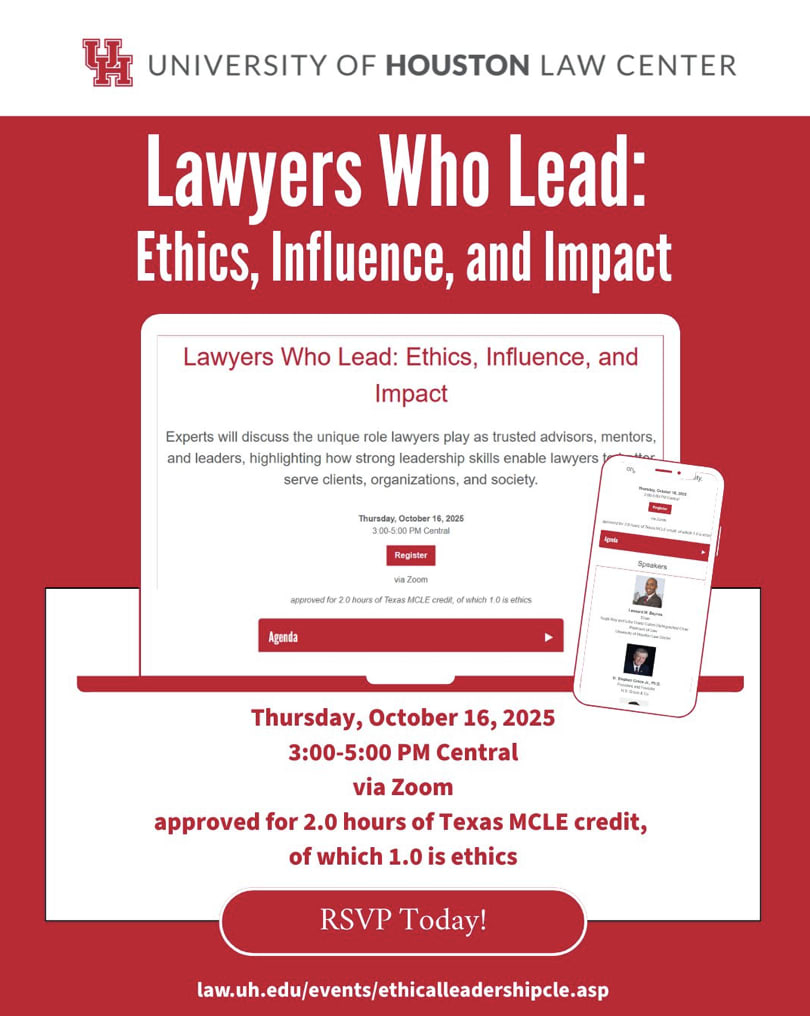
program “Lawyers
Who
Lead:
Ethics,
Influence,
and
Impact” on
Thursday
10/16
from
3-5PM
central.
Learn
more
and
register here.
Other
speakers
include H.
Stephen
Grace
Jr. (President
and
Founder
H.S.
Grace
&
Co.)
and Andrew
Gratz (Founder
of
the
Initiative
on
Lawyers
as
Leaders).
Now
for
your
headlines.
Highlights
from
Last
Week –
Top
Ten
Headlines
#1
“Court
Leans
Toward
Allowing
Trial
Judges
to
Limit
Attorney-Client
Discussions
During
Overnight
Recesses.” From SCOTUSBlog: “At
least
some
of
the
justices
at
Monday
morning’s
oral
argument
in Villarreal
v.
Texas appear
to
be
willing
to
permit
trial
courts
to
limit
what
defense
lawyers
may
discuss
with
their
clients
overnight
when
the
client
is
still
on
the
stand.
Specifically,
several
justices
seem
to
think
the
court
may
prohibit
lawyer
and
client
from
direct
discussions
of
the
client’s
testimony,
but
not
collateral
matters
of
trial
strategy
and
management
that
relate
to
the
testimony.”
Read
more here.
(Full
disclosure:
Along
with
several
other
legal
ethics
scholars, I
joined
an
amicus
brief in
this
matter.)
#2
“C.I.A.
Deputy
Director
Has
Replaced
Agency’s
Top
Legal
Official
With
Himself.” From The
New
York
Times: “It
was
not
clear
what
was
behind [Michael]
Ellis’s taking
personal
control
of
making
legal
judgments
for
the
agency
while
continuing
to
help
lead
it,
but
the
move
raised
alarms
among
some
current
and
former
intelligence
officials. Stephen
Gillers,
a
New
York
University
professor
of
legal
ethics,
called
the
arrangement
‘rather
bizarre.’
Pointing
to
rules
of
professional
conduct
for
lawyers
that
prohibit
conflicts
of
interest,
he
said
Mr.
Ellis
could
serve
as
C.I.A.
general
counsel
for
matters
in
which
he
had
no
interest,
but
could
not
ethically
give
himself
legal
advice
about
issues
that
concern
him
—
including
whether
policy
actions
he
wants
to
take
would
be
lawful.”
Read
more here (gift
link).
#3
“Law
Firms’
Trump
Deals
Escape
NY
Lawyer
Ethics
Investigation.” From Bloomberg
Law: “A
disciplinary
body
for
New
York
lawyers
is
putting
off
an
ethics
probe
into
major
law
firms’
deals
with President
Donald
Trump.
A
New
York
Supreme
Court
committee
last
month
declined
to
take
up
a
complaint
against
nine
firms
that
pledged
nearly
$1
billion
in
free
legal
services
to
White
House
in
exchange
for
the
removal
of
administrative
probes
and
punishments,
according
to
documents
obtained
by
Bloomberg
Law.
The
complaint,
filed
by
a
group
of
law
professors,
accused
the
firms
of
violating
ethics
rules
by
‘capitulating’
to
Trump’s
‘bullying.’
‘The
business
decisions
of
law
firms,
such
as
the
selection
of
clients
or
the
allocation
of
pro
bono
resources,
generally
fall
outside
the
purview
of
this
Committee,’ Jorge
Dopico,
chief
attorney
for
the
committee,
said
in
a
Sept.
2
letter.”
Read
more here.
#4
“New
Law
Lets
California
Law
Students
Be
Paid
for
For-Credit
Externships.” From
the California
Lawyer Daily
Journal: “What
started
as
a
student
brainstorming
session
in
a
Sacramento
classroom
has
now
become
California
law.
On
Friday, Gov.
Gavin
Newsomsigned
AB
1155,
legislation
requiring
law
schools
across
the
state
to
allow
students
to
be
paid
for
professional
externships
even
while
earning
academic
credit.”
Read
more here.
#5
“Retired
Justice
Kennedy
Laments
Coarse
Discourse
of
Trump
Era
and
Its
Effects
on
the
Supreme
Court.” From
the Associated
Press: “Retired Supreme
Court
Justice
Anthony
Kennedy said
Wednesday
he
was
troubled
that
partisanship
seemed
to
be
‘creeping
its
way
into
the
court,’
and
that
the
state
of
political
discourse
in
the
country
has
gotten
so
vulgar
and
vile
that
he
worries
for
the
country.
The
tone
of
recent
opinions
bothers
him
more
than
outcomes
of
cases,
Kennedy
said
in
an
interview
with
The
Associated
Press
in
his
court
office
in
advance
of
next
week’s
publication
of
his
memoir, Life,
Law
&
Liberty.
‘The
justices
have
to
resist
thinking
of
themselves
as
being
partisan,’
he
said.
‘In
our
current
discourse,
it
seems
to
me,
partisanship
is
creeping
its
way
into
the
court.’”
Read
more here.
#6
“How
Letitia
James
Will
Do
Her
Day
Job.” From The
New
York
Times: “Letitia
James is
New
York’s
chief
legal
officer,
leading
an
office
of
1,700
people,
including
800
lawyers.
And
now
she’s
a
criminal
defendant.
After
Ms.
James,
who
has
been
New
York’s
attorney
general
since
2018,
was
indicted
on
Thursday
on
federal
charges
of
bank
fraud
and
false
statements,
she
vowed
to
keep
doing
her
job
leading
one
of
the
country’s
largest
prosecutor’s
offices.
The
case’s
impact
on
her
job
will
be
‘zero,’
said James
E.
Tierney,
a
former
Maine
attorney
general
who
teaches
about
the
position
at
Harvard
Law
School.
It
is
not
the
first
time
that
an
attorney
general
has
been
indicted
and
continued
to
lead,
Mr.
Tierney
said.
…Stephen
Gillers,
a
legal
ethics
expert
at
New
York
University’s
School
of
Law,
said
that
ethical
guidelines
would
not
require
Ms.
James
to
recuse
herself
from
those
cases.”
Read
more here (gift
link).
And
for additional
commentary on
the
indictment,
see
this
op-ed
from Richard
Zitrin (UC
San
Francisco)
in
the San
Francisco
Chronicle:
“With
the
Letitia
James
indictment,
Trump’s
politics
of
revenge
threaten
to
rewrite
justice
in
America.” Read
more here.
#7
“Golden
Gate
University
Seeks
California
Accreditation
to
Reopen
Law
School.” From Reuters: “The
Golden
Gate
University
is
aiming
to
revive
the
troubled
law
school
it
closed
last
year,
reopening
it
as
a
California-accredited
institution.
The
San
Francisco-based
university
has
asked
the
State
Bar
of
California
for
accreditation
—
which
would
enable
Juris
Doctor
graduates
of
the
school
to
sit
for
the
bar
in
California
but
not
in
most
other
states.
The
state
bar’s
Committee
of
Bar
Examiners
is
due
to
consider
the
university’s
application
on
Friday.”
Read
more here.
#8
“Independence
First:
An
Ethical
Test
for
Litigation
Funding.” From Bailey
Glasser: “Of
the
handful
of
ethics
authorities
that
have
issued
opinions
directly
addressing
litigation
financing,
one
issue
remains
paramount:
attorney
control
of
litigation
and
independence
in
attorney
judgment.
Although
ethics
bodies
apply
varying
ethics
rules
to
address
the
pertinent
issues,
a
common
theme
between
them
is
an
emphasis
that
funding
agreements
will
be
impermissible
if
they
imperil
or
restrict
attorney
independence.
Below
are
highlights
from
a
few
of
the
states
that
have
addressed
the
issue
and
prioritize
the
importance
of
protecting
attorney
independence.”
Read
more here.
#9
“Lawyer
AI
Competence:
Training
Is
Becoming
Mandatory
—
But
Lawyers
Still
Get
Burned.” From Attorney
at
Work: “If
you
think
knowing
something
about
artificial
intelligence
is
optional
for
lawyers,
think
again.
A
growing
number
of
U.S.
law
schools
have
decided
that
AI
training
is
not
a
luxury
or
an
elective
—
it
is
becoming
a
requirement.
Meanwhile,
lawyers
continue
to
face
discipline
or
fines
because
they
lack
basic
AI
competence.
The
contrast
couldn’t
be
more
stark:
Students
are
being
taught
the
rules
while
practicing
lawyers
are
still
struggling
to
understand
them.”
Read
more here.
#10
“Deepfakes,
Data,
and
Duty:
Navigating
AI
Ethics
in
Law,
with
Merisa
Bowers.” From Lawyerist
Podcast: “Zack
Glaser talks
with Merisa
Bowers,
Loss
Prevention
and
Outreach
Counsel
at
the
Ohio
Bar
Liability
Insurance
Company,
about
how
artificial
intelligence
is
reshaping
lawyers’
ethical
duties.
Merisa
explains
how
deepfakes
and
realistic
scams
are
creating
new
challenges
for
diligence
and
verification,
why
unregulated
chatbots
can
accidentally
create
attorney-client
relationships,
and
what
disclosures
lawyers
should
make
when
using
AI
tools.
She
also
shares
practical
steps
to
maintain
confidentiality,
protect
client
data,
and
apply
long-standing
ethics
rules
to
fast-changing
technologies.”
Read
more here.
Get
Hired
Did
you
miss
the
350+
job
postings
from
previous
weeks?
Find
them
all here.
Upcoming
Ethics
Events
&
Other
Announcements
Did
you
miss
an
announcement
from
previous
weeks?
Find
them
all here.
Keep
in
Touch
-
News
tips?
Announcements?
Events? A
job
to
post? Reading
recommendations? Email [email protected] –
but
be
sure
to
subscribe
first,
otherwise
the
email
won’t
be
delivered.
Renee
Knake
Jefferson
holds
the
endowed
Doherty
Chair
in
Legal
Ethics
and
is
a
Professor
of
Law
at
the
University
of
Houston.
Check
out
more
of
her
writing
at
the Legal
Ethics
Roundup.
Find
her
on
X
(formerly
Twitter)
at @reneeknake or
Bluesky
at legalethics.bsky.social.