‘Police are lenient’: Zimbabwe’s disabled black market currency dealers


Zimbabwe
 Kenias
Mutsenha
had
long
ceased
using
his
Zimbabwean
local
currency
bank
account,
abandoning
it
for
one
trading
in
US
dollars,
as
many
in
the
economically
volatile
country
prefer
dealing
with
more
stable
foreign
currencies.

But
when
he
took
on
consultancy
work
in
Harare
this
year
and
a
client
needed
to
pay
him
in
Zimbabwe
Gold,
or
ZiG,
currency,
he
returned
to
the
bank
to
reopen
his
account.
There,
the
teller
asked
for
a
reactivation
fee
in
ZiG
notes.
Again,
Mutsenha
only
had
US
dollars,
which
the
bank
would
not
accept
or
exchange.

“I
had
to
find
cash
somewhere,”
Mutsenha,
46,
said,
realising
there
was
only
one
place
he
could
go:
“The
streets”.

While
most
Zimbabweans
prefer
trading
in
US
dollars –
to
avoid
the
pitfalls
of
major
currency
fluctuations

government
institutions
use
local
currency.
At
the
same
time,
banks
don’t
have
enough
ZiG
notes,
as
the
Central
Bank

wanting
Zimbabwe
to
move
towards
a
cashless
society

has
not
put
enough
cash
in
circulation,
experts
say.

As
a
result,
people
flock
to
Harare’s
central
business
district
(CBD),
where
there
is
a
thriving
black
market foreign
exchange
trading
operation.

Since
the
launch
of
the
ZiG
last
year,
the
government
has
been clamping
down
 on
informal
currency dealers.
But
this
has
only
created
a
situation
where
the
suppliers
find
new
avenues
to
explore

as
Mutsenha
discovered
that
day.

Finding
local
currency
on
the
street
was
a
nightmare,
he
said.
“I
wandered
in
the
CBD until
one
illegal
forex
dealer
[who
said
he
had
no
cash]
directed
me
to
a
certain
street.
I
was
told
the
person
[exchanging
money]
is
disabled
on
a
wheelchair.”

On
a
bustling
street
corner,
Mutsenha
found
Leonard
Mumba*, who
used
to
sell
mobile
phone
airtime
at
a
local
bus
terminus
but
now
deals
in
something
far
more
lucrative,
secretive,
and
risky.

Every
day
except
Sundays,
43-year-old
Mumba
is
wheeled
into
town
by
a
relative.
He
works
from
about
7am
to
6pm
from
the
same
spot
on
the
corner,
and
is
paid
a
weekly
commission
by
the
black
market
dealer
who
hired
him.

As
Mutsenha
handed
over
his
US
dollar
note
to
Mumba,
he
observed
the
subtle
operations
of
this
trade.
“A
man
came
from
across
the
road,
walking,
passing
by
the
street
corner.
He
just
dropped
a
black
satchel
at
this
illegal
forex
dealer
and
hooked
it
on
the
wheelchair.
They
did
not
speak
to
each
other,”
Mutsenha
recounted.

All
across
the
capital
city,
dealers
like
Mumba
now
sit
in
wheelchairs
and
on
sidewalks
with
satchels
of
banknotes.
Silent
handoffs
are
not
uncommon
to
witness:
A
plastic
bag
tossed
casually
at
a
trader’s
feet
as
a
supplier
walks
by,
avoiding
eye
contact
and
accountability.

A
man
uses
old
Zimbabwean
dollar
notes
to
buy
groceries
in
Harare.
Zimbabwe’s
currency
is
weak
against
foreign
currencies,
so
many
locals
prefer
to
use
the
US
dollar
[File:
Tsvangirayi
Mukwazhi/AP]

Police
are
more
‘lenient’

After
the
2024
introduction
of
the
ZiG
and
the
associated
government
crackdown
on
illegal
money
traders,
an
increasing
number
of
people
with
disabilities
have
taken
up
the
trade
in
Harare,
observers
and
disability
rights
groups
say.

Although
there
are
no
clear
estimates
of
how
many
people
with
disabilities
work
as
black
market
dealers,
Plaxedes
Choto,
a
disability
activist,
told
Al
Jazeera
that
in
the
CBD
alone,
there
are
more
than
three
dozen
disabled
people
involved
in
the
trade.

While
some
have
approached
the
trade
organically,
others,
like
Mumba,
were
recruited
to
be
proxies
for
someone
else.

“I
used
to
sell
airtime
at
Copacabana
bus
terminus,
but
when
police
continued
rounding
up
the
money
changers,
one
of
the
suppliers
approached
me
to
work
for
him,”
Mumba
told
Al
Jazeera
from
his
street
corner.

“Due
to
my
condition
[being
in
a
wheelchair],
police
would
not
easily
suspect
me,
especially
in
the
beginning,”
he
said.
“And
they
are
lenient
on
arrest
due
to
our
circumstances.”

People
with
disabilities
may
be
overlooked
or
viewed
more
sympathetically
by
the
police,
who
are
less
likely
to
crack
down
on
them,
according
to
observers.
Thabiso
Moyo,
a
Harare-based
social
justice
activist
and
human
rights
defender,
told
Al
Jazeera
this
is
because
police
stations
are
often
not
disability
friendly,
which
creates
hassles
for
the
officers.

“Being
generally
spared
from
police
raids
then
creates
a
situation
which
allows
wheelchair
users
to
be
shields
and
proxies
in
a
broader
system
of
economic
survival
and
corruption.
Real
culprits
hide
behind
the
disabled.”

Moyo
notes
that
the
shift
to
front-lining
disabled
money
traders
is
a
tactic
that
allows
the
real
suppliers
of
illicit
street
currency
to
stay
behind
the
scenes
and
be
more
protected.

Despite
their
work
with
sought-after
US
dollars,
observers
say
there
are
seldom
reports
of
disabled
money
traders
being
robbed
by
thieves.
However,
many
traders
say
law
enforcement
agents
approach
them
for
bribes
in
exchange
for
allowing
their
operations
to
continue.

Despite
any
risks,
for
many,
including
Mumba,
the
benefits
of
the
job
outweigh
previous
economic
ventures.
“With
airtime
and
fruits
it
was
quite
a
hustle.
And
now
everyone
wants
money

cash
or
online
transfers,
both
in
USD
and
ZiG.
It’s
a
lucrative
business
and
I
could
not
deny
such
a
[job]
offer.”

Not
too
far
away,
Clever
Gorejena*,
another
street
currency
dealer,
has
been
in
a
wheelchair
since
an
accident
a
decade
ago
left
him
disabled.
He
dabbles
in
the
trade
to
make
additional
income.

Like
Mumba,
he
works
for
someone
else
and
is
paid
weekly
on
commission
based
on
the
profits
from
the
transactions
he
makes.

“I
took
the
offer
as
an
opportunity
to
make
money.
I
deal
in
both
hard
currency
and
online
transactions
using
my
phone.
In
addition
to
forex
exchange, I
also
sell
airtime.
Those
are
my
two
major
activities,”
he
told
Al
Jazeera.

Zimbabwe
People
with
disabilities
face
many
challenges
in
Zimbabwe
[File:
Tsvangirayi
Mukwazhi/AP]

Lack
of
opportunities

People
with
disabilities
face
many
hurdles
in
Zimbabwe,
including
a
high
cost
of
living
due
to
additional
care
and
resources
they
may
require.
On
the
streets
of
Harare,
several
told
Al
Jazeera
about
the
stressful
cost
of
diapers,
food
for
their
specific
diets,
special
transport
services,
and
a
support
person
or
aids
to
help
them
get
by.

Although
Zimbabwe’s
social
welfare
department
gives
monthly
grants
to
people
with
disabilities,
representatives
of
this
community
say
it
is
a
drop
in
the
ocean.
Employment
prospects
also
remain
a
challenge.
In
2021,
Zimbabwe
launched
a
national
disability
policy
to
close
the
gaps
between
disabled
and
able-bodied
Zimbabweans.
The
policy
stated
the
government’s
intention
for
inclusion,
including
employment
opportunities,
but
four
years
down
the
line,
the
community
say
they
are
still
excluded
and
often
exploited.

For
many,
this
has
led
to
begging
or
vending
to
earn
money.
According
to
a
2017
study
by
the
National
Association
of
Social
Workers,
57
percent
of
people
begging
in
Harare
have
a
physical
disability.

“Beggars
with
disabilities
have
a
low
level
of
education.
Forty-seven
percent
have
no
formal
education.
This
has
made
it
difficult
for
them
to
get
employed,”
said
the
report.

As
people
attempt
to
leave
begging,
many
are
drawn
to
the
informal
sector
because
of
the
challenging
economic
situation,
said
Samantha
Sibanda,
the
director
of
Signs
of
Hope
Trust,
an
organisation
for
people
with
disabilities.
Some
fall
into
illegal
currency
dealing,
while
others
sell
what
they
can
in
the
street.

“I
think
the
national
budget
and
other
economic
outlooks
have
shown
that,
generally,
we
have
now
moved
to
an
informal
economy,”
said
Sibanda.
“But
for
persons
with
disabilities,
the
challenges
are
unique,”
she
added,
including
insufficient
access
to
education,
as
few
schools
provide
accessible
infrastructure.
This
then
affects
their
chances
of
getting
a
formal
job.
And
even
for
the
employed,
workplace
discrimination
remains
a
challenge.

“This
is
a
huge
gap
in
inclusion.
Our
infrastructure
was
built
without
the
disabled
in
mind,”
Sibanda
said.
“The
majority
of
the
disabled
find
their
way
to
city
centres,
in
the
streets
or
vending
due
to
lack
of
opportunities.”

Zimbabwe
People
queue
to
withdraw
money
from
a
bank
in
Harare
[File:
Philimon
Bulawayo/Reuters]

‘We
meet
in
the
streets’

In
August,
the
Harare
City
Council
conducted
Operation
Restore
CBD
Order,
during
which
officials
inspected
shops
and
buildings
to
ensure
their
businesses
were
complying
with
the
law.

The
city
council
told
Al
Jazeera
that
although
it
was
aware
that
disabled
people
are
working
in
the
illegal
money
trade
in
Harare,
the
current
focus
of
its
operation
was
on
unlicensed
shops
and
illegal
infrastructure
in
the
greater
CBD.

“But
anyone
operating
any
business
within
the
CBD
without
regulation
through
the
City
of
Harare
is
illegal,
including
those
in
the
streets,”
added
Stanley
Gama,
the
city’s
spokesperson.

Other
concerned
stakeholders
say
that
despite
government
efforts
to
fight
illegal
forex
trade,
currency
shortages
and
bureaucracy
in
the
banking
system
drive
the
black
market
operation.

In
Zimbabwe,
changing
foreign
currency
to
local
notes
the
official
way
is
a
long
process,
involving
paperwork
and
banks
asking
for
detailed
information.
Meanwhile,
changing
ZiG
to
foreign
currency
requires
Central
Bank
approval
and
is
near
impossible,
locals
say.
So
many
choose
to
go
the
black
market
route.

Ngonidzashe
Mutsigo,
a
Harare
resident,
mentions
other
challenges
for
Zimbabweans.

“I
don’t
have
a
bank
account;
it
costs
to
maintain
a
bank
account
in
Zimbabwe.
It
costs
to
withdraw
and
transact
using
the
bank
account.
So
I
think
such
things
are
the
ones
that
make
the
business
of
informal
money
changing
blossom,”
he
said.

“Unfortunately,
even
for
those
with
bank
accounts,
when
they
want
to
buy
the
USD
in
the
bank,
they
don’t
get
it,
and
we
meet
in
the
streets.”

A
black-market
money
supplier
who
provides
currency
to
disabled
traders
said
that,
these
days,
ZiG
notes
are
scarce.
As
the
ZiG
is
in
demand,
the
supplier,
who
requested
anonymity
for
security
reasons,
told
Al
Jazeera,
black
market
suppliers
often
source
it
from
big
businesspeople.

“There
are
people
in
business
and
government
getting
tenders
and
paid
in
local
currency

this
is
big
money

millions.
And
the
only
way
for
them
to
get
the
USD
is
to
come
to
the
streets.”

Even
though
the
government
pays
in
local
currency,
the
“big
shots”
want
US
dollars,
he
said.

“We
help
them
by
looking
for
the
greenback

and
we
work
with
our
guys
on
the
ground,
including
those
with
disabilities.
We
believe
in
numbers

the
more
we
get
these
people,
the
quicker
our
money
is
turned
into
the
sought-after
USD.”

New Zimbabwean banknotes
Zimbabwe
Reserve
Bank
Governor
John
Mushayavanhu
holds
a
ZiG
note
[File:
Jekesai
Njikizana/AFP]

‘Tough
times’

In
June,
the
Reserve
Bank
of
Zimbabwe
(RBZ)
reported
that
it
had
achieved
one
year
of
ZiG
stability.

“Zimbabwe’s
exchange
rate
has
become
more
stable,
with
the
difference
between
the
official
and
black
market
rates
now
below
20
percent.
The
country
also
received
more
foreign
currency

[This
has]
made
it
easier
for
businesses
and
individuals
to
access
foreign
currency
for
genuine
needs,
and
helped
keep
the
financial
sector
stable
and
healthy,”
said
RBZ
governor,
John
Mushayavanhu.

Observers
and
financial
experts,
however,
say
the
RBZ
is
not
realistic
about
the
situation
on
the
ground,
where
US
dollars
are in
demand
and
widely
different
exchange
rates
on
the
official and
parallel
markets
have
created
opportunities
for
illegal
dealers
to
thrive.

Meanwhile,
on
the
streets,
people
with
disabilities
have
been
drawn
in,
too

many
out
of
desperation
or
necessity.

“We
are
living
in
tough
times,”
Sign
of
Hope’s
Sibanda
said.
“We
do
also
have
people
who
have
been
exploiting
persons
with
disabilities
since
time
immemorial,
using
them
for
begging,
using
them
to
run
their
stores
while
they
keep
their
money
for
themselves.”
Recruitment
by
money
traders
wanting
to
stay
in
the
shadows
is
the
newest
iteration
of
that.

“Operating
a
parallel
market
of
forex
or
currency
exchange
is
illegal,
and
we
do
not
condone
such
activities,”
Sibanda
said.
“But
we
do
look
forward
to
other
opportunities
that
can
give
people
with
disabilities
better
incomes
and
a
better
life.”

On
his
street
corner,
Mumba
agrees.
Despite
some
financial
respite,
he
says
currency
trading
does
not
provide
real
security

neither
economic
nor
social.
He
hopes
the
government
will
roll
out
initiatives
and
invest
in
helping
him
and
others
get
away
from the
criminal
trade
and
unsafe
streets
of
Harare.

“No
one
knows
about
tomorrow.
Robbers
can
target
me,
here
or
at
home,
and
it
will
affect
my
family,”
Mumba
said. 
“My
biggest
fear
is
that
the
work
we
do
is
illegal
and
does
not
help
in
building
my
country’s
economy.”


*Name
changed
for
safety
reasons

That 70s Show: Why Your 70s Might Be The Perfect Time To Start A Law Firm – Above the Law

The

Wall
Street
Journal

recently

ran
a
story

that
might
surprise
those
who
view
entrepreneurship
as
a
young
person’s
game. 
Turns
out,
70-somethings
are
launching
new
businesses
at
record
rates.
Nearly
30
percent
of
employed
Americans
over
70
now
work
for
themselves

double
the
share
of
those
in
their
60s.

So
why
not
law?
Why
couldn’t
that
same
spirit
of
reinvention
take
hold
among
senior
attorneys?

Consider
the
context. 
At
large
firms,
many
lawyers
in
their
60s
and
70s
are
being

eased
out
by
mandatory
retirement
policies

Others
begin
to
feel
that
life’s
too
short
to
defend
policies
or
causes
they
don’t
believe
in. 
Yet
as
older
lawyers
depart
the
work
force,
decades
of
valuable
experience,
judgment,
and
relationships
are
being
left
on
the
sidelines. 
And
those
qualities
are
exactly
what
make
older
lawyers
perfect
candidates
for
law
firm
ownership. 

Already,
older
lawyers
already
have
the
assets
that
younger
founders
are
still
scrambling
to
build. 
That
includes
a
network
that
spans
industries,
a
reputation
that
opens
doors,
and
the
confidence
that
comes
from
having
weathered
cycles
of
boom,
bust,
and
burnout.
Plus
many
older
lawyers
are
financially
secure,
with
mortgages
and
children’s
college
tuition
in
the
rearview
mirror.

Even
better,
the
practice
opportunities
are
wide
open
to
serve
clients
with
a
similar
background

and
who
are
likely
to
feel
more
comfortable
around
a
lawyer
who
looks
like
them. 
Potential
practice
areas
include:


  • Estate
    planning
    and
    elder
    law

    align
    naturally
    with
    older
    lawyers’
    stage
    of
    life
    and
    the
    client
    base


    the
    majority
    of
    who
    don’t
    complete
    estate
    planning
    until
    the
    ages
    of
    55-64.

  • “Silver
    divorce”

    cases

    couples
    separating
    after
    decades
    together

    call
    for
    empathy
    and
    realism
    that
    only
    life
    experience
    provides.

  • Later-in-Life
    entrepreneurs

    like
    those
    featured
    in
    the

    Journal

    article
    will
    need
    small
    business
    lawyers
    to
    draft
    up
    corporate
    documents
    and
    business
    agreements.

  • Fiduciary
    disputes,
    financial
    elder
    abuse,
    and
    age
    discrimination

    are
    rising
    issues
    where
    seasoned
    counsel
    can
    make
    a
    difference.

  • Independent
    mediation
    and
    arbitration
    services

    offer
    a
    path
    for
    attorneys
    with
    decades
    of
    experience
    in
    family
    law,
    commercial
    litigation
    or
    regulatory
    practice
    tov1
    apply
    their
    skills
    to
    resolve
    disputes
    rather
    than
    initiate
    them.

  • Consulting
    niches


    ethics,
    trial
    strategy,
    negotiation,
    or
    mentoring
    younger
    lawyers

    allow
    you
    to
    monetize
    what
    you
    know
    without
    carrying
    a
    heavy
    caseload. 
    In
    fact,
    the 

    Journal

    article
    featured
    trial
    lawyer
    Judson
    Graves
    who
    teamed
    up
    with
    an
    actor
    to
    produce
    online
    CLEs
    on
    entertaining
    trial
    performance
    through

    Judson
    Squared
    .

Meanwhile,
the
emergence
of
generative
AI
promises
to
mitigate
many
age-related
concerns
about
older
lawyers’
mental
acuity,
stamina,
and
tech
competence
(a

2023
study

showed
that
73%
of
Oklahoma
lawyers
disciplined
are
over
50
years
old).
AI
is
intuitive
for
most
lawyers
to
use
and
can
tackle
much
of
the
repetitive
drudge
work
that
older
lawyers
struggle
with. 
Older
lawyers
have
the
added
advantage
of
experience
which
enables
them
to
spot
hallucinated
or
suspicious
AI
output
more
capably
than
newer
lawyers.

Like
“That
70s
Show,”
a
70-something

solo
by
choice

sounds
like
a
sitcom. 
But
it’s
really
a
reboot

where
you
finally
get
to
write
the
script.
You’ve
already
lived
the
first
few
seasons
of
your
career.
You’ve
seen
what
works,
what
doesn’t,
and
what
actually
matters.
The
70s
don’t
have
to
be
an
ending.
They
can
be
the
decade
where
you
take
everything
you’ve
learned
and
finally
practice
law
the
way
you
always
wanted
to.


Carolyn
Elefant
is
one
of
the
country’s
most
recognized
advocates
for
solo
and
small
firm
lawyers.
She
founded
MyShingle.com
in
2002,
the
longest-running
blog
for
solo
practitioners,
where
she
has
published
thousands
of
articles,
resources,
and
guides
on
starting,
running,
and
growing
independent
law
practices.
She
is
the
author
of
Solo
by
Choice,
widely
regarded
as
the
definitive
handbook
for
launching
and
sustaining
a
law
practice,
and
has
spoken
at
countless
bar
events
and
legal
conferences
on
technology,
innovation,
and
regulatory
reform
that
impacts
solos
and
smalls.
Elefant
also
develops
practical
tools
like
the AI
Teach-In
 to
help
small
firms
adopt
AI
and
she
consistently
champions
reforms
to
level
the
playing
field
for
independent
lawyers.
Alongside
this
work,
she
runs
the
Law
Offices
of
Carolyn
Elefant,
a
national
energy
and
regulatory
practice
that
handles
selective
complex,
high-stakes
matters.

Relativity Offers Key AI Products At No Extra Charge – But That’s Not The Most Important Thing – Above the Law

The
12th
annual

Relativity
Fest

kicked
off
this
week
in
Chicago
before
over
1,800
attendees.
Lots
of
announcements,
the
most
significant
of
which
was
that
starting
in
early
2026,
the
Relativity

aiR
for
Review

and

aiR
for
Privilege

products
will
be
included
in
the
standard
Relativity
One
package
and
pricing.
The
accompanying
press
release
announcing
the
change
describes
these
tools
as
“generative
AI
solutions
for
legal
review.”

In
other
words,
what
were
previously
only
obtainable
by
paying
a
separate
and
additional
charge
will
now
essentially
be
free
for
Relativity
customers.


Why
Is
This
Important?

This
is
important
because
so
many
vendors
try
to
create
AI
programs
and
then
charge
separately
for
them
to
generate
revenue.
Many
of
these
products
are
already
expensive
and
adding
an
AI
surcharge
can
place
them
out
of
reach
for
many
practitioners.
And
the
idea
that
there
are
separate
charges
for
the
state-of-the-art
products
feels
like
nickel
and
diming
that
does
little
more
than
breed
mistrust.

Yet
these
products
can
save
thousands
of
dollars
and
countless
hours
and
are
valuable.
Many
AI
tools
do
little
more
than
make
the
rich
richer,
providing
an
advantage
to
the
large
firms
that
can
afford
state-of-the-art
tools.
 Offering
the
review
and
privilege
review
tools
as
part
of
the
standard
package
levels
the
playing
field.
It
also
makes
for
better
results
when
both
sides
have
access
to
the
same
tools.


Phil
Saunders
,
the
Relativity
CEO,
put
it
this
way:
“We
believe
generative
AI
is
the
undeniable
future
of
review,
and
we’re
making
it
easy
for
all
RelativityOne
customers
to
experience
the
platform.”

In
some
respects,
the
decision
reflects
the
culture
of
the
company
and
in
particular
the
philosophy
of
Saunders
who
has
been
in
that
position
for
almost
three
years.
Unlike
many
of
those
in
C-suites
of
legal
tech
companies,
Saunders
is
refreshingly
honest.
He’s
self-deprecating.
He’s
humble
but
confident.
He’s
the
kind
of
CEO
who
goes
to
the
somewhat
drab
hotel
gym
to
work
out
with
everyone
else
instead
of
being
chauffeured
to
someplace
fancy
with
his
entourage.
You
know
the
kind
of
guy
you
want
to
have
a
beer
with?
That’s
Saunders.


Some
Honesty
For
a
Change

Consistent
with
his
style
and
philosophy,
Saunders
made
a
number
of
revealing
and
candid
comments
in
the
Keynote
and
afterwards
in
a
press
conference.

For
example,
one
of
the
tools
announced
recently
by
Relativity
is

aiR
Strategy
,
which
helps
users
create
case
strategies.
When
asked
why
that
tool
was
also
not
being
bundled
in
the
standard
package,
his
response
was
interesting:
frankly,
he
admitted
that
the
product
is
not
quite
ready
yet.
It’s
not
a
“real-time,
best-in-class”
offering.
Interesting
and
honest:
bundling
aiR
Strategy
will
apparently
be
discussed
only
when
the
product
is
ready.

When
asked
about
future
mergers
and
acquisitions,
Saunders
also
answered
honestly
that
the
company
had
not
been
good
at
integrating
acquired
companies
in
the
past.
He
also
noted
that
a
lack
of
a
culture
fit
just
fuels
disruption.
So,
says
Saunders,
Relativity
just
hasn’t
been
ready
for
more
acquisitions.

Saunders
also
raised
the
question
of
the
importance
of
(or
perhaps
lack
of
importance)
of
focusing
too
much
on
revenue:
“just
because
something
builds
revenue
doesn’t
mean
it’s
going
to
serve
the
customers
well…
we
have
to
get
over
the
reality
that
revenue
is
like
heroin,
it’s
addictive.”

Saunders
also
addressed
the
relationship
of
Relativity
with
its
partners.
He
firmly
planted
a
flag:
Relativity
partners
can’t
take
a
Relativity
product
and
mark
it
up.
“It’s
not
serving
the
end
customer
by
marking
up
a
platform
5X
to
maintain
the
margins
they
once
had
in
the
human
review
business
and
then
doing
a
bunch
of
consulting
services
and
charging
$800
an
hour.”
 

Relationships
with
partners
can
often
be
touchy:
it’s
like
the
relationship
between
franchisors
and
franchisees
that
I’m
familiar
with
from
practicing
law.
They
need
each
other
but
if
the
franchisor
doesn’t
make
sure
the
franchisee
offers
the
products
fairly
and
honestly,
everyone
gets
hurt.
It’s
the
same
here,
so
it’s
good
to
see
Saunders
make
Relativity’s
stance
clear.

Saunders
was
also
asked
if
the
recently
announced
Relativity

Rel
Labs
program
,
an
investment
program
that
would
support
legal
tech
startups,
 might
partner
with
or
invest
in
some
socially
oriented
AI
tools.
Another
honest
answer:
“that’s
a
really
good
question,
we
haven’t
thought
of
it.”

As
Saunders
put
it,
“if
we
don’t
know
something,
we
own
it.”


Company
Culture

Concluding
the
press
conference,
Saunders
summed
up
in
a
few
words
what
he
thinks
the
culture
of
Relativity
is
or
should
be.
First,
it
approaches
things
with
“radical
candor”
where
ideas
and
for
that
matter,
failures,
are
discussed
openly
and
robustly.
It
strives
to
be
“humble
but
hungry.”
 

Platitudes?
Maybe.
But
if
bundling
key
tools
without
charging
extra
for
them
is
any
indication,
this
culture
may
be
real.

Plus,
by
the
way,
says
Saunders,
radical
candor
lets
him
swear
a
lot.


Why
This
Approach
Works

I
don’t
work
for
Relativity.
I’m
not
there
day
to
day.
I
don’t
use
their
products.
But
in
an
era
when
many
tech
vendors
overpromise
underperforming
products
or
announce
products
that
will
be
offered
later,
offer
enhancements
that
don’t
do
much
new,
or
offer
products
as
add-ons
to
their
central
core
products,
Saunders’s
honesty
and
transparency
is
refreshing.

As
with
most
customer
relationships,
at
the
end
of
the
day,
it
needs
to
be
about
trust.
Honesty
and
transparency
generate
trust.
Doing
the
right
thing
like
including
key
programs
in
the
standard
platform
says
a
lot.
Particularly
in
a
business
where
relationships
between
legal
service
providers
and
their
clients
hinge
almost
entirely
on
trust.

If
only
other
vendors
followed
suit,
they
might
be
become
trusted
allies
instead
of
just
vendors.


Stephen
Embry
is
a
lawyer,
speaker,
blogger,
and
writer.
He
publishes TechLaw
Crossroads
,
a
blog
devoted
to
the
examination
of
the
tension
between
technology,
the
law,
and
the
practice
of
law
.

The Forgotten Art Of Brainstorming: How To 10x Creativity In Group Settings – Above the Law

Group
Of
Businesswomen
Collaborating
In
Creative
Meeting
Around
Table
In
Modern
Office

Many
lawyers
have
a
lone
wolf
approach
to
their
cases.
Even
when
they
lead
a
team,
they
often
make
decisions
with
little
to
no
input
from
the
team.
Senior
lawyers
typically
view
their
role
as
defining
and
determining
the
case
strategy,
leaving
the
rest
of
the
team
to
implement
their
plan
and
ideas.
They’re
the
ones
defining
a
win
and
concocting
the
roadmap
to
achieve
it.
The
rest
of
the
team
takes
that
blueprint
and
constructs
the
case.
This
process
is
the
default
of
many
hierarchical
firms

senior
partners
create
the
plan,
junior
partners
manage
the
plan,
associates
and
paralegals
implement
the
plan.
It
often
works,
and
the
desired
outcomes
are
generally
achieved.
 I
would
suggest,
however,
that
a
better
approach
exists,
which
yields
better
outcomes.

This
top-to-bottom
approach,
almost
a
military
perspective,
where
generals
decide
on
the
war
plans
and
foot
soldiers
take
the
hill,
has
the
potential
for
poor
results
when
those
at
the
top
create
a
flawed
strategy,
resulting
in
the
execution
of
a
flawed
approach
that
produces
poor
results.

There
is
value
in
having
the
entire
team
contribute
input,
ideas,
creativity,
and
imagination
to
a
plan
before
finalizing
and
implementing
it.
This
strikes
me
as
a
truism. 
Yet,
why
don’t
more
lawyers
take
this
approach?
The
obstacles
are
myriad.

For
those
of
us
who
bill
by
the
hour,
some
clients
are
hesitant
to
pay
for
brainstorming
sessions.
You’ve
been
doing
this
for
X
years

why
is
collaboration
needed?
Don’t
you
already
know
how
to
handle
this
case?
Clients
have
historically
viewed
team
sessions
as
billing
blackholes,
fueling
senior
partners
to
create
a
plan
themselves
and
have
their
teams
implement
it,
with
little
to
no
input
from
them.
It
looks
cleaner
and
creates
fewer
line
items
on
the
firm
invoice.

Some
senior
partners,
due
to
tradition,
customs,
or
their
egos,
prefer
this
top-down
approach. 
They
can
define
a
case,
set
it
in
motion,
and
proceed
to
the
following
case.
They
say
jump,
and
the
troops
ask
how
high.
It’s
hard
to
change
how
things
have
always
been
done.

Some
junior
partners
and
associates
may
be
hesitant
to
be
seen
as
contrarian
or
argumentative,
and
therefore
feel
uncomfortable
voicing
their
views
and
opinions,
especially
if
they
contradict
the
senior
partner’s
plan
of
attack.
Better
to
stay
quiet
and
implement
a
flawed
plan
than
risk
a
poor
performance
review
for
being
perceived
as
not
getting
along
with
others.

And
collaboration
needs
to
be
intentional
and
well-directed. 
Experienced
lawyers
may
not
possess
the
necessary
skill
set
or
emotional
intelligence
to
encourage
the
team
to
freely
and
openly
participate
and
share
their
views
and
experiences.

All
of
these
inhibit
team
brainstorming
sessions.
Intentionality
is
key
to
overcoming
these
obstacles
and
breaking
down
these
barriers
to
facilitate
more
group
discussions
and
thoughtful
dialogue.

For
group
brainstorming
to
work,
the
firm
must
appreciate
its
importance
and
significance,
and
take
steps
to
implement
it
firm-wide,
including
addressing
billing
issues
with
clients,
creating
safe
spaces
where
the
team
can
speak
freely
(so
long
as
they
do
so
professionally
and
politely),
and
training
everyone
on
how
to
lead
and
participate
in
these
sessions.
Simply
encouraging
your
team
to
think
collectively
is
insufficient. 
You
must
empower
them
to
do
so
and
teach
them
the
necessary
skills.

When
a
case
first
comes
in
and
a
team
is
assembled
to
handle
it,
an
in-person
or
virtual
meeting
should
be
held
to
set
the
stage
for
the
case
and
discuss:
(1)
how
to
define
a
win;
(2)
how
to
achieve
that
win;
(3)
a
plan
with
action
steps
to
achieve
that
win.
Everyone
should
be
encouraged
to
participate,
share
their
thoughts,
and
discuss
the
subject.
About
once
a
month
(sometimes
less,
sometimes
more,
depending
on
the
case’s
complexity,
activity
level,
and
stakes
involved),
the
group
should
schedule
another
meeting
to
discuss
the
case’s
status
and
identify
any
necessary
adjustments
or
changes
to
the
plan
to
achieve
the
desired
outcomes. 
This
ensures
that
the
plan
is
modified
as
needed
and
also
serves
as
a
check-in
for
everyone
to
report
on
their
progress
and
any
roadblocks
or
issues
they
encounter.

In-house
legal
departments
are
generally
much
better
at
this
approach
than
law
firms
(possibly
because
they
don’t
encounter
billable
hour
issues
and
view
their
work
as
inherently
more
collaborative).
Taking
their
lead,
trying
this
approach
should
yield
more
effective
strategies
with
better
results.


Frank
Ramos
is
a
partner
at
Goldberg
Segalla
in
Miami,
where
he
practices
commercial
litigation,
products,
and
catastrophic
personal
injury. You
can
follow
him
on LinkedIn,
where
he
has
about
80,000
followers
.

How Filevine Helps In-House Legal Teams Manage Every Matter With Confidence – Above the Law

Most
in-house
legal
teams
know
the
feeling:
inboxes
overflowing
with
attachments,
redlines
lost
in
endless
email
chains,
and
that
nagging
worry
that
something
important
slipped
through
the
cracks. 

To
prevent
costly
mistakes
that
can
arise
from
such
disorganization,
company
legal
teams
are
increasingly
turning
to
management
software
like
Filevine.
Although
Filevine
may
be
best
known
as
a
litigation
tool
to
help
law
firms
prepare
for
trial,
its
AI-enhanced
document
management
and
contract
review
tools
can
save
time
and
money
across
various
industries.

In
a
recent
product
demo,
Madison
Doyle,
manager
of
sales
engineering
at
Filevine,
offered
a
real-life
scenario
that
the
software
can
prevent.
Before
a
real-estate
company
started
using
Filevine,
its
general
counsel
missed
a
lease
renewal
notice
buried
in
email.
The
60-day
deadline
came
and
went,
leaving
the
company
scrambling
to
argue
its
way
out
of
an
expensive
move. 

That
case
turned
out
fine,
but
the
lesson
was
obvious—running
legal
operations
from
Outlook
email
chains
is
asking
for
trouble.

“It’s
more
than
just
a
litigation
tool,”
Doyle
said.
“These
same
AI
tools
can
be
applied
to
so
many
other
applications.”


Getting
Started

Under
the
Project
Hub,
the
user
sees
a
repository
of
all
the
open
projects
they’re
working
on
as
well
as
their
status.
Click
on
the
project
name
and
a
window
opens
to
the
right
with
vital
information
such
as
the
contract
expiration
date
and
its
latest
activity.

Users
also
can
apply
several
filters
to
narrow
down
their
search,
such
as
by
project
type
if
they’re
looking
for
an
employment
matter
or
by
clicking
a
tag,
which
could
be
a
signal
from
a
higher-up
to
address
something
“#critical.”

In
each
project,
they
can
see
not
only
the
negotiation
history,
but
also
categories
of
activity
and
the
documents
that
have
been
appended
to
it—email
history,
redlined
versions,
internal
notes,
and
more,
all
in
one
space.


How
It
Helps
With
Data
Intake

For
most
lawyers,
the
day
starts
in
Outlook.
That’s
why
Filevine
built
its
most
popular
intake
feature
as
an
email
plugin.
It
scans
an
incoming
attachment,
captures
all
its
details
and
automatically
populates
the
data
into
the
correct
field. 

When
the
attachment
is
added
to
a
project,
the
user
can
tag
who
needs
to
act
on
it
to
create
a
task
in
their
workflow.
The
new
attachment,
the
email
and
the
task
are
all
added
to
the
project’s
activity
history
in
the
Project
Hub.

“I’m
not
trying
to
work
in
a
silo,”
Doyle
said.
“I
want
to
make
it
so
everyone
on
the
team
can
help
out.”

Legal
teams
that
rely
on
Slack
or
Teams
also
can
format
Filevine
to
integrate
their
existing
workflow
into
the
system.
So
wherever
the
request
originates,
it
flows
into
a
structured
central
place.

Once
a
document
is
uploaded,
an
AI
tool
automatically
summarizes
its
attributes
for
a
quick
glance
that
can
get
a
new
associate
up
to
speed.
For
an
updated
contract,
for
instance,
it
offers
a
sentence
or
two
each
about
payment
terms,
insurance
requirements,
and
indemnification,
among
others.
Another
panel
highlights
clauses
with
potential
disputes,
giving
lawyers
a
head
start
in
their
document
analysis.

Different
versions
of
documents
can
also
be
easily
compared
side
by
side
to
see
the
latest
changes. 

“This
is
way
better
than
how
most
groups
do
it,
which
really
is,
I
create
a
Word
document,
I
edit
it,
I
send
it
to
you
in
email,”
Doyle
said.
“You
open
it
up,
you
make
a
change,
you
send
it
back
to
me,
and
we
keep
doing
that
until
we’re
satisfied.
That
takes
much
longer.”

Besides
taking
much
less
time,
Filevine’s
system
makes
it
easier
to
produce
reports.


Boosting
Your
Document
Management

The
way
documents
have
been
traditionally
managed
in
legal
departments
often
meant
endless
hunting
through
folders
for
scattered
versions
saved
on
individuals’
hard
drives.
Filevine
replaces
all
that
with
a
searchable,
collaborative
repository.

Every
draft,
redline,
and
related
email
lives
in
a
single
transaction
space.
They
can
be
edited
in
the
system
or
even
in
Word,
and
notes
can
be
added
to
each
revision 
(“sent
to
counterparty,”
for
example).
Saving
it
automatically
creates
a
new
version
in
the
system
that
updates
for
everyone,
including
the
version
history
and
track
changes
to
ensure
no
one
loses
track
of
what
was
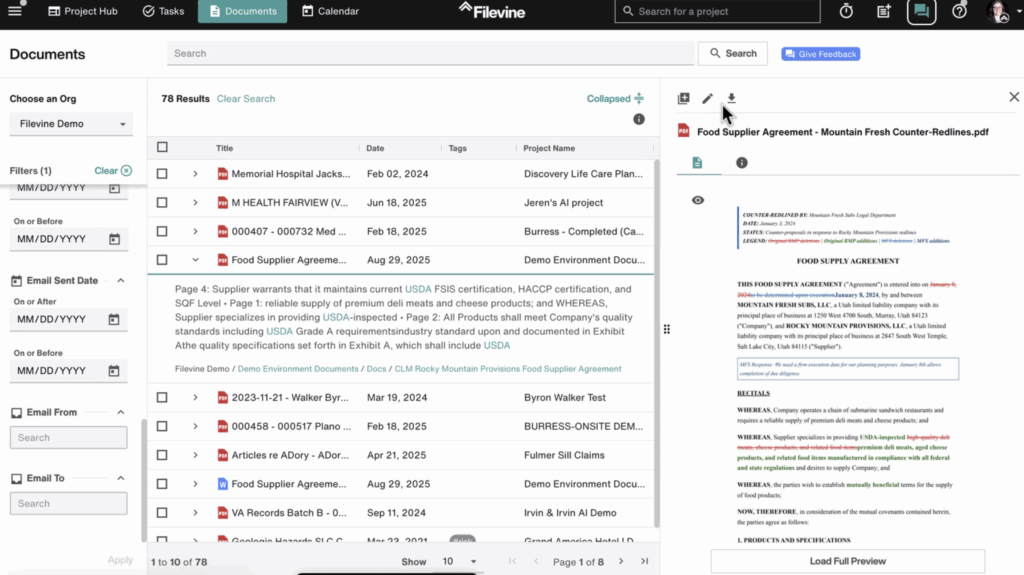
changed.pasted-image.png

Because
every
document
is
indexed
on
upload,
search
works
at
the
content
level—not
just
file
names.
Need
to
find
every
contract
with
a
non-standard
indemnification
clause?
It’s
a
few
clicks
away. 

For
bigger
matters,
Filevine
doubles
as
a
secure
data
room.
External
parties
can
upload
documents
via
password-protected
links,
without
creating
accounts
or
passing
endless
emails
back
and
forth.
With
file
limits
as
high
as
50GB,
storage
is
more
than
sufficient.

“When
groups
do
this
outside
of
Filevine,
it’s
very
easy
to
lose
track
of
which
version
you
actually
sent,”
Doyle
said.
“Inside
Filevine,
I
can
always
understand
how
a
document
came
in,
where
it’s
saved,
and
what
the
version
history
is.”


Draft
Documents
Faster
with
Customized
Templates

On
the
drafting
side,
Filevine
Document
Assembly
stands
out.
Legal
teams
can
generate
NDAs,
MSAs
or
amendments
from
structured
templates,
with
data
fields
flowing
directly
into
the
right
spots.
What
makes
FVDA
different
is
its
bi-directional
sync.
Change
a
variable—like
an
effective
date—in
one
place,
and
it
updates
across
the
entire
document
and
underlying
database.

That
ensures
reports
always
match
the
right
information.Screenshot 2025-09-19 at 6.45.57 PM.png

Lawyers
can
generate
boilerplate
or
tailored
language
with
a
click,
then
pull
from
a
clause
library
of
the
team’s
best
past
writing.
If
a
user
needs
to
adapt
indemnification
for
a
special
client,
for
example,
they
can
search
the
library
to
drop
in
the
right
version.

“All
of
that
exists,
but
it
can
be
enhanced
by
the
AI
to
help
perform
at
a
higher
level,
and
be
more
diligent
in
your
work,”
Doyle
said.


Enhancing
It
All
with
AI

All
of
these
features—intake,
document
management,
and
contract
drafting—are
valuable
on
their
own.
But
they
become
even
more
powerful
when
layered
with
Filevine’s
AI
capabilities.

In
one
scenario,
Doyle
uploaded
a
supplier
agreement
and
highlighted
purple
stars
that
mark
where
AI
is
active.
Immediately,
the
system
generated
a
summary
of
the
contract
and
flagged
potentially
problematic
terms—imbalances
between
parties,
undefined
provisions,
clauses
that
fell
outside
the
norm.

Cross-referencing
is
built
in.
Click
a
flagged
issue
in
the
AI
report,
and
it
jumps
straight
to
the
clause
in
the
contract. 

All
the
commands
are
managed
from
a
chat
window
on
the
right
that
can
answer
questions
and
take
commands
in
natural
language.
The
history
of
all
the
requests
is
preserved
so
everyone
on
the
team
can
see
who
did
what.

“It’s
a
nice
way
to
just
know
what’s
in
that
repository
that
might
sneak
up
on
you,”
Doyle
noted,
especially
in
contexts
like
M&A
where
dozens
or
hundreds
of
agreements
come
under
review.

At
modern
in-house
legal
teams,
people
are
under
more
pressure
than
ever
to
deliver
more
value
with
fewer
people
resources—and
no
tolerance
for
avoidable
mistakes.
Filevine
enables
the
team
to
work
together
to
streamline
intake,
organize
documents,
and
free
up
time
with
AI-powered
tools.

“We
think
this
is
more
of
the
way
of
the
future,
instead
of
just
passing
the
same
Word
document
back
and
forth
and
letting
chaos
develop
in
your
inbox,”
Doyle
said.

Corporate And Litigation Powerhouses Tie The Knot In Biglaw’s Latest Merger – Above the Law

Another
week,
another
law
firm
merger.
Because
apparently
no
one
in
Biglaw
wants
to
stay
regional
anymore,
in
yet
another
sign
of
growing
consolidation
in
industry,
Frost
Brown
Todd
and
Gibbons
are
joining
forces
to
create
a
new
national
firm
called
FBT
Gibbons.

The
combination,
set
to
go
live
on
January
1,
2026,
will
bring
together
about
800
attorneys
across
25
offices
from
coast
to
coast.
The
new
firm
will
have
a
reach
that
stretches
from
New
York
to
California,
giving
both
firms
a
much
broader
platform

and
a
lot
more
lawyers
to
wrangle.

Frost
Brown
Todd,
based
in
Cincinnati,
is
known
for
its
corporate
and
transactional
work,
while
Newark-based
Gibbons

a
firm
that’s
nearly
a
century
old

has
long
been
a
litigation
heavyweight
in
the
Northeast.
Together,
they’re
hoping
to
carve
out
a
bigger
slice
of
the
middle-market
pie,
the
increasingly
competitive
space
between
the
global
Biglaw
giants
and
the
smaller
boutiques.

Financially
speaking,
they’re
off
to
a
solid
start.
Combined,
the
two
firms
bring
in
north
of
$450
million
in
revenue

enough
to
land
FBT
Gibbons
comfortably
within
the
Am
Law
100
when
the
next
set
of
rankings
come
out.
As
noted
by
the

American
Lawyer
,
leadership
for
the
new
firm
is
already
set:

“We
are
very
excited
about
this
as
leaders
of
our
respective
firms
and
the
leaders
of
the
combined
firm
to
be,”
said
FBT
chairman
Robert
Sartin
in
an
interview.
“Our
partners
are
very
much
behind
this
and
excited
about
it.”

Sartin
will
serve
as
chair
of
the
combined
firm,
with
Gibbons
managing
director
Peter
Torcicollo
and
FBT’s
CEO
Adam
Hall
serving
as
co-managing
partners.
FBT
held
its
partnership
vote
on
the
combination
Monday,
with
more
than
90%
of
the
firm’s
partnership
greenlighting
the
merger,
and
Gibbons’
partnership
unanimously
confirmed
the
merger
Tuesday.

When
the
dust
settles,
FBT
Gibbons
will
be
one
of
the
largest
mid-market
firms
in
the
country,
with
the
resources
to
take
on
national
matters
while
keeping
that
“client-first”
vibe
both
firms
swear
by.
Whether
that
balance
holds
up
after
the
honeymoon
phase
remains
to
be
seen,
but
for
now,
Frost
Brown
Todd
and
Gibbons
are
the
latest
to
say
“I
do”
in
Biglaw’s
ongoing
merger
season.


Frost
Brown
Todd
to
Merge
With
NJ
Mainstay
Gibbons,
Bolstering
Northeast
Footprint

[American
Lawyer]


Staci Zaretsky


Staci
Zaretsky
 is
the
managing
editor
of
Above
the
Law,
where
she’s
worked
since
2011.
She’d
love
to
hear
from
you,
so
please
feel
free
to

email

her
with
any
tips,
questions,
comments,
or
critiques.
You
can
follow
her
on BlueskyX/Twitter,
and Threads, or
connect
with
her
on LinkedIn.

When Will AI Be Your Opposing Counsel? – Above the Law

Most
lawyers
have
fretted
from
time
to
time
about
the
encroachment
of
artificial
intelligence
on
the
work
that
they
do.
Although
it
is
a
relief
not
to
have
to
do
document
review
until
your
eyes
are
bleary,
and
it
is
also
a
relief
not
to
have
to
draft
basic
discovery
documents
(those
pesky
interrogatories,
requests
for
admission,
and
document
requests)
or
respond
to
them
with
objections
and
redactions
galore,
up
to
now,
there
has
been
some
comfort
in
thinking
that
certain
duties,
responsibilities,
and
obligations
that
lawyers
have
cannot
be
replicated
by
AI.
Is
that
still
the
case?

How
many
people
have
read
the
recent
stories
about
the
creation
of
an
AI
actress?
This development
has
the
entertainment
world
in
a
tizzy
and
rightfully
so.
Her
name
is

Tilly
Norwood

(a
nice
name
for
an
actress),
but
Tilly
is
not
a
real
person.
She
is
an
AI
creation.
I
am
not
making
this
up.

Just
Google
Tilly’s
name
to
read
stories
about
her
and
what
her
potential
is
to
affect
the
entertainment
industry
and

not
in
good
ways
.
She
doesn’t
have
to
belong
to
a
union
to
get
work,
she
doesn’t
have
a
limit
on
her
working
hours,
and
she
probably
won’t
need
publicists,
agents,
and
others
in
the
entourage
that
have
been
hallmarks
of
the
talent
industry.

I
started
thinking
(always
perilous
for
me)
about
what
would
happen
if
AI
started
to
create
lawyers?
Would
there
be
any
restrictions
on
the
kind
of
work
that
they
could
do?
Let’s
name
one
lawyer:
Arthur
Indolent
(aka
AI
for
short).
What
would
AI
be
allowed
to
do?
Would
AI
be
able
to
take
or
defend
depositions?
Would
AI
be
able
to
meet
with
clients
(most
likely
over
Zoom)
and
provide
legal
advice?
What
would
that
do
to
the
requirement
that
attorneys
be
admitted
to
a
bar?
Would
AI
create
his
own
bar
license?
Would
AI
even
need
to
pass
a
bar
exam
to
practice,
let
alone
go
to
law
school?
(Note
that
Utah
has
announced
an

alternative
path
to
licensing
.)

What
about
the
ethical
responsibilities
and
duties
of
real
life
lawyers?
Would
they
apply
to
AI
and
its
cohort?
If
not,
would
there
be
any
guardrails
to
prevent
horror
stories
like
Tom
Girardi
and
others?
Would
AI
have
to
maintain
a
trust
account?
And
would
there
be
any
reason
for
AI
to
fulfill
CLE
requirements?
My
mind
explodes
with
all
the
possibilities
of
AI
as
lawyers.
How
do
we
compete?

But
I
am
not
done
yet.
How
would
AI
act
in
the
courtroom?
Would
an
artificial
intelligence
lawyer
be
able
to
represent
clients
in
court?
If
so,
how?
And
if
not,
why
not?
We
are
already
seeing
the
use
of
AI
in
mediation.
Not
being
bashful
about
using
AI
to
prove
my
point,
here
is
part
of
what
AI
(not
Arthur,
but
artificial
intelligence
per
Google)
reports: “AAA
[American
Arbitration
Association]
is
leveraging
AI
to
improve
the
efficiency
and
accessibility
of
mediation
services,
not
to
replace
human
mediators
entirely.“
Read
that
again.
“Not
to
replace
human
mediators
entirely.”
What
does
“not
replace
entirely”
mean?
What
does
that
mean
for
lawyers
who
mediate
and
those

full-time
mediators
?
Should
we
start
looking
for
side
gigs?
What
will
be
their
futures?
What
will
be
ours?

How
will
a
court
discipline
AI
that
hallucinates?
Will
there
be
any
remedy?
Sanctions
may
well
be
laughable.
Collectible?
Please.
And
what
if
as
it
probably
will,
AI
wants
to
become
a
judge
someday?
Is
that
a
possibility?
What
about
jury
panels?
Will
they
be
composed
of
AIs
as
well?  

And
I
won’t
even
get
started
on
judicial
AI
FUBARS.
Those
deserve

their
own
column
.

We
can’t
say
that
Tilly
Norwood
and
her
cohorts
will
leave
us
alone.
Junior
Tilly
Norwoods
are
already
present
at
the
basic
levels
of
lawyering.
Unfortunately,
I
am
not
hallucinating
about
all
this,
although
perhaps
some
of
you
will
think
so.
AI
and
its
cohorts
are
coming
for
us,
in
ways
big
and
small.
What
use
will
a
bar
exam
be
if
AI
doesn’t
need
one
to
take
one?
What
will
differentiate
us
from
them?
I
know,
many
of
you
are
chortling
now,
but
remember
HAL
from
“2001:
A
Space
Odyssey.”
Who
had
the
last
chortle
there? 

And
for
those
Biglaw
firms
that
populate
ATL’s
Spine
Index,
using
AI
“persons”
might
be
a
way
to
staff
up,
replacing
lawyers
who
have
left.
The
good
news
for
those
firms
is
that

an
AI
replacement
lawyer
need
not
have
a
spine
.


Jill
Switzer
has
been
an
active
member
of
the
State
Bar
of
California
for
over
40
years.
She
remembers
practicing
law
in
a
kinder,
gentler
time.
She’s
had
a
diverse
legal
career,
including
stints
as
a
deputy
district
attorney,
a
solo
practice,
and
several
senior
in-house
gigs.
She
now
mediates
full-time,
which
gives
her
the
opportunity
to
see
dinosaurs,
millennials,
and
those
in-between
interact

it’s
not
always
civil.
You
can
reach
her
by
email
at


[email protected]
.

Pentagon’s small business innovation fund in jeopardy

WASHINGTON
— While
all
eyes
were
on
the
efforts
to
avert
a
government
shutdown
at
the
end
of
September,
a
lesser
known
tool
used
by
the
Pentagon
to
support
small
companies
was
left
fighting
for
its
own
life:
the
Small
Business
Innovation
Research
program.

As
of
eight
days
ago,
funding
for

SBIR

lapsed,
and
while
it
could
be
restored,
lawmakers
are
at
a
hard
impasse
about
whether
it
should
be
— at
least
in
its
current
form.

The
program,
launched
in
1982
and
administered
by
the
Small
Business
Administration,
provides
seed
funding
to
small
businesses
for
technology
development,
with
the
Defense
Department
as
the
largest
participant
of
the
program. 

Proponents
say
it’s
an
initiative
with
a
proven
track
record
of
success,
and
that
allowing
funding
to
lapse
permanently
or
enact
reforms
too
aggressively
will
do
irreparable
damage
to
the
small
defense
business
ecosystem.
But
critics
say
it
is
not
fulfilling
its
mandate,
and
that
changes
are
needed
to
bring
in
new
entrants
and
ensure
repeat
awardees
eventually
“graduate”
from
the
program. 

“You
look
at
the
DoD
in
particular

25
companies
sucked
up
18
percent
of
the
[SBIR]
funding
at
DoD
and
are
not
really
producing,”
Sen.
Joni
Ernst,
chairwoman
of
the
Senate
Small
Business
and
Entrepreneurship
Committee,
said
in
September
at
the
Center
for
Strategic
and
International
Studies.
“It’s
really
like
a
negative
investment
strategy,
because
we’re
pumping
the
money
in
but
not
getting
anything
back
out.”

For
now,
the
Pentagon
has
given
guidance
to
companies
stating
that
while
current
contracts
“remain
valid
unless
otherwise
directed,”
new
solicitations
are
paused
and
pending
awards
will
only
proceed
if
fiscal
2025
funding
is
available,
a
department
official
told
Breaking
Defense
in
a
statement.

“While
the
War
Department’s
Small
Business
Innovation
Research
(SBIR)
and
Small
Business
Technology
Transfer
(STTR)
programs’
authorization
lapsed,
that
does
not
mean
ongoing
work
has
been
terminated,”
the
official
said,
using
a
secondary
name
for
the
Defense
Department.
“Until
reauthorized,
we
encourage
our
small
business
partners
to
use
this
pause
to
assess
how
their
capabilities
align
with
Department
needs.
Once
restored,
the
program
and
its
functions
will
swiftly
resume.”

It’s
the
longer
term
future
of
the
program
that
appears
most
murky,
in
part
because
of
a
split
in
industry
and
its
congressional
supporters
about
how
SBIR
has,
or
has
not,
been
exploited
by
some
firms. 

At
the
center
of
the
debate
is
the
Investing
in
National
Next-Generation
Opportunities
for
Venture
Acceleration
and
Technological
Excellence
(INNOVATE)
Act
proposed
by
Ernst,
R-Iowa.
The
INNOVATE
Act
imposes
new
rules
meant
to
root
out
the
risks
of
foreign
nations
like
China
gaining
control
of
US
technology,
and
shifts
some
money
from
the
Small
Business
Technology
Transfer
(SBTT)
program
to
a
new
“Strategic
Breakthrough”
initiative
aimed
at
helping
companies
bridge
the
timeline
between
developing
a
new
technology
and
producing
it.

However,
the
bill’s
most
controversial
provision
would
create
a
$75
million
cap
on
SBIR
funds
a
company
could
win
throughout
its
lifetime

a
measure
meant
to
force
companies
to
move
on
from
the
program
and
find
a
wider
market
for
their
products
in
the
commercial
sector. 

Ernst
and
the
venture-backed
startup
community
contend
that
there
are
so-called
“SBIR
mills”—
research
and
development
firms
that
have
historically
specialized
in
winning
SBIR
contracts
but
do
not
typically
compete
for
larger
defense
programs.
Those
firms,
the
critics
say,
soak
up
most
of
the
funding
made
available,
at
the
expense
of
new
entrants
who
could
use
that
money
to
scale
technologies
for
mass
production.

But
defenders
of
the
program
state
that
eliminating
longstanding
SBIR
winners
would
punish
companies
who
have
a
track
record
of
successfully
developing
and
producing
technology
for
the
Defense
Department.

“All
that
we’re
saying
is
that,
why
can’t
everybody
compete?”
said
Jay
Rozzi,
vice
president
and
principal
engineer
for
Creare,
a
research
and
development
company
that
could
be
forced
out
of
the
SBIR
program
under
an
award
cap.
“Why
can’t
the
market
be
open
for
everyone?”

A
Political
Stalemate

The
House
passed
a
clean,
one-year
extension
for
the
SBIR/STTR
programs
in
mid-September.
But
although
that
bill
was
backed
on
a
bipartisan
basis
by
members
of
the
House
Small
Business
Committee,
the
Senate
has
yet
to
vote
on
the
measure.

On
Sept.
30,
with
just
hours
counting
down
before
the
program
lapsed,
Massachusetts
Sen.
Ed
Markey,
the
top
Democrat
on
the
Senate
Small
Business
Committee,
took
to
the
Senate
floor
to
seek
agreement
to
bring
the
House
bill
up
for
a
vote,
defending
the
ability
for
companies
to
win
multiple
SBIR
awards.

“These
programs
work
because
of
their
merit-based
competition
nature.
Darwinian,
paranoia-inducing
competition,”
he
said.
“Kicking
successful
companies
out
of
these
programs
would
be
like
cutting
your
highest
scorers
after
winning
the
NBA
title.”

However,
Ernst
made
clear
she
would
oppose
any
effort
to
pass
a
clean
extension
of
the
program
and
offered
her
own
substitute
proposal:
A
30-day
extension,
during
which
the
$75
million
lifetime
cap
on
awards
would
be
in
effect.

“If
my
colleagues
truly
oppose
even
basic
safeguards,
then
this
SBIR
set-aside
charade
should
end,
and
taxpayer
dollars
should
be
restored
to
the
agency’s
R&D
budgets
where
they
will
better
serve
our
warfighters
and
strengthen
our
nation’s
competitiveness,”
she
said
in
a
speech
on
the
floor.
“Instead
of
recklessly
extending
the
status
quo
for
another
year,
these
set
aside
dollars
would
simply
be
returned
to
each
agency.
And
small
businesses
can
continue
to
compete
for
those
awards.”

In
the
end,
both
Ernst
and
Markey
objected
to
each
others’
proposals,
effectively
cancelling
each
other
out
and
leaving
the
SBIR
program
in
limbo.


RELATED:

The
$35
billion
question:
Is
SBIR
funding
delivering
for
America’s
warfighters?

In
the
wake
of
the
failed
vote,
bipartisan
leaders
from
two
House
committees
called
on
the
Senate
to
pass
a
short-term
extension.

“The
House
came
together
across
party
lines
to
pass
a
one-year
extension
that
would
provide
certainty
to
Main
Street
while
Congress
worked
toward
a
strong,
long-term
reauthorization.
Without
it,
research
could
be
delayed,
innovation
diminished,
and
America’s
competitive
edge
on
the
world
stage
eroded,”
said
House
Committee
on
Small
Business
Chairman
Roger
Williams,
Ranking
Member
Nydia
M.
Velázquez
(D-NY),
House
Science,
Space,
and
Technology
Committee
Chairman
Brian
Babin
and
Ranking
Member
Zoe
Lofgren
in
a
Sept.
30
statement.

In
a
statement
to
Breaking
Defense,
a
Democratic
spokeswoman
for
the
Senate
Small
Business
Committee
said
that
Markey
continues
to
support
a
one-year
extension
of
the
program,
which
would
allow
time
for
both
parties
to
negotiate
a
longer
extension.
Otherwise,
she
said,
the
SBIR
and
STTR
programs
will
end.

“Senator
Markey
will
continue
to
show
up
to
the
table
and
negotiate
with
Senate
Republicans
on
SBIR/STTR,
but
the
uncertainty
for
small
businesses
will
be
detrimental
to
innovation,”
she
said.
“By
being
the
only
Republican
leader
to
not
support
the
one
year
extension,
R&D
funds
would
go
back
to
the
participating
agencies,
forcing
small
businesses
to
compete
with
bigger
businesses.
She
[Ernst]
is
leaving
small
businesses
behind.”

A
Republican
congressional
aide
responded,
“The
reason
small
businesses
and
others
are
unable
to
access
funding
right
now
is
because
of
the
Schumer
Shutdown.”
(While
the
government
shutdown
is
also
complicating
funding
for
the
SBIR
program,
SBIR
reauthorization
can
occur
independently
of
solving
the
shutdown.)

Industry
groups
and
SBIR
recipients
said
there
doesn’t
appear
to
be
a
clear
path
forward
to
end
the
stalemate.

“It
does
seem
to
be
that
there
is
an
impasse,”
said
Eric
Blatt,
the
executive
director
of
the
Alliance
for
Commercial
Technology
in
Government,
which
represents
startups
and
the
commercial
tech
sector.
“My
sense
is
that
there
really
has
not
been
much
progress
toward
the
middle.”

 A
Need
To
Reform
SBIR? 

While
the
debate
on
repeat
winners
of
SBIR
funds
has
overwhelmed
the
discussion
over
the
INNOVATE
Act,
which
the
Alliance
supports,
Blatt
said
the
industry
group
does
not
see
that
issue
as
its
most
important
reform.
Rather,
he
pointed
to
the
new
Strategic
Breakthrough
initiative
meant
to
help
firms
transition
technologies
into
production
as
the
“breakthrough
reform.”

The
SBIR
award
cap
“was
priority
number
five
or
so
in
our
goals
for
SBIR
reauthorization
this
year,”
he
said.
“So
our
viewpoint
is
that
we
should
find
something
between
massive
reforms
that
kick
all
these
companies
out
of
the
program
and
no
reforms
at
all.”

At
the
same
time,
Blatt
said
that
SBIR
authorization
needs
to
come
with
an
updated
commercialization
benchmark
that
all
firms
must
meet
to
receive
funds.

“There
is
a
lot
of
resentment
in
the
[startup]
community
that
goes
after
SBIR
awards,
that
20
percent
of
the
money
is
going
to
companies
that
are
just
doing
research
and
development
and
are
not
able
to
create,
whether
by
intent
or
just
lack
of
capacity,
they
are
not
creating
products
and
services
that
are
competitive
on
the
open
market,”
he
said.

However,
Alliance
chairman
Warren
Katz
noted
that
some
of
the
organizations’
members
want
to
see
Ernst
continue
her
aggressive
posture
toward
rooting
out
repeat
SBIR
winners.

“Our
constituencies
are
going
to
be
greatly
harmed
by
the
SBIR
either
being
delayed
or
canceled.
The
SBIR
mill
community
will
actually
be
positively
decimated.
They’ll
be
killed
off
entirely,”
he
said.
“Now,
if
you
ask
some
of
our
membership:
Would
you
just
bite
the
bullet
and
take
whatever
deal
you
can
get
to
get
the
SBIR
program
back
on
track
and
let
the
SBIR
mills
stay
in
the
system,
and
let
them
continue
to
be
parasites?
Half
of
our
constituency
would
probably
say
yes
to
that
question. 

“The
other
half
would
probably
say,
‘Fuck
it.
Finally
clean
those
bastards
out.
Get
rid
of
them.
I’ll
take
the
hit
for
a
year.’”

When
There’s
‘No
Commercial
Market’

Executives
at
firms
who
have
repeatedly
won
SBIR
contracts
argue
that
their
firms
fill
a
particular
niche
in
the
program,
as
they
are
scoped
to
develop
and
produce
low-volume,
military-specific
technologies
for
which
there
is
no
commercial
market

opportunities
that
venture-backed
startups
for
dual-use
tech
would
not
be
interested
in.

For
example,
Physical
Sciences
Inc.
is
working
on
specialty
battery
technology
that
can
be
used
by
the
Navy
in
undersea
applications,
said
William
Marinelli,
CEO
of
the
Massachusetts-based
research
and
development
company.
Because
those
batteries
must
conform
to
stricter
safety
standards
than
those
used
in
electric
vehicles,
no
commercial
option
is
readily
available.

Another
such
product,
created
by
Creare
and
sold
to
the
Navy,
allows
the
sea
service
to
repair
the
landing
cables
aboard
aircraft
carriers
while
at
sea,
Rozzi
said.

“There’s
no
commercial
market
for
this.
There’s
no
commercial
supplier
that
you
could
go
to
find
it.
There’s
no
one
that
you
could
ask
to
do
the
NRE
[non-recurring
engineering]
to
develop
it,
because
you’re
only
going
to
sell
30
of
them,
or
36
of
them
when
you
make
them,”
Rozzi
said.
“That’s
where
companies
like
Creare
and
many
of
the
multiple
award
winners
step
in.
They
have
the
infrastructure.
They
can
build
these
things.
They
can
go
through
the
difficult
qualification
processes.
They
can
withstand
the
often
fickle
and
non-linear
procurement
process
at
DoD.”

Both
Marinelli
and
Rozzi
also
noted
that
their
companies’
ratio
of
SBIR
work
and
production
contracts
has
shifted
over
time.
Marrinelli
said
about
59
percent
of
PSI’s
revenue
currently
comes
from
SBIR
contracts.
However,
it
used
to
be
the
opposite,
and
will
shift
again
once
PSI’s
current
development
contracts
switch
to
their
production
phase,
he
said.

Meanwhile,
Creare
gets
“substantially
more”
of
its
revenue
from
non-SBIR
sources,
Rozzi
said,
a
change
that
he
attributed
to
the
military
services
making
improvements
to
carry
technologies
from
development
to
production.

All
three
SBIR
awardees
who
spoke
to
Breaking
Defense
expressed
concern
about
how
a
long
lapse
in
SBIR/STTR
authorization
could
impact
businesses.

“If
I
were
a
much
smaller
company
and
a
startup
where
I
was
looking
at
maybe
one
or
two
or
three
awards
that
were
supporting
my
company,
I
would
probably
be
very
concerned
right
now
about
what’s
happening
with
the
program,”
Marinelli
said.
“Assuming
that
the
current
state
continues
for
a
while,
the
people
who
are
going
to
be
hurt
the
most
in
the
short
term
are
going
to
be
the
people
that
INNOVATE
seems
to
want
to
elevate.”

One
CEO
from
a
small
technology
startup
that
recently
won
its
first
SBIR
contract,
who
asked
not
to
be
identified
to
speak
freely
about
his
firm’s
financial
status,
said
that
the
company’s
other
revenue
streams
would
be
enough
to
keep
it
going
during
the
government
shutdown
and
reauthorization
pause.
However,
he
described
the
situation
as
“frustrating,”
noting
that
the
lapse
had
delayed
future
contracting
opportunities
that
are
pivotal
for
startups
seeking
to
scale.

“For
small
startups
like
us,
SBIRs
are
a
critical
influx
of
cash,
and
also
they
show
investors
interest
from
the
DoD,”
the
CEO
said.
“Especially
when
the
DoD
is
your
main
customer,
those
SBIRs
are
a
lifeline.”

But
when
asked
whether
he
would
like
to
see
Ernst
continue
to
hold
out
against
a
clean-sheet
reauthorization,
the
CEO
acknowledged
that
there
was
no
easy
answer.

“I
would
love
to
see
something
to
start
preventing
the
SBIR
mills
from
taking
advantage
of
the
program.
But,
I
mean,
I
know
there’s
a
lot
of
nuance
to
it,”
he
said.

Morning Docket: 10.09.25 – Above the Law

*
Woman
who
defrauded
JP
Morgan
used
her
indemnification
clause
to
make
JP
Morgan
pay
almost
as
much
in
legal
bills
as
the
whole
scam
was
worth.
[NY
Post
]

*
Following
D.C.’s
lead,
Chicago
grand
juries
are
declining
to
indict
people
rounded
up
by
the
Trump
administration.
[MSNBC]

*
Baldoni
and
Lively
fight
spills
out
into
malpractice
claim.
[Hollywood
Reporter
]

*
Former
Overstock.com
CEO
defaults
in
defamation
case
brought
by
Hunter
Biden.
[Courthouse
News
Service
]

*
Ninth
Circuit
allows
Trump
to
federalize
Oregon
National
Guard
but
keeps
a
temporary
ban
on
deployment.
[Bloomberg
Law
News
]

*
LBR
acquires
Legal
Geek.
[Law.com]

*
Clarence
Thomas
may
have
created
a
loophole
to
resuscitate
affirmative
action.
Too
bad
he
explicitly
doesn’t
think
the
Court
should
be
bound
by
any
prior
decision.
[Slate]

18-year nightmare as families discover daughters were switched at birth

BULAWAYO

Two
families
are
reeling
after
discovering
that
their
daughters,
now
18,
were
swapped
at
birth
at
Mpilo
Central
Hospital
on
May
13,
2007,
ZimLive
can
reveal.

The
heartbreaking
mix-up
came
to
light
after
the
father
of
one
of
the
girls,
whose
family
lives
in
Bulawayo,
grew
suspicious
that
his
youngest
child
looked
nothing
like
her
siblings.

Acting
on
his
doubts,
he
secretly
commissioned
a
DNA
test,
which
revealed
the
girl
was
not
biologically
his.

A
family
source
said:
“He
naturally
accused
his
wife
of
cheating
and
they
became
estranged.
The
wife
was
devastated
because
she
knew
she
had
been
faithful.”


Determined
to
uncover
the
truth,
the
woman
returned
to
Mpilo
Hospital
to
investigate.
Records
showed
that
only
two
girls
were
born
that
day,
and
she
managed
to
obtain
the
name
of
the
other
mother,
though
no
contact
details
were
available.

“She
began
searching
and
in
2023
found
the
other
woman
on
social
media,”
the
source
continued.
“They
met,
shared
their
stories
and
agreed
to
do
a
DNA
test.
It
confirmed
beyond
doubt
that
their
babies
had
been
swapped.”

The
discovery
upended
both
families’
lives.
Mpilo
Hospital
allegedly
admitted
negligence,
saying
baby
identification
tags
had
likely
slipped
off
and
been
replaced
incorrectly.

“The
hospital
pleaded
that
in
2007
the
country
was
going
through
a
severe
economic
crisis,
they
were
short-staffed
and
systems
were
compromised,”
the
source
said.

Mpilo
Hospital
chief
medical
officer
Dr
Narcisius
Dzvanga
said
he
needed
more
time
to
respond
to
questions
sent
by
ZimLive.
We
asked
the
hospital
to
explain
how
the
mix-up
occurred,
whether
similar
risks
remain,
and
what
assistance

psychological
or
otherwise

has
been
provided
to
the
affected
families.

Mpilo
Central
Hospital
chief
medical
officer
Narcisius
Dzvanga

Sources
close
to
the
families
said
the
hospital
has
done
little
more
than
advise
them
to
find
common
ground.

“The
least
they
could
have
done
was
deploy
psychologists

they
have
no
shortage
of
them
under
the
ministry
of
health

to
help
them
through
the
trauma,”
said
the
source.
“Instead,
the
families
have
been
left
to
deal
with
the
fallout
alone.”

The
ordeal
was
compounded
by
the
death
of
the
father
of
the
Shurugwi-based
girl,
who
passed
away
before
learning
the
truth.

“The
Bulawayo
family
is
well-off
and
has
offered
to
take
care
of
both
girls,
but
the
Shurugwi
relatives
are
still
deciding.
It’s
not
made
better
by
the
fact
that
the
Shurugwi
mum
lives
in
South
Africa,
trying
this
and
that
to
make
ends
meet.
It’s
difficult
for
everyone,
understandably,”
the
source
added.

Efforts
have
been
made
for
the
girls
to
spend
time
with
both
families
to
help
them
adjust
and
bond,
though
differences
in
language
and
culture

one
family
is
Shona-speaking,
the
other
Ndebele

have
complicated
the
process.

The
two
families
have
reportedly
engaged
lawyers
over
potential
lawsuits
against
the
hospital.

The
Mpilo
Hospital
case
comes
just
months
after
a
similar
baby
swap
at
the
United
Bulawayo
Hospitals
(UBH)
in
January.

In
that
incident,
a
Cowdray
Park
mother
who
had
delivered
a
boy
by
Caesarean
section
was
handed
a
girl
after
the
babies
were
taken
for
cleaning.
She
maintained
that
her
child
was
in
fact
a
boy,
but
the
nurses
refused
to
entertain
her
protests.

Her
suspicions
led
her
to
pay
for
a
private
DNA
test,
which
confirmed
her
fears.

UBH
later
referred
the
case
to
the
Applied
Genetics
Testing
Centre
at
the
National
University
of
Science
and
Technology
(NUST),
which
confirmed
the
babies
had
indeed
been
switched.

The
Esigodini
couple
who
had
received
the
boy
reportedly
refused
DNA
testing
until
police
intervened.
The
father,
a
small-scale
miner,
had
been
desperate
for
a
son.

The
Mpilo
Hospital
baby
swap
bears
a
striking
resemblance
to
a
precedent-setting
case
in
South
Africa.
In
2014,
the
North
Gauteng
High
Court
in
Pretoria
ruled
on
an
almost
identical
situation
from
Tambo
Memorial
Hospital,
where
two
children
were
accidentally
swapped
in
2010.

The
truth
in
that
case
emerged
when
a
paternity
test
revealed
a
man
was
not
the
father
of
the
boy
he
was
raising.
The
court
was
faced
with
an
agonising
decision:
return
the
children
to
their
biological
families
or
preserve
the
bonds
they
had
formed
over
years.

The
court
ultimately
ruled
that
the
children
should
remain
with
the
families
who
had
raised
them,
prioritising
the
psychological
bonds
of
attachment
over
biological
ties.
The
biological
parents
were
granted
contact
rights,
but
not
custody

a
judgement
that
underscored
the
profound
and
irreversible
emotional
trauma
inflicted
by
such
a
mix-up.

Today’s
revelations
could
not
have
come
at
a
worse
time
for
Mpilo
Central
Hospital,
the
biggest
referral
health
centre
in
Zimbabwe’s
south-western
region,
which
serves
Matabeleland
South,
Matabeleland
North,
Bulawayo,
Midlands
and
Masvingo.

The
hospital
has
recently
been
engulfed
in
scandal
over
the
recruitment
of
nursing
students
with
falsified
O’
Level
certificates

not
long
after
a
man
claiming
to
be
a
doctor
was
found
attending
to
patients.

Thelma
Gurupira,
23,
of
Mbare
in
Harare,
trained
at
the
hospital
as
a
nurse
between
2022
and
2025
after
presenting
a
fake
certificate
showing
she
had
passed
six
O’
Level
subjects.
She
is
currently
on
remand
following
her
arrest
for
fraud.

Sandra
Kudzaishe
Ndege,
25,
of
Murehwa,
twice
failed
her
O’
Levels
but
was
admitted
to
train
as
a
nurse
at
Mpilo
in
2023.
She
was
arrested
after
the
Zimbabwe
Schools
Examinations
Council
said
her
purported
eight
O’
Level
passes
were
a
forgery.

Another
nursing
student
from
the
2023
intake,
Jonathan
Mukwenha
from
Gokwe,
allegedly
stole
the
results
of
one
Memory
Moyo

a
former
student
at
Tsungai
High
School
in
the
district

and
manipulated
them
through
a
computer
programme.

Lazarus
Munatsi,
50,
the
deputy
headmaster
at
Tsungai
High
School,
has
also
been
arrested,
accused
of
handing
over
Moyo’s
certificate
for
digital
alteration
by
one
Tonderai
Mukakati,
who
remains
on
the
run.

The
scandals
have
raised
serious
questions
about
patient
safety
at
the
hospital,
which
was
already
battling
to
repair
its
image
after
Taurayi
Prosper
Vanhuvaone,
29,
posed
as
a
doctor
for
several
months

prescribing
dubious
medicines
and
swindling
patients
before
he
was
caught.