Why Minh Merchant Drafted The Earnings Script Herself And What Every In-House Lawyer Can Learn From It – Above the Law

When
Minh
Merchant
stepped
into
her
first
general
counsel
role,
she
did
not
just
take
a
seat
at
the
table.
She
grabbed
the
pen.

“One
of
the
first
things
I
did
as
general
counsel
was
to
take
the
pen
on
the
earnings
script,”
she
recalled
in
a
recent
conversation.
“It’s
not
usually
something
that’s
owned
by
legal,
but
it’s
a
forcing
function.
It
requires
you
to
understand
the
commercial
side,
the
financial
side,
the
development
pipeline,
everything
that’s
driving
the
business.”

That
choice
is
a
masterclass
in
how
in-house
counsel
can
embed
themselves
into
the
business
in
ways
that
pay
dividends
far
beyond
the
legal
department.
By
drafting
the
script,
Minh
forced
herself
to
learn
what
really
mattered
to
investors,
how
the
company
positioned
itself
against
competitors,
and
where
the
operational
pain
points
were.


From
Legal
Lens
To
Business
Lens

Minh
is
clear
about
the
mindset
shift
required.
“Before
this
role,
you
might
have
been
looking
at
everything
purely
through
a
legal
lens,”
she
said.
“As
general
counsel,
you
are
first
and
foremost
a
business
partner
and
a
strategist.
You
put
yourself
forward
as
a
business
person
first
and
a
legal
person
second.”

For
many
lawyers,
that
is
a
challenging
transition.
It
means
looking
for
opportunities,
sometimes
unconventional
ones,
to
see
the
business
from
the
inside
out.
Minh
points
to
sales
ride-alongs
as
another
example.

“I
have
always
asked
to
be
on
a
ride-along
with
the
sales
team,”
she
explained.
“It
is
incredibly
insightful
to
hear
how
they
are
selling,
what
resonates
with
customers,
and
what
lands
flat.
You
cannot
get
that
perspective
from
behind
a
desk.”


Why
This
Matters
For
Legal’s
Impact

When
lawyers
see
firsthand
how
products
are
sold,
promises
are
made,
and
customers
react,
they
are
better
equipped
to
shape
policies,
compliance
programs,
and
processes
that
align
with
reality,
not
assumptions.
It
is
one
thing
to
advise
on
a
marketing
claim
from
a
conference
room.
It
is
another
to
sit
in
the
field
and
hear
a
customer
push
back
or
ask
for
something
the
product
does
not
yet
deliver.

Minh
acknowledges
that
there
can
be
a
chilling
effect
when
a
GC
shows
up
on
a
sales
call,
but
says
it
wears
off
quickly.
“I
try
to
be
approachable
and
accessible,”
she
said.
“I
want
people
to
come
to
me
early
and
often,
even
to
‘spam
me’
with
issues,
so
I
can
help
before
something
becomes
a
problem.”


The
Takeaway
For
In-House
Lawyers

The
most
effective
in-house
counsel
do
not
just
respond
to
issues.
They
position
themselves
to
anticipate
them.
That
means
intentionally
stepping
into
projects
and
spaces
where
legal
is
not
traditionally
present.
It
means
volunteering
for
work
that
forces
you
to
learn
the
business
at
a
granular
level.
And
it
means
building
relationships
across
functions
so
that
legal
advice
is
grounded
in
the
operational
and
commercial
realities
of
the
company.

As
Minh
put
it,
“The
more
you
know
about
the
company,
the
better
you
can
do
your
job.”

For
in-house
lawyers
who
want
to
increase
their
impact,
the
lesson
is
simple.
Do
not
just
read
the
earnings
script.
Write
it.


Olga V.
Mack
 is
the
CEO
of 
TermScout,
an
AI-powered
contract
certification
platform
that
accelerates
revenue
and
eliminates
friction
by
certifying
contracts
as
fair,
balanced,
and
market-ready.
A
serial
CEO
and
legal
tech
executive,
she
previously
led
a
company
through
a
successful
acquisition
by
LexisNexis. Olga is
also
Fellow
at
CodeX,
The
Stanford
Center
for
Legal
Informatics
,
and
the
Generative
AI
Editor
at
law.MIT.
She
is
a
visionary
executive
reshaping
how
we
law—how
legal
systems
are
built,
experienced,
and
trusted. Olga 
teaches
at
Berkeley
Law
,
lectures
widely,
and
advises
companies
of
all
sizes,
as
well
as
boards
and
institutions.
An
award-winning
general
counsel
turned
builder,
she
also
leads
early-stage
ventures
including 
Virtual
Gabby
(Better
Parenting
Plan)
Product
Law
Hub
ESI
Flow
,
and 
Notes
to
My
(Legal)
Self
,
each
rethinking
the
practice
and
business
of
law
through
technology,
data,
and
human-centered
design.
She
has
authored 
The
Rise
of
Product
Lawyers
Legal
Operations
in
the
Age
of
AI
and
Data
Blockchain
Value
,
and 
Get
on
Board
,
with Visual
IQ
for
Lawyers (ABA)
forthcoming. Olga is
a
6x
TEDx
speaker
and
has
been
recognized
as
a
Silicon
Valley
Woman
of
Influence
and
an
ABA
Woman
in
Legal
Tech.
Her
work
reimagines
people’s
relationship
with
law—making
it
more
accessible,
inclusive,
data-driven,
and
aligned
with
how
the
world
actually
works.
She
is
also
the
host
of
the
Notes
to
My
(Legal)
Self
podcast
(streaming
on 
SpotifyApple
Podcasts
,
and 
YouTube),
and
her
insights
regularly
appear
in
Forbes,
Bloomberg
Law,
Newsweek,
VentureBeat,
ACC
Docket,
and
Above
the
Law.
She
earned
her
B.A.
and
J.D.
from
UC
Berkeley.
Follow
her
on 
LinkedIn and
X
@olgavmack.

Another Career Prosecutor Prepares To Be Fired For Refusing To Seek Charges Against Letitia James – Above the Law

Donald
Trump
is

determined
to
prosecute

his
political
enemies.
It
was
less
than
a
month
ago
that
U.S.
Attorney
for
the
Eastern
District
of
Virginia
Erik
Siebert

was
forced
out
of
a
job

for
refusing
to
bring
charges
against
New
York
Attorney
General
Letitia
James
and
other
Trump
foes.
The
utterly
unqualified
Lindsey
Halligan

was
installed

in
his
place
and
immediately
slapped
together
some
charges

against
another
Trump
target,
former
FBI
Director

James
Comey
,
as
the
statute
of
limitations
was
expiring,
while
the
witch
hunts
against
other
political
enemies
continued.

Elizabeth
Yusi,
head
of
major
criminal
prosecutions
in
the
Norfolk
office
of
the
Eastern
District
of
Virginia,
took
the
lead
on
the
James
investigation
(in
an
apparent
effort
to
insulate
her
staff
from
the
political
pressure
of
the
case).
And
MSNBC
is

reporting

Yusi
sees
no
probable
cause
to
seek
mortgage
fraud
charges

the
right’s

go-to
investigation 
for
Trump’s
political
enemies

against
James.
And
she’s
willing
to
lose
her
job
over
it,
according
to
two
sources
who
spoke
with
MSNBC,
as
she
readies
to
present
her
conclusion
to
Halligan.

And
Seibert
and
Yusi
aren’t
the
only
prosecutors
in
that
office
who
are
opting
to
follow
the
law,
rather
than
the
politics
of
the
moment.

On
Friday,
the
top
national
security
prosecutor
in
Virginia’s
Eastern
District
railed
against
Justice
Department
political
appointees
for
carrying
out
Trump’s
directives
rather
than
fulfilling
their
oath
to
“follow
the
facts
and
the
law
wherever
they
lead,
free
from
fear
or
favor,
and
unhindered
by
political
interference.”

The
prosecutor,
Michael
Ben’Ary,
had
been
fired
after
a
Trump
ally
questioned
his
loyalty
to
Trump
in
a
social
media
post.
Ben’Ary
wrote
in
a
letter,
“In
recent
months,
the
political
leadership
of
the
Department
have
violated
these
principles,
jeopardizing
our
national
security
and
making
American
citizens
less
safe.”

Randall
Eliason,
former
prosecutor
at
the
U.S.
Attorney’s
Office
for
the
District
of
Columbia,
said,
Yusi
“clearly
is
doing
the
right
and
ethical
thing
by
refusing
to
bend
her
legal
conclusions
to
fit
the
president’s
desire
for
political
retribution.”
But
said
it
is
“tragic”
career
prosecutors
are
being
“forced
to
choose
between
honoring
their
oaths
and
risking
their
livelihood”
and
“forced
out
by
the
president’s
politicization
of
the
Justice
Department.”


Kathryn
Rubino
is
a
Senior
Editor
at
Above
the
Law,
host
of

The
Jabot
podcast
,
and
co-host
of

Thinking
Like
A
Lawyer
.
AtL
tipsters
are
the
best,
so
please
connect
with
her.
Feel
free
to
email

her

with
any
tips,
questions,
or
comments
and
follow
her
on
Twitter

@Kathryn1
 or
Mastodon

@[email protected].

Democracy On The Docket As Supreme Court Kicks Off Momentous Term – Above the Law

(Photo
by
Staci
Zaretsky)


Ed.
note
:
Welcome
to
our
daily
feature,

Quote
of
the
Day
.


I
think
that
this
is
teed
up
to
potentially
be
one
of
the
most
consequential
Supreme
Court
terms
from
the
perspective
of
our
democracy
in
our
history
.


Alicia
Bannon
,
director
of
the
Judiciary
Program
at
New
York
University’s
Brennan
Center
for
Justice,
in
comments
given
to

Law.com’s
Supreme
Court
Brief
,
on
the
especially
high
stakes
of
the
Supreme
Court’s
term.


Staci Zaretsky


Staci
Zaretsky
 is
the
managing
editor
of
Above
the
Law,
where
she’s
worked
since
2011.
She’d
love
to
hear
from
you,
so
please
feel
free
to

email

her
with
any
tips,
questions,
comments,
or
critiques.
You
can
follow
her
on BlueskyX/Twitter,
and Threads, or
connect
with
her
on LinkedIn.

Judge’s Home Happens To Burn Down Day After Stephen Miller Claims Democrat Judges Shield ‘Terrorists’ – Above the Law

Since
at
least
the
Bush
administration,
designating
someone
or
something
as
a
terrorist
or
terrorism
has
been
our
equivalent
of
the
John
Wick
universe’s
being
declared
excommunicado.
Due
process,
the
notion
that
someone
would
come
to
your
aid
if
you
were
physically
harmed,
out
the
window.
And
while
the
designation
hasn’t
lost
any
of
its
gravitas,
the
threshold
you
need
to
cross
before
getting
called
a
terrorist
has
rapidly
fallen
over
time.
Per
a
recent

White
House

release,
merely
having
“anti-American
views”

otherwise
known
as
thought-crime

could
get
you
on
the
list.
As
it
turns
out,
even
active
members
of
the
government
aren’t
safe
from
the
suspicion
that
they’re
actually
terrorists
in
wait
using
their
positions
for
dastardly
ends.
For
example,
here’s
Stephen
Miller
tweeting
about
judges.

A
day
after
this
tweet,
Judge
Diane
Goodstein’s
home
went
up
in
flames.

AP
News
has

coverage:

State
investigators
are
trying
to
find
the
cause
of
a
fire
that
destroyed
a
judge’s
home
on
a
South
Carolina
island.

The
Saturday
blaze
nearly
burned
to
the
ground
the
house
listed
in
property
records
as
owned
by
Circuit
Judge
Diane
Goodstein
on
a
remote
part
of
Edisto
Island,
authorities
said.

Three
people
were
hurt
in
the
blaze
and
one
of
them
was
taken
by
helicopter
to
the
Medical
University
of
South
Carolina,
according
to
Colleton
County
Fire-Rescue.

She’s
received
death
threats

since
she
blocked
the
DOJ
from
accessing
South
Carolinians’
voter
data
.
An
investigation
is
underway,
so
it
is
too
early
to
say
definitively
that
her
home
was
attacked
over
her
rulings,
but
the
threats
and
recent
acts
of
violence
do
suggest
a
connection
between
Democrats
and
terrorism

namely,
that
they
are
the
ones
being
targeted:

This
isn’t
to
say
that
the
only
political
figures
who
are
concerned
with
their
safety
are
Democrats

a
guy
who
tried
to
assassinate
Kavanaugh
was
just
sentenced
on
Friday.
But
it
is
to
say
that
the
Trump
administration
is
doing
their
damnedest
to
pretend
the
violence
only
matters
when
Republican
lives
are
targeted.

Surprise,
surprise:
Miller
didn’t
seem
to
take
Goldman
up
on
that
opportunity.

Doesn’t
take
a
high
level
of
reading
to
see
that
Miller
side-stepped
the
opportunity
to
condemn
all
political
violence
with
a
moral
grandstand
about
how
much
the
administration
is
doing.
Say
what
you
want
the
regime,
but
one
of
the
things
about
Trump
is
that
he’s
so
transparent
with
his
disdain
that
he’s
incapable
of
pulling
the
“we’re
the
real
good
guys!”
shtick
Miller
is
going
for
here.
Not
only
is
Trump
not
capable
of
caring
less
about
right-wing
extremism:

There’s
no
reason
to
believe
he
isn’t
happy
to
see
his
enemies
get
their
comeuppance:

Long
story
short

don’t
expect
a
heartfelt
condemnation
of
what
happened
if
it
turns
out
that
Judge
Goodstein’s
home
was
set
ablaze
for
political
reasons.
Unless,
of
course,
an
unused
Molotov
cocktail
is
found
nearby
with
the
words
“I
am
doing
this
for
antifa!”
are
found
in
handwriting
that
looks
eerily
similar
to
Kash
Patel’s.


Agents
Investigate
Cause
Of
Fire
That
Destroyed
Judge’s
Home
On
South
Carolina
Island

[AP
News]


Chris
Williams
became
a
social
media
manager
and
assistant
editor
for
Above
the
Law
in
June
2021.
Prior
to
joining
the
staff,
he
moonlighted
as
a
minor
Memelord™
in
the
Facebook
group Law
School
Memes
for
Edgy
T14s
.
 He
endured
Missouri
long
enough
to
graduate
from
Washington
University
in
St.
Louis
School
of
Law.
He
is
a
former
boatbuilder
who
is
learning
to
swim, is
interested
in
critical
race
theory,
philosophy,
and
humor,
and
has
a
love
for
cycling
that
occasionally
annoys
his
peers.
You
can
reach
him
by
email
at [email protected]
and
by
tweet
at @WritesForRent.

Harvard Law School Professor Arrested Following Shooting Incident – Above the Law

via
Brookline
Police
Department


Carlos
Portugal
Gouvêa
,
a
visiting
professor
at
Harvard
Law
School,
was

arrested

last
week
following
a

shooting
incident

in
front
of
Temple
Beth
Zion
on
Yom
Kippur.
Gouvêa
was
charged
with
illegally
discharging
a
pellet
gun,
disorderly
conduct,
disturbing
the
peace
and
malicious
damage
of
personal
property.

Security
for
the
Temple
called
the
police
reporting
a
man
with
a
gun,
after
the
shooting
which
occurred
their
Kol
Nidre
service.
There
was
damage
to
a
nearby
car
that
police
believe
is
from
Gouvêa’s
pellet
gun.
According
to

the
Temple’s
statement
,
no
one
was
injured
in
the
shooting
and
they
“have
no
reason
to
believe
this
was
an
anti-Semitic
event.”

Gouvêa
told
authorities
he
used
the
pellet
gun
to
“hunt
rats
in
the
area.”
Following
his
arraignment,
Gouvêa
was
released
on
his
recognizance.

Harvard
Law
placed
Gouvêa
on
“administrative
leave
as
the
school
seeks
to
learn
more
about
this
matter.”

Gouvêa
himself
graduated
from
HLS
in
2008
and
is
an
associate
professor
at
the
University
of
São
Paulo
Law
School and
the
CEO
of
the
Global
Law
Institute.
His
courses
this
semester
at
Harvard
include
Corruption
and
Inequality
Seminar:
Unraveling
the
Vicious
Circle,
and
Sustainable
Capitalism.

Gouvêa
is
due
back
in
court
for
a
pretrial
hearing
November
6th.


Kathryn
Rubino
is
a
Senior
Editor
at
Above
the
Law,
host
of

The
Jabot
podcast
,
and
co-host
of

Thinking
Like
A
Lawyer
.
AtL
tipsters
are
the
best,
so
please
connect
with
her.
Feel
free
to
email

her

with
any
tips,
questions,
or
comments
and
follow
her
on
Twitter

@Kathryn1
 or
Mastodon

@[email protected].

Zimbabwe complete perfect run to win ICC Men’s T20 World Cup 2026 Africa Qualifier

Zimbabwe
capped
a
flawless
campaign
by
beating
Namibia
by
seven
wickets
in
the
final
of
the
ICC
Men’s
T20
World
Cup
2026
Africa
Qualifier
at
Harare
Sports
Club
on
Saturday.

Both
teams
had
already
booked
their
places
at
the
ICC
Men’s
T20
World
Cup
2026,
to
be
co-hosted
by
India
and
Sri
Lanka.

Zimbabwe
captain
Sikandar
Raza
said
the
victory
was
about
more
than
qualification,
describing
it
as
a
gift
to
the
home
fans
who
thronged
Harare
Sports
Club
in
their
numbers.

“We
never
set
out
just
to
qualify

we
wanted
to
win
this
tournament
in
front
of
our
home
crowd,”
Raza
said.

“Even
though
we
had
already
qualified,
the
people
wanted
us
to
win,
and
we
wanted
to
win
it
for
them.

“What’s
been
special
is
that
in
every
game
someone
different
has
stepped
up

everyone
has
played
selflessly
for
the
team,
and
that’s
a
sign
of
a
side
on
the
right
path.

“We’re
building
a
winning
culture
in
the
changeroom,
and
this
success
will
go
a
long
way
toward
helping
us
win
more
games
in
future.”

Namibia
skipper
Gerhard
Erasmus
admitted
he
was
disappointed
not
to
lift
the
trophy
but
said
qualifying
again
for
the
global
showpiece
was
an
important
achievement.

“Our
main
goal
was
to
qualify,
and
we’ve
done
that,
but
as
captain
I
can’t
hide
my
disappointment

I
came
here
to
win,”
Erasmus
said.

“We
want
to
keep
challenging
higher-ranked
teams
like
Zimbabwe
and
keep
moving
forward.

“Hopefully
both
of
us
can
do
well
at
the
World
Cup
and
help
strengthen
the
African
region
as
a
whole.”

Tournament
Director
Wonder
Chisango
hailed
the
event
as
a
major
success,
praising
the
quality
of
cricket,
the
organisation
and
the
passion
of
local
fans.

“This
tournament
has
once
again
shown
why
Zimbabwe
is
a
trusted
and
reliable
host
for
international
cricket
and
we
thank
ICC
Africa
for
their
confidence
in
Zimbabwe
Cricket,”
Chisango
said.

“The
event
ran
smoothly
and
the
fans
turned
out
in
impressive
numbers,
creating
a
lively,
carnival-like
atmosphere
that
reflects
our
nation’s
passion
for
the
game.”

The
qualifier
tournament
produced
high-quality
cricket
and
two
worthy
finalists
are
now
set
to
represent
Africa
on
the
global
stage
next
year.

The
individual
awards
provided
fitting
recognition
for
the
tournament’s
standout
performers.

Zimbabwe’s
Brian
Bennett
took
centre
stage,
collecting
both
the
Player
of
the
Tournament
and
Batter
of
the
Tournament
honours
after
scoring
314
runs,
including
a
century
and
three
fifties,
at
an
average
of
62.80
and
a
strike
rate
of
181.50.

Namibia’s
Nicol
Loftie-Eaton
was
named
Bowler
of
the
Tournament,
finishing
with
10
wickets
at
an
average
of
6.40
and
an
economy
rate
of
4.92
to
underline
his
class
with
the
ball.


Zimbabwe
vs
Namibia

An
outstanding
unbeaten,
64-ball
74
from
Tadiwanashe
Marumani
powered
Zimbabwe
to
a
thrilling
seven-wicket
victory
over
Namibia

with
just
four
balls
to
spare

in
the
final
of
the
ICC
Men’s
T20
World
Cup
Africa
2026
Qualifier
at
Harare
Sports
Club
on
Saturday.

After
winning
the
toss,
the
hosts
opted
to
field
and
struck
early,
reducing
Namibia
to
19
for
two
within
the
first
three
overs.

Richard
Ngarava
made
the
early
breakthroughs,
dismissing
the
dangerous
Jan
Frylinck
for
four
and
Jan
Nicol
Loftie-Eaton
for
13,
both
well
held
in
the
deep.

Malan
Kruger
struggled
for
fluency
before
falling
lbw
to
Ryan
Burl
for
13
off
17
balls,
leaving
Namibia
wobbling
at
55
for
three
in
the
seventh
over.

Louren
Steenkamp
provided
resistance
with
a
brisk
40
off
27
balls,
putting
on
a
useful
partnership
with
captain
Gerhard
Erasmus
(38
off
32)
to
steady
the
innings.

Once
they
departed,
Ngarava
returned
to
claim
his
third
wicket,
finishing
with
impressive
figures
of
three
for
26.

Brad
Evans
bowled
the
final
over,
dismissing
JJ
Smit
for
23,
but
Ruben
Trumpelmann’s
late
flourish

18
not
out
from
11deliveries

lifted
Namibia
to
a
competitive
167
for
six.

Wellington
Masakadza
was
the
most
economical
of
the
bowlers,
conceding
only
22
runs
in
his
four
overs.

In
reply,
Brian
Bennett
and
Marumani
gave
Zimbabwe
a
steady
start
before
Bennett
fell
for
15,
caught
off
Ben
Shikongo
with
the
score
on
29.

Dion
Myers
joined
Marumani,
and
the
pair
rebuilt
the
innings
beautifully,
rotating
the
strike
well
and
punishing
loose
deliveries.

They
added
88
for
the
second
wicket,
with
Marumani
reaching
his
fifty
from
43
balls.

Myers
was
bowled
by
Bernard
Scholtz
for
a
fine
44,
and
Sikandar
Raza
fell
the
very
next
ball,
suddenly
putting
Namibia
back
in
the
contest.

With
Burl
at
the
crease,
Zimbabwe
needed
29
from
the
last
three
overs.

Burl
struck
vital
boundaries
to
ease
the
pressure,
but
11
runs
were
still
required
from
the
final
over

to
be
bowled
by
Trumpelmann.

Then
disaster
struck
for
Namibia.

Trumpelmann
opened
with
a
wide,
followed
by
two
costly
no-balls.

Burl
punished
both,
hitting
fours
from
each
and
sealing
victory
in
dramatic
fashion.

Marumani
remained
unbeaten
on
74,
anchoring
the
chase
to
perfection.

Scholtz
was
Namibia’s
standout
bowler
with
two
for
21
from
four
overs.


Kenya
vs
Tanzania

Kenya
captain
Dhiren
Gondaria
led
from
the
front
with
a
composed
60
to
guide
his
side
to
a
51-run
win
over
Tanzania
and
secure
third
place
at
Harare
Sports
Club.

Opening
the
innings,
Gondaria
and
Neil
Mugabe
(22)
shared
63
for
the
first
wicket
before
the
middle
order
sacrificed
their
wickets
in
pursuit
of
quick
runs.

Gondaria
anchored
the
innings
until
the
17th
over,
compiling
60
from
53
balls
with
seven
fours.

A
late
cameo
from
Nitesh
Hirani
(19
off
11)
boosted
Kenya
to
142
for
seven.

Laksh
Bakrania
was
Tanzania’s
best
bowler,
returning
figures
of
two
for
20.

In
reply,
Tanzania
never
looked
in
contention.

Only
Abhik
Patwa
(18)
and
wicketkeeper
Amal
Rajeevan
(39)
reached
double
figures
as
they
were
bowled
out
for
91
in
17.2
overs.

Gondaria
contributed
with
the
ball
too,
taking
two
for
21,
while
Vraj
Patel
(three
for
10)
and
Hirani
(four
for
41)
cleaned
up
the
rest.


Nigeria
vs
Uganda

A
blistering
innings
from
Riazat
Ali
Shah
inspired
Uganda
to
a
commanding
66-run
win
over
Nigeria
at
Takashinga
Cricket
Club,
securing
fifth
place
in
the
competition.

After
losing
both
openers
early,
Uganda’s
middle
order
counter-attacked
through
Gaurav
Tomer
(33
off
25)
and
Sumeet
Verma
(33
off
18).

Shah
then
launched
a
stunning
assault,
smashing
an
unbeaten
66
off
just
30
balls,
featuring
four
sixes
and
six
fours.

He
found
a
capable
partner
in
Dinesh
Nakrani
(23
not
out
off
15),
as
the
pair
added
an
unbroken
66
for
the
eighth
wicket
to
post
196
for
seven.

Sylvester
Okpe
was
Nigeria’s
best
bowler
with
two
for
31.

Nigeria’s
chase
never
gathered
momentum,
with
only
Okpe
showing
resistance

scoring
29
not
out
off
27

as
they
stumbled
to
130
for
seven.

Henry
Ssenyondo
starred
with
the
ball
for
Uganda,
claiming
three
for
12
in
his
four
overs.


Botswana
vs
Malawi

A
strong
team
effort
helped
Malawi
clinch
seventh
place
in
the
tournament,
defeating
Botswana
by
56
runs
at
Takashinga
Cricket
Club.

Five
batters
chipped
in
with
useful
contributions,
led
by
Sami
Sohail’s
lively
30
off
23
balls.

After
a
mid-innings
wobble
at
112
for
five,
Salim
Nihute
(29
not
out
off
24)
and
Sohail
Vayani
(30
not
out
off
21)
combined
to
add
39
runs
in
the
final
overs,
lifting
Malawi
to
151
for
five.

Bothle
Kegane
bowled
impressively
for
Botswana,
taking
two
for
15
in
three
overs.

Botswana’s
chase
never
gathered
momentum.

Their
highest
partnership
was
36
between
Tharindu
Perera
(19)
and
Monroux
Kasselman
(18)
before
they
were
restricted
to
95
for
9
in
20
overs.

Moazzam
Baig
produced
a
match-winning
spell,
taking
four
wickets
for
just
10
runs
in
his
four
overs.


Match
summaries


Final


Namibia

167-6
in
20
overs
(Louren
Steenkamp
40,
Gerhard
Erasmus
38,
JJ
Smit
23;
Richard
Ngarava
3/26,
Ryan
Burl
1/17,
Wellington
Masakadza
1/22)


Zimbabwe

171-3
in
19.2
overs
(Tadiwanashe
Marumani
74
,
Dion
Myers
44,
Ryan
Burl
26*;
Bernard
Scholtz
2/21,
Ben
Shikongo
1/18)*


Zimbabwe
won
by
seven
wickets


Scorecard


Photo
Link


Third-Place
Playoff


Kenya

142-7
in
20
overs
(Dhiren
Gondaria
60,
Neil
Mugabe
22,
Nitish
Hirani
19;
Laksh
Bakrania
2/20,
Ajith
Augastin
1/10,
Sivaraj
Selvaraj
1/19)


Tanzania

91
all
out
in
17.2
overs
(Amal
Rajeevan
39,
Abhik
Patwa
18,
Sivaraj
Selvaraj
6;
Nitish
Hirani
4/21,
Vraj
Patel
3/10,
Dhiren
Gondaria
2/21)


Kenya
won
by
51
runs


Scorecard


Photo
Link


Fifth-Place
Playoff


Uganda

196-7
in
20
overs
(Riazat
Ali
Shah
66
,
Sumeet
Verma
33,
Gaurav
Tomar
33;
Sylvester
Okpe
2/31,
Prosper
Useni
1/24,
Ridwan
Abdulkareem
1/37)*


Nigeria

130-7
in
20
overs
(Sylvester
Okpe
29
,
Isaac
Danladi
17,
Vincent
Adewoye
16;
Henry
Ssenyondo
3/12,
Alpesh
Ramjani
2/17,
Juma
Miyagi
1/24)*


Uganda
won
by
66
runs


Scorecard


Photo
Link


Seventh-Place
Playoff


Malawi

151-5
in
20
overs
(Suhail
Vayani
30
,
Sami
Sohail
30,
Salim
Nihute
29*;
Botlhe
Keganne
2/15,
Katlo
Piet
1/26,
Tharindu
Perera
1/28)*


Botswana

95-9
in
20
overs
(Tharindu
Perera
19,
Monroux
Kasselman
18,
Karabo
Modise
16;
Moazzam
Baig
4/10,
Suhail
Vayani
2/17,
Kelvin
Thuchila
2/23)


Malawi
won
by
56
runs


Scorecard


Photo
Link


INDIVIDUAL
PLAYER
AWARDS


Batter
of
the
Tournament:
 Brian
Bennett
(Zimbabwe)


Bowler
of
the
Tournament:
 Nicol
Loftie-Eaton
(Namibia)


Player
of
the
Tournament:
 Brian
Bennett
(Zimbabwe)

The politics of land: introducing an important new collection


Such
livelihoods
are
intimately
bound
up
with
nature,
and
the
complex
and
diverse
ecosystems
that
thrive
on
land.
Land
creates
a
sense
of
identity
refracted
through
gender,
race,
class
and
other
axes
of
difference. 
Through
diverse
institutions
and
forms
of
authority,
land
connects
citizens
and
states,
corporations
and
capital,
and
is
the
locus
of
accumulation,
extraction
and
control.
Access
to
land
is
thus
contested,
negotiated
and
claimed
through
multiple,
competing
actors,
linked
to
a
myriad
of
struggles.
Land,
in
other
words,
connects
us
all
through
its
politics.

This
is
why
the
newly-published Oxford
Handbook
of
Land
Politics
 is
so
important.
Across
38
chapters
and
a
mammoth
880
pages,
written
by
a
veritable
who’s
who
of
the
broad
field
of
critical
agrarian
studies,
the
book
offers
an
invaluable
guide
to
these
debates,
with
a
stellar overview
and
introduction
 from
its
editors,
Jun
Borras
and
Jenny
Franco.
What
follows
are
some
reflections
taken
from
the Foreword that
I
wrote.

At
the
end
of
the
Foreword,
I
ask,
what
are
the
new
axes
of
debate,
transforming
our
understandings
of
agrarian
change
and
politics
of
land
offered
in
the
pages
of
the
Handbook?
There
are
many,
but
I
highlight
just
four.

  • First
    is
    the
    move
    from
    seeing
    land
    as
    only
    a
    site
    of
    production
    and
    so
    accumulation,
    but
    also
    social
    reproduction,
    and
    the
    locus
    of
    highly
    gendered
    social
    and
    cultural
    relations.
    This
    suggests
    a
    much
    more
    diverse
    land
    politics
    going
    beyond
    class
    to
    gender,
    race,
    identity
    and
    so
    on.
    It
    in
    turn
    suggests
    a
    renewed
    focus
    on
    labour,
    with
    complex
    livelihoods
    generated
    from
    multiple
    sources
    beyond
    the
    fixed
    plot
    of
    land,
    through
    migration,
    trade
    and
    so
    on.
    The
    classic
    categories
    of
    land-based
    classes
    centred
    only
    on
    production
    are
    thus
    unsettled
    as
    new
    forms
    of
    livelihood
    are
    created.
    As
    a
    result,
    the
    dynamics
    of
    differentiation
    and
    accumulation
    shifts,
    with
    land
    politics
    changing
    as
    a
    wider
    appreciation
    emerges
    of
    Henry
    Bernstein’s
    classic
    questions
    of
    agrarian
    political
    economy

    who
    owns
    what,
    who
    does
    what,
    who
    gets
    what
    and
    what
    they
    do
    with
    it?
  • Second,
    the
    centring
    of
    nature,
    environment
    and
    climate
    in
    relation
    to
    land
    is
    a
    theme
    that
    resonates
    across
    many
    chapters.
    Humans
    and
    nature
    (and
    so
    land)
    are
    inseparable
    yet
    have
    often
    become
    disconnected
    by
    the
    forces
    of
    capitalist
    modernity.
    The
    importance
    of
    reconnecting
    is
    central,
    requiring
    a
    new
    political
    ecology/economy
    of
    land.
    This
    has
    deep
    implications
    for
    how
    we
    see
    land;
    again
    not
    just
    as
    a
    demarcated
    plot,
    but
    as
    part
    of
    a
    wider
    living
    landscape
    and
    territory,
    within
    a
    broader
    planetary
    system.
    This
    in
    turn
    highlights
    the
    crucial
    connection
    between
    land
    and
    the
    climate
    crisis.
    Changing
    land
    use,
    whether
    through
    deforestation,
    intensive
    agriculture
    and
    extraction
    of
    water
    or
    minerals
    is
    a
    major
    contributor
    to
    climate
    change.
    As
    the
    regimes
    of
    extraction
    evolve
    under
    new
    frontiers
    of
    capitalism,
    land
    is
    central.
    Such
    regimes
    of
    food,
    water
    and
    energy
    are
    constituted
    through
    a
    contested
    politics
    and,
    as
    the
    imperative
    to
    switch
    from
    fossil
    fuel
    dependence
    and
    intensive,
    polluting
    systems
    of
    agriculture
    accelerates,
    new
    challenges
    emerge.
    In
    the
    rush
    to
    ‘net
    zero’,
    for
    example,
    alternative
    energy,
    climate
    adaptation
    and
    nature-based
    ‘solutions’
    are
    offered,
    yet
    all
    these
    have
    implications
    for
    who
    controls
    the
    land,
    with
    land
    grabs
    increasingly
    justified
    in
    the
    name
    of
    green
    and
    climate
    ‘transitions’,
    which
    in
    turn
    create
    new
    land-based
    politics
    across
    the
    world.
  • Third,
    many
    chapters
    argue
    for
    going
    beyond
    a
    narrow,
    individualised
    approach
    to
    land
    rights,
    tenure
    security
    and
    land
    governance.
    This
    managerial,
    administrative
    and
    technocratic
    frame
    dominates
    policy
    thinking
    but
    is
    incompatible
    with
    the
    realities
    on
    the
    ground.
    As
    the
    introduction
    points
    out,
    such
    efforts
    to
    provide
    ‘security’
    for
    women,
    Indigenous
    peoples
    and
    others
    can
    paradoxically
    lead
    to
    opportunities
    for
    dispossession,
    as
    speculation,
    appropriation
    and
    extraction
    increase
    in
    areas
    where
    ‘regularisation’
    has
    generated
    legibility
    through
    demarcation
    and
    delimitation.
    Instead,
    there
    is
    a
    need
    to
    think
    about
    land
    as
    constituted
    through
    hybrid,
    mosaic
    forms
    of
    property
    relation,
    with
    property-making
    as
    a
    continuous,
    contested
    and
    negotiated
    process.
    Land
    is
    always
    embedded
    in
    power
    relations
    and
    so
    thinking
    about
    how
    authority
    over
    land
    is
    generated

    through
    interactions
    between
    citizens,
    states,
    corporations
    and
    other
    actors

    can
    help
    us
    elaborate
    more
    appropriate
    democratic
    institutions
    for
    land
    control
    and
    a
    more
    innovative,
    grounded
    approach
    to
    ‘land
    governance’.
  • Finally,
    the
    Handbook
    points
    to
    the
    importance
    of
    understanding
    land
    as
    a
    ‘regime’,
    situated
    in
    a
    wider
    historical
    political
    economy
    context.
    As
    the
    introduction
    highlights,
    a
    land
    regime

    just
    as
    a
    food
    regime

    is
    stabilised,
    perhaps
    only
    tentatively
    and
    temporarily,
    by
    a
    set
    of
    political-economic
    forces
    that
    operate
    within
    a
    particular
    phase
    of
    capitalism.
    But
    regimes
    change
    due
    to
    the
    intersection
    of
    local
    struggles
    and
    wider
    political
    forces
    and
    interests.
    Today
    these
    are
    influenced
    by
    new
    frontiers
    of
    extraction
    and
    accumulation,
    linked
    to
    globalised
    economic
    relations,
    changing
    food
    systems
    and
    heightening
    climate-environment
    imperatives.
    Meanwhile,
    authoritarian,
    populist
    regimes
    define
    the
    nation
    in
    terms
    of
    the
    relationship
    between
    ‘the
    people’
    and
    their
    mother/fatherland,
    always
    in
    ways
    that
    act
    to
    exclude
    some,
    while
    incorporating
    others
    in
    a
    populist
    politics
    of
    land
    and
    belonging.
    Until
    we
    understand
    this
    wider
    historically
    situated,
    structural
    context,
    the
    attempts
    to
    address
    the
    pressing
    challenges
    of
    land
    and
    its
    use
    at
    more
    local
    levels

    whether
    through
    moves
    to
    agroecology
    or
    food
    sovereignty,
    for
    example

    will
    remain
    elusive.

A
great
new
under
2
minute
video
animating
the
one
of
Filipino
artist-activist
Boy
Dominguez’s
now
world-famous
paintings
illustrates
the
themes
well.

The
Handbook
is
a
rich,
diverse
and
deeply
informed
collection,
mixing
theoretical
perspectives
and
grounded
reflections.
By
going
beyond
a
narrow
Marxist
canon
to
encompass
a
wide
array
of
perspectives,
no
particular
line
is
taken.
The
introduction
encourages
readers
to
find
their
own
way,
to
read
across
conceptual
framings
and
reflect
on
different
dimensions

in
other
words
to
generate
a
critical
sensibility
to
agrarian
studies
and
land
politics.

For
any
student
of
land,
or
indeed
politics
more
generally,
as
well
as
activists
and
practitioners
grappling
with
the
challenges
of
land
politics,
this
Handbook
is
an
enormously
valuable
and
vital
resource.
These
themes
will
be
central
to
the
discussions
kicking
off
tomorrow
at
the Land,
Life
and
Society
conference
in
Cape
Town
.
The
Handbook
will
be
a
great
resource
for
any
attendee
and
many
more.
Get
your
libraries
to
buy
a
copy!


Links:

The Handbook (30%
discount, https://fdslive.oup.com/www.oup.com/academic/pdf/authors/promotion/9780197618646-discount.pdf)


The
Introduction
 (Borras
and
Franco

open
access)

The
full Foreword (Scoones

open
access)

Post
published
in:

Agriculture

Capitulating To Trump Seems To Be A Sore Subject For Lawyers At Firms That Capitulated To Trump – Above the Law

It’s
been
a
little
over
six
months
since
Donald
Trump
fired
off

a
retaliatory
executive
order

threatening
to
shut
down
Paul
Weiss’s
ability
to
do
business
as
a
global
law
firm,
which
the
firm

immediately
followed
with
sycophantic
groveling
.
Paul
Weiss
offered
the
administration
$40
million
in
free
legal
services

ostensibly
for
conservative-friendly
charities

but
we’ve

since
learned

that
they’ve
taken
on
a
role
papering
up
work
for
the
Commerce
Department

in
a
questionably
legal
arrangement
.

But
the
firm’s
role
as
the
White
House’s
Groom
of
the
Stool
hasn’t
sat
well
with
everyone.
And
while
some
departed
to

less
compromised
shores
,
others
have
just
hoped
we’d
all
stop
talking
about
it.

Over
the
weekend,
an
account
explicitly
named
after
Paul
Weiss
and
the
other
firms
who
signed
onto
cowardly
deals
with
the
administration
to
avoid
plainly
illegal
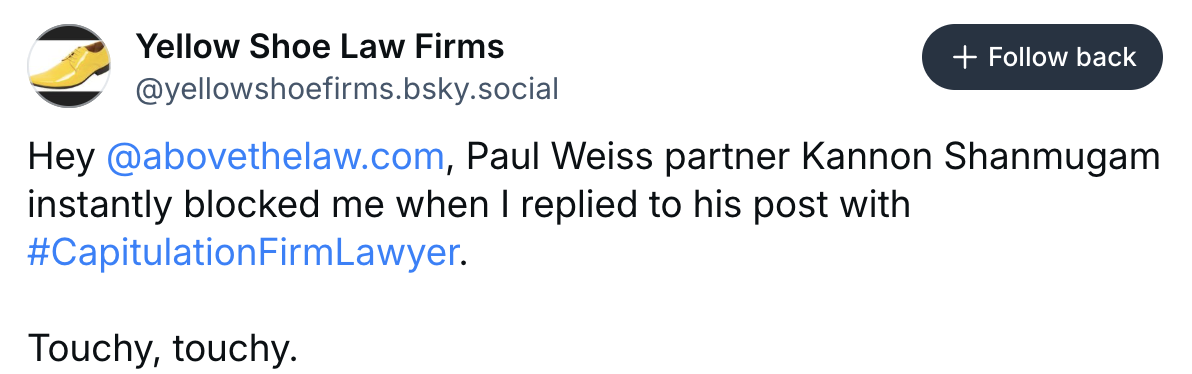
retaliation,
engaged
with
a
prominent
Paul
Weiss
partner
and
got
immediately
blocked.

No
one
should
expect
a
partner
to
publicly
throw
the
firm
under
the
bus.
At
least
not
until
they’ve
sketched
out
an
escape
plan.
But
just
ignoring
a
critic
reply
is
free!
Instead,
we’ve
got
a

Streisand
Effect


an
example
of
the
reaction
creating
more
of
a
story
than
the
original
event.
We
almost
certainly
would
never
have
heard
about
it
again
if
he’d
just
ignored
the
hashtag.

But
it
seems
the
“Capitulation
Firm”
branding
strikes
a
nerve
over
there.

Would
be
a
shame
if
people
kept
calling
it
out
on
social
media…


HeadshotJoe
Patrice
 is
a
senior
editor
at
Above
the
Law
and
co-host
of

Thinking
Like
A
Lawyer
.
Feel
free
to email
any
tips,
questions,
or
comments.
Follow
him
on Twitter or

Bluesky

if
you’re
interested
in
law,
politics,
and
a
healthy
dose
of
college
sports
news.
Joe
also
serves
as
a

Managing
Director
at
RPN
Executive
Search
.

Zanu PF can legally extend Mnangagwa’s term without a referendum: Prof Moyo

According
to
Prof
Moyo,
this
precedent
means
Zanu
PF
can
lawfully
amend
section
95(2)(b)
of
the
Constitution
by
changing
the
president’s
‘term
length’
from
five
to
seven
years,
extending
it,
for
example,
through
a
two-thirds
parliamentary
majority
so
President
Mnangagwa
can
reach
their “Vision
2030”
agenda.


Prof
Moyo
on
his
X
page
argued 
that
the
“term‑limit”
clause
(Section 91 (2))
limits
the
number
of
terms
a
person
may
serve,
not
the
duration
of
each
term
and
adjusting
the
duration
(Section 95 (2)(b))
can
be
done
by
a
two‑thirds
parliamentary
majority
(Section 328 (5)).

Moyo’s
main
argument
rests
on
the
difference
between
“term
limits”
and
“term
lengths.”
He
noted
that
criticism
from
opposition
politicians
such
as
David Coltart
on
term
limits
is
mistaken
because
they
mix
up
two
different
parts
of
the
constitution.

Quoting
sections
328
(6),(7),
(8)
and
(9)
of
the
constitution
on his
X
page,
Coltart
had
written
 
extending
the
president’s
term
would
require
two
national
referendums,
as
the
constitution
clause
on
term
limits
caps
how
long
a
person
can
stay
in
office,
so
any
extension
must
be
voted
for
by
people
in
a
referendum

“The
term
limit
provisions
are
specially
protected
as
are
provisions
in
Chapter
4
(fundamental
rights)
and
16
(land
provisions).
The
wording
of
328(7)
is
critical

“the
effect
of
which
is
to
extend”
makes
it
clear
that
even
if
another
term
isn’t
sought
(that
is,
just
an
extension
of
a
few
years)
any
such
constitutional
amendment
must
go
beyond
a
mere
two
thirds
majority
and
must
have
two
referenda
where
it
involves
an
incumbent,”
Coltart
said.

“It
is
simply
disingenuous
for
anyone
to
suggest
that
the
Zanu
PF
resolution
in
Bulawayo
last
year
calling
for
an
extension
of
President
Mnangagwa’s
term,
or
a
further
term
of
office,
can
lawfully
circumvent
the
two
referenda
provision.”

However,
Prof
Moyo
said
Coltart
had
confused
the
two,
explaining
that
a
term
limit
restricts
how
many
times
a
person
can
hold
office,
currently
two
terms
for
a
president,
while
a
term
length
simply
defines
how
long
each
term
lasts,
such
as
five
years.

Prof
Moyo
pointed
to
the
2021
Constitutional
Court
decision
in
Marx Mupungu
versus
 Minister
of
Justice
as
the
key
precedent,
where
it
ruled
term‑limit
provisions
fixed
caps
on
how
many
terms
an
individual
may
hold
a
post,
that
is
a
president
may
serve
only
two
terms
and
that
requires
a
referendum
to
change
but
the
length
of
a
single
term
for
an
office,
that
is
a
five‑year
presidential
term
can
be
altered
by
Parliament
alone.

“Applied
to
section
95(2)(b),
the
five-year
presidential
term
of
office
is
inherently
variable:
It
‘extends
until’
events
like
resignation,
removal,
or
parliamentary
dissolution,
mirroring
the
contingent
logic
in
the
Mupungu
case.
This
provision
outlines
the
office’s
maximum
framework
(which
is
five
years);
it
is
not
a
personal
cap
on
the
President
as
a
‘public
officer,’”
said
Prof
Moyo.

“The
Constitution’s
sole
presidential
term
limit
on
the
officeholder
lies
in
section
91(2)’s
two-term
bar,
which
would
remain
untouched
by
a
term
length
amendment
to
section
95(2)(b).”

Because
Zanu
PF’s
October 2024
“Resolution Number 1”
concluded
in
its
congress
in
Bulawayo
seeks
to
amend
section 95 (2)(b)
– 
the
clause
that
sets
the
presidential
term
at
five
years,
Prof
Moyo
claimed
the
move
is
fully
permissible
under
the
constitution.

Prof
Moyo
said
Parliament
could
simply
pass
a
bill
with
a
two‑thirds
majority
in
both
houses,
extending
the
term
to,
say,
seven
years,
and
the
president
could
stay
in
office
until
2030.
No
referendum
would
be
needed.

“Amending
Section
95(2)(b)
to
seven
years,
for
instance,
would
simply
recalibrate
this
flexible
duration,
enabling
the
extension
to
2030
via
a
two-thirds
vote
in
each
House
in
Parliament
-free
from
the
“dictates”
of
Sections
328(6)–
(9),”
he
said.

Prof
Moyo
said
several
countries,
such
as
Guinea
and
Ireland,
already
have
seven-year
presidential
terms
without
violating
democratic
principles,
suggesting
Zimbabwe
could
follow
suit.

“If
a
president
resigns
after
two
years,
his
or
her
successor
serves
only
the
remaining
three,
not
a
full
five.
This
underlines
the
office’s
contingent
nature.
The
true
‘term
of
officer’
limit
appears
solely
in
Section
91(2),
which
caps
re-eligibility
of
incumbents
at
two
terms
(with
three
or
more
years
counting
as
a
full
term)
but
imposes
no
upper
ceiling
on
term
duration
-allowing
for
four,
five,
seven,
or
more
years
as
may
be
rationally
and
democratically
justifiable,”
he
said.

“Recent
examples
abound:
Guinea
just
adopted
a
seven-year
presidential
term
on
21
September
2025,
while
Ireland
has
for
decades
maintained
a
seven-year
presidential
term
capped
at
two
terms.”

Political
analyst,
Mxolisi
Ncube,
said
these
were
signs
of
creeping
authoritarianism,
where
the
ruling
party
is
testing
constitutional
loopholes
to
prolong
its
stay
in
power
and
called
for
vigilance

“The
practical
impact
of
this
is
if
Zanu
PF’s
resolution
passes,
President
Mnangagwa
could
remain
in
office
longer
without
a
public
vote,
provided
the
two‑term
limit
is
not
breached.
Any
amendment
extending
Mnangagwa’s
current
term
should
be
subject
to
broad
public
consultation,”
he
said.

Meanwhile,
a
comparative
constitutional
and
international
law
scholar
Dr
Justice
Mavedzenge
outlined
another
potential
political
manoeuvre
where
President
Mnangagwa
could
resign
before
completing
three
years
of
his
current
term,
triggering
the
provisions
of
Sections
100
and
101
of
the
Constitution,
which
allow
a
vice
president
to
act
as
president
until
Zanu
PF
nominates
a
replacement
to
complete
the
term.

He
said
this
constitutional
loophole
can
extend
President
Mnangagwa’s
stay
in
power
beyond
2028
without
formally
amending
the
Constitution.

Speaking
during
one
of
CITE’s
This
Morning
Asakhe
X
Space
discussion
titled
“Vision
2030
or
Power
Extension:
Decoding
Zanu
PF
Endorsements,”
Dr
Mavedzenge
said
certain
provisions
in
Zimbabwe’s
Constitution
could
be
strategically
interpreted
to
allow
President
Mnangagwa
to
remain
politically
relevant
up
to
2030.

“A
constitution
is
only
powerful
to
the
extent
that
its
owners,
the
citizens,
know
about
it,”
said
Dr
Mavedzenge.

“I
wrote
about
this
issue
on
my
blog,
trying
to
unpack
what
Zanu
PF
Harare
provincial
chairperson
(Godwills
Masimirembwa)
meant
when
he
said
Zanu
PF
will
achieve
Vision
2030
without
a
national
referendum.
I
grappled
with
that
because
I
wanted
to
find
out
what
it
is.
Is
he
just
mad
or
is
he
on
to
something?
And
I
found
something.”

Dr
Mavedzenge
said
the
key
lies
in
Sections
91,
100
and
101
of
the
Constitution,
which
together
define
how
presidential
terms
are
measured
and
what
happens
when
a
president
leaves
office.

“The
Constitution
says
that
a
full
term
for
the
president
is
anything
from
three
years
and
above.
If
a
president
serves
less
than
three
years,
that
period
is
not
considered
a
full
term,”
he
explained.
“If
President
Mnangagwa
were
to
serve
only
up
to
around
September
2026,
that
would
not
count
as
a
full
term,
making
him
constitutionally
eligible
to
contest
again.”

Dr
Mavedzenge
said
if
the
president
were
to
resign
before
completing
three
years
of
his
current
term,
triggering
the
provisions
of
Sections
100
and
101,
that
allows
a
vice
president
to
act
as
president
until
Zanu
PF
nominates
a
replacement
to
complete
the
term.

“I
imagine
what
the
party
could
potentially
do
is
engage
Section
101
and
100,
allowing
one
of
the
vice
presidents
to
act
as
president
while
the
party
nominates
a
substantive
replacement
to
serve
out
the
remainder,”
he
said.
“When
I
first
wrote
this,
it
sounded
crazy,
and
my
colleagues
said
it
was
risky
and
impossible.
But
the
more
I
look
at
what
is
happening
in
Zanu
PF
today,
the
more
I
feel
I
might
be
correct.”

He
said
recent
political
developments,
including
speculation
about
a
reconfiguration
of
the
vice
presidency,
suggest
possible
preparations
for
such
a
scenario.

“When
you
look
at
this
idea
of
trying
to
reconstitute
the
presidency,
bringing
in
figures
like
(businessman
Kuda)
Tagwirei
as
potential
vice
presidents
and
the
pushback
against
Vice
President
Constantino
Chiwenga,
I
get
the
sense
that
what
the
2030
campaigners
are
doing
is
to
also
try
and
reconfigure
the
office
of
the
vice
president,”
he
noted.

Dr
Mavedzenge
added
this
could
make
it
possible
for
President
Mnangagwa
to
temporarily
leave
office
between
September
2026
and
return
in
2028
ahead
of
the
next
election,
with
a
temporary
placeholder
in
between.

“In
order
to
make
it
a
possibility
that
President
Mnangagwa
can
have
the
option
of
temporarily
leaving
the
office
between
September
2026
and
coming
back
in
September
2028
when
the
next
elections
are
due
and
Zanu
PF
will
have
a
temporary
placeholder.”

Dr
Mavedzenge
acknowledged
that
such
a
move
would
be
politically
risky,
as
power
vacuums
often
shift
loyalties
but
said
it
was
still
a
scenario
worth
considering
seriously.

Of
course,
we
have
to
accept
that
that
is
risky
because
in
politics,
loyalties
shift.
But
I
want
us
to
think
about
that
as
well
as
a
possibility.
I’m
not
saying
and
I’m
still
not
even
myself
convinced
that
is
a
viable
way
of
achieving
2030. 
But
it
is
important,
I
emphasize
to
think
about
that
and
also
say
if
we
are
going
to
work
to
defend
our
constitution.”

He
further
warned
Zimbabwe’s
constitutional
protections
remain
vulnerable
because
the
institutions
meant
to
uphold
them,
the
judiciary,
civil
society
and
opposition,
are
weak
or
compromised.

“A
good
constitutional
text
such
as
what
we
have
must
be
supported
by
an
independent
judiciary,
which
I
think
there
are
doubts
about
the
independence
of
the
Zimbabwean
judiciary,
especially
when
it
comes
to
deciding
on
politically
sensitive
cases.
The
second
is
that
a
good
constitution
such
as
ours
needs
to
be
supported
by
a
strong
civil
society.
And
I
think
our
civil
society
at
the
moment
is
quite
in
a
very
difficult
situation,”
he
said.

“Civic
space
or
democratic
space
has
been
closed,
but
also
inadequate
resources.
But
also,
I
think
there
have
been
attempts
to
capture
civil
society
itself.
So
we
currently
have
a
very
weak
civil
society.
You
also
have
to
have
a
very
strong
opposition…But
the
fact
is
we
don’t
have
a
strong
opposition.

Dr
Mavedzenge
urged
citizens
to
focus
not
only
on
political
outcomes
but
on
the
“infrastructure
of
democracy”
that
sustains
constitutionalism.

“Without
the
infrastructure
of
a
strong
opposition,
a
strong
civil
society,
independent
courts,
the
constitution
is
meaningless.
So
we
have
to
pay
attention
to
the
infrastructure.
Democracy
is
a
good
thing,
but
democracy
only
works
if
the
infrastructure
to
defend
it
is
in
place,”
he
said.