In
this
episode,
I
chat
with
Marc
Brown,
a
dynamic
attorney
and
Big
Dave’s
Cheesesteaks
franchise
owner.
Marc
opens
up
about
his
non-linear
career
path
from
Biglaw
to
founding
his
own
successful
firm,
sharing
insights
on
the
fulfilling
shift
to
plaintiff’s
work
and
the
challenges
of
running
a
business.
Aspiring
lawyers
and
entrepreneurs
alike
will
find
inspiration
in
Marc’s
journey
of
pursuing
passion
over
convention
and
learning
to
balance
career
and
life.
Tune
in
for
a
mix
of
legal
wisdom
and
the
secret
to
a
perfect
cheesesteak!
Episode
Highlights
Childhood
dream
of
becoming
a
lawyer
Reality
vs.
TV
portrayal
of
law
work
Unplanned
career
path:
Starting
a
law
firm
Shift
from
Biglaw
to
plaintiff’s
work
Dealing
with
emotionally
challenging
cases
Transition
to
owning
a
law
firm
Lessons
from
running
a
personal
injury
firm
Challenges
of
starting
a
new
practice
Importance
of
experience
before
starting
a
firm
Franchise
opportunity
with
Big
Dave’s
Balancing
multiple
business
ventures
Career
highlight:
Marc
Brown
Legal
Minute
Learning
from
career
lows
and
losses
The
Jabot
podcast
is
an
offshoot
of
the
Above
the
Law
brand
focused
on
the
challenges
women,
people
of
color,
LGBTQIA,
and
other
diverse
populations
face
in
the
legal
industry.
Our
name
comes
from
none
other
than
the
Notorious
Ruth
Bader
Ginsburg
and
the
jabot
(decorative
collar)
she
wore
when
delivering
dissents
from
the
bench.
It’s
a
reminder
that
even
when
we
aren’t
winning,
we’re
still
a
powerful
force
to
be
reckoned
with.
Happy
listening!
Kathryn
Rubino
is
a
Senior
Editor
at
Above
the
Law,
host
of
The
Jabot
podcast,
and
co-host
of
Thinking
Like
A
Lawyer.
AtL
tipsters
are
the
best,
so
please
connect
with
her.
Feel
free
to
email
her
with
any
tips,
questions,
or
comments
and
follow
her
on
Twitter
@Kathryn1 or
Mastodon
@[email protected].
Cadwalader
Wickersham
&
Taft,
long
viewed
as
a
stalwart
of
Wall
Street
law
firms,
now
seems
to
be
scrambling
to
steady
its
ship.
Already
battling
turbulence,
the
firm
just
shook
the
table
again
—
this
time,
by
naming
a
new
co-managing
partner
in
the
midst
of
mass
partner
exits
and
swirling
merger
chatter.
The
timing,
and
optics,
are
hard
to
ignore.
As
noted
by
the
American
Lawyer,
the
firm
recently
announced
the
appointment
of
Wesley
Mission,
the
firm’s
finance
group
chair,
to
assist
Patrick
Quinn,
the
firm’s
longtime
managing
partner.
The
firm
hasn’t
had
a
co-managing
partner
in
a
decade.
In
a
memo
to
partners,
Quinn
said
that
Mission
“has
been
serving
alongside
me
effectively
as
co-managing
partner,
and
I’m
thrilled
that
he
has
agreed
formally
[to]
take
on
the
role.”
So
what,
exactly,
is
Mission’s
mission
at
CWT?
The
addition
of
a
co-managing
partner
may
suggest
the
firm
is
hedging
its
bets
in
an
attempt
to
stop
the
bleeding.
Over
the
past
several
months,
Cadwalader
has
lost
more
than
40
partners
to
competitor
firms,
with
high-profile
defections
hitting
core
practices.
Many
of
these
moves
are
reportedly
tied
to
internal
dissatisfaction
over
the
firm’s
controversial
agreement
with
the
Trump
administration,
in
which
CWT
pledged
$100
million
in
pro
bono
payola
to
help
avoid
punitive
executive
orders.
Some
partners
viewed
the
deal
as
a
capitulation,
prompting
their
resignations
in
protest.
This
talent
drain
caused
merger
rumors
to
swirl,
and
perhaps
the
firm
hopes
that
Mission’s
appointment
will
stem
further
partner
loss,
reestablish
confidence
in
Cadwalader’s
platform,
and
manage
—
or
at
least
resist
—
further
merger
overtures.
Earlier
this
month,
the
firm
offered
Am
Law
the
following
comment
on
its
speculated
merger
plans:
According
to
a
firm
leader,
“Cadwalader
has
received
inbound
interest
from
multiple
firms
over
the
years,
but
is
not
currently
engaged
in
merger
discussions.”
The
leader
added
that
the
firm
considers
all
strategic
opportunities
that
are
best
for
it
and
its
clients.
In
short,
Cadwalader’s
announcement
of
a
co-managing
partner
is
as
much
a
firefight
as
it
is
a
renewal.
The
firm
is
attempting
to
reassert
control
amid
spiraling
exits
and
uncertainty.
What
will
matter
most
here,
however,
is
whether
Mission
and
leadership
can
engineer
a
coherent
recovery
—
or
whether
Cadwalader
will
be
forced
into
a
merger
by
necessity,
not
choice.
Staci
Zaretsky is
the
managing
editor
of
Above
the
Law,
where
she’s
worked
since
2011.
She’d
love
to
hear
from
you,
so
please
feel
free
to
email
her
with
any
tips,
questions,
comments,
or
critiques.
You
can
follow
her
on Bluesky, X/Twitter,
and Threads, or
connect
with
her
on LinkedIn.
Draftable’s
simple
design
and
reliable
performance
takes
the
stress
out
of
redlining
and
summarising
changes.
It’s
closing
in
on
midnight,
and
instead
of
watching
that
movie
you
planned,
you’re
toggling
between
three
windows
on
your
laptop.
Jittery
after
your
third
cup
of
coffee,
you’re
trying
to
reconcile
the
“final-final-v7-clean.docx”
version
of
a
1,000-page
contract
a
partner
sent
before
dinner.
The
deadline
to
file
is
tomorrow.
The
redlines
are
chaotic,
the
PDF
formatting
is
jumping
all
over
the
place,
and
the
software
keeps
crashing.
Hanging
over
it
all
is
the
dread
that
a
single
missed
change
will
blow
the
deal.
That’s
exactly
the
situation
the
fastest-growing
document
comparison
tool
Draftable
was
built
to
resolve.
“Every
lawyer
has
lived
that
pain,”
said
Caspar
Roxburgh,
product
lead
at
Draftable.
“Our
goal
was
to
make
sure
they
never
have
to
again.”
Unlike
other
legal
tech
that
tries
to
do
everything,
Draftable
focuses
on
one
thing:
making
document
comparison
seamless.
The
software
doesn’t
need
hours
of
training,
and
it
doesn’t
overwhelm
you
with
features
you
don’t
need.
And
with
its
newest
upgrade,
redlining
directly
in
email,
it
has
become
even
more
useful.
“We’ve
been
demoing
this
new
feature
at
conferences
and
firms
are
saying,
‘I
want
everyone
in
my
firm
to
have
this.
This
is
something
I
need,’”
Roxburgh
said.
He
noted
these
features
also
come
at
a
more
affordable
price
than
any
competing
software.
More
than
900
law
firms
globally
have
already
switched
to
Draftable,
including
leading
firms
like
Allens,
Brodies
and
Mills
&
Reeve.
So
read
ahead
for
a
quick
primer.
Getting
Started
The
simple
interface
of
Draftable
is
designed
to
mimic
familiar
software
to
clearly
show
lawyers
what
changed
between
two
documents.
Users
upload
two
versions
of
a
file
and,
with
a
single
click,
the
software
highlights
the
differences.
Photo:
Courtesy
of
Draftable.
Draftable
offers
more
than
25
ways
to
upload
documents,
letting
lawyers
work
exactly
how
they
like.
You
can
drag
and
drop
files,
browse
from
your
desktop,
right-click
or
pull
them
straight
from
iManage,
NetDocuments,
SharePoint
or
other
web-based
software.
There’s
also
quick
access
to
recently
compared
files
and
even
the
option
to
paste
text.
The
software
integrates
with
Word,
Excel,
Outlook
and
other
everyday
tools,
“almost
pedantic”
in
the
number
of
paths
it
offers,
Roxburgh
said.
But
that’s
the
point.
“It’s
part
and
parcel
of
trying
to
build
something
that
time-poor
lawyers
need
to
just
work,
and
everyone’s
got
their
own
way
of
doing
things,”
he
said.
No
Regrets
Design
Once
the
software
runs
the
comparison,
lawyers
can
review
the
changes
in
several
ways,
depending
on
their
preference.
A
drop
down
menu
offers
the
choice
to
redline
in
Draftable
directly,
using
track
changes
in
Word,
as
a
side
by
side
comparison
and
in
a
departures
table.
In
the
side
by-side
comparison,
for
instance,
the
original
appears
on
the
left,
the
modified
on
the
right,
and
changes
are
highlighted
in
a
customizable,
color-coded
display.
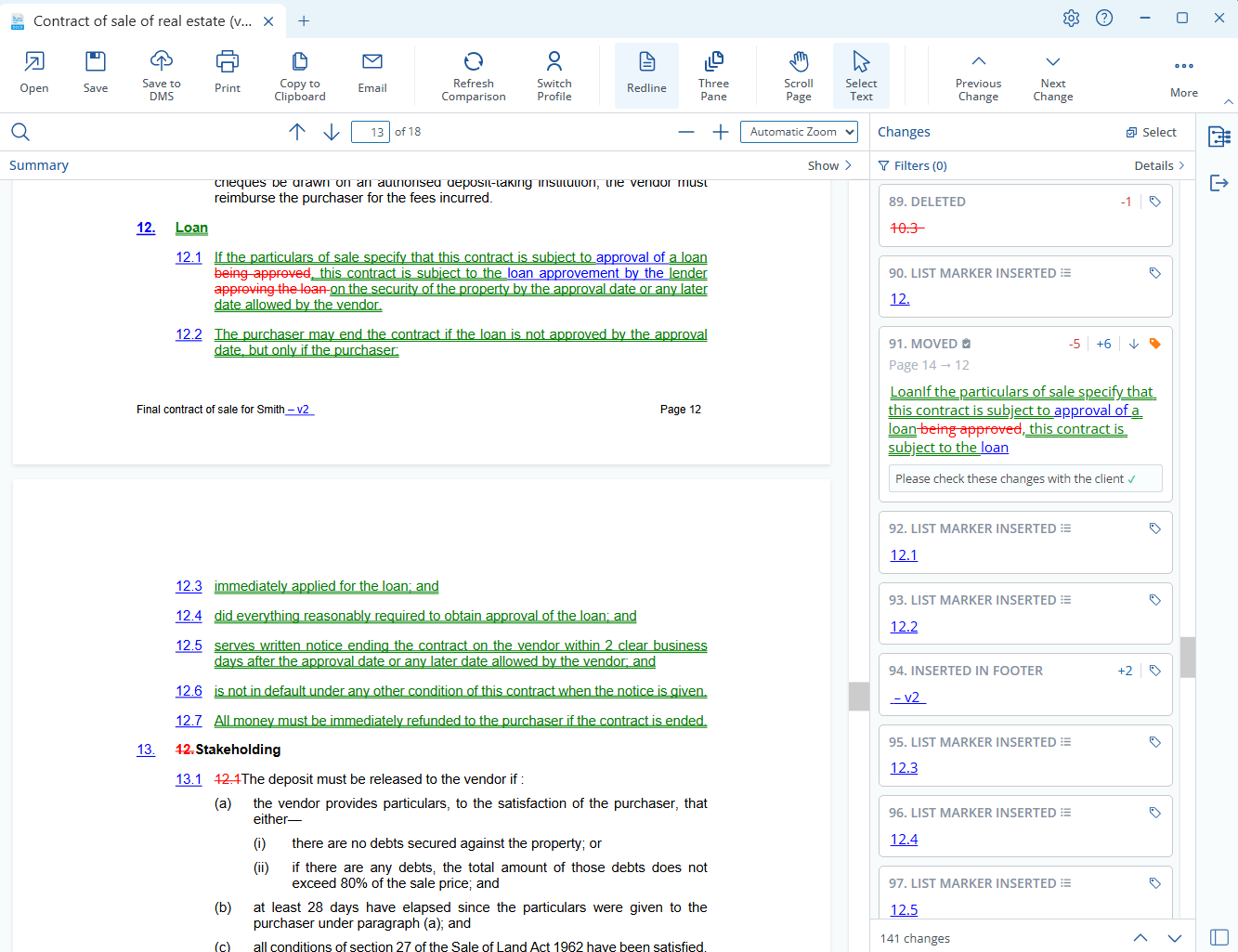
A
sidebar
on
the
right
highlights
each
change,
with
the
ability
to
tag
or
make
a
note.
Photo:
Courtesy
of
Draftable.
Lawyers
can
scroll
through
a
long
agreement
or
jump
directly
to
specific
sections
where
edits
appear.
The
report
can
be
saved
as
a
PDF
for
sharing,
or
exported
into
Word
for
further
markup.
Once
documents
are
uploaded,
the
software
creates
several
comparison
types
simultaneously,
so
users
can
select
their
preferred
view.
The
interface
is
deliberately
simple,
which
is
part
of
the
design
philosophy.
Roxburgh
said
users
should
never
have
regrets
about
having
made
the
wrong
decision
in
their
workflow.
“Products
should
be
designed
in
a
way
where
you
don’t
have
to
go
backwards,”
he
said.
“You
maintain
the
flexibility
to
allow
people
to
flow
through
the
product
to
get
the
outcome
they
want.”
Once
the
changes
are
reviewed,
it
provides
the
option
to
save
or
send
only
what
you
need
to
your
colleagues.
For
instance,
users
could
select
to
export
only
the
redline
and
departures
table
of
the
modified
file
as
an
email.
The
goal
is
to
give
lawyers
immediate
confidence
in
what
has
changed,
without
the
distraction
of
irrelevant
noise.
Photo:
Courtesy
of
Draftable.
Redline
in
Email
The
newest
feature
most
firms
are
buzzing
about—only
released
in
May
2025—is
Draftable’s
ability
to
handle
redlines
directly
in
email.
Imagine
a
long
email
negotiation
among
a
few
lawyers.
Someone
says,
“Yep,
see
my
changes
below.”
But
they
haven’t
visually
indicated
the
changes.
Instead
of
having
to
compare
each
email
in
a
thread
of
dozens,
Draftable’s
integration
with
Outlook
compares
emails
in
the
thread
to
highlight
the
differences.
Clicking
the
menu
that
says
“Compare
against
an
earlier
email”
automatically
tries
to
select
the
right
one.
Or
users
can
select
a
specific
email
or
compare
it
against
the
first
email
they
sent.
Photo:
Courtesy
of
Draftable.
“This
is
hugely
valuable
because
Outlook
can’t
do
this
on
its
own,”
Roxburgh
said.
“We’re
using
Draftable’s
algorithm
with
all
that
ability
to
detect
moves
and
granularity.”
Then
users
can
accept
or
reject
changes
directly
in
the
email.
A
Faster
Departures
Table
Another
of
Draftable’s
standout
features
is
how
it
handles
departures
tables.
Instead
of
asking
lawyers
to
comb
through
a
full
redline,
the
software
pulls
out
the
relevant
changes
and
lays
them
out
in
a
structured
table
format.
“Realistically,
most
people
looking
at
what’s
changed
in
an
agreement
aren’t
reading
the
full
agreement,”
he
said.
“They’re
reading
a
summary
someone
else
has
created.”
Traditionally,
that
summary
takes
hours.
An
associate
has
to
review
the
redline,
copy
the
relevant
text
into
Word,
paste
it
into
a
table,
and
add
notes
on
what
the
change
means
and
whether
it
goes
back
to
the
client.
Draftable
automates
the
entire
process
with
a
single
command.
Photo:
Courtesy
of
Draftable.
Lawyers
can
choose
how
much
detail
to
include—every
change,
or
just
those
marked
as
important—and
the
table
can
be
shared
as
a
Word
or
Excel
document
or
dropped
straight
into
the
body
of
an
email.
That
means
a
senior
partner
doesn’t
have
to
wait
for
a
manual
summary
before
weighing
in.
They
can
see
the
substance
of
the
edits
instantly.
More
to
come
in
2025—for
half
the
money
Roxburgh
said
Draftable
isn’t
stopping
there.
In
the
next
several
months
they
plan
performance
upgrades
that
will
speed
comparisons
and
improve
their
already
stellar
PDF
comparison
tool.
A
modernized
user
experience
will
include
improved
settings,
new
add-ins
for
Microsoft
Office
and
capability
in
German
and
French.
And
perhaps
most
significantly
for
Mac
users,
Draftable
is
working
on
a
web
application
that
can
be
used
on
any
operating
system
and
browser.
That’s
besides
providing
empathetic
customer
support
with
real
humans
at
a
transparent,
fair
price.
“We’re
less
than
half
the
cost
of
our
competitor
and
we
actually
offer
more
functionality,
but
it’s
a
deliberate
choice,”
Roxburgh
said.
“We’re
doing
something
really
boring—building
good
products,
supporting
it
well
and
charging
a
fair
price
for
it.
It’s
not
rocket
science,
but
lawyers
love
it.”
On
September
8,
the
Supreme
Court
effectively
legalized
racial
profiling.
Naturally,
they
did
it
on
the
shadow
docket,
in
a
one-paragraph
order
in
which
five
of
the
six
conservative
justices
voted
to
stay
a
trial
judge’s
order
“pending
the
disposition
of
the
appeal
in
the
United
States
Court
of
Appeals
for
the
Ninth
Circuit
and
disposition
of
a
petition
for
a
writ
of
certiorari,
if
such
a
writ
is
timely
sought.”
So
far,
so
blahblahblah.
But
Justice
Kavanaugh,
likely
stinging
from
criticism
of
the
Supreme
Court’s
unexplained
shadow
docket
rulings,
took
it
upon
himself
to
explain
that
the
conservative
justices
are
very
definitely
greenlighting
racial
profiling.
Kavanaugh
imagined
a
cheerful
exchange,
wherein
ICE
agents
politely
ask
for
confirmation
of
citizenship
and
are
quickly
on
their
way.
“The
questioning
in
those
circumstances
is
typically
brief,
and
those
individuals
may
promptly
go
free
after
making
clear
to
the
immigration
officers
that
they
are
U.
S.
citizens
or
otherwise
legally
in
the
United
States,”
he
insisted,
despite
extensive
evidence
that
ICE
agents
are
tackling
every
brown
person
they
see
and
locking
up
a
lot
of
citizens
who
fail
to
“make
clear”
their
right
to
walk
down
the
street
in
a
fashion
that
satisfies
a
pack
of
glorified
bounty
hunters.
NEW:
ICE
agents
violently
arrested
a
man
in
a
busy
Hyattsville,
MD
intersection
this
week,
at
one
point
brandishing
guns
and
pointing
them
at
bystanders.
I
spoke
to
multiple
witnesses—including
a
local
priest
whose
church
is
a
sanctuary
for
undocumented
people:
www.thehandbasket.co/p/ice-agents…
Apparently
the
Fourth
Amendment
no
longer
applies
to
“detentive
stops,”
since
all
that’s
required
for
reasonable
suspicion
of
a
crime
these
days
is
speaking
Spanish
at
Home
Depot.
So
now
plaintiffs
have
filed
a
new
lawsuit
pointing
out
that
what
ICE
is
doing
is
not,
in
fact,
briefly
detaining
people.
It’s
arresting
them,
without
probable
cause
and
illegally
holding
them
for
days
on
end.
How
will
SCOTUS
justify
that
one?
Vasquez
Perdomo
v.
Noem
The
Supreme
Court’s
racial
profiling
order
stayed
an
injunction
by
US
District
Judge
Maame
Frimpong,
who
worked
from
the
uncontroversial
premise
that
ICE
agents
cannot
detain
an
individual
without
reasonable
suspicion
that
he
committed
a
crime.
All
parties
agree
that
race
alone
cannot
form
the
basis
for
reasonable
suspicion.
But
Judge
Frimpong
disagreed
with
the
government’s
position
that
mixing
race
with
some
other
general
characteristic,
like
working
in
construction,
miraculously
transforms
it
into
a
legal
basis
for
reasonable
suspicion.
Specifically
she
barred
DHS
from
detaining
people
based
on
these
four
factors
“alone
or
in
combination”:
i.
Apparent
race
or
ethnicity;
ii.
Speaking
Spanish
or
speaking
English
with
an
accent;
iii.
Presence
at
a
particular
location
(e.g.
bus
stop,
car
wash,
tow
yard,
day
laborer
pick
up
site,
agricultural
site,
etc.);
or
iv.
The
type
of
work
one
does
But
Justice
Kavanaugh
said
that
RACE
+
LOCATION
(OR
LAWN
MOWER)
makes
it
legal
for
ICE
to
grab
up
every
brown
person
outside
a
Home
Depot.
He
began
by
stating
as
fact
that
one
in
ten
people
in
Los
Angeles
is
an
undocumented
immigrant
and
that
immigrants
cause
“significant
economic
and
social
problems.”
He
cited
no
evidence
for
the
first,
and
the
second
is
dicta
from
a
fifty-year-old
Supreme
Court
case
called
US
v.
Brignoni-Ponce
—
fair
evidence
that
Kavanaugh
knows
he’s
building
his
house
on
a
pack
of
racist
cards.
Having
established
his
bigot
bona
fides,
he
went
on
to
reason
that
ICE
goons
need
not
have
reasonable
suspicion
that
an
individual
is
an
undocumented
immigrant;
a
mere
collection
of
demographic
probabilities
will
do
the
trick.
In
Brignoni-Ponce,
the
Court
held
that
“Driving
While
Mexican”
could
not
amount
to
reasonable
suspicion
for
a
traffic
stop
because
it
“would
subject
the
residents
of
these
and
other
areas
to
potentially
unlimited
interference
with
their
use
of
the
highways,
solely
at
the
discretion
of
Border
Patrol
officers.”
But
Kavanaugh
was
unbothered,
blithely
asserting
that,
under
“this
Court’s
precedents,
not
to
mention
common
sense,”
ICE
can
legally
stop
someone
for
being
a
Hispanic
landscaper
and
demand
proof
of
citizenship.
This
is
clearly
a
violation
of
the
Fourth
Amendment,
and
so
Kavanaugh
took
pains
to
downplay
the
interaction
as
a
mere
collegial
inquiry.
“If
the
person
is
a
U.
S.
citizen
or
otherwise
lawfully
in
the
United
States,
that
individual
will
be
free
to
go
after
the
brief
encounter,”
he
simpered.
“Only
if
the
person
is
illegally
in
the
United
States
may
the
stop
lead
to
further
immigration
proceedings.”
This
was
horseshit
when
he
wrote
it,
and
it’s
horseshit
now.
The
complaint
in
Vasquez
Perdomo
records
multiple
instances
of
ICE
physically
attacking
US
citizens
and
locking
them
up
for
hours
or
even
days.
That’s
not
a
“brief”
detention
—
it’s
an
arrest
without
anything
like
probable
cause.
Judge
Frimpong
described
Pedro
Vasquez
Perdomo,
a
US
citizen,
being
arrested
and
held
without
charge
for
at
least
two
days:
In
the
early
morning
of
June
18,
2025,
in
Pasadena,
California,
Vasquez
Perdomo
was
waiting
at
a
bus
stop
across
the
street
from
Winchell’s
Donuts
with
several
co-workers
to
be
picked
up
for
a
job.
About
four
cars
converged
on
his
location,
and
about
half
a
dozen
masked
agents
jumped
out
on
either
side
of
him.
They
had
weapons
and
masks,
and
did
not
identify
themselves.
Vasquez
Perdomo
tried
to
leave
but
was
surrounded,
grabbed,
handcuffed,
and
put
into
one
of
the
vehicles.
No
warrant
was
shown.
It
was
only
after
he
was
brought
to
a
nearby
CVS
parking
lot
that
agents
checked
Vasquez
Perdomo’s
identification.
Agents
did
not
inform
Vasquez
Perdomo
that
they
were
immigration
officers
authorized
to
make
an
arrest
or
of
the
basis
for
his
arrest.
At
the
time
this
action
was
filed,
Vasquez
Perdomo
had
been
transported
to
and
was
being
held
at
B-18.
There,
he
experienced
extremely
crowded
and
unsanitary
conditions,
was
given
little
to
eat
or
drink,
and
slept
on
the
floor.
In
fact,
hundreds
of
American
citizens
have
been
brutalized
and
arrested
in
these
supposedly
“brief
investigative
stops.”
They
include:
Army
veteran
George
Retes,
who
was
detained
in
California
for
three
days
without
being
allowed
to
speak
to
a
lawyer
or
even
take
a
shower
to
wash
off
the
pepper
spray
police
soaked
him
with
after
he
said
“I’m
a
citizen;”
19-year-old
Jose
Hermosillo,
who
was
detained
for
ten
days
in
Arizona
for
the
crime
of
walking
around
without
ID
while
Latino;
and
Illinois
man
Julio
Noriega,
who
was
cuffed
and
thrown
into
a
van
without
anyone
even
asking
about
his
citizenship,
and
only
released
ten
hours
later
after
ICE
bothered
to
look
in
Noriega’s
confiscated
wallet
and
found
his
ID.
US
citizens
have
no
obligation
to
walk
around
with
our
“papers,”
not
even
if
we
are
Hispanic
and
work
“in
certain
kinds
of
jobs,
such
as
day
labor,
landscaping,
agriculture,
and
construction,
that
do
not
require
paperwork
and
are
therefore
especially
attractive
to
illegal
immigrants,”
as
Justice
Kavanaugh
put
it.
None
of
this
is
legal,
regardless
of
the
citizenship
status
of
the
victim.
And,
by
the
by,
Kavanaugh’s
imagined
binary
—
citizen
or
“illegal”
immigrant
—
ignores
the
fact
that
hundreds
of
thousands
of
non-citizens
are
living
in
this
country
with
legal
status
as
students,
or
green
card
holders,
or
asylum
seekers.
How
are
they
supposed
to
prove
their
right
to
walk
down
the
street
unmolested
in
this
friendly
chat
of
Kavanaugh’s
daydreams?
Escobar
Molina
v.
Department
of
Homeland
Security
A
lawsuit
filed
Friday
in
DC
dispenses
with
the
justice’s
creative
fiction
that
ICE
is
making
a
“detentive
stop”
when
it
snatches
up
every
non-white
person
who
can’t
immediately
“prove”
their
citizenship
status
and
carts
them
off
in
shackles.
The
lead
plaintiff,
José
Escobar
Molina,
is
a
Salvadoran
immigrant
with
legal
status
who
was
walking
to
work
in
DC
on
August
21
when
“agents
arrested
him
without
a
warrant
and
without
asking
for
his
name,
his
identification,
or
anything
about
his
immigration
status.”
He
was
taken
to
Virginia
and
held
overnight
until
ICE
finally
realized
that
he
was
legal
and
released
him.
That
is
clearly
an
arrest
which
requires
probable
cause
to
believe
that
the
person
is
in
the
US
without
legal
status
and
that
he
is
likely
to
flee
in
the
time
that
it
takes
to
get
an
arrest
warrant.
Any
officer
or
employee
of
the
Service
authorized
under
regulations
prescribed
by
the
Attorney
General
shall
have
power
without
warrant
….
to
arrest
any
alien
who
in
his
presence
or
view
is
entering
or
attempting
to
enter
the
United
States
in
violation
of
any
law
or
regulation
made
in
pursuance
of
law
regulating
the
admission,
exclusion,
expulsion,
or
removal
of
aliens,
or
to
arrest
any
alien
in
the
United
States,
if
he
has
reason
to
believe
that
the
alien
so
arrested
is
in
the
United
States
in
violation
of
any
such
law
or
regulation
and
is
likely
to
escape
before
a
warrant
can
be
obtained
for
his
arrest,
but
the
alien
arrested
shall
be
taken
without
unnecessary
delay
for
examination
before
an
officer
of
the
Service
having
authority
to
examine
aliens
as
to
their
right
to
enter
or
remain
in
the
United
States;
The
plaintiffs
have
essentially
called
Kavanaugh’s
bluff:
If
the
Court
won’t
protect
immigrants
from
unlawful
detentions,
then
let’s
dispense
with
the
charade
that
these
are
“brief”
stops
and
acknowledge
that
they
are
dragnets
designed
to
arrest
every
non-white
person
in
a
particular
location
and
figure
out
at
some
future
hour
whether
they
have
committed
a
“crime.”
STFU,
Brett
Perhaps
Justice
Kavanaugh
will
learn
to
keep
his
mouth
shut
next
time
his
pals
try
to
put
out
an
indefensible
shadow
docket
order.
But
despite
the
fact
that
none
of
his
fellow
conservatives
signed
on
to
Kavanaugh’s
concurrence,
Kristi
Noem’s
pack
of
mangy
dogs
is
taking
it
as
carte
blanche
to
run
riot
in
the
streets.
“The
Supreme
Court’s
decision
is
evidence
of
the
fact
Border
Patrol
follows
the
Constitution
and
the
Fourth
Amendment,”
smirked
Gregory
Bovino,
the
Customs
and
Border
Patrol
official
who
supervised
the
ICE
dragnets
in
California.
The
New
York
Times
reports
that
Michele
Beckwith,
the
US
Attorney
for
the
Eastern
District
of
California,
was
fired
after
reminding
Bovino
that
he’d
need
reasonable
suspicion
to
detain
people
in
his
raid
on
Sacramento.
Within
five
hours
of
warning
Bovino
that
she
expected
“compliance
with
court
orders
and
the
Constitution,”
Beckwith
was
terminated
from
the
office
she’d
worked
in
for
15
years.
Meanwhile
on
BlueSky,
lawyers
are
calling
the
daily
barrage
of
violent
ICE
attacks
“Kavanaugh
stops,”
after
the
man
who
explained
that
they
were
very
cool
and
very
legal.
Let’s
see
whether
Kavanaugh
sticks
his
neck
out
again
to
explain
why
courts
are
simply
powerless
to
stop
the
government
from
locking
up
US
citizens
without
charge
for
days
on
end,
but
it’s
fine,
really
because
actually
…
…
Nope,
we
are
not
creative
(or
evil)
enough
to
come
up
with
a
way
to
paint
locking
human
beings
in
a
dungeon
is
merely
a
civil
exchange
of
pleasantries.
Over
to
you,
Brett.
Liz
Dye produces
the
Law
and
Chaos Substack and podcast.
You
can
subscribe
to
her
Substack
by
clicking
the
logo:
I
stayed
up
way
too
late
this
weekend making
history with
112,000+
other
people
at
the
largest
ticketed
concert
ever
held
in
the
U.S.
– Zach
Bryan at
the
Big
House.
I
was
visiting
my
son
who
is
a
junior
at
the
University
of
Michigan,
and
I
have
to
say
it
was
pretty
special
to
be
belting
out
lyrics
with
my
husband
and
children
at
the
top
of
our
lungs
amidst
thousands
of
fans
under
the
pink
skies
of
a
Michigan
sunset,
which
I’ve
hopefully taught
‘em
to
enjoy.
The
Big
House,
Ann
Arbor
(photo
by
Renee
Jefferson)
This
week
you
can
join
me
LIVE
at
an
event
featuring
my
book Shortlisted:
Women
in
the
Shadows
of
the
Supreme
Court hosted
by
the
Dallas
Allied
Bars
Equality
Committee
and
the
Dallas
Women
Lawyers
Association
on
Tuesday
from
noon-1PM
central.
Learn
more
and
register here.
Other
speakers
include Judge
Rebecca
Rutherford,
U.S.
District
Court
for
the
Northern
District
of
Texas
and Professor
Cheryl
Wattley (UNT
Dallas).
I’m
also
happy
to
share
a
recent
review
of Shortlisted.
Even
though
the
book
was
first
published
in
2020
with
a
paperback
update
in
2022,
the
themes
seem
to
resonate
now
more
than
ever.
Here’s
an
excerpt
from
the
review:
One
of
the
book’s
standout
features
is
its
meticulous
research
that
supports
the
authors’
arguments.
The
writing
style
strikes
a
remarkable
balance
between
academic
rigor
and
accessibility.
Even
as
someone
not
deeply
entrenched
in
the
intricacies
of
the
American
judicial
system,
I
found
the
explanations
clear
enough
to
engage
me
deeply.
The
first
half
unveils
a
narrative
steeped
in
history,
examining
how
female
presence
was
regarded
as
both
revolutionary
and
contentious—especially
in
a
time
when
presidents
would
endorse
women’s
suffrage
yet
remain
hesitant
to
genuinely
support
women
in
positions
of
power.
Notably,
the
authors
don’t
shy
away
from
the
complexities
that
arise
after
women
are
appointed.
The
challenges
they
present—such
as
balancing
familial
expectations
and
professional
responsibilities—are
all
too
relatable.
I
found
myself
reflecting
on
the
broader
implications
not
only
in
the
court
but
in
workplaces
everywhere,
as
women
juggle
identities
that
society
often
complicates
for
them.
Read
the
full
review here.
And
my
co-author Dean
Hannah
Brenner
Johnson (Southern
Illinois)
and
I
are
always
happy
to
speak
about
the
book.
We’ve
given
talks
to
a wide
range
of
audiences.
Please
reach
out
to
either
(or
both!)
of
us
if
you
have
an
engagement
in
mind.
Now
for
your
headlines.
I
can’t
blame
the
slow
start
to
my
Monday
only
on
my
late
night
concert
over
the
weekend.
I
am
definitely
still
recovering
from
the
onslaught
of
legal
ethics
news
from
the
past
week.
We
of
course
have
more
than
ten
headlines…so
let’s
turn
now
to
the
top
fifteen.
You
might
want
to
grab
a
cup
of
coffee
for
this
read.
☕️
Highlights
from
Last
Week –
Top Ten Fifteen
Headlines
#1 “If
the
Trump
administration
can
do
this,
then
no
American
is
safe
from
political
prosecution.” A
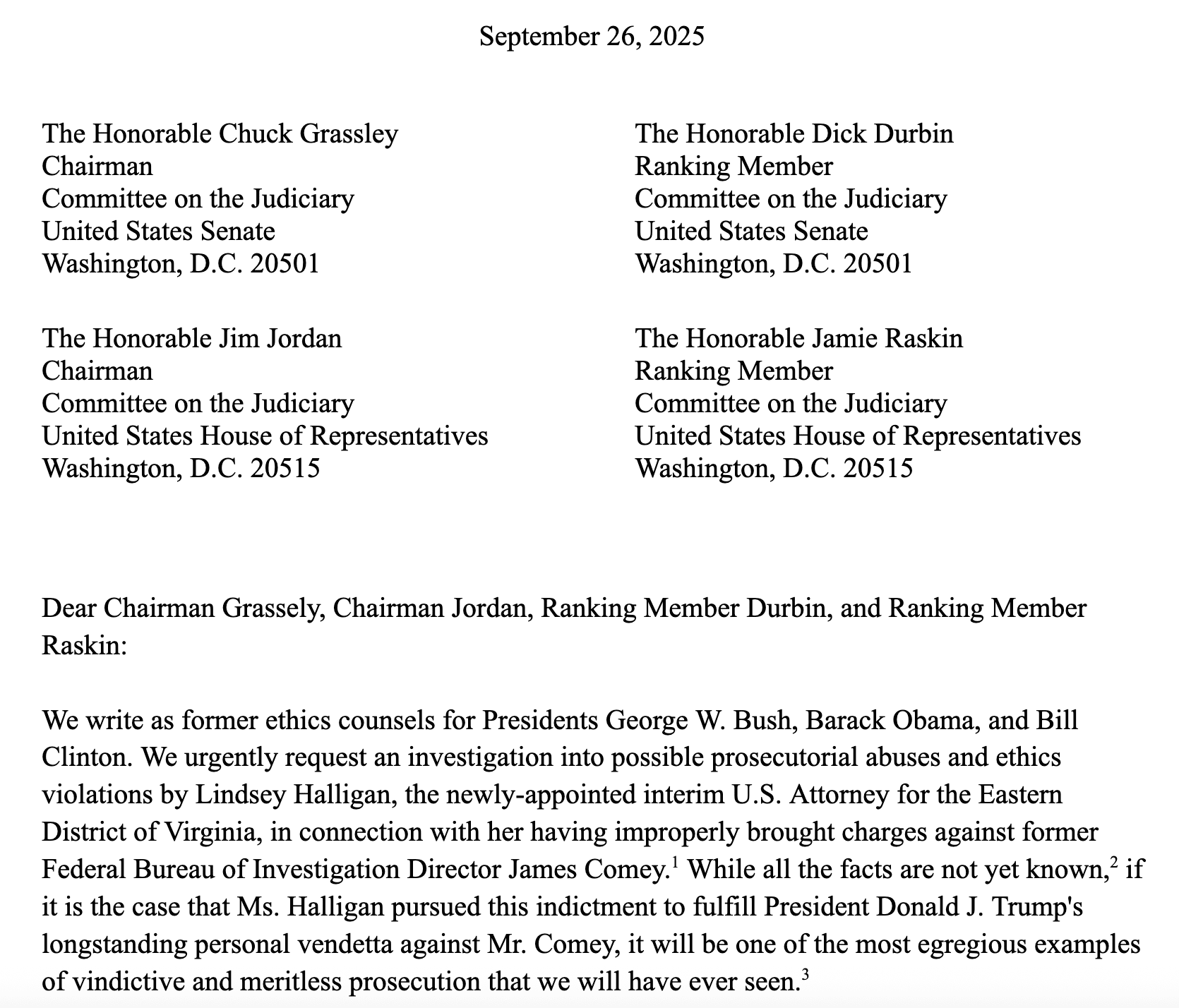
letter
to
Congress
from Norman
Eisen, Richard
Painter,
and Virginia
Canter:
“We
write
as
former
ethics
counsels
for Presidents
George
W.
Bush, Barack
Obama,
and Bill
Clinton.
We
urgently
request
an
investigation
into
possible
prosecutorial
abuses
and
ethics
violations
by Lindsey
Halligan,
the
newly-appointed
interim
U.S.
Attorney
for
the
Eastern
District
of
Virginia,
in
connection
with
her
having
improperly
brought
charges
against
former Federal
Bureau
of
Investigation
Director
James
Comey.
…
In
the
United
States,
a
president
should
never
order
prosecutions
of
his
enemies.”
Read
the full
letter
here and
an
op-ed
from
the
authors
published
on
MSNBC here.
#2
“‘At
Professional
Risk’:
Charging
Comey
Could
Land
Lindsey
Halligan
in
Hot
Water.” From Vanity
Fair: “An
ethics
professor
from
Halligan’s
law
school
warns
that
if
she
pursues
charges
against
the
former
FBI
director
without
probable
cause,
she
could
be
disciplined
by
the
Florida
bar.”
Read
more here.
#3“Newman
Makes
Full-Court
Press
in
Appeals
Challenge
of
Suspension.” From Bloomberg
Law: “Judge
Pauline
Newman,
the
country’s
oldest
active
federal
judge,
asked
the
full
D.C.
Circuit
to
reconsider
her
constitutional
challenge
to
the
law
her
colleagues
used
to
suspend
her
from
hearing
new
cases.
The
full
appellate
court
should
heed
a
three-judge
panel’s
implicit
invitation’
to
take
the
case
en
banc
and
revisit
a
precedent
preventing
the
court
from
considering
Newman’s
arguments
on
the
merits,
she
argued
in
a petition filed
Sept.
19
at
the
US
Court
of
Appeals
for
the
District
of
Columbia
Circuit.
The
panel
in
August
upheld
a
D.C.-based
district
court’s
dismissal
of
Newman’s
lawsuit
seeking
reinstatement.”
Read
more here.
#4
“Amy
Coney
Barrett
Explains
Why
She
Won’t
Explain
Her
Recusals.” From Politico: “Justice
Amy
Coney
Barrett indicated
Thursday
that
one
reason
she
chooses
not
to
explain
why
she
recuses
herself
from
cases
for
ethics
reasons
is
because
her
friends
or
family
could
face
unwanted
public
attention,
threats
or
worse.
The
comments
from
Barrett
are
a
rare
sign
that
a
recent
surge
in
threats
against
judges
and
their
families
are
affecting
how
members
of
the
Supreme
Court
carry
out
their
official
duties.
During
a
stop
in
Washington
to
promote
her
new
book,
Barrett
was
asked
why
some
justices
explain
their
decisions
to
recuse
from
cases,
while
others
don’t.”
Read
more here.
#5
“I
Sought
to
Protect
an
Immigrant
Legal
Client.
Instead,
I’m
Facing
Trump’s
New
Sanctions.” From The
Guardian: “Facing
the
specter
of
conditions
in
El
Salvador’s
Cecot
facility
and
the
plight
of
other
immigrants
having
been
removed
without
notice,
I
had
previously
secured
a class
action against
removals
for
my
own
district
around
Los
Angeles,
and
I
wanted
to
extend
such
protection
to
this
client.
I
knew
President
Trump
had
issued
a proclamation attempting
to
justify
removals
after
the
fact,
but
I
used
my
best
judgment
and
skills
to
ask
the
court
to
enforce
the
actual
law
as
written.
The
government
nevertheless
proceeded
to
take
my
client
out
of
the
United
States.
So
I
was
taken
aback
when
the
government
asked
the
judge
to
punish
me
for
my
efforts
via
a
motion
for
sanctions
–
which
is
a
novel
strategy
by
the
administration
to
go
after
immigration
attorneys
personally
by
attempting
to
ruin
their
record
or
fine
them. I
was
now
a
target.”
Read
more here.
#6“Private
Equity
Circles
Law
Firms,
But
Will
They
Sell?” From
the Wall
Street
Journal: “U.S.
law
firms
want
cash,
and
private
equity
wants
to
buy
U.S.
law
firms.
But
bringing
the
two
industries
together
is
harder
than
it
looks,
dealmakers
say.”
Read
more here.
#7
“Fla.
Bar
Must
Conduct
Bondi
Ethics
Probe,
State
Justices
Told.” From Law360: “An
attorney
has
doubled
down
on
his
attempt
to
force
the
Florida
Bar
into
investigating U.S.
Attorney
General
Pam
Bondi for
alleged
unethical
conduct,
arguing
to
the
state
Supreme
Court
that
the
bar
has
a
clear
legal
duty
to
do
so.
In
a
lengthy
Thursday
filing, John
May responded
to
the
bar
as
well
as
the
federal
government
and
the
state
of
Florida,
both
of
which
supported
the
decision
not
to
investigate
Bondi.
May
and
other
petitioners
argued
that
the
bar
provided
no
valid
argument
as
to
why
it
is
not
required
to
conduct
an
investigation
into
a
sworn
complaint
against
an
attorney.”
Read
more here.
#8
“AI
Drives
Arizona’s
First-in-Nation
Judicial
Tech
Competence
Rule.” From JD
Supra: “The
Arizona
Supreme
Court
has
added
the
ethical
obligation
of
technology
competence
to
the
state’s
judicial
ethics
code.
The
court’s
decision
to
explicitly
insert
a
technology
competence
requirement
into
its
rules
for
judges
is
a
first
in
the
nation.
Effective
Jan.
1,
2026,
Rule
2.5
of
the
Arizona
Code
of
Judicial
Conduct
will
have
a new
Comment
1,
which
reads:
“Competence
in
the
performance
of
judicial
duties
requires
the
legal
knowledge,
skill,
thoroughness,
and
preparation
reasonably
necessary
to
perform
a
judge’s
responsibilities
of
judicial
office,
including
the
use
of,
and
knowledge
of
the
benefits
and
risks
associated
with,
technology
relevant
to
service
as
a
judicial
officer.”
The
Arizona
high
court’s
action
appears
to
be
the
first
state
to
explicitly
write
a
duty
of
technology
competence
into
its
judicial
ethics
code.
Judicial
ethics
opinions
in
Michigan
(Ethics
Op.
JL-155,
Oct.
27,
2023)
and
West
Virginia
(Ethics
Op.
2023-22,
Oct.
13,
2023)
have
previously
found
a
duty
of
technology
competence
implied
in
a
judicial
officer’s
general
duty
of
competency,
however.”
Read
more here.
#9“Trial
Separation:
Courtroom
Lawyers
Are
Breaking
Up
With
Big
Law.” From
the Wall
Street
Journal: “Law
firms
are
increasingly
divided
into
two
factions:
lawyers
who
go
to
court
and
those
who
don’t.
Rainmaking
corporate
lawyers
who
paper
up
boardroom
deals
have
amassed
significant
power
at
global
law
firms.
Meanwhile,
litigators,
whose
contribution
to
the
firms’
bottom
line
is
modest
by
comparison,
have
been
sidelined
and
frustrated
in
their
efforts
to
take
on
controversial
clients,
especially
in
the
Trump
era.
Big-name
trial
lawyers
are
voting
with
their
feet
by
leaving
major
law
firms
and
going
to
boutique
outfits
dedicated
to
litigation.”
Read
more here (gift
link).
#10“Law
Firms
With
Trump
Deals
Probed
by
Democrats
on
Commerce
Work.” From Bloomberg
Law: “Democrats
in
Congress
want
more
information
on
three
major
law
firms’
possible
work
for
the
Commerce
Department
after
making
deals
with
the
White
House
to
evade
executive
orders. Rep.
Jamie
Raskin (D-Md.)
and Sens.
Adam
Schiff (D-Calif.)
and Richard
Blumenthal (D-Conn.)
on
Wednesday
sent
letters
to Paul
Weiss, Kirkland
&
Ellis,
and Skadden,
requesting
information
about
their
lawyers’
work
for
the
department.
The
firms
are
among
a
group
of
nine
that
pledged
nearly
$1
billion
in
free
legal
services
on
causes
shared
with President
Donald
Trump’s administration
in
a
series
of
agreements
beginning
in
March.”
Read
more here.
#11
“Lawyers
Accused
of
AI
Misuse
in
FIFA
Case
Fined
$24,400.” From Reuters: “A
federal
judge
in
Puerto
Rico
has
sanctioned
two
plaintiffs’
lawyers
over
error-filled
court
filings
in
a
lawsuit
involving
professional
soccer,
awarding
more
than
$24,400
in
legal
fees
to Paul
Weiss, Sidley
Austin and
other
law
firms
that
accused
the
lawyers
of
misusing
artificial
intelligence
in
the
case. Chief
U.S.
District
Judge
Raúl
Arias-Marxuach said
in
a
Tuesday order, that
the
fees
were
justified
based
on
court
filings
that
included
at
least
55
defective
citations
to
cases.”
Read
more here.
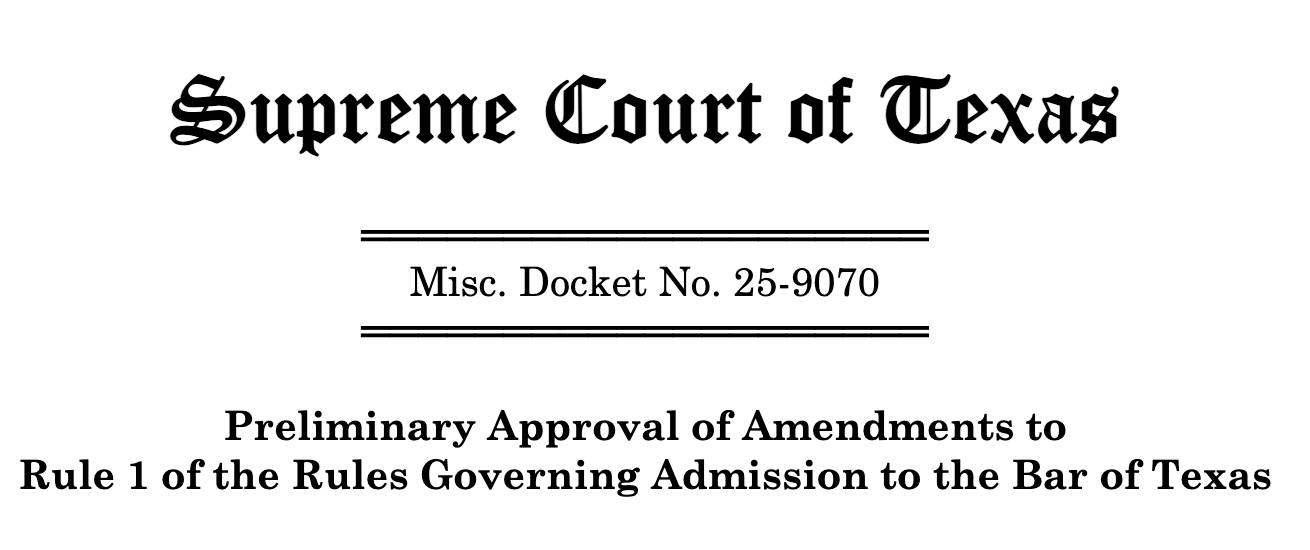
#12
“Supreme
Court
of
Texas
Likely
to
Remove
ABA
as
‘Final
Say’
on
Accreditation.” From Josh
Blackman (South
Texas)
in The
Volokh
Conspiracy:
“On
September
26,
2025,
the
Supreme
Court
of
Texas
issued
a momentous
order.
The
Justices
likely
signaled
that
the
ABA
will
no
longer
have
the
‘final
say’
on
accreditation.”
Read
more here.
#13
“On
LawNext:
Justice
Workers
—
Reimagining
Access
to
Justice
as
Democracy
Work,
with
Rebecca
Sandefur
and
Matthew
Burnett.” From LawSites :
“With
as
many
as
120
million
legal
problems
going
unresolved
in
America
each
year,
traditional
lawyer-centered
approaches
to
access
to
justice
have
consistently
failed
to
meet
the
scale
of
need.
But
what
if
the
solution
is
not
just
about
providing
more
legal
services
—
what
if
it
lies
in
fundamentally
rethinking
who
can
provide
legal
help?
In
today’s
episode,
host Bob
Ambrogi is
joined
by
two
of
the
nation’s
leading
researchers
on
access
to
justice: Rebecca
Sandefur,
professor
and
director
of
the
Sanford
School
of
Social
and
Family
Dynamics
at
Arizona
State
University
and
a
faculty
fellow
at
the
American
Bar
Foundation,
and Matthew
Burnett,
director
of
research
and
programs
for
the
Access
to
Justice
Research
Initiative
at
the
American
Bar
Foundation
and
an
adjunct
professor
of
law
at
Georgetown
University
Law
Center.
They
argue
that
the
access
to
justice
crisis
is
actually
a
crisis
of
democracy.
As
cofounders
of Frontline
Justice,
they
have
been
pioneering
research
on
‘justice
workers’
—
community
members
trained
to
help
their
neighbors
navigate
legal
issues.”
Read
more
and
listen here.
#14
“How
Should
a
DOJ
Political
Appointee
Think
About
a
Trump-Weaponized
DOJ?” From Jack
Goldsmith (Harvard)
in Executive
Functions:
“The
Justice
Department
is
filled
with
dozens
of
Trump
political
appointees—Senate-confirmed
senior
officials,
non-confirmed
deputies
and
special
assistants,
and
others.
I
am
trying
to
imagine
how
these
officials
are
processing
recent
events
at
the
Department—and
how
they
justify
to
themselves
continued
service
there.”
Read
more here.
#15
“‘I’m
a
Tough
Cookie.’
Alina
Habba,
Trump’s
Favorite
Lawyer,
Explains
Herself.’” From Vanity
Fair:
“And
there
is
no
better
advocate
for
Habba
than
Habba
herself.
She
is
funny,
profane,
nimble,
and
fierce.
She
responds
to
attacks
about
her
being
unqualified
for
the
job
by
detailing
her
years
of
running
successful
law
firms
and
of
representing
Trump
as
ample
preparation
for
the
role
of
US
attorney.”
Read
more here.
(You
might
recall
from LER
No.
40 that
Habba
was
among
the
lawyers
indicted
for
their
work
involving
Trump
in
2024.)
Get
Hired
Did
you
miss
the
350+
job
postings
from
previous
weeks?
Find
them
all here.
Upcoming
Ethics
Events
&
Other
Announcements
Did
you
miss
an
announcement
from
previous
weeks?
Find
them
all here.
Keep
in
Touch
News
tips?
Announcements?
Events?A
job
to
post?Reading
recommendations? Email [email protected] –
but
be
sure
to
subscribe
first,
otherwise
the
email
won’t
be
delivered.
Renee
Knake
Jefferson
holds
the
endowed
Doherty
Chair
in
Legal
Ethics
and
is
a
Professor
of
Law
at
the
University
of
Houston.
Check
out
more
of
her
writing
at
the Legal
Ethics
Roundup.
Find
her
on
X
(formerly
Twitter)
at @reneeknake or
Bluesky
at legalethics.bsky.social.
Building
a
better
healthcare
system
isn’t
just
about
adopting
the
latest
technology
—
it’s
about
redesigning
processes,
policies
and
patient
experiences.
The
VA
has
offered
telehealth-based
care
since
2006,
but
it
has
significantly
scaled
these
programs
—
such
as
tele-rehabilitation,
tele-ICU
and
tele-oncology
—
since
the
pandemic,
said
Carolyn
Clancy,
the
department’s
under
secretary
for
health.
The
expansion
of
these
programs
was
spurred
by
the
pandemic,
during
which
clinicians
devised
creative
solutions
when
in-person
care
wasn’t
possible,
she
explained.
For
example,
she
recalled
when
acupuncture
sessions
shifted
online
during
the
pandemic.
A
VA
physician
quickly
pivoted
to
holding
virtual
appointments
teaching
veterans
“acu-touch”
techniques
they
could
use
at
home
to
relieve
pain.
This
shows
that
innovation
involves
more
than
just
technology,
Clancy
noted.
It’s
about
changing
care
delivery
methods
to
meet
patients
where
they
are.
This
is
especially
important
for
rural
patients,
she
added.
“Depending
on
which
source
I’m
looking
at,
either
a
quarter
or
a
third
of
our
veterans
live
in
rural
areas.
I’m
not
talking
about
lovely
exurbs
—
I
mean
seriously
rural.
And
unlike
most
systems,
we
don’t
have
the
luxury
[of
choosing
our
market.]
We
have
to
provide
care
to
all
veterans
—
we
can’t
say
‘that’s
not
a
good
market
to
be
in,’”
Clancy
stated.
To
better
care
for
these
patients,
the
VA
has
invested
in
better
broadband
access
and
provided
telehealth
pods
in
community
locations
like
VFW
halls.
This
has
saved
thousands
of
veterans
from
driving
hours
to
seek
care,
she
pointed
out.
The
department
has
also
struck
partnerships
with
community
groups
like
volunteer
fire
departments
to
help
veterans
learn
to
use
telehealth
technology.
This
step
is
key
because
access
is
not
only
about
connectivity,
but
also
ease
of
use,
especially
for
older
veterans
or
those
with
sensory
impairments,
Clancy
noted.
While
the
VA
is
scaling
innovations
on
the
ground,
the
ONC
is
creating
policy
and
technical
infrastructure
aimed
at
making
health
data
flow
more
efficiently.
Steve
Posnack,
principal
deputy
national
coordinator,
explained
that
over
the
past
decade,
the
office
has
pushed
for
standards-based
APIs
and
frameworks
like
FHIR
to
make
patient
records
more
accessible.
Beyond
improved
data
movement,
Posnack
also
highlighted
the
need
to
make
data
more
actionable
and
easier
to
glean
insights
from.
“First,
it’s
about
getting
us,
as
individuals,
access
to
our
information
and
our
entire
record.
And
that’s
scattered
still,
so
we
have
a
lot
of
work
to
do
in
that
space.
The
second
is
to
help
our
overworked
clinicians
across
the
entire
spectrum
—
nurses,
docs,
et
cetera
—
to
have
better
tools
that
can
help
synthesize
all
of
the
data
that
we’re
shooting
at
them
in
different
ways,”
he
remarked.
Ultimately,
Posnack
said
that
the
ONC’s
work
complements
the
VA’s
on-the-ground
innovations.
The
federal
division
is
trying
to
ensure
that
when
new
tools
and
care
models
are
developed,
they
can
connect
across
systems
and
support
clinicians,
he
stated.
*
Supreme
Court
considers
letting
Ghislaine
Maxwell
off
the
hook.
[MSNBC]
*
Oregon
sues
Trump
administration
over
troop
deployment.
Suit
comes
after
Trump
indicates
to
Oregon’s
governor
that
he
sent
military
because
he’s
watching
bizarre
conspiracy
accounts
suggesting
Portland
is
on
fire
instead
of
a
hipster
artsy
town.
[Willamette
Week]
*
Apparently,
the
war
on
drugs
is
over
because
the
DOJ
has
surrendered
so
they
can
spend
all
their
time
hunting
immigrants.
[Reuters]
*
Cadwalader
has
lost
33
partners
this
year
and
that’s
going
to
lead
to
some
sort
of
reckoning.
[Bloomberg
Law
News]
*
Amy
Wax
plans
to
appeal
her
discrimination
case
against
Penn
to
the
Third
Circuit.
[Legal
Intelligencer]
*
Trump
demands
Microsoft
fire
Lisa
Monaco,
its
President
of
Global
Affairs,
because
she
worked
for
Biden’s
DOJ.
[Law360]
Cooley
Law
Has
Real
Trouble
Getting
Its
Graduates
To
Pass
The
Bar
Exam:
And
the
ABA
has
a
real
issue
with
that.
Everyone
Knows
Biglaw
Associates
Work
A
Lot
Of
Hours:
But
where
do
the
work
the
*most*?
Biglaw
Firm
Files
Lawsuit
Against
A
Former
Associate:
After
they
say
she
made
false
allegations
of
sexual
assault
against
a
partner.
Paul
Weiss
And
Kirkland
Got
Some
‘Splainin
To
Do
(Again):
Because
how
they’re
paying
off
their
pro
bono
payola
sure
seems
like
it
violates
the
law.
Kamala
Harris
Has
Some
Harsh
Words
For
Business
Leaders
Who
Capitulate
To
Donald
Trump:
But
her
admonition
rings
a
little
hollow
when
her
husband
is
a
partner
at
one
of
the
Biglaw
firms
that
did
its
own
capitulation
to
Trump.
There’s
A
Modern
Day
Teapot
Dome
Scandal
Afoot:
But
where’s
the
actual
cash?
America
Has
Passed
A
Dangerous
Rubicon:
As
Donald
Trump’s
thirst
for
retribution
reaches
a
new
height
with
some
chilling
parallels.
Zimbabwe
is
Africa’s
biggest
producer
of
tobacco
but
some
farmers
believe
the
country’s
long-term
future
could
lie
in
a
very
different
crop
–
blueberries.
Thanks
to
a
breakthrough
in
trade
talks
with
China,
the
world’s
biggest
importer
of
the
nutrient-rich
fruit,
Zimbabwe
has
taken
a
major
step
towards
achieving
its
ambition
of
becoming
Africa’s
blueberry
capital.
Tobacco
sales
surged
to
a
record
$1.3bn
(£1bn)
last
year,
helped
by
the
rising
number
of
smokers
in
China.
In
contrast,
blueberry
exports
were
worth
a
more
modest
$30m
but
horticulture
specialist
Clarence
Mwale
is
undaunted.
“The
future
is
food,
not
a
bad
habit,”
he
tells
the
BBC
at
his
warehouse
in
Harare.
For
the
first
time,
China
has
agreed
to
import
Zimbabwean
blueberries
and,
crucially,
has
exempted
them
from
tariffs,
in
a
boost
for
the
southern
African
state’s
struggling
economy.
“We
have
to
strike
while
the
iron
is
hot,”
exuberant
blueberry
farmer
Alistair
Campbell
tells
the
BBC.
Currently
exporting
to
Europe,
the
Middle
East
and
South
East
Asia,
farmers
like
Campbell
would
be
gaining
access
to
a
massive
new
market,
once
Zimbabwe
passes
China’s
compliance
tests
on
pest
and
disease
control.
A
former
captain
of
Zimbabwe’s
cricket
team,
53-year-old
Campbell
co-owns
a
high-tech
50
hectare
(123
acres)
blueberry
farm
about
an
hour
from
the
capital,
Harare.
Each
of
the
240,000
plants
on
the
farm
is
grown
in
a
pot
imported
from
the
Netherlands
or
South
Africa.
The
pot
soil
is
also
imported.
The
plants
are
watered
eight
times
a
day,
with
specially
treated
water,
and
the
blueberries
are
kept
in
refrigerators
soon
after
they
are
harvested
to
maintain
freshness.
Campbell
said
that
although
it
was
a
demanding
fruit
to
grow,
the
rewards
are
worth
it,
especially
as
global
demand
is
increasing
for
what
some
describe
as
a
superfood,
with
high
levels
of
vitamins
and
anti-oxidants.
Campbell
believes
Zimbabwe
can
cash
in
on
the
rising
demand,
as
the
fruit
comes
into
season
early,
in
late
March,
hitting
the
market
ahead
of
major
competitors
like
Peru.
“It’s
all
about
Peru
avoidance,”
laughs
Campbell.
Peru
is
both
a
bitter
rival
and
an
inspiration
for
Zimbabwe’s
farmers.
In
the
last
10
to
15
years,
it
has
gone
from
being
responsible
for
less
than
2%
of
global
blueberry
production
to
becoming
the
largest
exporter
of
the
fruit.
Zimbabwe’s
production
this
year
is
expected
to
rise
by
50%
to
12,000
tonnes.
Morocco
currently
leads
Africa’s
production
with
more
than
80,000
tonnes
in
2024.
South
Africa,
Zimbabwe’s
neighbour,
produced
25,000
tonnes.
With
South
Africa
being
severely
hit
by
US
tariffs,
it
is
looking
for
new
markets
for
its
fruit,
with
China
being
an
obvious
one,
especially
as
it
has
promised
zero
tariffs
for
all
African
states,
except
Eswatini
because
of
its
close
ties
with
Taiwan.
The
Washington
Post
via
Getty
Images
Blueberries
have
become
increasingly
popular
because
of
their
health
benefits
“This
agreement
is
a
milestone
for
Zimbabwe’s
horticultural
sector,”
says
Zimbabwe’s
Horticultural
Development
Council
executive
director
Linda
Nielsen.
“We
now
need
collaboration
to
design
policies
that
increase
investment,
boost
production,
and
ensure
our
blueberries
meet
China’s
strict
quality
and
phytosanitary
standards,”
she
adds.
Zimbabwe
farmers
are
now
looking
for
capital
to
boost
blueberry
production
to
30,000
tonnes
by
2030.
Expressing
caution
about
whether
this
can
be
achieved,
Campbell
tells
the
BBC:
“It’s
all
good
saying
Zimbabwe
is
open
for
business
but
the
underlying
fundamentals
need
to
be
correct.”
Many
analysts
say
that
more
than
20
years
after
the
government’s
controversial
land
reform
programme
led
to
the
seizure
of
many
white-owned
farms,
investors
remain
uncertain
about
the
security
of
their
land,
despite
a
new
law
that
does
away
with
leases
and
offers
full
title
to
resettled
farmers.
With
Zimbabwe
experiencing
a
severe
cash
crisis,
exporters
are
required
to
surrender
almost
a
third
of
their
foreign-currency
earnings
to
the
central
bank
in
exchange
for
local
currency
–
something
that
many
Zimbabweans
are
loathe
to
do,
fearing
it
will
lose
its
value.
Last
year
Zimbabwe
generated
$30m
(£22.5m)
from
blueberry
exports.
The
amount
may
be
modest,
but
with
unemployment
high,
the
jobs
the
industry
creates
are
welcome.
It
employs
about
6,000
people,
mostly
women.
Shingai
Nyoka
/
BBC
Rebecca
Bonzo
says
blueberry
farms
are
a
source
of
employment
for
women
“It’s
delicate
hands
that
are
needed
for
a
delicate
fruit,”
Rebecca
Bonzo,
a
supervisor
at
Campbell’s
farm,
tells
the
BBC
in
the
Shona
language.
“Up
to
300
women
work
during
the
peak
harvesting
season.
Many
are
sole
breadwinners
who
can
now
take
care
of
their
families,”
she
says.
Clarence
Mwale
–
the
founder
of
Kuminda,
which
represents
a
collective
of
small-
and
medium-scale
farmers
–
says
he
is
pushing
more
of
them
to
become
involved
in
blueberry
farming.
He
says
he
has
achieved
this
with
other
crops
–
for
instance,
about
5,000
small-scale
farmers
now
supply
horticultural
products,
mainly
mange
touts
and
sugar
snap
peas,
to
the
UK
and
other
European
markets,
something
that
was
unheard
of
15
to
20
years
ago.
Mwale
says
he
is
now
looking
for
about
100
young
farmers
to
diversify
into
blueberry
farming
and
benefit
from
China’s
decision
to
open
the
market
to
Zimbabweans.
“As
the
Chinese
market
opens
up…it
gives
us
much
more
scope,”
he
tells
the
BBC.
“Where
we
were
scrambling
and
fighting
for
the
European
markets,
which
we
haven’t
been
able
to
fulfil,
now
we
have
a
vast
market
that
we
have
to
fill.
“It
gives
everyone
a
chance
to
get
into
the
blueberry
production.”
Zimbabwe
has
traditionally
been
tobacco
country.
But
having
fuelled
a
bad
habit
in
China,
it
now
wants
to
promote
a
health
food
there,
hoping
in
the
process
to
acquire
the
status
of
Africa’s
blueberry
capital.
A
week
later
on
the
21st,
President
Mugabe
turned
in
his
resignation
letter
just
as
the
impeachment
process
in
Parliament
began.
I
watched
all
this
from
my
dorm
room,
terrified
that
the
bloodshed
and
pillage
that
I
had
seen
in
other
countries
like
Syria,
Somalia
and
Egypt
had
come
to
my
home.
I
feared
for
the
safety
of
my
family
back
home.
The
army,
however,
was
quick
to
put
out
the
disclaimer
that
its
actions
were
not
a
coup
and
news
from
my
family,
friends,
and
other
countrymen
mirrored
these
sentiments.
Watching
the
events
unfold,
the
peace
that
pervades
Zimbabwean
atmosphere
right
now
and
the
hope
for
a
future
without
Mugabe
has
me
reflecting
on
some
of
the
things
that
characterized
my
21
years
living
under
the
Mugabe
regime.
The
Cult
of
Personality
Whenever
people
who
know
the
political
situation
of
Zimbabwe
find
out
my
nationality,
they
always
ask
what
is
it
like
to
have
a
93-year
old
president.
While
my
American
classmates
have
lived
through
three
or
four
presidencies,
I
have
only
known
one.
Years
of
propaganda
and
Mugabe’s
charisma
have
not
left
me
unscathed.
Listening
to
his
speeches
had
the
same
effect
as
listening
to
Obama
speak
has
for
many
Americans.
Mugabe
is
charming,
energetic,
articulate,
funny,
and
smart.
He
has
a
way
of
working
a
crowd
such
that
you
can’t
help
but
feel
a
fondness
for
him.
I
was
part
of
the
population
in
my
country
that
even
believed
that
Mugabe
was
infallible,
almost
immortal.
Indeed,
there
are
several
myths
of
immortality
surrounding
him,
one
of
the
most
popular
being
that
Mugabe
ate
the
heart
of
a
tortoise
and
so
will
live
the
same
life
span
as
a
turtle,
which
can
live
up
to
200
years.
This
is
ridiculous,
of
course,
but
that’s
the
effect
of
the
Cult
of
Personality.
Fear
of
Speaking
Out
I
cannot
stress
the
level
of
anxiety
I
have
writing
this
article
right
now.
Even
though
Mugabe
has
resigned
and
seems
to
have
lost
his
political
clout,
I
am
still
afraid
of
him.
I
am
afraid
that
tomorrow
I
will
wake
up
and
be
charged
for
treason
for
even
putting
these
thoughts
down.
That’s
what
speaking
out
in
Zimbabwe
entailed
under
Mugabe
–
being
charged
with
“subverting
the
authority
of
a
constitutionally
elected
government.”
While
studying
abroad
I
have
often
been
envious
of
how
people
in
the
US
can
easily
express
their
dissatisfaction
and
not
expect
any
repercussions.
Coming
from
a
country
with
state
owned
media,
a
ruthless
secret
police,
and
a
highly
trained
riot
police,
organizing
and
attending
protests
is
not
as
easy
as
it
is
here.
Even
writing
an
op-ed
can
land
you
in
jail.
Loss
of
Hope
I’ve
lived
through
holding
a
10
billion
dollar
note
in
my
hand
that
couldn’t
buy
a
loaf
of
bread.
I’ve
lived
through
water
shortages
and
food
shortages
and
the
adoption
of
a
chaotic
multi-currency
system
in
which
you
buy
goods
in
one
currency
and
receive
change
in
another.
My
country
currently
has
one
of
the
highest
unemployment
rates
—
I
know
more
than
20
degreed
and
highly
educated
people
who
have
no
jobs.
This
made
me
and
many
others
my
age
lose
hope.
Most
of
us
looked
for
opportunities
beyond
borders;
many
Zimbabweans
are
in
South
Africa,
Canada,
Ireland,
and
the
US.
Those
who
remain
hope
to
leave
soon,
too.
Nobody
chooses
to
leave
the
familiarity
of
their
home
out
of
a
whim
—
all
Zimbabwean
immigrants
were
forced
beyond
their
borders
and
yearn
for
home.
While
Zimbabweans
wait
anxiously
to
see
how
Mugabe’s
successor
will
fair,
we
hope
that
after
this
cut-off
head
falls
down,
another
won’t
sprout
in
its
place.
The
experiences
I
have
detailed
are
not
at
all
exhaustive.
they’re
just
the
surface
of
a
very
rotten
regime.
Even
though
there
is
uncertainty
at
the
moment
in
my
country
and
in
the
diaspora,
this
is
the
first
time
in
37
years
that
Zimbabweans
have
hope
for
a
change.
As
we
move
into
a
new
era,
I
hope
we
can
consolidate
the
gains
of
this
“non-coup”
and
usher
in
a
stable
democracy
and
economic
prosperity.


 Kathryn