(Photo
by
Daniel
Acker/Bloomberg
via
Getty
Images)
Getting
your
ears
pierced
at
Claire’s
is
almost
a
rite
of
passage
for
adults
of
a
certain
vintage.
Your
mother
either
brought
you
to
Claire’s
to
get
it
done,
or
your
mother
yelled
at
you
after
you
went
to
Claire’s
to
get
it
done
with
your
friends.
Either
way,
it’s
highly
likely
that
you,
or
someone
you
know,
got
their
ears
pierced
at
Claire’s.
The
trend
continues
on
today,
but
unfortunately,
with
sales
declining
and
the
brand
filing
for
its
second
bankruptcy
in
seven
years,
America’s
youth
may
be
deprived
of
the
chance
to
get
their
ears
pierced
at
Claire’s.
Thankfully,
one
enterprising
Biglaw
partner
pledged
to
solve
that
problem
by
literally
“putting
some
skin
in
the
game”
to
get
it
done.
Kirkland
&
Ellis
bankruptcy
partner
Joshua
Sussberg
knew
that
no
one
wanted
to
see
Claire’s
go
under,
and
he
was
willing
to
go
to
extremes
to
stop
that
from
happening.
The
American
Lawyer
has
details
on
what
happened
next:
[L]iquidating
the
64-year-old
retailer
wasn’t
what
anyone
at
the
August
first
day
hearing
wanted.
Kirkland
partner
Alexandra
Schwarzman
said
she
got
her
ears
pierced
at
Claire’s;
so
did
Shannon’s
daughter,
the
judge
said.
Then
the
Kirkland
team
held
up
a
picture
of
Sussberg
circa
1995,
when
he
had
his
ears
pierced
at
Claire’s
as
a
high
schooler.
“At
the
end
of
the
hearing,
I
said,
‘Your
honor,
we
are
focused
on
preserving
jobs
and
keeping
stores
open
for
a
long
time
so
many
people
can
get
their
ears
pierced.
If
we
can
get
a
deal
done,
I
am
willing
to
get
my
ears
pierced,’”
Sussberg
recounted.
“The
judge
said,
‘I’m
going
to
hold
you
to
that.’
He
threw
down
the
gauntlet.”
Not
only
did
Sussberg
find
a
buyer,
but
he’s
a
great
sport
and
stayed
true
to
his
word
to
get
his
ears
pierced.
During
a
recent
hearing,
Sussberg
got
his
left
ear
pierced
in
court
by
a
Claire’s
store
veteran.
He
even
got
to
wear
a
celebratory
Claire’s
crown
while
it
happened.
Click
here
to
see
the
piercing
in
action.
Congratulations
to
Joshua
Sussberg
for
helping
to
save
the
tradition
of
the
youth
of
America
getting
their
ears
pierced
at
Claire’s.
Staci
Zaretsky is
the
managing
editor
of
Above
the
Law,
where
she’s
worked
since
2011.
She’d
love
to
hear
from
you,
so
please
feel
free
to
email
her
with
any
tips,
questions,
comments,
or
critiques.
You
can
follow
her
on Bluesky, X/Twitter,
and Threads, or
connect
with
her
on LinkedIn.
Two
weeks
into
the
new
term,
a
Seattle
courtroom
offered
the
year’s
defining
image
of
presidential
power
meeting
its
limits:
a Ninth
Circuit
panel
upheld a
nationwide
block
on
the
administration’s
attempt
to
curtail
birthright
citizenship,
acknowledging
that
the
judges’
interpretation
of
the
Constitution—not
a
presidential
pen
stroke—sets
the
terms
of
American
membership.
Weeks
earlier,
in
Baltimore,
a
federal
judge
had temporarily
enjoined key
parts
of
two
DEI-related
executive
orders
as
both
vague
and
speech-burdening—an
early
reminder
that
even
marquee
directives
can
stall
at
the
courthouse
door—before
the
Fourth
Circuit
stayed
that
injunction
while
the
appeal
plays
out.
More
than
half
of
the
administration’s
major
orders
this
year
hit
a
judicial
roadblock,
often
within
weeks.
And
the
action
has
hardly
been
confined
to
the
usual
venues:
the
administration
even
took
the
extraordinary
step
of suing
all
15
federal
judges in
Maryland
over
a
deportation-related
order—only
to
see
the
case
tossed.
The
result
is
a
litigation
map
that
runs
through
Washington,
D.C.,
Seattle,
and
Baltimore
as
reliably
as
it
does
through
Texas,
with
trial
and
appellate
courts
asked—again
and
again—to
decide
how
far
executive
power
can
go
on
contact
with
statute
and
Constitution.
The
Supreme
Court,
for
its
part,
has signaled
that
the
outer
edge
of
that
power will
be
tested
in
cases
now
moving
onto
its
docket—an
arena
where
campaign-trail
ambition
meets
Article
II
in
full
daylight.
In
other
words,
the
myth
of
the
instant,
untouchable
executive
order
collided
this
year
with
a
more
grounded
reality:
in
a
polarized
moment,
the
federal
judiciary
has
become
the
first
responder
to
the
biggest
policy
fights,
not
as
a
partisan
counterforce
but
as
the
system’s
built-in
referee.
This
trend
highlights
a
new
reality
of
American
governance:
in
an
era
of congressional
gridlock,
courts
are
where
politics
move
next.
In
the
past
this
placed
courts
as
a
main
engine creating
policy in
the
void
of
action
by
Congress
and
Executive.
Now
Trump
seems
to
have
acknowledged
this
vacuum
and
has
taken
the
reins
on
action
from
both
Congress
and
the
courts.
EOs
now
serve
as
a
President’s
bid
to
deliver
fast
policy
wins
to
their
base,
but
the
opposition
(state
attorneys
general,
advocacy
groups,
and
even
some
businesses)
now
reflexively
races
to
court
to
halt
those
policies.
The
result
is
that
the
ultimate
fate
of
many
high-profile
EOs
is
decided
by
judges,
not
just
by
the
stroke
of
a
pen.
Far
from
being
all-powerful,
executive
orders
in
2025
were
immediately
pulled
into
a
political-legal
tug-of-war,
demonstrating
that
when
it
comes
to
major
policies,
the
President’s
power
is
checked
early
and
often
by
the
courts.
To
dig
into
this
area
of
litigation,
this
article
analyzes
a
comprehensive
dataset
of
327
federal
district
court
cases
challenging
executive
orders
issued
through
the
first
half
of
August
2025.
This
“EO
Litigation
Tracker”
captures
each
case’s
issue
area,
the
presiding
judge
and
their
appointing
president,
the
relief
sought
(Temporary
Restraining
Order
or
Preliminary
Injunction),
whether
an
injunction
was
granted
(and
if
so,
whether
it
was
nationwide
in
scope),
and
the
outcome
(whether
the
EO
was
upheld
or
enjoined
in
the
end).
By
categorizing
cases
by
policy
issue
and
by
the
type/scope
of
injunctive
relief,
patterns
emerged
that
tell
a
political
story:
which
issues
provoked
the
most
legal
battles,
and
where
(and
before
whom)
those
battles
played
out.
The
Tracker
also
groups
cases
by
the
court’s
location
(circuit)
and
by
each
presiding
judge’s
background
to
see
how
ideological
leanings
might
have
influenced
results.
This
article
focuses
on
the
judicial
dimensions
of
these
decisions.
A
second
article
will
emphasize
policy
area
where
orders
are
under
judicial
scrutiny.
Who
Decides?
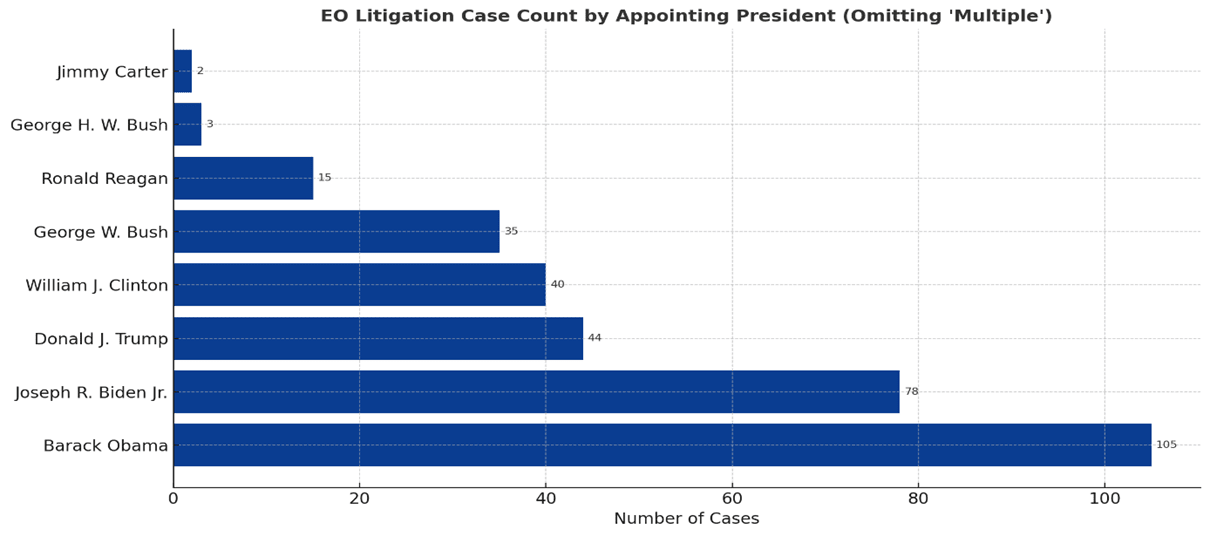
This
chart
shows
that
most
EO
cases
in
2025
were
decided
by
judges
appointed
by
Barack
Obama
(105)
and
Joseph
R.
Biden
Jr.
(78)—together,
well
over
half
of
the
total
shown.
Donald
Trump
(44),
William
J.
Clinton
(40),
and
George
W.
Bush
(35)
appointees
handled
a
smaller
but
still
substantial
share,
while
Reagan
(15),
George
H.
W.
Bush
(3),
and
Carter
(2)
trailed.
The
skew
reflects
where
plaintiffs
filed—especially
D.D.C.
and
coastal
circuits—more
than
any
single
judge’s
ideology,
and
it
helps
explain
why
many
outcomes
tilted
against
the
administration;
the
figure
omits
judges
that
were
nominated
by
one
president
and
held
over
for
confirmation
under
another
president.
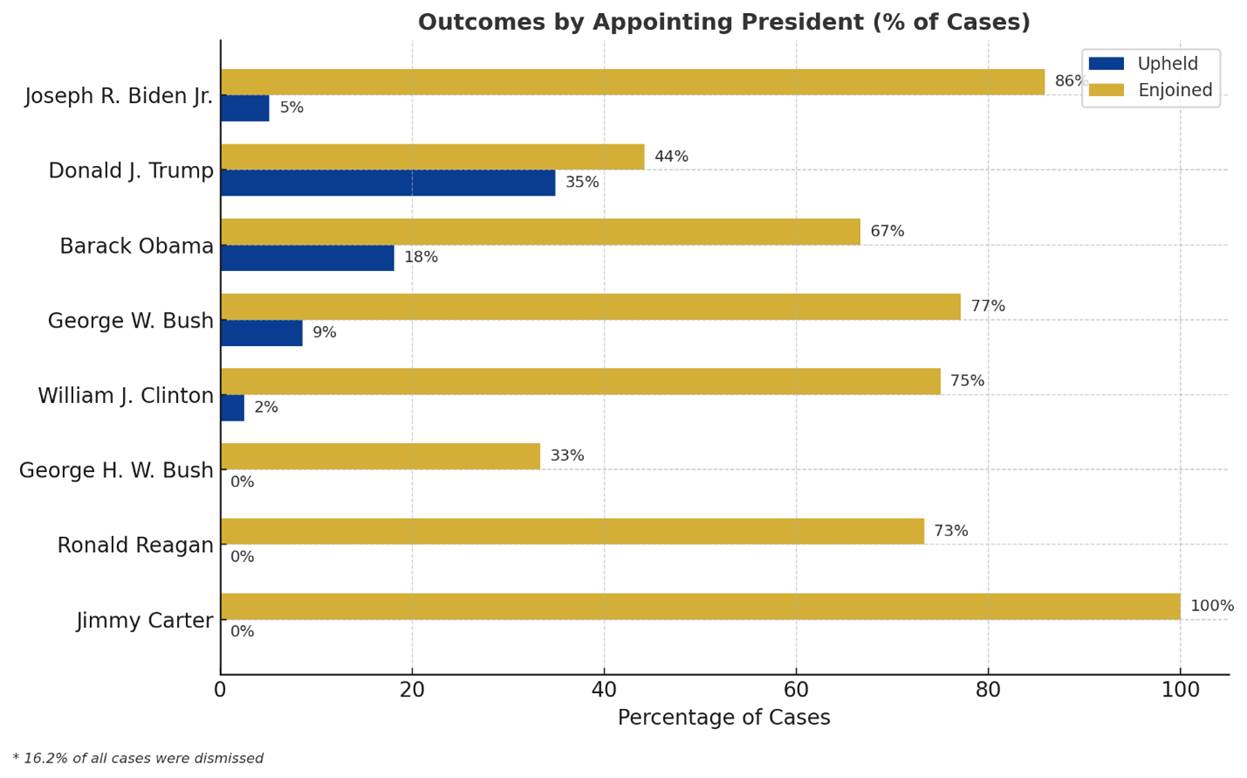
The
graph
above
tracks
case
outcomes
by
the
appointing
president
of
the
presiding
judge.
Trump
and
Obama
appointees
show
the
largest
upheld
slices,
but
even
there,
injunctions
still
outnumber
affirmances.
Reagan,
Clinton,
and
Biden
appointees
have
only
slivers
of
upheld
EOs
while
George
H.
W.
Bush
(and
to
a
lesser
extent
Reagan
and
George
W.
Bush)
appointees
have
comparatively
larger
dismissal
shares.
The
pattern
suggests
judges’
political
backgrounds
and
ideology
matters
at
the
margins,
but
the
prevailing
story
is
broad
judicial
skepticism
of
the
orders
at
the
interim
stage
regardless
of
who
appointed
the
judge.
By
mid-2025,
the
administration
lost
far
more
than
it
won.
Of
the
274
cases
that
reached
a
clear
outcome
in
2025,
232
(approximately
85%)
enjoined
the
EO
or
related
agency
action
in
whole
or
part,
while
42
(15%)
upheld
it.
Party-of-appointing-president
mattered,
but
not
enough
to
save
most
orders.
Democratic
appointees
ruled
against
the
EO
about
88%
of
the
time;
Republican
appointees
did
so
about
77%
of
the
time.
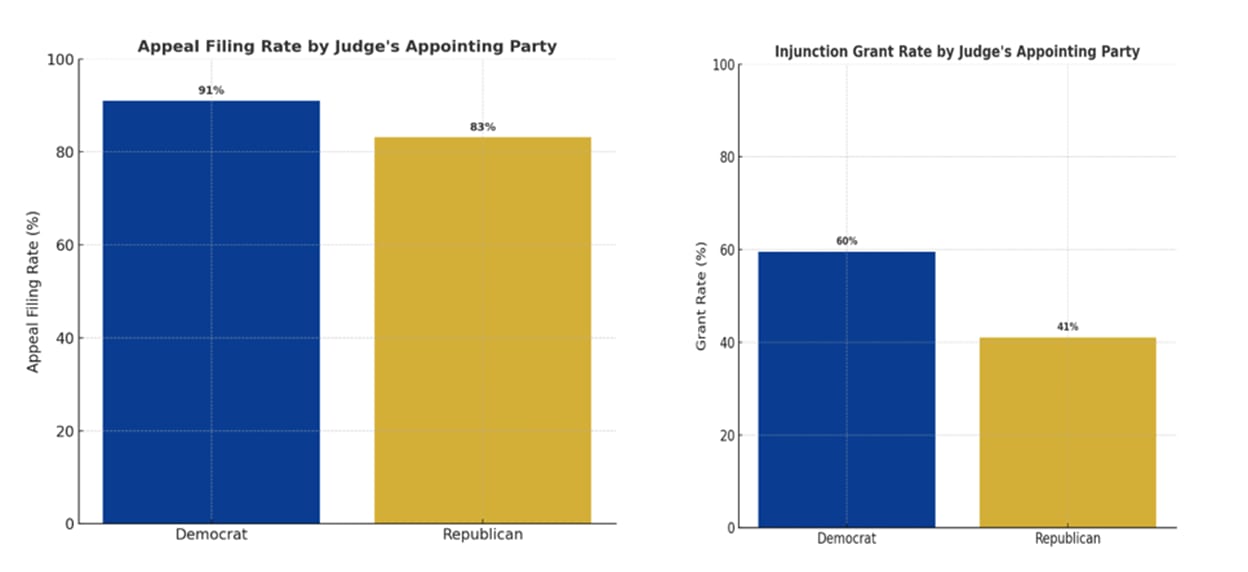
On
early
relief,
Democratic
appointees
granted
preliminary
injunctions
in
roughly
60%
of
cases,
compared
with
about
42%
for
Republican
appointees.
The
gap
tracks
expectations—but
the
striking
fact
is
how
often
judges
from
both
camps
found
legal
defects
serious
enough
to
sink
the
orders.
The
trend
isn’t
new—and
it
cuts
both
ways. Analyses
show that
most
nationwide
injunctions
(before
the
Supreme
Court
essentially
prohibited
them
in Trump
v.
CASA)
against
both
Trump’s
first
term
and
Biden’s
administration
came
from
judges
appointed
by
the
opposite
party.
Policy
fights
are
increasingly
resolved
through
legal
briefs
and
emergency
motions,
with
courtroom
wins
and
losses
carrying
the
weight—and
the
political
aftershocks—of
legislative
victories
or
defeats.
The
Emerging
Pattern
The
biggest
driver
wasn’t
just
ideology;
it
was
where
the
lawsuits
were
filed.
The
District
of
Columbia
was
ground
zero:
104
of
327
cases—just
over
30%—ran
through
D.D.C..
That’s
logical
and
strategic.
National
policies
are
administered
in
Washington,
the
judges
there
are
steeped
in
administrative
law,
and
both
government
and
public-interest
lawyers
know
the
forum
well.
Blue-state
venues
like
the
Northern
District
of
California,
the
District
of
Massachusetts,
and
the
District
of
Maryland
also
drew
heavy
fire,
reflecting
plaintiffs’
choices
to
file
where
they
expected
a
receptive
ear
to
statutory
and
APA
arguments.
Texas—the
star
of
nationwide
policy
fights
under
the
prior
administration—was
relatively
quiet.
The
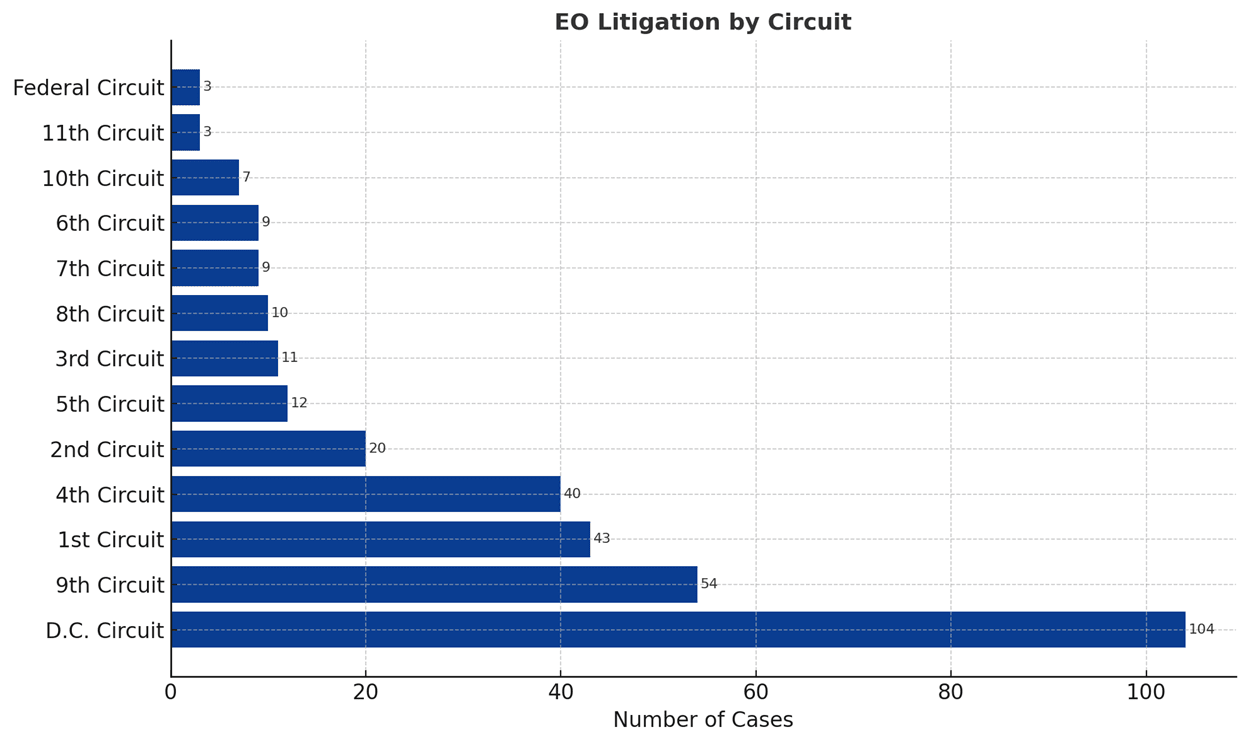
Fifth
Circuit
(Texas,
Louisiana,
Mississippi)
accounted
for
only
12
cases
(approximately
3.7%),
while
the
Ninth
Circuit
saw
53
(approximately
16%)
and
the
First
Circuit
logged
43.
In
a
role-reversal,
liberal
states
and
advocacy
groups
led
the
charge
in
2025
and
steered
cases
to
D.C.,
California,
and
the
Northeast
rather
than
to
Texas.
Inside
those
busy
forums,
repeat
players
mattered.
In
D.D.C.,
judges
such
as
Paul
Friedman,
John
Bates,
Rudolph
Contreras,
and
Timothy
Kelly
handled
multiple
EO
cases.
Despite
different
appointing
presidents,
they
often
converged
on
results—frequently
enjoining
or
striking
down
orders
when
they
viewed
defects
as
obvious
(conflicts
with
statute,
APA
shortcuts,
or
shaky
authority).
Executive
orders
set
the
agenda,
but
judges
set
the
bounds.
In
2025,
venue
strategy
and
ideology
shaped
the
skirmishes,
yet
basic
law
resolved
the
disputes
for
the
time
being.
With
the Supreme
Court
poised to
refine
the
rules,
any
presidency
should
expect
its
biggest
EOs
to
face
the
courtroom
first.
**
This
work
would
not
be
possible
without
the
inimitable
assistance
of Daniel
Thompson.
Adam
Feldman
runs
the
litigation
consulting
company
Optimized
Legal
Solutions
LLC.
Check
out
more
of
his
writing
at Legalytics and Empirical
SCOTUS.
For
more
information,
write
Adam
at [email protected]. Find
him
on
Twitter: @AdamSFeldman.
From
drafting
airtight
documents
and
surfacing
firm-wide
knowledge
to
driving
growth
and
ensuring
operational
excellence,
Litera
works
where
lawyers
do:
in
Microsoft
365
and
across
every
device
with
unmatched
speed
and
efficiency.
Here,
Adam
Ryan,
the
company’s
Chief
Product
Officer,
sits
down
with
ILTA’s
Michael
Foster
at
the
conference
to
discuss
the
company’s
approach
and
newest
offerings.
Litera’s
North
Star
Litera’s
mission
is
to
deliver
the
right
data,
in
the
right
location,
at
the
right
time.
To
achieve
this
goal,
the
company
is
focused
on
advancements
in
three
key
areas,
which
Adam
details
here.
Ed.
note:
Please
welcome
Vivia
Chen
back
to
the
pages
of
Above
the
Law.
Subscribe
to
her
Substack,
“The
Ex-Careerist,”here.
Unless
your
perception
of
law
firm
life
is
warped
by Suits, The
Good
Wife,
or Ally
McBeal,
no
person
would
think
of
law
as
a
fun,
sexy
profession.
And
you
certainly
don’t
go
into
it
for
its
salubrious
lifestyle.
Biglaw
in
particular
runs
on
insecurity.
Not
only
do
lawyers
work
insane
hours,
they’re
expected
to
perform
with
absolute
precision.
From
day
one,
the
message
is
clear:
Miss
a
deadline
(even
if
arbitrary)
or
make
an
error
(however
inconsequential),
and
your
career
is
toast.
The
culture
of
extreme
perfectionism
breeds
fear
and
anxiety,
yet
it
remains
the
industry
standard.
The
question
is
what
this
is
doing
to
lawyers’
mental
state.
A recent
study offers
some
answers.
According
to
a
survey
of
764
lawyers
by
Krill
Strategies,
JC
Coaching
&
Consulting,
Ambitionprofile,
and
NALP,
the
price
is
“stress,
depression,
workaholism,
resistance
to
feedback,
and
reduced
engagement,
motivation,
and
longevity.”
Among
lawyers
who
scored
high
on
the
perfectionist
scale,
50.6%
showed
elevated
depression,
compared
to
7.1%
in
the
low-perfectionism
group.
Perfectionist
lawyers
also
tend
to
have
shorter
tenures
at
their
firms:
5.3
years,
compared
to
8.4
years
for
low-perfectionists.
And
you
guessed
it:
women
reported
higher
levels
of
perfectionism
and
stress,
suggesting
that
“that
perfectionism
may
be
a
contributing
factor
to
elevated
turnover
risk
among
women
lawyers.”
It’s
a
troubling
picture
but
is
Biglaw
aware
of
the
problem?
Does
it
care?
I
asked
Patrick
Krill,
one
of
the
authors
of
the
study,
those
questions
and
more.
Below
is
an
edited
version
of
our
chat.
A
chicken
and
egg
question:
Do
more
neurotic
people
flock
to
brutal
professions
like
Biglaw,
or
is
it
the
profession
that
turns
normal
people
into
crazed
perfectionists?
Probably
both.
Historically,
a
high
number
of
perfectionists
go
into
the
profession.
It’s
a
disposition
that
a
lot
of
people
come
pre-packaged
with.
But
there’s
also
the
work
environment.
It’s
firm-specific
whether
it’s
making
someone’s
perfectionism
worse.
Isn’t
it
a
given
that
Biglaw
promotes
an
unrealistic
level
of
perfectionism
and
that
only
the
truly
exceptional
make
it
to
the
top?
We
need
to
distinguish
between
perfectionism
and maladaptive
perfectionism,
which
entails
setting
unrealistically
high
standards.
Professional
athletes
have
high
standards
but
they
don’t
internalize
failure
like
lawyers
do.
Maladaptive
perfectionists
have
a
very
pronounced
fear
of
failure
and
excessive
self-criticism;
they
beat
themselves
up.
Even
though
maladaptive
perfectionism
has
long
been
understood
to
be
bad
for
people’s
health,
it’s
almost
a
badge
of
honor
for
lawyers.
What
surprised
me
in
the
study
is
how
clear
it
was
that
this
trait
is
undermining
lawyer’s
success,
and
yet
they’re
not
aware
of
it.
If
you
had
to
name
one
culprit
that’s
responsible
for
this
miserable
state
of
affairs,
what
would
it
be?
Fear.
At
some
firms,
fear
permeates
from
the
top
down.
It
can
be
a
management
style
where
fear
is
the
primary
motivator.
Fear
is
jet
fuel
for
maladaptive
perfectionism.
Vivia
Chen writes “The
Ex-Careerist” column
on
Substack
where
she
unleashes
her
unvarnished
views
about
the
intersection
of
work,
life,
and
politics.
A
former
lawyer,
she
was
an
opinion
columnist
at
Bloomberg
Law
and
The
American
Lawyer.
Subscribe
to
her
Substack
by
clicking
here:
We’ve
all
lost
count
of
the
times
we’ve
received
an
email,
policy,
or
memo
from
a
lawyer
so
“well
written”
that
nobody
understands
it.
It’s
frustrating,
and
you
want
to
write
back:
“Great
legal
summary
—
I
have
no
idea
what
it
means.”
Unfortunately,
that’s
often
how
legal
communications
are
received
by
business
colleagues
and
stakeholders:
overly
complicated,
needlessly
formal,
and
disconnected
from
everyday
business
needs
—
not
human.
For
too
long,
the
legal
profession
has
equated
complexity
with
competence.
Contracts,
memos,
and
policies
packed
with
dense
language
and
archaic
legalese
—
complete
with
exhaustive
footnotes
—
have
been
seen
as
hallmarks
of
legal
skill.
AI
Is
Reshaping
How
Lawyers
Think
And
Communicate
But
in
the
age
of
artificial
intelligence,
that
might
finally
change
—
and
not
in
the
way
most
fear.
Yes,
AI
is
advancing
quickly.
Tools
like
Harvey,
Spellbook,
and
Lex
Machina
are
already
transforming
how
lawyers
research,
draft,
and
analyze.
But
here’s
the
irony:
instead
of
turning
lawyers
into
robots,
AI
may
actually
free
them
to
become
more
human.
AI
is
already
adept
at
doing
what
law
school
trained
us
to
do
—
identifying
risks,
spotting
issues,
and
referencing
precedent.
What
it’s
not
good
at
is
nuance,
trust,
or
judgment
—
skills
that
define
great
lawyering.
When
AI
handles
some
of
the
drudgery
—
like
contract
clause
spotting
and
formatting
—
it
gives
us
something
precious
back:
time.
That
time
forces
lawyers
to
stop
hiding
behind
legalese
and
impractical
analysis.
It
allows
—
and
even
demands
—
that
we
communicate
like
leaders.
Imagine
walking
into
a
business
meeting
and,
instead
of
delivering
a
20-page
memo,
offering
a
single
slide
with
a
recommendation
tied
directly
to
company
goals.
That’s
not
just
good
lawyering;
that’s
leadership.
And
AI
may
be
the
catalyst
that
gets
us
there.
Businesses
Don’t
Pay
By
The
Word
—
Or
The
Footnote
Let’s
be
honest:
business
leaders
aren’t
impressed
by
lengthy
legal
analysis.
They
want
clarity,
direction,
and
advice
aligned
with
business
objectives.
They’re
not
paying
for
academic
thoroughness;
they’re
paying
for
actionable
answers.
Yet
for
years,
many
lawyers
have
responded
to
this
demand
by
doubling
down
on
complexity.
The
prevailing
belief
has
been
that
the
longer
and
more
technical
the
memo,
the
more
valuable
the
advice.
Legal
teams
often
conflate
precision
with
exhaustiveness,
thinking
that
covering
every
possibility
makes
advice
more
defensible.
The
truth?
This
approach
doesn’t
instill
confidence.
It
does
the
opposite
—
it
slows
decision-making
and
alienates
colleagues.
AI
changes
the
game.
When
generative
tools
can
translate
clauses
into
plain
English,
the
old
value
proposition
of
complexity
begins
to
crumble.
The
playing
field
shifts
—
from
who
can
analyze
the
most
thoroughly
to
who
can
communicate
the
most
clearly.
That’s
not
a
threat.
It’s
an
opportunity
—
one
for
lawyers
to
become
better
partners
to
the
business
by
focusing
on
what
matters
most:
sound
judgment
delivered
in
plain
language.
The
Most
Human
Skills
Are
Now
the
Most
Valuable
It
turns
out
the
skills
business
leaders
have
always
wanted
—
judgment,
prioritization,
and
practical
legal
analysis
—
are
the
same
ones
AI
can’t
replicate.
The
future
of
law
isn’t
about
replacing
lawyers;
it’s
about
elevating
them.
We
may
soon
see
a
world
where
lawyers
are
no
longer
rewarded
for
how
much
they
can
write
but
for
the
value
of
their
advice.
It
won’t
be
the
lawyer
who
analyzes
every
nuance
and
every
possible
scenario
who
adds
the
most
value.
It
will
be
the
lawyer
who
drills
issues
down
to
their
simplest
terms,
describes
and
assesses
risk,
and
recommends
a
course
of
action
aligned
with
business
objectives
and
risk
tolerance.
It’s
the
lawyer’s
job
to
use
AI-generated
resources
and
leverage
them
into
thoughtful,
human
legal
analysis.
If
that
happens,
AI
won’t
dehumanize
the
legal
profession.
It
will
bring
us
back
to
what
lawyering
should
have
always
been
a
value-added
business
resource.
Lisa
Lang
is
an
accomplished
in-house
lawyer
and
thought
leader
dedicated
to
empowering
fellow
legal
professionals. She
offers
insights
and
resources
tailored
for
in-house
counsel
through
her
website
and
blog,
Why
This,
Not
That™
(www.lawyerlisalang.com).
Lisa
actively
engages
with
the
legal
community
via
LinkedIn,
sharing
her
expertise
and
fostering
meaningful
connections.
You
can
reach
her
at
[email protected],
connect
on
LinkedIn
(https://www.linkedin.com/in/lawyerlisalang/).
Joshua
Horenstein
has
an
extensive
background
in
executive
leadership
and
HR/legal/facilities/regulatory
management. He
is
Senior
Vice
President,
Chief
Legal
Officer
and
Chief
Human
Resources
Officer
at
Innophos
Holdings,
Inc.,
an
international
specialty
ingredient
and
chemical
manufacturer.
At
Innophos,
Josh
is
responsible
for
all
human
resources,
legal,
corporate
facilities
and
regulatory
matters
worldwide
for
the
company.
Prior
to
joining
Innophos,
Josh
practiced
law
at
several
leading
law
firms
in
the
Philadelphia
metro
area
and
was
Vice
President
and
Chief
Legal
Officer
at
Rock
Your
Phone,
Inc.
Healthcare
groups
are
reacting
to
CMS’
proposed
2026
Physician
Fee
Schedule
mainly
with
concern,
arguing
that
it
needs
significant
revisions
in
order
to
avoid
destabilizing
providers
and
undermining
value-based
care
momentum.
The
proposal,
issued
in
July,
seeks
to
establish
two
new
conversion
factors
—
one
for
physicians
in
advanced
alternative
payment
models
(APMs)
and
another
for
those
who
aren’t.
CMS
plans
to
increase
the
APM
rate
by
3.83%
in
2026,
while
the
non-APM
rate
would
go
up
by
3.62%.
These
increases
reflect
several
factors
—
a
small
statutory
bump
(0.75%
for
APM
participants
and
0.25%
for
others),
an
across-the-board
2.5%
increase
required
by
recent
legislation,
and
an
additional
0.55%
adjustment
tied
to
CMS’
proposed
changes
in
physician
work
relative
value
units
(wRVUs).
For
2026,
CMS
is
also
proposing
to
trim
payments
by
applying
a
2.5%
“efficiency
adjustment”
to
certain
wRVUs.
Essentially,
CMS
believes
some
services
can
be
delivered
more
efficiently,
so
it
is
lowering
the
amount
of
physician
work
credited
for
those
services
—
wRVUs
are
central
to
how
Medicare
sets
payment
rates,
so
this
adjustment
would
effectively
reduce
reimbursement
for
many
affected
codes.
In
addition,
the
agency’s
plan
seeks
to
lower
the
indirect
practice
expense
payments
for
services
performed
in
hospital
facilities,
arguing
that
providers
in
those
settings
face
lower
overhead
costs
than
office-based
practices.
This
change
would
reduce
reimbursement
for
many
facility-based
services
while
slightly
boosting
payments
for
care
delivered
in
physician
offices.
CMS’
deadline
for
healthcare
organizations
to
submit
their
comments
was
September
12.
In
its
letter,
the
Medical
Group
Management
Association
(MGMA)
voiced
strong
opposition
to
the
payment
rates
included
in
the
proposal.
While
the
organization
appreciates
that
CMS
is
proposing
to
increase
the
two
newly
introduced
conversion
factors,
“this
does
not
remedy
previous
cuts
that
physician
groups
have
had
to
absorb
due
to
flawed
policy,
nor
does
it
address
potential
future
cuts
due
to
budget
neutrality,”
MGMA
wrote.
The
group
also
pushed
back
on
the
efficiency
adjustment
to
wRVUs
and
the
cuts
to
indirect
practice
expenses,
saying
both
changes
would
unfairly
penalize
providers
and
accelerate
consolidation.
Another
industry
group
—
the
National
Association
of
ACOs
(NAACOS)
—
criticized
CMS’
plan
to
mandate
participation
in
its
ambulatory
specialty
model,
which
is
a
value-based
care
program
aimed
at
integrating
specialists
into
Medicare
payment
models
for
conditions
like
heart
failure
and
back
pain.
In
its
proposal,
CMS
said
participation
would
be
mandatory,
with
specialists’
payments
tied
to
performance
and
patient
outcomes,
overlapping
with
other
programs
like
the
Medicare
Shared
Savings
Program
(MSSP).
“Requiring
specialists
in
an
ACO
to
participate
will
exponentially
increase
administrative
burden,
create
duplicative
reporting
requirements,
and
more
importantly,
unintentionally
discourage
specialists
from
remaining
in
and
joining
advanced
APM
arrangements.
At
a
minimum,
providers
that
have
qualified
provider/partial
qualified
provider
status
should
be
excluded
from
the
model
or
allowed
to
voluntarily
opt-in
to
[the
ambulatory
specialty
model],”
NAACOS
wrote
in
its
letter.
In
addition
to
structural
and
payment
concerns,
healthcare
groups
are
pressing
CMS
to
make
better
use
of
data.
Premier
called
on
the
agency
to
utilize
data
from
performance-based
contracting
arrangements
to
better
inform
coverage
and
reimbursement
decisions
for
new
digital
health
tools.
“Premier
encourages
CMS
to
engage
with
SaaS
vendors
and
provider
end
users
who
are
already
collecting
and
evaluating
evidence
of
the
tool’s
impact
on
quality
improvement
and
cost
effectiveness,”
the
company
wrote.
Healthcare
stakeholders
will
now
wait
to
see
how
the
agency
responds
to
these
comments
and
whether
the
final
rule
will
address
the
concerns
they
raised.
*
D.C.
Circuit
blocks
attempt
to
fire
Federal
Reserve
governor.
[NBC
News]
*
Trump
files
$15
billion
lawsuit
against
the
New
York
Times
for
malicious
reporting
of
stuff
he
doesn’t
like.
[CNN]
*
Two
different
people
claim
to
be
Chief
Legal
Officer
of
Microsoft
and
no
one
could
figure
out
the
correct
answer.
This
is
what
happens
when
you
run
on
Microsoft
Teams.
[Corporate
Counsel]
*
Brett
Kavanaugh’s
getting
protested
in
Waco,
if
you
want
a
sense
of
how
unpopular
this
Court
has
gotten.
[Texas
Lawyer]
*
Prosecutors
argue
that
Tom
Goldstein
can’t
pay
his
fees
with
his
house
since
his
house
is
the
subject
of
one
of
the
charges.
[Law360]
*
Trump
administration
calling
its
politically
motivated
federal
cuts
as
contract
breaches
in
order
to
shunt
them
into
the
Court
of
Claims
where
litigants
can’t
get
equitable
relief.
If
you’re
wondering,
yes,
this
is
the
bonkers
baby-splitting
solution
Justice
Barrett
recently
pitched.
[Bloomberg
Law
News]
*
China
accuses
Nvdia
of
antitrust
violations.
[Investopedia]
In
a
cramped
room
with
blistered
walls
on
the
edge
of
Harare,
three
sex
workers
sat
pressed
together
on
a
frayed
mattress
spread
across
bare
concrete.
This
was
the
work
station
for
the
women,
who
say
their
trade
turned
perilous
after
US
President
Donald
Trump
abruptly
cut
foreign
health
aid
earlier
this
year.
One
of
them,
Sharon
Mukakanhanga,
reached
into
her
bag
and
pulled
out
a
pair
of
baby
socks
she
used
when
there
was
nothing
else
between
her
and
risk.
“These
little
socks
served
as
condoms
when
I
became
so
desperate
after
the
American
government
withdrew
its
support
from
my
all-time
go-to
safe
haven,”
the
43-year-old
told
AFP,
referring
to
her
preferred
clinic.
Mukakanhanga
is
among
thousands
of
sex
workers
in
Zimbabwe
who
have
struggled
to
access
HIV
prevention
tools
since
the
US
cuts
gutted
centres
that
once
provided
free
condoms,
antiretrovirals
and
basic
care.
For
nearly
two
decades,
the
US
programmes
including
PEPFAR,
the
world’s
largest
HIV
initiative,
formed
a
critical
safety
net
for
Zimbabwe’s
fragile
health
system.
The
first
half
of
2025
has
seen
5,932
AIDS-related
deaths,
a
rise
from
5,712
in
the
same
period
last
year,
according
to
official
government
figures.
–
‘Lost
my
mind’
–
The
impact
of
the
withdrawals
was
immediate,
said
47-year-old
HIV-positive
sex
worker
Cecilia
Ruzvidzo.
“It
was
a
very
difficult
period.
I
literally
lost
my
mind,”
said
the
mother
of
four
who
has
been
in
the
trade
for
nearly
two
decades.
She
recalled
leaving
her
most
recent
visit
to
the
clinic
with
only
10
days’
worth
of
antiretrovirals.
“I
could
not
get
condoms,
which
are
a
necessity
for
my
work.
I
was
at
risk
of
contracting
more
infections.
My
clients
were
also
exposed,”
she
said
quickly.
With
US-funded
facilities
shuttered
or
empty,
the
few
remaining
providers
say
they
are
buckling
under
the
pressure.
Medical
charity
Doctors
Without
Borders
(MSF),
which
operates
independently
of
US
government
funding,
said
its
clinics
in
Harare
suburbs
like
Epworth
and
Mbare
were
stretched
thin.
“They
don’t
know
where
to
go.
They
don’t
know
where
to
seek
services,”
said
project
lead
Charlotte
Pignon,
referring
to
patients
and
especially
sex
workers.
While
she
did
not
directly
link
the
rising
deaths
to
the
funding
cuts,
she
said
the
impact
of
the
withdrawal
could
not
be
ignored.
“It
is
difficult
to
know
all
the
factors
that
are
impacting
those
numbers
but
it’s
impossible
to
say
that
it’s
not
impacted
by
the
US
cuts
either,”
she
said.
–
‘Serious
disruption’
–
The
scale
of
the
fallout
was
still
coming
into
focus,
said
Wonder
Mufunda,
chief
executive
of
the
Harare-headquartered
think-tank
Centre
for
Humanitarian
Analytics
(CHA).
Mufunda
said
US
support
had
previously
amounted
to
about
$522
million,
with
roughly
$90
million
directed
to
HIV
programmes.
“You
wake
up
and
you
have
lost
such
funding,
there
were
serious
disruptions,”
he
said,
warning
that
deaths
could
rise.
“It’s
quite
a
big
blow
we
are
talking
about,”
he
told
AFP.
Beyond
overstretched
clinics,
Zimbabwe’s
economic
freefall
is
pushing
more
people
into
sex
work
with
an
estimated
40,500
women
already
engaged
in
sex
work
nationwide,
according
to
CHA.
Competition
had
eroded
the
power
to
insist
on
safer
sex,
said
20-year-old
Cleopatra
Katsande. Some
workers
were
charging
as
little
as
50
US
cents
per
client,
far
less
than
the
cost
of
a
box
of
condoms,
she
said.
For
veteran
Ruzvidzo,
there
was
no
real
choice.
“We
knew
it
wasn’t
safe,”
she
said
of
using
baby
socks
as
condoms.
“But
I
had
to
feed
my
children.”
The
clients
did
not
seem
to
mind,
she
said.
“When
it
comes
to
this
moment,
men
don’t
think
straight.”
Travel
disruptions
have
once
again
hit Zimbabwe and South
Africa,
as Air
Zimbabwe
cancels
2
flights.
The
cancellations
have
left
passengers
at
both Harare and OR
Tambo airports.
This
latest
disruption
comes
as
travelers
were
hoping
for
smooth
connections
between
the
two
countries.
Air
Zimbabwe’s
decision
to
cancel
flights
between
Harare
and
Johannesburg
has
caused
a
ripple
effect,
impacting
those
with
urgent
travel
plans.
Passengers
at
Harare
International
and
OR
Tambo
International
are
now
dealing
with
the
inconvenience
of
rescheduled
flights
or
alternative
arrangements.
As
a
result,
many
are
left
scrambling
for
solutions,
with
some
facing
long
waits
at
the
airports.
These
cancellations
highlight
ongoing
challenges
in
air
travel,
further
complicating
the
already
strained
travel
schedules
of
many
passengers.
The
disruption
is
a
reminder
of
the
unpredictable
nature
of
air
travel,
leaving
both
Zimbabwe
and
South
Africa’s
travelers
in
a
state
of
frustration.
Affected
Cities
and
Airports
The
affected
cities
and
airports
include Harare,
the
capital
city
of Zimbabwe,
with Harare
International
Airport (HRE
/
FVRG)
as
the
departure
point.
The
other
city
mentioned
is Johannesburg,
located
in South
Africa,
where
passengers
are
headed
to OR
Tambo
International
Airport (JNB
/
FAOR).
These
two
major
airports
are
central
to
the
disruptions
caused
by
Air
Zimbabwe’s
flight
cancellations.
Flight
Cancellations
Ident
Type
Origin
Destination
Scheduled
Departure
Time
AZW461
E145
Harare
International
(HRE
/
FVRG)
OR
Tambo
Int’l
(JNB
/
FAOR)
Sun
02:45PM
CAT
AZW462
E145
OR
Tambo
Int’l
(JNB
/
FAOR)
Harare
International
(HRE
/
FVRG)
Sun
05:05PM
SAST
Air
Zimbabwe’s
Recent
Flight
Cancellations
Affected
Flights
and
Routes
The
two
flights
that
were
canceled
are:
Flight
AZW461: This
flight
was
scheduled
to
depart
from Harare
International
Airport
(HRE),
Zimbabwe,
at
2:45
PM
CAT,
bound
for OR
Tambo
International
Airport
(JNB) in
Johannesburg,
South
Africa.
Flight
AZW462: The
return
flight
from OR
Tambo
International
Airport
(JNB) to Harare
International
Airport
(HRE) was
scheduled
for
5:05
PM
SAST.
Both
flights
are
critical
for
the
travel
corridor
between
Zimbabwe
and
South
Africa,
which
is
one
of
the
busiest
and
most
essential
air
routes
for
business,
tourism,
and
diplomatic
exchanges.
The
cancellations
of
these
flights
have
left
numerous
passengers
stranded,
and
many
others
have
had
to
make
last-minute
arrangements
to
find
alternative
flights.
Immediate
Impact
on
Passengers
Travel
disruptions
are
never
easy,
but
the
impact
of
these
cancellations
has
been
particularly
severe
for
those
who
were
unaware
of
the
changes.
Many
passengers
found
themselves
arriving
at
the
airports
only
to
be
told
that
their
flights
had
been
canceled,
causing
a
great
deal
of
distress.
Passengers
who
had
pre-booked
connecting
flights
from
Johannesburg
to
other
destinations
also
faced
delays,
with
some
of
them
being
rebooked
on
flights
with
different
airlines.
Passengers
at
both Harare
International
Airport and OR
Tambo
International
Airport were
left
in
limbo,
scrambling
to
find
out
when
the
next
available
flights
would
be.
In
some
cases,
travelers
had
to
wait
for
several
hours
or
even
days
for
alternative
flights.
This
level
of
uncertainty
has
exacerbated
the
frustrations
felt
by
those
affected,
with
many
expressing
dissatisfaction
with
the
airline’s
poor
communication.
What
to
Do
if
Your
Flight
Gets
Cancelled:
A
Quick
Guide
Flight
cancellations
can
be
frustrating,
but
knowing
the
right
steps
to
take
can
help
minimize
stress.
Here’s
what
you
can
do
if
you
find
yourself
in
this
situation:
Stay
Updated Monitor
your
email,
phone,
and
the
airline’s
app
for
rebooking
confirmation
or
further
announcements.
Stay
Calm
and
Check
for
Updates As
soon
as
you
learn
your
flight
is
canceled,
stay
calm
and
check
for
updates.
Many
airlines
will
notify
you
via
text,
email,
or
their
app.
Visit
the
airline’s
website
for
real-time
updates
on
the
situation.
Contact
the
Airline Reach
out
to
the
airline’s
customer
service
either
in
person
at
the
airport
or
over
the
phone.
If
you’re
at
the
airport,
head
to
the
service
desk.
If
you’re
not,
try
calling
or
using
the
airline’s
online
chat
system
to
avoid
waiting
in
long
queues.
Know
Your
Rights Familiarize
yourself
with
the
airline’s
policies
regarding
cancellations.
Many
airlines
offer
rebooking
options
or
compensation,
especially
if
the
cancellation
is
within
their
control.
In
the
EU,
for
example,
passengers
are
entitled
to
compensation
under
certain
conditions.
Consider
Alternative
Flights Ask
the
airline
about
the
next
available
flight.
If
you
can’t
find
a
suitable
option,
consider
booking
a
new
flight
through
another
airline,
or
check
for
other
forms
of
transport
like
trains
or
buses.
The
recent
flight
cancellations
by
Air
Zimbabwe
have
cast
a
shadow
over
the
airline’s
ability
to
provide
consistent
and
reliable
service.
As
travelers
face
delays,
additional
costs,
and
uncertainty,
Air
Zimbabwe
must
take
swift
and
decisive
action
to
address
its
operational
and
financial
challenges.
If
the
airline
is
to
regain
public
trust
and
remain
competitive
in
the
aviation
industry,
it
will
need
to
overhaul
its
fleet,
manage
its
debts,
and
improve
customer
communication.
For
now,
both
Zimbabwe
and
South
Africa’s
travelers
will
continue
to
face
disruptions
as
Air
Zimbabwe
works
to
resolve
its
issues.
Zimbabwe’s
national
statistical
agency,
ZimStat,
recently
reported
that 76%
of
the
national
economy is
informal.
This
should
be
of
no
surprise
to
anyone,
but
what
to
do
about
it
is
the
big
question
troubling
policymakers.
We
know
the
causes:
failure
to
invest
in
the
core
economy,
lack
of
external
financing,
mountains
of
inherited
regulation
and
poor
economic
governance.
But
is
the
solution
to
try
and
tax
and
ban
the
informal
economy
or
work
with
it,
avoiding
unnecessary
distortions
and
disincentives?
Many
of
those
notionally
in
the
formal
sector
of
course
also
engage
in
the
informal
economy.
Ask
any
teacher,
health
worker
or
government
civil
servant
and
they
all
do
other
work
making
money
when
their
salaries
are
inadequate.
The
boundaries
between
the
formal
and
informal
are
very
obscure
these
days,
meaning
that
taking
the
informal
economy
seriously
–
which
after
all is the
majority
economy
–
must
be
important.
And
of
course,
as many
commentators
point
out,
the
informal
is
not
‘bad’.
After
all,
nearly
all
farming
that
keeps
the
nation
alive
is
‘informal’
in
this
sense.
The
obsession
with
a
particular
type
of
modernist
formality
as
representing
‘development’
is
one
that
emerges
from
colonial
policies,
along
with
the
raft
of
regulations,
licensing
systems
and
so
on
that
follow.
The
desire
to
control
and
manage
towards
a
particular
vision
of
progress
is
strong,
despite
the
long
and
important
tradition
in
development
thinking
that
has
made
the
case
for
the
so-called
‘informal
sector’
in
growing
economies
as
discussed
in
a previous
blog.
Blunt
instruments
Yet
politicians
keep
haranguing
the
informal
sector,
despite
the
fact
that
it
contributes
a
very
substantial
proportion
of
the
GDP
and
many,
many
livelihoods
both
urban
and
rural.
From
all
political
sides,
the
informal
is
condemned
and
deemed
unhygienic,
unsightly,
unsafe,
and
most
especially
not
contributing
the
national
fiscus
through
taxation.
Many
attempts
have
been
made
to tax
informality,
including
the
so-called
‘presumptive
tax’ or
the 2%
tax applied
to
all
money
transfers. To
much
outrage,
presumptive
taxes
have
just
been
hiked
on
all
transport
operators
recently,
once
again
increasing
costs.
These
are
blunt
and
much-resented
instruments.
And
they
don’t
work;
in
fact,
the
opposite
as
they
undermine
informal
activity
and
encourage
people
to
avoid
taxes
as
much
as
possible.
Attempts
to
outlaw
the
informal
sector,
as
has
recently
happened
with
dramatic
interventions
by
the
local
government
minister,
are
bound
to
fail.
In
March
he
announced
that
all street
vending
would
be
banned,
and
most
recently
in
August
he
added
to
this
by
making night-time
clothes
trading
illegal.
These
are
reminiscent
of
colonial
interventions
that
prevented
Africans
trading
in
downtown
areas,
which
were
reserved
for
whites.
Yet
most
citizens
rely
on
these
trading
options
for
cheap,
reliable
supplies
of
important
goods,
especially
when
the
economy
is
so
depressed
and
wages
so
minimal.
Rural
implications
Although
mostly
focused
on
the
metropolitan
urban
areas
these
measures
have
impacts
on
the
rural
hinterlands
too.
The
huge
trade
in
agricultural
products
flowing
from
the
land
reform
areas
go
to
these
markets
in
both
large
and
small
towns.
Traders
from
rural
areas
are
central
to
the
activity
in
the
many
informal
markets,
such as
the
kuTrain
market
in
Masvingo.
Rural
people
invest
in
and
deploy
labour
to
enterprises
in
towns,
investing
their
surplus
income
from
farming
in
new
enterprises,
whether
small
shops,
hair
salons
or
hardware
stores
as our
studies
of
small
towns have
shown.
Upsetting local
(frequently
informal)
economic
development,
now
thriving
thanks
to
land
reform,
through
poorly
thought-out
interventions
can
have
major
knock-on
effects
on
the
growth
and
linkage
potentials
of
land
reform
areas
too,
as
well
as
the
direct
negative
impacts
on
those
informal
traders
and
service
providers. A
recent
positive
development
has
been
the
reduction
of
taxes,
levies
and
fees
in
the
agricultural
sector,
focusing
initially
on
livestock,
dairy
and
stockfeed,
but
trailed
as
part
of
a
revision
and
rationalisation
of
taxes
across
all
sectors
to
improve the
‘ease
of
doing
business’
across
the
economy. This
is
certainly
welcome
and
long
overdue.
Taxation
choices
An
excellent
new
study
has
been
published through
the
International
Centre
for
Tax
and
Development (ICTD)
(briefing here),
which
is
based
at
my
home
base,
the
Institute
of
Development
Studies
at
the
University
of
Sussex
in
the
UK.
The
two
Zimbabwean
authors
highlight
the
dilemmas
of
taxing
informal
economic
systems, a
theme
that
the
Centre
has
been
exploring especially
in
Africa
in
a
number
of
interesting
publications
(see,
for
example, here and here,
amongst
many).
The
bottom
line
is
that
generic,
unfocused
tax
instruments
(like
the
ones
favoured
by
the
Zimbabwean
government)
are
inappropriate
and
simpler,
more
targeted
approaches
are
required
that
don’t
cause
disincentives
to
economic
activity
and
encourage
a
gradual
shift
to
more
formal
forms.
This
is
the
same
advice
offered
by
the World
Bank
in
a
report
covered
on
this
blog
before.
The
ICTD
report
uses
a
survey
of
2490
informants,
covering
a
whole
array
of
informal
suppliers
of
goods
and
services,
in
two
cities
–
Harare
and
Masvingo.
They
show
that
most
of
these
informal
sector
players
have
incomes
below
the
poverty
line.
Most
would
not
be
normally
subject
to
income-based
taxation,
therefore,
and
it
is
only
the
top
20%
of
the
sample
who
might
be
eligible,
although
in
practice
only
6%
pay
mostly
the
‘presumptive
tax’
applied
to
informal
operators.
But
in
fact
all
informal
players
are
heavily
taxed,
whether
through
licensing,
tolls,
fees
and
permits
(see
the
report’s
table
5.4).
And
in
particular,
a
large
proportion
of
outgoings
are
through
bribes
to
local
government,
police
and
other
officials
so
as
to
avoid
other
forms
of
tax.
This
is
a
grossly
inefficient
system
and
although
the
bribes
go
to
support
underpaid
officials,
this
is
a
huge
loss
to
the
tax
system
and
a
poor
form
of
redistribution.
The
survey
shows
too
that
women
suffer
a
particularly
large
burden
of
this
array
of
taxes
and
bribes
because
of
the
sort
of
activities
they
do,
including
trading
involving
moving
so
being
vulnerable
to
being
stopped
and
charged.
And
yet
women
are
largely
in
the
lower
income
brackets
so
suffer
a
high
burden
comparatively.
The
report
also
shows
that
it
depends
on
the
city
what
types
of
taxes/bribes
are
charged,
with
Harare
showing
a
far
higher
level
than
Masvingo.
The
report
authors
argue
that
it
is
essential
to
have
a
decentralised
taxation
system,
appropriate
to
the
locality
and
types
of
businesses,
and
have
this
targeted
so
that
there
are
fewer
gender
and
other
inequities.
The
massive
loss
of
revenue
through
bribes
of
course
can
only
be
reversed
when
such
officials
are
paid
living
wages
but
will
reduce
if
the
opportunities
for
taking
bribes
are
not
available
through
so
many
layers
of
regulation
and
licensing.
Supporting
informality
through
appropriate
policies
What
is
clear
–
as
many
others
have
pointed
out
–
is
that
the
top-down
implementation
of
taxes,
bans
on
informal
activity
and
police
harassment
that
results
is
massively
counter-productive.
Wishing
the
informal
economy
away
with
dreams
of
a
modern,
formal
system
is
simply
pie-in-the-sky.
The
finance
minister, Mthuli
Ncube,
appears
to
have
realised
the
burdens
of
regulation
and
taxation
only
when his
wife
tried
to
set
up
a
restaurant and
had
to
navigate
so
many
licenses
and
associated
charges.
The
mooted
economy-wide
changes
to
encourage
business
will
hopefully
get
rid
of
inappropriate
polices
and
clumsy
interventions
that
have
for
so
long
undermined
the
very
economy
the
finance
ministry
is
trying
to
manage,
which
after
all
is
predominantly
informal.
A
look
at the
ICTD
report by
ministry
officials
might
offer
some
clues
to
a
different
path
ahead.