The
resolution,
confirmed
by
provincial
Secretary
for
Administration
Misheck
Nyarubero,
has
triggered
shockwaves
across
the
country.
Critics
warn
that
the
move
is
nothing
short
of
a
constitutional
coup,
designed
to
tear
apart
the
limits
placed
on
presidential
terms
and
cement
Mnangagwa’s
grip
on
power.
“This
is
not
leadership
—
it’s
theft
of
the
people’s
future,”
one
political
analyst
fumed.
“By
pushing
this
2030
agenda,
ZANU
PF
is
saying
the
Constitution
is
meaningless,
and
the
suffering
of
millions
of
Zimbabweans
does
not
matter.”
For
ordinary
citizens,
the
development
feels
like
a
betrayal.
While
families
struggle
with
hunger,
hospitals
collapse,
and
unemployment
soars,
the
ruling
elite
is
fixated
on
rewriting
the
law
for
Mnangagwa’s
survival.
“We
voted
for
a
president
to
serve
the
nation,
not
to
cling
onto
power
like
a
monarch,”
a
Harare
resident
said.
Observers
have
described
the
Mashonaland
West
endorsement
as
the
first
step
in
a
wider
campaign
to
bulldoze
constitutional
amendments
through
the
ruling
party’s
structures
before
presenting
them
as
national
consensus.
Human
rights
groups
have
already
warned
that
the
2030
agenda
is
a
direct
violation
of
the
will
of
the
people,
expressed
in
the
Constitution
that
clearly
limits
presidential
terms.
“This
is
a
dangerous
betrayal
of
the
liberation
struggle,”
another
critic
said.
“Our
parents
and
grandparents
fought
for
freedom
and
democracy,
not
for
one
man
to
rule
indefinitely.
This
2030
agenda
is
dictatorship
dressed
in
party
slogans.”
As
the
endorsement
gains
momentum,
the
nation
now
faces
a
constitutional
and
political
crisis.
The
choice
is
stark:
defend
the
integrity
of
the
Constitution,
or
allow
the
2030
agenda
to
drag
Zimbabwe
deeper
into
authoritarian
rule.
Another
virtual
Vigil
today
continues
our
protest
against
the
human
rights
abuse
and
lack
of
democracy
in
Zimbabwe.
Our
virtual
Vigil
activists
today
were
Munashe
Madziyauswa
and
Melody
Mkwenje.
Next
Vigil
meeting
outside
the
Zimbabwe
Embassy. Saturday
20th September
from
2
–
5
pm.
We
meet
on
the
first
and
third
Saturdays
of
every
month.
On
other
Saturdays
the
virtual
Vigil
will
run.
The
Restoration
of
Human
Rights
in
Zimbabwe
(ROHR) is
the
Vigil’s
partner
organisation
based
in
Zimbabwe.
ROHR
grew
out
of
the
need
for
the
Vigil
to
have
an
organisation
on
the
ground
in
Zimbabwe
which
reflected
the
Vigil’s
mission
statement
in
a
practical
way.
ROHR
in
the
UK
actively
fundraises
through
membership
subscriptions,
events,
sales
etc
to
support
the
activities
of
ROHR
in
Zimbabwe.
The
Vigil’s
book
‘Zimbabwe
Emergency’ is
based
on
our
weekly
diaries.
It
records
how
events
in
Zimbabwe
have
unfolded
as
seen
by
the
diaspora
in
the
UK.
It
chronicles
the
economic
disintegration,
violence,
growing
oppression
and
political
manoeuvring
–
and
the
tragic
human
cost
involved. It
is
available
at
the
Vigil.
All
proceeds
go
to
the
Vigil
and
our
sister
organisation
the
Restoration
of
Human
Rights
in
Zimbabwe’s
work
in
Zimbabwe.
The
book
is
also
available
from
Amazon.
The
Vigil,
outside
the
Zimbabwe
Embassy,
429
Strand,
London
meets
regularly
on
Saturdays
from
14.00
to
17.00
to
protest
against
gross
violations
of
human
rights
in
Zimbabwe.
The
Vigil
which started
in
October
2002
will
continue
until
internationally-monitored,
free
and
fair
elections
are
held
in
Zimbabwe.
Feelings
Matter
More
Than
Facts
To
The
Right:
Can
you
point
out
where
the
associate
said
anything
inaccurate
in
the
post?
Sorry
Kilmeade,
You
Can’t
Just
Kill
Homeless
People:
Makes
you
wonder
how
far
the
Supreme
Court
is
from
changing
that.
Whoa
There,
Partner!:
Biglaw
partner
gets
benchslapped
due
to
entitlement.
Maureen
Comey
Is
Fighting
To
Get
Her
Job
Back:
Best
of
luck
to
her.
According
to
Corporate
Counsel
and
ALM
Intelligence’s
2025
General
Counsel
Compensation
Report
of
Fortune
1000
companies,
what
is
the
median
compensation
for
legal
chiefs?
Hint:
Compensation
is
up
—
8.6%
higher
than
the
year
before.
Last
week,
employees
at
Debevoise
&
Plimpton’s
New
York
office
had
a
terrifying
experience
that
is
far
too
common
in
this
country.
An
emergency
notification
went
out
through
the
building,
informing
of
an
active
shooter
in
the
area.
Fortunately,
the
alert,
which
was
sent
out
based
on
information
from
law
enforcement,
was
a
false
alarm
and
there
was
no
danger.
But,
as
an
office-wide
email
confirmed,
it
naturally
caused
“a
great
deal
of
fear,
concern,
and
likely
some
confusion.”
The
cold,
hard
reality
is
that
Biglaw
firms
around
the
United
States
—
like
schools
and
hospitals
and
movie
theaters
and
concert
venues
and
parades
and
nightclubs
and
malls
and
bars
and
churches
and
splashpads
and
literally
everywhere
else
—
have
to
plan
for
this
increasingly
likely
event.
A
point
underscored
by
this
summer’s
deadly
shooting
at
345
Park
Avenue,
where
Loeb
&
Loeb
is
located.
A
firm
spokesperson
told
Above
the
Law,
“building
management
reported
an
active
assailant
incident
based
on
information
from
law
enforcement,
which
was
soon
confirmed
to
be
a
false
alarm. The
safety
and
well
being
of
our
people
is
our
foremost
priority.
Like
any
large
organization,
we
regularly
evaluate
and
improve
our
emergency
protocols,
and
continue
to
do
so
in
the
wake
of
this
week’s
incident.”
In
addition
to
the
logistics
of
security,
there’s
also
the
real,
human
element
to
the
planning.
Indeed,
a
tipster
at
the
firm
said
that
even
though
it
was
a
false
alarm,
it
was
challenging
to
“get back
to
‘business
as
usual,’” after
the
stark
reminder
of
the
fragility
of
safety.
Kathryn
Rubino
is
a
Senior
Editor
at
Above
the
Law,
host
of
The
Jabot
podcast,
and
co-host
of
Thinking
Like
A
Lawyer.
AtL
tipsters
are
the
best,
so
please
connect
with
her.
Feel
free
to
email
her
with
any
tips,
questions,
or
comments
and
follow
her
on
Twitter
@Kathryn1 or
Mastodon
@[email protected].
—
An
anonymous
Am
Law
100
associate’s
response
to
a
question
found
in
the American
Lawyer
Midlevel
Associates
Survey about
what
they
consider
the
biggest
threat
to
their
current
role
in
the
industry.
As
noted
by
Am
Law,
how
firms
handled
the
Trump
v.
Biglaw
battle
really
shaped
this
year’s
feedback
from
midlevel
associates.
More
notable
and
quotable
responses
can
be
found here.
Staci
Zaretsky is
the
managing
editor
of
Above
the
Law,
where
she’s
worked
since
2011.
She’d
love
to
hear
from
you,
so
please
feel
free
to
email
her
with
any
tips,
questions,
comments,
or
critiques.
You
can
follow
her
on Bluesky, X/Twitter,
and Threads, or
connect
with
her
on LinkedIn.
Possibly
the
dumbest
news
cycle
of
the
year
involved
former
FBI
Director
James
Comey
being
branded
as
a
political
terrorist
for
taking
an
Instagram
shot
of
some
goddamned
seashells
by
the
seashore.
In
May,
the
longtime
Republican
had
arranged
the
shells
into
“8647,”
marrying
“86”
—
the
old-timey
lingo
for
bouncing
an
unruly
patron
or
the
restaurant
slang
for
canceling
an
order
—
with
“47,”
indicating
the
47th
president.
The
Secret
Service
interviewed
Comey
over
the
picture
and
then
tracked
him
for
some
time.
Kash
Patel
followed
up
declaring
that
he
diverted
resources
away
from
“chasing
down
child
sex
predators,
fentanyl
traffickers,
terrorists”
to
chase
down
people
making
funny
social
media
posts.
It
was
one
of
the
earlier
signs
that
the
people
running
federal
law
enforcement
right
now
are
not
the
sharpest
tools
in
the
shed.
Just
tools.
A
knock-on
effect
of
Comey’s
post,
the
administration
fired
his
daughter
Maureen,
who
had
served
for
years
in
the
U.S.
Attorney’s
Office
for
the
SDNY.
At
the
time,
the
younger
Comey
said,
“fear
is
the
tool
of
a
tyrant,
wielded
to
suppress
independent
thought.”
Which
is
a
more
eloquent
way
of
saying,
“suckas
just
messed
with
the
wrong
lawyer.”
Defendants
have
not
provided
any
explanation
whatsoever
for
terminating
Ms.
Comey.
In
truth,
there
is
no
legitimate
explanation.
Rather,
Defendants
fired
Ms.
Comey
solely
or
substantially
because
her
father
is
former
FBI
Director
James
B.
Comey,
or
because
of
her
perceived
political
affiliation
and
beliefs,
or
both.
She’s
probably
right,
but
let’s
not
sleep
on
her
role
as
the
Epstein
and
Ghislaine
Maxwell
prosecutor,
a
case
that
Donald
Trump
seems
to
care
a
lot
about
for
some
reason.
If
I
had
to
wager
a
guess,
I’d
say
Pillsbury
Winthrop
Shaw
Pittman
partner
Mark
Krotoski is
still
smarting
over
the
benchslap
he
got
from Judge
Cristina
D.
Silva
of
the
District
of
Nevada
on
September
3rd.
Because
Silva
absolutely
*slammed*
Krotoski
over
behavior
exhibited
over
the
course
of
an
antitrust
trial.
And
Judge
Silva
thinks
she
knows
the
root
of
the
“unprofessional”
conduct:
entitlement.
The
straw
that
broke
the
camel’s
back
was
a
representation
made
repeatedly
by
Krotoski
that
an
expert
witness
was
traveling
on
a
particular
date.
But
when
the
witness
returned
to
court,
the
witness
told
the
judge
she
was
running
errands
on
the
date
in
question.
“Stated
otherwise,”
Silva
wrote,
“Krotoski’s
representation
that
the
witness
was
‘traveling’
was
a
lie.”
And
that’s
not
the
only
bone
the
judge
has
to
pick
with
Krotoski.
Judge
Silva
said
the
lie
was
“exacerbated
by
other
unprofessional
trial
conduct
from
Krotoski,
such
as
delaying
the
proceedings
by
lackadaisically
retrieving
witnesses
and
not
providing
direct
answers
to
direct
questions
in
the
days
leading
up
to
his
misrepresentation.”
In
responding
to
the
incident,
Krotoski
wrote
he
was
“saddened
and
shocked”
by
the
order
to
show
cause.
He
argued,
“[t]he
record
and
facts
do
not
demonstrate
an
effort
‘to
mislead
the
court’…
and
do
not
support
a
finding
of
subjective
bad
faith.”
And
chalked
it
up
to
“a
poor
choice
of
words
in
communicating
with
the
government
concerning
the
unavailability
of
the
expert.”
But
Judge
Silva
sees
that
as
a
veneer
hastily
slapped
on
the
problematic
tactics
at
play.
“Krotoski
writes
that
he
has
profound
respect
for
the
judicial
system
and
the
rule
of
law
and
details
his
prior
professional
experiences,
which
includes
two
clerkships,
a
decorated
career
with
the
Department
of
Justice,
and
other
public
service
roles,”
Silva
said.
And
then
the
judge
goes
for
the
metaphorical
kill
shot.
“The
court
has
spent
considerable
time
contemplating
why
someone
with
as
much
experience
as
detailed
in
Krotoski’s
23-page
response
would
engage
in
the
unprofessionalism
this
court
has
observed,”
Silva
wrote.
“Indeed,
the
details
of
his
experience
are
wholly
at
odds
with
his
actions
during
the
trial,
which
candidly
saddened
and
shocked
the
court,
as
well.
Unfortunately,
the
court
has
come
to
the
only
logical
explanation
for
his
conduct:
entitlement.”
Harsh.
Silva
continues,
“As
defined
by
Merriam-Webster,
entitlement
is
the
belief
that
‘[he]
is
deserving
of
or
entitled
to
certain
privileges.’
The
record
here
reveals
Mr.
Krotoski
believed
he
was
entitled
to
misrepresent
[the
expert
witness]’s
availability
in
an
email
to
the
government,
writing
she
was
‘traveling’
when
she
was
not.
And
he
apparently
felt
entitled
to
maintain
that
representation
in
open
court.”
The
Merriam-Webster
definition
is
a
classic
rhetorical
flourish
that
really
brings
down
the
hammer.
It’s
pretty
clear
the
judge
is
well
and
truly
tired
of
the
bullshit
she’d
been
getting
during
the
course
of
this
case.
You
can
read
Judge
Silva’s
full
admonition
of
Krotoski
below.
Kathryn
Rubino
is
a
Senior
Editor
at
Above
the
Law,
host
of
The
Jabot
podcast,
and
co-host
of
Thinking
Like
A
Lawyer.
AtL
tipsters
are
the
best,
so
please
connect
with
her.
Feel
free
to
email
her
with
any
tips,
questions,
or
comments
and
follow
her
on
Twitter
@Kathryn1 or
Mastodon
@[email protected].
If
an
attorney
chooses
to
publicly
air
controversial
opinions,
they
can
expect
to
get
fired.
Law
firms
are
a
business
first,
and
if
their
public-facing
professionals
make
statements
that
alienate
clients
or
create
the
whiff
of
a
hostile
work
environment,
the
firm
can
cut
ties
to
protect
its
business.
It’s
not
a
free
speech
thing,
it’s
just
business.
That
said,
firing
someone
over
their
remarks
is
always
a
question
of
“coulda
and
shoulda.”
When
an
incoming
Winston
&
Strawn
associate
called
the
October
7
Hamas
attacks
“necessary,”
the
firm
quickly
revoked
that
offer.
When
Foley
&
Lardner
fired
a
new
associate
months
later
for
calling
out
the
human
rights
crisis
brought
on
by
the
Israeli
government’s
response,
the
move
smacked
of
overreaction…
and
possible
discrimination.
Which
is
all
to
say
that
the
death
of
Charlie
Kirk
presents
law
firms
with
new
opportunities
to
struggle
with
this
line.
There
are
certainly
people
out
there
celebrating
the
right-wing
activist’s
death
on
social
media.
However,
many,
many
more
are
“celebrating”
his
death
only
in
the
twisted
minds
of
the
right-wing
political
correctness
police.
Which
is
to
say
they
are
NOT
celebrating
at
all
—
indeed,
they’re
openly
denouncing
political
violence
—
but
they’re
using
this
moment
to
callously
“quote
things
Kirk
actually
said.”
That’s
all
some
GOP
elected
officials
need
to
start
demanding
funding
cuts
and
systematic
firings.
An
odd
way
to
honor
an
activist
who
made
“campus
free
speech”
the
core
of
his
movement.
Senator
Mike
Lee
suggested
the
Kirk
estate
sue
Stephen
King
for
defamation
even
though
(a)
American
law
does
not
recognize
a
claim
for
defaming
a
dead
person
and
(b)
the
statement
in
question
was…
not
inaccurate.
But
if
you’re
wondering
why
some
corners
of
the
Supreme
Court
seem
like
they
couldn’t
find
black
letter
law
with
both
hands
and
a
Lexis
subscription,
I
remind
you
that
Mike
Lee
clerked
for
Justice
Alito.
All
these
“crackdowns”
on
people
posting
about
Kirk’s
legacy
brings
us
to
the
news
that
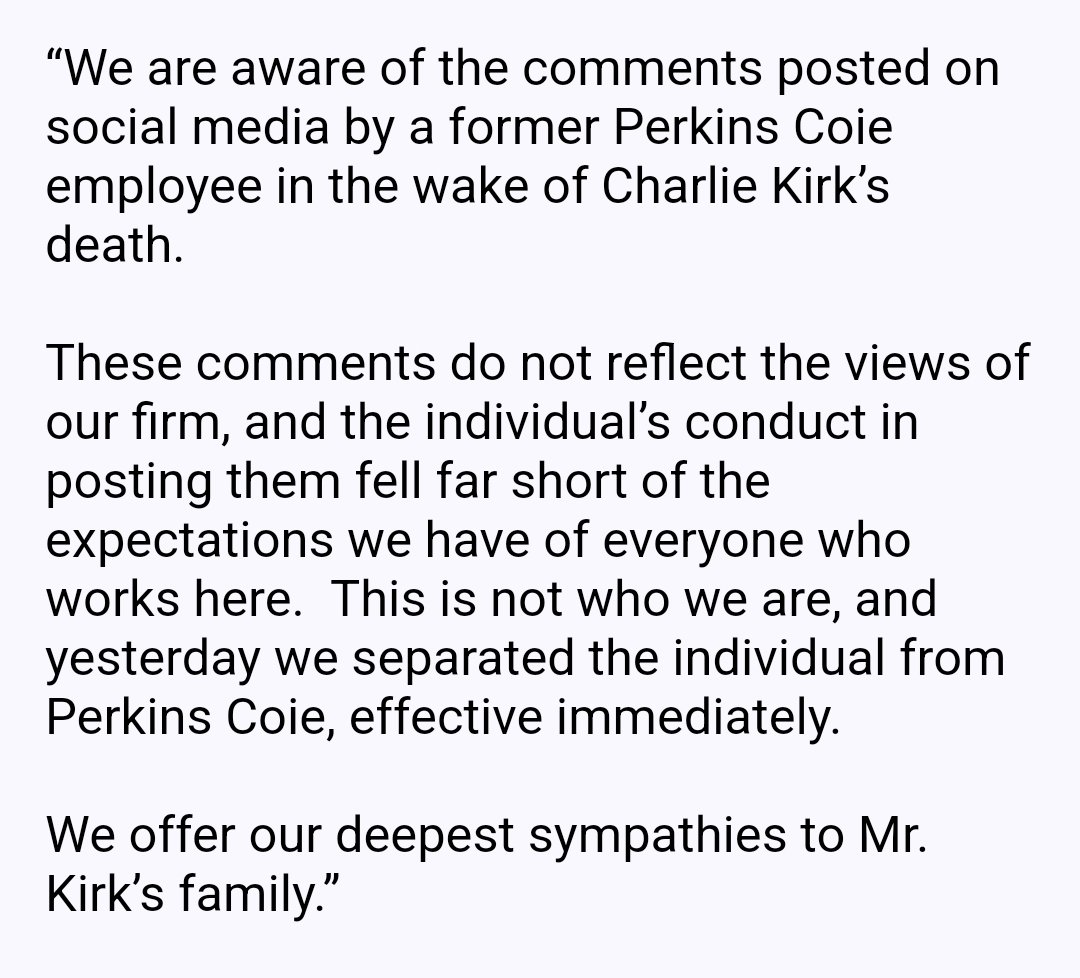
Perkins
Coie
fired
an
associate
over
his
social
media
response
to
the
Kirk
killing.
Not
only
have
they
fired
this
lawyer,
but
they
appear
to
have
taken
down
firm
publicity
posts
that
mention
him.
It’s
quite
the
purge
from
Perkins,
and
it
makes
you
wonder
what
sort
of
commentary
could
have
possibly
have
prompted
this
aggressive
response.
Right-wing
journalist
Benjamin
Domenech
posted
what
he
purports
to
be
the
underlying
post.
Let’s
break
it
down:
Charlie
Kirk
got
famous
as
one
of
America’s
leading
spreaders
of
hatred,
misinformation,
and
intolerance.
The
current
political
moment
—
where
an
extremist
Supreme
Court
and
feckless
Republican
Congress
are
enabling
a
Republican
President
to
become
a
tyrant
and
building
him
modern-day
Gestapo
for
assaulting
black
and
brown
folks
—
is
a
result
of
Charlie
Kirk’s
“contributions”
to
American
media
and
politics.
Hell,
Kirk
would
likely
be
flattered
by
the
underlying
claim.
His
Turning
Point
USA
began
as
a
sort
of
Misbehaved
Young
Republicans
and
eventually
overshadowed
traditional
right-wing
organizations
like
CPAC
in
dictating
the
shape
of
American
conservatism.
Not
to
diminish
Donald
Trump’s
media
instincts,
but
when
polls
suggest
young
men
turning
more
conservative
helped
get
Trump
to
this
point,
that’s
all
Kirk.
And
he
can
take
credit
for
all
that
flows
from
that,
including
the
current
Supreme
Court
making
a
straightfaced
proclamation
that
forgiving
student
debt
is
executive
tyranny
and
then
deciding
that
sending
people
to
South
Sudan
without
due
process
is
just
“practicing
executive
authority
the
right
way.”
It’s
not
“celebrating”
a
murder
just
because
you
decline
to
whitewash
Kirk’s
legacy
by
acting
like
he
“was
practicing
politics
the
right
way”
as
Ezra
Klein
belched
out
onto
the
pages
of
the
New
York
Times.
Klein
apparently
believes
saying
that
the
guy
who
tried
to
murder
Paul
Pelosi
with
a
hammer
should
be
bailed
out
by
some
“patriot”
or
responding
to
the
murder
of
George
Floyd
by
calling
him
a
“scumbag”
is
“the
right
way.”
It’s
a
stunning
display
of
pathological
centrism
brain:
a
compulsion
to
champion
an
angle
that
almost
no
one
in
the
real
world
shares
and
then
preen
as
though
being
an
outlier
is
a
sign
of
genius.
Because
while
liberals
didn’t
think
Kirk
practiced
politics
the
right
way…
neither
did
conservatives!
If
they’re
being
honest
with
themselves,
the
highest
compliment
conservatives
give
Kirk
is
that
he
broke
politics.
He
saw
the
dusty,
genteel
norms
of
the
post-War
political
divide
and
tossed
them
aside
to
build
a
following.
He
took
Rush
Limbaugh’s
model
and
pushed
it
beyond
its
limits.
That
said,
no
one
in
this
country
should
be
murdered
for
their
political
speech.
Wishing
comfort
to
his
wife
and
children
in
this
difficult
time.
Is
this
the
sentiment
that
Perkins
Coie
thinks
is
“not
who
we
are”?
Because
this
is
exactly
the
right
thing
to
say.
Maybe
this
will
be
the
event
that
gets
MAGA
to
be
serious
about
gun
control.
Dead
school
children
haven’t
been
enough.
So
far,
MAGA
took
the
opposite
path.
Out
of
the
gate,
social
media
flooded
with
calls
for
war
against
“the
left”
and
tirades
about
how
“the
left
owns
political
violence
in
this
country!!!”
Then
all
the
alleged
shooter’s
ties
to
the
Groypers
came
out,
a
group
of
far
right-wingers
who
saw
Kirk
as
too
liberal,
kicking
off
“The
Great
Deleting”
as
conservatives
quietly
purged
their
feeds
of
all
the
posts
about
violent
leftists.
Since
then,
they’ve
all
returned
to
writing
about
mental
illness
and
video
games
and
anything
that
isn’t
gun
control.
That
narrative
disappeared
faster
than
Trump’s
plan
to
end
the
Ukraine
war
on
day
1.
Who
couldn’t
see
this
coming?
A
week
earlier,
right-wing
media
was
bragging
about
“The
Department
of
War”
and
purging
the
military
of
“wokeness”
because
liberals
are
all
soy
boy
cucks
who
lack
the
warrior
mentality.
A
murder
happens
on
air
and
suddenly
“yep,
that
sniper
was
obviously
a
liberal!”
and
the
audience
just
follows
along
like
the
sheep
they
are.
They
were
probably
right
the
first
time.
No
political
ideology
holds
a
monopoly
on
violence,
certainly,
but
violence
is
more
likely
to
emerge
from
communities
where
there
are
a
lot
of
young
men,
ready
access
to
guns,
and
a
value
system
that
sees
“strength”
is
a
laudable
political
solution.
That’s
just
going
to
tilt
right-wing
far
more
often.
You
tell
the
Oberlin
campus
someone
is
a
fascist
and
they’re
far
more
likely
to
organize
a
poetry
slam
about
it,
than
turn
to
violence.
Republicans
even
dusted
off
their
classic,
“no
way
to
prevent
this”
claims,
with
the
added
spin
that
the
bolt-action
Mauser
98
allegedly
used
in
this
killing
isn’t
the
sort
of
high
powered
assault
rifle-inspired
weapon
typically
covered
by
gun
control
proposals.
Which
is
true
as
far
as
it
goes,
though
this
highlights
the
profound
superficiality
that
defines
conservative
argument.
Gun
control
couldn’t
have
stopped
this
specific
killing?
Speculative,
but
even
if
that’s
true,
why
is
that
dispositive?
Political
violence
tends
to
beget
political
violence.
The
next
potential
shooter
might
not
opt
for
an
antique
rifle,
which
is
why
throwing
obstacles
in
the
process
and
massively
curtailing
the
ready
supply
of
weaponry
can
save
lives.
Or
at
least
make
catching
the
perpetrator
on
the
back
end
easier
through
more
robust
licensing
and
tracking
—
and
that
provides
at
least
some
disincentive.
That’s
before
considering
how
the
marketing
surrounding
gun
culture
nurtures
the
idea
that
guns
are
the
solution
to
all
one’s
problems.
And
that’s
before
considering
how
the
shooter
might
not
have
ever
gotten
in
position
if
Utah
didn’t
allow
unfettered
open
carry
on
campuses.
You
can’t
credibly
secure
a
venue
when
law
enforcement
and
private
security
aren’t
stopping
people
and
asking,
“um,
why
the
gun,
bro?”
In
any
event,
there’s
nothing
in
this
statement
that
comes
close
to
offensive
or
inappropriate
when
discussing
a
prominent
political
activist.
Viewed
through
the
lens
of
Perkins
Coie’s
ongoing
legal
fight
with
the
administration,
the
response
seems
more
cynical.
The
firm
did
not
surrender
to
White
House
demands
and
took
Trump
to
court
over
retaliatory
executive
actions
directed
at
the
longtime
Democratic
Party
lawyers.
Given
that
Trump’s
actions
are
patently
illegal,
the
firm
has
consistently
whupped
the
government
in
the
case.
But
locked
in
a
high-stakes
fight
with
the
administration,
the
firm
might
be
depending
on
its
lawyers
to
steer
completely
clear
of
any
controversy.
Even
though
there’s
exactly
zilch
about
this
post
to
justify
taking
away
his
job,
this
could
be
a
proactive
step
to
avoid
the
DOJ
running
into
court
and
pretending
this
post,
benign
though
it
may
be,
is
some
sort
of
“proof”
that
the
firm
is
biased.
Unless
this
attorney
said
a
lot
worse
—
and,
again,
right-wing
sources
are
even
claiming
this
is
it
—
then
Perkins
Coie
did
him
dirty.
But
the
firm
may
be
looking
out
for
number
1
here.
And
by
that
we
mean
profits.
Joe
Patrice is
a
senior
editor
at
Above
the
Law
and
co-host
of
Thinking
Like
A
Lawyer.
Feel
free
to email
any
tips,
questions,
or
comments.
Follow
him
on Twitter or
Bluesky
if
you’re
interested
in
law,
politics,
and
a
healthy
dose
of
college
sports
news.
The
report
confirms
what
I
have
heard
over
and
over
again
from
lawyers,
particularly
at
smaller
and
midsize
law
firms:
they
simply
can’t
find
good
quality
associates,
and
when
they
do,
they
frequently
leave
for
perceived
greener
pastures.
BigHand
believes,
and
I
agree,
that
one
solution
is
to
better
utilize
the
associates
that
you
have.
And
that
comes
down,
in
part,
to
better
resource
allocation.
As
BigHand
puts
it,
it’s
a
$1
million
problem.
BigHand
is
selling
a
resource
management
tool
that
purportedly
solves
that
problem.
Some
Numbers
But
first,
some
numbers
from
the
report
that
reflect
the
resource
allocation
problem
and
paint
a
stark
picture:
43%
of
assignment
decisions
are
made
by
lawyers,
and
37%
are
based
on
personal
preference
over
merit.
45%
of
the
firms
surveyed
report
they
only
have
partial
data
on
the
capacity
and
utilization
of
their
associates.
Only
40%
have
partial
data
on
the
work
allocated
from
partners
to
associates.
Many
firms
are
essentially
resourcing
in
the
dark.
The
Clients
Eighty-six
percent
of
the
firms
surveyed
reported
that
client
demand
had
increased
over
the
last
year.
At
the
same
time,
despite
the
increased
demand,
40%
said
clients
are
reducing
their
spend,
38%
are
reducing
the
number
of
firms
that
they
use,
and
30%
of
the
firms
believed
clients
had
found
cheaper
alternatives.
Most
law
firms
surveyed
reported
client
attrition
in
the
last
12
months.
In
short,
there
are
tremendous
opportunities
for
firms
that
can
meet
client
demand.
And
one
way
to
help
do
that
is
to
retain
and
appropriately
utilize
associates.
The
Associates
So,
what
about
the
associates?
It’s
not
pretty.
The
number
of
associates
leaving
the
profession
has
almost
doubled
in
the
last
12
months
from
9%
in
2024
to
17%
in
2025.
The
main
reason
for
associates’
departure
is
the
desire
for
hybrid
working
and
better
work-life
balance.
Other
factors
include
a
lack
of
professional
development
as
well
as
concerns
over
salary.
According
to
the
report,
more
associates
are
moving
in-house
than
ever.
And
clearly,
when
an
associate
leaves,
it
disrupts
the
quality
of
service.
It
increases
the
workload
for
the
remaining
staff.
It
increases
recruiting
and
training
costs,
not
to
mention
the
loss
of
institutional
and
cultural
knowledge.
BigHand
estimates
that
the
cost
of
losing
a
third-year
associate
exceeds
$1,000,000,
even
before
considering
the
impact
on
other
lawyers
and
client
relationships.
Thus,
trying
to
reduce
attrition
is
crucial
for
these
reasons
alone.
And
33%
of
the
firms
surveyed
are
planning
to
reduce
equity
partners.
So,
not
surprisingly,
40%
of
the
firms
surveyed
want
to
increase
senior
associate
levels
in
the
next
year.
A
Perfect
Storm
It
sounds
like
a
perfect
storm:
more
work
available
from
clients,
increased
competition
with
emphasis
on
efficiency,
fewer
partners,
and
unhappy
associates
leaving
in
droves.
No
wonder
law
firm
leaders
keep
wailing
about
not
having
quality
associates
to
do
the
work.
So,
what
are
law
firms
doing?
Based
on
the
Survey,
not
much.
Instead,
they’re
relying
on
lawyers’
gut
instincts
about
associate
quality,
instincts
that
are
often
wrong.
Why
Use
Data
to
Allocate
Resources?
I
know
from
experience
that
many
resource
allocation
decisions
in
law
firms
are
made
based
on
a
partner’s
perceived
abilities
and
qualities
of
associates,
which
are
often
not
entirely
correct.
This
inevitably
results
in
underutilized
associates
on
one
hand
and
overutilized
associates
on
the
other.
The
overutilized
associates
quickly
become
burned
out
and
chafe
at
the
unfairness
of
the
system.
The
underutilized
associate,
on
the
other
hand,
worries
constantly
about
their
development
and
future
at
the
firm.
And
perhaps
they
should.
A
more
data-driven
allocation
method
might
result
in
utilization
on
a
more
accurate
and
fairer
basis
and
alleviate
the
stress
of
too
much
or
too
little
work,
stress
that
drives
associates
to
leave
and
costs
firms
dearly.
Dave
Cook,
BigHand’s
Global
Director
–
Resource
Management,
agrees:
“Partner-led
resourcing
with
no
data
visibility
leads
to
some
associates
being
overloaded
with
work
while
others
are
underutilized,
slowing
their
development
and
limiting
growth
opportunities.”
And
There’s
More
In
addition
to
relieving
associate
utilization
stress,
there
are
other
reasons
for
better
allocation.
For
example,
much
of
what
is
perceived
associate
quality
is
based
on
little
more
than
reputation.
I
remember
a
situation
when
I
was
a
partner
with
an
associate
who
had
the
reputation
of
being
underperforming.
The
firm
was
this
close
to
firing
the
associate
when
another
partner
took
the
associate
under
their
wing
and
moved
them
from
the
section
in
which
they
were
working
to
another
completely
different
section
where
that
partner
could
mentor
the
associate.
That
associate
later
became
an
equity
partner
and
had
some
of
the
highest
origination
of
any
lawyer
in
the
firm.
That,
of
course,
occurred
by
pure
happenstance.
But
if
there
were
data-driven
resources
that
could
help
determine
where
the
needs
were
and
match
those
needs
with
the
skill
set
of
associates,
keeping
in
mind
that,
as
the
associate
I
referred
to,
many
have
different
skill
sets
that
are
suited
to
different
types
of
practice.
A
closer
look
at
utilization
could
help
solve
both
problems
and
decrease
attrition.
It
might
also
detect
quality
issues
that
need
to
be
addressed
with
an
associate
before
it
becomes
such
a
significant
problem
as
in
the
example
that
I
provided.
And
let’s
face
facts.
Not
using
data
to
drive
work
assignments
and
instead
letting
the
lawyer
do
it
themselves
often
mean
lawyers
assigning
work
to
people
that
look
like
them
and
come
from
similar
backgrounds.
Since
most
assigning
lawyers
are
white
male
partners,
you
get
an
inevitably
unfair
result.
In
turn,
the
firm
loses
what
could
be
an
excellent
lawyer.
Cook
puts
it
this
way:
lawyer-based
assignment
“also
opens
the
door
to
all
kinds
of
bias.
Work
is
rarely
ever
equitably
allocated,
leading
to
frustration,
and
sometimes
departures,
from
talent
that
would
otherwise
help
the
firm
succeed.”
The
associate
in
my
example,
by
the
way?
A
black
female.
So,
Why
Not?
So,
why
aren’t
firms
using
a
data-driven
approach
to
allocating
work
to
associates?
As
the
report
points
out,
robust
resource
allocation
is
not
something
that
lawyers
without
data
are
good
at,
and
it
takes
away
from
billable
time.
Yet
they
keep
insisting
on
doing
it
themselves.
That’s
because
most
partners
want
the
freedom
to
utilize
their
favorite
associates.
They
perceive
themselves
as
special
snowflakes
with
the
unique
ability
to
spot
and
develop
talent.
They
believe
that,
instead
of
data,
their
“gut
instinct”
is
the
most
valid
determining
factor.
They
believe
that
their
work
is
so
important
that
only
the
best
associates
can
work
on
it.
And
they
aren’t
going
to
give
up
that
control.
Secondly,
too
many
partners
are
unwilling
to
delegate
the
allocation
of
their
work
to
a
data-driven
platform
and
personnel
who
are
not
lawyers.
The
idea
is
that
this
is
my
practice,
this
is
my
law
firm,
and
you
work
for
me
–
so
butt
out.
I’ve
seen
this
hubris
repeatedly,
especially
from
senior
partners
who’ve
never
had
or
wanted
to
justify
their
resource
decisions
with
data.
Moreover,
rather
than
looking
hard
at
career
development
and
addressing
problems
before
they
get
too
large,
too
many
partners
are
too
focused
on
billable
hours
and
client
origination
to
worry
about
the
development
of
associates,
the
lifeblood
for
the
future
of
the
law
firm.
Conclusion
So
even
though
data-driven
resource
allocation
reduces
associate
attrition
at
a
time
when
more
not
fewer
are
needed,
reduces
cost
and
disruption,
and
may
indirectly
lead
to
better
partners,
firms
are
slow
to
embrace
it.
But
BigHand
is
right;
to
compete
effectively
for
new
work
and
keep
the
clients
and
associates
you
have,
resources
need
to
be
appropriately
allocated
to
the
right
levels
based
upon
profitability,
hourly
rates,
and
efficiencies.
The
best
way
to
do
that
is
not
by
gut
instinct
but
by
data
and
analytics.
While
I
can’t
verify
all
of
BigHand’s
findings,
the
core
problems
they
identify
align
with
what
I’ve
observed
repeatedly.
Does
BigHand’s
resource
management
tool
better
allocate
work?
I
couldn’t
tell
you
that
either.
But
data-driven
resource
allocation
is
the
right
idea
at
the
right
time.
Stephen
Embry
is
a
lawyer,
speaker,
blogger,
and
writer.
He
publishes TechLaw
Crossroads,
a
blog
devoted
to
the
examination
of
the
tension
between
technology,
the
law,
and
the
practice
of
law.










 Kathryn