Founding Partner Passes – See Also – Above the Law

Greenberg
Traurig’s
Larry
Hoffman
Has
Passed
Away:
We
extend
our
condolences
to
his
family,
friends,
and
the
firm.
A
Picture
Is
Worth
A
Thousand
Billable
Hours:
Here’s
a
showing
of
the
biggest
associate
bang
for
buck
for
housing.
Activists
Use
AI
To
Identify
Ice
Agents:
Masks
won’t
hide
you
for
too
long.
Training
Lawyers
In
The
Age
Of
AI:
Stephen
Embry
grapples
with
what’s
to
be
done.

Debunked Episode 19: Turmoil at the CDC, Epic’s AI Strategy – MedCity News

There
is
a
long-simmering
debate
in
the
healthcare
industry
on
whether
we
should
cut
out
health
insurers
as
the
middlemen
in
paying
for
checkups,
prescription
drugs,
procedures
and
more.
Despite
paying
monthly
fees,
health
plan
members
have
to
pay
thousands
in
premiums,
which
can
lead
to
significant
out-of-pocket
costs
for
prescription
medication
and
medical
visits.
The
latest
episode
of
the
Debunked
podcast
explores
an
ongoing
debate
on
this
topic

led
by
investor
Mark
Cuban
,
which
spilled
onto
social
media
channel
X.
The
podcast
also
devotes
attention
to
the
turmoil
at
the
Department
of
Health
and
Human
Services
on
Secretary
Robert
F
Kennedy
Jr.’s
watch,
particularly
at
the
Centers
for
Disease
Control
and
Prevention.
MedCity
News
Editor
in
Chief
Arundhati
Parmar
co-hosts
the
podcast
with
Samir
Batra,
managing
partner
of
Health
Innovation
Pitch.

Arundhati
and
Samir
discuss
whether
payers
are
gaming
the
health
system
by
taking
advantage
of
a
public
who
may
not
fully
understand
their
health
insurance
options
or
the
consequences
of
choosing
one
plan
over
another,
which
can
lead
to
unexpected
out-of-pocket
costs
to
pay
premiums.

“The
system
is
not
set
up
to
support
patient-doctor
[price]
negotiations,”
Samir
said,
pointing
to
a
rising
trend
of
subscription-based
primary
care
services
offered
through
companies
like
One
Medical,
which
Amazon
acquired
in
2023.

The
conversation
then
delves
into
Kennedy’s
chaotic
leadership
at
HHS.
Despite
assurances
made
to
U.S.
Senators
that
Kennedy
would
leave
vaccine
recommendations
in
place,
he
has
made
several
changes
to
longstanding
vaccine
policy.
He
did
away
with
a
recommendation
to
administer
the
Covid-19
vaccine
to
pregnant
women
and
women
nursing
children
under
6
months
old.
Susan
Monarez,
the
former
Senate-confirmed
director
of
the
CDC,

was
ousted

over
her
vaccine
policy
stance,
which
prompted
other
CDC
executives
to
resign
in
protest.
Kennedy
also
replaced
a
board
overseeing
vaccine
policy
with
vaccine
skeptics.
In
2025,
there
have
been

1,431
confirmed
measles
cases
in
41
states
,
mostly
children

the
largest
number
of
cases
in
a
year
since
2000,
when
the
disease
was
declared
eliminated
in
the
U.S.

Epic’s
announcement
at
its
annual
Users
Group
Meeting
that
it
is

developing
hundreds
of
different
AI
bots

to
assist
clinicians,
payers
and
patients
is
also
highlighted,
sparking
a
discussion
on
the
ramifications
of
this
news,
mainly
that
it
could
shut
out
competition
from
its
app
marketplace
because
of
its
dominance
as
an
EHR
vendor.


Listen
to
the
full
Debunked
podcast
here:

Zimbabwe beats South African in securing zero-tariff access for blueberries to China


Guest
article
by
Diego
Castagnasso,
a
fresh
produce
and
blueberry
industry
expert.
Loud,
opinionated,
INFORMED!
Diego
writes
DC’s
B-Side’s
newsletter
as
he
speaks
and
speaks
as
he
writes.
You
can
subscribe,
under
your
own
peril,
to 
his
newsletter
 here
or
visit
his
less
fun
(for
now)
website 
Drip
Consulting
.


In
the
produce
industry, there’s
always
a
race
to
become
the
top
exporter
,
the
largest
producer,
or
the
first
to
enter
a
promising
new
market.
I’ve
witnessed
a
few
of
those
in
my
region.
Take
Chile,
for
example—the
country was
the
leading
blueberry
exporter
for
some
time
and
was
the
first
to
open
access
to
the
Chinese
market.


China
remains
the
golden
goose
in
the
global
agricultural
industry
—the
market
everyone
wants
to
reach.
For
growers
across
all
categories,
gaining
access
to
the
Asian
giant
represents
a
major
milestone.
Entering
this
market
is
like
earning
a
gold
star
on
your
chest,
much
like
in
middle
school.

In
this
case, Zimbabwe
has
earned
that
star,
beating
South
Africa
 to
secure
access
to
China.
But
even
more
notably,
the
African
nation
did
it
with zero
tariffs
,
which
is
a
significant
accomplishment.

Now,
it
appears
China
is
placing
its
bets
on
Zimbabwe.
The
reason
is
unknown,
but
I
suspect
the
Chinese
have
been
testing
Zimbabwean
blueberries
through
Hong
Kong,
which
often
acts
as
an
informal
‘beta
tester’
for
products
entering
mainland
China.


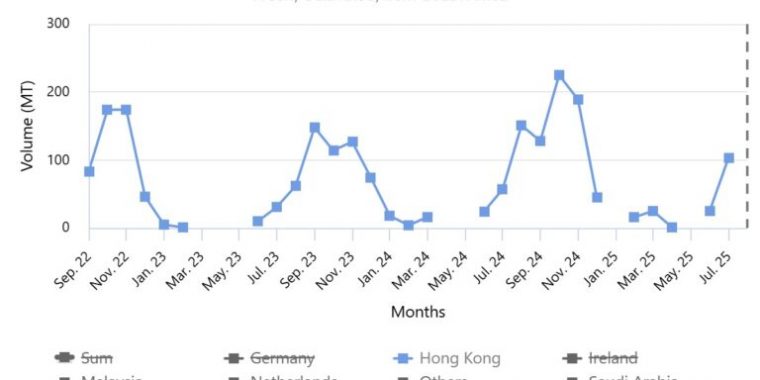
Source:
USDA
Market
News
via Agronometrics.
(Agronometrics
users
can
view
this
chart
with
live
updates here)

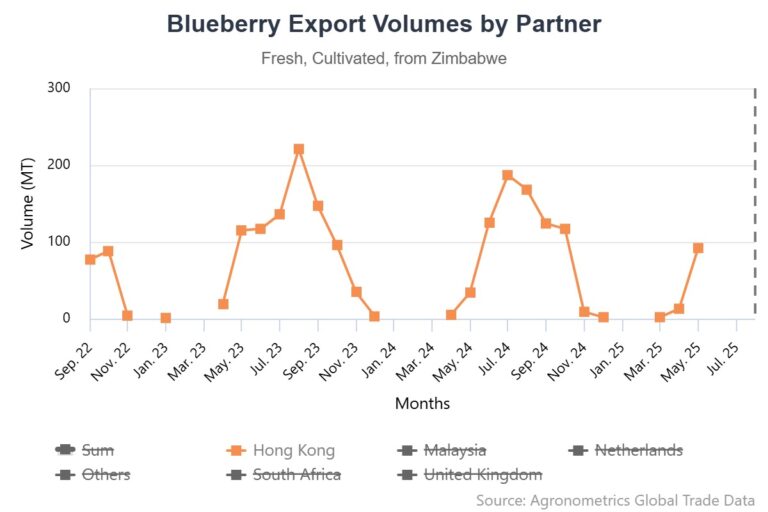
Source:
USDA
Market
News
via Agronometrics.
(Agronometrics
users
can
view
this
chart
with
live
updates here)

Despite
the
large
difference
in
overall
production
volumes
between
Zimbabwe
and
South
Africa,
their
exports
to
Hong
Kong
appear
similar
in
size,
and
Zimbabwe
may
even
be
shipping
more
fruit.
However, the
two
countries
aren’t
in
direct
competition
,
as
their
harvest
peaks
occur
at
different
times.
Zimbabwe’s
peak
arrives
earlier,
which
allows
the
two
to
complement
rather
than
compete
with
each
other
in
the
Chinese
market.

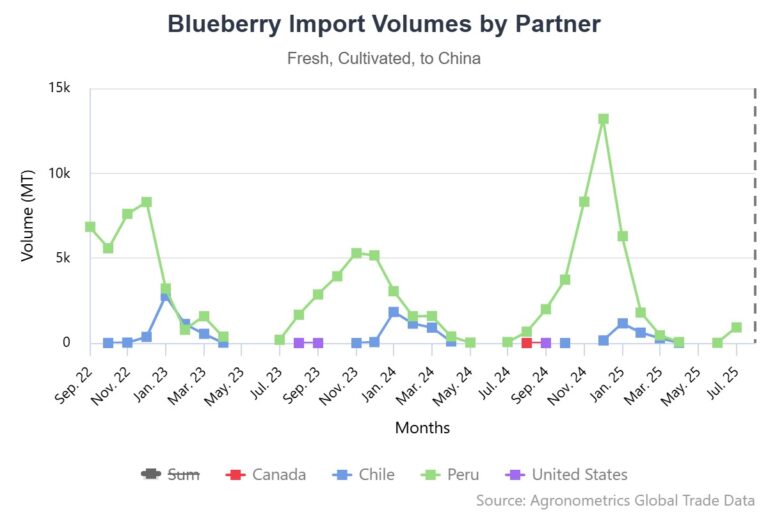
That
said,
both
countries
still
represent
relatively
small
volumes
when
compared
to
China’s
leading
blueberry
suppliers:
Peru
and
Chile.
These
two
continue
to
dominate,
thanks
in
part
to
their
robust
export
infrastructure
and
tariff-free
access.


Source:
USDA
Market
News
via Agronometrics.
(Agronometrics
users
can
view
this
chart
with
live
updates here)

Looking
at
the
data,
one
question
comes
to
mind:
Why
does
China,
with
such
a
vast
appetite
for
fruit,
limit
itself
to
just
four
blueberry
suppliers?
And
why
not
lower
tariffs
to
attract
more
competition?

I
believe
that
if
China
extended
zero-percent
tariffs
to
countries
like
Argentina
and
Uruguay
(which
already
have
approved
export
protocols),
they
might
start
exporting
more
actively
as
well. It’s
a
matter
of
strategy
,
and
such
adjustments
are
often
well
within
China’s
capabilities
when
the
timing
is
right.

In
the
meantime, congratulations
to
Zimbabwe
.
With
this
new
market
opportunity,
the
country
becomes
a
more
attractive
destination
for
foreign
investment
in
its
blueberry
sector.


P.S.
 In
South
America,
Chile
was
the
first
to
open
the
Chinese
market
for
blueberries
and
eliminate
tariffs
through
a
Free
Trade
Agreement.
Uruguay
followed,
but
faced
high
tariffs
(30
percent),
which
limited
the
impact
of
market
access.
Peru
later
joined
with
the
added
benefit
of
duty-free
access,
also
thanks
to
its
FTA.


P.S.
2.
 For
clarity,
when
I
said
“the
reason
is
unknown”
regarding
why
China
chose
Zimbabwe,
I
meant
that
while
there
are
many
possible
explanations,
I
don’t
know
which
specific
factors
influenced
the
decision.
The
likely
explanations,
in
my
view,
are
political
and
unrelated
to
the
blueberry
market
itself.

Source:


Zimbabwe
secures
zero-tariff
access
for
blueberries


FreshFruitPortal.com

Chinese national jailed 18 years for illegal rhino horn and ivory dealings

HARARE

A
Chinese
man
has
been
sentenced
to
18
years
in
prison
after
being
convicted
of
illegally
dealing
in
wildlife,
in
one
of
the
stiffest
penalties
handed
down
in
Zimbabwe’s
ongoing
crackdown
on
poaching
and
the
illicit
wildlife
trade.

A
Harare
magistrates
on
Thursday
convicted
Cong
Yanzhong,
57,
on
two
counts
of
unlawfully
dealing
in
wildlife
products.

He
was
arrested
in
July
after
detectives
recovered
7.7kg
of
rhino
horn
worth
US$240,000
and
36kg
of
raw
ivory
valued
at
just
over
US$6,000
from
his
possession
and
residence.

According
to
the
National
Prosecuting
Authority,
detectives
acting
on
a
tip-off
trailed
Cong
on
July
16.
They
intercepted
him
carrying
a
black
satchel
and
a
brown
bag,
which
were
found
to
contain
three
shrink-wrapped
rhino
horns.
He
was
unable
to
produce
the
necessary
permits
or
licences.


A
subsequent
search
of
his
Harare
home
uncovered
the
ivory
pieces,
deepening
suspicions
that
Cong
was
part
of
a
wider
trafficking
network.

The
court
imposed
an
effective
18-year
custodial
sentence.

“The
sentencing
sends
a
strong
message
that
Zimbabwe
has
zero
tolerance
for
wildlife
crime,”
the
NPA
said
in
a
statement.

“We
will
continue
to
work
tirelessly
to
protect
our
precious
natural
heritage
and
ensure
that
those
who
seek
to
profit
from
the
destruction
of
our
wildlife
face
the
full
force
of
the
law.”

Zimbabwe,
home
to
some
of
the
world’s
largest
populations
of
elephants
and
black
rhinos,
has
been
battling
sophisticated
poaching
syndicates
that
often
operate
across
borders.
Wildlife
crime
has
been
fuelled
by
demand
for
ivory
and
rhino
horn
in
parts
of
Asia,
where
they
are
prized
for
ornaments
and
traditional
medicine.

The
NPA
said
Cong’s
sentencing
should
deter
others
who
may
be
tempted
by
the
lucrative
but
illegal
wildlife
trade.

Supreme Court delivers blow to Zimra in $7 million chrome royalties dispute

HARARE

The
Supreme
Court
has
delivered
detailed
reasons
for
a
judgment
issued
in
March
which
upheld
a
landmark
High
Court
ruling
exonerating
ferrochrome
producer
ZIMASCO
from
paying
millions
in
disputed
mining
royalties,
dealing
a
blow
to
the
Zimbabwe
Revenue
Authority
(Zimra)
in
a
case
with
major
implications
for
the
mining
sector.

In
a
March
27
ruling,
the
apex
court
dismissed
Zimra’s
appeal
against
a
2023
decision
that
chrome
ore
concentrates
and
ferrochrome
were
not
subject
to
royalties
between
2019
and
2022.

The
judgement,
whose
reasons
were
released
this
week,
shields
ZIMASCO
from
liability
for
reassessed
royalties
amounting
to
ZWL$604
million
and
US$7
million,
while
clarifying
the
limits
of
the
taxman’s
reach
in
mining
taxation.

The
dispute
traces
back
to
a
2022
audit
in
which
Zimra
accused
ZIMASCO
of
underpaying
royalties
on
its
exports
of
chrome
products.
The
tax
authority
argued
that
royalties
should
have
been
calculated
on
the
gross
invoice
value,
including
logistics
costs,
rather
than
the
“ex-works”
price
declared
by
ZIMASCO.


More
critically,
Zimra
insisted
that
both
chrome
concentrates
and
ferrochrome—an
alloy
produced
by
smelting
chromite
ore—fell
within
the
scope
of
mineral
royalties
under
the
Mines
and
Minerals
Act.
It
issued
a
revised
assessment
covering
the
period
January
2019
to
September
2022,
triggering
the
legal
battle.

ZIMASCO,
represented
by
Advocate
Thabani
Mpofu,
pushed
back,
filing
for
a
declaratory
order
at
the
High
Court.
The
ferrochrome
producer
argued
that,
at
the
time,
royalties
were
only
chargeable
on
raw
minerals,
not
on
“mineral-bearing
products”
such
as
processed
alloys.
The
company
further
maintained
that
ferrochrome,
being
man-made,
could
not
be
classified
as
a
“mineral”
under
the
law.

The
High
Court
sided
with
ZIMASCO,
finding
that
no
royalty
rate
had
been
prescribed
for
mineral-bearing
products
before
January
1,
2022,
when
parliament
amended
the
Finance
Act
to
expressly
extend
royalties
to
such
products.

Zimra
escalated
the
matter
to
the
Supreme
Court,
arguing
that
royalties
should
always
have
applied
to
mineral-bearing
products.
Its
legal
team,
led
by
Simplicio
Bhebhe,
urged
the
court
to
adopt
a
“purposive”
reading
of
the
law,
warning
that
exempting
processed
products
like
ferrochrome
from
royalties
would
lead
to
an
“absurdity.”

But
the
three-judge
panel—Justices
Chinembiri
Bhunu,
George
Chiweshe
and
Joseph
Musakwa—was
unmoved.
In
its
newly
released
reasons,
the
court
reaffirmed
a
cardinal
principle
of
tax
law:
no
tax
or
royalty
can
be
imposed
without
clear
statutory
authority.

“Any
ambiguity
or
silence
in
the
legislation
must
be
resolved
in
favour
of
the
taxpayer
rather
than
the
taxing
authority,”
wrote
Justice
Musakwa.

The
judges
said
between
2019
and
2022,
the
Finance
Act’s
royalty
schedule
listed
rates
for
“minerals”
only.
Mineral-bearing
products
such
as
chrome
concentrates
and
ferrochrome
were
conspicuously
absent.
Without
a
prescribed
rate,
there
could
be
no
enforceable
obligation.

In
a
significant
finding
for
the
mining
industry,
the
court
also
ruled
on
the
status
of
ferrochrome
itself.

Evidence
before
the
court
showed
that
ferrochrome
is
produced
by
smelting
chromite
ore
in
furnaces
with
reductants
and
fluxes,
yielding
an
alloy
not
found
in
nature.
The
court
accepted
this,
holding
that
ferrochrome
does
not
fall
within
the
Mines
and
Minerals
Act’s
definition
of
a
“mineral,”
which
must
occur
naturally
and
result
from
geological
processes.

“Where
a
mineral
is
processed
to
the
extent
that
it
is
converted
into
an
alloy
not
found
in
the
earth’s
crust,
it
no
longer
retains
its
character
as
a
mineral,”
the
judgement
noted,
citing
earlier
case
law.

Adding
complexity
to
the
case
was
the
government’s
subsequent
attempt
to
close
the
gap.
In
2021,
parliament
enacted
Finance
Act
No.
7,
introducing
Section
37B
to
impose
royalties
on
mineral-bearing
products
effective
January
1,
2022.

In
2024,
a
further
amendment
retrospectively
broadened
the
definition
of
“mineral”
to
include
mineral-bearing
products,
backdated
to
2010.

Zimra
tried
to
lean
on
the
2024
amendment
to
argue
that
liability
should
apply
to
past
years.
But
the
Supreme
Court
dismissed
the
argument,
ruling
that
retrospective
definitions
could
not
substitute
for
the
absence
of
a
fixed
royalty
rate
in
the
law
during
the
relevant
period.

The
judgment
represents
a
major
victory
for
ZIMASCO—and
potentially
for
other
miners
who
exported
processed
mineral
products
before
2022.

By
affirming
that
royalties
must
rest
on
explicit
statutory
rates,
the
court
reinforced
taxpayer
protections
against
what
it
called
“arbitrary
or
expansive
interpretations”
by
revenue
authorities.

The
ruling
is
a
high-profile
setback
for
Zimra
that
not
only
wipes
out
a
multimillion-dollar
claim
but
may
embolden
other
mining
firms
to
challenge
royalty
assessments
for
past
periods.

With
royalties
on
mineral-bearing
products
now
firmly
entrenched
in
law
since
2022,
the
judgement
does
not
exempt
miners
from
current
obligations.


Zimbabwe launches bid for UN Security Council seat

Speaking
at
the
launch
event
in
Harare
on
Tuesday,
Mnangagwa
said
Zimbabwe’s
candidacy
reflects
its
longstanding
commitment
to
multilateralism
and
its
track
record
in
peacekeeping
and
regional
diplomacy.

“Our
mission
is
to
serve
as
a
trusted,
proactive
and
solutions-driven
partner
in
the
maintenance
of
global
peace
and
security,”
he
said.

He
said
the
campaign,
themed
“Advancing
21st
Century
Solutions
for
Global
Peace
and
Security
through
Multilateralism,”
has
already
received
endorsements
from
the
Southern
African
Development
Community
and
the
African
Union.

If
elected,
Zimbabwe
would
join
the
UNSC’s
10
rotating
non-permanent
members,
who
serve
two-year
terms
alongside
five
permanent
members

China,
France,
Russia,
the
United
Kingdom
and
the
United
States.

Non-permanent
members
are
elected
by
the
UN
General
Assembly
and
require
a
two-thirds
majority
vote.

The
next
round
of
elections
is
scheduled
for
June
2026.

Zimbabwe
previously
held
a
non-permanent
seat
on
the
UNSC
during
the
1983–1984
and
1991–1992
terms.

School in fierce legal battle against Chinese-owned Shuntai Holdings over the construction of a lime & cement factory just 497 metres from the school boundary


Bryden
Country
School
in
Chegutu
is
locked
in
a
fierce
legal
battle
against
Chinese-owned
Shuntai
Holdings
over
the
construction
of
a
lime
and
cement
factory
just
497
metres
from
the
school
boundary,
with
parents,
teachers
and
education
leaders
warning
of
dire
health
and
environmental
consequences
for
pupils.
In
a
circular
to
parents
last
week,
the
school’s
Board
of
Governors
detailed
a
timeline
of
events
since
February,
when
Shuntai
first
informed
Bryden
of
its
plans.
Despite
resistance
from
the
school,
parents,
and
other
stakeholders,
construction
has
pressed
ahead

in
open
defiance
of
a
High
Court
order
suspending
work
at
the
site.
“We
found
there
was
no
supporting
documentation
for
Shuntai
to
operate
in
this
Zone
earmarked
for
Education,”
the
letter
reads,
pointing
out
that
Springs
of
Grace,
the
Seventh
Day
Adventist
Secondary
School
and
University
are
also
within
the
affected
area.

The
school
says
it
raised
multiple
objections
to
Shuntai’s
Environmental
and
Social
Impact
Assessment
(ESIA)
report,
which
it
claims
failed
to
address
health
and
safety
concerns.
Despite
this,
the
Environmental
Management
Agency
(EMA)
issued
the
company
a
certificate
in
April,
forcing
Bryden
to
sue
the
regulator.
The
High
Court
subsequently
ordered
EMA
to
release
the
documents
underlying
the
certification,
but
they
turned
out
to
be
the
same
contested
report.
Meanwhile,
parents
and
pupils
have
endured
worsening
conditions
at
the
school,
including
clouds
of
dust,
noxious
fumes,
loud
blasting
and
heavy
machinery
noise.
On
July
25,
a
High
Court
judge
personally
visited
the
site
and
later
ruled
that
Shuntai
was
in
contempt
of
the
original
stop-work
order.
But
despite
the
ruling,
construction
has
continued,
the
school
said.

Former
education
minister
David
Coltart
slammed
the
developments,
calling
the
situation
“simply
outrageous.”
“How
can
we
allow
one
of
our
finest
schools
to
be
threatened
in
this
manner
by
a
Chinese
company
which
will
rape
our
resources,
expend
them
all,
shift
their
profits
to
China
and
then
move
back
to
China
to
enjoy
them

all
while
one
of
our
finest
educational
institutions
is
destroyed?”
Coltart
said.
“This
must
stop.
We
need
firm
Government
action
to
end
this
thuggery.”
Bryden’s
board
has
urged
parents
to
rally
behind
the
school
in
its
legal
fight,
warning
that
the
future
of
generations
of
learners
is
at
stake.

Source:


Zimbabwe:
School
in
fierce
legal
battle
against
Chinese-owned
Shuntai
Holdings
over
the
construction
of
a
lime
&
cement
factory
just
497
metres
from
the
school
boundary


Business
&
Human
Rights
Resource
Centre

Post
published
in:

Featured

Major South African insurer takes R2 billion hit from Zimbabwe

Old
Mutual
had
a
mixed
performance
in
the
first
six
months
of
2025,
as
higher-than-expected
market
returns
boosted
its
results
while
a
hit
in
Zimbabwe
weighed
on
profit
and
earnings.

Old
Mutual
was
established
in
Cape
Town
in
1845
as
South
Africa’s
first
mutual
life
insurance
company.

Today,
it
is
a
financial
services
group
that
operates
in
12
countries,
offering
insurance,
asset
management
and,
more
recently,
banking.
It
is
listed
on
the
JSE
and
has
a
market
cap
of
around
R64
billion.

On
Wednesday,
10
September,
Old
Mutual
released
its
results
for
the
six
months
ended
30
June
2025,
the
first
half
of
its
2025
financial
year.

These
results
showed
a
mixed
performance.
The
insurer’s
results
from
operations
increased
by
16%
to
R4.94
billion,
while
profit
and
headline
earnings
declined.

The
increase
in
results
from
operations
was
primarily
driven
by
exceptional
growth
in
Old
Mutual
Insure
and
favourable
market
conditions.

However,
the
company
noted
that
this
growth
was
partially
offset
by
the
negative
impact
of
a
persistency
basis
change
in
its
Mass
and
Foundation
Cluster
and
higher
central
costs.

These
costs
include
a
once-off
restructuring
provision
incurred
to
reduce
future
expenditure.

The
company’s
adjusted
headline
earnings
grew
by
29%
to
R4.20
billion,
supported
by
an
88%
increase
in
shareholder
investment
returns.
This
comes
as
the
JSE
All-Share
Index
returned
16.7%
in
the
first
half
of
2025.

However,
Old
Mutual’s
headline
earnings,
not
adjusted,
declined
by
29%
to
R4.16
billion,
mainly
due
to
reduced
profits
from
its
Zimbabwean
business.

This
business
unit
experienced
a
R2.2
billion
decrease
in
profits
as
Old
Mutual
implemented
a
change
in
functional
currency
from
Zimbabwe
Gold
to
the
United
States
dollar
from
1
July
2024.

This
is
the
same
reason
Old
Mutual’s
basic
earnings
per
share
dropped
by
20%
to
96.1
cents,
and
its
IFRS
profit
after
tax
declined
by
22%
to
R4.10
billion.

The
company
further
noted
that
it
saw
muted
sales
growth
with
the
present
value
of
new
business
premiums
decreasing
by
7%.

Old
Mutual’s
Life
APE
sales
increased
by
1%,
but
higher
retail
risk
volumes
in
its
Mass
and
Foundation
Cluster
and
good
sales
in
Old
Mutual
Africa
Regions
were
largely
offset
by
lower
guaranteed
annuity
sales
in
Personal
Finance.

Overall,
gross
written
premiums
increased
by
5%,
driven
by
good
growth
in
Old
Mutual
Insure.

Old
Mutual’s
return
on
net
asset
value
grew
by
290
basis
points
to
15.5%.
When
excluding
the
company’s
newly
launched
bank,
these
figures
go
up
to
390
basis
points
and
18.7%,
respectively.

On
the
back
of
these
results,
Old
Mutual
declared
an
interim
dividend
of
37
cents
per
share,
up
from
34
cents
in
the
first
half
of
2024.

Source:


Major
South
African
insurer
takes
R2
billion
hit
from
Zimbabwe


Daily
Investor

Zimbabwe Rural Schools Library Trust wins Best Literary Development Initiative Award


The
organisation’s
work
was
noticed
through
a
book
published
in
2024
to
mark
its
tenth
anniversary.
This
accolade
celebrates
the
book’s
contribution
to
education
and
social
development
and
reflects
the
impact
of
the
Trust’s
work
over
the
past
decade.

Titled
Uniting
the
World
for
Rural
School
Library
Development,
the
book
was
intended
to
mark
the
Trust’s
10-year
milestone
of
mobilising
books
for
over
100
rural
schools
and
advocating
for
the
establishment
of
libraries
in
schools
in
Zimbabwe.
Several
individuals
and
former
students’
associations
were
inspired
to
build
libraries
at
rural
schools
they
or
their
parents
went
through
the
organisation’s
Know
Your
Roots
campaign,
which
encouraged
people
to
give
back
to
their
communities.

The
book
also
highlights
initiatives
such
as
sponsoring
an
orphaned
student
to
complete
high
school,
running
reading
promotion
programs,
producing
a
musical
album
to
encourage
literacy,
and
advocating
for
national
library
policy
reform
through
engagement
with
the
Zimbabwean
government.

Edited
by
Dr.
Eric
Boamah,
a
Ghanaian
national
who
lectures
at
the
Open
Polytechnic
of
New
Zealand,
the
publication
includes
chapters
written
by
the
late
Tonderayi
Chanakira,
Zimbabwe’s
Minister
of
Skills
Audit
and
Development,
Professor
Paul
Mavima,
former
Minister
of
Information
and
Communication
Technology
Advocate
Nelson
Chamisa,
ladies
who
studied
at
benefiting
schools,
namely
Rufaro
Marbo
Lunga,
who
did
her
Ordinary
level
studies
at
Igava
High
School
in
Wedza,
and
Kudzaishe
Mungwena,
a
former
student
at
Batanai
High
School
in
Gokwe.
The
former
President
of
the
International
Federation
of
Library
Associations
and
Institutions
(IFLA),
Barbara
Lison,
wrote
the
preface,
while
Professor
Tinashe
Mugwisi
of
the
National
University
of
Science
and
Technology
did
the
foreword.
Other
contributors
include
Mr.
Macdonald
Nhakura,
Mr.
Carren
Musada,
Dr.
Kudakwashe
Tuwe,
Dr.
Josiline
Chigada,
Dr.
Shadreck
Ndinde,
Mr.Kudakwashe
Muchenje,
Mr.
Bert
Nyabadza,
Dr.
Eric
Boamah,
and
Mr.
Driden
Kunaka.

With
such
a
diverse
array
of
contributors,
the
book
covers
a
wide
range
of
interests,
giving
an
in-depth
coverage
of
factors
influencing
the
state
of
school
libraries,
particularly
in
the
rural
areas
of
Zimbabwe.
It
provides
solutions
to
the
slow
growth
of
school
libraries
and
recommends
legislative
reforms
to
ensure
adequate
attention
is
given
to
school
library
development.

Officially
launched
in
Zimbabwe
by
the
Minister
of
Primary
and
Secondary
Education,
Dr.
Torerayi
Moyo,
and
in
Australia
by
the
Deputy
Mayor
of
the
City
of
Belmont,
Councillor
Deborah
Sessions,
the
book
is
available
online
from
Amazon.
In
Zimbabwe,
hard
copies
can
be
obtained
from
Mr.
Macdonald
Nhakura,
who
can
be
reached
on
 +263
77
304
8590.

The
Zimbabwe
Rural
Schools
Library
Trust
was
registered
as
a
Charitable
Trust
in
Zimbabwe
in
2012
and
in
New
Zealand
in
2013.
It
rebranded
in
Zimbabwe
to
become
the
Zimbabwe
Rural
Schools
Library
Initiative
in
Zimbabwe
following
the
decision
to
register
as
a
Private
Voluntary
Organisation
in
2023,
as
Zimbabwe
legislation
does
not
allow
the
name
of
a
Private
Voluntary
Organisation
to
have
the
word
Trust
as
part
of
its
name.
The
New
Zealand
chapter
still
operates
as
Zimbabwe
Rural
Schools
Library
Trust,
but
in
Australia,
we
have
obtained
an
ABN
as
the
Zimbabwe
Rural
Schools
Library
Initiative
to
reflect
the
name
now
used
in
Zimbabwe,
the
benefiting
country.

Chairperson
of
the
Zimbabwe
Rural
Schools
Library
Initiative
in
Zimbabwe,
Dr.
Josiline
Chigwada,
says
the
accolade
is
testimony
of
the
hard
work
that
has
been
done
over
the
years.
“Getting
people
who
benefited
giving
testimonies
proves
beyond
a
reasonable
doubt
that
we
are
on
course
to
do
greater
things.
We
thank
all
the
authors,
advertisers,
and
donors
who
made
this
book
a
reality,”
she
said.

Post
published
in:

Featured