Visa
Applications: Applicants
for
U.S.
nonimmigrant
visas must
now schedule
their
visa
interview
appointments
at
the
U.S.
Embassy
or
Consulate
in
their
country
of
nationality
or
residence. Nationals
of
countries
where
the
U.S.
government
is
not
conducting
routine
nonimmigrant
visa
operations must apply
at a designated
embassy
or
consulate,
unless
their
residence
is
elsewhere. For
Zimbabweans
resident
in
Zimbabwe,
you
must
apply
at
the United
States
Consulate
in Johannesburg,
South
Africa.
Residence
Requirement:
Zimbabwean
applicants
not
resident
in
Zimbabwe
must apply
for
a
visa
in
their
country
of
residence
and be
able
to
demonstrate
residence
in
the
country
where
they
are
applying.
Fees: Fees
paid
for applications outside
an
applicant’s
country
of
residence
cannot be
refunded.
Important
Update
on
C1/D
Visas
The
validity
of
C1/D
(transit/crew
member)
visas
for
Zimbabwean
applicants
has
been
extended
to
24
months
with
multiple
entry. Applications
for
C1/D
visas
may
be
submitted
at
the
U.S.
Embassy
in
Johannesburg
at
this
time. The
U.S.
Embassy
in
Harare
continues
the
pause
on
routine
immigrant
and
nonimmigrant
visa
services.
Pause
on
Immigrant
and
Non-Immigrant
Visa
Services
at
U.S.
Embassy
Harare
Continues
The
U.S.
Embassy
in
Harare,
Zimbabwe,
continues
its
pause
on
all
routine
immigrant
and
nonimmigrant
visa
services
except
for
most
diplomatic
and
official
visas. Zimbabwean
applicants for
U.S.
nonimmigrant
visas currently
resident
in
Zimbabwe should
schedule
their
visa
interview
appointments
at
the
U.S
Embassy
in
Johannesburg
unless
their
residence
is
elsewhere.
Effective
immediately,
all
individuals
applying
for
an
F,
M,
or
J
nonimmigrant
visa
are
requested
to
adjust
the
privacy
settings
on
all
their
social
media
accounts
to
‘public’
to
facilitate
vetting
necessary
to
establish
their
identity
and
admissibility
to
the
United
States
under
U.S.
law.
Applicants
with
scheduled
visa
interviews
will
receive
information
once
appointments
can
be
rescheduled.
Wait
times
for
nonimmigrant
interview
appointments
vary
by
location.
Applicants
applying
outside
their
country
of
nationality
or
residence
should
expect
to
wait
significantly
longer
for
an
appointment
and
might
find
that
it
will
be
more
difficult
to
qualify
for
the
visa.
Fees
paid
for
such
applications
will
not
be
refunded.
Routine
and
emergency
American
Citizens
Services
will
continue
as
normal.
The
Department
of
State
is
committed
to
protecting
our
nation
and
our
citizens
by
upholding
the
highest
standards
of
national
security
and
public
safety
through
our
visa
processes,
preventing
overstay
and
visa
misuse.
Left
to
their
own
devices,
universities
probably
just
double
down
on
the
trend
of
being
real
estate
hedge
funds
with
a
degree-minting
side
hustle.
Unfortunately,
they
have
to
respond
to
existential
threats
from
Trump
administration
like
getting
their
accreditation
taken
from
them
or
having
to
fight
in
court
over
billions
of
dollars
in
federal
funding.
As
such,
universities
have
to
move
with
a
bit
more
finesse
and
planning;
NYU
is
commiting
to
that
reality
by
having
Trevor
Morrison
serve
as
their
Chief
Legal
Officer.
Law.com
has
coverage:
New
York
University
has
appointed
Trevor
Morrison,
who
was
dean
of
the
NYU
School
of
Law
from
2013
to
2022,
as
its
first
chief
legal
officer
and
senior
presidential
adviser
for
institutional
policy. … In
a
memo
to
senior
leadership,
NYU
President
Linda
Mills
said
Morrison
will
report
to
her
and
will
be
NYU’s
senior-most
legal
strategist,
leading
on
such
issues
as
institutional
integrity,
governance,
ethics,
risk
and
compliance.
You
can
imagine
that
some
of
the
issues
discussed
will
be.
“Do
you
think
Trump
will
threaten
our
ability
to
take
international
students
if
at
least
three
faculty
in
the
Economics
department
don’t
scrounge
up
some
data
on
how
tariffs
are
actually
good
for
the
country?”
and
“If
we
don’t
call
the
police
on
campus
protestors
within
the
first
five
minutes
of
them
erecting
signs,
how
much
federal
funding
will
it
cost
us?”
Best
of
luck
to
Morrison
in
the
new
role.
As
rough
as
it
is
to
balance
integrity
with
the
short-term
shock
of
the
disturbances
the
Trump
administration
can
throw
your
way,
there
is
some
solace
in
knowing
that
Harvard
and
Perkins
Coie
are
better
off
fighting
the
good
fight
than
Columbia
and
the
Yellow-Bellied
Nine
fared
by
caving
in
early.
Chris
Williams
became
a
social
media
manager
and
assistant
editor
for
Above
the
Law
in
June
2021.
Prior
to
joining
the
staff,
he
moonlighted
as
a
minor
Memelord™
in
the
Facebook
group Law
School
Memes
for
Edgy
T14s
.
He
endured
Missouri
long
enough
to
graduate
from
Washington
University
in
St.
Louis
School
of
Law.
He
is
a
former
boatbuilder
who
is
learning
to
swim, is
interested
in
critical
race
theory,
philosophy,
and
humor,
and
has
a
love
for
cycling
that
occasionally
annoys
his
peers.
You
can
reach
him
by
email
at [email protected]
and
by
tweet
at @WritesForRent.
Gordon
Sibanda,
who
worked
in
one
of
Zimbabwe’s
artisanal
mines,
pictured
with
his
grandson
(Picture:
Gergana
Krasteva)
Metro’s
foreign
correspondent
Gergana
Krasteva
reports
from
Zimbabwe
Beads
of
sweat
drip
down
Gilbert
Nuovu’s
forehead
as
the
memories
of
working
in one
of
Zimbabwe’s
gold
mines rush
back
in.
Over
a
year
ago,
the
dad-of-two
deserted
his
job
after
a
colleague
was
killed
when
the
walls
of
the
pit
caved
in,
burying
him
alive.
‘A
friend
of
mine
died
on
the
spot.
I
was
afraid
for
my
life,
so
I
went
back
home,’
he
tells Metro.
The
road
into
Matabeleland
North,
150
miles
from
the
city
of
Bulawayo,
is
uneven
and
thick
with
dust,
but
I
am
assured
that
it
will
eventually
lead
to
a
gold
mine.
It
is
one
of
the
many
precious
materials
for
which
the
land
here
has
been
exploited
since
before
British
colonial
rule,
with
the
first
extractions
made
as
early
as
the
14th
century.
As
our
SUV
crawls
forward,
a
line
of
workers
stretches
along
the
footpath
–
boys
barely
into
their
teens
and
weathered
men
three
times
their
age.
Most
are
wearing
the
same
faded
blue
overalls,
and
chipped
shovels
slung
over
their
shoulders
–
a
sign
they work in
one
of
the
legal
mines.
Matabeleland
North
sits
on
some
of
the
richest
deposits
of
gold
in
Africa,
and
so
is
plagued
with
artisanal
pits,
which
are
not
officially
registered
with
the government,
making
them
illegal.
Metro gained
access
to
Turk,
one
of
the
oldest
gold
mines
in
Zimbabwe,
located
in
the
Bubbi
District
(Picture:
Gergana
Krasteva)
Yet,
tens
of
thousands
of
men
and
women
are
forced
into
the
trade
due
to
unemployment,
making
up
the
majority
of
the
mining
workforce.
‘Three
of
my
friends
were
killed
in
the
mines’
Gordon
Sibanda
used
to
be
one
of
them.
Metro speaks
with
him
at
the
Libeni
Primary School,
where
he
volunteers
as
a
chef
to
somehow
contribute
to
the
local
community
while
searching
for
work.
Sitting
on
a
wooden
log
and
smoothing
his
cooking
apron,
he
admits
that
poverty
is
what
drove
him
to
mining
in
2001,
when
he
was
39.
He
says:
‘A
friend
introduced
me
to
the
trade.
Many
of
my
friends
are
still
in
the
pits
to
this
day.
‘Mining
is
strenuous
labor.
You
can
spend
months
searching
for
a
mineral
you
cannot
see
and
do
not
know
if
it
is
actually
in
the
earth.
‘And
when
luck
would
fall
on
our
side,
you
may
get
something.’
In
Zimbabwe’s
mines,
death
never
seems
far.
So
when
I
ask
Gordon
if
any
of
his
colleagues
were
injured
or
killed
in
the
pits,
he
replies,
almost
nonchalantly,
as
he
takes
off
his
woolen
beanie:
‘Ah
yes.
Three
have
been
killed
when
the
mines
collapsed. ‘
Disintegrated
shafts,
explosions,
flooding
–
each
shift
carries
the
chance
that
a
worker
will
not
return
home.
As
many
as
237
people
died
in
incidents
in
2023,
making
it
one
of
the
very
worst
years
in
the
country’s
mining
history.
And
up
until
May
this
year,
59
fatal
incidents
were
reported
–
most
in
illegal
mines,
like
the
one
that
Gordon
worked
in.
To
fully
comprehend
the
vast
scale
of
illegal
mining, Metro sits
down
with
Pumulu
Masu,
government
school
inspector,
who
says
that
most
people
in
Matabeleland
North
dig
without
a
permit,
which
means
the
state
does
not
‘profit’
from
it.
‘Mostly,
people
in
the
area
mine
illegally,’
she
explains.
‘Let’s
say
there
is
an
agricultural
field.
Instead
of
a
farm,
they
will
turn
it
into
a
mine.
‘Even
in
their
personal
properties
–
behind
their
homes
–
people
start
to
dig.
‘We
can
always
tell
by
the
maps
of
soil.
If
people
suspect
there
is
gold,
they
will
always
dig
no
matter
what
the
land
is.’
While
Gordon
worked
in
an
illegal
pit,
Gilbert
has
experience
in
a
registered
mine.
Their
only
piece
of
advice
–
what
they
want
everyone
to
know
–
is
‘do
not
do
it,
do
not
work
in
a
mine,’
pointing
to
how
deadly
the
trade
is.
Gilbert
says:
‘The
pit
is
not
that
strong
as
miners
often
dig
tunnels
[without
much
planning],
making
the
walls
weak.
‘We
are
not
given
helmets
or
boots
to
protect
us.
It
is
difficult
to
survive.
‘The
work
is
just
too
much.
In
mines,
there
are
no
set
working
hours.You
work
and
you
stop
when
it
is
time
to
eat,
then
you
go
back
to
work.
It
is
continuous,
we
do
not
stop.’
Labour
exploitation
and
low
pay
in
mines
In
Zimbabwe,
mining
runs
through
generations
like
a
vein
of
gold
itself.
It
is
often
seen
as
a
rite
of
passage
for
children
as
young
as
nine,
and
at
the
same
time
a
lifeline
for
families
in
the
depths
of
poverty.
Gilbert
now
volunteers
as
a
chef
at
his
children’s
school
(Picture:
Gergana
Krasteva)
Though
the
pay
is
still
meagre.
All
the
money
Gordon
earned
was
spent
on
food
for
his
large
family,
all
13
of
them.
At
the
time,
he
was
the
sole
breadwinner
for
his
wife,
three
sons
and
three
daughters,
his
own
parents
and
siblings.
‘Hand
to
mouth,
nothing
else
[is
left],’
he
adds,
gesturing
at
his
grandson,
a
four-year-old
boy
playing
with
his
friends
a
few
metres
away.
Yet,
despite
facing
unemployment,
Gordon
has
not
given
mining
another
thought
because
of
the
precarious
conditions.
Like
him,
Gilbert
also
did
not
live
a
life
of
luxury
–
but
he
was
under
no
such
illusions
when
he
picked
up
a
shovel.
After
three
months
of
digging,
he
was
paid
around
$20,
and
only
after
gold
was
actually
discovered.
Miners
divvy
up
half
the
proceeds,
while
the
rest
goes
straight
to
the
owner’s
pocket.
There
are
other
dangers
too.
The
industry
has
long
been
linked
to
human
rights
abuses,
environmental
violations
and
labour
exploitation,
particularly
in
lithium
mines
operated
by China,
despite
denials
by
Zimbabwe’s
government.
About
70%
of
all
lithium
is
processed
there.
Robert
Mugabe’s
successor,
president
Emmerson
Mnangagwa,
of
ZANU-PF,
has
so
far
supported
the
takeovers,
arguing
they
will
bring
economic
growth.
Perhaps
this
has
materialised
in
the
capital,
Harare;
yet,
on
the
ground,
in
Matabeleland
North,
the
mines
have
brought
little
benefits
–
if
any
–
to
the
local
community.
Inside
one
of
the
oldest
gold
mines
in
Zimbabwe
Metro gained
access
to
Turk,
one
of
the
oldest
gold
mines
in
Zimbabwe,
located
in
the
Bubbi
District.
Armed
security
usually
guard
gold
mines,
but
today
luck
has
fallen
on
our
side
–
at
least
for
a
few
minutes.
Piles
of
reddish
earth
and
stones
mount
inside
the
compound.
A
dragline
excavator
in
the
distance
seems
to
have
dosed
off,
but
only
momentarily.
The
mine
itself
gapes
before
us,
an
abyss
carved
so
deep
and
wide
that,
when
peering
over
the
edge,
the
bottom
is
not
visible.
Across
the
road
from
the
pit,
a
supermarket
and
two
bars
stand
shoulder
to
shoulder,
their
doors
flung
wide
open.
A
few
men
have
gathered
around
a
plastic
table,
kicking
dust
with
their
feet
as
they
chat.
@gergana.krastevaWhy
are
Zimbabwe’s
mining
towns
plagued
with
substance
and
alcohol
abuse?
I
travelled
to
mines
in
Matabeleland
North
to
learn
more
about
the
issues
faced
by
miners.
I
hope
this
sheds
more
light
on
them. #zimbabwe#zimtiktok#matabeleland#mining#gold#climatechange#news#journalism#fyp#travel Disclaimer
as
part
of
the
video:
Mary’s
Meals
and
its
trusted
local
partners
work
in
close
partnership
with
the
Zimbabwean
Government
to
deliver
school
feeding,
enabling
Mary’s
Meals
to
reach
more
than
185
000
children
in
Zimbabwe
in
their
place
of
education.
Mary’s
Meals
works
with
local
NGO
ORAP
to
deliver
school
feeding
in
the
Matabeleland
North
Province
in
close
partnership
with
the
Government
of
Zimbabwe.
Alongside
supporting
the
Mary’s
Meals
School
Feeding
Programme,
the
Zimbabwean
Government
also
delivers
a
‘home
grown
school
feeding
initiative’
to
a
number
of
schools
in
Zimbabwe.♬
original
sound
–
Gergana
Krasteva
|
Journalist
This
is
the
heart
of
what
is
accepted
as
the
traditional
mining
community
in
Zimbabwe.
There
are
no
clinics
or
schools,
or
in
fact
any
other
reliable
infrastructure
apart
from
the
mine.
Alcohol
abuse
is
rife
in
mining
communities
Bars
are
always
the
first
to
spring
up
whenever
gold
is
unearthed,
offering
miners
a
place
to
unwind
and
spend
their
hard-earned
cash
in.
As
I
come
to
learn,
this
has
also
led
to
alcohol
abuse
among
workers
who
use
drinking
as
a
coping
mechanism.
A
source,
who
wished
to
remain
anonymous,
tells Metro:
‘You
cannot
put
a
figure
on
how
many
people
have
died
because
of
it.
Some
have
been
found
dead
on
pavements.’
Workers’
deaths
are
often
blamed
on
the
rise
in
popularity
of
an
illicit
brew
called
‘krango’,
which
can
cause
severe
organ
damage,
and
is
associated
with
soaring
rates
of
binge
drinking.
My
source
explains
that
it
is
mostly
made
from
ethanol
concentrate
diluted
with
large
amounts
of
water,
adding:
‘Krango
is
what
it
is
all
about
in
rural
areas.
It
is
packed
in
bottles
of
250ml.
What
are
the
effects
of
sanctions
on
Zimbabwe?
Sanctions
on
Zimbabwe
were
first
introduced
in
the
early
2000s,
mainly
by
the
UK,
the
EU,
and
the
US,
amid
allegations
of
human
rights
abuses,
electoral
fraud,
and
Robert
Mugabe’s
land
reform
programme.
These
measures
are
not
broad
trade
embargoes.
They
focus
on
asset
freezes
and
travel
bans
on
senior
government
officials
linked
to
the
state.
The
US
also
brought
out
the
Zimbabwe
Democracy
and
Economic
Recovery
Act
(ZDERA)
in
2001,
which
restricted
its
access
to
international
financial
institutions.
While
the
sanctions
target
political
elites,
the
Zimbabwean
government
argues
they
have
deterred
foreign
investment
and
limited
lines
of
credit
–
so
much
so
that
the
now
vice
president
Constantino
Chiwenga
said
the
country
had
lost
more
than
$150
billion.
‘Some
are
even
packed
by
legitimate
companies.
It
is
sold
for
just
$0.50,
and
the
strength
is
usually
around
40%
strength.’
Real
benefactors
of
Zimbabwe’s
natural
wealth
Despite
the
reported
issues
plaguing
Zimbabwe’s
mines,
the
government
is
hellbent
on
expanding
the
industry
–
the
faster,
the
better.
For
a
nation
that
fought
so
hard
to
rid
itself
from
colonial
rule,
it
now
relies
on
investors
from
China,
South
Africa,
Australia,
Canada
and
the
UK,
and
it
is
eager
to
attract
more.
The
sector
as
a
whole
accounts
for
more
than
60%
of
export
revenues
and
13%
of
gross
domestic
product
(GDP),
according
to
national
statistics
from
2023.
To
increase
those
numbers,
the
Zimbabwean
government
introduced
the
‘Vision
2030’
plan
to
become
an
upper-middle-income
economy
by
the
end
of
the
decade.
Supposedly,
one
of
the
key
objectives
is
to
grow
the
mining
sector
to
have
a
revenue
of
$12
billion
per
year.
It
makes
money,
that
is
for
sure,
though
not
for
the
small
miner
like
Gordon
or
Gilbert.
They
are
currently
unemployed
and
living
with
the
memories
of
the
hell
inside
the
mines.
Metro
travelled
to
Zimbabwe
with
the
help
of Mary’s
Meals,
a
Scottish-based
charity
feeding
children
in
the
country.
Staci
Zaretsky is
the
managing
editor
of
Above
the
Law,
where
she’s
worked
since
2011.
She’d
love
to
hear
from
you,
so
please
feel
free
to
email
her
with
any
tips,
questions,
comments,
or
critiques.
You
can
follow
her
on Bluesky, X/Twitter,
and Threads, or
connect
with
her
on LinkedIn.
Appearing
on
Fox
News
to
continue
the
publicity
blitz
for
her
“studiously
bland”
memoir,
Supreme
Court
justice
Amy
Coney
Barrett
began
laying
the
groundwork
for
her
upcoming
2028
opinion
requiring
states
to
let
Donald
Trump
run
for
a
third
term
notwithstanding
the
whole
“Constitution”
thing.
Brett
Baier,
the
Andy
Cohen
of
this
Real
Justices
of
Washington
D.C.
production,
asked
Barrett
specifically
about
the
Twenty-Second
Amendment’s
bar
on
Trump’s
possible
First
Consul
for
Life
bid.
Baier:
The
22nd
amendment
says
you
can
only
run
for
office
for
two
terms.
Well,
you
know,
the
answer
we
were
looking
for
was
“yes.”
This
isn’t
like
the
First
Amendment,
where
a
legal
scholar
can
debate
the
limitations
and
exceptions
and
tradeoffs
inherent
in
the
freedoms
it
protects
(including
the
one
Barrett
can’t
remember).
The
Twenty-Second
Amendment
is
astoundingly
explicit.
Presidents
can’t
serve
more
than
two
terms.
But
the
official
Trump
store
is
selling
“Trump
2028”
hats
so
the
writing
is
on
the
wall
—
or
hat,
as
the
case
may
be
—
as
to
the
president’s
intention.
Republicans
have
already
started
floating
new
amendments
to
get
around
this.
First,
they
suggested
lifting
the
term
limit
altogether
before
realizing
that
this
would
result
in
Barack
Obama
symbolically
pulling
Trump’s
diaper
off
in
while
the
country
pointed
and
laughed.
Then
conservatives
got
really
high
and
pitched
an
alternative
that
allows
presidents
to
run
again
as
long
as
they
got
pummeled
in
an
intervening
election
and
got
Grover
Clevelanded.
But
with
no
urgent
action
on
these
proposed
amendments,
it
seems
as
though
the
Trump
camp
is
warming
to
the
simpler
solution
of
just
letting
the
Supreme
Court
erase
the
Twenty-Second
Amendment
the
way
it
erased
the
Fourteenth
Amendment’s
bar
on
insurrectionists.
For
those
who
don’t
remember,
the
Supreme
Court
decided
unanimously
that
Colorado
had
to
keep
Trump
on
the
2024
ballot
despite
Section
3
of
that
amendment.
The
majority
went
further,
functionally
taking
Section
3
off
the
table
as
an
enforceable
provision
in
perpetuity.
In
that
case,
Barrett
relished
her
“reluctant
executioner”
schtick
in
a
concurrence
mildly
chiding
the
majority
for
going
too
far.
But
Barrett
saw
a
bigger
problem
at
play.
“The
majority’s
choice
of
a
different
path
leaves
the
remaining
Justices
with
a
choice
of
how
to
respond,”
Barrett
wrote
then.
“In
my
judgment,
this
is
not
the
time
to
amplify
disagreement
with
stridency.”
In
other
words,
erasing
part
of
the
Constitution
isn’t
nearly
as
objectionable
as
dissent.
It’s
a
blueprint
for
Barrett’s
future
take
on
presidential
term
limits.
Sure,
she
knows
what
the
Constitution
requires,
but
when
forced
to
call
it
cut
and
dried?
Grab
your
Calvinball
gear.
“Well,
everyone
knows
the
Constitution
bars
a
third
presidential
term,”
she’ll
pen
in
concurrence.
“What
this
opinion
presupposes
is…
maybe
it
doesn’t?”
Then
she’ll
go
on
a
lengthy,
performatively
academic
jag
about
how
the
amendment
might
say
two
terms,
but
Article
II
supersedes
this
because
something
something.
However
she
squares
it,
she’ll
conclude
by
reminding
us
that
what’s
important
—
in
the
end
—
is
that
Justice
Jackson
not
be
too
strident
about
it!
Look,
the
Barrett
apologists
out
there
will
suggest
that
this
is
Barrett
Derangement
Syndrome.
“She
didn’t
say
it
wasn’t
cut
and
dried!”
they’ll
protest.
Yeah,
I
call
shenanigans.
There’s
no
room
for
equivocation
here.
She
can’t
hide
behind
some
kind
of
“I
don’t
want
to
comment
on
a
case
I
might
hear”
bullshit.
This
is
about
as
black
letter
as
it
gets.
Even
Sir
Samuel
of
the
Upside-Down
Flag
knows
better
than
to
say
publicly
that
he
would
vote
to
make
Trump
a
God
King.
The
unwillingness
to
say,
loud
and
clear,
that
“yes,
this
is
not
an
open
question”
is
the
whole
issue.
Biglaw
firms
with
single
partnership
tiers
are
now
few
and
far
between,
with
more
big-name
firms
showing
that
they’re
ready,
willing,
and
able
to
welcome
nonequity
partners
to
their
ranks.
One
top
Biglaw
firm,
however,
has
decided
to
stay
true
to
its
single-tier
partnership
model
—
at
least
for
the
time
being.
Earlier
this
summer,
we
reported
that
Ropes
&
Gray,
the
#7
firm
in
the
country
by
gross
revenue, had
been
flirting
with
creating
a
nonequity
partnership
tier.
This
was
in
the
wake
of
other
storied
firms
welcoming
nonequity
partners
to
their
ranks
in
recent
years,
starting
in
November
2023
when
Cravath
created
a “salaried
partner
tier.” That
move
gave
other
highly
ranked
firms
permission
to
tread
the
same
path,
including
Paul
Weiss,
which
announced
its new
two-tier
partnership
plan in
March
2024;
WilmerHale,
which added
a
nonequity
partnership
tier in
August
2024;
Cleary,
which
announced
its
own new
partnership
platform in
October
2024;
Skadden,
which
began
considering
a nonequity
level in
February
2025;
and
Schulte
Roth
&
Zabel,
which
announced
an income
partnership
tier in
March
2025.
Ropes
now
seems
to
have
settled
on
its
single
partnership
tier.
In
an
interview
with
the
American
Lawyer,
partner
Dan
Stanco,
a
member
of
the
firm’s
policy
committee,
said
it
would
be
“premature”
to
say
the
firm
will
be
incorporating
a
nonequity
partnership
tier.
So,
for
now,
the
firm
will
retain
its
equity
partnership
scheme,
but
who’s
to
say
what
the
future
holds.
Ropes
—
which
brought
in
$4,989,000
in
profit
per
equity
partner
in
2024
—
is
one
of
the
last
firms
in
the
Am
Law
100,
to
retain
an
all-equity
partnership.
As
previously
noted
by Bloomberg
Law,
the
largest
law
firms
in
America
could
soon
have
more
nonequity
partners
than
equity
partners
by
the
end
of
2025.
Is
your
firm
planning
to
increase
its
nonequity
partnership
ranks?
Please
please
text
us
(646-820-8477)
or email
us and
let
us
know.
Thanks.
Staci
Zaretsky is
the
managing
editor
of
Above
the
Law,
where
she’s
worked
since
2011.
She’d
love
to
hear
from
you,
so
please
feel
free
to
email
her
with
any
tips,
questions,
comments,
or
critiques.
You
can
follow
her
on Bluesky, X/Twitter,
and Threads, or
connect
with
her
on LinkedIn.
A
lifetime
appointment
to
the
federal
bench
is
a
helluva
thank
you
gift!
Judge
Ed
Artau
of
Florida’s
Fourth
District
Court
of
Appeal
was
confirmed
to
the
District
Court
for
the
Southern
District
of
Florida,
along
party
lines
because
it
is
the
year
of
our
Lord
2025.
Artau
made
legal
news
recently
after
he,
as
part
of
an
appellate
panel,
signed
off
on
Donald
Trump’s…
interesting
legal
theory
that
he
can
file
a
defamation
lawsuit
against
the
Pulitzer
Prize
Board
for
refusing
to
rescind
the
award
given
to
journalists
reporting
on
the
Russian
interference
in
the
2016
presidential
election.
But
more
than
just
join
the
decision,
Artau
wrote
a
concurrence
endorsing
Trump’s
version
of
the
election,
writing,
“‘FAKE
NEWS.’
‘The
phony
Witch
Hunt.’
And
‘a
big
hoax.’
President
Donald
J.
Trump
has
publicly
used
these
phrases
to
describe
the
now
debunked
allegations
that
he
colluded
with
the
Russians
to
win
the
2016
presidential
election.”
And
just
a
few
months
later,
Artau
got
a
nomination
to
a
lifetime
position.
Democrats
have
also
questioned
the
timing
of
the
nom,
as
reported
by
Reuters:
Democratic
lawmakers
have
questioned
the
timing
of
Artau’s
nomination,
as
he
disclosed
he
had
spoken
with
Senator
Rick
Scott’s
general
counsel
about
a
potential
nomination
in
the
days
after
Trump
was
elected
in
November
2024
and
interviewed
with
the
White
House
two
weeks
after
the
court
ruled.
Senate
Minority
Leader
Chuck
Schumer,
a
Democrat
from
New
York,
on
the
Senate
floor
on
Monday
accused
Artau
of
a
conflict
of
interest,
saying
he
presided
over
the
case
while
simultaneously
“begging
Donald
Trump
and
Republican
senators
for
a
judgeship.”
“He’s
one
of
the
most
blatant
cases
of
quid
pro
quo
I
have
ever
seen,”
Schumer
said.
Artau
is
also
on
the
vanguard
of
far-right
jurists
itching
to
overturn
the
defamation
precedent
enshrined
in
New
York
Times
v.
Sullivan.
Which
seems
like
another
indicator
that
the
First
Amendment
is
about
to
get
a
troubling
makeover.
Kathryn
Rubino
is
a
Senior
Editor
at
Above
the
Law,
host
of
The
Jabot
podcast,
and
co-host
of
Thinking
Like
A
Lawyer.
AtL
tipsters
are
the
best,
so
please
connect
with
her.
Feel
free
to
email
her
with
any
tips,
questions,
or
comments
and
follow
her
on
Twitter
@Kathryn1 or
Mastodon
@[email protected].
We
have
some
sad
news
to
report
out
of
the
Los
Angeles
legal
community,
where
an
accomplished
partner
who
co-chaired
one
of
the
national
practice
groups
at
her
Biglaw
firm
recently
passed
away.
Michele
Mulrooney,
64,
who
co-chaired
Willkie
Farr
&
Gallagher’s
private
wealth
group,
was
killed
in
a
Labor
Day
e-biking
accident
just
outside
of
Aspen,
Colorado.
As
noted
by
the
Aspen
Times,
a
local
sheriff
referred
to
the
circumstances
surrounding
her
death
as
“tragic.”
She
was
a
founding
member
of
the
firm’s
Los
Angeles
office,
and
prior
to
her
death,
had
practiced
law
for
40
years.
The
firm
offered
the
following
statement
in
the
wake
of
her
passing:
“A
visionary
leader
and
a
founding
member
of
Willkie’s
Los
Angeles
office,
Michele’s
passion,
dedication
and
unwavering
commitment
to
excellence
were
instrumental
in
driving
Willkie’s
growth,
culture
and
success
in
Los
Angeles
and
beyond.
…
We
will
remember
Michele
not
only
for
her
many
professional
achievements,
but
as
a
compassionate
leader,
committed
mentor
and
dedicated
advocate
who
touched
so
many
lives
at
Willkie,
in
the
legal
community,
in
Los
Angeles,
and
beyond.
Her
legacy
will
continue
to
inspire
us
for
many
years
to
come.”
Willkie
poignantly
notes
in
its
memoriam
that
“[w]hile
Michele
was
a
brilliant
and
highly
accomplished
lawyer,
she
took
immense
pride
in
her
role
as
a
mother.” According
to
The
Recorder,
she
is
survived
by
two
daughters,
two
stepsons,
and
two
grandchildren.
We
here
at
Above
the
Law
extend
our
condolences
to
Michele
Mulrooney’s
family,
friends,
and
colleagues
during
this
difficult
time.
Staci
Zaretsky is
the
managing
editor
of
Above
the
Law,
where
she’s
worked
since
2011.
She’d
love
to
hear
from
you,
so
please
feel
free
to
email
her
with
any
tips,
questions,
comments,
or
critiques.
You
can
follow
her
on Bluesky, X/Twitter,
and Threads, or
connect
with
her
on LinkedIn.
It’s
no
secret
that
collections
and
billing
can
be
a
dreaded
ritual
at
many
law
firms.
So
can
maintaining
the
books
in
compliance
with
legal
accounting
rules.
That’s
why
you
owe
it
to
your
firm
and
your
clients
to
make
this
as
easy
as
possible
on
everyone
involved.
8am
LawPay
can
ensure
that
you’re
doing
just
that.
This
solution:
•
Gives
your
clients
multiple
ways
to
pay,
speeding
the
collections
process
•
Seamlessly
places
funds
in
trust
accounts
and
operating
accounts
in
compliance
with
legal
accounting
rules
•
Eases
administrative
burdens
by
keeping
your
contacts
organized
and
quickly
sending
out
invoices,
among
other
features
With
LawPay,
there’s
no
need
to
pore
over
individual
client
files
to
track
down
late
payments
or
flag
dwindling
trust
accounts.
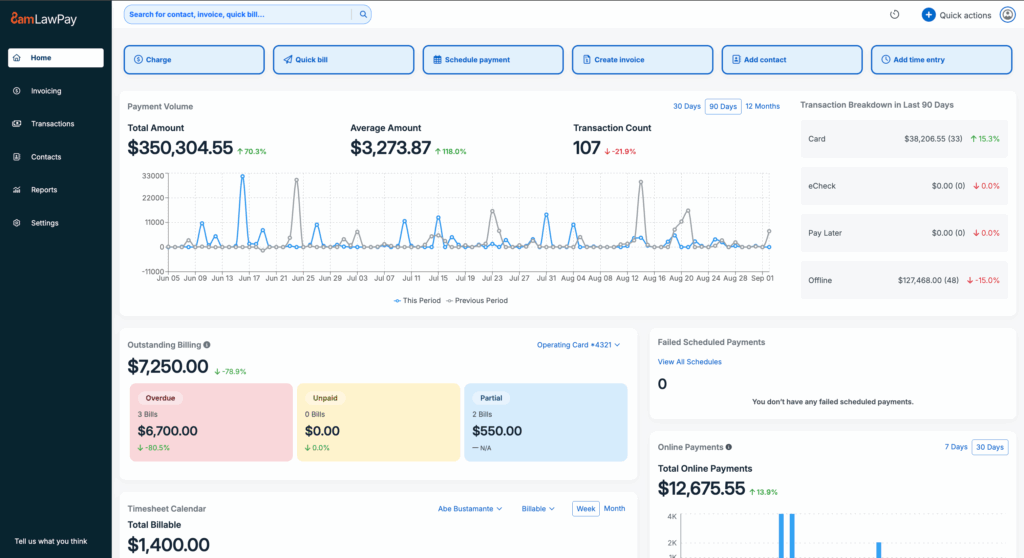
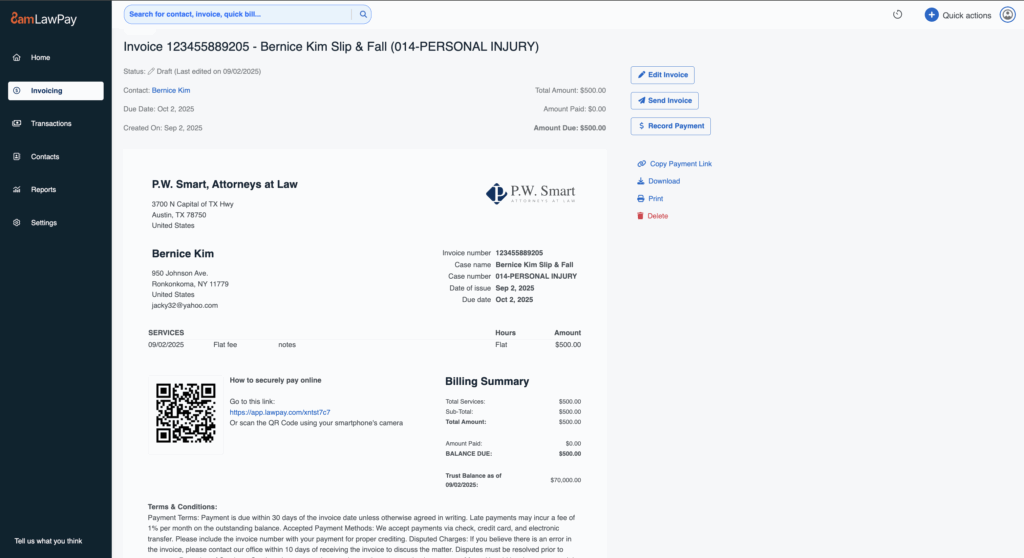
LawPay’s
opening
screen
allows
you
to
add
contacts
and
generate
invoices
directly
from
the
system.
The
main
dashboard
is
automatically
populated
as
transactions
occur,
and
it
displays
extensive
financial
wellness
metrics
for
your
firm.
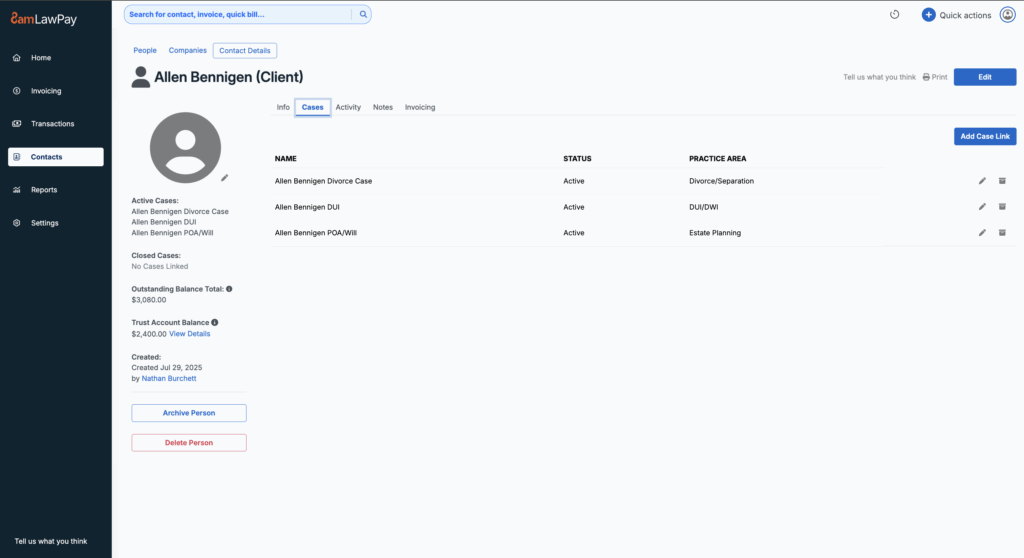
When
you
add
a
contact,
it
includes
the
client’s
financial
details,
like
trust
balance,
as
well
as
a
list
of
all
of
the
matters
involving
them.
These
numbers
also
update
automatically
as
the
system
processes
transactions.
Funds
can
be
linked
to
specific
cases,
allowing
detailed
firmwide
reporting
on
metrics
like
revenue
for
a
particular
practice
area.
The
client
tab
also
allows
you
to
see
a
detailed
list
of
history
involving
the
client,
and
to
make
notes
on
the
file,
like
“don’t
call
in
the
morning.”
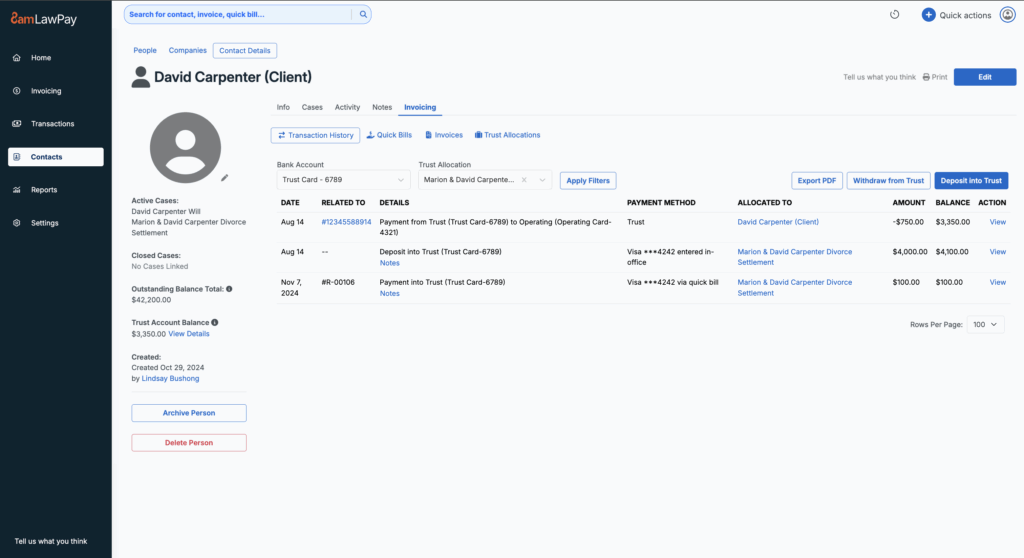
Contacts
will
also
display
an
invoicing
history
related
to
the
client.
Notably,
it
automatically
generates
a
trust
ledger,
which
updates
as
soon
as
the
account
receives
the
funds.
This
tab
also
allows
you
to
deposit
funds
into
a
client
trust
account
and
process
a
client’s
credit
card
on
their
behalf.
Cards
can
be
stored
in
a
card
vault,
which
saves
payment
information
for
future
billing.
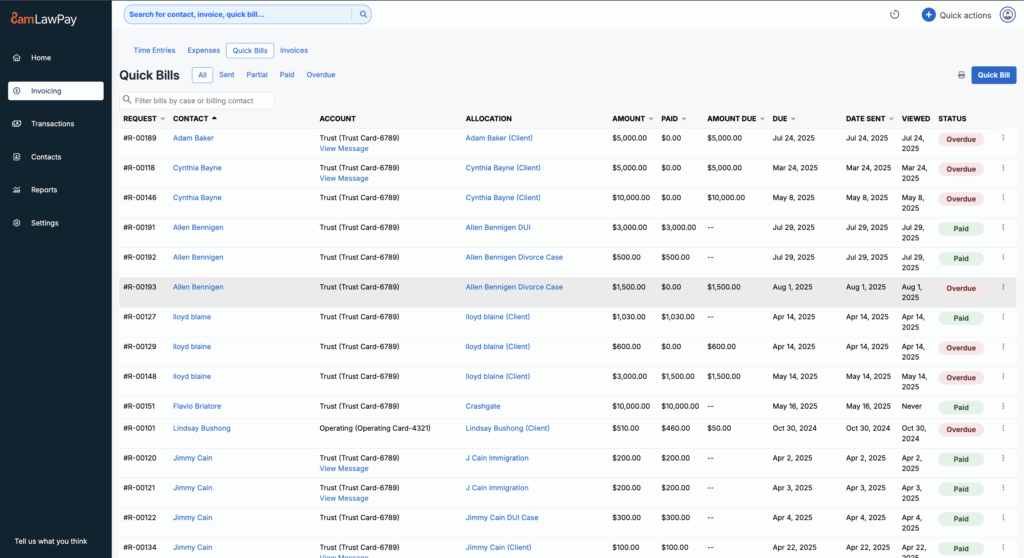
Invoicing
and
Payments
The
invoicing
function
is
a
relatively
new
feature
of
LawPay.
It
will
show
and
organize
all
of
the
firm’s
existing
invoices.
When
you
open
a
particular
invoice,
it
autogenerates
a
document
that
can
be
shared
with
the
client.
When
it
comes
to
collecting
on
the
invoice,
the
payment
pages
are
a
particularly
popular
feature.
These
give
your
clients
multiple
ways
to
quickly
pay,
which
speeds
and
simplifies
the
collections
process.
The
firm
can
text
and
send
QR
codes
to
clients
requesting
payments,
and
clients
can
submit
payments
by
credit
card
or
e-check.
There’s
also
a
“pay
later”
option
with
third-party
financing.
Payments
are
auto-reconciled
to
the
matters
and
client
accounts.
The
firm
can
also
pay
invoices
out
of
a
client’s
trust
account,
and
all
relevant
documents
will
be
reconciled
and
updated.
Additionally,
there’s
a
scheduled
payments
option,
which
will
automatically
charge
on
a
timed
basis,
appropriate
for
subscription
services
or
fractional
GC
arrangements.
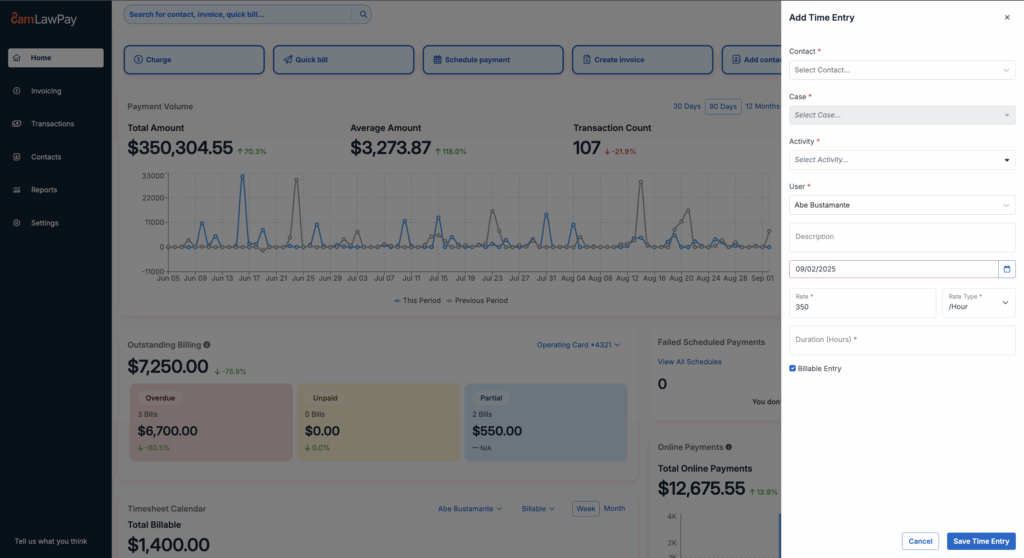
Tracking
Your
Time
LawPay
also
allows
you
to
enter
the
time
worked
on
the
case
with
one
click.
Time
entries
will
automatically
be
pulled
into
the
relevant
client
invoices,
which
can
then
be
applied
to
the
appropriate
trust
or
operating
account.
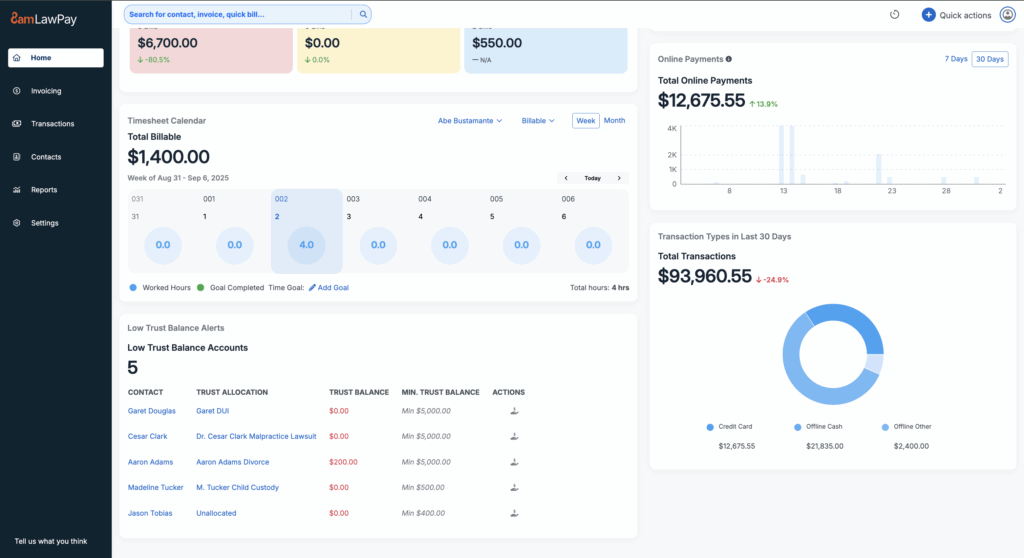
The
main
dashboard
also
displays
live
updates
of
time
entries
by
lawyers
in
the
firm.
Notably,
it
will
warn
you
if
a
client’s
trust
balance
falls
below
a
certain
amount.
This
feature
means
you
don’t
have
to
stay
on
top
of
individual
client
files
to
track
late
payments
or
low
balances.
LawPay
can
also
easily
be
integrated
with
the
8am
MyCase
practice
management
system
without
the
need
to
transfer
data.
Take
Your
Next
Step
Want
to
simplify
your
firm’s
finances,
get
paid
faster,
and
spend
less
time
chasing
payments?
Attending
the
inaugural
Kaleidoscope
conference
in
Austin
last
week,
I
couldn’t
shake
a
strange
feeling:
I’d
been
here
before.
That
was
impossible,
of
course,
as
this
was
8am’s
very
first
customer
conference.
But
the
energy,
the
setup,
the
vibe
all
felt
uncannily
familiar.
It
was,
as
Yogi
Berra
might
have
said,
déjà
vu
all
over
again.
The
two-day
event
was
the
first-ever
customer
conference
put
on
by
the
company
8am.
If
you
have
no
idea
who
or
what
8am
is,
don’t
feel
out
of
the
loop.
The
name
is
barely
three
weeks
old
–
the
new
brand
identity
announced
Aug.
19
by
the
company
formerly
known
as
AffiniPay.
That
company
is
the
parent
of
a
group
of
products
related
to
payments
and
practice
management
for
lawyers
and
accountants.
They
include
the
payments
platform
LawPay,
the
practice
management
platform
MyCase,
the
personal
injury
platform
CasePeer,
and
the
immigration
lawyers
platform
DocketWise.
Producing
these
types
of
customer
conferences
is
becoming
increasingly
common
for
legal
tech
companies,
much
as
it
is
for
their
general
tech
counterparts,
and
so,
for
8am,
it
was
only
a
matter
of
time
(no
pun
intended)
before
it
staged
one
of
its
own.
The
second
day
keynote
featured
an
inspiring
and
entertaining
conversation
between
Olympic
sprinter
Gabby
Thomas
and
8am’s
chief
legal
officer
Catherine
Dawson.
Even
so,
to
both
go
through
a
major
rebrand
and
put
on
a
major
conference
within
the
span
of
two
weeks
is
no
small
feat,
and
the
company
deserves
credit
for
successfully
pulling
off
both.
It
is
worth
noting
that
a
customer
conference
is
not
just
some
sort
of
corporate
vanity
project.
In
my
experience,
a
customer
conference
can
offer
many
legitimate
benefits
to
both
the
customers
and
the
company.
It
was
always
8am
at
Kaleidoscope.
For
customers,
they
get
opportunities
to
network
and
share
tips
with
their
peers
who
are
also
using
the
products,
and
to
get
direct
training
from
the
company
in
how
to
make
the
most
out
of
the
products.
For
companies,
they
get
opportunities
to
interact
with
and
better
know
their
customers
and
to
get
direct
feedback
from
them
on
what
they
like
or
do
not
like
about
their
products,
and
what
features
they
wish
to
see
added.
Small
But
Polished
All
of
that
said,
any
new
conference
has
to
start
somewhere,
and
that
somewhere
is
typically
on
the
smallish,
more
modest
side.
Such
was
this
conference,
when
judged
purely
by
attendance.
The
attendance
totaled
330,
but
that
number
included
75
8am
employees
(39
of
whom
were
presenters).
Of
the
remaining
255
non-employee
attendees,
some
were
from
the
12
partner
companies
that
exhibited
at
the
conference,
and
some
others
were
media,
consultants
and
various
others.
So
the
number
of
actual
customers
who
attended
was
probably
in
the
range
of
200-220.
I
got
to
be
part
of
two
panels.
The
first,
‘The
Future
of
Law:
Emerging
Trends
from
Legal
Tech
Experts,’
including
my
Legaltech
Week
colleagues
Niki
Black
as
moderator,
Steve
Embry,
Joe
Patrice
and
Stephanie
Wilkins.
In
the
second,
“Running
A
Business
in
the
Face
of
Unpredictability,”
I
interviewed
8am’s
chief
financial
officer
Christian
Fadel
and
chief
legal
officer
Catherine
Dawson.
When
you
consider
that
ClioCon
–
the
conference
of
one
of
8am’s
primary
competitors,
Clio
–
last
year
had
over
5,000
attendees,
including
2,600
in
person
and
the
rest
virtual,
Kaleidoscope’s
numbers
might
seem
small.
But,
as
I
said,
every
conference
has
to
start
somewhere.
And,
frankly,
numbers
alone
do
not
tell
the
whole
story.
The
fact
of
the
matter
is
that
Kaleidoscope
came
across
as
highly
polished
and
professional,
virtually
devoid
of
rough
edges.
From
the
venue
to
the
programming
to
the
food
and
socializing,
it
had
the
sheen
and
refinement
of
an
event
put
on
by
an
experienced
crew.
From
Boots
to
Bashes
LawNext’s
Ben
Ambrogi
chats
with
a
pedicab
driver
as
8am’s
SVP
of
application
engineering
Daisy
Itty
looks
on.
Among
the
nice
touches
that
made
this
feel
so
polished
and
professional:
A
diverse
and
well
thought
out
array
of
programming.
Thankfully,
this
was
not
all
AI
all
the
time.
While
that
topic
was
certainly
covered,
programs
spanned
a
variety
of
subjects
of
interest
to
solo
and
small
firm
lawyers
(along
with
some
for
the
company’s
accounting
customers).
Free
cowboy
boots!
Free
Tecovas
cowboy
boots
were
promised
to
the
first
50
registrants.
It
seemed
as
if
more
than
50
ultimately
were
able
to
take
advantage
of
that
offer.
Either
way,
Tecovas
was
there
on
site
in
a
“boot
corral”
to
fit
attendees
with
their
new
boots.
And,
yes,
I
now
count
myself
among
those
who
are
cowboy
boot
enabled.
A
second-day
keynote
featuring
a
conversation
with
2024
Olympics
gold
medal
sprinter
Gabby
Thomas,
who
was
both
entertaining
and
insightful.
The
return
of
the
pedicabs.
Last
year
when
ClioCon
was
in
Austin,
8am
(then
still
AffiniPay)
made
an
inspired
guerilla
marketing
move
by
providing
branded
pedicabs
to
whisk
ClioCon
attendees
to
its
own
alternative
party.
At
Kaleidoscope,
the
pedicabs
were
back
to
take
attendees
out
for
a
night
on
the
town.
Support
for
charity.
An
8am
Cares
table
at
the
conference
raised
over
$10,000
for
the
Ronald
McDonald
House
charity.
Various
networking
events,
including
a
closing
night
party
at
an
Austin
club
with
live
music
and
line
dancing.
Those
of
us
attending
as
media
also
appreciated
the
dedicated
media
“green
room”
where
we
could
work
on
our
stories,
as
well
as
the
dedicated
podcast
room,
complete
with
professional
audio
and
video
equipment
and
the
technicians
to
make
it
all
work.
Where
Was
‘I’?
However,
that
is
not
to
say
everything
was
perfect.
If
there
was
one
standout
glitch,
it
was
the
case
of
the
missing
“i.”
Graphics
throughout
the
conference,
including
the
stage
backdrop
during
many
of
the
presentations,
boldly
proclaimed,
“Become
a
visonary.”
Unfortunately,
some
poor
graphics
person
had
lacked
the
vision
to
see
the
missing
letter.
But
the
company
turned
adversity
to
opportunity,
exploiting
the
omission
with
humor
and
humility,
and
giving
the
opening
keynote
speaker
Leslie
Witt,
the
company’s
chief
product
officer,
her
Oprah
moment.
“What
I’d
like
you
to
do,”
Witt
invited
the
keynote
audience,
“is
take
a
look
underneath
your
seat,
and
for
one
lucky
person,
you
may
find
something
there.”
Sure
enough,
one
person
did,
and
what
he
found
was
the
missing
“i”
–
or
at
least
a
facsimile
thereof
–
winning
him
a
gift
certificate
of
$600.
Chief
Product
Officer
Leslie
Witt
got
her
Oprah
moment
thanks
to
the
missing
“i”
in
“visonary,”
which
you
can
see
on
the
backdrop
behind
her.
A
greater
oversight,
to
my
mind,
was
the
lack
of
healthy
food.
I
get
it,
this
was
Texas,
and
Texans
like
their
meat
–
especially
their
barbecue.
But
we
live
at
a
time
in
which
many
people
–
I
among
them
–
try
to
eat
healthy.
Against
my
better
judgment,
I
was
compelled
to
sample
a
donut.
Food
was
ample
in
quantity,
with
breakfast
and
lunch
provided
as
well
as
mid-morning
and
mid-afternoon
snacks.
But
the
meals
had
only
limited
options
for
vegetarians,
and
the
snacks
favored
donuts
and
cookies
over
healthful
alternatives.
(I’ll
admit,
trapped
in
this
health
food
desert
with
no
easy
way
out,
I
was
forced
to
sample
said
donuts,
which,
for
something
that
was
poisoning
my
body,
turned
out
to
be
surprisingly
tasty.)
CEO
Unable
to
Attend
One
other
element
missing
from
the
conference
was
its
chief
executive
officer
Dru
Armstrong.
In
a
pre-recorded
video
at
the
conference’s
opening,
she
welcomed
attendees
and
then
said,
“I
wish
I
could
be
there
with
you
this
week,
but
I’m
unable
to
attend
because
of
some
personal
circumstances.”
I’ve
had
the
opportunity
to
interview
and
speak
with
Dru
on
many
occasions,
and
I
can
tell
you
she
is
the
kind
of
dynamic
leader
whose
presence
would
have
been
a
further
boost
to
the
conference.
Her
absence
cast
a
slight
pall
over
the
otherwise
buoyant
atmosphere.
Based
on
what
I
know
of
Dru,
those
personal
circumstances
must
have
risen
to
the
level
of
Texas
wild
horses
to
have
kept
her
away.
All
of
that
said,
the
success
of
a
conference
ultimately
has
little
to
do
with
the
attendance
numbers
or
the
food
choices
or
the
polish
of
the
production.
What
makes
or
breaks
a
conference
is
the
intangible
energy
that
pervades
it
–
the
vibe,
if
you
will.
And
here,
for
me,
is
where
that
sense
of
déjà
vu
kicked
in.
The
reason
I
felt
at
Kaleidoscope
as
if
I’d
been
there
before
was
because
I
had
once
been
somewhere
with
a
very
similar
vibe,
the
very
first
ClioCon
back
in
2013.
Even
though
ClioCon
is
now
one
of
the
largest
legal
tech
conferences
in
the
world,
it,
too,
started
small,
and
the
parallels
between
it
and
Kaleidoscope
were
many.
The
exhibitors’
area
put
every
vendor
on
equal
footing
with
a
uniformly
sized
booth.
That
first
year
of
ClioCon
had
roughly
the
same
attendance
as
this
first
year
of
Kaleidoscope.
It,
like
Kaleidoscope,
fit
within
a
fairly
modest
space
within
a
fairly
small
hotel.
It,
like
Kaleidoscope,
had
just
a
handful
of
exhibitors,
with
small,
uniform
booths
arranged
in
an
open
hallway
area.
But
even
with
those
modest
beginnings,
ClioCon
always
stood
out
–
and
the
reason
it
stood
out
was
its
energy,
its
vibe.
As
I
wrote
after
the
second
ClioCon:
“The
solo
and
small-firm
lawyers
at
this
conference
…
all
seemed
charged
about
their
practices
and
their
prospects.
They
seemed
eager
to
take
in
new
ideas
and
brought
plenty
of
their
own
ideas.
As
much
went
on
outside
the
seminar
rooms
as
in
them.”
It
was
conference
that
was
modest
in
size,
but
big
in
impact.
And
that
it
why
it
has
continued
to
grow
year
after
year
to
the
colossal
conference
it
is
today.
In
much
the
same
way,
Kaleidoscope
felt
bigger
and
more
vibrant
than
the
attendance
numbers
would
suggest.
On
the
Cusp
I
am
sure
8am
has
no
desire
for
its
conference
to
be
compared
to
the
conference
of
one
of
its
major
competitors.
But
the
déjà
vu
I
felt
in
Austin
was
because
the
conference’s
overall
atmosphere
–
its
energy
and
vibe
–
was
strongly
reminiscent
of
that
very
first
ClioCon.
And
that
is
a
good
thing.
Josh
Carter,
senior
product
manager,
and
Lindsay
Bushong,
manager
of
solutions
consulting,
gave
a
preview
of
the
company’s
new
8am
IQ
generative
AI
features.
At
that
first
ClioCon,
there
was
a
strong
sense
that
we
were
at
the
cusp
of
something
big,
at
the
beginning
of
a
new
generation
of
law
practice
and
technology
for
solo
and
smaller
firms,
driven
in
part
by
the
advent
of
the
cloud.
And
at
Kaleidoscope,
there
was
a
similar
sense
of
being
on
the
cusp
of
something
new,
only
this
time
the
“new”
had
more
to
do
with
generative
AI
and
its
potential
to
transform
the
business
and
practice
of
law
for
solos
and
small
firms.
The
lawyers
and
law
firm
professionals
I
spoke
to
there
were
explicit
about
it:
Many
said
they
had
come
to
the
conference
specifically
to
learn
more
about
AI
and
what
it
means
for
them.
Some
told
me
they
were
just
starting
to
explore
AI,
but
eager
to
get
up
to
speed.
Even
beyond
AI,
there
seemed
to
be
a
strong
sense
of
excitement
among
attendees
about
technology
and
its
potential
impact
on
their
practices.
Kaleidoscope’s
first
outing
proved
that
8am
can
put
on
a
professional,
well-run
conference
with
an
energy
that
belied
its
modest
size.
The
company
is
already
planning
a
second
Kaleidoscope
next
year.
Much
to
my
regret,
it
will
be
in
Las
Vegas,
which
I
do
not
like
as
a
conference
location.
But,
location
aside,
if
it
continues
next
year
to
build
on
this
year’s
momentum,
this
debut
may
come
to
be
remembered
as
the
foundation
of
an
enduring
annual
event
on
the
legal
tech
calendar.
As
Yogi
Berra
might
have
said
had
he
been
there
last
week,
when
it
comes
to
Kaleidoscope,
the
déjà
vu
is
worth
doing
all
over
again.












 Kathryn