It’s Your Career: Assume Responsibility For It – Above the Law

No
one
is
coming
to
save
you.
No
one
other
than
you
is
responsible
for
your
career. 
Not
your
supervisor.
Not
the
managing
partner.
Not
your
firm.
What
you
make
of
yourself
is
entirely
in
your
hands.
The
decisions
you
make.
The
effort
you
put
forth.
The
money
you
spend.
What
will
separate
you
from
other
lawyers,
what
will
allow
you
to
break
ahead
of
the
pack,
is
your
time,
energy,
and
money,
not
your
firm’s.

           
A
mistake
I
see
some
young
lawyers
make
is
to
entrust
their
careers
to
their
law
firms. 
In
their
eyes,
the
law
firms
will
be
primarily,
and
even
exclusively,
responsible
for
making
them
great
lawyers
with
huge
books
of
business.
Do
law
firms
play
a
role
in
your
development?
Yes.
Should
they?
Yes.
Do
good
firms
spend
time,
energy,
and
money
making
you
a
better
lawyer
and
improving
your
hard
and
soft
skills?
Yes.
But
are
there
limitations
to
what
they
are
willing
and
can
do?
Yes.
Do
they
sometimes
say
no
to
things
you
want
and
need
to
make
you
a
better
lawyer?
Yes.
Do
they
have
unlimited
resources
and
budgets
to
help
you
endlessly?
No.

           
Let’s
start
with
mentoring. 
Law
firms
should
have
both
formal
and
informal
mentoring
for
their
associates. 
Some
do. 
Some
have
great
ones. 
Some
have
poor
ones. 
Some
have
none
at
all.
Should
you
work
for
firms
that
place
a
premium
on
mentoring?
Yes. 
Does
everyone
have
this
opportunity?
No. 
Even
if
you
do,
will
the
firm
absolutely
meet
all
your
mentoring
needs?
Unlikely.
It
is
up
to
you
to
seek
out
mentors
and
establish
mentoring
relationships,
both
within
and
outside
your
law
firm.

           
How
about
training?
Some
firms
offer
deposition
and
trial
bootcamps. 
Some
provide
writing
courses.
Some
offer
business
development
coaching.
Many
don’t.
And
even
the
ones
that
provide
a
potpourri
of
offerings
can’t
offer
everything
you
need
to
grow
and
develop
as
a
lawyer.
It’s
up
to
you
to
seek
out
and
pursue
this
training. 
These
days,
so
many
lawyers
share
their
expertise
through
their
writings,
podcasts,
videos,
and
CLE,
many
of
which
you
can
find
for
free
or
modest
costs
online.
And
what
if
you
find
a
course
that’s
perfect
for
you,
but
your
firm
won’t
pay
for
it?
Is
your
immediate
reaction,
“Well,
I
guess
I’m
not
taking
that
course”? 
Or
rather,
should
I
invest
my
own
money
in
this
course?
If
it’s
the
former,
then
you
have
the
wrong
outlook.
Should
your
firm
support
you?
Yes. 
If
it
doesn’t,
do
you
not
help
yourself?
No. 
It’s
your
career,
and
if
that
CLE
course
is
essential
to
you,
and
your
firm
won’t
pay
for
it,
pay
for
it
yourself.

           
How
about
an
organization?
You
really
want
to
get
involved
in
a
bar
association,
and
your
firm
won’t
support
you? 
Yes,
you
should
consider
whether
the
firm
is
the
right
one
for
you.
But
every
firm
places
its
lawyers
on
marketing
budgets,
real
or
imagined,
and
some
will
support
you
in
one
or
more
organizations,
and
some
don’t.
Again,
perhaps
if
your
firm
isn’t
helping
you
in
this
way,
it
may
not
be
the
right
firm
for
you.
But
while
you’re
there,
if
there
is
an
organization
you
believe
is
crucial
for
your
development,
then
you
may
want
to
reach
into
your
wallet
and
pay
for
it.
Or
what
if
your
firm
pays
for
your
membership
but
won’t
cover
the
cost
of
a
conference
or
symposium?
Again,
consider
paying
for
it
yourself,
or
at
least
be
willing
to
contribute
to
the
cost.
Ask
your
firm:
Will
you
split
the
cost
for
me?
Pay
for
this
or
that,
and
I’ll
pay
for
that
or
this?

           
How
about
a
book,
or
a
course,
or
a
reception,
or
a
happy
hour?
Or
meeting
someone
for
coffee,
lunch,
or
drinks?
Again,
how
important
are
these
things
for
you?
Your
career?
Your
development?
If
they
are
essential,
then
consider
paying
for
them.

           
Years
ago,
I
decided
to
meet
others
for
coffee
regularly. 
I
went
out
two
or
three
times
a
week. 
Almost
invariably,
I
paid
for
these
coffee
meets
myself. 
Occasionally,
I
submitted
receipts
for
reimbursement
here
and
there,
but
generally,
I
paid
for
them
myself.
These
coffee
meetings
were
crucial
for
meeting
potential
mentors,
referral
sources,
leads
for
matters,
and
a
whole
host
of
individuals
who
were
beneficial
to
me,
my
career,
and
my
path.
At
the
end
of
the
year,
I
spent
between
$1,000
and
$2,000
on
coffee. 
However,
the
meetings
were
essential
to
me,
important
enough
that
I
would
reach
into
my
pocket
and
pay
for
them.

           
When
I
traveled
to
conferences,
I
often
paid
for
business
lunches
and
dinners
myself. 
Again,
these
were
important
to
me,
and
I
couldn’t
always
expect
my
firm
to
cover
the
costs.

           
My
recommendation
for
you
is
to
set
aside
a
specific
line
item
in
your
personal
budget
for
your
career.
Maybe
it’s
a
few
hundred
dollars. 
Maybe
a
thousand
dollars
or
even
a
few
thousand
dollars.
This
money
can
go
to
any
of
the
items
mentioned
in
this
piece.
Or
other
items
altogether.
Maybe
it’s
for
a
career
coach.
Perhaps
it’s
for
equipment
to
start
your
own
podcast.
Maybe
it’s
for
a
LinkedIn
Premium
account
(I
acquired
one
several
years
ago
and
have
always
paid
for
it
myself).
If
I
think
about
it,
I
probably
spend
between
$3,000
and
$5,000
per
year
of
my
own
money
on
business
needs. 
I’m
not
suggesting
you
spend
this
much,
but
you
should
set
aside
something
for
yourself.

           
And
yes,
if
your
firm
doesn’t
mentor
you,
doesn’t
pay
for
anything,
then
you’re
probably
at
the
wrong
firm. 
But
while
you’re
there,
you’re
still
responsible
for
your
career.
And
even
if
you
find
the
ideal
firm
that
supports
you,
it’s
doubtful
they’ll
support
everything
you
do,
and
when
that
happens,
ask
yourself,
should
I
support
myself
with
my
own
checkbook?

           
Remember,
when
it
comes
to
your
career,
your
passions,
your
life

no
one
is
coming
to
save
you. 
You’re
in
charge
of
you. 
Your
dreams
are
yours.
What
you
make
of
yourself
is
up
to
you.
And
sometimes
that
means
you
not
only
take
the
time
and
energy
to
do
something,
but
you
also
pay
for
it
too.



Frank
Ramos
is
a
partner
at
Goldberg
Segalla
in
Miami,
where
he
practices
commercial
litigation,
products,
and
catastrophic
personal
injury. You
can
follow
him
on LinkedIn,
where
he
has
about
80,000
followers
.

Harvard Just Defrosted Trump’s Multibillion-Dollar Funding Freeze – Above the Law

The
ongoing
lesson
with
these
Trump
institutional
strong-arms
seems
to
be
that
if
you
can
survive
the
initial
pressure,
you’ll
get
everything
you
were
pushing
for.
So
much
for
“Art
of
the
Deal”!
The
Trump
administration
has
pulled
no
punches
in
their
fight
with
Harvard
University.
Massive
federal
funding
freezes,

cutting
their
ability
to
host
international
students
,
and

getting
one
of
their
graduates
to
handle
the
dirty
work

as
additional
salt
in
the
wound.
But
Harvard
isn’t
the
type
of
school
to
just
take
a
beating
and
not
fight
back

what
are
they,
Columbia?
They’ve
been
fighting
in
court
and
it
looks
like
the
legal
fees
paid
off.
Yesterday,
Judge
Allison
Burroughs
of
the
U.S.
District
Court
for
the
District
of
Massachusetts
ruled
that
the
President’s
fund
freeze
was
unconstitutional.
In
what
has
to
be
one
of
the
most
tame
“give
me
my
two
point
fucking
six
billion
dollars”
in
history,

Harvard

has
this
to
say:

A
few
hours
ago,
the
US
District
Court granted
Harvard’s
motion
for
summary
judgment,
finding
that
the
federal
government’s
freeze
of
University
research
funding
was
unlawful.
The
ruling
affirms
Harvard’s
First
Amendment
and
procedural
rights,
and
validates
our
arguments
in
defense
of
the
University’s
academic
freedom,
critical
scientific
research,
and
the
core
principles
of
American
higher
education.
 
Even
as
we
acknowledge
the
important
principles
affirmed
in
today’s
ruling,
we
will
continue
to
assess
the
implications
of
the
opinion,
monitor
further
legal
developments,
and
be
mindful
of
the
changing
landscape
in
which
we
seek
to
fulfill
our
mission.

An
evenhanded
response
was
the
move
to
make
here.
Spending
too
much
time
hammering
on
your
superiority
and
punching
down
on
Trump
is
a
great
way
to
make
an
enemy
out
of
a
petty,
vindictive
man
who
is
willing
to
commit
to
the
bit
out
of
spite;
the
last
thing
Harvard

or
any
of
us,
for
that
matter

needs
right
now
is
for
this
multibillion-dollar
loss
to
be

another
Obama
roast
.
This
isn’t
to
say
that
Trump
Team
is
going
to
put
their
legs
between
their
legs
and
walk
home.
White
House
spokesperson
Liz
Huston
shared
that
the
administration
intends
to
immediately
appeal
the
decision.

Big
win
for
Harvard!


An
Update
on
Our
Litigation

[Harvard]


Earlier
:

Trump
Administration
Places
Thumb
On
Negotiation
Scale,
Decides
Harvard
Didn’t
Do
Enough
To
Fight
Antisemitism


Trump
Administration
Threatens
To
Strip
Harvard
Law’s
Ability
To
Enroll
And
Teach
International
Students


Harvard
Law
Graduate
Is
Helping
Trump
Attack
Her
Alma
Mater


Chris
Williams
became
a
social
media
manager
and
assistant
editor
for
Above
the
Law
in
June
2021.
Prior
to
joining
the
staff,
he
moonlighted
as
a
minor
Memelord™
in
the
Facebook
group Law
School
Memes
for
Edgy
T14s
.
 He
endured
Missouri
long
enough
to
graduate
from
Washington
University
in
St.
Louis
School
of
Law.
He
is
a
former
boatbuilder
who
is
learning
to
swim, is
interested
in
critical
race
theory,
philosophy,
and
humor,
and
has
a
love
for
cycling
that
occasionally
annoys
his
peers.
You
can
reach
him
by
email
at [email protected]
and
by
tweet
at @WritesForRent.

8am And Kaleidoscope Revealed Along With Some New Stuff: The Witt Keynote – Above the Law

(Photo
via
8am)

Like
many
of
you,
I
sort
of
wondered
about
the
new
name
for
AffiniPay’s
set
of
companies,
8am,
as
I
discussed
in
a

previous
post
.
Are
they
offering
a
new
coffee?
Some
sort
of
clock?
I
appeared
on
a
Michael
Eisenberg’s

Tech
Savvy
Lawyer

podcast
earlier
this
week
and
when
I
said
I
was
at
the
8am
conference,
he
said,
“What?
It’s
2
p.m.
here,
where
are
you?”
It
took
us
a
few
minutes
to
get
things
straight.

And
8am’s
conference
name:
Kaleidoscope.
What’s
that
all
about?


Kaleidoscope???

Most
of
this
became
a
little
clearer
at
the
keynote
from
8am’s
Chief
Product
Officer,
Leslie
Witt.
Witt
bounded
on
the
stage
Wednesday
morning
full
of
energy
and
fittingly
sporting
a
pair
of
cowboy
boots.
She
gave
a
30-ish-minute
talk
explaining
the
names
of
both
the
company
and
the
conference
and
as
she
put
it,
the
new
program.

Kaleidoscope
is
8am’s
(and
the
AffiniPay
companies’)
first
user
conference
and
they
are
working
hard
at
doing
it
right
and
being
hospitable.
Witt
explained
that
the
conference
name
was
based
upon
the
concept
behind
the
children’s
kaleidoscope
toy.
When
you
first
look
though
the
toy,
there
appears
to
be
random
bits
and
pieces
of
objects.
But
when
you
twist
the
bottom,
the
pieces
come
together
in
an
interesting
geometric
design.

Witt
likened
the
coming
together
of
the
previous
AffiniPay
companies
into
8am
as
a
similar
process.
AffiniPay
started
as
a
payment
company.
It
added
practice
and
case
management
companies
and
capabilities
and,
later
financial
management
companies
as
well.
All
of
these
acquired
companies
and
tools
kept
their
separate
names.
Now
they
are
all
coming
together
and
being
integrated
into
the
singular
8am
platform,
according
to
Witt.
The
idea,
I
suppose,
is
that
in
the
coming
together,
the
mission
and
goals
of
the
company
and
its
set
of
tools
will
become
clearer.
The
integration
certainly
cleared
up
for
me
8am’s
vision
and
mission.


It’s
All
in
a
Name

And
about
the
name.
As
I

previously
mentioned
,
the
name
8am
reportedly
comes
from
the
concept
 that
the
first
thing
many
of
us
do
in
the
morning
is
to
try
to
take
care
of
business:
the
financial
non-billable
end
of
things.
“Rising
means
getting
up
and
getting
going.”

Indeed,
the
theme
that
every
day
is
a
brand
new
day
permeates
the
entire
conference.
And
8am’s
mission
statement
carries
this
idea
forward:
“we
start
every
day
on
a
mission
to
empower
professionals
to
deliver
world
class
outcomes
for
your
clients
and
exceptional
financial
results
for
your
business.”
Hence
8am.
(I
guess
if
you
work
for
8am,
you
better
be
a
morning
person.)


And
Now
the
Substance

Now
for
the
substance
of
what
Witt
talked
about.
She
described
how
8am
is
going
to
increase
its
focus
on
how
the
business
needs
of
a
growing
law
firm
shift
as
the
firm
grows.

She
also
specifically
mentioned
several
new
tools.
SmartSpend,
for
example,
is
a
credit
card
provided
to
employees
that
allows
them
to
charge
business
expenses.
The
tool
then
automatically
applies
those
charges
to
correct
invoices
enabling
better
collection.
I
had

written
about

this
tool
when
it
was
introduced
in
beta
at
LegalWeek
in
March;
it’s
 now
out
of
beta
and
live.

Witt
also
announced
a
new
feature
called
8am
Capital
which
she
says
will
be
launched
in
the
market
early
next
year.
This
tool
will
assess
a
firm’s
financial
needs
and
viability
and
extend
short-term
loans
where
needed.
Witt
noted
that
it’s
sometimes
difficult
for
law
firms
to
obtain
these
kinds
of
loans
from
banks
who
don’t
understand
the
business
end
of
the
practice.
8am
Capital
will
offer
an
alternative
option.

A
new
integration
of
the
8am
tools
with
NetDocuments
in
the
future
was
also
announced.
This
one
is
pretty
interesting
given
the
search
capability
within
NetDocuments.
The
integration
will
broaden
the
materials
upon
which
the
8am
tools
can
operate
and
from
which
results
can
be
provided.
It
also
reflects
that
NetDocuments
is
focusing
on
the
smaller
firm
market
(which
8am
primarily
serves)
in
addition
to
the
large
firm
market.

Witt
also
talked
about
a
customizable
reporting
dashboard
that
will
be
offered
in
the
next
few
weeks
that
will
be
able
to
filter
and
add
different
dimensions
to
better
convey
financial
and
other
information.
She
also
announced
that
8am
will
soon
have
the
OCR
ability
to
search
images
in
addition
to
just
text.

Finally,
and
perhaps
most
importantly,
she
talked
about
something
called
Chat
with
Cases
that
8am
is
developing.
The
tool
will
enable
natural
language
chat
capability
similar
to
that
offered
by
ChatGPT
and
other
LLM
providers
whereby
you
can
query
the
8am
tools
and
data
to
obtain
answers
to
questions
concerning
finances
and
client
information.
It
will
provide
what
Witt
described
as
“actionable
financial
insights.”

So,
according
to
Witt,
you
can
ask
it
things
like
who
owes
you
money:
once
the
tool
identifies
someone,
it
can
automatically
send
them
a
ding
letter.
I
assume
this
will
be
an
agentic
AI
type
of
tool,
although
unlike
in
most
other
vendor
presentations,
Witt
never
used
the
term.
And
she
promised,
the
tool
won’t
hallucinate.
Unfortunately,
that
smacks
of
vendor
hyperbole.
Hallucinations
and
inaccuracies
can
be
reduced
by
limiting
the
data
set
upon
which
the
LLM
operates
but
don’t
think
anyone
is
yet
at
the
point
of
guaranteeing
that
a
GenAI
tool
will
be
hallucination
free.

Chat
with
Cases
does
have
somewhat
profound
implications.
Much
of
the
debate
at
Kaleidoscope
and
other
legal
tech
conferences
is
whether
and
to
what
extent
AI
will
finally
drive
a
stake
in
the
billable
hour.
And
whether
it
can
or
will
be
replaced
by
alternative
value-based
billing.
At
the
heart
of
making
those
alternative
systems
successful
is
understanding
the
cost
to
the
firm
of
taking
a
certain
matter.
That
cost
is
reflected
both
by
the
time
to
get
to
a
result
but
also
by
the
cost
to
the
firm
of
the
matter,
the
cost
of
the
resources
the
firm
must
expend.
Having
a
tool
that
can
provide
immediate
feedback
on
cost
and
other
financial
questions
alleviate
the
fears
many

both
lawyers
and
clients

have
about
adopting
an
alternative
fee
approach.

Like
most
vendor
keynotes,
there
was
little
reference
to
the
cost
of
any
of
these
new
offerings
to
the
customer.


What
the
Integration
Means
for
the
Everyday
Lawyer

While
you
might
be
jaded
and
think
the
name
8am
and
the
Kaleidoscope
concept
are
a
little
too
cute,
it’s
hard
to
deny
that
what
8am
is
doing
and
where
it’s
headed
is
good.
I
have

mentioned
before

all
too
often
legal
tech
vendors
offer
a
plethora
of
products
doing
slightly
different
things.
It’s
confusing
and
bewildering
even
to
me
and
I
cover
this
stuff.
For
lawyers,
particularly
in
small
firms
without
IT
resources,
it
has
to
be
even
worse.
 I
frankly
had
trouble
keeping
track
of
the
AffiniPay
companies
and
what
they
did.
Combining
these
into
one
platform
helps.


Do
the
Tools
Scratch
a
Real
Itch?

And
what
8am
is
offering
is
important
to
lawyers
and
address
a
real
need
as
well.
As
Witt
put
it,
few
lawyers
have
studied
or
know
how
to
run
a
business.
She
cited
some
statistics
from
the
Legal
Industry
Report
of
8am
that
reflect
this:

  • 68%
    of
    lawyers
    surveyed
    report
    fee
    collection
    is
    a
    major
    hurdle.
  • 61%
    of
    law
    firms
    have
    difficulty
    with
    accounting
    principles.
    (I
    know
    from
    experience
    that
    trying
    to
    read
    a
    basic
    financial
    statement
    in
    an
    understandable
    way
    is
    a
    challenge.)
  • 53%
    reported
    having
    difficulty
    making
    a
    confident
    set
    of
    informed
    financial
    decisions.

The
8am
tools
promise
to
help
with
by
offering
“seamless
connectivity”
and
an
efficient
way
to
be
a
better
businessperson
without
having
to
go
to
B
school
to
succeed
in
practicing
law.
It
provides
help
in
dealing
with
critical
financial
issues
for
which
lawyers
have
little
training
and
spend
too
little
time
dealing
with.

The
proof
though
is
where
the
new
tools
do
what
8am
says
they
will
do
and
whether
the
promised
future
products
come
to
fruition.
Over-promising
and
under-delivering
is
all
too
common
with
legal
tech
vendors.
Let’s
hope
that’s
not
the
case
with
8am.


Stephen
Embry
is
a
lawyer,
speaker,
blogger,
and
writer.
He
publishes TechLaw
Crossroads
,
a
blog
devoted
to
the
examination
of
the
tension
between
technology,
the
law,
and
the
practice
of
law
.

Court Smacks Down Trump’s Roving Military Police Force – Above the Law

(Photo
by
Win
McNamee/Getty
Images)

On
Tuesday,
Judge
Charles
Breyer

ordered

the
Trump
administration
to
quit
violating
the
Posse
Comitatus
Act
(PCA).
The
court
found
that
the
Defense
Department
illegally
used
Marines
and
federalized
National
Guard
troops
to
enforce
civil
law
during
a
surge
of
immigration
raids
in
and
around
Los
Angeles
in
June
and
July.
Worse
still,
Secretary
of
Defense
Pete
Hegseth
and
his
minions
deliberately
countermanded
their
own
instruction
materials
to
authorize
illegal
conduct.

“Defendants
knew
that
they
were
ordering
troops
to
execute
domestic
law
beyond
their
usual
authority,”
Judge
Breyer
wrote,
concluding
that
“Defendants’
systemic
use
of
Task
Force
51
troops
to
execute
domestic
law
in
and
around
Los
Angeles
violated
the
Posse
Comitatus
Act.”

Judge
Breyer
is
clearly
aware
of
the
stakes.

“Los
Angeles
was
the
first
U.S.
city
where
President
Trump
and
Secretary
Hegseth
deployed
troops,
but
not
the
last,”
he
wrote,
noting
that
National
Guard
troops
have
descended
on
Washington
DC
to
“stand
with
their
law
enforcement
partners.”
Even
today
Trump
is
threatening
to
send
troops
to
Oakland,
Baltimore,
Chicago,
and
San
Francisco
to
“clean
up”
those
cities
as
well.

And
so
the
jurist
took
pains
to
explain

why

erecting
a
cordon
and
shutting
down
streets
amount
to
domestic
law
enforcement,
and
not
simply
“protecting”
ICE
and
DHS
agents.
Parading
through
MacArthur
Park
in
full
battle
rattle
to
demonstrate
“presence”
is
less
of
a
close
call.

The
opinion
serves
as
a
roadmap
for
states
and
federal
judges
when
the
“national
police
force
with
the
President
as
its
chief”
rolls
onto
their
streets.
And
so,
of
course,
the
administration
is
trying
to
stick
a
shiv
in
it,
immediately
filing
an

emergency
motion
to
stay

during
its
appeal.

Background


Newsom
v.
Trump

has
followed
a
weird
procedural
trajectory.
After
a
few
hours
of
anti-ICE
rioting
which
was
quickly
quelled
by
police,
Trump
seized
on
the
“emergency”
as
justification
to
federalize
the
California
National
Guard
over
the
objections
of
Governor
Gavin
Newsom.
The
state

sued
,
alleging
that
there
was
no
emergency,
the
Guard
had
been
illegally
federalized,
and
that
the
Guard
and
Marines
were
grossly
violating
the
PCA.

Judge
Breyer
issued
a

temporary
restraining
order

as
to
the
first
two
issues,
rubbishing
the
so-called
“emergency”
of
a
few
kids
throwing
rocks
and
ruling
that

10
USC
§
12406
’s
requirement
that
the
Guard
be
federalized
“through”
the
governor
did
not
allow
for
Hegseth
to
unilaterally
deploy
them.
But
the
trial
judge
saved
the
issue
of
the
PCA
for
the
preliminary
injunction
stage,
reasoning
that
a
couple
of
weeks
of
troops
on
the
ground
would
yield
evidence
relevant
to
the
PCA
issue.

The
administration
immediately
appealed
the
(unappealable)
TRO,
as
is
its
habit.
And
a
Ninth
Circuit
panel,
which
contained
two
Trump
appointees,
ultimately

reversed

Judge
Breyer’s
TRO
with
respect
to
the
emergency
declaration
and
the
federalization
under
§
12406,
staying
the
order
pending
appeal.

But
that
left
the
issue
of
the
PCA
unresolved,
and
so
Judge
Breyer
held
a
three-day
bench
trial
in
August
to
determine
whether
the
Trump
administration
was
using
“any
part
of
the
Army,
the
Navy,
the
Marine
Corps,
the
Air
Force,
or
the
Space
Force
as
a
posse
comitatus
or
otherwise
to
execute
the
laws.”

The
law
doesn’t
count
if
you
cross
it
out?

As
Judge
Breyer
explained,
the
PCA
issue
turns
on
whether
troops
“actively
assisted
with
the
execution
of
domestic
law,”
or
“whether
the
military’s
involvement
isso
indirect
as
to
not
violate
the
Act.”

Luckily,
the
Defense
Department
produced
a
handy-dandy
PCA
training
manual
for
the
“Task
Force
51”
troops
deployed
to
Los
Angeles.

Less
luckily

(for
the
government
defendants),
they
seem
to
have
taken
a
giant
Sharpie
to
it,
crossing
out
stuff
they
really
wanted
to
do
anyway.

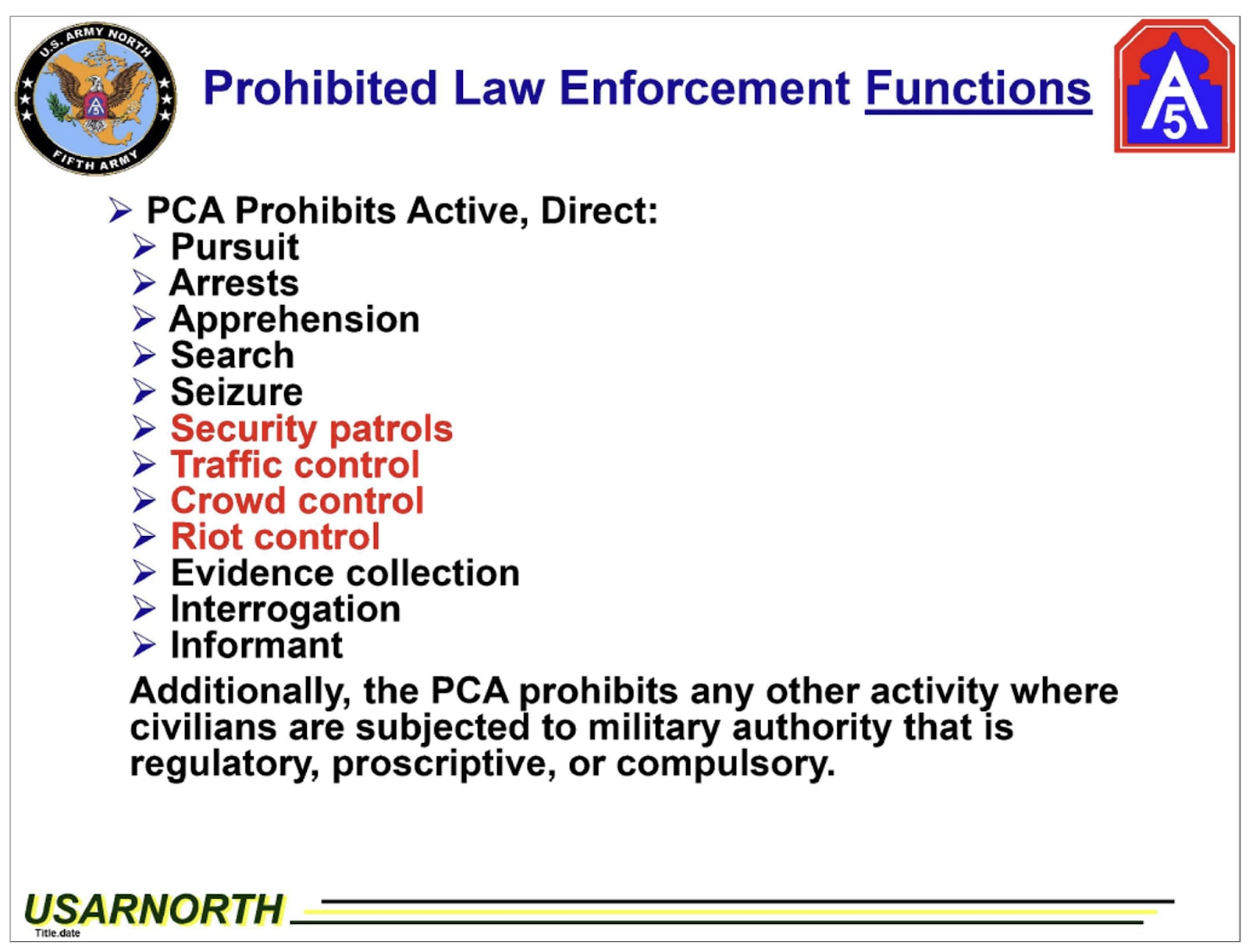
Here’s
the
PowerPoint
slide
of
“Prohibited
Law
Enforcement
Functions”
entered
into
evidence.
It
explains
that
the
PCA
prohibits
twelve
categories
of
actions:
pursuit,
arrests,
apprehension,
search,
seizure,
security
patrols,
traffic
control,
crowd
control,
riot
control,
evidence
collection,
interrogation,
and
serving
as
an
informant.


But
four
of
those

establishing
security
patrols,
traffic
control,
crowd
control,
and
riot
control

were
rendered
in
red.
That’s
because
troops
were
“orally
instructed”
that
those
four
were
part
of
a
“so-called
constitutional
exception
to
the
Posse
Comitatus
Act.”

There
is
no
such
“constitutional
exception.”
As
Judge
Breyer
noted,
“This
assertion
is
not
grounded
in
the
history
of
the
Act,
Supreme
Court
jurisprudence
on
executive
authority,
or
common
sense.”

And
so
the
Defense
Department
tried
hard

albeit
ineffectively

to
hide
what
they
were
doing.

“This
instruction
was
initially
not
put
in
writing,”
the
court
observed
dryly.
But
on
June
23,
Hegseth
sent
out
a
memo
authorizing
“measures
for
temporary
detention,
cursory
search,
and
the
steps
necessary
to
ensure
the
safety
of
Federal
personnel”
including
“perimeter
protection
against
third
parties
and
such
crowd
control
measures
as
are
reasonably
necessary
to
ensure
the
execution
of
Federal
functions
and
the
safety
of
Federal
personnel.”

In
short,
“Task
Force
51
troops
were
openly
instructed
that
they
could,
consistent
with
the
Posse
Comitatus
Act,
engage
in
some
law
enforcement
actions
as
long
as
they
were
doing
so
to
protect
federal
property,
personnel,
or
functions.”

And
engage
in
them,

they
did
.

TL,
DR:
If
you’d
otherwise
have
ICE
agents
or
cops
doing
it,
it’s
law
enforcement

After
Hegseth’s
memo
and
the
green
light
from
the
Ninth
Circuit,
the
Task
Force
51
troops
were
deployed
as
virtual
bodyguards
for
ICE,
blocking
streets
and
forming
cordons
for
every
law
enforcement
action.
They
even
participated
in
a
chest
thumping
military
parade
through
MacArthur
Park,
using
Humvees
and
tactical
vehicles
to
block
traffic
along
Wilshire
Boulevard
as
part
of
Hegseth’s
plan
“to
demonstrate,
through
a
show
of
presence,
the
capacity
and
freedom
of
maneuver
of
federal
law
enforcement
within
the
Los
Angeles
Joint
Operations
Area.”

Judge
Breyer
held
that
all
of
this
violated
the
PCA.
He
also
rejected
a
truly
bizarre
claim
made
by
the
DOJ
that
§
12406
is
an
exception
to
the
PCA,
so
the
federalized
troops
were
free
to
act
as
a
roving
police
force.

“The
Court
is
unaware
of
any
person—government
lawyer,
military
or
civilian
official,
court,
or
commentator—who
has
made
this
argument
other
than
Defendants’
lawyers
in
this
case,”
he
scoffed.
“The
Department
of
Defense
has
not
taken
this
position
in
its
publications
on
the
Posse
Comitatus
Act.”
The
court
did,
however
partially
excuse
the
DOJ’s
bonkers
argument,
chalking
it
up
as
the
“consequences
of
the
Ninth
Circuit’s
highly
deferential
reading
of
the
statute.”
(Shaaaaaaade.)

Judge
Breyer
laid
out
three
metrics
to
assess
whether
a
particular
military
action
complies
with
the
PCA’s
ban
on
using
the
military
to
“execute
the
laws.”
It
is

more
likely

that
an
activity
violates
the
PCA
if
it
involves:

  1. Troops
    engages
    in
    direct
    law
    enforcement
    functions,
    such
    as
    “setting
    up
    protective
    perimeters,
    traffic
    blockades,
    crowd
    control,
    and
    the
    like”;
  2. Coordinated,
    ongoing
    activities
    as
    opposed
    to
    isolated,
    passive
    ones;
    and
  3. Actions
    taken
    without
    the
    support
    of
    state
    and
    local
    law
    enforcement,
    particularly
    when
    troops
    are
    used
    as
    a
    substitute
    for
    security
    that
    local
    police
    would
    otherwise
    proved.

Here,
there’s
ample
evidence
of
all
three.

Task
Force
51
routinely
blockaded
the
roads
and
“used
riot
shields
and
military
vehicles
to
establish
a
perimeter
at
the
DEA
enforcement
operation”
at
a
marijuana
farm
in
Mecca,
California.
It
mustered
in
advance
of
ICE
actions,
not
as
a
response
to
actual
violence
or
protest,
but
to
discourage
it
and
impede
the
movement
of
people
into
and
out
of
the
area.

It
performed
functions
that
would
otherwise
have
been
carried
out
by
ICE
agents
or
local
law
enforcement.
Even
some
of
the
government’s
witnesses
were
“unable
to
distinguish”
Task
Force
51
troops
from
ICE
agents
in
photos
of
joint
actions.

And,
once
the
troops
were
on
the
ground,
ICE
virtually
ceased
cooperating
with
the
Los
Angeles
Police
and
Sheriffs
Departments.

Even
though
multiple
federal
agencies
and
Task
Force
51
rehearsed
Operation
Excalibur
several
times,
they
provided
LAPD
and
LASD
with
a
mere
two
hours’
notice
of
the
operation.
Likewise,
federal
agencies
notified
local
law
enforcement
of
cannabis
farm
raids
only
at
the
time
of
the
raids,
not
beforehand.
This
is
not
typical.
In
those
Posse
Comitatus
Act
cases
where
state
and
local
law
enforcement
had
jurisdiction…
federal
troops
generally
worked
alongside
state
and
local
officials.
Defendants’
lack
of
cooperation
with
their
state
and
local
counterparts
raises
red
flags.
It
also
highlights
the
lack
of
any
showing
by
Defendants
that
state
and
local
officials
were
unable
or
unwilling
to
execute
the
laws
before
Defendants
deployed
troops
to
engage
in
typical
law
enforcement
functions.

The
court’s
conclusion
was
inescapable:
“Defendants
instigated
a
months-long
deployment
of
the
National
Guard
and
Marines
to
Los
Angeles
for
the
purpose
of
establishing
a
military
presence
there
and
enforcing
federal
law.
Such
conduct
is
a
serious
violation
of
the
Posse
Comitatus
Act.”

Avenues
of
attack

This
case
is
clearly
headed
to
the
Supreme
Court.
Trump
is
fixated
on
unleashing
the
military
on
Democratic
cities,
and
he
knows
that
the
six
conservative
justices
are
largely
supine
to
the
“unitary
executive”

if
only
when
that
executive
is
a
Republican.

Even
if
the
Court
does
wind
up
ruling
against
him,
the
administration
can
likely
wrangle
many
more
months
of
delay
from
a
Court-imposed
stay,
during
which
time
the
military
will
be
allowed
to
run
riot
in
Democratic
strongholds.
Hell,
if
DOJ
times
this
thing
right,
they
might
be
able
to
drag
this
out
until
November
of
2026,
so
Trump
can
flood
the
swing
states
with
troops
during
the
election.

But
if
the
Supreme
Court
wants
to
avoid
the
issue,
they
might
kick
this
case
on
standing
grounds.
The
Posse
Comitatus
Act,
codified
at

18
USC
§
1385

is
a

criminal

statute
that
doesn’t
on
its
face
allow
for
civil
actions
to
enforce
it.
Judge
Breyer
found
that
California
had
equitable
standing
to
sue
the
Trump
administration
because
having
troops
on
the
street
conducting
domestic
law
enforcement
infringes
on
the
“quintessential
power
that
the
Constitution
reserves
to
the
states,”
that
is,
the
state’s
police
power
to
enforce
its
own
laws.
It
is
not
hard
to
imagine
the
Court’s
howler
monkey
wing
seizing
on
standing
as
a
convenient
excuse
to
let
the
Trump
administration
to
continue
flagrantly
violating
the
law.

But
for
now,
we
wait
for
the
Ninth
Circuit.
Judge
Breyer
stayed
his
order
until
September
12,
and
so
we
get
to
spend
the
week
playing
the

Laws,
Do
They
Even
Matter?

game.
Again.


Liz
Dye
 and Andrew
Torrez
 produce
the
Law
and
Chaos Substack and podcast.
 

Law Department Professionals: How Does Your Patent Management Stack Up? – Above the Law

Does
your
organization
see
intellectual
property
as
a
key
value
driver?
How
is
your
patent
portfolio
integrated
into
business
strategy?
Do
you
have
sufficient
resources
for
growth
in
this
area?

As
technology
reshapes
the
functioning
of
in-house
law
departments,
Above
the
Law
and
our
friends
at
Tradespace
are
gauging
how
in-house
law
departments
are
managing
their
IP. 

Participants
in
this
brief
and
anonymous
survey
will
receive
a
chance
to
win
a
$250
gift
card,
along
with
the
opportunity
to
pre-register
for
a
report
detailing
its
findings.


At Its Inaugural Kaleidoscope Conference, 8am’s CPO Announces AI Tools, Platform Integration and More

Two
weeks
after
the
company
formerly
known
as
AffiniPay

unveiled
its
rebranding
as
8am
,
it
convened
its
inaugural
Kaleidoscope
customer
conference
in
Austin
today,
where
its
chief
product
officer,
Leslie
Witt,
took
to
the
stage
to
deliver
a
keynote
address
in
which
she
announced
key
platform
integrations,
new
AI-powered
tools,
and
expanded
financial
services
offerings.

Witt,
who
joined
the
company
in
May,
announced
that
three
core
8am
products

LawPay,
MyCase
and
SmartSpend

will
now
be
fully
integrated
on
a
single
technology
platform.
The
unified
platform
will
be
rolled
out
to
existing
LawPay
customers
over
the
coming
months,
maintaining
familiar
functionality
while
adding
features
like
time
tracking
and
invoicing
capabilities.

“This
platform
moment
allows
these
amazing
pieces
to
come
together
like
a
kaleidoscope
into
a
more
coherent
and
wonderful
whole,”
Witt
said,
saying
the
integration
will
bring
seamless
connectivity
between
payment
processing,
practice
management
and
financial
tools.

AI
“Chat
with
Cases”
Beta

Witt
also
previewed
the
launch
of
the
company’s
generative
AI
initiative,
8AM
IQ.
It
will
introduce
a
“Chat
with
Cases”
feature
currently
in
beta
testing
for
MyCase
customers.
She
said
that
the
tool
has
been
trained
specifically
to
avoid
hallucination
while
providing:

  • Natural
    language
    search
    capabilities
    across
    case
    histories.
  • Document
    scanning
    and
    synthesis
    across
    multiple
    files.
  • Case
    summarization
    features.
  • Query
    responses
    about
    case
    details
    (family
    members,
    names,
    etc.)

Witt
emphasized
that
the
AI
system
includes
human
oversight
and
has
been
designed
for
high
accuracy
from
the
outset,
following
a
“human
in
the
loop”
approach.

8am
is
also
deploying
AI
to
automatically
extract
data
from
legal
documents,
particularly
targeting
immigration
cases
to
start.

The
feature,
now
live
in
both
the
immigration
plugin
for
MyCase
and
the
DocketWise
immigration
platform,
is
designed
to
extract
information
from
common
forms
and
populate
submissible
documents
with
lawyer
oversight.

Future
AI
Development

Witt
outlined
the
company’s
plans
to
expand
AI
capabilities
into
financial
management,
including:

  • Automated
    accounts
    receivable
    reminders.
  • Cash
    flow
    predictions
    based
    on
    firm
    history.
  • Payroll
    feasibility
    analysis.
  • Actionable
    financial
    insights.

Witt
noted
that
customer
feedback
indicated
the
highest
comfort
level
with
AI
adoption
in
financial
analysis
applications.

Other
New
Integrations
and
Capabilities

In
her
keynote,
Witt
also
announced
other
new
integrations
and
capabilities.

Among
these
is
a
new
integration
with
the
NetDocuments
document
management
system.
This
was
done,
she
said,
in
response
to
customer
demand
for
best-in-class
document
management
tools
as
firms
scale.

Witt
said
the
company
plans
to
launch
customizable
reporting
features
in
the
coming
weeks.
These
will
allow
firms
to:

  • Apply
    custom
    filters
    to
    reports.
  • Add
    different
    conventions
    to
    standard
    forms.
  • Export
    data
    with
    greater
    control.
  • Access
    more
    granular
    financial
    reporting.

In
another
enhancement,
8am
is
implementing
OCR
technology
across
its
platform,
which
will
enable
search
and
processing
of
uploaded
image
files.

Witt
revealed
that
approximately
30%
of
documents
stored
in
MyCase,
CasePeer
and
DocketWise

some
38
million
documents

are
images
containing
unsearchable
text.

The
OCR
implementation,
rolling
out
over
the
next
quarter,
will
make
these
documents
fully
searchable
and
accessible
to
AI
tools.

Expansion
of
Financial
Services

Last
year,
the

company
rolled
out
the
beta
of
SmartSpend
,
which marries
a
business
credit
card
for
law
firms
to
software
that
directly
channels
client-related
expenses
into
the
associated
matters
and
invoices
within
the
MyCase
law
practice
management
platform.

Now,
Witt
said,
SmartSpend
is
out
of
beta
and
live
for
customers.
She
said
that
customers
that
participated
in
the
beta indicated
time
savings
of
up
to
20
hours
per
week
through
SmartSpend’s
automated
receipt
capture
and
invoice
mapping.

Witt
also
announced
8am
Capital,
a
short-term
lending
service
launching
early
next
year.
The
service
leverages
transaction
data
insights
to
provide
low-cost
loans
to
legal
professionals,
addressing
the
challenges
small
firms
sometimes
face
with
traditional
banking
relationships
and
credit
access.

These
product
announcements,
Witt
said,
support
8am’s
rebranding
strategy,
positioning
the
company
beyond
its
payment
processing
origins
as
a
comprehensive
suite
of
practice
management
and
business
operations
tools.

It
is
the
company’s
mission,
Witt
said,
to
“power
a
world
where
professionals
thrive”
through
integrated
technology
solutions.

What One Investor Believes Is the Key to Healthcare AI Success – MedCity News

Artificial
intelligence
in
the
healthcare
field
is
full
of
promise
but
still
under-adopted,
according
to
Chirag
Shah,
partner
at

Define
Ventures

Last
month,
the
venture
capital
firm
published
its

AI
thesis
,
arguing
that
the
healthcare
industry
must
start
moving
beyond
narrow
use
cases
for
AI
and
embrace
more
workflow-integrated
platforms
in
order
to
achieve
lasting
impact.
A
convergence
of
factors

ongoing
money
problems,
rapid
technical
advances
and
growing
readiness
among
healthcare
customers

is
giving
way
to
what
Define
calls
a
“once-in-a-generation
moment”
in
which
the
best
workflow-integrated
AI
startups
can
transform
how
care
is
delivered,
paid
for
and
experienced.

Define
uses
the
“house
of
healthcare”
as
a
framework
for
understanding
healthcare
innovation.
This
includes
the
front
door,
where
patients
first
interact
with
the
system;
the
foundation,
made
up
of
data
and
infrastructure;
and
the
rooms,
representing
care
delivery.

When
it
comes
to
the
front
door,
AI
can
make
outreach
and
engagement
more
personalized
by
combining
clinical
and
personal
data.
Innovation
for
the
foundation
has
historically
centered
on
digitization
and
aggregation

with
AI,
healthcare
organizations
are
turning
that
data
into
insight,
Shah
explained.

As
for
the
rooms,
AI
is
already
starting
to
offload
administrative
tasks
such
as
charting,
documentation
and
messaging
so
providers
can
focus
more
on
their
patients,
he
said.

Define’s
portfolio
companies
span
all
areas
of
the
house,
Shah
stated.
One
of
these
startups
is

Luminai
,
which
uses
AI
to
automate
routine
tasks
like
patient
intake,
eligibility
checks
and
documentation,
freeing
up
healthcare
staff
to
focus
on
direct
patient
care.
Another
is

Layer
Health
,
which
sells
an
AI
engine
to
quickly
abstract
and
organize
clinical
data
from
charts. 

There’s
a
lot
to
be
excited
about
in
terms
of
the
future
of
AI
in
the
field,
Shah
noted,
saying
that
the
technology
is
still
in
the
early
stages
of
demonstrating
its
full
potential.

As
innovation
continues,
he
believes
the
most
successful
AI
startups
will
be
the
ones
that
are
able
to
integrate
quickly
into
provider,
payer
and
pharma
workflows
without
creating
any
extra
burden.

Shah
added
that
while
it’s
easier
than
ever
to
build
a
point
solution,
it
is
much
wiser
for
startups
to
expand
into
second,
third
and
fourth
use
cases
with
customers,
evolving
their
tools
from
wedges
into
platforms.
As
he
sees
it,
companies
that
only
solve
one
narrow
pain
point
risk
being
displaced.

Portfolio
company

Cohere
Health

is
a
good
example
of
a
startup
that
expanded
the
capabilities
of
its
AI.
The
company
began
with
prior
authorization
in
musculoskeletal
care
and
then
expanded
into
oncology,
cardiology,
drugs
and
software-based
models,
Shah
explained.

“In
the
world
of
AI,
when
everybody
else
can
move
just
as
fast,
if
not
faster,
than
you
can,
one
of
the
mistakes
that
we
see
is
that
people
haven’t
done
enough
of
the
customer
discovery
work
to
understand
what’s
going
to
come
next.
After
that
wedge,
what
else
are
your
customers
going
to
need?
At
some
point,
the
competition
is
going
to
come
in,
and
the
last
thing
you
want
is
for
your
wedge
to
be
your
only
product.
We
think
it’s
really
important
to
be
building
that

your
product
development
cycles
have
to
get
really
accelerated
now,
especially
as
compared
to
prior
years,”
he
remarked.

From
his
perspective
as
a
digital
health
investor,
Shah
thinks
the
key
to
success
in
healthcare
AI
lies
not
in
simply
developing
a
strong
product

startups
need
to
expand
beyond
their
initial
use
cases
and
move
faster
than
the
competition.


Photo:
z_wei,
Getty
Images

Summer Surprise: This Firm Just Matched Milbank’s Bonuses – And Raised Salaries – Above the Law

Summer
bonuses
have
been
anything
but
predictable
this
year.
Milbank
kicked
things
off
in
early
August,
announcing
that
it
would
be handing
out
special
bonuses
 to
associates,
but
the
rest
of
Biglaw
has
been
slow

even
reluctant

to
follow.
A
handful
of
firms
eventually
stepped
up
with
matches,
while
others
have
stayed
silent,
leaving
associates
frustrated
as
the
summer
draws
to
a
close.
Against
that
backdrop
of
hesitation,
one
unexpected
firm
has
now
shaken
things
up
with
not
just
a
bonus
match,
but
a
salary
increase
to
boot.

That
firm
is
Axinn.
Known
more
for
its
strong
niche
practices
than
for
making
headlines
in
the
compensation
wars,
Axinn
stunned
the
market
today
by
matching
Milbank’s
summer
bonuses
and
raising
associate
salaries.
It’s
a
bold
move
from
a
firm
that
hasn’t
historically
been
part
of
the
Biglaw
pay
conversation,
and
it
immediately
raises
the
question:
if
Axinn
can
step
up,
why
can’t
everyone
else?
Here’s
what
the
firm’s
new
salary
scale
looks
like:

First-years
to
$250K?!
Eighth-years
to
$460K?!
Talk
about
a
nice
paycheck!
Wow!
These
type
of
numbers
are
enough
to
make
Biglaw
blush,
but
will
anyone
match
to
come
out
ahead
as
a
true
compensation
leader
like
Axinn?

Traditionally,
Axinn
hasn’t
been
the
one
to
lead
the
compensation
conversation,
so
this
move
is

especially

surprising.
Matching
Milbank’s
bonus
structure
was
newsworthy
enough,
but
throwing
in
a
huge
salary
bump
puts
Axinn
in
a
whole
new
category
of
competitiveness.
For
associates,
that
means
not
just
a
nice
summer
cash
infusion,
but
a
raise
that
signals
the
firm
is
serious
about
retention.

The
real
question
is
whether
this
will
put
pressure
on
other
firms
that
have
been
dragging
their
feet.
If
Axinn
is
willing
to
step
up,
what
excuse
do
the
bigger,
more
profitable
firms
have
for
holding
back?
Associates
are
watching
closely,
and
patience
is
wearing
thin.

Congratulations
to
everyone
at
Axinn!
Let’s
see
if
this
surprise
salary
increase
will
be
enough
to
move
the
market.


(Flip
to
the
next
page
to
see
the
full
memo
from
Axinn.)

Remember
everyone,
we
depend
on
your
tips
to
stay
on
top
of
this
stuff.
So
when
your
firm
matches,
please
text
us
(646-820-8477)
or email
us
 (subject
line:
“[Firm
Name]
Summer
Bonuses”).
Please
include
the
memo
if
available.
You
can
take
a
photo
of
the
memo
and
send
it
via
text
or
email
if
you
don’t
want
to
forward
the
original
PDF
or
Word
file.

And
if
you’d
like
to
sign
up
for
ATL’s
Bonus
Alerts
(which
is
the
alert
list
we’ll
also
use
for
salary
announcements),
please
scroll
down
and
enter
your
email
address
in
the
box
below
this
post.
If
you
previously
signed
up
for
the
bonus
alerts,
you
don’t
need
to
do
anything.
You’ll
receive
an
email
notification
within
minutes
of
each
bonus
announcement
that
we
publish.


Staci Zaretsky


Staci
Zaretsky
 is
the
managing
editor
of
Above
the
Law,
where
she’s
worked
since
2011.
She’d
love
to
hear
from
you,
so
please
feel
free
to

email

her
with
any
tips,
questions,
comments,
or
critiques.
You
can
follow
her
on BlueskyX/Twitter,
and Threads, or
connect
with
her
on LinkedIn.

Morning Docket: 09.04.25 – Above the Law

*
Federal
judges
blame
Supreme
Court’s
shadow
docket
reversals
with
no
explanation
for
undermining
the
lower
courts
and
fostering
false
sense
of
bias,
fueling
sometimes
violent
attacks
against
the
judiciary.
Apparently
the
Chief
Justice’s
strategy
of
responding
to
critics
with
shut
up
and
let
us
rule
you
like
gods

hasn’t
really
gained
traction.
[NBC
News
]

*
State
letting
students
become
take
on
criminal
defense
cases
after
only
one
year
of
law
school.
[Arizona
Capital
Times
]

*
Livestreams
of
one
judge’s
courtroom
become
viral
sensation.
[ABA
Journal
]

*
Jury
slaps
Google
with
$425
million
in
damages
over
unauthorized
data
collection.
[Law360]

*
Lobbyist
calls
Biglaw
surrender
deals
“smart”
because
“it’s
better
to
be
someone
who
can
work
with
the
government
than
someone
who
just
says
screw
you,”
which
is
the
precise
definition
of
the
swamp
that
was
supposed
to
be
drained.
[Bloomberg
Law
News
]

*
Texas
brings
back
the
abortion
vigilante
law,
this
time
aimed
at
pills.
[Reuters]

*
Former
GC
says
she
was
fired
in
retaliation
for
reporting
sexual
assaults
and
antitrust
violations.
[Corporate
Counsel
]

Milbank Makes Money Moves! – See Also – Above the Law

They’ve
Announced
Bonuses!:
Where
the
hell
is
everyone
else’s
announcements?
Former
Partner
Pleads
No
Contest
To
Domestic
Abuse
Charges:
Adam
P.
Beckerink
will
be
sentenced
on
October
20th.
Cardi
B
Wins
In
Court:
Let
that
be
a
lesson
to
anyone
else
that
sees
her
as
a
quick
come
up.
Unexpected
Law
School
Fauna:
Roaches
hit
University
of
Kentucky
College
of
Law.
The
Ring
Won’t
Be
The
Only
Big
Cost
Toward
The
Marriage:
Here’s
your
Taylor-Kelce
crash
course
on
the
marriage
penalty!