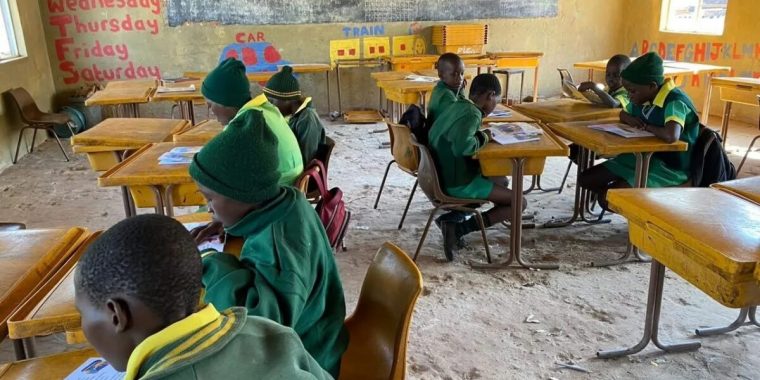
Learners
at
a
school
in
Hwange
district
sit
in
a
classroom
which
has
lost
much
of
its
flooring
HARARE
–
Schools
across
Zimbabwe
are
struggling
to
stay
afloat
as
the
government
continues
to
delay
disbursements
under
the
Basic
Education
Assistance
Module
(BEAM),
a
scheme
meant
to
cover
fees
for
vulnerable
learners.
Public
Service,
Labour
and
Social
Welfare
Minister
Edgar
Moyo
admitted
in
Parliament
on
Wednesday
that
Treasury
has
not
paid
BEAM
funds
since
the
beginning
of
2023,
leaving
schools
in
financial
distress.
“The
information
I
have
is
that
we
have
arrears
from
the
beginning
of
2023,”
Moyo
told
lawmakers
during
a
question-and-answer
session.
He
said
Treasury
had
only
released
ZiG40
million
this
year,
which
went
towards
clearing
arrears
for
the
first
and
second
terms
of
2024
—
but
only
for
special
schools
such
as
Jairos
Jiri,
St.
Giles,
Sibantubanye
and
M.
Hugo
School
for
the
Blind.
“Treasury
is
committed
to
releasing
more
funds
so
that
we
can
clear
arrears
for
the
main
schools,”
Moyo
said,
adding
that
his
ministry
is
engaging
finance
officials
“almost
weekly”
over
the
crisis.
Lawmakers
warned
that
the
non-payment
was
crippling
the
education
sector.
Mkoba
South
MP
Kuka
John,
who
raised
the
initial
question,
said
many
schools
were
now
on
the
brink
of
collapse.
“We
have
a
problem.
Most
schools
in
our
constituencies
are
deteriorating
while
we
wait
for
Treasury
disbursements.
The
only
option
left
is
for
schools
to
close,”
he
said.
Rushinga
legislator
Tendai
Nyabani
added
that
some
schools
had
as
many
as
100
percent
of
learners
enrolled
under
BEAM,
meaning
they
had
virtually
no
other
source
of
income.
The
BEAM
programme,
which
supports
at
least
1.5
million
learners
nationwide,
was
introduced
to
ensure
access
to
education
for
children
from
disadvantaged
backgrounds.
However,
with
funds
frozen
for
nearly
two
years,
schools
say
they
are
unable
to
buy
teaching
materials,
pay
support
staff
or
maintain
infrastructure.
HARARE
–
Former
information
minister
Webster
Shamu,
famed
for
his
extravagant
praise
of
Zimbabwean
leaders,
has
turned
his
attention
to
President
Emmerson
Mnangagwa,
hailing
his
just-ended
chairmanship
of
the
Southern
African
Development
Community
(SADC)
as
a
triumph
for
the
nation.
Raising
a
point
of
national
interest
in
Parliament
on
Thursday,
the
Zanu
PF
Chegutu
East
MP
—
who
chairs
the
Foreign
Affairs
and
International
Trade
Committee
—
described
Mnangagwa’s
tenure
as
SADC
chair
as
“about
action,
not
words.”
“There
are
moments
and
achievements
that
go
beyond
political
party
persuasion;
they
speak
to
us
as
Zimbabweans,
united
in
pride
and
purpose.
This
chairmanship
is
one
such
moment,”
Shamu
declared.
He
credited
Mnangagwa
with
spearheading
regional
development
projects,
citing
the
Beitbridge–Harare–Chirundu
Highway,
the
Mbudzi
Traffic
Interchange,
the
expansion
of
Robert
Gabriel
Mugabe
International
Airport’s
VIP
pavilion,
and
the
commissioning
of
Hwange
Units
7
and
8,
which
added
new
power
to
the
national
grid
and
beyond.
Mnangagwa
handed
over
the
SADC
chairmanship
to
Madagascar’s
President
Andry
Rajoelina
at
the
45th
summit
hosted
in
Harare
last
week.
“On
that
very
day,
Madagascar
and
Mauritius
signed
the
Agreement
Amending
the
Treaty,
bringing
to
15
the
members
that
have
signed
up
—
thanks
to
the
leadership
prowess
of
His
Excellency,
the
President,”
Shamu
said.
He
went
on
to
claim
that
Zimbabwe
had
received
commendation
from
fellow
member
states
for
“lifting
regional
integration
to
new
heights,”
adding:
“This
proves
that
Zimbabwe
does
not
simply
occupy
a
seat
in
SADC
—
Zimbabwe
leads,
Zimbabwe
inspires,
and
Zimbabwe
delivers.
Let
us
then
commend
His
Excellency,
Dr
Emmerson
Dambudzo
Mnangagwa,
for
his
distinguished
tenure,
and
may
the
foundations
he
laid
continue
to
guide
our
region
towards
unity,
peace
and
shared
prosperity.”
Shamu,
once
Robert
Mugabe’s
most
loyal
cheerleader
—
he
once
famously
said
he
wished
he
were
Mugabe’s
son
—
has
in
recent
years
redirected
his
effusive
praise
towards
Mnangagwa.
HARARE
–
A
Harare
magistrate
has
acquitted
human
rights
activists
Robson
Chere,
Namatai
Kwekweza
and
Samuel
Gwenzi
of
disorderly
conduct,
ending
a
year-long
trial
that
drew
widespread
criticism
from
rights
groups.
The
three
were
tried
alongside
Vusumuzi
Moyo,
Phillies
Pikitayi,
Delphine
Gutsa,
Simbarashe
Blackson,
Emmanuel
Sitima
and
Last
Chinodya,
who
were
also
cleared
of
the
charges.
Chere,
Kwekweza
and
Gwenzi
had
been
dramatically
removed
from
a
plane
at
Robert
Gabriel
Mugabe
International
Airport
last
year
by
12
unidentified
men
as
they
prepared
to
fly
to
Victoria
Falls.
The
activists
said
they
were
interrogated
and
tortured
for
hours,
with
Chere
sustaining
life-threatening
injuries
after
being
severely
beaten.
Prosecutors
alleged
the
group
had
participated
in
an
illegal
protest
outside
the
Harare
Magistrates
Court
on
June
27,
2024,
held
in
solidarity
with
more
than
70
Citizens
Coalition
for
Change
(CCC)
activists
who
were
appearing
in
court
that
day.
The
magistrate
ruled
the
state
had
failed
to
prove
its
case,
resulting
in
the
acquittal
of
all
nine
accused.
HARARE
–
Justice
Never
Katiyo
of
the
Harare
High
Court
is
once
again
under
the
spotlight
after
granting
the
National
Prosecuting
Authority
(NPA)
leave
to
appeal
in
a
politically
sensitive
case
before
the
deadline
for
respondents
to
oppose
had
lapsed,
in
what
lawyers
say
is
a
blatant
violation
of
court
rules.
The
case
involves
Clayd
Mashozhera,
Noel
Munhuwei,
Daud
Jessub
and
Maureen
Kademaunga,
who
along
with
11
others
were
accused
of
attacking
three
Zanu
PF
members
–
Cyril
Nyauchi,
Artwell
Marwa
and
Spencer
Mudarikwa
–
before
torching
a
Toyota
Spacio
and
its
contents
valued
at
US$15,600.
Their
trial
at
the
Harare
Regional
Magistrates’
Court
ended
in
November
2024
with
an
acquittal,
after
a
discharge
application
was
granted
at
the
close
of
the
state
case.
The
NPA
failed
to
file
its
appeal
on
time,
forcing
it
to
seek
condonation
at
the
High
Court.
On
August
8,
2025,
Justice
Katiyo
granted
the
application,
allowing
the
NPA
to
file
its
appeal
within
10
days.
But
defence
lawyers
argue
the
ruling
was
premature
and
unlawful,
as
the
application
had
only
been
served
on
the
respondents
on
August
4,
giving
them
until
August
20
to
file
opposing
papers
in
terms
of
Rule
59(b)
of
the
High
Court
Rules.
“This
judgment
was
granted
in
error
and
to
the
prejudice
of
the
respondents,”
wrote
Mhishi
Nkomo
Legal
Practice
in
a
letter
to
the
Registrar,
demanding
that
Justice
Katiyo
rescind
his
own
ruling
under
Rule
29(1)(a).
Compounding
the
controversy,
Justice
Katiyo’s
order
also
misstated
the
date
of
the
acquittal,
saying
it
occurred
in
November
2004
instead
of
November
2024.
Lawyers
say
the
20-year
discrepancy
illustrates
a
worrying
lack
of
attention
to
detail
in
a
matter
of
such
gravity.
The
Registrar
of
the
High
Court
confirmed
on
August
20
that
the
complaint
has
been
placed
before
the
judge
for
his
consideration.
The
controversy
adds
to
a
growing
list
of
complaints
against
Justice
Katiyo.
Earlier
this
month,
the
judge
was
forced
into
the
unprecedented
step
of
rescinding
his
own
ruling
in
a
property
dispute
between
a
Bulgarian
investor
and
a
local
company,
after
acknowledging
that
his
initial
judgment
had
been
“erroneously
issued.”
Legal
experts
say
the
pattern
of
serial
blunders
and
premature
rulings
threatens
to
erode
confidence
in
the
judiciary.
“Once
is
an
error,
twice
is
a
trend.
If
litigants
keep
finding
themselves
prejudiced
by
the
same
judge’s
disregard
of
procedure,
then
the
integrity
of
the
bench
itself
comes
under
question,”
said
one
senior
Harare
lawyer,
speaking
on
condition
of
anonymity.
As
the
Mashozhera
case
returns
to
the
High
Court,
Justice
Katiyo
must
now
decide
whether
to
withdraw
yet
another
of
his
own
orders
—
a
move
that
would
further
cement
concerns
over
his
handling
of
cases.
ZimLive
understands
that
the
Judicial
Service
Commission
has
opened
an
inquiry
into
Justice
Katiyo
after
a
complaint
lodged
by
the
Bulgarian
company’s
lawyers.
Should
the
investigation
uncover
wrongdoing,
the
JSC
may
advise
President
Emmerson
Mnangagwa
to
appoint
a
tribunal
to
assess
the
judge’s
suitability
to
remain
on
the
bench.
Justice
Katiyo
was
controversially
appointed
a
judge
by
President
Mnangagwa
in
2021
after
allegedly
scoring
lowly
in
public
interviews
for
judges
conducted
by
the
JSC.
He
previously
worked
as
a
magistrate
in
Chinhoyi
and
was
legal
affairs
director
in
the
ministry
of
industry
and
commerce
immediately
before
his
appointment
as
a
judge.
While
the
suspension
does
not
amount
to
a
complete
travel
ban,
it
has
nonetheless
created
significant
disruptions
for
those
intending
to
travel
to
the
United
States,
especially
students
and
business
travelers.
Impact
on
Students
In
recent
years,
the
number
of
Zimbabwean
students
applying
to
U.S.
universities
has
risen,
with
many
securing
scholarships
and
educational
opportunities
abroad.
However,
with
the
suspension
in
place,
numerous
students
now
find
themselves
unable
to
finalize
their
visa
applications,
leaving
them
in
a
state
of
uncertainty.
The
suspension
has
particularly
impacted
students
who
had
already
made
financial
arrangements
and
were
eagerly
preparing
to
study
in
the
U.S.
The
halt
in
visa
processing
means
that
many
students
are
left
waiting
indefinitely
for
interview
appointments,
with
no
clear
indication
of
when
these
will
resume.
Some
have
considered
traveling
to
nearby
countries
like
Zambia
or
Namibia
to
apply
for
visas
at
U.S.
embassies,
though
the
additional
costs
of
such
arrangements
are
a
significant
barrier
for
many.
Effects
on
Travelers
and
Tourists
Tourists
and
business
travelers
from
Zimbabwe,
who
were
planning
visits
to
the
U.S.,
are
now
faced
with
considerable
uncertainty.
While
the
embassy
has
emphasized
that
the
suspension
is
temporary,
there
is
no
guarantee
regarding
when
the
visa
processing
will
return
to
normal.
The
timing
of
this
suspension
is
also
noteworthy,
as
it
comes
amid
heightened
scrutiny
of
visa
overstays,
particularly
among
applicants
from
African
countries.
Visa
overstays
have
become
a
significant
issue
for
U.S.
immigration
authorities,
with
Zimbabwe
recording
a
visa
overstay
rate
of
10.57%
in
2023.
This
statistic
illustrates
the
challenges
the
U.S.
faces
in
managing
visa
issuance,
and
highlights
broader
concerns
regarding
immigration
and
visa
misuse.
The
Broader
Context
of
U.S.
Immigration
Policies
This
visa
suspension
is
part
of
a
wider
trend
of
tighter
immigration
policies
that
have
been
implemented
under
President
Trump’s
administration.
In
recent
years,
the
U.S.
government
has
introduced
stricter
travel
restrictions
aimed
at
reducing
visa
overstays,
and
Zimbabwe
is
not
the
only
nation
affected
by
these
changes.
Several
African
countries
have
experienced
similar
suspensions
or
more
rigid
visa
requirements,
particularly
for
student
and
tourist
visa
applicants.
Additionally,
the
U.S.
has
begun
imposing
bond
requirements
on
visa
applicants
from
certain
countries,
including
some
in
Southern
Africa.
These
bonds
can
reach
up
to
$15,000,
adding
another
financial
burden
to
those
hoping
to
visit
the
United
States.
Zimbabwean
Response
to
the
Suspension
For
many
Zimbabweans,
this
suspension
represents
a
significant
setback,
particularly
for
those
seeking
educational
opportunities
in
the
U.S.
The
added
cost
of
applying
for
visas
through
embassies
in
other
countries
in
Southern
Africa
is
a
major
concern.
Many
are
now
left
questioning
how
long
the
suspension
will
last
and
whether
they
will
be
able
to
pursue
their
travel
and
educational
goals
in
the
U.S.
as
planned.
While
the
U.S.
Embassy
has
clarified
that
visas
already
issued
remain
valid,
the
uncertainty
surrounding
future
visa
approvals
has
left
many
in
a
difficult
position.
The
Zimbabwean
government
has
yet
to
issue
an
official
statement
regarding
the
suspension,
leaving
citizens
uncertain
about
the
long-term
effects.
Uncertainty
Over
the
Suspension’s
Duration
Although
the
U.S.
Embassy
in
Zimbabwe
has
reassured
the
public
that
the
suspension
is
temporary,
it
has
provided
no
specific
timeline
for
when
normal
visa
processing
will
resume.
While
efforts
are
being
made
to
address
the
issues
at
hand,
travelers
and
students
remain
in
the
dark
about
how
long
this
situation
will
continue.
For
those
hoping
to
visit
or
study
in
the
U.S.,
this
uncertainty
is
proving
to
be
a
major
concern.
Some
individuals
are
exploring
alternative
options,
such
as
applying
for
visas
at
other
U.S.
embassies,
but
the
additional
financial
costs
involved
make
this
a
less
attractive
choice
for
many.
The
Future
of
Zimbabwean
Travelers
The
suspension
of
U.S.
visa
services
in
Zimbabwe
is
a
notable
development,
especially
for
those
hoping
to
study
or
visit
the
United
States.
It
underscores
the
broader
shift
in
U.S.
immigration
policies
under
the
current
administration,
with
stricter
controls
on
visa
issuance
and
an
increasing
focus
on
reducing
visa
overstays.
As
the
situation
unfolds,
Zimbabweans
are
left
with
little
choice
but
to
wait
for
further
updates
and
hope
for
a
swift
resolution
to
the
ongoing
visa
processing
disruptions.
While
the
suspension
does
not
amount
to
a
full
travel
ban,
the
challenges
posed
by
the
situation
are
significant,
and
many
are
left
searching
for
alternative
ways
to
navigate
this
uncertain
period.
Paul
Weiss
&
Kirkland
Are
Working
To
Stay
On
Trump’s
Good
Side:
Commerce
work
is
on
the
more
neutral
end
of
what
they
could
be
doing.
Where
Are
The
Client
Service
All-Stars?:
See
if
your
firm
is
on
the
list!
Trump
Is
Merely
A
Fraud!:
He’s
pretty
happy
about
no
longer
having
to
pay
the
$465M
as
a
consequence.
Legal
Community
Mourns
‘Nicest
Judge
In
The
World’:
Our
condolences
to
the
family
of
Frank
Caprio.
This
Isn’t
The
‘Get
Out
Of
Jail
Card’
You
Thought
It
Was:
Prosecutor
shocked
that
police
arrested
her
for
trespassing.
The
bottom
line
is
that
it
is
coming.
There
are
many,
many
firms
who
believe
firmly
that
it
is
going
to
have
a
pretty
significant
impact
on
the
way
they
work
and
their
leverage
models.
—
Gretta
Rusanow,
managing
director
and
head
of
advisory
services
at
Citigroup
Inc.’s
law
firm
group,
in
comments
given
to
Bloomberg
Law,
concerning
the
impending
costs
associated
with
Biglaw
firms’
efforts
to
deploy
artificial
intelligence
tools
across
their
practices.
It’s
been
estimated
that
in
the
not-too
distant
future,
firms
may
be
spending
0.5%
or
more
of
their
revenue
on
AI.
Staci
Zaretsky is
the
managing
editor
of
Above
the
Law,
where
she’s
worked
since
2011.
She’d
love
to
hear
from
you,
so
please
feel
free
to
email
her
with
any
tips,
questions,
comments,
or
critiques.
You
can
follow
her
on Bluesky, X/Twitter,
and Threads, or
connect
with
her
on LinkedIn.
According
to
news
reports,
there’s
an
active
shooter
situation
at
Villanova
University.
The
Radnor
Township
Police
Department
are
on
the
scene
and
issued
a
shelter
in
place
order
to
residents
and
students.
The
alert
from
the
university
provided
some
more
specific
information.
That
alert
asks
folks
to
steer
clear
of
the
law
school
building,
John
F.
Scarpa
Hall.
Scarpa
Hall
is
described
as
“home
to
everything
Villanova
Law.
From
the
Commons
to
the
library,
research
centers,
the
career
strategy
office,
and
state-of-the-art
classrooms,
Villanova
Law
has
everything
you
need
all
under
one
roof.”
The
active
shooter
alert
went
out
around
4:30
p.m.
Just
hours
before,
the
law
school
completed
its
annual
orientation.
Another
successful
Villanova
Law
orientation
came
to
a
close
with
a
picnic
hosted
by
the
Villanova
Law
Alumni
Association.
We
can’t
wait
to
see
all
the
great
things
the
class
of
2028
will
accomplish
during
their
time
here.
See
you
bright
and
early
on
Monday!
pic.twitter.com/TAwaH8INPu
This
story
will
be
updated
as
more
information
becomes
available.
Kathryn
Rubino
is
a
Senior
Editor
at
Above
the
Law,
host
of
The
Jabot
podcast,
and
co-host
of
Thinking
Like
A
Lawyer.
AtL
tipsters
are
the
best,
so
please
connect
with
her.
Feel
free
to
email
her
with
any
tips,
questions,
or
comments
and
follow
her
on
Twitter
@Kathryn1 or
Mastodon
@[email protected].
Alina
Habba’s
tenure
as
the
not-really-U.S.
Attorney
for
the
District
of
New
Jersey
reached
another
predictable
milestone
today
as
Judge
Matthew
Brann
disqualified
Habba
from
a
criminal
prosecution
on
the
grounds
that
she
doesn’t
actually
have
the
job
in
any
legal
sense.
Brann,
the
chief
judge
of
the
Middle
District
of
Pennsylvania,
heard
the
case
by
designation
since
all
the
judges
from
the
New
Jersey
District
already
chose
a
different
U.S.
Attorney.
Over
the
course
of
a
77-page
opinion,
the
judge
explained
that
Habba,
Trump’s
favorite
parking
garage
lawyer,
was
never
actually
the
U.S.
Attorney
in
the
first
place
and
has
been
unlawfully
squatting
in
the
office
since
July
1.
The
precise
date
that
Habba
transformed
into
a
proverbial
pumpkin
is
convoluted,
but
somewhere
between
the
beginning
and
end
of
July,
Habba’s
interim
appointment
came
to
an
end
while
her
formal
nomination
stalled
in
the
Senate.
Believing
the
conclusion
of
her
appointment
to
end
toward
the
end
of
July,
and
with
no
replacement
legally
appointed,
the
judges
of
the
district
of
New
Jersey
appointed
Desiree
Grace,
who
happened
to
be
Habba’s
assistant
at
the
time.
The
Trump
administration
initiated
a
series
of
Rube
Goldberg
staffing
gimmicks
in
a
bid
to
return
Habba
to
the
job.
Attorney
General
Pam
Bondi
promptly
fired
Grace
in
order
to
keep
Habba
in
the
job
despite
the
fact
that
this
(a)
had
zilch
to
do
with
Grace’s
legal
appointment
and
(b)
wouldn’t
return
Habba
to
the
job
even
if
it
did.
Since
Trump
had
nominated
Habba
for
the
permanent
job,
she
was
ineligible
under
the
Federal
Vacancies
Reform
Act
to
serve
as
Acting
U.S.
Attorney,
so
they
pulled
her
nomination.
But
only
after
naming
her
as
her
own
assistant
so
she
would
ascend
to
her
own
job
when
she
resigned
it
before
it
technically
expired,
meaning
there
would
be
no
vacancy
for
Grace
to
fill.
And,
for
good
measure,
Trump
purported
to
fire
Grace
again
—
this
time
from
the
U.S.
Attorney
appointment
that
the
administration
claims
never
even
happened.
Make
sense?
Untangling
the
factual
record,
Brann
did
find
one
error
on
the
part
of
the
Jersey
judges:
they
let
Habba
hang
around
illegally
for
too
long.
My
analysis
generally
proceeds
in
chronological
order.
First,
I
consider
whether
Ms.
Habba’s
tenure
as
Interim
United
States
Attorney
pursuant
to
28
U.S.C.
§
546,
which
began
on
March
28,
2025,
lawfully
continued
until
July
24,
2025,
when
she
purported
to
resign,
and
conclude
that
it
did
not.
As
I
interpret
the
law,
her
interim
appointment
ended
on
July
1,
2025—120
days
after
Attorney
General
Bondi
invoked
her
power
under
section
546(a)
by
appointing
Mr.
Giordano
Interim
United
States
Attorney
on
March
3,
2025.
Thus,
Ms.
Habba
was
not
lawfully
acting
as
the
United
States
Attorney
in
any
capacity
from
July
1,
2025
until
at
least
July
24,
2025.
Judge
Brann
—
who
despite
being
an
Obama
nominee
is
a
Republican
with
ties
to
the
Federalist
Society
and
the
NRA
—
delivered
an
ode
of
originalist
jurisprudence,
guiding
the
reader
through
the
“American
revolutionary
generation’s”
understanding
of
the
Appointments
Clause
and
their
concern
that
a
corrupt
idiot
might
use
the
White
House
to
give
patronage
jobs
to
unqualified
hacks.
A
prescient
bunch.
That
said,
Brann
doesn’t
end
up
ruling
on
constitutional
grounds
because
the
statutory
arguments
resolved
everything.
Continuing
by
noting
that
her
backdoor
effort
to
take
the
job
as
her
own
assistant
made
no
sense.
Running
through
the
Republican
judicial
greatest
hits,
Brann
takes
a
meticulously
textualist
stab
at
the
relevant
statutes
and
decided:
The
Government
protests
that
the
appointment
referred
to
in
section
546(c)’s
“chapeau”—“a
person
appointed”—should
carry
through
to
the
“appointment”
referred
to
section
546(c)(2).
But
that
reading
strains
the
text
for
three
reasons.
First,
it
transforms
the
indefinite
article
in
the
chapeau
into
a
definite
article
or
pronoun
that
is
unstated
in
section
546(c)(2),
rewriting
the
unmodified
term
“appointment”
as
“her
appointment”
or
“that
appointment.”
Second,
both
the
chapeau
and
subsection
(c)(2)
describe
an
appointment
“under
this
section.”
If
subsection
(c)(2)’s
bar
is
limited
to
the
appointment
described
in
(c),
then
restating
“under
this
section”
is
redundant
because
that
is
the
only
type
of
appointment
to
which
it
could
apply.
But
courts
should
give
“‘every
clause
and
word
of
a
statute’
.
.
.
meaning.”
Giving
meaning
to
the
second
use
of
“under
this
section”
indicates
that
that
subsection
(c)(2)
refers
more
broadly
to
any
appointment
“under
this
section.”
And
third,
the
chapeau
clearly
does
not
modify
the
other
barring
provision
in
section
546(c)(1),
which
is
indisputably
benchmarked
to
an
event
unrelated
to
any
specific
person’s
interim
appointment:
Senate
confirmation
of
the
President’s
nominee.
Had
Congress
wanted
the
120
day
clock
to
run
on
a
per-appointee
basis,
it
could
easily
have
written
the
statute
to
place
the
bar
of
subsection
(c)(2)
first
and
written
it
as
“the
expiration
of
120
days
after
her
appointment.”
Congress’s
choice
not
to
so
define
the
appointment
in
subsection
(c)(2)
is
meaningful,
and
the
Court
will
not
redraft
the
text.
As
to
the
theory
that
the
administration
could
just
appoint
Habba
as
an
assistant
to
succeed
to
the
job,
Brann
invokes
the
canons
of
construction
to
point
out
that
this
reading
would
“render
the
limits
in
subsections
(a)(2)
and
(a)(3)
surplusage
in
the
vast
majority
of
cases.”
The
government
tried
arguing,
“well,
what
if
Habba
is
just
a
special
prosecutor
with
the
powers
of
the
U.S.
Attorney”
and
Judge
Brann
strained
a
muscle
to
avoid
writing
“are
you
fucking
kidding
me
with
this
right
now?”
Alas,
the
ruling
was
a
Pyrrhic
victory
for
the
criminal
defendants.
Despite
determining
that
Habba
was
illegally
cosplaying
as
U.S.
Attorney
when
she
signed
the
indictment,
Brann
ruled
that
this
doesn’t
require
dismissing
the
charges
because
it’s
a
harmless
technical
deficiency
and
any
government
lawyer
willing
to
vouch
for
the
authenticity
of
the
document
will
do.
But
Habba
is
disqualified
from
the
case
and
any
attorney
prosecuting
the
case
under
her
direction
will
be
similarly
disqualified.
Thankfully,
she
can
still
go
on
Newsmax
to
complain
about
how
these
woke
Federalist
Society
judges
are
out
to
get
her.










 Kathryn