Emmerson Mnangagwa’s online stormtroopers target women who speak out

Zimbabwe’s
brutal
regime,
under
President
Emmerson
Mnangagwa,
is
using
social
media,
particularly
X,
to
smear
and
silence
mostly
female
anti-government
political
activists
and
human
rights
defenders
in
the
country.

President
Mnangagwa’s
army
of
paid
pro-government
social
media
trolls
is
known
as
the Varakashi —propaganda
stormtroopers—with
some
using
names
of
prominent
people
to
open
fake
X
accounts
without
their
knowledge.
One
ghost X
account
uses
 the
name
of
Zimbabwe’s
former
vice
president,
Joice
Mujuru.
Even
President
Mnangagwa’s
spokesperson,
George
Charamba—who
is
also
a
senior
government
employee
—runs
two
toxic
ghost
X
accounts—@Jamwanda2 and @dhonzamusoro007—which
he
uses
to
attack
and
post
completely
fabricated
and
malicious
information
about
female
human
rights
defenders
and
political
activists
in
Zimbabwe.
The
first
of
these
accounts
was suspended
in
2022
 but
was
reinstated
after
Elon
Musk
acquired
Twitter
and
renamed
it
X.

In
the
past
year
there
has
been
a
proliferation
of
toxic
X
accounts
in
the
country
and
they
are
flourishing.
At
times,
these
X
accounts
incite
physical
and
sexual
violence
against
female
political
and
human
rights
activists.
In
one
post,
a
ghost
X
account
threatened
a
prominent
human
rights
activist
that
“[I’m]
waiting
to
rape
you.”
The
post
drew
outrage
from
X
users,
and
it
was
later
deleted.

And
in
study
published
in
2023
,
Constance
Kasiyamhuru
from
the
University
of
Johannesburg
in
South
Africa
said
the
Varakashi
in
Zimbabwe
operate
mostly
on
Twitter/X
to
“shut
down”
the
political
opponents
of
the
governing
Zanu
PF
party.

“Through
trolling,
name-calling,
threats,
mocking,
mobbing,
labelling,
ridicule,
casting
aspersions,
delegitimation,
disinforming,
and
other
strategies,
Varakashi
seek
to
regulate,
censure,
and
‘discipline’
anti-musangano [anti-ruling
party]
online
discourse,”
Kasiyamhuru
wrote.

Tendai
Ruben
Mbofana,
a
Zimbabwe
based
social
justice
advocate
and
writer,
said
the
systematic
deployment
of
online
trolls—particularly
targeting
female
human
rights
defenders
and
political
activists—has
become
a
chilling
hallmark
of
repression
in
Zimbabwe.

“These
smear
campaigns
are
not
just
personal
attacks;
they
are
part
of
a
broader
strategy
to
delegitimise
our
work,
intimidate
us
into
silence,
and
discredit
our
credibility
in
the
eyes
of
the
public,”
Mbofana
said.

He
added
that
the
abuse
often
takes
on
a
deeply
misogynistic
tone,
laced
with
gendered
insults,
threats
of
sexual
violence,
and
false
accusations
designed
to
shame
and
isolate
women.

“It
creates
a
climate
of
fear
and
forces
many
women
out
of
digital
spaces
that
should
otherwise
be
used
to
amplify
their
voices
and
advocacy,”
he
said.

Sophia
Gwasira,
who
was
elected
as
the
first
female
mayor
for
Mutare
City
in
eastern
Zimbabwe
in
August
2023,
told
Index
on
Censorship
that
the
fear
of
being
smeared
and
attacked
on
social
media
platforms
by
Zanu
PF
social
media
trolls
was
forcing
many
women
to
abandon
opposition
politics
and
activism.
She
said
social
media
platforms
were
no
longer
safe
places
for
women
in
opposition
politics
in
Zimbabwe,
with
the
attackes
affecting
both
them
and
their
families.

“It’s
affecting
us
not
only
physically
but
emotionally
too.
We
are
trying
to
find
ways
of
countering
these
attacks.
But
currently
we
don’t
have
any
protection
from
our
own
political
parties
or
from
the
government,”
Gwasira
said.

But
Gwasira
said
she
will
continue
to
fight
for
the
people
and,
given
the
opportunity,
she
would
contest
the
general
elections
slated
for
2028.
Gwasira
and
many
other
opposition
mayors,
MPs
and
councillors
were
recalled
in
late
2023
after
her
party,
the
Citizens
Coalition
for
Change
(CCC) was
hijacked
 by
President
Mnangagwa’s
ruling
party
Zanu
PF
through
its
proxy,
Sengezo
Tshabangu.
This
forced
the
CCC
leader
Nelson
Chamisa
to abandon
the
opposition
 party
and
he
took
a
sabbatical
from
party
politics
in
January
2024.

Promise
Mkwananzi,
spokesperson
for
opposition
party
Citizens
Coalition
for
Change—which
is
still
loyal
to
former
leader
Nelson
Chamisa—
told
Index
on
Censorship
that
as
opposition,
they
have
been
identifying
and
exposing
some
of
these
social
media
ghost
accounts
and
to
direct
their
members
to
counter
the
toxic
narratives
on
X.

“It
must
be
noted
also
that
these
trolls
are
paid
using
taxpayers’
money
to
denigrate
women
and
bully
voices
of
the
alternative
on
social
media,”
Mkwananzi
said.

But
Mkwananzi
was
quick
to
add
that
his
party
will
continue
to
fight
and
mobilise
people
for
a
better
Zimbabwe.

“We
are
also
educating
our
members
to
be
strong
and
to
remain
focused
on
recruiting
mobilising,
educating
and
radicalising
the
base.”

Although
women
are
the
main
target,
men
critical
of
the
ruling
party
are
also
targeted.

“In
my
own
experience,
I
have
faced
repeated,
coordinated
attacks
on
X,
particularly
from
anonymous
accounts
believed
to
be
run
or
supported
by
high-ranking
government
officials,
including
the
president’s
spokesperson.
These
attacks
are
aimed
at
silencing
dissent
and
discouraging
public
engagement.
But
we
will
not
be
silenced.
If
anything,
these
attacks
only
reinforce
the
urgency
of
our
work,”
said
Tendai
Ruben
Mbofana.

When
President
Mnangagwa seized
power
 through
a
military
coup
from
Zimbabwe’s
long-time
dictator,
Robert
Mugabe
in
2017,
President
Mnangagwa
promised
sweeping
reforms;
economic
and
political
reforms,
including
upholding
human
rights
and
rule
of
law
in
the
country.

However,
Zimbabwe
has
become
worse
under
President
Mnangagwa
than
Mugabe;
political
opponents
to
Zanu
PF
have
been
brutalised, tortured and killed and
corruption
is
widespread.


A
recent
report
 by
Human
Rights
Watch
said
authorities
in
Zimbabwe
have
continued
to
restrict
civic
space
and
the
rights
to
freedom
of
expression,
association,
and
peaceful
assembly
and
the
human
rights,
political
and
economic
situation
in
Zimbabwe
continues
to
deteriorate.

Under
the
current
constitution,
President
Mnangagwa’s
term
of
office—his
second
and
last
term—ends
in
2028
but
his
party
is
now
planning
to
amend
the
constitution
to
keep
him
in
office
till
2030.
Meanwhile,
Mnangagwa’s
Varakashi
are
flooding
social
media
with
messages
in
support
of
the
extension
of
his
term
and
touting
his
“achievements”
so
far.

Source:


Zimbabwe:
Emmerson
Mnangagwa’s
online
stormtroopers
target
women
who
speak
out


Index
on
Censorship

Emmerson Mnangagwa’s online stormtroopers target women who speak out

Zimbabwe’s
brutal
regime,
under
President
Emmerson
Mnangagwa,
is
using
social
media,
particularly
X,
to
smear
and
silence
mostly
female
anti-government
political
activists
and
human
rights
defenders
in
the
country.

President
Mnangagwa’s
army
of
paid
pro-government
social
media
trolls
is
known
as
the Varakashi —propaganda
stormtroopers—with
some
using
names
of
prominent
people
to
open
fake
X
accounts
without
their
knowledge.
One
ghost X
account
uses
 the
name
of
Zimbabwe’s
former
vice
president,
Joice
Mujuru.
Even
President
Mnangagwa’s
spokesperson,
George
Charamba—who
is
also
a
senior
government
employee
—runs
two
toxic
ghost
X
accounts—@Jamwanda2 and @dhonzamusoro007—which
he
uses
to
attack
and
post
completely
fabricated
and
malicious
information
about
female
human
rights
defenders
and
political
activists
in
Zimbabwe.
The
first
of
these
accounts
was suspended
in
2022
 but
was
reinstated
after
Elon
Musk
acquired
Twitter
and
renamed
it
X.

In
the
past
year
there
has
been
a
proliferation
of
toxic
X
accounts
in
the
country
and
they
are
flourishing.
At
times,
these
X
accounts
incite
physical
and
sexual
violence
against
female
political
and
human
rights
activists.
In
one
post,
a
ghost
X
account
threatened
a
prominent
human
rights
activist
that
“[I’m]
waiting
to
rape
you.”
The
post
drew
outrage
from
X
users,
and
it
was
later
deleted.

And
in
study
published
in
2023
,
Constance
Kasiyamhuru
from
the
University
of
Johannesburg
in
South
Africa
said
the
Varakashi
in
Zimbabwe
operate
mostly
on
Twitter/X
to
“shut
down”
the
political
opponents
of
the
governing
Zanu
PF
party.

“Through
trolling,
name-calling,
threats,
mocking,
mobbing,
labelling,
ridicule,
casting
aspersions,
delegitimation,
disinforming,
and
other
strategies,
Varakashi
seek
to
regulate,
censure,
and
‘discipline’
anti-musangano [anti-ruling
party]
online
discourse,”
Kasiyamhuru
wrote.

Tendai
Ruben
Mbofana,
a
Zimbabwe
based
social
justice
advocate
and
writer,
said
the
systematic
deployment
of
online
trolls—particularly
targeting
female
human
rights
defenders
and
political
activists—has
become
a
chilling
hallmark
of
repression
in
Zimbabwe.

“These
smear
campaigns
are
not
just
personal
attacks;
they
are
part
of
a
broader
strategy
to
delegitimise
our
work,
intimidate
us
into
silence,
and
discredit
our
credibility
in
the
eyes
of
the
public,”
Mbofana
said.

He
added
that
the
abuse
often
takes
on
a
deeply
misogynistic
tone,
laced
with
gendered
insults,
threats
of
sexual
violence,
and
false
accusations
designed
to
shame
and
isolate
women.

“It
creates
a
climate
of
fear
and
forces
many
women
out
of
digital
spaces
that
should
otherwise
be
used
to
amplify
their
voices
and
advocacy,”
he
said.

Sophia
Gwasira,
who
was
elected
as
the
first
female
mayor
for
Mutare
City
in
eastern
Zimbabwe
in
August
2023,
told
Index
on
Censorship
that
the
fear
of
being
smeared
and
attacked
on
social
media
platforms
by
Zanu
PF
social
media
trolls
was
forcing
many
women
to
abandon
opposition
politics
and
activism.
She
said
social
media
platforms
were
no
longer
safe
places
for
women
in
opposition
politics
in
Zimbabwe,
with
the
attackes
affecting
both
them
and
their
families.

“It’s
affecting
us
not
only
physically
but
emotionally
too.
We
are
trying
to
find
ways
of
countering
these
attacks.
But
currently
we
don’t
have
any
protection
from
our
own
political
parties
or
from
the
government,”
Gwasira
said.

But
Gwasira
said
she
will
continue
to
fight
for
the
people
and,
given
the
opportunity,
she
would
contest
the
general
elections
slated
for
2028.
Gwasira
and
many
other
opposition
mayors,
MPs
and
councillors
were
recalled
in
late
2023
after
her
party,
the
Citizens
Coalition
for
Change
(CCC) was
hijacked
 by
President
Mnangagwa’s
ruling
party
Zanu
PF
through
its
proxy,
Sengezo
Tshabangu.
This
forced
the
CCC
leader
Nelson
Chamisa
to abandon
the
opposition
 party
and
he
took
a
sabbatical
from
party
politics
in
January
2024.

Promise
Mkwananzi,
spokesperson
for
opposition
party
Citizens
Coalition
for
Change—which
is
still
loyal
to
former
leader
Nelson
Chamisa—
told
Index
on
Censorship
that
as
opposition,
they
have
been
identifying
and
exposing
some
of
these
social
media
ghost
accounts
and
to
direct
their
members
to
counter
the
toxic
narratives
on
X.

“It
must
be
noted
also
that
these
trolls
are
paid
using
taxpayers’
money
to
denigrate
women
and
bully
voices
of
the
alternative
on
social
media,”
Mkwananzi
said.

But
Mkwananzi
was
quick
to
add
that
his
party
will
continue
to
fight
and
mobilise
people
for
a
better
Zimbabwe.

“We
are
also
educating
our
members
to
be
strong
and
to
remain
focused
on
recruiting
mobilising,
educating
and
radicalising
the
base.”

Although
women
are
the
main
target,
men
critical
of
the
ruling
party
are
also
targeted.

“In
my
own
experience,
I
have
faced
repeated,
coordinated
attacks
on
X,
particularly
from
anonymous
accounts
believed
to
be
run
or
supported
by
high-ranking
government
officials,
including
the
president’s
spokesperson.
These
attacks
are
aimed
at
silencing
dissent
and
discouraging
public
engagement.
But
we
will
not
be
silenced.
If
anything,
these
attacks
only
reinforce
the
urgency
of
our
work,”
said
Tendai
Ruben
Mbofana.

When
President
Mnangagwa seized
power
 through
a
military
coup
from
Zimbabwe’s
long-time
dictator,
Robert
Mugabe
in
2017,
President
Mnangagwa
promised
sweeping
reforms;
economic
and
political
reforms,
including
upholding
human
rights
and
rule
of
law
in
the
country.

However,
Zimbabwe
has
become
worse
under
President
Mnangagwa
than
Mugabe;
political
opponents
to
Zanu
PF
have
been
brutalised, tortured and killed and
corruption
is
widespread.


A
recent
report
 by
Human
Rights
Watch
said
authorities
in
Zimbabwe
have
continued
to
restrict
civic
space
and
the
rights
to
freedom
of
expression,
association,
and
peaceful
assembly
and
the
human
rights,
political
and
economic
situation
in
Zimbabwe
continues
to
deteriorate.

Under
the
current
constitution,
President
Mnangagwa’s
term
of
office—his
second
and
last
term—ends
in
2028
but
his
party
is
now
planning
to
amend
the
constitution
to
keep
him
in
office
till
2030.
Meanwhile,
Mnangagwa’s
Varakashi
are
flooding
social
media
with
messages
in
support
of
the
extension
of
his
term
and
touting
his
“achievements”
so
far.

Source:


Zimbabwe:
Emmerson
Mnangagwa’s
online
stormtroopers
target
women
who
speak
out


Index
on
Censorship

Emmerson Mnangagwa’s online stormtroopers target women who speak out

Zimbabwe’s
brutal
regime,
under
President
Emmerson
Mnangagwa,
is
using
social
media,
particularly
X,
to
smear
and
silence
mostly
female
anti-government
political
activists
and
human
rights
defenders
in
the
country.

President
Mnangagwa’s
army
of
paid
pro-government
social
media
trolls
is
known
as
the Varakashi —propaganda
stormtroopers—with
some
using
names
of
prominent
people
to
open
fake
X
accounts
without
their
knowledge.
One
ghost X
account
uses
 the
name
of
Zimbabwe’s
former
vice
president,
Joice
Mujuru.
Even
President
Mnangagwa’s
spokesperson,
George
Charamba—who
is
also
a
senior
government
employee
—runs
two
toxic
ghost
X
accounts—@Jamwanda2 and @dhonzamusoro007—which
he
uses
to
attack
and
post
completely
fabricated
and
malicious
information
about
female
human
rights
defenders
and
political
activists
in
Zimbabwe.
The
first
of
these
accounts
was suspended
in
2022
 but
was
reinstated
after
Elon
Musk
acquired
Twitter
and
renamed
it
X.

In
the
past
year
there
has
been
a
proliferation
of
toxic
X
accounts
in
the
country
and
they
are
flourishing.
At
times,
these
X
accounts
incite
physical
and
sexual
violence
against
female
political
and
human
rights
activists.
In
one
post,
a
ghost
X
account
threatened
a
prominent
human
rights
activist
that
“[I’m]
waiting
to
rape
you.”
The
post
drew
outrage
from
X
users,
and
it
was
later
deleted.

And
in
study
published
in
2023
,
Constance
Kasiyamhuru
from
the
University
of
Johannesburg
in
South
Africa
said
the
Varakashi
in
Zimbabwe
operate
mostly
on
Twitter/X
to
“shut
down”
the
political
opponents
of
the
governing
Zanu
PF
party.

“Through
trolling,
name-calling,
threats,
mocking,
mobbing,
labelling,
ridicule,
casting
aspersions,
delegitimation,
disinforming,
and
other
strategies,
Varakashi
seek
to
regulate,
censure,
and
‘discipline’
anti-musangano [anti-ruling
party]
online
discourse,”
Kasiyamhuru
wrote.

Tendai
Ruben
Mbofana,
a
Zimbabwe
based
social
justice
advocate
and
writer,
said
the
systematic
deployment
of
online
trolls—particularly
targeting
female
human
rights
defenders
and
political
activists—has
become
a
chilling
hallmark
of
repression
in
Zimbabwe.

“These
smear
campaigns
are
not
just
personal
attacks;
they
are
part
of
a
broader
strategy
to
delegitimise
our
work,
intimidate
us
into
silence,
and
discredit
our
credibility
in
the
eyes
of
the
public,”
Mbofana
said.

He
added
that
the
abuse
often
takes
on
a
deeply
misogynistic
tone,
laced
with
gendered
insults,
threats
of
sexual
violence,
and
false
accusations
designed
to
shame
and
isolate
women.

“It
creates
a
climate
of
fear
and
forces
many
women
out
of
digital
spaces
that
should
otherwise
be
used
to
amplify
their
voices
and
advocacy,”
he
said.

Sophia
Gwasira,
who
was
elected
as
the
first
female
mayor
for
Mutare
City
in
eastern
Zimbabwe
in
August
2023,
told
Index
on
Censorship
that
the
fear
of
being
smeared
and
attacked
on
social
media
platforms
by
Zanu
PF
social
media
trolls
was
forcing
many
women
to
abandon
opposition
politics
and
activism.
She
said
social
media
platforms
were
no
longer
safe
places
for
women
in
opposition
politics
in
Zimbabwe,
with
the
attackes
affecting
both
them
and
their
families.

“It’s
affecting
us
not
only
physically
but
emotionally
too.
We
are
trying
to
find
ways
of
countering
these
attacks.
But
currently
we
don’t
have
any
protection
from
our
own
political
parties
or
from
the
government,”
Gwasira
said.

But
Gwasira
said
she
will
continue
to
fight
for
the
people
and,
given
the
opportunity,
she
would
contest
the
general
elections
slated
for
2028.
Gwasira
and
many
other
opposition
mayors,
MPs
and
councillors
were
recalled
in
late
2023
after
her
party,
the
Citizens
Coalition
for
Change
(CCC) was
hijacked
 by
President
Mnangagwa’s
ruling
party
Zanu
PF
through
its
proxy,
Sengezo
Tshabangu.
This
forced
the
CCC
leader
Nelson
Chamisa
to abandon
the
opposition
 party
and
he
took
a
sabbatical
from
party
politics
in
January
2024.

Promise
Mkwananzi,
spokesperson
for
opposition
party
Citizens
Coalition
for
Change—which
is
still
loyal
to
former
leader
Nelson
Chamisa—
told
Index
on
Censorship
that
as
opposition,
they
have
been
identifying
and
exposing
some
of
these
social
media
ghost
accounts
and
to
direct
their
members
to
counter
the
toxic
narratives
on
X.

“It
must
be
noted
also
that
these
trolls
are
paid
using
taxpayers’
money
to
denigrate
women
and
bully
voices
of
the
alternative
on
social
media,”
Mkwananzi
said.

But
Mkwananzi
was
quick
to
add
that
his
party
will
continue
to
fight
and
mobilise
people
for
a
better
Zimbabwe.

“We
are
also
educating
our
members
to
be
strong
and
to
remain
focused
on
recruiting
mobilising,
educating
and
radicalising
the
base.”

Although
women
are
the
main
target,
men
critical
of
the
ruling
party
are
also
targeted.

“In
my
own
experience,
I
have
faced
repeated,
coordinated
attacks
on
X,
particularly
from
anonymous
accounts
believed
to
be
run
or
supported
by
high-ranking
government
officials,
including
the
president’s
spokesperson.
These
attacks
are
aimed
at
silencing
dissent
and
discouraging
public
engagement.
But
we
will
not
be
silenced.
If
anything,
these
attacks
only
reinforce
the
urgency
of
our
work,”
said
Tendai
Ruben
Mbofana.

When
President
Mnangagwa seized
power
 through
a
military
coup
from
Zimbabwe’s
long-time
dictator,
Robert
Mugabe
in
2017,
President
Mnangagwa
promised
sweeping
reforms;
economic
and
political
reforms,
including
upholding
human
rights
and
rule
of
law
in
the
country.

However,
Zimbabwe
has
become
worse
under
President
Mnangagwa
than
Mugabe;
political
opponents
to
Zanu
PF
have
been
brutalised, tortured and killed and
corruption
is
widespread.


A
recent
report
 by
Human
Rights
Watch
said
authorities
in
Zimbabwe
have
continued
to
restrict
civic
space
and
the
rights
to
freedom
of
expression,
association,
and
peaceful
assembly
and
the
human
rights,
political
and
economic
situation
in
Zimbabwe
continues
to
deteriorate.

Under
the
current
constitution,
President
Mnangagwa’s
term
of
office—his
second
and
last
term—ends
in
2028
but
his
party
is
now
planning
to
amend
the
constitution
to
keep
him
in
office
till
2030.
Meanwhile,
Mnangagwa’s
Varakashi
are
flooding
social
media
with
messages
in
support
of
the
extension
of
his
term
and
touting
his
“achievements”
so
far.

Source:


Zimbabwe:
Emmerson
Mnangagwa’s
online
stormtroopers
target
women
who
speak
out


Index
on
Censorship

Emmerson Mnangagwa’s online stormtroopers target women who speak out

Zimbabwe’s
brutal
regime,
under
President
Emmerson
Mnangagwa,
is
using
social
media,
particularly
X,
to
smear
and
silence
mostly
female
anti-government
political
activists
and
human
rights
defenders
in
the
country.

President
Mnangagwa’s
army
of
paid
pro-government
social
media
trolls
is
known
as
the Varakashi —propaganda
stormtroopers—with
some
using
names
of
prominent
people
to
open
fake
X
accounts
without
their
knowledge.
One
ghost X
account
uses
 the
name
of
Zimbabwe’s
former
vice
president,
Joice
Mujuru.
Even
President
Mnangagwa’s
spokesperson,
George
Charamba—who
is
also
a
senior
government
employee
—runs
two
toxic
ghost
X
accounts—@Jamwanda2 and @dhonzamusoro007—which
he
uses
to
attack
and
post
completely
fabricated
and
malicious
information
about
female
human
rights
defenders
and
political
activists
in
Zimbabwe.
The
first
of
these
accounts
was suspended
in
2022
 but
was
reinstated
after
Elon
Musk
acquired
Twitter
and
renamed
it
X.

In
the
past
year
there
has
been
a
proliferation
of
toxic
X
accounts
in
the
country
and
they
are
flourishing.
At
times,
these
X
accounts
incite
physical
and
sexual
violence
against
female
political
and
human
rights
activists.
In
one
post,
a
ghost
X
account
threatened
a
prominent
human
rights
activist
that
“[I’m]
waiting
to
rape
you.”
The
post
drew
outrage
from
X
users,
and
it
was
later
deleted.

And
in
study
published
in
2023
,
Constance
Kasiyamhuru
from
the
University
of
Johannesburg
in
South
Africa
said
the
Varakashi
in
Zimbabwe
operate
mostly
on
Twitter/X
to
“shut
down”
the
political
opponents
of
the
governing
Zanu
PF
party.

“Through
trolling,
name-calling,
threats,
mocking,
mobbing,
labelling,
ridicule,
casting
aspersions,
delegitimation,
disinforming,
and
other
strategies,
Varakashi
seek
to
regulate,
censure,
and
‘discipline’
anti-musangano [anti-ruling
party]
online
discourse,”
Kasiyamhuru
wrote.

Tendai
Ruben
Mbofana,
a
Zimbabwe
based
social
justice
advocate
and
writer,
said
the
systematic
deployment
of
online
trolls—particularly
targeting
female
human
rights
defenders
and
political
activists—has
become
a
chilling
hallmark
of
repression
in
Zimbabwe.

“These
smear
campaigns
are
not
just
personal
attacks;
they
are
part
of
a
broader
strategy
to
delegitimise
our
work,
intimidate
us
into
silence,
and
discredit
our
credibility
in
the
eyes
of
the
public,”
Mbofana
said.

He
added
that
the
abuse
often
takes
on
a
deeply
misogynistic
tone,
laced
with
gendered
insults,
threats
of
sexual
violence,
and
false
accusations
designed
to
shame
and
isolate
women.

“It
creates
a
climate
of
fear
and
forces
many
women
out
of
digital
spaces
that
should
otherwise
be
used
to
amplify
their
voices
and
advocacy,”
he
said.

Sophia
Gwasira,
who
was
elected
as
the
first
female
mayor
for
Mutare
City
in
eastern
Zimbabwe
in
August
2023,
told
Index
on
Censorship
that
the
fear
of
being
smeared
and
attacked
on
social
media
platforms
by
Zanu
PF
social
media
trolls
was
forcing
many
women
to
abandon
opposition
politics
and
activism.
She
said
social
media
platforms
were
no
longer
safe
places
for
women
in
opposition
politics
in
Zimbabwe,
with
the
attackes
affecting
both
them
and
their
families.

“It’s
affecting
us
not
only
physically
but
emotionally
too.
We
are
trying
to
find
ways
of
countering
these
attacks.
But
currently
we
don’t
have
any
protection
from
our
own
political
parties
or
from
the
government,”
Gwasira
said.

But
Gwasira
said
she
will
continue
to
fight
for
the
people
and,
given
the
opportunity,
she
would
contest
the
general
elections
slated
for
2028.
Gwasira
and
many
other
opposition
mayors,
MPs
and
councillors
were
recalled
in
late
2023
after
her
party,
the
Citizens
Coalition
for
Change
(CCC) was
hijacked
 by
President
Mnangagwa’s
ruling
party
Zanu
PF
through
its
proxy,
Sengezo
Tshabangu.
This
forced
the
CCC
leader
Nelson
Chamisa
to abandon
the
opposition
 party
and
he
took
a
sabbatical
from
party
politics
in
January
2024.

Promise
Mkwananzi,
spokesperson
for
opposition
party
Citizens
Coalition
for
Change—which
is
still
loyal
to
former
leader
Nelson
Chamisa—
told
Index
on
Censorship
that
as
opposition,
they
have
been
identifying
and
exposing
some
of
these
social
media
ghost
accounts
and
to
direct
their
members
to
counter
the
toxic
narratives
on
X.

“It
must
be
noted
also
that
these
trolls
are
paid
using
taxpayers’
money
to
denigrate
women
and
bully
voices
of
the
alternative
on
social
media,”
Mkwananzi
said.

But
Mkwananzi
was
quick
to
add
that
his
party
will
continue
to
fight
and
mobilise
people
for
a
better
Zimbabwe.

“We
are
also
educating
our
members
to
be
strong
and
to
remain
focused
on
recruiting
mobilising,
educating
and
radicalising
the
base.”

Although
women
are
the
main
target,
men
critical
of
the
ruling
party
are
also
targeted.

“In
my
own
experience,
I
have
faced
repeated,
coordinated
attacks
on
X,
particularly
from
anonymous
accounts
believed
to
be
run
or
supported
by
high-ranking
government
officials,
including
the
president’s
spokesperson.
These
attacks
are
aimed
at
silencing
dissent
and
discouraging
public
engagement.
But
we
will
not
be
silenced.
If
anything,
these
attacks
only
reinforce
the
urgency
of
our
work,”
said
Tendai
Ruben
Mbofana.

When
President
Mnangagwa seized
power
 through
a
military
coup
from
Zimbabwe’s
long-time
dictator,
Robert
Mugabe
in
2017,
President
Mnangagwa
promised
sweeping
reforms;
economic
and
political
reforms,
including
upholding
human
rights
and
rule
of
law
in
the
country.

However,
Zimbabwe
has
become
worse
under
President
Mnangagwa
than
Mugabe;
political
opponents
to
Zanu
PF
have
been
brutalised, tortured and killed and
corruption
is
widespread.


A
recent
report
 by
Human
Rights
Watch
said
authorities
in
Zimbabwe
have
continued
to
restrict
civic
space
and
the
rights
to
freedom
of
expression,
association,
and
peaceful
assembly
and
the
human
rights,
political
and
economic
situation
in
Zimbabwe
continues
to
deteriorate.

Under
the
current
constitution,
President
Mnangagwa’s
term
of
office—his
second
and
last
term—ends
in
2028
but
his
party
is
now
planning
to
amend
the
constitution
to
keep
him
in
office
till
2030.
Meanwhile,
Mnangagwa’s
Varakashi
are
flooding
social
media
with
messages
in
support
of
the
extension
of
his
term
and
touting
his
“achievements”
so
far.

Source:


Zimbabwe:
Emmerson
Mnangagwa’s
online
stormtroopers
target
women
who
speak
out


Index
on
Censorship

Tying Health Care To Employment Cuts Productivity, Harms The Economy, And Makes Workers Miserable – Above the Law

I’ve
been
listening
to
the
audio
book
version
of
Careless
People

by
Sarah
Wynn-Williams.
If
you
haven’t
read
it,
you
should.
It’s
great.

Despite
being
set
within
the
halls
of
Facebook,
one
of
the
most
powerful
companies
on
the
planet,
it
is
remarkable
how
relatable
so
many
of
the
problems
the
author
faces
are.
It
reminds
me
of
working
at
a
law
firm,
except
in
the
book,
rather
than
law
firm
partners
recklessly
wielding
their
power
for
personal
gain
while
completely
blinding
themselves
to
the
negative
externalities
of
their
actions,
it’s
Mark
Zuckerberg
and
Sheryl
Sandberg
doing
the
same
with
global
consequences.

One
particular
problem
Wynn-Williams
describes,
and
I
don’t
think
this
is
much
of
a
spoiler
because
almost
every
person
who
has
ever
been
employed
has
had
the
same
problem
at
one
point
or
another,
is
wanting
to
leave
her
job
but
being
unable
to
because
the
health
insurance
her
family
relies
on
is
being
provided
by
Facebook.

Wynn-Williams
becomes
disillusioned
with
Facebook
long
before
she
ultimately
leaves
the
company
but
has
to
keep
helping
it
wreck
democracy
around
the
world
for
years
because
she
needs
the
health
benefits
and
has
trouble
finding
another
equivalent
job.
From
Facebook’s
perspective,
during
that
lag
time
she
is
providing
them
with
worse
labor.
From
her
perspective,
she
is
justifiably
miserable.
This
is
partially
a
function
of
the
fact
that
tying
health
care
to
a
particular
employer
is
stupid
and
dramatically
harms
both
the
individual
and
the
broader
economy.

No
employer
would
be
dumb
enough
to
say
anything
about
this
directly
or
to
put
it
in
writing,
but
bosses
know
they
have
us
by
the
balls
when
it
comes
to
health
care.
Are
you
really
going
to
risk
suing
your
company
because
your
boss
is
mildly
sexually
harassing
you
when
you
know
your
kid
might
need
surgery
funded
by
the
company
health
insurance
package?
Of
course
you
are
not
going
to
take
this
risk.
You
are
going
to
be
reluctantly
willing
to
just
swallow
all
sorts
of
abuses
from
your
boss
to
keep
your
health
care,
because
even
for
high-achievers
it
is
very
difficult
to
find
another
job
with
good
health
benefits.

Countless
personal
miseries
can
be
laid
at
the
feet
of
a
health
care
system
driven
by
employer-sponsored
insurance.
It
is
also
a
disaster
for
the
broader
economy.

This
figure
varies
over
time
and
by
methodology,
but
one
fairly

recent
survey
found
that
a
third
of
workers

who
get
their
health
insurance
through
their
employers
would
either
be
very
likely
or
somewhat
likely
to
quit
if
they
did
not
have
to
rely
on
their
employers
for
health
insurance.
This
survey
also
found
that
26%
of
Americans
with
employer-sponsored
health
insurance
said
they
would
start
their
own
companies
if
health
insurance
was
not
a
factor.

Think
of
all
that
innovation
we
are
missing
out
on
from
more
than
a
quarter
of
workers
who
would
rather
be
trying
out
their
own
things
if
that
wouldn’t
entail
being
bankrupted
by
keeping
themselves
and
their
kids
alive.
Think
of
how
much
more
productive
workers
would
be
if
a
third
of
them
could
be
doing
something
they
were
actually
passionate
about.

This
is
not
an
intractable
problem.
Every
single
other
wealthy
country
in
the
world
has
some
form
of
government-sponsored
health
care
that
is
not
tied
to
a
specific
employer
for
primary
health
care
coverage.
We
could
emulate
any
international
example
we
chose,
and
combine
that
with
all
the
good
old-fashioned
American
ingenuity
we
already
have
going
for
us
here.

Yes,
government-sponsored
health
care
is
expensive.
Insurance
premium
payments
are
also
expensive.
Whatever
the
funding
source,
it
is
all
going
to
pay
for
the
same
health
care
services,
so
there
is
no
reason
government-sponsored
primary
coverage
needs
to
be
inherently
more
expensive
than
the
current
system
in
which
most
people
rely
on
their
employers
for
coverage
(in
fact,
the
former
should
be
cheaper
than
the
latter
in
that
it
cuts
out
the
for-profit
middlemen

private
insurance
companies

and
also
through
the
much
more
powerful
negotiating
leverage
single-payer
systems
have
over
providers).

Well,
I
feel
a
lot
of
solidarity
with
Sarah
Wynn-Williams
and
everyone
else
faced
with
the
same
impossible
choices.
At
least
she
now
has
a
bestselling
book
under
her
belt,
even
as

Facebook
is
still
trying
to
make
her
miserable
.
Myself?
I’ve
just
been
raw
dogging
it
without
health
insurance
for
the
past
two
years
since
I
became
an
independent
operator.
Hopefully
we
can
all
struggle
through
another
four
years
in
this
garbage
system,
because
the
current
occupant
of
the
White
House
has
no
intention
of
changing
it.


Jonathan
Wolf
is
a
civil
litigator
and
author
of 
Your
Debt-Free
JD
 (affiliate
link).
He
has
taught
legal
writing,
written
for
a
wide
variety
of
publications,
and
made
it
both
his
business
and
his
pleasure
to
be
financially
and
scientifically
literate.
Any
views
he
expresses
are
probably
pure
gold,
but
are
nonetheless
solely
his
own
and
should
not
be
attributed
to
any
organization
with
which
he
is
affiliated.
He
wouldn’t
want
to
share
the
credit
anyway.
He
can
be
reached
at 
[email protected].

Tying Health Care To Employment Cuts Productivity, Harms The Economy, And Makes Workers Miserable – Above the Law

I’ve
been
listening
to
the
audio
book
version
of
Careless
People

by
Sarah
Wynn-Williams.
If
you
haven’t
read
it,
you
should.
It’s
great.

Despite
being
set
within
the
halls
of
Facebook,
one
of
the
most
powerful
companies
on
the
planet,
it
is
remarkable
how
relatable
so
many
of
the
problems
the
author
faces
are.
It
reminds
me
of
working
at
a
law
firm,
except
in
the
book,
rather
than
law
firm
partners
recklessly
wielding
their
power
for
personal
gain
while
completely
blinding
themselves
to
the
negative
externalities
of
their
actions,
it’s
Mark
Zuckerberg
and
Sheryl
Sandberg
doing
the
same
with
global
consequences.

One
particular
problem
Wynn-Williams
describes,
and
I
don’t
think
this
is
much
of
a
spoiler
because
almost
every
person
who
has
ever
been
employed
has
had
the
same
problem
at
one
point
or
another,
is
wanting
to
leave
her
job
but
being
unable
to
because
the
health
insurance
her
family
relies
on
is
being
provided
by
Facebook.

Wynn-Williams
becomes
disillusioned
with
Facebook
long
before
she
ultimately
leaves
the
company
but
has
to
keep
helping
it
wreck
democracy
around
the
world
for
years
because
she
needs
the
health
benefits
and
has
trouble
finding
another
equivalent
job.
From
Facebook’s
perspective,
during
that
lag
time
she
is
providing
them
with
worse
labor.
From
her
perspective,
she
is
justifiably
miserable.
This
is
partially
a
function
of
the
fact
that
tying
health
care
to
a
particular
employer
is
stupid
and
dramatically
harms
both
the
individual
and
the
broader
economy.

No
employer
would
be
dumb
enough
to
say
anything
about
this
directly
or
to
put
it
in
writing,
but
bosses
know
they
have
us
by
the
balls
when
it
comes
to
health
care.
Are
you
really
going
to
risk
suing
your
company
because
your
boss
is
mildly
sexually
harassing
you
when
you
know
your
kid
might
need
surgery
funded
by
the
company
health
insurance
package?
Of
course
you
are
not
going
to
take
this
risk.
You
are
going
to
be
reluctantly
willing
to
just
swallow
all
sorts
of
abuses
from
your
boss
to
keep
your
health
care,
because
even
for
high-achievers
it
is
very
difficult
to
find
another
job
with
good
health
benefits.

Countless
personal
miseries
can
be
laid
at
the
feet
of
a
health
care
system
driven
by
employer-sponsored
insurance.
It
is
also
a
disaster
for
the
broader
economy.

This
figure
varies
over
time
and
by
methodology,
but
one
fairly

recent
survey
found
that
a
third
of
workers

who
get
their
health
insurance
through
their
employers
would
either
be
very
likely
or
somewhat
likely
to
quit
if
they
did
not
have
to
rely
on
their
employers
for
health
insurance.
This
survey
also
found
that
26%
of
Americans
with
employer-sponsored
health
insurance
said
they
would
start
their
own
companies
if
health
insurance
was
not
a
factor.

Think
of
all
that
innovation
we
are
missing
out
on
from
more
than
a
quarter
of
workers
who
would
rather
be
trying
out
their
own
things
if
that
wouldn’t
entail
being
bankrupted
by
keeping
themselves
and
their
kids
alive.
Think
of
how
much
more
productive
workers
would
be
if
a
third
of
them
could
be
doing
something
they
were
actually
passionate
about.

This
is
not
an
intractable
problem.
Every
single
other
wealthy
country
in
the
world
has
some
form
of
government-sponsored
health
care
that
is
not
tied
to
a
specific
employer
for
primary
health
care
coverage.
We
could
emulate
any
international
example
we
chose,
and
combine
that
with
all
the
good
old-fashioned
American
ingenuity
we
already
have
going
for
us
here.

Yes,
government-sponsored
health
care
is
expensive.
Insurance
premium
payments
are
also
expensive.
Whatever
the
funding
source,
it
is
all
going
to
pay
for
the
same
health
care
services,
so
there
is
no
reason
government-sponsored
primary
coverage
needs
to
be
inherently
more
expensive
than
the
current
system
in
which
most
people
rely
on
their
employers
for
coverage
(in
fact,
the
former
should
be
cheaper
than
the
latter
in
that
it
cuts
out
the
for-profit
middlemen

private
insurance
companies

and
also
through
the
much
more
powerful
negotiating
leverage
single-payer
systems
have
over
providers).

Well,
I
feel
a
lot
of
solidarity
with
Sarah
Wynn-Williams
and
everyone
else
faced
with
the
same
impossible
choices.
At
least
she
now
has
a
bestselling
book
under
her
belt,
even
as

Facebook
is
still
trying
to
make
her
miserable
.
Myself?
I’ve
just
been
raw
dogging
it
without
health
insurance
for
the
past
two
years
since
I
became
an
independent
operator.
Hopefully
we
can
all
struggle
through
another
four
years
in
this
garbage
system,
because
the
current
occupant
of
the
White
House
has
no
intention
of
changing
it.


Jonathan
Wolf
is
a
civil
litigator
and
author
of 
Your
Debt-Free
JD
 (affiliate
link).
He
has
taught
legal
writing,
written
for
a
wide
variety
of
publications,
and
made
it
both
his
business
and
his
pleasure
to
be
financially
and
scientifically
literate.
Any
views
he
expresses
are
probably
pure
gold,
but
are
nonetheless
solely
his
own
and
should
not
be
attributed
to
any
organization
with
which
he
is
affiliated.
He
wouldn’t
want
to
share
the
credit
anyway.
He
can
be
reached
at 
[email protected].

Assistant U.S. Attorneys Are Heading For The Exits Thanks To Political Creep Into Government Work – Above the Law


Ed.
note
:
Welcome
to
our
daily
feature,

Quote
of
the
Day
.


[P]eople
[in
the
New
Jersey
office]
are
concerned
about
leadership
of
the
office
and
their
directives
about
which
cases
to
pursue
or
not
to
pursue.


This
is
not
the
normal
course
of
business,
not
by
any
means.
We’re
getting
lots
of
inquiries
from
AUSAs
in
the
[New
Jersey]
office
and
other
offices.
There’s
definitely
been
an
uptick
in
people
reaching
out
to
us.


David
Garber,
founder
and
principal
of
the
Princeton
Legal
Search
Group,
in
comments
given
to
the

New
York
Law
Journal
,
concerning
assistant
U.S.
attorneys
from
the
Southern
District
of
New
York
and
the
District
of
New
Jersey
who
are
eager
to
find
new
jobs
in
light
of
the
politicization
of
their
jobs
in
the
Trump
II
era.


Staci Zaretsky


Staci
Zaretsky
 is
the
managing
editor
of
Above
the
Law,
where
she’s
worked
since
2011.
She’d
love
to
hear
from
you,
so
please
feel
free
to

email

her
with
any
tips,
questions,
comments,
or
critiques.
You
can
follow
her
on BlueskyX/Twitter,
and Threads, or
connect
with
her
on LinkedIn.

Andrew Yang Says AI Is Replacing Biglaw Associates, Which Is Great News For Malpractice Lawyers – Above the Law

Andrew
Yang
hasn’t
had
a
lot
of
success
at
the
polls,
but
the
former
Davis
Polk
associate
turned
tech
entrepreneur
still
enjoys
his
Yang
Gang
following
on
social
media.
Over
the
weekend,
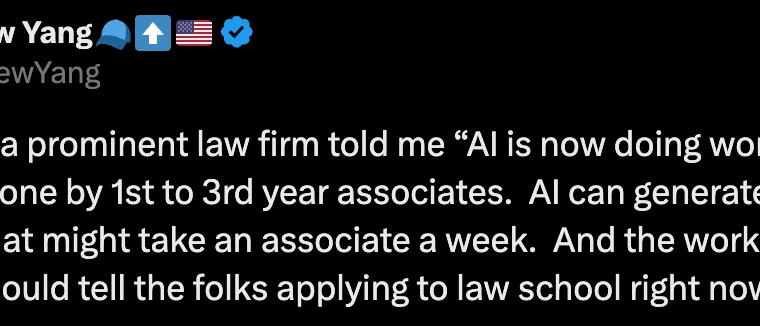
Yang
offered
a
bleak
assessment
of
the
future
of
the
profession
based
on
a
conversation
with
an
unnamed
Biglaw
partner.

No,
it’s
not.
No,
it
can’t.
No,
it’s
not.
And
of
the
million
reasons
to
second-guess
that
law
school
application,
this
is
none
of
them.

To
be
a
little
more
fair
to
the
unduly
credulous
Yang,
AI
might
be
doing

some

work
that
used
to
be
done
by
junior
associates,
but
most
of
that
sort
of
drudgery

the
proverbial
first-pass
review
in
a
Topeka
warehouse

had
already
been
outsourced
one
way
or
another
years
ago.
The
work
that
departed
in
favor
of
contract
attorneys
in
the
2000s
may
now
be
in
the
hands
of
an
algorithm,
but
that’s
not
what
this
Tweet
is
about.

First
of
all,
AI
doesn’t
“generate
a
motion
in
an
hour.”
If
you’re
just
looking
for
AI
to
do
the
job,
then
AI
can
produce
a
motion
in

minutes

as
long
as
you
don’t
care
how
much
the
firm
will
get
sanctioned.
AI
still
screws
up.
Often.
Most
of
the
work
involved
in
a
draft
motion
isn’t
generating
the
words,
it’s
making
sure
it’s
the
best
words.
If
a
motion
generated
by
AI
“in
an
hour”
is
better
than
what
a
junior
can
produce
in
a
week

it
won’t
be

it
probably
says
more
about
the
partner’s
warped
recollection
of
their
own
genius.

Professional
AI
solutions
absolutely
speed
up
the
workflow,
perhaps
helping
that
junior
associate
complete
a
non-embarrassing
first
draft
in
two
days
instead
of
a
week,
but
that’s
still
a
draft

the
junior
associate

prepares
even
if
the
AI
sped
up
the
process.

Which
puts
the
lie
to
the
claim
“And
the
work
is
better.”
The
work
is
still
a
junior
associate’s,
pushed
along
by
an
algorithm
spitting
out
filler
text
or
summarizing
the
statement
of
facts
or
producing
better
research
results
teased
out
of
the
natural
language
prompt.
If
the
partner
really
thinks
the
work
is
better,
that’s
not
the
AI’s
doing.
The
AI
is
busy
trying
to
shove

Mack
v.
Armstrong

into
the
brief

even
though
it
doesn’t
exist
.

So
students
shouldn’t
let
AI
become
the
reason
not
to
go
to
law
school.
Let

the
Trump
administration
making
it
prohibitively
expensive

do
that
work
for
you.

If
there’s
a
lesson
to
extract
from
the
last
few
AI
hallucination
scandals,
it’s
that
the
hallucination
problem
is

almost
always
a
partner’s
fault
.
It’s
the
partners
who
have
convinced
themselves
that
the
magic
chatbot
is
replacing
their
costly
associates
before
bonus
season.
The
associates
themselves
seem
to
understand
how
to
actually
use
AI
while
the
partners
keep
trying
to
lawyer
via
AI
about
as
well
as
they
could
explain
Italian
Brainrot
memes.
So
it’s
not
surprising
that
a
partner
claims

smittenly

that
some
vague
AI
can
“generate”
work
that’s
“better”
than
the
associates.

The
tech
bros
of
the
world
aren’t
helping,
perpetually
overpromising
on
what
this
tool
can
accomplish
in
their
mad
pursuit
of
VC
money.
It
makes
me
sound
like
I’m
down
on
AI,
which
is
not
true
at
all:
I
think
AI
is
a
revolutionary
technology
that

assuming
the
bubble
doesn’t
burst

will
accelerate
the
legal
workflow.
But
it’s
not
about
to
replace
associates
because
what
we
have
right
now
is

about
as
good
as
it’s
going
to
get
.
At
least
for
a
long
while.
And
then
only
if

the
bubble
doesn’t
burst
.

But
this
is
the
critical
distinction:
AI
does
not
in
any
way

replace

lawyer
jobs.

Whalers
were

replaced

by
electric
lightbulbs.1
Manual
typesetters
were

replaced

by
digital
printing.
AI
isn’t
replacing
associates,
it’s
a
tool
allowing
them
to
work
faster.
In
that
sense,
it’s
not
unlike
the
advent
of
online
research:
junior
associates
didn’t
disappear
because
they
didn’t
spend
half
their
day
running
back
and
forth
to
the
library…
they
just
did
more
research.

That
might
mean
the
industry
has
fewer
openings
for
new
lawyers.
If
junior
lawyers
do
their
jobs
twice
as
fast,
the
firm
needs
half
as
many
to
do
the
the
same
work.
While
the
distinction
may
not
be
much
comfort
to
the
law
grad
left
outside
looking
in,
it’s
important
because
jobs
lost
to
efficiency
come
back
when
there’s
more
work
to
be
done.
Indeed,
the
legal
industry
probably
will
get
bigger.
The
world
keeps
growing
in
size
and
complexity
and
that
means
more
legal
work
over
the
long
haul
and,
by
extension,
more
junior
associate
jobs
for
partners
to
systematically
devalue
by
pretending
AI
is
doing
everything.

No
one
is
picking
Captain
Ahab
up
off
the
unemployment
line.
I’d
say
he
should
learn
to
code,
but
AI
actually
might
replace
that.

[1]
Or
relocating
to
Carolina
in
1997.


HeadshotJoe
Patrice
 is
a
senior
editor
at
Above
the
Law
and
co-host
of

Thinking
Like
A
Lawyer
.
Feel
free
to email
any
tips,
questions,
or
comments.
Follow
him
on Twitter or

Bluesky

if
you’re
interested
in
law,
politics,
and
a
healthy
dose
of
college
sports
news.
Joe
also
serves
as
a

Managing
Director
at
RPN
Executive
Search
.

Hallucinations Here, Hallucinations There, Hallucinations Everywhere: Why Do Lawyers Keep Doing It? – Above the Law

The
story
is
all
too
familiar
by
now.
A
lawyer
uses
ChatGPT
to
draft
a
brief,
gets
back
a
polished
product
that
looks
professional
and
which
appears
to
cite
relevant
cases.
Only
problem?
The
cases
are
fabricated
or
don’t
stand
for
the
proposition
for
which
they
are
cited.
The
lawyer
then
gets
caught
and
called
out.

The
standard
uproar
commences.
Why
didn’t
they
just
read
the
cases?
Everybody
knows
you
have
to
read
every
case,
every
time.
Stupid,
lazy
lawyers.

But
maybe
we
ought
to
ask
why
this
keeps
happening,
especially
when
the
propensity
of
LLMs
to
make
these
kinds
of
mistakes
and
hallucinate
is
well
known.
As
is
the
need
to
read
cited
cases.


So,
What’s
Going
on
Here?

Certainly,
it
can’t
be
disputed
that
a
lawyer
filing
a
paper
with
the
court
needs
to
read
the
cases
and
make
sure
the
cites
are
correct.
But
a
number
of
factors
work
to
place
pressure
on
lawyers
and
legal
professionals
that
can
lead
and
tempt
them
to
not
do
what
they
are
supposed
to
do.
And
these
are
often
ignored
by
the
critics
who
just
say
read
the
cases
and
there
is
something
immoral
about
lawyers
who
don’t.
The
reality
on
the
ground
is
not
always
that
simple.

The
ability
of
LLMs
to
shortcut
work
is
having
its
impact
on
expectations
and
what
clients
will
pay
for
and,
in
turn,
even
what
senior
partners
may
demand
of
associates.
And
that
impact
may
lead
to
even
greater
hallucinations
and
inaccuracy
problems
down
the
road
if
they
go
unrecognized.


The
Traditional
Way
of
Working

As
I
previously
reported,
the
expected
work
process
for
such
things
as
legal
research
may
be
changing.
That
traditional
work
process
was
to
evaluate
the
problem
and
issues,
begin
to
read
cases,
then
read
cited
cases,
then
search
for
some
more
and
related
cases.
Then
refine
the
search
and
look
other
places.
Then
even
read
dissents.
Review
things
like
the
development
of
the
legal
theory
over
time.
Understand
context
and
nuance.
All
of
this
takes
time.
It’s
tedious.

But
with
LLMs,
this
work
can
be
short
circuited.
An
“answer”
can
be
found
in
seconds.
The
result?
Clients
may
take
a
dim
view
of
paying
for
the
old-fashioned
workflow
when
they
perceive
work
can
be
done
in
a
fraction
of
the
time.

But
in
doing
so,
the
nuance
and
context
is
lost.
It
becomes
easy
to
miss
something
that’s
not
quite
right.


Can
I
Bill
For
That?

Here’s
where
economics
makes
things
a
little
complicated.
It’s
easy
to
say
when
the
LLM
gives
you
some
case
cites
you
still
have
to
read
the
cases
in
detail,
right?
That’s
probably
true
in
a
perfect
world.
But
most
lawyers
live
in
a
billable
hour
world.
They
live
in
a
world
governed
by
not
just
the
number
of
hours
you
bill
but
what
portion
of
those
hours
can
be
collected.

So,
where
does
that
leave
you
as
an
associate
or
for
that
matter,
a
billing
partner?
What
if
the
client
won’t
pay
for
the
kind
of
studied
research
that
you
think
should
be
done?
You
have
billable
hour
quotas
to
meet. 
Your
advancement
and
compensation
depend
on
billables
and
collections.

If
you
do
the
extra
work
for
which
the
client
won’t
pay,
you
have
wasted
time
that
could
otherwise
be
spent
on
billable
and
collectable
time.
For
partners,
their
profitability
index
takes
a
hit.
For
associates,
what
happens
when
a
senior
partner
implicitly
(or
perhaps
explicitly)
says
we
can’t
bill
for
that,
so
don’t
do
it?


What
Is
Your
Duty
in
the
Age
of
AI?

And
exactly
what
is
the
extent
of
your
duty
to
check
citations
and
other
source
materials?
We
have
all
used
string
cites
to
support
some
clear
principles.
The
standard
for
summary
judgment
for
example:
in
pre-AI
days,
I
would
routinely
cite
cases
for
the
standard
I
pulled
from
someplace
without
reading
the
entire
case.
Or
I
might
cite
a
case
for
a
proposition
and
then
look
for
other
cases
that
stood
for
the
same
principle
without
perhaps
reading
those
cases
as
carefully
as
I
should
have.
And
now
in
the
time
of
GenAI,
I
would
be
faced
with
the
worry
that
the
work
I
perhaps
should
have
done
might
not
be
billable.

There
are
also
delegation
issues.
Let’s
say
I
ask
an
associate
or
paralegal
to
run
down
the
cite
and
they
either
use
GenAI
or
don’t
carefully
check
the
cases.
As
a
partner,
do
I
need
to
tell
them
to
do
work
that
may
be
necessary
but
may
not
be
billable
and
collectible?

What
happens
when
you
are
local
counsel
and
are
sent
a
pleading
to
sign
that
contains
cites
and
information?
Do
you
have
to
check
the
cites
even
though
it’s
doubtful
you
can
get
paid
for
it?

These
are
all
tough
questions
we
need
to
consider
as
the
tools
become
better,
and
their
use
becomes
more
demanded
and
expected.


It’s
So
Easy

Add
to
these
pressures
the
fact
that
using
these
tools
to
avoid
tedious,
time-consuming
tasks
is
so
easy
and
tempting.
Indeed,
I
suspect
most
attorney
errors
thus
far
have
stemmed
not
from
ignorance
of
the
risks,
but
because
the
tools
usually
work
well
and
require
no
technical
expertise.
You
don’t
need
IT
to
help.
You
don’t
need
to
consult
a
senior
partner.
You
don’t
have
to
read
cases
until
the
wee
hours.
Easy-peasy.
 And
that’s
a
danger.


What
Needs
to
Happen

I’m
certainly
not
saying
that
we
can’t
or
shouldn’t
check
citations.
But
we
do
need
to
recognize
the
potential
pressures
being
put
on
lawyers
by
clients,
coworkers,
and
partners.
We
need
to
recognize
danger
areas
and
be
sure
we
educate
everyone,
including
clients
looking
to
lower
legal
bills
by
insisting
on
GenAI
being
used
without
robust
checking.
Law
firms
need
to
make
clear
what
is
expected
when
some
of
the
work
can’t
be
billed
or
collected
but
is
nevertheless
necessary.
And
we
need
clear
standards
from
courts
and
bar
associations
on
what
our
duties
are.

It’s
a
brave
new
world.
Until
we
acknowledge
these
economic
realities
and
adjust
our
expectations
and
guidelines
to
ensure
hallucinations
aren’t
being
adopted,
we’ll
keep
seeing
more
headlines
about
“stupid,
lazy
lawyers”
while
missing
the
real
systemic
issues
at
play.


Stephen
Embry
is
a
lawyer,
speaker,
blogger,
and
writer.
He
publishes TechLaw
Crossroads
,
a
blog
devoted
to
the
examination
of
the
tension
between
technology,
the
law,
and
the
practice
of
law
.

Lawyers Getting Really High On AI Hallucinations – Above the Law

It
was
a
very
bad
week
for
lawyers
and
hallucinations.
A
federal
judge
had
to

withdraw
an
opinion
with
fake
cites
.
One
Biglaw
firm

fired
a
partner
over
an
invented
case
,
while
another
firm
got

tossed
off
a
case
over
AI
shenanigans
.
And
the
scribe
of
Ashurbanipal
got
mercilessly
trolled
by
a
judge
pointing
out
that
his
fake
AI
cite
apology
included…

another
fake
cite
.
Why
does
it
seem
like
this
is
all
getting
worse?
A
Biglaw
firm

pushes
its
start
date

leaving
incoming
associates
in
the
lurch
and
Alina
Habba

might

be
the
U.S.
Attorney
for
New
Jersey.
Or

maybe
not
.
Or

maybe
yes
.