It’s
pretty
hot
out
this
summer,
and
Biglaw
firms
think
they’ve
got
the
perfect
solution
for
beating
the
heat:
by
announcing
mandatory
office
attendance
policies.
Which
firm
is
the
latest
to
invite
attorneys
to
enjoy
their
supercool
office
air
conditioning
four
days
a
week?
It’s
Covington
&
Burling.
The
firm
—
which
brought
in
$1,747,129,000
gross
revenue
in
2024,
putting
it
at
No.
31
on
the
Am
Law
100
—
recently
decided
to
change
up
its
attendance
policy
to
mandate
four
days
spent
in
the
office
each
week,
including
those
working
in
its
London
office.
Law.com
has
some
additional
details,
including
a
late
summer
work
perk:
The
firm’s
lawyers
are
now
expected
to
be
in
the
office
Monday
through
Thursday,
but
can
work
remotely
on
Friday,
according
to
several
sources
with
knowledge
of
the
matter.
…
To
ease
the
shift,
the
firm
has
told
its
staff
that
they
can
have
up
to
two
weeks
working
remotely
in
August,
but
this
is
subject
to
applicable
policies
concerning
remote
working,
including
that
it
cannot
impact
availability.
Best
of
luck
to
everyone
at
Covington
as
they
adjust
to
their
new
lives,
which
will
be
mostly
spent
at
the
office.
As
soon
as
you
find
out
about
office
attendance
plans
at
your
firm,
please email
us (subject
line:
“[Firm
Name]
Office
Reopening”)
or
text
us
at
(646)
820-8477.
We
always
keep
our
sources
on
stories
anonymous.
There’s
no
need
to
send
a
memo
(if
one
exists)
using
your
firm
email
account;
your
personal
email
account
is
fine.
If
a
memo
has
been
circulated,
please
be
sure
to
include
it
as
proof;
we
like
to
post
complete
memos
as
a
service
to
our
readers.
You
can
take
a
photo
of
the
memo
and
attach
as
a
picture
if
you
are
worried
about
metadata
in
a
PDF
or
Word
file.
Thanks.
Staci
Zaretsky is
a
senior
editor
at
Above
the
Law,
where
she’s
worked
since
2011.
She’d
love
to
hear
from
you,
so
please
feel
free
to
email
her
with
any
tips,
questions,
comments,
or
critiques.
You
can
follow
her
on Bluesky, X/Twitter,
and Threads, or
connect
with
her
on LinkedIn.
Managing
client
funds
is
one
of
the
most
critical
responsibilities
a
law
firm
faces.
Mismanaging
trust
accounts
can
lead
to
ethics
violations,
financial
penalties,
or
even
disbarment.
That’s
why
a
thorough
understanding
of
trust
accounting
and
the
implementation
of
three-way
reconciliation
practices
are
non-negotiable.
In
this
post,
we’ll
walk
through
the
essential
three-way
reconciliation
process
and
explore
how
modern
legal
software
helps
law
firms
stay
compliant,
efficient,
and
audit-ready.
What
Is
Trust
Accounting?
Trust
accounting
refers
to
the
proper
management
of
funds
held
in
trust
on
behalf
of
a
client.
This
typically
occurs
when
a
law
firm
receives
an
advance
retainer
or
settlement
funds
that
don’t
yet
belong
to
the
firm.
These
funds
are
placed
into
a
separate
client
trust
account—often
referred
to
as
an
IOLTA
(Interest
on
Lawyers’
Trust
Accounts)
account.
The
cardinal
rule
of
trust
accounting
is
simple:
no
commingling.
Client
trust
funds
must
always
be
kept
separate
from
the
firm’s
operating
funds.
Any
earned
fees,
expense
reimbursements,
or
withdrawals
must
be
meticulously
documented
and
only
made
when
properly
invoiced
or
authorized.
To
ensure
compliance,
firms
are
expected
to
maintain
detailed
records
for
every
transaction,
including:
The
amount
received
The
client
associated
with
the
funds
The
purpose
of
the
deposit
The
dates
and
details
of
any
disbursements
Legal-specific
accounting
software
simplifies
this
process
by
automatically
categorizing
transactions
and
assigning
them
to
individual
client
ledgers.
Why
Trust
Accounting
Matters
The
stakes
for
getting
trust
accounting
wrong
are
high.
Many
state
bars
conduct
random
audits,
and
any
discrepancies
can
result
in
disciplinary
action.
According
to
the
2025
Legal
Industry
Report,
49%
of
firms
cite
trust
accounting
as
a
moderate
or
significant
challenge,
and
61%
report
challenges
with
accounting
overall.
The
complexity
and
compliance
burden
are
real,
especially
for
small
or
solo
practices
juggling
multiple
responsibilities.
The
good
news?
With
the
right
processes
and
tools
in
place,
firms
can
turn
trust
accounting
into
a
strength
rather
than
a
liability.
Three-Way
Reconciliation:
A
Monthly
Must
One
of
the
most
effective
ways
to
maintain
accurate
trust
accounting
is
through
three-way
reconciliation.
This
practice
ensures
the
law
firm’s
trust
records
are
accurate
and
aligned
with
actual
bank
balances.
It
involves
cross-checking
three
key
elements:
Trust
Account
Bank
Statement:
What
your
financial
institution
reports
Firm
Trust
Ledger:
The
internal
accounting
record
of
all
trust
activity
The
total
of
all
client
sub-ledgers
should
exactly
match
both
the
firm’s
trust
ledger
and
the
adjusted
bank
balance.
Any
discrepancies,
such
as
outstanding
checks
or
bank
fees,
must
be
identified
and
documented.
The
process
should
be
conducted
monthly,
though
some
jurisdictions
allow
quarterly
reconciliation.
It
should
also
be
accompanied
by
clear
documentation
and
sign-offs
to
satisfy
audit
requirements.
How
Software
Simplifies
Reconciliation
Traditionally,
three-way
reconciliation
was
handled
using
spreadsheets
and
manual
calculations,
a
process
that
is
both
time-consuming
and
error-prone.
Today,
legal
accounting
software
like
MyCase
can
automate
much
of
this
work.
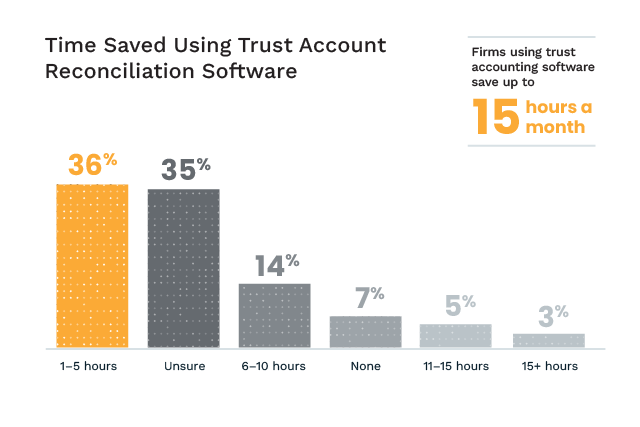
Data
from
the
2025
Legal
Industry
Report
found
that
firms
using
trust
accounting
software
save
up
to
15
hours
per
month.
Specifically,
36%
reported
saving
1
to
5
hours
monthly,
and
14%
saved
6
to
10
hours—a
powerful
endorsement
for
digital
tools
that
reduce
manual
entry
and
improve
compliance.
Best
Practices
for
Trust
Accounting
&
Reconciliation
To
ensure
your
firm
is
compliant
and
efficient,
follow
these
key
trust
accounting
best
practices:
Separate
Accounts:
Use
distinct
accounts
for
client
funds
and
operating
expenses.
For
large
or
long-term
matters,
consider
opening
separate
trust
accounts.
Document
Everything:
Always
include
a
memo
or
reference
for
each
deposit
or
withdrawal.
Save
receipts,
client
instructions,
and
invoices.
Reconcile
Monthly:
Even
if
not
required
in
your
jurisdiction,
monthly
reconciliation
is
a
best
practice
that
ensures
no
errors
go
unchecked.
Avoid
Bank
Fees:
Ensure
your
trust
account
agreement
does
not
specify
service
charges,
overdrafts,
or
bounced
check
fees.
Assign
Responsibility:
Delegate
trust
reconciliation
to
a
specific
person
(or
team),
and
require
dual
review
for
added
oversight.
Use
Legal-Specific
Software:
Platforms
like
MyCase
help
reduce
human
error,
streamline
workflows,
and
automatically
track
compliance
tasks.
Streamlining
Trust
Management
With
MyCase
Trust
accounting
can
feel
intimidating,
but
it
doesn’t
have
to
be.
By
understanding
the
basics,
embracing
three-way
reconciliation,
and
using
the
right
tools,
firms
can
build
trust
with
clients
and
regulators
alike.
With
software
like
MyCase,
your
firm
can
streamline
compliance,
reduce
risk,
and
save
hours
every
month,
so
you
can
focus
on
what
matters
most:
practicing
law.
Want
to
see
how
you
can
transform
your
trust
accounting
with
MyCase?
Schedule
a
demo
today.
Great
lawyers
have
an
intimate
relationship
with
words.
They
know
how
words
feel.
They
know
what
words
mean.
As
do
the
writers
at
Merriam-Webster.
That
is
why
when
someone
uses
a
word
incorrectly,
the
staffers
at
Merriam-Webster
take
it
upon
themselves
to
set
the
record
straight
on
word’s
behalf:
Another
important
word
to
remember
is
the
word
“retreat.”
Merriam-Webster
defines
retreat
as
“an
act
or
process
of
withdrawing
especially
from
what
is
difficult,
dangerous,
or
disagreeable”
and
“the
process
of
receding
from
a
position
or
state
attained.”
Keep
this
definition
in
mind
as
you
read
this
snippet
from
the
ABA
president’s
address
on
the
importance
of
diversity.
From
Bloomberg
Law:
The
American
Bar
Association
isn’t
“retreating”
from
diversity,
equity,
and
inclusion
in
the
face
of
the
Trump
administration’s
efforts
to
block
such
initiatives,
the
group’s
leader
told
a
Cleveland
audience
on
Tuesday.
“Bias
is
real,
and
we
have
to
confront
it,”
ABA
President
William
R.
Bay
said.
His
comments
at
a
City
Club
of
Cleveland
forum
came
after
the
group,
amid
pressure
from
the
White
House,
in
February
suspended
its
DEI
mandate
for
law
schools.
One
thing
the
ABA
definitely
isn’t
doing
is
advancing
(an
antonym
of
retreat)
DEI
causes
in
the
face
of
the
Trump
administration.
The
ABA
has
offered
diversity
truisms
like
“We
must
fight
for
what
we
believe
in”
and
is
fighting
to
regain
ground
after
the
administration
targeted
Biglaw
for
its
diversity
programs,
but
catching
up
to
where
things
were
is
not
an
advance.
We
should
hold
institutions
to
a
higher
standard
than
pretty
words
and
maintaining
the
status
quo
if
things
we
actually
value
are
under
attack.
Chris
Williams
became
a
social
media
manager
and
assistant
editor
for
Above
the
Law
in
June
2021.
Prior
to
joining
the
staff,
he
moonlighted
as
a
minor
Memelord™
in
the
Facebook
group Law
School
Memes
for
Edgy
T14s
.
He
endured
Missouri
long
enough
to
graduate
from
Washington
University
in
St.
Louis
School
of
Law.
He
is
a
former
boatbuilder
who
is
learning
to
swim, is
interested
in
critical
race
theory,
philosophy,
and
humor,
and
has
a
love
for
cycling
that
occasionally
annoys
his
peers.
You
can
reach
him
by
email
at [email protected]
and
by
tweet
at @WritesForRent.
Vault
recently
published
the
2026
edition
of
all
manner
of
its
closely
watched
rankings
for
the
largest
law
firms
in
the
country,
proving
that
money
—
in
the
form
of
Cravath’s
perennially
competitive
pay
scale
—
can
buy
prestige
and
(sometimes)
happiness.
But
what
about
the
nation’s
midsized
and
regional
firms?
Which
ones
are
the
best
to
work
for,
and
will
young
associates
be
happy
there
as
associates?
Today,
Vault
released
the
latest
edition
of
its
list
of
the
25
Best
Midsize
Law
Firms
to
Work
For.
Associates
at
firms
with
200
attorneys
or
fewer
were
asked
to
rank
their
own
law
firms
based
on
categories
most
relevant
to
their
overall
quality
of
life,
including
overall
satisfaction;
firm
culture;
hours;
compensation;
quality
of
work;
informal
training,
mentorship,
and
sponsorship;
business
outlook;
career
outlook;
associate/partner
relations;
leadership
transparency;
and
formal
training.
There
was
a
great
deal
of
movement
in
the
Top
10
this
year.
Which
firms
made
the
cut?
Without
any
further
ado,
here
are
the Top
10
Best
Midsize
Law
Firms
to
Work
For based
on
Vault’s
Annual
Associate
Survey
for
2026:
A
strong
performance
for
some
of
the
most
well-known
midsize
firms
in
the
country.
But
which
firms
took
the
spotlight
when
it
came
to
individual
Quality
of
Life
categories?
In
almost
a
clean
sweep,
Elsberg
Baker
&
Maruri
came
in
first
place
for
nearly
every
single
category.
Not
bad
for
a
firm
that’s
a
little
more
than
a
year
old.
Here
are
all
of
the
No.
1
firms
for
2026:
Congratulations
to
each
of
the
firms
that
made
the
latest
edition
of
the
Vault
Best
Midsize
Firms
to
Work
For
rankings,
and
a
huge
congratulations
to
Elsberg
Baker
&
Maruri
for
doing
so
well
in
the
rankings.
How
did
your
firm
do? Email
us,
text
us
at (646)
820-8477,
or
tweet
us @atlblog
to
let
us
know
how
you
feel.
Staci
Zaretsky is
a
senior
editor
at
Above
the
Law,
where
she’s
worked
since
2011.
She’d
love
to
hear
from
you,
so
please
feel
free
to
email
her
with
any
tips,
questions,
comments,
or
critiques.
You
can
follow
her
on Bluesky, X/Twitter,
and Threads, or
connect
with
her
on LinkedIn.
Ho
Chi
Minh
City
(or
“Saigon”
as
many
of
the
locals
still
call
it)
has
its
own
rhythms.
Walkable
in
a
way
that
doesn’t
exist
stateside,
an
American
can
stroll
for
hours
in
the
oppressive
afternoon
heat.
One
might
make
it
only
two
or
three
blocks
at
a
time,
drawn
in
to
a
local
bar
to
punctuate
each
short
jaunt
with
an
ice-cold
beer
that
can
be
had
for
the
equivalent
of
a
fistful
of
pennies.
The
non-suicidal
Westerner
will
necessarily
get
around
mostly
on
foot.
Vietnam
is
worth
visiting
for
the
traffic
alone.
The
streets
buzz
day
and
night
with
the
whine
of
little
100cc
and
125cc
motorcycles.
I
have
my
motorcycle
license
endorsement,
and
I
rode
bikes
–
mainly
big,
American-made
cruisers
–
for
a
decade.
I
wouldn’t
dare
to
enter
the
stream
of
traffic
in
Saigon
on
a
motorcycle.
As
a
pedestrian,
the
American
style
of
street-crossing
(to
wait
for
the
directions
of
a
traffic
light
or
to
pause
until
a
sufficient
gap
in
the
traffic
presents
itself)
is
a
nonoption.
This
would
lead
to
entire
lives
lived
on
street
corners.
Instead,
you
start
walking
—
never
dashing,
never
being
indecisive,
always
at
a
constant,
confident
pace
—
and
the
people
on
motorbikes
deftly
swerve
around
you.
You
marvel
at
the
ingenuity
of
what
gets
transported
on
motorcycles
that
a
single
average-sized
American
would
struggle
to
fit
onto.
A
family
of
four
is
de
rigueur.
Once
I
saw
a
man
speed
by
with
at
least
half
a
dozen
50-gallon
drums
lashed
together
and
impossibly
balanced
above
him.
I
witnessed
a
single
traffic
accident.
The
drivers
involved
shouted
and
gesticulated
wildly
at
one
another
for
a
minute,
as
their
cohorts
continued
to
swarm
around
them,
then
each
picked
up
his
motorbike
and
continued
on.
Four-wheeled
vehicles
are
not
unheard
of
in
Vietnam.
In
the
city,
I
crawled
along
in
one
slower
than
I
could
walk,
trapped
in
a
little
bubble
created
for
us
by
all
the
motorcycles.
Out
in
the
Mekong
Delta,
we
took
a
van
on
the
way
to
the
boats.
Though
this
van
did
have
its
own
Wi-Fi
that
seemed
to
work
just
fine
even
well
out
into
the
jungle,
it
was
a
practical,
utilitarian
affair,
far
from
the
luxuriant
family
minivans
with
built-in
touchscreens
that
we
are
used
to
in
the
United
States.
Individual
tastes
differ,
of
course,
but
I
think
it’s
fair
to
say
that
the
Vietnamese
generally
value
practicality,
affordability,
and
suitability
for
the
existing
traffic
culture
when
it
comes
to
their
vehicles.
It
is
an
absurd
fantasy
to
think
that
Vietnam
is
going
to
start
importing,
in
large
numbers,
huge,
expensive,
gas-guzzling
American-made
SUVs.
In
announcing
a
new
trade
deal
with
Vietnam,
President
Donald
Trump
said,
“It
is
my
opinion
that
the
SUV
or,
as
it
is
sometimes
referred
to,
Large
Engine
Vehicle,
which
does
so
well
in
the
United
States,
will
be
a
wonderful
addition
to
the
various
product
lines
within
Vietnam.”
Never
going
to
happen.
Even
with
no
trade
barriers
to
selling
our
big,
dumb
SUVs
in
Vietnam,
which
is
what
Trump
is
claiming
his
trade
deal
will
accomplish
(though
we
have
yet
to
see
any
details),
the
U.S.
is
not
going
to
move
a
lot
of
SUVs
there.
You’ll
find
somewhat
different
figures
depending
on
the
source,
but
the
equivalent
of
$697
per
month
seems
to
be
a
pretty
high-end
estimate
of
the
average
salary
in
Vietnam.
Meanwhile,
the
average
price
of
a
new
vehicle
in
the
U.S.
stands
at
about
$48,000.
You
can
do
the
math
on
that.
Trump
says
that
although
Vietnam
will
be
able
to
import
U.S.
goods
with
a
0%
tariff,
American
importers
will
pay
a
20%
tariff
on
Vietnamese
goods
(we
import
far
more
from
Vietnam
than
we
export
to
it).
There
will
also
be
a
40%
levy
on
shipments
from
third
countries
that
are
routed
through
Vietnam
(Trump
added
no
details
about
how
the
levy
on
trans-shipments
would
be
implemented
and
enforced).
President
Trump’s
new
trade
deal
will
not
lead
to
a
bonanza
of
American
SUV
sales
to
people
who
don’t
want
them
and
can’t
afford
them.
The
Vietnamese
are
already
building
better
and
far
cheaper
vehicles
on
their
own.
In
the
off
chance
that
I’m
wrong,
though,
get
there
before
America’s
bigger-is-better
vehicular
lunacy
ruins
Vietnamese
traffic
culture.
What
they
have
there
now
is
far
more
elegant,
in
its
own
way,
than
the
sprawling
mobile
status-symbol
parade
that
we
have
here.
Jonathan
Wolf
is
a
civil
litigator
and
author
of Your
Debt-Free
JD (affiliate
link).
He
has
taught
legal
writing,
written
for
a
wide
variety
of
publications,
and
made
it
both
his
business
and
his
pleasure
to
be
financially
and
scientifically
literate.
Any
views
he
expresses
are
probably
pure
gold,
but
are
nonetheless
solely
his
own
and
should
not
be
attributed
to
any
organization
with
which
he
is
affiliated.
He
wouldn’t
want
to
share
the
credit
anyway.
He
can
be
reached
at [email protected].
The
digital
health
world
showed
real
signs
of
market
traction
during
the
first
half
of
this
year,
with
startups
in
the
space
raising
$6.4
billion
in
venture
capital
funding,
according
to
a
report
released
by
Rock
Health
on
Monday.
Digital
health
startups’
funding
total
during
the
first
half
of
2025
is
slightly
more
than
the
$6.2
billion
and
$6
billion
that
these
startups
raised
in
the
first
halves
of
2023
and
2024,
respectively.
This
signals
a
steady
market
that
has
figured
out
what
its
new
normal
looks
like
following
a
pandemic-era
boom,
the
report
noted.
AI-focused
startups
captured
62%
of
all
digital
health
venture
funding
in
the
first
half
of
the
year,
raising
an
average
of
$34.4
million
per
round
—
which
is
an
83%
premium
over
these
startups’
non-AI
peers,
the
report
said.
Most
of
these
AI-first
companies
made
products
to
improve
clinical
workflows,
nonclinical
administrative
tasks
and
data
infrastructure.
Of
the
11
megadeals
—
fundraises
totaling
$100
million
or
more
—
that
were
closed
by
digital
health
startups
during
the
first
half
of
2025,
nine
were
raised
by
AI-focused
companies.
For
instance,
clinical
documentation
startup
Abridge
raised
$250
million
in
February
and
another
$300
million
in
June.
Other
AI
startups
including
Innovaccer,
Hippocratic
AI,
Qventus
and
Truveta
all
closed
rounds
larger
than
$100
million.
The
report
noted
that
providers
are
rapidly
adopting
some
of
these
tools,
too.
For
AI
tools
that
tackle
things
like
ambient
documentation
and
medical
reference
platforms,
some
hospitals
are
reporting
usage
rates
as
high
as
90%,
which
is
a
striking
shift
given
providers’
past
resistance
to
new
tech,
the
report
stated.
It
also
said
that
AI
startups
are
earning
providers’
trust
by
delivering
products
that
are
more
intuitive,
implementing
tools
more
seamlessly
into
the
existing
tech
infrastructure
and
generating
measurable
outcomes.
In
addition
to
the
billions
flowing
to
AI
vendors,
the
first
half
of
2025
also
featured
the
long-awaited
IPOs
of
Hinge
Health
and
Omada
Health
—
two
exits
that
many
felt
were
overdue,
following
years
of
stagnation.
The
report
pointed
out
that
these
companies
spent
over
a
decade
building
trust,
refining
their
care
models
and
deploying
AI
to
deliver
scalable
care.
The
public
debuts
of
Hinge
and
Omada
could
mark
the
beginning
of
a
more
mature
digital
health
market,
which
may
help
reignite
investor
confidence,
as
well
as
set
the
stage
for
future
exits
and
healthier
investment
cycles.
While
public
offerings
draw
headlines,
the
report
noted
that
most
digital
health
startups
are
exiting
through
M&A,
with
107
such
deals
in
the
first
half
of
2025
—
which
puts
the
year
on
pace
to
nearly
double
2024’s
total.
Private
equity
firms
are
also
fueling
consolidation
by
combining
legacy
healthcare
businesses
with
AI-native
startups.
They’re
betting
that
these
roll-ups
will
enable
greater
efficiency
and
scale,
according
to
the
report.
Amid
the
promising
exit
environment
and
increasingly
fast
pace
of
AI
adoption,
digital
health
companies
also
face
growing
policy
and
economic
uncertainty,
particularly
regarding
the
recent
passage
of
the
One
Big
Beautiful
Bill
Act.
The
bill’s
Medicaid
work
requirements
and
changes
to
ACA
marketplaces
could
leave
millions
of
people
uninsured,
shrinking
the
addressable
market
and
exacerbating
providers’
financial
strain.
To
navigate
these
shifts,
Rock
Health
encouraged
digital
health
startups
to
engage
early
with
federal
initiatives
and
try
to
align
with
priorities
like
chronic
disease
and
AI
in
care
delivery.
*
Musk
demanded
his
Grok
AI
be
less
liberal
and
it
started
calling
itself
MechaHitler.
Reminder,
Elon
is
suing
Media
Matters
for
suggesting
that
X
can
put
Nazi
content
next
to
advertiser
spots.
[Guardian]
*
Both
Goodwin
and
Eckert
Seamans
suffered
data
breaches
this
spring.
[American
Lawyer]
*
Eighth
Circuit
rules
that
your
cable
company
can
make
it
impossible
to
cancel.
For
freedom!
[Law360]
*
Supreme
Court
issues
another
non-opinion
striking
down
orders
blocking
Trump’s
planned
mass
layoffs
and
impoundment.
[National
Law
Journal]
*
DOJ
drops
case
against
Puerto
Rico
governor
after
she
pulled
an
Eric
Adams
and
publicly
declared
support
for
Trump.
[Bloomberg
Law
News]
Flash
Flood
Hits
Camp
Mystic:
We
send
our
condolences
to
the
impacted
families.
Meryl
Governski
Joins
Boutique
Firm:
Who
will
be
the
next
big
name
to
leave
Willkie?
Will
The
Next
Best
Supreme
Court
Advocate
Be
An
AI
Program?:
Adam
Unikowsky
thinks
that
AI
is
a
mean,
oral
argument
making
machine.
Are
You
Caught
Up
On
Free
Law
Project’s
Tools:
Every
federal
court
litigator
should
be!
It’s
Like
Walking
On
Eggshells:
Clearing
Biglaw
pro
bono
work
has
its
challenges
under
this
administration.
According
to
Above
the
Law’s
2025
Biglaw
Intimidation
Survey,
what
percentage
of
respondents
said
Biglaw
firms
signing
deals
with
the
Trump
administration
to
avoid
(unconstitutional) Executive
Orders
targeting
Biglaw
were
giving
into
extortion?
Hint:
As
one
respondent
said,
“Sure,
the
bottom
line
is
important,
but
so
is
legacy
and
longevity.
Don’t
be
on
the
wrong
side
of
history
here,
folks.”