Jordan Furlong’s TECHSHOW Keynote: The Lawyers Who Will Thrive In The New World Order Will Be Entrepreneurs – And Humans – Above the Law


Stay
on
the
streets
of
this
town


And
they’ll
be
carvin’
you
up,
alright


They
say
you
gotta
stay
hungry

“Dancing
in
the
Dark,”

Bruce
Springsteen
,
1984

Years
ago,
our
team
was
invited
to
take
part
in
a
“beauty
contest”
for
a
major,
national
piece
of
“bet
the
company”
litigation.
Our
competition
was
all
New
York
and
Chicago
Am
Law
50
law
firms.
Here
we
were,
a
small
player
in
a
small
venue
far
removed
from
where
the
case
was
filed.
Yet
we
got
the
work.

After
the
litigation
was
successfully
concluded,
I
asked
the
main
client
rep
why
we
got
picked.
He
shrugged
and
said,
“Well,
you
know
every
firm
we
met
with
was
competent.
But
if
we
had
to
be
in
a
foxhole
with
someone
for
a
few
years,
it
might
as
well
be
with
people
we
liked.
Which
was
you
guys.”

But
this
didn’t
happen
by
accident.
We
cultivated
that
client
for
a
long
time
before
the
litigation.
We
got
to
know
them.
We
spent
time
with
them.
Our
team
leader
made
it
a
point
to
pick
out
a
book
for
the
client
every
year
as
a
Christmas
present.
That
took
time
and
getting
to
know
the
client
well
enough
to
know
what
they
would
like
and
be
interested
in.

We
were
entrepreneurs:
we
worked
on
creating
both
trusted
and
collegial,
well-liked
relationships
with
our
clients
because
that
satisfied
the
needs
they
had.

I
was
thinking
about
that
very
client
when
I
listened
to

Jordan
Furlong
’s
remarkable
opening
keynote
at
ABA

TECHSHOW
.


The
Jordan
Furlong
Keynote
Thesis

According
to
Furlong,
in
the
AI-driven
future,
the
successful
lawyers
will
be
those
who
can
supply
sound
advice
to
clients,
who
will
be
their
advocate
through
thick
and
thin,
and
who
will
accompany
them,
being
with
them
through
every
step
of
the
matter.
In
short,
being
a
“human
lawyer”
whose
value
is
not
in
what
they
know
but
who
they
are
and
how
they
enhance
value
through
their
relationships.

In
short,
to
be
someone
they
like
and
trust
in
the
foxhole,
and
to
be
the
lawyer
they
know
has
their
back,
just
like
our
client
said.
But
this
isn’t
necessarily
new;
it’s
what
the
most
successful
lawyers
have
always
done.
And
always
will
do.
The
only
difference
is
that
in
the
future,
the
lawyers
who
don’t
do
this
may
find
it
tough
sledding.

To
understand
Furlong’s
thesis,
it’s
important
to
look
at
his
analysis
and
then
how
we
get
young
lawyers
where
they
may
need
to
be.


What
Hath
AI
Wrought?

Furlong
identified
three
long-term
“gains”
to
the
legal
profession
that
AI
will
bring.
First,
legal
services
in
the
age
of
AI
will
be
commoditized.
It
will
no
longer
be
enough
to
be
able
to
“think
like
a
lawyer”
because
that
ability
will
be
on
every
device.
As
a
result,
legal
services
will
expand
and
cost
decline.

Second,
legal
products
and
services
will
become
mechanized.
The
amount
of
work
a
human
lawyer
can
do
will
no
longer
limit
what
can
be
provided.
AI
will
fill
the
gap.
Again,
more
services
can
and
will
be
delivered
at
lower
costs.

The
third
“gain”
identified 
by
Furlong
is
the
reconfiguration
of
law
firms.
According
to
Furlong,
law
firms
“will
become
professional
businesses
that
will
also
feature
lawyers,”
instead
of
being
lawyer
centered.
This
will
help
those
who
need
service
to
get
it
faster
and,
again,
at
less
cost.

But
there
is
a
catch,
says
Furlong.
The
“gains”
will
not
necessarily
inure
to
the
lawyers
of
today.
Instead,
the
benefits
will
go
to
those
who
need
the
services.
And
that
scares
lawyers
to
death.

Furlong
believes
GenAI
will
dramatically
change
the
legal
profession
and
move
lawyers
away
from
their
traditional
roles
of
being
“task
performers
and
overseers,”
which
is
how
so
many
perceive
themselves.
Instead,
as
pointed
out
above,
the
future
lawyers
will
be
the
human
lawyers
who
thrive
on
building
and
maintaining
relationships.


Training
the
Next
Generation
of
“Human”
Lawyers

It’s
tempting
to
say
that
this
idea
is
not
new.
Afterall,
it
was
a
formula
our
team
and
I
followed.
But
it
does
beg
the
question,
says
Furlong,
of
how
we
get
the
next
generation
of
lawyers
to
become
the
kind
of
lawyers
who
are
able
to
provide
that
kind
of
value.
It’s
a
question
I
and
others
have
been

struggling
with
.

Traditional
law
firms
supplied
the
training
to
young
lawyers
on
how
to
be
lawyers
and
serve
clients.
Furlong
noted
that
firms
were
happy
to
provide
that
kind
of
training
since
they
were
able
to
bill
the
training
time
of
the
associates
to
clients
and
enhance
profit.
That,
according
to
Furlong,
is
about
to
change
as
GenAI
takes
over
more
and
more
the
tasks
typically
done
by
associates
and
by
which
they
learned.

In
the
future,
Furlong
believes
that
training
will
need
to
be
provided
by
first
assembling
a
competence
profile
and
defining
what
it
means
to
be
a
good
lawyer,
a
subject
I

have
discussed
.
Secondly,
firms
will
need
to
create
a
learning
environment
like
that
in
teaching
hospitals
through
more
robust
mentorships,
an
idea
I
have
also
mentioned.

Finally,
the
profession
will
need
to
provide
a
mechanism
by
which
readiness
can
be
assessed;
performance
standards
that
need
to
be
met.
Not
a
bar
exam
but
real
standards
about
what
it
means
to
serve
clients.

I
agree
with
Furlong
on
almost
all
of
these
points.
But
there
is
something
more
we
need
to
teach
young
lawyers
if
we
want
them
to
be
that
kind
of
human
lawyer
Furlong
envisions
and
clients
want
to
be
in
a
foxhole
with.
It’s
the
spirit
of
entrepreneurship
that
drove
our
team
to
form
the
kind
of
relationship
with
our
client
that
got
us
big
cases.
It
was
the
spirit
that
drove
my
partner
to
take
the
time
to
pick
out
special
books
as
Christmas
gifts
every
year.

When
I
meet
with
law
students,
the
first
thing
I
tell
them
about
the
successful
practice
of
law
is
to
think
of
yourself
as
an
entrepreneur,
no
matter
if
you
are
going
to
practice
as
a
solo
or
in
an
Am
Law
100
firm.
I
didn’t
become
a
mass
tort
defense
lawyer
by
osmosis.
I
defined
it
as
an
area
in
which
I
wanted
to
practice
and
then
became
an
entrepreneur
to
get
there.
I
found
a
mentor
in
the
area,
sunk
my
fangs
in
his
ankle,
and
hung
on
for
dear
life.
I’m
not
sure
he
wanted
the
role,
but
I
made
damned
sure
he
wasn’t
getting
out
of
it.

I
saw
how
he
cultivated
clients.
I
saw
how
he
won
their
trust.
He
was
Furlong’s
proverbial
human
lawyer.
And
by
hard
work
and
some
good
luck,
I
like
to
think
I
became
one
too.


How
Do
We
Get
There?

I
agree
we
need
to
make
more
of
the
human
lawyers.
But
I
don’t
think
just
saying
that,
defining
what
that
is,
setting
standards,
and
assessing
performance
will
get
us
there.
What
we
first
need
to
impart
is
the
need
to
do
what
my
mentor
and
our
team
did.
To
instill
that
spirit
of
entrepreneurship
in
young
lawyers.
Entrepreneurs
who
don’t
become
successful
by
mastering
a
subject
but
by
seeing
the
needs
of
others
and
doggedly
pursuing
a
solution
to
satisfy
those
needs.

I
believe
Furlong
is
absolutely
right
that
the
lawyers
who
will
succeed
in
the
future
will
be
masters
of
relationships
and
cultivate
trust
and
confidence.
I
believe
this
because
that
is
exactly
what
has
set
the
really
successful
lawyers
apart
from
those
that
merely
push
paper
and
bill
hours,
at
least
throughout
my
career.

But
that
suggests
a
final
reality.
Not
every
lawyer
had
that
desire
and
spirit
in
the
past
and,
no
matter
how
hard
we
try,
not
everyone
will
have
it
in
the
future.
Like
everything
else,
there
will
be
those
who
get
it
and
there
will
be
those
who
either
can’t
or
don’t.

But
given
that
GenAI
will

inevitably
mean

less
need
for
lawyers,
it’s
all
the
more
reason
to
look
at
why
clients
have
always
trusted
successful
lawyers
and
wanted
to
work
with
them.
It’s
all
the
more
reason
to
impart
that
need
and
skills
to
do
so.
And
it
all
starts
with
cultivating
the
notion
of
entrepreneurship
in
our
younger
lawyers.
The
spirit
of
staying
hungry.

Want
to
be
a
successful
lawyer
in
the
future?
Listen
to
Jordan
Furlong.
And
be
an
entrepreneur.


Stephen
Embry
is
a
lawyer,
speaker,
blogger,
and
writer.
He
publishes TechLaw
Crossroads
,
a
blog
devoted
to
the
examination
of
the
tension
between
technology,
the
law,
and
the
practice
of
law
.

Legal Ethics Roundup: Lawyer Court Selfie Sanction, J&J Conflict Disqualification, House Rep Ethics Violations, Alito/Gorsuch Recusals, Fiery Judicial Opinions, LSB’s New Ethics Hierarchy & More – Above the Law


Ed.
note
:
Please
welcome
Renee
Knake
Jefferson
back
to
the
pages
of
Above
the
Law.
Subscribe
to
her
Substack,
Legal
Ethics
Roundup, here.


Welcome
to
what
captivates,
haunts,
inspires,
and
surprises
me
every
week
in
the
world
of
legal
ethics.

Hi
from
Denver,
where
I
am
attending
the National
Conference
on
Trusteeship
 hosted
by
the Association
of
Governing
Boards
of
Universities
and
Colleges
 (AGB).
It’s
not
a
typical
destination
for
legal
ethicists—pretty
sure
I’m
the
only
one
in
attendance—but
many
of
the
panels
and
presentations
intersect
with
themes
from
my
scholarship
like
the
ethical
obligations
of
institutions
and
their
leaders.
(I’m
here
in
my
capacity
as
the
Vice
Chair
of
the
Michigan
State
University
Board
of
Trustees.)
One
highlight
was
a
talk
by David
Rabban
 (Texas)
about
his
book Academic
Freedom:
From
Professional
Norm
to
First
Amendment
Right
.
It
was
especially
wonderful
to
finally
meet Jackie
Gardina 
in
person.
Back
in
early
2024,
she
interviewed
me
on
her podcast
Side
Bar
 with Mitchel
Winick
 about
my
book Law
Democratized:
A
Blueprint
for
Access
to
Justice
.
At
the
time
she
served
as
Dean
of
the
Colleges
of
Law
(Santa
Barbara
and
Ventura)
and
she
now
is
the
Senior
Director
of
Institution
and
System
Programs
at
AGB.


Denver
at
Sunset
(photo
by
Renee
Jefferson)

As
mentioned
last
week
,
PrawfsBlawg
has
been
hosting
an online
symposium
 about
a
new
book
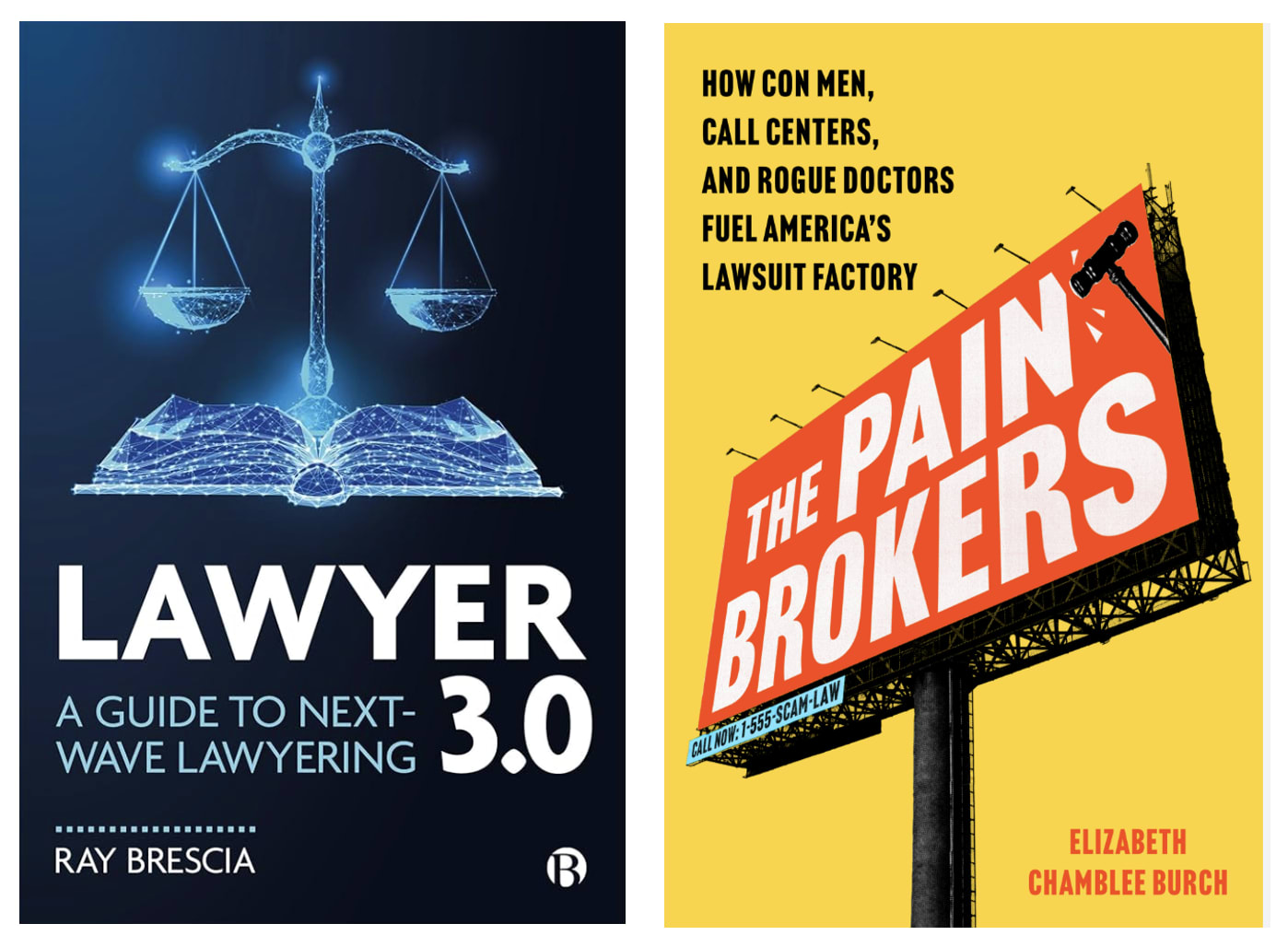
by Elizabeth
Burch
 (Georgia), The
Pain
Brokers:
How
Con
Men,
Call
Centers,
and
Rogue
Doctors
Fuel
America’s
Law
Suit
Factory
.
Other
contributors
include Brooke
Coleman
 (Seattle), Miriam
Giles
 (Northwestern), Tony
Sebok
 (Cardozo), Howard
Wasserman
 (FIU),
and Brad
Wendel
 (Cornell).
My
post
goes
live
today,
and
Burch
gets
the
final
word
later
this
week.
And
if
you
missed
last
Wednesday’s
event
hosted
by Hofstra
Law’s
 Monroe
H.
Freedman
Center
for
the
Study
of
Legal
Ethics
and
Fordham
Law’s
Stein
Center
for
Law
and
Ethics
 where
I
spoke
about
the
new
book
from Ray
Brescia
 (Albany) Lawyer
3.0:
A
Guide
to
Next-Wave
Lawyering
,
a
recording
should
soon
be available.


Now
for
the
headlines.

Highlights
from
Last
Week

Top
Ten
Headlines


#1
“Some
Judges
See
Risks
in
Fiery
Opinions
Warning
of
Threats
to
Democracy.” 
From
the New
York
Times: 
“Judges
are
turning
up
the
volume.
One compared
her
district’s
ballooning
caseload
 to
a
demigod’s
battle
against
a
mythological
monster.
Another sought
to
buttress
 his
argument
against
National
Guard
deployments
to
U.S.
cities
with
a
YouTube
link
to
a
1970
protest
song.
third
compared
 the
Trump
administration’s
rewriting
of
American
history
to
the
Ministry
of
Truth
in
George
Orwell’s
novel
‘1984.’
More
and
more
federal
judges
have
been
setting
aside
their
profession’s
traditional,
restrained
style
of
opinion
writing
in
favor
of
an
emotive,
populist
approach,
giving
full
vent
to
the
intensity
of
their
concerns
about
cases
flooding
their
dockets
since
President
Trump
returned
to
office.”
Read
more here (gift
link).


#2
“Johnson
&
Johnson
Gets
Beasley
Allen
Tossed
From
Talc
Cases.” 
From Bloomberg
Law: 
“Beasley
Allen,
one
of
the
leading
trial
firms
taking
on
Johnson
&
Johnson
in
the
sprawling
multi-district
talc
litigation,
has
been
disqualified
by
a
federal
court.
Thursday’s
ruling
from
a
New
Jersey
federal
magistrate
judge
removes
the
Alabama-based
firm
from
the
litigation,
in
which
customers
claim
J&J
talc
products
are
responsible
for
their
ovarian
cancer.
The
decision
sprang
from
a
request
from
J&J
after
Beasley
Allen
met
with
a
former
lawyer
for
the
medical
products
company
in
a
mediation
which
the
company
said
was
tantamount
to
a
lawyer
switching
sides.
Beasley
Allen
was
disqualified
from
hundreds
of
New
Jersey-based
state
court
cases
in
February.
‘Disqualification
is
a
remedy
courts
are
not
quick
to
administer,’ US
District
Court
for
the
District
of
New
Jersey
Magistrate
Judge
Rukhsanah
L.
Singh
 said
in
her opinion.
‘Yet,
there
are
moments
when
it
is
necessary
when
balancing
the
equities
and
interests.
This
is
such
a
moment.’”
Read
more here.


#3
“Neil
Gorsuch
and
Samuel
Alito
Sit
Out
Supreme
Court
Cases.” 
From Newsweek: Supreme
Court
Justices
Neil
Gorsuch
 and Samuel
Alito
 did
not
participate
in
the
decision
making
of
two
different
cases
and
while
it
may
be
known
why
Alito
decided
to
recuse
himself,
it’s
less
clear
the
reasoning
behind
Gorsuch’s
decision.
Supreme
Court
justices,
who
aren’t
required
to
explain
why
they’re
sitting
out
of
a
case,
tend
to
sit
them
out
when
there’s
a
conflict
of
interest.
That
could
be
because
of
a
financial
stake
in
the
case
through
stocks
they
own,
a
personal
relationship
or
that
they
were
involved
in
the
case
as
a
judge
before
they
joined
the
court.”
Read
more here.


#4
“House
Panel
Finds
Florida
Democrat
Guilty
of
Ethics
Violations.” 
From NPR: “The
House
Ethics
Committee has
found
‘clear
and
convincing
evidence’
that Rep.
Sheila
Cherfilus-McCormick
 violated
House
rules,
after
a
rare
marathon
public
hearing
Thursday
night.
The
Florida
Democrat
[and
lawyer]
was indicted
in
November
over
allegations
she
stole
$5
million
in
disaster
relief
funds
 and
used
it
to
bankroll
her
2021
special
election
campaign.
Federal
prosecutors
allege
she
funneled
money
to
support
her
campaign
using
FEMA
overpayments
distributed
to
Trinity
Healthcare
services,
her
family’s
company.
She
pleaded
not
guilty.
‘After
careful
deliberation
that
lasted
until
well
past
midnight,
the
adjudicatory
subcommittee
found
that
Counts
1-15
and
17-26
of
the
SAV
[Statement
of
Alleged
Violations]
had
been
proven,’
a
committee statement read.
Cherfilus-McCormick
has
repeatedly
denied
any
wrongdoing.
‘I
look
forward
to
proving
my
innocence,’
she
said
in
a
statement
to
NPR
Friday
morning.”
Read
more here.


#5
“Sexual
Misconduct
Report
Leaves
I.C.C.’s
Path
Ahead
Unclear.” 
From
the New
York
Times: 
“In
a
report
obtained
by
The
New
York
Times,
a
panel
of
judges
found
that
evidence
of
sexual
misconduct
by
the
chief
prosecutor
of
the
International
Criminal
Court
left
room
for
‘reasonable
doubt.’”
Read
more here (gift
link).


#6
“Attorney
at
Social
Media
Addiction
Trial
Takes
Selfie,
Receives
$1,100
Sanction.” 
From
the ABA
Journal: 
“A
plaintiffs
lawyer
recently
received
a
$1,100
sanction
for
taking
a
selfie
and
conducting
a
Zoom
interview
from
inside
the
Los
Angeles
Superior
Court
during
the
first
trial
alleging
that
Meta
Platforms
and
YouTube
caused
addictions
in
adolescents.”
Read
more here.


#7
“98-Year-Old
US
Judge
Loses
Another
Challenge
to
Her
Suspension.” 
From Reuters: “The
federal
court
system’s
governing
body
on
Tuesday
rejected
​another
bid
by U.S.
Circuit
Judge
Pauline
Newman
,
who
at
‌98
years
old
is
the
oldest
active
federal
judge,
to
overturn
her
ongoing
suspension
from
the
U.S.
Court
of
Appeals
for
the
Federal
Circuit.
​The
Judicial
Conference
of
the
United
States’
Committee
on
Judicial
​Conduct
and
Disability
upheld
the
Federal
Circuit’s
decision
from
⁠last
year
to
extend
Newman’s
suspension
after
she
allegedly
stonewalled
her
court’s
​investigation
into
her
fitness
to
serve.”
Read
more here.


#8
“Nome
Judge
Will
Resign
Following
Lengthy
Investigation
Into
Misconduct
Allegations
.” From
the Anchorage
Daily
News: 
Nome
Superior
Court
Judge
Romano
DiBenedetto
 will
resign,
effective
April
1,
a
spokesperson
for
the
Alaska
Court
System
said
Friday.
A
year
ago,
the
Alaska
Court
System
placed
DiBenedetto
on
leave
after
court
staff
reported
behavior
including
incidents
when
the
judge
used
offensive
accents
to
impersonate
people
from
other
ethnic
groups
and
kept
a
courtroom
of
people
waiting
while
he
watched
a
sports
game
on
TV.
In
February,
after
a
lengthy
investigation,
the
Alaska
Commission
on
Judicial
Conduct recommended
that
DiBenedetto
 receive
a
reprimand
from
the
Alaska
Supreme
Court,
which
has
ultimate
authority
over
discipline
for
judges.
The
recommendation
stopped
short
of
advising
that
DiBenedetto
face
a
harsher
punishment,
such
as
being
removed
from
the
bench.”
Read
more here.


#9
“LSB
Introduces
Hierarchy
in
Lawyers’
Ethical
Duties.” 
From LegalFutures
(UK): 
“New
requirements
to
strengthen
ethical
standards
now
expressly
state
that
lawyers
must
place
their
duties
to
the
court,
and
to
act
with
independence
and
integrity,
above
the
duty
to
act
in
the
best
interests
of
their
client,
where
they
conflict.
The
Legal
Services
Board’s
statutory
statement
of
policy
on
upholding
professional
ethical
duties
also
makes
clear
that
they
apply
to
all
staff
working
within
law
firms
and
not
just
authorised
lawyers.
The statement
of
policy
,
published
today after
consultation
,
sets
out
a
definition
of
‘professional
ethical
duties.”
Read
more here.


#10
“Honing
Legal
Judgment:
How
Professional
Acumen
&
Fiduciary
Care
Can
Keep
Lawyers
Relevant
in
the
Age
of
AI.” 
From Thompson
Reuters: 
“The
special
relevance
of
lawyers
in
the
age
of
AI
is
the
profession’s
enduring
value
around
the
unique
human
capacity
for
independent
judgment,
fiduciary
care,
and
preserving
the
law’s
connection
to
justice
and
human
dignity.”
Read
more here.

Get
Hired

Did
you
miss
the
450+
job
postings
from
previous
weeks?
Find
them
all here.


Upcoming
Ethics
Events
&
Other
Announcements
️

Did
you
miss
an
announcement
from
previous
weeks?
Find
them
all here.


Keep
in
Touch


Do
you
have
colleagues
who
care
about
legal
ethics?
 Please
share
the
Roundup
with
them.
I’d
love
to
see
our
community
continue
to
grow!


News
tips?
Announcements?
Events?
 A
job
to
post?
 Reading
recommendations?
 Email

[email protected]


but
be
sure
to
subscribe
first,
otherwise
the
email
won’t
be
delivered.


Renee
Knake
Jefferson
holds
the
endowed
Doherty
Chair
in
Legal
Ethics
and
is
a
Professor
of
Law
at
the
University
of
Houston.
Check
out
more
of
her
writing
at
the Legal
Ethics
Roundup
.
Find
her
on
X
(formerly
Twitter)
at @reneeknake or
Bluesky
at legalethics.bsky.social

Biglaw Firms Are Starting To Get ‘Nervous’ About Deal Work Inventory – Above the Law


Ed.
note
:
Welcome
to
our
daily
feature, Quote
of
the
Day
.


There’s
more
warning
signs
popping
up,
even
on
the
strategic
side
.


Virtually
every
managing
partner
I
know
[is]
more
careful
about
predicting
how
well
their
firm
is
going
to
do
this
year.


— 
Blane
Prescott,
law
firm
management
consultant
at
MesaFive, in
comments
given
to
the

American
Lawyer
,
concerning
deal
work
inventory
this
year,
and
the
lack
thereof
for
certain
firms.
Compared
to
this
time
last
year,
some
law
firms
are
“suddenly
see
their
workloads
getting
a
little
lighter,”
he
said,
“and
that’s
started
to
make
them
nervous.”


Staci
Zaretsky
 is
the
managing
editor
of
Above
the
Law,
where
she’s
worked
since
2011.
She’d
love
to
hear
from
you,
so
please
feel
free
to email her
with
any
tips,
questions,
comments,
or
critiques.
You
can
follow
her
on BlueskyX/Twitter,
and Threads, or
connect
with
her
on LinkedIn.

Trump Officials Downplay Guilt By Association, Cite White Supremacists As Authorities In Birthright Case – Above the Law

Complicit
is
a
fun
word.
It
comes
from
the
Latin
word
complicare,
which
means
to
fold
together.
Trump’s
presidential
runs
have
been
folded
together
with
the
Confederacy

in
some
pretty
obvious
ways

that
folks,
for
the
sake
of
staying
in
good
social
graces,
have
done
their
best
to
obscure.
“Yes,

Donald
Trump
was
endorsed
by
David
Duke
,
but
that’s
not
why
I’m
voting
for
him:
I
just
care
about
the
economy.”
But
others
make
it
harder
to
be
subtly
complicit:
a
Trump-appointed
judge
gave
top
marks
to
a
student
who
penned
a
White
supremacist
Con
Law
paper
that
regurgitated
Klan
theories
on
what
the
“we”
in
“We
The
People”
actually
meant.
It
was
taken
to
task
for
being
on
the
fringe
and
a
bad
reading
of
history,
but

I
argued
that
its
ultimate
conclusions
aren’t
really
that
far
off
from
contemporary
Conservative
politics


rising
ICE
death
tolls,

Texan
murder-buoys
,
and

voter
suppression

are
culling
tactics
that
whiten
the
national
We.

The
Trump
Administration’s
confederate
complicity
comes
to
the
fore
again
as
they
try
to
gut
birthright
citizenship.
The

Washington
Post

has
coverage:

Alexander
Porter
Morse,
a
Confederate
officer
during
the
Civil
War
and
a
Louisiana
attorney,
argued
for
legalized
segregation
in
the
landmark
1896
Supreme
Court
case
that
established
the
“separate
but
equal”
doctrine
and
buttressed
Jim
Crow
laws.

He
is
again
playing
a
key
role
in
a
monumental
case
to
be
argued
before
the
justices
Wednesday:
The
Trump
administration
has
tapped
Morse
as
an
authority
in
its
push
to
upend
long-settled
law
that
virtually
everyone
born
in
the
United
States
is
a
citizen.

The
administration
is
citing
arguments
“built
on
a
racist
foundation,”
Justin
Sadowsky,
an
attorney
for
the
Chinese
American
Legal
Defense
Alliance
(CALDA),
wrote
in
a
friend-of-the-court
brief.

When
pressed,
the
administration
responded
with
a
red
herring:

When
asked
for
comment
about
relying
on
Morse
and
his
compatriots,
the
Trump
administration
pointed
to
a
brief
in
which
it
wrote
“this
Court
has
repeatedly
cited
their
work
in
other
contexts.”

Nice
bait-and-switch,
but
we
aren’t
focused
on
the
times
Morse

didn’t

make
racist
arguments,
we
focused
on
the
times
he
1)

did

and
2)
that
you
are
using

those

to
support
your
position.
People
contain
multitudes.
There
might
be
a
journal
or
two
where
a
certain
Austrian
gives
good
advice
on
brush
strokes
and
attention
to
line
work
in
panting.
But
people
would
be
understandably
concerned
if
I
started
looking
to
his
political
writings
for
inspiration.
The
Post
points
out
that
there
were
prominent
politicians
who
“did
not
have
racist
views”
that
had
similar
views.
If
that
is
true,
why
not
cite
them
and
avoid
the
whole
Morse
drama?
The
signaling
has
to
be
part
of
the
point.

The
government’s
legal
theory
is
that
the
citizenship
clause
should
not
vest
citizenship
in
anyone
born
to
parents
here
illegally
or
on
temporary
visas.
The
argument
isn’t

inherently

racist.
As
a
matter
of
governmentality,
determining
who
gets
citizenship
and
why
is
an
open
question
that
states
have
answered
in
different
ways.
There’s
relative
uniformity
in
the
Americas,
but

you
start
seeing
requirements
for
citizenship
once
you
cross
the
Atlantic
.
But
as
a
matter
of
history,
it
isn’t
a
coincidence
that
there
was
a
racial
animus
to
arguing
against
birthright
citizenship
then
and
now.


Trump
Officials
Cite
White
Supremacists
In
Bid
To
End
Birthright
Citizenship

[The
Washington
Post]


Earlier
:

Trump
Judge
Gives
Nazi-Sympathizing
Law
Student
High
Marks
For
Rehashing
Klan
Legal
Theory
Calling
For
Minority
Disenfranchisement
And
Murdering
Immigrants


Chris
Williams
became
a
social
media
manager
and
assistant
editor
for
Above
the
Law
in
June
2021.
Prior
to
joining
the
staff,
he
moonlighted
as
a
minor
Memelord™
in
the
Facebook
group Law
School
Memes
for
Edgy
T14s
.
 He
endured
Missouri
long
enough
to
graduate
from
Washington
University
in
St.
Louis
School
of
Law.
He
is
a
former
boat
builder
who
is
learning
to
swim
and
is
interested
in
rhetoric,
Spinozists
and
humor.
Getting
back
in
to
cycling
wouldn’t
hurt
either.
You
can
reach
him
by
email
at 
[email protected]
and
by
tweet
at @WritesForRent.

Has Legal Industry Upheaval Changed Your Career Goals?  – Above the Law

As
AI
and
other
factors

drive


uncertainty


for


law


firms
,
we’re
looking
to
our
readers
to
weigh
in
on
their
own
career
goals. 

Does
the
risk
of
“cognitive
offloading”
alter
your
plans
for
AI
adoption?
Does
working
from
the
office
appeal
to
you
more
than
it
did
last
year?
Are
law
schools
and
law
firms
doing
enough
to
develop
the
necessary
skills
for
young
lawyers
to
succeed? 

Please
take
this
(always)
brief
and
anonymous
survey
to
help
us
benchmark
the
industry
in
2026.
We’ll
be
sharing
the
results
in
a
report
later
this
year,
and
respondents
will
have
a
chance
to
receive
a
$250
gift
card. 


Dems Scold Trump For Not Stealing Money Sooner – Above the Law

(Photo
by
MANDEL
NGAN/AFP
via
Getty
Images)

As
the
DHS
funding
lapse
drags
on,
American
airports
are
buckling.
TSA
agents
haven’t
been
paid
for
six
weeks
and
are
calling
out
sick
in
record
numbers

some
airports
have
more
than
a
third
of
staff
MIA,
and
more
than
500
TSA
agents
have
quit
altogether.
This
weekend
saw
hours-long
security
lines,
with
travelers
arriving
four
hours
early
and
still
missing
their
flights.

Trump’s
first
brain
wave
was
to
send
in
ICE
agents,
who

are

getting
paid.
Turns
out
a
squad
of
untrained
thugs
whose
main
job
is
civil
rights
violations
weren’t
much
help.
Senate
Republicans
begged
him
to
sign
a
partial
DHS
bill
that
would
have
funded
TSA
but
not
ICE
and
CBP,
but
he
insisted
that
they
ought
to
kill
the
filibuster
instead.

And
so
President
Fire
Alarm
did
what
he
always
does:
Shout
“EMERGENCY!”
and
then
claim
the
power
to
break
the
law.

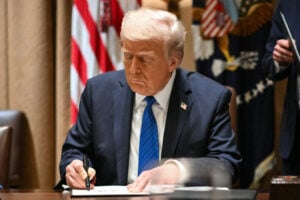
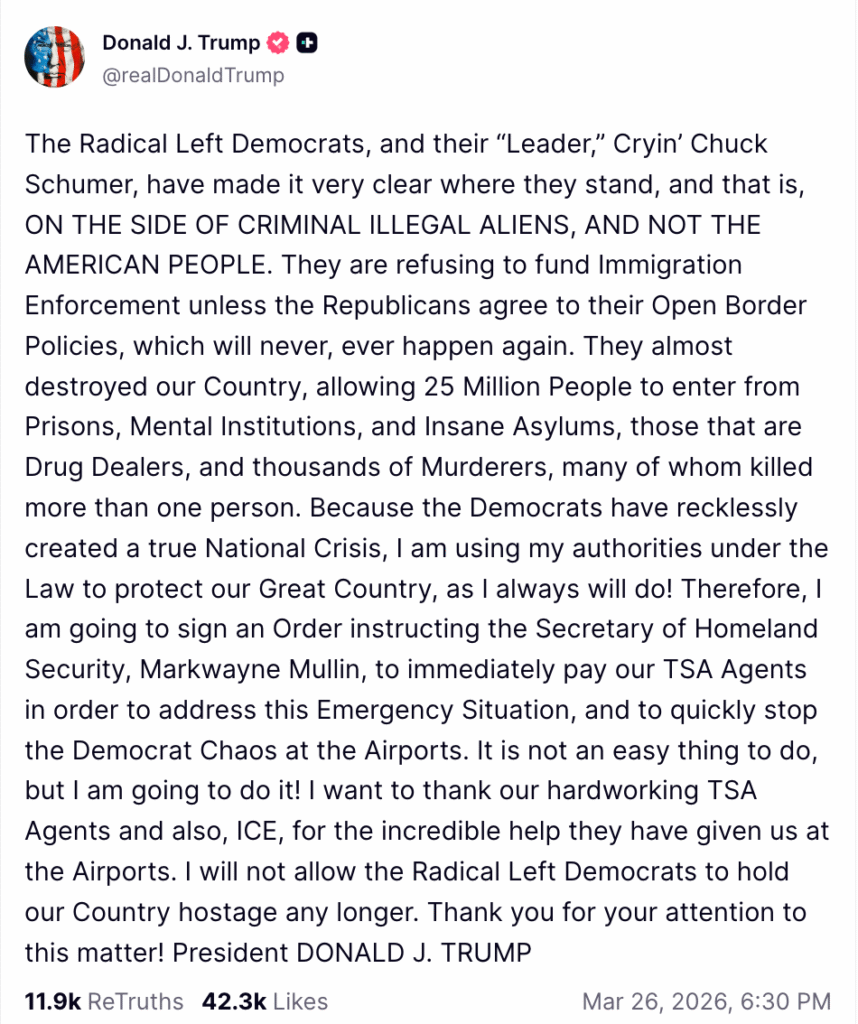
On
Friday,
he
signed
an

executive
order

instructing
newly
minted
DHS
Secretary
Markwayne
Mullin
to
pay
TSA
agents,
despite
the
fact
that
there’s
no
money
appropriated
to
do
it.

Decrying
“congressional
Democrats’
reckless
decision
to
prioritize
criminal
illegal
aliens
over
American
citizens,”
Trump
ordered
Mullin
to
“to
use
funds
that
have
a
reasonable
and
logical
nexus
to
TSA
operations
to
provide
TSA
employees
with
the
compensation
and
benefits
that
would
have
accrued
to
them
if
not
for
the
Democrat-led
DHS
shutdown,
consistent
with
applicable
law,
including
31
U.S.C.
1301(a).”

Usually
Trump
just
gestures
vaguely
in
the
direction
of
Article
II
of
the
Constitution
and
claims
the
power
to
command
the
sun
to
rise
in
the
west,
so
perhaps
he’s
due
one
muted
cheer
for
pointing
to
the
actual
code.
But
that
statutory
cite
is
quite
a
head-scratcher.
Section
1301(a)
says
only
that
“Appropriations
shall
be
applied
only
to
the
objects
for
which
the
appropriations
were
made
except
as
otherwise
provided
by
law.”
Trump
is
specifically
ordering
DHS
to
apply
appropriations
to
objects
for
which
they
were

not

made

effectively
citing
the
rule
he’s
breaking
as
justification
for
breaking
it.


CNN

reports
that
Trump
intends
to
siphon
off
cash
for
TSA
from
the
deportation
slush
fund
in
the
One
Big
Beautiful
Bill
Act
(OBBBA),
which
is
keeping
ICE’s
goons

paid
during
the
DHS
shutdown
.
Congress
appropriated
that
$75
billion
for
ICE
and
CBP
specifically
as
multi-year
or
no-year
funding,
which
doesn’t
expire
at
the
end
of
the
fiscal
year
and
isn’t
subject
to
the
annual
appropriations
cycle.
So
when
DHS
funding
lapsed
in
February,
ICE
and
CBP
kept
spending
because
they
had
a
separate,
still-active
pot
of
money
that
the
shutdown
couldn’t
touch.

The
theory
here
is
that
airport
security
has
a
“reasonable
and
logical
nexus”
to
border
operations

a
test
that
appears
nowhere
in
the
statute,
nowhere
in
relevant
caselaw,
and
that
the
White
House
invented
wholesale
for
the
occasion.
But
maybe
if
you
take
several
shots
of
Everclear
and
squint
real
hard,
working
the
X-ray
belt
in
Toledo
counts
as
border
patrol
activity
and
can
be
paid
for
out
of
OBBBA.

Sadly,
Tom
“Cava”
Homan
was
still
sober
Sunday
morning
when
he
sat
down
with
CNN’s
Jake
Tapper,
protesting
that
he
was
but
a
simple
policeman,
who
knows
nothing
about
the
law.

TAPPER:
If
Trump
had
the
power
to
pay
TSA
agents
this
whole
time,
why
only
start
going
it
now?HOMAN:
Look,
I
don’t
understand

I’m
a
cop

I
don’t
understand
the
whole
appropriations
language,
appropriations
law


Aaron
Rupar
(@atrupar.com)


2026-03-29T13:24:56.323Z

There
is
no
universe
in
which
the
OBBBA
funds
can
legally
be
used
to
pay
TSA
agents.
The
Antideficiency
Act
bars
federal
agencies
from
obligating
or
spending
funds
before
they
are
appropriated
or
in
excess
of
the
amount
approved
by
Congress.
And
putting
in
your
executive
order
that
you’ll
“adjust
applicable
funding
accounts
within
DHS”
once
Congress
appropriates
money
for
TSA
doesn’t
fix
the
problem.

Under
the
Constitution,
Congress
has
the
power
of
the
purse.
The
Trump
administration
has
systematically
disregarded
this,
ignoring
congressional
appropriations
and
ordering
the
shutdown
of
everything
from
Voice
of
America
to
the
Institute
of
Museum
and
Library
Services.
Particularly
in
this
moment,
Democrats
have
an
affirmative
obligation
to
use
all
their
leverage
over
the
budget
to
control
how
tax
dollars
are
spent.

Right
now,
Democrats
want
an
agreement
that
ICE
and
CBP
will:
quit
pretending
that
administrative
warrants
it
signs
for
itself
are
the
same
as
judicial
warrants;
take
off
the
masks
and
put
on
badges
that
identify
them;
and
quit
conducting
raids
in
sensitive
locations,
like
hospitals,
churches,
and
schools.
Trump
wants
to
keep
doing
those
things,
and
he’s
pretending
that
he
can
cancel
out
Congress’s
leverage
with
accounting
tricks.

And
so
it’s
a
bit
disappointing
to
see
Democrats
asking
why
Trump
didn’t
steal
the
money

and
their
own
power!


sooner
.

Andy
Kim:
“Homan
did
an
excellent
job
dodging
your
question
about
why
Trump
didn’t
start
paying
the
TSA
agents
sooner
if
he
had
the
authority
all
along.
I
know
the
answer
to
that,
the
American
people
know.
It’s
because
he
doesn’t
care
about
them.”


Aaron
Rupar
(@atrupar.com)


2026-03-29T14:41:06.523Z

“Tom
Homan
did
an
excellent
job
of
dodging
your
question
earlier
in
the
show
when
he
said
that
he
doesn’t
know
why
Trump
didn’t
start
paying
the
TSA
agents
sooner
if
they
had
the
authority
all
along,”
New
Jersey
Senator
Andy
Kim
replied.
“Well,
I
know
the
answer
to
that.
The
American
people
know
it’s
because
he
didn’t
care
about
them,
that
he
cared
about
ICE.
He
cares
about
his
efforts
to
antagonize
and
assault
the
American
people
in
our
communities.”

Senator
Kim
is
great,
but
this
answer
is

terrible
.
The
reason
Trump
didn’t
steal
the
money
sooner
was
because
it’s
flatly
illegal
and
he
was
hoping
Congress
would
buckle
and
give
him
the
money
with
no
strings
attached.
When
Democrats
used
their
leverage
to
make
the
shutdown
unpleasant,
he
rejected
any
compromise
and
effectively
kicked
over
the
table.

By
validating
that
gambit
and
complaining
only
about
its
timing,
Democrats
are
giving
up
their
own
power
to
get
ICE
under
control.
As
Senate
Majority
Leader
Thune

admitted
,
Trump’s
illegal
order
“takes
the
immediate
pressure
off”
Republicans
to
negotiate
with
Democrats,
allowing
everyone
to
leave
town
for
a
two-week
recess
without
getting
screamed
at
in
the
airport.

Obviously,
TSA
workers
deserve
to
be
paid.
But
the
law
requires
them
to
be
paid
by
an
act
of
Congress,
not
a
presidential
raid
on
border
security
funds.
Framing
the
debate
as
a
question
of
why
the
president
didn’t
steal
the
money
faster
is
like
a
little
old
lady
tut-tutting
at
a
mugger
for
failing
to
snatch
her
handbag
at
a
reasonable
hour.
Congress
has
the
power
of
the
purse,
and
they
need
to
keep
socking
that
mugger
in
the
nose
when
he
tries
to
grab
it!


Liz
Dye
 produces
the
Law
and
Chaos Substack and podcast.
 You
can
subscribe
by
clicking
the
logo:


Biglaw To D.C. Circuit: This Isn’t Just About Us – It’s About Whether The President Can Put Lawyers On A Leash – Above the Law

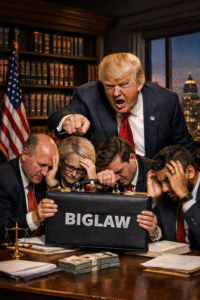
via
ChatGPT

If
you
thought
the
fight
over
Trump-era
executive
orders
targeting
Biglaw
firms
might
lose
some
of
its
edge
on
appeal,
think
again.
The
four
firms
still
standing

Perkins
Coie,
Jenner
&
Block,
WilmerHale,
and
Susman
Godfrey

have
now
filed
their
response
briefs
in
the
D.C.
Circuit,
and
they
are
not
exactly
mincing
words.

Susman
Godfrey,
never
one
to
shy
away
from
a
punchy
line,
framed
the
stakes
in
stark
constitutional
terms,
calling
the
executive
order
targeting
the
firm
“a
grave
abuse
of
presidential
power
that
threatens
the
essential
postulates
of
our
constitution
and
the
rule
of
law
itself.”
A
point
that’s
more
than
just
rhetorical
flourish,
it’s
actually
the
throughline
of
all
four
briefs.

Because,
as
Susman
puts
it,
if
this
order
stands,
lawyers
are
no
longer
independent
actors:
“Susman’s
lawyers
would
effectively
be
under
the
thumb
of
the
president,
forced
to
submit
to
his
whims
regardless
of
their
own
sense
of
duty
to
the
constitution,
their
clients,
and
the
rule
of
law.”
And
the
risk
the
orders
spread
is
real,
“Today,
it
is
Susman.
Tomorrow,
it
could
be
any
law
firm
or
lawyer.”
The
Framers,
they
note,
baked
the
First
Amendment
and
due
process
protections
into
the
Constitution
precisely
to
prevent
this
kind
of
strong-arm
governance.

Over
at
Jenner,
the
brief
leans
hard
into
what
should
be
an
uncontroversial
proposition
but
apparently
now
needs
litigating,
that
the
government
does
not
get
to
punish
lawyers
for
who
they
represent.
“Our
Constitution
forbids
the
government
from
retaliating
against
lawyers
based
on
the
clients
they
represent
and
the
people
with
whom
they
associate,”
Jenner
writes,
before
twisting
the
knife:
“The
executive
orders
challenged
here
defy
this
fundamental
precept.”

And
in
case
anyone
in
the
back
row
missed
the
implications,
Jenner
spells
it
out
the
harsh
reality.
If
lawyers
fear
sanctions
for
doing
their
jobs,
they
cannot
effectively
advocate,
which
stunts
clients’
ability
to
vindicate
their
rights.
Which
is
a
system-wide
failure.
The
orders,
Jenner
warns,
“cast
a
chill
over
the
entire
legal
profession.”

Jenner
also
takes
a
not-so-subtle
swipe
at
the
government’s
appellate
strategy:

Faced
with
defending
the
indefensible—and
after
wavering
on
whether
to
maintain
this
appeal
at
all—the
government
has
little
to
say.
On
the
merits,
it
protests
that
the
order
has
nothing
to
do
with
Jenner’s
representations
or
associations,
but
instead
was
prompted
by
unspecific
and
unsubstantiated
allegations
of
hiring
discrimination.

Meanwhile,
Perkins
Coie

the
OG
Biglaw
target

situates
the
dispute
in
a
broader
landscape
of
fear
and
capitulation.
Nine
firms,
they
note,
folded
under
pressure
and
struck
deals
with
the
administration
rather
than
risk
existential
sanctions.
(A
fact
that
continues
to
hang
over
this
entire
saga
like
a
particularly
judgmental
cloud.)

Nine
law
firms,
cowed
by
the
threat
of
firm-ending
sanctions,
‘settled’
with
the
President.
But
Perkins,
followed
by
Jenner,
WilmerHale,
and
Susman,
sued
to
defend
themselves
and
their
clients.
Four
different
district
judges
recognized
the
President’s
executive
orders
for
what
they
are:
shocking
abuses
of
power
that
trample
the
constitutional
rights
of
the
law
firms
and
their
clients.
This
Court
should
recognize
the
same.

WilmerHale’s
brief,
for
its
part,
zeroes
in
on
what
it
calls
the
order’s
“unabashed”
retaliatory
purpose,
pointing
to
the
laundry
list
of
penalties
imposed
on
the
firm,
from
restricting
access
to
federal
buildings
to
effectively
blacklisting
it
from
government
engagement
and
leaning
on
its
clients
to
walk
away.

Wilmer
doesn’t
sugarcoat
it,
calling
the
EO
a
“direct
assault”
on
the
First
Amendment,
separation
of
powers,
and
the
adversarial
system
itself.

And
that’s
really
where
all
four
briefs
converge,
framing
the
legal
fight
as
something
much
bigger
than
the
individual
firms
and
whether
the
executive
branch
can
weaponize
its
power
to
reward
friendly
lawyers
and
kneecap
the
ones
who
displease
the
administration.

The
question
isn’t
whether
Biglaw
can
survive;
it’s
whether
the
legal
system,
as
we
understand
it,
can.


Kathryn
Rubino
is
a
Senior
Editor
at
Above
the
Law,
host
of The
Jabot
podcast
,
and
co-host
of Thinking
Like
A
Lawyer
.
AtL
tipsters
are
the
best,
so
please
connect
with
her.
Feel
free
to
email her with
any
tips,
questions,
or
comments
and
follow
her
on
Twitter @Kathryn1 or
Mastodon @[email protected].

Judge Throws IT Worker Out Of Courtroom For Doing His Job – Above the Law

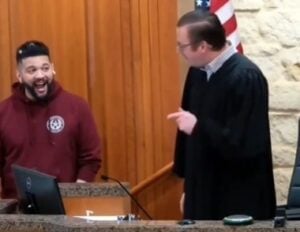
(Screenshot
via
Reddit)

Judges
hold
ultimate
power
in
their
courtrooms,
but
the
eternal
question
is
will
they
wield
that
power
as
an
enlightened
monarch

tempered
by
humility
and
a
keen
sense
of
their
role
as
a
public
servant,
a
living
avatar
of
the
nation’s
sense
of
justice

or
more
like
mall
cop
with
a
bazooka
and
qualified
immunity.
When
it’s
the
latter,
that’s
when
you
end
up
with
judges

handcuffing


children

and
putting
on
a
show
of

brutally
punishing
defendants

and

berating
attorneys
.

Over
the
weekend,
Judge
Nathan
J.
Milliron
of
the
215th
Civil
District
Court
in
Harris
County,
Texas,
garnered
some
notoriety
when
video
of
his
courtroom
interaction
with
an
IT
support
worker
started
circulating
around
the
internet.

The
setup:
Milliron
experienced
some
kind
of
audio
issue
in
his
courtroom.
An
IT
worker
came
to
investigate.
The
IT
worker

doing
his
actual
job

determined
there
was
no
problem
and
described
it
as
a
“false
alarm.”

And
Judge
Milliron
lost
it.

After
the
support
worker
found
there
was
no
problem
and
called
it
a
false
alarm,
the
normal,
grounded
response
would
be
something
like
“yeah,
I
don’t
know
what
happened,
but
thank
you.”
Instead
Judge
Milliron
protested
the
characterization
and
became
even
more
agitated
when
the
IT
worker
revised
it
to
a
“false
negative.”
Honestly,
you’ve
got
to
appreciate
the
restraint
to
not
say,
“the
problem
was
a
loose
nut
behind
the
keyboard.”

The
judge
orders
the
IT
worker
to
“get
out
of
my
courtroom,”
then
goes
full
Judge
Karen
and
asks
his
staff
to
find
the
technician’s
supervisor.
As
he
stews,
you
can
hear
him
mumbling
that
he’s
“sick
of
this
bullshit.”
Apparently,
insufficient
deference
in
delivering
good
news
is
grounds
for
professional
discipline.

The
frustrating
thing
about
a
tech
problem
is
that
most
of
the
time,
there
is
no
problem.
Once
you
call
IT,
the
gremlins
magically
disappear,
leaving
you
holding
the
bag
in
front
of
an
expert.
But
just
being
frustrating,
is
not
a
reason
to
start
daydreaming
about
putting
the
staff
in
solitary.

This
is
what
happens
when
someone
confuses
a
courtroom
with
a
personal
kingdom.
The
IT
worker
didn’t
say
“hey
dummy,
it’s
working
fine”
or
“the
secret
is
being
at
least
10
percent
smarter
than
the
piece
of
equipment.”
A
“false
alarm”
is
a
perfectly
professional
way
of
describing
the
situation.

It’s
possible
that
the
judge
was
just
having
a
bad
day
and
this
is
an
uncharacteristic
slice
of
his
life
that
he
regrets.
On
the
other
hand,
Judge
Milliron’s
social
media
presence
suggests
he’s
enjoys
cultivating
a
reputation
for
lashing
out
at
people
from
the
bench.
On

his
Facebook
page


where
he’s
identified
as
a
“Digital
Creator”

he’s
got
a
courtroom
video
compiled
by
Court
Disorder
and
starring
himself
with
the
title
Judge
Sanctions
Attorney
THOUSANDS
Then
Throws
Him
Out!

Apparently,
“get
out
of
my
courtroom”
is
a
bit
of
a
catchphrase
for
the
judge.

Was
it
appropriate
for
the
judge
to
sanction
this
lawyer?
I
don’t
know.
But
I
do
know
celebrating
the
sanction
by
posting
a
video
on
social
media
with
captioned
commentary
like
“Yikes!”
and
“Oh
Sht!~”
is
not
appropriate.
And
arrayed
next
to
this
IT
interaction,
it
raises
serious
questions
about
temperament.

Also,
not
for
nothing,
the
optics
of
a
white
Republican
judge
constantly
featured
lashing
out
at
minorities

as
both
the
IT
worker
and
the
sanctioned
lawyer
appear
to
be

is

not
lost
on
folks
.

There
was
also

a
social
media
post
several
months
ago

calling
upon
the
Texas
State
Commission
on
Judicial
Conduct
to
open
an
investigation
into
the
judge,
alleging
“unprofessional,
nasty,
and
degrading
communications
toward
Harris
County
Clerk’s
Office
staff”
that
“were
not
only
unbecoming
of
a
judge,
but
a
direct
violation
of
the
standards
of
dignity,
respect,
and
impartiality
required
of
the
bench.”
Not
an
encouraging
set
of
circumstances
for
anyone
hoping
to
give
the
judge
the
benefit
of
the
doubt
on
his
IT
escapades.

Judges
who
act
like
tin-pot
dictators
in
their
courtrooms
tell
themselves
they’re
maintaining
decorum,
but
they’re
actually
undermining
it.
This
comes
across
as
full
clown
show.
Given
the
power
that
judges
command,
the
public
needs
to
see
someone
exercising
a
deep
sense
of
humility
and
respect
for
others.
Milliron
won
his
judgeship
by
roughly
304
votes
out
of
over
1.4
million
cast

how
is
that
not
humbling?
For
all
the
authority
afforded
judges
to
run
their
little
fiefdoms,
the
courtroom
belongs
to
the
public
and
the
judge
is
a
mere
custodian,
not
its
king.
And
certainly
not
its
“digital
creator.”


HeadshotJoe
Patrice
 is
a
senior
editor
at
Above
the
Law
and
co-host
of

Thinking
Like
A
Lawyer
.
Feel
free
to email
any
tips,
questions,
or
comments.
Follow
him
on Twitter or

Bluesky

if
you’re
interested
in
law,
politics,
and
a
healthy
dose
of
college
sports
news.
Joe
also
serves
as
a

Managing
Director
at
RPN
Executive
Search
.

‘This is Crazy’: Health Experts Call for Changes to the No Surprises Act – MedCity News

As
a
member
of
the
Coalition
Against
Surprise
Medical
Billing,
Katy
Spangler
helped
push
for
the
No
Surprises
Act
in
2020.
However,
on
Wednesday,
she
took
the
stage
at
the

AHIP
Medicare,
Medicaid,
Duals
&
Commercial
Markets
Forum

to
call
for
changes
to
the
law. 

The
No
Surprises
Act
protects
patients
from
unexpected
bills
and
removes
them
from
insurer-provider
payment
friction.
The
act
requires
insurers
and
providers
to
enter
into
30
days
of
open
negotiation
to
determine
how
much
providers
are
paid.
If
they
can’t
come
to
an
agreement,
either
side
can
use
the
Independent
Dispute
Resolution
(IDR)
process,
in
which
a
provider
submits
a
payment
offer
and
an
insurer
submits
a
payment
offer
and
then
a
neutral
arbitrator
(called
an
IDR
entity)
picks
one.

While
the
act
is
successful
in
protecting
patients
against
surprise
bills,
Spangler
and

others
in
the
industry

are
arguing
that
the
IDR
process
is
now
being
abused
by
some
providers.
What
was
meant
to
be
a
last
resort
has
instead
seen
an
explosion
in
volume,
with
providers
initiating
the
vast
majority
of
IDR
cases
and
winning
most
of
the
time
at
significantly
inflated
award
levels,
she
said.

“When
we
have
an
in-network
surgeon
who
has
agreed
to
$800
for
the
reimbursement
for
that
surgery,
but
an
assistant
surgeon
takes
that
same
case
to
IDR,
and
they
get
$80,000,
that
is
unsustainable.

This
is
crazy

we
have
got
to
fix
this
problem,”
Spangler
said
on
the
panel.

Recently
published

data

from
another
panelist
backs
this
up.
Kennah
Watts,
a
research
fellow
at
the
Center
on
Health
Insurance
Reforms
(CHIR)
at
Georgetown
University’s
McCourt
School
of
Public
Policy,
explained
on
the
panel
that
there
have
been
3.4
million
IDR
disputes
from
2022
through
June
2025.
CMS,
however,
anticipated
there
to
be
about
55,000
over
that
same
time
period.

Watts
added
that
providers
and
healthcare
facilities
are
initiating
99%
of
disputes.

“We
also
see
that
not
only
are
providers
submitting
the
vast
majority
of
disputes,
but
they’re
winning
a
majority
as
well,
and
they’re
winning
at
much
higher
rates
than
plans.

We
can
see
that
to
date,
[when
providers]
win,
they
have
a
median
win
rate
that’s
about
4.5
times
the
in-network
rate,”
she
said.

And
the
IDR
process
is
costly:
from
2022
to
2024,
the
IDR
process
has
incurred
about
$5
billion
in
total
costs,
according
to
Watts’
data. 

A
health
insurance
executive
on
the
panel

Josh
Goldberg,
executive
director
of
health
policy
at
Health
Care
Service
Corporation

echoed
these
issues.
He
noted
that
the
company
has
seen
about
750,000
IDR
disputes
and
keeping
up
has
been
extremely
challenging.

“Between
two
months,
you
might
see
a
swing
of
40%
in
terms
of
volume
and
so
accurately
staffing
for
that
fluctuating
volume
is
very
difficult,”
he
said.
“We
see,
I
think,
what
may
be
intentional
manipulation
of
the
volume
to
try
and
concentrate
a
lot
of
volume
in
a
short
period
of
time
to
make
the
response
more
difficult.

Currently,
we
have
well
over
400
people
just
working
IDR
disputes.
That’s
significant.
Those
salaries,
the
cost
of
that
all
has
to
be
paid
somewhere,
and
it
comes
out
in
premiums.”

He
added
that
because
of
the
volume
of
IDR
disputes,
he
doesn’t
think
IDR
entities
are
able
to
give
the
disputes
adequate
consideration.
He
noted
that
a
$7,000
claim
for
a
respiratory
panel
resulted
in
a
$255
million
award
through
the
IDR
process. 

“Now,
to
their
credit,
we
went
back
to
the
IDR
institute
and
said,
‘You
want
to
look
and
see
if
there’s
a
mistake
here,
because
this
can’t
be
right.’
They
acknowledged
that
they
had
an
error,
selected
the
wrong
prevailing
party,
and
they
went
to
CMS
and
had
that
reopened,”
Goldberg
said.
“But
I
think
it’s
indicative
of
the
stress
that
they
are
under
to
close
cases
very
quickly,
and
that
results,
I
think,
in
a
reduction
in
the
quality
of
work
that
they’re
able
to
do.”

As
for
how
to
improve
the
IDR
process,
Spangler
argued
that
the
current
administration
should
take
regulatory
action
to
block
ineligible
claims
from
entering
arbitration
and
address
flawed
incentives
that
encourage
improper
IDR
rulings.
However,
congressional
action
may
be
needed
as
well.

“There’s
a
lot
that
we
think
can
happen
to
make
this
less
bad,
but
it’s
really
bad,
and
I’m
so
sad
to
say
it,”
Spangler
said.


Photo:
KLH49,
Getty
Images