
Botha Gold Mine Under Scrutiny as $40 Million Gold Trail Leads to Luxury Vehicle Bonanza


By
staff
reporter

A
detailed
confidential
dossier
has
uncovered
a
complex
web
linking
alleged
illegal
gold
extraction,
shareholder
enrichment,
and
related-party
transactions
at
Botha
Gold
Mine,
with
evidence
suggesting
that
proceeds
from
unauthorised
mining
may
have
been
used
to
acquire
luxury
vehicles
for
company
insiders,
this
publication
has
gathered.

At
the
centre
of
the
revelations
is
a
written
admission
by
Botha
Gold
Mine
dated
17
January
2026,
in
which
the
company
publicly
confirmed
distributing
new
vehicles
to
its
shareholders.

In
a
statement
titled
“Botha
Gold
Mine
Shareholders
Receive
New
Vehicles

A
Shared
Step
Forward,”
the
company
acknowledged
that
the
handover
ceremony
took
place
on
16
January
2026
at
FaraMatsi
Toyota
in
Harare.

The
statement
explicitly
notes
that
the
vehicles
were
distributed
to
“the
company’s
shareholders.”

Accompanying
photographic
evidence
shows
Nomsa
Hove,
a
3
percent
shareholder,
receiving
a
white
Toyota
Hilux

providing
direct
visual
confirmation
of
the
transaction.

Nomsa
Hove,
a
3
percent
shareholder
of
Botha
Mine,
receiving
a
white
Toyota
Hilux


Who
Owns
Botha?

Company
records
reveal
a
tightly
held
shareholding
structure
dominated
by
a
mix
of
individuals,
trusts
and
corporate
entities.

The
largest
stake
is
held
by
Sendoyi
Trust
(36
percent),
followed
by
Jiwe
Gold
(20
percent)
and
Lanewiz
Trading
and
Projects
(16
percent).

Other
shareholders
include
Premoline
(10
percent),
Wellington
Chigumira
(6
percent),
and
smaller
stakes
held
by
Prowatch,
Knowrush,
Nomsa
Hove
(3
percent
each),
as
well
as
Simba
Nyenza,
Tendayi
Chinyani,
Admire
Chigumira,
Sande
Chinomona
and
Terrence
Dick
(each
holding
1
percent).

The
distribution
of
vehicles
across
this
shareholder
base
raises
critical
questions

particularly
when
examined
alongside
the
source
of
funds
used
to
finance
the
purchases.


The
Lanewiz–FaraMatsi
Link

Investigations
have
established
a
direct
nexus
between
Botha
Gold
Mine,
one
of
its
key
shareholders,
and
the
dealership
that
supplied
the
vehicles.

Lanewiz
Trading
and
Projects
(Private)
Limited,
which
holds
a
16
percent
stake
in
Botha,
is
registered
under
company
number
7732/2017.

Registrar
of
Companies
records
list
Farai
Matsika
and
Edson
Gatsi
as
its
directors,
with
listed
addresses
in
Ballantyne
Park
and
Greystone
Park
respectively.

FaraMatsi
Toyota,
the
dealership
that
supplied
the
vehicles
to
Botha
shareholders
is
closely
linked
to
Matsika.

This
effectively
means
that
a
company
associated
with
a
significant
shareholder
in
Botha
was
involved
in
supplying
vehicles
to
the
same
company’s
shareholders.


Mining
Without
Title

In
a
sworn
affidavit
dated
22
April
2026,
Provincial
Mining
Director
Tendai
Kashiri
stated
unequivocally
that
Botha
Gold
Mine
(also
linked
to
Side
Electricals)
“has
never
acquired
any
mining
rights
within
Mining
Lease
21,”
adding
that
any
mining
activity
in
the
area
would
be
in
violation
of
Section
5
of
the
Gold
Trade
Act.

Mining
Lease
21
(ML21)
is
legally
held
by
Freda
Rebecca
Gold
Mine
under
Mutapa
Gold
Resources.

Despite
this,
Botha
is
understood
to
have
conducted
mining
operations
in
Kitsiyatota
an
area
falling
within
ML21

and
has
previously
indicated
that
proceeds
from
these
operations
were
used
to
purchase
high-value
vehicles,
including
Toyota
Land
Cruisers,
for
shareholders.


The
$40
Million
Question

Investigators
estimate
that
approximately
271
kilograms
of
gold,
valued
at
around
US$40
million,
may
have
been
extracted
from
ML21
without
authorisation
and
without
payment
of
royalties
to
the
State.

Further
evidence
suggests
a
structured
system
of
monetising
access
to
the
concession.

A
letter
dated
27
February
2025
from
Zimbabwe
Empowered
Youths
United
an
entity
claiming
links
to
Side
Electricals
alleges
that
miners
were
being
charged
US$20,000
as
a
“lease
fee”
to
operate
within
ML21
at
Freda
Rebecca
Mine.


Lavish
Spending
Amid
Legal
Questions

Botha
Gold
Mine
has
previously
indicated
that
proceeds
from
its
mining
operations
in
Kitsiyatota
an
area
falling
within
ML21
were
used
to
purchase
high-end
vehicles,
including
Toyota
Land
Cruisers,
for
its
shareholders.

The
timing
and
structure
of
these
transactions
have
intensified
suspicions
that
proceeds
from
unauthorised
mining
may
have
been
channelled
into
personal
enrichment.

Under
Zimbabwe’s
Money
Laundering
and
Proceeds
of
Crime
Act
[Chapter
9:24],
any
assets
acquired
using
proceeds
from
unlawful
activities
may
be
classified
as
“tainted
property,”
exposing
beneficiaries
to
potential
legal
consequences.


Calls
for
Investigation

The
dossier
outlines
several
urgent
investigative
leads,
including
a
forensic
audit
of
Botha’s
gold
production
from
2020
to
2026,
verification
of
royalty
payments
to
Fidelity
Gold
Refinery,
and
scrutiny
of
vehicle
purchase
invoices
from
FaraMatsi
Toyota.

Authorities
such
as
the
Zimbabwe
Anti-Corruption
Commission
(ZACC)
and
the
Financial
Intelligence
Unit
(FIU)
are
being
urged
to
examine
whether
the
distribution
of
vehicles
to
shareholders
constitutes
a
form
of
benefit
derived
from
criminal
activity.

There
are
also
calls
to
investigate
financial
flows
linked
to
the
alleged
US$20,000
mining
levies
and
whether
these
funds
were
properly
declared
and
remitted.
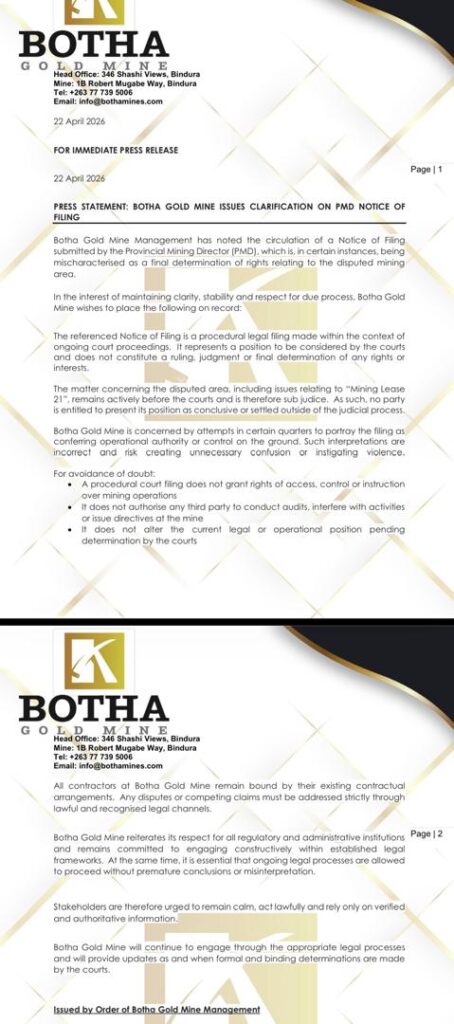
Botha Gold Mine clarifies PMD filing, says dispute remains before courts

Botha
Gold
Mine,
trading
as
Side
Electrical
Private
Limited,
has
issued
a
clarification
on
a
recent
Notice
of
Filing
submitted
by
the
Provincial
Mining
Director
(PMD),
distancing
the
document
from
claims
that
it
represents
a
final
determination
in
an
ongoing
mining
dispute.

In
a
press
statement
dated
April
22,
2026,
the
mine’s
management
said
it
had
taken
note
of
“the
circulation
of
a
Notice
of
Filing…
which
is,
in
certain
instances,
being
mischaracterised
as
a
final
determination
of
rights
relating
to
the
disputed
mining
area.”

press
statement

The
company
stressed
that
the
notice
is
purely
procedural
and
forms
part
of
ongoing
court
proceedings.

“It
represents
a
position
to
be
considered
by
the
courts
and
does
not
constitute
a
ruling
or
final
determination
of
any
rights
or
interests,”
the
statement
read.

According
to
Botha
Gold
Mine,
the
matter—centred
on
a
disputed
mining
area,
including
issues
related
to
Mining
Lease
21—remains
sub
judice
and
is
still
before
the
courts.

“As
such,
no
party
is
entitled
to
present
its
position
as
conclusive
or
settled
outside
of
the
judicial
process,”
the
company
said.

Management
also
raised
concern
over
what
it
described
as
attempts
by
some
parties
to
interpret
the
PMD
filing
as
conferring
operational
authority
or
control
over
the
disputed
ground.

“Such
interpretations
are
incorrect
and
risk
creating
unnecessary
confusion
or
instigating
conflict,”
the
statement
warned.

The
company
further
clarified
that
a
procedural
court
filing
does
not
grant
rights
of
access,
control,
or
instruction
over
mining
operations.

It
added
that
third
parties
are
not
authorised
to
conduct
audits
or
interfere
with
activities
at
the
mine,
and
that
the
current
legal
and
operational
position
remains
unchanged
pending
a
court
ruling.

Botha
Gold
Mine
said
all
contractors
remain
bound
by
existing
contractual
arrangements
and
that
any
disputes
or
competing
claims
must
be
addressed
through
lawful
and
recognised
legal
channels.

The
firm
reaffirmed
its
commitment
to
regulatory
compliance
and
engagement
with
relevant
authorities,
while
urging
stakeholders
to
allow
legal
processes
to
proceed
without
premature
conclusions
or
misinterpretation.

“Stakeholders
are
therefore
urged
to
remain
calm,
act
lawfully
and
rely
only
on
verified
and
authoritative
information,”
the
statement
said.

The
company
indicated
it
will
continue
to
pursue
the
matter
through
the
courts
and
will
provide
updates
once
formal
and
binding
determinations
are
made.

SA prosecutors seek 2-year jail for Bellarmine Mugabe

JOHANNESBURG,
South
Africa

Prosecutors
have
asked
for
direct
imprisonment
for
Bellarmine
Chatunga
Mugabe,
the
son
of
the
late
former
president
Robert
Mugabe,
as
a
South
African
court
postponed
sentencing
to
April
29.

The
state
is
seeking
12
months’
direct
imprisonment
on
a
charge
of
pointing
a
firearm,
and
a
further
12
months
on
a
charge
of
being
an
illegal
immigrant.

For
his
co-accused,
Tobias
Matonhodze,
who
pleaded
guilty
to
a
raft
of
more
serious
charges,
prosecutors
are
seeking
five
years’
direct
imprisonment
for
attempted
murder,
12
years
for
possession
of
an
illegal
firearm,
12
years
for
defeating
the
ends
of
justice,
a
fine
for
possession
of
ammunition,
and
12
months’
direct
imprisonment
for
immigration
violations.

Matonhodze’s
exposure
is
substantially
greater,
with
the
firearm
and
defeating-the-ends-of-justice
counts
alone
carrying
a
combined
24
years
sought
by
the
state.

Mugabe
pleaded
guilty
to
being
in
South
Africa
illegally
and
to
pointing
a
firearm,
the
latter
arising
from
a
separate
incident
just
two
weeks
before
his
security
guard,
Sipho
Mahlangu,
was
shot
at
his
Hyde
Park
home
on
February
19.

The
investigating
officer
told
the
Alexandra
Magistrates
Court
that
Mahlangu
has
received
R250,000
in
compensation,
with
a
further
R150,000
still
outstanding.

He
pushed
for
a
harsh
sentence,
arguing
that
neither
accused
had
disclosed
the
whereabouts
of
the
firearm
used
in
the
shooting,
which
has
not
been
recovered.

“Both
accused
showed
no
remorse,”
the
officer
told
the
court,
saying
the
failure
to
produce
the
weapon
amounted
to
continued
non-cooperation.

The
defence
countered
that
other
individuals
were
present
at
the
Hyde
Park
property
at
the
time
and
that
the
gun
could
have
been
removed
by
someone
else.

It
has
asked
for
non-custodial
sentences,
pointing
to
the
compensation
paid
to
Mahlangu
as
evidence
of
accountability,
though
the
prosecution
noted
the
full
agreed
amount
remains
unpaid.

The
matter
was
postponed
to
April
29
for
sentencing.

Man attempts suicide over ‘headman post’

Njodzi
Zhambe
is
said
to
have
taken
a
pesticide
after
he
failed
to
get
appointed
as
acting
Headman
Mawere.
His
nephew
Kabias
Chityatya
(junior)
is
the
new
acting
Headman
Mawere
after
the
death
of
his
father.

Masvingo
Police
Spokesperson,
Inspector
Kudakwashe
Dhewa
said
the
matter
is
not
in
their
reports.
Sources
told
Masvingo
Mirror
that
Zhambe
attempted
suicide
after
failing
to
secure
the
position
during
a
selection
meeting
held
on
April
9,
2026
at
Mawere
Township.

Gutu
District
Development
Coordinator
Chiedza
Tafirei
confirmed
both
the
meeting
and
the
selection
of
Kabias
Chityatya
as
acting
headman.
However,
she
said
she
was
not
aware
of
Zhambe’s
alleged
suicide
attempt.
The
meeting
resulted
in
the
selection
of
the
late
headman’s
eldest
son,
Chityatya
(junior),
for
the
post.

“I
am
not
aware
of
that.
Traditionally,
the
deceased’s
eldest
son
assumes
the
position,
and
in
this
case,
Kabiyasa
Chityatya
was
selected
as
acting
headman
Mawere,”
said
Tafirei.
Efforts
to
get
a
comment
from
Chief
Gutu
were
futile
as
his
mobile
phone
was
not
reachable.


Source:


Man
attempts
suicide
over
‘headman
post’


Masvingo
Mirror

Big Names Polking Around – See Also – Above the Law

Kannon
Shanmugam
Is
Headed
To
Davis
Polk
&
Wardwell:
Best
of
luck
to
the
firm’s
new
Supreme
Court
and
appellate
practice!
Wave
Goodbye
To
The
ICE/IRS
Firewall:
One
small
step
toward
losing
billions
in
taxable
income
at
a
time.
The
Government’s
Poor
Case
Against
The
Southern
Poverty
Law
Center:
They
didn’t
even
include
the
elements
of
the
crime!
Protestors
Protest
DHS
Lead
Counsel’s
Talk
At
UCLA:
Make
the
most
of
free
speech
on
campus
while
you
can.
It’s
Bigger
In
Boston:
Check
out
the
area’s
most
prestigious
Biglaw
firms!
We’re
Calling
A
2-1:
The
Biglaw
EO
cases
are
headed
to
the
D.C.
Circuit.

‘Glassdoor for Judges’ Celebrates Its Second Birthday – Above the Law


So,
you
want
to
clerk?
How
will
you
avoid
judges
who
harass
their
clerks?

For
two
years,
I
posed
this
question
at
dozens
of

The
Legal
Accountability
Project’s

(LAP)

law
school
events

across
the
country.
Then,
in
April
2024


two
years
ago
this
month


that
answer
changed
forever.
LAP
launched
our
first-of-its-kind

Clerkships
Database

(“Glassdoor
for
Judges”),
a

nationally
recognized
,

award-winning
platform

now
containing
over
2,000
candid
clerkship
reviews
about
more
than
1,200
federal
and
state
court
judges
nationwide.
It’s
the
largest
independent
repository
of
clerkship
information
in
the
U.S.

several
times
the
size
of
the
largest

law
school
databases


and
the
only
source
of

honest

feedback,
particularly
about
judges
to
avoid. 

I
recently
returned
from
a

LAP
event
at
Yale
Law
School

(YLS)

known
for
funneling
students
into
prestigious
clerkships
but
perhaps
not
for
ensuring
positive
experiences
for
graduates.
In
fact,
last
school
year,

YLS
prohibited
students

from
using
student
organization
funds
to
subscribe
to
LAP’s
Database
on
behalf
of
members

perhaps
intending
to
dissuade
students
from
accessing
LAP’s
information.
It
sparked
outraged,
inspired
more
than
10
donors
to
cover
Database
costs
for
students,
including
at
YLS

and

over
160
YLS
students
subscribed

last
year. 

At
YLS,
I
shared
my

personal
experience
,
because
it’s
the
first
time
many
students
hear
about
a
negative
clerkship
experience.
Legal
academia
and
the
legal
industry
still
lionize
judges,
acting
as
if
they
can
do
no
wrong.
It
may
shake
eager
students’
worldviews
to
learn
their
legal
heroes

the
liberal
lion
or
conservative
crusader
writing
the
bombshell
opinions
they
just
read
in
class

are
adjudicating
litigants’
misconduct
in
front
of
the
bench,
while


committing
misconduct

behind
the
bench.
Students’
eyes
bug
out
when
I
share
that
I
was
fired
over
the
phone
during
the
COVID-19
pandemic
by
a
judge
who
told
me
I
made
him
“uncomfortable”
and
“lacked
respect”
for
him.
I
hear
audible
gasps
when
I
discuss
the
judge’s
negative
reference
to
the
DC
U.S.
Attorney’s
Office
(USAO)
a
year
later
that
caused
the
USAO
to
deny
me
a
security
clearance
and
revoke
my
job
offer.
I
emphasize
my
experience
is
not
rare

I
hear
regularly
from
clerks

but
it’s
rarely
shared
publicly,
due
to
the
culture
of
silence
and
fear
surrounding
the
judiciary. 

During
audience
questions,
a
student
recounted
searching
for
judges
in
the
YLS
internal
database,
which
requires
clerks
to
put
their
names
on
their
surveys
(dissuading
those
who
were
mistreated
from
disclosing).
The
only
information
about
certain
judges
was
“contact
me”

a
euphemism
for
mistreatment.
(I
cautioned
students
that
some
mistreated
clerks
are
untruthful
even
when
contacted,
thereby
misleading
students
into
bad
clerkships

which
is
why
a
platform
like
LAP’s,
which
replaces
individual
conversations,
is
so
important.)
But,
when
the
student
searched
for
the
same
judges
in
LAP’s
Database,
clerks
actually

described

the
mistreatment. 

Many
students
understand

schools’
misaligned
clerkship
incentives
.
Schools
benefit
when
more
students
clerk:
they
rarely
dissuade
students
from
clerking
for
judges
they
know
mistreat
clerks,
especially
when
schools
have
relationships
with
judges
or
they’re
alumni.
This
necessitates
a
third-party,

independent
information
source

LAP’s
Database
is
the
resource
I
wish
existed
when
I
was
applying
for
clerkships
a
decade
ago.
This
student-
and
clerk-centric
platform
is
heavily
informed
by
what
students
want
to
know
before
clerking,
and
what
clerks
wish
they’d
known
before
clerking.
Because
I
conceptualized
it
and
oversee
its
daily
operations,
students’
and
clerks’
needs
remain
front
and
center.
As
someone
whose
law
school
misled
me
into
a
career-ending
clerkship;
who
endured
mistreatment
until
I
was
fired
because
no
support
or
resources
like
LAP
existed;
and
was
subsequently
retaliated
against
by
the
judge
I
worked
for,
I
am
particularly
sensitive
to
the
need
to
balance
clerks’
privacy
and
data
security
with
transparency
and
candor. 

Anyone
who
clerked
can

submit
a
survey
to
LAP’s
Database


anonymously
if
they
choose.
Anonymity

vastly

increases
the
candor
of
submissions,
yet
inexplicably,
some
law
schools
won’t
allow
clerks
to
submit
anonymously
to
their
internal
databases.
Clerks
aren’t
anonymous
to
me,
of
course

they
register
with
all
their
information.
Importantly,

only

students
and
recent
graduates
can
subscribe
to
read
reviews


no
judges


to
prevent
retaliation. 

For
just
$50
per
school
year,
students
can
avoid
career-
and
life-altering
negative
experiences

like
mine
.
LAP’s
Database
offers
exponentially
more
information
than
students
could
otherwise
access
when
applying
for
clerkships.
While
a
handful
of
top
schools
maintain
internal
databases
where
students
can
search
for
judges
by
name,
state,
and
court,
none
enable
students
to
search
by
judges’
race,
gender,
law
school,
or
appointing
president.
Beyond
LAP’s
unique
search
filters
and
user-friendly
interface,
we
ask

candid

questions
about
judges
as
managers,
clerk
treatment,
and
workplace
conduct.
And,
because
clerks
can
submit
anonymously,
we
receive

honest

responses.
Clerks
also
rate
both
the
judge
as
a
manager
and
the
clerkship
experience,
and
LAP
posts
those
ratings
on
judges’
profiles.
And
while
every
law
school’s
information
is
restricted
by
who
alumni
clerked
for
and
clerks’
willingness
to
share
information,
LAP
is
not:
the
Database
compiles
reviews
from
clerks
nationwide
from
every
law
school,
state,
and
court.
Nothing
else
like
it
exists. 

I

couldn’t
in
good
conscience

encourage
anyone
to
clerk

without

subscribing
to
LAP’s
Database
and
heeding
its
warnings.
Working
for
a
judge
who
treats
clerks
with
respect
could
be
the
difference
between
a
successful
career
in
law
and
none
at
all.
I’ve
seen
everything:
clerks
traumatized
and
in
therapy
years
later,
blackballed
from
dream
jobs
and
whole
industries,
shells
of
their
former
selves,
or
driven
from
the
law
entirely
after
investing
hundreds
of
thousands
of
dollars
in
their
legal
educations
and
taking
out
crushing
loans
to
pay
for
it.
LAP’s
Database
is
the
only
way
to
avoid
this. 

Hundreds
of

mistreated
clerks
tell
me

they
would
not
have
accepted
their
clerkships
if
they
knew
how
abusive
they’d
be.
And
yet,
students
desperate
to
clerk
may
read
negative
information
in
LAP’s
Database
and
pursue
the
clerkships
anyway

believing
it
won’t
happen
to
them
or
they
can
handle
it

only
to
reach
out
to
me
a
year
later
after
they’ve
quit
or
been
fired.
Frustratingly,
many
mistreated
clerks
who’ve
reached
out
recently
seeking
assistance
are
2025
graduates

meaning
the
Database
was
accessible
when
they
applied,
or
at
least
before
they
started
clerking

yet
they
chose
not
to
subscribe
or
disregarded
its
warnings.
Students
must
take
agency
over
their
lives
and
careers.
Even
if
you’ve
accepted
a
clerkship,
it’s
not
too
late
to

subscribe
,
inform
yourself,
and
potentially
withdraw.
Many
have

LAP
helped

and
you
should. 

LAP’s
Database
has
already
served
over
4,000
law
students
and
recent
graduates
in
just
two
years.
Many
more
are
preparing
to
apply

“On
Plan”
via
OSCAR

this
June.
I
worry
where
those
who
haven’t
subscribed
get
their
information,
if
not
from
LAP

either
not
at
all,
or
from
school
advisors
who
mislead
students. 

LAP’s
Database
is
accountability
through
transparency:
there’s
nothing
abusive
judges
hate
more
than
negative
feedback
they
cannot
see
or
retaliate
against
clerks
for
sharing.
LAP’s
Database
exists
because
the
judiciary
refuses
to
implement
guardrails,
hold
colleagues
accountable,

discipline
abusive
judges
,
or

provide
meaningful
redress

to
mistreated
employees.
Over
time,
as
abusive
judges
struggle
to
hire
and
retain
clerks

since
applicants
can
now
avoid
bad
bosses

judges
may
change
their
behavior
or,
preferably,
retire.
It’s
difficult
to

get
abusive
judges
off
the
bench
,
but
as
long
as
some
young
lawyers
willingly
endure
abuse,
they
perpetuate
the
problem.
As
long
as
these
judges
can
hire
clerks
and
conduct
chambers
business,
the
judiciary
has
no
incentive
to
discipline
or
remove
them.
But
a
struggling
judge,
or

one
who
can’t
hold
onto
clerks


they’re
a
liability. 

“Will
I
be
harassed,
discriminated
against,
or
retaliated
against
during
my
clerkship?”
was
never
a
question
I
thought
to
ask
when
I
was
applying.
But
now,
thanks
to
LAP,
applicants
do.
And,
having
heard
my
experience,
they’re
attuned
to
the
risks,
and
better
able
to
avoid
them.
My
“birthday
wish”
on

LAP’s
Database’s
second
birthday

is
that
every
clerkship
applicant
will
subscribe
and
heed
its
warnings,
so
no
clerk
willingly
subjects
themselves
to
abuse. 

I
think
a
lot
about
long-term
solutions

disciplining
and
removing
abusive
judges;
ensuring
presidents
and
chief
executives
appoint
judges
who
aren’t
just
good
jurists,
but
also
good
bosses;
and
finally

extending
legal
protections

against
discrimination,
harassment,
and
retaliation
to
court
employees.
LAP’s
Database
is
a
front-end,
“right
now”
solution.
We
don’t
wait
on
anyone

not
the
judiciary,
not
Congress,
and
not
law
schools

to
make
the
change
that’s
urgently
necessary.
Because
thousands
of
students
and
recent
graduates
can’t
wait.
Tens
of
thousands
of
judiciary
employees
can’t
wait.
Society
can’t
wait. 


Aliza
Shatzman
is
the
President
and
Founder
of 
The
Legal
Accountability
Project
,
a
nonprofit
aimed
at
ensuring
that
law
clerks
have
positive
clerkship
experiences,
while
extending
support
and
resources
to
those
who
do
not.
She
regularly
writes
and
speaks
about
judicial
accountability
and
clerkships.
Reach
out
to
her
via
email
at 
[email protected] and
follow
her
on
Twitter
@AlizaShatzman.

Attorneys Often Clog eFiling Systems With Unnecessary Filings – Above the Law

I
am
old
enough
to
remember
when
many
courts
did
not
have
electronic
systems
to
accept
documents
for
filing. During
this
time,
filing
motion
papers,
pleadings,
and
other
documents
was
an
arduous
process
that
either
involved
going
to
court
or
using
a
service
to
file
hardcopy
documents
with
clerks
located
in
various
places. Efiling
systems
offer
a
convenient
way
to
file
and
serve
papers
with
courts
and
adversaries,
and
the
entire
process
can
be
completed
from
the
comfort
of
an
attorney’s
home
or
office. However,
some
people
use
efiling
systems
to
send
unnecessary
documents
to
stakeholders
involved
in
litigation,
which
can
lead
to
unnecessary
filings
and
clogged
dockets
that
make
it
more
difficult
to
find
relevant
documents. In
many
instances,
there
are
certain
documents
that
attorneys
should
try
not
to
efile.


Letters
To
Counsel

It
usually
makes
sense
to
efile
letters
to
a
judge,
although
some
judges
prefer
that
letters
be
emailed
so
that
they
are
seen
faster,
and
individual
practices
should
be
consulted. However,
it
almost
never
makes
sense
to
efile
letters
to
counsel. There
is
no
reason
why
courts
need
to
be
involved
in
letters
to
counsel,
and
before
efiling
systems,
no
one
would
ever
think
of
filing
letters
between
counsel
with
the
court.

However,
I
have
had
several
adversaries
over
the
years
who
efile
letters
to
counsel. In
some
instances,
“good
faith”
letters
about
discovery
disputes
are
efiled,
and
in
other
cases,
letters
about
scheduling
and
other
matters
are
efiled. In
some
instance,
filers
style
these
letters
as
“letters
to
the
court”
or
something
similar
since
there
is
usually
no
filing
option
for
letters
between
counsel. Of
course,
efiling
a
letter
might
be
a
good
way
to
create
a
record
about
a
dispute
and
show
when
a
letter
was
indeed
served
on
other
stakeholders
to
a
case. However,
letters
between
counsel
should
usually
just
be
sent
by
email
or
other
nonpublic
means,
and
they
can
be
attached
as
exhibits
to
motion
papers
as
needed.


Discovery
Demands
And
Responses

Some
attorneys
efile
discovery
demands
and
responses,
and
in
some
instances,
it
makes
sense
to
efile
discovery
demands. For
instance,
in
one
jurisdiction
in
which
I
practice,
attorneys
can
gain
an
advantage
if
they
file
a
notice
to
take
deposition
with
their
answer.
However,
it
often
does
not
make
sense
to
efile
every
single
discovery
demand
that
is
sent
in
a
case.

It
makes
less
sense
to
efile
discovery
responses. In
the
days
before
efiling
systems,
people
would
never
think
of
filing
discovery
responses
with
courts
since
discovery
responses
are
not
the
type
of
legal
papers
that
need
to
be
filed.
In
addition,
discovery
responses
often
contain
social
security
numbers
and
other
confidential
information
that
should
not
be
included
in
the
public
domain. Again,
if
discovery
is
relevant
to
a
motion,
it
can
be
filed
with
motion
papers,
but
it
need
not
be
filed
in
the
first
instance.


Affirmations
Of
Service

This
is
a
pet
peeve
of
mine,
but
some
court
rules
specifically
provide
that
if
an
efiling
system
is
used,
a
separate
affirmation
of
service
does
not
need
to
be
filed. The
confirmation
of
efiling
is
sufficient
to
satisfy
any
type
of
affirmation
of
service
requirement.
Notwithstanding
this
rule,
many
attorneys
still
efile
affirmation
of
service. This
is
pretty
harmless,
but
this
might
create
a
docket
entry
that
does
not
need
to
exist.

All
told,
efiling
systems
should
only
be
used
for
bona
fide
filings
that
need
to
be
provided
to
courts
and
served
on
stakeholders
to
a
lawsuit. Clogging
dockets
with
unnecessary
filings
creates
more
efiling
notifications
and
makes
it
harder
to
review
dockets
for
important
information.


Jordan
Rothman
is
a
partner
of 
The
Rothman
Law
Firm
,
a
full-service
New
York
and
New
Jersey
law
firm.
He
is
also
the
founder
of 
Student
Debt
Diaries
,
a
website
discussing
how
he
paid
off
his
student
loans.
You
can
reach
Jordan
through
email
at 
jordan@rothman.law.

Justice Department’s SPLC Indictment Just Got Dumber, Which Seemed Impossible – Above the Law

Describing
this
case
with
air
quotes
is
apt.
Photographer:
Graeme
Sloan/Bloomberg
via
Getty
Images

There’s
a
lot
of
nuance
to
the
practice
of
criminal
law,
but
all
those
fuzzy,
creative,
ingenious
aspects
rest
atop
a
straightforward
foundation.
A
lot
goes
down
over
the
course
of
a
prosecution,
but
from
jump,
the
government
takes
the
elements
of
a
crime
and
engages
in
some
plug-and-play,
inserting
factual
allegations
into
those
elements.

And
this
Department
of
Justice
can’t
even
get
that
right.

Earlier
this
week,
Acting
Attorney
General
Todd
Blanche
announced
that
DOJ

secured
an
indictment
of
the
Southern
Poverty
Law
Center

that
was

not
at
all

hurriedly
rushed
out
the
door
to
distract
from

FBI
Director
Kash
Patel’s
new
“J.
Edgar
Boozer”
nickname
.
The
half-baked
theory
behind
the
case
is
that
the
group’s
payments
to
confidential
informants
within
hate
groups
amounted
to
a
vast
conspiracy
to
manufacture
hate
crimes
to
justify
the
SPLC’s
own
existence.
That
sounds
too
ridiculous
to
believe,
but
it’s
reached
what
you’d
call
shibboleth
status
over
on
Elon
Musk’s
X.
Or
you
would
call
it
that,
except

they
also
hate
Jews
over
there
.

In
reality,
SPLC
pays
informants
to
gather
intel
on
hate
groups,
which
it
then
shares
with
law
enforcement,
in
order
to
undermine
those
groups.
It
obscures
the
payments
to
protect
its
sources.
The
DOJ
this
week
dropped
a
friendly
message
to
every
extremist
group
in
America
that
they
might
have
moles
to
smoke
out.

Among
the
SPLC’s
“crimes”
is
a
form
of
bank
fraud.
But
it’s
not
the
standard
bank
fraud
statute,
because
bank
fraud
requires
showing
a
scheme
to
actually
defraud
a
financial
institution
of
money
or
property,
which
becomes
a
non-starter
when
the
“fraud”
is
“opening
a
checking
account
under
a
shell
company
name
so
the
Klan
doesn’t
murder
your
source.”
So,
the
government
turned
to
the
little
used
bank
deception
statute


18
U.S.C.
§
1014


that
criminalizes
knowingly
making
false
statements
for
the
purpose
of
influencing
a
bank’s
action
on
an
application,
loan,
or
agreement.
This
is
the
basis
of
four
counts
in
the
11-count
indictment.

And
the
DOJ
forgot
one
of
the
elements.

As

Bloomberg
Law
News

points
out:

Although
the
indictment
states
that
SPLC
“knowingly”
made
false
statements
in
bank
applications,
there’s
no
specific
mention
of
what
action
by
the
bank
the
statements
sought
to
influence.
Including
such
intent
should’ve
been
“prosecution
101,”
said
Scott
Armstrong,
a
former
supervisor
in
DOJ’s
criminal
fraud
section.

Amateur
hour.

“To
have
a
complete
absence
of
the
required
intent

in
four
counts

is
a
major,
major
omission
that
I
think
will
be
troubling
to
the
court
and
really
open
the
door
to
whether
in
fact
the
grand
jury
was
instructed
properly,”
Scott
Armstrong,
a
former
supervisor
in
the
DOJ
criminal
fraud
section,
told
Bloomberg
Law.
He
called
it
“prosecution
101,”
which
is
a
misnomer
because
remembering
every
element
is
a
lesson
that
law
schools
should
instill
long
before
someone
starts
prosecutor
boot
camp.

The
indictment
also
repeatedly
characterizes
the
statements
at
issue
as
“false
or
misleading.”
Apparently,
the
DOJ
is
missing
a
pocket
part,
because
last
year’s
Supreme
Court
decision
in

Thompson
v.
United
States

held
that
§
1014
does
not
reach
merely
misleading
statements.

This
is
bullshit,
because
that’s
not
how
grand
juries
work.
Federal
grand
juries
aren’t
making
up
crimes
to
pursue.
The
Department
of
Justice
makes
allegations
and
the
grand
jury
accepts
or
rejects
them.
Blanche
was
quite
literally
“alleging
it.”
But
if
this
indictment
skipped
elements
and
gave
the
grand
jury
incorrect
instructions,
maybe
his
misunderstanding
of
grand
juries
runs
even
deeper.

The
government
can,
they
say,
indict
a
ham
sandwich,
but

this

DOJ
has

struggled
to
clear

even
the

notoriously
low
bar

presented
by
a
grand
jury.

The
DOJ
can
fix
this
with
a
superseding
indictment.
You
know,
after
they
aren’t
feeling
rushed
to
change
the
topic
from
the
fact
that
reports
of
Patel’s
drinking
habits
caught
him
like
a
cross-eyed
deer
in
headlights.
But
it’s
still
embarrassing.

And,
of
course,
the
Trump
administration
doesn’t
necessarily
care
about
winning
this
case.
It
already
got
most
of
what
it
came
for
once
the
administration’s
fellow
traveler
hate
groups
knew
they
had
moles
and
the
SPLC
lost
its
ability
to
pay
or
even
recruit
future
informants.
None
of
that
requires
a
conviction,
or
even
making
it
to
trial.
The
damage
was
done
at
the
press
conference.


DOJ
Omits
Crucial
Element
in
Southern
Poverty
Law
Center
Charges

[Bloomberg
Law
News]


Earlier
:

Trump
DOJ
Indicts
Civil
Rights
Group
For
Working
To
Take
Down
Hate
Groups


Kash
Patel’s
$250
Million
Defamation
Lawsuit
Looks
Better
With
Beer
Goggles


HeadshotJoe
Patrice
 is
a
senior
editor
at
Above
the
Law
and
co-host
of

Thinking
Like
A
Lawyer
.
Feel
free
to email
any
tips,
questions,
or
comments.
Follow
him
on Twitter or

Bluesky

if
you’re
interested
in
law,
politics,
and
a
healthy
dose
of
college
sports
news.
Joe
also
serves
as
a

Managing
Director
at
RPN
Executive
Search
.

The Most Prestigious Biglaw Firms In Boston (2027) – Above the Law

(Photo
by
Paul
Marotta/Getty
Images)

Boston
is
brimming
with
business
opportunities,
which
is
just
one
of
the
reasons
that
Biglaw
firms
are
flocking
there
to
throw
open
their
doors.
If
you’re
a
lawyer
who
runs
on
Dunkin’,
Beantown
is
the
place
to
be.
But
which
firm
is
right
for
you?

Thanks
to
Vault’s
recently
released regional
rankings
,
we
now
know
which
Biglaw
firms
are
dominating
the
legal
scene
in
the
Cradle
of
Liberty.
This
ranking
is
based
on
votes
tabulated
from
associates
who
were
asked
to
rate
firms
on
a
1
to
10
scale
based
on
their
prestige
within
the
region.

Here
are
the
top
10
most
prestigious
firms
in
Boston
(you
can
see
the
full
list
from
Vault
by
clicking here):

  1. Ropes
    &
    Gray
  2. Goodwin
  3. WilmerHale
  4. Latham
    &
    Watkins
  5. Kirkland
    &
    Ellis
  6. Choate
    Hall
    &
    Stewart
  7. Skadden
  8. Mintz
  9. Cooley
  10. Morgan
    Lewis
    &
    Bockius

Congrats
to
all
of
the
Biglaw
firms
that
made
the
latest
edition
of
Vault’s
Boston
rankings.
How
did
your
firm
do
this
time? Email
us
,
text
us
at (646)
820-8477
,
or
tweet
us @atlblog to
let
us
know
how
you
feel.


2027
Best
Law
Firms
in
Boston
 [Vault]


Staci
Zaretsky
 is
the
managing
editor
of
Above
the
Law,
where
she’s
worked
since
2011.
She’d
love
to
hear
from
you,
so
please
feel
free
to email her
with
any
tips,
questions,
comments,
or
critiques.
You
can
follow
her
on BlueskyX/Twitter,
and Threads, or
connect
with
her
on LinkedIn.