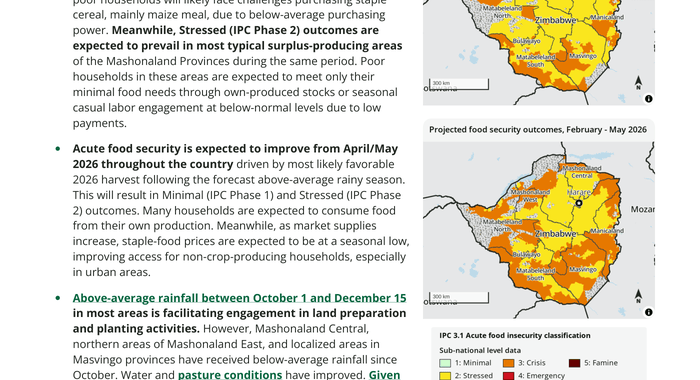
Zimbabwe Food Security Outlook Update – December 2025: Crisis (IPC Phase 3) outcomes expanding during lean season through March


25.12.2025


10:17

Analysis
in
English
on
Zimbabwe
about
Agriculture,
Food
and
Nutrition
and
Drought;
published
on
23
Dec
2025
by
FEWS
NET


Key
Messages


  • Crisis
    (IPC
    Phase
    3)
    outcomes
    are
    expected
    to
    expand
    in
    early
    2026
    as
    an
    increasing
    number
    of
    households
    face
    difficulty
    accessing
    food
    .
    Households
    in
    these
    areas
    are
    expected
    to
    have
    depleted
    own
    produced
    food
    stocks.
    With
    grain
    stocks
    low
    or
    unavailable
    on
    the
    market
    in
    some
    areas,
    many
    poor
    households
    will
    likely
    face
    challenges
    purchasing
    staple
    cereal,
    mainly
    maize
    meal,
    due
    to
    below-average
    purchasing
    power. Meanwhile, Stressed
    (IPC
    Phase
    2)
    outcomes
    are
    expected
    to
    prevail
    in
    most
    typical
    surplus-producing
    areas
     of
    the
    Mashonaland
    Provinces
    during
    the
    same
    period.
    Poor
    households
    in
    these
    areas
    are
    expected
    to
    meet
    only
    their
    minimal
    food
    needs
    through
    own-produced
    stocks
    or
    seasonal
    casual
    labor
    engagement
    at
    below-normal
    levels
    due
    to
    low
    payments.

  • Acute
    food
    security
    is
    expected
    to
    improve
    from
    April/May
    2026
    throughout
    the
    country
     driven
    by
    most
    likely
    favorable
    2026
    harvest
    following
    the
    forecast
    above-average
    rainy
    season.
    This
    will
    result
    in
    Minimal
    (IPC
    Phase
    1)
    and
    Stressed
    (IPC
    Phase
    2)
    outcomes.
    Many
    households
    are
    expected
    to
    consume
    food
    from
    their
    own
    production.
    Meanwhile,
    as
    market
    supplies
    increase,
    staple-food
    prices
    are
    expected
    to
    be
    at
    a
    seasonal
    low,
    improving
    access
    for
    non-crop-producing
    households,
    especially
    in
    urban
    areas.


  • Above-average
    rainfall
    between
    October
    1
    and
    December
    15
     in
    most
    areas
    is
    facilitating
    engagement
    in
    land
    preparation
    and
    planting
    activities.
     However,
    Mashonaland
    Central,
    northern
    areas
    of
    Mashonaland
    East,
    and
    localized
    areas
    in
    Masvingo
    provinces
    have
    received
    below-average
    rainfall
    since
    October.Water
    and pasture
    conditions
     have
    improved.Given
    sufficient
    rainfall
    by
    early
    December,
     planting
    is
    ongoing
    across
    the
    country,
    and
    planted
    areas
    are
    significantly
    higher
    than
    at
    the
    same
    time
    last
    year.

  • Typical
    seasonal
    income-earning
    activities
    and
    household
    income
    remain
    at
    below-normal
    levels
    across
    many
    parts
    of
    the
    country.
     Theseinclude
    food
    crop
    sales
    due
    to
    lack
    of
    stocks
    among
    the
    poor
    in
    some
    areas,
    agricultural
    labor,
    self-employment,
    petty
    trade,
    remittances,
    and
    cross-border
    trade.
    Most
    of
    these
    have
    been
    reduced
    due
    to
    localized
    rainfall
    deficits
    last
    year
    and
    continued
    macroeconomic
    constraints.

Post
published
in:

Agriculture

The Week Before Christmas! – See Also – Above the Law

Boutique
Firm
Brings
The
Money!:
Rolnick
Kramer
Sadighi
announced
bonuses!
A
Second
Bite
At
Failure:
Lindsey
Halligan
has
plans
to
go
to
SCOTUS.
That’s
A
Fly
Bonus!:
Alston
&
Bird
announced
bonuses!
Behind
The
Boutique
Scenes:
Sandra
Cohen
drops
jewels
on
The
Jabot.
This
Week
On
Thinking
Like
A
Lawyer:
We
chat
about
the
Hogan
Lovells-Cadwalader
merger,
Coca-Cola,
and
the
year’s
most
memorable
stories.

From Sinners To Civil Servants: The Evolution Of Tax Collectors From Jesus’s Time To Today – Above the Law

While
Christmas
is
often
associated
with
exchanging
gifts
and
enjoying
a
day
off,
it
also
commemorates
the
birth
of
Jesus

a
carpenter
who
shifted
careers
to
preach,
teach,
and
perform
miracles.

Not
all
of
Jesus’s
actions
won
universal
praise,
however.
He
stirred
controversy
by
associating
with
tax
collectors,
who
were
deeply
despised
at
the
time.
One
of
his
own
apostles,
Matthew,
had
been
a
tax
collector.

To
understand
this
dynamic,
let’s
examine
why
tax
collectors
were
so
hated
during
Jesus’s
era

and
whether
that
animosity
persists
today.

In
the
ancient
Roman
empire,
the
government
was
not
directly
involved
in
tax
collection.
Instead,
the
government
engaged
in
tax
farming.
The
government
would
sell
tax
collection
rights
in
a
given
area
to
third
parties
for
a
fixed
fee.
The
independent
contractors,
known
as
publicani,
would
then
collect
the
taxes
from
the
people
with
no
limit
as
to
how
much
they
could
collect.
If
they
collected
more
than
the
fee
they
had
paid
to
the
government,
then
they
profited.
If
they
collected
less
than
the
fee,
the
publicani
would
have
to
eat
the
loss.

To
maximize
profit,
the
publicani
would
resort
to
harsh
and
unethical
tactics.
Property
assessments
were
inflated
in
order
to
collect
more
taxes.
Unpaid
taxes
were
subject
to
very
high
interest
rates.
Sometimes,
the
publicani
resorted
to
violence
in
order
to
collect.
They
could
even
call
on
Roman
soldiers
if
needed.

The
Jewish
people
were
hit
particularly
hard
by
the
publicani.
As
a
result,
tax
collectors
were
despised
and
were
considered
sinners.
The
Talmud
considered
tax
collectors
to
be
in
the
same
league
as

murderers
and
robbers
.
It
also
allowed
Jews
to

lie
to
the
publicani

to
avoid
paying
taxes.
Tax
collectors
were

not
allowed
to
testify

in
Jewish
courts.
Jewish
religious
leaders
excommunicated
followers
engaged
in
tax
collection,
who
were
considered
traitors
to
their
people.

In
the
New
Testament,

Zacchaeus

was
the
archetypal
publicani.
He
was
the
chief
tax
collector
and
became
very
wealthy
by
taking
excessive
taxes
from
his
own
people.
But
Zacchaeus
was
short
and
had
to
climb
a
tree
to
get
a
view
of
Jesus
when
he
came
to
visit
Zacchaeus’s
city.
Jesus
called
Zacchaeus
by
name
and
asked
to
stay
at
his
home.
Moved
by
the
encounter,
Zacchaeus
pledged
that
he
would
give
half
of
his
possessions
to
the
poor
and
repay
fourfold
everyone
he
cheated.

Today,
the
U.S.
does
not
engage
in
tax
farming.
The
IRS
is
in
charge
of
collecting
federal
taxes.
But
changes
in
the
law
in
2006
require
the
IRS
to
delegate
smaller,
inactive
tax
debts
to
private
collection
agencies.
While
this
may
seem
like
modern
tax
farming,
there
are
some
differences.
The
agencies
cannot
take
enforcement
action
such
as
tax
liens,
seizing
bank
accounts,
or
garnishing
wages.
Also,
the
collection
agencies
must
agree
to
act
professionally
and
abide
by
privacy
rules.
They
must
also
follow
the
Fair
Debt
and
Collection
Practices
Act
which
regulates
when
and
how
a
collection
agency
can
contact
debtors.

Most
tax
collection
cases
are
handled
by
the
Internal
Revenue
Service’s
Automated
Collections
System
which,
as
the
name
implies,
handles
most
collection
cases
electronically
using
automation.
A
collections
representative
can
step
in
to
resolve
the
account
so
long
as
the
taxpayer
calls
to
resolve
the
balance
through
an
installment
agreement,
challenging
the
debt,
or
offering
to
settle
the
debt
for
less
by
submitting
an
Offer
in
Compromise.

Certain
sensitive
cases
can
be
sent
to
a
local
tax
collection
specialist,
known
as
a
Revenue
Officer
(RO).
Taxpayer
accounts
are
referred
to
a
RO
if
the
balance
is
particularly
large,
or
the
taxpayer
is
constantly
accumulating
new
tax
debt,
the
most
common
being
employment
taxes
which
are
usually
assessed
every
three
months.

Before
the
IRS
can
take
punitive
measures
such
as
bank
levies
or
wage
garnishments,
they
must
follow
certain
procedures,
including
allowing
the
taxpayer
to
request
a
Collection
Due
Process
or
to
participate
in
the
Collection
Appeals
Program.
Both
allow
the
taxpayer
to
resolve
the
matter
with
an
IRS
appeals
officer
or
settlement
officer.

Most
states
have
similar
tax
collections
policies
and
procedures.
The
most
common
difference
between
states
and
the
IRS
is
that
states
tend
to
be
more
aggressive
and
their
collection
agents
have
more
leeway
to
take
enforcement
action.
Because
of
this
and
smaller
state
tax
balances,
most
tax
professionals
recommend
resolving
tax
debts
with
the
state
first
if
possible.

In
modern
society,
tax
collectors

now
professional
civil
servants

are
largely
viewed
as
essential
for
funding
public
services
and
ensuring
fairness
by
pursuing
evaders.
They
no
longer
profit
personally
from
collections.
While
some
taxpayers
resent
or
fear
the
IRS
due
to
its
enforcement
authority,
widespread
hatred
like
in
ancient
times
has
faded.
Surveys
show

moderate
trust

in
the
IRS
to
administer
taxes
fairly,
with
most
interactions
rated
positively.

Jesus’s
willingness
to
engage
with
the
outcasts
of
his
day
highlights
a
timeless
message:
redemption
and
dignity
for
even
the
most
scorned.


Steven
Chung
is
a
tax
attorney
in
Los
Angeles,
California.
He
helps
people
with
basic
tax
planning
and
resolve
tax
disputes.
He
is
also
sympathetic
to
people
with
large
student
loans.
He
can
be
reached
via
email
at [email protected].
Or
you
can
connect
with
him
on
Twitter
(
@stevenchung)
and
connect
with
him
on 
LinkedIn.

Merry Christmas: 2025 Was A Record-Breaking Year For Greed – Above the Law

“Greed,
for
lack
of
a
better
word,
is
good.”
So
said
Michael
Douglas’s
character
Gordon
Gekko
in
the
hit
1987
movie
“Wall
Street.”
The
film
(a
December
release)
deftly
articulated
the
materialistic
ethos
rampant
in
the
financial
world
of
the
rough-and-tumble
1980s.

What’s
Douglas
up
to
these
days?
Well,
still
acting,
but
some
of

his
recent
comments
to
the
press

could
give
his
turn
as
Gekko
a
run
for
its
money
in
capturing
the
moment:
“Right
now,
our
country
is
flirting
with
autocracy
[…
.]
The
disappointing
thing
is
that
politics
now
seems
to
be
for
profit.”

Although
perhaps
the
2025
comments
aren’t
quite
as
lyrical,
Douglas
has
a
point.
When
it
comes
to
rapacious
capitalism,
2025
makes
1987
look
like
a
child’s
lemonade
stand.
Let’s
peruse
a
few
of
the
ways
in
which
this
year
was
unprecedented
when
it
comes
to
greed.


Elon
Musk
Becomes
Richest
Person
In
History
With
Record-Setting
Net
Worth

This
December,
Elon
Musk
became

the
first
person
ever
worth
at
least

$600
billion.
Just
four
days
later,

Musk
became
the
first
person

worth
more
than
$700
billion.
No
other
person
has
ever
been
worth
even
a
paltry
$500
billion.

Forbes
most
recently
pegged
Musk’s
net
worth
at
$749
billion,
and
I’m
too
disgusted
to
look
again
to
see
if
that
rises
any
higher
before
my
deadline.
Musk
is
well
on
his
way
to
becoming
history’s
first
trillionaire.


Donald
Trump
Monetizes
The
Presidency
Like
Never
Before

Though
historically
many
former
presidents
had
trouble
with
it,
in
modern
times
it
is
de
rigueur
for
American
heads
of
state
to
feather
their
own
nests.
Bill
and
Hillary
Clinton,
for
example,

gave
729
paid
speeches

from
February
2001
to
May
2016
in
return
for
an
average
payout
of
$210,795
per
address,
earning
a
total
of
more
than
$153
million.

That
is
not
exactly
demonstrating
the
restraint
of
Mother
Teresa.
Still,
most
presidents
wait
until
after
their
final
term
to
really
cash
in,
and
a
haul
in
the
low
nine
figures
is
almost
quaint
by
2025
standards.

A
number
of
experts,
using
a
variety
of
methodologies,
have
calculated
how
much
Donald
Trump
has
profited
off
the
presidency.
The
calculations
with
any
credibility
put
the
figure
well
into
the
billions
of
dollars,
a
substantial
portion
attributable
to
the
president’s
various
familial
cryptocurrency
schemes.

One
very
thorough
analysis
found
that
Trump
and
his
immediate
family

had
pocketed
$3.4
billion

during
his
entire
time
in
the
White
House
as
of
August.
Another
report,
released
in
October,
found
that
President
Trump,
Melania
Trump,
and
Trump’s
two
oldest
sons

amassed
more
than
$1.8
billion

“from
selling
the
presidency”
since
his
2024
reelection
alone.


World’s
Largest
Country
Likely
Surpasses
1
Million
Casualties
In
Quest
To
Steal
Even
More
Land

Russia
is

by
far
the
largest
country

in
the
world.
It’s
almost
twice
the
size
of
the
second-largest
country,
Canada.

Russia
also
has
a
very
low
population
density.
It
does
not
need
any
more
land.
Yet,
that
hasn’t
stopped
Russia
from
instigating
and
continuing
the
largest
war
in
Europe
since
World
War
II,
simply

in
order
to
steal
land

from
its
smaller
neighbor,
Ukraine.

Unfortunately,
wars
of
territorial
expansion
are
common
throughout
history.
That
being
said,
Russia’s
unprovoked
war
against
Ukraine
is
unique
in
modernity,
and
this
year
it
likely
reached
a
bloody
milestone.

We
don’t
know
for
sure
how
many
casualties
Russia
has
suffered
so
far
in
the
war,
because
Russia
lies
constantly
about
anything
that
might
make
it
look
bad.
Western
estimates
can
also
be
all
over
the
map
(for
instance,
Trump

put
the
number
of
Russian
servicemen
killed
or
injured

during
the
war
at
600,000
in
December
2024
before
saying
Russia
had
lost
1
million
troops
during
the
war
just
one
month
later).

With
2025

starting
out
on
pace

to
be
the
war’s
deadliest
year,
more
credible
sources
indicate
that
Russia’s
casualty
count
may
have
surpassed
1
million
this
year,
with
Ukraine’s
estimated
casualties
thus
far
in
the
war
at
a
bit
less
than
half
of
that.
It’s
a
terrible
loss
of
human
life,
especially
in
pursuit
of
something
that
the
aggressor
already
has
more
of
than
it
could
ever
realistically
put
to
use.


More
To
Come?

While
these
are
a
few
of
the
most
poignant
examples
of
how
2025
was
particularly
greedy,
they
are
far
from
the
only
ones
I
could
have
chosen.
To
bastardize
a
Churchill
quote,
“Never
have
so
few
taken
so
much
from
so
many.”
If
you
care
about
the
obscenely
wealthy
getting
even
more
rich
off
the
backs
of
everyone
else,
2025
was
rough.

As
for
2026?
I
don’t
have
a
crystal
ball.
But
there
sure
doesn’t
seem
to
be
anything
standing
on
the
horizon
to
prevent
more
of
the
same.


Jonathan
Wolf
is
a
civil
litigator
and
author
of 
Your
Debt-Free
JD
 (affiliate
link).
He
has
taught
legal
writing,
written
for
a
wide
variety
of
publications,
and
made
it
both
his
business
and
his
pleasure
to
be
financially
and
scientifically
literate.
Any
views
he
expresses
are
probably
pure
gold,
but
are
nonetheless
solely
his
own
and
should
not
be
attributed
to
any
organization
with
which
he
is
affiliated.
He
wouldn’t
want
to
share
the
credit
anyway.
He
can
be
reached
at 
[email protected].

Closing Out The Year With Mergers And Attacks On The Rule Of Law – Above the Law

A
critical
analysis
of
the
best
variety
of
Coca-Cola
product
gives
way
to
a
conversation
about
law
this
week.
Cadwalader
ends
its
tumultuous
year

involving
a
Trump
administration
capitulation
and
a
series
of
defections

with

a
big
quasi-transatlantic
merger

announcement
with
cross-Pond
Hogan
Lovells.
Christmas
came
early

to
the
extent
anyone
thinks
of
U.S.
News
law
school
rankings
as
“Christmas”

with
a

prediction
about
the
new
law
school
pecking
order
.
And
it
looks
like
garbage
at
a
time
when
those
rankings
may
be
more
important
than
ever.
Also,

ICE
appears
to
be
publishing
an
enemies
list?

That
doesn’t
seem
great.
All
that
and
some
thoughts
on
Alan
Dershowitz
writing
a
new
book
suggesting
Trump
might
be

able
to
get
a
third
term

despite
the
clear
text
of
the
Constitution.

Biglaw Firm Hosting ‘Resilience’ Workshops For Tomorrow’s Lawyers So They’ll Be Prepared For Stressful Careers – Above the Law

We
don’t
go
by
that
anymore!


Ed.
note
:
Welcome
to
our
daily
feature,

Quote
of
the
Day
.


We
support
lawyers
of
the
future
with
skills-focused,
interactive
workshops
that
reflect
the
realities
of
legal
work.
Students
learn
practical
reframing
techniques
to
build
resilience
so
they
can
perform
to
the
best
of
their
ability,
maintain
perspective
and
look
after
their
wellbeing
as
they
pursue
a
career
in
law.


A
spokesperson
from
Freshfields,
in
comments
given
to

Legal
Cheek
,
concerning
the
firm’s
new
“resilience”
workshops
for
prospective
lawyers.
Held
at
UK
universities,
these
sessions
are
designed
to
help
future
lawyers

manage
their
stress
and
“stay
composed”
in
uncomfortable
situations
,
like
receiving
criticism
from
a
partner
or
requests
to
work
later
than
expected.


Staci
Zaretsky
 is
the
managing
editor
of
Above
the
Law,
where
she’s
worked
since
2011.
She’d
love
to
hear
from
you,
so
please
feel
free
to

email

her
with
any
tips,
questions,
comments,
or
critiques.
You
can
follow
her
on BlueskyX/Twitter,
and Threads, or
connect
with
her
on LinkedIn.

Associate Compensation Scorecard: Biglaw’s 2025 Bonus Blitz – Above the Law


Firm

Date
Matched

Minimum
Hours

Payout
Date

Cravath

Class
of
2025:
$15K
/
$6K
(prorated)
Class
of
2018:
$115K
/
$25K November
18,
2025 None December
12,
2025
Paul
Hastings

Class
of
2024:
$20K
/
$6K
Class
of
2018+:
$115K
/
$25K November
18,
2025 2000
hours Undisclosed
Cadwalader

Class
of
2025:
$15K
/
$6K
(prorated)
Class
of
2017:
$115K
/
$25K November
18,
2054 Additional
bonuses
“equal
to
120%
of
[market
bonuses]”
for
high
billers
with
2200
hours
or
more By
or
before
end
of
February
2026
Fried
Frank

Class
of
2025:
$15K
/
$6K
(prorated)
Class
of
2018+:
$115K
/
$25K November
19,
2025 1850
hours
for
special
bonus
(including
billable,
pro
bono,
qualified
nonbillable,
and
firm
matter
hours);
associates
eligible
for
“premium”
bonus
ranging
from
$3K
to
$34.5K
for
2200
hours
or
2450
hours On
or
before
December
31,
2025
McDermott
Will
&
Schulte

Class
of
2025:
$0
/
$6K
(prorated)
Class
of
2018+:
$115K
/
$25K November
19,
2025 2000
hours
(merit
bonuses
available
for
eligible
associates;
“two-thirds”
of
legacy
MWE
associates
will
see
bonuses
above
market) December
26,
2025
(legacy
MWE)
/
January
16,
2026
(legacy
SRZ)
Dechert

Class
of
2024:
$20K
/
$6K
Class
of
2018+:
$115K
/
$25K November
19,
2025 1950
hours
(client
billable,
pro
bono,
firm
as
client,
maximum
of
50
community
hours);
associates
who
exceeded
hours
expectations
eligible
to
receive
an
“extraordinary”
bonus
(i.e.,
2200
hours
=
addt’l
30%;
2400+
hours
=
addt’l
40%) By
or
before
end
of
January
2026
Wilkinson
Stekloff

Class
of
2025:
$22.5K
/
$0
spring
bonus
Class
of
2017+:
$172.5K
/
$60K
spring
bonus November
19,
2025 None By
December
15,
2025
Ropes
&
Gray

Class
of
2025:
$15K
/
$6K
(prorated)
Class
of
2017+:
$130K
/
$25K November
20,
2024 1900
creditable
hours
(bonuses
“may
be
increased
up
to
150%
of
the
year-end
bonus
amounts”
for
those
who
have
billed
“materially
more”
than
1900
hours) Undisclosed
Hogan
Lovells

Class
of
2024:
$20K
/
$6K
Class
of
2018+:
$115K
/
$25K November
20,
2025 2000
hours;
additional
bonuses
available
include
incremental
hours-based
bonuses,
discretionary
bonuses,
and
business-generation
bonuses End
of
December
2025
Vartabedian
Hester
&
Haynes

Class
of
2025:
$21K
(total
bonus,
including
$5K
summer
bonus)
Class
of
2018:
$140K
(total
bonus,
including
$5K
summer
bonus) November
20,
2025 1800
hours On
or
before
December
31,
2025
Paul
Weiss

Class
of
2025:
$15K
/
$6K
Class
of
2018+:
$115K
/
$25K November
21,
2025 None
(additional
discretionary
bonuses
for
“outsized
contributions”) December
22,
2025;
discretionary
bonuses
to
be
paid
in
early
2026
Proskauer

Class
of
2025:
$15K
/
$6K
(prorated)
Class
of
2017:
$115K
/
$25K November
21,
2025 2000
hours On
or
before
December
24,
2025
Baker
Botts

Class
of
2024:
$20K
/
$6K
Class
of
2018+:
$115K
/
$25K November
21,
2025 2000
hours
(1800
client
billable
hours
and
200
non-client
billable
hours,
including
pro
bono,
business
development,
etc.);
“enhanced”
bonuses
available
for
“exceptional”
performance Undisclosed
Davis
Polk

Class
of
2025:
$15K
/
$6K
(prorated)
Class
of
2018+:
$115K
/
$25K November
21,
2025 None December
30,
2025
White
&
Case

Class
of
2025:
$15K
/
$6K
(prorated)
Class
of
2018:
$115K
/
$25K November
21,
2025 Eligibility
criteria
detailed
in
separate
memo February
13,
2026
Debevoise

Class
of
2025:
$15K
/
$6K
(prorated)
Class
of
2018+:
$115K
/
$25K November
21,
2025 None Undisclosed
Skadden

Class
of
2025:
$15K
/
$6K
Class
of
2018+:
$115K
or
$125K
/
$25K November
21,
2025 1800
“productive
hours”
(including
unlimited
pro
bono
time
and
up
to
150
hours
of
productive
non-billable
work) December
15,
2025
Cleary

Class
of
2025:
$15K
/
$6K
(prorated)
Class
of
2018+:
$115K
/
$25K November
21,
2025 None December
19,
2025
A&O
Shearman

Class
of
2025:
$15K
/
$6K
(prorated)
Class
of
2018+:
$115K
/
$25K November
21,
2025 2000
hours
(including
a
minimum
of
25
pro
bono
hours
and
up
to
100
investment
hours
(e.g.,
DEI/mental
health;
personal
development/training;
community
involvement;
management
&
talent
development;
knowledge
development;
origination,
client
relationships,
business
development;
and
market
innovation
group));
associates
eligible
for
an
“enhanced
year-end
bonus”
if
they
“significantly
exceed”
the
firm’s
hourly
requirements Undisclosed
Covington

Class
of
2025:
$15K
/
$6K
Class
of
2018+:
$115K
/
$25K November
21,
2025 1950
hours
(including
pro
bono
and
up
to
50
DEI
hours) January
2026
Vinson
&
Elkins

Class
of
2025:
$15K
/
$6K
(prorated)
Class
of
2018+:
$115K
/
$25K November
24,
2025 Based
on
hours
and
good
standing On
or
about
January
30,
2026
Simpson
Thacher

Class
of
2025:
$15K
/
$6K
(prorated)
Class
of
2018:
$115K
/
$25K November
24,
2025 Undisclosed December
2025
Morgan
Lewis

Class
of
2024:
$20K
/
$6K
Class
of
2018:
$115K
/
$25K November
24,
2025 1900+
hours
(20
of
which
must
be
pro
bono
hours) January
2026
Milbank

Class
of
2025:
$15K
/
$6K
(paid
9/25)
Class
of
2017:
$115K
/
$25K
(paid
9/25) November
24,
2025 None December
31,
2025
Willkie
Farr

Class
of
2025:
$15K
/
$6K
(prorated)
Class
of
2018+:
$115K
/
$25K November
24,
2025 None December
31,
2025
Weil
Gotshal

Class
of
2025:
$15K
/
$6K
(prorated)
Class
of
2018+:
$115K
/
$25K November
25,
2025 None January
30,
2026
Holwell
Shuster

Class
of
2025:
$15K
/
$6K
(prorated)
Class
of
2018:
$115K
/
$25K November
25,
2025 None On
or
before
December
31,
2025
Linklaters

Class
of
2025:
$15K
/
$6K
(prorated)
Class
of
2018+:
$115K
/
$25K November
26,
2025 1900
hours
(including
unlimited
pro
bono,
up
to
400
hours
of
marketing,
and
other
work) Undisclosed
Clifford
Chance

Class
of
2025:
$15K
/
$6K
(prorated)
Class
of
2018+:
$115K
/
$25K November
26,
2025 None
(based
on
overall
performance,
quality
of
work,
contributions
to
firm,
teamwork,
and
pro
bono) January
15,
2026
Perkins
Coie

Class
of
2025:
$6K
Class
of
2018+:
$25K November
26,
2025 Undisclosed;
year-end
bonuses
announced
separately December
31,
2025
Sidley

Class
of
2024:
$15K
/
$6K
Class
of
2017:
$115K
/
$25K December
1,
2025 2000
hours
required
for
base
bonuses;
associates
with
“higher
productivity
and/or
exceptional
performance”
will
receive
additional
bonuses,
in
some
cases
“more
than
50%
above
base
bonus” Prior
to
December
31,
2025
Sheppard
Mullin

A1:
$15K
/
$6K
C2:
$115K
/
$25K December
2,
2025 2000
hours
for
base
bonus
(associates
who
record
1950
hours
will
receive
a
partial
bonus;
associates
who
record
2200
and
2400
hours
will
receive
110%
and
120%
of
the
market
bonus);
2000
hours
for
special
bonus January
16,
2026
McKool
Smith

Class
of
2025:
$15K
/
$6K
(prorated)
Class
of
2018:
$115K
/
$25K December
2,
2025 Undisclosed;
high
billers
will
receive
additional
bonus
money,
with
some
exceeding
the
market
scale
more
than
35%;
firm
previously
awarded
Thanksgiving
bonuses
based
on
tenure
at
the
firm
(ranging
from
$2.5K
to
$10K) December
19,
2025
Cahill

Class
of
2025:
$15K
/
$7.5K
(prorated)
Class
of
2017:
$115K
/
$40K December
4,
2025 Undisclosed;
select
associates
in
Classes
of
2018-2022
who
have
demonstrated
“extraordinary”
performance
eligible
for
a
“super
bonus”
up
to
$200K
(based
on
performance
and
seniority)
in
lieu
of
special
bonus Second
half
of
January
2026
Katten

Class
of
2025:
$15K
/
$6K
(prorated)
Class
of
2018+:
$115K
/
$25K December
4,
2025 2000
hours
(2100
hours
for
$16.5K-$126.5K;
2200
hours
for
$18K-$138K;
2300
hours
for
$19.5K-$149.5K;
2400
hours
for
$22.5K-$172.5K);
additional
“superstar”
bonuses
available Undisclosed
Orrick

Assoc
Year
1:
$15K
/
$6K
(prorated)
Senior
Assoc
Year
2+:
$115K
/
$25K December
4,
2025 Overmarket
merit
bonuses
for
those
who
have
displayed
“exceptional
performance” December
31,
2025
(special
bonuses);
mid-February
2025
(merit
bonuses)
Morrison
&
Foerster

Class
of
2025:
$15K
/
$6K
(prorated)
Class
of
2018+:
$115K
/
$25K December
4,
2025 Undisclosed;
high
hours
bonus
of
10/20/40%
of
base
by
class
year
($16.5K
(prorated)
to
$161K)
and
merit
incentive
bonus
of
10/20%
of
base
+
high
hours
by
class
year
($16.5K
(prorated)
to
$193.2K)
also
available;
potential
bonus
total
by
class
year
of
$21K
to
$218.2K February
13,
2026
Kellogg
Hansen

Assoc
Year
1:
$65K
median
/
$75K
high
/
$30K
special
Assoc
Year
6:
$225K
median/$300K
high
/
$55K
special
Of
Counsel:
$60K December
9,
2025;

December
10,
2025
Undisclosed;
year-end
bonuses
announced
separately Undisclosed
Yetter
Coleman

Class
of
2025:
$21K
(prorated)
Class
of
2018+:
$140K December
9,
2025 Undisclosed;
bonuses
expected
to
be
“significantly
higher”
than
market
for
“almost
all”
associates December
11,
2025
Dunn
Isaacson
Rhee

Bonuses
ranging
from
$21K
to
$140K
(based
on
seniority)
/
Special
bonus
$35K
for
all
class
years December
9,
2025 Undisclosed Undisclosed
Boies
Schiller

Class
of
2025:
$15K
/
$6K
(prorated)
Class
of
2018+:
$115K
/
$25K December
10,
2025 2000
hours
for
associates
on
the
“market”
system;
more
than
88%
of
associates
received
bonuses
as
high
as,
and
in
most
cases
higher
than
market
system
bonuses;
some
junior
associates
received
bonuses
of
$200K+
or
$300K+,
top
associate
bonuses
were
more
than
8
times
what
they
would
have
received
under
the
market
system December
12,
2025
Ross
Aronstam

Class
of
2025:
$15K
/
$6K
(prorated)
Class
of
2018+:
$115K
/
$25K December
10,
2025 None Undisclosed
Sullivan
&
Cromwell

Class
of
2025:
$15K
/
$6K
(prorated)
Class
of
2018+:
$115K
/
$25K December
10,
2025 Undisclosed Before
Christmas
2025
Freshfields

Class
of
2025:
$15K
/
$6K
(prorated)
Class
of
2018+:
$115K
/
$25K December
10,
2025 Undisclosed December
30,
2025
Perry
Law

Class
of
2025:
$20K
/
$6K
Class
of
2018:
$120K
/
$25K December
10,
2025 Undisclosed By
or
before
the
end
of
December
2025
Pallas
Partners

Class
of
2024:
$20K
/
$6K
Class
of
2018+:
$115K
/
$25K December
11,
2025 2000
hours
for
base
bonus;
step
up
bonuses
for
all
class
years
and
counsel
based
on
hours
(2100
hours
for
15%
more;
2200
hours
for
30%
more;
2350
hours
for
50%
more;
2400
hours
for
60%
more;
2500
hours
for
80%
more) Undisclosed
Axinn

Class
of
2025:
$20K
(prorated)
/
$6K
(prorated)
Class
of
2018+:
$115K
/
$25K December
11,
2025 2000
hours
(some
associates
earned
bonuses
of
up
to
$100K
above
market;
others
earned
total
bonuses
of
up
to
$240K) December
19,
2025
Elsberg
Baker
&
Maruri

Class
of
2025:
$26.25K
/
$6K
Class
of
2015+:
$201.25K
/
$25K December
11,
2025 Undisclosed December
19,
2025
Cohen
Ziffer

Class
of
2024:
$20K
/
$6K
Class
of
2018+:
$115K
/
$25K December
12,
2025 Undisclosed December
19,
2025
Bursor
&
Fisher

Class
of
2024:
$50K
Class
of
2023+:
$100K+ December
12,
2025 Undisclosed;
bonuses
are
based
on
business
origination
and
revenue;
highest
bonus
awarded
was
$770K+ Undisclosed
Glenn
Agre

Class
of
2025:
$15K
(prorated)
/
$6K
(prorated)
Class
of
2018:
$115K
/
$25K December
12,
2025 Undisclosed;
associates
will
be
eligible
to
receive
a
“premium”
above
base
bonuses
if
they’ve
shown
“extraordinary
dedication
and/or
performance”
this
year December
19,
2025
Massumi
+
Consoli

Class
of
2025:
$2.5K
/
$1.5K
Class
of
2017:
$115K
/
$25K December
15,
2025 1900
hours December
19,
2025
Goodwin

Class
of
2024:
$20K
/
$6K
Class
of
2018+:
$115K
/
$25K December
15,
2025 1900
hours
(including
pro
bono
hours
and
up
to
100
hours
of
culture
&
innovation
hours);
counsel
eligible
for
$25K
special
bonus
as
well
as
individualized
bonuses;
department
and
discovery
attorneys
eligible
for
$6K
special
bonus;
individualized
bonuses
for
all
Global
Operations
Team
members January
30,
2026
Susman
Godfrey

Class
of
2023:
$130K
(median)
Class
of
2016:
$280K
(median) December
16,
2025 None Undisclosed
Arnold
&
Porter

Class
of
2025:
$15K
(prorated)
/
$6K
(prorated)
Class
of
2018+:
$115K
/
$25K December
16,
2025 2000-2199
hours
(1800
billable)
for
year-end
bonus;
2200-2399
hours
(2000
billable)
for
special
bonus Undisclosed
Selendy
Gay

Class
of
2025:
$17.25K
/
$6K
Class
of
2018+:
$132.25K
/
$25K December
16,
2025 None
(some
associates
will
receive
even
more
bonus
money
based
on
performance,
hours,
and
firm
citizenship;
some
associates
received
bonuses
more
than
50%
above
market) Undisclosed
Irell
&
Manella

Class
of
2025:
$45K
(prorated)
/
N/A
Class
of
2017+:
$175K
/
$42K December
16,
2025 Undisclosed December
19,
2025
Gjerset
&
Lorenz

Class
of
2025:
$21K
Class
of
2018:
$140K December
16,
2025 1900
hours
for
base
bonus;
2000
hours
for
$26K-$180K
bonus;
2100
hours
for
$34K-$200K
bonus;
2200
hours
for
$41K-$215K
bonus;
maximum
potential
bonuses
of
$61K-$355K;
additional
bonuses
of
up
to
$160K
to
be
paid
out
over
the
next
four
quarters,
with
the
first
installment
on
March
31,
2026 December
19,
2025
Groombridge
Wu

Class
of
2025:
$30K
Class
of
2018:
$155K December
17,
2025 Undisclosed Undisclosed
Foley
&
Lardner

Tier
I,
Year
1
(2024):
$20K
/
$6K
Sr.
Counsel:
$115K
/
$25K December
17,
2025 1950
hours
for
partial
special
bonus
(ranging
from
$3K
to
$12.5K);
2000
hours
for
partial
year-end
bonus
(ranging
from
$12.5K
to
$65K);
2000
hours
for
market
special
bonus;
2100
hours
for
market
year-end
bonus;
2200
hours
for
above-market
year-end
bonus
(ranging
from
$40K
to
$140K) End
of
January
2026
HSF
Kramer

Class
of
2024:
$20K
/
$6K
Class
of
2018+:
$115K
/
$25K December
17,
2025 Undisclosed February
13,
2026
Hueston
Hennigan
December
17,
2025 All
associates
in
good
standing
reportedly
received
above-market
bonuses,
and
in
some
cases,
near
or
more
than
double
the
market
bonus Undisclosed
WilmerHale

Class
of
2025:
$15K
(prorated)
/
$6K
(prorated)
Class
of
2018+:
$115K
/
$25K December
18,
2025 Undisclosed Undisclosed
Seward
&
Kissel

Class
of
2024:
$15K
/
$7.5K
Class
of
2018+:
$115K
/
$40K December
18,
2025 2000
total
hours
for
year-end
bonus,
with
at
least
1850
billable
hours
and
up
to
150
qualified
non-billable
hours;
2200
total
hours
for
special
bonus,
with
at
least
2050
billable
hours
and
up
to
150
qualified
non-billable
hours;
special
contribution
bonus
for
associates
who
exceed
the
billable
hours
req
for
special
bonus
(based
on
hours
by
which
they
exceed
target
of
2200) First
quarter
of
2026
King
&
Spalding

Class
of
2025:
$15K
(prorated)
/
$6K
(prorated)
Class
of
2018+:
$115K
/
$25K December
19,
2025 Undisclosed Undisclosed
Haynes
Boone

Class
of
2025:
$15K
(prorated)
/
$6K
(prorated)
Class
of
2018+:
$115K
/
$25K December
19,
2025 2000
creditable
hours
(billable
hours
and
100
pro
bono
hours,
plus
up
to
50
inclusion
&
engagement
hours);
all
associates
eligible
to
receive
“catch-up”
bonuses
if
their
performance
later
meets
hourly
standards Undisclosed
Alston
&
Bird

Class
of
2025:
$15K
(prorated)
/
$6K
(prorated)
Class
of
2018+:
$115K
/
$25K December
19,
2025 2000
hours
for
base
bonus
and
special
bonus Undisclosed
Rolnick
Kramer
Sadighi

Class
of
2025:
$15K
(prorated)
/
$6K
(prorated)
Class
of
2018+:
$115K
/
$25K December
22,
2025 Undisclosed;
the
firm
reportedly
awarded
associate
bonuses
that
in
some
cases
were
“significantly”
above
market Undisclosed

Small Firm, Big Checks: Boutique Firm Leaves Market Bonus Rate In The Dust – Above the Law

Time
and
again
this
bonus
season,
boutique
firms
have
done
much
more
than
simply
match
the
Cravath/Milbank
scale
for

year-end

and

special
bonuses
.
The
latest
firm
to
do
so
is
offering
above-market
bonuses
to
its
associates

and
source
tell
us
that
in
some
cases,
those
bonuses
are
“significantly”
above
market.

The
latest
boutique
to
spread
the
wealth
to
associates
is
New
York-based
investment
fund
litigation
boutique Rolnick
Kramer
Sadighi
.
The
young
firm
recently
celebrated
its
five-year
anniversary,
and
in
LinkedIn
post
 published
earlier
this
week,
announced
that
“its
associate
and
counsel
bonuses
yet
again
exceeded
the
Cravath/Milbank
year-end
and
special
bonus
scale.”

As
a
reminder,
this
is
what
the
prevailing
market
rate
for
bonuses
and
special
bonuses
looks
like
this
year
(give
or
take
the
inclusion
of
the
Class
of
2025),
and
RKS
is
awarding
bonuses “above” these
amounts:

  • Class
    of
    2024

    $20,000
    /
    $6,000
  • Class
    of
    2023

    $30,000
    /
    $10,000
  • Class
    of
    2022

    $57,500
    /
    $15,000
  • Class
    of
    2021

    $75,000
    /
    $20,000
  • Class
    of
    2020

    $90,000
    /
    $25,000
  • Class
    of
    2019

    $105,000
    /
    $25,000
  • Class
    of
    2018+

    $115,000
    /
    $25,000

Congratulations
to
all
Rolnick
Kramer
Sadighi
associates!

Remember
everyone,
we
depend
on
your
tips
to
stay
on
top
of
compensation
updates,
so
when
your
firm
announces
or
matches,
please
text
us
(646-820-8477)
or email
us
 (subject
line:
“[Firm
Name]
Bonus/Matches”).
Please
include
the
memo
if
available.
You
can
take
a
photo
of
the
memo
and
send
it
via
text
or
email
if
you
don’t
want
to
forward
the
original
PDF
or
Word
file.

And
if
you’d
like
to
sign
up
for
ATL’s
Bonus
Alerts
(which
is
the
alert
list
we
also
use
for
salary
announcements),
please
scroll
down
and
enter
your
email
address
in
the
box
below
this
post.
If
you
previously
signed
up
for
the
bonus
alerts,
you
don’t
need
to
do
anything.
You’ll
receive
an
email
notification
within
minutes
of
each
bonus
announcement
that
we
publish.
Thanks
for
your
help!


Staci
Zaretsky
 is
the
managing
editor
of
Above
the
Law,
where
she’s
worked
since
2011.
She’d
love
to
hear
from
you,
so
please
feel
free
to

email

her
with
any
tips,
questions,
comments,
or
critiques.
You
can
follow
her
on BlueskyX/Twitter,
and Threads, or
connect
with
her
o
n.

Deloitte’s 2026 Healthcare Outlook: Key Findings on Confidence, Digital Health, AI and Partnerships – MedCity News

More
than
two-thirds
of
leaders
from
health
plans
and
health
systems
anticipate
outperforming
their
competitors
in
2026,
according
to
a
recent

report

from
Deloitte.

Still,
many
don’t
have
a
very
confident
outlook
for
the
healthcare
industry.
About
43%
of
leaders
feel
“uncertain”
or
“neutral”
about
the
industry’s
near-term
outlook,
up
from
28%
last
year.
This
is
mainly
due
to
policy
and
regulatory
uncertainty,
such
as
the
expiration
of
Affordable
Care
Act
subsidies
and
uncertainty
regarding
the
Medicare
telehealth
flexibilities.

“A
majority
of
U.S.
health
system
and
health
plan
leaders
are
expecting
to
outperform
their
competitors
next
year,
but
doing
so
by
following
their
traditional
playbook,”
said
Alicia
Janisch,
vice
chair
and
U.S.
health
care
sector
leader
at
Deloitte,
in
an
interview.
“However,
these
traditional
strategies
may
fall
short
amongst
all
the
mounting
financial
and
regulatory
pressures
that
are
happening
in
healthcare.
Our
outlook
findings
indicated
rising
anxiety
about
policy
shifts,
persistent
affordability
issues
in
a
transformational
moment
right
now
for
digital
adoption
and
care
models.”

Deloitte’s
2026
U.S.
Healthcare
Outlook
Survey
received
responses
from
120
U.S.
C-suite
executives
from
health
plans
and
health
systems.
Additional
findings
from
the
report
include:


1.
Investment
in
digital
delivery:

Consumers
are
continuing
to
receive
care
digitally
due
to
convenience.
More
than
90%
of
consumers
who
had
a
virtual
health
visit
say
they’d
be
willing
to
have
another.
In
addition,
37%
of
consumers
use
monitoring
devices
for
health
conditions
and
47%
use
devices
for
fitness
and
health
tracking. 

Because
of
this
interest
among
consumers,
about
60%
of
health
plan
and
health
system
executives
report
that
they
plan
to
invest
in
virtual
health
services
to
support
preventive
care.


2.
Scaling
AI:

More
than
80%
of
leaders
believe
that
gen
AI
and
agentic
AI
can
provide
“moderate-to-significant
value
across
a
range
of
functions
in
2026,
from
clinical
and
business
operations
to
back-office
functions.”
However,
49%
of
organizations
are
still
experimenting
with
AI
and
18%
of
organizations
have
not
adopted
AI
at
all.
Only
a
third
of
healthcare
organizations
are
using
AI
at
scale.

The
areas
where
gen
AI
and
agentic
AI
can
add
value
for
payers
and
health
systems
include
enabling
clinical
care,
reducing
administrative
burden
and
improving
consumer
and
workforce
experiences.

“Achieving
scale
with
AI
means
implementing
the
technology
enterprisewide
and
realizing
measurable
financial
impact,”
the
report
stated.
“Health
care
organizations
that
deploy
AI
across
multiple
functions—rather
than
isolating
it
within
specific
departments—can
broadly
reduce
administrative
burdens,
accelerate
decision-making,
and
enhance
outcomes
and
consumer
experiences.”


3.
Partnering
with
other
industries:

About
80%
of
executives
say
that
collaborating
with
other
industries

such
as
retail,
tech
and
grocery

is
a
C-suite
priority.
For
example,
working
with
community-based
organizations
can
help
address
social
and
economic
needs,
while
partnering
with
retailers
can
address
food-related
needs.

“It
is
important
to
think
about
joining
forces
and
what
innovation
can
come
[from]
looking
outside
of
healthcare,”
Janisch
said.


Thai
Noipho,
Getty
Images

Morning Docket: 12.24.25 – Above the Law

*
Supreme
Court
blocks
Trump
effort
to
send
troops
into
cities.
The
countdown
to
the
Insurrection
Act
begins.
[CNN]

*
Lawyer
representing
Epstein
victims
blasts
DOJ
release
as
a
complete
mess.
[Daily
Beast
]

*

for
example,
if
you
highlight
redacted
portions
of
the
Epstein
files
there’s
a
decent
chance
you
can
copy
and
paste
the
underlying
text
into
a
new
document.
How
are
lawyers
still
making
this
mistake?
[NY
Post
]

*
New
York’s
legal
aid
system
facing
major
funding
shortfall.
[AMNY]

*
Johnson
&
Johnson
appealing
latest
massive
loss.
[Reuters]

*
Weil
clients
talk
about
the
firm’s
AI
workflow.
[American
Lawyer
]

*
Chamber
of
Commerce
fails
to
block
new
$100K
visa
fee.
[Law360]