Judge Jerry Smith’s Soros-Fueled Tantrum Is The Wildest Thing You’ll Read This Week – Above the Law

Judge
Jerry
Smith
has
a
flare
for
off-the-hook
opinions.
He
once
dissented
by
writing

a
fake
majority
opinion


styled
to
look
like
a
majority
opinion

that
he
claimed
the
majority

should
have

written.
Good
luck
to
the
AI
bots
scraping
that
one
and
trying
to
figure
out
what
the
law
actually
is!
He
also
spit
hot
fire
for
50-some-odd
pages
against

conservative
colleagues
second-guessing
an
airline’s
vaccine
policy
,
dragging
the
majority’s
attempt
to
graft
a
culture
war
exception
on
the
concept
of
at-will
employment.

Right
or
wrong,
Judge
Smith
carries
terminal
“main
character
syndrome”
into
everything
he
does.

And
he
has
not
disappointed
with
his

104-page
dissent

in
the
Texas
redistricting
case.
Arriving
a
little
later
than
the
majority
opinion
putting
a
block
on
the
new
Texas
maps,
Judge
Smith
warns
us
to
buckle
in

Smith
opens
with
a
“Preliminary
Statement,”
fixing
his
ire
on
Trump-appointed
Judge
Jeffrey
Brown,
a
deeply
conservative
former
Texas
Supreme
Court
justice:

I
append
this
Preliminary
Statement
to
dispel
any
suspicion
that
I’m
responsible
for
any
delay
in
issuing
the
preliminary
injunction
or
that
I
am
or
saw
slow-walking
the
ruling.
I
also
need
to
highlight
the
pernicious
judicial
misbehavior
of
U.S.
District
Judge
Jeffrey
Vincent
Brown.

The
next
several
pages
only
succeed
in
painting
Judge
Brown
as
entirely
reasonable.
If
anything,
Judge
Brown
is
bending
over
backward
for
a
dissenting
judge
who
wants
to
dawdle
in
the
face
of

Purcell
‘s
ticking
time
bomb.
The
majority
provided
Judge
Smith
with
an
outline
13
days
before
publishing
the
majority
opinion,
and
a
draft
five
days
before.
A
tight
timeline,
but
not
an
absurd
one
for
a
case
of
national
import.
Judge
Brown
even
informed
Judge
Smith
that
the
majority
would
note
that
a
dissenting
opinion
would
be
forthcoming

allowing
the
parties
to
begin
the
inevitable
appeals
process
as
quickly
as
possible.

This
outrage
speaks
for
itself.
Any
pretense
of
judicial
restraint,
good
faith,
or
trust
by
these
two
judges
is
gone.
If
these
judges
were
so
sure
of
their
result,
they
would
not
have
been
so
unfairly
eager
to
issue
the
opinion
sans
my
dissent,
or
they
could
have
waited
for
the
dissent
in
order
to
join
issue
with
it.
What
indeed
are
they
afraid
of?


Purcell
.
They
were
afraid
of
violating

Purcell
.

Under
the

Purcell

principle,
courts
are
admonished
not
to
settle
election
law
issues
sufficiently
prior
to
an
election
to
avoid
confusing
voters
or
otherwise
influencing
the
outcome.
The
deadline
to
file
to
run
for
the
offices
implicated
by
the
Texas
redistricting
plan
is
December
8.

Judge
Smith
includes
a
joke
in
the
opinion
about
district
judges
thinking
they’re
gods,
in
a
true
“every
accusation
is
an
admission”
moment.
His
dissent
is
strictly
gratuitous.
Beyond
personal
ego,
it
serves
no
purpose
in
the
resolution
of
the
case.
If
Judge
Smith
thinks
this
decision
is
so
bad,
he
should
want
to
see
the
appeals
process
begin
swiftly.

But…
if
someone
slow-walked
the
process
enough,
maybe
the
2026
election
could
be
ordered
to
follow
these
maps,
even
if
they’re
ultimately
determined
to
be
illegal.

Not
that
Smith
would
have
any
political
motivations…

The
main
winners
from
Judge
Brown’s
opinion
are
George
Soros
and
Gavin
Newsom.
The
obvious
losers
are
the
People
of
Texas
and
the
Rule
of
Law.

That’s
the
first
line
of
the
dissent
proper,
and
George
Soros
will
be
mentioned
a
total
of
17
times
in
this
case
that
has
nothing
to
do
with
George
Soros.

The
oral
history
of
this
footnote
would
make
for
some
entertainment.
This
is
pure
speculation,
but
this
feels
like
a
note
born
of
some
clerk
saying
“hey
Judge,
you
keep
mentioning
George
Soros
for
no
reason.
Kind
of
makes
you
seem
like
a
crank
peddling

antisemitic
conspiracy
theories
.
Maybe
you
want
to
just
drop
all
these
references”
and
Smith
going
“no,
I’ll
go
one
better!”
and
composing
this
footnote.

He
continues
by
charting
connections
that
lawyers
and
experts
in
the
case
have
had
with
other
Soros
initiatives
in
a
real
six-degrees-of-the-Elders-of-Zion
way.
For
example,
Judge
Smith
writes
of
one
expert
witness,
“Matt
Barreto,
whose
testimony
is
so
problematic
that
it
is
unusable.”
Smith
has
no
response
to
Barreto,
but
instead
launches
a
footnote
that
begins
“Plaintiffs’
top
expert
Matt
Barreto
is
a
Soros
operative.”

Pepe
Silvia
all
the
way
down.

Judge
Brown
could
have
saved
himself
and
the
readers
a
lot
of
time
and
effort
by
merely
stating
the
following:

I
just
don’t
like
what
the
Legislature
did
here.
It
was
unnecessary,
and
it
seems
unfair
to
disadvantaged
voters.
I
need
to
step
in
to
make
sure
wiser
heads
prevail
over
the
nakedly
partisan
and
racially
questionable
actions
of
these
zealous
lawmakers.
Just
as
I
did
to
the
lawmakers
in
Galveston
County
in
Petteway,
I’m
using
my
considerable
clout
as
a
federal
district
judge
to
put
a
stop
to
bad
policy
judgments.
After
all,
I
get
paid
to
do
what
I
think
is
right.

Ideally,
you
don’t
want
your
fake
straw
argument
to
be
objectively
accurate.

The
“unfair
to
disadvantaged
voters”
part
is
kinda
the
whole
point
of
the
Voting
Rights
Act.
For
most
of
the
opinion,
Smith
tries
to
characterize
the
case
as
purely
partisan
redistricting

which
is
constitutional

as
opposed
to
discriminating
against
historically
disadvantaged
groups,
which
is,
at
least
technically,
not.
But
here
he
gives
up
the
game,
unable
to
resist
blasting
Judge
Brown
for
the
audacity
of
applying
the
law
as
written.

And,
in
Smith’s
defense,
the
Fifth
Circuit
and
Supreme
Court
have
certainly
expressed
hostility
to
the
law
as
written.
Judge
Brown
just
seems
to
be
more
of
a
committed
textualist.

Substantively,
the
dissent
constantly
repeats
generic
maxims
as
talismans
against
the
specific
facts.


“The
most
obvious
reason
for
mid-cycle
redistricting,
of
course,
is
partisan
gain,”

the
dissent
repeats,
citing
the
obvious

no
one
tries
to
redistrict
to
their
partisan
detriment

without
addressing
the
relevant
legal
question
of
whether
or
not
that
the
legislature
got
those
partisan
gains
through
racial
discrimination.
Not
to
get
all
“basic
LSAT
prep”
on
the
judge,
but
having
a
partisan
goal
doesn’t
establish
that
the
gerrymander
is
purely
partisan.


“[T]he
presumption
of
legislative
good
faith,”

carries
oceans
of
water
for
Smith
as
he
brushes
off
explicit
statements
about
the
racial
distribution
of
the
new
maps
from
their
legislative
architects.
But
it’s
not
an
irrefutable
presumption.
Just
because
a
legislature
is
presumed
to
act
in
good
faith,
the
facts
of
this
case
are
that
Texas
didn’t
want
to
redistrict
and
only
agreed
to
do
so
after

a
Justice
Department
official
explicitly
told
them
to
break
up
minority-majority
districts
.


“[C]ourts
must
be
careful
not
to
‘overemphasiz[e]
statements
from
individual
legislators,’”

he
warns
in
an
effort
to
ward
off
the
majority
considering
any
statements
from
individual
legislators.
At
one
point,
Judge
Smith
writes,
“Judge
Brown
is
an
unskilled
magician.
The
audience
knows
what
is
coming
next.”
But
it’s
Smith
who
keeps
demanding
the
audience
ignore
what’s
going
on
behind
the
curtain.

The
magician
crack
is
one
of
several
random
acts
of
snarkery
strewn
throughout
the
opinion.
“If
this
were
a
law
school
exam,
the
opinion
would
deserve
an
‘F’”
and
“Confused
yet?
You
can
thank
Judge
Brown
for
that.”
Judge
Smith,
a
Reagan-appointee,
also
repeatedly

and
without
noting
it

invokes
Reagan’s
1984
debate
with
Walter
Mondale,
playing
both
roles
at
various
points.
We
certainly
appreciate
biting
commentary
and
referential
humor,
but
it’s
not
a
substitute
for
substance.
Smith’s
only
semblance
of
that
stems
from
his
lengthy
recitation
of
the
GOP
mapmaker’s
account
of
the
process.
Evidence
to
the
contrary
gets
waved
off,
often
with
“something
something
George
Soros.”

Then,
returning
to

Purcell
,
Judge
Smith
offers
the
most
galaxy-brained
take
of
all:
if
the
legislature
isn’t
allowed
to
racially
gerrymander,
then
there
can’t
be
elections
at
all!

A
federal
court
cannot
reinstate
a
statute
that
the
legislature
has
explicitly
repealed
and
voided.
That
move
presents
grave
federalism
concerns,
commandeers
the
state
legislature,
departs
from
the
standard
remedial
process
in
voting
rights
cases,
and
intrudes
into
the
‘sensitive
area
of
state
legislative
redistricting.’

Quite
the
hack!
His
argument
is
that,
given
the
2025
redistricting
bill
explicitly
repealed
the
prior
2021
maps,
any
opinion
invalidating
the
2025
maps
cannot
return
the
parties
to
the
old
maps,
leaving
Texas
with
no
maps
at
all
for
the
rapidly
upcoming
election.
So
all
a
legislature
would
need
to
do
to
impose
an
illegal
map
is
explicitly
repeal
the
last
one
and
engage
the
courts
in
a
murder-suicide
pact?
That’s
a
special
kind
of
stupid.

And
then
it
gets
worse:

Also,
Judge
Brown’s
chosen
remedy
engenders
an
interesting
contradiction:
The
plaintiffs
have
insisted,
for
years,
that
the
2021
maps
are
themselves
racist
and
unconstitutional.
While
Judge
Brown’s
opinion
[is

sic]
exactly
what
they
asked
for,
it
is
manifestly
absurd
for
them
to
mandate
an
unconstitutional
set
of
2021
maps!

Democrats
thought
the
old
maps
were
racist…
so
how
can
they
complain
just
because
these
maps
are
more
racist?
OK,
I’m
starting
to
understand
why
Smith
thought
he
needed
a
lot
more
time
to
think
through
this
opinion
before
committing
it
to
paper.

The
opinion
raises
the
specter
of
the
legislature’s
being
incentivized
to
redistrict
“as
close
to
elections
as
possible.”

This
is,
apparently,
not
meant
ironically.
His
argument
is
that
if
courts
can
halt
last-minute
election
interference
it
just
means
legislators
engage
in
last-last-minute
interference.
Probably
true,
but
is
like
saying,
“if
we
prosecute
murderers,
they’ll
be
incentivized
to
try
to
hide
their
crimes.”

Smith
kicked
off
his
dissent
promising
a
bumpy
night,
so
you
can’t
accuse
him
of
failing
to
pay
off
on
his
headline.
But
like
Margo
Channing
in

All
About
Eve
,
it’s
hard
to
separate
this
opinion
from
an
aging
star
desperately
clinging
to
the
spotlight.


(Check
out
the
whole
opinion
on
the
next
page…)



HeadshotJoe
Patrice
 is
a
senior
editor
at
Above
the
Law
and
co-host
of

Thinking
Like
A
Lawyer
.
Feel
free
to email
any
tips,
questions,
or
comments.
Follow
him
on Twitter or

Bluesky

if
you’re
interested
in
law,
politics,
and
a
healthy
dose
of
college
sports
news.
Joe
also
serves
as
a

Managing
Director
at
RPN
Executive
Search
.

Top Biglaw Firm Closes Out Year With Special Bonuses – Above the Law

There’s
good
news
for
the
associates
working
at
Hogan
Lovells

you’re
in
for
a
lot
of
money!
Hogan
Lovells,
a
firm
that
brought
in
$2,964,460,000
gross
revenue
in
2024,
is
sharing
the
wealth
this
holiday
season
by
matching
the
Cravath
scale.
For
those
with
photographic
memories,
the
payouts
look
very
similiar
to
last
year’s
bonus
scale.
To
everyone
else
who
happens
to
be
normal,
the
scale
is
below:

Looks
like
HoLove
learned
the
lesson
this
year
and
matched
their
competitors’
special
bonuses.
Last
year,
they
weren’t
as
generous
with
the
holiday
cheer

and
the
associates
were
pissed
!
The
associates
can
rest
easy
now.
Unless,
of
course,
Milbank
decides
to
drop
a
more
generous
bonus
package
and
upend
the
scale.
Don’t
give
it
too
much
thought,
though.
Firms
raking
in
billions
of
dollars
can
match
whatever
the
new
market
rate
tops
out
at
if
they
want
to.
Speaking
of
that
money,
you’ll
be
getting
the
bonus
money
in
your
final
2025
paycheck!

We
like
hearing
about
bonuses
almost
as
much
as
you
enjoy
spending
them.
As
soon
as
your
firm’s
memo
comes
out,
please email
it
to
us
 (subject
line:
“[Firm
Name]
Bonus”)
or
text
us
(646-820-8477).
Please
include
the
memo
if
available.
You
can
take
a
photo
of
the
memo
and
send
it
via
text
or
email
if
you
don’t
want
to
forward
the
original
PDF
or
Word
file.


Chris
Williams
became
a
social
media
manager
and
assistant
editor
for
Above
the
Law
in
June
2021.
Prior
to
joining
the
staff,
he
moonlighted
as
a
minor
Memelord™
in
the
Facebook
group Law
School
Memes
for
Edgy
T14s
.
 He
endured
Missouri
long
enough
to
graduate
from
Washington
University
in
St.
Louis
School
of
Law.
He
is
a
former
boatbuilder
who
is
learning
to
swim, is
interested
in
critical
race
theory,
philosophy,
and
humor,
and
has
a
love
for
cycling
that
occasionally
annoys
his
peers.
You
can
reach
him
by
email
at [email protected]
and
by
tweet
at @WritesForRent.

Does Our Profession Have A Gender? – Above the Law

Do
you
think
that
the
legal
profession
is
too
feminine?
No,
this
is
not
a
trick
question.
I
am
interested
in
your
opinion
because
a
conservative
commentator,
Helen
Andrews,
asserts
that
our 
profession
is
being
feminized,
to
the
profession’s
detriment.

Andrews
thinks
all
professions
are
being
feminized,
due
to
“wokeness,”
but
she
leans
most
heavily
on
the
legal
profession.
Cancel
culture
is
female,
she
says,
and
it
is
what
women
do
when
there
are
enough
of
us
in
a
given
field.
Everything
you
think
of
as
wokeness
involves
prioritizing

the
feminine
over
the
masculine
:
empathy
over
rationality,
safety
over
risk,
cohesion
over
competition.
Wokeness,
says
Andrews,
is
“simply
feminine
patterns
of
behavior
applied
to
institutions
where
women
were
few
in
number
until
recently.” Qualities
that
women
see
as
positive,
Andrews
says
are
negative:
women
use
collaboration
and
consensus
to
reach
decisions,
while
men
are
not
afraid
to
engage
in
open
warfare. 

According
to
Andrews,
another
failing
of
women
is
the
inability
to
compartmentalize,
something
that
men
are
very
good
at. Wokeness,
she
says,
is
an
inability
to
compartmentalize, 
pointing
out,
as
an
example, the
differences
between
men
and
women
in
dispute
resolution. 

When
men
are
finished
fighting
and
one
side
or
the
other
has
won,
they
are
quicker
to
reconcile
and
to
move
forward
in
peace.
Really?
Not
my
experience. 

I
won’t
tell
you
about
the
sore
loser
male
attorney
who
yelled
at
me
because
he
hadn’t
received
the
settlement
check
yet
and
it
wasn’t
due
until
a
certain
date.
How
many
sore
losers
are
men?
Whereas,
according
to
Andrews,
women
are
slower
to
accept
resolution.
Who
pouts
more?
How
many
stereotypes
fit
on
the
head
of
her
theses?

Andrews
devotes
much
of
her
criticism
to
the
legal
profession
and,
as
the
older
lawyers
(of
course
men)
retire
and
die,
it
will
be
the
female
majority
in
charge
of
the
profession.
Ha!
Don’t
we
wish.
With
the
eviscerating
of
the
DEI
initiatives,
the
number
of
women
in
law
leadership
roles
will
probably
be
rolled
back
with
the
implicit
or
explicit
blessing
of
the
current
administration.

Andrews
fears
that
the
rule
of
law
will
not
survive
feminization.
Why?
She
says
that
the
rule
of
law
can
only
survive
in
a
world
where
precedent
must
be
followed
and
appeals
to
sympathies
must
be
ignored.
What
world
is
she
living
in?
Precedent
being
followed?
Please.
She
is
right
that
appeals
to
doing
the
right
thing
are
being
ignored.
How
many
Supreme
Court
cases
do
I
need
to
cite?
And
as
long
as
the
Supreme
Court
is
majority
male
and
majority
conservative,
she
has
nothing
to
worry
about.

Way
back
when
in
dinosaur
times
(e.g.,
1970)
as
more
women
started
entering
law
school
and
then
the
profession,
the
thought
was
that
women’s
impact
would
be
“minor,”
as
Andrews
puts
it.
But
it’s
not,
and
many
of
us
think
that
is
cause
for
celebration,
not
denigration.
A
workplace
where
women
have
equal
opportunity?
What
a
concept!
Contrary
to
Andrews’
theory,
many
women
have
moved
ahead
based
on
merit,
not
on
gender,
just
as
many
men
have
moved
ahead
punching
their
tickets
issued
by
the
“good
old
boys”
in
the
country
club,
the
locker
room
or
all
those
private
clubs
that
excluded
women
until
laws
forced
changes,
to
the
dismay
of
many
members.

Feminization,
to
Andrews,
is
not
something
that
has
happened
organically.
It
is,
she
says,
social
engineering.
Is
Andrews
that
naive
to
believe
that
discrimination
against
women
in
the
workplace
hasn’t
happened
and
won’t
continue
to
happen?
That
sexual
discrimination
has
been
erased
from
our
society?
I
don’t
think
that
there
is
any
woman
lawyer
in
our
profession
or
any
other,
who
wouldn’t
be
delighted
if
that
was
the
case,
but
it’s
not,
and
it’s
a
pipe
dream.
It’s
not
wokeness,
it’s
wake-up-ness.

Men
can
be
aggressive,
and
that’s
just
peachy.
Women
who
are
aggressive
are
called
by
any
number
of
unflattering
names
as
they
rise
in
the
profession.
A
little
discrimination
there?
Andrews
calls
for
the
restoration
of
what
she
calls
“fair
rules.”
and
contends 
that
“Right
now
we
have
a
nominally
meritocratic
system
in
which
it
is
illegal
for
women
to
lose.
Let’s
make
hiring
meritocratic
in
substance
and
not
just
name,
and
we
will
see
how
it
shakes
out.
Make
it
legal
to
have
a
masculine
office
culture
again.” 

Yes,
definitely,
let’s
return
to
that.
A
masculine
office
culture
full
of
bullying,
yelling,
and
hollering,
leering,
touching, and
other
boorish
behavior. 

Women
lawyers
have
worked
hard
to
achieve.
Contrary
to
what
Andrews
believes,
it’s
not
the
feminization
of
the
profession,
it’s
the
humanization
of
it. She
admits
she
is
not
a
lawyer,
so
her
opinions
are
observational,
not
participatory.
Go
ahead,
please
walk
a
mile
in
my
lawyer
shoes
of
almost
50
years
(and
I
am
not
even
including
the
preceding
three
years
of
law
school).
I
am
a
size
7B.


Jill
Switzer
has
been
an
active
member
of
the
State
Bar
of
California
for
over
40
years.
She
remembers
practicing
law
in
a
kinder,
gentler
time.
She’s
had
a
diverse
legal
career,
including
stints
as
a
deputy
district
attorney,
a
solo
practice,
and
several
senior
in-house
gigs.
She
now
mediates
full-time,
which
gives
her
the
opportunity
to
see
dinosaurs,
millennials,
and
those
in-between
interact

it’s
not
always
civil.
You
can
reach
her
by
email
at 
[email protected].

Building Your Brand: Everything You Do Builds It Up Or Drags It Down – Above the Law

(Image
via
Getty)

Whether
we
appreciate
it
or
not,
each
of
us
has
a
personal
brand,
and
everything
we
do
affects
it.
It’s
more
than
your
reputation,
win/loss
record,
or
what
you’re
most
known
for.
It’s
everything
we
do,
say,
post,
share,
write,
and
present.
It’s
the
cases
we
handle
(and
the
ones
we
don’t),
it’s
how
we
help
others
(or
don’t),
how
we
develop
our
expertise,
and
how
we
share
it
with
others.
It’s
about
how
we
pay
it
forward,
how
we
lead,
how
we
act,
how
we
network,
how
we
listen,
how
we
speak,
and
how
we
share
our
authentic
selves
(and
what
comprises
our
authentic
selves).

It’s
essential
to
understand
and
appreciate
that
building
a
reliable,
effective
brand
takes
time,
energy,
and
effort.
And
it’s
relatively
easy
to
undermine,
especially
in
our
culture,
where
social
media
and
clickbait
drive
attention
to
missteps,
mistakes,
and
personal
failures
and
shortcomings. 

So
how
do
you
build
your
brand? 
First,
you
must
define
it.
Perhaps
you
want
to
be
known
as
the
go-to
cybersecurity
lawyer
in
South
Florida
or
the
premier
trial
lawyer
for
asbestos
matters
in
Atlanta.
To
do
so,
obviously,
you
must
do
great
work
in
those
areas
in
your
jurisdiction.
Beyond
that,
you
want
to
write,
speak,
and
lead
in
that
field.
You
want
to
be
a
leader
in
AI?
If
so,
do
you
belong
to
organizations
with
an
AI
focus?
Do
you
speak,
write,
and
post
about
AI?
Do
journalists
quote
you
in
articles
about
AI?
If
you
want
to
own
a
space
and
have
your
brand
reflect
that,
then
you
flood
the
zone
in
that
space,
so
anyone
interested,
involved,
and
curious
about
it
inevitably
learns
about
you
and
is
exposed
to
you.

What
happens
to
some
of
us
(including
me)
is
losing
focus
on
our
brand
and
doing
too
much
in
too
many
areas,
diluting
our
voice
and
message.
Some
of
the
best
lawyers
I
know
maintain
a
consistent,
focused
theme
across
all
social
media
platforms,
in
their
writing,
speaking
engagements,
and
their
work.
They
focus
on
their
primary
practice
area
and
own
that
space
through
everything
they
do,
which
positions
them
as
experts,
and
that
perceived
expertise
leads
to
referrals,
clients,
and
cases.
And
when
I
say
perceived
expertise,
I’m
not
suggesting
these
lawyers
are
not
in
fact
experts.
Still,
their
ability
to
get
others
to
see
them
as
experts

create
a
perception
of
expertise

is
what
enables
them
to
develop
a
brand
that
supports
their
professional
and
career
development.

So,
not
only
do
you
want
to
define
your
brand
and
do
what
you
can
to
contribute
to
it,
but
you
also
want
to
focus
your
efforts
like
a
laser
on
hitting
the
bullseye
of
that
brand,
rather
than
coloring
outside
the
lines.
Building
your
brand
is
something
you
do
every
day
in
small
and
big
ways,
in
loud
and
quiet
ways,
and
the
saying
that
everything
you
do
defines
you
applies
to
your
brand
as
well.

So
that’s
how
you
build
your
brand.
How
do
you
avoid
damaging
it?
Avoid
being
a
troll,
picking
fights,
or
being
unnecessarily
controversial
in
person
or
online.
I
see
so
many
people
online
confuse
popularity
with
a
positive
brand.
They
look
at
their
analytics
and
reference
high
click
numbers
as
positive,
but
they’re
little
more
than
a
human
car
accident
with
everyone
rubbernecking
to
see
what
happened.
I
know
several
lawyers
on
LinkedIn
with
a
large
number
of
followers,
but
who
are
human
flame
throwers,
and
though
it
may
work
for
them,
I
recommend
against
that
approach.
Unless
you
have
your
own
firm,
most
firms
and
employers
would
not
be
thrilled
with
that
approach
(and
I’ve
seen
lawyers
fired
over
online
antics).

My
final
thought
is
that
your
brand
is
your
brand
and
travels
with
you
from
one
position
to
the
next
and
from
one
job
to
the
next.
A
strong,
powerful
brand
will
provide
you
with
autonomy,
clients,
cases,
and
control
over
your
destiny.
Every
company
has
a
brand. 
Every
firm
has
a
brand.
And
every
lawyer
has
a
brand
that
will
be
your
support,
crutch,
and
resource
for
professional
growth.
And
chances
are
your
perfect
workplace
is
a
firm
or
company
whose
brand
fits
hand
in
glove
with
yours.


Frank
Ramos
is
a
partner
at
Goldberg
Segalla
in
Miami,
where
he
practices
commercial
litigation,
products,
and
catastrophic
personal
injury. You
can
follow
him
on LinkedIn,
where
he
has
about
80,000
followers
.

Top 10 Biglaw Firm Announces Bonuses For Associates – Offering Extra Cash For Big Billers – Above the Law

Bonuses,
bonuses,
and
more
bonuses!
Yet
another
Biglaw
firm
has
stepped
into
the
2025
bonus
arena,
rolling
out
its
year-end
awards.
While
the
market
continues
to
wait
for
a
leader

cough,
Milbank,
cough

to
break
from
the
pack
with
something
splashier,
this
latest
announcement
shows
that
firms
are
still
jockeying
for
position
by
offering
bigger
and
better
bonuses
to
their
highest
billers.

Ropes
&
Gray

a
firm
that
brought
in
$3,416,636,000
gross
revenue
in
2024,
putting
it
at
No.
7
on
the
most
recent
Am
Law
100

has
announced
a
Cravath
match
for
year-end
bonuses
for
those
who
have
met
1900
creditable
hours,
and
a
Milbank
match
for
special
bonuses.

This
is
what
the
firm’s
bonus
scales
look
like
(note
that
for
the
Class
of
2017
and
beyond,
Ropes
is
offering
associates
$15,000
in
additional
bonus
money):

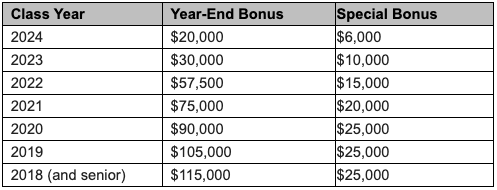
  • Class
    of
    2025

    $15,000
    /
    $6,000
    (prorated)
  • Class
    of
    2024

    $20,000
    /
    $6,000
  • Class
    of
    2023

    $30,000
    /
    $10,000
  • Class
    of
    2022

    $57,500
    /
    $15,000
  • Class
    of
    2021

    $75,000
    /
    $20,000
  • Class
    of
    2020

    $90,000
    /
    $25,000
  • Class
    of
    2019

    $105,000
    /
    $25,000
  • Class
    of
    2018

    $115,000
    /
    $25,000
  • Class
    of
    2017+

    $130,000
    /
    $25,000

In
addition
to
matching
both
the
year-end
and
the
special
bonus
scales,
the
firm
is
offering
bonuses
that
“may
be
increased
up
to
150%
of
the
year-end
bonus
amounts”
for
those
who
have
billed
“materially
more”
than
their
1900-hour
billable
expectation.

Congratulations
to
everyone
at
Ropes
&
Gray!

Remember
everyone,
we
depend
on
your
tips
to
stay
on
top
of
compensation
updates,
so
when
your
firm
announces
or
matches,
please
text
us
(646-820-8477)
or email
us
 (subject
line:
“[Firm
Name]
Bonus/Matches”).
Please
include
the
memo
if
available.
You
can
take
a
photo
of
the
memo
and
send
it
via
text
or
email
if
you
don’t
want
to
forward
the
original
PDF
or
Word
file.

And
if
you’d
like
to
sign
up
for
ATL’s
Bonus
Alerts
(which
is
the
alert
list
we
also
use
for
salary
announcements),
please
scroll
down
and
enter
your
email
address
in
the
box
below
this
post.
If
you
previously
signed
up
for
the
bonus
alerts,
you
don’t
need
to
do
anything.
You’ll
receive
an
email
notification
within
minutes
of
each
bonus
announcement
that
we
publish.
Thanks
for
your
help!


Staci
Zaretsky
 is
the
managing
editor
of
Above
the
Law,
where
she’s
worked
since
2011.
She’d
love
to
hear
from
you,
so
please
feel
free
to

email

her
with
any
tips,
questions,
comments,
or
critiques.
You
can
follow
her
on BlueskyX/Twitter,
and Threads, or
connect
with
her
on Lin

Milbank Holds Its Fire In 2025 Bonus Wars, Sparking Speculation Of A Compensation Power Move – Above the Law


Ed.
note
:
Welcome
to
our
daily
feature,

Quote
of
the
Day
.


If
any
firm
is
going
to
raise
Cravath,
it’s
going
to
be
a
firm
like
Milbank
or
a
firm
with
a
top-of-market
M&A
practice
.


David
Nicol,
head
of
the
US
practice
for
recruiting
firm
Marsden,
in
comments
given
to

Bloomberg
Law
,
concerning
Milbank’s
silence
thus
far
during
Biglaw’s
2025
bonus
season.
The
elite
firm
is
known
for
being
a
compensation
leader,
often
leading
the
pack
when
it
comes
to
salary
increases
and
bonus
announcements.


Staci
Zaretsky
 is
the
managing
editor
of
Above
the
Law,
where
she’s
worked
since
2011.
She’d
love
to
hear
from
you,
so
please
feel
free
to

email

her
with
any
tips,
questions,
comments,
or
critiques.
You
can
follow
her
on BlueskyX/Twitter,
and Threads, or
connect
with
her
on LinkedIn.

Tradespace Acquires Paragon, A Patent Drafting Startup Founded By Computer Science Students, to Round Out Its End-to-End IP Platform


Tradespace
,
the
San
Francisco-based
AI-powered
intellectual
property
management
platform,
has
acquired
Paragon,
an
AI
patent-drafting
startup
founded
by
three
Princeton
University
computer
science
students.

The
acquisition,
Tradespace
says,
makes
it
the
first
AI-powered
platform
to
support
the
complete
IP
lifecycle,
from
initial
invention
disclosure
through
patent
drafting,
prosecution,
portfolio
management
and
commercialization.

The
deal
brings
together
two
companies
with
complementary
missions
around
democratizing
access
to
patent
protection.

Tradespace
was
founded
in
2019
by
CEO

Alec
Sorensen
,
who
formerly
founded
and
led
the
IP
practice
at
the
management
consulting
firm
Avascent,
and
CTO

Kapil
Israni
,
an
engineer
and
entrepreneur,
while
Paragon
emerged
from
Princeton’s
computer
science
program
with
a
focus
on
addressing
the
accessibility
challenges
in
patent
drafting.

The
acquisition
was
announced
Nov.
10.

Paragon’s
Student
Founders

Paragon
CEO
and
co-founder

AbdurRahman
(AR)
Bhatti

first
envisioned
the
company
as
a
teenager
after
seeking
a
patent
for
his
own
invention,
and
by
his
sophomore
year
at
Princeton,
he
had
11
patents
to
his
name.

As
AI
technology
matured,
he
assembled
two
of
his
Princeton
classmates,
chief
technology
officer

Ethan
Haque

and
chief
engineer

Claire
Shin
,
to
create
a
platform
that
would
make
professional-grade
patent
drafting
more
accessible.

Princeton
University’s
Office
of
Innovation
supported
the
startup
and
offered
the
student
founders
access
to
past
invention
disclosures
to
train
their
algorithm,
allowing
them
to
test
their
drafting
capabilities
by
comparing
outputs
to
patents
that
were
actually
filed,
according
to

Craig
Arnold
,
Princeton’s
vice
dean
of
innovation
and
university
innovation
officer.

“In
line
with
our
educational
mission,
our
Technology
Licensing
team
recognized
the
potential
benefit
of
an
AI
patent-drafting
platform
and
offered
the
student
founders
access
to
a
curated
number
of
past
invention
disclosures
to
train
their
algorithm,”
Arnold
said.

Haque
and
Shin
graduated
from
Princeton
last
spring,
while
Bhatti
is
set
to
graduate
in
the
fall.
All
three
are
joining
Tradespace,
with
Bhatti
taking
on
the
role
of
head
of
product
for
patent
drafting,
while
Haque
and
Shin
join
as
senior
members
of
the
AI
research
team.

The
Patent-Drafting
Bottleneck

The
acquisition
targets
a
major
pain
point
in
the
IP
ecosystem,
Tradespace
says.
Traditional
patent
drafting
can
take
months
and
cost
tens
of
thousands
of
dollars,
creating
a
bottleneck
that
prevents
many
innovations
from
being
protected.
This
is
particularly
challenging
as
organizations
face
mounting
pressure
to
accelerate
innovation
while
managing
legal
costs.

Using
AI
agents,
Paragon
generates
accurate,
defensible
patent
drafts
with
full
traceability
to
source
materials,
giving
R&D
and
IP
teams
confidence
that
every
claim,
citation
and
technical
detail
can
be
verified
and
defended.

The
company
says
that
the
platform
is
distinct
from
other
AI
patent
tools
because
it
keeps
users
in
control
at
every
decision
point,
with
verification
checkpoints
designed
to
maintain
professional
IP
standards

an
important
factor
for
legal
professionals
who
may
have
concerns
about
trusting
AI
with
high-stakes
work.

“When
I
founded
Tradespace,
the
vision
was
clear:
empower
organizations
to
develop,
protect,
and
commercialize
ideas
at
a
much
greater
scale,”
said
Sorensen.
“In
acquiring
Paragon,
we
are
investing
not
only
in
democratizing
the
patent
drafting
process,
but
in
building
an
approach
to
legal
AI
that
works
alongside
IP
teams
with
the
same
levels
of
trust,
transparency
and
expertise
they
would
get
from
an
attorney.”

Tradespace’s
Evolution

Sorensen
co-founded
the
company
in
2017
after
spending
years
in
management
consulting,
working
with
Fortune
500
companies,
private
equity
firms
and
government
labs
to
analyze
and
commercialize
their
IP.

The
company
announced
$4.2
million
in
seed
funding
in
November
2023,
led
by
Eniac
Ventures
with
participation
from
Abstract
Ventures,
Amplo
VC,
and
Scrum
Ventures,
bringing
its
total
funding
to
$5.2
million.

That
funding
round
coincided
with
the
release
of
its
AI-powered
IP
Management
Platform,
which
the
company
said
was
trained
on
the
largest
dataset
of
open-source
and
proprietary
IP
data.

At
the
time
of
that
2023
funding
round,
Tradespace
said
it
had
generated
over
$100
million
in
IP
commercialization
revenue
for
customers
including
America’s
Frontier
Fund,
BAE
Systems,
and
the
Department
of
Defense.
Other
clients
of
the
company
include
AGC,
leading
research
institutions
like
the
Department
of
Energy,
MITRE,
and
Northeastern
University,
as
well
as
companies
like
8×8.

With
Paragon
integrated
into
its
platform,
Tradespace
plans
to
draft
10,000
patents
through
the
platform
in
the
next
18
months

an
ambitious
target
that
signals
the
company’s
confidence
in
scaling
AI-assisted
patent
drafting.

For
Bhatti,
the
acquisition
represents
the
best
path
to
maximize
impact.
“For
me,
it’s
always
just
been
about
where
this
technology
is
going
to
serve
the
most
people,”
he
said.

“We
wanted
to
make
patent
drafting
accessible
to
innovators
who
needed
it.
Joining
Tradespace
makes
sense
as
a
natural
fit

we
get
to
integrate
as
a
link
in
the
chain
of
what
is
already
a
really
strong
product.”

The
Bottom
Line

Tradespace’s
acquisition
of
Paragon
is
interesting
in
and
of
itself,
but
also
because
it
reflects
three
broader
trends
related
to
AI
in
legal:

  • The
    growing
    number
    of
    companies
    that
    are
    moving
    beyond
    point
    solutions
    toward
    more-comprehensive
    platforms
    that
    address
    entire
    workflows.
  • The
    changing
    economics
    of
    patent
    protection,
    whereby
    AI
    can
    lower
    the
    cost
    of
    patent
    drafting
    and
    potentially
    open
    patent
    protection
    to
    a
    broader
    range
    of
    inventors.
  • The
    importance
    of
    incorporating
    transparency
    and
    traceability
    in
    the
    design
    of
    AI
    products,
    to
    address
    legal
    professionals’
    concerns.

There
is
also
the
human-in-the-loop
issue,
which
is
why
it
is
notable
that
Paragon
says
its
agents
work
alongside
users
and
keep
them
in
control
at
every
decision
point.

“This
human-AI
collaboration
addresses
the
legal
industry’s
biggest
concern:
trusting
AI
with
high-stakes
professional
work,”
the
company
says.

International Firm’s Former London Managing Partner Facing Sexual Harassment Investigation – Above the Law

The
spotlight
is
on
Jeffrey
Bronheim,
the
former
London
managing
partner
of
Cohen
&
Gresser,
who
is
now
under
investigation
by
the
U.K.’s
Solicitors
Regulation
Authority
(SRA).
And
if
you
thought
this
was
going
to
be
a
mild
HR
hiccup,
buckle
up:
according
to

reporting
from

Law.com,
the
allegations
include
sexual
harassment,
repeated
inappropriate
conduct,
and
a
pattern
of
behavior
that
made
multiple
women
at
the
firm
uncomfortable.

Sources
told
Law.com
that
Bronheim
allegedly
engaged
in
sexual
harassment
of
a
staff
member
on
multiple
occasions
between
2022
and
2023.
The
conduct
reportedly
included
both
verbally
inappropriate
comments
and
physically
inappropriate
behavior.
There
are
also
claims
that
Bronheim
made
unwanted
physical
contact,
purchased
or
discussed
“items
of
a
personal
nature,”
and
acted
inappropriately
toward
other
female
staff.
Several
women
also
reported
feeling
excluded
from
work-related
social
gatherings
because
of
his
behavior

which
is
certainly
one
way
to
poison
a
workplace
culture.

According
to
a
spokesperson,
when
they
firm
learned
of
the
allegations
they
“initiated
a
thorough,
independent
investigation,
which
included
interviews
of
every
current
employee
and
partner
with
knowledge
of
the
facts
and
circumstances,”
and
he
was
“immediately
removed
as firm managing
partner.”

The
spokesperson
continued
that
Bronheim
“was
instructed
to
work remotely,
and was
restricted
from
attending
in-person
firm
activities
while
the
matter
was
under
review,”
and
he
was
required
to
“undergo
one-on-one
sensitivity
coaching.”

“[Bronheim]
subsequently
chose
not
to
return
to
the
office
as
a
partner
and
instead
requested
to
transition
to
an
external
part-time
consulting
role,
which
the
firm’s
management
accepted,”
the
firm’s
statement
read. 

But
Bronheim
insists
it
wasn’t
a
demotion
from
partner,
but
a
career
choice
he
made.
As
Bronhem
told
Law.com,
“In
fact,
the
investigation
concluded
and
I
was
scheduled
to
return
to
the
office.
Instead,
I
decided
to
resign
my
London
partnership
while
remaining
a
part-time
consultant
to
the
New
York
office
of
the
firm
and pursuing
other
interests
in
London.”

However,
this
chapter
of
Bronheim’s
story
isn’t
over.
There’s
still
the
matter
of
the
SRA
investigation.
Cohen
&
Gresser
self-reported
to
the
regulators
and
turned
over
their
250-page
report
on
the
matter.
An
SRA
spokesperson
said,
“We
are
investigating
this
matter,
before
deciding
on next steps.”


Kathryn
Rubino
is
a
Senior
Editor
at
Above
the
Law,
host
of

The
Jabot
podcast
,
and
co-host
of

Thinking
Like
A
Lawyer
.
AtL
tipsters
are
the
best,
so
please
connect
with
her.
Feel
free
to
email

her

with
any
tips,
questions,
or
comments
and
follow
her
on
Twitter

@Kathryn1
 or
Mastodon

@[email protected].

Elite Boutique Announces Associate Bonuses That Completely Blow The Market Scale Out Of The Water – Above the Law

Biglaw
bonus
season
is
in
full
swing,
with
firms
stepping
in
left
and
right
to
match

Cravath’s
year-end
bonuses

and

Milbank’s
special
bonuses
,
but
things
are
about
to
get
even
hotter,
because
one
of
the
boutiques
is
here
to
play.
This
firm
went
over
the
top
in
a
major
way

including
on
their
bigger
and
better
special
bonuses.

Yesterday
afternoon,
D.C.-based
litigation
boutique
Wilkinson
Stekloff announced
year-end
bonuses
that
are
150%
of
market
bonuses.
On
top
of
those
bonuses,
let’s
not
forget
that
the
firm
announced

their
own
set
of
special
bonuses

back
in
April

ranging
from
$25,000
to
$60,000

before
Milbank’s
special
summer
bonuses
were
even
in
play.
This
is
what
the
firm’s
incredibly
generous
bonus
scale
looks
like:


Class
Year

Year-End
Bonus

Spring
Bonus

Total
Bonus
2025 $22,500 N/A $22,500
2024 $30,000 $25,000 $55,000
2023 $45,000 $30,000 $75,000
2022 $86,250 $35,000 $121,250
2021 $112,500 $40,000 $152,500
2020 $135,000 $45,000 $180,000
2019 $157,500 $50,000 $207,500
2018 $172,500 $55,000 $227,500
2017+ $172,500 $60,000 $232,500

Associates
at
Wilkinson
will
be
earning
$1,500
to
$87,500+
more
than
those
at
Biglaw
firms
on
the
market
bonus
scale.
Now


THESE

are
big-time
bonuses!

“As
we
approach
the
firm’s
10th year
anniversary
in
January,
the
firm
continues
to
grow
and
evolve
while
staying
true
to
its
founding
principles
of
providing
exceptional
client
service
in
high
stakes
litigation
and
developing
the
next
generation
of
trial
lawyers,”
Brian
Stekloff,
the
firm’s
founding
partner,
shared
in
a
message
to
all
of
his
colleagues
at
the
firm.
“We
are
deeply
proud
of
the
results
you
deliver,
including
in
many
impactful
pro
bono
matters.”

Associates
will
receive
their
bonuses
on
December
15.
Counsel
bonuses
will
be
communicated
separately.

Congratulations
to
everyone
at
Wilkinson
Stekloff!

Remember
everyone,
we
depend
on
your
tips
to
stay
on
top
of
compensation
updates,
so
when
your
firm
announces
or
matches,
please
text
us
(646-820-8477)
or email
us
 (subject
line:
“[Firm
Name]
Bonus/Matches”).
Please
include
the
memo
if
available.
You
can
take
a
photo
of
the
memo
and
send
it
via
text
or
email
if
you
don’t
want
to
forward
the
original
PDF
or
Word
file.

And
if
you’d
like
to
sign
up
for
ATL’s
Bonus
Alerts
(which
is
the
alert
list
we
also
use
for
salary
announcements),
please
scroll
down
and
enter
your
email
address
in
the
box
below
this
post.
If
you
previously
signed
up
for
the
bonus
alerts,
you
don’t
need
to
do
anything.
You’ll
receive
an
email
notification
within
minutes
of
each
bonus
announcement
that
we
publish.
Thanks
for
your
help!


Staci
Zaretsky
 is
the
managing
editor
of
Above
the
Law,
where
she’s
worked
since
2011.
She’d
love
to
hear
from
you,
so
please
feel
free
to

email

her
with
any
tips,
questions,
comments,
or
critiques.
You
can
follow
her
on BlueskyX/Twitter,
and Threads, or
connect
with
her
on LinkedIn.

Morning Docket: 11.20.25 – Above the Law

*
“If
you
kill
this
witness,
the
case
will
be
dismissed,”
advised
attorney.
Man,
these
MPRE
hypos
are
getting
super
easy.
[Toronto
Star
]

*
Trump
signs
bill
to
release
the
Epstein
files.
Unclear
if
he
drew
a
woman’s
curves
around
it
before
signing
this
time.
[Reuters]

*
Texas
governor
demands
action
on
Sharia
Law,
so
you
know
it’s
a
bad
news
cycle
for
him.
[KXAN]

*
White
House
suggests
executive
order
to
block
state
AI
regulations,
which
is
not
how
the
Constitution
works.
[Axios]

*
State
AGs
want
social
media
addiction
handled
in
one
trial
so
they
aren’t
constantly
scrolling
for
updates.
[Law360]

*
Harvard
releases
digitized
collection
of
Nuremberg
Trials.
[Law.com]

*
Shilo
Sanders
sued
by
Barnes
&
Thornburg
for
unpaid
bills.
[NY
Post
]