Conservative Warning To Judges: Get On Board With Trump’s Agenda Or Get Impeached – Above the Law

The
Federalist
Society’s
annual
lawyers
meeting
is
going
on
in
Washington
D.C.,
and
yesterday
there
was
a
panel
on
Judicial
Oversight
of
District
Courts
after

Trump
v.
CASA
,
limiting
lower
courts’
ability
to
issue
universal
injunctions
to
block
the
enforcement
of
policies.
Though
conservatives
won
that
case,
and
have
a

wildly
partisan
win
rate

at
the
Supreme
Court,
panelist
Chad
Mizelle,
former
chief
of
staff
to
the
Attorney
General,
still
finds
plenty
to
complain
about.

Mizelle’s
comments
called
out
district
courts
that
have
tried
to
place
constitutional
speed
bumps
on
the
Trump
agenda.
Like
his
former
boss,
Mizelle
says
these
are
liberal
judges
that
aren’t
acting
in
good
faith
(never
mind
that

Reagan-appointed
judges

are
leading
the
charge).
And
he
knows
what
we
should
do
about
it.
Impeach
them.

Politico

reports

on
Mizelle’s
comments:

“What’s
going
to
force
the
Supreme
Court to
do
something
is
fundamentally
political
pressure.
It’s
going
to
be
when
Congress
starts
impeaching
judges
and
saying

‘You
are
now
encroaching
into
our
territory,’”
Mizelle
said
during a
panel
discussion at
the
Federalist
Society’s
annual
lawyers’
meeting
in
Washington.

Mizelle’s
impeachment
battle
cry followed
a
somewhat
cryptic
story
he
shared
that
appeared
to
involve
an
implicit
threat
his
father
once
issued
to
put
down
a
stray
cat
in
the
family’s
yard.

“What
do
I
think
DJT
should
do? He
should
stand
up,
and
he’s
already
done
this,
and
say,
‘Judges,
I
know
how
to
deal
with
stray
cats,’”
said
Mizelle,
who
served
as
acting
associate
AG
and
chief
of
staff
to
AG Pam
Bondi before
stepping
down
last
month.
(Mizelle’s
wife, Kathryn
Kimball
Mizelle, is
a
Trump-appointed
federal
district
court
judge
in
Florida.)

Of
course,
there
are
problems
with
this
strategy.
Put
aside
the
massive
hit
this
would
cause
to
the
rule
of
law,
but
as
a
matter
of
logistics,
this
is
nothing
more
than
an
empty
threat.
Remember,
it’s
not
that
easy
to
kick
someone
out
of
their
lifetime
appointment.
In
order
to
actually
remove
a
federal
judge
from
the
bench,
you
need
60
senators
to
vote
to
convict
the
jurist

and
refusing
to
rubber
stamp
a
far-right
policy
agenda
isn’t
going
to
have
the
votes.
(Hell,
even
before
you
get
to
the
Senate’s
trial
part
of
an
impeachment,
Mike
Johnson
would
have
to
call
the
House
of
Representatives
back
from
recess,
and

who
knows
when
that
will
be
.)

Yet
it’s
important
to
note
that
the
impeachment
option
is
so
freely
bandied
about.
We
now
live
in
a
world
of

political
retribution
,
and
this
is
merely
another
way
conservatives
are
trying
to
apply
pressure
to
eliminate
the
opposition
to
their
agenda.
Even
if
the
opposition
is
rooted
in
constitutional
concerns.

Mizelle’s
words
are
chilling,
and
they
don’t
exist
in
a
vacuum.
There’s
a
sharp
increase
in
threats
against
federal
judges
— up
327%
 in
the
Trump
II
era.
Though
Mizelle
means
treating
judges
who
dare
to
question
the
far-right
agenda
like
“stray
cats”
is
impeachment,
it’s
easy
to
see
how
an
extremist
might
take
the
words
more
literally.



Kathryn
Rubino
is
a
Senior
Editor
at
Above
the
Law,
host
of

The
Jabot
podcast
,
and
co-host
of

Thinking
Like
A
Lawyer
.
AtL
tipsters
are
the
best,
so
please
connect
with
her.
Feel
free
to
email

her

with
any
tips,
questions,
or
comments
and
follow
her
on
Twitter

@Kathryn1
 or
Mastodon

@[email protected].

CLOC Restructures Board, Expanding to 16 Members and Adding Legal Tech Vendors for First Time

The

Corporate
Legal
Operations
Consortium

(CLOC)
today
announced
a
major
expansion
and
restructuring
of
its
board
of
directors,
expanding
it
from
nine
to
16
members,
the
largest
increase
in
the
organization’s
10-year
history.

In
a
significant
policy
shift
for
the
organization,
CLOC
is
formally
adding
legal
technology
and
service
providers
to
its
board
for
the
first
time,
alongside
in-house
legal
operations
professionals.
The
move
reflects
what
the
organization
calls
a
commitment
to
bringing
“all
stakeholders
to
the
table”
to
drive
industry
transformation.

“This
leadership
lineup
underscores
our
commitment
to
representing
a
broad
range
of
perspectives
across
industries,
regions
and
experiences,
and
to
advancing
the
practice
of
legal
operations
on
a
truly
global
scale,”
said
Oyango
Snell,
CLOC’s
executive
director,
in
an
announcement.

Along
with
the
board
expansion,
CLOC
is
modernizing
its
governance
structure
by
introducing
two
new
roles,
board
chair
and
chair-elect,
and
transitioning
to
an
entirely
volunteer
board.
The
organization
is
also
reconstituting
the
position
of
executive
director
as
president
and
CEO
to
align
with
association
best
practices
and
support
its
6,500
global
members.

“In
the
AI
era,
shaping
the
future
of
legal
operations
requires
our
collective
ingenuity,”
said
Áine
Lyons,
CLOC
president
and
SVP
and
deputy
general
counsel
at
Workday.
“These
governance
updates
go
beyond
expanding
our
board;
they
are
a
fundamental
realignment
for
impact.”

CLOC’s
New
Board

The
new
board,
which
begins
its
term
in
January
2026,
includes
two
legal
technology
vendor
executives
and
one
legal
services
executive
among
the
11
newly
elected
directors:

  • Jerry
    Levine,
    chief
    evangelist
    and
    general
    counsel
    at
    ContractPodAI.
  • Colin
    Levy,
    general
    counsel
    at
    Malbek.
  • Richard
    Robinson,
    director
    of
    client
    success
    at
    Epiq.

Other
new
members
of
CLOC’s
board
are:

  • Mark
    Allen,
    director
    of
    legal
    and
    compliance
    operations,
    Zillow.
  • Donovan
    Bell,
    senior
    director,
    head
    of
    global
    operations,
    corporate
    affairs,
    policy,
    integrity,
    trade
    and
    and
    legal,
    Intel.
  • Alex
    Gao,
    senior
    director,
    legal
    operations,
    Hilton
    Worldwide
    Corporation.
  • Kurt
    Grasinger,
    legal
    operations
    and
    outside
    counsel
    manager,
    Meta.
  • Stacy
    Lettie,
    chief
    of
    staff
    to
    the
    general
    counsel,
    Organon.
  • Carl
    Morrison,
    senior
    manager,
    legal
    operations,
    Otsuka
    America
    Pharmaceutical
    Inc.
  • Kirsten
    Taitelbaum,
    vice
    president,
    head
    of
    legal
    operations
    and
    chief
    of
    staff,
    Sutter
    Health.
  • Darth
    Vaughn,
    associate
    general
    counsel
    and
    managing
    director,
    policy
    and
    legal
    operations,
    Ford
    Motor
    Company

In
addition
to
CLOC
President
Lyons,
current
members
who
will
continue
on
the
board
are:

  • Frances
    Pomposo,
    senior
    director,
    head
    of
    legal
    operations,
    and
    chief
    of
    staff
    to
    the
    chief
    legal
    officer,
    Intuitive.
  • Laura
    Dieudonné,
    legal
    operations
    and
    administration
    director,
    Delta
    Air
    Lines.
  • Adam
    Becker,
    director,
    legal
    operations,
    Cockroach
    Labs.

“The
2026
board
brings
together
a
diverse,
powerful
slate
of
legal
operations
leaders,
in-house
counsel,
and
technology
innovators
to
drive
the
organization’s
long-term
strategy
and
impact,”
the
organization
said.

First-Year Student At Elite Law School Is Making Better-Than-Biglaw Money Posting Adult Content Online – Above the Law


Ed.
note
:
Welcome
to
our
daily
feature,

Quote
of
the
Day
.


Everyone
here
is
really
respectful
and
fantastic.
I
haven’t
had
any
negative
experiences.


Emily
Cocea
,
a
first-year
student
at
the
University
of
Michigan
Law
School,
in
comments
given
to

People
,
concerning
her
experience
at
the
T14
law
school.
Cocea
has
what
the
magazine
refers
to
as
an
“unconventional
side
profession”:
she
earns
$1.5
million
a
year
posting
and
selling
adult
content
online.
She
has
dreams
of
becoming
a
public
defender
after
graduating
from
law
school.


Staci
Zaretsky
 is
the
managing
editor
of
Above
the
Law,
where
she’s
worked
since
2011.
She’d
love
to
hear
from
you,
so
please
feel
free
to

email

her
with
any
tips,
questions,
comments,
or
critiques.
You
can
follow
her
on BlueskyX/Twitter,
and Threads, or
connect
with
her
on LinkedIn.

Prosecutorial Error: ‘AI Hallucinations’ Are Popping Up In Criminal Cases – Above the Law

When
it
comes
to
public
defense,
it
seems
like
the
only
news
is
bad
news.
We
are
seeing
nationwide
shortages
of
public
defenders.
In
some
places,
the
demand
for
public
defenders
is
so
dire
that
their

workload
has
become
a
constitutional
issue

and
people
are
being
allowed
to
walk
because
no
one
is
there
to
represent
them:

As
far
as
the
other
side?
I’ll
put
it
this
way:
they
have
so
many
resources
that
they
can
afford
to
prosecute
someone
for
throwing
a
sandwich.
With
all
the
time
and
discretion
on
their
hands,
you’d
imagine
that
prosecutors
are
taking
their
time
to
do
the
paperwork
required
to
send
someone
to
jail.
Turns
out
even
they
are
being
swayed
by
the
large
language
modeling
of
all
things
legal.
And
while
that
might
be
cool
when
it
comes
to
grunt
work,
human
intelligence
should
be
in
the
driver’s
seat
on
matters
of
fundamental
liberty.

Gov
Tech

has
coverage:

Northern
California
prosecutors
used
artificial
intelligence
to
write
a
criminal
court
filing
that
contained
references
to
nonexistent
legal
cases
and
precedents,
Nevada
County
District
Attorney
Jesse
Wilson
said
in
a
statement.

“A
prosecutor
recently
used
artificial
intelligence
in
preparing
a
filing,
which
resulted
in
an
inaccurate
citation,”
Wilson
said
in
the
statement
to
The
Sacramento
Bee.
“Once
the
error
was
discovered,
the
filing
was
immediately
withdrawn.”

As
bad
as
this
is,
the
harms
could
be
managed
if
it
were
a
one-off.
Unfortunately,
it
looks
like
we’re
starting
at
serial
prosecutorial
error:

“The
Nevada
County
District
Attorney’s
Office
has,
in
at
least
three
criminal
cases
in
recent
weeks,
filed
briefing
citing
to
fabricated
(legal)
authority,”
wrote
lawyers
for
the
nonprofit
Civil
Rights
Corps,
which
is
representing
Kjoller
along
with
a
Nevada
County
public
defender.

While
we’re
on
the
topic
of
prosecutorial
error,
few
things
should
set
off
bigger
alarms
than
repeated
Brady
violations.
Lazy
AI
usage
pales
in
comparison
to
the
shame
of

over
200
people
being
sentenced
to
death
because
prosecutors
withheld
exonerating
evidence
.
Nonetheless,
it
blows
my
mind
that
the
team
that
is
already
in
the
lead
on
resources
is
using
shortcuts
to
get
guilty
pleas
and
verdicts.


Maybe

it
should
be
fair
game
to
let
ChatGPT
do
part
of
being
a
lawyer
for
you.
But
whenever
you
submit
your
filings,
whatever
is
in
them
should
be
on
you.
That’s
your
responsibility,
regardless
of
whether
an
intern
or
a
large
language
model
got
sloppy
and
made
up
a
case
to
make
it
easier
for
you
to
imprison
someone.


California
Prosecutor
Says
AI
Caused
Errors
in
Criminal
Case

[Gov
Tech]


Earlier
:

Public
Defender
Schedules
Are
So
Swamped
It
Probably
Isn’t
Constitutional


Chris
Williams
became
a
social
media
manager
and
assistant
editor
for
Above
the
Law
in
June
2021.
Prior
to
joining
the
staff,
he
moonlighted
as
a
minor
Memelord™
in
the
Facebook
group Law
School
Memes
for
Edgy
T14s
.
 He
endured
Missouri
long
enough
to
graduate
from
Washington
University
in
St.
Louis
School
of
Law.
He
is
a
former
boatbuilder
who
is
learning
to
swim, is
interested
in
critical
race
theory,
philosophy,
and
humor,
and
has
a
love
for
cycling
that
occasionally
annoys
his
peers.
You
can
reach
him
by
email
at [email protected]
and
by
tweet
at @WritesForRent.

Trump Defends Sacred Right To Starve Kids For Separation Of Powers – Above the Law

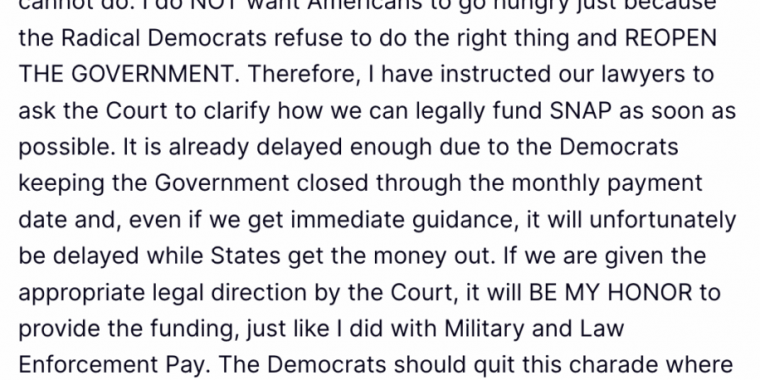
On
Halloween,
President
Trump
announced
that,
if
ordered
to
by
a
court,
“it
will
BE
MY
HONOR”
to
fund
SNAP
benefits
and
feed
the
41
million
Americans
who
rely
on
them.

Turns
out

not
so
much.
Instead
the
Trump
administration
opted
to
defy
an
order
by
Judge
John
McConnell,
Jr.
in
Rhode
Island
to
get
the
money
out
to
hungry
Americans.

Specifically,
on
November
1,
the
court

directed

the
Department
of
Agriculture
to
either
tap
into
a
$23
billion
reserve
fund
for
Child
Nutrition
Programs
and
fully
fund
November
SNAP
entitlements,
or
use
$4.6
billion
in
SNAP
reserves
to
make
an
immediate
partial
payment
to
the
states.

The
USDA
opted
to
do
neither,
instead
docketing
a

declaration

claiming
to
have
transmitted
“revised
issuance
tables
to
State
agencies,”
transferring
the
obligation
to
individual
states
to
rejigger
and
resubmit
their
own
funding
requests.

“As
is
required
by
Federal
law,
after
receiving
notice
from
FNS,
State
agencies
must
recode
their
eligibility
systems
to
adjust
for
the
reduced
maximum
allotments,”
the
government
wrote,
adding
that
“For
at
least
some
States,
USDA’s
understanding
is
that
the
system
changes
States
must
implement
to
provide
the
reduced
benefit
amounts
will
take
anywhere
from
a
few
weeks
to
up
to
several
months.”

Judge
McConnell
hit
the
roof.
At
a

hearing

on
Thursday,
he
scoffed
at
the
DOJ’s
suggestion
that
it
couldn’t
possibly
tap
the
Child
Nutrition
Programs,
which
are
fully
funded
through
June,
without
starving
children.
He
called
the
DOJ’s
protests
“entirely
pretextual
given
the
numerous
statements
made
in
recent
weeks
by
the
president
and
his
administration
officials
who
admit
to
withholding
full
SNAP
benefits
for
political
reasons.”

He
followed
up
the
oral
order
with
a

written
TRO

instructing
the
USDA
to
tap
the
emergency
funds
immediately.
Instead,
the
administration
raced
to
the
First
Circuit
and

demanded

immediate
relief
from
“this
unprecedented
injunction
[that]
makes
a
mockery
of
the
separation
of
powers.”
The
government
requested
a
ruling
by
4
p.m.,
teeing
up
yet
another
request
for
“emergency
relief”
at
SCOTUS.
The
states
submitted
their

response
,
arguing
that
the
trial
court

did
not

abuse
its
discretion
when
it
ordered
the
government
to
feed
people.

So
now
it’s
on
the
First
Circuit
to
decide
if
allowing
41
million
people
to
go
hungry
is
arbitrary
and
capricious
or
simply
a
president
virtuously
guarding
his
prerogatives
and
the
federal
fisc.

And
then
it’s
on
to
SCOTUS
to
see
if
there
are
five
votes
for
the
theory
that
separation
of
powers
requires
courts
to
let
the
president
starve
people
as
a
tool
to
bludgeon
his
political
enemies.


As
the
Founders
intended!


Liz
Dye
 lives
in
Baltimore
where
she
produces
the
Law
and
Chaos substack and podcast.

Get A Grip: Focusing On Risks Instead Of Benefits Is Making AI Way Too Hard – Above the Law

In
case
anyone
hasn’t
been
listening
carefully,
Comment
8
to
Model
Rule
1.1
requires
lawyers
to
understand
not
just
the risks of
technology,
but
the benefits
and
the
word
“benefits”
appears
first.
We
have
an
ethical
duty
(yes,
duty)
to
understand
and
leverage
the
benefits
of
technology.


Ethics
and
Benefits

Let’s
talk
about
the
notion
of
benefits.
Comment
8
to
Model
Rule
1.1,
is
the
oft
cited
source
when
people
preach
about
risks
and
technology.
But
in
doing
so,
they
ignore
the
additional
requirement:

To
maintain
the
requisite
knowledge
and
skill,
a
lawyer
should
keep
abreast
of
changes
in
the
law
and
its
practice,
including

the
benefits

and
risks
associated
with
relevant
technology,
engage
in
continuing
study.

Not
only
does
the
word
benefits
appear,
but
it
also
actually
appears
first.

Comment
8
has
been
adopted
in
most
states
and
even
where
it
hasn’t
been,
there
seems
to
be
little
question
that
competency
these
days
requires
the
consideration
and
use
of
technology.
And
to
be
competent
can’t
mean
wringing
our
hands
over
the
risks
of
technology
and
concluding
it
shouldn’t
be
used.
Understanding
benefits
and
taking
advantage
of
them
is
an
ethical
requirement.

And
the
word
benefits
means
the
positive
capabilities
of
technologies
like
AI
to
improve
the
practice.
Things
like
using
technology
to
do
things
to
efficiently
and
save
costs,
using
things
like
AI
to
enhance
client
service,
using
things
like
data
analytics
for
better
insights
and
outcomes,
predicting
case
outcomes
and
judicial
tendencies,
better
use
of
technology
in
the
courtroom
to
achieve
better
outcomes
for
clients,
preventative
lawyering. 
I
could
go
on
and
on.

But
that
message
gets
lost,
particularly
at
legal
tech
conferences.


Legal
Tech
Conference
Speak

A
friend
of
mine
was
a
recent
speaker
at
a
legal
AI
conference.
Speaking
last,
my
friend
noticed
that
every
speaker
focused
on
the
risks
and
dangers
of
using
AI.
You
know
the
drill:
hallucinations,
loss
of
confidentiality,
the
need
for
accurate
prompts,
the
need
to
check
the
outputs,
etc.
My
friend
took
a
different
tack
and
talked
about
what
AI
could
do.
How
it
could
be
used
to
be
more
efficient,
precise,
and
accurate
in
particular
practice
areas.

I
was
the
first
speaker
at
a
recent
legal
AI
conference
as
well.
I
spoke
about
ethics
and
AI;
toward
the
end
of
my
talk,
I
realized
I
also
had
not
spent
enough
time
talking
about
our
ethical
duty
to
understand
and
leverage
the
benefits.

Of
course,
I
was
followed
by
a
slew
of
people
doing
just
what
the
speakers
at
my
friend’s
conference
did:
talking
about
the
problems,
the
risks,
the
needs
for
cautions.
Some
were
vendors
who
seemed
to
be
saying
something
like
“Lawyers
don’t
try
this
at
home.
AI
should
only
be
used
in
conjunction
with
a
licensed
professional.”

Of
course,
the
vendors
weren’t
licensed
professionals
in
the
true
sense.
But
the
message
was
clear,
lawyers
shouldn’t
use
AI
without
the
help
of
someone
who
really
knows
what
they
are
doing.

But
that
message
directly
leads
lawyers
to
shy
away
from
such
a
“dangerous”
tool.


The
Only
Thing
You
Need
to
Know
Is
That
There’s
Not
That
Much
to
Know

And
it’s
wrong.
I
have
another
friend
who
is
not
a
lawyer
but
who
hires
them.
She
uses
ChatGPT
extensively
for
all
sorts
of
things.
When
I
told
her
about
my
conference,
she
scoffed:
“The
only
thing
you
need
to
know
about
AI
is
there
is
really
not
that
much
to
know.”
She
meant
of
course
that
us
lawyers
tend
to
get
all
balled
up
in
how
many
angels
(or
risks)
can
dance
on
the
head
of
a
pin
and
we
don’t
just
roll
up
our
sleeves
and
use
the
product,
learning
as
we
go.


Get
A
Grip

Get
a
grip.
The
truth
is
there
are
only
a
couple
of
things
you
need
to
know
about
using
AI:

  • It
    makes
    mistakes.
    Check
    the
    results.
  • Don’t
    put
    client
    confidences
    in
    it.

I’m
amazed
how
we
make
this
so
complicated.
No
one
in
their
right
mind
would
put
their
client
confidences
in
a
Google
search.
No
lawyer
in
their
right
mind
would
take
the
websites
that
Google
provides
in
response
to
a
search
and
use
them
without
reviewing
the
site.

Yes,
there
have
been
numerous
instances
of
lawyers
taking
the
results
of
prompts
and
not
checking
the
cites,
to
later
get
embarrassed.
Yes,
it
shouldn’t
happen.
Yes,
they
were
dumb.

But
how
many
examples
are
there
of
dumb
lawyers
commingling
funds,
using
client
funds
for
their
own
expense,
violating
conflict
of
interest
standards,
missing
deadlines,
and
plain
incompetence
out
there?
Happens
every
day
but
we
don’t
say
using
bank
accounts
is
too
risky
because
a
dumb
lawyer
might
commingle
funds.
It’s
the
missed
cites
that
get
all
the
attention.

Here’s
a
good
example:
a
recent

AP
article

reported
a
French
data
scientist
and
lawyer
has
catalogued
at
least
490
court
fillings
in
the
past
six
months
with
hallucinations.
But
buried
in
the
article
was
the
fact
that
the
majority
of
instances
occurred
in
cases
where
the
plaintiffs
were
representing
themselves
instead
of
being
represented
by
lawyers.
That
fact
got
lost
in
the
headlines.

Bottom
line,
we
can’t
let
the
fact
that
there
are
dumb
lawyers
making
stupid
mistakes
blind
us
to
the
benefits
that
AI
brings.


How
to
Get
There

Another
point:
don’t
get
hung
up
on
thinking
the
tools
are
too
hard
and
complicated
to
use
as
some
would
have
you
believe.
Start
by
using
the
tools
for
anything
and
everything.
Start
with
personal
and
inconsequential
stuff.
Then
build.
It’s
on-the-job
training.

You
don’t
learn
to
play
the
guitar
by
reading
all
the
risks
of
an
electric
guitar.
You
learn
by
playing
it.
Or
trying
to
until
you
become
competent.
You
didn’t
learn
how
to
try
a
case
well
by
reading
about
it.
You
learned
by
trying
cases.
By
making
mistakes.


It’s
All
About
Our
Clients

And
make
no
mistake,
when
we
talk
about
our
ethical
duty
of
competency
that
requires
understanding,
being
aware
of,
and
taking
advantage
of
technology,
we
are
also
talking
about
something
else:
our
ethical
duty
to
benefit
our
clients,
not
just
ourselves.
We
are
talking
about
things
like
making
our
fees
reasonable
(Model
Rule
1.5),
rendering
candid
and
professional
advice
(Model
Rule
2.1),
keeping
our
clients
informed
(Model
Rule
1.4),
acting
with
reasonable
diligence
and
dedication
to
the
interests
of
our
clients
(Model
Rule
1.3),
and
serving
our
clients
best
interests.

If
you
can
use
AI
to
get
to
a
better
legal
answer
to
a
thorny
litigation
question
in
a
fraction
of
the
time
and
more
timely
advise
your
client
of
the
accompanying
risks
and
exposure,
your
client
is
the
beneficiary.
And
it
is

or
should
be

all
about
them.


So,
What’s
the
Point
Really?

Yes,
we
have
to
know
the
risks.
But
we
can’t
be
blind
to
the
benefits
of
things
like
AI.
Getting
to
these
benefits
doesn’t
require
a
host
of
consultants
or
years
of
study
and
handwringing.
It
means
getting
a
rudimentary
knowledge
of
the
tools
and
then
using
the
tools
to
wrap
your
arms
around
how
they
can
benefit
you
in
your
practice.
That
takes
a
little
time
and
effort,
but
the
benefits
can
be
worth
it.

And
just
remember
two
things:
don’t
put
client
confidences
in
a
prompt
and
check
cites.
That’s
pretty
much
all
you
need
to
know.

Now
let’s
get
to
work.
Open
up
an
AI
tool
and
ask
it
a
question.
Ask
it
to
do
something
for
you.
You
might
be
amazed
what
you
will
get.


Stephen
Embry
is
a
lawyer,
speaker,
blogger,
and
writer.
He
publishes TechLaw
Crossroads
,
a
blog
devoted
to
the
examination
of
the
tension
between
technology,
the
law,
and
the
practice
of
law
.

ATL’s Legally Themed Halloween Costume Contest: The Finalists (2025) – Above the Law

Just
before
Halloween,
we
asked
our
readers
to
submit
their
legally
themed
costumes
to
us
for
our
annual
contest.
We
got
a
great
crop
of
entries,
and
there
even
some
creative
costumes
related
to
political
pop
culture.
We
think
you’re
going
to
like
them
a
lot.

We’ve
got
three
awesome
finalists
for
you
to
choose
from,
and
voting
starts
today.
Who
will
be
the
winner
of
the
sixteenth
year
of
our
competition?

But
before
we
get
to
our
finalists,
we’ve
got
a
super-cute
honorable
mention.
Aww,
it’s
none
other
than
Ruth
Baby
Ginsburg.

The
first
of
our
finalists
is
doing
a
#GRWM
for

robbing
the
Louvre.
Oh
mon
dieu!
C’est
super,
pas
de
notes.

Next
up,
we’ve
got
a
contestant
with
some
90s
flair
that
everyone
will
remember
from
their
1Ls
case
books.
It’s
the
star
of
the
infamous
ad
that
gave
rise
to

Leonard
v.
PepsiCo
,
the
contracts
case
we
all
know
and
love.

Last,
but
certainly
not
least,
we’ve
got
perhaps
the
most
meaningful
Halloween
costume
contest
entry
to
date.
Given
the
state
of
the
rule
of
law
in
America,
this
is
a
depiction
the
battered,
beaten,
and
bruised
Justicia,
better
known
as
Lady
Justice,
2025
A.D.

You’ve
seen
the
finalists,
so
now
it’s
time
to
vote.
Who
wore
the
best
law-related
Halloween
costume
this
year?
It’s
all
up
to
you!
Polls
close
on SUNDAY,
NOVEMBER
9,
at
11:30
P.M.
 (Eastern
time).

Click


HERE

to
vote!


Staci
Zaretsky
 is
the
managing
editor
of
Above
the
Law,
where
she’s
worked
since
2011.
She’d
love
to
hear
from
you,
so
please
feel
free
to

email

her
with
any
tips,
questions,
comments,
or
critiques.
You
can
follow
her
on BlueskyX/Twitter,
and Threads, or
connect
with
her
on LinkedIn.

Democracy Has A Mass Incarceration Problem – Above the Law

On
this
episode
of
The
Jabot,
I
am
joined
by
Yale
Law’s
Judith
Resnik.
Discover
how
historical
detention
practices
challenge
democracy
today.
Explore
her
new
book,
“Impermissible
Punishments,”
for
insights
on
humane
reforms.
A
thought-provoking
must-listen!


Episode
Highlights

  • Discussion
    of
    upcoming
    book,
    Impermissible
    Punishments
  • Journey
    to
    Academia:
    From
    Law
    School
    to
    Professor
  • Prison
    as
    a
    Social
    Service:
    Complexities
    and
    Paradoxes
  • Judicial
    Debate
    on
    the
    Permissibility
    of
    Whipping
    in
    Prisons
  • Historical
    Roots:
    The
    League
    of
    Nations
    and
    Prison
    Standards
  • Evolution
    of
    Prisoners’
    Rights
    and
    Dignity
  • Importance
    of
    Recognizing
    Incarcerated
    as
    Rights
    Bearers
  • Global
    Perspective:
    Common
    Problems
    in
    Prisons
    Worldwide
  • The
    Cost
    of
    Maintaining
    the
    Current
    Prison
    System
  • Inhumane
    Practices
    and
    the
    Need
    for
    Solid
    Lines
    on
    Punishments
  • Changing
    Nature:
    Prison
    is
    a
    Construct,
    Not
    a
    Standard
  • Solitary
    Confinement:
    A
    Physical
    and
    Emotional
    Burden

The
Jabot
podcast
is
an
offshoot
of
the
Above
the
Law
brand
focused
on
the
challenges
women,
people
of
color,
LGBTQIA,
and
other
diverse
populations
face
in
the
legal
industry.
Our
name
comes
from
none
other
than
the
Notorious
Ruth
Bader
Ginsburg
and
the
jabot
(decorative
collar)
she
wore
when
delivering
dissents
from
the
bench.
It’s
a
reminder
that
even
when
we
aren’t
winning,
we’re
still
a
powerful
force
to
be
reckoned
with.

Happy
listening!


Kathryn
Rubino
is
a
Senior
Editor
at
Above
the
Law,
host
of

The
Jabot
podcast
,
and
co-host
of

Thinking
Like
A
Lawyer
.
AtL
tipsters
are
the
best,
so
please
connect
with
her.
Feel
free
to
email

her

with
any
tips,
questions,
or
comments
and
follow
her
on
Twitter

@Kathryn1
 or
Mastodon

@[email protected].

The Unsolved Murder Of A Promising Law School Grad Still Puzzles Investigators – Above the Law

More
than
three
decades
after
a
young
law
school
graduate
was
found
murdered
in
his
home,
his
brutal
1990
killing
remains
an
unsolved
mystery
that
continues
to
haunt
investigators
to
this
day.

Robert
Spann,
27,
was
a
1989
graduate
of
the
William
Mitchell
College
of
Law
(now
known
as
Mitchell
Hamline)
who
served
as
president
of
the
Black
Law
Students
Association.
According
to
his
brother,
Spann
had
dreamed
of
being
a
lawyer
since
he
was
a
young
boy
“to
help
other
people,”
and
had
been
planning
to
take
the
bar
exam.
Unfortunately,
tragedy
struck
before
he
was
able
to
do
so.

Spann
lived
with
his
girlfriend,
a
Minneapolis
city
attorney,
and
her
teenage
son.
After
returning
from
school
on
November
6,
1990,
he
discovered
Spann’s
body.
The

Pioneer
Press

has
additional
details:

Spann
was
shot
and
stabbed,
and
robbery
was
a
possible
motive
as
monetary
items
were
taken
from
the
residence,
according
to
a
cold
case
playing
card highlighting
Spann’s
case
 that
was
distributed
by
the
Minnesota
Bureau
of
Criminal
Apprehension.

“Today
we
remember
Robert
Spann
and
his
loved
ones,”
Alyssa
Arcand,
a
St.
Paul
police
spokeswoman,
said
on
the
anniversary
of
Spann’s
death.
“Thirty-five
years
without
closure
for
this
case
is
35
years
too
long.

Even
the
smallest
piece
of
information
could
lead
to
justice
for
Robert.”

St.
Paul
police
are
asking
anyone
with
information
to
call
them
at
651-266-5650.


35
years
since
law
school
grad
found
dead
in
St.
Paul
home,
homicide
still
unsolved

[Pioneer
Press]


Staci
Zaretsky
 is
the
managing
editor
of
Above
the
Law,
where
she’s
worked
since
2011.
She’d
love
to
hear
from
you,
so
please
feel
free
to

email

her
with
any
tips,
questions,
comments,
or
critiques.
You
can
follow
her
on BlueskyX/Twitter,
and Threads, or
connect
with
her
on LinkedIn.

Anatomy Of A Modern IP Department: The Data Behind A Shift In Strategy – Above the Law

Something
is
changing
inside
IP
departments.
And
for
the
first
time,
we
have
the
data
to
prove
it.
Above
the
Law
and
Tradespace
partnered
on
a
first-of-its-kind
study
to
uncover
how
IP
leaders
are
redefining
the
function:
where
they’re
investing,
how
they’re
measuring
value,
and
what’s
next
for
the
modern
IP
organization.

Join
us
on

December
3rd
at
1
p.m.
ET
, as
we
reveal
surprising
patterns
emerging
from
this
new
research

insights
that
challenge
long-held
assumptions
about
staffing,
technology,
and
the
business
role
of
IP. This
webinar
is
CLE-eligible.


You’ll
walk
away
knowing:


Why
a
growing
segment
of
organizations
are
reframing
IP
from
a
cost
center
to
a
strategic
driver

How
resource
allocation
and
staffing
ratios
are
quietly
reshaping
performance
outcomes

Where
technology
adoption
is
accelerating
fastest
(and
what’s
holding
others
back)

What
top-performing
IP
teams
are
planning
for
2026
and
beyond