Mr.
Bere
took
on
the
role
in
January
2020
during
a
pivotal
period
for
both
the
nation
and
the
organisation,
marked
by
shrinking
civic
space,
the
COVID-19
pandemic,
shifting
donor
priorities,
and
declining
confidence
in
people
movements.
Throughout
his
tenure,
Mr.
Bere
faithfully
and
effectively
led
ZimRights,
driving
a
turnaround
that
saw
the
launch
of
the
transformative
‘Shifting
Power
to
the
People’
strategy
(SP2P)
and
the
adoption
of
the
eight-action
zone
framework,
which
reinvigorated
the
movement.
He
re-engaged
development
partners,
restored
faith
in
grassroots
movements,
and
championed
robust
collaboration
with
global
bodies,
strengthening
the
Zimbabwe
solidarity
movement
on
various
international
platforms.
During
difficult
times
of
donor
fatigue
and
wavering
trust
in
civil
society,
ZimRights
expanded
its
ecosystem,
rallying
international
support
for
Zimbabwe’s
human
rights
cause.
The
SP2P
enabled
the
development
of
key
projects:
strengthening
ZimRights’
knowledge
resources
to
empower
communities
through
such
flagship
products
as
the People’s
Human
Rights
Manifesto,
the Annual
State
of
Peace
in
Zimbabwe
Reports,
and
the Annual
State
of
Civic
Space
in
Zimbabwe
Report.
ZimRights
also
reached
out
to
new
frontiers
of
human
rights
advocacy,
establishing
the
ZimRights
Diaspora
Chapter,
launching
the
Open
Up
Taskforce—providing
women
leadership
opportunities
within
the
human
rights
struggle—mobilising
youth
through
a
digital
activism
strategy
via
the
Youth
Zone,
and
facilitating
Persons
with
Disabilities
chapters
nationwide.
Within
the
Association,
ZimRights
implemented
a
leadership
development
programme
that
fortified
its
structures
at
the
secretariat
and
membership
levels.
These
efforts
have
cultivated
leaders
who
continue
to
make
an
impact
beyond
organisational
boundaries.
The
creation
of
the
Annual
Movement
Builders
Academy
and
the
National
Human
Rights
Leadership
Symposium
in
2023
and
2024
demonstrates
strong
trust
in
the
ability
of
Zimbabwe’s
local
communities
to
drive
the
human
rights
movement
forward.
Recognising
his
outstanding
leadership,
Mr.
Bere
received
the
NANGO
2024
Director
of
the
Year
Award,
highlighting
both
his
personal
commitment
and
the
collective
strength
of
ZimRights
as
a
movement.
As
Mr.
Bere’s
term
draws
to
a
close,
the
ZimRights
family
celebrates
his
contributions
and
wishes
him
success
in
his
future
endeavours.
In
recent
weeks,
ZimRights
leaders
have
met
with
all
the
structures
around
the
country
to
guide
a
smooth
transition.
Addressing
members
at
the
last
membership
engagement
meeting
in
Mashonaland
West,
National
Chairperson
Mr.
Takesure
Musiiwa
expressed
profound
gratitude
for
Bere’s
selfless
service,
stating
that
it
benefited
not
only
ZimRights
but
the
broader
human
rights
community.
He
paid
tribute
to
the
membership
for
their
unwavering
support,
which
keeps
the
movement
vibrant.
“We
do
not
doubt
that
Bere’s
commitment
to
human
rights
will
continue
beyond
his
tenure
as
the
National
Director.”
Said
Musiiwa,
“And
we
will
continue
to
work
together
in
other
capacities
to
advance
the
human
rights
struggle.
Once
a
human
rights
defender,
always
a
human
rights
defender.
The
roles
change,
the
struggle
continues.”
If
you’re
a
Biglaw
associate
in
the
fall
of
2025,
two
things
are
probably
true:
(i)
you’re
billing
your
life
away
while
considering
if
a
lateral
move
is
right
for
you
while
the
market
is
still
hot,
and
(ii)
you’re
eagerly
waiting
to
receive
news
about
your
annual
bonus
(that
may
or
may
not
include
a
special
bonus
on
top),
which
may
be
right
around
the
corner.
To
kick
off
our
coverage,
we’re
asking
you
to
take
this
(always)
confidential,
(always)
brief
survey
to
share
your
thoughts
on
the
upcoming
bonus
season.
And
if
you’d
like
to
stay
on
top
of
any
changes
this
bonus
season,
enter
your
email
below
to
sign
up
for
our
free
bonus
alerts.
And
as
a
little
reminder,
we
love
covering
the
Biglaw
bonus
season,
but
we
need
your
help.
As
soon
as
your
firm’s
bonus
memo
comes
out,
please email
us (subject
line:
“[Firm
Name]
Bonus”).
We
always
keep
our
sources
on
bonus
stories
anonymous.
There’s
no
need
to
send
the
memo
using
your
firm
email
account;
your
personal
email
account
is
fine.
Please
be
sure
to
include
the
memo
as
proof;
we
like
to
post
complete
bonus
memos
as
a
service
to
our
readers.
You
can
take
a
photo
of
the
memo
and
attach
as
a
picture
if
you
are
worried
about
metadata
in
a
PDF
or
Word
file.
Don’t
forget,
if
you’d
like
to
sign
up
for
ATL’s
Bonus
Alerts,
please
enter
your
email
address
in
the
box
below.
If
you
previously
signed
up
for
the
bonus
alerts,
you
don’t
need
to
do
anything.
You’ll
receive
an
email
notification
within
minutes
of
each
bonus
announcement
that
we
publish
—
including,
of
course,
the
first
such
announcement.
Staci
Zaretsky is
the
managing
editor
of
Above
the
Law,
where
she’s
worked
since
2011.
She’d
love
to
hear
from
you,
so
please
feel
free
to
email
her
with
any
tips,
questions,
comments,
or
critiques.
You
can
follow
her
on Bluesky, X/Twitter,
and Threads, or
connect
with
her
on LinkedIn.
HARARE
–
The
firearm
used
to
kill
a
police
officer
at
Sanyati
Police
Station
in
the
early
hours
of
Sunday
is
the
same
weapon
that
was
used
in
the
cold-blooded
murder
of
Ruwa
businessman
Joseph
Mutangadura
in
August,
police
said
on
Monday.
Police
spokesman
Commissioner
Paul
Nyathi
said
ballistic
tests
on
the
gun,
recovered
following
a
citizens’
arrest
of
suspect
Vengesai
Jabulani
Mutasa,
41,
proved
that
it
was
the
same
firearm
that
shot
Mutangadura
as
he
slept
with
his
wife
on
the
night
of
August
17.
“The
gun
which
killed
the
policeman
is
the
same
pistol
which
killed
the
businessman
Mutangadura,”
Nyathi
said.
Mutasa
was
cornered
at
his
house
in
Sanyati
on
Saturday
night
by
CID
Homicide
detectives
but
fled
half
naked,
Nyathi
said.
He
shot
a
police
officer
named
only
as
Detective
Constable
Ngwenya
as
he
fled,
but
the
officer
survived.
Hours
later,
at
around
2AM
on
Sunday,
Mutasa
walked
into
Sanyati
charge
office
where
he
found
Constable
Courage
Muchechesi
taking
a
statement
from
Abraham
Mayavo,
who
had
been
assaulted.
Mutasa,
say
police,
demanded
to
know
the
whereabouts
of
the
Homicide
detectives
who
had
been
to
his
house,
claiming
they
stole
his
US$1,000
in
cash. He
ordered
Muchechesi
and
Mavayo
to
lie
down
while
demanding
cash.
Mavayo
handed
over
$5
but
Muchechesi
tried
to
flee
into
an
adjacent
room
but
was
shot
in
the
stomach.
Nyathi
said
after
Mutasa
bolted
from
the
station,
locals
including
people
from
Sanyati,
Kadoma,
Chakari
and
Patchway
hunted
him
down.
“He
was
arrested
by
citizens
whilst
armed
with
a
pistol,”
Nyathi
confirmed.
Mutasa
now
faces
charges
of
double
murder,
attempted
murder
and
possession
of
an
unlicensed
firearm.
The
police
investigation
into
the
murder
of
Mutangadura
at
his
home
and
entertainment
spot,
Mutangadura
Hideout,
along
Dunstan
Road
in
Ruwa,
has
picked
up
speed
after
police
made
a
breakthrough
with
the
arrest
of
Phillip
Mutasa,
38,
in
Mkoba
6,
Gweru,
on
October
3.
Police
believe
eight
suspects
were
involved
in
the
incident,
which
appears
to
have
been
a
robbery
gone
wrong.
HARARE
–
Nigerian
billionaire
Aliko
Dangote
is
expected
in
Zimbabwe
in
mid-November
after
approving
a
package
of
investments
in
cement,
coal
and
power
generation
worth
about
US$1
billion,
the
government
said
on
Monday.
A
delegation
from
local
financial
services
firm
Bard
Santner,
which
will
structure
the
deals,
was
in
Nigeria
on
Monday
laying
the
groundwork
for
the
visit.
Paul
Tungwarara,
President
Emmerson
Mnangagwa’s
investment
adviser,
told
journalists
that
preparations
were
underway
for
meetings
between
Mnangagwa
and
the
petroleum
tycoon.
“The
richest
man
in
Africa
is
coming
to
Zimbabwe
at
the
invitation
of
President
Mnangagwa,”
Tungwarara
said.
“The
two
have
been
in
constant
communication
and
we
are
presently
working
on
the
logistical
aspects
of
the
visit.
“We
are
keen
to
ensure
that
he
makes
a
significant
investment
in
Zimbabwe
and
avoid
what
happened
during
his
previous
visit
in
2015,
when
he
came
but
did
not
return.”
Dangote’s
2015
visit
ended
inconclusively
amid
reports
that
a
cabinet
minister
solicited
a
bribe,
angering
the
businessman.
Journalist
and
business
adviser
Josephine
Mahachi
is
believed
to
have
played
a
key
role
in
facilitating
Dangote’s
renewed
interest
in
Zimbabwe.
The
68-year-old
industrialist,
worth
an
estimated
US$30
billion
according
to
Forbes,
built
the
650,000-barrel-per-day
Dangote
Refinery
in
Lekki,
Nigeria
—
a
US$20
billion
project
inaugurated
in
May
2023.
His
flagship
company,
Dangote
Cement
Plc,
is
a
Nigerian
publicly
listed
multinational
with
a
production
capacity
of
52
million
tonnes
per
year
across
10
African
countries.
In
July,
Dangote
announced
plans
to
construct
fuel
storage
tanks
in
Namibia
with
capacity
for
1.6
million
barrels
of
petrol
and
diesel
to
supply
refined
fuel
to
southern
Africa
—
part
of
a
broader
regional
expansion
drive.
BakerHostetler
just
announced
a
“strategic
three-year
partnership”
with
vLex
to
integrate
the
company’s
Vincent
AI
platform
across
its
18
offices.
By
itself,
this
is
another
straightforward
sign-of-the-times
story
about
a
major
law
firm
bringing
its
lawyers
an
artificial
intelligence
product
designed
specifically
for
the
legal
industry.
It’s
a
pretty
standard
announcement
these
days,
whether
a
firm
is
adding
Vincent
or
Harvey
or
CoCounsel
or
HAL
9000
or
Legora…
firms
are
looking
for
legal
AI
so
attorneys
aren’t
tempted
to
shadow
IT
the
firm
into
malpractice
by
asking
ChatGPT
to
make
up
good
caselaw.
“Our
partnership
with
vLex
is
a
natural
fit:
Its
legal
data
and
workflows
will
enrich
our
environment,
amplifying
our
ability
to
deliver
intelligent,
transformative
solutions
for
clients,”
said Katherine
Lowry,
Chief
Information
Officer
at
BakerHostetler.
“We’re
entering
a
phase
where
AI
isn’t
just
a
tool
–
it’s
part
of
operations.
We’re
focused
on
connecting
AI
to
the
data
we
already
trust,
both
internally
and
externally,
to
drive
better
decisions
and
outcomes.”
But
this
deal
smuggles
in
a
little
extra
baggage
when
you
remember
that
vLex
is
on
the
verge
—
pending
almost
certain
regulatory
approval
—
to
become
part
of
Clio.
Biglaw
is
a
different
animal.
Biglaw
moves
slower.
Biglaw
doesn’t
purchase
software
the
way
small
law
does.
It’s
a
bold
vision,
but
can
they
execute?
And
on
and
on.
But
Clio
already
has
an
in
with
some
of
the
bigger
firms
and
legal
departments.
There
are
Clio
point
solutions
out
there.
They
acquired
ShareDo,
bringing
those
relationships
under
their
roof.
And
while
vLex
already
had
relationships
with
bigger
teams,
we
now
we
have
a
Biglaw
firm
signing
a
deal
fully
aware
that
vLex
is
about
to
join
Clio.
As
an
observer,
that
seems
like
a
significant
fact
lost
in
a
more
routine
story.
Knowing
that
vLex
is
about
to
undergo
a
big
change,
BakerHostetler
leaned
in.
It’s
a
testament
to
Vincent
as
a
product,
sure,
but
also
to
the
firm’s
assessment
that
building
an
ongoing
relationship
with
a
company
just
now
entering
Biglaw
in
earnest
is
in
the
firm’s
interest.
It
will
take
years
to
know
if
Clio’s
new
strategy
pans
out,
but
this
is
an
important
early
milestone
on
that
journey.
Thanks
to
the
ongoing
government
shutdown,
Washington
has
no
shortage
of
overeducated
professionals
living
in
existential
crisis.
Few
are
embracing
the
chaos
quite
like
Isaac
Stein,
a
31-year-old
IRS
attorney
who
swapped
drafting
retirement
regulations
for
slinging
hot
dogs
on
the
streets
of
the
nation’s
capital
—
by
choice,
and
with
a
full
sense
of
irony.
In
a
city
where
every
lawyer
claims
to
serve
the
public,
Stein
may
be
the
only
one
who’s
doing
it
literally.
With
the
help
of
a
federal
furlough,
Stein’s
living
his
childhood
fantasy
of
owning
a
hot
dog
cart,
and
he’s
managed
to
turn
it
into
his
own
unique
side
hustle,
suit
and
tie
included.
His
cart,
brilliantly
named
SHYSTERS,
advertises
itself
as
“The
Only
Honest
Ripoff
in
D.C.”
It’s
“performance
art”
meets
processed
meat,
and
every
single
detail
has
been
thought
through
with
a
lawyer’s
precision
and
a
comedian’s
sensibility.
Reuters
has
additional
details:
A
“plurality
but
not
the
majority”
of
his
customers
order
a
steamed
hot
dog
served
with
spicy
brown
mustard
and
sauerkraut,
which
Stein
describes
on
his
menu
as
‘The
Only
Choice:
Correct
Hot
Dog
and
Drink’.
…
The
menu
is
a
blend
of
nostalgia
and
regional
flair:
Hebrew
National
hot
dogs
and
Chicago-style
giardiniera,
as
well
as
Moon
Pies
and
RC
Cola
for
Southern
patrons,
and
free,
hot
dog-shaped
dog
treats.
“If
someone
recites
the
historical
significance
of
RC
Cola
and
Moon
Pies,
I
give
them
a
nickel
off,”
Stein
said.
https://www.instagram.com/p/DPl1pWhjQzD
What
started
as
a
weekend
side
gig
has
turned
into
a
full-time,
street-side
enterprise
while
the
government
remains
shut
down.
Instead
of
reading
the
tax
code,
Stein
now
reads
his
customers,
describing
the
experience
as
a
series
of
“vignettes
in
a
novel”
—
brief
glimpses
into
real
lives,
one
hot
dog
at
a
time.
“You
feel
really
connected,”
he
said.
Stein
has
invested
five
figures
into
SHYSTERS,
and
says
he’ll
continue
selling
hot
dogs
on
the
weekends
when
the
government
reopens
for
business,
because
living
the
dream
for
this
lawyer
comes
with
serving
of
sauerkraut.
Staci
Zaretsky is
the
managing
editor
of
Above
the
Law,
where
she’s
worked
since
2011.
She’d
love
to
hear
from
you,
so
please
feel
free
to
email
her
with
any
tips,
questions,
comments,
or
critiques.
You
can
follow
her
on Bluesky, X/Twitter,
and Threads, or
connect
with
her
on LinkedIn.
Vinaya
Ganesan,
general
counsel
for
Europe
at
First
Source
Solutions,
has
closed
more
than
a
billion
dollars’
worth
of
deals
over
her
career.
She
carries
a
reputation
for
doing
more
for
less,
but
not
in
the
way
many
lawyers
might
first
assume.
The
“less”
is
about
managing
resources
wisely.
The
“more”
is
about
adding
real
value.
“Increasing
value
without
compromising
on
quality
is
the
point,”
Ganesan
says.
“You
are
actively
looking
for
the
pain
points
for
the
business
and
solving
them.”
It
is
a
philosophy
that
translates
directly
into
contract
management
and
the
role
of
in-house
legal
teams
in
driving
business
outcomes.
Streamlining
Without
Sacrificing
Protection
Many
in-house
teams
operate
under
constant
pressure
to
move
contracts
faster.
The
risk
is
that
speed
becomes
the
sole
metric.
Ganesan’s
approach
suggests
a
better
way,
one
that
focuses
on
streamlining
the
contracting
process
without
diluting
the
safeguards
that
protect
the
company.
In
practice,
that
means
finding
and
addressing
process
inefficiencies
rather
than
simply
cutting
corners.
If
low-risk
clauses
consistently
cause
negotiation
delays,
then
standardizing
or
preapproving
those
terms
can
free
up
time
for
the
team
to
focus
on
higher-impact
issues.
This
is
where
contract
data
comes
into
play.
Without
visibility
into
where
deals
stall,
legal
teams
are
left
relying
on
anecdote
instead
of
evidence.
Using
Contract
Data
To
Focus
Negotiation
Energy
Ganesan
makes
a
point
of
tracking
where
delays
occur
in
the
contracting
process
and
sharing
that
data
with
the
business.
“It
busts
the
myth
that
legal
is
the
bottleneck,”
she
explains.
By
showing
turnaround
times
and
pinpointing
where
deals
actually
slow
down,
legal
can
shift
the
conversation
from
blame
to
solutions.
For
teams
that
want
to
move
beyond
firefighting,
this
is
a
critical
step.
Contract
data
can
identify
the
clauses
that
are
negotiated
most
often
and
quantify
the
cost
of
that
friction.
Once
you
know
the
hotspots,
you
can
direct
negotiation
resources
where
they
matter
most,
and
you
can
automate
or
template
the
rest.
Embedding
The
‘More
For
Less’
Mindset
Across
The
Team
In
Ganesan’s
view,
this
philosophy
should
not
be
reserved
for
senior
counsel.
She
actively
empowers
paralegals
and
junior
team
members
to
think
about
value
creation.
“No
problem
is
too
small,”
she
says.
That
includes
seemingly
routine
agreements
like
NDAs.
If
the
first
touchpoint
a
business
partner
has
with
legal
is
a
smooth
NDA
process,
it
shapes
their
perception
of
the
department
as
responsive
and
aligned
with
business
needs.
This
mindset,
applied
to
contracts,
means
every
person
who
touches
the
process
is
encouraged
to
spot
opportunities
for
simplification,
clarity,
and
speed,
and
is
backed
by
leadership
when
they
make
those
improvements.
Turning
Insight
Into
Influence
Tracking
contract
KPIs
is
one
thing.
Marketing
those
results
internally
is
another.
Ganesan
deliberately
shares
metrics
and
wins
with
executives,
using
the
company’s
own
marketing
team
to
celebrate
major
process
improvements.
For
legal
teams
seeking
to
be
seen
as
strategic
partners,
this
is
an
underused
tactic.
It
reinforces
that
legal
is
not
just
a
gatekeeper
but
a
driver
of
business
performance.
In
the
end,
Ganesan’s
“more
for
less”
philosophy
is
not
about
doing
legal
work
faster
or
cheaper
for
its
own
sake.
It
is
about
using
data
and
strategic
thinking
to
remove
friction
where
possible,
focus
effort
where
it
matters,
and
build
credibility
as
a
team
that
accelerates
rather
than
impedes
the
business.
In
contracting,
that
is
the
kind
of
value
that
lasts.
Olga
V.
Mack is
the
CEO
of TermScout,
an
AI-powered
contract
certification
platform
that
accelerates
revenue
and
eliminates
friction
by
certifying
contracts
as
fair,
balanced,
and
market-ready.
A
serial
CEO
and
legal
tech
executive,
she
previously
led
a
company
through
a
successful
acquisition
by
LexisNexis.
Olga
is
also
a Fellow
at
CodeX,
The
Stanford
Center
for
Legal
Informatics,
and
the
Generative
AI
Editor
at
law.MIT.
She
is
a
visionary
executive
reshaping
how
we
law—how
legal
systems
are
built,
experienced,
and
trusted.
Olga teaches
at
Berkeley
Law,
lectures
widely,
and
advises
companies
of
all
sizes,
as
well
as
boards
and
institutions.
An
award-winning
general
counsel
turned
builder,
she
also
leads
early-stage
ventures
including Virtual
Gabby
(Better
Parenting
Plan), Product
Law
Hub, ESI
Flow,
and Notes
to
My
(Legal)
Self,
each
rethinking
the
practice
and
business
of
law
through
technology,
data,
and
human-centered
design.
She
has
authored The
Rise
of
Product
Lawyers, Legal
Operations
in
the
Age
of
AI
and
Data, Blockchain
Value,
and Get
on
Board,
with Visual
IQ
for
Lawyers (ABA)
forthcoming.
Olga
is
a
6x
TEDx
speaker
and
has
been
recognized
as
a
Silicon
Valley
Woman
of
Influence
and
an
ABA
Woman
in
Legal
Tech.
Her
work
reimagines
people’s
relationship
with
law—making
it
more
accessible,
inclusive,
data-driven,
and
aligned
with
how
the
world
actually
works.
She
is
also
the
host
of
the
Notes
to
My
(Legal)
Self
podcast
(streaming
on Spotify, Apple
Podcasts,
and YouTube),
and
her
insights
regularly
appear
in
Forbes,
Bloomberg
Law,
Newsweek,
VentureBeat,
ACC
Docket,
and
Above
the
Law.
She
earned
her
B.A.
and
J.D.
from
UC
Berkeley.
Follow
her
on LinkedIn and
X
@olgavmack.
(Photo
by
Stephen
Lam/San
Francisco
Chronicle
via
Getty
Images)
If
there’s
one
lesson
of
the
Trump
era,
it’s
that
the
president
can
lie
with
reckless
abandon
and
face
zero
consequences.
The
jury’s
still
out
on
whether
his
underlings
enjoy
the
same
immunity.
And
by
jury,
we
mean
the
Ninth
Circuit
Court
of
Appeals,
which
must
now
decide
whether
it
matters
that
the
Department
of
Justice
told
a
lie
in
defense
of
the
president’s
raging
whopper
about
hordes
of
ANTIFA
laying
waste
to
an
immigration
detention
center
in
Portland,
Oregon.
The
genesis
of
this
conflict
is
fittingly
ridiculous.
In
September,
Homeland
Security
spokesliar
Tricia
McLaughlin
went
on
Fox
News
to
spew
nonsense
about
poor,
beleaguered
ICE
agents
being
attacked
as
they
went
about
their
noble
task
of
kidnapping
every
brown
person
they
can
get
their
hands
on.
Fox
backed
up
McLaughlin’s
pitch
with
B-roll
from
protests
in
Portland
five
years
ago,
which
President
Couch
Potato
decided
was
an
accurate
representation
of
the
situation
on
the
ground
today.
And
despite
the
fact
that
the
ICE
facility
in
Portland
drew
only
sporadic
protests
this
year,
Trump
decreed
that
the
city
would
be
next
on
the
list
of
Democratic
strongholds
to
involuntarily
host
hundreds
of
federalized
National
Guard
troops.
The
DOJ
scrambled
to
back-formulate
a
legal
justification
for
this
military
onslaught,
and,
as
in
so
many
cases
lately,
it
wasn’t
too
concerned
about
the
veracity
of
its
evidence.
So
now
the
Ninth
Circuit
Court
of
Appeals
has
to
decide
whether
a
comparatively
little
lie
matters
when
they’ve
already
credited
the
big
lie
it
supports.
Off
to
a
Bad
Start
In
a
very
real
sense,
the
Ninth
Circuit
laid
this
trap
for
itself
in
earlier
litigation
over
National
Guard
troops
in
California.
In
June,
trial
Judge
Charles
Breyer
issued
a
temporary
restraining
order
declaring
that
none
of
the
preconditions
for
federalizing
the
state
militia
under
10
U.S.C.
§
12406
had
been
met:
There
was
no
invasion
or
rebellion
in
Los
Angeles,
and
the
president
was
not
“unable
with
the
regular
forces
to
execute
the
laws
of
the
United
States.”
But
a
conservative
panel
of
the
Ninth
Circuit,
including
two
Trump
appointees,
disagreed.
Citing
the
brief
spasm
of
rioting
—
which
was
quickly
put
down
by
the
Los
Angeles
Police
Department
—
they
determined
that
the
president
made
a
“colorable”
claim
that
he
was
unable
to
execute
the
laws.
The
slim
silver
lining
was
that
the
panel
in
Newsom
v.
Trump
was
unwilling
to
cede
the
field
entirely
to
the
executive
branch.
The
Department
of
Justice
takes
the
position
that,
whenever
Trump
declares
an
emergency
under
§
12406,
his
determination
is
absolutely
unreviewable
by
any
court.
If
the
president
says
that
there
is
rebellion,
then
there
is
rebellion,
and
no
judge
can
decide
whether
he’s
lying
or
not.
The
original
Ninth
Circuit
panel
rejected
that
maximalist
argument,
holding
that,
while
they
were
obliged
to
“give
a
great
level
of
deference
to
the
President’s
determination
that
a
predicate
condition
exists,”
the
president’s
determination
is
subject
to
judicial
review.
But
deference
to
the
president’s
claims,
no
matter
how
patently
false,
incentivizes
the
Justice
Department
to
play
fast
and
loose
when
called
upon
to
invent
post
facto
justifications
—
particularly
this
Justice
Department.
And
because
the
Ninth
Circuit
got
the
first
crack,
their
highly
deferential
standard
was
accepted
by
subsequent
courts,
including
a
second
panel
of
Ninth
Circuit
judges
that
reviewed
the
Oregon
National
Guard
deployment,
as
well
as
the
Seventh
Circuit’s
review
of
the
parallel
case
in
Illinois.
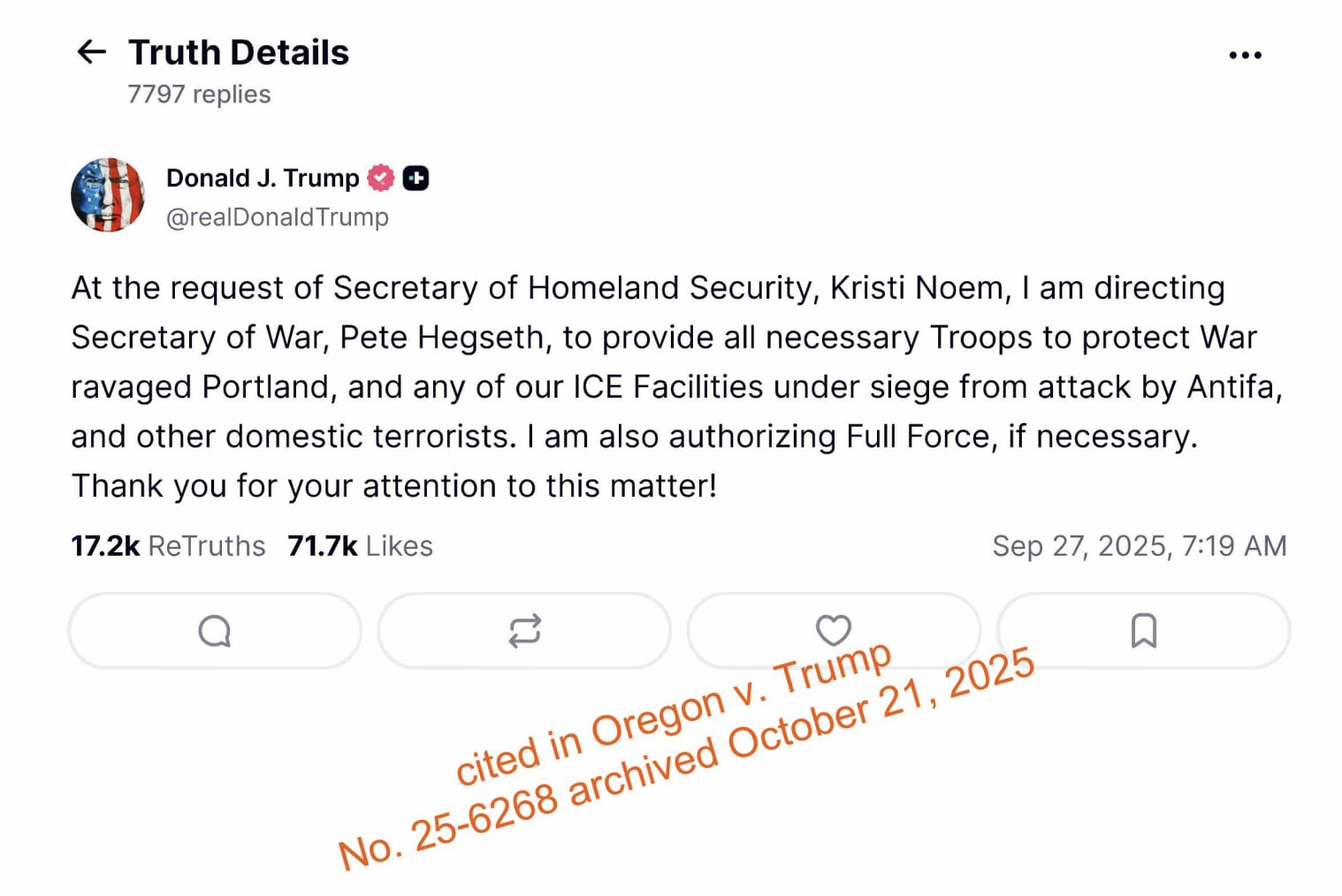
Antifa
Fantasies
Contrary
to
what
the
President
says
on
social
media,
there
is
no
“War”
in
Portland
and
no
“ICE
facilities
under
siege
from
attack
by
Antifa
and
other
domestic
terrorists.”
There
are,
however,
a
lot
of
protesters
dressed
up
as
frogs
and
rainbow
unicorns.
Nevertheless,
the
second
Ninth
Circuit
panel
considering
Trump’s
federalization
order
in
Oregon
found
that
the
president’s
emergency
determination
“reflects
a
colorable
assessment
of
the
facts
and
law
within
a
range
of
honest
judgment.”
That
panel
also
had
two
Trump
appointees,
including
Judge
Ryan
Nelson
who
penned
a
concurrence
endorsing
the
DOJ’s
previously-rejected
assertion
that
the
president’s
emergency
determination
is
“unreviewable
by
the
federal
courts.”
To
Nelson,
“the
President’s
decision
in
this
area
is
absolute,”
so
it
doesn’t
matter
that
Trump
openly
lies
about
imaginary
Antifas
conducting
make-believe
sieges.
As
it
turns
out,
Trump’s
lackeys
in
the
DOJ
have
also
lied.
A
lot.
In
fact,
while
the
Ninth
Circuit
was
considering
the
Oregon
federalization
appeal,
the
DOJ
admitted
that
one
of
its
central
claims
in
support
of
the
emergency
declaration
was
grossly
inaccurate.
That
lie
came
in
a
supporting
affidavit
by
Robert
Cantu,
the
Deputy
Director
of
the
Federal
Protective
Services,
who
attested
that
115
of
the
776
members
of
his
agency
had
been
forced
to
surge
into
Portland
to
protect
its
immigration
facility:
The
sustained
violence
associated
with
the
protests
in
Portland
has
required
FPS
Region
10
to
deploy
officers
from
the
other
FPS
Regions.
To
date,
115
FPS
officers
have
had
to
deploy
to
Portland
to
maintain
a
24/7
operational
tempo.
Removing
these
officers
from
their
normal
duty
stations
means
that
the
buildings
they
are
assigned
to
must
rely
on
other
FPS
officers
or
the
local
police
force
to
respond
to
law
enforcement
incidents.
Moreover,
the
security
related
functions
that
the
assigned
officers
normally
perform
end
up
being
delayed.
Judge
Nelson
and
Judge
Bridget
Bade,
the
two
Trump
appointees
considering
the
appeal,
cited
Cantu’s
declaration
18
times
in
the
majority
opinion,
which
bemoaned
the
“lack
of
support”
from
local
law
enforcement
and
the
drain
on
operational
capacity
of
federal
law
enforcement
nationwide.
“The
record
reflects
that
115
FPS
officers—nearly
25%
of
FPS
officers
nationwide—were
diverted
to
Portland”
they
tut-tutted.
“The
President
may
reasonably
rely
on
this
evidence
in
determining
whether
he
is
unable
to
execute
the
law.”
In
dissent,
Judge
Susan
Graber,
a
Clinton
appointee,
noted
that
something
seemed
fishy
about
Cantu’s
“vague,
carefully
worded
assertion.”
Crediting
his
assertion,
we
know
that
a
total
of
115
officers
from
elsewhere
were
deployed
in
Portland
during
the
preceding
four
months.
The
record
contains
no
information
about
how
many
officers
were
in
Portland
at
any
given
time.
For
all
we
know,
FPS
sent
a
different
8
officers
to
Portland
every
week
for
14
or
15
weeks,
meaning
that
Portland’s
drain
on
FPS’s
staff
from
elsewhere
on
any
particular
day
was
8
people,
not
115.
Indeed,
the
only
description
in
the
record
of
a
“[s]urge”
in
officers
was
the
deployment
of
8
officers.
The
fact
that
there
were
26
FPS
officers
on
duty
on
September
6,
as
the
majority’s
order
emphasizes,
says
nothing
about
whether
any
or
all
of
those
individuals
were
from
somewhere
other
than
Portland.
The
record
does
not
reveal
the
number
of
local
FPS
officers.
The
majority
all
but
mocked
Judge
Graber,
scoffing
the
she
“only
reaches
a
different
conclusion
by
characterizing
this
evidence
as
‘staffing
difficulties’
and
committing
the
same
error
as
the
district
court
in
discounting,
minimizing,
and
discrediting
[the
government’s]
undisputed
evidence
on
this
point.”
Except
that
Judge
Graber
was
absolutely
right
to
discount,
minimize,
and
discredit
the
government’s
evidence.
In
discovery,
FPS
admitted
that
it
did
exactly
what
Graber
suspected,
rotating
different
officers
through
Portland
each
month
and
aggregating
the
total
to
make
it
appear
as
if
the
agency
was
dedicating
a
quarter
of
its
resources
to
maintaining
order
in
Portland.
In
reality,
there
are
four
agents
permanently
stationed
in
Portland,
and
FPS
deployed
waves
of
27,
31,
and
29
agents
from
other
regions.
In
the
month
leading
up
to
Trump’s
emergency
declaration,
a
mere
20
agents
were
pulled
in.
That
does
not
support
an
honest
judgment
that
Portland
was
under
siege.
FPS,
which
is
charged
with
protecting
the
Lindquist
Building,
is
stretched
to
the
point
of
collapse.
The
sustained
violence
and
security
risks
have
required
FPS
to
provide
24/7
protection
for
the
building,
a
task
it
is
simply
not
resourced
to
accomplish.
To
date,
115
FPS
officers
have
deployed
to
Portland
in
order
to
maintain
this
operational
tempo.
DHS
has
been
forced
to
reassign
members
of
Homeland
Security
Investigations
(HSI)
Portland’s
Special
Response
Team
(SRT)
to
support
FPS,
significantly
impeding
HSI’s
ability
to
accomplish
the
missions
with
which
SRT
is
tasked.
Lies,
Lies,
Lies
Lawyers
for
the
state
of
Oregon
flagged
this
“material
factual
error”
in
a
supplement
to
its
request
for
en
banc
review
of
the
Nelson/Bade
order.
They
noted
the
centrality
of
the
Cantu
affidavit
to
the
ruling,
and
pointed
out
that
the
DOJ
repeated
the
lie
at
oral
argument:
The
dissent
noted
that
defendants’
declaration
on
the
actual
extent
of
the
deployment
was
“carefully
worded”
to
the
point
of
“vague.”
(Dissent
16-21).
But
defendants’
counsel
emphasized
at
oral
argument
the
“magnitude”
and
“unsustainab[ility]”
of
having
115
FPS
offices
redeployed;
then,
when
asked
directly
whether
all
115
officers
remained
in
Portland,
counsel
stated
only
that
“some”
had
gone
home
but
“many”
remained.
That
looks
like
a
deliberate
attempt
to
mislead
the
court
about
the
true
state
of
the
FPS
deployment
—
yet
another
comparatively
little
lie
in
service
of
the
much
bigger
one
about
“war
ravaged”
Portland.
And
it
illustrates
the
folly
of
treating
the
president’s
fact-free
rantings
as
presumptively
correct.
Even
with
the
court’s
deferential
thumb
on
the
scale
in
favor
of
the
president,
the
DOJ
was
still
forced
to
backfill
the
tiny
crack
left
for
judicial
review
with
slurry
of
falsehood
and
deception.
This
episode
highlights
the
disaster
of
the
first
Ninth
Circuit
panel’s
ruling,
which
works
from
the
premise
that
the
president
probably
gets
to
declare
reality
by
executive
fiat,
and
then
invites
the
DOJ
to
concoct
a
rationale
to
back
it
up.
Because
like
ChatGPT,
the
Trump
DOJ
will
come
up
with
“facts”
to
support
Trump’s
claims
—
they
just
might
not
be
true.
Whether
this
will
wind
up
mattering
remains
to
be
seen.
Senior
Judge
Sidney
R.
Thomas,
the
En
Banc
Coordinator
for
the
Ninth
Circuit,
administratively
stayed
the
Nelson/Bade
order
pending
a
vote
by
the
full
Ninth
Circuit.
In
practical
terms,
that
means
that
the
Trump
administration
remains
unable
to
deploy
federalized
national
guard
units
to
the
streets
of
Portland
until
at
least
October
28
—
and
possibly
longer
if
the
court
grants
the
motion
for
reconsideration.
Will
Trump
then
be
allowed
to
flood
the
streets
with
soldiers
based
on
an
obvious
lie,
backed
up
by
even
more
untruths?
As
the
state
urged,
“This
Court
must
act
swiftly
to
prevent
defendants
from
attempting
to
benefit
from
their
own
material
mistake
to
deploy
military
forces
to
peaceful
civilian
streets,
contravening
the
rule
of
law
and
our
nation’s
history
and
traditions.”
In
response
to
the
“No
Kings”
rallies,
Trump
posted
a
video,
created
by
artificial
intelligence,
that
showed
him
wearing
a
crown,
flying
a
plane,
and
dumping
excrement
on
protestors
in
America
cities. But
that’s
not
all. Trump
literally
took
a
sledgehammer
to
the
White
House,
destroying
the
historic
East
Wing
to
make
room
for
his
new
“President
Donald
J.
Trump
Ballroom.” But
that’s
not
all.
Trump
filed
a
claim
demanding
that
the
government
pay
him
$230
million
to
offset
supposed
damages
Trump
had
suffered
as
a
result
of
government
investigations
of
him. Trump
will
decide
whether
his
Department
of
Justice
should
pay
him
$230
million
of
taxpayer
money.
Maybe
the
press
had
a
right
to
be
distracted.
But
not
me,
your
worthy
opinion
commentator.
In
the
avalanche
of
last
week’s
news,
one
story
has
not
received
the
attention
it
deserves.
Earlier
this
year,
the
United
States
wanted
to
be
able
to
deport
people
who
were
described
as
Venezuelan
gang
members
to
the
CECOT
prison
in
El
Salvador. The
U.S.
agreed
to
pay
El
Salvador
a
fee
of
$6
million
to
hold
300
American
prisoners
for
one
year
pending
the
U.S.
government’s final
decision on
where
to
place
the
prisoners.
The
deal
apparently
included
one
extraordinarily
unseemly
aspect.
MS-13
is
an
El
Salvadoran
gang.
According
to
articles
in The
Washington
Post, CNN,
and ProPublica,
the
administration
of
El
Salvadoran
President
Nayib
Bukele
refused
to
accept
the
300
Venezuelan
prisoners
unless
the
U.S.
agreed
to
return
at
least
nine
MS-13
gang
leaders
—
some
of
whom
were
protected
federal
informants
—
to
El
Salvador. Secretary
of
State
Marco
Rubio
spoke
to
Attorney
General
Pam
Bondi
about
the
proposal,
and
Rubio
ultimately
agreed
to
the
deal.
The
El
Salvadoran
government had
apparently
made
deals
for
the
MS-13
gang
to
use
its
political
influence
to
turn
out
votes for
candidates
belonging
to
Bukele’s
Nuevas
Ideas
party
in
legislative
elections
in
2021. The
gang
bosses
had
also
“agreed
to
reduce the
number
of
public
murders
in
El
Salvador,
which
politically
benefited
the
government
of
El
Salvador,
by
creating
the
perception
that
the
government
was
reducing
the
murder
rate,”
according
to
a
federal
indictment.
For
years,
Bukele
has
sought
to
block
witnesses
from testifying
about
alleged
ties between
his
government
and
the
gang.
At
least
three
of
the
MS-13
leaders
involved
in
Rubio’s
deal
had
previously
given
testimony
that
some
members
of
Bukele’s
government
had
ties
to
the
gang.
If
the
United
States
really
released
to
El
Salvador
gang
members
who
were
“protected
federal
informants”
to
obtain
use
of
the
CECOT
prison,
then
the
press
—
liberal
or
otherwise
—
should
be
screaming
louder.
Is
Trump
really
sending
protected
federal
informants,
who
gave
testimony
about
how
the
El
Salvadoran
government
had
agreements
with
gang
members
for
the
gangs
to
serve
the
government’s
purposes,
back
to
El
Salvador?
If
so,
then
the
Trump
administration
has
hit
the
immoral
trifecta. First,
the
federal
government
is
violating
its
word. The
government
agreed
to
“protect”
informants,
not
to
condemn
those
informants
by
sending
them
back
to
the
country
whose
government
they
incriminated.
Second,
to
all
appearances,
the
U.S.
government
is
sending
its
informants
back
to
near-certain
death. High-level
gang
members
who
gave
testimony
ratting
out
both
the
MS-13
gang
and
the
El
Salvadoran
government
are
not
going
to
survive
for
long
in
El
Salvador. Damn
near
everyone
in
the
country
wants
those
turncoats
dead.
Lastly,
if
the
U.S.
government
releases
protected
informants
to
achieve
political
ends,
who
will
ever
agree
in
the
future
to
give
evidence
to
the
U.S.
government
in
return
(in
part)
for
the
government’s
protection? Everyone
will
know
that,
when
the
government
sees
a
political
advantage
from
no
longer
protecting
you,
the
government
will
break
its
promise
to
give
protection.
If
you
want
to
entice
informants
to
speak,
you
must
provide
iron-clad
permanent
protection,
not
meaningless
protection
that
can
later
be
undone
at
the
whim
of
government
officials.
The
press
should
pursue
this
story
relentlessly,
investigating
who
was
sent
back
to
El
Salvador,
what
protection
the
U.S.
government
had
previously
promised
them,
and
how
long
those
folks
survived
after
being
shipped
back
home.
A
sophomoric
AI
video,
the
destruction
of
a
historic
building,
and
a
demand
for
$230
million
are
news. But
sending
protected
informants
back
to
the
country
(and
gang)
they
incriminated
may
well
top
last
week’s
heap.
Each
year,
the
HLTH
conference
gives
healthcare
leaders
a
chance
to
gather
and
share
ideas.
The
event
also
gives
companies
the
chance
to
announce
news
—
oftentimes
about
new
products,
partnerships
and
business
plans.
Below
are
seven
noteworthy
announcements
made
during
this
year’s
HLTH
conference
in
Las
Vegas.
Mark
Cuban’s
Cost
Plus
Drugs
company
will
partner
with
TrumpRx
During
an
onstage
session
at
HLTH,
Mark
Cuban
revealed
a
forthcoming
partnership
between
his
Cost
Plus
Drugs
company
and
TrumpRx,
a
federal
program
designed
to
bring
discounted
prescription
drugs
directly
to
consumers.
TrumpRx,
which
is
set
to
launch
early
next
year,
will
function
as
a
referral
platform,
directing
people
to
websites
like
Cost
Plus
Drugs.
Through
this
partnership,
Cost
Plus
Drugs
will
provide
its
pricing
data
to
TrumpRx.
Cuban
said
he
hopes
this
collaboration
will
disrupt
the
traditional
PBM
model,
which
he
has
long
criticized
for
contributing
to
the
nation’s
exorbitant
drug
prices.
Optum
launches
claims
management
platform
UnitedHealth
Group
subsidiary
Optum
unveiled
an
AI-powered
real-time
claims
management
platform
called
Optum
Real.
The
system
is
designed
to
reduce
friction
between
providers
and
payers
during
claims
submission
and
reimbursement
processes.
The
platform’s
goal
is
to
allow
providers
to
instantly
verify
details
about
patients’
benefits
and
coverage,
therefore
reducing
the
guesswork
and
delays
that
providers
typically
face
when
trying
to
get
paid.
Cedar
rolls
out
new
tools
to
help
people
afford
care
Healthcare
payments
startup
Cedar
introduced
Cedar
Cover,
a
digital
platform
aimed
at
helping
patients
access
Medicaid
coverage
and
financial
assistance.
The
platform
—
which
integrates
with
hospital
billing
workflows
—
helps
identify
patients’
potential
Medicaid
eligibility,
assists
with
their
enrollment,
manages
their
renewals
and
connects
them
to
co-pay
support
for
medications.
Given
the
recent
Medicaid
cuts
under
the
One
Big
Beautiful
Bill
Act,
Cedar’s
new
system
is
meant
to
mitigate
the
harm
on
patients
and
providers
by
decreasing
uncompensated
care
costs.
Early
adopters
of
Cedar
Cover
include
Novant
Health,
Baystate
Health
and
The
Iowa
Clinic.
Oscar
Health
creates
menopause-focused
ACA
plan
Oscar
Health
debuted
a
new
Affordable
Care
Act
plan
called
HelloMeno.
The
New
York-based
payer
developed
the
plan
in
collaboration
with
Elektra
Health,
a
virtual
provider
of
menopause
care.
Tailored
for
women
navigating
menopause,
HelloMeno
offers
zero-copay
primary
care,
gynecological
and
behavioral
health
visits,
as
well
as
no-cost
labs,
hormone
therapy,
insomnia
medications
and
bone
density
scans.
AMA
unveils
new
center
for
digital
health
and
AI
The
American
Medical
Association
launched
a
new
center
aimed
at
giving
physicians
a
stronger
voice
in
shaping
how
digital
health
tools
and
AI
technologies
are
deployed
in
clinical
care.
The
center
seeks
to
help
shape
policies
and
regulations
around
digital
health
technology,
as
well
as
find
better
ways
to
integrate
these
tools
into
clinical
workflows.
Other
goals
include
providing
education
and
training
to
clinicians
about
how
to
use
AI
tools
and
fostering
collaboration
across
industries
—
including
with
tech
companies,
payers,
government
and
researchers.
Knownwell
snags
$25
million
Knownwell
closed
a
$25
million
funding
round
led
by
CVS
Health
Ventures.
The
startup
offers
metabolic
health
services,
primary
care,
nutrition
counseling
and
behavioral
health
care
—
and
also
prescribes
GLP-1s
when
considered
appropriate.
It
provides
virtual
care
nationwide,
as
well
as
in
person
care
at
its
clinics
in
the
Atlanta,
Boston,
Chicago
and
Dallas
areas.
With
its
new
capital,
the
startup
will
focus
on
expanding
care,
both
by
adding
additional
clinics
and
growing
its
virtual
care
team.
Highmark
Health
teams
up
with
Noom
Highmark
Health,
the
Pittsburgh-based
parent
company
of
payer
Highmark
and
health
system
Allegheny
Health
Network,
partnered
with
digital
weight
loss
company
Noom.
They
will
offer
Noom’s
weight
management
and
behavioral
health
programs
to
nearly
2
million
eligible
Highmark
members
starting
next
year.
The
program
is
designed
to
leverage
AI
tools
and
behavior‑science
techniques,
such
as
food
logging,
body
scan
technologies
and
peer
support
communities,
to
help
members
develop
healthy
habits
rather
than
just
treat
disease.
The
benefit
will
be
available
at
no
additional
cost
for
Highmark’s
eligible
members.