BigHand’s Pricing And Budgeting Survey: A Wake-Up Call And An Opportunity – Above the Law

Another
week,
another
interesting

BigHand
survey
.
This
time
the
BigHand
team
tackled
pricing
and
budgeting
issues.
The
bottom
line:
every
client
wants
budgets
and
financial
transparency,
but
few
lawyers
want
to
do
it.
(At
least
those
in
law
firms.)

The
survey
is
pretty
comprehensive.
It
looked
at
data
points
from
five
years
of
surveys
and
then
added
the
responses
of
some
800
senior
legal
finance
professionals
in
the
US
and
UK.
For
the
first
time,
BigHand
looked
at
law
firms.


The
Survey
Findings

Let’s
start
with
what
the
survey
says
about
what
clients
may
want:

  • 47%
    of
    the
    firms
    surveyed
    say
    clients
    are
    increasingly
    demanding
    budgets
    and
    50%
    say
    clients
    want
    greater
    transparency.
  • The
    same
    percentage
    (47%)
    say
    clients
    want
    more
    alternative
    fee
    arrangements
    (AFAs).
  • 48%
    of
    the
    firms
    surveyed
    say
    clients
    want
    more
    technology
    driven
    efficiencies.

Remember
that
these
findings
are
not
what
clients
are
saying
but
what
law
firms
are
seeing
from
clients.
That’s
what
makes
the
survey
results
about
what
are
law
firms
doing
startling:

  • 53%
    of
    the
    firms
    mandate
    budgets
    on
    most
    but
    not
    all
    matters.
  • 37%
    say
    the
    driving
    factor
    in
    doing
    budgets
    is
    if
    the
    client
    requests
    it.
  • But
    70%
    say
    they
    get
    increased
    billing
    realizations
    when
    they
    do
    budgets.
  • Only
    4%
    give
    updates
    to
    the
    budgets
    throughout
    the
    life
    cycle
    of
    all
    budgeted
    matters.
    A
    little
    over
    30%
    of
    the
    firms
    give
    updates
    in
    21-40%
    of
    matters.
  • Many
    firms
    report
    only
    “moderate”
    use
    of
    AFAs.

So
in
short,
clients
want
more
and
better
budget
and
financial
transparency.
But
most
firms
are
not
giving
them
that
at
least
consistently.
That
immediately
raises
the
question,
why?
Why
aren’t
firms
budgeting
better,
reporting
better,
and
doing
more
with
AFAs,
especially
when
they
would
get
better
realizations.


Lawyers
Are
Dumb
When
It
Comes
to
Running
a
Business

The
survey
makes
clear
there
is
a
real
opportunity
here
that
lawyers
should
be
seeing
and
acting
on.
But
by
and
large
they’re
not,
at
least
according
to
the
Survey.

The
first
reason
for
this
mismatch
is
that
a
lot
of
lawyers
in
law
firms
don’t
really
know
how
to
run
a
business.
And
if
that’s
not
bad
enough,
they
think
that
they
do.
In
many
firms,
you
advance
both
in
terms
of
compensation
and
leadership
by
bringing
business.
Bringing
in
business
and
servicing
their
legal
needs
requires
a
lot
of
skills
but
it
doesn’t
necessarily
mean
you
are
a
good
businessperson.

Only
about
30%
of
the
firms
provide
any
formal
training
to
their
lawyers
on
things
like
profit,
sound
billing
practices,
pricing,
key
performance
indicators,
and
the
like. 
According
to
the
survey,
only
about
30%
of
the
firms
bother
to
train
their
associates
on
financial
performance
metrics,
the
lifeblood
of
the
business
of
the
firm.
Is
it
any
wonder
that
law
firms
are
not
meeting
the
financial
expectations
of
their
clients.

We
see
this
hubris
when
it
comes
to
hiring
folks
who
are
businesspeople
like
financial
analysts
and
data
scientists.
According
to
the
survey,
only
about
30%
of
the
firms
have
these
resources.
And,
as
I
have

written
before
,
even
when
they
do
hire
these
kinds
of
people,
they
often
don’t
listen
to
them.


Lawyers
Don’t
Like
Doing
Budgets

Lawyers
don’t
like
doing
budgets
because
it
holds
their
feet
to
the
fire.
There’s
nothing
worse
than
blowing
through
a
budget
and
then
having
a
client
look
at
you
and
say,
“What
happened?
You’ve
got
some
explaining
to
do.”
Yet
despite
how
uncomfortable
this
is,
lawyers
don’t
update
clients
as
much
as
they
should
about
where
they
stand
on
the
budget,
mainly
because
the
budget
has
been
exceeded.

Why?
The
truth
is
a
lot
of
lawyers
don’t
know
how
to
do
budgets.
Their
standard
practice
is
to
try
to
determine
how
many
hours
a
matter
will
take
plus
how
many
hours
can
we
pad
to
give
us
leeway.
As
the
survey
reflects,
on
most
matters,
lawyers
don’t
include
a
breakdown
of
the
cost
of
allocated
resources
when
pricing
a
matter
(only
4%
provide
this
on
most
matters).

And
even
the
padded
hourly
estimate
is
often
wrong
because
the
lawyers
either
don’t
have
or
don’t
capture
the
data
to
know
how
long
something
will
really
take.
Only
49%
have
dedicated
pricing
and
budgeting
software
that
might
allow
them
to
better
mine
the
data
they
do
have.
What
business
in
the
world
these
days
has
nearly
half
of
the
providers
with
no
pricing
software???

Data
resides
internally
at
many
firms,
but
it
is
buried
away
and
not
accessible.
There’s
a
wealth
of
public
data
that
can
be
mined
with
things
like
litigation
analytics.
But
it
too
often
goes
untouched.

Without
data,
the
budgeting
process
becomes
little
more
than
a
wild
ass
guess.
I
know,
I
tried
it.
It
would
be
interesting
to
survey
what
percentage
of
firms’
budgets
are
blown?
But
it’s
likely
nobody
would
be
telling.


AFAs

AFAs:
everyone
talks
a
big
game
but
not
many
firms
want
to
do
them
for
all
the
reasons
set
out
above.
Most
AFAs
are
still
determined
the
way
budgets
are:
how
many
hours
do
we
guesstimate
it
will
take
and
how
much
cushion
can
we
get
away
with.
And
the
result
of
that
process
is
the
same:
a
fee
that’s
not
realistic
and
which
gets
blown.
Lawyers
often
say
we
can’t
do
a
flat
fee,
particularly
in
litigation,
because
there’s
just
too
much
uncertainty.
The
truth
may
be
that
there’s
uncertainty
because
factors
like
overhead
and
time
value
aren’t
considered
and
the
data
to
reduce
the
uncertainty
goes
untouched.


A
Wake-Up
Call?
Or
an
Opportunity?

The
BigHand
report
ought
to
serve
as
a
wake-up
call
for
firms,
but
it
may
not
be
as
long
as
most
every
firm
is
like
so
many
of
those
surveyed:
giving
only
lip
service
to
what
clients
want.
But
for
those
firms
that
do
seize
the
opportunity,
the
report
shows
a
path
forward
to
achieving
greater
client
satisfaction
and
increased
profitability.
As
the
report
puts
it,
“the
gap
between
client
expectations,
internal
capabilities
and
implementation
remains
one
of
the
biggest
challenges
but
also
one
of
the
biggest
opportunities
for
forward
looking
firms.”


Stephen
Embry
is
a
lawyer,
speaker,
blogger,
and
writer.
He
publishes TechLaw
Crossroads
,
a
blog
devoted
to
the
examination
of
the
tension
between
technology,
the
law,
and
the
practice
of
law
.

Huge Law School Classes Could Mean Huge Employment Woes In the Future – Above the Law

(Image
via
Getty)


Ed.
note
:
Welcome
to
our
daily
feature,

Quote
of
the
Day
.


The
unknown
here
is
how
quickly
that
change
will
happen
across
the
whole
market
and
whether
the
impact
will
be
felt
before
or
after
these
students
graduate.


Nikia
Gray,
executive
director
of
the
 National
Association
for
Law
Placement,
in
comments
given
to

Reuters
,
on
how
oversized
law
school
classes
could
translate
into
an
oversaturated
job
market
for
graduates
come
2028.
At
least
10
law
schools
have
reported
their
largest
incoming
classes
in
more
than
a
decade
thanks
to
a
“blockbuster”
admissions
cycle.


Staci Zaretsky


Staci
Zaretsky
 is
the
managing
editor
of
Above
the
Law,
where
she’s
worked
since
2011.
She’d
love
to
hear
from
you,
so
please
feel
free
to

email

her
with
any
tips,
questions,
comments,
or
critiques.
You
can
follow
her
on BlueskyX/Twitter,
and Threads, or
connect
with
her
on LinkedIn.

Wanna Join The Legal Fight Against The Trump Administration? Best Break Up With Biglaw – Above the Law

(Photo
by
Andrew
Harnik/Getty
Images)

Since
the
start
of
the
Trump
II
reign,
and
the

attack
on
the
rule
of
law

that
coincided
with
that,
it’s
been
clear
that
Biglaw

wasn’t
going
to
be

our
savior.
When
directly
confronted

with

unconstitutional

Executive
Orders
targeting
firms
on
Trump’s
list
for
retribution,
more
than
twice
as
many
major
law
firm
were
willing
to
promise
the
president
nearly
a
billion
dollars
in

pro
bono
payola

for

conservative
causes
or
clients

as
were
willing
to
fight
the
EOs
in
court.
Not
a
great
look
for
the
supposed
best
in
the
legal
industry.

Part
of
Biglaw’s
reticence
to
stand
up
for
the
rule
of
law
is
the

tension
between
corporate
lawyers
and
litigators
.
Corporate
types
want
to
stay
on
the

good
side

of
the
administration
to
grease
the
wheels
for
deals.
Conversely,
litigators
worried
they
were
signaling
that
if
a
firm
won’t
stand
up
to
the
bullying
of
the
Trump
administration
for
themselves, they
wouldn’t
be
able
to
do
it
for
clients
.

So
what
if
the
answer
is
a
firm
that
doesn’t
have
that
inherent
conflict
built
into
its
business
model?
The
Wall
Street
Journal

investigates

the
rise
of
the
litigation
boutique.
Certainly
elite
litigation
boutiques
aren’t
a
new
concept,
but
they’re
getting
increasingly
popular
in
the
Trump
era.

Whether
it’s
the
high-profile
(and
growing
)
Dunn
Isaacson
created

by
former
Paul
Weiss
partners

(the
first
firm
to

fold
to
Donald
Trump’s
pressure
),
the

Abbe
Lowell
boutique


staffed
with
lawyers

who
left
their
capitulating
Biglaw
firm,
Paul
Clement’s
boutique

coming
out
swinging

against
the
Trump
administration
and

defending
Biglaw

against
the
EOs,
or
Roberta
Kaplan’s
boutique

getting
more
talent
,
these
small
but
mighty
firms
are
poised
to
take
on
some
of
the
biggest
cases.
As
Karen
Dunn
noted,
“Clients
are
comfortable
with
boutique
firms
handling
their
most
consequential
litigation.” 

And
that
smaller
size
is
actually
an
advantage
when
taking
on
clients
with
disputes
with
the
government.
As
former
Skadden
partner
Benjamin
Klubes,
who
started
his
own
firm
after
serving
as
the
top
lawyer
for
the
federal
housing
agency
during
the
Biden
administration,
told
the
Wall
Street
Journal:

But
he
said
he
was
disappointed
by
the
legal
industry’s
reluctance
to
push
back
against
Trump
and
wanted
to
start
a
firm
that
wouldn’t
shy
away
from
representing
clients
adverse
to
the
government.
“A
lot
of
lawyers
are
taking
interest
and
thinking
about
better
ways
to
practice
law
in
the
future,”
he
said.

The
best
in
the
legal
field
is
not
necessarily
found
at
the
biggest
law
firms.


Kathryn
Rubino
is
a
Senior
Editor
at
Above
the
Law,
host
of

The
Jabot
podcast
,
and
co-host
of

Thinking
Like
A
Lawyer
.
AtL
tipsters
are
the
best,
so
please
connect
with
her.
Feel
free
to
email

her

with
any
tips,
questions,
or
comments
and
follow
her
on
Twitter

@Kathryn1
 or
Mastodon

@[email protected].

Families Are Relying On Trump’s Batshit Tylenol Diagnosis To Revive Dismissed Cases – Above the Law

Tylenol
is
a
well-known
pain
reliever.
It
isn’t
particularly
strong

it’s
effectiveness
is
probably
one
step
above

spit
,
but
it
is
better
than
nothing
when
you’re
dealing
with
pregnancy
cramps
or
a
fever.
Unfortunately,
the
party
that
brought
you
bleach
and
horse
de-wormer
as
COVID
cures
is
still
in
power
and
they’ve
set
their
sights
on
acetaminophen.
And
despite
Trump’s
difficulty
pronouncing
it,
he
went
all
in
on
establishing
a
causal
link
between
using
Tylenol
while
pregnant
and
giving
birth
to
a
child
with
autism.
And
as
dumb
as
that
was

it
was
very
dumb,
by
the
way

if
you
thought
Trump
had
a
problem
pronouncing
acetaminophen,
imagine
if
he
had
to
get
on
a
podium
and
talk
about
things
that

actual

scientists
think
can
contribute
to
autism
like
the
genes
AVPR1a,
DISC1,
DYX1C1,
ITGB3,
SLC6A4,
RELN,
RPL10,
or
SHANK3!

As
much
as
it
activates
the
schadenfreude
to
think
that
Trump
was
foolish
enough
to
make
the
Tylenol/autism
connection
with
his
full
chest
as
eloquently
as
he
did
(“it
can
only
good
happen,”
etc.
),
he
isn’t
the
only
one
who
has
been
fighting
to
make
the
same
connection.
Back
in
2023,
a
judge
rejected
claims
that
Tylenol
caused
autism
and
ADHD

due
to
plaintiffs
lacking
admissible
evidence
.
But
after
Trump’s
monologue,
plaintiffs
want
a
second
bite
at
the
pill.

Reuters

has
coverage:

Families
appealing
the
dismissal
of
their
lawsuits
alleging
that
Kenvue’s
Tylenol
or
generic
versions
of
the
pain-relief
medication
caused
their
children’s
autism
are
asking
an
appeals
court
to
consider
President
Donald
Trump’s
new
advice
that
pregnant
women
avoid
the
pain
killer
as
it
decides
whether
to
revive
their
lawsuits.

U.S.
District
Judge
Denise
Cote
in
Manhattan
last
year
dismissed
more
than
500
lawsuits
against
Kenvue
and
retailers
that
sold
store-brand
acetaminophen,
which
alleged
that
the
drugs
caused
autism
spectrum
disorder,
or
ADHD.
Cote
had
ruled
the
previous
year
that
none
of
the
expert
witnesses
offered
by
the
plaintiffs
to
testify
at
trial
that
acetaminophen
could
cause
the
conditions
had
used
a
sound
scientific
methodology.
She
said
the
experts’
“unstructured
approach”
allowed
“cherry-picking”
and
a
“results-driven
analysis.”

Funny,
that
assessment
of
the
experts
would
apply
just
as
well
to

Wormbrain
firing
every
member
of
the
CDC
vaccine
advisory
panel

just
because
of
little
things
like
“the
rest
of
the
scientific
world’s
overwhelming
consensus
on
the
data.”

The
plaintiffs’
attorney,
Ashley
Keller,
is
pushing
to
require
a
jury
to
hear
from
the
same
experts
that
the
Executive
used
in
their
findings,
going
so
far
as
to
say
that
not
doing
so
would
pose
separation
of
powers
issues.

Oral
argument
should
start
on
the
6th
of
October.
Pray
for
anyone
who
has
to
sit
through
an
“expert”
bumbling
through
whatever
half-cocked
reasoning
they
use
to
establish
the
causal
connection.
I
need
a
Tylenol
just
thinking
about
it.


Attorneys
Urge
Court
Overseeing
Tylenol
Autism
Lawsuits
To
Consider
Trump
Administration’s
Stance
 [Reuters]


Chris
Williams
became
a
social
media
manager
and
assistant
editor
for
Above
the
Law
in
June
2021.
Prior
to
joining
the
staff,
he
moonlighted
as
a
minor
Memelord™
in
the
Facebook
group Law
School
Memes
for
Edgy
T14s
.
 He
endured
Missouri
long
enough
to
graduate
from
Washington
University
in
St.
Louis
School
of
Law.
He
is
a
former
boatbuilder
who
is
learning
to
swim, is
interested
in
critical
race
theory,
philosophy,
and
humor,
and
has
a
love
for
cycling
that
occasionally
annoys
his
peers.
You
can
reach
him
by
email
at [email protected]
and
by
tweet
at @WritesForRent.

Write A Filing For This Futuristic AI-Refugee Case Hypo And Win $10,000 – Above the Law

In
2047,
Ahmad
Hakim
and
his
family
are
climate
refugees
fleeing
the
Levantine
Consolidation
Zone
after
Ahmad
refused
to
place
his
daughters
in
mandatory
fertility
conscription.
The
family
seeks
sanctuary
in
CoralNet,
a
community
governed
though
“judicial
meshes”
combining
human,
AI,
and
nonhuman
perspectives.
It’s
unlikely
that
we’re
less
than
25
years
away
from
animals
weighing
in
on
judicial
decisions,
but
I,
for
one,
welcome
our
new
Orca
overlords


they
seem
to
have
the
right
idea
.
Authorities
deny
sanctuary
to
Ahmad
himself,
while
provisionally
granting
sanctuary
to
his
wife
and
children,
on
the
grounds
that
Ahmad
refuses
to
allow
AI
copilots
for
himself
or
his
children,
refuses
verification
literacy
training,
and
rejects
CoralNet’s
epistemic
infrastructure.

As
a
hypothetical,
it
goes
a
lot
further
out
there
than
your
1L
Torts
final.
This
is
the
background
for
the

Karl
Popper
Legal
Reasoning
Scholarship

competition,
challenging
law
students
to
navigate
a
future
dominated
by
“artificial
intelligence,
climate
change,
and
evolving
concepts
of
personhood
and
humanism”
as
well
as
rising
global
authoritarianism.
Law
students
are
given
a
description
of
the
case
and
a
body
of
real
and
hypothetical
precedent,
and
asked
to
enter
a
2000-5000
word
submission
in
the
form
of
either
a
party
brief,
a
judicial
opinion,
or
a
scholarly
analysis.

And,
in
keeping
with
an
AI-driven
future,
students
are
not
only
allowed,
but
encouraged
to
use
AI
in
their
submissions.

The
competition
has
$25,000
prize
pool
and
is
open
to
JD/LLB,
LLM,
SJD,
and
PhD
candidates,
either
working
solo
or
in
teams
up
to
three.
First
prize
earns
$10,000,
the
two
runners-up
receive
$2,500
each,
and
seven
finalists
will
take
home
$500.
The
deadline
is

October
10,
2025,
23:59
UTC
.

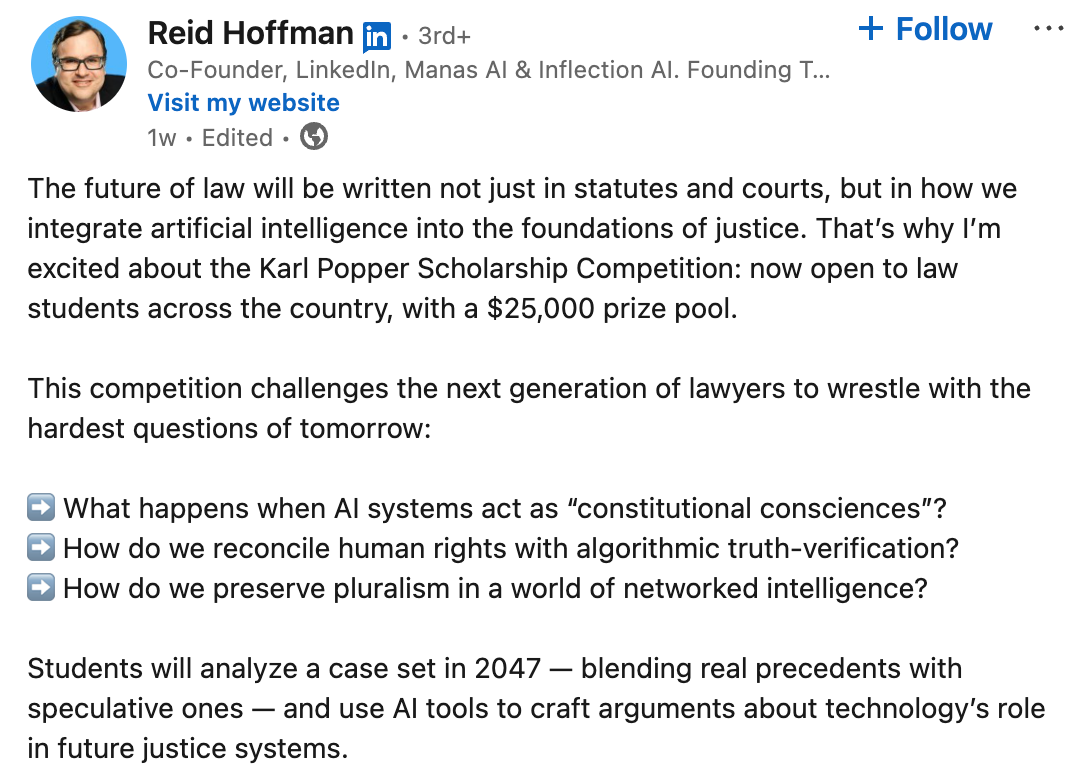
LinkedIn
cofounder
Reid
Hoffman
took
to,
well,
LinkedIn
to

express
his
interest
in
the
competition
:

The
future
of
law
being
written
by
“how
we
integrate
artificial
intelligence
into
the
foundations
of
justice”
sounds
appropriately
dystopian,
but
the
present
of
law
is
written
by
a
mix
of

Calvinball

and
who
paid
for
Clarence
Thomas’s
last
vacation
,”
so
maybe
ChatGPT
should
take
a
stab
at
it.

There
is
an
AI
executive
out
there
claiming
his
AI
can
replace
human
judges.

He
is
also
an
idiot
.

But
even
if
artificial
intelligence
won’t
take
its
place
in
the
foundations
of
justice,
it’s
certainly
going
to
reshape
the
legal
workflow.
Lawyers
already
use
these
word
calculators
the
same
way
they
historically
used
junior
associates,
to
write
first
drafts
that
get
marked
up
enough
to
make
Theseus
wince.
Judges
will
also
employ
more
AI
in
their
process,
even
if
they
don’t
want
to,
as
legal
research
products
integrate
more
and
more
AI
on
the
backend.

AI
hallucinations
have
embarrassed
lawyers

up

and

down

the
prestige
scale.
The
best
hope
for
the
next
generation
of
attorneys
is
to
get
them
actively
employing
the
technology
early
so
they
can
figure
out
what
it
can

and
cannot

actually
do.
Law
schools
will
harbor
understandable
skittishness
about
turning
students
loose
on
AI-assisted
projects,
making
competitions
like
this
one
all
the
more
important.

Beyond
the
technology,
the
competition
asks
an
interesting
philosophical
question,
inspired
by
Karl
Popper
himself,
about
the
limits
of
tolerance.
Popper
famously
warned
that
tolerance
requires
a
society
to
be
intolerant
of
intolerance,
a
timely
maxim
to
remember
as
some
of
the
loudest
demands
for
“free
speech”
come
from
those
preaching
intolerance.
How
does
a
society
balance
open
discourse
with
a
tolerating
a
media
landscape
built
around
hijacking
it
for
fascist
ends?
The
best
answer
historically
is
to
let
the
audience
speak
freely
themselves:
to
protest,
to
mock,
and
to
boycott.
Those
rights
of
the
audience
have
come
under
assault
from
those
who
want
to
say
that

free
speech
is
the
affirmative
right
to
be
protected
from
criticism
.
This
interpretation,
couched
in
the
language
of
freedom,
was
always
a
precursor
to
fascism
because
its
fundamental
logic
rests
on
coercive
government
action
to
silence
opposition.
So
when
we
start
seeing
FCC
licenses
dangled
to

get
late-night
hosts
removed
for
making
jokes
,
it’s
just
one
more
step
on
the
road
to
eroding
the
guardrails
protecting
society
from
intolerance.

But,
Popper’s
tolerance
paradox
goes
deeper
than
speech,
the
hypothetical
asks
about
granting
asylum
to
a
father
who
espouses
racist
and
misogynist
views
that
clash
with
the
community
while
keeping
a
family
fleeing
persecution
together.
Should
a
society
seek
to
keep
out
intolerance
at
the
cost
of
punishing
the
whole
family?
When
should
the
state
sacrifice
cultural
pluralism
to
protect
the
individual
rights
of
the
family
members?
Then
throw
the
concept
of
compelled
AI
copilots
onto
all
this.

It’s
a
fascinating
competition.

Read
more
about
it
here
.
And
remember,
you
have
until

October
10,
2025,
23:59
UTC

to
enter.


HeadshotJoe
Patrice
 is
a
senior
editor
at
Above
the
Law
and
co-host
of

Thinking
Like
A
Lawyer
.
Feel
free
to email
any
tips,
questions,
or
comments.
Follow
him
on Twitter or

Bluesky

if
you’re
interested
in
law,
politics,
and
a
healthy
dose
of
college
sports
news.
Joe
also
serves
as
a

Managing
Director
at
RPN
Executive
Search
.

Filevine Raises $400M in Two-Round Funding to Scale AI-Powered Legal Platform; I Speak with Its CEO

Legal
technology
company

Filevine

announced
today
it
has
raised
$400
million
across
two
funding
rounds
over
the
past
15
months,
positioning
the
Salt
Lake
City-based
company
as
one
of
the
most
well-capitalized
players
in
the
legal
tech
space.

The
funding
consists
of
a
$150
million
round
led
by
Insight
Partners
completed
about
15
months
ago,
followed
by
a
more
recent
round
of
about
$260
million
co-led
by
Accel
and
Halo
Fund
alongside
Insight
Partners.
Previous
investors,
including
Meritech,
Stepstone,
Run
Ventures,
and
Album
Ventures,
also
participated
in
the
latest
round.

Filevine
had
previously
raised
about
$226.1
million,
including
a

$108
million
Series
D
round
in
April
2022

that
was,
at
the
time,
one
of
the

largest
legal
tech
investments
ever
.

“This
cements
Filevine
as
a
category-defining
legal
technology
platform
built
with
AI
and
fully
integrated
into
the
operating
system
legal
teams
rely
on
daily,”
the
company
said
in
an
announcement.
“While
fragmented
tools
create
silos
and
provide
limited
or
incorrect
insight,
Filevine
delivers
one
holistic
AI
platform
giving
legal
teams
the
scale,
data,
and
connectivity
they
need
to
deliver
real
business
impact.”

The
announcement
comes
just
ahead
of
Filevine’s
annual

Lex
Summit

customer
conference,
which
convenes
Sept.
29.


‘We
Did
Not
Need
the
Money’

In
an
interview
with
LawSites,
Filevine
cofounder
and
CEO

Ryan
Anderson

explained
that
the
company
did
not
initially
set
out
to
raise
additional
capital.
“We
did
not
need
money,”
Anderson
said.
“But
there
was
a
good
reason
for
it
in
this
case.”

The
catalyst
came
from
an
unexpected
source:
Ryan
Smith,
the
owner
of
the
Utah
Jazz
and
founder
of
Qualtrics,
who
reached
out
to
Anderson
in
June,
following
Filevine’s
strongest
quarter
in
company
history.


Related:


On
LawNext:
Live
from
Filevine’s
LEX
Summit:
Interviews
with
Three
of
Its
Leaders
.

“Ryan
called
me
and
he
just
said,
‘Hey,
I
would
really
like
to
spend
some
time
with
you,’”
Anderson
recalled,
saying
that
Smith
convinced
him
that
Filevine
was
not
“getting
its
due”
as
a
recognized
brand
and
offered
to
put
together
an
investment
team
to
help.

Smith,
who
famously
built
the
“experience
management”
category
at
Qualtrics
before
selling
the
company
to
SAP,
connected
Anderson
with
Accel
partners.
“After
listening
to
John
Locke
over
at
Accel,
who’s
the
partner
that
did
the
deal
with
us,
I
got
convinced
that
this
was
time
for
an
opportunistic
raise,”
Anderson
said.


Focus
on
AI
Talent
and
Brand
Building

Anderson
said
that
the
primary
use
of
the
new
capital
will
be
talent
acquisition,
particularly
in
artificial
intelligence
and
machine
learning.
“The
primary
thing
I
think
you’ll
see
us
do
is
try
and
go
out
and
compete
to
get
the
very
best
talent.”

The
company,
which
currently
employs
just
under
700
people,
is
specifically
targeting
AI
engineers
who
traditionally
have
not
been
attracted
to
jobs
in
legal
technology.

“If
you
are
an
AI
engineer
today,
what
really
matters
to
you
is
being
with
a
company
that
believes
in
an
AI-first

approach
to
how
to
build
products,”
Anderson
told
me.
“And
those
engineers
really
do
key
off
a
little
bit
on
who
your
investors
are
and
are
they
investors
that
have
credibility
in
that.”

The
funding
also
reflects
Filevine’s
broader
ambition
to
raise
its
profile
beyond
the
legal
technology
community.
The
company
recently
announced
a
sponsorship
deal
with
a
hockey
team,
joining
Clio
as
the
second
legal
tech
company
with
such
a
sponsorship.

“I
don’t
know
that
any
legal
tech
tool
is
going
to
become
a
household
name,
but
it’s
definitely
an
initiative
of
the
company
to
get
ready
to
maybe
someday
IPO,”
Anderson
said.


Legal
Intelligence
Operating
System’

Filevine
positions
itself
as
creating
what
it
calls
a
“Legal
Operating
Intelligence
System”

a
comprehensive
platform
that
integrates
case
management
with
AI
capabilities.
The
company
serves
nearly
6,000
customers
and
100,000
legal
professionals,
primarily
in
the
area
of
litigation,
across
law
firms,
government
agencies,
and
Fortune
500
enterprises.

Anderson
argues
that
Filevine’s
advantage
lies
in
having
both
the
operational
system
containing
all
case
data
and
the
AI
capabilities
to
surface
insights
from
that
information.

“It
requires
an
operational
system
that
has
all
the
documents,
the
data,
the
deadlines,
the
notes,
the
phases
of
the
case,
the
witnesses,
you
know,
all
the
information
that
you
would
need
to
run
a
case.
You
have
to
have
all
that
to
surface
that
kind
of
detail
via
AI,”
he
said.

The
company
is
particularly
focused
on
litigation
workflows,
including
what
Anderson
describes
as
an
end-to-end
deposition
experience.

“You
can
schedule
a
deposition
out
of
Filevine.
We
can
actually
host
the
deposition
and
then,
of
course,
live
in
the
deposition,
as
you
know,
with
Depo
Copilot,
we
can
surface
insights
and
direction
and
suggestions
to
the
lawyers
as
they’re
doing
the
deposition.”


Agentic
AI
on
the
Horizon

While
Anderson
declined
to
reveal
specific
details
of
his
product
roadmap,
he
hinted
at
significant
developments
in
agentic
AI
workflows
that
will
be
announced
at
the
upcoming
Lex
Summit
conference.

“We
will
announce
some
agentic
workflows
at
Lex
and
you’ll
be
able
to
see
the
beginnings
of
Filevine
using
an
agentic
flow
to
do
certain
things
that
we
haven’t
been
able
to
do
in
the
system
yet,”
he
said.

Anderson
envisions
a
future
where
lawyers
can
interact
conversationally
with
their
legal
operating
system:
“Draft
me
the
initial
set
of
discovery
for
this
matter
and
then
set
a
task
for
Bob
to
review
those
and
once
Bob
has
reviewed
it,
send
an
email
to
the
managing
partner
for
final
sign
off.”


Increasingly
Competitive
Landscape

The
legal
tech
market
has
seen
an
influx
of
AI-focused
companies
over
the
past
two
years,
particularly
targeting
litigation
workflows
where
Filevine
originally
established
its
niche.
In
our
interview,
Anderson
acknowledged
the
increased
competition
but
said
he
welcomes
it.

“I
don’t
want
to
cede
any
of
that
territory
to
competing
products,”
he
said.
“We
think
we
have
built
a
platform
that
is
uniquely
positioned
to
serve
litigators,
and
that
means
we
can’t
sit
on
our
hands
and
say,
‘You
should
be
here
because
we
have
a
great
SaaS
platform.’
It
means
we
need
to
build
the
very
best
AI
workflows
for
litigators
as
well.”

The
company
reports
over
96%
gross
retention
for
Filevine
Core,
its
flagship
platform,
and
net
dollar
retention
over
120%.
Users
upload
more
than
20
million
pages
of
documents
daily
to
the
platform,
according
to
the
company.


Defending
the
Role
of
Lawyers

Anderson
pushed
back
against
Silicon
Valley
narratives
suggesting
AI
will
replace
lawyers
entirely.

I’ve
heard
a
number
of
leading
lights
in
the
AI
space
say
things
like,
‘Well,
you
know,
we’re
more
interested
in
workflows
that
actually
take
the
lawyer
completely
out
of
the
loop.’
I
think
that
is
misguided,”
he
said.

“When
I
sit
down
and
I
talk
with
our
litigators
about
how
they’re
using
AI,
the
amount
of
craft
and
skill
and
intention
they
have
to
bring
to
the
AI
tool
to
make
it
do
what
they
want
it
to
do
is
enormous,”
he
continued.
“It
would
take
years
of
skill
and
dedication
to
have
the
judgment
to
know
how
to
use
the
AI
in
the
right
way.”


Funding
Structure
and
Future
Plans

This
latest
funding
was
structured
as
all-equity
financing,
with
a
significant
portion
of
it
representing
new
capital.

Beyond
talent
acquisition,
Anderson
said
the
company
may
pursue
additional
acquisitions,
building
on
its
recent
purchase
of
Parrot,
a
court
reporting
and
deposition
management
company.

The
funding
announcement
comes
as
Filevine
prepares
for
the
Lex
Summit
conference,
where
the
company
plans
to
unveil
new
AI
capabilities
and
continue
building
its
brand
in
the
broader
technology
ecosystem.

The
funding
positions
Filevine
among
the
most
well-capitalized
companies
in
legal
technology,
as
the
sector
continues
to
attract
significant
investment
amid
growing
adoption
of
AI
tools
in
legal
practice.

Is This Elite Biglaw Firm Allowing Its Offices In China To ‘Flounder’? – Above the Law

Many
Biglaw
firms
are
fleeing
from
China,
closing
offices
left
and
right.
Firms
that
haven
chosen
to
remain,
however,
are
seeing
their
partners
do
the
exits
for
them.
Kirkland
&
Ellis,
arguably
the
most
successful
law
firm
on
the
planet,
is
one
of
those
firms,
and
the
legal
community
has
taken
notice,
leading
many
to
wonder
if
the
firm
has
“misplayed”
Asia.

Law.com
International

has
additional
details:

Eleven
partners
have
left
Kirkland
&
Ellis
in
Hong
Kong
since
February
of
this
year.
Their
departures
follow
those
of 10
additional
partners
who
left
the
firm
 in
2024.

Twenty-one
partner
departures
from
one
firm
in
a
single
region
in
less
than
two
years
is
noteworthy
for
any
law
firm,
even
for the
world’s
richest
and
most
prominent
 practice.
The
exodus
calls
into
question
the
health
and
viability
of
Kirkland’s
business
and
strategy
in
Asia,
where
it
has
long
focused
on
Greater
China
with
three
offices
in
the
region.

Kirkland
is
said
to
have

conducted
layoffs

in
its
Hong
Kong
office
last
March,
claiming
that
its
team
was
“too
big.”
Other
attorneys
in
the
area
have
pointed
out
a
reported
“noxious
culture”
at
the
firm,
where
the
name
of
the
game
for
lawyers
is
to
“kill
or
be
killed.”
An
insider
at
the
firm
claims
that
the
Shanghai
and
Beijing
offices
“have
not
been
making
money
for
a
very
long
time”

and
yet
the
firm
has
chosen
to
retain
all
three
of
its
offices
in
China.

For
its
part,
Kirkland
&
Ellis
doesn’t
see
a
problem.
“We
remain
deeply
committed
to
our
long-term
strategy
and
presence
in
Asia,
which
includes
fostering
a
collaborative
culture
where
our
talent
can
thrive,”
the
firm’s
spokesperson
told
Law.com
International.

Will
Kirkland
soon
become
one
of
the
next
Biglaw
firms
to
say
zàijiàn
to
its
offices
in
China?
You
can email
us
 or
text
us
(646-820-8477)
if
you
have
any
intel.
Thank
you.


The
Kirkland
Effect:
Has
the
Firm
Misplayed
Asia?

[Law.com
International]


Staci Zaretsky


Staci
Zaretsky
 is
the
managing
editor
of
Above
the
Law,
where
she’s
worked
since
2011.
She’d
love
to
hear
from
you,
so
please
feel
free
to

email

her
with
any
tips,
questions,
comments,
or
critiques.
You
can
follow
her
on BlueskyX/Twitter,
and Threads, or
connect
with
her
on LinkedIn.

What Your Clients Say When They Know You Won’t Hear It – Above the Law

When
it
comes
to
the
client
experience,
the
factors
with
the
biggest
impact
are
often
the
things
law
firms
overlook.

Our
friends
at
InfoTrack
asked
1000+
legal
clients
whether
they
thought
their
lawyer
was
competent,
how
their
legal
issue
went,
and
whether
or
not
they
were
happy
with
their
choice
of
law
firm.

Then,
they
crunched
the
data
to
find
out
what
really
shapes
the
client
experience. 

The
results
might
surprise
you.

Download
this
63-page
report
for
comprehensive
results
from
the
survey.
You’ll
learn:

  • What
    really
    impacts
    a
    client’s
    satisfaction

    and
    exactly
    how
    much
    it
    matters
  • How
    to
    attract
    legal
    clients
    that
    are
    easy
    to
    work
    with
    and
    eager
    to
    refer
    more
    business
  • What
    your
    clients
    say
    when
    they
    know
    you
    won’t
    hear
    it

Find
out
more
by
signing
up
today!

Parental Leave At Law Firms: Policy v. Culture – Above the Law


Ed.
note
:
This
article
is
part
of
Parental
Leave
&
The
Legal
Profession,
a
special
series
for
Above
the
Law
that
explores
the
realities
of
parental
leave
and
return-to-work
in
law
firms.
From
planning
leave
to
reintegration,
from
the
role
of
managers
to
the
mental
load
of
Biglaw
parents,
these
articles
bring
research,
clinical
insight,
and
practical
strategies
to
help
lawyers
and
the
firms
that
employ
them
navigate
one
of
the
most
critical
transitions
of
their
careers.

Hiding
baby
bumps
under
flowy
tops.
Associates
dreading
the
“time-off”
conversation.
Managing
partners
saying
as
little
as
possible
so
they
don’t
“say
the
wrong
thing.”
How
can
something
so
commonplace
in
a
big
organization

after
all,

69
percent

of
US
adults
have
children

be
talked
about
so
little?

The
legacy
of
one-income
households
and
male-dominated
workforces
permeates
the
law
profession,
even
as
so
much
has
changed
in
legal
education,
opportunities
for
young
female
lawyers,
and
the
U.S.
workplace
generally. 

That
means
that
taking
leave
is
still
perceived
as
contrary
to
firm
goals
and
a
net
loss
for
a
team
and
the
individual.
Systems
are
not
structured
to
plan
the
time,
optimize
it,
and
identify
and
appreciate
long-term
benefits
of
parental
leave.  

Yet,
despite
the
fear
and
judgment
about
time
away,
policies
are
often
relatively
generous
at
law
firms,
for
legal
professionals
if
not
support
staff,
in
comparison
to
many
other
industries.
Law
firm
leave
policies
fill
a
gap
left
by
federal
policies
that
poorly
support
working
families
in
the
country.
The
United
States
is
the
only
OECD
country
without
mandatory
paid
leave.
In
the
past
several
years,
an
increasing
number
of
states
have
initiated
paid
leave
requirements;
big
firm
policies
generally
surpass
those
plans
as
well.

Four
to
six
months
(or
more)
of
leave
guaranteed
at
full
pay
sounds
like
a
dream
to
those
in
many
fields…
until
one
hears
stories
of
poor
treatment,
lost
opportunities,
and
being
sidelined
as
a
new
parent
in
a
way
that
sticks
in
the
long
term.
At
law
firms,
women
often
talk
about
pressure
to
return
early
and
pay
decreasing
after
they
return
from
leave.
They
share
stories
of
being
left
out
of
important
new
work
because
of
beliefs
about
their
capacity,
and
of
receiving
little
to
no
flexibility
around
how
they
return
to
intense
work
hours.
Meanwhile,
men
are
assumed
to
not
be
“primary
caregivers,”
an
outdated
categorization
alive
in
many
policies,
and
discouraged
from
asking
for
family
leave
or
taking
more
than
a
few
weeks
even
when
the
firm
has
policies
that
offer
more
expansive
leave.
We
regularly
hear
stories
of
those
who
say
their
decision
to
change
firms
was
a
direct
result
of
how
the
firm
handled
their
period
of
parental
leave.

The
parental
leave
topic
is
therefore
not
only
about
policy
and
compliance
but
also
about
culture.
A

2023
ABA
report

on
the
legal
careers
of
parents
and
child
caregivers
concluded
there
was
“an
urgent
need
to
change
the
paradigm”
after
finding
that
taking
leave
was
held
against
parents
and
that
61
percent
of
mothers
and
26
percent
of
fathers
experienced
demeaning
comments
about
being
a
working
parent.
In
a

2021
study
,
35
percent
of
lawyers
surveyed
reported
that
their
advancement
to
partnership
was

negatively
affected

by
taking
parental
leave.

What
is
the
paradigm
shift
that
can
dislodge
the
patterns
and
assumptions
that
underly
unspoken
parent
penalties?

First,
there
is
a
need
to
address
the
topic
head
on
with
direct
communication
and
planning:
For
managers,
it’s
about
becoming
informed
and
planning
strategically
for
leave
periods,
communicating
openly
with
team
members.
Genuine
dialogue
covering
an
off-boarding
plan,
communication
preferences
during
leave,
and
a
re-onboarding
process
demonstrate
leadership
strength
and
trust
in
the
individual
and
wider
team
to
successfully
navigate
these
short-
or
medium-term
changes.
To
support
a
productive
and
loyal
workforce
in
the
real
world
over
the
long
term,
parental
leave
is
incorporated
in
workplace
culture
and
even
serves
as
a
professional
development
opportunity.
(Yes,
that’s
right!
Specific
forms
of
professional
development
through
parental
leave
will
be
explored
in
future
articles
of
this
series.)  

In
our
experience,
a
few
strong
leaders
at
a
firm
who
ask
questions,
mentor
new
parents,
and
accept
life
events
as
inevitable
create
supportive
environments
and
engender
long-term
loyalty.
New
parents
who
leave
their
jobs
generally
do
so
as
a
result
of
poor
manager
support,
leaving
the
firm
rather
than
the
field.
The
flip
side
is
managers
who
work
to
retain
staff:
Parents
are
“an
incredibly
motivated”
workforce
and,
according
to

research
by
Vivvi
,
provide
$18
in
benefit
for
every
$1
spent
on
supporting
them.
Just
consider
the
cost
of
recruiting,
onboarding,
and
training
new
hires
at
your
firm.

Paradigm
shifts
also
depend
on
communication
and
proactivity
by
lawyers
anticipating
leave.
Work
with
HR
and
partners
to
become
informed
about
policies
affecting
leave,
so
that
everyone
is
on
the
same
page.
Also,
consider
that
availing
of
leave
in
the
short
term
will
create
more
ease
in
the
long
term,
benefitting
mental
health,
careers,
the
firm,
and
families.
Throughout
the
process,
have
potentially
difficult
conversations:
Share
concerns
about
the
hidden
costs
of
leave
including
lost
opportunities
and
the
desire
to
be
kept
abreast
of
case
developments.
Express
a
desire
to
meet
new
clients
in
the
period
after
leave
and
address
assumptions
head
on

for
example,
the
willingness
to
travel
if
that’s
relevant.
The
more
we
speak
directly
about
career
development
needs,
the
less
people
decide
for
us.

Over
the
course
of
this
series,
we
will
address
what
is
often
a
communication
void
in
the
legal
profession,
flagging
common
biases,
conflicts,
and
opportunities
related
to
parental
leave.
Upcoming
articles
will
benefit
new
or
repeat
parents,
on
one
hand,
and
firm
management
on
the
other.
We’ll
dig
into
how
to
plan
your
leave
and
your
return
without
tanking
your
career
and
the
mental
load
of
working
parenthood
in
Biglaw
for
women
and
men.
We’ll
cover
what
managers
and
firms
need
to
do
differently
for
the
well-being
of
not
just
employees
but
the
firm
itself,
building
systems
and
strengthening
firm
culture.
We
have
practical
tips,
communication
strategies,
and
coaching
insights
to
share,
along
with
a
good
number
of
stories.
Consider
the
professional
development
opportunities
of
leave
and
how
lawyers
might
not
just
endure
leave
but
use
it
to
recharge
their
legal
careers.
Join
our
discussion,
no
matter
your
gender,
generation,
or
role
at
your
firm. 


Marny
Requa,
JD

is
an
academic,
coach,
and
consultant
with
global
experience
and
gender
equity
expertise.

Dr.
Anne
Welsh

is
a
clinical
psychologist,
executive
coach,
and
consultant
with
a
specialization
in
supporting
working
parents
in
law.
Both
are
certified
RETAIN
Parental
Leave
Coaches,
engaging
a
research-backed
methodology
to
support
and
retain
employees
as
they
grow
their
families.

LinkedIn For Lawyers: How To Leverage The Platform For Your Practice And Career – Above the Law

If
you’re
not
active
on
LinkedIn,
let
me
remind
you
it’s
2025.
It’s
free
(unless
you
have
a
premium
account,
which
I
have
because
I
am
a
heavy
user
of
the
platform),
it’s
portable
(I
interact
with
it
mainly
on
my
cell
phone),
it’s
easy
to
use
(in
five
minutes,
I
can
teach
you
everything
you
need
to
know)
and
it’s
something
you
can
do
in
those
few
minutes
of
each
day
when
you’re
waiting
for
something
or
between
tasks.

Why
LinkedIn?
Because
your
potential
referral
sources
and
clients
are
on
LinkedIn.
Because
it
is
a
safe
space,
largely
free
of
flamethrowers
and
trolls.
Because
you
can
build
a
tribe
there
that
will
support
you
and
walk
with
you
on
your
legal
journey.
No
other
platform
is
better
suited
for
professionals
communicating
with
other
professionals.

Let
me
briefly
share
my
LinkedIn
journey. 
I
joined
in
2008.
Then
it
was
essentially
a
resume-sharing
site.
I
didn’t
really
know
what
to
do
with
the
platform.
I
re-engaged
in
2011. 
Again,
it
hadn’t
evolved
much,
and
I
was
still
confused
by
what
value
it
offered
me
(unless
I
was
looking
for
a
job).
In
2016,
I
wrote
my
second
book,
The
Associate
Handbook,
and
re-engaged
with
LinkedIn
to
promote
the
book.
And
I
committed
that
year
to
post
every
day,
forever.
 And
I
have,
including
weekends
and
holidays. 
And
for
nine
years,
that’s
what
I
have
done,
growing
my
following
from
a
few
hundred
members
to
close
to
80,000.

During
that
time,
I
have
read
every
book
and
listened
to
every
podcast
episode
I
could
on
LinkedIn
and
realized
that
succeeding
on
the
platform
is
simple

find
a
topic
or
topics
you
enjoy,
preferably
your
primary
areas
of
practice,
and
post
about
it
every
day
forever,
and
engage
with
those
who
engage
with
your
posts. 
That’s
it. 
It’s
that
simple.
Do
that,
and
you
will
benefit
from
LinkedIn.

There
are
no
secrets
about
LinkedIn.
There
are
no
magic
potions,
silver
bullets,
or
shortcuts.
Post
every
day
on
a
topic
that
means
something
to
you.
You
will
build
a
following,
a
tribe,
and
a
group
that
will
get
to
know,
like,
and
trust
you
and
will
send
you
work
or
will
help
in
another
way
(offer
speaking
or
writing
opportunities,
offer
you
a
job,
or
offer
you
something
else
you
want
or
need).

But,
you
say,
how
do
I
post
every
day?
Let’s
assume
your
primary
practice
area
is
AI. 
I
regularly
post
about
AI. 
It’s
easy
to
share
a
recent
decision,
order,
regulation,
or
article
with
your
hot
take. 
That
takes
a
few
minutes
a
day.
It’s
easy
to
share
information
about
the
latest
platform,
lawsuit,
or
issue
related
to
AI.
If
you’re
in
that
space,
you
have
no
shortage
of
content. 
Likewise,
if
you’re
a
trial
lawyer,
you
can
discuss
every
aspect
of
trial
over
hundreds
of
posts. 
If
you
handle
employment,
there
is
no
shortage
of
information
to
share.
The
only
thing
that
prevents
you
from
posting
every
day
is
you. 
You
know
what
you
do,
and
there
is
enough
content
to
post
every
day
for
a
lifetime
and
not
run
out
of
content.

And
yes,
you
need
a
good
headshot,
a
background
image,
a
clever
tag
line,
and
a
bio
that
is
in
plain
English,
preferably
in
the
first
person,
and
all
the
other
things
to
make
your
landing
page
look
and
appear
captivating.
But
to
succeed
on
the
platform,
you
need
to
create
content
that
others
will
be
interested
in,
read,
consume,
and
associate
you
with,
and
think
of
you
when
they
have
a
given
type
of
case
in
your
neck
of
the
woods.

I
know
a
lawyer
who
specializes
in
writing
only
on
insurance
coverage
and
receives
referrals
as
a
result. 
I
know
someone
who
writes
about
non-competes
and
receives
cases
as
a
result. 
I
know
someone
who
writes
on
data
privacy
and
gets
data
privacy
cases.
Write
about
what
you
know
every
day,
and
never
plan
on
stopping,
and
it
will
pay
off. 
Too
often,
I
see
folks
drop
off
the
platform
after
a
few
weeks
or
months,
because
they
haven’t
gotten
any
cases. 
Give
it
time. 
If
you
build
it,
they
will
come.

You
don’t
need
to
hire
a
LinkedIn
guru
for
hundreds
or
thousands
of
dollars
to
maximize
your
presence
on
the
platform.
Update
your
profile
page,
pick
one
or
two
topics
to
write
about,
write
on
those
topics
every
day,
and
engage
with
those
who
engage
with
your
content. 
Do
that
consistently,
and
it
will
pay
off.
It’s
a
simple
formula
that
produces
favorable
results.


Frank
Ramos
is
a
partner
at
Goldberg
Segalla
in
Miami,
where
he
practices
commercial
litigation,
products,
and
catastrophic
personal
injury. You
can
follow
him
on LinkedIn,
where
he
has
about
80,000
followers
.