GOP Election Official Charged After Putting Cocaine & MDMA In Children’s Ice Cream – Above the Law

Move
over
Rocky
Road!
There’s
a
new
flavor
out
there
that
will
have
kids
absolutely
bouncing
off
the
walls
this
summer.
Call
it
Pablo
Escob-erry
Crunch,
because
it’s
regular
ice
cream
with
cocaine
and
MDMA
mixed
in.

Wilmington,
NC
authorities
have
charged
James
Edwin
Yokeley
Jr.
with
lacing
his
own
grandchildren’s
ice
cream
with
narcotics
at
a
Dairy
Queen.
I
know
the
Blizzard
refers
to
snow,
but
this
takes
it
a
bit
too
far.
Yokeley
told
the
cops
on
August
8
that
the
kids
just
found
the
drugs
in
the
ice
cream

before
consuming
them
thankfully

but
subsequent
review
of
video
footage
allegedly
showed
Yokeley
putting
the
drugs
in
the
Ecsta-S’mores
shakes
himself.

Look,
if
you’re
just
trying
to
sue
a
fast
food
joint
you
can
just
claim
to
find
a
hair
in
the
food,
but
you’ve
got
to
appreciate
the
commitment
required
to
go
all
the
way
to
Schedule
1
narcotics.

From

WRAL
News
:

Yokeley
was
charged
with
contaminating
food
or
drink
with
a
controlled
substance,
felony
possession
of
schedule
1
narcotics
and
felony
child
abuse,
records
show.
He
was
transported
to
the
New
Hanover
County
Detention
Center
and
posted
a
$100,000
secured
bond.

As
it
happens,
Republican
officials
recently
tabbed
Yokeley
to
serve
as
the
chairman
of
the
Surry
County
Board
of
Elections,
an
area
on
the
Virginia
border.
How
did
he
get
that
gig?

From
last
year
:

Yokeley
said
prospective
voters
are
allowed
to
attest
to
being
U.S.
citizens
rather
than
providing
proper
credentials
for
that.
The
GOP
is
suing
the
N.C.
State
Board
of
Elections
over
this
issue.

“The
laws
should
be
stricter
when
it
comes
to
verification
of
citizenship,”
Yokeley
said
Wednesday
night.

Amazing
what
happens
when
one
party
trades
serious
election
supervision
for
anyone
willing
to
flog

debunked
talking
points
about
non-citizens
illegally
voting
en
masse
.


NC
county
elections
chair
accused
of
putting
cocaine,
MDMA
in
granddaughters’
ice
cream

[WRAL
News]


HeadshotJoe
Patrice
 is
a
senior
editor
at
Above
the
Law
and
co-host
of

Thinking
Like
A
Lawyer
.
Feel
free
to email
any
tips,
questions,
or
comments.
Follow
him
on Twitter or

Bluesky

if
you’re
interested
in
law,
politics,
and
a
healthy
dose
of
college
sports
news.
Joe
also
serves
as
a

Managing
Director
at
RPN
Executive
Search
.

Everlaw Expands AI Capabilities with Deep Dive Tool and Achieves FedRAMP Certification For Its AI

As
I
continue
to
play
catch
up
on
some
of
the
news
announced
during
ILTACON,
the
e-discovery
company
Everlaw
made
two
notable
announcements
there:
The
expansion
from
private
to
open
beta
of
its
AI
Deep
Dive,
a
tool
that
can
answer
complex
questions
about
large
document
collections,
and
its
having
secured
FedRAMP
certification
for
its
AI
Assistant
features.

Deep
Dive
Moves
to
Open
Beta

Deep
Dive,
which
the
company
had
previously
code-named
“Project
Query,”
allows
legal
teams
to
query
entire
document
corpuses
in
seconds
using
natural
language
questions.
The
tool
synthesizes
answers
grounded
in
facts
extracted
from
specific
documents,
providing
citations
and
access
to
underlying
source
materials
for
verification.

“Deep
Drive
helps
legal
teams
uncover
insights
in
an
entire
corpus
of
data
sooner
by
simply
asking
questions
related
to
specific
issues,
parties,
or
events
and
get
answers
in
just
seconds,”
the
announcement
said.
“Answers
are
supported
with
a
list
of
facts
and
referenceable
resources
so
users
can
dive
deeper
into
the
breakdown
of
information
available
as
part
of
the
response.”

During
a
media
briefing
at
ILTACON,
Everlaw
CEO
AJ
Shankar
demonstrated
the
technology
using
the
1.3
million
document
dataset
from
the
Mallinckrodt
opioid
litigation.
He
showed
how
the
AI
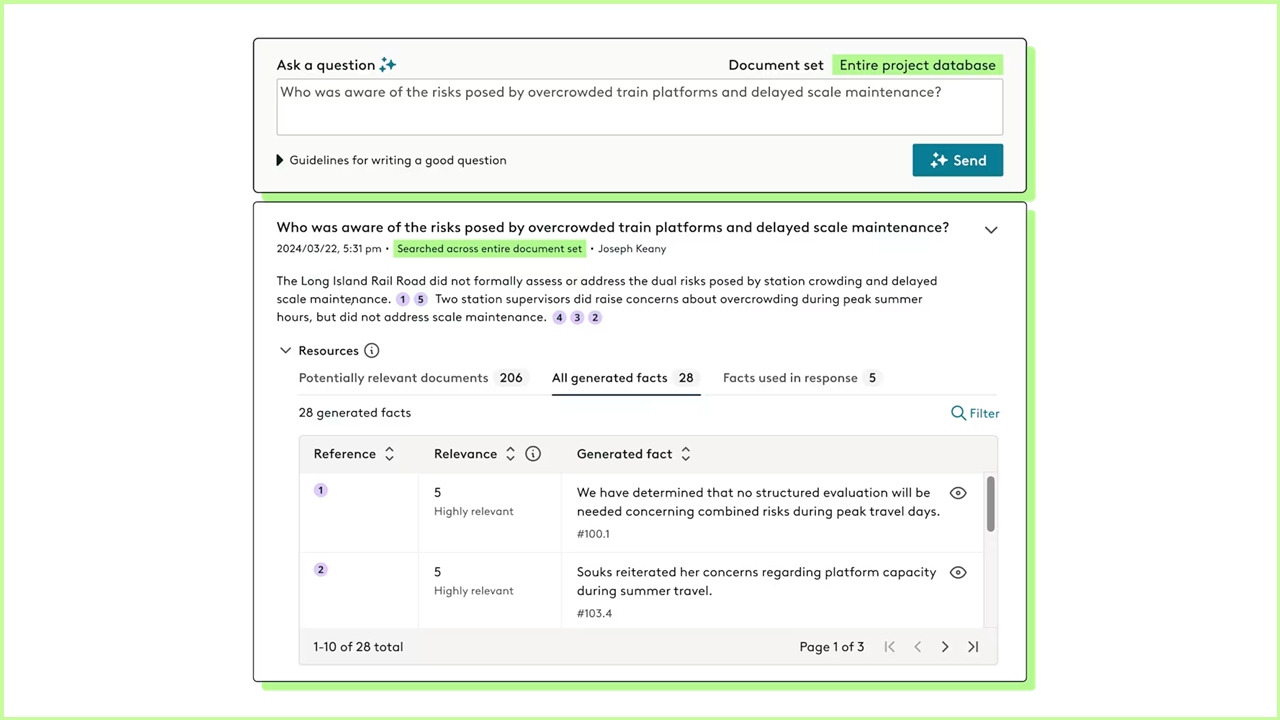
tool
processes
queries
by
first
identifying
relevant
document
subsets,
extracting
pertinent
facts,
scoring
their
relevance,
and
then
synthesizing
responses
with
full
citations.

When
Shankar
asked
Deep
Dive
how
opioids
work,
for
example,
it
returned
what
appeared
to
be
a
scientifically
grounded
explanation,
drawn
from
documents
within
the
corpus,
complete
with
citations
to
the
specific
documents
containing
the
information.

Transparency
and
Verification

The
tool
works
by
first
identifying
roughly
10,000
potentially
relevant
documents,
then
narrowing
them
to
approximately
50
of
the
most
pertinent
sources.
From
these,
it
extracts
and
scores
specific
facts,
showing
users
exactly
which
documents
support
each
claim
and
allowing
them
to
verify
the
underlying
sources.

“We
want
to
be
very
transparent
to
the
user,”
Shankar
said
as
he
clicked
through
screens
that
showed
relevance
scores
and
document
excerpts,
“so
you
can
check
up
on
the
site,
you
can
look
at
this
specific
document
and
the
request.”

At
the
same
time,
Shankar
was
candid
about
the
system’s
limitations.
“Does
that
mean
that
it
gives
you
great
answers
every
time?
Absolutely
not,”
he
said.
“…
Just
as
you’d
check
the
facts
if
an
intern
or
associate
brought
you
something
interesting,
you
want
to
check
the
facts
here.”

However,
one
check
built
into
the
system
is
that,
if
insufficient
evidence
exists
within
the
document
set
for
it
to
answer
a
question,
it
will
tell
you
so,
answering,
“No
promising
answers
were
discovered.”

Shankar
also
noted
that
Deep
Dive
is
not
suitable
for
comprehensive
document
review
or
privilege
determinations

Everlaw
has
other
AI
tools
designed
for
those
purposes.

“I
would
not
use
it
in
relevance
or
privilege
review
because
those
are
casting
wide
nets,”
Shankar
explained.
“Your
obligation
in
relevance
is
pretty
broad.
You
don’t
want
to
miss
things.”

Noting
that
Everlaw
already
has
a
constellation
of
products
designed
to
help
with
document
review,
timeline
creation,
information
synthesis
and
more,
Shankar
said
Deep
Dive
is
yet
another
approach,
with
its
own
time
and
place,
and
yet
is
perhaps
“the
most
transformative.”

“We
expect
it
to
be
essential
for
many
large
cases
over
time,”
he
said.
“It’s
not
going
to
solve
all
your
problems,
it’s
not
going
to
solve
discovery,
but
it’s
going
to
be
able
to
help
guide
discovery
at
every
step
of
the
way.”

Under
the
Hood

Everlaw’s
Deep
Dive
uses
retrieval-augmented
generation
(RAG)
combined
with
sophisticated
reasoning
models,
including
OpenAI’s
o3
model
for
analysis
and
synthesis,
Shankar
said.

In
developing
the
product,
he
said,
Everlaw’s
strategy
was
to
leverage
the
“billions
and
billions
of
dollars”
invested
by
foundation
model
providers,
with
Everlaw’s
developers
focusing
on
implementation
rather
than
on
reinventing
the
wheel.

They
worked
closely
with
Google
on
advanced
embedding
models
and
maintain
commercial
agreements
with
all
major
AI
providers,
including
OpenAI,
with
the
goal
of
positioning
themselves
to
use
the
best
available
tools
as
the
landscape
evolves.

Documents
are
processed
into
chunks
of
200-300
words
with
overlapping
context
windows
to
preserve
meaning
across
sentence
and
paragraph
boundaries.

The
system
typically
analyzes
around
10,000
documents
before
narrowing
results
to
approximately
50
most
relevant
sources.
Shankar
noted
this
limitation
is
by
design
rather
than
technical
constraint:
“The
bigger
the
set,
the
lower
the
signal
to
noise
ratio
of
the
facts.”

Potential
Use
Cases

At
the
briefing,

Chuck
Kellner
,
senior
strategic
discovery
advisor
at
Everlaw,
outlined
three
“out
of
the
box”
use
cases
for
Deep
Dive:

  • Last-minute
    deposition
    preparation,
    especially
    in
    the
    face
    of
    a
    last-minute
    data
    dump
    from
    an
    unfamiliar
    opposing
    party.
  • Early
    case
    assessment
    to
    determine
    litigation
    strategy,
    allowing
    legal
    teams
    to
    quickly
    probe
    their
    documents
    for
    evidence
    supporting
    or
    undermining
    their
    positions.
  • Improved
    planning
    for
    document
    review
    based
    on
    actual
    case
    content
    rather
    than
    assumptions
    from
    complaints
    or
    other
    pleadings.

The
tool
has
been
tested
across
49-50
matters
in
private
beta,
with
document
counts
averaging
150,000
per
case
and
ranging
up
to
10
million
documents.
User
testimonials
included
a
case
where
attorneys
immediately
discovered
a
previously
missed
key
document
during
an
onboarding
session.

Future
Development

Planned
enhancements
for
Deep
Dive
include
more
sophisticated
query
planning,
conversational
threading
to
build
on
previous
questions,
and
expanded
context
analysis,
Shankar
said.

The
company
expects
to
announce
general
availability
later
this
year,
though
no
specific
timeline
was
provided.

FedRAMP
Certification

Separately,
Everlaw
announced
forthcoming
FedRAMP
certification
for
its
EverlawAI
Assistant,
its
suite
of
generative
AI
tools,
enabling
federal
government
agencies
to
adopt
the
platform’s
generative
AI
capabilities.

The
certification,
which
Everlaw
expects
to
receive
in
September,
covers
its
gen
AI
features
Review
Assistant,
Coding
Suggestions,
and
Writing
Assistant.

Everlaw
said
this
makes
it
the
first
e-discovery
vendor
to
have
its
full
portfolio
of
gen
AI
features
FedRAMP
authorized.

Dumbass Attorney Baffled By Haircare During High Profile Case – Above the Law

(Photo
by
MEGA/GC
Images)

Legally
Blonde
is
the
movie
that
taught
a
generation
that
blonde
women
can
do
anything,
even
think
real
nice
like.
A
pivotal
part
of
the
film
(sorry
for
the
spoiler)
includes
Elle
questioning
a
witness
on
the
minutia
of
haircare
at
the
stand.
Truly
an
early
2000s
period
piece

we’ve
since
moved
far
away
from
depending
on
secretly
smart
big
screen
blondes
from
deducing
legal
conclusions
for
comedic
or
dramatic
effect:

Cardi
B
recently
found
herself
caught
up
in
courtroom
blonde
shenanigans.

People

has
coverage:

Cardi
B’s
wig
swap
left
an
attorney
who
was
cross-examining
her
during
a
civil
assault
trial
confused
about
her
“real
hair.”

“Yesterday
you
had
black
hair,
short
hair.
Today
it’s
blonde
and
long.
Which
one
is
your
real
hair?
Or
are
they
both
real?”
he
asked
her.

[Cardi
B]
laughed
before
replying,
“They’re
wigs.”

“Okay.
Sorry,
I
didn’t
know
that.
It’s
a
good
wig
today,
then,”
the
lawyer
responded.

You
can
see
the
exchange
here:

Imagine,
gaining
a
good
enough
grasp
on
RAP
to
pass
the
bar
only
to
be
confuddled
by
a
rapper’s
rolodex
of
wigs
years
later.
And
while
it
is
admittedly
funny
that
Cardi
B
is
changing
trial
wigs

like
Ray-J
changed
his
hat
that
one
time
,
if
you’re
a
trial
attorney
working
on
a
high
profile
case,
have
some
tact.
Gaffes
like
that
can
tank
your
credibility
and
distract
jurors
from
the
reason
you’re
really
there,
like
arguing
that
a
celebrity
physically
assaulted
your
client.


Cardi
B
Confuses
Attorney
with
Wig
Swap
During
Security
Guard
Assault
Trial
in
Viral
Video

[People]


Chris
Williams
became
a
social
media
manager
and
assistant
editor
for
Above
the
Law
in
June
2021.
Prior
to
joining
the
staff,
he
moonlighted
as
a
minor
Memelord™
in
the
Facebook
group Law
School
Memes
for
Edgy
T14s
.
 He
endured
Missouri
long
enough
to
graduate
from
Washington
University
in
St.
Louis
School
of
Law.
He
is
a
former
boatbuilder
who
is
learning
to
swim, is
interested
in
critical
race
theory,
philosophy,
and
humor,
and
has
a
love
for
cycling
that
occasionally
annoys
his
peers.
You
can
reach
him
by
email
at [email protected]
and
by
tweet
at @WritesForRent.

DOJ Trollsuit Against Maryland Judges Gets Benchslapped Into Oblivion – Above the Law

With

Calvinball

the
order
of
the
day
at
One
First
Street,
it’s
a
relief
to
the
see
the
Justice
Department’s
bad
faith
shenanigans
get
spanked
in
court.
And
it’s
especially
gratifying
when
the
judge

delivering
that
spanking

is
one
of
Trump’s
own
appointees.
So
Judge
Thomas
Cullen
benchslapping
the
Justice
Department
for
its

preposterous
lawsuit
against

all
the
federal
judges

in
Maryland

is
an
exceptionally
delightful
read.

The
verdict:

Dismissed
.
And

God
help
ya

at
the
Fourth
Circuit,
PAM.

Bad
faith

After
the
Trump
administration
openly
defied
Chief
Judge
James
Boasberg’s
order
to
“turn
the
planes
around”
and
not
deport
any
alien
detainees
to
CECOT
in
El
Salvador,
DHS
embarked
on
a
nationwide
shell
game.
Detainees
like
Mahmoud
Khalil
and
Rumeysa
Ozturk
were
arrested
in
blue
states
and
rapidly
transferred
to
far
flung
detention
centers,
mostly
in
the
Fifth
Circuit,
in
a
blatant
attempt
to
deprive
local
courts
of
jurisdiction
over
habeas
claims.
Worse
still,
DHS
refused
to
commit
to

any

delay
in
deporting
immigrants
with
pending
habeas
petition,
despite
this(!)
Supreme
Court
ordering
the
government
to
give
detainees

“reasonable”
time

to
contest
their
deportation.

And
so
Chief
Judge
George
Russell
III
of
the
District
of
Maryland,
where
DHS
snatched
up
Kilmar
Abrego
Garcia
and
summarily
deported
him
to
the
one
country
on
earth
where
it
was
illegal
to
send
him,

took
steps
to
proactively
block
the
government

from
evading
the
jurisdiction
of
the
federal
court
in
Maryland.

In
a
May
28

standing
order
,
Judge
Russell
noted
that
the
“recent
influx
of
habeas
petitions
concerning
alien
detainees
purportedly
subject
to
improper
and
imminent
removal
from
the
United
States
that
have
been
filed
after
normal
court
hours
and
on
weekends
and
holidays
has
created
scheduling
difficulties
and
resulted
in
hurried
and
frustrating
hearings
in
that
obtaining
clear
and
concrete
information
about
the
location
and
status
of
the
petitioners
is
elusive.”
Pursuant
to
the
All
Writs
Act,
which
allows
courts
to
take
all
necessary
action
to
preserve
their
jurisdiction
over
a
pending
case,
he
enjoined
the
government
from
deporting
any
immigrant
for
two
full
business
days
after
the
filing
of
a
habeas
petition.
This
would
obviate
the
problem
of
the
government
immediately
whisking
immigrants
out
of
the
country
before
a
judge
could
adjudicate
their
habeas
claims,
as
it
would
have
succeeded
in
doing
in
the
Western
District
of
Texas
without
the

1
am
intervention

of
this(!)
Supreme
Court.

After
which
Attorney
General
Pam
Bondi
lost
her
shit.

“The
American
people
elected
President
Trump
to
carry
out
his
policy
agenda:
this
pattern
of
judicial
overreach
undermines
the
democratic
process
and
cannot
be
allowed
to
stand,”
she

fulminated
.

And
then
she
did
something

even
crazier
:
She
sued
every
federal
judge
in
the
state
of
Maryland,
even
including
the
ones
on
senior
status.

Bad
law

The

complaint

characterized
Judge
Russell’s
order
as
a
part
of
a
pattern
of
insolence
by
trial
court
judges,
who
“have
used
and
abused
their
equitable
powers
to
interfere
with
the
prerogatives
of
the
Executive
Branch
to
an
unprecedented
degree.”
The
DOJ
whined
that
courts
have
no
right
to
issue
equitable
relief
without
a
live
case
before
them
to
adjudicate,
and
they
demanded
injunctive
relief
to
block
the
standing
order.

Because
every
single
judge
in
Maryland

including
those
on
senior
status

was
a
named
defendant,
the
Fourth
Circuit
reassigned
the
case
to
Judge
Thomas
Cullen,
a
Trump
appointee
to
the
Western
District
of
Virginia.
And
so
Judge
Cullen
had
to
schlep
up
to
Baltimore
from
Roanoke
to
hear
this
dumb
turkey
in
person.

At
a
hearing
on
August
13,
he
seemed
dubious
of
the
DOJ’s
right
to
sue
judges.

“I
think
you
probably
picked
up
on
the
fact
that
I
have
some
skepticism,”
he

warned

DOJ
lawyer
Elizabeth
Themins
Hedges.

But
the

order

that
he
released
on
August
26
makes
it
clear
that
he
was
a
lot
more
than
skeptical.

You
are
bad,
and
you
should
feel
bad,
PAM!

Judge
Cullen
took
the
Trump
administration
to
task
for
its
full-blown
assault
on
the
independence
of
the
judiciary.

“The
coordinate
branches
together
form
the
government
of
the
United
States
of
America,
and
together
they
are
the
sovereign
in
this
Nation,”
he
notes,
reminding
the
Justice
Department
that
“the
executive
branch
is
not
the
sole
sovereign
in
the
United
States
of
America.”

He
excoriates
the
DOJ
and
its
leadership
for
their
constant,
inappropriate
attacks
on
the
judiciary
as
a
whole
and
on
individual
federal
judges:

Indeed,
over
the
past
several
months,
principal
officers
of
the
Executive
(and
their
spokespersons)
have
described
federal
district
judges
across
the
country
as
“left-wing,”
“liberal,”
“activists,”
“radical,”
“politically
minded,”
“rogue,”
“unhinged,”
“outrageous,
overzealous,
[and]
unconstitutional,”
“[c]rooked,”
and
worse.
Although
some
tension
between
the
coordinate
branches
of
government
is
a
hallmark
of
our
constitutional
system,
this
concerted
effort
by
the
Executive
to
smear
and
impugn
individual
judges
who
rule
against
it
is
both
unprecedented
and
unfortunate.

And
he
lambasted
the
executive
branch
for
carelessly
initiating
a
battle
with
the
judicial
branch
which
could
easily
escalate
into
a
massive
constitutional
crisis.

“If
the
case
were
to
survive
a
motion
to
dismiss,
the
parties—the
individual
judicial
defendants
and
principal
officers
of
the
Executive,
including
the
Secretary
of
Homeland
Security
and
the
United
States
Attorney
General—would
potentially
be
required
to
sit
for
depositions
and
produce
documents,
including
emails
and
other
internal
communications,
relevant
to
the
issuance
of
the
standing
orders
and
the
actual
reasons
for
filing
suit,”
he
railed.
“These
discovery
demands,
in
turn,
would
almost
certainly
trigger
claims
of
privilege—
executive,
judicial,
deliberative-process,
and
the
like—and
invariably
compound
this
constitutional
standoff
into
epic
proportions.”

GTFO

Judge
Cullen
found
that
the
judges
were
immune
from
suit,
the
president
had
no
standing
to
sue,
and
“the
Executive
fails
to
identify
a
legitimate
cause
of
action
that
allows
it
to
bring
this
lawsuit.”
But
other
than
that

bang
up
job,
fellas!

He
dismissed
the
case
without
reaching
the
gravamen
of
the
complaint,
although
he
did
note
that
the
Fourth
Circuit
has
its
own
standing
order
imposing
an
automatic


two-week
stay

of
removal
upon
notice
of
appeal,
compared
to
which
“the
District
of
Maryland’s
recent
stopgap
measure
appears
considerably
more
modest.”

Judge
Cullen
also
expressed
astonishment
that
the
DOJ
didn’t
do
the

normal

thing
and
just
challenge
the
48-hour
order
in
a
relevant
case,
rather
than
declare
war
on
Maryland’s
judiciary.

“But
as
events
over
the
past
several
months
have
revealed,
these
are
not
normal
times—
at
least
regarding
the
interplay
between
the
Executive
and
this
coordinate
branch
of
government,”
he
wrote.
“It’s
no
surprise
that
the
Executive
chose
a
different,
and
more
confrontational,
path
entirely.”

And
perhaps
it’s
no
surprise
that
this
abnormal
regime
immediately
noticed
an
appeal
to
the
Fourth
Circuit.
That
court
has
not
been
particularly
friendly
to
the
DOJ
of
late.
Even
Judge
Wilkinson

gave
it
the
back
of
his
hand

when
it
demanded
a
get-out-of-discovery-free
card
in
the

Abrego
Garcia

case.
But
the
Supreme
Court
has
been
lighting
trial
judges
on
fire
for
sport
of
late
so

might
as
well
give
it
a
go,
right?

Morning Docket: 08.28.25 – Above the Law

*
Chicago
prepares
for
potential
troop
deployment.
Chicagoans
might
want
to
familiarize
themselves
with

how
grand
juries
work

before
the
Italian
Beefs
start
flying.
[Reuters]

*
Trump
can
bring
lawsuit
against
Pulitzer
Prize
board
for
aggravated
awarding
journalists
for
reporting
on
him.
The
Pulitzer
committee
wanted
the
case
delayed
until
after
his
presidency
out
of
fear
that
he
would
use
the
office
to
abuse
discovery
obligations.
[Bloomberg
Law
News
]

*
Trump
administration
claims
to
have
fired
the
new
CDC
director.
Her
lawyers
Abbe
Lowell
and
Mark
Zaid
say
otherwise.
[ABC
News
]

*
AI
hallucinations
show
up
again,
this
time
in
Katt
Williams
litigation.
[Law360]

*
Sam
Alito
becomes
last
horse
to
cross
the
finish
line
with
financial
disclosure.
[Fix
the
Court
]

*
Top
50
firms
continue
to
outpace
the
competition
according
to
the
Wells
Fargo
report
while
other
bank
reports
showed
midsized
firms
growing
faster
so
maybe
nobody
knows
what’s
happening
right
now.
[American
Lawyer
]

*
The
legal
fight
over
James
Bond
trademarks.
[Law.com
International
]

Mnangagwa’s land and irrigation push sparks legal and corruption concerns

MAZOWE

President
Emmerson
Mnangagwa
on
Monday
handed
out
title
deeds
to
10,000
A1
farmers
and
launched
a
US$2
billion
irrigation
scheme,
pledging
to
transform
small-scale
farming
into
a
climate-resilient,
year-round
enterprise.

At
a
ceremony
held
at
Craigengower
Farm
in
Mazowe,
Mashonaland
Central,
Mnangagwa
said
the
so-called
A1
Irrigation
Productivity
Booster
Kits
would
mark
a
turning
point
in
Zimbabwe’s
push
for
food
security.
Each
participating
farmer
is
set
to
receive
irrigation
equipment
worth
US$6,000,
financed
through
a
loan
facility
to
be
repaid
over
seven
years.

“This
programme
will
free
our
farmers
from
dependence
on
rainfall
and
ensure
food
security
for
our
nation,”
Mnangagwa
said,
promising
that
the
scheme
would
eventually
cover
300,000
beneficiaries
nationwide.

But
while
the
handover
was
pitched
as
a
milestone
in
agrarian
reform,
legal
experts
immediately
raised
doubts
over
the
legitimacy
of
the
“title
deeds”
given
to
farmers.

Prominent
lawyer
and
opposition
politician
Fadzayi
Mahere
described
the
exercise
as
unconstitutional.

“The
constitution
does
not
allow
for
private
ownership
of
agricultural
land.
Sections
72(4)
and
72(5)
make
it
clear
that
all
agricultural
land
belongs
to
the
State.
Title
deeds
for
such
land
were
cancelled
after
the
land
reform
programme,
and
the
law
only
permits
the
State
to
issue
permits,
offer
letters
or
leases

not
title
deeds,”
Mahere
said.

She
added
that
the
documents
distributed
by
government
“are
of
no
force
or
effect”
and
would
not
be
recognised
by
banks
as
security
for
loans
or
lawful
transfers
of
land.

The
irrigation
initiative
is
also
drawing
comparisons
with
the
controversial
Command
Agriculture
programme,
which
left
treasury
saddled
with
billions
of
dollars
in
debt
amid
accusations
of
massive
corruption.

Critics
argue
that
the
new
irrigation
kits
are
overpriced.
One
government
critic
said:

“The
kits
cost
less
than
US$2,500
on
the
market.
Farmers
are
being
forced
to
take
on
a
US$6,000
debt,
leaving
US$3,500
per
kit
to
be
skimmed
off.
Multiply
that
across
the
300,000
targeted
farmers,
and
it’s
a
potential
US$1
billion
scandal.”

Such
concerns
have
fuelled
suspicion
that
the
scheme
could
be
another
state-backed
mechanism
for
looting
under
the
guise
of
empowerment.

The
controversy
deepens
with
the
involvement
of
businessman
Kudakwashe
Tagwirei,
a
close
Mnangagwa
ally
who
chairs
the
Land
Tenure
Implementation
Committee.
Tagwirei
is
also
a
major
shareholder
in
CBZ,
the
bank
spearheading
the
loan
programme.

Analysts
warn
that
this
dual
role
raises
serious
conflicts
of
interest,
with
fears
that
CBZ
could
ultimately
seize
vast
tracts
of
farmland
from
farmers
who
default
on
their
loans.

“The
scheme
is
diabolical
in
its
simplicity.
What
looks
like
liberation
is
debt
bondage.
What
looks
like
development
is
theft,
institutionalised
at
scale,”
one
critic
observed.

Food
Security
vs.
Political
Patronage

Government
insists
the
irrigation
drive
is
about
climate-proofing
agriculture
and
boosting
productivity.
Mnangagwa
cited
improvements
in
grain
output
in
recent
years
as
evidence
that
state-led
interventions
are
bearing
fruit.

Yet
the
questions
over
the
legal
standing
of
the
title
deeds,
the
true
cost
of
the
irrigation
kits,
and
Tagwirei’s
central
role
cast
a
long
shadow
over
what
was
meant
to
be
a
flagship
initiative.

‘Remarkable Failure’ By U.S. Attorney’s Office – See Also – Above the Law

They
Can’t
Even
Prosecute
A
Sandwich!:
Grand
jurors
weren’t
too
keen
on
imprisoning
a
man
for
throwing
lunch.
Employees
Get
Work
Off
Because
Your
Favorite
English
And
Gym
Teachers
Are
Getting
Married:
Truly
a
reason
for
celebration!
Mental
Health
And
Product
Liability:
A
teenage
suicide
puts
the
spotlight
on
who
is
responsible
for
following
ChatGPT’s
advice.
Are
You
Sure
You
Bought
That
Video?:
Amazon
hit
with
class
action
over
selling
leases
to
videos
instead
of
actual
ownership.
This
Week
On
Thinking
Like
A
Lawyer:
This
firm’s
recent
2400
hour
adoption
has
associates
pissed.

Prosecution Fails Third Attempt At FBI ‘Assault’ Case – Above the Law

What’s
with
all
of
these
soft
ass
assault
charges?
Before
headlines
were
focused
on

an
errant
Subway
sandwich
hitting
an
officer’s
uniform
,
a
woman
was
arrested
and
charged
with
assault
for
actions
that
followed
an
attempt
to
move
men
accused
of
gang
activity.
Sounds
fancy,
right?
A
lot
of
fluff
to
pad
what
actually
happened

she
was
recording
the
police
and
for
whatever
reason
an
officer’s
hand
brushed
a
cement
wall
as
she
was
arrested
for
doing
so.
The
charges
were
such
bullshit
that
prosecutors
weren’t
able
to
find
a
grand
jury
to
charge
her
with
the
“crime.”
And
they
tried
to
do
so

three

times.


Reuters

has
coverage:

Federal
prosecutors
failed
three
times
to
persuade
a
grand
jury
to
indict
a
woman
accused
of
assaulting
an
FBI
agent
during
an
immigration
operation
in
Washington,
D.C.,
last
month,
a
highly
unusual
failure
as
President
Donald
Trump’s
administration
seeks
to
aggressively
charge
street
crime
in
the
nation’s
capital.

Three
different
federal
grand
juries
declined
to
indict
Sydney
Reid
for
assaulting,
resisting,
or
impeding
officers,
prosecutors
disclosed
in
a
court
filing
late
on
Monday.
Prosecutors
then
downgraded
the
offense
to
a
misdemeanor.

Oof.
Between
these
grand
juries
and

the
one
that
decided
against

paying
the
sandwich
throwing
any
mind,
Trump’s
“tough
on
crime”
D.C.
crackdown
might
not
be
as
easy
to
carry
out
as
imagined.
Makes
you
wonder
how
flimsy
the
evidence
must
have
been.
Or
maybe
three
separate
grand
juries
deciding
not
to
play
ball
is
an
indication
of
people’s
discontent
about
immigration
operations.
Don’t
worry

I’m
sure
there
will
be
some
other
person
filming
the
police
or

burning
an
American
flag

that
prosecutors
can
divert
their
important
resources
toward.


US
Prosecutors
Fail
Three
Times
To
Secure
Indictment
In
FBI
Assault
Case

[Reuters]


Chris
Williams
became
a
social
media
manager
and
assistant
editor
for
Above
the
Law
in
June
2021.
Prior
to
joining
the
staff,
he
moonlighted
as
a
minor
Memelord™
in
the
Facebook
group Law
School
Memes
for
Edgy
T14s
.
 He
endured
Missouri
long
enough
to
graduate
from
Washington
University
in
St.
Louis
School
of
Law.
He
is
a
former
boatbuilder
who
is
learning
to
swim, is
interested
in
critical
race
theory,
philosophy,
and
humor,
and
has
a
love
for
cycling
that
occasionally
annoys
his
peers.
You
can
reach
him
by
email
at [email protected]
and
by
tweet
at @WritesForRent.

Can Congress pass a FY26 defense budget this year? Here are 12 key issues for lawmakers. – Breaking Defense

WASHINGTON

Congressional
defense
hawks
in
the
Senate
are
once
again
pushing
to
boost
the
topline
of
the

defense
budget
in
fiscal
2026,

but
as
lawmakers
return
to
Capitol
Hill
in
September,
they
will
have
to
face
an
even
more
pressing
question:
Will
they
be
able
to
pass
a
full-year
spending
bill
at
all?

Congress
failed
at
passing

FY25
appropriations

after
talks
between
Republicans
and
Democrats
broke
down,
resulting
in
the
approval
of
a
full
year
continuing
resolution

in
March
.
The
bill
marked
the
first
time
the
Defense
Department
will
have
been
funded
under
a
CR
for
an
entire
year.

This
year,
the
budget
process
has
been
even
more
tumultuous

even
with
Republican
control
of
both
the
House
and
the
Senate

raising
questions
about
whether
the
Pentagon
is
heading
toward
another
full-year
funding
extension.

For
much
of
the
year,
lawmakers
have
been
wrapped
up
in
passing

reconciliation

legislation
known
as
the
One
Big
Beautiful
Bill,
a
Trump-backed
megabill
that
contained
an
extra

$150
billion
in
defense
funding

as
well
as
other
priority
items. 

Meanwhile,
the
Pentagon
has
dragged
its
feet
in
presenting
its
own
budget
request
for
FY26,
putting
out
some
budget
documents

in
late
June

while
other
more
detailed
justification
documents
are
still
yet
to
be
released
or
presented
to
Congress.
(House
appropriators
drafted
their
version
of
the
FY26
defense
bill

without
having
seen

the
Pentagon’s
budget
proposal.)

With
the
clock
ticking
until
government
funding
runs
out
when
the
new
fiscal
year
starts
on
Oct.
1,
Congress’s
first
order
of
business
upon
its
return
from
recess
next
week
will
be
teeing
up
and
passing
a
short-term
continuing
resolution
that
will
give
lawmakers
time
to
work
out
a
spending
agreement.

After
that,
the
House
and
Senate
will
start
the
more
difficult
work
of
hammering
out
appropriations
bills,
with
the
House
promoting

a
bill

that
adheres
to
the
Defense
Department’s
flat
$848
billion
budget
request
and
the
Senate
advocating
for
a

topline
funding
bump

of
upwards
of
$22
billion.

Meanwhile,
neither
chamber
has
taken
its
version
of
the
National
Defense
Authorization
Act
to
the
floor
yet,
but
the
Senate
is
slated
to
start
debate

on
its
NDAA

as
soon
as
lawmakers
return
in
September. 

Some
experts
say
differences
in
the
various
defense
bills
might
not
ultimately
matter.

“The
most
probable
outcome,
in
our
view,
for
FY26
discretionary
spending
is
a
full-year
continuing
resolution
similar
to
what
occurred
in
FY25,”
Byron
Callan
of
Capital
Alpha
Partners
said
in
an
Aug.
1
note
after
the
Senate
Appropriations
Committee
passed
its
versions
of
the
defense
bill
out
of
committee.
“That
would
keep
DoD
discretionary
at
the
same
level
as
FY25
for
FY26,
but
we
would
expect
more
anomalies
to
allow
rate
increases
and
new
starts.”

As
Capitol
Hill
gets
down
to
business,
here’s
a
look
at
how
the
Pentagon
and
each
congressional
defense
committee
is
approaching
12
major
issues
this
budget
season:

Defense
Budget
Topline

Topline
budget
numbers
among
the
appropriations
and
authorizing
committees
aren’t
apples
to
apples,
with
no
single
bill
containing
the
whole
of
national
defense
spending.

The
NDAA

which
sanctions
funds
but
does
not
actually
obligate
them 

includes
the
Defense
Department
as
well
as
defense
spending
within
the
Department
of
Energy,
but
does
not
include
about
$11.5
billion
in
national
security
spending
outside
the
jurisdiction
of
the
House
and
Senate
armed
services
committees.

Meanwhile,
House
and
Senate
defense
appropriations
bills
cover
most
of
the
Defense
Department
and
some
intelligence-related
spending,
but
not
defense
spending
at
the
Department
of
Energy
or
military
construction
spending.


President’s
budget:

The
Defense
Department
requested
$848.3
billion
in
discretionary
funds
for
fiscal
2026,
flat
with
the
enacted
full-year
continuing
resolution
for
FY25.


Reconciliation:

The
reconciliation
bill
added
$150
billion
in
mandatory
funds
available
during
the
Trump
administration.
The
Pentagon
intends
to
use
$113.3
billion
of
that
funding
in
FY26.


HASC
NDAA:

Authorizes
$882.6
billion
in
defense
spending,
including
$848.3
billion
for
the
Defense
Department.


SASC
NDAA:

Boosts
defense
spending
by
$32
billion
to
$913.9
billion
in
defense
spending,
with
$
878.7
billion
for
the
Defense
Department.


House
defense
appropriations:

Adheres
to
OMB-approved
amount
by
appropriating
$831.5
billion.


Senate
defense
appropriations:

Includes
$851.9
billion,
increasing
defense
funding
by
about
$22
billion.

F-35
Joint
Strike
Fighter


President’s
budget:

Purchases
47
F-35s:
24
F-35As,
11
F-35Bs
and
12
F-35Cs.


Reconciliation
bill:

Did
not
add
money
for
additional
F-35s.


HASC
NDAA:

Authorizes
the
47
F-35s
requested
by
the
department.


SASC
NDAA:

Authorizes
57
F-35s,
adding
10
F-35As.


House
defense
appropriations:

Adds
funds
for
a
total
of
69
F-35s,
including
42
F-35As,
13
F-35Bs
and
14
F-35Cs.


Senate
defense
appropriations:

Funds
the
47
F-35s
requested
in
the
budget.

Golden
Dome


President’s
budget:

Outside
of
the
reconciliation
spending,
the
department’s
budget
request
includes
no
funding
specifically
earmarked
for
Golden
Dome.


Reconciliation:

Includes
$25
billion
in
Golden
Dome
spending,
all
of
which
the
department
intends
to
use
in
FY26.


HASC
NDAA:

Modifies
national
missile
defense
policy
to
include
the
deployment
of
a
next-generation
missile
shield
for
the
US
homeland
such
as
Golden
Dome,
and
requires
yearly
reports
on
Golden
Dome.


SASC
NDAA:

Modifies
national
missile
defense
policy
to
reflect
Golden
Dome
and
codifies
the
position
of
Direct
Reporting
Program
Manager
(DRPM)
for
Golden
Dome.


House
defense
appropriations:

The
bill
contains
$13
billion
in
space
and
missile
defense
funds
that
appropriators
said
could
fall
under
the
Golden
Dome
umbrella,
broken
down
into
$8.8
billion
for
Missile
Defense
Agency
programs
and
$4.1
billion
for
Space
Force
programs.


Senate
defense
appropriations
:
The
bill
report
states
that
the
Pentagon
“has
not
yet
provided
the
Committee
with
sufficiently
detailed
proposals
to
accurately
assess”
Golden
Dome,
and
requires
a
briefing
on
its
cost,
architecture
and
acquisition
strategy.

F-15EX


President’s
budget
:
No
aircraft
funded
through
discretionary
budget.


Reconciliation
:
Included
$3.1
billion
to
increase
F-15EX
production.
The
Pentagon
intends
to
use
that
money
to
buy
21
F-15EXs
in
FY26.


HASC
NDAA:

Conforms
to
DoD
recommendations.


SASC
NDAA:

Conforms
to
DoD
recommendations.


House
defense
appropriations:

Adds
$345
million
for
the
procurement
of
three
F–15EX
aircraft.

Senate
defense
appropriations:
Conforms
to
DoD
recommendations.

E-7
Wedgetail


President’s
budget:


Cancelled
the
program

due
to
survivability
and
cost
concerns,
but
included
$199
million
to
wrap
up
current
activities.


Reconciliation:

Did
not
address
the
E-7.


HASC
NDAA:

Adds
$600
million
to
continue
the
rapid
prototyping
program
for
a
total
of
$799
million.


SASC
NDAA:

Adds
$700
million
to
continue
development
and
procurement,
for
a
total
of
$899
million.


House
defense
appropriations:

Includes
a
total
of
$500
million
to
continue
the
E-7
program.


Senate
defense
appropriations:

Adds
$647
million
for
a
total
of
$846
million.

A-10
Retirement


President’s
Budget:

Retires
the
remaining
A-10
Warthogs
in
FY26.


Reconciliation:

Did
not
address
the
A-10.


HASC
NDAA:

During
the
markup
process,
HASC
passed
an
amendment
prohibiting
retirements
of
any
A-10s
in
FY26.

SASC
NDAA:
Mandates
that
the
Air
Force
retain
103
A-10s
in
its
inventory.


House
defense
appropriations:

Did
not
address
the
A-10
retirement.


Senate
defense
appropriations:

Did
not
address
the
A-10
retirement. 

F/A-XX


President’s
budget:

Includes
$74
million,
with
the
program
currently
under
review.
The
White
House

has
said

additional
congressional
funding
to
continue
the
new
naval
fighter
could
strain
the
defense
aviation
industrial
base
and
“delay
the
higher-priority
F-47
program.”


Reconciliation:

$750
million
to
“accelerate”
the
F/A-XX
program


HASC
NDAA:

Did
not
include
additional
funding
due
to
reconciliation
funds.


SASC
NDAA:

Adds
$500
million
to
F/A-XX
through

“Link
Plumeria”

special
access
program
code.


House
defense
appropriations:

Added
$971
million
to
continue
development
of
the
F/A–XX
program
with
the
intent
of
accelerating
initial
operational
capability.
Also
directs
the
Navy
to
provide
an
updated
schedule
for
awarding
the
engineering,
manufacturing
and
design
contract.


Senate
defense
appropriations:

Added
about
$1.4
billion
to
continue
F/A-XX
development.

E-2D


President’s
budget:

Four
aircraft


Reconciliation
bill:

Not
included
in
reconciliation
bill.


HASC
NDAA:

Four
aircraft


SASC
NDAA:

Strips
$1.5
billion
from
the
program,
described
in
the
committee
report
as
“E-2D
cancellation.”


House
defense
appropriations:

Four
aircraft


Senate
defense
appropriations:

Strips
about
$1.5
billion,
cancelling
the
procurement
of
four
aircraft.

Landing
Ship
Medium


President’s
budget:

No
discretionary
funding
is
requested
in
FY26.


Reconciliation
bill:

The
Pentagon
aims
to
use
reconciliation
funds
to
procure
nine
LSMs
in
FY26.

Congressional
guidance

states
that
funding
in
the
reconciliation
would
allow
the
department
to
purchase
eight
LSMs.


HASC
NDAA:

Adheres
to
the
president’s
budget.


SASC
NDAA:

Adheres
to
the
president’s
budget.


House
defense
appropriations:

Adds
$225
million
for
one
ship.


Senate
defense
appropriations:

Adheres
to
the
president’s
budget.

Joint
Light
Tactical
Vehicle


President’s
budget:

The
Army
canceled

further
procurement
of
the
JLTV,

while
the
Marine
Corps
included
about
$82
million
to
buy
138
JLTVs.


Reconciliation:

Does
not
include
funding
for
JLTV.


HASC
NDAA:

Conformed
to
DoD
recommendations


SASC
NDAA:

Adds
$168
million
for
224
additional
JLTVs
for
the
Marine
Corps.


House
defense
appropriations:

Included
$345
million
for
863
JLTVs
for
the
Army,
and
$169
million
for
224
JLTVs
for
the
Marine
Corps.


Senate
defense
appropriations:

Conforms
to
DoD
recommendations,
directs
the
Marine
Corps
to
provide
an
updated
acquisition
strategy.

Improved
Turbine
Engine
Program


President’s
budget:

Doesn’t
include
funding.


Reconciliation:

Congress
included
$63
million
for
“for
development
of
advanced
rotary-wing
engines.”
Congressional
guidance
stipulates
this
funding
is
meant
to
continue
the
ITEP
program.


HASC
NDAA:

Doesn’t
include
funding.


SASC
NDAA:

Doesn’t
include
funding.


House
defense
appropriations:

$175
million
for
the
Improved
Turbine
Engine
Program
(ITEP)


Senate
defense
appropriations:

Doesn’t
include
funding.

Ukraine


President’s
budget:

The
Pentagon
did
not
include
money
for
Ukraine
in
the
budget
request.


Reconciliation
:
Did
not
include
funding
for
Ukraine.


HASC
NDAA:

The
chairman’s
mark
included
$300
million
for
the
Ukraine
Security
Assistance
Initiative,
and
lawmakers
added
another
$100
million

during
the
markup
process,

for
a
total
of
$400
million.


SASC
NDAA:

Adds
$500
million
for
USAI


House
defense
appropriations:

House
appropriators
did
not
include
money
for
Ukraine
in
the
spending
bill.
(https://breakingdefense.com/2025/07/house-passes-832b-defense-appropriations-bill/)


Senate
defense
appropriations:

Adds
$800
million
for
USAI