Zimbabwe’s drug crisis exposes gaps in rehab services

A
recent
parliamentary
investigation
has
revealed
that
Matabeleland
North
and
South
provinces
do
not
have
any
drug
and
rehabilitation
centres,
leaving
youth
in
those
regions
without
proper
avenues
for
recovery.

This
stark
finding
is
part
of
the
Report
of
the
Portfolio
Committee
on
Youth
Empowerment,
Development
and
Vocational
Training
on
the
State
of
Drug
and
Substance
Abuse
Treatment
and
Rehabilitation
Centres,
presented
following
verification
visits
to
existing
and
proposed
facilities
across
the
country.

“The
Committee
observed
Matabeleland
North
and
South
Provinces
do
not
have
drug
and
rehabilitation
centres,”
reads
the
report,
exposing
a
geographic
disparity
that
has
left
communities
in
the
region
vulnerable.

Rehabilitation
centres
play
a
vital
role
in
providing
medical,
psychological
and
social
support
to
people
battling
addiction.

However,
the
report
paints
a
grim
picture
of
facilities
across
the
country,
with
inadequate
resources,
infrastructure
and
personnel
hampering
the
fight
against
drug
abuse.

Even
in
established
institutions,
a
severe
shortage
of
essential
medication
is
undermining
treatment
efforts.

“The
quality
of
care
and
treatment
is
compromised
due
to
a
shortage
of
psychotherapeutic
drugs,”
the
Committee
noted.

“At
the
general
section
of
Ngomahuru
Hospital
(in
Masvingo),
the
institution
is
not
providing
medications
to
patients,
leading
to
the
situation
where
the
section
of
the
hospital
functions
more
as
a
detention
centre
for
individuals
who
struggle
to
coexist
with
others
in
society.
Unfortunately,
after
four
to
eight
weeks
of
inadequate
treatment,
these
individuals
are
released
back
into
the
community.”

The
situation
is
also
placing
staff
at
risk
as
“some
patients
may
become
violent
and
without
the
necessary
drugs,
staff
are
unable
to
manage
these
situations
effectively.”

At
Ingutsheni
Central
Hospital,
Zimbabwe’s
largest
psychiatric
institution,
medicine
donations
have
failed
to
close
the
gap.

“Despite
Ingutsheni
Hospital
receiving
medicines
from
Egypt,
it
still
faces
shortages
of
critical
medications
like
Chlorpromazine
and
Diazepam
as
well
as
essential
anti-craving
and
aversive
drugs
necessary
for
effective
rehabilitation.”

Some
of
the
facilities
identified
for
conversion
into
rehabilitation
centres
are
still
waiting
for
formal
communication.

“Some
of
the
institutions
earmarked
for
conversion
into
rehabilitation
centres
such
as
St.
Luke’s
(in
Lupane)
and
Mzilikazi
Male
Circumcision
Centres
(in
Bulawayo)
have
not
yet
received
any
communication
in
that
regard,”
observed
the
Committee.

These
delays
come
despite
the
escalating
prevalence
of
substance
abuse,
with
common
substances
cited
including
crystal
meth,
cannabis,
alcohol
mixtures,
cough
syrups,
and
concoctions
like njengu and tototo.

The
report
cited
how
the
proposed
Gwanda
rehabilitation
centre
is
in
disrepair,
lacking
roofing
and
basic
infrastructure.

In
Lupane,
the
St.
Luke’s
facility
requires
extensive
resources
to
be
functional
while
Mzilikazi
centre
in
Bulawayo,
however,
needs
minimal
investment.

Consequently,
psychiatric
patients
are
referred
to
Ingutsheni
Central
Hospital
as
all
the
hospitals
visited
lack
adequate
infrastructure
and
facilities
while
these
institutions
are
overwhelmed
by
the
number
of
admissions
that
exceed
their
carrying
capacity.

The
report
stated
how
Masvingo’s
Ngomahuru
Hospital,
though
“dilapidated
and
seemingly
marginalised,”
holds
significant
potential
due
to
its
extensive
land
and
is
Zimbabwe’s
second-largest
psychiatric
facility
after
Ingutsheni
Hospital,
with
the
highest
capacity
compared
to
Ingutsheni.

“Unfortunately,
some
patients
remain
in
the
hospitals
permanently,
such
as
at
Ngomahuru
and
Ingutsheni
Central
Hospital,
further
straining
resources.
Families
often
abandon
their
relatives,
leading
to
an
increase
in
admissions.
For
instance,
as
of
June
24,
2024,
Ingutsheni
had
565
patients
with
a
capacity
of
708.”

Across
the
board,
the
health
institutions
visited
suffer
from
critical
shortages
of
trained
professionals.

“There
is
a
general
shortage
of
trained
professionals,
including
counsellors,
psychiatrists
and
social
workers
with
expertise
in
addiction
treatment,
which
limits
the
quality
and
scope
of
services
provided.
Staffing
levels
are
insufficient,
with
the
ideal
ratio
of
one
nurse
per
four
patients
not
being
met,”
the
report
says.

“Gwanda
Provincial
Hospital
is
struggling
with
a
deficit
of
mental
health
personnel,
currently
employing
only
33
out
of
the
recommended
70
workers.
Additionally,
institutions
like
Chipadze
lack
social
workers,
an
essential
role
in
the
recovery
process
for
patients.”

Basic
necessities
are
also
in
short
supply
such
as
uniforms
for
patients,
especially
in
psychiatric
sections,
which
are
often
unavailable,
in
poor
condition
with
many
torn.

“There
is
a
persistent
shortage
of
bedding
and
laundry
facilities
often
malfunction
leading
to
the
deterioration
of
linen,”
the
Committee
observed.

“There
is
a
severe
shortage
of
beds,
forcing
some
patients
to
sleep
on
the
floor
or
in
makeshift
arrangements.”

The
financial
constraints
are
most
pronounced
at
facilities
like
Ngomahuru
Hospital,
which
only
receives
30
percent
of
its
proposed
budget,
which
“often
only
allows
for
the
purchase
of
mealie-meal
for
two
months.”

The
Committee
concluded
that
Zimbabwe
lacks
a
consolidated
policy
on
drug
and
substance
abuse.

Though
several
laws
exist,
including
the
Dangerous
Drugs
Act,
Medicines
Control
Act,
and
the
Zimbabwe
National
Drug
Master
Plan
(2020–2025),
coordination
remains
fragmented.

The
report
called
on
the
Ministry
of
Health
and
Child
Care
to
urgently
send
formal
communication
to
all
facilities
earmarked
for
conversion,
recruit
student
interns
to
alleviate
staff
shortages
and
review
outdated
legislation.

Recommendations
also
urged
the
Ministry
of
Finance
to
allocate
adequate
resources
to
renovate
the
proposed
centre
in
Gwanda
and
complete
the
one
at
St.
Luke’s
Hospital.

The
Ministry
of
Public
Service,
Labour
and
Social
Welfare
is
tasked
with
incentivising
rural
nurses
to
retain
staff,
while
the
Ministry
of
Youth
Empowerment
is
urged
to
link
rehab
centres
with
vocational
training
institutions
to
provide
long-term
recovery.
DNA test should precede maintenance claims, petition tells MPs

Dr
Believe
Guta,
a
litigation
specialist,
submitted
the
petition
to
the
Speaker
of
Parliament
on
8
July.

In
it,
he
calls
for
changes
to
Section
23
of
the
Maintenance
Act
[Chapter
5:09],
which
currently
allows
for
the
prosecution
and
imprisonment
of
individuals
who
fail
to
meet
maintenance
obligations,
regardless
of
whether
paternity
has
been
legally
or
scientifically
confirmed.

Dr
Guta
wants
the
courts
to
require
paternity
confirmation,
via
voluntary
acknowledgment,
court
declaration,
or
DNA
testing,
before
initiating
any
criminal
proceedings
against
someone
presumed
to
be
a
father.

The
petition
cites
multiple
cases
in
which
men
were
jailed
for
defaulting
on
maintenance
orders,
only
for
subsequent
DNA
tests
to
prove
they
were
not
the
biological
fathers.

“Numerous
men
in
Zimbabwe
have
been
imprisoned…
where
paternity
was
either
in
dispute
or
subsequently
disproved
by
DNA
testing,”
the
petition
reads.

Dr
Guta
argues
that
affected
individuals
have
suffered
“irreparable
harm,”
including
loss
of
liberty,
reputational
damage,
psychological
trauma,
and
unjust
criminal
records.

He
also
cites
Section
49(1)(a)
of
the
Constitution,
which
protects
the
right
to
personal
liberty,
warning
that
the
current
law
risks
violating
that
right
in
the
absence
of
proper
legal
safeguards.

The
petition
proposes
a
new
subsection
to
Section
23
of
the
Maintenance
Act:

“No
proceedings
under
this
section
shall
be
instituted
unless
the
paternity
of
the
child
concerned
has
been
established
by
voluntary
acknowledgment,
a
court
declaration,
or
a
DNA
test
conducted
in
accordance
with
the
law,
where
paternity
has
not
previously
been
admitted
or
is
disputed.”

Dr
Guta
also
recommends
the
establishment
of
a
statutory
review
mechanism
to
reassess
past
cases
where
individuals
may
have
been
wrongfully
imprisoned
or
penalised
under
disputed
paternity
claims.

Kudzayi Challenges US$100K Defamation Award To Mahere, Accuses Judge Of Bias

In
a
statement
posted
on
X,
Kudzayi
claimed
the
ruling
in
“Mahere
v
Kudzayi”
was
procedurally
flawed
and
based
on
a
“demonstrable
falsehood.”

He
alleged
that
Mahere
falsely
swore
in
her
condonation
application
that
she
had
applied
for
a
pre-trial
conference
when
the
case
was
struck
off
for
inactivity.

According
to
Kudzayi,
court
records
show
no
such
application,
and
the
required
Rule
49
documents
are
absent,
evidence
he
says
proves
fabrication.
Wrote
Kudzayi:

Mahere’s
misrepresentation
revived
litigation
the
Court
had
twice
struck
off,
leaving
the
ensuing
default
judgment
a
procedural
shell
built
on
perjury.

The
defamation
case
stems
from
a
2022
article
published
on Kukurigo,
a
news
platform
reportedly
run
by
Kudzayi,
which
alleged
Mahere
had
an
extramarital
affair
with
businessman
Tinashe
Murapata.

Mahere
denied
the
claims,
arguing
they
were
defamatory
and
violated
her
privacy.
The
High
Court
awarded
her
damages
after
Kudzayi
failed
to
appear
in
court.

Kudzayi
now
accuses
Justice
Wamambo
of
aiding
Mahere
by
ignoring
a
letter
he
sent
in
March
warning
that
the
proceedings
were
fraudulent.

He
said
the
judge’s
office
signed
for
the
letter
but
later
claimed
not
to
have
read
it.
Said
Kudzayi:

What
sort
of
judge
signs
for
a
document
and
then
professes
ignorance
of
its
contents?
A
shameless
judge
without
honour.

He
further
alleged
that
Mahere
was
allowed
to
bypass
a
mandatory
round-table
meeting
meant
to
define
trial
issues,
another
procedural
lapse
he
says
shielded
her
from
scrutiny.

Kudzayi
has
vowed
to
file
an
urgent
application
for
rescission,
arguing
that
the
judgment
is
void
under
the
legal
principle
“fraus
omnia
vitiat”,
fraud
vitiates
everything.

Mahere Wins US$100,000 Defamation Case Against Edmund Kudzayi

Mahere
brought
the
suit
over
an
article
published
by
the
online
platform
Kukurigo,
reportedly
operated
by
Kudzayi,
which
alleged
she
had
an
affair
with
businessman
Tinashe
Murapata,
resulting
in
the
breakdown
of
his
marriage.

The
claim,
lodged
in
July
2022,
went
undefended
after
Kudzayi
failed
to
appear
in
court.

Justice
Joel
Mambara
has
issued
a
default
judgment
in
Mahere’s
favour.
Ruled
Justice
Mambara:

Whereupon,
after
reading
documents
filed
of
record
and
hearing
counsel,
the
plaintiff’s
claim
be
and
is
hereby
granted.

The
defendant
(Edmund
Kudzayi)
shall
pay
the
plaintiff
the
sum
of
US$100,000.00
(One
hundred
thousand
United
States
dollars),
or
the
equivalent
thereof
in
local
currency
at
the
rate
of
exchange
prevailing
at
the
time
of
payment.

The
defendant
shall
pay
interest
on
the
above
amount
at
the
prescribed
rate
namely
5%
per
annum
from
the
date
of
service
of
summons
to
the
date
of
payment.

In
addition
to
the
damages,
Kudzayi
was
ordered
to
pay
the
costs
of
the
suit.

Under
the
law,
a
default
judgment
cannot
be
appealed
directly
but
may
be
challenged
through
an
application
for
rescission.

To
succeed,
Kudzayi
must
provide
valid
reasons
for
failing
to
respond
to
the
lawsuit.
If
that
application
is
unsuccessful,
he
may
then
appeal
the
decision
to
a
higher
court.

The
article
at
the
centre
of
the
case
included
photographs
of
Mahere
and
Murapata
at
public
events,
including
a
funeral.

It
also
claimed
to
reference
WhatsApp
messages
in
which
Mahere
allegedly
requested
money
from
Murapata,
using
this
to
support
the
affair
allegation.

Mahere
argued
that
the
claims
were
“wrongful
and
defamatory,”
portraying
her
as
unethical
and
unprofessional.

She
denied
any
misconduct
and
maintained
that
her
public
status
did
not
justify
intrusions
into
her
private
life,
stressing
her
right
to
privacy
and
to
a
good
reputation.

Court
documents
noted
that
Kukurigo,
which
claims
a
readership
of
370,000
and
substantial
social
media
presence,
had
amplified
the
story,
resulting
in
further
republication
by
other
outlets.

Mahere
said
the
wide
circulation
had
harmed
her
reputation
as
a
legal
professional,
public
figure,
and
international
speaker.

In
a
defence
filed
prior
to
the
default
judgment,
Kudzayi
maintained
that
the
article
was
a
responsible
act
of
journalism.

He
insisted
it
was
based
on
fact
and
professional
standards,
describing
the
content
as
truthful
and
supported
by
evidence
he
intended
to
present
in
court.

He
rejected
Mahere’s
claims
that
the
article
relied
on
insinuation
or
falsehoods,
and
challenged
her
to
meet
the
“strictest
proof”
required
to
substantiate
her
allegations.

Kudzayi
also
denied
acting
out
of
malice,
arguing
that
Mahere
had
been
given
an
opportunity
to
respond
and
that
open
communication
channels
had
existed
throughout.

Kudzayi
insisted
his
actions
were
in
the
public
interest,
not
driven
by
spite
or
personal
vendetta.

Mthuli Breaks Down US$114 Million Trabablas Interchange Cost

Responding
to
questions
from
legislators
in
the
National
Assembly,
Ncube
explained
that
a
portion
of
the
funds
was
allocated
to
compensate
families
who
were
relocated
to
make
way
for
the
infrastructure
development.
He
said:

We
spent
$65
million
on
things
such
as,
for
instance,
contractors’
establishment
on
site,
accommodation
of
traffic,
the
drains
and
just
picking
up
a
few
things,
pitching
storm
rate
protection
against
erosion,
stabilisation,
prime
court,
road
signs
and
foundation
structures
so
the
hard
infrastructure
engineering
part
was
$65.5
million.

Then
we
had
to
add
some
bridges,
which
were
needed.
Things
like
bridge
1,
bridge
2,
up
to
bridge
12,
that
was
another
$16
million,
for
example.

Then
there
was
the
supervisor
engineering
fees
and
electrical
works.
Supervisor
fees
alone
$2.4
million,
electrical
works
$4.4
million,
for
example.
If
you
just
add
those,
then
we
are
coming
to
$88.3
million.

You
can
see
that
here
we
have
not
included
the
relocation
costs
that
I
was
referring
to.
This
$26
million
went
towards
those
relocation
costs,
relocating
households
who
were
on
the
way.

We
did
that
successfully
and
we
thanked
them
for
agreeing
to
move.
That
is
what
happens
with
projects.

You
have
these
unforeseen
costs
and
you
have
to
make
provisions
for
them.

I
am
pleased
that
we
were
able
to
cover
them
and
I
think
the
Hon.
Members
are
pleased
with
the
product.

I
hope
they
will
have
an
opportunity
to
drive
on
it
as
well
and
really
experience
it.

It
is
a
wonderful
product
and
I
think
that
they
should
be
pleased
that
we
completed
the
project
successfully.

Lithium Smuggling Rampant as Zimbabwe Fails to End Corruption

HARARE,
ZIMBABWE

In
2023,
Peter,
a
truck
driver,
was
approaching
a
border
checkpoint
between
Zimbabwe
and
Mozambique.
He
had
little
reason
to
question
what
was
in
his
truck’s
sealed
container

he’d
transported
shipments
for
this
Chinese-owned
company
before.

“We
just
thought
everything
was
in
order,”
he
says.

But
rather
than
chrome,
the
mineral
listed
on
the
container’s
paperwork,
inspectors
found
raw
lithium.
By
law,
unprocessed
lithium
shouldn’t
leave
Zimbabwe
without
written
permission
from
the
minister
of
mines
and
mining
development.
Peter
didn’t
have
that.
Border
officials
impounded
the
truck
and
trailer

worth
more
than
US$50,000

for
a
year.
Drape
Trucking,
the
company
where
Peter
works,
recovered
it
after
paying
a
US$5,000
fine.

Zimbabwe,
which
boasts
Africa’s
largest
lithium
reserves,
is
poised
to
help
meet
global
demand
in
the
race
to
secure
green
energy
and
develop
advanced
technology.
Its
production
pales
in
comparison
to
powerhouses
like
Australia
and
Chile,
but
the
country
is
still
among
the
top-eight
producers
of
the
mineral,
producing
1,200
tons
in
2021
alone.

But
as
demand
grows,
so
does
illegal
trading.
In
Zimbabwe,
some
companies
mislabel
shipments
or
underreport
the
quality
and
quantity
of
lithium
exports.
Border
officials

either
unaware
or
complicit

allow
the
shipments
to
slip
through,
undermining
efforts
to
regulate
one
of
Zimbabwe’s
most
valuable
exports.

Peter
asked
that
Global
Press
Journal
use
only
his
first
name,
and
he
did
not
share
the
name
of
the
company
responsible
for
the
shipping
container’s
contents.
He
provided
the
name
of
the
owner
of
the
company,
but
Global
Press
Journal
was
not
able
to
verify
the
involvement
of
anyone
by
that
name
in
the
industry.

Tendai,
a
former
border
agent,
says
he’s
accepted
bribes
to
allow
lithium
shipments
to
pass
through
the
border.
Tendai
confirmed
the
incident
involving
Peter
and
says
he
was
arrested
and
fined
for
his
role.
Like
many
other
sources
who
spoke
to
Global
Press
Journal
for
this
article,
he
asked
not
to
use
his
full
name
for
fear
of
losing
his
job.

Barely
banned

In
2022,
Zimbabwe
banned
the
export
of
raw
lithium
to
curb
smuggling
and
extract
more
value,
since
the
law
would
force
mining
companies
to
process
lithium
domestically.
Since
then,
some
of
the
largest
lithium
mining
companies
in
the
country,
such
as
Arcadia
and
Bikita
Minerals,
have
set
up
processing
operations.

Data
on
whether
these
regulations
have
generated
more
revenue
is
hard
to
find.
Official
records
show
that
the
country’s
lithium
production
capacity
surged
by
230%
between
2022
and
2023.
Most
of
the
product
ends
up
in
China,
which
controls
90%
of
Zimbabwe’s
mining
sector.
Even
so,
the
ban
has
done
little
to
contain
lithium
smuggling
across
Zimbabwe’s
porous
borders.

The
regulations
are
ineffective,
says
Gorden
Moyo,
director
of
the
Public
Policy
and
Research
Institute
of
Zimbabwe.
Officials,
“including
members
of
security
services,
who
collude
with
politicians
and
foreign
governments,
particularly
China,”
facilitate
illegal
exports,
he
says.

Nomsa
Jane
Moyo,
the
general
manager
at
the
Minerals
Marketing
Corporation
of
Zimbabwe,
a
parastatal
group
that
inspects
exports,
says
the
organization
closely
monitors
mining
at
all
stages
to
ensure
that
companies
export
the
quantities
and
qualities
they
declare.
They
intercept
those
who
skirt
the
law,
she
says.

The
government
seized
22
lithium
shipments
in
2023
and
23
in
2024.
Some
were
seized
before
reaching
the
borders;
others
were
flagged
by
officials
at
the
Forbes
border
post,
between
Zimbabwe
and
Mozambique,
and
the
Beitbridge
border
post,
between
Zimbabwe
and
South
Africa.

Linda
Mujuru,
GPJ
Zimbabwe

A
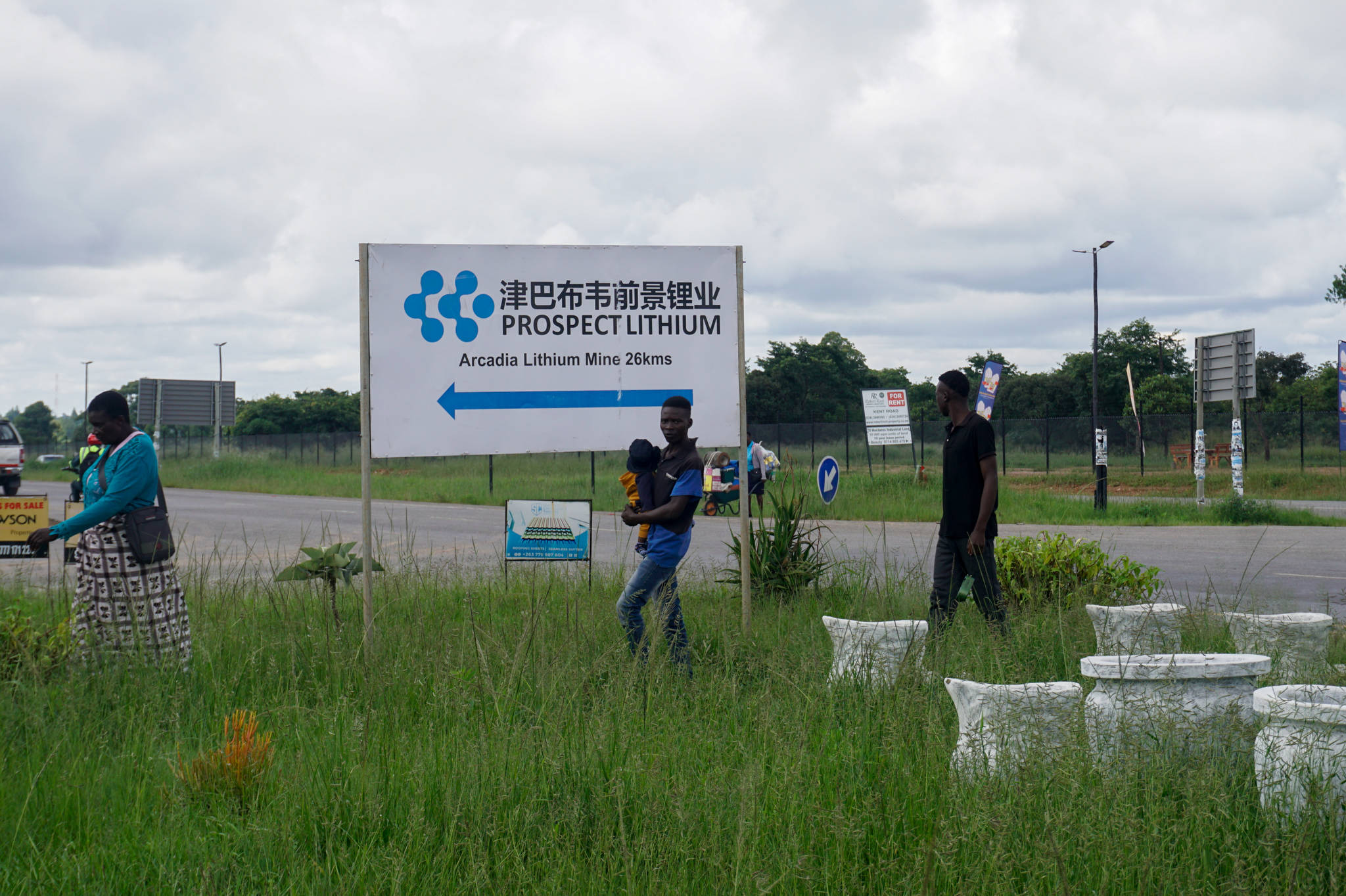
sign
marks
the
entrance
to
Prospect
Lithium
Zimbabwe’s
processing
plant
in
Goromonzi.
Despite
government
efforts
to
curb
smuggling,
former
border
officials
say
companies
conceal
high-grade
lithium
and
bribe
authorities
to
export
unprocessed
minerals.
Most
of
the
country’s
lithium
ends
up
in
China
and
Hong
Kong.

Secrecy
at
the
mines

According
to
the
Minerals
Marketing
Corporation,
in
2023,
the
country
sold
a
total
of
769,086
metric
tons
of
lithium,
valued
at
US$794
million
and
produced
by
two
main
lithium
mining
companies,
Prospect
Lithium
Zimbabwe
and
Bikita
Minerals.
Two-thirds
of
these
minerals
went
to
either
China
(59%)
or
Hong
Kong
(7%),
according
to
United
Nations
trade
data.

But
these
figures
don’t
reflect
the
true
volume
of
lithium
leaving
Zimbabwe,
says
Tendai,
the
former
border
agent.
Lithium
export
permits
are
issued
with
a
fixed
limit
for
how
much
a
company
can
export,
so
companies
often
underreport,
he
says.

It
all
starts
at
the
mines,
where
officials
claim
to
closely
monitor
activities,
says
Tatenda,
an
employee
at
Prospect
Lithium
Zimbabwe
who
asked
that
Global
Press
Journal
use
only
his
first
name
for
fear
of
losing
his
job.

Tatenda
says
the
company
undervalues
high
grades
of
lithium.
And
while
the
ministry
of
mines
carries
out
inspections,
he
says,
“the
high-quality
lithium
is
concealed
beneath
lower-value
ore
to
mislead
inspectors.”

Global
Press
Journal
made
several
attempts
to
speak
to
Prospect
Lithium
Zimbabwe.
Officials
indicated
that
they
would
comment
but
did
not
respond
to
subsequent
requests.


Companies
mislabel
shipments
or
underreport
the
quality
and
quantity
of
lithium
exports.
Border
officials

either
unaware
or
complicit

allow
the
shipments
to
slip
through.

Nomsa
Jane
Moyo,
from
the
Minerals
Marketing
Corporation,
says
the
lithium
quality
tests
they’ve
carried
out
at
Prospect
Lithium
Zimbabwe
meet
all
legal
requirements.

Tendai,
the
former
border
agent,
says
the
mining
companies
sometimes
bypass
shipment
records
by
bribing
not
only
border
officials
but
also
officers
from
the
Zimbabwe
Revenue
Authority
or
the
Minerals
Marketing
Corporation
of
Zimbabwe
and
others
within
the
export
chain.

The
Zimbabwe
Revenue
Authority
did
not
respond
to
multiple
requests
for
an
interview,
and
Nomsa
Jane
Moyo
did
not
respond
to
allegations
of
corruption
within
the
Minerals
Marketing
Corporation.

Corruption
facilitates
smuggling,
but
some
border
officials
don’t
always
know
what
they’re
inspecting,
says
Levious
Chiukira,
a
customs
and
trade
consultant
at
Gleam
Customs
and
Clearing
Agency.

“I
worked
as
a
customs
official
for
years,
yet
I
cannot
differentiate
between
petalite
and
lepidolite,
both
of
which
are
forms
of
lithium,”
he
says.
“[The
revenue
authority]
does
not
employ
geologists,
and
there
is
no
institutional
capacity
to
address
this
knowledge
gap.”

Linda
Mujuru,
GPJ
Zimbabwe

Piles
of
lithium
at
a
mine
in
Mutoko.
Zimbabwe
banned
the
export
of
unprocessed
lithium
in
2022,
but
weak
enforcement
and
corruption
have
allowed
smuggling
to
continue.

Undermined

Exporters
exploit
the
regulatory
gaps,
Gorden
Moyo
says.
“While
corruption
is
punishable
by
law
in
China,
when
they
operate
abroad,
they
act
with
impunity.”

The
government
hasn’t
helped.
Contracts
between
the
state
and
investors
are
not
accessible
to
the
public,
according
to
a
report
by
the
Africa
Policy
Research
Institute.
It
erodes
public
trust,
says
Tafara
Chiremba,
an
environmentalist
at
the
Zimbabwe
Environmental
Lawyers
Association.

Because
of
the
smuggling,
Chiremba
says,
it’s
China,
not
Zimbabwe,
that
benefits
from
the
country’s
wealth
of
lithium.

Zimbabwe undertakes second Joint External Evaluation to strengthen National Health Security


The
JEE
is
a
voluntary,
collaborative
process
used
globally
to
assess
a
country’s
readiness
to
manage
infectious
disease
outbreaks
and
other
health
emergencies.
It
is
conducted
every
five
years,
with
the
country’s
first
evaluation
completed
in
2018.

“The
JEE
gives
us
a
structured
opportunity
to
check
how
ready
we
are
to
detect
and
respond
to
public
health
threats
and
we
thank
all
the
partners
who
have
made
this
possible,”
said
Dr
Wenceslaus
Nyamayaro,
MoHCC
Acting
Chief
Director,
Public
Health.

The
internal
self-assessment,
the
first
phase
of
the
JEE,
was
completed
in
July
2025
with
over
100
participants
from
across
sectors
including
health,
environment,
veterinary
services,
defense,
disaster
management,
civil
society,
and
development
partners
including
WHO,
UNICEF,
FAO,
Africa
CDC
and
others.
This
participatory
process
assessed
19
technical
areas
ranging
from
biosafety
and
surveillance
to
legislation
and
points
of
entry.

Key
areas
that
emerged
as
requiring
urgent
attention
include
outdated
or
poorly
implemented
legal
instruments,
coupled
with
limited
availability
of
legal
support
at
subnational
levels.
Gender
equity
in
emergencies
remains
a
concern,
with
notable
gaps
in
funding
for
gender-based
violence
(GBV)
prevention
and
response,
as
well
as
low
representation
of
women
in
emergency
preparedness
and
decision-making
processes.
Funding
for
emergency
response
activities
was
also
highlighted
as
inadequate.  Surveillance
systems
for
foodborne
illnesses
and
healthcare-associated
infections
(HAIs)
are
still
fragmented,
highlighting
the
need
for
stronger
cross-sector
coordination.
Coordination
between
the
human,
animal
and
environmental
health
sectors
is
still
weak,
showing
the
need
to
improve
how
these
groups
work
together.
Biosafety
and
biosecurity
capacities
also
require
strengthening,
particularly
in
terms
of
laboratory
infrastructure
and
staff
training.
Additionally,
readiness
at
points
of
entry
remains
limited,
with
gaps
in
the
ability
to
detect
and
respond
to
public
health
threats
at
borders
and
airports.

Zimbabwe
also
assessed
its
progress
in
tackling
antimicrobial
resistance
(AMR),
a
growing
global
threat.
While
the
country
has
developed
a
robust
One
Health
AMR
National
Action
Plan
and
established
14
multisectoral
surveillance
sites,
challenges
remain
in
laboratory
capacity,
integration
of
data
systems
and
containment
of
multidrug-resistant
organisms
(MDROs).

The
next
phase
of
the
JEE
will
involve
an
external
validation
mission
scheduled
for
6–13
September
2025.
A
team
of
international
subject
matter
experts,
coordinated
by
WHO’s
Regional
Office
for
Africa,
will
work
with
technical
teams
in
Zimbabwe
to
validate
scores,
review
documentation
and
conduct
site
visits
to
key
health
facilities
including
laboratories
and
points
of
entry.
Following
the
mission,
Zimbabwe
will
develop
or
update
its
National
Action
Plan
for
Health
Security
(NAPHS).
This
plan
will
consolidate
findings
from
the
JEE,
past
outbreak
reviews,
and
risk
assessments
to
guide
future
investments
and
reforms
in
public
health
preparedness.

“The
evaluation
is
about
continuous
improvement.
It
reflects
Zimbabwe’s
commitment
to
protect
the
health
of
its
people
through
stronger
systems,
better
data,
and
broader
collaboration,”
said
Dr.
Desta
Tiruneh,
WHO
Representative
to
Zimbabwe.

The
evaluation
was
made
possible
with
funding
from
the
Health
Resilience
Fund
(HRF)
through
WHO,
with
additional
support
mobilized
by
MoHCC
from
Africa
CDC
and
UNICEF.

Post
published
in:

Featured

Another Day, Another Firm Bumping Up The In-Person Quota – See Also – Above the Law

This
Time
It’s
Duane
Morris:
Which
Biglaw
firm
will
be
the
next
to
hop
on
the
trend?
Never
A
Bad
Time
To
Call
Out
Stupidity:
Marc
Randazza
wrote
a
response
to
a
cease
and
desist
you
can
only
dream
of
sending
out.
About
Harvard’s
Negotiations
With
Trump:
They
scrubbed
diversity
mentions
from
several
of
their
undergrad
websites.
Midsize
Firms
Have
Prestige
Rankings
Too!:
Check
out
the
best
of
the
best
by
region
here!
Is
This
A
Pulpit
Or
A
Political
Rally?:
If
the
Johnson
Amendment
isn’t
being
enforced,
what’s
the
difference?

Trump Administration Bones The Johnson Amendment – Above the Law

In
2017,
a
newly
elected
President
Trump
promised
faith
leaders
to
remove
a
once-critical
barrier
in
the
separation
of
church
and
state.

“I
will
get
rid
of
and
totally
destroy
the
Johnson
Amendment
and
allow
our
representatives
of
faith
to
speak
freely
and
without
fear
of
retribution,”
he
vowed
at
the
National
Prayer
Breakfast
just
two
weeks
after
his
inauguration.

As
with
so
many
of
his
promises,
that
one
went

unkept
.
The
Johnson
Amendment,
which
bars
churches
from
endorsing
political
candidates,
is
a
federal
law,
so
it
can’t
be
“destroyed”
by
the
President.
And
when
congressional
Republicans
tried
to
sneak
repeal
of
the
Johnson
Amendment
into
a
budget
reconciliation
bill,
the
Senate
parliamentarian
nixed
it.

But
no
matter!
Because
the
Supreme
Court’s
conservatives
have
been
working
overtime
to
grant
wishes
to
Christian
conservatives.
And
with
the
help
of
a
Trump-appointed
district
court
judge
in
Texas,
they
might
be
able
to
leverage
a
largely-defunct
lawsuit
brought
by
two
tiny
churches
to
pull
the
Trump
DOJ
over
the
finish
line.

Hey
hey
LBJ

Named
for
then-Senator
Lyndon
Johnson,
the

1954
amendment

to
the
Internal
Revenue
Code
grants
charitable
organizations
a
special
kind
of
tax-exempt
status,
wherein
the
organization’s
revenues
are
untaxed,

and

its
donors
can
deduct
their
contributions.
Churches
get
to
keep
this
“double
dip”
as
long
as
“no
substantial
part
of
the
activities
of
which
is
carrying
on
propaganda,
or
otherwise
attempting,
to
influence
legislation

and
which
does
not
participate
in,
or
intervene
in
(including
the
publishing
or
distributing
of
statements),
any
political
campaign
on
behalf
of
(or
in
opposition
to)
any
candidate
for
public
office.”

That
means

or

should

mean,
anyway

that
if
either
a
secular
charity
or
a
church
endorses
a
particular
candidate
for
President,
the
organization
will
lose
its
tax-exempt
status.
But
evangelical
churches
really,
really
wanted
to
endorse
Republicans
from
the
pulpit

and

keep
all
the
goodies
from
being
tax-exempt
501(c)(3)
organizations.
And
so,
they
did.

Beginning
in
2008,
the
Alliance
Defending
Freedom
started
organizing
what
it
called
Pulpit
Freedom
Sundays
,”
encouraging
pastors
to
publicly
flout
the
law
by
endorsing
specific
candidates
in
their
sermons.

For
example,
on
May
15,
2022,
Pastor
(and

January
6th
insurrectionist
)
Greg
Locke

preached

that
Democrats
were
“baby-butchering
election
thieves”
unwelcome
in
his
house
of
god:

If
you
vote
Democrat,
I
don’t
even
want
you
around
this
church.
You
can
get
out.
You
can
get
out,
you
demon.
You
can
get
out,
you
baby-butchering,
election
thief.
You
cannot
be
a
Christian
and
vote
Democrat
in
this
nation.
I
don’t
care
how
mad
that
makes
you.
You
can
get
as
pissed
off
as
you
want
to.
You
cannot
be
a
Christian
and
vote
Democrat
in
this
nation.
You
cannot
be
a
Democrat
and
a
Christian.
You
cannot.
Somebody
say
“Amen.”
The
rest
of
you
get
out.
Get
out!
Get
out
in
the
name
of
Jesus!

It’s
difficult
to
imagine
a
more
flagrant
violation
of
a
law
prohibiting
“opposition
to

any

candidate
for
public
office”
than
opposing
literally

every

candidate
of
one
political
party.
And
the
IRS
did
exactly

nothing
.
Over
the
past
17
years,
just

one
church

has
ever
been
investigated
by
the
IRS
for
violating
the
Johnson
Amendment,
and
there,
too,
the
government

declined

to
take
any
remedial
action.

But
even
the
tacit
refusal
to
enforce
the
Johnson
Amendment
is
not
enough.
The
Christian
right
wants
the
law
declared
unconstitutional
to
allow
it
to
be
able
to
double
dip
and
play
politics,
too.
And
so,
as
with
so
many
rightwing
causes,
conservative
activists
went
looking
for
a
test
case
and
a
friendly
judge
to
shop
it
to.

What
Would
Jesus

Do

Vote
For

In
August
of
2024,
National
Religious
Broadcasters,
an
“association
of
Christian
communicators,”

sued

the
IRS,
claiming
that
the
Johnson
Amendment
violates
the
First
Amendment.
NRB
is
headquartered
in
DC,
but
luckily
it
had
a
couple
of
Texas
churches
along
for
the
ride,
which
is
how


National
Religious
Broadcasters
v.
Werfel

wound
up
in
the
Eastern
District
of
Texas
in
front
of
Judge
J.
Campbell
Barker,
a
Trump
appointee
who
authored
an

amicus
brief

in
favor
of
the
hate-baker
in
the

Masterpiece
Cakeshop

case
back
when
he
was
the
Deputy
Solicitor
General
of
Texas.

District
courts
in
Texas
have
become
a
sort
of
one-stop
shop
for
conservatives
seeking
nationwide
injunctions
blocking
everything
from
medication
abortion
to
caps
on
credit
card
fees.
But
that
plan
hit
a
snag
last
week
when
the
Supreme
Court

discovered

that
nationwide
injunctions
are
actually
illegal.

Who
knew?

The
new
rule
magicked
up
by
the
Roberts
Court
makes
it
harder
for
judges
to
stop
Trump
from
doing
crazy,
illegal
stuff
like
banning
birthright
citizenship
by
executive
fiat.
But
it
also
means
that
a
victory
in

NRB
v.


Werfel

can
provide
tax
relief

only

as
to
the
named
plaintiffs.
The

demand

for
a
declaratory
judgment
calling
the
Johnson
Amendment
unconstitutional
and
barring
its
enforcement
nationwide
is
functionally
DOA.

But
when
Sam
Alito
closes
a
door,
he
opens
up
a
window…
and
pushes
civil
society
out
it

One
of
the
reasons
Christian
conservatives
are
so
loyal
to
Trump
is
that
he
has
remade
America’s
courts
by
nominating
judges
willing
to
tear
down
the
wall
between
church
and
state.
In
the
past,
it
was
understood
that
governments
could
not
fund
religious
organizations
without
violating
the
First
Amendment’s
Establishment
Clause.
But
the
Supreme
Court
has
increasingly
turned
this
on
its
head,
ruling
that
it
violates
the
Free
Exercise
Clause
to
force
churches
to
“choose”
between
their
religious
beliefs
and
receiving
a
government
benefit.

In
2017,
the
Court
ruled
in


Trinity
Lutheran
v.
Comer

that
it
was
unconstitutional
for
the
state
of
Missouri
to
pay
to
resurface
public
school
playgrounds
while
refusing
to
extend
those
grants
to
parochial
schools.
Two
weeks
ago
it
held
in


Mahmoud
v.
Taylor

that
public
schools

must
allow
religious
parents

to
yank
their
kids
out
of
any
classroom
where
the
mere
existence
of
LBGTQ+
people
is
acknowledged
because
“Public
education
is
a
public
benefit,
and
the
government
cannot
‘condition’
its
‘availability’
on
parents’
willingness
to
accept
a
burden
on
their
religious
exercise.”
And
so
it
is
no
coincidence
that
the
NRB
plaintiffs
framed
their
case
as
one
of
poor,
beleaguered
religious
organizations
being
forced
to
choose
between
exercising
their
First
Amendment
right
to
endorse
political
candidates
and
their
501(c)(3)
tax
status.

Meanwhile
back
in
Tyler,
Texas…

When
the
NRB
plaintiffs
filed
they
complaint
in
August,
they
clearly
intended
to
tee
up
their
case
for
the
Fifth
Circuit
and
then
the
Supreme
Court
as
a
vehicle
to
overturn
the
Johnson
Amendment.
Then
Trump
got
elected,
and
they
likely
hoped
that
the
DOJ
would
switch
sides,
perhaps
entering
into
a
consent
decree
for
a
nationwide
injunction.
But
after

CASA
v.
Trump
,
that’s
off
the
table,
and
so
the
Trump
administration
did
the
next
best
thing.

On
Monday
it
filed
a

joint
motion

with
the
plaintiffs
asking
Judge
Barker
to
approve
a

consent
judgment

settling
the
case.
So
far,
he’s
stayed
all
deadlines
to
consider
it.

In
the
motion,
the
DOJ

very
carefully

picked
its
way
around
the
issue
of
nationwide
injunctions,
agreeing
only
that
“the
Court
has
the
power
to
provide
the
injunction
with
respect
to
the
Plaintiffs
requested
by
this
Motion
under
the
U.S.
Constitution
and
the
Judiciary
Act
of
1789.”
Instead,
it
used
the
filing
to
announce
that
the
IRS
will
henceforth
interpret
the
Johnson
Amendment
as
if
it

does
not

bar
churches
from
making
political
endorsements.

The
government
begins
by
parsing
the

Merriam-Webster

definitions
of
“participate”
and
“intervene”
and

eureka!

concludes
that
endorsements
from
the
pulpit
are
kosher
after
all.

Bona
fide
communications
internal
to
a
house
of
worship,
between
the
house
of
worship
and
its
congregation,
in
connection
with
religious
services,
do
neither
of
those
things,
any
more
than
does
a
family
discussion
concerning
candidates.
Thus,
communications
from
a
house
of
worship
to
its
congregation
in
connection
with
religious
services
through
its
usual
channels
of
communication
on
matters
of
faith
do
not
run
afoul
of
the
Johnson
Amendment
as
properly
interpreted.

Then
it
commits
a
Cirque
du
Soleil-worthy
act
of
historical
contortionism
by
claiming
that
the
Establishment
Clause
actually
prohibits
the
government
from
“regulating”
religious
observance
by
denying
it
a
government
subsidy.
The
argument
is
that
enforcing
the
Johnson
Amendment
(or
any
restriction
on
a
church’s
political
speech
whatsoever)
is
tantamount
to
preferring
one
religious
denomination
over
another
because
it
“treats
religions
that
do
not
speak
directly
to
matters
of
electoral
politics
more
favorably
than
religions
that
do.”

Finally,
it
argues
that
the
court
is
obliged
to
interpret
the
statute
to
avoid
this
glaring
constitutional
defect
the
DOJ
and
the
ADF
just
made
up:
“The
doctrine
of
constitutional
avoidance
counsels
in
favor
of
interpreting
the
Johnson
Amendment
so
that
it
does
not
reach
communications
from
a
house
of
worship
to
its
congregation
in
connection
with
religious
services
through
its
usual
channels
of
communication
on
matters
of
faith.”

Because
if
they
can’t
repeal
the
law,
and
they
can’t
get
a
nationwide
injunction,
then
BY
GOD
they
are
going
to
use
the
federal
docket
as
a
forum
to
dance
around
the
open
grave
and
invite
the
Supreme
Court
to
toss
that
body
in.

RIP
separation
of
church
and
state.


Subscribe
to
read
more
at
Law
and
Chaos….


Liz
Dye
 and Andrew
Torrez
 produce
the
Law
and
Chaos Substack and podcast.


You
can
subscribe
to
their
Substack
by
clicking
the
logo:

Trump Administration Bones The Johnson Amendment – Above the Law

In
2017,
a
newly
elected
President
Trump
promised
faith
leaders
to
remove
a
once-critical
barrier
in
the
separation
of
church
and
state.

“I
will
get
rid
of
and
totally
destroy
the
Johnson
Amendment
and
allow
our
representatives
of
faith
to
speak
freely
and
without
fear
of
retribution,”
he
vowed
at
the
National
Prayer
Breakfast
just
two
weeks
after
his
inauguration.

As
with
so
many
of
his
promises,
that
one
went

unkept
.
The
Johnson
Amendment,
which
bars
churches
from
endorsing
political
candidates,
is
a
federal
law,
so
it
can’t
be
“destroyed”
by
the
President.
And
when
congressional
Republicans
tried
to
sneak
repeal
of
the
Johnson
Amendment
into
a
budget
reconciliation
bill,
the
Senate
parliamentarian
nixed
it.

But
no
matter!
Because
the
Supreme
Court’s
conservatives
have
been
working
overtime
to
grant
wishes
to
Christian
conservatives.
And
with
the
help
of
a
Trump-appointed
district
court
judge
in
Texas,
they
might
be
able
to
leverage
a
largely-defunct
lawsuit
brought
by
two
tiny
churches
to
pull
the
Trump
DOJ
over
the
finish
line.

Hey
hey
LBJ

Named
for
then-Senator
Lyndon
Johnson,
the

1954
amendment

to
the
Internal
Revenue
Code
grants
charitable
organizations
a
special
kind
of
tax-exempt
status,
wherein
the
organization’s
revenues
are
untaxed,

and

its
donors
can
deduct
their
contributions.
Churches
get
to
keep
this
“double
dip”
as
long
as
“no
substantial
part
of
the
activities
of
which
is
carrying
on
propaganda,
or
otherwise
attempting,
to
influence
legislation

and
which
does
not
participate
in,
or
intervene
in
(including
the
publishing
or
distributing
of
statements),
any
political
campaign
on
behalf
of
(or
in
opposition
to)
any
candidate
for
public
office.”

That
means

or

should

mean,
anyway

that
if
either
a
secular
charity
or
a
church
endorses
a
particular
candidate
for
President,
the
organization
will
lose
its
tax-exempt
status.
But
evangelical
churches
really,
really
wanted
to
endorse
Republicans
from
the
pulpit

and

keep
all
the
goodies
from
being
tax-exempt
501(c)(3)
organizations.
And
so,
they
did.

Beginning
in
2008,
the
Alliance
Defending
Freedom
started
organizing
what
it
called
Pulpit
Freedom
Sundays
,”
encouraging
pastors
to
publicly
flout
the
law
by
endorsing
specific
candidates
in
their
sermons.

For
example,
on
May
15,
2022,
Pastor
(and

January
6th
insurrectionist
)
Greg
Locke

preached

that
Democrats
were
“baby-butchering
election
thieves”
unwelcome
in
his
house
of
god:

If
you
vote
Democrat,
I
don’t
even
want
you
around
this
church.
You
can
get
out.
You
can
get
out,
you
demon.
You
can
get
out,
you
baby-butchering,
election
thief.
You
cannot
be
a
Christian
and
vote
Democrat
in
this
nation.
I
don’t
care
how
mad
that
makes
you.
You
can
get
as
pissed
off
as
you
want
to.
You
cannot
be
a
Christian
and
vote
Democrat
in
this
nation.
You
cannot
be
a
Democrat
and
a
Christian.
You
cannot.
Somebody
say
“Amen.”
The
rest
of
you
get
out.
Get
out!
Get
out
in
the
name
of
Jesus!

It’s
difficult
to
imagine
a
more
flagrant
violation
of
a
law
prohibiting
“opposition
to

any

candidate
for
public
office”
than
opposing
literally

every

candidate
of
one
political
party.
And
the
IRS
did
exactly

nothing
.
Over
the
past
17
years,
just

one
church

has
ever
been
investigated
by
the
IRS
for
violating
the
Johnson
Amendment,
and
there,
too,
the
government

declined

to
take
any
remedial
action.

But
even
the
tacit
refusal
to
enforce
the
Johnson
Amendment
is
not
enough.
The
Christian
right
wants
the
law
declared
unconstitutional
to
allow
it
to
be
able
to
double
dip
and
play
politics,
too.
And
so,
as
with
so
many
rightwing
causes,
conservative
activists
went
looking
for
a
test
case
and
a
friendly
judge
to
shop
it
to.

What
Would
Jesus

Do

Vote
For

In
August
of
2024,
National
Religious
Broadcasters,
an
“association
of
Christian
communicators,”

sued

the
IRS,
claiming
that
the
Johnson
Amendment
violates
the
First
Amendment.
NRB
is
headquartered
in
DC,
but
luckily
it
had
a
couple
of
Texas
churches
along
for
the
ride,
which
is
how


National
Religious
Broadcasters
v.
Werfel

wound
up
in
the
Eastern
District
of
Texas
in
front
of
Judge
J.
Campbell
Barker,
a
Trump
appointee
who
authored
an

amicus
brief

in
favor
of
the
hate-baker
in
the

Masterpiece
Cakeshop

case
back
when
he
was
the
Deputy
Solicitor
General
of
Texas.

District
courts
in
Texas
have
become
a
sort
of
one-stop
shop
for
conservatives
seeking
nationwide
injunctions
blocking
everything
from
medication
abortion
to
caps
on
credit
card
fees.
But
that
plan
hit
a
snag
last
week
when
the
Supreme
Court

discovered

that
nationwide
injunctions
are
actually
illegal.

Who
knew?

The
new
rule
magicked
up
by
the
Roberts
Court
makes
it
harder
for
judges
to
stop
Trump
from
doing
crazy,
illegal
stuff
like
banning
birthright
citizenship
by
executive
fiat.
But
it
also
means
that
a
victory
in

NRB
v.


Werfel

can
provide
tax
relief

only

as
to
the
named
plaintiffs.
The

demand

for
a
declaratory
judgment
calling
the
Johnson
Amendment
unconstitutional
and
barring
its
enforcement
nationwide
is
functionally
DOA.

But
when
Sam
Alito
closes
a
door,
he
opens
up
a
window…
and
pushes
civil
society
out
it

One
of
the
reasons
Christian
conservatives
are
so
loyal
to
Trump
is
that
he
has
remade
America’s
courts
by
nominating
judges
willing
to
tear
down
the
wall
between
church
and
state.
In
the
past,
it
was
understood
that
governments
could
not
fund
religious
organizations
without
violating
the
First
Amendment’s
Establishment
Clause.
But
the
Supreme
Court
has
increasingly
turned
this
on
its
head,
ruling
that
it
violates
the
Free
Exercise
Clause
to
force
churches
to
“choose”
between
their
religious
beliefs
and
receiving
a
government
benefit.

In
2017,
the
Court
ruled
in


Trinity
Lutheran
v.
Comer

that
it
was
unconstitutional
for
the
state
of
Missouri
to
pay
to
resurface
public
school
playgrounds
while
refusing
to
extend
those
grants
to
parochial
schools.
Two
weeks
ago
it
held
in


Mahmoud
v.
Taylor

that
public
schools

must
allow
religious
parents

to
yank
their
kids
out
of
any
classroom
where
the
mere
existence
of
LBGTQ+
people
is
acknowledged
because
“Public
education
is
a
public
benefit,
and
the
government
cannot
‘condition’
its
‘availability’
on
parents’
willingness
to
accept
a
burden
on
their
religious
exercise.”
And
so
it
is
no
coincidence
that
the
NRB
plaintiffs
framed
their
case
as
one
of
poor,
beleaguered
religious
organizations
being
forced
to
choose
between
exercising
their
First
Amendment
right
to
endorse
political
candidates
and
their
501(c)(3)
tax
status.

Meanwhile
back
in
Tyler,
Texas…

When
the
NRB
plaintiffs
filed
they
complaint
in
August,
they
clearly
intended
to
tee
up
their
case
for
the
Fifth
Circuit
and
then
the
Supreme
Court
as
a
vehicle
to
overturn
the
Johnson
Amendment.
Then
Trump
got
elected,
and
they
likely
hoped
that
the
DOJ
would
switch
sides,
perhaps
entering
into
a
consent
decree
for
a
nationwide
injunction.
But
after

CASA
v.
Trump
,
that’s
off
the
table,
and
so
the
Trump
administration
did
the
next
best
thing.

On
Monday
it
filed
a

joint
motion

with
the
plaintiffs
asking
Judge
Barker
to
approve
a

consent
judgment

settling
the
case.
So
far,
he’s
stayed
all
deadlines
to
consider
it.

In
the
motion,
the
DOJ

very
carefully

picked
its
way
around
the
issue
of
nationwide
injunctions,
agreeing
only
that
“the
Court
has
the
power
to
provide
the
injunction
with
respect
to
the
Plaintiffs
requested
by
this
Motion
under
the
U.S.
Constitution
and
the
Judiciary
Act
of
1789.”
Instead,
it
used
the
filing
to
announce
that
the
IRS
will
henceforth
interpret
the
Johnson
Amendment
as
if
it

does
not

bar
churches
from
making
political
endorsements.

The
government
begins
by
parsing
the

Merriam-Webster

definitions
of
“participate”
and
“intervene”
and

eureka!

concludes
that
endorsements
from
the
pulpit
are
kosher
after
all.

Bona
fide
communications
internal
to
a
house
of
worship,
between
the
house
of
worship
and
its
congregation,
in
connection
with
religious
services,
do
neither
of
those
things,
any
more
than
does
a
family
discussion
concerning
candidates.
Thus,
communications
from
a
house
of
worship
to
its
congregation
in
connection
with
religious
services
through
its
usual
channels
of
communication
on
matters
of
faith
do
not
run
afoul
of
the
Johnson
Amendment
as
properly
interpreted.

Then
it
commits
a
Cirque
du
Soleil-worthy
act
of
historical
contortionism
by
claiming
that
the
Establishment
Clause
actually
prohibits
the
government
from
“regulating”
religious
observance
by
denying
it
a
government
subsidy.
The
argument
is
that
enforcing
the
Johnson
Amendment
(or
any
restriction
on
a
church’s
political
speech
whatsoever)
is
tantamount
to
preferring
one
religious
denomination
over
another
because
it
“treats
religions
that
do
not
speak
directly
to
matters
of
electoral
politics
more
favorably
than
religions
that
do.”

Finally,
it
argues
that
the
court
is
obliged
to
interpret
the
statute
to
avoid
this
glaring
constitutional
defect
the
DOJ
and
the
ADF
just
made
up:
“The
doctrine
of
constitutional
avoidance
counsels
in
favor
of
interpreting
the
Johnson
Amendment
so
that
it
does
not
reach
communications
from
a
house
of
worship
to
its
congregation
in
connection
with
religious
services
through
its
usual
channels
of
communication
on
matters
of
faith.”

Because
if
they
can’t
repeal
the
law,
and
they
can’t
get
a
nationwide
injunction,
then
BY
GOD
they
are
going
to
use
the
federal
docket
as
a
forum
to
dance
around
the
open
grave
and
invite
the
Supreme
Court
to
toss
that
body
in.

RIP
separation
of
church
and
state.


Subscribe
to
read
more
at
Law
and
Chaos….


Liz
Dye
 and Andrew
Torrez
 produce
the
Law
and
Chaos Substack and podcast.


You
can
subscribe
to
their
Substack
by
clicking
the
logo: