Didn’t Pass The California Bar? No Problem! You Might Still Be Able To Practice! – Above the Law

‘Please
let
me
get
this
job!’

The
bar
exam
is
meant
to
do
one
thing:
sift
the
people
who
are
minimally
competent
enough
to
be
lawyers
from
the
people
that
need
to
hit
the
books
before
they
can
practice.
It’s
a
vetting
process
that
is
meant
to
make
sure
that
lawyers
are
somewhat
familiar
with
the
ins
and
outs
of
their
trade.
You
know
what
else
would
do
that?
Hands-on
experiential
lawyering.
Four
states
(Vermont,
Virginia,
Washington,
and
California)
offer
the
option
of
apprenticeship
as
a
means
to
be
able
to
later
practice
law.
In
the
scramble
to
make
up
for
the

disastrous

February
bar
exam,
California
is
leaning
in
to
apprenticeships
as
one
of
the
ways
test
droppers
and
fail-ers
can
gain
the
right
to
practice.

Reuters

has
coverage:

First-time
test
takers
who
withdrew
from
or
failed
California’s
troubled
February
bar
exam
will
have
the
option
to
work
under
the
supervision
of
an
experienced
attorney
while
they
wait
to
retake
the
attorney
licensing
exam,
the
Supreme
Court
of
California
ruled
on
Wednesday.

Can
we
be
serious
for
a
moment?
Either
require
the
bar
before
you
let
people
work
or
let
people
work
and
give
the
bar
the
boot.
The
“work
under
supervision
until
you
re-take
the
bar”
option
is
a
cop-out
solution
whose
only
merit
is
that
it
makes
everyone
unhappy.
What
is
the
point
of
letting
people
get
hands-on
experience
for
two
years
and
pretending
passing
the
bar
is
the
only
way
to
know
if
they’re
competent?
Future
employers
shouldn’t
need
their
bar
scores,
when
they
could
just
ask
to
speak
with
their
prior
employer
and
see
if
the
applicant
hit
all
their
deliverables
or
not.
If
you’ve
been
doing
a
job
well
for
two
years,
your
work
experience
should
trump
whatever
grade
you
get
on
a
test.
If
you’re
trying
your
best
and
aren’t
up
to
snuff,
that’s
your
sign
to
take
a
break
and
go
hit
the
books.
It
could
all
be
so
simple.

There’s
good
news
beyond
the
“try
before
you
test”
deal
being
offered
to
the
test
drop-outs
and
low
scorers.
Some
of
the
test
takers
will
be
able
to
pass
go
without
any
of
the
extra
fixings:

The
court
on
Wednesday
also
granted
the
state
bar
permission
to
“impute”
performance
test
scores
for
those
unable
to
complete
that
test
section
due
to
technical
problems—a
process
that
involves
using
submitted
answers
to
project
their
performance
on
sections
that
were
missing.

The
state
bar
estimates
that
imputing
performance
test
scores
will
result
in
79
more
people
going
from
failing
to
passing
and
bump
up
the
overall
pass
rate
from
the
current
63%
to
65%—which
is
nearly
double
the
average
35%
rate
in
recent
years.

If
you’re
a
member
of
the
79,
buy
a
lottery
ticket
to
see
if
you
have
some
residual
luck
running
through
your
veins.


Some
Who
Did
Not
Pass
California
Bar
Exam
Get
A
Chance
To
Practice,
For
Now

[Reuters]


Earlier
:

California
Bar
Exam
Managed
To
Be
Even
Worse
Than
Expected


The
Number
Of
People
Who
Passed
California’s
February
Bar
Exam
Has
Grown
By
The
Hundreds


Chris
Williams
became
a
social
media
manager
and
assistant
editor
for
Above
the
Law
in
June
2021.
Prior
to
joining
the
staff,
he
moonlighted
as
a
minor
Memelord™
in
the
Facebook
group Law
School
Memes
for
Edgy
T14s
.
 He
endured
Missouri
long
enough
to
graduate
from
Washington
University
in
St.
Louis
School
of
Law.
He
is
a
former
boatbuilder
who
is
learning
to
swim, is
interested
in
critical
race
theory,
philosophy,
and
humor,
and
has
a
love
for
cycling
that
occasionally
annoys
his
peers.
You
can
reach
him
by
email
at [email protected]
and
by
tweet
at @WritesForRent.

Paladin Collaborates with Some 30 Law Schools to Launch A Pro Bono Platform for Law Students


Paladin
,
a
legal
technology
company
whose
platform
is
used
by
law
firms,
in-house
legal
teams,
and
legal
services
organizations
to
match
lawyers
with
pro
bono
opportunities
and
manage
pro
bono
engagement,
is
today
launching
a
pro
bono
platform
designed
specifically
for
law
schools
and
law
students.


Developed
in
collaboration
with
some
30
law
schools,
the
platform
is
designed
to
make
it
easier
for
law
students
to
find
pro
bono
opportunities,
while
enabling
school
administrators
to
centralize
and
manage
pro
bono
and
public
interest
programs.


It
also
allows
students
to
create
an
organized
record
of
their
volunteer
experience.


A
future
iteration
will
support
engagement
with
alumni
and
partnering
with
law
firms
and
corporate
teams
on
pro
bono
projects.


“Law
students
are
eager
to
make
a
difference
and
build
professional
legal
skills,
and
we
want
to
empower
them
with
tools
that
match
those
goals,”
said

Kristen
Sonday
,
cofounder
and
CEO
of
Paladin.
“This
new
platform
will
support
students
in
gaining
real-world
experience
while
giving
back
to
their
communities,
and
give
schools
the
essential
infrastructure
to
support,
track,
and
celebrate
that
work.”

A
Portal
to
Opportunities


Similar
to
how
Paladin’s
platform
works
with
law
firms,
the
law
school
platform
will
offer
a
centralized
portal
where
students
can
browse,
sign
up
for,
and
track
vetted
pro
bono
and
volunteer
opportunities
across
over
350
legal
services
providers.


It
will
also
include
a
feature
for
students
to
log
their
pro
bono
and
clinical
hours
in
one
place,
effectively
creating
a
pro
bono
portfolio
that
they
can
share
with
potential
employers.


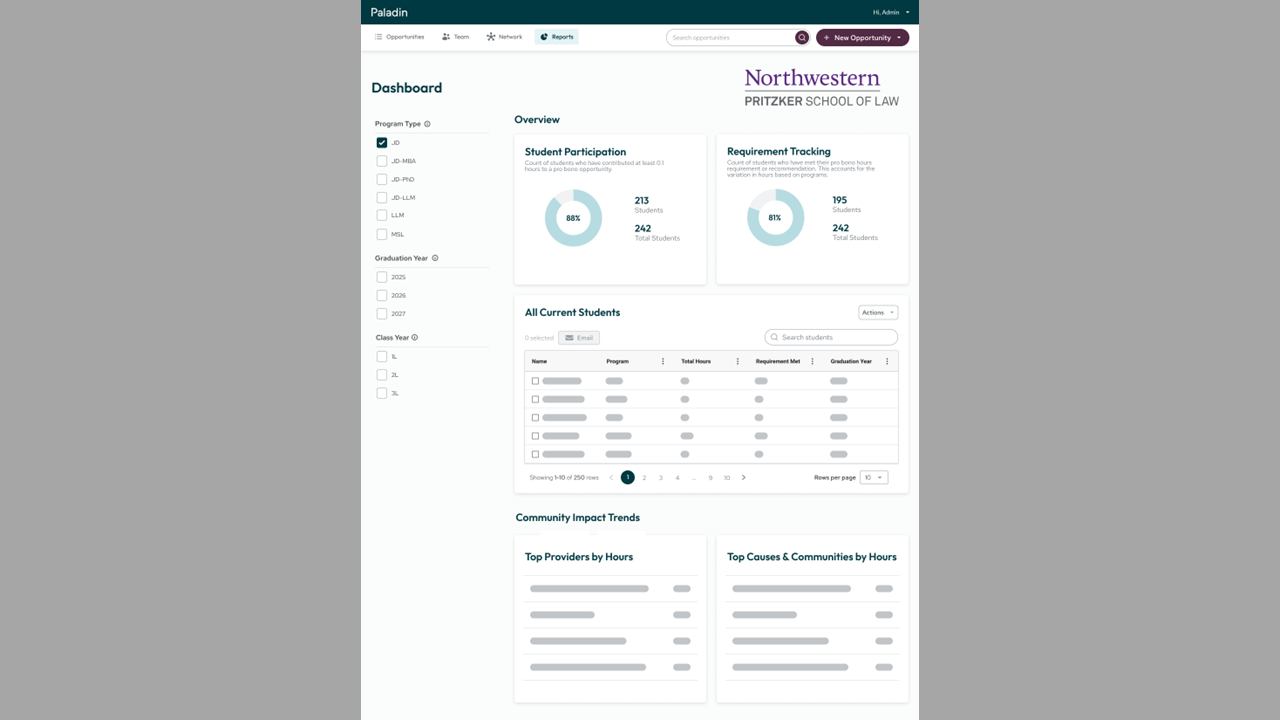
For
administrators,
the
platform
will
include
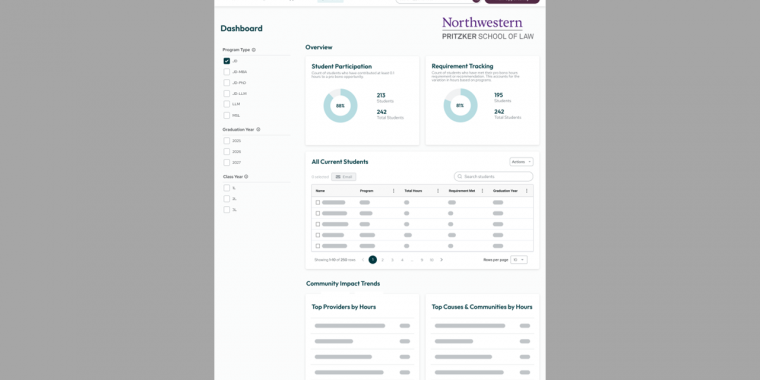
dashboards
for
tracking
student
participation,
coordinating
opportunities,
and
generating
detailed
reports.


Among
the
benefits
to
administrators
of
the
platform,
Paladin
says,
is
that
it
will
allow
them
to
expand
pro
bono
offerings
to
include
more
nationwide
and
remote
opportunities.
The
platform
could
also
broaden
schools’
networks
of
connections
for
student
relationship-building
and
mentoring,
and
enable
schools
to
track
more
granular
data
about
their
pro
bono
programs.


For
students,
benefits
of
the
platform
include
allowing
them
to
track
professional
skills
and
community
impact
in
one
place,
as
well
as
visualize
progress
toward
pro
bono
hour
targets
for
honors
distinctions,
participation
pledges,
or
state
bar
requirements,
Paladin
says.


Paladin
is
offering
free
accounts
to
student
groups
and
legal
services
organizations
to
better
manage
student
clinics,
externships,
and
community
outreach
programs
in
a
unified
way.

Alleviating
Administrative
Tasks


Leah
Gould
,
assistant
dean
of
public
interest
at
Northwestern
Pritzker
School
of
Law,
said
the
platform
will
enhance
the
school’s
ability
to
fulfill
its
commitment
to
public
service.


“By
co-developing
a
platform
that
meets
the
real
needs
of
law
students,
administrators,
and
legal
services
organizations,
we’re
making
it
easier
for
students
to
find
meaningful
opportunities,
for
administrators
to
track
and
support
their
work,
and
for
community
partners
to
connect
with
capable
and
passionate
volunteers,”
Gould
said.


One
of
the
problems
the
platform
tackles
is
that
of
tracking
law
students’
pro
bono
work.
According
to
the
Association
of
American
Law
Schools,
nearly
19,000
law
students
contributed
at
least
4.7
million
hours
to
pro
bono
legal
services
last
year.
However,
most
of
that
work
was
tracked
via
a
patchwork
of
handwritten
forms,
spreadsheets,
and
online
job
boards.


Erin
Han
,
director
of
the
Judge
Rand
Schrader
Pro
Bono
Program
at
UCLA
School
of
Law,
said
she
is
excited
about
the
potential
of
this
platform
to
consolidate
many
of
the
administrative
aspects
of
tracking
pro
bono.


“Rather
than
using
multiple
platforms
to
promote
pro
bono
opportunities,
track
hours,
and
send
out
newsletters,
Paladin
offers
the
potential
for
these
functions
to
happen
on
one
single
platform,”
Han
said.


Of
course,
the
bottom
line
is
about
expanding
law
students’
opportunities
to
engage
in
pro
bono
work.


“Having
a
central
database
of
pro
bono
related
opportunities
can
greatly
help
our
students
provide
support
to
nonprofits
across
the
country
and
expand
their
understanding
of
various
access
to
justice
needs,”
said

Alexi
Freeman
,
director
of
externships
and
social
justice
initiatives
at
the
University
of
Denver
Sturm
College
of
Law.


“Aligned
with
our
values
at
Denver
Law,
this
partnership
has
the
potential
to
grow
meaningful
connections
among
students
and
legal
service
providers,
hopefully
planting
seeds
for
students’
lifelong
commitment
to
service
and
pro
bono,”
Freeman
said. 

Participating
Law
Schools


Law
schools
and
organizations
involved
with
the
co-development
include
(not
a
complete
list):

  • Albany
    Law
    School.
  • Arizona
    State
    University
    Sandra
    Day
    O’Connor
    College
    of
    Law.
  • Belmont
    University
    College
    of
    Law.
  • Chicago-Kent
    College
    of
    Law,
    Illinois
    Tech.
  • Emory
    University
    School
    of
    Law.
  • Georgetown
    University
    Law
    Center.
  • George
    Washington
    University
    Law
    School.
  • Harvard
    Law
    School.
  • Lewis
    &
    Clark
    Law
    School.
  • Marquette
    University
    Law
    School.
  • Minnesota
    Justice
    Foundation
    (which
    provides
    pro
    bono
    opportunities
    for
    students
    from
    three
    Minnesota
    law
    schools).
  • New
    York
    Law
    School.
  • Northwestern
    Pritzker
    School
    of
    Law.
  • Oklahoma
    City
    University
    School
    of
    Law.
  • Seattle
    University
    School
    of
    Law.
  • SMU
    Dedman
    School
    of
    Law.
  • Stanford
    Law
    School.
  • St.
    John’s
    University
    School
    of
    Law.
  • UCLA
    School
    of
    Law.
  • University
    of
    Denver
    Sturm
    College
    of
    Law.
  • University
    of
    Kansas
    School
    of
    Law.
  • University
    of
    Nebraska
    College
    of
    Law.
  • University
    of
    Wisconsin
    Law
    School.
  • Vanderbilt
    Law
    School


Schools
interested
in
learning
more
about
the
platform
can
visit

joinpaladin.com
,
read
a
one
sheet

here
,
or
reach
out
directly
to
support@joinpaladin.com.

Zimbabwe Vigil Diary 7th June 2025


12.6.2025


17:02

Once
again
Vigil
activists
met
outside
the
Zimbabwe
Embassy
in
London
to
continue
our
protest
against
the
human
rights
abuse
and
lack
of
democracy
in
Zimbabwe
perpetrated
by
ZANU
PF,
the
ruling
regime.
Ahead
of
the
Vigil,
activists
from
our
sister
Organisation
Restoration
of
Human
Rights
in
Zimbabwe
(ROHR)
met
to
discuss
ROHR’s
work
in
Zimbabwe.


https://www.flickr.com/photos/zimbabwevigil/54575458906/sizes/m/

Photyos:

https://www.flickr.com/photos/zimbabwevigil/albums/72177720326785565
.
Thanks
to
those
who
came
today: Shepherd
Gandanga,
Blessing
Harry,
Jonathan
Kariwo,
Munashe
Madziyauswa,
Patricia
Masamba,
Ziwanai
Mbanje
and
Ephraim
Tapa.
Photos: https://www.flickr.com/photos/zimbabwevigil/albums/72177720326726673/.

For
Vigil
pictures
check: http://www.flickr.com/photos/zimbabwevigil/.
Please
note:
Vigil
photos
can
only
be
downloaded
from
our
Flickr
website.


Events
and
Notices:  


  • Next
    Vigil
    meeting
    outside
    the
    Zimbabwe
    Embassy. 
    Saturday
    21st June
    from
    2

    5
    pm.
    We
    meet
    on
    the
    first
    and
    third
    Saturdays
    of
    every
    month.
    On
    other
    Saturdays
    the
    virtual
    Vigil
    will
    run.

  • The
    Restoration
    of
    Human
    Rights
    in
    Zimbabwe
    (ROHR)
     is
    the
    Vigil’s
    partner
    organisation
    based
    in
    Zimbabwe.
    ROHR
    grew
    out
    of
    the
    need
    for
    the
    Vigil
    to
    have
    an
    organisation
    on
    the
    ground
    in
    Zimbabwe
    which
    reflected
    the
    Vigil’s
    mission
    statement
    in
    a
    practical
    way.
    ROHR
    in
    the
    UK
    actively
    fundraises
    through
    membership
    subscriptions,
    events,
    sales
    etc
    to
    support
    the
    activities
    of
    ROHR
    in
    Zimbabwe.

  • The
    Vigil’s
    book
    ‘Zimbabwe
    Emergency’
     is
    based
    on
    our
    weekly
    diaries.
    It
    records
    how
    events
    in
    Zimbabwe
    have
    unfolded
    as
    seen
    by
    the
    diaspora
    in
    the
    UK.
    It
    chronicles
    the
    economic
    disintegration,
    violence,
    growing
    oppression
    and
    political
    manoeuvring

    and
    the
    tragic
    human
    cost
    involved. It
    is
    available
    at
    the
    Vigil.
    All
    proceeds
    go
    to
    the
    Vigil
    and
    our
    sister
    organisation
    the
    Restoration
    of
    Human
    Rights
    in
    Zimbabwe’s
    work
    in
    Zimbabwe.
    The
    book
    is
    also
    available
    from
    Amazon.


  • Facebook
    pages:   


        Vigil : 
https ://www.facebook.com/zimbabwevigil 


ROHR: https://www.facebook.com/Restoration-of-Human-Rights-ROHR-Zimbabwe-International-370825706588551/

ZAF: https://www.facebook.com/pages/Zimbabwe-Action-Forum-ZAF/490257051027515

The
Vigil,
outside
the
Zimbabwe
Embassy,
429
Strand,
London
meets
regularly
on
Saturdays
from
14.00
to
17.00
to
protest
against
gross
violations
of
human
rights
in
Zimbabwe.
The
Vigil
which started
in
October
2002
will
continue
until
internationally-monitored,
free
and
fair
elections
are
held
in
Zimbabwe.

Post
published
in:

Featured

The Best Way To Handle The Jerks Working At Your Law Firm – Above the Law

(Image
via
Getty)

Lawyers
tend
to
get
a
reputation
for
being
jerks,
both
within
and
outside
of
the
legal
industry.
Try
as
they
might,
they’ve
been
unable
to
shake
the
designation

and
maybe
that’s
because
some
lawyers
really

are

jerks.


BTI
Consulting
Group

recently
surveyed
more
than
1,000
lawyers
to
get
some
insight
as
to
whether
law
firms
are
doing
anything
about
those
who
could
be
characterized
as
jerks
and
their
associated
bad
behavior.
For
some,
the
results
may
be
shocking;
for
others,
it’s
really
no
surprise
at
all.
Take
a
look:

My
firm
absolutely
tolerates
jerks
and
bad
behavior: 
 22.14%

Kind
of
tolerates
jerks
and
bad
behavior: 


31.14%

Occasionally
tolerates
jerks
and
bad
behavior: 


19.70%

No
tolerance
for
jerks
and
bad
behavior: 


27.05%

Nearly
73%
of
lawyers
say
jerks
are
tolerated
in
some
form
or
fashion
at
their
firms.
What
can
be
done
about
this?
BTI
has
some
pretty
sound
advice
on
how
firms
can
work
to
eliminate
this
behavior:


Coach
and
Advise

Provide
an
independent
behavioral
coach.
Some
jerks
don’t
know
they
are
jerks

and
no
one
wants
to
tell
them.
A
large
number
of
jerks
are
coachable

and
can
create
the
positive
energy
every
firm
needs.


Add
it
to
Annual
Reviews

Include
key
behaviors
for
both
firm
and
self-evaluation.
Add
a
quantitative
component
so
you
can
easily
track
it.


Train
Leaders
to
Intervene

Not
Avoid

Teach
leaders
how
to
spot
stealth
jerks
and
have
hard
conversations.
Most
bad
behavior
lingers
because
leaders
lack
the
skill

or
courage

to
call
it
out
early.


Tie
Culture
to
Compensation

Create
a
path
to
build
cultural
leadership
as
a
factor
in
comp
decisions
and
advancement.
If
someone
builds
a
high-performing,
jerk-free
team

reward
them
like
they
just
landed
an
amazing
client.

BTI
has
the
final
word
on
how
to
handle
lawyers
who
act
like
jerks
within
law
firms:
“Every
firm
has
jerks.
The
best
firms
don’t
let
them stay
jerks
.
Or
they
don’t
let
them stay –
period.”


Jerks
Welcome.
Partners
Weigh
in
on
Firms
Who
Tolerate
Jerks

[Mad
Clientist
/
BTI
Consulting
Group]


Staci Zaretsky


Staci
Zaretsky
 is
a
senior
editor
at
Above
the
Law,
where
she’s
worked
since
2011.
She’d
love
to
hear
from
you,
so
please
feel
free
to

email

her
with
any
tips,
questions,
comments,
or
critiques.
You
can
follow
her
on BlueskyX/Twitter,
and Threads, or
connect
with
her
on LinkedIn.

Former Judges Blast State Bar Association For Cowering From Trump – Above the Law

Multiple

Biglaw
firms

agreed
to

deputize
themselves

to
the
federal
government
to
avoid
executive
orders
that
everyone
knew
were
illegal,
the

DOJ’s
making
up
fake
quotes

in
its
briefing,
and
Marines
are
preparing
to

arrest
people
on
American
soil
.
Add
in
a

barrage
of
insults
leveled
at
federal
judges


including
his
own
nominees

for
daring
to
put
the
Constitution
over
patronage
and
you’ve
got
a
troubling
series
of
assaults
on
the
rule
of
law.

That’s
why

many
bar
associations
,
as
the
professional
guilds
charged
with
safeguarding
the
sanctity
of
the
legal
system,
joined
together
to
denounce
these
actions.
Bar
associations
aren’t
trying
to
be
political,
but
when
the
rule
of
law
becomes
a
matter
of
partisan
politics,
the
bar
has
to
rise
to
the
occasion.

We
covered
all
this
in

the
recent
DC
Bar
election

where
Pam
Bondi’s
brother
got
hammered
because
he
kept
pitching
an
apolitical
bar
association
in
a
world
where
the
bedrock
mission
of
the
bar
is
now
political.

In
the
face
of
all
this,
the
Wisconsin
State
Bar
opted
to
do…
absolutely
nothing.
That’s
not
sitting
well
with
a
lot
of
its
25,000
or
so
members.
But
John
Markson
and
Richard
Niess,
a
pair
of
former
Wisconsin
judges,
point
out
that
the
state
bar’s
leadership
hasn’t
just
been
asleep
at
the
switch.
They
held
a
secret
vote
on
the
prospect
of
showing
backbone
and

voted

to
do
nothing.

On
May
22,
we
were
informed
by
a
single
member
of
the
Wisconsin
State
Bar
board
of
governors
that
the
board
met
in
closed
session
May
14,
and “following
extensive
discussion
protected
by
the
attorney-client
privilege,
the
Board
voted
to
make
no
statement
concerning
recent
actions
taken
by
the
Executive
Branch
of
the
federal
government.”

There’s
no
obvious
reason
why
this
subject
should
be
a
state
bar
secret
and
when
the
judges
asked
several
board
members
about
the
vote,
they
didn’t
get
any
further
justification.
They
did
learn
that
the
existing
board
took
covering
up
its
own
cowardice
so
seriously
that
incoming
board
members
will
be
barred
from
learning
about
the
vote
unless
they
take
a
vow
of
silence.

You’re
not
planning
D-Day,
you’re
running
a
bar
association.

We
have
since
asked
12
representatives
on
the
board
several
questions
about
what
happened
in
secret
and
why.
Only
three
replied,
but
they
provided
little
information.
We
still
don’t
know:
(1)
why
the
question
was
taken
up
in
closed
session,
(2)
why
State
Bar
leaders
needed
legal
counsel
to
advise
whether
the
Bar
should
issue
a
statement
supporting
the
rule
of
law,
(3)
what
was
discussed,
(4)
why
no
statement
was
issued,
and
(5)
what
was
the
final
vote. 

The
only
possible
justification
for
keeping
a
lid
on
the
mere
fact
that
the
bar
considered
taking
a
stand
is
so
the
group
can
further
minimize
the
risk
of
retaliation
by
acting
like
they
never
even
considered
doing
anything.
And
if
that’s
the
case,
it
sort
of
proves
the
point
that
the
administration
is
a
threat
to
the
rule
of
law
requiring
a
strong
response.

Thus,
the
State
Bar’s
cowering
non-response
bodes
ill
for
the
rule
of
law
in
Wisconsin.
As
the
American
Bar
Association
stated:
“If
the
lawyers
do
not
speak…who
will
protect
the
bedrock
of
justice?”

In
the
words
of
Homer
Simpson,
I
dunno…
Coast
Guard?


Wisconsin
State
Bar
leadership
betrays
the
rule
of
law

[Wisconsin
Examiner]


HeadshotJoe
Patrice
 is
a
senior
editor
at
Above
the
Law
and
co-host
of

Thinking
Like
A
Lawyer
.
Feel
free
to email
any
tips,
questions,
or
comments.
Follow
him
on Twitter or

Bluesky

if
you’re
interested
in
law,
politics,
and
a
healthy
dose
of
college
sports
news.
Joe
also
serves
as
a

Managing
Director
at
RPN
Executive
Search
.

Paying For Law School In 2025: A Straight-Talk Playbook – Above the Law


I’m
Nicolas,
COO
at


Juno

and
a
proud
(if
battle-scarred)
grad-school
alum
who
once
signed
on
the
dotted
line
for
nearly

$200,000
in
student
debt
.
Living
through
that
experience—and
later
helping
thousands
of
classmates
do
the
same—showed
me
just
how
lopsided
the
loan
market
can
be
for
individual
borrowers. 

That’s
why


Juno

was
born:
we
band
students
together,
use
their
collective
buying
power,
and
negotiate
bulk
discounts
on
private-loan
rates
and
perks
that
no
borrower
could
secure
alone.
After
several
years
of
securing
the
best
private
loan
deals
for
students
at
top
MBA
programs,
we
now
bring
the
same
no-cost
leverage
to
law
students.
Below
is
the
playbook
I
wish
someone
had
handed
me
before
orientation
day—a
step-by-step
recipe
for
keeping
your
J.D.
affordable.


Step
1.
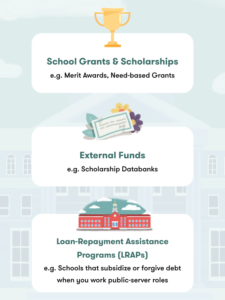
Chase
the
Money
You
Never
Repay


School
grants
&
scholarships

Most
law-school
“free
money”
arrives
with
your
admit
letter:


  • Merit
    awards


    driven
    by
    LSAT
    /
    GPA,
    leadership
    résumé,
    diversity
    fellowships
    (e.g.,
    ABA
    Legal
    Opportunity,
    AccessLex
    MAX),
    or
    practice-area
    tracks
    such
    as
    IP
    or
    public
    interest.

  • Need-based
    grants


    at
    a
    growing
    list
    of
    schools
    (Harvard,
    Stanford,
    Yale,
    Berkeley,
    Georgetown,
    NYU).


External
funds

Check
the

AccessLex
Scholarship
Databank
,
state-bar
foundations,
and
affinity-bar
associations
(HNBA,
NAPABA,
NBLSA,
etc.)—many
awards
have
deadlines
as
late
as
July—worth
a
final
sweep.


Loan-Repayment
Assistance
Programs
(LRAPs)

~60
ABA-accredited
schools
may
subsidize
or
forgive
part
of
your
debt
if
you
enter
public-service
or
government
roles.
Run
the
math:
LRAP
+
PSLF
can
slash
your
effective
borrowing
cost.


Step
2.
Decide
How
Much
Cash
to
Use


  1. Budget
    honestly.

    Rely
    on
    your
    law
    school’s
    published
    Cost
    of
    Attendance
    (COA),
    but
    note
    that
    summer
    housing,
    clinics,
    moot-court
    travel,
    and
    the
    3L
    bar-study
    gap
    often
    push
    actual
    spending
    above
    that
    amount.

  2. Keep
    an
    emergency
    fund
    —include
    bar-exam
    and
    bar-review
    costs
    (typically
    ~$3–$4k).

  3. Compare
    returns
    vs.
    borrowing
    cost.

    Consider
    your
    opportunity
    cost
    (e.g.,
    potential
    investment
    gains,
    emergency
    savings)
    against
    the
    interest
    rate
    on
    your
    loans.
    If
    you
    can’t
    reliably
    out-earn
    that
    rate,
    using
    some
    savings
    may
    make
    sense.
    That
    said,
    many
    graduates
    from
    T14
    schools
    begin
    their
    careers
    in
    Big
    Law,
    where
    higher
    starting
    salaries
    can
    accelerate
    loan
    repayment
    or
    qualify
    for
    refinancing
    later
    on.
    If
    that
    path
    is
    likely
    for
    you,
    it
    may
    justify
    holding
    onto
    more
    cash
    upfront
    and
    using
    it
    for
    longer-term
    investments.


Step
3.
Know
Your
Loan
Options

After
finishing
exploring
all
the
scholarship
options,
and
assessing
how
much
of
your
savings
you
are
willing/able
to
use,
Student
loans
are
used
to
fill
the
gap.
U.S.
citizens
and
Permanent
Residents
have
access
to
Federal
Loans.
There
are
two
types
for
Law
students:
Direct
Unsubsidized
(more
affordable
but
limited
to
$20.5k
a
year)
and
Grad
PLUS
(more
expensive,
but
can
go
up
to
the
cost
of
attendance)

Those
have
fixed
terms,
independent
of
your
specific
credit
profile.
The
terms
are
as
follows
for
the
academic
year
2025

2026


Key
points

  • Federal
    loans
    carry
    IDR
    plans
    and
    PSLF
    eligibility—
    most
    valuable
    if
    you’ll
    stay
    in
    public
    service.
  • Grad
    PLUS
    fees
    add
    4.228
    %
    to
    your
    balance
    on
    day
    one

If
you
are
not
planning
to
take
advantage
of
the
Federal
protections,
it’s
worth
comparing
whether
you
can
get
a
more
affordable
loan
on
the
private
side.


Step
4.
Check
Your
Rates
on
Juno
(without
impacting
your
credit)

We
created
Juno
to
make
it
a
no-brainer
option
if
you
decide
to
take
a
private
loan.
We
negotiate
to
ensure
our
deals
are
better
than
going
directly
to
the
lender,
and
some
of
our
deals
don’t
need
a
cosigner
or
income
for
you
to
qualify.


Some
key
points:


  • Soft-credit
    check
    in
    ~2
    minutes

    (Does
    not
    affect
    your
    credit)

  • Fixed
    and
    variable
    APRs
    that
    beat
    Federal
    options
    for
    many
    credit
    tiers.


  • Negotiated
    Rates
    and/or
    Cash
    Bonuses
    are
    available


  • Rate
    Match
    Program:
    If
    you
    find
    a
    better
    rate
    from
    a
    long
    list
    of
    competitors,
    we
    will
    match
    it
    and
    give
    you
    1%
    of
    your
    loan
    amount
    as
    cash
    back

Compare
your
personalized
Juno
quote
against
your
Federal
offers.


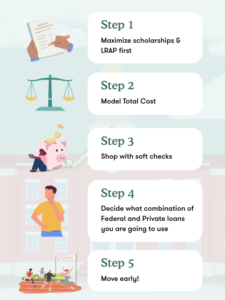
Step
5.
Bottom-Line
Playbook


  1. Maximize
    scholarships
    &
    LRAP
    first.

    Every
    free
    dollar
    is
    one
    you
    never
    repay.

  2. Model


    total


    cost.

    Include
    origination
    fees,
    bar-prep
    expenses,
    and
    how
    quickly
    you’ll
    refinance
    or
    pursue
    PSLF.

  3. Shop
    with
    soft
    checks.

    Gather
    real
    quotes,
    then
    decide—without
    any
    impact
    on
    your
    credit.

  4. Decide
    what
    combination
    of
    Federal
    and
    Private
    loans
    you
    are
    going
    to
    use:

    You
    can
    use
    any
    combination
    of
    Federal
    and
    Private
    loans
    up
    to
    your
    COA.

  5. Move
    early.

    If
    you
    see
    a
    rate
    you
    like,
    consider
    applying
    early
    to
    lock
    it
    in.
    Remember,
    rates
    may
    move
    at
    a
    moment’s
    notice.

Law
school
is
a
major
investment,
but
thoughtful
planning
can
keep
your
debt
in
check
so
you
can
focus
on
contracts,
criminal,
or
con-law
instead
of
compounding
interest.
Juno
helps
law
students
access
discounted
deals
through
collective
bargaining,
so
you
can
borrow
smarter
and
stress
less.
Best
of
luck
in
your
legal
journey!


The
information
provided
in
this
article
is
current
as
of
June
4,
2025,
and
is
intended
for
general
informational
purposes
only.
It
does
not
constitute
legal,
financial,
or
tax
advice.
Readers
should
consult
their
own
advisors
before
making
any
decisions.
Terms
and
conditions
may
apply
to
the
loan
products
discussed.
Federal
student
loans
offer
certain
borrower
protections
and
benefits—such
as
income-driven
repayment
plans
and
potential
forgiveness
options—that
may
be
important
to
consider.
To
learn
more,
visit


studentaid.gov
.

Beware: Don’t Open That Email From L@tham – Above the Law

Increasingly,
fraudsters
are
using
(or
least
attempting
to
use)
the
good
name
of
Biglaw
firms
in
order
to
perpetrate
their
crimes.
According
to
the
British
Solicitors
Regulation
Authority
(SRA)
Scam
Alerts
database,
scams
using
law
firm
names
has
increased
180%
in
three
years.

As

reported
by

American
Lawyer,
the
names
of
Biglaw
firms
are
getting
dragged
in
the
process:

Milbank’s
name
was
misused
in
phone
calls
earlier
this
year
by
fraudsters
posing
as
insurance
agents
linked
to
the
firm,
according
to
the
SRA
Scam
Alerts.
Dechert’s
brand
was
used
on
fake
WhatsApp
numbers,
email
addresses,
a
fraudulent
website,
and
a
forged
agreement
falsely
signed
by
a
real
partner.
And
Latham’s
name
has
cropped
up
in
three
email
scams
where
the
names
of
real
partners
were
falsely
cited
to
demand
overdue
payments,
the
SRA
site
shows.

Linklaters,
Hogan
Lovells,
and
Slaughter
and
May
monikers
have
all
been
misused
in
past
years
as
well,
as
have
Debevoise
&
Plimpton,
Simpson
Thacher
&
Bartlett,
Baker
McKenzie,
and
Ropes
&
Gray.

And
it’s
not
like
it’s
just
a
problem
across
the
pond.
Matthew
R.
Baker,
Baker
Botts’s
San
Francisco-based
privacy
and
cybersecurity
practice
group
chair
says,
“We
are
getting
notices
and
fielding
these
threats
every
day.
Every
single
day.
Law
firms
are
becoming
quite
an
interesting
and
unique
and
ripe
target
right
now
and
I
think
it
is
because
we
represent
a
variety
of
very
very
big
targets,
victims,
and
we
have
so
much
incredibly
confidential
and
proprietary
information.”

These
aren’t
the
only
cybercrimes
facing
Biglaw.

While
law
firm
scams
often
involve
deceiving
people
to
steal
money
or
information,
hackers
use
their
technical
skills
to
break
into
systems,
often
to
steal,
spy,
or
disrupt.
Ransomware
cybercriminals
lock
or
encrypt
their
target’s
data,
usually
with
a
demand
for
payment
to
restore
access.
Kirkland
&
Ellis,
K&L
Gates,
and
Proskauer
Rose
have
all
been
targets
of
a
ransomware
group
known
as
CL0P.
DLA
Piper
was
also
hit
by
a
major
cyber
attack
in
2017
that
knocked
out
phones
and
computers.

In
November
2023,
legacy
firm
Allen
&
Overy
was
targeted
by
ransomware
group
LockBit
and
the
firm
was
given
a
deadline
to
pay
a
ransom
to
recover
data
that
the
group
claimed
to
have
stolen.
It
is
not
known
if
the
firm
paid
the
ransom,
but
one
day
before
the
deadline
the
firm’s
name
disappeared
from
the
hacker
group’s
list
of
organisations
it
was
holding
to
ransom.

And
with
the
rise
of
AI,
don’t
expect
the
problem
to
get
better.
As
Baker
said,
“Artificial
intelligence
has
really
given
over
unique
weapons
to
amateurs
and
it
has
allowed
amateurs
and
professionals
to
weaponize
these
kinds
of
TTPs
[Tactics,
Techniques,
and
Procedures].
So
it
has
broadened
the
landscape
for
who
is
a
threat
actor,
and
then
at
the
same
time
it
has
made
those
TTPs—those
types
of
processes—more
varied,
more
sophisticated,
and
it
has
multiplied
them.”
So
even
lawyers
that
don’t
care
for
technology
can’t
ignore
this
growing
problem.


Kathryn
Rubino
is
a
Senior
Editor
at
Above
the
Law,
host
of

The
Jabot
podcast
,
and
co-host
of

Thinking
Like
A
Lawyer
.
AtL
tipsters
are
the
best,
so
please
connect
with
her.
Feel
free
to
email

her

with
any
tips,
questions,
or
comments
and
follow
her
on
Twitter

@Kathryn1
 or
Mastodon

@[email protected].

‘We Dissent’: NIH Workers Protest Trump Policies That ‘Harm the Health of Americans’ – MedCity News

Hundreds
of
workers
at
the
National
Institutes
of
Health
on
Monday
openly
protested
the
Trump
administration’s
cuts
to
the
agency
and
consequences
for
human
lives,
writing
in
a
sharply
worded
letter
that
its
actions
are
causing
“a
dramatic
reduction
in
life-saving
research.”

In
a

June
9
letter

to
NIH
Director
Jay
Bhattacharya,
NIH
workers
said
they
felt
“compelled
to
speak
up
when
our
leadership
prioritizes
political
momentum
over
human
safety
and
faithful
stewardship
of
public
resources.”

“For
staff
across
the
National
Institutes
of
Health
(NIH),
we
dissent
to
Administration
policies
that
undermine
the
NIH
mission,
waste
public
resources,
and
harm
the
health
of
Americans
and
people
across
the
globe,”
they
said.

The
letter
is
an
extraordinary
rebuke
of
the
Trump
administration’s
actions
against
the
NIH,
which
include:
terminating
hundreds
of
grants

funding
scientific
and
biomedical
research
;
firing
more
than
1,000
employees
this
year;
and
moving
to
end
billions
in
funds
to
partner
institutions
overseas,
a
move
current
and
former
NIH
workers
say
will
harm
research
on
rare
cancers
and
infectious
diseases,
as
well
as
research
that
aims
to
minimize
tobacco
use
and
related
chronic
illnesses,
among
other
areas.

Some
NIH
workers
signed
their
names
publicly,
openly
daring
to
challenge
a
president
who
has
sought
to
purge the
government
of
employees
he
views
as
disloyal
to
him.
Others
signed
anonymously.

“It’s
about
the
harm
that
these
policies
are
having
on
research
participants
and
American
public
health,
and
global
public
health,”
said
Jenna
Norton,
who
works
at
the
National
Institute
of
Diabetes
and
Digestive
and
Kidney
Diseases,
one
of
NIH’s
27
institutes.
“There
are
research
participants
who
generously
decide
to
donate
their
time
and
literal
pieces
of
their
body,
with
the
understanding
that
that
service
is
going
to
help
advance
research
for
diseases
that
they
are
living
with
and
help
the
next
person
who
comes
along
with
that
disease.”

“These
policies
are
preventing
us
from
delivering
on
the
promise
we
made
to
them
and
honoring
the
commitment
that
they
made,
and
putting
them
at
risk,”
she
said.

The
workers
wrote
that
they
hope
Bhattacharya
welcomes
their
criticisms
given
his

vows
to
prioritize
“academic
freedom”

and
to
respect
dissenting
views
as
leader
of
the
NIH,
which
is
based
in
Bethesda,
Maryland.
Its
authors
called
it
the
“Bethesda
Declaration”

a
play
on
the
controversial
“Great
Barrington
Declaration”
that
Bhattacharya
co-authored
during
the
covid-19
pandemic.

Bhattacharya’s
declaration
advocated
against
lockdown
measures
and
proposed
that
widespread
immunity
against
covid
could
be
achieved
by
allowing
healthy
people
to
get
infected
with
the
virus
and
instituting
protective
measures
only
for
medically
vulnerable
people.
It
was
criticized
at
the
time
by
Francis
Collins,
then-director
of
the
NIH,
who
called
Bhattacharya
and
his
co-authors
“fringe
epidemiologists,”

according
to
emails

the
American
Institute
for
Economic
Research
obtained
through
a
Freedom
of
Information
Act
request.

In
their
letter,
NIH
workers
demanded
that
Bhattacharya
restore
grants
that
were
“delayed
or
terminated
for
political
reasons.”
Those
grants
funded
a
range
of
projects,
including
those
addressing
Alzheimer’s
disease,
ways
to
boost
vaccination
rates,
and
efforts
to
combat
health
disparities
or
health
misinformation.

“Academic
freedom
should
not
be
applied
selectively
based
on
political
ideology.
To
achieve
political
aims,
NIH
has
targeted
multiple
universities
with
indiscriminate
grant
terminations,
payment
freezes
for
ongoing
research,
and
blanket
holds
on
awards
regardless
of
the
quality,
progress,
or
impact
of
the
science,”
the
NIH
workers
wrote.

The
funding
terminations,
they
said,
“throw
away
years
of
hard
work
and
millions
of
dollars,”
“risk
participant
health,”
and
“damage
hard-earned
public
trust,
counter
to
your
stated
goal
to
improve
trust
in
NIH.”

In
an
emailed
comment,
Bhattacharya
said,
“The
Bethesda
Declaration
has
some
fundamental
misconceptions
about
the
policy
directions
the
NIH
has
taken
in
recent
months,
including
the
continuing
support
of
the
NIH
for
international
collaboration.
Nevertheless,
respectful
dissent
in
science
is
productive.
We
all
want
the
NIH
to
succeed.”

The
NIH’s
nearly
$48
billion
budget
makes
it
the
world’s
largest
public
funder
of
scientific
research.
Its
work
has
led
to
countless
scientific
discoveries
that
have
helped
improve
health
and
save
lives
around
the
globe.
But
it
hasn’t
been
without
controversies,
including
instances
of

research
misconduct

and

not
effectively
monitoring

grant
awards
and
the
related
research.

Researchers
and
some
states
have
sued
NIH
and
HHS
over
the
grant
cuts.
An
April
3
deposition
by
NIH
official
Michelle
Bulls
said
Rachel
Riley,
a
senior
adviser
at
HHS
who
is
part
of
the
Department
of
Government
Efficiency
created
by
executive
order,
provided
NIH
officials
lists
of
grants
to
terminate
and
language
for
termination
notices.
Elon
Musk,
the
world’s
richest
person,
led
DOGE
through
May.

Norton
has
worked
at
the
NIH
as
a
federal
employee
or
contractor
for
about
a
decade.
She
said
the
current
administration’s
policies
are
“definitely
unethical
and
very
likely
illegal,”
listing
a
string
of
developments
 in
recent
months.
They
include
terminating
studies
early
and
putting
participating
patients
at
risk
because
they
have
had
to
abruptly
stop
taking
medications,
and
holding
up
research
that
would
predominantly
or
exclusively
recruit
participants
from
minority
races
and
ethnicities,
who
have
historically
been
underrepresented
in
medical
research.

“They’re
saying
that
doing
studies
exclusively
on
Black
Americans
to
try
to
develop
interventions
that
work
for
that
population,
or
interventions
that
are
culturally
tailored
to
Hispanic-Latino
populations

that
that
kind
of
research
can’t
go
forward
is
extremely
problematic,”
Norton
said.
“And,
as
a
matter
of
fact,
studies
that
over-recruit
from
white
people
have
been
allowed
to
go
forward.”

The
NIH
workers
also
demanded
that
Bhattacharya
reinstate
workers
who
were
dismissed
under
recent
mass
firings
and
allow
research
that
is
done
in
partnership
with
institutions
in
foreign
countries
“to
continue
without
disruption.”
The
NIH
works
with
organizations
around
the
globe
to
combat
major
public
health
issues,
including
types
of
cancer,
tobacco-related
illnesses,
and
HIV.

In
addition
to
the
firing
of
probationary
workers,
NIH
fired
1,200
civil
servants
as
part
of
a
rapid
“reduction
in
force”
at
federal
health
agencies.
During
a
May
19
town
hall
meeting
with
NIH
staff,
a
recording
of
which
was
obtained
by
KFF
Health
News,
Bhattacharya
said
the
decisions
about
RIFs
“happened
before
I
got
here.
I
actually
don’t
have
any
transparency
into
how
those
decisions
were
made.”

He
started
at
NIH
on
April
1,
the
day
many
workers
at
NIH
and
other
agencies
were
told
they
were
fired.
Other
workers
have
been
fired
since
Bhattacharya
took
the
helm

nearly
all
the
National
Cancer
Institute’s
communications
staff
were
fired
in
early
May,
three
former
employees
told
KFF
Health
News.

The
letter
is
the
latest
salvo
in
a
growing
movement
by
scientists
and
others
against
the
Trump
administration’s
actions.
In
addition
to
in-person
protests
outside
HHS
headquarters
and
elsewhere,
some
former
employees
are
organizing
patients
to
get
involved.

Peter
Garrett,
who
led
the
National
Cancer
Institute’s
communications
work,
has
created
an
advocacy
nonprofit
called
Patient
Action
for
Cancer
Research.
The
aim
is
to
engage
patients
“in
the
conversation
and
federal
funding
and
science
policymaking,”
he
said
in
an
interview.

His
group
aims
to
get
patients
and
their
relatives
to
speak
out
about
how
federal
cancer
research
affects
them
directly,
he
said

a
“guerrilla
lobbying”
effort
to
put
the
issue
squarely
before
members
of
Congress.
Garrett
said
he
retired
early
from
the
cancer
institute
because
of
concerns
about
political
interference.

Career
officials
routinely
work
under
both
Republican
and
Democratic
presidents.
It
is
par
for
the
course
for
their
priorities
and
assignments
to
evolve
when
a
new
president,
Cabinet
secretaries,
and
other
political
appointees
take
over.
Usually,
those
changes
occur
without
much
protest.

This
time,
workers
said
the
upheaval
and
harm
done
to
the
NIH
is
so
extensive
that
they
felt
they
had
no
choice
but
to
protest.

In
11
years
at
NIH,
Norton
said,
“I’ve
never
seen
anything
that
comes
anywhere
near
this.”

In
the
June
9
letter,
the
workers
said,
“Many
have
raised
these
concerns
to
NIH
leadership,
yet
we
remain
pressured
to
implement
harmful
measures.”

“It’s
not
about
our
jobs,”
said
one
NIH
worker
who
signed
the
letter
anonymously.
“It
is
about
humanity.
It
is
about
the
future.”


Senior
correspondent
Arthur
Allen
contributed
to
this
report.


KFF
Health
News

is
a
national
newsroom
that
produces
in-depth
journalism
about
health
issues
and
is
one
of
the
core
operating
programs
at
KFF—an
independent
source
of
health
policy
research,
polling,
and
journalism.
Learn
more
about

KFF
.


Photo:
FilippoBacci,
Getty
Images 
Morning Docket: 06.12.25 – Above the Law

*
Police
officers
file
suit
to
force
Republicans
to
hang
statutorily
required
plaque
honoring
law
enforcement
efforts
on
January
6.
[CBS
News
]

*
Judge
orders
administration
to
release
Mahmoud
Khalil
setting
up
latest
opportunity
for
administration
to
ignore
court
order.
[Courthouse
News
Service
]

*
In
most
ambitious
crossover
event
ever,
Disney
and
Universal
team
up
to
sue
AI
company.
[Law360]

*
Second
Circuit
hears
Trump
bid
to
move
state
criminal
case
to
federal
court.
[New
York
Law
Journal
]

*
Provisional
licensing
for
victims
of
the
February
bar
debacle
begins
in
California.
[Reuters]

*
NCAA
settlement
already
facing
appeal.
[Bloomberg
Law
News
]

So Long And Thanks For All The DEI – See Also – Above the Law

Kirkland
Boots
Their
DEI
Staff:
Surprise
surprise,
everyone.
If
It
Looks
Like
An
Arrest
And
Smells
Like
An
Arrest:
Call
it
something
else!
Then
the
Marines
can
do
whatever
they
want!
Elon
Musk
Still
Blames
Collusion
For
Advertisers
Wanting
Nothing
To
Do
With
Twitter:
Who
wouldn’t
want
their
advertisement
being
ran
next
to
footage
of
a
sieg-heiling
CEO?!
Mikie
Sherrill
Wins
NJ
Democratic
Primary
For
Governor:
Congratulations
to
the
Georgetown
Law
grad!
This
Week
On
Thinking
Like
A
Lawyer:
Dunn
Isaacson
Rhee
are
farming
Paul
Weiss
for
talent
and
the
Harvard
Law
Review
snitch
is
working
with
Stephen
Miller.