Ed.
Note:
A
weekly
roundup
of
just
a
few
items
from
Howard
Bashman’s
How
Appealing
blog,
the
Web’s
first
blog
devoted
to
appellate
litigation.
Check
out
these
stories
and
more
at
How
Appealing.
“Judge
Vows
to
End
Trump
Administration’s
Noncompliance
‘One
Way
or
Another’;
The
federal
judge
identified
210
orders
issued
in
143
cases
in
Minnesota
in
which
he
said
Immigration
and
Customs
Enforcement
officials
had
not
complied
with
court
orders”: Mitch
Smith,
Ernesto
Londoño,
and
Mattathias
Schwartz
of
The
New
York
Times
have this
report.
“Bonus
212:
The
Supreme
Court
is
Not
‘Reining
in’
Executive
Power;
The
Court’s
defenders
claim
the
tariffs
ruling
is
part
of
a
trend
in
which
the
justices
are
reining
in
President
Trump
and
(re-)empowering
Congress;
The
full
dataset
is
overwhelmingly
to
the
contrary.” Steve
Vladeck
has this
post at
his
“One
First”
Substack
site.
“Trump’s
next
tariff
fight:
Keeping
the
money;
After
Trump’s
Supreme
Court
tariff
defeat,
administration
officials
are
devising
legal
strategies
that
would
let
the
president
keep
some
—
or
maybe
even
most
—
of
the
revenue,
five
people
familiar
with
the
conversations
told
POLITICO.” Megan
Messerly
and
Daniel
“Testimony
Offers
New
Details
on
Justice
Dept.
Role
in
Abrego
Garcia
Prosecution”: Alan
Feuer
of
The
New
York
Times
has this
report.
“You
Guys
Look
Miserable:
The
Supreme
Court’s
silliest
tradition
is
sending
a
handful
of
justices
to
sit
through
a
two-hour
State
of
the
Union
without
changing
their
facial
expressions.” Jay
Willis
has this
essay online
at
Balls
and
Strikes.
I’ll
take
my
joy
where
I
can.
And
this
iteration
of
the
Trump
DOJ
continues
to
provide
bright
bursts
of
schadenfreude-tinted
sunshine.
Any
competent
DOJ
can
close
cases.
Any barely competent
prosecutor
can
push
a
case
past
a
grand
jury.
Any
sufficiently
slippery
solicitor
(mixing
in
some
British
for
the
sheer
alliteration
of
it
all)
can
convince
a
judge
that
the
lies
told
by
officers
were
merely
good
faith
blunders
not
worthy
of
anything
more
than
a
judicial
“no
one’s
perfect”
shrug.
This DOJ fails
at every
single
level.
It
can’t secure
indictments.
It
can’t
convince
grand
juries
that
vindictive
prosecutions
are legitimate prosecutions.
And
its
prosecutors
are
constantly
undermined
by
(1)
prejudicial,
fact-free
social
media
posts
and
public
statements
by
administration
officials,
(2)
the illegal
actions of
federal
officers,
(3)
their
own
ineptitude,
(4)
the
lies told
by
federal
officers,
and
(5)
any
or
all
of
the
above.
High-level
prosecutors
keep
getting
sidelined
because
they’ve
been illegally
appointed.
Other
prosecutors
have
refused
to
engage
with
the
administration’s
vindictive
plans,
resulting
in
most
of
them
retiring
or
being
fired.
Consequently,
there’s
a
shortage
of
qualified,
experienced
prosecutors.
The
void
is
being
constantly
refilled
by
some
of
the
emptiest
people
ever
to
leverage
MAGA
loyalty
into
federal
employment.
It
took
less
than
a
year
for
the
Trump
DOJ
to
almost
completely
destroy
the
“presumption
of
regularity”
—
the
legal
concept
that
the
government
is
acting
in
good
faith,
even
if
its
legal
arguments
aren’t
the
best.
It
took
less
than
a
year
for
the
Trump
DOJ
to turn
grand
juries into
coin
flips.
In
2016,
the
most
recent
year
for
which the
Justice
Department
has
published
data,
federal
prosecutors
concluded
more
than
155,000
prosecutions
and
declined
over
25,000
cases
presented
by
investigators. In
only
six
instances
was
a
grand
jury’s
refusal
to
indict
listed
as
the
reason
for
dropping
the
matter.
Six
times
in
a
one
year
over
25,000
declined
cases.
Trump’s
loyalist
US
Attorney
pick,
Lindsey
Halligan,
put
her
insurance
law
background
to
work
and…
managed
to
do
this
twice
during
a single (attempted)
prosecution.
When
prosecutors
aren’t
shooting
themselves
in
the
foot
(or
being
shot
in
the
foot
by
their
employer),
they’re
losing
cases
because
the
people
they
expect
to
back
up
their
cases
—
the
federal
officers
claiming
to
have
been
assaulted,
etc.
—
can’t
even
back
up
their
own
narratives
when
testifying
in
court.
The
most
recent
significant
fumble
came
from
Minneapolis
prosecutors,
who
last
week dismissed
felony
assault
charges they
had
filed
against
two
Venezuelan
men accused of
“violently
beating”
an
Immigration
and
Customs
Enforcement
(ICE)
officer
“with
weapons”
on
14
January.
According
to
the
early
government
narrative,
federal
officers
were
assaulted
by
“violent
criminal
illegal
aliens”
during
a
stop
of
an
undocumented
Venezuelan.
The
officers
claimed
two
other
men
came
out
of
a
nearby
apartment
and
attacked
an
officer
with
a
“snow
shovel
and
broom
handle.”
That
case
is
now
dead
because…
well,
the
testifying
officers
lied.
[O]n
12
February,
prosecutors
filed
a
motion
to
dismiss
both
men’s
cases,
saying:
“Newly
discovered
evidence
in
this
matter
is
materially
inconsistent
with
the
allegations
in
the
complaint
affidavit.”
[…]
ICE
director
Todd
Lyons
said
ICE
and
the
DoJ
had opened
an
investigation into
the
case
after
videos
revealed
“sworn
testimony
provided
by
two
separate
officers
appears
to
have
made
untruthful
statements”,
marking
a
rare
acknowledgement
of
possible
wrongdoing
by
DHS
officials.
It’s
extremely
rare
for
the
government
to
dismiss
its own prosecution
with
prejudice,
meaning
it
can’t ever seek
to
refile
these
criminal
charges
against
the
alleged
perpetrators.
And
I
don’t
know
if
Todd
Lyons
just
misspoke
or
if
he
actually
tried
to
use
the
exonerative
tense
while
simultaneously
stating
these
officers
lied.
“Sworn
testimony…
appears
to
have
made
untruthful
statements”
sounds
like
the
courtroom
version
of
a
government
official
discussing
a
shooting
by
an
officer
with
the
phrase
“the
officer’s
weapon
discharged,”
suggesting
no
one
actually
pulled
the
trigger.
Whatever
the
case,
there’s
definitely
a
trend
here.
In
Chicago,
of
92
people
arrested
for
assaulting
or
impeding
officers
last
fall,
74
cases
have
resulted
in
no
charges;
in
13
cases,
charges
were
filed
and
dismissed;
and
five
charged
cases
were
still
pending,
a recent
investigation by
Fox
9,
a
Minneapolis-based
station,
showed.
As
of
the
end
of
January,
there
have
been
no
convictions.
In
LA,
the
federal
public
defenders
have
won
all
six
cases
filed
against
ICE
protesters
that
have
gone
to
trial
since
June,
the LA
Times
recently
reported.
Fewer
than
1%
of
federal
criminal
defendants
were
acquitted
across
the
US
in
fiscal
year
2024,
with
US
prosecutors
traditionally
having
a
roughly
90%
conviction
rate,
the
paper
noted.
I
assume
the
DOJ
bloodshed
will
continue.
Trump
hates
losing
and
he
hates
people
who
lose
in
his
name
even
more.
But
replacing
talent
with
loyalists
isn’t
going
to
end
this
losing
streak.
If
nothing
else,
this
iteration
of
the
DOJ
has
the
chance
to
go
down
in
history
as
one
of
the
worst
ever
assembled,
even
if
we
consider
nothing
else
but
its
win-loss
record.
It
doesn’t
mean
the
DOJ
is
harmless,
however.
It’s
still
more
than
willing
to
engage
in
vindictive
prosecutions,
ignore
court
orders,
and
take
bite
after
bite
of
the
apple
(so
to
speak)
until
it
finally
manages
to
at
least
pierce
the
skin.
And
that
means
a
lot
of
people
are
going
to
have
their
lives
upended,
even
if
only
temporarily,
just
to
please
a
tyrant
who
thinks
anything
or
anyone
presenting
even
the
most
minimal
of
opposition
should
be
subjected
to
punishment.
Editor’s
note:
A
companion
webinar
featuring
these
speakers
is
available
on-demand,
with
CLE
credit
available.
Use
the
form
at
the
bottom
of
this
article
to
access
the
presentation.
This
is
the
first
in
a
three-part
series.
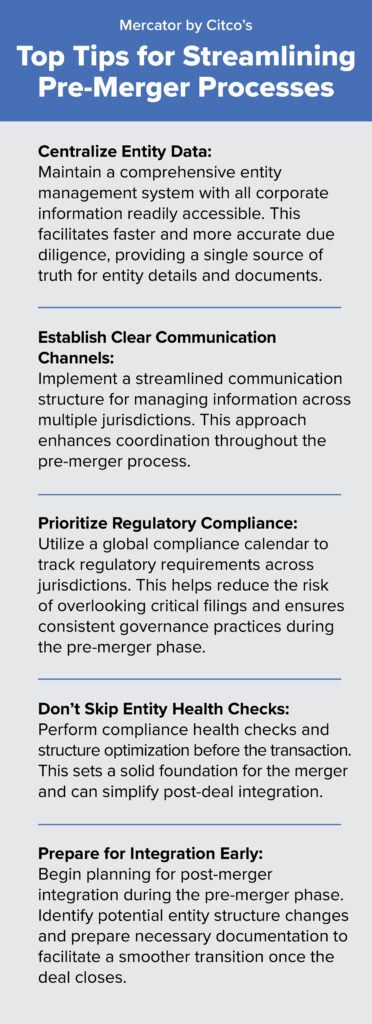
Although
the
deals
market
has
shown
a
modest
rebound
in
early
2025,
a
recent
report
by
Deloitte
notes
that
today’s
dealmakers
must
“navigate
perpetual
uncertainty.”
This
uncertainty
is
driven
by
numerous
factors:
economic
changes,
evolving
risk
management,
and
emerging
technologies,
for
example.
As
a
result,
Deloitte
says,
“pivoting
has
emerged
as
a
core
competency”
for
dealmakers.
The
same
goes
for
law
departments
involved
with
a
corporate
transaction
—
or
even
the
possibility
of
a
future
transaction.
“‘Logistics’
is
an
important
word
here,
because
the
whole
M&A
process
is
also
a
process
of
logistics,”
says
Kariem
Abdellatif,
the
head
of
Mercator
by
Citco
(Mercator),
a
specialist
entity
management
provider
that
helps
organizations
manage
their
global
entity
portfolios,
including
during
complex
M&A
transactions.
Having
the
right
partner
in
place
to
oversee
a
transaction’s
numerous
and
intricate
details
will
allow
the
lawyers
to
focus
on
high-level
work
like
pricing
and
negotiation,
he
notes.
This,
in
turn,
enables
the
flexibility
that
today’s
dealmakers
must
cultivate.
In
this
series
presented
by
our
friends
at
Mercator,
we’ll
be
providing
a
step-by-step
guide
for
general
counsel
navigating
a
merger
or
other
corporate
transaction.
To
start,
we’re
exploring
best
practices
for
corporate
law
departments
in
the
pre-merger
phase.
Stay
tuned
for
our
upcoming
articles
detailing
how
GCs
can
help
negotiate
and
close
a
deal,
as
well
as
how
the
law
department
can
help
integrate
organizations
post-merger.
A
first
step
for
any
legal
department
involved
in
a
corporate
transaction
is
to
understand
the
portfolio
of
companies
involved.
The
only
way
to
do
this
is
by
gathering
trustworthy
data.
“When
it
comes
to
data,
there
are
several
critical
questions
that
need
answering,”
Abdellatif
says.
“What
information
do
we
need?
Where
is
it
stored?
Who
maintains
it?
How
can
we
verify
its
accuracy?
Is
it
up
to
date?
Getting
clear
answers
to
these
questions
early
on
is
essential
for
making
informed
decisions
and
planning
effective
integration.”
A
platform
like
Mercator’s
Entica
can
take
this
a
step
further
by
applying
that
data
to
create
detailed
and
interactive
corporate
org
charts.
The
platform
can
also
generate
hypothetical
charts
to
model
potential
acquisitions.
These
charts
map
out
the
“family
tree”
of
an
organization
—
showing
which
entity
sits
on
top,
what
happens
if
entities’
locations
are
moved,
what
it
would
mean
if
an
entity
were
liquidated.
“Our
technology
enables
legal
teams
to
visualize
the
entire
org
chart,”
Abdellatif
says.
“From
there
they
can
toy
around
with
it
to
see
how
changes
might
affect
the
overall
corporate
structure.
This
is
particularly
valuable
during
M&A
discussions,
where
understanding
complex
entity
relationship
is
key.”
Determine
Your
Lane
While
gathering
corporate
data
is
critical,
knowledge
of
a
potential
deal
must
typically
be
kept
confidential
outside
of
a
few
key
stakeholders.
When
the
GC
is
brought
under
the
umbrella,
their
first
step
is
to
determine
their
role.
Will
the
GC
be
engaging
outside
counsel?
Will
they
be
managing
these
lawyers?
Will
the
GC
be
the
primary
point
of
contact
for
the
transaction?
The
scope
of
these
potential
roles
varies
widely,
notes
Josh
Hollingsworth,
an
M&A
partner
with
Barnes
&
Thornburg
LLP.
The
GC
of
a
company
being
acquired,
for
example,
might
be
limited
to
assisting
the
buyer
in
conducting
due
diligence.
In
other
circumstances,
the
GC
might
be
expected
to
lead
the
entire
deal.
“Navigating
where
they
fit
in
and
asking
affirmative
questions
so
that
there
aren’t
any
assumptions
—
it’s
important
for
a
GC
to
just
figure
out
what
their
role
is
in
some
cases,”
Hollingsworth
says.
Master
Organizational
Psychology
When
a
GC
is
involved
in
advancing
a
transaction,
they
must
draw
on
their
soft
skills
as
much
as
their
legal
training
in
the
pre-merger
phase.
Thinking
strategically
about
the
organization
and
the
stakeholders
involved
is
a
key
to
success.
“I
don’t
think
there’s
a
specific
playbook
for
each
circumstance,”
Hollingsworth
says.
“I
think
it’s
just
a
matter
of
being
aware
of
everyone
who’s
involved
and
making
sure
that
you
understand
the
universe
of
how
this
transaction’s
going
to
affect
everybody.”
An
initial
step
is
to
determine
who
will
be
brought
into
the
deal,
and
who
will
not
be
informed.
This
requires
thinking
through
who
in
the
organization
will
be
important
—
the
IT,
HR,
and
risk
management
teams,
for
example.
“If
nobody
in
HR
knows,
it’s
going
to
be
hard
to
get
through
employee
and
benefits
diligence,”
Hollingsworth
says.
“If
nobody
in
IT
knows
about
a
transaction,
and
an
IT
issue
comes
up,
similarly,
that
will
be
challenging.”
Abdellatif
notes
that
technology
like
Mercator’s
Entica
system
can
play
a
role
in
ensuring
the
knowledge
of
the
deal
sits
only
with
the
stakeholders
who
are
looped
in.
“What
we
want
to
make
certain
is
that
data
access
is
available
to
those
who
need
it,
but
not
beyond
that,”
Abdellatif
says.
“That
data
is
only
accessible
to
those
who
actually
require
it,
and
you
don’t
have
people
rummaging
through
information
they
shouldn’t.”
Understand
Your
Team
It’s
also
important
to
gauge
the
likely
motivations
of
each
stakeholder
with
a
role
in
the
transaction.
Hollingsworth
notes
that
anyone
informed
of
a
potential
deal
will
first
ask
themself
a
simple
question.
“Literally,
‘What
does
this
mean
for
me?’
is
going
to
be
the
first
question
that
everybody
who’s
brought
under
the
tent
is
going
to
think
about,
and
that’s
just
human
nature,”
Hollingsworth
says.
“So
just
being
prepared
to
work
through
those
dynamics
is
important
for
a
GC.”
If
a
company
is
being
acquired,
for
example,
that
could
be
seen
as
a
threat
to
many
stakeholders,
who
may
work
to
undermine
the
deal.
It’s
true
of
acquiror
companies
as
well,
Hollingsworth
notes.
Some
may
see
someone
in
the
acquired
organization
as
a
threat
to
their
position.
Some
may
simply
think
it’s
too
much
work
to
go
through
with
the
deal.
Will
a
stakeholder
be
gaining
or
losing
in
job
title
and
status?
Are
there
financial
incentives,
like
parachute
payments
to
a
departing
CEO,
involved?
“I
think
a
lot
of
people
take
it
for
granted
that
if
the
CEO
or
the
board
says,
‘We’re
gonna
do
something,’
that
we’re
gonna
do
it,”
Hollingsworth
says.
“What
ends
up
happening
in
any
group
dynamic
is
there
are
various
levels
of
resistance.”
For
a
company
potentially
being
acquired,
maintaining
impeccable
data
and
compliance
can
help
thwart
resistance
to
a
deal.
These
practices
can
even
provide
bargaining
leverage,
according
to
Abdellatif.
“Having
this
level
of
organization
builds
confidence
with
potential
acquirers
and
can
positively
influence
their
approach
to
the
transaction”
he
says.
If
a
company
doesn’t
seem
to
have
well-maintained
regulatory
compliance,
by
contrast,
an
acquiring
company
will
likely
become
more
critical.
Technology
can
also
help.
Mercator’s
Entica,
for
example,
features
a
corporate
compliance
calendar
that
tracks
all
requirements
a
year
in
advance
and
ensures
a
company
maintains
proper
structures
around
compliance.
Abdellatif
has
seen
acquired
companies
impressing
acquirors
with
the
thoroughness
of
their
regulatory
compliance,
and
the
acquiring
companies
in
turn
seeking
to
adopt
their
systems.
This
thoroughness
can
also
help
stave
off
any
internal
resistance
to
a
deal.
“The
best
defense
is
making
sure
that
you
have
your
ducks
in
a
row,
that
your
information
and
data
is
properly
set
up,
and
that
you
can
demonstrate
just
how
effectively
you
run
your
department,”
he
says.
Don’t
Forget
About
Your
JD
In
addition
to
organizational
management,
of
course,
a
GC
must
also
consider
legal
risks
at
this
stage.
One
top
risk
in
a
pre-merger
environment
is
confidentiality.
For
publicly
traded
companies,
insider
trading
laws
will
kick
in,
and
for
nonpublicly
traded
companies,
there
can
be
issues
with
employees
or
vendors
knowing
of
the
deal
at
the
early
stages.
A
GC
must
ensure
there
are
robust
nondisclosure
agreements
—
and
serious
consideration
around
which
internal
and
external
stakeholders
are
informed
to
begin
with.
“Confidentiality
will
be
at
the
very
top
of
your
legal
risk
in
the
pre-transaction
phase,”
Hollingsworth
says.
“Similarly,
antitrust
considerations
go
hand-in-hand.”
Corporate
transactions
will
often
take
place
between
competing
companies,
which
must
make
a
pre-merger
filing
with
the
Federal
Trade
Commission
under
the
Hart-Scott-Rodino
Act.
If
there
are
foreign
operations,
a
variety
of
other
regulations
apply
as
well.
Competing
companies
that
are
exploring
a
merger
must
also
be
careful
about
the
level
of
cooperation
during
this
stage
because
of
antitrust
concerns
known
as
“gun-jumping.”
“The
expectation
is
that
you’re
going
to
operate
the
business
independently
all
the
way
up
through
closing,”
Hollingsworth
says.
Leverage
Your
Tech
As
with
all
things
in
the
corporate
world,
AI-enabled
technology
is
playing
an
increasing
role
in
mergers
and
acquisitions.
In
the
pre-merger
phase,
generative
AI
will
come
into
play
for
in-house
lawyers
—
particularly
when
drafting
pre-merger
documents
like
nondisclosure
agreements.
New
technology
can
also
immediately
inform
counsel
of
“what’s
market,”
giving
negotiators
detailed
knowledge
of
precedent
regarding
every
aspect
of
a
transaction.
The
Entica
platform
combines
workflows
with
data
management,
ensuring
actions
as
varied
as
filing
financial
statements,
appointing
directors
and
auditors,
and
executing
documents
are
all
tracked
and
accounted
for.
It
allows
quick
access
to
this
data
throughout
a
company’s
full
portfolio,
and
segments
it
to
ensure
it’s
only
accessible
to
stakeholders
who
require
it.
“When
you
come
back
to
logistics,
it
really
serves
as
the
backbone
in
many
ways,”
Abdellatif
says.
Seasoned
practitioners
like
Hollingsworth
remember
the
due
diligence
process
of
decades
ago,
where
there
was
a
physical
data
room
that
contained
banker
boxes
full
of
documents
related
to
the
transaction.
These,
of
course,
have
been
replaced
by
online
data
rooms
that
can
be
accessed
24/7.
Similarly
to
due
diligence,
closings
and
negotiations
have
moved
from
in-person
to
virtual.
For
negotiators,
though,
this
convenience
may
create
a
new
pitfall
to
avoid.
If
you’ve
flown
across
the
country
for
an
in-person
meeting,
the
expectation
is
that
items
will
be
resolved
in
that
meeting,
Hollingsworth
notes.
“Allowing
virtual
negotiations
leads
to
more
iterations
of
the
document,”
he
says,
“and
it
may
actually
lead
to
the
negotiations
taking
longer.”
Stay
tuned
for
the
next
article
in
this
series,
where
we’ll
be
exploring
steps
to
consider
during
the
negotiation
and
closing
of
a
transaction.
*
Anthropic
rejects
Defense
Department
ultimatum
to
rewrite
their
contract
and
remove
guardrails
or
face
potentially
devastating
retaliation.
[Axios]
*
Bill
Clinton
due
to
testify
about
Epstein
after
Hillary’s
deposition
devolved
into
Pizzagate
and
UFOs.
[Reuters]
*
NYPD
perp
walked
suspect
from
Washington
Square
snowball
fight.
DA’s
office
rejects
assault
charge
because
the
cops
were
being
actual
snowflakes.
[NY
Times]
*
DOJ
supoosedly
investigating
why
it
just
happened
to
withhold
multiple
FBI
interview
statements
where
a
witness
talked
about
Donald
Trump
raping
a
child.
[Washington
Post]
*
Kobre
&
Kim
lawyer
carried
on
business
relationship
with
Epstein
having,
“intentionally
waited
being
introduced
to
you…
until
your
sentence
was
fully
served
to
avoid
even
the
appearance
of
impropriety.”
Not
sure
how
successful
that
proved,
but
all
right.
[American
Lawyer]
*
Netflix
drops
out
of
Warner
Bros.
deal
virtually
guaranteeing
Paramount
will
acquire
the
company
and
manage
to
merge
the
two
worst
studios
into
a
giant
ball
of
dreck.
[Law360]
William
Christopher
Swett
Gets
Charged
With
A
Lot
Of
Fraud:
No
relation,
of
course.
Maurene
Comey
Makes
Partner:
The
administration’s
brain
drain
lets
Biglaw
snag
major
talent!
Tom
Goldstein
Convicted
On
12
Of
16
Counts:
Can’t
win
’em
all.
Abrego
Garcia
Still
Getting
Harassed
By
The
DOJ:
His
legal
team
want
the
charges
dismissed
for
being
vindictive.
There’s
No
Privilege
Protecting
AI
Searches:
But
should
there
be?
Carolyn
Elefant
argues
in
favor.
The
Warren
Commission
brought
together
a
number
of
prominent
lawyers–
from
Chief
Justice
Earl
Warren
to
Covington
alum
Senator
John
Sherman
Cooper
—
to
investigate
the
Kennedy
assassination,
but
who
would
be
the
only
one
enshrined
in
the
name
of
a
current
elite
Biglaw
firm?
Hint:
One
member,
Representative
Hale
Boggs,
does
not
have
a
Biglaw
firm
named
after
him
—
it
was
his
son
who
became
the
name
behind
Squire
Patton
Boggs.
Confidence
is
misunderstood
in
our
profession.
Young
lawyers
often
think
confidence
is
volume.
It
is
the
booming
voice
at
a
hearing,
the
perfectly
timed
objection,
the
sharp cross-examination that
leaves
opposing
counsel
blinking.
It
is
the
partner
who
never
seems
rattled or unsure.
That
is
theater.
Real
confidence
is
much
quieter and built
long
before
anyone
is
watching.
I
remember
my
first
assignment
as
a
lawyer.
I
had
just
passed
the
bar
and
had
been
sworn
in
by
a
notary
at
the
firm.
A
file
was
handed
to
me
with
a Post-it note
that
said, “Congratulations
on
being
our
newest
lawyer.
Please
cover
this
hearing.
Here
is
a
quarter
for
the
meter.
It
starts
in
an
hour.
Good
luck.” There was no
training
session
and
no warm-up.
That
was
not
confidence.
That
was
fear.
But
confidence
does
not
come
before
the
experience.
It
comes
after
surviving
it.
Confidence is
competence repeated.
The
first
time
you
argue
a
motion, your
voice
may
crack.
The
first
time
you
take
a
deposition, you
may
cling
to
your
outline
like
it
is
a
life
raft.
The
first
time
you
try
a
case, you
may
not
sleep
for
days.
That
discomfort
is
tuition.
Confidence
is
not
a
personality
trait.
It is
competence repeated often
enough
that
your
mind
stops
treating
every
appearance
as a
threat.
When
you
have
handled
five
hearings,
the
sixth
feels
different.
When
you
have
taken
20
depositions,
the
next
one
feels
like
work
instead
of
a
performance.
When
you
have
tried
a
handful
of
cases,
the
courtroom
stops
feeling
foreign.
Young
lawyers
need
their
version
of
open
mic
night.
When
my
sons
were
in
high
school,
we
took
them
to
small
venues
where
they
could
play
music
in
front
of
small,
forgiving
crowds.
They
could
struggle
and
improve
without
permanent
consequences.
Lawyers
need
the
same
runway.
Argue
the
smaller
motion.
Take
the
straightforward
deposition.
Speak
at
the
local
bar
lunch
—
volunteer to
handle
the
short
calendar
call.
Confidence
is
built
in
smaller
rooms
before
it
ever
shows
up
in
the
bigger
ones.
Confidence
is
also
preparation.
I
knew
a
seasoned
trial
lawyer
who
described
himself
as
a
mercenary
dropped
into
the
jungle.
It
was
not
personal.
It
was
tactical.
Fulfill
the
mission
and
leave.
He
was
not
loud, and
he
did
not
pound
the
table.
He
prepared.
He
knew
his
file cold.
He
knew
the
weaknesses
in
his
case
before
anyone
else
did.
He
knew
the
judge
and
the
venue.
He
was
rarely
surprised
because
he
had
thought
through
the
angles
in
advance.
That
is
confidence.
Arrogance
is
insecurity
dressed
up
in
a
suit.
Confidence
is
calm
because
the
work
has
been
done.
When
you
have
studied
the
documents,
anticipated
the
questions,
and
mapped
out
your
themes,
you
do
not
need
to
perform a
confidence
check.
You
execute.
Confidence
also
comes
from
ownership.
One
of
my
first
bosses
told
me
that
my
cases
were
mine.
They
were
not
my assistant’s and
not
my paralegal’s.
I
could
delegate
tasks,
but
the
responsibility
was
mine.
That
mindset
changes
how
you
show
up.
When
you
know
every
deadline,
when
you
have
read
every
key
document,
when
you
have
spoken
to
the
client
and
understand
the
stakes,
you
stand
differently
in
court.
Ownership
forces
growth,
and
growth
breeds
confidence.
If
you
treat
your
cases
as
someone
else’s
problem,
you
will
always
feel
slightly
unsteady.
If
you
treat
them
as
your
professional
responsibility,
your
footing
becomes
firmer.
You
will
doubt
yourself.
You
will
walk
out
of the hearings
replaying
every
sentence.
You
will
read
an
opposing
motion
and
wonder
if
you
are
outmatched.
You
will
compare
yourself
to
lawyers
with
decades
more
experience
and
feel
behind.
That
feeling
does
not
mean
you
are
not
capable.
It
means
you
care.
You
graduated from college.
You
graduated from law
school.
You
passed
the
bar.
You
show
up
every
day
and
put
in
the
work.
Those
are
facts.
Confidence
is
remembering
your
receipts
when
doubt
tries
to
erase
them.
Growing
up
in inner-city Chicago,
nothing
was
handed
to
us.
My
parents
were
working
class, and
the
message
was
simple.
Work
hard.
Be
disciplined.
Do
your
best
every
single
day.
There
was
no
talk
of
quick
success.
There
was
no
shortcut.
There
was an effort
over
time.
That
lesson
translates
directly
to
law
practice.
Confidence
is
not
a
lightning
strike.
It
is
a
byproduct
of
sustained
effort.
Confidence
is
not
the
absence
of
fear.
I
have
tried
cases
where
I
felt
nervous
walking
into
the
courtroom.
I
have
given
presentations
where
I
would
have
welcomed
a
technical
failure
to buy
time.
I
have
handled
matters
with
enormous
stakes
and
felt
the
weight
of
responsibility.
The
nerves
do
not
disappear, and
they
should
not.
A
little
fear
sharpens
you.
It
keeps
you
from
being
careless.
The
goal
is
not
to
eliminate
fear.
The
goal
is
to
function
despite
it.
Emotional
control
is
another
form
of
confidence.
Early
in
my
career, I
encountered
lawyers
who
tried
to
provoke
reactions.
They
would
raise
their
voices,
make
personal
comments,
or
attempt
to
bait
you
into
overreacting.
The
temptation
is
to
respond
in
kind.
That
is
not a strength.
Real
confidence
is
lowering
the
temperature.
It
is
picking
up
the
phone rather
than
sending
an angry
email.
It
is
giving
the
other
side
a
way
to
resolve
a
dispute
without
humiliation.
Judges
and
clients
notice
composure.
Stability
builds
credibility, and
credibility
builds
confidence.
Confidence
accumulates
over
time
—
every deposition
taken.
Every
client
call is handled
well
—
every mistake is owned
and
corrected.
Every
tough
conversation is navigated
without
losing
your
balance.
You
stack
those
experiences
like
bricks.
There
will
be
losses.
There
will
be
rulings
that
do
not
go
your
way.
There
will
be
moments
you
wish
you
could
redo.
The
key
is to
extract
the
lesson
and
move forward.
One
day, you
will
look
up
and
realize
you
are
the calm
one
in
the
room.
A
younger
lawyer
will
be
watching
you
the
way
you
once
watched
others.
You
will
understand
that
confidence
was
never
something
you
found.
It
was
something
you
built
quietly
through
preparation,
repetition,
discipline,
and
resilience.
If
you
are
a
young
lawyer
waiting
to
feel
ready,
you
may
be
waiting
a
long
time.
Step
forward
anyway.
Volunteer
anyway.
Speak
anyway.
The
confidence
will
follow
the
effort.
Frank
Ramos
is
a
partner
at
Goldberg
Segalla
in
Miami,
where
he
practices
commercial
litigation,
products,
and
catastrophic
personal
injury. You
can
follow
him
on LinkedIn,
where
he
has
about
80,000
followers.
Given
the
recent
gyrations
in
the
markets,
it’s
no
wonder
that
people
are
jittery
about
the
effects
(past,
present,
and
future)
of
AI
in
our
profession.
True,
we
are
not
the
only
profession
that
is
nervous
about
AI’s
potential
to
completely
reset
our
landscape.
Jobs
once
stable
and
secure
may
not
be
any
more.
It’s
no
fun
looking
at
something
that
doesn’t
blink
back.
Panicking
about
our
demise
is
premature.
Lawyers
are
not
just
lawyers;
we
are
counselors
too.
How
often
have
we
sat
with
a
client
who
is
anxious,
fearful,
uncertain
as
to
how
to
proceed?
Sometimes
clients
need
to
vent,
to
feel
that
someone
is
truly
listening
to
them,
an
art
in
itself
that
many
lawyers
do
not
have.
Often,
it’s
not
legal
advice
that
is
needed
(sorry
billable
hours)
but
more
for
the
client
to
be
heard.
That’s
a
skill
that
we
don’t
do
often
enough:
to
listen
and
not
talk,
to
not
interrupt,
to
tell
the
client
and
show
that
nothing
is
more
important
than
the
here
and
now,
or
should
I
say
the
“the
hear
and
now.”
We’ve
all
chatted
about
emotional
intelligence
for
decades,
that
EQ
is
a
necessary component
of
lawyering,
but
it
seems
that
it’s
even
more
important
now
and
going
forward
for
lawyers
to
have
emotional
intelligence.
That
is
one
thing
that
large
language
models
and
other
forms
of
AI
just
don’t
have.
How
do
you
schmooze
with
a
robot?
Go
out
for
coffee?
Go
out
for
lunch?
Entertain
clients?
The
only
advantage
is
that
the
robot
doesn’t
have
to
run
home
to
take
care
of
the
family
or
any
personal
matters;
it
doesn’t
have
to
be
human.
The
robot
can
and
does
work
24/7.
Dreary,
but
the
robot
doesn’t
know
that,
at
least
not
yet.
One
tech
company
that
is
trying
to
install
a
moral
code
in
AI
is
Anthropic,
which
has
a
resident
philosopher
whose
job
is
to
teach
Claude
about
morality.
(And
I
am
not
making
this up.)
We
can
debate
the
morals
of
lawyers
but
that’s
for
another
time.
We
do
have
rules
of
professional
conduct.
I
wonder
if
AI
ever
will.
What
does
a
resident
philosopher
at
a
tech
company
do?
Amanda
Askell’s
job
is
to
interact
with
Claude
in
an
effort
to
learn
its
reasoning
patterns
and
build
its
personality.
What?
An
AI
model
with
personality?
Is
that
a
good
thing?
It’s
Askell’s
belief
that
eventually
the
models
will
create
“senses
of
self.”
She
is
teaching
Claude
to
learn
right
from
wrong.
Humans
are
taught
right
from
wrong,
at
least
they
should
have
been,
but
sometimes
that
learning
goes
awry.
That
morality
instruction
can’t
come
too
soon,
as
there
have
been
deaths
in
which
it
is
claimed
that
chatbots
have
somehow
and
in
some
manner
have
been
responsible.
However,
before
delving
into
whether
LLMs
should
have
a
soul
or
at
least
a
moral
compass,
we
still
need
to
stop
the
hallucinations
that
seem
to
hover
over
the
shoulders
of
some
firms.
Hallucinations
are
the
epitome
of
laziness.
And
they
seem
to
be
without
end.
Right
now,
it’s
not
AI
that
needs
a
soul,
although
perhaps
that
would
be
a
step
in
the
right
direction.
But
first,
lawyers
need
to
have
a
soul
or,
at
least
a
conscience,
so
that
when
they
sign
a
pleading,
they
understand
the
consequences.
Ever
wondered
how
you
benchslap
AI?
Meanwhile,
a
report
by
Citrini
Research
is
sobering,
even
frightening,
saying
that
there
may
be
a
“race
to
the
bottom”
for
white-collar
workers,
(i.e.,
us).
The
report
wonders
whether
future
predictions
for
AI
are
not
bullish,
but
bearish. It
used
to
be
that
human
intelligence
was
a
scarce
commodity.
Not
any
more.
Not
with
AI
being
able
to
perform
many
tasks
that
we
used
to
think
only
humans
could
do.
“While
machine
intelligence
will
continue
to
accelerate,
the
premium
on
human
intelligence
will
narrow.”
Swell.
However,
a
New
York
Times
article
says
“not
so
fast.”
It
points
out
that
while
some
fret
about
displacement,
others
think
that
AI
will
be
just
a
tool,
and
not
the
kiss
of
death
for
white
collar
workers.
So,
for
some,
reports
of
AI
taking
over
the
world
may
be
greatly
exaggerated,
at
least
right
now.
Lastly,
remember
the
Magic
8
Ball?
It
answered
questions
in
the
affirmative,
the
neutral
noncommittal,
and
the
flat-out
negative.
Will
AI
replace
lawyers?
The
Magic
8
Ball
is
not
ready
to
answer
that
question
yet.
Jill
Switzer
has
been
an
active
member
of
the
State
Bar
of
California
for
over
40
years.
She
remembers
practicing
law
in
a
kinder,
gentler
time.
She’s
had
a
diverse
legal
career,
including
stints
as
a
deputy
district
attorney,
a
solo
practice,
and
several
senior
in-house
gigs.
She
now
mediates
full-time,
which
gives
her
the
opportunity
to
see
dinosaurs,
millennials,
and
those
in-between
interact
—
it’s
not
always
civil.
You
can
reach
her
by
email
at [email protected].
Judge
James
Dennis
was
a
member
of
the
original
panel,
concurring
in
part
and
dissenting
in
part
from
the
panel
opinion.
See
Woodlands
Pride,
Inc.
v.
Paxton,
157
F.4th
775,
789–803
(5th
Cir.
2025)
(Dennis,
J.,
concurring
in
part
and
dissenting
in
part).
Judge
Dennis
took
inactive
status
from
the
Court
on
February
23,
2026,
and
therefore
did
not
participate
in
this
decision
to
withdraw
and
substitute
the
panel
opinion.
This
case
is
decided
by
a
quorum
under
28
U.S.C.
§
46(d).
—
Judge
Kurt
D.
Engelhardt,
joined
by
Judge
Leslie
Southwick,
writing
for
a…
unanimous?…
2-0
panel
of
the
Fifth
Circuit
Court
of
Appeals.
This
opinion
was
issued
in
November,
with
the
judges
ruling
that
Texas
could
enforce
its
ban
on
drag
performances
while
litigation
continued.
But
it
included
a
partial
dissent
from
Judge
James
Dennis
that
called
out
the
majority’s
sloppy
reasoning,
misapprehending
applicable
law
and
disregarding
“unrebutted
testimony
and
record
evidence.”
So,
with
Judge
Dennis
taking
inactive
status
—
the
following
February
—
they
just
purged
his
opinion.
Gabriel
Malor
caught
the
new
edit,
noting
that
the
result
was
unchanged
and
“the
only
things
they
added
were
a
footnote
on
the
Fourteenth
Amendment
claims
and
a
paragraph
expanding
on
facial
challenges.”
CoCounsel,
which
launched
almost
exactly
three
years
ago,
on
March
1,
2023,
as
the
first
AI
legal
assistant
built
on
GPT-4,
today
marked
a
notable
milestone,
reaching
1
million
customers
across
107
countries
and
territories.
Developed
by
legal
research
startup
Casetext,
Thomson
Reuters
acquired
CoCounsel
(and
Casetext)
just
four
months
after
its
release,
for
a
whopping
$650
million
in
cash.
Since
then,
TR
has
expanded
CoCounsel
across
its
product
lines
and
across
professional
verticals,
from
legal
to
risk,
compliance,
tax,
accounting,
audit
and
trade.
Thomson
Reuters
(TSX/Nasdaq:
TRI)
announced
the
milestone
at
an
event
in
San
Francisco
Monday,
framing
it
not
just
as
a
measure
of
growth
but
as
a
signal
of
a
broader
shift
in
how
regulated
industries
are
approaching
artificial
intelligence
—
from
cautious
pilots
and
experiments
to
embedded
production
systems.
“Professionals
are
not
deciding
whether
to
use
AI
anymore,”
said
Steve
Hasker,
TR’s
president
and
chief
executive
officer.
“They
are
deciding
which
AI
they
trust
when
their
reputation
and
their
clients’
data
are
on
the
line.”
The
milestone
comes
as
AI
adoption
among
legal
and
other
regulated
professionals
has
moved
decisively
past
the
experimentation
phase,
TR
says.
Firms
and
corporations
are
no
longer
asking
whether
AI
belongs
in
high-stakes
workflows
—
they
are
choosing
which
systems
can
actually
meet
the
standards
those
workflows
demand.
AI
for
Regulated
Work
While
CoCounsel
started
as
a
standalone
chat
interface,
TRThe
company
has
emphasized
that
general-purpose
AI,
however
capable,
falls
short
in
professional
environments
where
outputs
must
withstand
courtroom
scrutiny,
regulatory
review
or
audit
proceedings.
CoCounsel
is
designed
specifically
for
those
contexts,
TR
says,
grounding
its
outputs
in
editorially
refined
legal
and
tax
content
developed
over
175
years
and
validated
by
more
than
4,500
TR
subject-matter
experts
across
legal,
tax
and
compliance
domains.
While
CoCounsel
started
as
a
standalone
chat
interface,
TR
has
integrated
it
across
its
major
product
lines,
including
Westlaw
and
Practical
Law
on
the
legal
side
and
Checkpoint
on
the
tax
side,
as
well
as
Microsoft
365.
It
draws
on
a
multi-model
AI
architecture
—
working
with
frontier
models
from
Anthropic,
OpenAI
and
Google,
alongside
TR’s
own
proprietary
AI
technology
—
and
produces
structured,
citation-backed
outputs
rather
than
freestanding
text
generation.
On
data
privacy,
TR
has
stressed
that
customer
inputs
are
never
used
to
train
third-party
models
or
generate
outputs
for
other
users.
“One
million
professionals
have
chosen
CoCounsel,”
David
Wong,
TR’s
chief
product
officer,
wrote
in
a
related
blog
post.
“Not
for
pilots.
Not
for
experiments.
As
core
infrastructure
for
how
they
work.”
The
Road
to
a
Million
CoCounsel’s
path
from
launch
to
a
million
users
involved
considerable
iteration.
In
a
separate
blog
post,
Joel
Hron,
chief
technology
officer
at
TR,
described
the
early
months
after
Thomson
Reuters
introduced
AI
Assisted
Research
—
the
first
generative
AI
feature
in
Westlaw
—
as
challenging
and
formative.
“What
felt
strong
in
our
research
loops
needed
refinement
when
put
to
the
test
with
real
human
feedback,”
Hron
wrote.
Over
time,
he
acknowledged,
an
intense
focus
on
accuracy
created
its
own
trade-off,
in
that
the
system
became
highly
reliable
but
less
fluid.
“We
optimized
for
never
being
wrong.
Our
users
wanted
us
to
also
optimize
for
being
genuinely
helpful.”
That
tension,
Hron
wrote,
drove
CoCounsel’s
evolution
into
something
more
ambitious
—
including
the
development
of
Westlaw
Deep
Research,
which
the
company
describes
as
the
most
advanced
AI-powered
legal
research
system
available,
capable
of
analyzing
thousands
of
documents,
synthesizing
findings
across
jurisdictions,
and
delivering
court-ready
analysis
with
citations
and
reasoning.
What
Comes
Next
TR
used
the
million-user
announcement
to
tease
what
it
said
will
be
the
next
generation
of
CoCounsel
Legal,
which
is
entering
beta
soon.
The
new
version
is
designed
around
conversational
task
execution
—
allowing
a
lawyer
or
legal
professional
to
describe
an
objective
much
as
they
would
brief
a
colleague,
and
then
have
CoCounsel
build
a
plan,
retrieve
authoritative
sources
from
Westlaw
and
Practical
Law,
search
relevant
documents
and
precedent,
verify
citations,
and
deliver
structured
work
product
within
a
single
system.
Additional
next-generation
capabilities
within
CoCounsel
Tax
and
ONESOURCE+
are
planned
for
later
in
2026.
The
company
has
also
disclosed
it
is
developing
a
proprietary
large
language
model
designed
specifically
for
legal,
tax
and
compliance
use
cases
—
a
move
that
would
reduce
dependence
on
external
model
providers
for
its
most
sensitive
professional
applications.
Hron,
in
his
blog
post,
acknowledged
the
ambition
of
what
lies
ahead
while
expressing
confidence
in
the
team
that
got
CoCounsel
to
this
point.
“One
million
users
proves
we
are
trusted.
What
we’ll
prove
when
we
10x
that
number
this
year
is
that
we’ve
built
the
AI
professionals
genuinely
can’t
live
without.”
Thomson
Reuters
invested
more
than
$200
million
annually
in
productized
AI,
the
company
has
said,
and
has
indicated
it
has
approximately
$11
billion
in
capital
capacity
through
2028
for
continued
investment
and
acquisitions.