Chinese Mining Stirs Up Anger in Zimbabwe

Armies
of
excavators
and
dump
trucks
carving
deep,
terraced
ruts
into
and
around
hills,
mountainsides
and
waterways
are
a
common
sight
in
Zimbabwe.
For
locals,
the
scars
of
large,
industrial
mining
operations
offer
frequent
reminders
of
the
environmental
toll.

Public
anger
among
Zimbabweans
has
risen
steadily
in
recent
years
amid
accusations
of
Chinese
mining
companies
committing
serious
crimes

ranging
from
murder,
rape
and
forced
evictions
to
pollution
and
loss
of
habitats

sometimes
with
few
or
no
legal
consequences.

Journalist
and
human
rights
advocate
Tendai
Mbofana
recently
raised
alarm
when
he
shared
a
video
on
October
21
of
a
Chinese
mining
operation
near
his
home
in
Redcliff.
The
video,
which
was
widely
shared
across
Zimbabwean
media
outlets,
showed
heavy
equipment
digging
next
to
the
Cactus
Port
Dam,
leading
Mbofana
to
warn
of
a
serious
threat
to
the
ecosystem
along
the
Kwekwe
River.

“The
only
word
that
I
can
think
of
right
now
to
describe
these
Chinese
mining
activities
in
Redcliff
is
that
it’s
appalling.
It’s
reprehensible,”
he
told
The
Public
Eye
newspaper.
“We
cannot
surely
call
ourselves
an
independent,
sovereign,
self-governing
state
when
we
allow
foreigners
to
come
into
our
country
and
do
pretty
much
what
they
want.”

Chinese-owned
companies
control
an
estimated
90%
of
Zimbabwe’s
mining
industry,
according
to
the
Harare-based
Centre
for
Natural
Resource
Governance
(CNRG),
an
organization
that
seeks
to
support
communities
affected
by
mining.
It
has
reported
on
mineral
extractions
worth
billions
of
dollars
annually
to
Chinese
mining
companies,
including
$2.79
billion
in
2023.

“Over
the
past
decade,
CNRG
has
led
efforts
to
investigate
and
document
the
environmental,
social,
and
economic
effects
of
mining
in
Zimbabwe,”
the
organization
said
in
an
October
14
statement.
“Our
research

consistently
reveals
that
many
foreign
mining
operations,
including
those
involving
Chinese
capital,
occur
in
[sensitive]
environments,
circumvent
regulation,
lack
transparency
and
bribe
officials
to
weaken
their
oversight
role.”

Mbofana
said
mining
in
Redcliff
is
destroying
landscapes
and
poisoning
a
water
source
that
supplies
commercial
and
subsistence
farmers
downstream.

“Cactus
Port
Dam
is
a
very
important
dam
for
Redcliff,”
he
said.
“The
Kwekwe
is
vital
for
agriculture,
for
flora
and
fauna
in
aquatic
life,
but
that
is
all
under
threat
by
these
Chinese
activities.
We
are
going
to
be
left
behind
with
unusable
land
and
mountains
that
have
been
mutilated.”

Mbofana’s
video
set
off
stern
criticism
from
citizens
and
environmental
and
civil
society
activists
who
say
Chinese
companies
are
plundering
the
country’s
natural
resources
with
little
oversight
or
accountability.

“This
is
not
investment,
it’s
daylight
environmental
terrorism,”
Rodreck
Kudakwashe,
a
prolific
Harare-based
social
commentator,
posted
on
X
on
October
21.
“The
Chinese
systematically
strip
Zimbabwe
of
its
resources
and
mortgage
our
future
under
the
guise
of
economic
development.”

Mbofana
reported
“a
massive
blast
during
the
night
that
shook
homes
across
Redcliff
and
filled
the
air
with
suffocating
dust”
in
an
October
22
article
on
the
Harare-based
NewsHawks
website.
“This
was
not
an
isolated
incident.
Residents
say
these
blasts
have
become
a
regular
nightmare.

“If
the
mining
continues
unchecked,
contamination
and
siltation
will
inevitably
destroy
the
livelihoods
of
countless
farmers
and
threaten
food
security
for
families
dependent
on
small-scale
agriculture.
Once
the
dam
and
river
are
polluted
by
mining
waste,
it
will
take
generations
to
recover,
if
ever.”

Citing
Chinese
lithium
extraction
in
Zimbabwe’s
Bikita
region,
journalist
Marcus
Mushonga
said
China’s
resource-for-infrastructure
model
has
raised
alarms
about
exploitation,
sovereignty
and
sustainability.

“Across
Africa,
Chinese
mining
operations
have
been
linked
to
environmental
destruction,
labor
violations
and
disregard
for
local
communities,”
he
wrote
in
an
October
22
article
for
the
South
Africa-based
Centre
for
African
Journalists
news
agency.

“In
Zimbabwe,
the
partnership
between
the
state
and
Chinese
entities

often
described
as
opaque
and
unaccountable

has
left
many
communities
disenfranchised
and
ecosystems
degraded.”

Source:


Chinese
Mining
Stirs
Up
Anger
in
Zimbabwe


Africa
Defense
Forum

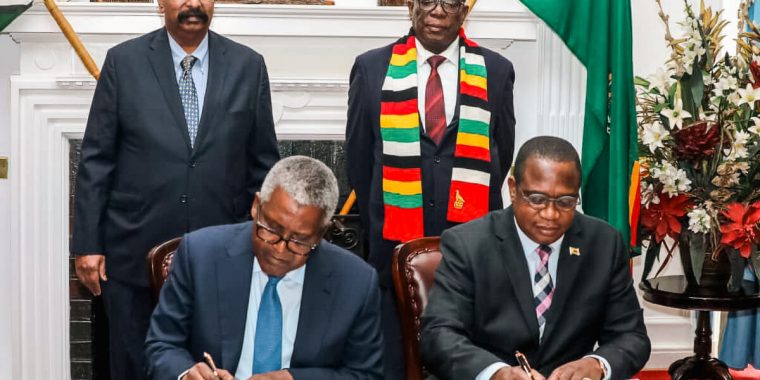
Dangote signs deal with Zimbabwe to build 2,000km-long pipeline from Namibia


The
project
includes
a
fertiliser
plant
and
2,000km-long
pipeline
from
Namibia’s
Walvis
Bay,
through
Botswana,
to
Zimbabwe’s
second-largest
city,
Bulawayo.

Dangote
met
with
President
Emmerson
Mnangagwa
in
Harare
on
Wednesday
to
sign
a
Memorandum
of
Understanding,
marking
one
of
the
most
significant
private-sector
investments
in
the
country
in
years.

The
deal
underscores
growing
investor
confidence
in
Mnangagwa’s
economic
reform
agenda
and
brings
the
powerful
West
African
conglomerate,
headed
by
Africa’s
richest
man,
deeper
into
the
southern
region.

“The
broader
investment
is
in
the
hundreds
of
millions
of
dollars,
maybe
even
more
than
a
billion,
but
you
know
we
will
tell
you
the
amount
as
we
go
along,
But
really
it
will
be
over
a
billion
because
of
the
pipeline,”
Dangote
said
on
Wednesday.

A
spokesperson
for
the
president
said
the
project
could
change
Zimbabwe’s
production
structure
with
fuel
cheaper
to
import.

The
agreement
paves
the
way
for
major
projects
across
energy,
cement
and
fertiliser
production,
and
infrastructure
development.

Dangote
is
already
planning
a
major
fuel
storage
facility
in
Walvis
Bay,
cutting
Southern
Africa’s
dependence
on
fuel
imports
from
Europe
and
Asia.

Post
published
in:

Agriculture

Farmers to negotiate shares before mining starts, Govt says

Dr
Makwiranzou
told
Senate
on
Thursday
that
the
new
law,
H.B.
1,
2025,
aims
to
end
long-standing
conflicts
between
mining
companies
and
rural
communities.

He
was
responding
to
a
question
from
Senator
Chief
Chikwaka,
who
raised
concerns
about
communities
being
displaced
by
mining
operations
without
proper
compensation
or
suitable
living
conditions.

Chief
Chikwaka
said
that
although
Zimbabwe
welcomes
foreign
mining
investors
under
the
“open
for
business”
policy,
many
villagers
are
being
relocated
to
inhospitable
areas
without
their
livelihoods
being
improved.

“We
are
glad
that
Zimbabwe
is
open
for
business…
However,
we
have
a
challenge.
What
is
government
policy
regarding
the
allocation
of
licences
where
miners
displace
local
communities?
You
find
that
people
are
just
relocated
without
improving
their
lives,”
he
said.

Dr
Makwiranzou
said
that
mining
cannot
begin
without
an
Environmental
Impact
Assessment
(EIA)
outlining
how
affected
households
will
be
compensated
or
resettled.

“Before
giving
permission
to
miners,
we
require
an
Environmental
Impact
Assessment
report,
which
looks
at
the
community
to
be
affected
and
where
they
will
be
relocated.
If
they
are
to
receive
houses,
that
must
be
shown
in
the
report.
Only
after
receiving
that
report
can
we
allow
mining
to
proceed,”
he
said.

He
added
that
under
the
new
law,
farmers
will
have
the
right
to
negotiate
for
shares
in
the
mining
company.

“The
new
law
allows
that
if
someone
has
a
field
or
farm
where
mining
is
required,
that
person
is
given
the
first
option.
They
are
asked
whether
they
agree
to
mining,
and
they
can
negotiate
with
the
investor,
including
discussing
the
allocation
of
shares,”
he
said.

Dr
Makwiranzou
emphasised
that
relocation
must
be
based
on
consent.

“They
must
give
consent
because
the
previous
law
caused
disputes
due
to
conflicts
between
the
Minerals
Act
and
the
Agricultural
Act,”
he
said.

Farmers to negotiate shares before mining starts, Govt says 

Dr
Makwiranzou
told
Senate
on
Thursday
that
the
new
law,
H.B.
1,
2025,
aims
to
end
long-standing
conflicts
between
mining
companies
and
rural
communities.

He
was
responding
to
a
question
from
Senator
Chief
Chikwaka,
who
raised
concerns
about
communities
being
displaced
by
mining
operations
without
proper
compensation
or
suitable
living
conditions.

Chief
Chikwaka
said
that
although
Zimbabwe
welcomes
foreign
mining
investors
under
the
“open
for
business”
policy,
many
villagers
are
being
relocated
to
inhospitable
areas
without
their
livelihoods
being
improved.

“We
are
glad
that
Zimbabwe
is
open
for
business…
However,
we
have
a
challenge.
What
is
government
policy
regarding
the
allocation
of
licences
where
miners
displace
local
communities?
You
find
that
people
are
just
relocated
without
improving
their
lives,”
he
said.

Dr
Makwiranzou
said
that
mining
cannot
begin
without
an
Environmental
Impact
Assessment
(EIA)
outlining
how
affected
households
will
be
compensated
or
resettled.

“Before
giving
permission
to
miners,
we
require
an
Environmental
Impact
Assessment
report,
which
looks
at
the
community
to
be
affected
and
where
they
will
be
relocated.
If
they
are
to
receive
houses,
that
must
be
shown
in
the
report.
Only
after
receiving
that
report
can
we
allow
mining
to
proceed,”
he
said.

He
added
that
under
the
new
law,
farmers
will
have
the
right
to
negotiate
for
shares
in
the
mining
company.

“The
new
law
allows
that
if
someone
has
a
field
or
farm
where
mining
is
required,
that
person
is
given
the
first
option.
They
are
asked
whether
they
agree
to
mining,
and
they
can
negotiate
with
the
investor,
including
discussing
the
allocation
of
shares,”
he
said.

Dr
Makwiranzou
emphasised
that
relocation
must
be
based
on
consent.

“They
must
give
consent
because
the
previous
law
caused
disputes
due
to
conflicts
between
the
Minerals
Act
and
the
Agricultural
Act,”
he
said.

WHO warns TB deaths could rise sharply as global funding stalls

In
its
latest
report,
WHO
provides
a
comprehensive
assessment
of
the
TB
epidemic
and
progress
in
prevention, diagnosis and
treatment
at
global, regional and
country
levels.
The
2025
edition
draws
primarily
on
data submitted annually
by
national ministries
of
health.
In
2025,
184
countries
and
areas,
representing more
than
99%
of
the
world’s
population
and
TB
burden,
reported
their
data.

According
to
the
report,
progress remains far
behind
End
TB
Strategy
targets
as
funding
continues
to
stagnate.

“Despite
many
gains,
global
progress
levels remain far
from
meeting
the
End
TB
Strategy
targets.
A
major
obstacle
is
global
funding
for
TB,
which
has
stagnated
since
2020.
In
2024,
only
US$5.9
billion was
available
for
prevention,
diagnosis,
and
treatment,
just
over
a
quarter
of
the
US$22
billion annual
target
set
for
2027,”
the
summary
noted.

It
further
warned
that
looming
cuts
to
international
donor
funding
from
2025
pose
a
significant
threat.
Modelling
shows
that
sustained
reductions
could
lead
to
up
to 2
million additional deaths and 10
million
more
TB
infections between
2025
and
2035.

Global
TB
research
funding
is
also
lagging,
reaching
only
US$1.2
billion in
2023,
24%
of
the
target.
However,
scientific
activity
continues
to grow: as
of
August
2025,
63
diagnostic
tests
were
in
development
and
29
drugs
were
undergoing
clinical
trials,
compared
to
just
eight
in
2015.
In
addition,
18
vaccine
candidates
are
in
clinical
trials,
including
six
in
Phase
3.
WHO
continues
to
steer
global
vaccine
development
efforts
through
the
TB
Vaccine
Accelerator
Council.

Dr Tereza Kasaeva,
Director
of
the
WHO
Department
for
HIV,
TB,
Hepatitis
and
STIs,
urged
countries
to
reinforce
political
commitment
and
increase
domestic
investment
to
avoid
reversing
gains
made
in
recent
years.

“We
are
at
a
defining
moment
in
the
fight
against
TB,”
she
said.
“Funding
cuts
and
persistent
drivers
of
the
epidemic
threaten
to
undo
hard-won
gains,
but
with
political
commitment,
sustained
investment,
and
global
solidarity,
we
can
turn
the
tide
and
end
this
ancient
killer
once
and
for
all.”

Victoria Falls border post operating hours extended to 24 hours

HARARE

The
government
has
extended
operating
hours
at
the
Victoria
Falls
Border
Post
to
run
24
hours
a
day,
according
to
an
Extraordinary
Government
Gazette
published
on
Thursday.

The
post
was
previously
open
between
6AM
and
10PM.

General
Notice
2265A
of
2025,
issued
under
the
Immigration
Act,
declares
that
the
border
post,
one
of
Zimbabwe’s
busiest
ports
of
entry,
will
now
operate
around
the
clock
with
immediate
effect.

The
notice
was
signed
by
Home
Affairs
and
Cultural
Heritage
secretary
Raphael
Faranisi.


The
move
is
expected
to
facilitate
tourism
and
trade,
and
improve
cross-border
movement
between
Zimbabwe
and
Zambia.

The
announcement
came
ahead
of
Friday’s
meeting
between
President
Emmerson
Mnangagwa
and
his
Zambian
counterpart
Hakainde
Hichilema
in
Harare
for
the
inaugural
session
of
the
Zambia-Zimbabwe
Bi-National
Commission.

Mnangagwa faces crucial choice as ZDF chief Sibanda’s term ends

HARARE

Zimbabwe
Defence
Forces
commander
Phillip
Valerio
Sibanda
is
set
to
leave
the
post
on
November
23
at
the
expiry
of
his
contract,
which
was
extended
by
a
year
by
President
Emmerson
Mnangagwa.

Sibanda,
who
turns
71
in
December,
has
led
Zimbabwe’s
armed
forces
since
2017.
He
replaced
Constantino
Chiwenga,
who
became
vice
president
after
leading
the
military
coup
that
ousted
Robert
Mugabe.

His
reappointment
last
year
sparked
controversy,
with
lawyers
arguing
that
the
statutory
retirement
age
is
70.
Mnangagwa’s
decision
to
revive
an
already
expired
term
was
“flawed”
and
an
“absurdity,”
they
said.

A
ceremony
is
planned
for
November
24
to
mark
Sibanda’s
exit,
but
both
his
future
role
and
his
successor
remain
uncertain.

There
has
been
speculation
that
Sibanda
could
be
elevated
to
the
vice
presidency,
but
without
a
vacancy
Mnangagwa
would
need
to
remove
either
Chiwenga
or
his
other
deputy,
Kembo
Mohadi,
to
accommodate
him.

Precedent
would
suggest
that
Zimbabwe
National
Army
commander
Lieutenant
General
Emmanuel
Matatu

appointed
only
in
March

would
succeed
him.
But
at
72,
well
past
retirement
age,
Matatu
could
also
be
heading
for
the
exit.

That
scenario
would
open
the
way
for
Major
General
Walter
Tapfumaneyi,
appointed
chief
of
staff
in
May
after
leaving
his
post
as
deputy
director
general
of
the
Central
Intelligence
Organisation.

A
wildcard
prospect
is
Gatsha
Mazithulela,
the
former
CIO
deputy
director
general
and
chemical
scientist
now
serving
as
the
president’s
drug
tzar.
Unlike
Tapfumaneyi,
Mazithulela
is
not
a
career
soldier
but
could
be
elevated
for
his
administrative
strengths.
He
previously
served
as
vice
chancellor
of
the
National
University
of
Science
and
Technology.

The
changing
of
command
at
the
apex
of
Zimbabwe’s
military
is
never
a
routine
administrative
matter.
Since
independence
in
1980,
the
armed
forces
have
been
deeply
intertwined
with
the
politics
of
the
ruling
Zanu
PF,
functioning
not
just
as
a
security
institution
but
as
one
of
the
central
levers
of
political
power.

Senior
commanders
have
openly
declared
they
would
not
salute
anyone
without
liberation-war
credentials,
a
position
that
has
shaped
national
politics
for
more
than
two
decades.

The
military
has
also
played
an
outsized
role
in
elections,
frequently
accused
by
opposition
parties
and
civil
society
of
voter
intimidation,
mobilising
ruling
party
structures
and
directing
state
institutions
behind
the
scenes.

In
2008,
the
military
intervened
after
the
late
opposition
leader
Morgan
Tsvangirai
defeated
Mugabe
in
the
first
round
of
presidential
voting,
triggering
a
violent
runoff
that
forced
Tsvangirai
to
withdraw.
The
2017
coup
that
removed
Mugabe
cemented
the
military’s
status
as
kingmaker,
with
generals
proclaiming
their
takeover
a
defence
of
the
revolution
and
the
ruling
party.

Since
then,
Mnangagwa’s
authority
has
rested
partly
on
maintaining
the
loyalty
and
balance
of
competing
military
factions.
Control
of
the
command
structure
is
central
to
managing
Zanu
PF’s
succession
battles.

Some
analysts
say
Mnangagwa
has
sought
to
sideline
generals
perceived
as
loyal
to
Chiwenga,
who
opposes
a
plan
by
the
president’s
loyalists
to
force
through
constitutional
amendments
and
extend
his
term
beyond
2028.

The
choice
of
Sibanda’s
successor

and
the
political
alliances
they
bring

will
have
ramifications
not
only
for
the
military’s
internal
balance
but
for
Zimbabwe’s
wider
political
direction
as
Zanu
PF
edges
towards
its
elective
congress
in
2027
and
general
elections
in
2028.

Peter Dube convicted of brutal Gweru double murder, awaits sentencing

GWERU

After
a
dramatic
international
manhunt
spanning
four
years
and
multiple
countries,
fugitive
murder
accused
Peter
Dube
has
been
convicted
of
two
counts
of
murder
and
two
counts
of
attempted
murder
by
the
Bulawayo
High
Court.

He
now
awaits
sentencing
after
a
damning
judgment
by
Justice
Munamato
Mutevedzi.

The
court
found
that
Dube
unleashed
“unmitigated
violence”
on
the
night
of
April
22,
2021,
killing
Shelton
Chiduku
and
Gamuchirai
Madungwe
and
shooting
Nyasha
Nharingo
and
Nyaradzo
Nharingo,
leaving
both
women
seriously
injured.
Nyaradzo
later
died
from
the
complications
of
her
wounds,
a
fact
the
judge
noted
with
concern.

He
was
accusing
his
friend
Chiduku,
who
was
a
gold
dealer
based
in
Kwekwe,
of
having
an
affair
with
his
girlfriend,
Nyasha.

“The
medieval
ruthlessness
with
which
the
violence
manifested
was
said
to
have
shaken
the
usually
sleepy
town
of
Gweru,”
Justice
Mutevedzi
wrote.

The
judge
rejected
Dube’s
claim
that
he
had
been
suffering
from
mental
illness
at
the
time,
describing
his
defence
as
malingering,
calculated,
and
unsupported
by
evidence.

After
the
shootings,
Dube

who
ran
a
popular
car
sale
in
Gweru

vanished
from
Zimbabwe.
The
judgment
reveals
for
the
first
time
the
full
details
of
his
escape.

Justice
Mutevedzi
detailed
how
Dube
fled
Gweru
the
same
night,
assisted
by
his
senior
wife,
Nomatter
Chawana.
He
crossed
into
South
Africa,
moved
on
to
Eswatini
and
acquired
a
false
Mozambican
identity.
He
subsequently
flew
to
Ireland,
where
he
lived
undetected
for
years.

“By
his
own
admission,
he
escaped
with
the
aid
of
his
senior
wife…
acquired
a
pseudonym…
and
used
it
to
fly
to
and
settle
in
Ireland,”
the
court
said.

His
cover
was
blown
abroad,
resulting
in
him
being
deported
first
to
Mozambique,
where
he
was
disowned,
and
then
to
Zimbabwe.

The
judgment
paints
a
vivid
and
harrowing
picture
of
the
violence.

Earlier
that
day,
Nyasha
and
her
sister
Nyaradzo
had
travelled
to
Masvingo
with
their
friends,
the
now-deceased
Shelton
and
Gamu,
to
collect
a
passport.
On
their
return,
they
found
Dube
had
locked
himself
in
their
apartment.

When
police
briefly
intervened
and
left,
the
situation
deteriorated
quickly.

Dube
went
downstairs,
armed
himself
with
a
gun,
and
confronted
Shelton
and
Gamu
in
the
car
park.

“At
point-blank
range,
he
shot
Shelton
and
killed
him
instantly…
Gamu
tried
to
flee.
Unfortunately,
she
couldn’t
go
far.
She
was
also
shot
and
died
on
the
spot.”

Consumed
by
what
the
judge
called
an
“implacable
rage,”
Dube
then
stormed
upstairs.

Justice
Mutevedzi
went
on:
“From
very
close
range,
he
shot
Nyasha…
The
bullet
entered
her
cheek
and
exited
the
other
side
of
the
neck.
He
then
took
aim
at
Nyaradzo…
The
bullet
found
its
mark
just
above
her
right
eye…
Her
eye
was
ruptured.
Satisfied
with
his
grisly
handiwork,
the
accused
nonchalantly
walked
out
and
left
the
scene
which
resembled
a
graveyard.”

Dube
claimed
he
suffered
from
temporal
lobe
epilepsy,
saying
he
had
no
recollection
of
the
shootings
and
that
he
was
mentally
incapacitated.

But
Justice
Mutevedzi
found
the
testimony
of
State
psychiatrist
Dr
Nemache
Mawere
compelling.
The
expert
described
Dube
as
evasive,
inconsistent,
and
deliberately
theatrical
during
examinations.

The
judge
cited
Dr
Mawere’s
observation
that:
“The
accused
was
simply
play-acting…
His
gestures
were
not
sequential…
He
was
trying
to
run
away
from
punishment.”

The
court
also
noted
that
Dube
managed
a
sophisticated
escape
across
several
countries,
maintained
relationships
with
both
wives,
managed
his
businesses,
and
navigated
foreign
immigration
systems

actions
wholly
incompatible
with
severe
mental
illness.

“The
conduct
of
the
accused
after
the
commission
of
the
offence
did
not
align
with
a
person
who
had
lost
his
memory,”
the
judge
said.

Ultimately,
Justice
Mutevedzi
concluded
that
the
defence
had
“failed
to
prove,
on
a
balance
of
probabilities,”
that
Dube
was
mentally
disordered
at
the
time

the
legal
threshold
required
for
a
special
verdict
of
insanity.

Justice
Mutevedzi
expressed
disquiet
about
Nyaradzo’s
later
death.
She
never
recovered
from
her
gunshot
injuries
and
later
died,
yet
prosecutors
did
not
charge
Dube
with
her
murder.

“Why
then
that
death
was
not
added
to
the
list
of
murders
can
only
be
explained
by
prosecution,”
he
said.

The
role
of
Dube’s
senior
wife
also
bothered
the
judge.
She
helped
him
flee,
yet
was
never
questioned.

“She
possibly
committed
a
crime…
but
nobody
ever
raised
an
eyebrow
against
her,”
the
judge
remarked.

With
the
insanity
defence
rejected,
and
with
Dube
admitting
he
shot
the
victims,
while
claiming
memory
loss,
the
court
found
him
guilty
of
all
four
charges

two
counts
of
murder
and
two
counts
of
attempted
murder.

Justice
Mutevedzi
said
that
the
killings
were
deliberate,
targeted,
and
executed
with
chilling
calmness.

Dube
now
awaits
sentencing.

Police, ministry call for early reporting of GBV 

The
call
was
made
during
a
community
workshop
in
Cowdray
Park
hosted
by
the
Ministry
of
Women
Affairs
in
partnership
with
the
Zimbabwe
Republic
Police’s
Victim
Friendly
Unit
(VFU),
UNFPA
and
other
stakeholders,
including
residents’
leaders,
community
health
clubs,
support
groups
and
church
representatives.

The
engagement
comes
ahead
of
the
annual
16
Days
of
Activism
Against
Gender-Based
Violence,
running
from
November
25
to
December
10
under
the
theme, “Unite
to
End
Digital
Violence
Against
All
Women
and
Girls.”

Representatives
from
the
One
Stop
Centre,
which
opened
last
year,
said
the
facility
was
established
to
ensure
survivors
can
access
counselling,
health
services,
police
support
and
legal
assistance
in
one
place.

“Since
opening,
we
have
handled
a
significant
number
of
cases,
with
survivors
receiving
support
and
perpetrators
being
arrested.
We
encourage
anyone
who
needs
help
to
come
forward.
The
centre
is
meant
to
make
the
process
easier
by
eliminating
the
need
to
move
from
office
to
office,”
a
representative
said.

A
VFU
officer
also
urged
residents
to
report
disputes
early,
warning
that
delayed
reporting
often
leads
to
severe
physical
assault
or
death.

“VFU
units
are
available
at
all
police
stations.
It
is
important
to
seek
help
early
before
issues
escalate,”
she
said.
“If
you
notice
constant
quarrelling
or
lack
of
peace
at
home,
you
can
visit
our
offices
for
counselling.”

She
raised
concern
over
cases
of
child
sexual
abuse
concealed
within
families.

“There
are
cases
where
a
child
is
raped
by
a
family
member
but
the
matter
is
covered
up
until
the
child
becomes
ill
or
pregnant.
Such
cases
must
be
reported
promptly
to
protect
the
child
from
pregnancy,
HIV
and
other
infections,”
she
said.

The
officer
also
encouraged
men
to
report
abuse,
saying
many
suffer
in
silence.

“Men
can
also
be
victims
of
verbal,
emotional,
physical
or
sexual
abuse.
Some
hesitate
to
speak
out,
yet
this
silence
contributes
to
rising
suicide
cases
among
men.
Our
officers
are
trained
to
support
everyone,”
she
said.

During
discussions,
residents
highlighted
several
drivers
of
GBV,
including
financial
strain,
dishonesty
and
family
disputes.

One
resident
shared
an
incident
involving
a
man
who
later
discovered
that
his
wife
had
been
secretly
receiving
maintenance
from
her
former
partner
for
a
child
born
before
their
marriage.

“When
he
confronted
her,
she
left
him
and
later
took
him
to
court
for
maintenance
for
the
child
they
had
together,”
the
resident
said.

Another
participant
noted
that
financial
dynamics
can
fuel
conflict.

“Money
plays
a
big
role
in
GBV.
Sometimes
when
women
start
earning
more
than
their
husbands,
they
lose
respect.
The
economy
is
already
tough,
and
when
men
are
blamed
for
failing
to
provide,
some
become
emotionally
overwhelmed
and
may
turn
violent,”
he
said.

Residents
also
cited
inheritance
disputes
as
an
increasingly
common
trigger
of
violence.

“Siblings
often
fight
over
houses
and
property
left
behind
by
parents.
These
conflicts
easily
escalate
into
physical
confrontations
or
worse,”
one
resident
added.

Capitalizing On The Dead – See Also – Above the Law

Lawyers
Try
To
Get
Away
With
Serving
Motions
To
A
Deceased
Lawyer:
Thankfully,
the
judge
stepped
in.
Judge
Orders
Handover
Of
Over
20
Million
Private
ChatGPT
Conversations:
Judge
Wang
thinks
anonymization
will
fix
the
problem.
Big
if.
Rainmaker
Reflects
On

Windsor
:
Roberta
Kaplan
shares
how
creativity
can
move
your
career
forward.
Take
Your
Sorry
And
Get
Out:
Trump’s
billion-dollar
BBC
suit
is
DOA.