Keep Cool And CLE On: Handling Hiccups Like A Pro – Above the Law

Getty
Images


Ed.
note:

Latest
in
a
series.

Read
the
prior
installment
here.

As
we
continue
our
journey
through
“Lights,
Camera,
CLE:
Making
Your
Presentation
a
Blockbuster,”
we’ve
covered
the
essentials
of
preparing
for
a
successful
CLE
presentation
and
engaging
your
audience
like
a
pro.

In
Part
3,
we’ve
focused
on
how
meticulous
preparation
and
dynamic
audience
engagement
can
set
the
stage
for
a
memorable
and
impactful
presentation.
But
even
the
most
well-prepared
presenter
will
face
challenges

whether
it’s
the
nerves
that
surface
before
stepping
onto
the
stage
or
the
unexpected
technical
hiccups
that
can
throw
off
your
rhythm.

In
this
article,
we’ll
tackle
how
to
manage
these
inevitable
obstacles
with
grace
and
professionalism.

From
staying
calm
under
pressure
to
dealing
with
difficult
audience
members,
we’ll
equip
you
with
strategies
to
keep
your
presentation
on
track
and
ensure
that
your
CLE
remains
a
standout
performance,
no
matter
what
challenges
arise.


Turning
Stage
Fright
Into
Stage
Might

Even
the
most
seasoned
presenters
experience
nerves.
It’s
natural
to
feel
a
rush
of
adrenaline
before
speaking,
but
the
key
is
to
channel
that
energy
into
a
confident,
compelling
delivery.

Remember,
you’ve
prepared
meticulously,
and
your
audience
is
here
to
learn
from
you.
You
are
the
Expert!


Staying
Calm
Under
Pressure


Preparation
is
Power:

The
more
prepared
you
are,
the
more
confident
you’ll
feel.
Rehearse
your
presentation
multiple
times,
focusing
on
the
flow,
transitions,
and
key
points.
Familiarity
with
your
material
is
your
best
defense
against
nerves.


Visualization
Techniques:

Before
stepping
up
to
present,
take
a
few
moments
to
visualize
success.
Imagine
the
room
filled
with
engaged,
attentive
listeners.
Visualization
can
help
calm
your
mind
and
boost
your
confidence.


Controlled
Breathing:

Practice
deep
breathing
exercises
to
calm
your
nerves.
Inhale
slowly
for
four
counts,
hold
for
four,
and
exhale
for
four.
This
simple
technique
can
lower
your
heart
rate
and
help
you
feel
more
centered.


When
Technology
Takes
Center
Stage

In
our
tech-driven
world,
even
the
best-laid
plans
can
go
awry.
Whether
it’s
a
malfunctioning
microphone,
a
glitchy
slideshow,
or
a
lost
connection,
technical
issues
can
disrupt
your
flow
and
rattle
your
nerves.

But
remember,
it’s
not
about
avoiding
problems

it’s
about
how
you
handle
them.


Strategies
for
Managing
Tech
Glitches


Tech
Rehearsal:

Always
do
a
full
run-through
of
your
presentation
with
all
the
equipment
you’ll
be
using.
This
includes
testing
microphones,
projectors,
slides,
and
any
other
tech
you
plan
to
incorporate.
Identify
potential
issues
ahead
of
time
and
have
a
backup
plan.


Stay
Composed:

If
something
goes
wrong,
stay
calm.
Acknowledge
the
issue
without
letting
it
derail
your
presentation.
For
example,
if
your
slides
stop
working,
continue
speaking
while
the
issue
is
being
resolved,
or
invite
your
audience
to
discuss
the
topic
at
hand.


Backup
Plan:

Always
have
a
contingency
plan.
This
could
mean
having
printed
handouts
of
your
slides,
a
backup
device
with
your
presentation,
or
being
prepared
to
switch
to
a
discussion
format
if
tech
fails
entirely.


When
the
Audience
Becomes
the
Challenge

Not
every
audience
member
will
be
on
your
side,
and
sometimes,
you’ll
face
interruptions,
challenging
questions,
or
even
disruptive
behavior.
The
key
to
handling
these
situations
is
to
remain
professional,
composed,
and
assertive.

But
beyond
just
managing
difficult
interactions,
your
authenticity
can
be
a
powerful
tool
in
creating
a
genuine
connection
with
your
audience.


Handling
Difficult
Interactions
with
Professionalism


Set
the
Tone
Early:

At
the
beginning
of
your
presentation,
establish
ground
rules
for
participation.
This
sets
expectations
for
behavior
and
shows
that
you’re
in
control
of
the
room.


Acknowledge,
Don’t
Argue:

If
a
difficult
question
or
comment
arises,
acknowledge
the
person’s
point,
and
then
steer
the
conversation
back
to
your
main
topic.
For
example,
“That’s
an
interesting
perspective,
and
while
it’s
not
the
focus
of
today’s
discussion,
I’d
be
happy
to
chat
about
it
afterward.”


Be
Authentically
You—Always:

Authenticity
isn’t
just
a
fallback
when
you
don’t
know
the
answer;
it’s
a
strength
that
can
enhance
your
entire
presentation.
From
the
moment
you
step
in
front
of
your
audience,
being
genuine
builds
trust
and
rapport.

If
a
question
stumps
you,
it’s
perfectly
fine
to
say:
“That’s
a
great
question.
I
don’t
have
the
answer
right
now,
but
let’s
take
it
offline,
and
I’ll
get
back
to
you.”

This
not
only
shows
humility
but
also
opens
the
door
for
continued
conversation
after
the
CLE.

More
importantly,
being
authentically
you
throughout
the
presentation
fosters
a
connection
that
makes
your
audience
more
receptive
and
engaged,
turning
potential
challenges
into
opportunities
for
deeper
interaction.


Keep
Cool
and
CLE
On

Mastering
the
art
of
staying
calm
and
handling
challenges
not
only
ensures
that
your
presentation
runs
smoothly
but
also
leaves
a
lasting
impression
on
your
audience.
Your
ability
to
navigate
obstacles
with
grace
and
professionalism
sets
you
apart
as
a
speaker
who
can
handle
any
situation
with
poise.

In
our
final
article
of
this
series,
we’ll
focus
on
the
importance
of
closing
your
CLE
with
a
compelling
conclusion
that
leaves
your
audience
with
clear
takeaways
and
a
desire
to
engage
with
you
further.
We’ll
also
explore
how
to
maintain
momentum
after
the
presentation
ends,
ensuring
that
your
impact
continues
long
after
the
session
is
over.


Managing
Nerves
Like
a
Pro:


✔️
 Prepare
Thoroughly:

Rehearse
your
presentation
multiple
times
to
build
confidence
and
familiarity.

✔️
 Visualize
Success:

Use
visualization
techniques
to
calm
your
mind
and
boost
confidence.

✔️
 Practice
Controlled
Breathing:

Use
deep
breathing
exercises
to
manage
anxiety
before
presenting.


Handling
Technical
Issues:


✔️
 Conduct
a
Tech
Rehearsal:

Test
all
equipment
ahead
of
time
and
have
a
backup
plan
in
place.

✔️
 Stay
Composed
During
Glitches:

Address
the
issue
calmly
and
keep
the
presentation
moving.

✔️
 Prepare
for
the
Worst:

Have
contingency
plans
ready,
such
as
printed
materials
or
backup
devices.


Dealing
with
Difficult
Audience
Members:


✔️
 Set
Ground
Rules:

Establish
expectations
for
audience
behavior
at
the
start
of
your
presentation.

✔️
 Acknowledge
and
Redirect:

Address
challenging
questions
or
comments
without
getting
sidetracked.

✔️
 Be
Authentically
You:

If
you
don’t
know
the
answer,
admit
it,
and
suggest
following
up
after
the
CLE
to
continue
the
conversation.

By
mastering
these
techniques,
you’ll
not
only
overcome
challenges
but
also
deliver
a
CLE
presentation
that’s
memorable
for
all
the
right
reasons.



Sejal
Bhasker
Patel is
a
Rainmaking
Consultant
and
Author
of Rainmaker:
Unleashed

a
sharp,
strategic
playbook
for
attorneys
who
don’t
fit
the
traditional
mold.
She’s
the
founder
of
Sage
Ivy,
a
consulting
firm
that
works
directly
with
law
firms
and
attorneys
to
turn
relationships
into
revenue

without
selling
their
soul.
Her
work
is
blunt,
tailored,
and
built
on
one
core
belief:
Authenticity
isn’t
a
liability

it’s
your
strongest
competitive
edge.
www.sageivyconsulting.com

Podcast Guesting Strategies That Move The Needle For Lawyers – Above the Law

Partners
in
the
largest
law
firms
may
have
dedicated
public
relations
staff
who
can
take
on
the
work
of
developing
podcast
guesting
strategies
to
build
on
their
existing
reputation
while
further
increasing
name
recognition
and
law
firm
visibility.
For
everyone
else,
appearing
as
the
expert
guest
on
a
podcast
whose
content
has
a
clear
connection
to
your
area
of
law
can
be
a
highly
effective
tool
for
accomplishing
the
same
goals,
but
you
will
likely
need
to
do
much
of
the
work
of
vetting
podcasts
and
pitching
ideas
for
a
guest
spot
yourself.
You
will
obviously
want
to
maximize
your
returns
on
those
“non-billable”
hours,
so
it
pays
to
take
some
time
upfront
to
consider
what
goes
into
an
effective
strategy
for
leveraging
podcast
guesting
to
grow
your
law
firm.


How
To
Pick
a
Podcast

Every
now
and
then,
an
attorney
may
be
lucky
enough
to
find
that
a
podcaster
is
seeking
them
out
because
the
podcaster
(or
their
programming/production
team)
already
recognizes
the
lawyer’s
expertise
and
has
a
specific
legal
topic
in
mind
for
presentation
to
the
podcast
audience.
This
scenario
may
sometimes
unfold
when
a
podcast
is
developing
an
episode
or
series
on
a
subject
with
which
a
specific
attorney
or
law
firm
has
substantial
experience.

In
most
cases,
however,
the
decision
to
try
podcasting
as
a
tool
for
increasing
awareness
of
your
law
firm
will
likely
come
first,
and
it
will
be
up
to
you
to
take
the
first
steps
toward
making
your
podcast
debut
a
reality.
In
that
instance,
you
will
need
to
start
by
choosing
a
podcast
to
which
you
can
pitch
effectively,
based
on
the
“fit”
between
your
legal
expertise
and
the
podcast’s
themes
and
target
audience.
Each
situation
will
be
unique,
but
there
are
a
few
general
factors
most
aspiring
podcast
guests
may
find
helpful
to
consider.


What
To
Look
For:
Audience

For
many
people,
their
first
instinct
in
identifying
a
podcast
where
they
might
like
to
make
a
guest
appearance
is
to
look
for
a
program
they
themselves
listen
to
and
appreciate.
It’s
natural
to
“start
with
what
you
know,”
but
unless
the
people
you
would
most
like
to
reach
are
very
much
like
yourself,
pitching
to
a
podcast
that
you
personally
listen
to
may
not
make
sense.

Ask
yourself
whether
your
priority
is
to
reach
other
lawyers
vs.
to
put
your
name
and
expertise
in
front
of
people
who
might
be
interested
in
hiring
your
law
firm.
Both
goals
are
valid,
but
they
imply
different
audiences
and
therefore
different
approaches
to
podcast
selection.
If
you
really
want
to
reach
other
attorneys
to
cement
your
professional
reputation,
then
a
podcast
aimed
at
unpacking
important
questions
and
challenges
confronting
the
legal
profession
may
be
worth
sending
a
pitch.
If
you
primarily
hope
to
educate
people
in
the
groups
from
which
your
own
clients
typically
come,
then
you
may
need
to
do
some
brainstorming
to
identify
content
areas
(and
therefore
podcasts)
that
enjoy
popularity
among
the
represented
groups.

You
may
also
want
to
consider
whether
there
are
groups
(defined
by
age,
by
interest,
by
location,
and
so
on)
that
seem
like
an
ideal
fit
for
your
law
firm’s
services,
but
from
which
you
get
fewer
clients
than
you
think
you
should,
or
than
you
would
like.
Identifying
a
podcast
whose
audience
has
substantial
overlap
with
your
base
of
prospective
clients
can
be
a
highly
effective
strategy
for
creating
targeted
awareness
with
the
people
who
can
“move
the
needle”
in
terms
of
your
law
firm
growth.


What
To
Look
For:
Topical
Coverage

There
is
really
no
point
in
developing
a
pitch
to
send
to
a
podcast’s
programming
staff
because
the
podcast’s
audience
has
a
strong
overlap
with
your
prospective
client
base
if
the
podcast
itself
does
not
consistently
handle
topics
you
can
speak
to
with
authority.
In
some
instances,
you
may
have
the
task
of
explaining,
in
your
pitch,
a
legal
question
that
connects
to
a
recent
or
(even
better)
recurring
theme
for
the
podcast.

For
example,
if
you
work
in
an
estate
planning
firm,
then
the
nuances
of
tax
planning
or
the
specific
details
of
state
law
concerning
homestead
property
might
be
useful
to
the
audiences
of
a
financial
management
podcast.
If
you
run
a
small
family
law
practice,
then
the
issues
people
commonly
overlook
in
drafting
their
parenting
agreements
may
be
of
interest
to
the
listeners
of
a
podcast
on
parenting
more
generally.
Make
sure
you
can
clearly
articulate
how
the
knowledge
you
offer
addresses
a
need
or
interest
of
the
podcast’s
audience,
and
aim
to
draw
explicit
connections
between
your
subject
matter
expertise
and
the
podcast’s
typical
programming.


What
To
Look
For:
Tone
and
Other
Guests

“You
will
be
known
by
the
company
you
keep,”
as
the
saying
goes.
This
is
not
an
argument
for
snobbery
but
be
sure
that
the
podcast
host
is
someone
whose
professionalism
you
trust,
and
that
the
program’s
(other)
guests
are
typically
people
you
feel
comfortable
being
associated
with.
Depending
on
the
type
of
law
you
practice
and
the
way
you
prefer
to
position
your
firm,
you
may
not
want
to
appear
back-to-back
with
guests
known
for
their
extreme
“hot
takes,”
or
in
a
context
where
the
overall
discourse
suggests
a
lax
commitment
to
ethics.
As
a
related
consideration,
reviewing
recent
episodes
to
get
a
sense
of
the
professions
and
perspectives
represented
by
the
selection
of
guests
can
also
help
to
clarify
whether
a
specific
podcast
is
truly
a
good
bet
for
your
pitch.


What
To
Look
For:
Format
and
Frequency

Listening
to
a
few
past
guests
can
give
you
a
feel
for
the
overall
format
of
the
podcast,
as
well
as
who
appears
in
it.
Take
the
time
to
listen
to
a
few
complete
episodes
of
any
podcast
you
have
identified
as
a
good
potential
fit.
Pay
attention
to
pacing:
How
long
does
the
host
generally
allow
for
a
guest
to
develop
their
thoughts
on
a
question
before
moving
on
to
the
next
topic?
How
frequent
are
the
other
topic
changes?
How
long
is
each
episode
when
aired?
Are
multiple
guests
interviewed
in
each,
or
do
episodes
commonly
feature
several
short
conversations?

Very
importantly,
you
will
also
want
to
confirm
how
often
and
how
regularly
new
episodes
are
released.
Check
any
download
or
view
numbers,
if
you
can;
a
larger
audience
for
the
podcast
obviously
means
a
larger
potential
platform
for
your
expertise,
but
well-established,
already-popular
podcasts
with
large
followings
may
also
be
more
challenging
to
pitch
successfully.
Aim
for
a
balance
between
visibility
and
your
chance
to
craft
a
pitch
that
stands
out
among
those
received
by
the
programming
team.


Post-Pitch
Protocol

If
you
receive
an
instant

yes
,
great!
You
can
coordinate
with
the
podcast
host
(or
their
program
development
staff,
depending
on
the
size
of
their
operation)
to
find
a
date
and
make
sure
your
talking
points
are
prepared
to
address
the
core
concerns
of
the
podcast
audience.
If
you
receive
an
immediate
rejection,
don[t
let
it
discourage
you;
take
the
moment
as
an
opportunity
to
review
your
pitch
and
look
for
ways
to
further
refine
your
technique
so
that
you
can
try
again,
with
a
different
program.
If
a
few
days
go
by
and
you
have
received
no
response
at
all,
there
are
a
few
“next
steps”
you
can
consider
taking
to
secure
your
best
chance
at
a
podcast
guesting
spot.

You
will
probably
want
to
plan
to
send
more
than
one
follow-up
message.
Similar
to
the
email
sequence
you
might
send
to
a
“warm”
lead
(but
with
different
content),
these
messages
can
be
staggered
over
a
few
weeks.
Aim
for
a
“soft”
check-in
to
touch
base
(and
put
your
name
in
the
podcast
host’s
inbox
again)
about
three
to
four
days
after
your
initial
pitch.
If
more
time
passes
and
you
still
have
not
heard
back,
write
a
follow-up
email
reiterating
the
main
points
of
your
pitch
and
underscoring
why
you
are
eager
to
work
with
this
podcast
and
how
you
think
you
can
serve
their
audience.
Aim
to
send
this
message
somewhere
between
10
to
15
days
after
your
previous
check-in.
If
this
second
message
also
gets
no
response,
then
let
this
particular
podcast
go
(for
now!)
and
look
for
an
alternative
program
with
which
you
think
you
might
be
a
good
fit.


Once
You
Land
a
Guesting
Spot

Of
course,
getting
a
slot
to
appear
on
a
podcast
is
only
the
beginning.
You
will
also
need
to
prepare
comprehensively
for
the
interview
itself.
While
preparing
for
depositions
has
undoubtedly
given
you
plenty
of
experience
in
anticipating
as
well
as
formulating
tough
questions,
the
informational
and
attentional
demands
of
a
podcast
interview
are
quite
different.
Even
if
you
and
the
podcast
host
review
potential
“leading”
questions
you
plan
to
work
from
as
the
conversation
develops
naturally,
on
a
podcast
that
accepts
calls
from
listeners
the
potential
range
of
questions
may
be
less
predictable
than
you
would
expect
to
find
in
a
more
controlled
setting.

If
you
are
appearing
on
the
podcast
because
you
submitted
a
pitch
that
was
accepted,
then
the
points
you
raised
in
that
pitch
will
obviously
be
your
first
consideration.
If
you
are
fortunate
enough
to
appear
on
a
podcast
by
invitation,
then
the
host
and/or
programming
team
will
likely
have
specific
topics
they
know
they
want
to
cover
while
you
are
on
the
show.
Either
way,
you
can
put
yourself
in
position
to
deliver
a
strong
performance
by
asking
the
podcast’s
programmers
tailored
questions
about
their
listeners,
based
on
the
topics
you
expect
to
come
up.

Take
the
time
to
find
out
if
there
are
any
particular
points
of
law
or
procedural
matters
about
which
the
individuals
behind
the
podcast
already
know
the
audience
consistently
has
questions
about,
and
spend
some
time
reviewing
the
details
of
case
law
and
any
technicalities
that
you
often
see
tripping
up
lay
people
or
your
colleagues
(depending
on
the
podcast).
You
may
also
want
to
consider
taking
the
time
to
prepare
some
hypothetical
or
anonymized
examples
that
you
can
pull
from
as
needed,
so
that
you
do
not
find
yourself
trying
to
avoid
potentially
compromising
client
confidentiality
as
you
illustrate
complex
concepts
and
processes
on
the
fly.


A
Word
on
Podcast
Guesting
and
Professional
Ethics:
The
Advantages
of
Educational
Content
for
Attorney
Advertising

For
many
individuals
working
in
the
legal
profession,
one
of
the
most
compelling
reasons
for
developing
effective
podcast
guesting
strategies
is
that
attorneys
tend
to
be
somewhat
limited
in
the
techniques
they
can
use
for
soliciting
new
clients.
Obviously,
law
firms
can
and
do
run
marketing
campaigns
of
various
kinds,
but
many
of
the
more
aggressive
options
for
reaching
out
to
potential
clients
that
might
apply
in
some
other
industries
are
off-limits
to
those
engaged
in
the
practice
of
law.

With
podcast
guest
spots,
you
have
the
opportunity
to
enhance
your
law
firm’s
name
recognition
and
foster
associations
between
your
name
and
genuine
value,
which
in
most
cases
will
come
in
the
form
of
helpful
answers
to
questions
members
of
the
podcast’s
audience
actually
have,
and
offering
insights
into
perspectives
they
may
never
have
considered.
By
contrast
to
the
norms
you
may
see
with
some
other
creative
marketing
models,
in
a
podcast
guesting
strategy
education,
not
self-promotion,
is
the
name
of
the
game.
During
your
guest
spot,
keep
the
focus
on
providing
thorough,
helpful
answers
to
the
questions
the
podcast
host
raises
or
those
that
are
called
in
by
listeners.
Approach
your
explanations
as
if
you
were
teaching
a
class
or
helping
a
client
understand
crucial
procedures.
Demonstrate
the
expertise
that
makes
you
someone
clients
would
want
to
work
with
and
someone
to
whom
colleagues
might
feel
comfortable
sending
referrals,
and
leave
it
to
the
podcast
host
to
underscore
the
source
of
the
valuable
information
you
have
shared.


Annette
Choti,
Esq.
is
the
founder
of 
Law
Quill
,
a
legal
digital
marketing
agency
that
helps
growth-minded
law
firms
increase
their
online
visibility
and
convert
more
clients.
She
is
also
the
author
of
“Click
Magnet:
The
Ultimate
Digital
Marketing
Guide
for
Law
Firms”
and
Click
Magnet
Academy.
Annette
used
to
do
professional
comedy,
which
is
not
so
far
from
the
law
if
we
are
all
being
honest. 

Lawyers Have A Harder Time Taking Vacation Than Other Professionals – Above the Law

I
just
finished
a
10-day
vacation
through
Central
Europe,
and
it
was
great
to
get
away
and
enjoy
some
time
off
from
work. This
was
the
longest
time
I
took
off
from
work
in
over
a
decade,
and
it
was
extremely
restorative
to
step
aside
from
legal
duties
for
a
while.
My
travel
companions
on
the
trip
were
medical
professionals
who
regularly
take
longer
vacations
at
least
once
or
twice
a
year.
For
a
variety
of
reasons,
it
is
often
easier
for
other
professionals
like
my
travel
companions
to
take
time
off
from
work
than
lawyers.

The
billable
hour
requirements
at
most
law
firms
make
taking
time
off
from
work
more
difficult
for
lawyers
than
it
is
for
other
professionals.
Such
requirements
necessitate
that
lawyers
bill
a
certain
amount
of
hours
per
year
regardless
of
whether
they
take
vacation
time.
Some
lawyers
might
find
it
difficult
to
bill
enough
hours
to
satisfy
such
requirements
if
they
take
time
off. Moreover,
some
lawyers
may
not
wish
to
work
harder
when
they
are
at
work
to
bank
sufficient
hours
so
that
they
can
take
vacation. Some
law
firms
condition
bonuses
on
the
number
of
hours
associates
bill,
so
lawyers
have
a
significant
incentive
to
stay
at
work
and
bill
as
many
hours
as
possible.

Many
other
professionals
do
not
have
anything
similar
to
a
billable
hour
requirement. Indeed,
other
professionals
are
assessed
more
on
job
performance
when
they
are
at
work
that
the
total
amount
of
output
they
generate
in
a
given
year. Accordingly,
when
other
professionals
take
time
off,
it
does
not
have
a
significant
impact
on
their
ability
to
meet
expectations
of
employers
since
their
vacation
time
is
not
part
of
their
work
evaluation.

The
schedules
of
many
lawyers
might
also
make
it
more
difficult
to
take
vacations. Many
lawyers
need
to
attend
court
appearances,
mediations,
depositions,
and
the
like,
and
attorneys
might
not
have
a
decision
about
when
these
events
are
scheduled. Although
it
is
often
possible
to
adjourn
some
of
these
events,
courts
and
adversaries
may
be
unwilling
to
reschedule. Indeed,
I
once
cancelled
a
planned
trip
because
I
was
unable
to
reschedule
a
court
appearance
even
though
my
adversary
consented
to
the
adjournment.
Other
professionals
do
not
have
such
scheduling
issues,
so
it
might
be
easier
for
them
to
take
time
off.

Moreover,
the
culture
at
many
law
firms
does
not
promote
attorneys
taking
vacations.
Law
firm
managers
often
extol
associates
who
bill
the
most
hours,
and
I
have
even
seen
managers
praise
attorneys
who
completed
tasks
on
vacation.
Attorneys
might
fear
that
they
will
be
punished
if
they
take
too
much
vacation,
since
this
might
possibly
show
that
they
are
not
sufficiently
dedicated
to
their
jobs.

Other
professionals
might
not
have
much
stigma
against
taking
vacations.
In
some
fields,
it
is
common
for
workers
to
take
all
of
the
vacation
days
they
are
assigned
in
a
given
year,
and
in
certain
finance
jobs,
it
is
even
mandated
that
workers
take
a
certain
amount
of
time
off
each
year.
This
culture
makes
it
much
easier
for
other
professionals
to
take
time
off
of
work.

All
told,
lawyers
can
learn
from
other
professions
and
prioritize
vacations
for
attorneys.
Vacations
can
have
a
number
of
positive
benefits,
and
law
firms
should
reduce
barriers
to
employees
taking
vacations
from
work.


Jordan
Rothman
is
a
partner
of 
The
Rothman
Law
Firm
,
a
full-service
New
York
and
New
Jersey
law
firm.
He
is
also
the
founder
of 
Student
Debt
Diaries
,
a
website
discussing
how
he
paid
off
his
student
loans.
You
can
reach
Jordan
through
email
at 
jordan@rothman.law.

Future-Proofing Your Law Firm Marketing With AI And Smarter Digital Strategy  – Above the Law

In
this
episode
of
the
“Be
That
Lawyer”
podcast,
I
sit
down
with
Eric
Ritter,
CEO
of
Digital
Neighbor,
to
explore
how
AI,
shifting
search
behavior,
and
smarter
digital
strategy
are
reshaping
marketing
for
law
firms. 

Eric
breaks
down
the
practical
steps
firms
must
take
to
stay
visible,
competitive,
and
client-ready
in
an
answer-driven
search
world. 


The
Shift
from
SEO
to
Answer
Engine
Optimization
(AEO) 

In
this
clip,
Eric
explains
how
Google’s
shift
toward
AI-generated
answers
is
forcing
firms
to
optimize
for
solutions,
not
just
search
terms. 

Traditional
SEO
is
no
longer
enough
to
win
online
visibility.
With
AI
now
powering
tools
like
Google’s
Search
Generative
Experience,
law
firms
must
optimize
for

answers
,
not
just
keywords. 

Known
as
Answer
Engine
Optimization
(AEO),
this
approach
involves
creating
FAQ-style
content
and
properly
tagging
it
with
schema
markup
to
make
it
easily
digestible
by
AI
engines.
Law
firms
that
embrace
AEO
can
appear
directly
in
AI
summaries,
giving
them
a
critical
edge
as
search
behaviors
evolve. 


Why
Local
Service
Ads
Beat
Expensive
Clicks 

Local
Service
Ads
(LSAs)
offer
a
better
ROI
than
traditional
pay-per-click
advertising
by
charging
only
for
qualified
leads. 

For
law
firms,
this
means
spending
money
only
when
someone
calls
or
messages
with
intent—not
just
when
someone
clicks
a
link.
When
paired
with
strong,
well-optimized
service
pages,
LSAs
can
dramatically
increase
lead
quality
without
draining
the
budget. 

Instead
of
blogging
endlessly,
firms
should
invest
in
refining
their
website’s
core
service
content
to
convert
traffic
more
effectively. 


Why
Reviews
Should
Be
Part
of
Your
Closing
Process 

The
best
time
to
collect
a
client
review
is
immediately
after
delivering
a
great
result.
Embedding
review
requests
into
your
closing
process

when
satisfaction
is
highest

ensures
stronger,
more
consistent
feedback.
Whether
you
serve
consumers
or
businesses,
reviews
on
platforms
like
Google
and
LinkedIn
boost
your
credibility
and
visibility.
Lawyers
who
automate
or
systematize
this
process
turn
happy
clients
into
long-term
marketing
assets
that
build
trust
and
drive
referrals. 

“SEO
gets
you
seen,
but
that
answer
engine
optimization
gets
you
quoted,”
Eric
says.

To
build
lasting
success
online,
law
firms
need
more
than
blog
posts
and
SEO

they
need
systems
that
align
with
AI-driven
search,
consumer
psychology,
and
digital
behavior. 

Eric
emphasizes
the
importance
of
topic
clusters,
review
requests,
remarketing
strategies,
and
thoughtful
ad
spend. 

The
firms
that
stay
focused,
adapt
early,
and
measure
their
efforts
will
not
only
survive
the
marketing
shifts

they’ll
thrive. 


Connect
with
Eric
Ritter
here.

Listen
to
the latest
episode
of
“Be
That
Lawyer”
here,
 and
if
you’re
serious
about
leveling
up
your
business
development,
grab
a
copy
of
my
new
book, now
available
on
Amazon.


Steve
Fretzin
is
a
bestselling
author,
host
of
the
“Be
That
Lawyer”
podcast,
and
business
development
coach
exclusively
for
attorneys.
Steve
has
committed
his
career
to
helping
lawyers
learn
key
growth
skills
not
currently
taught
in
law
school.
His
clients
soon
become
top
rainmakers
and
credit
Steve’s
program
and
coaching
for
their
success.
He
can
be
reached
directly
by
email
at 
[email protected].
Or
you
can
easily
find
him
on
his
website
at 
www.fretzin.com or
LinkedIn
at 
https://www.linkedin.com/in/stevefretzin.

How Appealing Weekly Roundup – Above the Law


Ed.
Note
:

A
weekly
roundup
of
just
a
few
items
from
Howard
Bashman’s

How
Appealing
blog
,
the
Web’s
first
blog
devoted
to
appellate
litigation.
Check
out
these
stories
and
more
at
How
Appealing.


“A
Senators-Only
Right
to
Sue
in
Shutdown
Deal;
In
their
legislation
reopening
the
government,
senators
awarded
themselves
a
legal
power
to
sue
the
government
that
should
be
universal”:
 Anya
Bidwell
and
Patrick
Jaicomo
have this
essay
 online
at
The
Wall
Street
Journal.


“Judging
The
Justice
System
In
The
Age
Of
Trump:
Nancy
Gertner.”
 You
can
access
the
new
episode
of
David
Lat’s
“Original
Jurisdiction”
podcast via
this
link
.


“Gorsuch
Joins
Sotomayor
as
Supreme
Court
Children’s
Author”:
 Justin
Wise
of
Bloomberg
Law
has this
report
.


“Justice
Dept.
Struggled
to
Find
Lawyers
to
Handle
Maurene
Comey
Suit;
Ms.
Comey,
the
daughter
of
the
former
F.B.I.
director
James
B.
Comey,
sued
the
Trump
administration
after
she
was
abruptly
fired;
Now
the
U.S.
attorney
in
Albany
has
agreed
to
take
the
case”:
 Jonah
E.
Bromwich
and
William
K.
Rashbaum
of
The
New
York
Times
have this
report
.


“Abortion
Has
Remained
Mostly
Accessible.
That
May
Soon
Change.”
 The
New
York
Times
has
published this
editorial
.


“The
Supreme
Court
Just
Took
a
Scary
Voting
Case
That
Has
Trump
Salivating.
He
Might
Be
Disappointed.”
 Law
professor Richard
L.
Hasen
 has this
Jurisprudence
essay
 online
at
Slate.

Did You Really Think Attorney’s Admitted ‘Nazi Streak’ Would End His Political Career?!?! – Above the Law

Paul
Ingrassia

If
you
thought

the
racist
text
scandal

surrounding
MAGA
attorney
Paul
Ingrassia
meant
we’d
get
a
break
from
hearing
about
him

hooboy,
were
you
wrong!

Last
we
heard,
Ingrassia’s
nomination
to
lead
the
Office
of
Special
Counsel
was

yanked

after
key
GOP
senators
decided
he
was
too
racist
for
their
taste.
Yesterday,
POLITICO’s
Daniel
Lippman

broke
news

about
what’s
next
for
Ingrassia.
He’s
leaving
his
role
as
White
House
liaison
to
the
Department
of
Homeland
Security.
No,
he’s
not
going
somewhere
to
lick
his
wounds

he’s
getting
a
title
bump:
to
Deputy
General
Counsel
of
the
General
Services
Administration.

That’s
right,
after
his
OSC
nomination
crashed
and
burned,
Ingrassia
isn’t
leaving
the
government
in
disgrace,
like
a
normal
person
would.

Nope.
The
administration
simply
slid
him
over
to
the
GSA

and

up

the
ladder.
Seriously,
how
is
this
even
a
career
path?

A
reminder
on
the
scandals

plural,
always
plural
–Ingrassia
faced
before
his
elevation
to
Deputy
Fucking
General
Counsel.
He
was
linked
to
antisemitic
extremists,
reportedly
faced
a
sexual
harassment
investigation,
and
then
there
was
the
racist
chat
that
blew
up.
There, Ingrassia
wrote,
“MLK
Jr.
was
the
1960s
George
Floyd
and
his
‘holiday’
should
be
ended
and
tossed
into
the
seventh
circle
of
hell
where
it
belongs.”
And,
“No
moulignon
holidays

From
kwanza
[sic]
to
mlk
jr
day
to
black
history
month
to
Juneteenth,”
then
added:
“Every
single
one
needs
to
be
eviscerated.”
And
of
course,
the
admission,
“I
do
have
a
Nazi
streak
in
me
from
time
to
time,
I
will
admit
it.”

Even
apart
from
the
deeply
problematic
baggage
surrounding
Ingrassia,
his
new
role
is
still
eyebrow
raising.
He
graduated
from
Cornell
Law

checks
notes

in
2022,
and
only
joined
the
New
York
Bar
last
year!
So
when
the
White
House
says Ingrassia
“is
a
very
helpful
addition
to
GSA
and
will
successfully
execute
President
Trump’s
America
First
policies,”
you
know
it’s
a
lot
more
about
being
loyal
to
Donald
Trump
and
not
about
any
actual
experience
he
has.

I
guess
we
know
what
qualifications
you
need
to
rise
in
government
right
now:
MAGA
loyalty,
a
law
degree
that
still
has
metaphorical
wet
ink
on
it,
and
scandals?
Well,
those
are
a
bonus.
Because
nothing
says
“merit”
like
a
lawyer
with
a
year
of
experience
and
Nazi
texts.


Kathryn
Rubino
is
a
Senior
Editor
at
Above
the
Law,
host
of

The
Jabot
podcast
,
and
co-host
of

Thinking
Like
A
Lawyer
.
AtL
tipsters
are
the
best,
so
please
connect
with
her.
Feel
free
to
email

her

with
any
tips,
questions,
or
comments
and
follow
her
on
Twitter

@Kathryn1
 or
Mastodon

@[email protected].

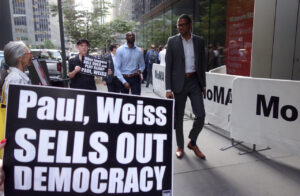
Man Who Heckled Paul Weiss Chair Turns Out To Be A Lawyer With A Warning For The Profession’s Future – Above the Law

Protesters
at
an
earlier
event
(Photo
credit:
Rise
and
Resist)


Ed.
note
:
Welcome
to
our
daily
feature,

Quote
of
the
Day
.


When
the
executive
branch
puts
their
fingers
on
the
scales
of
justice
and
says,
‘I’m
going
to
punish
you
for
your
viewpoint,’
everybody
in
the
bar
should
start
heckling
.


Raymond
J.
Dowd
,
a
partner
at
Dunnington
Bartholow
&
Miller,
in
comments
given
to

Bloomberg
Law
,
concerning
the
“entirely
spontaneous”
moment
when
he
started
heckling

Brad
Karp
,
chair
of
Paul
Weiss,
over

the
firm’s
pro
bono
deal
with
Trump
,
at
last
week’s
New
York
Bar
Foundation
gala.
After
the
event,
Karp
called
Dowd
to
discuss
what
happened.
“I
appreciated
him
sharing
his
views,”
Dowd
said.
“He
was
not
expressing
rage
or
anger.
I
just
think
he
felt
quite
blindsided,
and
I
said,
‘I
felt
exactly
the
same
way.’”
Dowd
went
on
to
say
that
it’s
his
“sincere
hope”
that
his
heckling
brings
about
change.
“I
think
having
a
larger
dialogue
on
these
issues
is
very
important
for
the
future
health
of
the
legal
profession,”
he
said.


Staci
Zaretsky
 is
the
managing
editor
of
Above
the
Law,
where
she’s
worked
since
2011.
She’d
love
to
hear
from
you,
so
please
feel
free
to

email

her
with
any
tips,
questions,
comments,
or
critiques.
You
can
follow
her
on BlueskyX/Twitter,
and Threads, or
connect
with
her
on LinkedIn.

Lawyers Marching In Defense Of Democracy Tomorrow Since Supreme Court Doesn’t Seem To Care – Above the Law

Last
week,
a
lawyer
attending
the
New
York
Bar
Foundation
gala
spoke
up
to
heckle
Paul
Weiss
chair
Brad
Karp

over
the
firm’s
deal
with
the
Trump
administration
.
Afterward,
a
prominent
authority
on
the
business
of
law
mused
to
me
that
we
don’t
level
enough
blame
on
the
rest
of
the
legal
industry
for
failing
to
organize
and
take
collective
action.
Paul
Weiss
and
the
other
capitulating
firms
found
themselves
in
a
classic
Prisoner’s
Dilemma
and
found
that
the
faster
they
made
a
deal,
the
better
the
terms.
But
the
best
outcome
for
the
hypothetical
prisoners
is

actually

to
stick
to
their
principles,
assuming
no
one
rats
them
out.
While
many
lawyers
called
out
the
administration’s
lawlessness,
there
wasn’t
the
unified
sense
of
purpose
across
the
industry

especially
across
Biglaw

that
a
firm
could
rely
upon.

But
a
number
of
legal
professionals
want
to
change
that,
and
start
making
a
public
demonstration
of
the
legal
community
coming
together
to
defend
the
rule
of
law

since
lawyers
should
consider
themselves
the
rightful
guardians
of
that
principle
anyway.

Tomorrow
offers
something
of
a
second
bite
at
the
apple
for
lawyers.

“Lawyers
March
for
Democracy”
kicks
off
tomorrow
at
1
p.m.
outside
the
Supreme
Court.

The
People’s
Parity
Project

organized
the
event,
backed
by
Alliance
for
Justice,
the
American
Constitution
Society,
Lambda
Legal,
and
a
coalition
of
other
progressive
legal
organizations
to
“call
out
the
Trump
administration’s
lawlessness
and
the
Supreme
Court’s
complicity
in
Trump’s
authoritarianism.”

Through
all
of
the
upheavals
of
the
early
months
of
Trump’s
second
term,
the
Supreme
Court
has
not
only
been
complicit
but
has
actively
participated
in
Trump’s
authoritarian
project,
siding
with
the
administration
over
and
over
again
and
allowing
him
to
continue
blatantly
unconstitutional
actions
without
any
public
legal
justification.

Why
start
at
the
Supreme
Court?
Remember
the
humble
ask
of
the

anonymous
federal
judges

who
asked
the
Supreme
Court
to

please
say
something
about
the
Trump
administration
telling
the
January
6
people
to
go
to
war
with
us?

At
least
try

they
asked
the
Court

to
explain
shadow
docket
opinions
so
the
administration
can’t
use
its
media
outlets
to
recast
those
empty
orders
as
indictments
of
lower
court
judges
just
following
existing
precedent.
Hearing
the
plea
and
understanding

the
gravity
of
the
violent
threats
mounting
against
federal
judges
,
the
Supreme
Court
said:
nah.

And
then
Republicans
called
for
a
probe

to
punish
the
judges
for
speaking
out
.

The
Supreme
Court
makes
a
lot
of
sense
as
a
starting
point.

The
New
Republic
ran
a

wonderful
piece

this
week
drawing
parallels
between
tomorrow’s
march
and
successful
lawyer-led
resistance
movements
around
the
world.
In
Pakistan
in
2007,
lawyers
marched

through
tear
gas
and
arrests

after
President
Musharraf
suspended
the
chief
justice.
They
wore
their
black
coats
as
symbols
that
the
law
itself
was
under
siege.
Eventually,
they
prevailed.

Lawyers
love
their
image
as
the
guardians
of
democracy.
Quoting

A
Man
For
All
Seasons

to
proclaim
themselves
the
last
defense
against
tyranny
is
practically
the
“Oh,
The
Places
You’ll
Go”
of
a
law
school
graduation.
But
when
tyranny
actually
knocks,
the
incentives
are
set
up
to
make
it
easier
to
invite
it
in
for
tea.
At
the
highest
levels,
law
firms
run
on
access
to
government
actors,
expensive
staff,
and…
well,
yeah,
also
big
personal
paychecks.
When
an
administration
launches
an
existential
threat
to
the
business
model

and
the
current
Supreme
Court
gives
few
guarantees
that
it
would
block
those
illegal
threats
if
called
upon

it’s
hard
to
convince
individual
firms
to
push
back
if
they
don’t
feel
like
the
rest
of
the
industry
has
their
back.

And
they
didn’t.
The
rest
of
Biglaw
failed
to
publicly
back
them
up
and
Karp
claims
rival
firms
actively
used
the
Executive
Order
threat
to
try
to
steal
talent
and
business
from
the
firm.
At
the
time
when
a
firm
needed
industry
support
the
most,
at
least
some
of
its
competitors
just
saw
a
chance
to
throw
them
under
the
bus.
That
those
same
firms
are
probably
now
using
the
fact
that
a
firm
DID
make
a
deal
to
try
to
steal
talent
and
business
may
involve
a
different
ethical
positioning,
but
the
underlying
problem
remains
that
the
industry
is
so
atomized
that
it
presents
a
custom-built
divide
and
conquer
opportunity.

Which
is
why
marches
like
the
one
tomorrow
are
so
important.
And
conferences
like
the
Rule
of
Law
Society
recently
held.
And
initiatives
defending
bar
associations
and
other
legal
groups
that
preach
profession
over
employer.
Lawyers
need
to
get
back
to
a
little
of
that
corny
law
school
idealism
and
get
together.


Lawyers
March
for
Democracy

[People’s
Parity
Project]


Earlier
:

Heckler
Asks
‘For
Trump?’
As
Paul
Weiss
Describes
Pro
Bono
Work
At
Gala
Dinner


In
A
Bold
Move,
Federal
Judges
Are
Calling
Out
The
Supreme
Court’s
Bullsh*t
District
Judges
Fight
To
Save
The
Rule
Of
Law
While
DOJ
And
Supreme
Court
Snicker


Rule
Of
Law
Conservatives
Awkwardly
Embrace
#Resistance


HeadshotJoe
Patrice
 is
a
senior
editor
at
Above
the
Law
and
co-host
of

Thinking
Like
A
Lawyer
.
Feel
free
to email
any
tips,
questions,
or
comments.
Follow
him
on Twitter or

Bluesky

if
you’re
interested
in
law,
politics,
and
a
healthy
dose
of
college
sports
news.
Joe
also
serves
as
a

Managing
Director
at
RPN
Executive
Search
.

BBC Tells Trump To Sod Off … Politely – Above the Law

Britain’s
national
broadcaster
will
not
be
cutting
a
check
to
America’s
president,

thankyouverymuch
.
Auntie
Beeb
has
closed
the
cupboard
and
will
not
be
doling
out
biscuits
to
the
naughty
tyke
in
chief.
After
reading
his
lawyer’s
bumptious
demand
letter
that
it
fork
over
English
taxpayer
dollars,
the
BBC
told
Trump
to
do
one.

The
kerfuffle
is
the
result
of
a
documentary
aired
more
than
a
year
ago
entitled
“Trump:
A
Second
Chance?”
in
which
footage
of
Trump’s
infamous
January
6
speech
was
edited
to
make
it
appear
that
he
told
his
supporters
to
walk
down
to
the
Capitol
and
fight.
Which
they
did!
But
in
fact
the
12-second
clip
was
a
pastiche
of
two
parts
of
the
speech
more
than
50
minutes
apart.

The
clip
was
surfaced
by
a
conservative
critic
of
the
BBC
as
part
of
a
memo
listing
several
culture
war
grievances,
including
bias
in
favor
of
trans
people
and
immigrants
and
against
Israel.
It
ignited
a
feeding
frenzy
of
right-wing
attack
dogs
which
has
already
claimed
the
scalps
of
the
BBC’s
two
top
officers.
It
also
summoned
the
American
president,
like
Beetlejuice
crossed
with
Paulie
Walnuts.

Trump’s
lawyer
lightly
edited
his
standard
presidential
shakedown
letter
and
fired
off
a

nastygram

(h/t
Politico)
to
BBC
Chair
Samir
Shah
demanding
that
he
“immediately
retract
the
false,
defamatory,
disparaging,
and
inflammatory
statements
made
about
President
Trump”
or
face
litigation
over
the
“overwhelming
financial
and
reputational
harm
that
the
BBC
has
caused
him
to
suffer.”

“If
the
BBC
does
not
comply
with
the
above
by
November
14,
2025,
at
5:00
p.m.
EST,
President
Trump
will
be
left
with
no
alternative
but
to
enforce
his
legal
and
equitable
rights,
all
of
which
are
expressly
reserved
and
are
not
waived,
including
by
filing
legal
action
for
no
less
than
$1,000,000,000
(One
Billion
Dollars)
in
damages,”
he
blustered.
“The
BBC
is
on
notice.
PLEASE
GOVERN
YOURSELF
ACCORDINGLY.”

How
Brito
calculated
the
damages
figure
for
a
broadcast
Trump
never
heard
about
until
a
week
ago
is
left
as
an
exercise
for
the
reader.

The
BBC

reports

that
Shah
sent
a
personal
apology
to
the
president
and
a
letter
to
Brito’s
declining
his
invitation
to
pay
tribute
to
America’s
King
George.
The
letter
laid
out
a
non-exhaustive
list
of
reasons
the
lawsuit
is
DOA,
even
if
the
president’s
home
state
of
Florida
has
a
two-year
statute
of
limitations
on
defamation:

First
it
says
the
BBC
did
not
have
the
rights
to,
and
did
not,
distribute
the
Panorama
episode
on
its
US
channels.

When
the
documentary
was
available
on
BBC
iPlayer,
it
was
restricted
to
viewers
in
the
UK.

Secondly,
it
says
the
documentary
did
not
cause
Trump
harm,
as
he
was
re-elected
shortly
after.

Thirdly,
it
says
the
clip
was
not
designed
to
mislead,
but
just
to
shorten
a
long
speech,
and
that
the
edit
was
not
done
with
malice.

Fourthly,
it
says
the
clip
was
never
meant
to
be
considered
in
isolation.
Rather,
it
was
12
seconds
within
an
hour-long
programme,
which
also
contained
lots
of
voices
in
support
of
Trump.

Finally,
an
opinion
on
a
matter
of
public
concern
and
political
speech
is
heavily
protected
under
defamation
laws
in
the
US.

But
other
than
that,
well
done,
you!


Liz
Dye
 lives
in
Baltimore
where
she
produces
the
Law
and
Chaos substack and podcast.

Everyone’s Law School Journey Is Unique – Above the Law

In
this
episode,
I
chat
with

Victoria
Inoyo
,
director
of
advising
at
Juris
Education.
Dive
into
the
world
of
law
school
applications
with
insights
on
choosing
the
right
path,
weighing
the
cost,
and
finding
a
career
that
fits
you.
Victoria
shares
personal
experiences,
highlighting
how
exposure
to
diverse
perspectives
can
enhance
your
law
school
journey.
A
must-listen
for
prospective
law
students!


Episode
Highlights

  • Curiosity’s
    Role
    in
    Choosing
    Law.
  • Importance
    of
    Talking
    to
    Lawyers
    Pre-Law
    School.
  • Rising
    Law
    School
    Costs
    and
    Job
    Decisions.
  • Law
    School
    Rankings
    vs.
    Personal
    Goals.
  • Location’s
    Impact
    on
    Law
    Career.
  • Dispelling
    Misconceptions:
    GPA
    &
    Test
    Scores.
  • Beyond
    Law:
    Alternative
    Careers
    with
    a
    JD.
  • Importance
    of
    Exposure
    to
    Diverse
    Perspectives.
  • Encouraging
    Exploration
    of
    Law
    Paths.


Kathryn
Rubino
is
a
Senior
Editor
at
Above
the
Law,
host
of

The
Jabot
podcast
,
and
co-host
of

Thinking
Like
A
Lawyer
.
AtL
tipsters
are
the
best,
so
please
connect
with
her.
Feel
free
to
email

her

with
any
tips,
questions,
or
comments
and
follow
her
on
Twitter

@Kathryn1
 or
Mastodon

@[email protected].