The
new
notes
will
circulate
alongside
the
existing
series
introduced
in
April
2024.
Speaking
during
the
2026
Monetary
Policy
Statement
on
27
February,
RBZ
Governor
John
Mushayavanhu
said
the
notes
are
not
a
new
currency,
but
an
upgrade
with
improved
design
and
enhanced
security
features.
He
said:
“These
banknotes
will
co-circulate
with
the
existing
notes
in
the
system.
We
currently
have
ZiG
10
and
ZiG
20
in
circulation.
The
new
series
will
circulate
side
by
side
with
the
old
notes.”
Mushayavanhu
said
banks
must
continue
accepting
the
old
notes,
which
will
be
gradually
withdrawn
and
destroyed
as
they
are
returned
to
the
banking
system.
He
said:
“When
you
are
in
a
shop,
and
someone
brings
a
new
note,
it
is
acceptable.
If
someone
brings
the
old
one,
it
is
also
acceptable.
“However,
when
the
old
notes
return
to
the
banking
system,
banks
are
expected
to
surrender
them
to
the
central
bank
for
destruction
and
replacement
with
new
notes.”
The
central
bank
chief
said
the
smaller
denominations
—
ZiG
10,
ZiG
20,
and
ZiG
50
—
will
be
released
on
7
April,
while
the
higher
denominations,
ZiG
100
and
ZiG
200,
will
be
introduced
at
a
later
date.
The
RBZ
also
announced
that
it
will
carry
out
an
extensive
public
awareness
campaign
ahead
of
the
rollout
to
familiarise
citizens
with
the
new
security
features.
In
his
2026
monetary
policy
statement
delivered
on
27
February,
RBZ
Governor
John
Mushayavanhu
instructed
banks
and
all
deposit-taking
microfinance
institutions
(DTMFIs)
to
implement
the
new
fee
structures
by
31
March
2026.
Under
the
new
rules,
cash
withdrawal
charges
at
both
banking
halls
and
ATMs
must
be
capped
at
a
maximum
of
2
per
cent
of
the
withdrawn
amount
for
both
US
dollars
and
Zimbabwe
Gold
(ZiG).
POS
charges
are
to
be
limited
to
1.5
per
cent
of
the
transaction
value
for
both
local
and
international
cards,
with
a
maximum
cap
of
US$20
or
the
ZiG
equivalent.
From
1
April
2026,
no
minimum
charge
may
be
applied
to
any
POS
transaction,
and
institutions
are
explicitly
prohibited
from
imposing
such
fees.
The
central
bank
also
ordered
the
removal
of
account
balance
inquiry
charges
across
all
banking
and
mobile
banking
platforms
for
both
ZiG
and
USD.
Additionally,
fees
on
cash
deposits
for
both
currencies
are
to
be
scrapped,
and
charges
for
issuing
new
or
replacement
bank
cards
must
not
exceed
the
cost
of
providing
the
service.
Would
Above
the
Law
really
publish
a
story
about
a
law
school
dean’s
bio
being
replaced
with
dungeon
porn?
Yeah…
that
tracks.
If
you’ve
spent
any
time
in
the
legal
academy
—
or
even
just
read
our
coverage
of
it
—
you
understand
that
the
annual
U.S.
News
rankings
transformed
law
school
administration
into
a
blood
sport.
The
apotheosis
of
the
joke
that
every
academic
fight
is
so
existentially
fierce
because
the
stakes
are
so
cosmically
meaningless.
The
gap
between
T14
and
the
TTT
matters,
but
schools
mortgaging
integrity
to
move
from
50th
to
45th
makes
makes
college
football
coaches
look
at
deans
and
say,
“the
important
thing
is
that
everyone
has
fun!”
Michael
Orey’s
new
novel,
Dean’s
List,
takes
a
flamethrower
to
that
whole
ecosystem
with
a
glee
that
only
someone
who’s
spent
real
time
inside
the
machine
could
muster.
Orey,
an
adjunct
professor
at
NYU
School
of
Law
and
the
school’s
head
of
public
affairs
since
2010,
has
navigated
egos
and
institutional
PR
for
almost
two
decades.
Before
that,
Orey
worked
as
a
legal
affairs
reporter
and
editor
at
American
Lawyer,
the
Wall
Street
Journal,
and
BusinessWeek.
Dean’s
List
marks
a
foray
into
fiction
after
previously
releasing
Assuming
the
Risk,
a
nonfiction
account
of
tobacco
litigation.
Dean’s
List
follows
Charles
Ogden
Dean
III
—
unfortunately
nicknamed
“Dean
Dean”
—
taking
the
helm
of
a
once-floundering
law
school
newly
rebranded
under
the
prestigious
Brown
University
banner.
Think
Cooley’s
association
with
Western
Michigan,
but
with
Ivy
League
stakes.
Brown
doesn’t
have
a
law
school
—
even
if
the
real-life
Department
of
Defense
doesn’t
realize
it
—
but
the
idea
that
an
Ivy
would
leap
into
the
law
school
business
by
purchasing
an
existing
school
has
been
speculated
before.
Decades
ago,
rumors
swirled
that
Princeton
would
start
a
turnkey
law
school
by
acquiring
NYU
School
of
Law.
That
never
came
to
pass,
but
Orey
envisions
Brown
pulling
off
what
Princeton
couldn’t
by
acquiring
Providence
Law
School
and
pumping
resources
into
a
mad
pursuit
of
Top
5
status.
Along
the
way
are
moral
compromises,
institutional
absurdities,
and
outright
chaos.
A
rogue
nation
bankrolls
a
secret
slush
fund
and
pirates
get
involved,
which
sounds
comically
ridiculous
until
you
remember
Yale
exists.
But
the
heavy
satire
balances
with
authenticity.
The
faculty
grievances,
the
donor
politics,
the
watching
rankings
become
the
golden
calf
that
administrators
worship
all
rings
true
because
Orey
has
been
watching
the
circus
from
inside
the
tent.
It’s
the
kind
of
insider
satire
where
you
laugh
and
then
wince
because
you’ve
seen
some
version
of
every
scene
play
out
in
real
life.
And,
yes,
Above
the
Law
gets
multiple
shout-outs
in
the
book.
Orey
graciously
provided
us
an
excerpt
as
a
preview
for
our
readers.
Complete
with
an
Above
the
Law
mention:
Dean’s
List
is
available
for
pre-order
now.
If
you’ve
ever
worked
in
legal
academia,
survived
a
U.S.
News
ranking
cycle,
or
just
want
to
understand
why
your
dean
looks
like
that,
check
it
out.
And
if
you’re
a
future
military
lawyer,
you’re
apparently
not
allowed
to
attend
the
school
described
in
its
pages
anyway,
so
at
least
you’ll
have
time
to
read
the
book.
Emily
shares
her
unexpected
path
into
law,
her
deep
commitment
to
criminal
defense,
and
the
emotional
realities
of
representing
clients
navigating
one
of
the
most
consequential
systems
in
American
society.
Drawing
from
years
in
public
defense
and
her
work
co-founding
Partners
for
Justice,
she
explains
why
the
criminal
legal
system
often
punishes
instability
rather
than
crime
—
and
how
policy
choices,
not
individual
morality,
frequently
determine
who
enters
the
system.
The
conversation
explores
burnout
among
defenders,
systemic
misconceptions
about
criminal
courts,
the
role
of
compassion
in
policy
reform,
and
the
economic
and
social
costs
of
incarceration.
Ultimately,
the
episode
reframes
justice
not
as
punishment,
but
as
a
question
of
public
safety,
community
stability,
and
human
dignity.
For
millions
of
people,
Mardi
Gras
is
their
last
hurrah
before
they
get
all
pious
on
Ash
Wednesday.
So
they
let
loose!
Alcohol,
calorie-rich
foods,
and
all
sorts
of
levity
make
up
for
obligatorily
giving
up
McDonald’s
or
whatever
for
the
next
40
days.
But
sometimes
people
let
a
little
too
much
loose
in
the
celebration.
One
of
those
people
was
Shia
Lebeouf.
WDSU
has
coverage:
According
to
the
New
Orleans
Police
Department,
LaBeouf
was
arrested
just
after
midnight
on
Mardi
Gras
morning.
Investigators
say
he
was
reportedly
causing
a
disturbance
and
becoming
increasingly
aggressive
at
a
Royal
Street
business.
A
staff
member
attempted
to
remove
LaBeouf
from
the
business.
Once
removed
from
the
building,
the
NOPD
says
the
victim
told
police
LaBeouf
punched
him
several
times.
Detectives
say
LaBeouf
then
reportedly
assaulted
another
person,
punching
him
in
the
nose.
AP
News
additionally
reported
that
LeBeouf
was
heard
yelling
homophobic
slurs.
Jeffrey
Klein,
a
man
who
claims
he
was
attacked
by
LeBeouf
during
the
brawl,
was
wearing
makeup
at
the
time.
While
he
was
charged
with
two
counts
of
simple
battery,
there
was
no
mention
of
being
charged
with
a
hate
crime.
This
isn’t
the
first
time
that
LeBeouf
has
been
charged
along
the
lines
of
being
drunk
in
public.
He
joked
about
it
ages
ago
on
Jimmy
Kimmel,
but
getting
arrested
for
the
same
shit
you
were
doing
over
a
decade
ago
is
no
laughing
matter.
Judge
Simone
Levine
ordered
him
to
go
to
rehabilitation.
As
challenging
as
rehab
can
be,
all
LeBeouf
has
to
do
is
channel
the
motivation
mascot
deep
inside:
Chris
Williams
became
a
social
media
manager
and
assistant
editor
for
Above
the
Law
in
June
2021.
Prior
to
joining
the
staff,
he
moonlighted
as
a
minor
Memelord™
in
the
Facebook
group Law
School
Memes
for
Edgy
T14s
.
He
endured
Missouri
long
enough
to
graduate
from
Washington
University
in
St.
Louis
School
of
Law.
He
is
a
former
boatbuilder
who
is
learning
to
swim, is
interested
in
critical
race
theory,
philosophy,
and
humor,
and
has
a
love
for
cycling
that
occasionally
annoys
his
peers.
You
can
reach
him
by
email
at [email protected]
and
by
tweet
at @WritesForRent.
It’s
an
understatement
to
call
this
time
exciting.
But
it
can
also
be
bewildering.
With
new
AI
offerings
popping
up
every
week,
how
can
government
professionals
decide
which
ones
are
worth
their
time?
Our
friends
at
Filevine
created
this
guide
to
answer
these
questions.
It
contains
the
context
you
need
to
evaluate
new
AI
tools,
pinpoint
which
ones
actually
meet
your
needs,
ensure
you
safeguard
government
data,
and
leverage
the
technology
to
the
greatest
effect.
Download
it
to
explore:
What
AI
can
do
for
government
agencies:
Finding
the
right
AI
tools
The
roadmap
for
AI
adoption
Being
ready
for
the
future
Built
into
Filevine,
LOIS
is
the
Legal
Operating
Intelligence
System
that
embeds
intelligence
into
the
DNA
of
your
legal
work.
OpenAI
is
quietly
waging
its
own
brand
of
legal
ethics
enforcement
—
and
the
target
isn’t
lawyers
or
law
firms,
it’s
ChatGPT
accounts
masquerading
as
them.
According
to
reporting
by Legal
Cheek,
OpenAI
has
banned
a
cluster
of
ChatGPT
accounts
tied
to
bogus
law
firms
and
fake
“lawyers”
running
scam-recovery
schemes,
aka
Operation
False
Witness.
The
playbook
is
familiar:
polished
websites,
convincing
attorney
bios,
legal-sounding
emails,
promises
to
recover
stolen
funds
—
and
then
requests
for
upfront
fees,
often
in
crypto.
The
twist?
AI
helped
generate
the
professional
gloss,
from
firm
profiles
to
client
communications,
making
the
operations
look
far
more
legitimate
than
your
average
internet
scam.
Here
are
some
additional
details:
OpenAI
says
the
network
promoted
at
least
six
supposed
law
firms.
In
some
instances,
it
claims
the
fraudsters
went
further,
impersonating
real
lawyers
and
even
law
enforcement
bodies.
Accounts
were
used
to
translate
messages,
rewrite
communications
into
“American
English”,
produce
text
“in
the
style
of
a
lawyer”
and
even
generate
fake
supporting
documents.
The
tech
giant
says
it
will
continue
to
disrupt
malicious
uses
of
its
models
and
ban
accounts
linked
to
scams
and
impersonation.
OpenAI
removing
the
accounts
is
great,
but
the
larger
issue
for
the
legal
industry
is
obvious:
when
AI
can
effortlessly
produce
credible-sounding
legal
content,
the
barrier
to
running
a
fake
firm
drops
dramatically.
Innovation
is
great.
Fake
lawyers
powered
by
machine
learning?
Less
so.
Staci
Zaretsky is
the
managing
editor
of
Above
the
Law,
where
she’s
worked
since
2011.
She’d
love
to
hear
from
you,
so
please
feel
free
to email her
with
any
tips,
questions,
comments,
or
critiques.
You
can
follow
her
on Bluesky, X/Twitter,
and Threads, or
connect
with
her
on LinkedIn.
Ed.
Note:
A
weekly
roundup
of
just
a
few
items
from
Howard
Bashman’s
How
Appealing
blog,
the
Web’s
first
blog
devoted
to
appellate
litigation.
Check
out
these
stories
and
more
at
How
Appealing.
“Judge
Vows
to
End
Trump
Administration’s
Noncompliance
‘One
Way
or
Another’;
The
federal
judge
identified
210
orders
issued
in
143
cases
in
Minnesota
in
which
he
said
Immigration
and
Customs
Enforcement
officials
had
not
complied
with
court
orders”: Mitch
Smith,
Ernesto
Londoño,
and
Mattathias
Schwartz
of
The
New
York
Times
have this
report.
“Bonus
212:
The
Supreme
Court
is
Not
‘Reining
in’
Executive
Power;
The
Court’s
defenders
claim
the
tariffs
ruling
is
part
of
a
trend
in
which
the
justices
are
reining
in
President
Trump
and
(re-)empowering
Congress;
The
full
dataset
is
overwhelmingly
to
the
contrary.” Steve
Vladeck
has this
post at
his
“One
First”
Substack
site.
“Trump’s
next
tariff
fight:
Keeping
the
money;
After
Trump’s
Supreme
Court
tariff
defeat,
administration
officials
are
devising
legal
strategies
that
would
let
the
president
keep
some
—
or
maybe
even
most
—
of
the
revenue,
five
people
familiar
with
the
conversations
told
POLITICO.” Megan
Messerly
and
Daniel
“Testimony
Offers
New
Details
on
Justice
Dept.
Role
in
Abrego
Garcia
Prosecution”: Alan
Feuer
of
The
New
York
Times
has this
report.
“You
Guys
Look
Miserable:
The
Supreme
Court’s
silliest
tradition
is
sending
a
handful
of
justices
to
sit
through
a
two-hour
State
of
the
Union
without
changing
their
facial
expressions.” Jay
Willis
has this
essay online
at
Balls
and
Strikes.
I’ll
take
my
joy
where
I
can.
And
this
iteration
of
the
Trump
DOJ
continues
to
provide
bright
bursts
of
schadenfreude-tinted
sunshine.
Any
competent
DOJ
can
close
cases.
Any barely competent
prosecutor
can
push
a
case
past
a
grand
jury.
Any
sufficiently
slippery
solicitor
(mixing
in
some
British
for
the
sheer
alliteration
of
it
all)
can
convince
a
judge
that
the
lies
told
by
officers
were
merely
good
faith
blunders
not
worthy
of
anything
more
than
a
judicial
“no
one’s
perfect”
shrug.
This DOJ fails
at every
single
level.
It
can’t secure
indictments.
It
can’t
convince
grand
juries
that
vindictive
prosecutions
are legitimate prosecutions.
And
its
prosecutors
are
constantly
undermined
by
(1)
prejudicial,
fact-free
social
media
posts
and
public
statements
by
administration
officials,
(2)
the illegal
actions of
federal
officers,
(3)
their
own
ineptitude,
(4)
the
lies told
by
federal
officers,
and
(5)
any
or
all
of
the
above.
High-level
prosecutors
keep
getting
sidelined
because
they’ve
been illegally
appointed.
Other
prosecutors
have
refused
to
engage
with
the
administration’s
vindictive
plans,
resulting
in
most
of
them
retiring
or
being
fired.
Consequently,
there’s
a
shortage
of
qualified,
experienced
prosecutors.
The
void
is
being
constantly
refilled
by
some
of
the
emptiest
people
ever
to
leverage
MAGA
loyalty
into
federal
employment.
It
took
less
than
a
year
for
the
Trump
DOJ
to
almost
completely
destroy
the
“presumption
of
regularity”
—
the
legal
concept
that
the
government
is
acting
in
good
faith,
even
if
its
legal
arguments
aren’t
the
best.
It
took
less
than
a
year
for
the
Trump
DOJ
to turn
grand
juries into
coin
flips.
In
2016,
the
most
recent
year
for
which the
Justice
Department
has
published
data,
federal
prosecutors
concluded
more
than
155,000
prosecutions
and
declined
over
25,000
cases
presented
by
investigators. In
only
six
instances
was
a
grand
jury’s
refusal
to
indict
listed
as
the
reason
for
dropping
the
matter.
Six
times
in
a
one
year
over
25,000
declined
cases.
Trump’s
loyalist
US
Attorney
pick,
Lindsey
Halligan,
put
her
insurance
law
background
to
work
and…
managed
to
do
this
twice
during
a single (attempted)
prosecution.
When
prosecutors
aren’t
shooting
themselves
in
the
foot
(or
being
shot
in
the
foot
by
their
employer),
they’re
losing
cases
because
the
people
they
expect
to
back
up
their
cases
—
the
federal
officers
claiming
to
have
been
assaulted,
etc.
—
can’t
even
back
up
their
own
narratives
when
testifying
in
court.
The
most
recent
significant
fumble
came
from
Minneapolis
prosecutors,
who
last
week dismissed
felony
assault
charges they
had
filed
against
two
Venezuelan
men accused of
“violently
beating”
an
Immigration
and
Customs
Enforcement
(ICE)
officer
“with
weapons”
on
14
January.
According
to
the
early
government
narrative,
federal
officers
were
assaulted
by
“violent
criminal
illegal
aliens”
during
a
stop
of
an
undocumented
Venezuelan.
The
officers
claimed
two
other
men
came
out
of
a
nearby
apartment
and
attacked
an
officer
with
a
“snow
shovel
and
broom
handle.”
That
case
is
now
dead
because…
well,
the
testifying
officers
lied.
[O]n
12
February,
prosecutors
filed
a
motion
to
dismiss
both
men’s
cases,
saying:
“Newly
discovered
evidence
in
this
matter
is
materially
inconsistent
with
the
allegations
in
the
complaint
affidavit.”
[…]
ICE
director
Todd
Lyons
said
ICE
and
the
DoJ
had opened
an
investigation into
the
case
after
videos
revealed
“sworn
testimony
provided
by
two
separate
officers
appears
to
have
made
untruthful
statements”,
marking
a
rare
acknowledgement
of
possible
wrongdoing
by
DHS
officials.
It’s
extremely
rare
for
the
government
to
dismiss
its own prosecution
with
prejudice,
meaning
it
can’t ever seek
to
refile
these
criminal
charges
against
the
alleged
perpetrators.
And
I
don’t
know
if
Todd
Lyons
just
misspoke
or
if
he
actually
tried
to
use
the
exonerative
tense
while
simultaneously
stating
these
officers
lied.
“Sworn
testimony…
appears
to
have
made
untruthful
statements”
sounds
like
the
courtroom
version
of
a
government
official
discussing
a
shooting
by
an
officer
with
the
phrase
“the
officer’s
weapon
discharged,”
suggesting
no
one
actually
pulled
the
trigger.
Whatever
the
case,
there’s
definitely
a
trend
here.
In
Chicago,
of
92
people
arrested
for
assaulting
or
impeding
officers
last
fall,
74
cases
have
resulted
in
no
charges;
in
13
cases,
charges
were
filed
and
dismissed;
and
five
charged
cases
were
still
pending,
a recent
investigation by
Fox
9,
a
Minneapolis-based
station,
showed.
As
of
the
end
of
January,
there
have
been
no
convictions.
In
LA,
the
federal
public
defenders
have
won
all
six
cases
filed
against
ICE
protesters
that
have
gone
to
trial
since
June,
the LA
Times
recently
reported.
Fewer
than
1%
of
federal
criminal
defendants
were
acquitted
across
the
US
in
fiscal
year
2024,
with
US
prosecutors
traditionally
having
a
roughly
90%
conviction
rate,
the
paper
noted.
I
assume
the
DOJ
bloodshed
will
continue.
Trump
hates
losing
and
he
hates
people
who
lose
in
his
name
even
more.
But
replacing
talent
with
loyalists
isn’t
going
to
end
this
losing
streak.
If
nothing
else,
this
iteration
of
the
DOJ
has
the
chance
to
go
down
in
history
as
one
of
the
worst
ever
assembled,
even
if
we
consider
nothing
else
but
its
win-loss
record.
It
doesn’t
mean
the
DOJ
is
harmless,
however.
It’s
still
more
than
willing
to
engage
in
vindictive
prosecutions,
ignore
court
orders,
and
take
bite
after
bite
of
the
apple
(so
to
speak)
until
it
finally
manages
to
at
least
pierce
the
skin.
And
that
means
a
lot
of
people
are
going
to
have
their
lives
upended,
even
if
only
temporarily,
just
to
please
a
tyrant
who
thinks
anything
or
anyone
presenting
even
the
most
minimal
of
opposition
should
be
subjected
to
punishment.
Editor’s
note:
A
companion
webinar
featuring
these
speakers
is
available
on-demand,
with
CLE
credit
available.
Use
the
form
at
the
bottom
of
this
article
to
access
the
presentation.
This
is
the
first
in
a
three-part
series.
Although
the
deals
market
has
shown
a
modest
rebound
in
early
2025,
a
recent
report
by
Deloitte
notes
that
today’s
dealmakers
must
“navigate
perpetual
uncertainty.”
This
uncertainty
is
driven
by
numerous
factors:
economic
changes,
evolving
risk
management,
and
emerging
technologies,
for
example.
As
a
result,
Deloitte
says,
“pivoting
has
emerged
as
a
core
competency”
for
dealmakers.
The
same
goes
for
law
departments
involved
with
a
corporate
transaction
—
or
even
the
possibility
of
a
future
transaction.
“‘Logistics’
is
an
important
word
here,
because
the
whole
M&A
process
is
also
a
process
of
logistics,”
says
Kariem
Abdellatif,
the
head
of
Mercator
by
Citco
(Mercator),
a
specialist
entity
management
provider
that
helps
organizations
manage
their
global
entity
portfolios,
including
during
complex
M&A
transactions.
Having
the
right
partner
in
place
to
oversee
a
transaction’s
numerous
and
intricate
details
will
allow
the
lawyers
to
focus
on
high-level
work
like
pricing
and
negotiation,
he
notes.
This,
in
turn,
enables
the
flexibility
that
today’s
dealmakers
must
cultivate.
In
this
series
presented
by
our
friends
at
Mercator,
we’ll
be
providing
a
step-by-step
guide
for
general
counsel
navigating
a
merger
or
other
corporate
transaction.
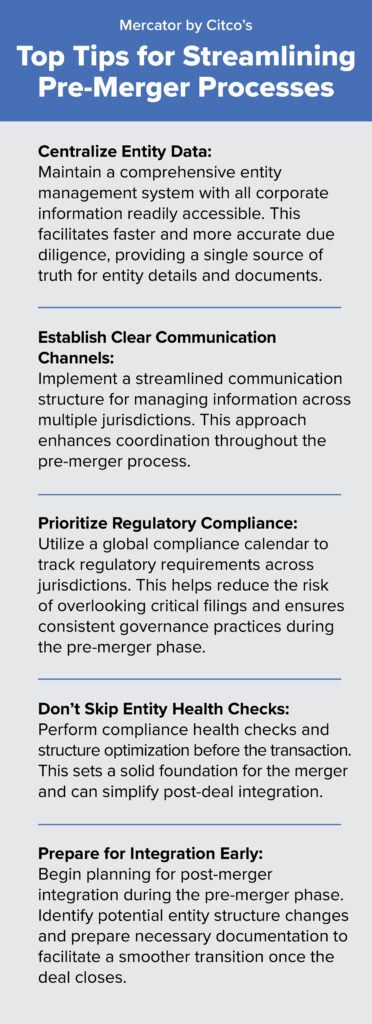
To
start,
we’re
exploring
best
practices
for
corporate
law
departments
in
the
pre-merger
phase.
Stay
tuned
for
our
upcoming
articles
detailing
how
GCs
can
help
negotiate
and
close
a
deal,
as
well
as
how
the
law
department
can
help
integrate
organizations
post-merger.
A
first
step
for
any
legal
department
involved
in
a
corporate
transaction
is
to
understand
the
portfolio
of
companies
involved.
The
only
way
to
do
this
is
by
gathering
trustworthy
data.
“When
it
comes
to
data,
there
are
several
critical
questions
that
need
answering,”
Abdellatif
says.
“What
information
do
we
need?
Where
is
it
stored?
Who
maintains
it?
How
can
we
verify
its
accuracy?
Is
it
up
to
date?
Getting
clear
answers
to
these
questions
early
on
is
essential
for
making
informed
decisions
and
planning
effective
integration.”
A
platform
like
Mercator’s
Entica
can
take
this
a
step
further
by
applying
that
data
to
create
detailed
and
interactive
corporate
org
charts.
The
platform
can
also
generate
hypothetical
charts
to
model
potential
acquisitions.
These
charts
map
out
the
“family
tree”
of
an
organization
—
showing
which
entity
sits
on
top,
what
happens
if
entities’
locations
are
moved,
what
it
would
mean
if
an
entity
were
liquidated.
“Our
technology
enables
legal
teams
to
visualize
the
entire
org
chart,”
Abdellatif
says.
“From
there
they
can
toy
around
with
it
to
see
how
changes
might
affect
the
overall
corporate
structure.
This
is
particularly
valuable
during
M&A
discussions,
where
understanding
complex
entity
relationship
is
key.”
Determine
Your
Lane
While
gathering
corporate
data
is
critical,
knowledge
of
a
potential
deal
must
typically
be
kept
confidential
outside
of
a
few
key
stakeholders.
When
the
GC
is
brought
under
the
umbrella,
their
first
step
is
to
determine
their
role.
Will
the
GC
be
engaging
outside
counsel?
Will
they
be
managing
these
lawyers?
Will
the
GC
be
the
primary
point
of
contact
for
the
transaction?
The
scope
of
these
potential
roles
varies
widely,
notes
Josh
Hollingsworth,
an
M&A
partner
with
Barnes
&
Thornburg
LLP.
The
GC
of
a
company
being
acquired,
for
example,
might
be
limited
to
assisting
the
buyer
in
conducting
due
diligence.
In
other
circumstances,
the
GC
might
be
expected
to
lead
the
entire
deal.
“Navigating
where
they
fit
in
and
asking
affirmative
questions
so
that
there
aren’t
any
assumptions
—
it’s
important
for
a
GC
to
just
figure
out
what
their
role
is
in
some
cases,”
Hollingsworth
says.
Master
Organizational
Psychology
When
a
GC
is
involved
in
advancing
a
transaction,
they
must
draw
on
their
soft
skills
as
much
as
their
legal
training
in
the
pre-merger
phase.
Thinking
strategically
about
the
organization
and
the
stakeholders
involved
is
a
key
to
success.
“I
don’t
think
there’s
a
specific
playbook
for
each
circumstance,”
Hollingsworth
says.
“I
think
it’s
just
a
matter
of
being
aware
of
everyone
who’s
involved
and
making
sure
that
you
understand
the
universe
of
how
this
transaction’s
going
to
affect
everybody.”
An
initial
step
is
to
determine
who
will
be
brought
into
the
deal,
and
who
will
not
be
informed.
This
requires
thinking
through
who
in
the
organization
will
be
important
—
the
IT,
HR,
and
risk
management
teams,
for
example.
“If
nobody
in
HR
knows,
it’s
going
to
be
hard
to
get
through
employee
and
benefits
diligence,”
Hollingsworth
says.
“If
nobody
in
IT
knows
about
a
transaction,
and
an
IT
issue
comes
up,
similarly,
that
will
be
challenging.”
Abdellatif
notes
that
technology
like
Mercator’s
Entica
system
can
play
a
role
in
ensuring
the
knowledge
of
the
deal
sits
only
with
the
stakeholders
who
are
looped
in.
“What
we
want
to
make
certain
is
that
data
access
is
available
to
those
who
need
it,
but
not
beyond
that,”
Abdellatif
says.
“That
data
is
only
accessible
to
those
who
actually
require
it,
and
you
don’t
have
people
rummaging
through
information
they
shouldn’t.”
Understand
Your
Team
It’s
also
important
to
gauge
the
likely
motivations
of
each
stakeholder
with
a
role
in
the
transaction.
Hollingsworth
notes
that
anyone
informed
of
a
potential
deal
will
first
ask
themself
a
simple
question.
“Literally,
‘What
does
this
mean
for
me?’
is
going
to
be
the
first
question
that
everybody
who’s
brought
under
the
tent
is
going
to
think
about,
and
that’s
just
human
nature,”
Hollingsworth
says.
“So
just
being
prepared
to
work
through
those
dynamics
is
important
for
a
GC.”
If
a
company
is
being
acquired,
for
example,
that
could
be
seen
as
a
threat
to
many
stakeholders,
who
may
work
to
undermine
the
deal.
It’s
true
of
acquiror
companies
as
well,
Hollingsworth
notes.
Some
may
see
someone
in
the
acquired
organization
as
a
threat
to
their
position.
Some
may
simply
think
it’s
too
much
work
to
go
through
with
the
deal.
Will
a
stakeholder
be
gaining
or
losing
in
job
title
and
status?
Are
there
financial
incentives,
like
parachute
payments
to
a
departing
CEO,
involved?
“I
think
a
lot
of
people
take
it
for
granted
that
if
the
CEO
or
the
board
says,
‘We’re
gonna
do
something,’
that
we’re
gonna
do
it,”
Hollingsworth
says.
“What
ends
up
happening
in
any
group
dynamic
is
there
are
various
levels
of
resistance.”
For
a
company
potentially
being
acquired,
maintaining
impeccable
data
and
compliance
can
help
thwart
resistance
to
a
deal.
These
practices
can
even
provide
bargaining
leverage,
according
to
Abdellatif.
“Having
this
level
of
organization
builds
confidence
with
potential
acquirers
and
can
positively
influence
their
approach
to
the
transaction”
he
says.
If
a
company
doesn’t
seem
to
have
well-maintained
regulatory
compliance,
by
contrast,
an
acquiring
company
will
likely
become
more
critical.
Technology
can
also
help.
Mercator’s
Entica,
for
example,
features
a
corporate
compliance
calendar
that
tracks
all
requirements
a
year
in
advance
and
ensures
a
company
maintains
proper
structures
around
compliance.
Abdellatif
has
seen
acquired
companies
impressing
acquirors
with
the
thoroughness
of
their
regulatory
compliance,
and
the
acquiring
companies
in
turn
seeking
to
adopt
their
systems.
This
thoroughness
can
also
help
stave
off
any
internal
resistance
to
a
deal.
“The
best
defense
is
making
sure
that
you
have
your
ducks
in
a
row,
that
your
information
and
data
is
properly
set
up,
and
that
you
can
demonstrate
just
how
effectively
you
run
your
department,”
he
says.
Don’t
Forget
About
Your
JD
In
addition
to
organizational
management,
of
course,
a
GC
must
also
consider
legal
risks
at
this
stage.
One
top
risk
in
a
pre-merger
environment
is
confidentiality.
For
publicly
traded
companies,
insider
trading
laws
will
kick
in,
and
for
nonpublicly
traded
companies,
there
can
be
issues
with
employees
or
vendors
knowing
of
the
deal
at
the
early
stages.
A
GC
must
ensure
there
are
robust
nondisclosure
agreements
—
and
serious
consideration
around
which
internal
and
external
stakeholders
are
informed
to
begin
with.
“Confidentiality
will
be
at
the
very
top
of
your
legal
risk
in
the
pre-transaction
phase,”
Hollingsworth
says.
“Similarly,
antitrust
considerations
go
hand-in-hand.”
Corporate
transactions
will
often
take
place
between
competing
companies,
which
must
make
a
pre-merger
filing
with
the
Federal
Trade
Commission
under
the
Hart-Scott-Rodino
Act.
If
there
are
foreign
operations,
a
variety
of
other
regulations
apply
as
well.
Competing
companies
that
are
exploring
a
merger
must
also
be
careful
about
the
level
of
cooperation
during
this
stage
because
of
antitrust
concerns
known
as
“gun-jumping.”
“The
expectation
is
that
you’re
going
to
operate
the
business
independently
all
the
way
up
through
closing,”
Hollingsworth
says.
Leverage
Your
Tech
As
with
all
things
in
the
corporate
world,
AI-enabled
technology
is
playing
an
increasing
role
in
mergers
and
acquisitions.
In
the
pre-merger
phase,
generative
AI
will
come
into
play
for
in-house
lawyers
—
particularly
when
drafting
pre-merger
documents
like
nondisclosure
agreements.
New
technology
can
also
immediately
inform
counsel
of
“what’s
market,”
giving
negotiators
detailed
knowledge
of
precedent
regarding
every
aspect
of
a
transaction.
The
Entica
platform
combines
workflows
with
data
management,
ensuring
actions
as
varied
as
filing
financial
statements,
appointing
directors
and
auditors,
and
executing
documents
are
all
tracked
and
accounted
for.
It
allows
quick
access
to
this
data
throughout
a
company’s
full
portfolio,
and
segments
it
to
ensure
it’s
only
accessible
to
stakeholders
who
require
it.
“When
you
come
back
to
logistics,
it
really
serves
as
the
backbone
in
many
ways,”
Abdellatif
says.
Seasoned
practitioners
like
Hollingsworth
remember
the
due
diligence
process
of
decades
ago,
where
there
was
a
physical
data
room
that
contained
banker
boxes
full
of
documents
related
to
the
transaction.
These,
of
course,
have
been
replaced
by
online
data
rooms
that
can
be
accessed
24/7.
Similarly
to
due
diligence,
closings
and
negotiations
have
moved
from
in-person
to
virtual.
For
negotiators,
though,
this
convenience
may
create
a
new
pitfall
to
avoid.
If
you’ve
flown
across
the
country
for
an
in-person
meeting,
the
expectation
is
that
items
will
be
resolved
in
that
meeting,
Hollingsworth
notes.
“Allowing
virtual
negotiations
leads
to
more
iterations
of
the
document,”
he
says,
“and
it
may
actually
lead
to
the
negotiations
taking
longer.”
Stay
tuned
for
the
next
article
in
this
series,
where
we’ll
be
exploring
steps
to
consider
during
the
negotiation
and
closing
of
a
transaction.