Police block Bulawayo meeting as Harare venue torched

The
Bulawayo
gathering,
titled “Constitutional
Crossroads:
Citizens
Respond
to
Zimbabwe’s
Constitutional
Crisis”
 was
shut
down
when
police
officers,
Zanu
PF
supporters
and
hired
bouncers
stationed
themselves
at
the
entrance
of
the
Bulawayo
Club,
preventing
journalists
and
invited
guests
from
entering.
Police
vehicles
were
also
seen
parked
outside
the
venue.

The
meeting
had
been
expected
to
feature
prominent
political
and
civic
figures,
among
them
ZAPU
leader
Sibangilizwe
Nkomo,
war
veterans’
representative
Ethan
Mathibela,
opposition
politicians
Prince
Dubeko
Sibanda
and
Lovemore
Moyo,
Mfulongatshi
Mpofu
of
the
Mthwakazi
Republic
Party,
Patrick
Tayiya
of
the
Democratic
Official
Party,
and
activists
Mbuso
Fuzwayo,
Thando
Gwinji,
Samkeliso
Tshuma,
Benon
Ncube
and
Silenkosi
Moyo.

Hours
earlier,
the
Southern
African
Political
Economy
Series
(SAPES)
Trust
offices
in
Harare,
where
a
parallel
event
was
scheduled,
were
gutted
in
a
suspected
arson
attack
shortly
after
midnight.

According
to
organisers,
unidentified
men
hurled
petrol
bombs
into
the
building,
destroying
the
seminar
room
where
the
press
conference
was
due
to
take
place.
The
assailants
reportedly
abducted
the
night
guard
and
locked
the
property’s
gates
with
new
padlocks
before
fleeing.

Later
in
the
morning,
another
fire
broke
out
at
the
Highfield
home
of
Gilbert
Bgwende,
a
member
of
the
Constitutional
Defence
Forum,
deepening
fears
of
a
wider
campaign
to
intimidate
voices
critical
of
the
government.

The
Harare
press
conference
was
to
be
addressed
by
opposition
and
civil
society
leaders
including
Job
Sikhala,
Tendai
Biti,
Jacob
Ngarivhume,
and
Jameson
Timba.
They
were
expected
to
condemn
what
they
describe
as
a
Zanu
PF-driven
attempt
to
unconstitutionally
extend
President
Emmerson
Mnangagwa’s
term
beyond
2028.

The
developments
come
just
weeks
after
the
ruling
party’s
annual
conference
in
Mutare
passed
a
resolution
directing
Parliament
to
consider
legislative
amendments
allowing
Mnangagwa
to
remain
in
office
until
2030,
a
move
that
has
triggered
widespread
political
and
public
backlash.

In
a
strongly
worded
statement,
the
Zimbabwe
Communist
Party
(ZCP)
condemned
the
bombings
and
blockades
as
“cowardly
acts”
and
“an
assault
on
the
working
class
and
peasantry’s
right
to
organise
and
express
themselves.”

“The
Zimbabwe
Republic
Police
must
immediately
investigate,
arrest,
and
prosecute
those
responsible,”
the
ZCP
said.
“The
working
class
and
peasantry
have
every
right
to
engage,
assemble
and
speak
on
matters
that
affect
their
lives.”

The
party
also
rejected
the
proposal
to
extend
Mnangagwa’s
presidency,
calling
it
“a
manipulation
of
the
Constitution
to
prolong
the
rule
of
a
corrupt
elite.”

“Zimbabwe
is
not
Zanu
PF.
The
power
to
rule
does
not
come
from
a
party
or
a
person
but
from
the
working
class
and
peasantry
whose
labour
sustains
the
nation,”
the
statement
read.

“Two
more
years
will
not
rebuild
Zimbabwe;
it
will
only
prolong
the
suffering
of
ordinary
people.
Our
struggle
is
not
about
personalities

it
is
about
class
power.
It
is
a
struggle
between
those
who
produce
and
those
who
plunder.”

The
ZCP
urged
citizens
to
unite
“in
defence
of
their
democratic
right
to
elect
their
representatives”
and
to
“complete
the
liberation
struggle
by
dismantling
the
neo-colonial
and
feudal
systems
that
continue
to
oppress
them.”

What Do You Mean 3 or 7 Years? – See Also – Above the Law

DOJ
Attorneys
Casually
Assume
Third
Trump
Term
At
Oral
Argument:
That’s
plainly
unconstitutional.
Did
They
Outsource
Editing
Too?:
Embarrassed
Biglaw
firm
submits
filing
full
of
AI
hallucinations.
(Halloween)
Clothing
Optional:
SDNY
Judge
opts
for
a
seasonally
appropriate
business
casual
dress
code
this
Friday.
District
Judge
Makes
It
Very
Clear
That
ICE
Doesn’t
Tear
Gas
Kids
In
Costumes:
Damn
shame
they
need
the
reminder.
Catch
Up
On
Dateline:
‘Deadly
Mischief’
takes
the
viewer
on
a
tour
of
the
Donna
Adelson
conspiracy
case.

Vals AI’s Latest Benchmark Finds Legal and General AI Now Outperform Lawyers in Legal Research Accuracy

A
new
benchmark
study
released
by
Vals
AI
suggests
that
both
legal-specific
and
general
large
language
models
are
now
capable
of
performing
legal
research
tasks
with
a
level
of
accuracy
equaling
or
exceeding
that
of
human
lawyers.

The
report,


VLAIR

Legal
Research
,
extends
the

earlier
Vals
Legal
AI
Report

(VLAIR)
from
February
2025
to
include
an
in-depth
examination
of
how
various
AI
products
handle
traditional
legal
research
questions.

That
earlier
report
evaluated
AI
tools
from
four
vendors

Harvey,
Thomson
Reuters
(CoCounsel),
vLex
(Vincent
AI),
and
Vecflow
(Oliver)

on
tasks
including
document
extraction,
document
Q&A,
summarization,
redlining,
transcript
analysis,
chronology
generation,
and
EDGAR
research.

This
follow-up
study
compared
three
legal
AI
systems

Alexi,
Counsel
Stack
and
Midpage

and
one
foundational
model,
ChatGPT,
against
a
lawyer
baseline
representing
traditional
manual
research.

All
four
AI
products,
including
ChatGPT,
scored
within
four
points
of
each
other,
with
the
legal
AI
products
performing
better
overall
than
the
generalist
product,
and
with
all
performing
better
than
the
lawyer
baseline.

The
highest
performer
across
all
criteria
was
Counsel
Stack.

Leading
Vendors
Did
Not
Participate

Unfortunately,
the
benchmarking
did
not
include
the
three
largest
AI
legal
research
platforms:
Thomson
Reuters,
LexisNexis
and
vLex.

According
to
a
spokespeople
for
Thomson
Reuters
and
LexisNexis,
neither
company
opted
into
participating
in
the
study.
They
did
not
not
say
why.

vLex,
however,
originally
agreed
to
have
its
Vincent
AI
participate
in
the
study,
but
then
withdrew
before
the
final
results
were
published.

A
spokesperson
for
vLex,
which

was
acquired
by
Clio
in
June
,
said
that
it
chose
not
to
participate
in
the
legal
research
benchmark
because
it
was
not
designed
for
enterprise
AI
tools.
The
spokesperson
said
vLex would
be
open
to
joining
future
studies
that
fit
its
focus.


Overview
of
the
Study

Vals
AI
designed
the
Legal
AI
Report
to
assess
AI
tools
on
a
lawyer-comparable
benchmark,
evaluating
performance
across
three
weighted
criteria:

  • Accuracy
    (50%
    weight)

    whether
    the
    AI
    produced
    a
    substantively
    correct
    answer.
  • Authoritativeness
    (40%)

    whether
    the
    response
    cited
    reliable,
    relevant,
    and
    authoritative
    sources.
  • Appropriateness
    (10%)

    whether
    the
    answer
    was
    well-structured
    and
    could
    be
    readily
    shared
    with
    a
    client
    or
    colleague.

Each
AI
product
and
the
lawyer
baseline
answered
210
questions
spanning
nine
legal
research
types,
from
confirming
statutory
definitions
to
producing
50-state
surveys.


Key
Findings


  1. AI
    Now
    Matches
    or
    Beats
    Lawyers
    in
    Accuracy

Across
all
questions,
the
AI
systems
scored
within
four
percentage
points
of
one
another
and
an
average
of
seven
points
above
the
lawyer
baseline.

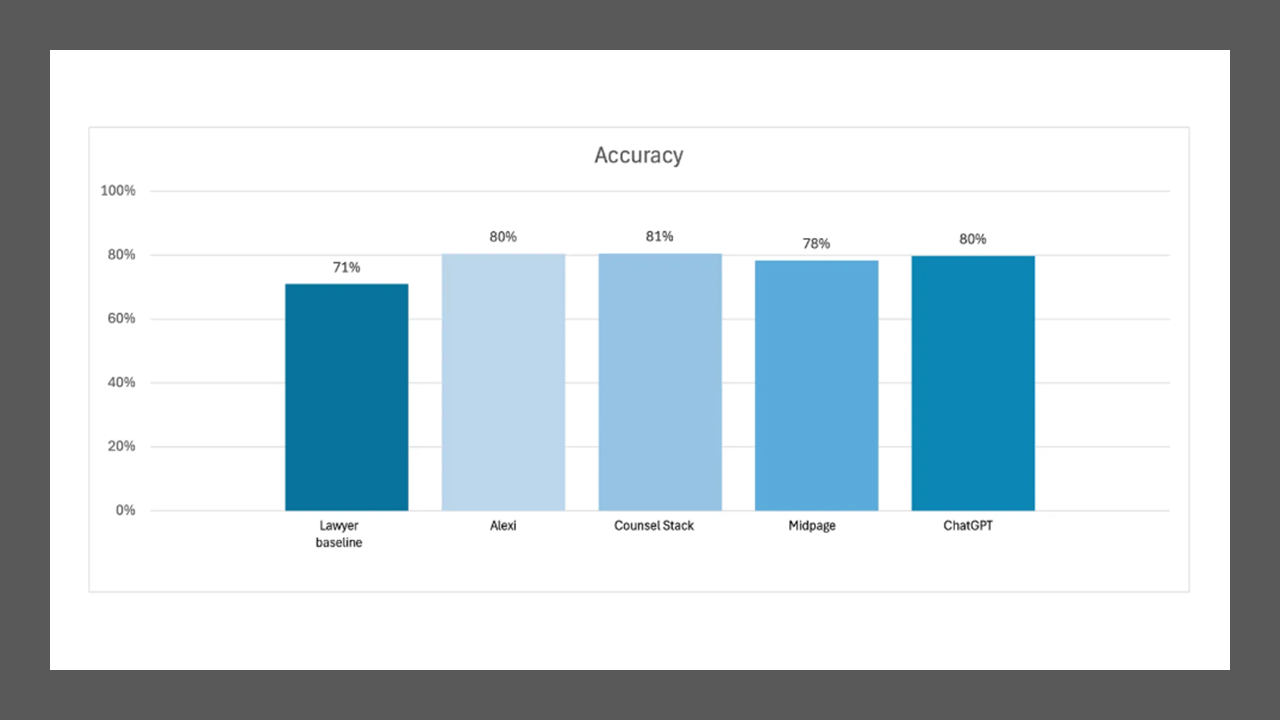
  • Lawyers
    averaged
    71%
    accuracy.
  • Alexi:
    80%
  • Counsel
    Stack:
    81%
  • Midpage:
    79%
  • ChatGPT:
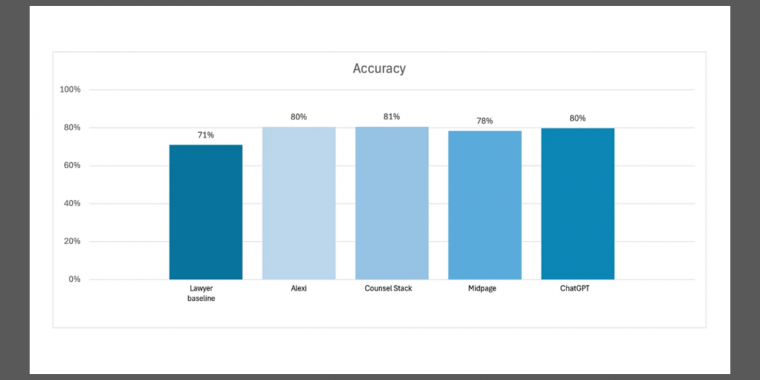
    80%.

When
grouped,
both
legal-specific
and
generalist
AIs
achieved
the
same
overall
accuracy
of
80%,
outperforming
lawyers
by
nine
points.

Significantly,
for
five
of
the
question
types,
on
average,
the
generalist
AI
product
provided
a
more
accurate
response
than
the
legal
AI
products,
and
one
question
type
where
the
accuracy
was
scored
the
same.

“Both
legal
AI
and
generalist
AI
can
produce
highly
accurate
answers
to
legal
research
questions,”
the
report
concludes.

Even
so,
the
report
found
multiple
instances
where
the
legal
AI
products
were
unable
to
produce
a
response.
This
was
due
to
either
technical
issues
or
deemed
lack
of
available
source
data.

“Pure
technical
issues
only
arose
with
Counsel
Stack
(4)
and
Midpage
(3),
where
no
response
was
provided
at
all.
In
other
cases,
the
AI
products
acknowledged
they
were
unable
to
locate
the
right
documents
to
provide
a
response
but
still
provided
some
form
of
response
or
explanation
as
to
why
the
available
sources
did
not
support
their
ability
to
provide
an
answer.”


  1. Legal
    AI
    Leads
    in
    Authoritativeness

While
ChatGPT
matched
its
legal-AI
rivals
on
accuracy,
it
lagged
in
authority

scoring
70%
to
the
legal
AIs’
76%
average.
The
difference,
Vals
AI
said,
reflects
access
to
proprietary
legal
databases
and
curated
citation
sources,
which
remain
differentiators
for
legal-domain
systems.

“The
study
outcomes
support
a
common
assumption
that
access
to
proprietary
databases,
even
if
composed
mainly
of
publicly
available
data,
does
result
in
differentiated
products.”


  1. Jurisdictional
    Complexity
    Remains
    Hard
    for
    All

All
systems
struggled
with
multi-jurisdictional
questions,
which
required
synthesizing
laws
from
multiple
states.
Performance
dropped
by
11
points
on
average
compared
to
single-state
questions.

Counsel
Stack
and
Alexi
tied
for
best
performance
on
these,
while
ChatGPT
trailed
closely.


  1. AI
    Excels
    at
    Certain
    Tasks
    Beyond
    Human
    Speed

The
AI
products
outperformed
the
lawyer
baseline
on
15
of
21
question
types

often
by
wide
margins
when
tasks
required
summarizing
holdings,
identifying
relevant
statutes,
or
sourcing
recent
caselaw.

For
example,
AI
responses
were
completed
in
seconds
or
minutes,
compared
to
lawyers’
average
1,400-second
response
latency
(~23
minutes).

And
where
the
AI
products
outperformed
the
humans
on
individual
questions,
they
did
so
by
a
wide
margin

an
average
of
31
percentage
points.


  1. Human
    Judgment
    Still
    Matters

Lawyers
outperformed
AI
in
roughly
one-third
of
question
categories,
particularly
those
requiring
deep
interpretive
analysis
or
nuanced
reasoning,
such
as
distinguishing
similar
precedents
or
reconciling
conflicting
authorities.

These
areas
underscore,
as
the
report
put
it,
“the
enduring
edge
of
human
judgment
in
complex,
multi-jurisdictional
reasoning.”


Methodology

The
study
was
conducted
blind
and
independently
evaluated
by
a
consortium
of
law
firms
and
academics.

Each
participant
answered
identical
research
questions
crafted
to
mirror
real-world
lawyer
tasks.
Evaluators
graded
every
response
using
a
detailed
rubric
(which
the
report
includes).

The
AI
vendors
represented
were:

  • Alexi

    legal
    research
    automation
    startup
    (founded
    2017).
  • Counsel
    Stack

    open-source
    legal
    knowledge
    platform.
  • Midpage

    AI
    research
    and
    brief-generation
    tool.
  • ChatGPT

    generalist
    large
    language
    model
    (GPT-4).

Vals
AI
cautioned
that
the
benchmark
covers
general
legal
research
only,
not
tasks
such
as
drafting
pleadings
or
generating
formatted
citations.

And,
as
the
report
notes,
“Legal
research
encompasses
a
wide
range
of
activities

but
there
is
not
always
a
single
correct
answer
prepared
in
advance.”


Bottom
Line

The
VLAIR

Legal
Research
study
reinforces
what
many
in
the
legal
tech
industry
have
already
observed,
which
is
that
AI
systems

both
generalist
and
domain-trained

are
rapidly
closing
the
quality
gap
with
human
legal
researchers,
particularly
in
accuracy
and
efficiency.

Yet,
the
edge
remains
with
legal-specific
AIs
in
trustworthiness
and
source
citation,
suggesting
that
proprietary
data
access
is
the
next
competitive
frontier.

For
law
firms,
corporate
legal
departments,
and
AI
vendors
alike,
the
study
serves
as
a
transparent
benchmark

a
rare
apples-to-apples
comparison

for
understanding
where
today’s
models
shine
and
where
human
expertise
remains
indispensable.

Even
so,
the
study
is
weakened
by
the
failure
of
the
three
biggest
AI
legal
research
platforms
to
participate.
This
is
not
the
fault
of
Vals
AI,
but
it
leaves
one
wondering
why
the
big
three
all
opted
out.

Justice By Coin Toss: Leading Litigator Lands Major SCOTUS Argument Based On Heads Or Tails – Above the Law

Closeup
of
business
man
tossing
a
coin.
Motion
blur.


Ed.
note
:
Welcome
to
our
daily
feature,

Quote
of
the
Day
.


After
a
few
days
of
discussion
between
the
parties,
Neal
Katyal
of
Milbank
was
appointed
to
this
role
after
a
coin
flip.
We
are
honored
to
be
represented
by
Neal
at
this
important
moment
in
the
case,
and
are
putting
all
our
energy
into
preparing
for
the
hearing
in
Nov.
5th.


Rick
Woldenberg,
the
CEO
of
Learning
Resources
Inc.,
an
Illinois-based
firm
that
sells
educational
products,
in
comments
given

following
a
coin
toss

that
landed
in

Neal
Katyal’s

favor
to
argue
before
the
Supreme
Court
that
Donald
Trump’s
tariffs
are
unconstitutional.


Staci
Zaretsky
 is
the
managing
editor
of
Above
the
Law,
where
she’s
worked
since
2011.
She’d
love
to
hear
from
you,
so
please
feel
free
to

email

her
with
any
tips,
questions,
comments,
or
critiques.
You
can
follow
her
on BlueskyX/Twitter,
and Threads, or
connect
with
her
on LinkedIn.

SAPES Trust firebombed, guard abducted ahead of National Press Conference challenging Mnangagwa’s term extension

SAPES
Trust
Director,
Ibbo
Mandaza,
said
the
attack
targeted
the
seminar
room,
which
is
regularly
used
as
a
venue
for
meetings
and
press
conferences.

SAPES
Trust
is
scheduled
to
host
a
National
Press
Conference
this
morning
against
ZANU
PF’s
Agenda
2030,
which
Mandaza
says
will
go
ahead
despite
the
setback.

SAPES
Trust
Director
Ibbo
Mandaza

“This
is
to
announce
that
there’s
been
another
arson
attack
(the
first
was
in
August
2023
ahead
of
the
elections)
at
SAPES
Trust
at
midnight,
with
the
PanAfrika
Restaurant
on
fire
and
the
security
staff
overtaken
by
a
group
of
armed
attackers.

“This
is
hardly
a
coincidence:
there is
the
National
Press
Conference
against
the
2030
Agenda
scheduled
for
11
am
at
SAPES
Trust
today
28
October.

“It
was
an
organised
attack
at
12:40
am
today:
the
main
target
was
the
SAPES
Trust
Seminar
Room,
the
usual
venue
for
meetings,
which
has
been
left
gutted
to
the
ground
by
fire;
and
then
they
abducted
the
guard
on
duty
after
locking
up
the
gate
with
two
padlocks,”
Mandaza
said
on
his
X
account
on
Tuesday.

The
attack
follows
a
fierce
debate
on
X
and
public
forums
regarding
the
constitutional
procedures
that
must
be
followed
to
amend
the
Constitution
to
allow
Mnangagwa
to
rule
until
2030,
beyond
his
term
limit
ending
in
2028.

Top
Harare
lawyer,
Thabani
Mpofu,
condemned
the
attack,
describing
it as
an
act
of
cowardice.

“This
is
just
not
right.
This
cowardly
act
must
be
condemned
in
the
strongest
terms
possible.
How
can
we
live
in
a
country
that
fears
words?”
Mpofu
wrote
on
his
X
account
on
Tuesday
morning.

Writing
on
his
X
account
on
Tuesday
morning,
self-exiled
former
Cabinet
Minister,
Saviour
Kasukuwere,
said
the
bombing
of
SAPES
Trust
is
a
shameful
act.

“This
is
shameful.
A
leopard
cannot
change
its
spots!
We
have
to
choose
hope
over
fear.”

Although
Mnangagwa
styles
himself
as
a
constitutionalist
and
has
declined
to
plan
for
running
beyond
2028,
he
has
done
little
to
stop
those
who
are
canvassing
support
for
him
to
continue
in
power
until
2030.

The
calls
for
Mnangagwa
to
continue
beyond
2028
have
caused
fissures
within
his
ruling
party,
Zanu
PF.

Analysts
have
warned
that
the
succession
battle
in
Zanu
PF
could
cause
chaos
and
violence
in
the
country,
as
they
believe
that
the
calls
for
Mnangagwa
to
go
beyond
2028
are
purely
a
strategy
to
frustrate
his
deputy,
Rtd
Constantino
Chiwenga,
who
is
widely
expected
to
take
over.


Source:


SAPES
Trust
firebombed,
guard
abducted ahead
of
National
Press Conference challenging Mnangagwa’s
term
extension


NewZimbabwe.com

Law School Runs Mock Trial Before Jury Of AI Chatbots As Dystopian Nightmare Accelerates – Above the Law

For
example,
AI
is
good
at
drawing
pictures
of
jurors,
not
necessarily
at
being
jurors.


Sci-Fi
Author:
In
my
book,
I
invented
the
Torment
Nexus
as
a
cautionary
tale
.

Tech
Company:
At
long
last,
we
have
created
the
Torment
Nexus
from
classic
sci-fi
novel

Don’t
Create
The
Torment
Nexus
.

So
goes
one
of
the

truly
perfect
social
media
posts

of
our
era.
Last
week,
law
students
at
the
University
of
North
Carolina
School
of
Law
had
an
opportunity
to
try
out
the
legal
profession’s
equivalent
of
the
Torment
Nexus
with

a
mock
trial
placing
AI
chatbots


specifically
ChatGPT,
Grok,
and
Claude

in
the
role
of
jurors
deciding
the
fate
of
an
accused
defendant.
For
all
the
faults
of
the
modern
jury
system,
should
we
replace
it
with
an
algorithm

prepared
at
the
behest
of
a
moron

who
wants
to

rewrite
history

to
make
sure
his
personal
bot
injects
an
aside
about
“white
genocide”
into
every
recipe
request?

As
it
turns
out,
the
answer
is
still
no.
At
least
as
a
1-to-1
replacement.

The
experiment
centered
on
a
mock
robbery
case
pursuant
to
the
make-believe
“AI
Criminal
Justice
Act
of
2035.”
Under
the
watchful
eye
of
Professor
Joseph
Kennedy,
serving
as
the
judge,
law
students
put
on
the
case
of
Henry
Justus,
an
African
American
high
school
senior
charged
with
robbery.
The
bots
received
a
real-time
transcript
of
the
proceedings
and
then,
like
an
unholy
episode
of

Judge
Judy:
The
Singularity
Edition
,
the
algorithmic
jurors
deliberated.

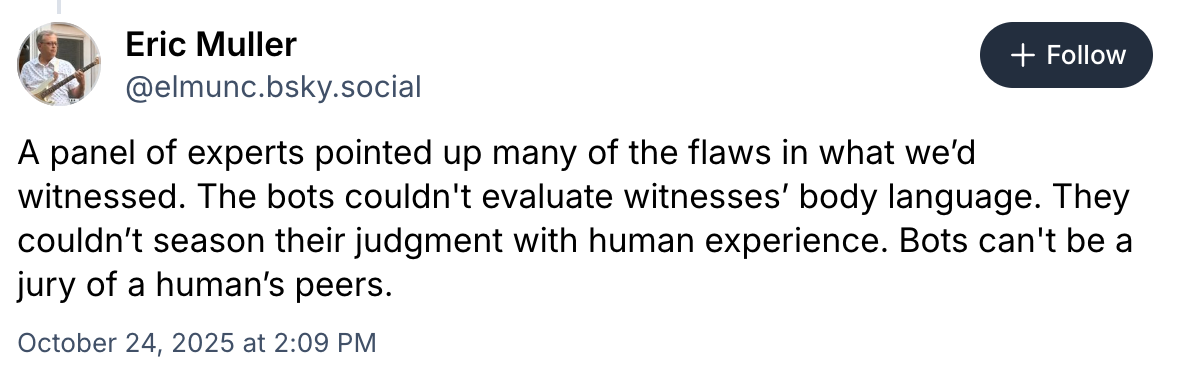
Professor
Eric
Muller
left
with
some
concerns.


The
idea
that
robots
can
cure
the
justice
system’s
bias

and
save
the
government
$15/day
per
juror
in
the
process

is
the
sort
of
Silicon
Valley
pipe
dream
that
generates
another
round
of
funding
to
be
heaped
on
the
capex
fire.
Venture
Capitalists
and
tech
bros
may
market
on
“disrupting
empathy”
or
whatever,
but
we’re
just
swapping
one
bias
for
another:
human
for
algorithmic,
emotional
for
opaque,
personal
for
corporate.
So
far,
the
robots
as
a
whole
have
proven
efficient
vectors
of
implicit
bias,
taking
the
unconscious
biases
of
their
designers
and
the
training
data
they’re
given
and
spitting
it
back
with
a
deceptive
coat
of
false
neutrality.

Except
Grok,
of
course,
which
is
constantly
being
tinkered
with
to
better
exhibit

explicit

and

very
conscious

bias.

And
there’s
this:


Since
it’s
Claude,
I
assume
it
got
to
“Ladies
and
Gentlemen
of
the–”
and
just
threw
up
a
“message
will
exceed
the
length
limit”
warning.

But
a
machine
can’t
tell
if
a
witness
is
lying
based
on
their
conduct,
because
it
can’t
perceive
that
conduct.
It
can
only
tell
if
there’s
an
outright
contradiction
of
a
definite
fact.
Maybe
it
could
conjure
up
some
approximation
of
“doubt”
if
a
witness
exhibits
inconsistent
sentence
structure
or
something,
and
that’s
fine
if
you
think
the
difference
between
an
innocent
man
and
a
sociopath
should
hang
on
their
grasp
of
Strunk
&
White.
Which,
honestly…
fair.
Muller’s
deeper
concern
though,
is
that
the
tech
industry’s
improvement
death
drive
will
take
all
the
present
drawbacks
and
patch
the
symptoms
without
acknowledging
the
disease.


The
thing
with
AI

aside
from
its
inherently
rickety
funding
model

is
that
(a)
it’s
very
good
at
the
tasks
it’s
good
at,
and
(b)
almost
everyone
pretends
it’s
good
at
the
tasks
it’s
not
good
at.
Can
AI
replace
human
jurors?
No.
No
matter
how
bad
human
jurors
are,
a
sycophantic
calculator
playing
“word
roulette”
is
not
better.

That’s
not
to
say
there
isn’t
a
role
for
AI
in
the
jury
process.
It
goes
without
saying
that
civil
litigation
offers
much
lower
stakes
than
criminal
cases
and
a
panel
of
robots
might
provide
an
opportunity
to
direct
limited
juror
resources
toward
the
criminal
cases
that
matter
more.
Even
within
the
criminal
context,
there
could
be

with
responsible
design
and
regulation
beyond
what
we
have
right
now

a
role
for
AI
in
allowing
jurors
to
query
the
evidence
to
avoid
missing
key
answers
buried
in
pages
and
pages
of
transcripts
without
the
benefit
of
a
verbatim
search
query.
Or
assisting
jurors
in
visualizing
the
points
of
disagreement
between
the
parties.

Just
because
AI
isn’t
in
a
position
to
replace
humans
in
the
box
doesn’t
mean
it
has
nothing
to
offer
though.
We
just
need
to
keep
experimenting…
in
mock
trials
only.


HeadshotJoe
Patrice
 is
a
senior
editor
at
Above
the
Law
and
co-host
of

Thinking
Like
A
Lawyer
.
Feel
free
to email
any
tips,
questions,
or
comments.
Follow
him
on Twitter or

Bluesky

if
you’re
interested
in
law,
politics,
and
a
healthy
dose
of
college
sports
news.
Joe
also
serves
as
a

Managing
Director
at
RPN
Executive
Search
.

Parliament sidelined ZESA before hired generator failed during Mnangagwa speech

HARARE

President
Emmerson
Mnangagwa
delivered
part
of
his
State
of
the
Nation
Address
(SONA)
under
torchlight
on
Tuesday
after
parliament
officials
chose
to
sideline
the
national
power
utility,
ZESA,
for
a
hired
generator
that
later
failed,
ZimLive
can
reveal.

Mnangagwa
was
opening
the
third
session
of
the
eighth
parliament
at
the
new
Mt
Hampden
building
when
the
lights
abruptly
went
out.

It
has
now
emerged
that
parliament
elected
to
power
the
event
using
a
generator

a
decision
taken
to
avoid
a
repeat
of
last
November’s
embarrassing
blackout
during
the
national
budget
presentation.

According
to
parliamentary
sources,
ZESA
supply
was
deliberately
switched
off
at
midday,
with
the
generator
taking
over.
The
system
failed
shortly
after
2.30PM
as
Mnangagwa
neared
the
end
of
his
speech.
An
automatic
switch-over
to
ZESA
did
not
occur
because
engineers
from
the
local
government
ministry
had
not
correctly
set
the
breaker,
sources
said.
The
problem
was
eventually
corrected
manually
after
more
than
five
minutes.


As
security
aides
scrambled,
Mnangagwa
appeared
to
decline
advice
from
a
security
aide
to
stop
his
address,
and
possibly
vacate
the
building.

With
a
flashlight
in
hand,
an
aide
stood
beside
the
83-year-old
leader,
illuminating
his
speech
as
he
read
on.
Power
was
restored
moments
after
he
concluded.

Mudenda
apologised
to
the
president
and
hinted
at
sabotage.

“It
is
proper
that
we
apologise
to
His
Excellency
the
President
and
the
House
for
the
electricity
outage,”
he
told
MPs.
“It
had
been
arranged
that
there
would
be
an
automatic
switch-over
if
there
was
either
a
problem
with
ZESA
or
the
generator.
We
will
go
beyond
what
happened
and
trace
the
culprits
and
deal
with
them
accordingly.
Those
that
will
be
found
wanting
will
regret
the
day
of
their
existence.”

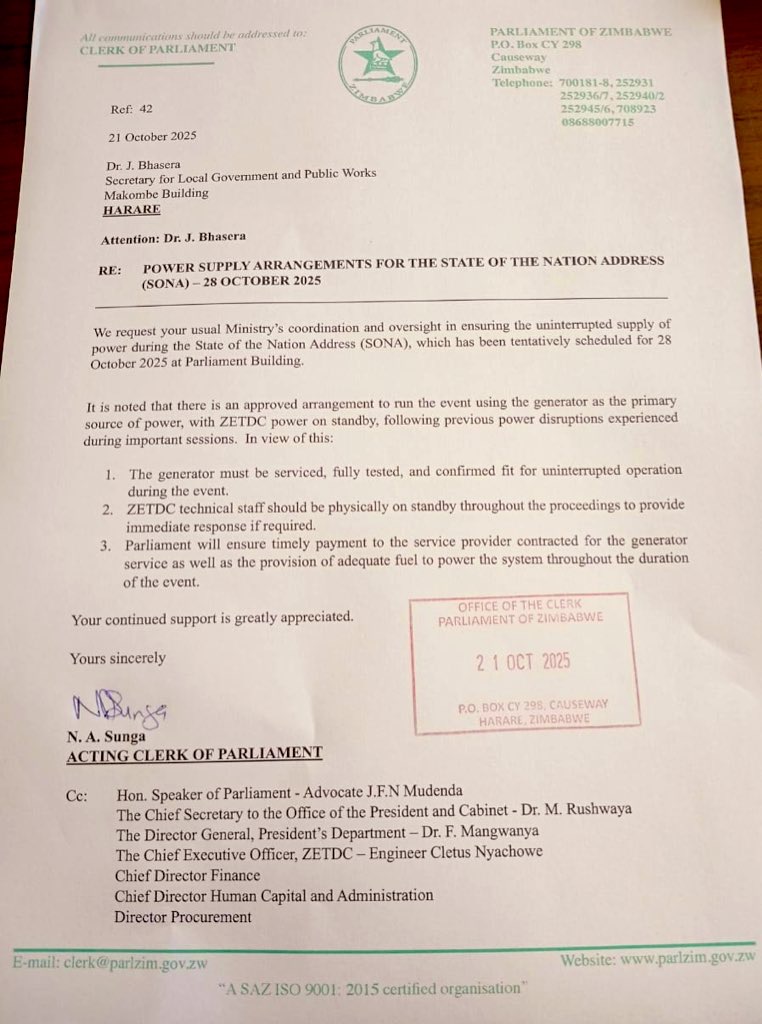
A
letter
obtained
by
ZimLive
confirms
that
parliament
had
instructed
the
local
government
ministry
to
employ
a
generator
for
the
event,
with
ZESA
as
a
standby
power
supplier
for
the
SONA.
“It
is
noted
that
there
is
an
approved
arrangement
to
run
the
event
using
the
generator
as
the
primary
source
of
power
with
ZETDC
power
on
standby
following
previous
power
disruptions,”
acting
clerk
of
parliament
Nomasonto
Audrey
Sunga
wrote
to
local
government
secretary
John
Bhasera
on
October
21.

Parliament
directed
that
the
generator
be
“serviced,
fully
tested
and
confirmed
fit
for
uninterrupted
operation,”
with
ZESA
engineers
required
to
be
on
site
for
immediate
response.

ZESA
snub

Parliament’s
letter
to
the
local
government
ministry
asking
for
a
generator
to
be
used
during
SONA

Zimbabwe
continues
to
face
crippling
power
shortages,
with
many
households
and
businesses
enduring
blackouts
lasting
more
than
five
hours
a
day.
There
was
no
suggestion
that
ZESA
was
responsible
for
Tuesday’s
failure.

In
the
November
2024
incident,
ZESA
blamed
“an
act
of
nature”
after
thunderstorms
and
strong
winds
tripped
a
132kv
feeder
line
supplying
Mt
Hampden.

Government
spokesman
Ndavaningi
Mangwana
downplayed
the
latest
mishap,
calling
it
a
testament
to
Mnangagwa’s
resolve.

Posting
a
photo
of
the
president
reading
under
torchlight,
Mangwana
wrote
on
X:
“DETERMINATION
PERSONIFIED.
Even
a
power
outage
couldn’t
stop
a
determined
President
Mnangagwa
from
fulfilling
his
constitutional
duty.
A
single
torchlight
in
the
dark
parliament
became
a
powerful
symbol
of
his
tenacity.”

Federal Judge Doing The Most To Make Sure ICE Doesn’t Ruin Halloween – Above the Law

US
Customs
and
Border
Patrol
Commander
Gregory
Bovino
(Photo
by
KAMIL
KRZACZYNSKI/
AFP
via
Getty
Images)


Last
we
checked
in

with
U.S.
District
Court
Judge
Sara
Ellis,
she
didn’t
seem
pleased
with
U.S.
Border
Patrol
commander
Gregory
Bovino.
Bovino
heads
the
Trump
administration’s
military
presence
in
Chicago,
Operation
Midway
Blitz,
and
there
were
some
pretty
serious
allegations
(and
video!)
that
federal
agents

and
Bovino
specifically

violated
a
temporary
restraining
order
issued
by
Ellis.

A
group
of
journalists,
protesters,
and
clergy
sued
the
Trump
administration over
the
military
occupation
of
Chicago,
and
Ellis
issued
a
TRO
limiting
the
tactics
federal
agents
can
use.
Amongst
the
banned
methods
of
riot
control
include
the
use
of
tear
gas
and
other
kinds
of
noxious
gas
unless
there
is
an
immediate
safety
threat.
But
over
the
weekend,
Bovino
was
caught
on
camera
throwing
canisters
of
tear
gas
into
a
crowd
without
any
warnings
or
verbal
orders
to
disperse.
It
sure
isn’t
a
good
look.

So
the
judge
hauled
Bovino
into
court
today
to
impress
upon
him
the
seriousness
of
the
TRO
and
what
sorts
of
actions
are
off
limits.
Specifically,
Judge
Ellis
is
deeply
concerned
that
Border
Patrol’s
actions
in
using
tear
gas
without
appropriate
warnings
actually
impacted
innocents,
specifically
kids
dressed
in
Halloween
costumes,
headed
to
a
parade.

Chicago
Sun-Times
reporter
John
Seidel

details

the
lengths
Judge
Ellis
went
to
in
order
to
impress
upon
Bovino
just
how
big
of
a
deal
it
is
to
not
adhere
to
the
terms
of
the
TRO.
And
hammered
home
what
it
means
for
citizens
in
the
community
quite
literally
caught
in
the
crossfire. 

While
Judge
Ellis
didn’t
press
for
many
additional
details
of
what
happened
in
the
incident
in
the
Little
Village
neighborhood
over
the
weekend,
she
made
it
very
clear
she
didn’t
want
Halloween
ruined
for
more
kids.

Judge
Ellis
also
ensured
Bovino
knows
his
agents
must
have
their
name
in
a
conspicuous
place
on
their
uniform
and
have
body
camera
in
use
at
all
times.

But
after
the
carelessness
with
which
Bovino
previously
treated
the
TRO,
Judge
Ellis
is
not
just
going
to
trust
Border
Patrol
to
do
the
right
thing.
No,
like
a
naughty
schoolchild
being
called
to
the
principal’s
office,
every
single
weekday
between
now
and
the
hearing
on
the
injunction
(November
5th),
Bovino
has
to
appear
in
Judge
Ellis’s
courtroom
at
6
p.m.
and
report
on
any
events
that
have
happened
that
day.


Kathryn
Rubino
is
a
Senior
Editor
at
Above
the
Law,
host
of

The
Jabot
podcast
,
and
co-host
of

Thinking
Like
A
Lawyer
.
AtL
tipsters
are
the
best,
so
please
connect
with
her.
Feel
free
to
email

her

with
any
tips,
questions,
or
comments
and
follow
her
on
Twitter

@Kathryn1
 or
Mastodon

@[email protected].

When development disregards fundamental rights and the law: The case of the Hurungwe cement plant


The
government
continues
to
make
efforts
to
lure
investors
in
various
sectors
as
it
moves
to
revive
the
country’s
ailing
economy
but
the
fundamental
question
and
probably
the
major
concern
from
communities
around
the
country
is;
At
what
costs
for
our
fundamental
rights?.

A
case
in
point
is
the
cement
plant
in
Hurungwe,
Mashonaland
West
province
being
set
up
by
a
Chinese
firm,
Labenmon
Investments
(Pvt)
Ltd.

The
case
of
Labenmon
Investments
has
revealed
a
complete
disregard
of
citizens’
fundamental
rights
as
well
as
complete
disregard
of
clearly
laid
down
procedures
in
terms
of
land
allocation,
compensation
and
relocation
of
affected
villagers
and
procedures
on
setting
up
investments
in
Zimbabwe.

Of
major
note
is
the
fact
that
the
Chinese
investors
have
chosen
to
disregard
fundamental
rights
and
the
law;
including
court
orders
by
riding
on
political
connections
and
communities
in
Hurungwe
have
been
left
vulnerable
and
continue
to
watch
as
the
Chinese
operate
with
impunity.

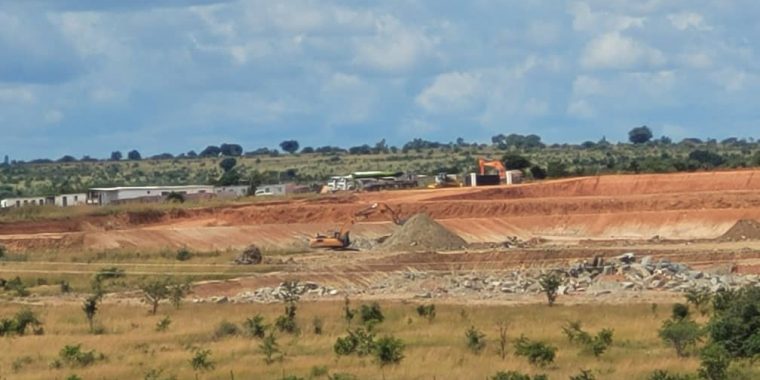
The
proposed
Hurungwe
cement
plant
is
located
at
Katenhe
turn-off,
Ward
11,
Magunje
Constituency.

In
June
last
year,
Vice
President,
Kembo
Mohadi,
directed
the
Chairperson
of
Hurungwe
Rural
District
Council,
Mary
Mliswa
to
allocate
135
hectares
of
land
to
Labenmon
Investments
for
the
cement
plant
claiming
this
had
been
endorsed
by
the
Presidency.

“The
company
above
met
with
His
Excellency
the
President,
Cde
E.D
Mnangagwa
in
the
presence
of
his
two
(2)
Vice
Presidents
and
he
directed
that
they
be
allocated
the
land
they
require.
By
this
letter,
you
are
therefore
requested
to
facilitate
the
acquisition
of
that
land,”
read
the
letter
from
Mohadi.

Mohadi’s
instructions
ignored
resistance
and
environmental
concerns
raised
by
affected
villagers
who
were
facing
eviction
from
their
ancestral
land
as
the
land
allocated
to
the
Chinese
firm
stretched
to
their
fields,
grazing
land
and
villages.

Following
the
letter
from
Mohadi,
Labenmon
Investments
started
pegging
land
in
July
last
year
and
this
resulted
in
villagers
being
prohibited
from
accessing
grazing
fields
and
farming
land.
About
80
families,
who
were
not
consulted
prior
to
the
allocation
of
the
land
to
the
Chinese
firm,
face
eviction
as
result
of
the
project.

The
unprocedural
land
allocation
to
the
Chinese
firm
reveals
the
complicit
nature
of
high
profile
politicians,
local
authorities,
government
agencies
and
the
traditional
leadership
and
could
probably
explain
the
reason
behind
the
Chinese
firm
operating
with
such
impunity
in
the
area.

Issues
of
major
concern
to
the
affected
villagers
include
impending
displacements
without
compensation,
lack
of
consultation
prior
to
the
allocation
of
the
land
to
the
Chinese
firm,
disregard
of
environmental
rights,
pollution
of
their
main
water
source,
Kemureza
Dam
as
well
as
other
rights
violations
that
include
arbitrary
arrests
and
torture.

The
cement
plant
project-
located
1.5
kilometres
upstream
of
Kemureza
Dam
is
a
huge
threat
to
the
villagers’
constitutional
right
to
water
and
villagers
from
Chasara
and
Kapere
villages
in
Wards
10
and
11
respectively
have
raised
concern
that
the
project
is
located
on
the
catchment
area
of
Kemureza
Dam-
a
wetland
area-
and
this
posed
risks
of
siltation
and
pollution
of
the
water
body.

The
villagers
also
contend
that
the
project
poses
a
huge
threat
to
Hurungwe’s
flora
and
fauna
as
well
as
aquatic
life.

Already,
there
is
massive
pollution
of
Kemureza
Dam
as
the
Chinese
company
continues
to
extract
water
from
the
dam
which
supplies
water
to
10
000
people
from
surrounding
communities.

In
August
last
year,
the
Environmental
Management
Agency
(EMA)
dispelled
fears
of
pollution
of
Kemureza
Dam
but
in
September,
affected
villagers
petitioned
the
Zimbabwe
Human
Rights
Commission
(ZHRC)
over
water
contamination
as
a
result
of
the
cement
manufacturing
project.


Unprocedural
land
allocation
and
subsequent
rights
violations

Investigations
have
revealed
serious
flaws
in
the
land
allocation
process
with
EMA
being
complicit
as
well.

Details
show
that
EMA
acted
in
direct
disregard
of
the
laid
down
procedures
on
the
allocation
of
an
Environmental
Impact
Assessment
(EIA)
to
Labenmon
Investments.

The
environmental
agency
issued
an
EIA
certificate
to
Labenmon
Investments
under
Certificate
Number
L10000034346
before
the
company
submitted
its
own
reports
on
environmental
impacts
associated
with
its
projects.
The
Zimbabwe
Lawyers
for
Human
Rights
(ZLHR)
contends
that
this
is
a
serious
violation
of
Section
100
(1)
and
(2)
of
EMA
Act
as
read
with
Section
10
of
the
Environmental
Management
Act
(Environmental
Impact
Assessment
and
Ecosystems
Protection
Regulations,
2007).

According
to
the
ZLHR,
EMA
violated
Section
100
(2)
(c)
of
the
EMA
Act
by
failing
to
conduct
a
consultative
meeting
with
Labenmon
Investments
and
interested
parties
before
issuance
of
the
EIA
certificate.

The
ZLHR
further
contends
that
the
proposed
cement
plant
project
failed
to
comply
with
the
Environmental
Management
Act
and
the
Zimbabwe
National
Water
Authority
Act
thus
posing
a
huge
threat
to
villagers’
fundamental
rights
enshrined
in
the
constitution.

According
to
villagers
who
now
face
eviction
as
a
result
of
the
proposed
cement
plant
project,
consultations
ahead
of
the
land
allocation
to
Lebanmon
Investments
were
held
in
Chinhoyi,
which
is
located
about
120
kilometres
from
their
area.
The
affected
villagers
 only
became
aware
of
the
issuance
of
the
EIA
certificate
through
a
newspaper
article.

According
to
EMA,
“the
project
was
issued
an
EIA
Certificate
in
accordance
with
the
Environmental
Management
Act
(CAP
20:27),
as
read
with
Statutory
Instrument
7
of
2007”
and
the
EIA
report
had
documentation
of
public
consultations
with
both
the
affected
and
interested
parties.

However,
the
EMA
Spokesperson,
Amkela
Sidange
also
confirmed
that
“the
project
in
question
faced
non-compliance
to
the
terms
and
conditions
outlined
in
the
Environmental
Impact
Assessment
Certificate
thus
resulting
in
litigation
being
instituted”.

Due
to
concerns
over
violation
of
their
rights
by
the
Chinese
firm,
villagers,
represented
by
the
ZLHR
approached
the
High
Court
in
Chinhoyi
seeking
an
order
barring
Labenmon
Investments
from
setting
up
their
cement
plant
in
their
grazing
area
and
argued
that
the
Chinese
firm
had
not
compensated
or
relocated
them
from
their
ancestral
land.

The
villagers
also
raised
concern
over
the
manner
in
which
EMA
conducted
its
Environmental
Impact
Assessment.

The
High
Court
in
February
this
year
 barred
Labenmon
Investments
from
expanding
its
project
into
the
grazing
area
owned
by
villagers
from
Chasara
and
Kapere
villages.

The
court
order
also
prohibited
the
Chinese
firm
from
continuing
operations
pending
the
outcome
of
investigations
on
the
breach
of
the
EIA
certificate.
Before
the
issuance
of
the
High
Court
order,
villagers
had
sought
the
intervention
of
Parliament
on
the
issue.

In
direct
disregard
of
the
High
Court
order,
Labenmon
Investments
continued
with
its
operations
and
a
series
of
human
rights
violations
were
reported
as
affected
villagers
continued
to
resist
the
company’s
operations
which
are
in
contempt
of
the
law.

Interviewed
villagers
confirmed
the
rights
violations
and
alleged
that
Labenmon
Investments
was
“enjoying
protection
from
the
local
police”.

“Human
rights
violations
have
become
rampant
since
the
Chinese
came
here.
We
have
recorded
cases
of
arbitrary
arrests,
displacements
and
physical
abuse
of
villagers
for
resisting
encroachment
into
their
fields
and
grazing
areas.
Of
major
concern
is
that
we
are
failing
to
get
justice
as
the
local
police
are
siding
with
the
Chinese.
The
police
have
chosen
to
ignore
our
concerns
but
they
are
swift
to
act
whenever
the
Chinese
lodge
a
complaint
against
local
villagers,”
said
a
concerned
villager.

Another
villager
said,
“Its
quite
disheartening
when
development
comes
with
costs
for
our
fundamental
rights.
Since
the
Chinese
came
here,
we
have
been
treated
as
slaves
and
our
genuine
concerns
continue
to
be
ignored.
A
genuine
investment
must
follow
the
proper
processes
such
as
consultation
and
compensation
of
affected
communities
but
that
has
not
been
the
case
here.
You
just
wake
up
to
find
out
that
you
have
been
dispossessed
of
your
land
and
any
attempt
to
defend
your
ancestral
land
attracts
punishment.
One
of
our
major
concerns
is
the
pollution
of
our
water
source
which
poses
a
major
threat
to
our
health.”

A
visit
to
Kemureza
Dam
revealed
serious
pollution
of
the
water
source
with
villagers
expressing
concerns
about
their
health.


Zimbabwe
Human
Rights
Commission
confirms
rights
violations.

The
Zimbabwe
Human
Rights
Commission
(ZHRC)
was
alerted
of
the
pollution
of
the
water
source
during
an
interview
with
a
representative
from
the
Zimbabwe
National
Water
Authority
(ZINWA).

“There
had
also
been
reports
that
muddied
water
recently
came
out
of
the
taps
in
Magunje.
ZINWA
had
to
go
and
raise
the
inlet
point
of
the
dam
to
get
less
muddied
water,
which
is
an
indicator
of
siltation.
So
two
concerns
arose
in
this
regard,
which
are
the
fact
that
siltation
will
occur
and
the
fact
that
the
water
quality
will
be
affected.
ZINWA
had
also
previously
challenged
the
location
of
the
cement
plant,”
read
a
report
from
the
ZHRC.

Following
concerted
efforts
by
affected
villagers
to
protect
their
constitutional
rights,
the
ZHRC
in
March
conducted
an
investigation
into
the
reported
rights
violations
in
the
area.

The
ZHRC
investigation
focused
on
violation
of
fundamental
rights
that
include
environmental
rights,
freedom
from
arbitrary
eviction,
right
of
access
to
information,
right
to
administrative
justice
and
the
right
to
property.

The
Commission
conducted
interviews
with
affected
villagers,
the
traditional
leadership,
the
Zimbabwe
Republic
Police
(ZRP),
officials
from
Hurungwe
Rural
District
Council,
the
EMA
and
the
Secretary
for
Provincial
Affairs
and
Devolution
(Mashonaland
West).The
report
exposed
serious
flaws
in
the
allocation
of
the
land
to
the
Chinese
firm,
violation
of
the
villagers’
constitutional
rights
and
a
deliberate
attempt
by
politicians
to
mislead
communities
regarding
the
project.

“In
December
2023,
a
helicopter
landed
in
the
field
in
Ward
11
out
of
the
blue.
Since
this
was
not
a
usual
occurrence
in
the
rural
areas,
people
rushed
from
all
over
to
see
what
was
going
on.
On
arrival
at
the
site,
they
realised
that
the
occupants
of
the
helicopter
were
Chinese
people
together
with
the
ZANU
PF
District
Chairperson,
Mr
Ziko
and
some
members
of
Parliament.
When
they
saw
the
community
gathering
around
them,
the
Members
of
Parliament
began
to
explain
that
they
had
brought
investors
with
a
wonderful
development
opportunity
to
Magunje
which
would
create
jobs.
Initially,
on
hearing
this
good
news,
everyone
was
excited
 and
they
welcomed
the
visitors
as
they
awaited
further
meetings
for
in-depth
explanations
and
consultations.

“The
Chinese
then
applied
to
Hurungwe
Rural
District
Council
for
land
and
on
24
January
2024,
they
were
awarded
50
hectares
of
land
in
Magunje
Growth
Point,
close
to
the
Grain
marketing
Board.
This
is
the
known
and
designated
industrial
zone
in
the
area.
However
the
company
did
not
take
up
this
offer
and
instead
approached
Chief
Chanetsa
for
an
alternative
area
from
which
to
operate.
The
younger
Chief
Chanetsa
(son
to
Chief
Chanetsa)
then
came
with
the
Chinese
for
them
to
pick
out
from
his
area
where
they
would
prefer
to
work.
Ultimately,
the
land
in
which
the
complainant’s
communal
fields
were
housed
was
chosen.
It
also
happens
to
be
located
upstream
of
Magunje
Dam,
1.5
km
away
from
the
dam,’
read
the
ZHRC
report.

The
report
noted
that
the
Chinese
firm
began
pegging
its
boundaries
before
the
affected
villagers
“had
been
served
with
any
documentation
nor
afforded
consultations”
marking
the
beginning
of
a
serious
dispute.

“The
Kapere
and
Chasara
villagers
heard
through
rumours
that
there
was
a
consultative
meeting
with
other
village
heads
that
was
held
concerning
these
developments
but
to
their
surprise,
they
were
never
invited
to
these
consultative
meetings
and
yet
they
were
the
people
who
would
be
significantly
affected
by
this
development.
The
District
Development
Coordinator-
Hurungwe
District
noticed
the
anomaly
and
noted
that
it
needed
to
be
rectified.
This
was
never
done.

“Afer
a
while,
the
villagers
in
Ward
11
began
to
question
why
Chief
Chanetsa
was
the
one
to
have
granted
the
land
to
the
Chinese
when
to
their
knowledge,
Ward
11
had
always
traditionally
belonged
to
Chief
Nematombo.
On
17
July
2024
at
8pm
in
the
evening,
villagers
close
to
the
site
of
the
cement
plant
saw
lorries
coming
into
the
village
and
some
of
the
men
went
to
 investigate
what
was
going
on.
On
arrival
they
found
men
offloading
bricks
at
the
site
and
asked
them
what
this
was
about.
These
investigating
villagers
were
informed
that
they
were
trespassing
on
private
property
and
they
were
reported
to
the
police.
They
were
arrested
and
taken
to
Magunje
Police
Station
that
very
evening,”
read
the
ZHRC
report.

The
report
confirmed
that
villagers’
source
of
livelihoods
were
also
destroyed
as
the
Chinese
firm
continued
to
invade
their
farming
land
with
impunity.
Attempts
by
the
villagers
to
resist
the
Chinese
operations
were
met
with
brute
force.
This
included
the
incarceration
of
a
woman
with
her
3
year
old
child
and
another
partially
blind
female
villager.

“On
another
separate
occasion
in
Chasara
village,
women
had
their
gardens
where
they
planted
vegetables
and
legumes
all
year
round.
These
gardens
were
burnt
down
without
warning
to
make
room
for
the
cement
plant.
The
women
asked
for
paperwork
authorising
this
but
none
was
produced.
The
villagers
then
congregated
at
the
site
where
poles
had
now
been
erected
to
barricade
that
area.
They
were
singing
in
protest
and
demanding
an
audience.

The
police
were
immediately
notified
and
three
women
who
were
identified
by
the
company’s
guard
were
arrested
for
malicious
damage
to
property
and
spent
three
nights
in
police
cells
before
going
for
their
initial
appearance
at
Karoi
magistrates
Court.
One
of
the
three
women
had
a
3
year
old
child
who
was
also
held
in
the
police
cells
with
her
during
this
time.
The
other
woman
who
was
partially
blind
needed
constant
assistance
during
this
time
.
No
food
nor
blankets
were
provided,”
read
the
report.

The
report
from
the
ZHRC
also
confirmed
the
continued
violation
of
a
High
Court
order
directing
Labenmon
Investments
to
halt
operations.
The
ZHRC
also
expressed
concern
over
the
disregard
of
the
villagers’
fundamental
rights.

“In
summary,
the
investigation
highlights
significant
concerns
regarding
land
use,
community
participation,
environmental
protection
and
adherence
to
legal
and
procedural
standards
in
the
establishment
of
the
cement
plant,”
noted
the
ZHRC.

The
Commission
expressed
concern
that
villagers’
rights
to
proper
consultation,
fair
compensation
and
environmental
safeguards
“appear
to
have
been
overlooked
or
inadequately
addressed”.

“To
promote
sustainable
development
that
respects
community
rights
and
environmental
integrity,
it
is
essential
for
authorities
and
stakeholders
to
strengthen
transparency,
ensure
inclusive
engagement
 and
rigorously
enforce
environmental
and
land
use
regulations,”
noted
the
ZHRC.

As
part
of
its
recommendations,
the
ZHRC
directed
the
Ministry
of
Local
Government
and
Public
Works
to
issue
a
moratorium
directing
the
Chinese
firm
to
halt
any
further
operations
until
administrative
action
recommended
to
the
Hurungwe
Rural
District
Council
and
the
private
company
have
been
implemented.

The
ZHRC
report,
which
confirmed
non-consultation
of
local
villagers
prior
to
the
setting
up
of
the
cement
plant
project,
directed
the
Minister
of
State
for
Provincial
Affairs
and
Devolution
(Mashonaland
West)
to
facilitate
community
consultations
“and
ensure
that
the
voices
of
local
residents
are
heard
regarding
the
proposed
cement
plant.
The
Hurungwe
Rural
District
Council
was
also
mandated
to
enhance
communication
with
communities
on
the
proposed
cement
plant.

The
Commission
also
confirmed
the
violation
of
the
condition
to
compensate
and
relocate
affected
villagers

As
a
confirmation
of
the
continued
violation
of
the
High
Court
order
by
Labenmon
Investments,
the
ZHRC
directed
the
ZRP
to
“enforce
the
provisions
order
under
Case
No.
HCCC15/25”
which
directs
the
Chinese
firm
to
halt
operations
until
all
grievances
are
addressed.

Police
Spokesperson
for
Mashonaland
West,
Inspector
Ian
Kohwera
said
he
was
not
in
a
position
to
comment
on
the
matter.

“I
cannot
comment
on
that,”
he
said.

Hurungwe
Rural
District
Council
Chairperson,
Mary
Mliswa
said
she
was
not
in
a
position
to
speak
on
the
issue
when
reached
for
a
comment.

The
Centre
for
Natural
Resource
Governance
(CNRG)
has
also
documented
reports
of
rampant
human
rights
violations
in
the
area.

“Following
growing
distress
calls
from
the
community,
CNRG
visited
the
area
and
documented
overwhelming
evidence
of
land
dispossession,
intimidation,
pollution
and
labour
exploitation
in
the
name
of
clean
energy
and
development.
The
community
is
disgruntled
whilst
government
officials
in
the
area
display
extreme
indifference
to
the
public
concerns.

These
abuses
are
not
isolated.
They
reflect
a
wider
pattern
of
corporate
impunity,
enabled
by
weak
regulatory
oversight
and
elite
collusion.
The
use
of
fear
and
repression
and
criminal
abuse
of
office
by
senior
government
officials
when
advancing
their
narrow,
partisan
interests
is
causing
distress
among
rural
communities
throughout
Zimbabwe,”
read
a
report
from
CNRG.

In
July,
the
Secretary
for
Presidential
Affairs,
Tafadzwa
Muguti
warned
Chinese
investors
against
environmental
crimes
and
failure
to
respect
the
country’s
values.

He
is
also
on
record
imploring
Labenmon
Investments
to
follow
due
procedure
on
its
cement
plant
project.

Muguti
slammed
EMA
for
issuing
an
EIA
to
Labenmon
Investments
without
verifying
its
ownership
of
the
land
earmarked
for
the
cement
plant
project.
The
move
by
EMA,
according
to
Muguti,
constituted
a
breach
of
environmental
regulations
and
investment
protocols.

He
also
expressed
concern
over
pollution
of
Kemureza
Dam
saying
this
was
a
serious
breach
of
the
fundamental
right
to
water
for
the
people
of
Magunje.

Going
forward,
he
said
there
was
a
need
to
rethink
the
project
and
ensure
due
process
is
followed
while
considering
the
concerns
of
the
Magunje
villagers.

The
Parliament
of
Zimbabwe
has
come
under
attack
for
failing
to
effectively
deal
with
rights
violations
by
Chinese
mining
companies.


The
complicit
nature
of
the
traditional
and
local
leadership

Villagers
blame
the
traditional
leadership
for
conniving
with
the
Chinese
firm
in
the
unprocedural
land
allocation.

Of
major
concern
is
the
issue
of
Chief
Chanetsa
allocating
the
Chinese
land
in
an
area
outside
of
his
jurisdiction.
In
May
last
year,
Chief
Chanetsa
directed
the
Chief
Executive
Officer
of
Hurungwe
Rural
District
Council
to
allocate
135
hectares
of
land
to
the
Chinese
firm
in
his
“capacity
as
the
Chief
responsible
for
the
area”.
He
said
that
the
project
will
boost
development
in
the
area.

However,
the
area
falls
under
the
jurisdiction
of
Chief
Nematombo
who
has
since
challenged
the
land
allocation
to
the
Chinese
by
Chief
Chanetsa.
Sources
claim
Chief
Chanetsa
connived
with
other
village
heads
to
issue
the
land
to
the
Chinese
firm.

In
July
last
year,
Chief
Nematombo
wrote
a
letter
to
the
Director
General
of
EMA,
Aaron
Chigona
expressing
concern
that
Chief
Chanetsa
allocated
land
to
the
Chinese
firm
in
an
area
outside
of
his
jurisdiction
and
without
consulting
affected
villagers.
He
claimed
that
he
was
dismissed
from
a
full
council
meeting
after
he
had
tried
to
raise
the
issue.
He
added
that
he
was
concerned
about
his
subjects’
food
security
due
to
displacements.

Chief
Chanetsa
however
contends
that
the
allocation
of
the
land
to
the
Chinese
firm
was
above
board
adding
that
the
area
falls
under
his
jurisdiction.
He
said
there
is
a
pending
court
case
of
chieftainship
boundaries
between
himself
and
Chief
Nematombo.

He
has
also
denied
reports
of
human
rights
violations
contending
that
there
is
mutual
co-existence
between
villagers
and
the
Chinese;
a
claim
that
is
in
stark
contrast
to
the
reality
on
the
ground.

“Everything
related
to
this
project
was
done
above
board
and
there
is
mutual
co-existence
between
the
Chinese
firm
and
the
villagers
who
were
consulted
before
implementation
of
the
project.
Reports
of
rights
violations
are
false,”
he
said
in
direct
contrast
to
events
occurring
on
the
ground.

An
Environmental
expert
based
in
Karoi
blamed
corruption
and
non-consultation
of
villagers
for
the
direct
disregard
of
villagers’
fundamental
rights
by
the
Chinese.

“The
Chinese
operate
with
so
much
impunity
because
they
capture
political
elites
and
the
traditional
leadership
through
bribes,
and
that
is
why
they
have
the
power
to
disregard
fundamental
rights
and
put
their
interests
first.
It
is
quite
unfortunate
that
when
our
political
leaders
receive
kickbacks,
they
choose
to
disregard
the
need
to
protect
the
environment
and
ensure
environmental
sustainability.
The
fact
remains
that
the
cement
project
poses
a
major
threat
to
sustainable
development
in
the
area
but
it
should
also
be
noted
that
villagers
are
not
against
development
but
that
they
are
calling
for
sustainable
development
and
that
they
should
be
consulted
as
affected
communities,”
said
the
environmental
expert
on
condition
of
anonymity.

In
their
letters
of
complaint
to
various
duty
bearers,
villagers
from
Kapere
and
Chasara
villages
are
on
record
saying
they
are
not
against
development
in
their
area
and
contend
that
the
Chinese
cement
plant
project
must
seek
to
consider
the
basic
tenets
of
sustainable
development.

Political
analyst,
Rashwet
Mukundu
blamed
corruption
and
political
interference
for
the
continued
violation
of
environmental
and
other
fundamental
rights
by
the
Chinese.

“The
first
problem
on
this
matter
is
actually
the
Zimbabwean
government
and
agencies
like
EMA
and
others
and
then
secondly
its
the
lack
of
ethical
business
practices
and
this
can
only
stop
when
Zimbabweans
adhere
to
the
environmental
laws
that
they
have
put
in
place
and
allow
our
agencies
to
work
independently
and
rout
out
corruption
in
the
agencies.
The
huge
challenge
is
ourselves
in
terms
of
our
greediness
and
lack
of
consideration
for
national
resources
and
our
environment
and
everyone
takes
advantage
of
the
laxity
to
do
as
they
please,”
said
Mukundu.

On
October
5,
2025
villagers
breathed
a
huge
sigh
of
relief
after
the
High
Court
imposed
a
$3
000
fine
on
Labenmon
Investments
for
contempt
of
court
after
finding
the
firm
guilty
of
failing
to
abide
by
conditions
set
out
in
its
February
ruling.

The
company
was
ordered
to
seize
operations
until
all
affected
stakeholders
are
consulted
and
adequately
compensated.

Villagers
however
reported
that
the
Chinese
firm
continues
to
use
its
political
influence
to
defy
the
High
Court
order
and
has
continued
with
its
operations
in
direct
disregard
of
the
law
and
citizens’
fundamental
rights
enshrined
in
the
constitution.

The
representative
for
Labenmon
Investments,
who
is
also
the
ZANU
PF
losing
parliamentary
candidate
for
Chinhoyi
constituency
in
the
2023
elections,
Thomas
Chidzomba
went
ballistic
when
asked
about
the
issue
of
rights
violations
and
defiance
of
the
High
Court
order
by
the
Chinese
firm.

“You
sound
more
of
an
opposition
activist
than
a
journalist.
I
do
not
want
to
talk
to
you,”
he
said.


Affected
villagers
left
to
fight
their
own
battle

No
comment
could
be
obtained
from
the
ZHRC
by
the
time
of
going
to
print
but
a
source
from
the
Commission
confirmed
that
the
matter
was
“a
politically
sensitive
one
which
makes
it
difficult
for
corrective
action
to
be
undertaken”.

This
also
explains
the
continued
violation
of
the
High
Court
order
for
Labenmon
Investments
to
halt
its
operations,
according
to
the
source.

Human
rights
groups
say
there
is
a
need
for
policies
aimed
at
balancing
between
development
and
the
need
to
protect
citizens’
fundamental
rights.

The
Zimbabwe
Union
of
Residents
and
Ratepayers
Association
(ZURRA)
Spokesperson,
Marvelous
Kumalo
said;”
Zimbabwe
Union
of
Residents
and
Ratepayers
Association
(ZURRA)
Spokesperson,
Marvelous
Kumalo
said,
“We
are
deeply
concerned
with
the
lack
of
balance
between
development
and
the
observance
of
community
rights
especially
land
and
property
rights
within
our
communities.
What
we
have
noticed
is
that
corporate
and
political
interests
are
being
prioritised
over
community
rights.
Most
communities
are
losing
their
ancestral
land
especially
to
the
Chinese
who
are
grabbing
land
for
mineral
exploitation.

As
they
exploit
Zimbabwe’s
minerals,
they
are
causing
environmental
degradation
and
leaving
communities
poorer
than
before.
We
have
also
recorded
serious
violations
of
human
rights
and
this
is
a
worrying
trend
that
we
are
witnessing
around
the
country.
Central
government
must
push
for
policies
to
ensure
a
balance
between
development
and
respect
for
human
rights.”

Kumalo
said
public
interest
litigation
remains
key
in
fighting
for
respect
of
the
villagers’
fundamental
rights.

Zimbabwe’s
constitution
guarantees
the
right
from
arbitrary
eviction,
clean
safe
and
portable
water,
environmental
rights
and
freedom
from
torture,
degrading
treatment.

Post
published
in:

Environment