
Shouting Matches Are Common At Some Law Firms – Above the Law

Law
firms
can
be
unpleasant
places
to
work
since
office
politics
and
bad
personalities
can
create
a
toxic
culture. Sometimes,
law
firm
partners
and
other
managers
might
abuse
their
power
and
belittle
associates
even
though
this
can
have
an
adverse
impact
on
morale. In
some
extreme
examples,
shouting
matches
might
be
commonplace
in
law
firm
offices.

I
worked
at
four
different
law
firms
before
starting
my
own
practice. One
of
the
shops
was
a
smaller
law
firm
that
did
not
pay
associates
as
much
as
other
practices. This
usually
meant
that
people
could
take
time
off
without
too
much
trouble
since
everyone
understood
there
needed
to
be
advantages
to
receiving
such
low
pay. For
some
attorneys,
this
also
meant
that
shouting
matches
were
tolerated
since
associates
did
not
feel
like
they
should
take
abuse
from
higher-ups
for
such
little
pay.

One
time,
we
received
a
negative
decision
from
a
court,
and
this
made
a
partner
at
the
law
firm
furious. The
partner
tasked
me
with
researching
ways
that
we
could
stay
the
decision
pending
appeal,
and
I
went
to
work
researching
an
area
of
the
law
I
had
not
previously
encountered. I
ended
up
discovering
that
in
our
situation,
we
might
not
need
to
post
an
undertaking
as
was
required
in
most
situations
in
which
litigants
wanted
to
stay
decisions
pending
appeal.

For
some
reason,
the
partner
did
not
believe
I
was
correct
in
my
assessment. He
asked
for
the
statute
that
included
this
provision,
and
he
read
the
provision
out
loud
from
a
desk
copy
of
the
relevant
procedural
rules
that
clearly
stated
we
could
ask
for
a
stay
without
posting
a
traditional
undertaking. Still,
he
would
not
concede
that
he
was
incorrect,
and
the
scene
eventually
became
a
shouting
match. I
don’t
remember
the
entire
conversation,
but
I
remember
our
last
exchange
was
me
saying
something
like
“I
haven’t
been
shown
anything
to
prove
that
this
provision
is
inapplicable”
and
he
said
something
like
“let
me
show
you
to
the
door”
and
I
left
for
my
own
office.

The
managing
partner
eventually
tasked
a
senior
associate
with
conducting
her
own
research
on
the
issue
to
see
who
was
right. 
Predictably,
this
person
found
that
I
was
correct
in
all
respects,
and
this
was
easy
to
conclude
since
the
language
of
the
relevant
provision
explicitly
backed
my
arguments. I
never
experienced
any
negative
consequences
from
this
shouting
match,
and
things
mostly
normalized
with
the
partner
who
was
my
shouting
sparing
partner.

Another
time
at
this
firm,
I
attended
a
court
appearance
for
a
senior
associate
and
the
court
rendered
an
unfavorable
decision
for
us. The
attorney
who
handled
the
case
was
livid
and
told
me
that
I
would
have
to
complete
any
follow
up
work
that
was
necessary
because
of
the
court’s
opinion. This
led
to
another
shouting
match,
and
I
was
on
bad
terms
with
this
attorney
for
about
a
week. When
this
attorney
saw
I
was
in
the
office
kitchen,
he
would
walk
out,
not
wanting
to
be
in
an
uncomfortable
encounter
with
me. Strangely,
our
connection
normalized
about
a
week
later
when
he
offered
to
give
me
a
shirt
that
he
was
gifted
but
that
was
too
large
for
him. I
declined
the
shirt,
thanked
him
for
the
gesture,
and
we
hugged
it
out. Everything
was
fine
with
us
from
that
point
on.

All
told,
when
attorneys
are
underpaid,
they
might
not
believe
that
they
should
have
to
swallow
some
indignities
that
employees
at
more
well-heeled
firms
need
to
endure. Moreover,
such
lawyers
might
not
be
so
fearful
of
losing
their
jobs
since
the
gig
they
have
is
not
that
valuable
to
begin
with. Accordingly,
it
is
more
common
for
attorneys
at
such
firms
to
have
more
hostile
interactions
and
for
there
to
be
fewer
negative
consequences
from
shouting
matches.


Jordan
Rothman
is
a
partner
of 
The
Rothman
Law
Firm
,
a
full-service
New
York
and
New
Jersey
law
firm.
He
is
also
the
founder
of 
Student
Debt
Diaries
,
a
website
discussing
how
he
paid
off
his
student
loans.
You
can
reach
Jordan
through
email
at 
jordan@rothman.law.

Federal Prosecutor Removed From Office For Not Pressing Charges Against Trump’s Political Enemies – Above the Law

New
York
Attorney
General
Letitia
James
(Photo
by
Michael
M.
Santiago/Getty
Images)

New
York
Attorney
General
Leitita
James
is
a
thorn
in
Donald
Trump’s
side.
James
was
behind
the
civil
fraud
case
against
the
Trump
organization
which,
though
the

fine
was
slashed
,
found
the
organization
engaged
in
fraud.
This,
of
course,
means
she’s
been
targeted
for
investigation
by
the
administration.

Mortgage
fraud
is
the

2025
go-to
investigation

for
Trump’s
political
enemies,
so
they
tried
to
make
that
stick
against
James.
Now,
MAGA
acolytes
put

A
LOT
of
effort

into
making
that
happen…
but
there’s
just
not
a
lot
there.

Because
there’s
no
actual
evidence
of
a
crime,
the
U.S.
Attorney
for
the
Eastern
District
of
Virginia
Erik
Siebert
didn’t
bring
charges
against
James.
And
now
he’s
out
of
a
job.
Bloomberg
Law
is

reporting

Siebert
is
being
removed
from
his
position
as
a
result
of
the
James
probe.

US
Attorney
Erik
Siebert,
whom
President Donald
Trump
nominated
to
the
position
in
May,
was
asked
by
administration
officials
to
prosecute
James
over
allegations
she
committed
mortgage
fraud
related
to
a
home
she
owned
in
Virginia,
said
one
of
the
people,
both
of
whom
asked
not
to
be
named
discussing
a
confidential
matter.
Siebert’s
office
told
the
officials
that
it
hadn’t
found
sufficient
evidence
to
charge
James,
said
the
person.

The
lack
of
evidence
against
Democrats
is
but
a
small
obstacle
in
Trumpland.


Kathryn
Rubino
is
a
Senior
Editor
at
Above
the
Law,
host
of

The
Jabot
podcast
,
and
co-host
of

Thinking
Like
A
Lawyer
.
AtL
tipsters
are
the
best,
so
please
connect
with
her.
Feel
free
to
email

her

with
any
tips,
questions,
or
comments
and
follow
her
on
Twitter

@Kathryn1
 or
Mastodon

@[email protected].

Law Professor Suspended Over Charlie Kirk Post – Above the Law

(Photo
by
Michael
Ciaglo/Getty
Images)

Law
professor
Felicia
Branch
was
suspended
by
the
University
of
Arkansas
Little
Rock
William
H.
Bowen
School
of
Law
over
comments
she
made
on
Facebook
concerning
the
death
of
far-right
activist
Charlie
Kirk.
Her
comments,
which
called
particular
attention
to
the
methods
of
Kirk
and
his
own
take
on
gun
violence,
sparked
a
firestorm
in
the
state.

Governor
Sarah
Huckabee
Sanders
called
the
now-deleted
post
(available
below)
“vile.”
Lieutenant
Governor
Leslie
Rutledge
said,
“While
faculty
members
have
the
right
to
express
opinions,
openly
celebrating
the
assassination
of
a
fellow
American
crosses
a
line.”

Arkansas
Attorney
General
Tim
Griffin

called
for

Branch,
who
leads
a
clinic
at
the
law
school
to
assist
low-income
individuals,
to
be
fired,
“The
First
Amendment
protects
your
right
to
say
what
you
want.
It
does
not,
however,
guarantee
you
the
job
you
want,
regardless
of
what
you
say.
The
law
school
should
terminate
her
immediately.”

University
of
Arkansas
Little
Rock
Chancellor
Christina
Drale
wrote
of
Branch’s
comments,
“As
educators
we
should
hold
ourselves
to
a
higher
standard
of
conduct
that
values
civil
discourse,
speaks
clearly
about
the
dangers
of
political
violence,
and
that
prioritizes
a
rigorous,
fair-minded
learning
environment.
The
postings
I
read
this
morning
do
not
reflect
this
standard.”

Branch
has
been
suspended
with
pay
while
the
university
conducts
its
investigation.

While
Reuters

reports

Branch
is
the
first
in
legal
academia
to
get
swept
up
in
the
witch
hunt,
educators
have
been
targeted
in
other
disciplines.
According
to

the
PayDay
Report
,
hundreds
of
teachers,
staff,
and
professors
have
been
suspended

particularly
in
red
states
where
state
agencies
are
actively
investigating
the

education
community
en
masse
.
And
in
Florida,
they’re
taking
it
a
step
further
than
just
social
media
posts.

Education
commissioner
Anastasios
Kamoutsas

is
asking
folks
to
rat
out
private
conversations
that
express
disfavored
viewpoints.

“What
we’re
seeing
right
now
is
certainly
what
feels
to
me
to
be
McCarthy-like,” Florida
Education
Association
President
Andrew
Spar
said.
 “Where
people
are
being
encouraged
by
the
commissioner
and
by
others
to
essentially
hunt
for,
teachers
or
staff
or
professors
who
are
saying
something
that
someone
has
a
problem
with,
however
small
it
may
be,
and
to
essentially
expose
that,
to
dox
teachers,
to
threaten
teachers
and
staff
and
professors.”

Biglaw
firm
Perkins
Coie
also

fired
an
attorney

for
comments
about
the
death
of
Kirk
they
found
objectionable.


Kathryn
Rubino
is
a
Senior
Editor
at
Above
the
Law,
host
of

The
Jabot
podcast
,
and
co-host
of

Thinking
Like
A
Lawyer
.
AtL
tipsters
are
the
best,
so
please
connect
with
her.
Feel
free
to
email

her

with
any
tips,
questions,
or
comments
and
follow
her
on
Twitter

@Kathryn1
 or
Mastodon

@[email protected].

Zimbabwe Must Lift The Ban on Maize Imports

We
understand
that
it
is
in
place
to
protect
domestic
farmers,
to
some
extent,
during
the
months
following
harvest.
But
there
is
growing
evidence
that
the
supply
is
constrained.
Some
milling
firms
already
face
challenges
because
of
the

maize
shortage
.

As
we
argued
a
few
days
ago,
Zimbabwe
likely
doesn’t
have
sufficient
maize
supplies
for
their
annual
needs.
We
believe,
based
on
data
from
the
United
States
Department
of
Agriculture
(USDA),
that
Zimbabwe’s
maize
production
is
around
1.3
million
tonnes.
Given
the
annual
consumption
of
2.0
million
tonnes,
they
naturally
need
about
700,000
tonnes
to
fulfil
their
needs.

However,
we
had
anticipated
that
the
needs
would
be
more
severe
by
the
end
of
the
year
and
into
the
first
quarter
of
2026.
We
thought
the
current
harvest
would
carry
them
for
now,
albeit
with
artificially
higher
prices
in
the
context
of
a
ban
on
imports
of
affordable
maize
from
the
world
market.
But
it
appears
that
the
supplies
are
constrained
already.

Under
this
context,
while
it
is
understandable
that
the
Zimbabwean
government
wants
to
protect
farmers,
it
would
be
beneficial
for
them
to
consider
lifting
the
ban
now
and
supporting
the
households.

Source:


Zimbabwe
Must
Lift
The
Ban
on
Maize
Imports

|
Wandile
Sihlobo

Chivayo Fires Back At Mahere Over Stalled Gwanda Solar Project

Zimbabwean
businessman
Wicknell
Chivayo
and
advocate
Fadzayi
Mahere
have
renewed
a
public
dispute
over
the
long-stalled
Gwanda
Solar
Project
after
Mahere
publicly
questioned
whether
Chivayo’s
company
owes
the
State
millions
and
whether
recent
high-value
ambulance
donations
might
be
partial
compensation
for
that
sum.
The
exchange
has
re-opened
a
wider
conversation
about
procurement,
project
delivery
and
public
accountability
in
Zimbabwe’s
energy
sector.

Mahere’s
Questions

Advocate
Fadzayi
Mahere
pressed
Wicknell
Chivayo
to
clarify
whether
he
still
owes
the
State
US$6.5
million
for
the
Gwanda
Solar
Project,
why
the
project
remains
incomplete,
and
if
his
donation
of
20
Land
Cruiser
ambulances,
which
she
estimated
at
US$60,000
each,
should
be
seen
as
philanthropy
or
a
partial
set-off
against
that
sum.
She
further
argued
that,
if
the
figures
were
correct,
taxpayers
would
effectively
still
be
owed
the
equivalent
of
88
more
ambulances,
calling
into
question
Chivayo’s
claims
of
generosity.

Chivayo’s
Response

Chivayo
replied
in
a
long
post
that
described
Mahere’s
line
of
questioning
as
ill-thought
and
accused
critics
of
ignorance,
pointing
to
a
Supreme
Court
judgment
and
insisting
Intratrek,
his
company,
does
not
owe
ZESA
or
the
State.
He
wrote
in
part:


“The
tired
and
IGNORANT
reference
to
the
Gwanda
Solar
Project
is
quite
laughable.
Even
a
first-year
law
student
would
know
that
the
SUPREME
COURT
of
Zimbabwe
conclusively
RULED
that
Intratrek
Zimbabwe
(Pvt)
Ltd
does
NOT
owe
ZESA
or
the
State
a
single
cent
!!!
Please
refer
to
judgement
SC127/23…”


On
the
ambulances
he
said
:

These
are
2025
STATE-OF-THE-ART,
high-end
Toyota
Land
Cruiser
units,
FULLY
EQUIPPED
with
ICU
technology,
ventilators,
oxygen
systems
and
defibrillators.
They
are
essentially
MOBILE
CLINICS
which
should
have
actually
costed
more
than
US$90,000
per
unit…”

He
also
stressed
that
his
philanthropy
was
separate
from
contractual
matters
and
closed
by
praising
the
government’s
Vision
2030.

Project
History

How
We
Got
Here

The
Gwanda
solar
scheme
was
contracted
as
a
100
MW
project
during
the
mid-2010s
with
an
original
contract
value
in
the
region
of
US$170–183
million,
awarded
to
Intratrek
Zimbabwe
with
Chinese
technical
partner
CHINT
as
part
of
a
wider
push
to
add
renewable
capacity.
Implementation
was
expected
in
phases
with
an
initial
10
MW
first
phase
discussed
in
government
statements.
Over
the
years
the
project
repeatedly
missed
deadlines
amid
disputes
over
financing,
guarantees
and
fulfillment
of
contractual “conditions
precedent.” 

In
2018–2020
the
matter
moved
through
the
courts
and
government
review
processes
after
ZPC
(the
Zimbabwe
Power
Company)
raised
concerns
about
progress
and
payments.
Some
court
rulings
and
later
appeals
found
the
procurement
contract
remained
valid
and
binding
and
ordered
related
remedies;
ultimately
the
Supreme
Court’s
decisions
in
late
2023
shaped
the
legal
position
between
Intratrek
and
the
State.

The
State
Of
The
Project
And
Site
A
Decade
Later

The
Gwanda
Solar
Project
remains
stalled
more
than
a
decade
after
its
inception.
Court
battles
between
Intratrek
and
the
Zimbabwe
Power
Company
(ZPC)
culminated
in
a
Supreme
Court
ruling
(SC127/23)
affirming
the
contract’s
validity,
but
legal
outcomes
have
not
translated
into
visible
progress
on
the
ground.

Site
inspections
by
parliamentarians,
journalists
and
civil-society
groups
found
overgrown
land,
limited
clearing,
and
negligible
infrastructure,
reinforcing
perceptions
of
delay.
Past
criminal
probes
and
parliamentary
scrutiny
focused
on
payments
made
to
Intratrek,
yet
prosecutions
failed
to
secure
convictions,
while
recovery
claims
were
contested
in
court.

Negotiations
to
revive
the
project
have
been
reported
but
little
physical
work
has
materialised.

Public
Opinion
Remains
Divided:

some
commend
Chivayo’s
philanthropy,
while
others
see
it
as
reputation
management
amid
unresolved
accountability
questions.
For
many
Zimbabweans,
Gwanda
has
become
symbolic
of
state
contracts
plagued
by
delays,
litigation,
and
limited
returns,
raising
demands
for
transparency
in
energy
infrastructure
deals.

This Law School Is Offering Guaranteed Scholarships To All Incoming Students Thanks To New Student Loan Caps – Above the Law


Ed.
note
:
Welcome
to
our
daily
feature,

Quote
of
the
Day
.


The
PLEDGE
Scholarship
is
more
than
a
financial
award.
It’s
a
promise
Santa
Clara
Law
is
making
to
help
relieve
next
year’s
students
from
the
kind
of
financial
pressure
that
might
otherwise
preclude
them
from
pursuing
rewarding
legal
careers
of
great
prominence
and
purpose
.


Dean

Michael
Kaufman

of
Santa
Clara
University
School
of
Law,
in
a
statement
concerning
the
school’s
new

PLEDGE
Scholarship
,
which
serves
as
a
means
to
undercut
the
annual
federal
loan
cap
of
$50,000 for
professional
degree
students
that
became
part
of
the
Trump
administration’s
budget
bill.
Each
incoming
full-time
student
at
the
law
school
will
receive
a

guaranteed
scholarship
of
$16,000

for
each
year
of
their
legal
studies,
which
will
allow
them
to
cover
the
rest
of
their
tuition
with
federal
student
loans
.


“We’re
not
just
educating
future
lawyers;
we’re
building
a
more
just
and
equitable
society,”
Kaufman
said.
“This
scholarship
is
a
strategic
investment
in
our
extraordinary
students
and
the
clients
and
communities
they
will
go
on
to
serve.” 


Staci Zaretsky


Staci
Zaretsky
 is
the
managing
editor
of
Above
the
Law,
where
she’s
worked
since
2011.
She’d
love
to
hear
from
you,
so
please
feel
free
to

email

her
with
any
tips,
questions,
comments,
or
critiques.
You
can
follow
her
on BlueskyX/Twitter,
and Threads, or
connect
with
her
on LinkedIn.

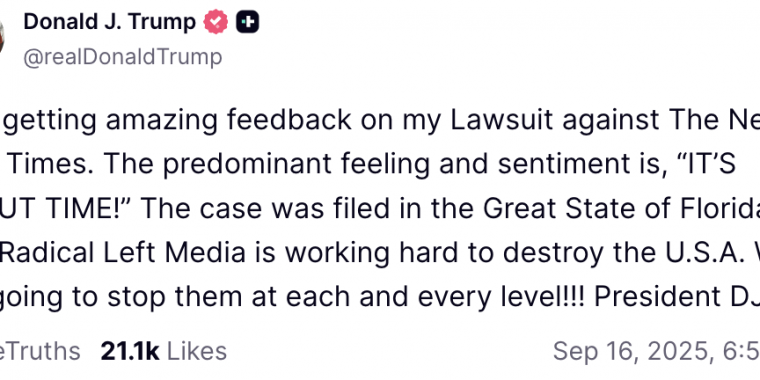
Trump Complaint Against NYT Gets Benchslapped Into Oblivion – Above the Law

The
president
suffered
a
minor
setback
this
morning
in
his
defamation
suit
against
the
New
York
Times.
Judge
Steven
Merryday

struck

the
entire
complaint
for
standing
“unmistakably
and
inexcusably
athwart
the
requirements
of
Rule
8.”


Ooopsie!

And
all
Trump’s
friends
said
it
was
going
so
great!

Despite
filing
this
suit
in
“the
Great
State
of
Florida,”
specifically
the
Tampa
Division
of
the
Middle
District


not

the
Southern
District
where
he
lives

the
president
did
not
manage
to
land
on
the
docket
of
one
of
his
own
appointees.
Instead
he
got
Judge
Merryday,
who’s
been
on
the
bench
since
1992
and
very
much

does
not
have
time
for
your
shit
.

The
court
was
deeply
unimpressed
with
the

85-page
screed

praising
the
Dear
Leader’s
“decades
of
magnificent
real
estate
achievements,”
“sui
generis
charisma
and
unique
business
acumen,”
“transcendent
ability
to
defy
wrongful
conventions,”
and
his
“one-of-a-kind,
unprecedented
personal
brand
alone
[which]
is
reasonably
estimated
to
be
worth
over
$100,000,000,000.”
Apparently
the
judge
wasn’t
interested
in
hearing
about
Donald
Trump’s
1990s
cameos
on
Wrestlemania
V,
All
My
Children,
and
The
Nanny.

“As
every
member
of
the
bar
of
every
federal
court
knows
(or
is
presumed
to
know),
Rule
8(a),
Federal
Rules
of
Civil
Procedure,
requires
that
a
complaint
include
‘a
short
and
plain
statement
of
the
claim
showing
that
the
pleader
is
entitled
to
relief,’”
Judge
Merryday
begins,
noting
that
the
plaintiff
spends
79
of
those
pages
detailing
“many,
often
repetitive,
and
laudatory
(toward
President
Trump)
but
superfluous
allegations.”

“As
every
lawyer
knows
(or
is
presumed
to
know),
a
complaint
is
not
a
public
forum
for
vituperation
and
invective

not
a
protected
platform
to
rage
against
an
adversary,”
he
continues

Presumably
these
lawyers
feel
the
sting
of
humiliation
at
being
treated
like
wild-eyed,
pro
se,
SovCits
lecturing
the
court
on
the
illegality
of
the
federal
income
tax.

Or
perhaps
not.

Local
counsel
Alejandro
Brito,
a
commercial
lawyer
from
Coral
Gables,
probably
burned
off
his
capacity
for
shame
when
he

argued

that
CNN
defamed
Trump
by
using
the
phrase
“Big
Lie.”
Brito
did,
however,
manage
to
negotiate
Trump’s
settlement
with
ABC,
and
he’s
currently
spearheading
the
suit
against
the
Wall
Street
Journal
for
saying
Trump

drew
boobs

two
decades
ago
for
Jeffrey
Epstein’s
birthday.

Brito’s
co-counsel
Edward
Paltzik
filed
the
complaint
against
CBS
in
Texas
that
led
to
a
$16
million
gift
to
Trump’s
presidential
library,
after
which
the
FCC
approved
CBS
parent
company
Paramount’s
merger
with
Skydance.
Paltzik
has
failed
to
replicate
that
success
in
Iowa,
however,
where
he
is
currently

pratfalling

all
over
three
separate
dockets

one
state,
two
federal

in
a
SLAPP
suit
against
the
Des
Moines
Register.
Rounding
out
the
dream
team
is
MAGA
goober
Daniel
Epstein,
who
once

promised

to
sue
the
US
government
over
the
raid
on
Mar-a-Lago,
demanding
$100,000,000
for
“intrusion
upon
seclusion.”
That
suit
was
never
filed,
but
Epstein
really
did

sue

Chief
Justice
Roberts
on
the
theory
that
the
judiciary
is
part
of
the
executive
branch
and
thus
subject
to
FOIA.

Safe
bet
that
these
guys
don’t
embarrass
easy!

Judge
Merryday
struck
the
complaint
and
gave
the
plaintiff
28
days
to
amend.
He
also
limited
the
filing
to
“forty
pages,
excluding
only
the
caption,
the
signature,
and
any
attachment,”
admonishing
counsel
that
“Although
lawyers
receive
a
modicum
of
expressive
latitude
in
pleading
the
claim
of
a
client,
the
complaint
in
this
action
extends
far
beyond
the
outer
bound
of
that
latitude.”
So
if
Trump
wants
to
pursue
this
case,
Brito,
Paltzik,
and
Epstein
are
going
to
have
to
axe
about
40
pages
of
Baghdad
Bob-level
sycophancy.

How
can
the
president
make
his
case
without
including
the
2024
electoral
map
and
his
appearance
on
The
Fresh
Prince
of
Bel
Air
in
1994?

Lawyering
is
hard,
y’all.

It’s A Small (Language Model) World After All – Above the Law

At
this
year’s

ILTACON
,
between
the
open
bars
and
the
marketing
bingo
cards,
I
picked
up
on
a
murmur
running
through
the
legal
tech
crowd.
While
OpenAI
and
Anthropic
continue
begging
for
more
and
more
investor
cash
in
the
face
of
consistently
lackluster
earnings,
some
vendors
delivering
advanced
AI
to
the
legal
industry
dropped
hints
about
growing
interest
in
small
models.
It’s
not
that
large
language
models
don’t
work


though
they
often
don’t


but
they’re
overbloated
science
experiments
that,
as
Goldman
Sachs
observed,

require
exponentially
increased
resources
to
achieve
tiny
linear
gains
.
Practical
applications,
at
least
in
legal,
don’t
need
models
that
need
the
human
battery
array
from

The
Matrix

just
to
say,
“here’s
a
haiku
about
ERISA.”

This
week,
a
number
of
developments
from
the
greater
tech
world
tend
to
confirm
that
the
future
is
small.

Small
models

for
the
purpose
of
this
discussion

are
“small”
only
as
compared
to
the
labyrinthian
architectures
behind
products
like
GPT-5.
That
said,
these
smaller
models
deliver
cheaper
results
without
much
drop
off
in
quality.
Some
could
be
light
enough
to
run
on
institutional
hardware,
meaning
law
firms
and
corporate
clients
can
keep
their
data
in-house
instead
of
shipping
it
off

to
Silicon
Valley
narcs
.
For
an
industry
that
still
treats
the
cloud
like
it’s
a
Soviet
spy
balloon

an
overreaction,
but
a
persistent
one

the
pitch
for
small
models
is
obvious:
more
control,
less
spend,
nearly
the
same
output.

This
week,

Meta
announced
its
small
reasoning
model
,
confirming
that
the
race
toward
small
might
be
on.
Its
new
model
is
designed
to
be
hosted
locally
and
will
be
specialized

as
small
models
are
by
necessity

to
math
and
coding
applications,
but
the
announcement
bucks
what
had
been
a
runaway
train
behind
building
bigger
and
bigger
models.
Going
small
might
also
be
in
Meta’s
best
interest
since
this
week’s
demonstration
of
its
general
AI
offering
imploded
on
stage
during
a
live
demo:

I’ll
bet
Zuckerberg
never
thought
he’d
ever
find
himself
on
stage
thinking
back
fondly
to
the
Metaverse
announcement.
Wifi
problems?
Sure,
bud.

For
some
time
now,
I’ve
been
saying
that
whoever
delivers
the
“American
DeepSeek”
wins
the
long-term
AI
crown.
China-based
DeepSeek
is
still
a
large
model
by
technical
standards,
but
much
smaller
than
the
competition,
and
it
burst
onto
the
scene
this
year
claiming
to
do
basically
everything
the
behemoth
American
models
can
for
a
fraction
of
the
price.
Except
tell
you
what
happened
in
Tiananmen
Square
in
1989,
of
course.
Investors
in
up
to
their
necks
with
the
big
American
foundational
models
tried
to
downplay
DeepSeek’s
cheapness
claims,
arguing
that
the
Chinese
government

must
have

contributed
more
money
under
the
table
to
bring
the
product
to
life.
Though
even
the
most
aggressive
theories
of
Chinese
government
involvement
still
ended
in
a
product
that
cost
a
tiny
fraction
of
what
the
Americans
spent
that
still

outperforming
American
models
on
some
tasks
.
Anyone
able
to
replicate
that
without
the
lingering
concern
that
the
product
is
scraping
corporate
secrets
into
a
PRC
database
should
dominate
the
space.

This
week,
in
a
preprint
of
a
peer-reviewed
paper,
DeepSeek
disclosed
the
cost
of
training
its
R1
model
was…

$294,000
.
That’s
cheaper
than
a
second-year
associate
once
you
include
the
bonus
and
the
cost
of
every
midnight
Uber
Eats
order
and
2
a.m.
black
car
voucher.
With
cheaper
training
comes
cheaper
operation.
DeepSeek
charges
something
like

$0.0011
per
thousand
tokens
,
which
is
a
whopping
27
times
cheaper
than
OpenAI.

But
are
smaller
models
ready
for
the
“agentic”
revolution?
The
answer
is
yes.
And
not
just
because

“agentic”
is
empty
buzzword
that
should
be
purged
from
legal
tech
conversations
.
According
to
VentureBeat,
“agentic”
is,
charitably,
a
largely
nebulous
term
still
to
this
day
in
the
AI
industry
.”
Less
charitably,
tech
commentator
Ed
Zitron
describes
it
as
one
of
the
most
egregious
acts
of
fraud
I’ve
seen
in
my
entire
career
writing
about
this
crap,
and
that
includes
the
metaverse
.”
Fundamentally,
it’s
a
batch
file
of
chatbot
prompts

which
is
not
necessarily
a
dig,
since
curated
and
vetted
prompts
make
for
better
results

but,
in
action,
agents
take
short,
general
prompts
from
the
user
and
from
that
build
a
workflow

which
a
chatbot
can
do

and
then
use
that
workflow
to
generate
results,
often
by
pinging
outside
resources.
It
can
save
some
time
over
repeatedly
prompting
a
bot,
but
it’s
not
a
robot
lawyer
run
amok
like
the
“agent”
branding
might
suggest.

They
also
fail
a
lot.
According
to
Salesforce,
the
company

putting
more
eggs
in
agentic
AI
than
anyone
,
agents
“achieve
around
a
58
percent
success
rate
on
tasks
that
can
be
completed
in
a
single
step
without
needing
follow-up
actions
or
more
information”
and
this
falls
“to
35
percent
when
a
task
requires
multiple
steps.”
This
is


their
own
research
!

However,
designed
by
the
right
hands,
these
systems
can
produce
better
and
faster
results
than
a
user
working
alone.
But,
again,
do
they
need
large
models
to
pull
this
off?

Also
this
week,
Alibaba’s
AI
research
team
dropped

Tongyi
DeepResearch
,
“on
par
with
OpenAI’s
DeepResearch
across
a
comprehensive
suite
of
benchmarks.”
Per

VentureBeat
:

The
new Tongyi DeepResearch Agent
is
setting
off
a
furor
among
AI
power
users
and
experts
around
the
globe
for
its
high
performance
marks:

according
to
its
makers
,
its
the
“the
first
fully
open-source
Web
Agent
to
achieve
performance
on
par
with
OpenAI’s
Deep
Research
with
only
30B
(Activated
3B)
parameters.”

That
is…
small.
By
way
of
comparison,
GPT-4
supposedly
ran
on
2
trillion
parameters.
Compared
to
an
activated
3
billion,
that’s
an
ominous
666x
difference.

Look,
large
models
played
their
part.
Without
them,
we
probably
wouldn’t
have
these
workable
smaller
models.
The
real
trick
of
a
large
model
is
that
it’s
nearly
impossible
to
properly
weight
a
model
to
get
the
most
efficient
results.
But
once
the
model
is
massive,
it
will
develop
smaller
sub-models
doing
the
real
work
on
various
queries.
The
premise
of
the

Lottery
Ticket
Hypothesis

is
that
once
you
have
a
big
enough
model,
you
can
start
paring
down
to
find
the
ideally
weighted
model
that
wouldn’t
have
been
uncovered
but
for
the
original
massive
investment.
At
that
point,
you
can,
as
the
joke
goes,
build
the
whole
plane
out
of
the
black
box

market
a
smaller
model
that
does
everything
an
application
actually
needs
and
nothing
more.

As
an
industry,
AI
can
start
cashing
in
those
winning
tickets
instead
of
doubling
down
on
lotto
scratchers.

This
is
especially
true
in
legal,
where
our
applications
don’t
require
paving
over
the
Mohave
with
server
farms,
we
just
need
something
smart
enough
to
speed
up
the
job.
When
you’re
summarizing
depositions,
you’re
not
going
to
find
yourself
hurting
because
the
underlying
model
wasn’t
trained
on
a
10-year-old
TypePad
blog
post
about
birdwatching.
For
our
profession,
small
is
both
beautiful
and
indispensable.

And
cheaper.
Did
we
mention
cheaper
yet?
Because
it’s
cheaper.

The
AI
landscape
isn’t
going
to
shift
overnight,
but
as
this
week
suggests,
the
tide
might
be
turning.
It’s
hard
to
imagine
OpenAI
going
belly
up
in
a
few
months
(unless
you
actually
look
at
their
revenues
and
expenditures).

But
it
was
also
hard
to
imagine
a
world
without
Napster
or
MySpace.


HeadshotJoe
Patrice
 is
a
senior
editor
at
Above
the
Law
and
co-host
of

Thinking
Like
A
Lawyer
.
Feel
free
to email
any
tips,
questions,
or
comments.
Follow
him
on Twitter or

Bluesky

if
you’re
interested
in
law,
politics,
and
a
healthy
dose
of
college
sports
news.
Joe
also
serves
as
a

Managing
Director
at
RPN
Executive
Search
.

Law Department Professionals: How Does Your Patent Management Stack Up? – Above the Law

Does
your
organization
see
intellectual
property
as
a
key
value
driver?
How
is
your
patent
portfolio
integrated
into
business
strategy?
Do
you
have
sufficient
resources
for
growth
in
this
area?

As
technology
reshapes
the
functioning
of
in-house
law
departments,
Above
the
Law
and
our
friends
at
Tradespace
are
gauging
how
in-house
law
departments
are
managing
their
IP. 

Participants
in
this
brief
and
anonymous
survey
will
receive
a
chance
to
win
a
$250
gift
card,
along
with
the
opportunity
to
pre-register
for
a
report
detailing
its
findings.


Associates’ Dissatisfaction With Firm Tech: What We Have Here Is A Failure To Communicate – Above the Law

The
American
Lawyer survey of
midlevel
associates
at
large
law
firms
recently
came
out
and it’s got
some
sad
findings. 

The
survey
revealed
several
troubling
trends:

• 56%
of
the
firms
had
at
least
one
associate
who complained about
the
firm technology,
in particular
the
laptops
they
were
issued.

• Many
say
the firm’s security
software
slowed
their
devices
down.

• Many
use
their
own money to
buy their
own technology
to
help
them
do
their
work.

• Many
say
they
wished
they
had
more
time
to
do
the
training
to
learn
how
to
use
the
technology
the firm
does have.

• A
number
of associates
say
partners
either aren’t
using
the
technology
the
firm
has,
were skeptical of
it,
or
just
plain
don’t
understand
it.
This
was particularly the
case
with
AI, as
partners
seemed
skeptical both about
using it and
its
impact.

• 34%
say
the
biggest
threat
to their career
was
technology
replacing
humans.


Why
So
Sad?

The
findings are
sad
in
so
many
ways.
The
fact
that
so
many associates are dissatisfied with
the
technology
of
the
firm
and
the
hardware
they
are given to
do
the
work
is
especially
significant.
This
means
that
it’s
taking associates longer
to
do
work that
could
be
done
more
efficiently if
they
had
better
hardware.
And
this
translates
into more
time
spent
on
tasks
and
higher
bills
to clients.
And
it
leads
to
poorer
quality.
I
know
from
experience
that
frustration
trying
to
use
technology
often
results
in
giving
up
on
a
task
that
might
be beneficial. 

Add
to
this
the pressure to
bill
more
hours
and
get
more
work
done
on
a timely basis
and
you
end
up
with stressed
and
burned
out
associates. And
it’s
even
worse
when
you
consider
the
additional
delay
and frustration
from the
security
software.
Not
good
for
service
and
not
good
for
morale.

The
fact
that
associates
are buying and
more
importantly
using
their
own
hardware
is
also
disturbing.
It
means
there
is
a
significant
“shadow
use”
going
on
that
may
not
have
the
security
protections
the
firm
and
sometimes
even clients
mandate. Indeed,
coming
out
of
law
schools,
many associates may
already
have better performing equipment. In the
throes
of
stress
and
need
to
meet
client
and
partner
deadlines,
the
temptation
to
use
this
better
equipment
will
always
be
there.
I’ve
been
there.
I’ve
seen
it.

Next,
the training issue.
I’m
amazed
that
firms
aren’t
mandating
the requisite training
for
associates
to
use
the
firm’s
technology.
Talk about
being
penny
wise
and
pound
foolish:
the
firm
buys
expensive
tech
that
presumably
will
make
work
more
efficient
but won’t invest
the
time
to
make
sure
people
know what
it
does
and
how
to
use
it.
And
when
you
impose
things
like
a
quota
of
2400
hours
of
work
per
year,
you
can’t
expect
associates to
learn
technology
tools on
their
own. So the
firm
spends
thousands
of
dollars
on
platforms that go unused and
everyone is
unhappy.

Add
to
this
the
fact
that partners themselves
aren’t
using
the
tech
and
don’t
understand
it and
you
get
a
culture
that
ignores
tech
and
encourages
inefficiencies.
It’s
a
poor
example
for
associates
when
partners fail
to
meet
their
ethical obligation
to
understand
the
risks
and
benefits
of
technology.
It’s
a
sad
example
when
partners
don’t
use
technology
to
work
more efficiently,
get
better
results,
and
be
more
efficient. 

In
addition,
by
not
understanding
AI,
AI
that
associates
are
no
doubt
using,
partners
are
not
ensuring
that
the
use
is
proper, consistent with
firm
guidelines,
and
making
sure
that
associates
using
it
are
getting
the
type
of
training
to
become
good
lawyers
in
the
future.
As
I
have written
before
,
without
good
training on
how
to
use
AI,
interpret
its
output,
and
think
critically,
associates
simply
won’t
develop
the
judgment
skills
that
make
for
good
lawyers. 

It’s also
ironic
that associates fear
that
AI
will
replace
them
when
partners
don’t
really understand it. Perhaps
they have
less
to
worry
about
than
they
think.


But 
Why?

Given
all
this,
you have
to ask
why
all
these
associate attitudes.
There
are
several
reasons. 

First,
if
the
partners
don’t
understand
and
use
the
technology
and
presumably hardware, they
really
have
no
way
of
understanding
the
frustration
with
it.
And
if
you
don’t
pay
attention
to
technology,
you
can’t
know
that
there
is
better
tech
than
what
you
have. If
you
don’t
use
it
and
don’t
understand,
you
can’t
be
up
on
how
tech
changes
and
improves
and
what
those
changes
may
mean. So what
is
going
on
at
the
associate
level
is unknown
to
partners.
It
becomes
a
different
world.

Second,
law
firms
often
make purchase
or
lease
decisions,
including
those
for technology,
that box
them in for
some period
of
time.
 But
technology isn’t like
conference
room
furniture
that
just
sits
there
and
perhaps
goes
out
of
style
every
10
years
or
so. Technology changes,
and
changes
dramatically,
year
over
year. Or
with
AI,
perhaps
week by
week.
But by
boxing
themselves
in,
firms
ensure an
inherent
lack
of
flexibility.

Next,
when
it
comes
to
technology,
most
often
decisions
are
slow
to
be
made and
require
consensus
by
partners
who again don’t
understand
or
don’t
use
the
technology.
There’s
typically an IT department that evaluates
potential tech
and
what’s
needed.
It
reports
to
a
tech
committee
with
lawyers
on
it.
That committee reports to
an
executive
committee
with
more senior
lawyers
typically
on
it.
The
EC
then
reports
to
the firm
as
a
whole.
All
along
the
way,
lawyers who
don’t
understand
or
use
the
tech
and
who
are
busy
billing
hours
to
service
clients
are
in
the decision-making loop. Is
it
any
wonder
that
associates
are
stuck
with
antiquated
tech
year
after
year?
And
by
the
time
the
firm finally gets
around
to making
a
decision,
the
tech
they
buy
is itself
often already
outdated.

Moreover,
when
it
comes
to
training,
the
billable
hour
sits
squarely
in
the
way.
Time
spent
in
training
is
time
spent
not
billing
and
making
the
firm
money. It’s no
wonder
training
suffers.
All too
often,
the
training
is given by
IT personnel. It’s often
boring
and
in
computer
speak.
And of
course, it’s truncated
so
that
the
trainees
can
get
back
to billing.
Associates
sit
through
this
and
worry
about
meeting
their
billable
hour
quotas
that
training
takes
away
from.
They
are
stressed
and
distracted.

And
again,
when
partners who
run
the
firm
don’t
understand
and
use
the
technology
the
firm
has,
they
fail
to
see
the
need
for
demanding
adequate
training.


A
Failure
to
Communicate

As
noted
by
some
in
the
survey,
it’s
a
sad state
of
affairs when
firms
are
making
millions
in
profits
and
partners
are
taking
home
so
much
money,
that
they
can’t
spring
for
better
technology
for
associates
to
get
their
work
done.
When
partners
don’t
get
the
technology
needs
and
why its important,
there
is
indeed
a
failure
to
communicate:
you can’t communicate
what
you
don’t
understand. 

Associates
are more
and
more voting
with
their
feet.
Yet
one
more
reason
to
be
technologically
competent
and
create
a
culture
of
tech
use
and
training. It’s not
just about being ethical
by
understanding
the
risks
and
benefits
of technology,
it’s good
business. Partners simply need
to
spend
the
time
to understand
and
use
the
technology and be
more
involved
in
decision
making
before
this
sad
state
of
affairs
changes.


Stephen
Embry
is
a
lawyer,
speaker,
blogger,
and
writer.
He
publishes TechLaw
Crossroads
,
a
blog
devoted
to
the
examination
of
the
tension
between
technology,
the
law,
and
the
practice
of
law
.