According
to
a
new
study
by
Yale
economics
professor
Joseph
Altonji
and
Vassar
economics
professor
Zhengren
Zhu,
on
average,
how
much
does
a
graduate’s
earnings
increase
when
they
get
a
J.D.?
Hint:
The
increase
in
earnings
for
lawyers
places
third
overall
on
the
list
of
most
financially
beneficial
degrees
after
pharmacists
(114%
increase)
and
medical
doctors
(110%).
(Photo
by
Jabin
Botsford
/
The
Washington
Post
via
Getty
Images)
I
don’t
know
how
closely
you
look
at
those
few
paper
bills
floating
around
in
your
wallet.
Cash
hasn’t
been
the
most
convenient
payment
option
for
a
long
time,
and
it’s
even
less
favorable
these
days
considering
the
Donald
Trump-induced
demise
of
the
penny,
which
prompted
many
merchants
to
round
transactions
by
a
few
cents
for
those
paying
with
cash.
If
you
were
to
closely
scrutinize
a
U.S.
banknote,
however,
right
now
you
would
come
across
two
signatures:
those
of
the
Treasury
Secretary
and
the
Treasurer.
If
you
have
bills
printed
far
enough
back
in
time,
you
could
compare
the
relatively
legible
signatures
of
some
of
the
more
recent
holders
of
those
offices,
and
the
inscrutable
scribbles
of
others.
It
has
been
this
way
for
165
years.
Yet,
despite
how
he
claims
to
care
so
deeply
about
history
and
tradition
whenever
he’s
attempting
to
preserve
a
statue
of
some
racist
he
just
learned
about
the
existence
of,
President
Trump
does
not
actually
give
one
sh*t
about
history,
tradition,
or
good
taste.
In
yet
another
unprecedented
(some
might
say
demented)
move
intended
to
fan
the
dictatorial
flames
of
a
sitting
president’s
massive
ego,
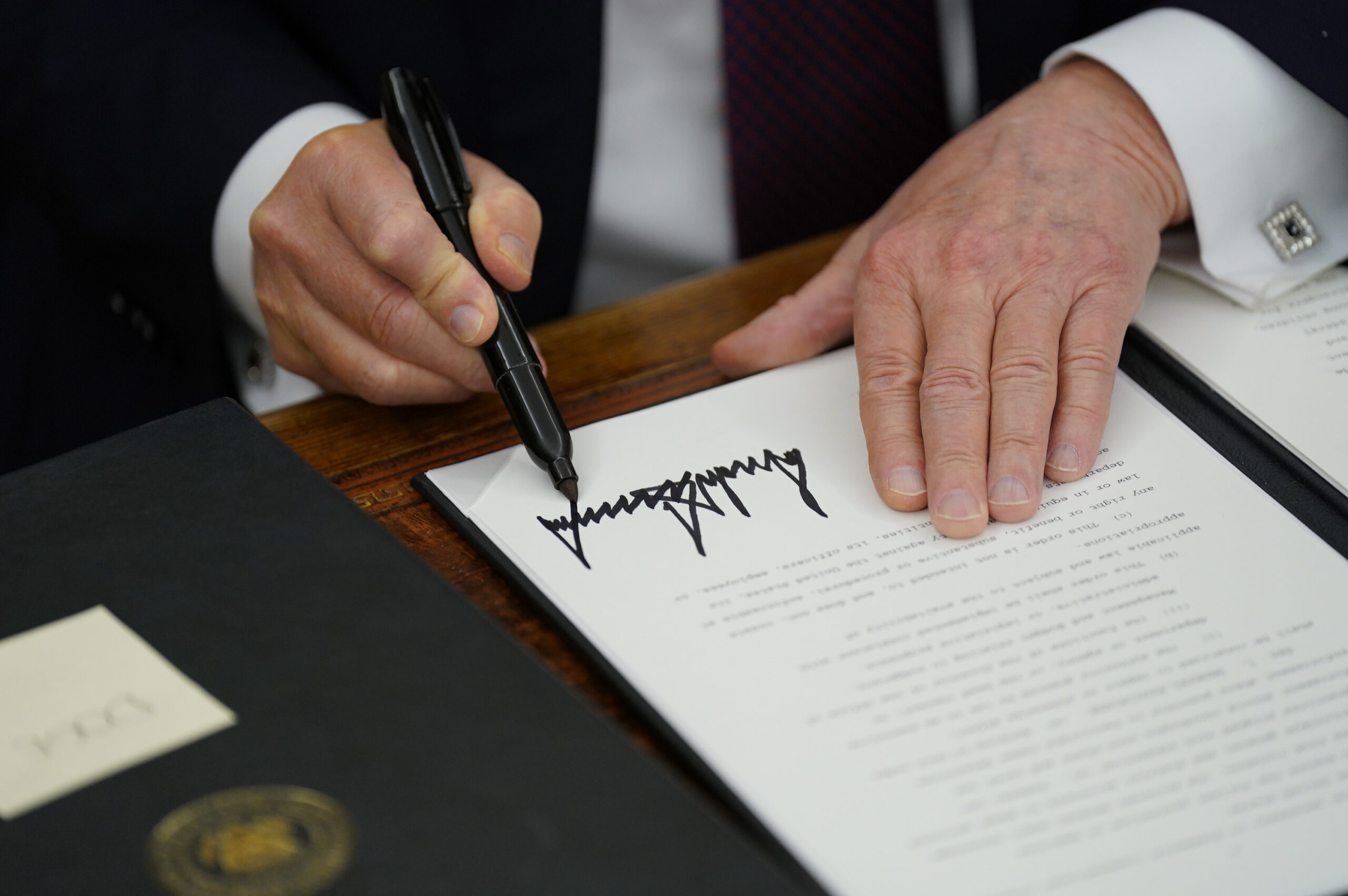
Trump’s
jagged,
thirsty
signature
is
going
to
adorn
U.S.
paper
currency.
The
Treasury
Department
also
intends
to
drop
the
signature
of
the
U.S.
Treasurer,
a
first
since
greenbacks
were
originally
introduced
in
1861.
Trump,
while
he
does
still
head
an
ever-shrinking
cult
of
irrationally
devoted
supporters,
is
probably
the
most
loathed
president
in
United
States
history.
Some
outraged
citizens
claim
that
they
will
refuse
to
use
any
paper
currency
bearing
Trump’s
signature.
Personally,
I
believe
large-scale
resistance
to
Trump-signed
paper
money
is
going
to
take
a
different
form.
Remember
when
he
slapped
his
disgusting
glowering
mug
on
this
year’s
annual
National
Parks
passes
right
next
to
a
portrait
of
George
Washington
like
a
total
f*cking
lunatic?
Well,
it
took
no
time
at
all
for
people
to
start
distributing
custom
stickers
fit
to
go
right
over
Trump’s
stupid
face,
or
to
just
color
over
it
with
a
Sharpie.
The
Trump
administration
then
scrambled
to
try
to
force
the
hardworking
NPS
rangers
it
had
treated
like
a
mass
of
human
garbage
during
its
DOGE
campaign
to
disallow
people
who’d
already
paid
for
their
passes
from
using
them
to
get
into
National
Parks
if
they’d
covered
the
Trump
photo.
Well,
the
Trump
picture
on
the
National
Parks
pass
went
over
like
a
fart
in
church,
and
it
seems
to
me
that
the
Trump
signature
on
paper
money
is
even
more
ill-conceived.
How
long
do
you
think
it’s
going
to
take
for
someone
to
start
selling
a
desktop
stamp
that
allows
a
person
to
stamp
every
single
Trump-signed
bill
they
come
across
to
read
“Donald
J.
Trump
protects
pedophiles”
in
his
own
dopey
handwriting
so
it
looks
like
he
wrote
it
himself?
I
should
note
that
anyone
who
“mutilates,
cuts,
defaces,
disfigures,
or
perforates”
a
banknote
with
intent
to
render
it
unfit
for
reissue
(the
intent
part’s
important)
commits
a
crime,
and
I
am
certainly
not
advocating
for
anyone
to
do
anything
like
that.
That
being
said,
it
actually
isn’t
against
the
law
to
harmlessly
write,
draw,
or
doodle
in
a
small
space
on
your
paper
currency
as
long
as
you’re
not
putting
an
advertisement
on
it.
Plus,
unlike
with
a
National
Parks
pass
that
is
issued
to
and
tied
to
an
individual
person,
cash
changes
hands
a
lot.
It
would
be
very
easy
for
anyone
with
a
modified
bill
to
claim
it
came
to
them
that
way
in
a
legitimate
cash
transaction.
The
possibilities
are
endless,
and
I
frankly
can’t
wait
to
see
what
people
come
up
with.
The
first
Trump-signed
hundred
dollar
bills
are
supposedly
going
to
be
printed
in
June,
with
other
denominations
to
follow,
though
keep
in
mind
that
his
ballroom
is
still
a
crater
in
the
ground
where
the
East
Wing
of
the
White
House
used
to
be,
Iran
is
far
from
fully
defeated,
and
we’re
still
waiting
on
that
wall
that
Mexico
was
supposed
to
pay
for
in
his
first
term.
Folks,
Trump
turns
80
in
June,
just
in
time
for
his
new
$100
bills
to
drop.
Hard
to
believe
though
it
is,
everything
is
only
going
to
keep
getting
even
stupider
from
here.
Hopefully
at
least
we
can
all
get
a
few
lolz
out
of
this
one.
Jonathan
Wolf
is
a
civil
litigator
and
author
of Your
Debt-Free
JD (affiliate
link).
He
has
taught
legal
writing,
written
for
a
wide
variety
of
publications,
and
made
it
both
his
business
and
his
pleasure
to
be
financially
and
scientifically
literate.
Any
views
he
expresses
are
probably
pure
gold,
but
are
nonetheless
solely
his
own
and
should
not
be
attributed
to
any
organization
with
which
he
is
affiliated.
He
wouldn’t
want
to
share
the
credit
anyway.
He
can
be
reached
at [email protected].
The
Supreme
Court
heard
oral
argument
on
Trump’s
effort
to
erase
birthright
citizenship
from
the
Constitution
via
executive
order,
and
it
went
as
poorly
for
the
administration
as
expected.
But
that
didn’t
deter
Trump
from
taking
the
unprecedented
step
of
attending
the
argument
personally.
The
president
didn’t
last
the
whole
time
though,
heading
for
the
exit
mid-proceeding
as
it
became
clear
that
his
Solicitor
General
was
getting
boatraced
by
the
competition.
Afterward,
the
graduates
of
the
Twitter
School
of
Law
ran
to
their
computers
to
complain
about
Justice
Jackson
because…
racism.
Meanwhile,
a
Texas
judge
earns
viral
infamy
for
sniping
at
an
IT
worker
and
then
doubled
down
on
arrogance.
And
the
Attorney
General
got
canned.
The
change
in
our
ranking
is
a
result
of
shifts
in
the
U.S.
News
formula,
not
any
meaningful
change
in
Berkeley
Law.
—
Dean
Erwin
Chemerinsky,
in
comments
given
to
Reuters,
concerning
UC
Berkeley
School
of
Law’s
tumble
in
the
latest
edition
of
the
U.S.
News
law
school
rankings.
Berkeley
has
been
a
mainstay
in
the
T14
since
the
90s,
but
the
school
landed
at
No.
16
in
this
year’s
version
of
the
rankings.
Staci
Zaretsky is
the
managing
editor
of
Above
the
Law,
where
she’s
worked
since
2011.
She’d
love
to
hear
from
you,
so
please
feel
free
to email her
with
any
tips,
questions,
comments,
or
critiques.
You
can
follow
her
on Bluesky, X/Twitter,
and Threads, or
connect
with
her
on LinkedIn.
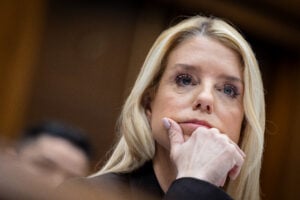
Pam
Bondi
is
reportedly
trying
to
spin
her
unceremonious
journey
into
the
dustbin
of
history
into
an
excuse
to
*not*
testify
before
Congress.
The
now-former
Attorney
General
was
subpoenaed
to
appear
before
the
House
Oversight
Committee
last
month.
In
a
rare
bipartisan
moment
fueled
by
the
principle
that
“this
looks
bad”
(sometimes)
transcends
party
lines,
five
Republicans
on
the
committee
joined
the
Dems
to
demand
answers
over
Bondi’s
handling
of
the
Epstein
files.
But
assistant
attorney
general
Patrick
Davis
wrote
to
the
committee
to
“kindly
ask
that
you
confirm
that
the
subpoena
is
withdrawn,”
and
that
the
DOJ
“continues
to
believe
that
additional
compulsory
process
is
unnecessary
in
light
of
our
demonstrated
willingness
to
voluntarily
assist
your
oversight
efforts.”
And
a
spokesperson
for
the
Department
said,
“Because
of
the
leadership
transition
at
the
Department,
the
subpoena
no
longer
applies.”
Which,
I
guess
if
you
never
ask
the
answer
is
always
no.
But,
let’s
be
so
fucking
for
real
right
now,
that
argument
is
about
as
persuasive
as
a
toddler
claiming
bedtime
“no
longer
applies”
because
they
changed
into
different
pajamas.
Unsurprisingly,
the
committee
is
not
buying
what
DOJ
is
selling
at
the
clearance
rack
of
accountability
—
they’ve
already
confirmed
they’ll
reach
out
to
her
personal
attorney.
“The
Department
of
Justice
has
stated
Pam
Bondi
will
not
appear
on
April
14
for
a
deposition
since
she
is
no
longer
Attorney
General
and
was
subpoenaed
in
her
capacity
as
Attorney
General,”
a
spokeswoman
for
Oversight
Republicans
said
in
a
statement.
“The
Committee
will
contact
Pam
Bondi’s
personal
counsel
to
discuss
next
steps
regarding
scheduling
her
deposition.”
Plus
the
committee
has
already
heard
testimony
from,
ahem,
former
Attorney
General
Bill
Barr,
proving
that
“ex-A.G.”
is
not,
in
fact,
a
cloak
of
invisibility.
And
top
Democrat
on
the
committee
Rep.
Richard
Garcia
made
it
clear
he’s
not
going
to
let
this
go.
“She
must
come
in
to
testify
immediately,
and
if
she
defies
the
subpoena,
we
will
begin
contempt
charges
in
the
Congress,”
he
said.
“The
survivors
deserve
justice.”
Rep.
James
Walkinshaw
noted
the
subpoena
“did
not
become
null
and
void
when
she
was
fired.”
Republican
Nancy
Mace
also
had
strong
words
for
the
flimsy
excuse.
“Leaving
office
doesn’t
mean
you
get
to
dodge
accountability,”
Mace
said
in
a
statement.
“Pam
Bondi
was
subpoenaed
by
name,
not
by
title,
and
because
the
DOJ
stonewalled
Congress
and
refused
to
follow
the
law,
she
needs
to
appear
before
the
Oversight
Committee
and
answer
for
it.”
“She
promised
she
would
comply,”
she
said.
“April
14
is
her
chance
to
prove
it.
Chairman
Comer
must
make
one
thing
clear:
show
up
or
face
contempt.”
The
committee
sure
looks
like
they’re
ready
to
go
all
in
to
show
Bondi
you
can’t
ghost
Congress
like
a
bad
Hinge
date.
Kathryn
Rubino
is
a
Senior
Editor
at
Above
the
Law,
host
of
The
Jabot
podcast,
and
co-host
of
Thinking
Like
A
Lawyer.
AtL
tipsters
are
the
best,
so
please
connect
with
her.
Feel
free
to
email
her
with
any
tips,
questions,
or
comments
and
follow
her
on
Twitter
@Kathryn1 or
Mastodon
@[email protected].
(Photo
by
Jennifer
S.
Altman/For
The
Washington
Post
via
Getty
Images)
Michael
Avenatti
managed
to
speedrun
the
full
Above
the
Law
experience.
He
spent
2018
as
the
most
visible
lawyer
in
America
while
representing
Stormy
Daniels
and
appearing
on
CNN
approximately
seven
thousand
times
as
a
thorn
in
Donald
Trump’s
side.
He
even
floated
a
presidential
run
and
appeared
on
America’s
favorite
podcast.
His
domination
of
the
news
that
year
earned
him
Above
the
Law’s
2018
Lawyer
of
the
Year
award.
Then
he
became
the
other
kind
of
ATL
story,
as
cases
cropped
up
on
both
coasts
alleging
an
effort
to
extort
millions
in
settlement
money
from
Nike,
stealing
$300,000
from
Stormy
Daniels
—
his
own
client
—
through
identity
theft
and
wire
fraud,
embezzling
millions
from
four
other
clients
including
a
mentally
ill
paraplegic,
and
obstructed
IRS
efforts
to
collect
payroll
taxes
from
his
coffee
business.
His
domination
of
the
news
for
all
the
wrong
reasons
earned
him
a
nomination
for
our
Lawyer
of
the
Year
award
in
2022.
Ultimately,
Avenatti
landed
in
federal
prison.
But
now
he’s
back!
Or
at
least
halfway
back,
as
TMZ
reports
the
former
gadfly
attorney
currently
resides
at
a
halfway
house
in
Hollywood
until
September
2028,
which
is
spectacularly
on-brand.
Avenatti
was
reportedly
released
Tuesday
after
serving
roughly
four
years
of
his
11-year,
3-month
sentence
(he
was
once
sentenced
to
14
years,
but
resentencing
shaved
some
time
off).
He
still
owes
$5,937,725.58
in
restitution
and
is
required
to
participate
in
mental
health
treatment.
Avenatti
built
his
fame
as
Trump’s
most
aggressive
legal
antagonist.
He
emerges
into
a
world
where
Trump
is
back
in
the
White
House
shielded
with
functional
total
immunity
courtesy
of
judicial
fiat
and
lawyers
who
break
the
basic
rules
of
professional
responsibility
collect
lifetime
judicial
appointments
instead
of
halfway
house
assignments
(as
long
as
they
do
it
on
the
government’s
behalf).
None
of
this
is
to
suggest
that
Avenatti
was
treated
unfairly.
But
it
does
underscore
how
lawyerly
misconduct
is
a
one-way
ratchet.
Over/under
on
when
he
launches
a
Substack?
I’m
taking
the
under.
A
retro
looking
funny
angry
computer
office
worker
holding
mouse
and
yelling
in
frustration.
Wood
paneling
office
with
vintage
computer
and
keyboard
on
desk.
Because
having
the
highest
score
requirement
to
pass
isn’t
enough
of
a
challenge,
the
California
bar
has
also
boasted
its
fair
share
of
tech
mishaps.
AI-generated
questions,
grading
screw-ups,
and
faulty
software
made
it
seem
like
test
takers
were
sleuthing
out
maximum
patience
rather
than
minimum
competency.
But
who
says
you
have
to
finish
law
school
before
a
test’s
technical
failures
makes
you
want
to
rip
your
hair
out?
UC
Berkeley’s
required
exam
software
has
its
fair
share
of
errors
and
students
are
pushing
back
against
being
forced
to
use
it.
Daily
Cal
has
coverage:
In
the
face
of
high-stakes
exams,
students
at
the
UC
Berkeley
School
of
Law
have
voiced
concerns
over
required
exam
software,
citing
serious
technical
issues,
privacy
risks
and
exam
complications
while
the
school
continues
to
use
Electric
Bluebook,
or
EBB. … Last
fall,
a
version
of
the
software
posed
issues
for
a
number
of
students,
including
crashes,
failed
submissions,
device
malfunctions
that
required
full
restarts
and
data
access
concerns
that
led
some
to
arrange
borrowing
a
new
device.
“We
received
over
150
anonymous
comments
last
semester
raising
technical
problems,
privacy
issues,
or
personal
concerns
relating
to
the
Electronic
Bluebook,”
said
Ben
Shipman,
the
co-president
of
the
Student
Association
of
Berkeley
Law,
in
an
email.
“This
semester
specifically,
we
received
57
non-anonymous
concerns
in
addition
to
more
concerns
raised
by
anonymous
submissions,
in-the-hall
interactions,
and
students
who
came
to
SABL’s
semesterly
Town
Hall
in
which
they
voiced
concerns
about
the
EBB.”
The
silver
lining
is
that
the
school
reached
out
to
the
developer
to
fix
the
errors.
Unfortunately,
there
are
still
privacy
concerns
even
if
the
exams
run
smoothy.
The
EBB
requires
admin
access
to
sensitive
data
on
the
student’s
computers
making
international
students
and
students
doing
pro-bono
work
hesitant
to
use
the
program.
Where
the
EBB
poses
too
difficult,
it
might
be
time
for
the
old
non-digital
version
to
step
up.
Chris
Williams
became
a
social
media
manager
and
assistant
editor
for
Above
the
Law
in
June
2021.
Prior
to
joining
the
staff,
he
moonlighted
as
a
minor
Memelord™
in
the
Facebook
group Law
School
Memes
for
Edgy
T14s
.
He
endured
Missouri
long
enough
to
graduate
from
Washington
University
in
St.
Louis
School
of
Law.
He
is
a
former
boat
builder
who
is
learning
to
swim
and
is
interested
in
rhetoric,
Spinozists
and
humor.
Getting
back
in
to
cycling
wouldn’t
hurt
either.
You
can
reach
him
by
email
at
[email protected]
and
by
Tweet/Bluesky
at @WritesForRent.
Last
year,
when
news
broke
that
Paul,
Weiss,
Rifkind,
Wharton
&
Garrison
was
inking
a
deal
with
the
Trump
administration
—
and,
more
to
the
point,
capitulating
—
it
landed
like
a
thunderclap.
Not
just
because
a
major
law
firm’s
whole
deal
is
supposed
to
be
defending
the
rule
of
law,
and
not
folding
like
a
wet
napkin
the
second
things
get
uncomfortable,
but
because
it
was
Paul,
Weiss.
This
is
a
firm
with
a
reputation
for
elite
litigators
who
didn’t
just
talk
a
big
game
about
standing
up
to
power,
they
actually
did
it
during
the
first
Trump
administration.
Hell,
for
decades
Paul,
Weiss
was
thought
of
as
the
Biglaw
firm
where
someone
with
progressive
politics
could
find
a
home.
And
now,
with
the
benefit
of
hindsight,
that
capitulation
looks
less
like
a
one-off
misstep
and
more
like
the
first
visible
crack
in
a
much
deeper
internal
transformation.
Now
there’s
a
new
chair
at
the
once-venerable
Biglaw
shop.
And
though
the
Trumpian
deal
was
widely
panned
by
those
in
the
legal
industry,
that
was
not
the
undoing
of
former
chair
Brad
Karp.
No,
it
was
his
repeated
appearances
in
the
Epstein
files
which
revealed
a
much
cozier
relationship
with
the
infamous
pedophile
than
previously
known.
Now
at
the
helm
of
Paul,
Weiss
is
mergers
&
acquisitions
partner
Scott
Barshay,
who
Karp
crowed
about
wooing
over
from
Cravath
in
2016.
Barshay
was
reportedly
a
major
internal
cheerleader
of
the
Trump
deal,
dressing
up
the
cowardice
as
pragmatism.
But
as
Above
the
Law
readers
know,
that
decision
ruffled
feathers
and
sent
litigators
packing.
And
more
may
be
headed
for
the
exits.
As
the
Wall
Street
Journal
reports,
additional
litigation
partners
are
currently
in
talks
to
leave,
while
Barshay
has
been
crisscrossing
the
country
trying
to
reassure
the
troops
that
everything
is
totally
fine,
nothing
to
see
here,
please
stop
updating
your
LinkedIn.
Barshay
has
been
steadily
reshaping
Paul,
Weiss
(pushing
for
the
changes
even
before
he
took
over
as
Chair)
into
something
that
looks
a
lot
more
like
a
hyper-corporatized
profit
machine
than
the
legacy
institution
many
of
the
partners
thought
they
signed
up
for.
The
partner
compensation
system
has
been
revamped
to
throw
eye-watering
sums
at
rainmakers.
Associate
staffing
is
now
more
tightly
controlled,
ending
the
firm’s
generalist
model
and
limiting
who
gets
to
work
with
whom
in
the
name
of
client
consistency.
The
firm’s
partner
meetings
are
reportedly
more
“subdued,”
which
is
a
nice
way
of
saying
the
personality
has
been
sanded
down
to
corporate
beige.
And
Barshay’s
push
to
make
the
firm
apolitical
has
sealed
the
transition
from
“litigation
powerhouse
with
a
conscience”
to
“M&A
juggernaut
with
a
carefully
managed
personality.”
But
here’s
the
part
that
makes
all
of
this
deliciously
complicated
—
the
numbers
are
good.
Like,
really
good.
Revenue
is
up
(23.8%
to
$3.26
billion)
and
profits
per
equity
partner
are
up
(14.5%).
The
money
is
flowing,
and
in
Biglaw,
that
tends
to
function
as
the
ultimate
sedative.
Barshay’s
changes
are
working
in
a
purely
financial
sense,
but
at
some
point,
the
people
who
came
for
something
more
than
just
a
paycheck
are
going
to
look
around
and
realize
they’re
working
at
a
place
they
barely
recognize.
Kathryn
Rubino
is
a
Senior
Editor
at
Above
the
Law,
host
of
The
Jabot
podcast,
and
co-host
of
Thinking
Like
A
Lawyer.
AtL
tipsters
are
the
best,
so
please
connect
with
her.
Feel
free
to
email
her
with
any
tips,
questions,
or
comments
and
follow
her
on
Twitter
@Kathryn1 or
Mastodon
@[email protected].
In
2023,
Judge
Roger
Benitez
of
the
Southern
District
of
California
ordered
his
marshals
to
handcuff
a
crying
child
attending
her
father’s
hearing
and
place
her
in
the
jury
box.
Then
he
asked
the
13-year-old
girl
if
she
liked
the
cuffs
and
told
her
she
was
“an
awfully
cute
young
lady.”
He
then
revoked
her
father’s
parole
and
sentenced
him
to
prison,
a
ruling
swiftly
reversed
by
the
next
judge
who
heard
the
case,
who
decided
that
the
man
having
to
watch
his
daughter
psychologically
tortured
by
a
federal
judge
was
probably
punishment
enough.
Now
he’s
retiring.
Benitez
earned
a
formal
complaint
over
the
handcuffing
incident,
which
the
Ninth
Circuit
was
forced
to
announce
publicly
after
Above
the
Law
reported
on
it.
After
sitting
on
the
complaint
for
over
a
year
to
let
the
heat
die
down,
the
Judicial
Council
found
“the
shackling
of
a
spectator
at
a
hearing
who
is
not
engaged
in
threatening
or
disorderly
behavior
exceeds
the
authority
of
a
district
judge,”
and
that
“creating
a
spectacle
out
of
a
minor
child
in
the
courtroom
chills
the
desire
of
friends,
family
members,
and
members
of
the
public
to
support
loved
ones
at
sentencing.”
Despite
these
serious
findings,
Benitez
received
gentle
slap
on
the
wrist
with
a
wet
noodle.
He
responded
to
his
punishment
by
telling
Reuters
that
he
disagreed
with
it.
Well,
at
least
he
learned
absolutely
nothing!
But
when
he
wasn’t
traumatizing
children
directly,
Benitez
was
traumatizing
them
indirectly
as
one
of
the
federal
judiciary’s
most
enthusiastic
supporters
of
the
school
shooting
industrial
complex.
Benitez
used
his
senior
status
to
pursue
ideological
assaults
on
the
will
of
California
voters,
routinely
striking
down
gun
regulations
in
cases
cynically
routed
to
his
courtroom.
A
rule
allowing
one
party
to
request
(without
the
other
party
having
a
right
to
object)
that
cases
be
transferred
to
a
judge
hearing
a
matter
involving
“similar”
issues,
giving
gun
advocates
a
fast
track
to
the
gun
manufacturing
lobby
friendly
Benitez
once
he
took
on
his
first
gun
rights
case.
From
this
perch,
he
struck
down
everything
from
background
check
legislation
and
large-capacity
magazine
limits.
Neither,
of
course,
prevents
someone
from
exercising
their
Second
Amendment
rights
to
possess
a
firearm
in
a
regulated
space,
but
both
did
make
it
harder
for
wingnuts
to
carry
out
high-impact
violent
rampages.
Benitez
also
compared
AR-15s
to
“Swiss
Army
knives,”
which
is
accurate
assuming
someone
affixes
a
bayonet
and
a
corkscrew.
As
a
senior
status
judge,
his
retirement
does
not
give
the
administration
a
vacancy
to
fill.
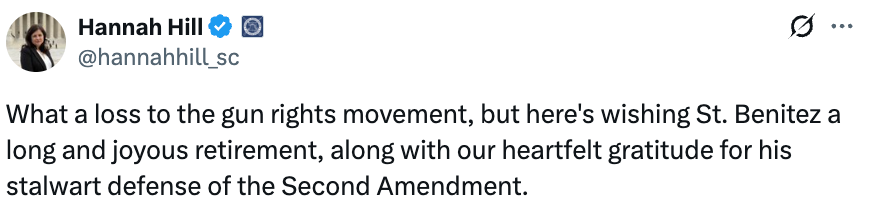
One
might
think
that
even
those
who
appreciated
his
rulings
might
shy
away
from
celebrating
a
guy
known
for
handcuffing
innocent
kids,
but
you’d
be
wildly
underestimating
how
much
conservatives
care
about
guns
more
than
kids.
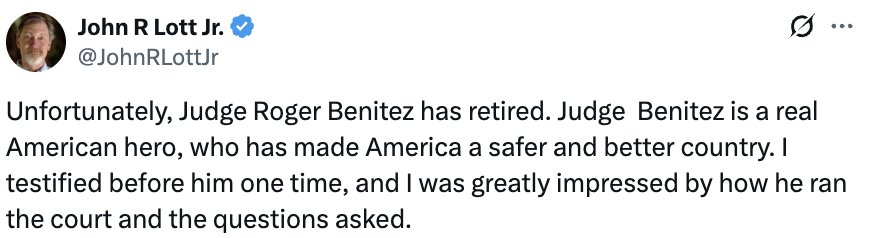
Remember,
when
Lott
says
Benitez
made
“a
safer
and
better
country,”
a
specific
statute
at
issue
was
“maybe
we
run
a
check
to
make
sure
we’re
not
selling
ammunition
to
someone
who
just
escaped
a
psych
ward.”
If
your
definition
of
America’s
“safety”
is
ensuring
that
someone
who
scribbles
“I
am
the
angel
of
death…
the
time
of
purification
is
at
hand”
all
over
their
walls
can
buy
a
thousand
rounds
of
5.56
like
they’re
picking
up
bubble
gum,
then
Benitez
was
definitely
your
guy.
Benitez
once
wrote
“Guns
and
ammunition
in
the
hands
of
criminals,
tyrants
and
terrorists
are
dangerous;
guns
in
the
hands
of
law
abiding
responsible
citizens
are
necessary.”
And
yet,
he
struck
down
statutes
narrowly
tailored
to
keep
guns
out
of
the
hands
of
criminals
and
terrorists
while
not
imposing
any
more
than
a
clerical
wait
upon
law-abiding
citizens.
It’s
almost
like
all
the
sanctimonious
rights
talk
is
just
a
contrivance
to
make
sure
no
one
puts
a
dent
in
Winchester’s
profits.
Points
for
honesty
though.
While
most
would
applaud
a
judge
for
their
commitment
to
“the
Constitution”
or
“rule
of
law”
—
however
disingenuous
those
claims
might
be
—
at
least
someone
is
willing
to
just
admit
Benitez
was
a
gun
rights
movement
activist
with
a
robe.
Also,
you’ve
got
to
love
injecting
a
little
sacrilegious
idolatry!
But
it’s
not
fair
to
reduce
Benitez’s
whole
career
to
being
a
shill
for
the
gun
lobby.
Yes,
he’s
also
the
judge
from
Mirabelli,
stripping
away
a
law
protecting
children
from
having
teachers
inform
parents
about
a
child’s
LGBTQ+
identity.
While
opponents
of
the
law
cast
it
as
infringing
on
parents’
rights
or
even
religious
rights,
the
statute
was
more
about
keeping
teachers
from
outing
students
against
their
will
since
parents
themselves
remain
one
of
the
most
dangerous
threats
to
LGBTQ+
children.
And
it
wasn’t
just
protecting
LGBTQ+
children,
because
the
law
also
endeavored
to
keep
teachers
with
no
real
qualifications
in
this
area
from
snitching
to
parents
because
they
thought
Johnny
playing
dolls
at
recess
was
the
start
of
something.
Handcuffing
a
crying
child
as
a
prop
to
traumatize
both
her
and
her
father
really
was
more
of
a
feature
than
a
bug.
Children
were,
consistently,
the
victims
of
Judge
Benitez’s
time
on
the
bench.
They
were
a
population
to
be
routinely
sacrificed
for
his
preferred
personal
politics,
dressed
up
with
obligatory
references
to
what
the
Framers
would’ve
thought.
So
maybe
his
fans
are
right,
and
Benitez
has,
at
last,
finally
made
America
a
safer
and
better
country.
By
retiring.
Joe
Patrice is
a
senior
editor
at
Above
the
Law
and
co-host
of
Thinking
Like
A
Lawyer.
Feel
free
to email
any
tips,
questions,
or
comments.
Follow
him
on Twitter or
Bluesky
if
you’re
interested
in
law,
politics,
and
a
healthy
dose
of
college
sports
news.
For
a
long
time,
the
definition
of
a
competent
lawyer
was
relatively
stable.
You
knew
the
law.
You
understood
the
procedure.
You
prepared
your
case.
You
showed
up.
You
asked
the
right
questions.
You
made
your
arguments.
You
learned
from
experience.
Technology
sat
on
the
periphery.
It
made
things
faster.
It
made
things
easier.
It
rarely
changed
the
core
of
what
it
meant
to
practice
well.
That
is
no
longer
true.
Litigation
is
beginning
to
move
in
real
time.
And
when
that
happens,
competence
starts
to
shift.
During
a
recent
conversation
with
Dean
Whalen,
chief
legal
officer
of
Readback,
we
explored
what
this
shift
looks
like
inside
one
of
the
most
consequential
moments
in
litigation:
the
deposition.
You
can
watch
the
full
discussion
here:
The
takeaway
is
not
that
technology
replaces
lawyers.
It
does
not.
The
takeaway
is
more
subtle
and
more
important.
When
the
tools
available
to
lawyers
change
the
speed,
precision,
and
visibility
of
decision-making,
the
baseline
for
competent
practice
shifts
with
them.
The
Old
Rhythm
Of
Litigation
For
decades,
depositions
followed
a
familiar
pattern.
Lawyers
prepared
their
outlines.
They
walked
into
the
room.
They
asked
questions.
A
stenographer
recorded
the
exchange.
And
then
everyone
waited.
Days
or
weeks
later,
the
transcript
arrived.
Only
then
could
lawyers
confirm
what
had
actually
been
said,
whether
key
testimony
landed
as
intended,
and
how
the
record
might
affect
summary
judgment
or
settlement
strategy.
Dean
described
that
experience
with
a
mix
of
familiarity
and
frustration.
“I
would
hear
attorneys
say,
‘I
think
we
did
really
well,
but
let’s
see
how
the
transcript
reads.’”
That
sentence
captures
an
older
rhythm
of
litigation.
Act
first.
Analyze
later.
It
was
acceptable
because
there
was
no
alternative.
When
Litigation
Becomes
Immediate
That
rhythm
is
starting
to
break.
Real-time
transcription,
live
annotation
tools,
and
AI-assisted
analysis
are
changing
how
depositions
unfold.
Lawyers
can
now
see
testimony
as
it
happens.
They
can
confirm
whether
an
answer
is
precise.
They
can
adjust
their
questions
immediately.
In
some
cases,
experts
are
observing
the
deposition
remotely,
reviewing
testimony
in
real
time,
and
feeding
suggestions
back
to
the
examining
attorney.
The
deposition
becomes
less
of
a
static
event
and
more
of
a
dynamic
system.
Imagine
a
key
witness
gives
a
vague
answer
on
causation.
In
the
old
model,
that
ambiguity
might
not
be
discovered
until
days
later,
after
the
deposition
is
over.
In
a
real-time
environment,
it’s
caught
immediately,
clarified
on
the
spot,
and
locked
into
the
record.
Dean
put
it
plainly.
“In
today’s
information
age,
we
shouldn’t
have
to
walk
out
of
there
not
knowing
that
we’ve
precisely
nailed
the
testimony.”
That
expectation
would
have
sounded
unrealistic
not
long
ago.
Today,
it
is
increasingly
achievable.
And
once
something
becomes
achievable,
it
starts
to
influence
what
clients
expect.
Competence
Is
No
Longer
Static
The
legal
profession
has
always
tied
competence
to
knowledge
and
judgment.
That
remains
true.
Technology
does
not
replace
either.
But
competence
has
also
always
had
a
practical
dimension.
It
reflects
what
a
reasonable
lawyer
should
know
and
do
under
current
conditions.
Dean
pointed
to
this
directly
when
discussing
ethical
obligations.
“We
as
attorneys
need
to
stay
up
and
competent
on
technologies,”
he
said,
referencing
the
professional
expectation
that
lawyers
understand
tools
that
can
benefit
their
clients.
There
was
a
time
when
it
was
reasonable
to
ignore
certain
tools.
They
were
too
expensive.
Too
immature.
Too
unreliable.
That
argument
is
becoming
harder
to
sustain.
When
real-time
tools
improve
the
accuracy
of
testimony,
reduce
ambiguity,
and
allow
lawyers
to
correct
gaps
before
they
become
embedded
in
the
record,
they
are
not
simply
conveniences.
They
are
inputs
into
the
quality
of
representation.
That
does
not
mean
every
tool
must
be
adopted.
It
does
mean
every
tool
worth
considering
must
be
evaluated.
The
In-House
Perspective
This
shift
is
particularly
important
for
in-house
counsel.
Legal
departments
are
not
only
consumers
of
legal
services.
They
are
managers
of
risk,
cost,
and
outcomes.
They
rely
on
outside
counsel
to
execute
a
litigation
strategy,
but
they
remain
accountable
for
the
results.
When
depositions
become
more
dynamic
and
data-rich,
in-house
leaders
gain
new
leverage
and
face
new
responsibilities.
They
can
ask
better
questions.
How
quickly
do
we
know
what
happened
in
a
deposition? How
confident
are
we
in
the
accuracy
of
the
transcript? Are
we
adjusting
strategy
in
real
time
or
reacting
weeks
later?
These
are
not
technical
questions.
They
are
management
questions.
Dean
framed
it
in
practical
terms.
“If
you’re
speaking
to
outside
counsel,
you
want
to
make
sure
you’re
using
all
the
tools
at
your
disposal
to
maximize
your
ability
to
win
the
case.”
That
does
not
require
in-house
lawyers
to
become
technologists.
It
requires
them
to
understand
where
technology
changes
outcomes.
The
Resistance
Is
Real
Not
every
lawyer
is
eager
to
embrace
this
shift.
Some
argue
that
real-time
tools
are
distracting.
They
prefer
to
maintain
eye
contact
with
the
witness,
focus
on
the
flow
of
questioning,
and
avoid
splitting
attention
between
the
person
in
front
of
them
and
the
transcript
on
the
screen.
That
concern
is
legitimate.
Litigation
is
still
a
human
process.
Rapport,
pressure,
and
presence
matter.
A
deposition
is
not
simply
a
data
exercise.
Dean
acknowledged
this
tension.
“Some
lawyers
want
to
be
eye
to
eye
with
the
witness,”
he
said.
“They
don’t
want
to
be
looking
to
the
right
to
see
how
the
transcript
is
being
created.”
But
he
also
described
a
middle
ground.
“I
call
it
the
safety
net
use
of
it.
Don’t
look
at
it
while
you’re
questioning.
Use
it
during
a
break.
Make
sure
you
actually
nailed
the
testimony.”
This
framing
matters.
The
question
is
not
whether
technology
should
replace
traditional
skills.
It
should
not.
The
question
is
whether
technology
can
reinforce
those
skills
by
reducing
avoidable
error.
Guardrails
Define
The
Future
As
litigation
becomes
more
dependent
on
technology,
another
issue
becomes
central:
trust.
Not
all
tools
are
created
equal.
Not
all
systems
protect
data.
Not
all
outputs
are
admissible.
Dean
was
clear
about
what
matters.
“You
want
to
make
sure
that
your
transcript
is
admissible.
You
want
to
make
sure
your
data
is
protected.
You
want
to
make
sure
there’s
human
oversight.”
Those
are
not
minor
details.
They
are
the
difference
between
useful
innovation
and
professional
risk.
In
many
ways,
this
is
where
competence
becomes
most
nuanced.
It
is
not
enough
to
adopt
new
tools.
Lawyers
must
understand
how
those
tools
work,
what
risks
they
introduce,
and
how
to
use
them
responsibly.
A
Moving
Baseline
The
definition
of
competence
does
not
change
overnight.
It
shifts
gradually,
almost
imperceptibly,
as
new
capabilities
become
standard
and
expectations
adjust.
We
are
in
the
middle
of
one
of
those
shifts.
Litigation
is
becoming
more
immediate.
Information
is
becoming
more
accessible.
Feedback
loops
are
getting
shorter.
In
that
environment,
waiting
weeks
to
understand
what
happened
in
a
deposition
starts
to
feel
less
like
prudence
and
more
like
delay.
The
profession
does
not
need
to
abandon
its
foundations
to
adapt.
Legal
judgment,
preparation,
and
advocacy
remain
central.
But
the
conditions
under
which
those
skills
are
applied
are
changing.
And
when
the
conditions
change,
competence
follows.
Lawyers
who
recognize
this
shift
early
won’t
simply
change
how
they
practice.
They’ll
change
the
outcomes
they
deliver.
Competence
isn’t
standing
still.
It’s
keeping
up.
Olga
V.
Mack
is
the
CEO
of
TermScout,
where
she
builds
legal
systems
that
make
contracts
faster
to
understand,
easier
to
operate,
and
more
trustworthy
in
real
business
conditions.
Her
work
focuses
on
how
legal
rules
allocate
power,
manage
risk,
and
shape
decisions
under
uncertainty.
A
serial
CEO
and
former
General
Counsel,
Olga
previously
led
a
legal
technology
company
through
acquisition
by
LexisNexis.
She
teaches
at
Berkeley
Law
and
is
a
Fellow
at
CodeX,
the
Stanford
Center
for
Legal
Informatics.
She
has
authored
several
books
on
legal
innovation
and
technology,
delivered
six
TEDx
talks,
and
her
insights
regularly
appear
in
Forbes,
Bloomberg
Law,
VentureBeat,
TechCrunch,
and
Above
the
Law.
Her
work
treats
law
as
essential
infrastructure,
designed
for
how
organizations
actually
operate.






 Kathryn