In
a
communique,
Taungana
Ndoro,
the
Ministry
of
Primary
and
Secondary
Education’s
director
of
communications
and
advocacy,
urged
heads
of
centres
to
make
sure
all
candidates
are
registered
through
the
online
system
before
the
deadline.
Said
Ndoro:
“All
centres
must
use
the
online
registration
system
and
heads
of
centres
bear
full
responsibility
for
the
accurate
submission
of
candidate
data.”
Ndoro
said
examination
centres
must
have
at
least
10
candidates
for
both
Ordinary
and
Advanced
Level
exams.
He
added
that
private
candidates
are
required
to
present
valid
identification,
such
as
a
national
ID
card,
passport,
driver’s
licence,
or
a
certified
birth
certificate,
when
registering.
Ndoro
also
said
candidates
with
special
needs
should
clearly
indicate
their
requirements
during
registration
to
ensure
the
necessary
arrangements
are
made.
Ed.
note:
We
don’t
normally
publish
op-eds
like
this,
but
given
the
gravity
of
the
ethical
issues
coming
out
of
the
Justice
Department,
we
are
lucky
to
present
this
timely
report
and
analysis
from
the
former
director
of
the
DOJ’s
Departmental
Ethics
Office,
Joseph
Tirrell.
I
spent
19
years
at
the
Justice
Department.
In
my
final
role,
as
senior
ethics
counsel
and
director
of
the
department’s
ethics
office,
I
trained
employees
on
the
Hatch
Act,
advised
leadership
on
compliance
and
helped
enforce
its
rules.
For
more
than
two
decades,
the
department
treated
its
political
appointees
as
“further
restricted”
employees
under
that
law
—
a
designation
grounded
in
a
straightforward
principle:
officials
responsible
for
enforcing
election
laws
must
be
held
to
the
highest
standard
of
political
neutrality.
The
Hatch
Act
is
the
primary
federal
law
intended
to
shield
elections
from
inappropriate
political
influence
by
government
employees.
Most
federal
workers
are
considered
“less
restricted”
under
the
law.
They
are
free
to
participate
widely
in
political
life
in
their
personal
capacities.
They
may
volunteer
for
campaigns,
attend
rallies,
distribute
campaign
messages
on
social
media
and
participate
in
party
organizations.
But
even
these
employees
face
limits.
They
may
not
engage
in
political
activity
while
on
duty
or
in
the
workplace,
solicit
campaign
contributions,
run
for
partisan
office
or
use
their
official
positions
to
influence
the
outcome
of
an
election.
A
smaller
group
of
federal
employees
—
those
whose
work
involves
investigations,
prosecutions
or
election
oversight
—
are
classified
as
“further
restricted.”
This
group
includes
employees
of
the
F.B.I.,
the
Justice
Department’s
Criminal
Division
and
the
Federal
Election
Commission.
In
addition
to
the
basic
Hatch
Act
restrictions,
these
employees
may
not
work
on
campaigns,
distribute
campaign
materials
or
hold
leadership
roles
in
political
parties.
Their
political
participation
is
largely
limited
to
voting,
donating
to
campaigns
and
expressing
personal
opinions.
The
distinction
reflects
a
deliberate
balance.
The
government
recognizes
the
political
rights
of
its
employees
while
also
protecting
the
integrity
of
institutions
that
must
enforce
election
laws
impartially.
More
than
half
a
century
ago,
the
Supreme
Court
affirmed
that
balance
in
United
States
Civil
Service
Commission
v.
National
Association
of
Letter
Carriers.
Upholding
the
Hatch
Act
in
1973,
the
court
emphasized
that
“the
impartial
execution
of
the
laws”
is
the
“great
end
of
government.”
The
logic
is
easy
to
understand.
Imagine
if
commissioners
at
the
Federal
Election
Commission
were
free
to
run
campaign
operations
for
candidates
whose
cases
might
later
appear
before
them.
Or
if
F.B.I.
agents
responsible
for
investigating
election
crimes
were
also
serving
as
leaders
in
political
parties.
Even
if
those
officials
acted
fairly,
public
confidence
in
the
integrity
of
elections
would
quickly
erode.
For
decades,
the
Justice
Department
recognized
this
risk
and
applied
the
stricter
standard
to
its
own
political
leadership.
By
long-standing
order
of
successive
attorneys
general,
political
appointees
at
the
department
were
treated
as
“further
restricted.”
Republican
and
Democratic
administrations
alike
maintained
the
policy.
In
the
months
leading
up
to
federal
elections,
department
leaders
regularly
reminded
employees
that
political
neutrality
was
essential
to
the
institution’s
credibility.
The
reasoning
was
clear.
Senior
Justice
Department
officials
oversee
matters
that
directly
affect
elections,
including
election
security,
campaign
finance
enforcement
and
civil
rights
protections
at
the
ballot
box.
They
also
speak
publicly
on
behalf
of
the
department
about
these
issues.
Allowing
these
officials
to
work
on
political
campaigns
—
even
in
their
personal
capacity
—
blurs
the
line
between
impartial
law
enforcement
and
partisan
advocacy.
Leadership
by
example
matters
as
well.
When
those
at
the
top
accept
stricter
limits
on
their
own
political
activity,
they
reinforce
the
expectation
that
the
entire
department
must
remain
above
partisan
politics.
The
new
policy
abandons
that
tradition.
The
likely
consequences
are
not
difficult
to
foresee.
Senior
officials
will
test
the
boundaries
of
their
expanded
political
freedom.
Some
will
publicly
support
candidates
on
social
media
while
insisting
they
are
speaking
only
as
private
citizens,
even
as
their
government
titles
lend
authority
to
their
words.
The
distinction
between
official
speech
and
political
advocacy
will
become
harder
to
maintain.
Once
that
line
begins
to
blur
at
the
top,
the
erosion
of
norms
throughout
the
department
becomes
almost
inevitable.
Career
employees
will
see
leaders
disregarding
long-standing
standards
and
begin
to
question
why
they
alone
should
continue
to
observe
them.
The
risk
extends
beyond
internal
discipline.
Enforcement
of
the
Hatch
Act
itself
could
come
to
appear
selective
—
vigorously
pursued
when
critics
of
the
administration
are
involved
while
violations
by
allies
receive
less
scrutiny.
More
troubling
still
is
the
potential
impact
on
election
law
enforcement.
If
the
public
comes
to
believe
that
investigations
and
prosecutions
are
influenced
by
partisan
considerations,
confidence
in
the
fairness
of
elections
will
suffer.
The
Justice
Department’s
authority
ultimately
depends
on
trust
—
the
belief
that
prosecutors
and
investigators
enforce
the
law
fairly,
without
regard
to
politics.
For
generations,
strict
limits
on
political
activity
helped
sustain
that
trust.
Weakening
those
limits
threatens
to
erode
it.
Opposition
to
this
change
must
be
loud
and
clear
until
the
former
policy
is
reinstated.
Congress
should
also
consider
expanding
the
definition
of
“further
restricted”
employees
under
the
Hatch
Act
so
that
officials
responsible
for
safeguarding
elections
remain
insulated
from
partisan
campaign
activity.
Finally,
in
preparation
for
a
new
administration,
an
Ethics
2029
playbook
must
be
developed,
strengthening
not
just
the
Hatch
Act,
but
all
of
the
ethics
rules
that
apply
to
Federal
employees,
including
the
financial
conflict
of
interest
statute,
and
Federal
Employee
Standards
of
Conduct
regulations,
particularly
the
impartiality
rules.
The
goal
is
not
to
deny
public
servants
their
political
rights.
It
is
to
protect
something
even
more
fundamental:
a
Justice
Department
that
Americans
can
trust
to
enforce
the
law
fairly
—
and
to
defend
the
integrity
of
the
nation’s
elections
without
fear
or
favor.
Joseph
W.
Tirrell
served
for
19
years
as
an
attorney
with
the
FBI
and
the
Department
of
Justice
and
was
Director
of
the
Justice
Department’s
Departmental
Ethics
Office
from
2023
to
2025.
In
that
role,
he
advised
senior
department
leadership
on
federal
ethics
rules,
including
the
Hatch
Act.
He
was
dismissed
without
cause
by
Pam
Bondi
in
July
2025.
Remember
when
the
Department
of
Justice
seemed
to
realize
that
defending
Donald
Trump’s
blatantly
unconstitutional
executive
orders
targeting
major
law
firms
was
a
bad
look?
Good
times.
That
lasted,
what,
a
day?
The
administration
is
now
back
in
appellate
court
insisting
those
same
executive
orders
were
perfectly
fine
all
along
—
and
explicitly
pointing
to
the
law
firms
that
didn’t
fight
back
as
proof
that
the
orders
worked
exactly
as
intended.
If
you’ve
been
following
along,
you’ll
recall
the
whiplash-inducing
saga.
First,
the
DOJ
announced
it
was
dropping
its
defense
of
Trump’s
orders
against
firms
like
WilmerHale,
Jenner
&
Block,
Perkins
Coie,
and
Susman
Godfrey.
That
move
left
the
firms
that
cut
deals
with
the
administration
looking…
less
than
thrilled
about
the
roughly
$940
million
in
pro
bono
payola
they’d
promised
to conservative
clients
or
approved
causes to
make
the
problem
go
away.
Despite
the
documented chilling
effect on
the
entire
industry.
Then
came
the
administration’s
“backsies,”
walking
back
the
retreat
and
signaling
that,
like
a
cockroach
after
WW3,
the
appeal
lives
on.
And
now?
The
government
has
filed
a
full-throated
appellate
brief
defending
the
orders
and
insisting
the
district
courts
that
blocked
them
were
completely
out
of
line.
Deep
sigh
as
we
sort
through
the
worst
of
what’s
in
there
(full
brief
available
below).
According
to
the
DOJ’s
brief,
signed
by
Deputy
Associate
Attorney
General
Abhishek
Kambli,
the
courts
simply
have
no
business
interfering
with
the
president’s
decisions
here:
“The
EOs
are
well
within
the
Presidential
prerogative.
Courts
cannot
tell
the
President
what
to
say.
Courts
cannot
tell
the
President
what
not
to
say.
They
cannot
tell
the
President
how
to
handle
national
security
clearances.
And
they
cannot
interfere
with
Presidential
directives
instructing
agencies
to
investigate
racial
discrimination
that
violates
federal
civil
rights
laws.”
To
be
clear,
in
this
case,
multiple
courts
—
across
ideological
lines —
have
found
that
the
actions
of
the
president
violate
the
Constitution,
which
is
EXACTLY
the
role
of
courts
in
the
United
States.
But
the
most
revealing
part
of
the
filing
comes
when
the
DOJ
addresses
the
broader
legal
industry,
and
specifically
the
firms
that
chose
a
different,
much
more
shameful,
path
than
the
four
challengers.
The
DOJ
points
to
the
firms
that
didn’t
sue,
the
yellow-bellied
nine
that
cut
deals
with
the
administration:
“The
President
also
issued
(or
considered
issuing)
EOs
addressing
risks
and
practices
from
other
law
firms
not
parties
to
this
appeal.
In
fact,
many
law
firms
agreed
to
address
their
practices
and
commit
to
providing
pro
bono
work
in
the
public
interest.”
Then
helpfully
lists
the
nine
firms
for
those
that
don’t
have
their
names
engraved
in
the
brain:
Allen
Overy
Shearman
Sterling;
Cadwalader,
Wickersham
&
Taft;
Kirkland
&
Ellis;
Latham
&
Watkins;
Milbank;
Paul,
Weiss;
Simpson
Thacher;
Skadden;
and
Wilkie
Farr.
And
contrasts
that
capitulation
with
the
plaintiffs,
“The
four
plaintiff
law
firms
instead
filed
suit.”
The
DOJ
is
arguing
that
the
orders
are
legitimate,
in
part,
because
other
firms
folded.
Which,
if
you’ve
been
reading
Above
the
Law
over
the
past
year,
is
the
exact
argument
that’s
been
lobbed
against
the
firms
that
took
a
knee.
The
capitulating
firms
have
taken
a
lot
of
criticism
for
cutting
those
deals
—
because
yielding
to
unconstitutional
government
pressure
is
exactly
how
you
normalize
unconstitutional
government
pressure.
The
rule
of
law
doesn’t
survive
if
powerful
institutions
decide
it’s
cheaper
to
just
write
a
check.
And
now
the
DOJ
is
using
that
compliance
as
evidence
the
system
works.
Those
nine
firms
didn’t
defuse
the
threat
of
unconstitutional
executive
authority.
They
validated
it.
And
it’s
why
the
rest
of
Biglaw
should
be
hoping
WilmerHale,
Jenner,
Perkins
Coie,
and
Susman
Godfrey
win.
Kathryn
Rubino
is
a
Senior
Editor
at
Above
the
Law,
host
of
The
Jabot
podcast,
and
co-host
of
Thinking
Like
A
Lawyer.
AtL
tipsters
are
the
best,
so
please
connect
with
her.
Feel
free
to
email
her
with
any
tips,
questions,
or
comments
and
follow
her
on
Twitter
@Kathryn1 or
Mastodon
@[email protected].
Most
lawyers
think
the
hard
part
of
AI
is
the
technology.
It
isn’t.
The
hard
part
is
that
the
law
is
moving
at
a
fraction
of
its
speed.
If
you
are
in-house,
you
are
already
feeling
the
pressure.
Your
business
wants
to
deploy
a
new
AI
capability,
buyers
are
asking
for
commitments
you’ve
never
seen
before,
and
your
executives
want
a
straight
answer
about
risk
in
a
landscape
where
even
regulators
seem
unsure.
In
my
conversation
with
John
Pavolotsky,
technology
transactions
attorney
and
co-head
of
the
AI
practice
at
Stoel
Rives,
he
put
it
plainly:
“You
draft
to
the
lay
of
the
land
right
now,
and
to
where
things
might
go
in
the
next
six
to
twelve
months.”
For
in-house
teams,
that
window
is
already
uncomfortably
small.
This
is
the
moment
when
legal
teams
either
adapt
or
fall
behind
the
speed
of
their
own
companies.
Understanding
this
tension
is
the
first
step.
Acting
on
it
is
the
second.
The
Regulatory
Terrain
Is
Shifting
Under
Your
Feet
John
described
the
current
patchwork
of
AI
regulation
as
a
moving
target.
California
alone
has
dozens
of
bills
that
are
labeled
“AI-related.”
The
EU
AI
Act
categorizes
systems
into
risk
tiers
that
many
U.S.
companies
will
feel
the
effects
of,
even
if
they
are
not
directly
subject
to
it.
For
in-house
teams,
the
problem
isn’t
tracking
every
bill.
The
problem
is
staying
aligned
with
the
small
subset
that
actually
intersects
your
business.
That
requires
more
than
scanning
headlines.
It
requires
ongoing
conversations
inside
the
company
about
how
the
technology
is
designed,
deployed,
updated,
and
used.
John’s
point
here
is
useful:
the
states
remain
laboratories
of
governance,
and
they
will
continue
experimenting
ahead
of
federal
frameworks.
In-house
lawyers
should
assume
that
a
“stable”
AI
regulatory
landscape
is
years
away.
The
job
is
not
to
predict
the
outcome
but
to
build
contracting
strategies
that
survive
the
volatility.
High-Risk
Use
Cases
Are
Already
Defined.
The
Market
Is
Paying
Attention.
One
practical
insight
John
shared
is
that
the
definition
of
“high-risk”
is
not
as
mysterious
as
people
assume.
The
EU
AI
Act
and
the
Colorado
AI
Act
list
them
clearly:
education,
housing,
financial
services,
government
services,
and
any
domain
with
a
meaningful
impact
on
a
person’s
livelihood.
Most
in-house
counsel
already
know
whether
their
company’s
products
or
internal
use
cases
touch
those
areas.
The
gap
is
often
operational,
not
conceptual.
Has
the
organization
mapped
its
AI
use
cases?
Do
product
managers
know
how
the
company
defines
“high-risk”?
Are
procurement
workflows
flagging
these
systems
before
a
contract
hits
legal?
If
the
answer
is
no,
the
issue
is
not
regulatory
uncertainty.
The
issue
is
internal
clarity.
This
is
where
legal
can
lead.
AI
Is
Software,
But
Contracting
for
AI
Is
Not
SaaS
2.0
John
made
a
point
that
sounds
simple
but
has
massive
implications:
AI
is
still
software.
Yet
once
AI
becomes
more
agentic,
“the
entire
risk
model
shifts.”
If
systems
begin
taking
actions
on
a
user’s
behalf,
making
decisions
without
human
sign-off,
or
interacting
with
other
systems
autonomously,
the
SaaS
analogy
breaks
down.
In
SaaS,
we
negotiate
availability,
uptime,
data
rights,
SLAs,
disaster
recovery,
audits.
With
agentic
systems,
we
shift
toward
questions
about
delegation,
autonomy
boundaries,
and
failure
modes.
We
shift
toward: What
happens
when
the
system
does
something
unanticipated? What
is
the
chain
of
accountability
when
a
system
acts
on
incomplete
or
misleading
data? How
do
you
evaluate
risk
when
the
system’s
internal
reasoning
is
not
deterministic?
This
is
not
theoretical.
John
gave
the
example
of
a
future
AI
travel
concierge.
You
tell
it
to
plan
your
hiking
trip
in
the
Bavarian
Alps.
It
books
your
flights,
pays
for
your
lodging,
coordinates
guides,
and
executes
decisions
across
multiple
vendors.
Today,
that
would
be
a
cute
demo.
In
a
few
years,
it
may
be
real.
And
once
AI
tools
begin
transacting,
negotiating,
and
executing
autonomously,
contract
clauses
built
for
SaaS
workflows
will
collapse
under
their
own
assumptions.
In-house
counsel
should
expect
this
shift,
not
react
to
it.
Experimentation
Is
Now
A
Professional
Obligation
One
of
John’s
most
valuable
pieces
of
advice
is
simple:
legal
teams
can’t
meaningfully
advise
on
AI
unless
they
are
using
it.
He
encourages
lawyers
to
pick
a
couple
of
tools
and
get
comfortable
with
them.
Feed
them
real
prompts.
Ask
them
to
draft
clauses.
Pressure-test
the
outputs.
Learn
where
the
seams
are.
Learn
where
they
hallucinate,
misinterpret,
or
oversimplify.
Learn
where
they
shine.
This
is
not
about
becoming
a
prompt
engineer.
It
is
about
understanding
the
mechanics
of
the
tools
shaping
modern
contracting.
If
the
business
is
experimenting
and
legal
is
not,
legal
will
not
be
ready
when
the
real
risk
decisions
show
up.
Experimentation
also
forces
clarity.
It
helps
you
define
what
“good
enough”
looks
like
for
your
organization.
As
John
noted,
humans
still
struggle
to
agree
on
shared
language,
and
AI
will
inherit
those
struggles.
Using
the
tools
gives
you
a
stronger
foundation
to
establish
drafting
standards,
review
checklists,
and
guidance
your
teams
can
rely
on.
The
In-House
Advantage:
You
Sit
Closest
To
The
Technology
John
spent
years
at
Intel
and
Roku
before
returning
to
private
practice,
and
he
emphasized
something
in-house
counsel
underestimate:
proximity
to
the
business
is
the
superpower.
You
see
product
roadmaps
before
outside
counsel.
You
see
design
discussions.
You
see
experimentation.
You
see
failures.
That
visibility
is
the
raw
material
needed
to
draft
contracts
that
reflect
how
the
technology
actually
behaves,
not
how
a
product
sheet
describes
it.
AI
risk
will
always
look
different
inside
the
company
than
from
the
outside.
Your
engineers
know
where
the
model
is
brittle.
Your
product
teams
know
what
happens
in
edge
cases.
Your
security
team
knows
the
real
data
flows.
If
legal
isn’t
in
those
conversations,
your
contracts
will
over-index
on
theoretical
risk
and
under-index
on
the
risks
your
company
is
actually
exposed
to.
This
is
the
moment
to
lean
in.
Focus
Your
AI
Contracting
Strategy
On
Your
Actual
Sandbox
John
ended
with
a
point
that
deserves
more
attention:
trying
to
track
every
bill,
proposal,
and
headline
is
a
waste
of
time.
Your
job
is
to
understand
your
slice
of
the
world
and
tailor
your
contracting
playbook
to
it.
That
starts
with
mapping:
What
AI
are
we
building? What
AI
are
we
buying? What
AI
are
we
embedding
in
third-party
platforms? Where
are
the
autonomy
boundaries? Where
does
data
go? What
decisions
are
being
delegated?
Once
you
know
this,
you
can
structure
contracts
around
the
real
risks,
not
speculative
patterns.
The
temptation
right
now
is
to
boil
the
ocean.
Resist
it.
Build
targeted
frameworks.
Train
your
team
on
those
frameworks.
Revisit
them
quarterly.
Align
them
with
product
reality,
not
headlines.
This
is
how
you
build
a
contracting
function
that
stays
ahead
of
regulatory
changes
without
chasing
every
draft
bill.
The
Only
Sustainable
Strategy
Is
Continuous
Dialogue
When
I
asked
John
for
one
takeaway,
he
said:
“Have
more
conversations.”
He’s
right.
None
of
us
will
get
this
right
in
isolation.
The
technology
is
evolving
quickly,
and
expertise
will
come
from
talking
with
each
other,
testing
ideas,
comparing
notes,
and
refining
our
approaches
over
time.
In-house
counsel
do
not
need
perfect
foresight.
They
need
adaptable
frameworks,
grounded
risk
assessment,
and
a
willingness
to
revise
their
approach
as
the
landscape
shifts.
The
companies
that
thrive
will
be
the
ones
whose
legal
teams
stay
engaged,
curious,
and
close
to
the
technology,
not
the
ones
waiting
for
regulators
to
hand
them
the
answers.
AI
contracting
is
moving
fast.
Your
organization
needs
you
to
move
with
it.
Olga
V.
Mack
is
the
CEO
of
TermScout,
where
she
builds
legal
systems
that
make
contracts
faster
to
understand,
easier
to
operate,
and
more
trustworthy
in
real
business
conditions.
Her
work
focuses
on
how
legal
rules
allocate
power,
manage
risk,
and
shape
decisions
under
uncertainty.
A
serial
CEO
and
former
General
Counsel,
Olga
previously
led
a
legal
technology
company
through
acquisition
by
LexisNexis.
She
teaches
at
Berkeley
Law
and
is
a
Fellow
at
CodeX,
the
Stanford
Center
for
Legal
Informatics.
She
has
authored
several
books
on
legal
innovation
and
technology,
delivered
six
TEDx
talks,
and
her
insights
regularly
appear
in
Forbes,
Bloomberg
Law,
VentureBeat,
TechCrunch,
and
Above
the
Law.
Her
work
treats
law
as
essential
infrastructure,
designed
for
how
organizations
actually
operate.
Right
now
would
be
a
really
good
time
for
the
US
to
have
a
direct
line
to
speak
to
the
Iranian
people.
A
radio
station,
broadcasting
directly
into
Iran
from
a
friendly
Gulf
state
like,
say
…
Kuwait.
But
we
don’t
because
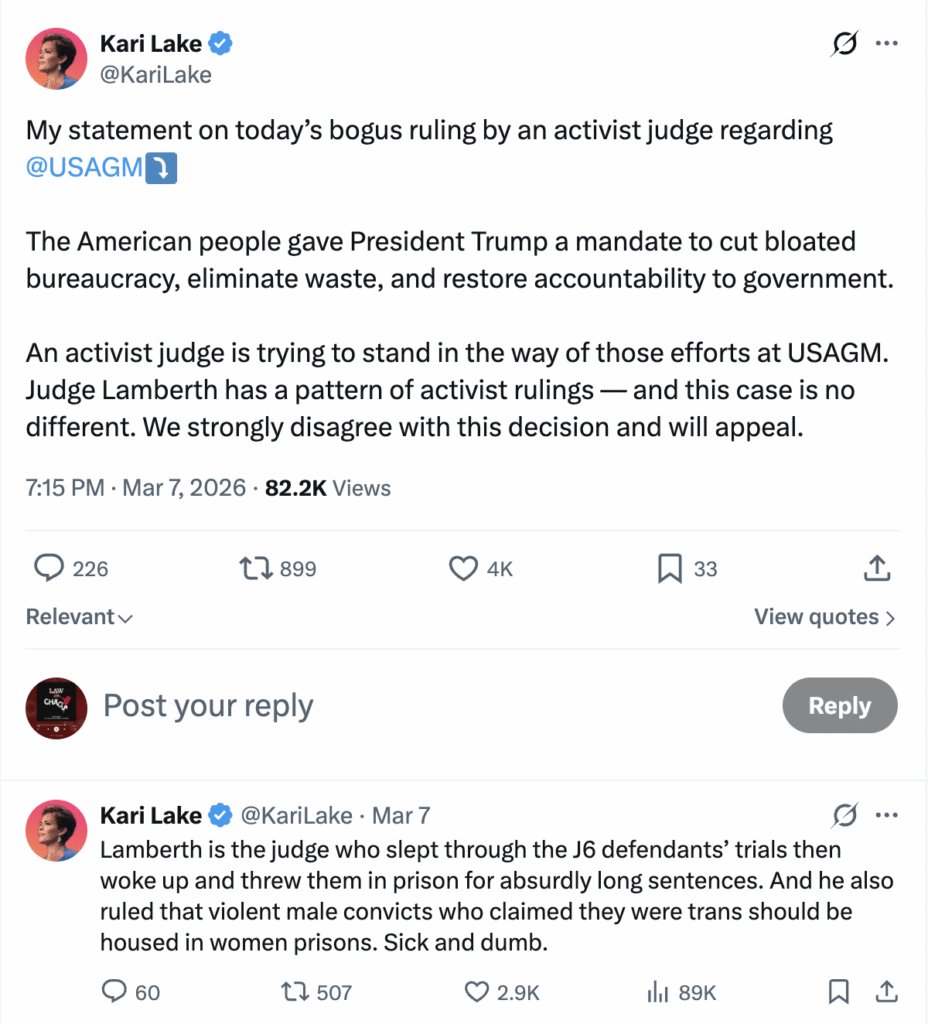
Arizona’s
perennial
loser
Kari
Lake
pulled
the
plug
last
year
on
most
of
Radio
Farda,
which
previously
broadcast
news
in
Farsi
into
Iran,
along
with
much
of
Voice
of
America,
Radio
Free
Europe/Radio
Liberty,
and
the
multiple
outlets
that
fall
under
the
US
Agency
for
Global
Media
(USAGM).
Lake
has
been
locked
in
a
pitched
battle
with
a
Judge
Royce
Lamberth
in
DC
as
she
desperately
tries
to
prove
herself
to
President
Trump
by
burning
down
the
media
outlets
which
have
been
a
major
source
of
American
soft
power
since
World
War
II.
But
instead
the
court
ruled
that
installing
her
as
“Deputy
CEO”
of
USAGM
was
an
illegal
end-run
around
Senate
confirmation,
and
everything
she
did
was
a
nullity.
Fake
it
‘til
you
make
it
As
president-elect,
Trump
promised
to
appoint
Lake
director
of
VOA,
“to
ensure
that
the
American
values
of
Freedom
and
Liberty
are
broadcast
around
the
World
FAIRLY
and
ACCURATELY,
unlike
the
lies
spread
by
the
Fake
News
Media.”
And
maybe
at
the
time
he
really
meant
it!
But
once
in
office,
Trump
fired
most
of
the
International
Broadcasting
Advisory
Board,
which
must
approve
the
director
of
VOA.
Without
a
quorum,
no
one
could
vote
in
Lake
as
the
agency
director.
So
instead
she
was
named
“Deputy
CEO”
of
USAGM.
At
the
same
time,
longtime
USAGM
advisor
Victor
Morales
was
elevated
to
Acting
CEO,
whereupon
he
immediately
executed
a
memo
devolving
most
of
his
authority
to
Lake.
But
those
were
the
DOGE
days,
when
whole
federal
agencies
were
disappearing
overnight,
and
by
then
the
president
had
decided
what
he
really
wanted
was
get
rid
of
USAGM
entirely.
On
March
14,
2025,
Trump
signed
an
executive
order
targeting
various
“unnecessary”
agencies
as
the
Minority
Business
Development
Agency,
the
Institute
of
Museum
and
Library
Services,
the
United
States
Interagency
Council
on
Homelessness,
and
of
course
USAGM
for
destruction.
Each
of
these
was
established
by
Congress
and
fully
funded
in
the
budget,
and
yet
the
president
ordered
them
“eliminated
to
the
maximum
extent
consistent
with
applicable
law,
and
such
entities
shall
reduce
the
performance
of
their
statutory
functions
and
associated
personnel
to
the
minimum
presence
and
function
required
by
law.”
With
her
borrowed
powers,
Lake
set
about
canceling
contracts,
shutting
down
broadcast
servers,
firing
employees,
and
terminating
leases.
She
called
USAGM
“a
rotten
piece
of
fish”
and
vowed
to
end
it
down
forever,
perhaps
replacing
it
with
feeds
from
conservative
outlets
like
One
America
News.
The
fired
journalists
sued,
and
Judge
Royce
Lamberth,
a
conservative
“old
bull”
blocked
Lake
from
terminating
most
employees
and
shutting
down
the
agency
entirely.
But
she
did
succeed
in
ending
many
of
the
foreign-language
broadcasts
which
spread
American
values
and
provided
real
news
to
citizens
living
in
nations
without
a
free
press.
On
July
31,
Lake
took
over
as
Acting
CEO
of
USAGM.
By
law,
USAGM’s
head
is
a
principal
officer
who
must
be
confirmed
by
the
Senate.
And
if
Trump
had
bothered
to
nominate
her,
the
same
supine
Congress
that
confirmed
Pete
Hegseth,
Kristi
Noem,
and
Robert
Kennedy
would
almost
certainly
have
held
its
nose
and
waved
her
along.
Instead,
Lake
claimed
authority
under
the
Federal
Vacancies
Reform
Act
(5
USC
§
3345),
which
automatically
authorizes
the
first
assistant
to
a
Senate-confirmed
official
to
take
over
if
the
position
becomes
vacant.
Déjà
vu
all
over
again
If
this
sounds
familiar,
it’s
because
it’s
exactly
what
Trump
did
when
he
couldn’t
get
his
preferred
candidates
confirmed
as
US
Attorneys
in
blue
states
thanks
to
the
Senate’s
blue
slip
rule.
Attorney
General
Pam
Bondi
purported
to
elevate
unconfirmable
cronies
like
Alina
Habba
in
New
Jersey
and
Bill
Essayli
in
Los
Angeles
by
making
them
their
own
first
assistants
and
then
replacing
themselves
by
action
of
the
FVRA
when
their
interim
appointments
timed
out.
As
a
backstop,
Bondi
appointed
the
cronies
as
special
counsels,
purporting
to
delegate
all
the
authority
of
the
US
Attorney’s
office
to
them.
The
USAGM
litigation
is
also
a
callback
to
the
first
Trump
administration,
when
he
tried
to
illegally
install
Ken
“Cooch”
Cuccinelli
as
acting
Director
of
United
States
Citizenship
and
Immigration
Services
(USCIS).
As
Virginia’s
attorney
general,
Cuccinelli
tried
to
ban
dildos
(for
real),
which
failed
to
lead
him
to
victory
in
the
2013
gubernatorial
race.
Cooch
went
on
to
lead
the
Senate
Conservatives
Fund,
dedicated
to
primarying
sitting
Republican
Senators
from
the
right.
This
did
not
endear
him
to
those
sitting
Republican
Senators,
who
made
clear
that
Trump’s
plan
to
get
Cuccinelli
confirmed
as
head
of
DHS
(or
literally
anything
else)
was
DOA.
So
Trump
came
up
with
another
plan,
inventing
a
new
position
called
the
Principal
Deputy
Director
and
effectively
inserting
Cuccinelli
into
the
line
of
succession
at
USCIS
via
the
FVRA.
In
2020,
Judge
Randolph
Moss
held
that
“Defendants’
construction
of
the
vacant-office
provision
is
at
odds
with
the
statutory
purpose
of
the
FVRA”
and
voided
several
of
Cuccinelli’s
directives
because
he’d
never
been
the
legitimate
head
of
USCIS.
And
in
2025,
the
Third
Circuit
and
six
trial
judges
across
the
country
similarly
agreed
that
Bondi
couldn’t
use
the
FVRA
to
evade
the
Constitutional
and
statutory
requirement
of
Senate
confirmation.
This
weekend,
Judge
Royce
Lamberth
drew
on
both
those
rulings
to
find
that
Lake
had
never
been
lawfully
appointed
as
Acting
CEO
of
USAGM.
Section
3345(a)(1)
automatically
elevates
the
first
assistant,
but
only
if
that
assistant
is
serving
at
the
moment
when
the
Senate-confirmed
officer
leaves.
USAGM
CEO
Amanda
Bennett
resigned
at
Trump’s
inauguration
on
January
20,
2025,
and
Lake
didn’t
join
the
agency
until
March.
Sections
3345(a)(2)
and
(a)(3)
allow
the
president
to
appoint
someone
with
relevant
agency
experience
or
an
official
who
has
been
Senate-confirmed
to
a
different
position
to
temporarily
lead
an
agency.
But
since
the
president
never
officially
tapped
Lake,
that’s
not
going
to
help
her
either.
As
a
third
fallback
position,
the
DOJ
argued
that
Lake
was
acting
under
a
lawful
delegation
of
authority
from
Morales,
pursuant
to
22
USC
§
1435.
But,
as
Judge
Lamberth
pointed
out,
that
statute
only
refers
to
a
delegation
by
the
Secretary
of
State.
“Although
the
Court
assumes
that
this
citation
was
not
purposely
misleading,
Lake
does
not
acknowledge
the
gap
between
her
characterization
of
§
1435
and
its
plain
text,
let
alone
suggest
why
the
Court
should
infer
that
when
Congress
explicitly
referred
to
the
Secretary
of
State,
it
in
fact
meant
to
include
the
CEO
of
USAGM,”
he
sniffed.
Benchslap
Judge
Lamberth’s
apparent
fury
may
have
something
to
do
with
the
rushed
posture
of
his
ruling.
On
February
26,
2026,
the
plaintiffs
informed
the
court
that
Lake
had
just
fired
off
a
tweet
inviting
USAGM
employees
to
check
their
emails
to
find
out
about
“our
continued
efforts
to
modernize
and
right
size
@USAGM.”
The
email
offered
USAGM
employees
a
chance
to
voluntarily
quit
by
March
9
and
earn
six
months’
severance.
If
they
stuck
around,
they’d
be
fired
as
soon
as
the
agency
could
get
out
from
under
Judge
Lamberth’s
order.
The
plaintiffs
raced
back
to
Judge
Lamberth
and
requested
that
the
court
rule
on
their
motion
for
summary
judgment
by
March
9
because
“a
decision
from
this
Court
could
significantly
influence
employee
decisionmaking
by
providing
valuable
information
before
the
deadline
to
respond.”
And
plaintiffs
got
their
wish.
Judge
Lamberth
granted
their
motion
for
summary
judgment
on
this
issue,
holding
that
“any
actions
taken
by
Lake
during
her
asserted
tenure
as
acting
CEO
between
“July
31
and
November
19,
2025,
including
but
not
limited
to
the
August
29
reduction-in-force
effort,
or
actions
taken
pursuant
to
the
March
or
July
delegations
of
CEO
authority,
are
void.”
Lake
responded
with
her
usual
grace
and
aplomb,
calling
one
of
the
longest-tenured
conservatives
in
Washington
an
“activist
judge.”
So
weird
that
Trump
never
got
around
to
nominating
such
a
paragon
of
professionalism
and
stability
for
Senate
confirmation!
Ah,
well,
she
can
always
go
back
to
Arizona
and
run
for
office
another
dozen
times.
At
last,
a
new
legal
tech
product
offering
that
doesn’t
mention
artificial
intelligence.
At
all.
Last
month,
8am
announced
its
expansion
of
its
popular 8am™
LawPay
into
what
it
calls
a
more
complete
financial
management
platform.
A
platform
that
just
works.
To
Do
or
Not
To
Do
AI
For
years,
the
world
has
been
divided
between
the
digital
and
analogue,
between
systems
built
on
discrete
binary
information
and
those
grounded
in
the
physical
world.
But
despite
all
the
talk
of
the
power
of
digital,
sometimes
analogue
still
drives
tools.
The
same
now
seems
true
of
GenAI:
the
world
seems
divided
between
things
powered
by
GenAI
and
things
that
aren’t.
And
the
things
that
aren’t
don’t
get
much
attention.
But
the
unheralded
things
that
aren’t
GenAI
can
still
be
critical
to
getting
what
lawyers
want
and
need
to
get
done.
All
the
GenAI
add-ons
in
the
world
aren’t
going
to
make
good
coffee
if
the
coffee
maker
isn’t
a
good
one.
The
same
thing
is
true
in
legal
tech:
there
are
some
tools
that
do
certain
jobs
better
without
being
trumpeted
as
a
GenAI
tool.
It’s
that
underlying
non-AI
tool
that
needs
to
work
well.
8am
What’s
this
have
to
do
with
8am
and
LawPay?
First
of
all,
8am
is
a
company
focused
on
the
business
end
of
law.
It
provides
billing,
accounting,
time
tracking,
and
collection-type
tools
that
get
to
a
key
need:
getting
paid.
Maybe
not
the
sexiest
part
of
legal
tech
but
certainly
one
of
the
most
important.
As
the
press
release
announcing
the
expansion
of
its
LawPay
tool
puts
it:
“8am
research
shows
that
fee
collection,
expense
collection,
and
expense
tracking
are
legal
professionals’
greatest
financial
and
operational
challenges.”
According
to
Leslie
Witt,
8am
Chief
Product
Officer,
“We
work
closely
with
firms
to
understand
how
they
actually
operate,
where
time
is
lost,
where
revenue
slips
through
cracks,
and
where
processes
break
down.”
Smart
Spend
One
of
the
key
and
most
interesting
components
of
this
unified
platform
is
something
called
8am™
Smart
Spend
for
LawPay,
about
which
I
have
written
before.
Smart
Spend
takes
the
pain
in
the
ass
process
of
turning
in
receipts
and
reports
for
reimbursement
into
an
automated
system
that
does
it
for
you.
You
use
the
credit
card
provided
by
8am
for
your
expenses
and
the
platform
automatically
records
and
links
the
expense
details
and
receipts
to
a
client
invoice.
Doesn’t
sound
all
that
cool,
right?
But
I
can
tell
you
from
experience
what
a
pain
it
is
to
try
to
turn
in
these
kinds
of
expenses
on
a
timely
basis.
You
rush
to
get
to
an
out-of-town
deposition,
choke
down
a
meal,
spend
the
night
in
some
forgotten
motel,
and
when
the
depo
ends
the
next
day,
rush
to
catch
a
plane.
When
you
get
back
to
the
office,
you
face
a
mountain
of
work
and
deadlines.
You
throw
the
receipts
in
a
pile
on
your
desk
and
then
sometime
later
get
around
to
turning
them
in,
often
losing
one
or
two
receipts
in
the
process.
It’s
a
pain
for
you
and
a
pain
for
the
firm.
8am
saw
the
problem
and
figured
out
a
solution.
That’s
what
good
legal
tech
vendors
ought
to
do.
And
not
being
content
with
just
eliminating
a
pain
point,
last
month
it
announced
a
major
enhancement
to
the
platform.
8am
says
this
enhancement
will
enable
such
things
as
centralized
billing
and
payments.
It
will
create
and
send
invoices,
receive
payments,
and
track
deposits
from
a
single
workspace.
It
will
also
enable
time
and
expense
tracking
that
captures
billable
hours
and
costs
as
they
occur
and
matter-specific
trust
accounting
that
allocates
and
monitors
client
trust
funds
across
matters
for
IOLTA
compliance. Finally
the
platform
will
now
allow
for
real-time
reporting
and
dashboards
to
view
cash
flow,
deposits,
and
trust
balances
instantly.
OK,
So
What?
The
remarkable
thing
about
the
announcement
and
the
press
release
were
two
words
that
did
not
appear:
Artificial
Intelligence.
That’s
right,
not
one
mention.
Not
one
sentence
heralding
the
exhaustive
implementation
of
AI
into
an
existing
and
good
platform.
Not
one
reference
to
AI
specialists
working
long
and
hard
to
develop
a
special
GenAI
platform
to
do
the
work
that
no
other
company
could
offer.
Instead,
the
refreshing
and
non-hyperbolic
press
release
does
what
8am
often
does:
introduce
a
product
by
talking
about
the
problem
it
solves,
a
problem
that
8am
perceptively
saw.
Like
Clearbrief,
which
came
up
with
a
non-GenAI
tool
to
check
case
citations
about
which
we
previously
wrote,
the
headline
is
not
what
Smart
Spend
does,
although
that’s
important,
it’s
that
8am
adopted
a
process
and
attacked
a
problem
in
a
practical
way
that
actually
helps
lawyers
and
legal
professionals.
It’s
the
old,
let’s
find
a
solution
to
a
problem
instead
of
finding
a
problem
for
an
AI
solution.
A
way
of
thinking
we
don’t
see
a
lot
of
these
days.
Witt
puts
it
this
way:
“There’s
a
lot
of
noise
and
excitement
around
the
[AI]
technology,
and
rightfully
so,
but
our
[customers]
trust
us
to
be
selective
and
intentional
about
where
–
and
how
–
it’s
applied
in
their
workflows…There’s
a
lot
of
noise
and
excitement
around
the
technology,
and
rightfully
so,
but
they
trust
us
to
be
selective
and
intentional
about
where
–
and
how
–
it’s
applied
in
their
workflows.”
I’ll
be
honest:
I
can’t
vouch
for
how
well
Smart
Spend
works
or
if
it
does
what
8am
says
it
will
(although
I
have
found
the
8am
folks
to
be
pretty
credible).
But
it
says
a
lot
these
days
and
times
when
a
company
markets
a
product
without
hyping
that
it’s
all
about
a
new
AI
application.
All
too
often
I
see
vendors
make
some
big
announcement
about
a
new
AI
tool
that
isn’t
all
that
new,
really
doesn’t
do
much
of
anything
different,
and
does
something
that
doesn’t
need
to
be
done.
8am
didn’t
do
that.
It
just
said
what
the
product
does.
And
here’s
why
it
helps
you
practice
law.
No
AI
hype.
No
AI
slop.
Just
good
old
thinking
about
a
problem
before
a
solution.
Stephen
Embry
is
a
lawyer,
speaker,
blogger,
and
writer.
He
publishes TechLaw
Crossroads,
a
blog
devoted
to
the
examination
of
the
tension
between
technology,
the
law,
and
the
practice
of
law.
Ed.
note:
Please
welcome
Renee
Knake
Jefferson
back
to
the
pages
of
Above
the
Law.
Subscribe
to
her
Substack,
Legal
Ethics
Roundup,here.
Welcome
to
what
captivates,
haunts,
inspires,
and
surprises
me
every
week
in
the
world
of
legal
ethics.
Happy
Monday!
Hello
from
Praha.
My
son’s
spring
break
was
last
week,
so
as
I
write
this
we
are
wrapping
up
travels
through
Czechia
and
Germany.
I
love
a
good
library,
so
a
highlight
was
touring
the
Klementinum,
which
houses
the
National
Library
of
the
Czech
Republic.
Here’s
a
peek
inside.
Klementinum
Baroque
Library,
Old
Town
Prague
(photo
by
Renee
Jefferson)
It
was
a
big
week
for
legal
ethics
news.
We
suffered
whiplash
as
the
administration
went
from
dropping
the
pursuit
of
its
Executive
Orders
against
law
firms
to
doubling-down
on
them
24
hours
later.
And
that
wasn’t
the
only
whiplash-reversal.
Check
out
the
headline
below
from
the
Florida
Bar
for
more
on
that.
Meanwhile
a
serious
threat
to
states’
rights
looms
with
the
Justice
Department
directing
bar
authorities
on
how
to
handle
discipline
of
its
lawyers.
I
also
spoke
with National
Law
Journal reporter Avalon
Zoppo who
has
analyzed
interesting
data
about
the
number
and
categories
of
judicial
complaints
over
the
past
15
years.
You
can
read
more
about
her
study
along
with
the
other
top
ten
headlines.
Highlights
from
Last
Week
–
Top
Ten
Headlines
#1
“What
Was
Behind
a
Spike
in
Judicial
Misconduct
Complaints
Last
Year?” From The
National
Law
Journal: “The
number
of
judicial
misconduct
complaints
filed
against
federal
judges
spiked
last
year,
according
to
the
most
recent
statistics
released
by
the Administrative
Office
of
the
U.S.
Courts.
A
little
over
1,850
ethics
complaints
were
commenced
against
judges
during
the
12-month
period
that
ended
Sept.
30,
an
almost
23%
increase
compared
to
the
same
period
a
year
prior
and
higher
than
recent
years.
Court
watchers
said
it’s
difficult
to
pin
down
what
could
be
behind
the
increase,
but
one
driver
could
be
a
ramping
up
of
public
officials’
criticism
of
judges
and
the
courts.
… University
of
Houston
Law
CenterprofessorRenee
Knake
Jefferson said
the
public
may
be
more
aware
about
the
process
for
raising
concerns
about
judges
compared
to
20
years
ago,
leading
to
more
complaints.
‘The
reason
why
I
think
there’s
a
heightened
awareness
by
the
public
is
because
we
saw
challenges
to
judges,
both
in
the
context
of
election-related
disputes,
but
also
because
we
have
a
president
who
has
called
out
judges
and
raised
concerns
about
the
judges
when
he’s
unhappy
with
the
substantive
outcome
of
a
matter,’
said
Knake
Jefferson,
who
studies
judicial
and
lawyer
ethics.”
Read
more here.
#2
“Trump
Administration,
in
Reversal,
Tries
to
Continue
Fight
Against
Law
Firms.” From The
New
York
Times: “The
administration
told
a
court
on
Monday
that
it
was
abandoning
its
defense
of
executive
orders
targeting
the
firms.
But
on
Tuesday,
the
Justice
Department
abruptly
changed
its
position.”
Read
more here.
#3
“Florida
Bar
Reverses
Itself,
Says
It
Is
Not
Investigating
Lindsey
Halligan.” From The
Washington
Post: “A
spokesperson
said
the
bar’s
counsel
‘erroneously’
stated
there
was
a
‘pending
investigation’;
instead,
a
complaint
against
Halligan
remains
at
a
preliminary
stage.”
Read
more here (gift
link).
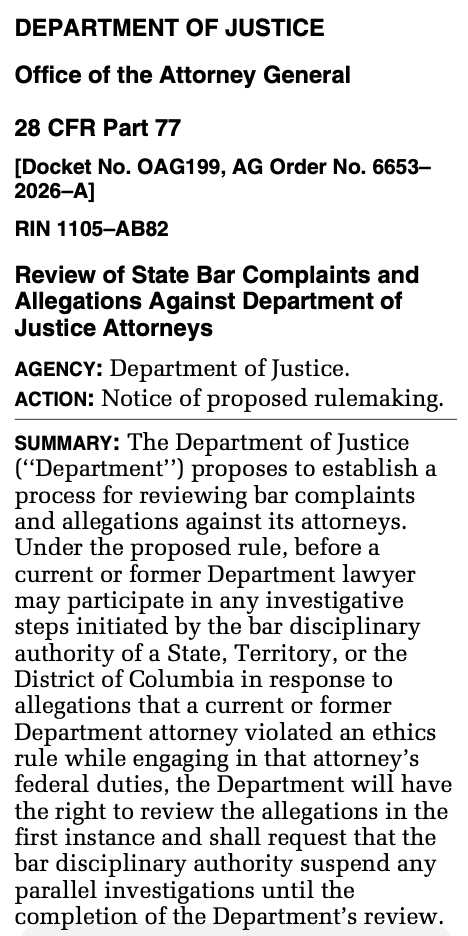
#3
“Trump
Justice
Dept.
Seeks
to
Stall
State
Bar
Discipline
of
Its
Lawyers.” From The
New
York
Times: “The
administration
has
no
control
over
the
disciplinary
authorities
of
state
bar
associations,
but
a
new
proposal
would
let
the
attorney
general
ask
them
to
suspend
proceedings
involving
department
lawyers.”
Read
more here (gift
link).
View
the
full
proposal
in
the
Federal
Register here.
#5
“The
Cathedral
of
Justice
is
Crumbling.” From
former Attorney
General
Alberto
Gonzalez at Checks
&
Balances: “As
Attorney
General
during
the George
W.
Bush administration,
I
witnessed
the
countless
efforts
of
department
lawyers
and
employees
to
protect
the
rule
of
law
and
maintain
the
cathedral
of
justice.
…
Today
it
appears
to
many
former
DOJ
employees
and
officials
that
the
cathedral
of
justice
is
being
dismantled
stone
by
stone.
Prosecutors
appear
to
no
longer
enjoy
prosecutorial
independence.
Prosecutions
at
the
federal
district
level
against
perceived
political
or
personal enemies of
the
administration’s
leadership
are,
in
many
cases,
now
directed
by
senior
leaders
at
the
Department
or
by
subordinates
at
the
White
House.
Further,
we
see
the
entire
legal
profession
weakened
by attacks on
law
firms.
Politically
motivated
criticism
of
our
judges,
as
well
as threats to
their
families,
threaten
to
undermine
the
independence
of
the
courts.
Recently,
it
was reported that
leaders
in
the
various
93
US
offices
were
told
to
provide
DOJ
headquarters
with
examples
of
perceived
judicial
activism
that
would
serve
as
the
basis
for
referral
to
the
House
of
Representatives
for
possible
impeachment
proceedings.
There
are
growing
complaints
about
executive
branch
defiance
of
court
orders.
Some
prosecutions
now
appear
to
be
motivated
not
by
justice—but
by
politics,
intimidation,
or
retribution.
Recent
prosecutions
of
perceived
political
enemies
of
the
current
administration—including
former FBI
Director
James
Comey, New
York
Attorney
General
Letitia
James,
and
six
members
of
Congress,
including Sen.
Mark
Kelly—have
all failed to
an
embarrassing
level.”
Read
more here.
#6
“California
Ban
on
Fee
Sharing
Prompts
Firm
to
Ditch
Owners.” From Bloomberg
Law: “A
new
California
law
has
already
forced
one
out-of-state
law
firm
to
change
its
ownership
structure.
Eleos
LLP,
an
Arizona
firm
affiliated
with
California’s
Wisner
Baum,
removed
non-lawyers
from
its
ownership
in
order
to
comply
with
the
law,
partners
at
Wisner
Baum
said
in
interviews.
The
law bans firms
in
California
from
sharing
contingency
fees
with
other
firms
that
are
owned
by
non-lawyers.
The
move
is
an
early
example
of
the
law’s
impact
since
taking
effect
in
January
on
firms
operating
under
relaxed
ownership
rules
in
Arizona
and
a
handful
of
other
jurisdictions.”
Read
more here.
#7
“UK
Law
Sector’s
Private
Equity
Boom
Offers
Lessons
For
US.” From Law360: “Private
equity
money
is
pouring
into
the
UK
legal
sector,
fueling
a
wave
of
consolidation
in
consumer-facing
practices
and
offering
a
glimpse
of
what
it
could
look
like
if
outside
investment
in
the
US
legal
industry
takes
off.”
Read
more here.
#8
“Social
Media
Threats
are
Disrupting
Rule
of
Law
for
Judges.” From Judge
Derwin
L.
Webb in
the The
Courier-Journal: “As
chief
judge
of
family
court,
I
do
not
ask
to
be
shielded
from
criticism.
I
ask
only
that
criticism
remain
within
the
bounds
of
law
and
civility.”
Read
more here.
#9
“DOJ
Attorney
Used
Fabricated
Quotes
in
Court
Filing.” From Bloomberg
Law: “An
assistant
US
attorney
in
North
Carolina
filed
a
response
with
the
court
that
included
‘fabricated
quotations
and
misstatements
of
case
holdings’
and
then
made
‘false
or
misleading
statements’
of
how
they
got
included,
a
magistrate
judge
said.
‘Because
of
the
seriousness
of
these
issues,’
senior
leaders
from
the
US
Attorney’s
Office
for
the
Eastern
District
of
North
Carolina
must
appear
at
a
show
cause
hearing
next
week
for
why
the
civil
litigator
responsible
shouldn’t
be
sanctioned
and
why
the
entire
office
shouldn’t
be
held
jointly
responsible, US
Magistrate
Judge
Robert
Numbers said
in
a
March
2 order.”
Read
more here.
#10
“11
Law
School
Deans
Oppose
Proposal
to
Speed
Up
Approval
Process
for
Accreditation
Changes.” From
the ABA
Journal: “Deans
at
11
law
schools
have
argued
the
council
for
the
ABA
Section
of
Legal
Education
and
Admissions
to
the
Bar
should
not
approve
a
proposal
that
would
speed
up
the
process
of
revising
or
creating
new
accreditation
standards.
Currently,
as
specified
by
Rule
55,
the
ABA
is
allowed
to
weigh
in
on
proposed
revisions
to
standards
twice
before
the
council
determines
the
specifics
of
the
change.
The
proposed
changes
would
give
the
ABA
only
one
chance
to
provide
its
input.
But
the
Feb.
20 memo addressed
to
council
chair Daniel
Thies and
signed
by
deans
including Angela
Onwuachi-Willig at
Boston
University
School
of
Law, Paul
Litton at
the
University
of
Missouri
School
of
Law
and Marcilynn
A.
Burke at
Tulane
Law
School,
stated
‘we
believe
that
the
council
should
prioritize
adopting
the
best
possible
standards,
interpretations
and
rules
over
reducing
the
time
it
may
take
to
implement
a
change.’”
Read
more here.
[Full
disclosure:
I
am
a
member
of
the
Accreditation
Council
for
the
ABA
Section
of
Legal
Education
and
Admission
to
the
Bar.]
Get
Hired
Did
you
miss
the
450+
job
postings
from
previous
weeks?
Find
them
all here.
Upcoming
Ethics
Events
&
Other
Announcements
️
Did
you
miss
an
announcement
from
previous
weeks?
Find
them
all here.
Keep
in
Touch
News
tips?
Announcements?
Events?A
job
to
post?Reading
recommendations? Email
[email protected]
–
but
be
sure
to
subscribe
first,
otherwise
the
email
won’t
be
delivered.
Do
you
have
colleagues
who
care
about
legal
ethics? Please
share
the
Roundup
with
them.
I’d
love
to
see
our
community
continue
to
grow!
Renee
Knake
Jefferson
holds
the
endowed
Doherty
Chair
in
Legal
Ethics
and
is
a
Professor
of
Law
at
the
University
of
Houston.
Check
out
more
of
her
writing
at
the Legal
Ethics
Roundup.
Find
her
on
X
(formerly
Twitter)
at @reneeknake or
Bluesky
at legalethics.bsky.social.
WASHINGTON
—
The
official
designation
of
Anthropic
as
a
“supply
chain
risk,”
delivered
to
the
company
Wednesday,
imposed
much
milder
penalties
on
the
AI
giant
than
Defense
Secretary
Pete
Hegseth
originally
threatened,
Anthropic
CEO
Dario
Amodei
said
Thursday
on
the
company’s
website.
After
Anthropic’s
refusal
to
accept
new
contract
language
allowing
“all
lawful
use”
of
its
Claude
chatbot
by
the
military,
Hegseth
declared
on
Feb.
27
that
“no
contractor,
supplier,
or
partner
that
does
business
with
the
United
States
military
may
conduct
any
commercial
activity
with
Anthropic.”
That
same
day,
President
Donald
Trump
declared
that
all
federal
agencies,
not
just
the
Defense
Department,
would
“IMMEDIATELY
CEASE
all
use
of
Anthropic’s
technology,”
albeit
over
“a
Six
Month
phase
out
period.”
The
actual
terms
of
the
March
4
designation,
however,
were
much
narrower,
Amodei
said
Thursday.
“The
vast
majority
of
our
customers
are
unaffected
by
a
supply
chain
risk
designation,”
he
wrote.
“It
plainly
applies
only
to
the
use
of
Claude
by
customers
as
a
direct
part
of
contracts
with
the
Department
of
War,
not
all
use
of
Claude
by
customers
who
have
such
contracts.”
Microsoft,
which
uses
Anthropic’s
Claude
in
its
software
suite,
concurred
in
statements
to
several
news
outlets.
“Our
lawyers
have
studied
the
designation
and
have
concluded
that
Anthropic
products,
including
Claude,
can
remain
available
to
our
customers
—
other
than
the
Department
of
War
—
through
platforms
such
as
M365,
GitHub,
and
Microsoft’s
AI
Foundry
and
that
we
can
continue
to
work
with
Anthropic
on
non-defense
related
projects,”
a
company
spokesperson
told
CNBC.
Despite
the
ban
being
less
harsh
than
feared,
Amodei
said
he
still
intends
to
sue
the
government
to
overturn
the
designation.
“We
do
not
believe
this
action
is
legally
sound,
and
we
see
no
choice
but
to
challenge
it
in
court.”
At
the
same
time,
he
struck
a
conciliatory,
even
apologetic
tone
in
public
statements.
“I
want
to
completely
apologize,”
he
told
The
Economist,
for
harsh
denunciations
of
the
Pentagon
and
rival
OpenAI
he
sent
Anthropic
employees
that
then
were
leaked
to
the
press.
He
added
that
“we
had
been
having
productive
conversations
with
the
Department
of
War
over
the
last
several
days.”
In
response,
Pentagon
CTO
Emil
Michael,
the
Undersecretary
for
Research
and
Engineering,
shared
in
an
X
post
Thursday
that
“there
is
no
active
@DeptofWar
negotiation
with
@AnthropicAI.”
previously
told
reporters
it
was
“undemocratic”
for
the
company
to
“dictate”
restrictions
on
the
military’s
use
of
AI
that
went
beyond
the
laws
Congress
had
passed.
Michael,
Hegseth,
Pentagon
spokesman
Sean
Parnell
and
other
Pentagon
officials
have
publicly
denounced
Anthropic
for
insisting
on
limitations
beyond
those
already
in
law
and
regulation
on
the
use
of
AI
for
mass
surveillance
and
autonomous
weapons.
What
Now?
With
such
mixed
signals
coming
from
both
sides,
experts
who
spoke
to
Breaking
Defense
struggled
to
predict
what
would
happen
next.
But
two
of
the
three
doubted
that
the
supply
chain
risk
designation
would
stand
up
in
court.
Hegseth’s
initial
threat
last
week
was
simply
more
than
the
law
allows,
said
Paul
Scharre,
a
former
Army
ranger
who’s
now
executive
vice
president
of
the
Center
for
a
New
American
Security.
“What
Hegseth
said
on
Friday
[Feb.
27]
is
just
not
what
the
supply
chain
risk
designation
means,”
Scharre
told
Breaking
Defense.
“It
means
no
one
can
use
Anthropic
tools
when
executing
a
DoD
contract.”
But
even
the
narrower
ban
actually
imposed
on
Anthropic
in
this
week’s
official
letter
would
probably
not
hold
up
in
court,
he
went
on:
The
law
was
written
to
keep
foreign
companies
from
sabotaging
the
military
supply
chain,
not
to
punish
American
companies
for
not
doing
business
on
the
Pentagon’s
terms.
“I
fully
expect
Dario
to
take
legal
action,”
agreed
Jack
Shanahan,
an
who
previously
led
the
military’s
AI-powered
Project
Maven
and
then
the
Pentagon’s
Joint
AI
Center,
told
Breaking
Defense,
“He
has
way
too
much
at
stake
to
be
booted
out
of
every
government
contract.
There
are
billions
of
dollars
at
stake
here.
“The
early
expert
consensus
is
that
the
most
draconian
punishment
—
supply
chain
risk
—
won’t
hold
up
in
court,”
he
added. But
too
much
damage
has
already
been
done
to
the
often-rocky
relationship
between
the
Pentagon
and
Silicon
Valley,
Shanahan
lamented,
undoing
a
decade
of
bridge-building.
“This
supply
chain
risk
designation
will
go
down
in
history
as
a
real
technology
low
point
of
this
administration,”
Shanahan
said.
“You
cannot,
for
a
second,
claim
you
want
to
‘dominate
globally
in
AI’
while
simultaneously
burying
a
shiv
in
the
heart
of
one
of
the
biggest
and
most
important
AI
companies
in
the
world.
Xi
Jinping
is
thrilled.”
Shanahan’s
successor
at
the
Joint
AI
Center,
however,
had
a
more
optimistic
take.
“I
think
that
there’s
a
rapprochement
here
that
is
in
the
making,”
said
Michael
Groen,
now
working
as
Even
if
Anthropic
can’t
come
to
terms
with
the
Pentagon,
“at
the
end
of
the
day,
there
will
be
plenty
of
AI
capabilities
and
companies
that
want
to
work
with
Defense,
that
want
to
make
sure
that
we
have
the
best
capability,
that
share
the
values
of
responsible
technology
and
responsible
warfighting,”
Groen
told
Breaking
Defense,
pointing
to
the
military’s
long
tradition
of
regulating
its
own
use
of
technology,
including
AI.
“We
can
do
this,”
Groen
said.
“It’s
natural
that
we
have
some
of
these
dust-ups,
[but]
it’s
shameful
if
our
technology
leaders
and
our
military
leaders
can’t
come
to
a
place
that
supports
our
young
warfighters
—
and
also
does
it
morally
and
ethically.”
*
After
about-face
on
withdrawing
lawsuits
against
law
firms,
Justice
Department
uncorks
almost
100
pages
of
vitriol
against
federal
judges
for
ruling
against
the
administration
generally.
[NY
Times]
*
Book
publishers
sue
what
they’re
calling
a
shadow
library
that
provided
materials
for
AI
training.
[Law360]
*
John
Quinn
tells
the
Brits
that
American
lawyers
work
harder.
Which
may
be
true,
but
you
don’t
rub
that
in!
[The
Times]
*
Profiling
the
judge
who
ordered
the
administration
to
start
issuing
tariff
refunds.
[New
York
Law
Journal]
*
The
administration
is
pushing
the
Supreme
Court
to
weaken
the
federal
judiciary.
And
so
far
the
Court
seems
on
board.
[Reuters]
*
Court
strikes
down…
basically
everything
about
how
Voice
of
America
has
been
run.
[NPR]
I am just back to Harare from a couple of months in Cape Town where Tapiwa Chatikobo and I have been writing up our project, Zimbabwe’s land reform after 25 years, getting to grips with overwhelming mountains of data. More on that in forthcoming blogs. I took a lot of Uber rides while there and virtually all drivers (bar two Malawians) were Zimbabweans.
Given Cape Town’s traffic these days, some of these journeys were quite long and inevitably conversations turned to Zimbabwe, people’s lives, their plans for the future and so on. Yes, the researcher never stops! It is a completely unrepresentative sample and based on discussions of varying lengths, but some themes emerged. Given that there are so many migrants in South Africa at any one time, these are important to reflect on.
All my Uber informants were highly educated and very articulate. They were all men ranging from their mid-20s to mid-40s. A number had taken up Uber driving as they had been fired from truck driving jobs due to businesses responding to pressure from the All Truck Drivers Association to stop hiring immigrants. Conversations ranged across many themes, from geopolitics to rural development, and all were nuanced and well informed. Nearly all had completed Form IV and many had sixth form and degree qualifications. Zimbabwe exports some serious talent, but fortunately this is mostly temporary.
All who I spoke to intended to go back home, sooner rather than later if at all possible. Circular migration is still an important feature of the regional economy, and the work relationships between South Africa and Zimbabwe remain strong as they have for a century or more. Money raised in South Africa is remitted home, and there are many projects on-going, as well as money being sent to parents and other relatives. The statistics on large numbers of Zimbabweans in South Africa are no doubt correct, but few migrants are permanent. For most, this is migration for a purpose, and mostly this is investment at home, very often in rural areas, with the intention of returning home. That said, at least one driver explained that he was ‘stuck’, unable to return home, without enough surplus to invest and few connections at home having left in 2008, and with parents no longer alive and siblings scattered. This he said was down to mistakes he made when he was younger, but now with a family, he saw no chance of leaving.
Many Uber drivers in Cape Town farm in Zimbabwe. I was shown prized fields and crops in photos, and many are building homes in rural areas as well as in towns. In most cases, rural origins were communal areas, but there were a few from resettlements and one from a ‘purchase area’. All had plans for rural life on return, even if living in town some of the time. Rural investment, particularly in irrigation, was central to many conversations. One driver was in business with a relative funding the purchase of gold hammer mills, which he bought in South Africa and transported home. He was making some serious money from the explosion of artisanal gold mining near his home area.
The drivers I spoke to were at different demographic stages. Some were married, some not; some had kids, others were without. Most had partnerships with Zimbabwean women, some of whom were still in Zimbabwe, while others had joined later, also finding jobs as cleaners, housekeepers, shop assistants and so on. Sustaining families in Cape Town is hard, especially for migrants, they explained.
Living in Cape Town meant finding cheap accommodation in safe places. This was a real challenge, my informants observed. Most aimed for lower income former ‘coloured’ or working-class ‘white’ suburbs. Low rise ‘medium-density’ living was the aim. Slotting into the old racialised apartheid divisions in urban areas as a migrant is always challenging, they explained. Muslim neighbourhoods were often preferred as places that were safe but cheaper. Except two, all emphasised that they would not live in the townships. These were dangerous, subject to gang violence and xenophobia. One exception was one determined young man, aged 27 and single, who lived alone in a small room in a notoriously dangerous township. He drove his taxi all day and went home in time and locked himself in until the next day. Not a great life, he agreed, but his mission was to raise money and support his money, and he would leave as soon as he could.
A recurrent theme in discussions of the comparisons between South and Zimbabwe was the incidence of violence. Even in the better suburbs you could hear gunshots at night. Robberies happened regularly on the streets. As an Uber driver you were especially vulnerable, and all had learned where not to pick up or drop off lifts. Everyone talked about how they enjoyed being back home for the peace and freedom from random violence.
Part of such violence was the xenophobia experienced in different ways by everyone. The antagonism of black South Africans in particular was pointed to. They were used to the casual racism of some whites, but the way migrants were being blamed for the ills of South Africa, while they were contributing important work was disappointing, they explained. The regular accounts of Zimbabweans being attacked, chased from schools or refused treatment in hospitals made them feel unwelcome, despite the assurances of the President in his State of the National Address. The anti-immigrant mobilisation around the Operation Dudula movement was particularly worrying, they claimed. South Africa, they reasserted, was a temporary stop, even if the period sometimes stretched to many years.
Another comparison was on school education. Everyone preferred the Zimbabwe education system to public schooling in South Africa (even in its current state, they said). ‘Cambridge exams’ were better than the South African exam system; higher quality and more rigorous, they claimed. Indeed, those with school aged kids either had left their children at home with parents or other relatives to attend school in Zimbabwe, or they paid for private education by Zimbabwean teachers using the Zimbabwean curriculum and exam system in South Africa. Just as in Zimbabwe, there has been an explosion of private schools in areas with high levels of migration, including Cape Town. These are run by former headmasters from Zimbabwe and staffed with former teachers. They make good money and are all full, my informants noted.
Complaints about police corruption and being hassled by authorities was a recurrent theme of discussion, with familiar tales of cars being impounded if the correct permits were not available. Pressure from the parallel taxi system where drivers are mostly South African was blamed. Corruption is of course familiar from Zimbabwe, but navigating it as a migrant, often with incomplete or no immigration papers, is always challenging. Fears of deportation or imprisonment are always present, creating anxiety and stress, they explained.
Over a couple of days, we discussed the South African tourist visiting Zimbabwe who was sending Twitter video updates on his trip, which were going viral. In his posts he was waxing lyrical about the quality of the road from Beitbridge, how supermarkets were well stocked and how South Africans have such a distorted view of Zimbabwe. This struck a chord. Many drivers commented that many customers assumed that they had escaped extreme poverty and hardship and that Zimbabweans had little food and the shops were empty. They found it difficult to explain that they simply were coming to earn money in order to return. Migrating was a choice; not great and hopefully short-lived. Indeed, everyone said that they would much prefer being at home.
And, in the end, as ever with Zimbabweans, conversations turned to politics. Two trips were on the day Nelson Chamisa reappeared. There were two contrasting views. One deemed him a spent force, too biblical, no longer convincing. The other argued that he is the only one who can make a change, and what’s more ‘we had supported him for so long’. The age group is one that has experienced a whole adult life since the emergence of an opposition, and then the disappointment of crushed hopes and electoral loss at the hands of ZANU-PF manipulation. Another trip happened on the day after Blessed Geza, aka Cde Bombsell, died. There was agreement that he was naïve and probably misguided, but I was interested to hear lots of positive commentary about VP Chiwenga, on both the outward and return journey.
So, take all this with a very large pinch of salt. This is more casual impression than solid evidence, but there were some interesting themes that are important for Zimbabwe. Migration is rarely forever. The rural areas and agriculture are the places to invest. Peace and the lack of a gun culture is a big draw. And, as ever, political allegiances are divided.
If you are in South Africa, travel by Uber and do your own research, but tip heavily please. The fares are low and the Uber fees are high, and all drivers not only have to survive in increasingly expensive south Africa, but they need to remit home to support homes, families and farms, so please add the maximum suggested on the App or, if possible, more!




 Kathryn